LE BOCAGE INTERNATIONAL SCHOOL
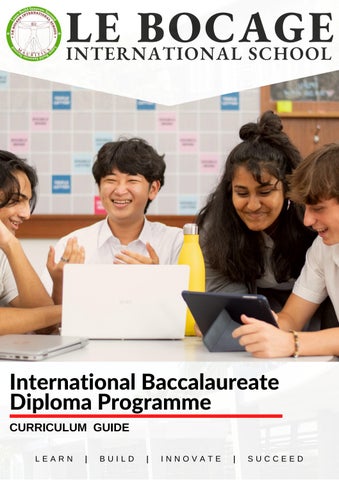
International Baccalaureate Diploma Programme CURRICULUM GUIDE LEARN
|
BUILD
|
INNOVATE
|
SUCCEED
Welcome to the IB
Diploma Programme Yovna Mewasingh, IBDP Coordinator
I am excited to take this journey through the IB Diploma Programme (IBDP) with you. Selecting courses for the IB Diploma is both exciting and daunting. It’s one of your first steps toward planning for life beyond high school. In this curriculum guide, you will learn more about the IB Diploma Programme and the Diploma subjects that are available to you at Le Bocage International School. As you decide upon your SL and HL subjects and make your course selections, you might ask yourself…Will I still enjoy the subjects after studying them for 2 years? How will my selections impact my university decisions? What are the differences between SL and HL courses? How can I balance coursework with my life outside school? As you consider these questions, keep these things in mind: • Consider which subjects you enjoy most; • Challenge yourself; • Keep your post-secondary options open by choosing a diverse range of courses; • Give yourself the flexibility to enjoy experiences and activities outside the classroom; • Seek advice from the DP Coordinator, and from your teachers and parents. Ultimately, it is your decision, but I am eager to help you identify a rewarding path for YOUR IB Diploma Programme! Over the next two years, I will be here to answer your questions about the IBDP, as well as support you academically. I look forward to working with you to achieve your goals. page 01
OUR
Vision
To inspire innovative and holistic leaders for a changing world.
OUR
Mission
LBIS offers a holistic, studentcentred secondary international education developing principled and balanced global citizens who are equipped to collaborate and overcome challenges in a fast changing multicultural world.
Learn
Build
Innovate Succeed page 02
Why choose IBDP? The IB Diploma Programme (DP) is a rigorous, challenging and balanced two-year university- preparation programme for students aged 16 to 19. It aims to support schools by providing outstanding researchbased education, developing both disciplinary and interdisciplinary knowledge and understanding. The DP is a truly international programme developed in consultation and collaboration with educators from around the world It incorporates the best educational practices from different systems while remaining free of influence of any particular one. At its heart, the DP is driven by the IB mission to create a better world through education.
The DP promotes language and literacy, multilingualism, the social sciences, science, mathematics, the arts, interdisciplinary learning, service learning and international-mindedness. It encourages students to be knowledgeable, inquiring, caring and compassionate, and to develop intercultural understanding, openindedness and respect for others’ views.
DP students are prepared for participation in a rapidly evolving and increasingly global society as they develop intellectually, emotionally, physically and ethically, while acquiring the skills that will prepare them for further education and life in the 21st century.
page 03
Understanding the DP at LBIS The IB Diploma Programme (IBDP) consists of both academic courses and a "core", ensuring breadth and depth of knowledge and understanding. All are required to achieve the IB Diploma. The DP promotes language and literacy, multilingualism, the social sciences, science, mathematics, the arts, interdisciplinary learning, service learning and international-mindedness. It encourages students to be knowledgeable, inquiring, caring and compassionate, and to develop intercultural understanding, openindedness and respect for others’ views.
The Six Subjects ● Each student should choose 3 Higher Level (HL) and 3 Standard Level (SL) subjects. ● Students select one course from each subject group (the Arts may be replaced with another subject). ● The same subject cannot be taken at both HL and SL. ● At least two languages are studied. The same language cannot be taken in both Group 1 and Group 2. English must be taken in either Group 1 or 2. ●Bilingual students may take two Language A courses.
page 04
How to choose? All students select their courses with the support of parents, teachers and the IB DP Coordinator. Mock and final IGCSE or MYP results are important indicators of a student’s ability level in each subject, and should be used as a guide when deciding subjects. University intentions, both location and course, should also be considered.
The Assessment Students receive regular feedback on summative tasks and sit mock examinations delivered by teachers in order to gauge progression and identify areas for improvement. Final IB examinations occur in October of Form 7. Most subjects have 2 - 3 exams. Each subject also contains the Internal Assessment (IA) which is spread out through the year.
page 05
DP Core
A compulsory core comprises three distinct components, and is an integral part of the DP student experience. ● Theory Of Knowledge (TOK) is a course on critical thinking that make connections across the academic disciplines and explores the nature of knowledge. ● The Extended Essay (EE) is an in-depth, externally assessed, independent research project into a topic of the student’s choice. Up to 4,000 words in length, it promotes highlevel research and writing skills, intellectual discovery and creativity. ● Creativity, Activity, Service (CAS) involves students in a range of experiential and service learning activities that enhance personal and interpersonal development. CAS encourages engagement in the arts, creative thinking, a healthy lifestyle and a sense of social responsibility.
page 06
University/Career Counseling The Careers Department at Le Bocage International School offers advice on personal development, career choice, and university research and applications. The Careers programme is delivered by the Careers and Guidance Counselor, guest speakers and tutorial teachers. Dedicated tutorial periods allow for the Careers programme to be delivered in Forms 6 and 7.
Form six In Form 6, students meet the Careers Counsellor, mainly as a group, once in a two-week cycle. During the course of the year, students are inducted into how to plan for university and research postsecondary educational opportunities locally and abroad, and when circumstances permit, work experience is built into the programme. The search for scholarships ranks high on the list of application priorities. Students also learn about themselves via online assessments in a bid to find their interests and strengths, which may lead to a career pathway. They become familiar with different university application systems for different countries, as well as the written part of an application (personal statements, college essays). They also begin to compile their CVs.
Form seven Form 7 students continue to meet the Careers Counsellor during tutorials. The focus for their final year is on individual interviews with the Counsellor, and parents if needed, to finalize their study destinations. They also develop the skills for an interview that may be required as part of a university application cycle. Students update their CVs, request references from teachers and finalize written components of the different applications. University application processes begin as early as April in Form 7. Students are also assisted with admissions tests (SATs, LNAT, UKCAT) that may be required by the university. Applications are then sent off to the different universities.
The Careers Department at Le Bocage International School offers advice on personal development, career choice, and university research and applications.
page 07
Subject Overview The following section details a course-by-course guide of all subjects across the six groups currently on offer as part of Le Bocage International School's IB Diploma Programme.
GROUP ONE: LANGUAGE & LITERATURE LANGUAGE A: LITERATURE LANGUAGE A: LANGUAGE & LITERATURE GROUP TWO: LANGUAGE ACQUISITION LANGUAGE B LANGUAGE B: AB INITIO GROUP THREE: INDIVIDUALS & SOCIETIES BUSINESS MANAGEMENT ECONOMICS PSYCHOLOGY GLOBAL POLITICS ENVIRONMENTAL SYSTEMS & SOCIETIES GROUP FOUR: SCIENCE ENVIRONMENTAL SYSTEMS & SOCIETIES BIOLOGY CHEMISTRY PHYSICS COMPUTER SCIENCE DESIGN TECHNOLOGY GROUP FIVE: MATHEMATICS MATHEMATICS: ANALYSIS AND APPROACHES MATHEMATICS: APPLICATIONS AND INTERPRETATION GROUP SIX: ART VISUAL ARTS THEATRE
page 08
Language A: Literature GROUP 1: Studies In Language & Literature Higher Level & Standard Level
COURSE OVERVIEW The Literature course focuses on the analysis of literary works. It explores the way people think, live and interact in different cultures around the world. Literature helps to explore the similarities and differences between different cultures and societies, from different perspectives and through a scale of a variety of different ideas, symbols, concepts and figures of speech. Literature helps students get used to using concepts and ideas through a given organized methodology. It also provides interdisciplinary grounding with some human and social sciences, such as history, philosophy and sociology in that it allows the exploration of different contexts across time, different systems of thought and knowledge and the study and description of societies in different space-time throughout history. Over the two-year course you will cover thirteen literary texts at Higher Level and ten at Standard Level. You will study many different genres including novels, poetry, plays, graphic novels, speeches, autobiographies, essays and travel writing. You will also study literature from all over the world and from various centuries. We provide a varied programme of study that covers several literary periods and canonical works of great influence.
HOW IS THIS COURSE ASSESSED? STANDARD LEVEL EXTERNAL; -Paper One: 35% -Paper Two: 35% INTERNAL Individual oral: 30% Includes a guided textual analysis, comparative essay based on two literary works. The prepared oral response focuses on one original language work and one work in translation focused on a common issue. HIGHER LEVEL EXTERNAL: -Paper One: 35% -Paper Two: 25% -Essay: 20% INTERNAL Individual oral: 20% Includes a guided textual analysis, comparative essay based on two literary works. The HL essay is 1200-1500 words on one work studied.
Why study this at LBIS? The DP Language A Literature course allows students to question and think deeply about different ways of thinking and producing art works, ways of living across the world and ways of using concepts, ideas and language to express themselves in an organised structure. demonstrates to universities and employers that students can communicate effectively through: Communicative competence: the ability to communicate with clarity, relevance, accuracy and variety. Critical skills: the ability to scan, filter and analyse different forms of information.
page 12 09
Language A: Language and Literature GROUP 1: Studies in Language and Literature Higher Level and Standard Level
COURSE OVERVIEW In the language A: language and literature course, students study a wide range of literary and non-literary texts in a variety of media. This course allows students to be constantly engaged with inquiry, critical thinking and reflection as they explore how meaning is generated in texts. By examining communicative acts across literary form and textual type alongside appropriate secondary readings, students will investigate the nature of language itself and the ways in which it shapes and is influenced by identity and culture. Through close analysis of various text types and literary forms, students will consider their own interpretations, as well as the critical perspectives of others, to explore how such positions are shaped by cultural belief systems and to negotiate meanings for texts.
HOW IS THIS COURSE ASSESSED? STANDARD LEVEL EXTERNAL; -Paper One: 35% -Paper Two: 35% INTERNAL Individual Oral 30 % Includes a guided textual analysis, comparative essay based on two literary works. The prepared oral response focuses on how one literary and one nonliterary work approached a common global issue. HIGHER LEVEL EXTERNAL; -Paper One: 35% -Paper Two: 25% -Essay: 20% INTERNAL Individual oral: 20% Includes a guided textual analysis, comparative essay based on two literary works. The HL essay is 12001500 words on one literary or non-literary body of text studies.
Why study this at LBIS? Studies in language and literature enable students to experience representations of other realities and other people, allowing them to get acquainted with perspectives of the world that might be different from their own. In this way, studies in language and literature offers access to an immensely rich culture of literature, theatre and cinema.
page 10
Language B GROUP 2: Language Acquisition Higher Level & Standard Level
COURSE OVERVIEW In Language B, students are expected to extend the range and complexity of the language they use and understand in order to communicate effectively. They continue to develop their knowledge of vocabulary and grammar, as well as the conceptual understanding of how language works, in order to construct, analyse and evaluate arguments on a variety of topics related to the course content and the target language culture(s). Students are expected to enhance three skills namely receptive (written and spoken authentic texts), productive (ideas and opinions on a variety of topics) and interactive (oral exchanges). There are five prescribed themes common to the syllabuses of Language B HL and SL (Identities, Experiences, Human Ingenuity, Social Organization and Sharing the Planet) which provide opportunities for students to communicate about matters of personal, national and global interest.
HOW IS THIS COURSE ASSESSED? HIGHER & STANDARD LEVEL EXTERNAL; Productive skills Writing: 25% Receptive skills -Listening: 25% -Reading: 25% INTERNAL Oral assessment: 25% HL and SL assessment outlines are identical. The nature of the assessments are different. For writing at HL the tasks set will require more complex language and structures and demand higher-order thinking skills. Additionally for HL, a higher word range has been provided.
Why study this at LBIS? Language B are language acquisition courses designed to provide students with the necessary skills and intercultural understanding to enable them to communicate successfully in an environment where the language studied is spoken. Students who wish to study languages at university level, or for whom the use of languages in their future professional life may be required would do well to consider this course.
page 11
Language B: Ab initio GROUP 2: Language Acquisition
COURSE OVERVIEW The course is structured around the five prescribed themes of identities, experiences, human ingenuity, social organization and sharing the planet. Additionally, the language ab initio syllabus prescribes four topics for each of the five prescribed themes. In total, there are 20 topics that must be addressed in the language ab initio course. Students develop the ability to communicate in the target language through the study of language themes. Since international mindedness is central to the IB philosophy, themes and topics are addressed in ways that foster intercultural understanding, allowing students to describe; compare and contrast cultural aspects of their own culture with those of the target culture. Students understand and produce a variety of text types. The conceptual understandings (audience, context, purpose, meaning, variation) are to be kept in mind when connecting the themes and topics to receptive, productive and interactive skills development.
HOW IS THIS COURSE ASSESSED? STANDARD LEVEL EXTERNAL; Productive skills Writing: 25% Receptive skills -Listening: 25% -Reading: 25% INTERNAL Oral assessment: 25% Writing skills requires two written tasks, each from a choice of three. Receptive skills includes a separate section each for listening and reading. The Internal Assessment includes an individual, oral assessment.
Why study this at LBIS? By doing research and developing their communication skills, students become improved communicators as well as inquiring learners. A good working knowledge of another language will be helpful in both business and leisure activities. Students who have taken the Ab Initio course should be able to access that language as a subsidiary subject at university level.
page 12
Business Management GROUP 3: Individual & Societies Higher Level & Standard Level
COURSE OVERVIEW Business Management is one among the most dynamic disciplines that exists in Individuals & Societies for the IBDP Programme as well as the IB Career-related Programme. The changing nature of business on a daily basis enables students to apply a range of theories, tools and techniques in order to develop knowledge and understanding in the subject. Local, national and international contexts allow students to appreciate the evolving nature of the discipline. Business Management covers all the functional areas required to run a business successfully: human resources, production, finance and marketing. Students opting for the subject become equipped to work for any business as well as becoming an entrepreneur.
HOW IS THIS COURSE ASSESSED? STANDARD LEVEL EXTERNAL; -Paper One: 35% -Paper Two: 35% INTERNAL Research project: 30% HIGHER LEVEL EXTERNAL; -Paper One: 25% -Paper Two: 30% -Paper Three: 25% INTERNAL Research project: 20%
Why study this at LBIS? The Business Management course is designed to meet the current and future needs of students who want to develop their knowledge of business content, concepts and tools to assist with business decision-making. Future employees, business leaders, entrepreneurs or social entrepreneurs need to be confident, creative and compassionate as change agents for business in an increasingly interconnected global marketplace. The Business Management course is designed to encourage the development of these attributes.
page 13
Economics GROUP 3: Individual & Societies Higher Level & Standard Level
COURSE OVERVIEW Economics is an exciting, dynamic subject that allows students to develop an understanding of the complexities and interdependence of economic activities in a rapidly changing world. At the heart of economic theory is the problem of scarcity of resources compared to the infinite wants of people. All economic agents must make choices. The Economics course, at both SL and HL, uses economic theories to examine the ways in which these choices are made: • at the level of producers and consumers in individual markets (microeconomics) • at the level of the government and the national economy (macroeconomics) • at an international level where countries are becoming increasingly interdependent through international trade and the movement of labour and capital (the global economy) . As a social science, economics examines these choices through the use of models and theories. The Diploma Programme (DP) Economics course allows students to explore these models and theories, and apply them, using empirical data, through the examination of real-world issues which are posed as economic questions. An inquiry approach is used to aid students in developing critical thinking and problem-solving skills, an appreciation of different viewpoints, collaboration and reflective discussion.
HOW IS THIS COURSE ASSESSED? STANDARD LEVEL EXTERNAL; -Paper One: 30% -Paper Two: 40% INTERNAL Three commentaries: 30% HIGHER LEVEL EXTERNAL; -Paper One: 20% -Paper Two: 30% -Paper Three: 30% INTERNAL Three commentaries: 20%
Why study this at LBIS? The study of IB Economics allows learners to explain and analyse economic issues and arguments, evaluate economic information, and organise, present and communicate ideas and judgements clearly. They gain lifelong skills and a solid foundation for further study in economics and any other subject in the field of Business and Finance.
page 14
Psychology GROUP 3: Individual & Societies Higher Level & Standard Level
COURSE OVERVIEW
HOW IS THIS COURSE ASSESSED?
Psychology is the rigorous and systematic study of mental processes and behaviour. It is a complex subject which draws on concepts, methods and understandings from a number of different disciplines.
STANDARD LEVEL EXTERNAL; -Paper One:50% -Paper Two: 30%
There is no single approach that would describe or explain mental processes and behaviour on its own as human beings are complex animals, with highly developed frontal lobes, cognitive abilities, involved social structures and cultures. The study of behaviour and mental processes requires a multidisciplinary approach and the use of a variety of research techniques whilst recognising that behaviour is not a static phenomenon. It is adaptive, and as the world, societies and challenges facing societies change, so does behaviour.
INTERNAL Experimental Study: 20%
HIGHER LEVEL EXTERNAL; -Paper One: 40% -Paper Two: 20% -Paper Three: 20% INTERNAL Experimental Study: 20%
Why study this at LBIS? The DP psychology course develops an understanding of how our behaviour is shaped by the societies and cultures we experience and how we in turn shape our environment. The course also aids in the understanding of individual mental processes and behaviour with all its nuances and flaws and supports the understanding that others can also be right. It is an excellent preparation for university level academic writing as well as critical thinking.
page 19 15
Global Politics GROUP 3: Individual & Societies Higher Level & Standard Level
COURSE OVERVIEW The Global Politics course is focused on 21st Century events. It explores the increasing interconnectedness and interdependence experienced within communities, at national, regional and international levels. It highlights the complex global political challenges and encourages students to critically engage with different and new perspectives in order to comprehend the challenges of the changing world and become aware of their role in it as active global citizens. Students are guided to reflect how political issues affect their own lives. Abstract political concepts are analysed through real world examples and case studies. The emphasis on “people” reflects the fact that the course explores politics not only at a state level but also explores the function and impact of nonstate actors, communities, groups and individuals.
HOW IS THIS COURSE ASSESSED? STANDARD LEVEL EXTERNAL; -Paper One: 30% -Paper Two: 45% INTERNAL Experimental Study: 25%
HIGHER LEVEL EXTERNAL; -Paper One: 20% -Paper Two: 40% -Paper Three: 20% INTERNAL Experimental Study: 20%
Throughout the course, issues such as conflict, migration or climate change are explored through an explicitly political lens: “politics” provide a uniquely rich context in which to explore the relationship between people and power.
Why study this at LBIS? Global Politics promotes international mindedness and encourages students to see themselves as active actors on the global political stage. It raises awareness about local, national and global issues and allows students to critically reflect on the shaping of the world today and in the future.
page 16
Environmental Systems & Societies GROUP 3: Individual & Societies // GROUP 4: Sciences Standard Level
COURSE OVERVIEW
HOW IS THIS COURSE ASSESSED?
Environmental systems & societies (ESS) is an interdisciplinary course which can be taken as either a Group 3 (Individuals and Societies) or Group 4 (Sciences) subject.
STANDARD LEVEL EXTERNAL; -Paper One: 25% -Paper Two: 50%
This course adopts a systems approach to develop awareness on local and global environmental issues, at a personal, local and international level. Scientific techniques and knowledge are used to understand the diverse and complex connections between the natural environment and human societies. By exploring the complexity of the connections between natural systems and human societies one can then propose sustainable and effective management solutions to safeguard the Earth and its resources.
INTERNAL Individual Investigation 25%
Lectures, research tasks, group presentations, case studies, and practical work are the main approaches used in the delivery of this course. This course is currently only available at standard level (SL). A higher level (HL) syllabus is being developed by IBO and will be available in the future.
Why study this at LBIS? Through studying environmental systems and societies students will be provided with a coherent perspective of the interrelationships between environmental systems and societies; one that enables them to adopt an informed personal response to the wide range of pressing environmental issues that they will inevitably come to face.
page 17
Biology GROUP 4: Sciences Higher Level & Standard Level
COURSE OVERVIEW
HOW IS THIS COURSE ASSESSED?
Biologists investigate the living world at all levels using many different approaches and techniques. Being an experimental science, students will experience an academic study through various classroom discussions, practicals and investigational skills.
STANDARD LEVEL EXTERNAL; -Paper One: 20% -Paper Two: 40% -Paper Three: 20%
Throughout the course of study, students will develop an insight into how scientists work and communicate together. Students will have opportunities to design investigations, collect data, develop manipulative skills, analyze results, collaborate with peers, and evaluate and communicate their findings. The investigations may be laboratory-based or they may make use of simulations and data bases. Students develop the skills to work independently on their own design, but also collegiately, including collaboration with schools in different regions, to mirror the way in which scientific research is conducted in the wider community.
INTERNAL Individual investigation: 20% HIGHER LEVEL EXTERNAL; -Paper One: 20% -Paper Two: 36% -Paper Three: 24% INTERNAL Individual investigation: 20%
Why study this at LBIS? DP Biology allows students to develop their critical thinking skills and develop all the different traits of the IB Learner Profile. Most students taking this course have the intention to study various areas of sciences at tertiary level, such as medicine and biomedical sciences among others.
page 18
Chemistry GROUP 4: Sciences Higher Level & Standard Level
COURSE OVERVIEW Chemistry is the study of matter and its interactions through a range of physical and chemical reactions. It is viewed as a central science as chemical principles underpin both the physical environment and all biological systems. Being an experimental science, students will experience an academic study through various classroom discussions, practicals and investigational skills. Throughout the course of study, students will develop an insight into how scientists work and communicate together. Students will have opportunities to design investigations, collect data, develop manipulative skills, analyze results, collaborate with peers, and evaluate and communicate their findings.
HOW IS THIS COURSE ASSESSED? STANDARD LEVEL EXTERNAL; -Paper One: 20% -Paper Two: 40% -Paper Three: 20% INTERNAL Individual investigation: 20% HIGHER LEVEL EXTERNAL; -Paper One: 20% -Paper Two: 36% -Paper Three: 24% INTERNAL Individual investigation: 20%
The investigations may be laboratory-based or they may make use of simulations and data bases. Students develop the skills to work independently on their own design, but also collegiately, including collaboration with schools in different regions, to mirror the way in which scientific research is conducted in the wider community.
Why study this at LBIS? DP Chemistry allows students to develop their critical thinking skills and develop all the different traits of the IB Learner Profile. Most students taking this course have the intention to study various areas of sciences at tertiary level, such as medical field and engineering among others.
page 19
Physics GROUP 4: Sciences Higher Level & Standard Level
COURSE OVERVIEW Physics is the most fundamental of the experimental sciences, as it seeks to explain the universe itself from the very smallest particles to the vast distances between galaxies. Being an experimental science, students will experience an academic study through various classroom discussions, practicals and investigational skills. Throughout the course of study, students will develop an insight into how scientists work and communicate together. Students will have opportunities to design investigations, collect data, develop manipulative skills, analyze results, collaborate with peers, and evaluate and communicate their findings.
HOW IS THIS COURSE ASSESSED? STANDARD LEVEL EXTERNAL; -Paper One: 20% -Paper Two: 40% -Paper Three: 20% INTERNAL Individual investigation: 20% HIGHER LEVEL EXTERNAL; -Paper One: 20% -Paper Two: 36% -Paper Three: 24% INTERNAL Individual investigation: 20%
The investigations may be laboratory-based or they may make use of simulations and databases. Students develop the skills to work independently on their own design, but also collegiately, including collaboration with schools in different regions, to mirror the way in which scientific research is conducted in the wider community.
Why study this at LBIS? DP Physics allows students to develop their critical thinking skills and develop all the different traits of the IB Learner Profile. Most students taking this course have the intention to study various areas of sciences at tertiary level, such as engineering among others.
page 20
Design Technology GROUP 4: Sciences Higher Level & Standard Level
COURSE OVERVIEW
HOW IS THIS COURSE ASSESSED?
Design Technology is the link between innovation and creativity, taking thoughts and exploring the possibilities and constraints associated with products or systems.
STANDARD LEVEL EXTERNAL; -Paper One: 30% -Paper Two: 30%
Students explore the design process through prototyping, experimentation, and concept adaptation. The course focuses on a humancentred approach and emphasises the needs, wants, and limitations of the end-user. The Design Technology course aims to develop internationally-minded people whose enhanced understanding of design and the technological world can facilitate our shared guardianship of the planet and create a better world.
INTERNAL Design Project: 40% HIGHER LEVEL EXTERNAL; -Paper One: 20% -Paper Two: 20% -Paper Three: 20% INTERNAL Design Project: 40%
Why study this at LBIS? Through studying Design Technology, LBIS students will become aware of how designers work and communicate with each other. While the design methodology may take on a wide variety of forms, students will emphasize on a practical approach in their design work that characterises this subject.
page 21
Computer Science GROUP 4: Sciences Higher Level & Standard Level
COURSE OVERVIEW
HOW IS THIS COURSE ASSESSED?
Computer science requires an understanding of the fundamental concepts of computational thinking as well as knowledge of how computers and other digital devices operate.
STANDARD LEVEL EXTERNAL; -Paper One: 45% -Paper Two: 25%
Computer science students should become aware of how computer scientists work and communicate with each other and with other stakeholders in the successful development and implementation of IT solutions. While the methodology used to solve problems in computer science may take a wide variety of forms, the course emphasizes the need for both a theoretical and practical approach.
INTERNAL Computational solution: 30% HIGHER LEVEL EXTERNAL; -Paper One: 40% -Paper Two: 20% -Paper Three: 20% INTERNAL Computational solution: 20%
Why study this at LBIS? Studying Computer Science allows students to study topics including information representation, communication and Internet technologies, hardware, software development, relational database modelling, and most importantly, computational thinking. Students will also be able to appreciate the ethical issues that arise with current and emerging computing technologies. All of these will prepare the student for a Computer Science career job in the future.
page 22
Mathematics: Analysis and Approaches GROUP 5: Mathematics Higher Level & Standard Level
COURSE OVERVIEW
HOW IS THIS COURSE ASSESSED?
This course recognizes the need for analytical expertise in a world where innovation is increasingly dependent on a deep understanding of mathematics.
STANDARD LEVEL EXTERNAL; -Paper One: 40% -Paper Two: 40%
This course includes topics that are both traditionally part of a pre-university mathematics course (for example, functions, trigonometry, calculus) as well as topics that are amenable to investigation, conjecture and proof, for instance the study of sequences and series at both SL and HL, and proof by induction at HL. This course has a great emphasis on Geometry, Trigonometry, and Calculus.
INTERNAL Exploration: 20% HIGHER LEVEL EXTERNAL; -Paper One: 30% -Paper Two: 30% -Paper Three: 20% INTERNAL; Exploration: 20%
The course allows the use of technology, as fluency in relevant mathematical software and hand-held technology is important regardless of choice of course. However, Mathematics: analysis and approaches has a strong emphasis on the ability to construct, communicate and justify correct mathematical arguments.
Why study this at LBIS? Individual students have different needs, aspirations, interests and abilities. The Mathematics courses are designed for different types of students: those who wish to study mathematics as a subject in its own right or to pursue their interests in areas related to mathematics, and those who wish to gain understanding and competence in how mathematics relates to the real world and to other subjects. Mathematics: Analysis and Approaches cater for students interested in the fields of Mathematics, Engineering, Computer Science, Physical sciences, and Economics.
page 23
Mathematics: Applications and Interpretation GROUP 5: Mathematics Higher Level & Standard Level
COURSE OVERVIEW This course recognizes the increasing role that mathematics and technology play in a diverse range of fields in a data-rich world. As such, it emphasizes the meaning of mathematics in context by focusing on topics that are often used as applications or in mathematical modeling. To give this understanding a firm base, this course also includes topics that are traditionally part of a pre-university mathematics course such as calculus and statistics. The course makes extensive use of technology to allow students to explore and construct mathematical models. Mathematics: Applications and Interpretation will develop mathematical thinking, often in the context of a practical problem and using technology to justify conjectures. This course has a great emphasis on Statistics and probability.
HOW IS THIS COURSE ASSESSED? STANDARD LEVEL EXTERNAL; -Paper One: 40% -Paper Two: 40% INTERNAL Exploration: 20% HIGHER LEVEL EXTERNAL; -Paper One 30% -Paper Two 30% -Paper Three 20% INTERNAL Exploration: 20%
Why study this at LBIS? Individual students have different needs, aspirations, interests and abilities. These courses are designed for different types of students: those who wish to study mathematics as a subject in its own right or to pursue their interests in areas related to mathematics, and those who wish to gain understanding and competence in how mathematics relates to the real world and to other subjects. Mathematics: Applications and Interpretation cater for students interested in the fields of Social sciences, Natural sciences, Medicine, Statistics, Business, Economics, Psychology and Design.
page 24
Visual Arts GROUP 6: Arts Higher Level & Standard Level
COURSE OVERVIEW The IB Diploma Programme visual arts course encourages students to challenge their own creative and cultural expectations and boundaries. It is a thought-provoking course in which students develop analytical skills in problem-solving and divergent thinking, while working towards technical proficiency and confidence as art-makers. In addition to exploring and comparing visual arts from different perspectives and in different contexts, students are expected to engage in, experiment with and critically reflect upon a wide range of contemporary practices and media.
HOW IS THIS COURSE ASSESSED? STANDARD LEVEL EXTERNAL; -Comparative Study: 20% -Process Portfolio: 40% INTERNAL Exhibition: 40%: HIGHER LEVEL EXTERNAL; -Comparative Study: 20% -Process Portfolio: 40% INTERNAL Exhibition: 40%
The course is designed for students who want to go on to study Visual Arts in higher education, as well as for those who are seeking lifelong enrichment through visual arts.
Why study this at LBIS? DP Visual Arts is a largely self-directed course. Although there are set assessment requirements, the specific content of each component is student-driven. Students are the ones in charge! The programme allows students to become independent learners, develop an appreciation and deeper understanding of their surrounding and global events/ incidents and issues. They become more sensitive and observant of various factors that define us and are able to clearly link various disciplines and their practice in real life. The course provides students with a variety of media to explore that include Printmaking, Sculpture making, Painting, Drawing, Fabric designing, Digital media exploration with 3D printing and Mixed media. The programme also allows students to build on creative and critical thinking skills that are required for the ever-changing world we live in. It provides students with the opportunity to experience the professional framework of the field of Arts, knowing a curator, aesthete, art historian, critique, artist, designer, foundations required for architecture, graphic designer, fashion designer, interior designer, backstage designer, and costume designer. page 25
Theatre Arts GROUP 6: Arts Higher Level & Standard Level
COURSE OVERVIEW DP Theatre invites students to approach the processes of making and presenting theatre from the perspectives of creator, designer, director, performer and spectator. As they inquire into various contexts of theatre traditions, they also explore how they position themselves in relation to global issues and the voice they wish to express through their creative practice.
HOW IS THIS COURSE ASSESSED? STANDARD LEVEL EXTERNAL; -Director’s Notebook: 35% -Research Presentation: 30% INTERNAL Collaborative Project: 35% HIGHER LEVEL EXTERNAL; -Solo Theatre Piece: 35% -Director’s Notebook: 20% -Research Presentation: 20% INTERNAL Collaborative Project: 25%
Why study this at LBIS? DP Theatre invites students to approach the processes of making and presenting theatre from the perspectives of creator, designer, director, performer and spectator. As they inquire into various contexts of theatre traditions, they also explore how they position themselves in relation to global issues and the voice they wish to express through their creative practice.
page 26
DP Core
Extended Essay
OVERVIEW The Extended Essay (EE) is an in-depth study of a focused topic, usually chosen from one of the student's six IB Diploma Programme subjects. The project is intended to promote academic research and writing skills, providing students with an opportunity to engage in personal research in a topic of their own choice, under the guidance of a supervisor. This leads to a major piece of formally presented, structured writing, in which ideas and findings are communicated in a reasoned and coherent manner, appropriate to the subject chosen.
HOW IS THE EXTENDED ESSAY ASSESSED? Supervisors will give feedback both verbally and in writing during the writing process but the Extended Essay is marked externally by the IB.
WHERE WILL THE EXTENDED ESSAY TAKE ME? The Extended Essay provides students with the skills required to write a formal academic paper. IB research shows that the IB DP students who write an Extended Essay find that the EE: 1. Provides familiarity with steps for writing a lengthy essay at university 2. Increases students’ confidence in research 3. Improves ability to gather and evaluate sources of information 4. Provides preparation for college level writing 5. Improves time management in writing projects 6. Increases knowledge of formal academic styles appropriate to a topic Essentially, it is excellent preparation for university level work.
page 27
DP Core Creativity, Activity, Service
OVERVIEW Studied throughout the Diploma Programme as a required component, CAS involves students in a range of activities alongside their academic studies. CAS is a required component of the Diploma Programme and involves students taking part in a variety of activities over the course of eighteen months.
HOW IS CAS STRUCTURED AT LBIS? The three strands of CAS are as follows:
Creativity: Exploring and extending ideas leading to an original or interpretive product or performance. Creativity in CAS provides students with the opportunity to explore their own sense of original thinking and expression.
Activity: Physical exertion contributing to a healthy lifestyle. The aim of the activity strand is to promote lifelong healthy habits related to physical well-being.
Service: The aim of the service strand is for students to understand their capacity to make a meaningful contribution to their community and society. Through service, students develop and apply personal and social skills in real-life situations involving decision-making, problem-solving, initiative, responsibility, and accountability for their actions.
WHAT IS THE SIGNIFICANCE OF CAS? Students making meaningful contributions to the world around them is part of what makes the LBIS community so special and unique and it’s often the most transformative part of a student’s educational journey.
page 28
DP Core Theory of Knowledge
OVERVIEW The aim of TOK is to encourage students to formulate answers to the question “how do you know?” in a variety of contexts, and to see the value of that question. It helps to: critically reevaluate previously trusted sources of information, filter and analyze data, challenge previously held assumptions, prejudices, stereotypes, labels and biases. Hence, as citizens of a global world, we become more aware of the factors that have influenced the perspectives of knowers and experts linked to real world context. By becoming more culturally sensitive, we see the world in a way that may not have been considered before, through our unique ways of thinking.
HOW IS THIS COURSE ASSESSED? While the course is not formally assessed, students are required to document their CAS experiences (5 stages: investigation and research, planning, taking action, reflecting and demonstrating). The students must have a balance of all three strands (creativity, activity and service) and all seven learning outcomes should be addressed multiple times over the eighteen months of the DP. In addition one CAS project is required (must be a collaborative effort and one month minimum duration). Students who do not fulfill the CAS requirements, will not be awarded the IB Diploma.
WHERE WILL TOK TAKE ME? TOK allows students to question and think both critically and creatively about knowledge claims. The students will develop skills which would help them to understand how sometimes consensus is reached in what we claim to know. The skills it encourages will be useful in all careers and academic programmes in that it fosters an independent and inquiring student.
page 29
Earning the Diploma
The IB Diploma Programme is marked out of 45 points. Each of the 6 subjects is scored from 1 to 7. Up to 3 bonus points may be awarded as a result of grades for Theory of Knowledge and the Extended Essay. These are both marked from A to E. The bonus points scored are decided by the following matrix:
CAS is not marked, but completion is required to earn the diploma.
Learn
Build
Innovate Succeed page 30
"I have been impressed with the urgency of doing. Knowing is not enough; we must apply. Being willing is not enough; we must do." -LEONARDO DA VINCI
Address: Mount Ory, Moka,Mauritius. Phone: (230) 433 9900 Website: www.lebocage.net Email: yovna.mewasingh@lebocage.net