
After AI: What Human Intelligence Actually Is
AI is forcing us to rethink what it means to be human.
It doesn’t diminish the value of human intelligence—it exposes how incomplete our definition of it has been.
This book maps the seven missing domains of human intelligence and argues that the future of learning and work depends on restoring them.
By LeiLani Cauthen

About the Author
LeiLani Cauthen is a futurist, AI developer, and systems architect focused on one central question: what human intelligence actually is especially now that machines can imitate so much of what schools have traditionally measured.
She is the CEO and Publisher of the Learning Counsel, a national research and news media organization serving K–12 education, and the Founder of Knowstory.com, where she builds infrastructure-level tools for learning design, curriculum orchestration, and the management of time in education systems.
Across a 35-year career spanning journalism, research, software development, and legislative work, Cauthen has worked at the intersection of technology and human development tracking how ideas become institutions, how systems shape outcomes, and how education evolves when the environment changes.
Her work is known for reframing familiar problems with clearer underlying architecture: not what looks smart, but what the human mind must continuously manage to function in reality.
She is the author of The Human Singularity: Balancing AI with Education and The Consumerization of Learning, and has produced numerous special reports, articles, and podcasts on the future of K–12 education.
Table of Contents
Preface Rethinking Being Human ….. 5
AI is our moment to expose a gap in our definition of intelligence. The investigation begins.
Chapter 1 The Nine Domains of Human Intelligence ….. 8
What if we shift from measuring ability to examining what the human mind manages?
The Corrected Architecture ….. 9
What changes when intelligence is mapped to reality instead of performance.
The Grid of Human Intelligence ….. 10
A clear alignment of humanity’s areas of concern against the domains of intelligence.
Chapter 2 — The Languages of the Mind ….. 15
Once the domains are clear, a second pattern emerges: each domain operates through its own representational system.
Chapter 3 — The Nine Domains in Real Life ….. 21
Real-world examples of intelligence that has gone unrecognized and what that reveals about the truth of these human intelligence domains.
Chapter 4 — The Two-Domain Illusion ….. 25
How language and math became mistaken for intelligence itself, and how we think across the domains.
Chapter 5 — Thinking Is Not What We Think ….. 27
The overlooked reality of human cognition:
• non-conceptual awareness
• non-verbal cognition
• thinking across domains
• critical thinking as comparison
Chapter 6 What Makes Human Intelligence Alive ….. 32
The five characteristics machines cannot authentically possess:
• creativity (free will)
• conscientiousness/critical thinking (focused will)
• cognition
• curiosity
• emotional resonance
Chapter 7 — Why Smart People Look “Bad at School” ….. 36
A recurring pattern of breakdown not in intelligence, but in learning design:
• no mass
• no gradient
• no definitions
Chapter 8 — Intelligence Domain Equality ….. 41
Developing legitimate tests and new science.
Chapter 9 What Actually Matters Now ….. 45
Which human capacities could rise in value when output is no longer scarce.
Chapter 10 — Misfitting Structure ….. 47
Let’s look at the delivery structure fitting goals for human intelligence development.
Conclusion A Necessary Correction ….. 52
This book is a necessary and timely correction to a world that needs a better learning and living system recognizing our humanity.
Appendix A — Human Intelligence Indicators ….. 54
Observable signals across all nine domains.
Appendix B - The Nine Domains as Languages Grid ….. 56
Representation + Communication (Internal and External)
Appendix C Data Logic ….. 57
The evaluation discipline behind judgment.
Appendix D Data Logic Practice ….. 61
Scenarios for applying the ledger method.
Preface
Across the world, massive data centers are going up. Entire industries are shifting. Some are accelerating. Some are disappearing.
We are not approaching the Age of AI. We are already inside it.
What makes this moment different from every previous wave of technology is not simply automation. We have automated before. What is different now is that machines are producing many of the same essays, reports and math solutions schools have historically used as evidence of intelligence writing, analysis, explanation, even forms of reasoning.
For decades, those work products were treated as proof that learning had occurred. If a student could produce them reliably, we assumed intelligence was present.
Now, those same work products can be generated often fluently by systems that are not human.
That creates an uncomfortable question.
If the work product can be produced without the mind we thought it proved, what were we actually measuring?
This is not a small adjustment. It is a structural crack.
It does not mean that reading, writing, or mathematics no longer matter. It means that what we chose to measure may have been only a narrow slice of a much larger system and we may have mistaken that slice for the whole.
For a long time, this didn’t appear to be a problem. Language and mathematical reasoning were visible, measurable, and scalable. They fit the needs of schooling and the demands of the workforce. Over time, those domains became more than subjects. They became a quiet definition of intelligence itself.
The assumption embedded into education was simple: if someone is strong in language and math, they are intelligent.
If not, the question became: what is wrong, missing, or delayed? Or, a label of “neurodivergent,” meaning their brain works in different patterns. But what if a “different pattern” is more normal than we know?
What if the issue was the model of how we frame “normal” and “intelligent?”
This book begins from that possibility. That the model of what we think of as intelligence as well as how we think was bracketed into a very narrow “normal.” Rather than starting with performance what people can produce I began looking at something more fundamental:
What does the human mind actually have to handle in order to function in reality?
Every moment of life involves navigating self, other people, meaning, quantity, living systems, physical structures, motion, space, and time. They are the conditions of existence.
The mind continuously represents, evaluates, and acts within all of them. That observation leads to a different way of thinking about intelligence. Not as a collection of talents. Not as a set of preferred learning styles.
But as a structured system aligned to the realities we live inside.
At first glance, this might seem similar to existing work on multiple intelligences.
Howard Gardner’s framework was an important step. It expanded the field beyond a single, narrow measure of IQ and made it possible to see variation in human capability. It opened a door that had long been closed. But it was built primarily from observation of abilities how intelligence appeared in performance and cultural expression.
What it did not fully address was something more foundational: whether those intelligences were mapped to the actual domains the mind must manage.
That distinction matters.
If the categories are not aligned to reality itself, they remain descriptive but not structural. They show what people do well without fully explaining what the mind is organized to do.
When the focus shifts from abilities to realities from what people demonstrate to what the mind must continuously process a different architecture, a different pattern, begins to emerge.
The issue, it turns out, is not how many intelligences there are. It is whether they are mapped to the correct things.
This book presents that corrected map. A journalistic research project.
It identifies nine domains not as a variation of previous theories, but as a reconstruction based on function. A model formed by asking what the mind processes, coordinates, and judges in order to operate at all. It is a reframing of intelligence itself.
Once that reframing is in place, other patterns begin to make sense.
- Why some students appear disengaged in environments that emphasize only one kind of thinking.
- Why individuals with high capability in real-world contexts are often misrecognized in school systems.
- Why “critical thinking” remains difficult to define, even when widely demanded.
- Why learning breaks in predictable ways that have little to do with motivation or effort.
- Why judgment especially over time and consequence becomes more important as AI grows more capable.
- And very significantly: Why the traits that distinguish human intelligence from machine output are not located in the two domains we emphasized most.
Artificial intelligence did not diminish human intelligence. It exposed how incomplete our definition of it has been.
That exposure arrives at a moment when the distinction between human and machine capability is becoming practically significant. If human intelligence is defined primarily by things machines can now generate, then we risk misunderstanding both.
The task is not to push back against technology. The task is to become clearer about ourselves.
This book is an attempt to do that by stepping outside inherited assumptions and examining what is directly observable about how human minds operate.
Chapter 1 — The Nine Domains of Human Intelligence
For a long time, intelligence has been treated as something you demonstrate primarily through words and numbers.
If you can write clearly, explain ideas, and solve structured problems, you are considered intelligent. If you cannot, the assumption is that something is missing.
But that framing depends on a hidden assumption: that intelligence is best understood through what it produces.
So what does the human mind actually have to manage in order to function in reality?
A Shift in Perspective
Instead of sorting intelligence by strengths or talents, step back and look at the conditions of everyday life.
No matter who you are, your mind is constantly navigating a fixed set of things:
• yourself
• other people
• meaning
• quantity
• living systems
• structure and matter
• motion and energy
• space and dimension
• time and consequence
These are the realities every human must continuously represent, evaluate, and act within.
• You monitor your internal state.
• You read people and situations.
• You interpret meaning.
• You estimate quantity and relationships.
• You interact with living systems.
• You manipulate objects and structures.
• You move through environments.
• You orient in space.
• You make decisions that carry forward in time.
That is what the mind is doing whether or not it is being measured. Which leads to a different definition:
Human intelligence is the mind’s capacity to represent reality, evaluate it, and act effectively within it across time.
If that is true, intelligence cannot be confined to a narrow set of results taken with IQ tests that are largely measuring math and language skills.
The Nine Domains
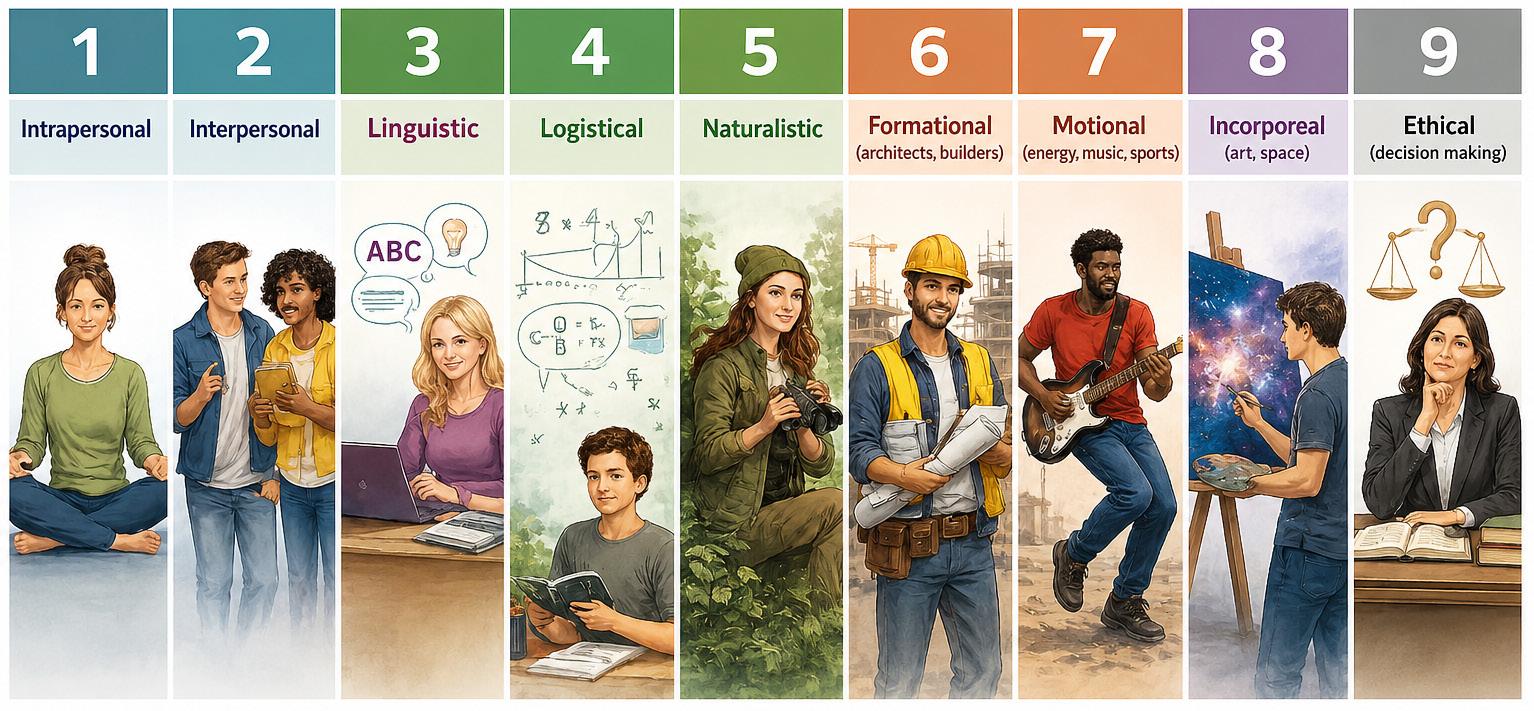
When those realities are examined directly, a consistent structure appears. The mind organizes around nine domains not as preferences or talents, but as arenas of operation.
1. Intrapersonal (Self)
Awareness and regulation of internal state.
2. Interpersonal (Others)
Understanding and navigating relationships.
3. Linguistic (Meaning)
Using symbols and language to create and interpret meaning.
4. Logical–Mathematical (Quantity)
Working with number, pattern, order, and consistency.
5. Naturalistic (Life Systems)
Recognizing and relating to living systems and cycles.
6. Formational (Structure & Matter)
Understanding how things are built, organized, and held together.
7. Motional (Energy & Movement)
Operating through rhythm, force, timing, and coordination.
8. Incorporeal (Space & Possibility)
Visualizing, designing, and working within space and dimension.
9. Ethical (Time & Consequence)
Governing action across time judgment, sequencing, and consequence.
At first glance, this may still feel like a list. But it is a map of what the mind must continuously process in order to live.
The Corrected Architecture
Seeing intelligence this way shifts how we can think about intelligence in three ways:
1. The domains align to reality, not to pet subjects or performance. Intelligence is anchored to what the mind handles.
2. Other arenas of cognition become visible.
Thinking is not limited to language or symbols.
3. Time and consequence govern the system.
Intelligence is not just generating responses it is deciding when and how to act.
This last point is often overlooked.A mind can generate ideas, explain concepts, or solve problems and still make poor decisions across time.
Judgment, restraint, timing, and consequences do not sit inside language or math. They operate across domains. This is why intelligence cannot be reduced to output alone.
The Grid of Human Intelligence
Seen clearly, the relationship between what we navigate and how the mind operates becomes explicit:
We compartmentalize our areas of concern into these categories:
1. Individual
2. Family, Small Group
3. Groups, Nations 4. Mankind
5. Plants, Animals
6. Matter 7. Energy
8. Space
9. Time
Recognition
Once named, the domains are easy to see.
Our corresponding Domains of Intelligence are:
1. Intrapersonal 2. Interpersonal 3. Linguistic 4. Logical (Mathematical) 5. Naturalistic 6. Formational 7. Motional
8. Incorporeal 9. Ethical
• The person who reads a room instantly and adjusts interpersonal.
• The one who can design and build systems before touching materials formational.
• The one who feels rhythm, timing, and movement precisely motional.
• The one who visualizes layouts and possibilities incorporeal.
• The one who weighs timing, consequence, and long-term effects ethical.
The difficulty is not that they are rare. It is that they are often not recognized.
What This Reveals
What I found is that humans are perceiving and then estimating how much time things will take, how much energy and space is needed for, say, moving some dense matter like a dining room table are part of intelligence.
Critically, this model identifies Ethical (time-governed) intelligence as the executive function the governor that adjudicates all other intelligences. This distinction becomes existentially important as AI systems, which are inherently non-living and non-biased toward life, increasingly influence decisions at scale. We are ethics-first natively, whereas machines are programmed with biases that
may or may not be ethical or even moral. It’s also because the mind’s perception of time is mechanically the first and central action of the mind because time is always moving.
Everything in the world is happening in step with time so we have to always be somewhat in sync with it. It is the only “constant inconstant.” Even when we ignore it, time is a catalyst for all our thinking even though it is not a “thing” so much as an every- changing state. In the illustration on this page, it is shown as the central mind, the governor.
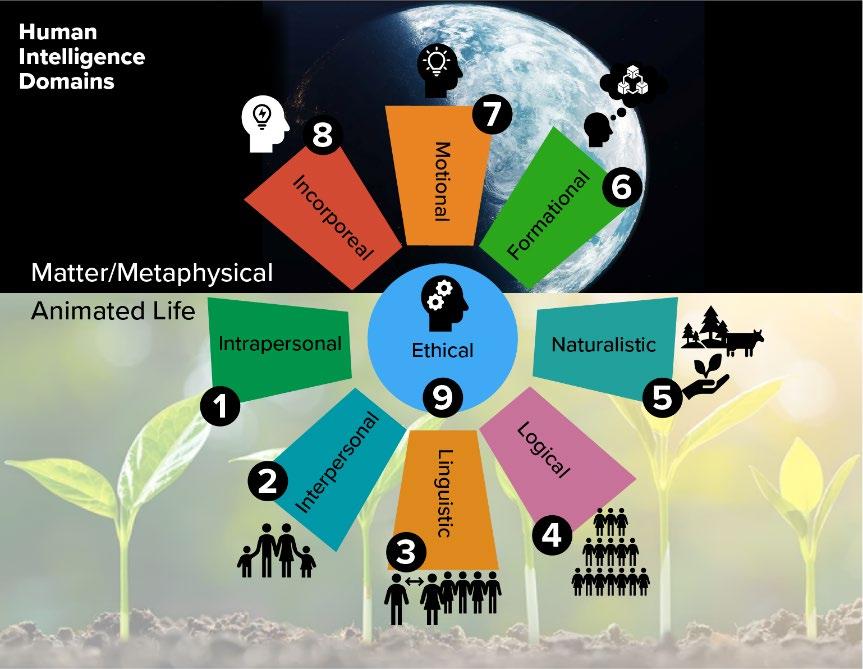
What follows is how each intelligence manifests in grids -- columns for each of the nine.
Where We Go Next: The Languages of the Mind
If these nine domains are real, a second question follows immediately: How does the mind operate in each domain?
Words and numbers are obvious because we formalized them early. They have external symbols and standardized rules.
But the other seven domains also have representational systems ways the mind encodes, compares, and communicates information often without formal symbols.
That is what I mean by domain languages.
Primary area of concern: Individual Self
Description
Awareness of self. Having an identity, having a corporeal body, interior processes and thoughts, emotions (motions within) and feelings.
Enactments Health focus; what drugs, vitamins, foods, medical conditions, hygienic and beauty care. workouts. Food connoisseur. Physical dexterity.
Skills Introspection, distinguishes own thought from others' input, selfregulation, self-motivation, resilience, emotionally-intelligent, hygienic.
Perceptions Own emotions and interpreting them. Limits of strength, flexibility, body safety, bodily processes, pains, and cycles.
Family, Small Group Groups
Awareness of others. Sociability, high acuity for culture, manners, fashions, relationship modes and methods.
Focuses attention on relationships with others, news and trends; what interpersonal relations are and how people relate. "Follows" others on social media and considers their opinions.
Initiating conversation, being welcoming for others, interest in others, dynamics and politics of relationships. Sharing, cooperation. Empathetic.
Emotional undercurrents between self and others, others with others.
Time Sense Daily routines, hours sense. Weekly motion of time as in "Today is Monday, 2nd week of April."
Difficulties if concentrated in this intelligence (gifted in this domain)
Doesn't understand how others cannot self-regulate, understand their emotional states, keep themselves healthy.
Struggling in this domain Little personal responsibility, uncoordinated, accident-prone, neglect of hygiene. Difficulty discerning own thoughts from remembered words spoken by others.
Common contexts where this intelligence is frequently expressed
Some athletes, doctors/surgeons, nurses, pharmacists, dentists, law enforcement, retail and manufacturing line work, drivers, electricians, plumbers, construction workers, agricultural workers, butchers, machinists.
Doesn't understand how others can be unaware of others' feelings, their lack of sociability, culture, fashions, manners; takes action to focus attention here when it may not be wanted and even considered trivial. Often distracted from productive actions into worry about relationships only.
Cannot make friends or assumes they cannot. Does not initiate conversation, unaware of manners, culture, fashion, others' desires or motivations.
Counselors, service workers, stylists, hygienists, cosmetologists, barbers, fashionistas, bloggers, ministers, parents, campaigners, marketers, trainers, teachers, managers, salespeople, human resources staff.
Awareness of language qualities. Assigning meaning with symbols, words, expressions; defining and making sense of things in orderly spoken and written communications.
Precision of language and punctuation focus, providing the right expression; what meaning from words and texts including lasting emotional impact and establishment of understanding.
Reading, writing, comprehension, assignment of meaning, fluency. Frequently narrating and evaluating meaningfulness of outside- of-self life, even if only internally. Eloquent.
A dimensionality to words/symbols beyond definitions alone, words are dynamic.
Monthly sense of time with attention to seasons, attaching language-like meaningfulness to months as in "Fall colors" and so forth.
Doesn't understand how others don't "get it," how they do not experience another's mind in stories or see multiple interpretations; difficulty "dumbing down" own comprehension for others. Feeling separate from others; retreats to reading, writing, observing.
Low literacy or no interest in words/symbols as meanings in life. Possibly more visual (incorporeal intelligence) or auditory (motion/wavelength intelligence).
Authors, publishers, librarians, teachers, marketers, clerical, literary agents, lawyers, historians, politicians, AI scripters.
Primary area of concern: Mankind
Description
Enactments
Awareness of quantities. Categorization of people and things, numbers and symbol placeholders, mathematical dexterity, a propensity to network ideas into taxonomies, assemble, distribute and partition.
Noticing amounts of things, sequence, and logic patterns, trends, relationships. Will seek mechanisms or disciplines to bring nuance to their awareness of quantities like statistical analysis.
Skills Solving mathematical problems, understanding graphs, percentages, fractions and quotients. Documenting and winnowing out facts from emotions. Bringing orderliness to environments.
Perceptions Imagines the world mathematically, conceptually, maybe even algorithmically, sees beyond flat numbers and equations.
Time Sense Time is "speeded," sensed as years, a disregard of time as a sort of inverse of being quantity oriented because time is infinite.
Difficulties if concentrated in this intelligence (gifted in this domain)
Struggling in this domain
Doesn't understand how others can be unaware of vast or no quantities to things or the troubles of mankind in disproportionalities. Uncomfortable in disordered environments, feeling "behind" in mathematically mastering every part of life into summations.
Difficulty bringing order and logic, thinks and converses non-sequentially, comes up with wrong answers to math problems, reads graphs wrong, money problems.
Common contexts where this intelligence is frequently expressed
Physicists, coding/programming, statistician, mathematician, scientist, clerks, auditors, financial analysts, investors, data technicians, actuaries, economists, engineers, teachers, house cleaners, business managers.
Plants, Animals
Awareness of other life forms. Symbiosis with plants and animals. Sense of inclusion and self-extension in other life and nature.
Connecting with animals, plants, weather, seasons, life- cycles; noticing planetary and universe forces stars, clouds, topology.
Having a "green thumb," tracking with weather and daily temperatures, interest in life- cycles, predator-prey, forest fire renewal, major and minor forces and cycles.
Sensitive to non-human living things and natural cycles as part of their mind's domain. Never feels alone because of other nearby plant or animal life and all matter.
Time sense is past and future, not present time. Concern for past natural orders, bringing future naturally. Tides, growing seasons, moon cycles, etc.
Doesn't understand how others are not aware of all that is happening naturally as if those forces are an extension of self; animal and environmental harm incomprehensible; self feels large and dispersed into the natural world.
May be unconcerned about throwing trash just anywhere. Disregard or illtreatment of animals, plants, unaware of weather, lack of interest in natures processes and symbiosis, dislikes the outdoors.
Farmers, conservationists, trade, parks and recreation, animal husbandry, research and practitioners in health sciences, ecology, cosmology, astronomy, biology, geology, meteorology, oceanography and others. Chefs, cooks. Herbalists.
Matter
Awareness of structure and form. Drawn to science, pattern, relational and systems thinking with analytical creativity and materials grounding. Extension of self into all things.
Causes, interrelationships. Builds organizational charts, architectures, routes. Efficiency/priorities. Unstructures to restructure.
Builds 4D geometric forms in mind space. Ability to see material and human dynamics in abstraction; creation of forms, schemas, transformation of matter.
Might be able to describe what they construct in their own minds as organic logical forms that they can “see” and “feel” as dimensional including density.
Present time sense is fractional, according to clocks and calendars, each time unit having dimension within a larger construct.
Doesn't understand how others do not recognize a truth because of facts. Prone to over-simplify for others; or may overly complexify to overwhelm others. May annoy with their need to address and correct forms/organizations and behaviors.
A follower and observer rather than manipulator of forms or systems, low energy to address correction of workflow, doesn't see inefficiencies, forms of things and confuses chain-of-command in organizations.
Coordinators and logistics workers, builders, architects, fabricators, mechanics, machinists, user interface/user experience software designers, interior designers, packaging designers, lawyers, data modelers, consultants, inventors.
Partially tested alongside math
Physical Environment Domains
Primary area of concern: Energy
Description Awareness of motion. Includes awareness of no -motion, raw energy, all wavelengths; oriented to the kinesthetic, to musical aesthetics, to infinity-scale rather than twofactor logic (right/wrong).
Enactments Spontaneously energetic or laid back at will. A starter, gamesmanship through sides, rules, fields- of-play, anticipatory moves and also unmaking- of-games by noopponent, no-field, nullness of rules. Mimics others easily.
Skills Listening skill, music creation and appreciation, use of efforts physically (athletic) or mental discipline (focusing attention, speed- of-reasoning).
Perceptions Hearing sound distinctions, pauses and nosound, feeling energy of environment and others and drawing into self or emanating it out.
Time Sense Can seem to "slow" time by focusing to one motion & hindering awareness of other motion. Perception windows of only present time, only past or only probable future at will.
Difficulties if concentrated in this intelligence (gifted in this domain)
Struggling in this domain
Doesn't understand others not thinking fast or disliking dancing. Poor sportsmanship. Has to start new efforts (games) in life constantly. Utilizes infinity-based logic tied to awareness of infinity of energy wavelengths.
Two -factor logic only things are right/wrong, black/white, up/down, only cannot switch to infinity-scaled logic with in-between realities; unmusical or only repetitious-beat relational, possibly hectic but uncoordinated motion.
Common contexts where this intelligence is frequently expressed
Musicians, music producers, game and interface designers, teachers, managers, coaches, athletes, dancers, martial artists, childcare, some athletes.
Awareness of dimension. Visual-spatial orientation with extension of self to any/all space, seen/unseen forces. Multi- sensory information collector ; thought origination or knowing seemingly from no data - rapid synthesis of partial clues
Principled, goal setting, creating or appreciating art and athleticism. Expressing originality, creativity. Locates lost things easily. Values silence, can be a loner, work independently.
Information curation, goal design, defining principals, isolating own thoughts as distinct from others. Constructs in mind space highly unique organic forms. Sympathetic.
Mental visualization and intuition conclusions are sometimes of unknown origin but often correctly predict or align facts and outcomes. Pattern recognition.
Sense of infinite time and no-time at all. Can possibly imagine being in a “timeless” moment.
Doesn't understand how others cannot expand mind-space, are uncreative, are unnecessarily noisy, can't find lost items or craft good AI scripts. Questions everything. May may non-sequitur leaps which to them are sequitur to some chain of thought but to others are not or only distantly related.
Narrow construct of breadth of impacts, hasn’t learned to use imagination because has no training in constructing in mind space well, poor AI scripting/agent creation. Dislikes silence. Materialistic.
Visual artist, graphic artist, crafts artists, counselors, philosophers, analysts, data architects, movie and show producers, script writers, actors, quality control, marketers, some athletes.
Reason and governance of the other intelligences for a decision or production of an effect, concerned with survival/achievement. Mindfulness of time as the only constant inconstant. Curiosity.
Considers penalties and rewards of action and inaction, engages various areas of their other intelligence domains. Takes right actions at the right times. Likes to adjudicate.
Good decisions. Data literacy. Extrapolates data and weighs importances, sees beyond the now to consequences for all the channels of thought from Energy down to Self.
Noticing discord or new potential, applies the other intelligences.
Precision sense of time down to minutes, seconds or extremely broadly out to infinite future. Time management.
Doesn't understand how others cannot see when something will do more harm than good; how others will not act towards achievement and survival but undermine themselves, others, the world. Abhors subterfuge, hidden influence.
Misdefines ethics for self only rather than greatest good for all channels of life. Neglects other areas of intelligence, limited consequence mapping, can't see consequences, impulsivity.
All management, human resources, lawyers, counselors, ministers, service people, clerks, human resources officers, governance.
IQ Testing Partially tested as processing speed Partially tested as Visio -spatial Partially tested as reasoning
Chapter 2 — The Languages of the Nine Intelligence Domains
Once I started seeing the domains as languages, everything shifted.
Spoken language and mathematics are only two of several representational systems the human mind uses. They are not the whole human mind. They are the most externally formalized parts of it.
Each intelligence domain operates through its own representational system its own communications depot. Some of these systems use symbols. Others are embodied, relational, spatial, energetic, ecological, or temporal. All are structured. All are real.
When this chapter refers to a “language,” it does not mean vocabulary or grammar. It means a domain-specific system by which the mind has a representational system of all the information it is encoding and giving . These are not metaphors.
A language is any system by which the human mind:
• represents reality
• processes signals
• exchanges information (internally or externally)
• and coordinates action
Words and numbers are languages because they use symbols with rules. The other domains are languages because they use coherent internal representations and specific operations, even when symbols are minimal or absent.
What follows is a unified description of the nine domains as distinct but interconnected languages of intelligence. After that is a grid for further clarity.
1. Intrapersonal Intelligence State and Identity Language
This domain operates through internal state recognition and regulation. We know when we feel hungry, when our hair is messy and we need a shower. We feel joy, anger, fear, grief and many other emotions. We may talk to ourselves.
Intrapersonal intelligence encodes signals from within:
• body sensation and state (tension, fatigue, energy, pain)
• emotional states and shifts
• stress, calm, coherence, fragmentation
• internal narrative and self-direction
Meaning is carried through biological and experiential signaling not symbols, a biological level of communication that involves chemicals, how a person holds themselves, and many other cues. The mind “reads” this language through awareness of state, and “writes” through:
• body regulation
• adjustment
• persistence
• posture
• facial expression
This is a continuous, embodied language of self.
2. Interpersonal Intelligence Relational Signal Language
This domain operates through human interaction and feedback. We know what it is to hold hands or feel someone distancing themselves. We see “pecking orders” in groups, and we notice who goes first and who goes last.
Interpersonal intelligence encodes:
• trust, threat, alliance, hierarchy
• inclusion, exclusion, reciprocity
• group dynamics and social timing
What is exchanged are subtle signals:
• tone, pacing, gesture, proximity
• attention, response, repair behaviors
Meaning is carried through patterns of interaction, not fixed symbols.
The mind “reads” relationships and “writes” through:
• coordination
• connection
• influence
• repair
This is a responsive, adaptive language of human systems.
3. Linguistic Intelligence — Symbolic Meaning Language
This is the formal language of words. We may have big vocabularies or not. We can have favorite, trendy words and make-up words. Words are symbols of what they represent, things and concepts.
Linguistic intelligence encodes:
• meaning
• definitions
• narrative and structure
• abstraction through symbols
What is exchanged:
• spoken and written words
• sentence structure, nuance, metaphor
It allows shared understanding beyond immediate experience.
This is a formal, externalized communication system and one of many.
4. Logical (Mathematical) Intelligence Quantitative and Relational Language
This is the formal language of numbers and mathematical symbols. We think in quantities of things, some of us always counting things even to just have fun spotting red compact cars with our fellow travelers while on a road trip. Our minds count things up even when we don’t realize we are counting because a “weight” on one thing over some other thing, a preference, is giving something a larger quantity of importance than others.
This domain encodes reality as:
• quantity, proportion
• sequence, equivalence
• pattern and formal relationships
What is exchanged:
• numbers, ratios, equations, graphs, structured relationships
It allows:
• comparison
• prediction
• constraint checking
This is the standardized language for formal reasoning and comparison, not the only form of intelligence.
5. Naturalistic Intelligence — Life Pattern Language
This domain operates through perception of living systems. We all know people who love animals or plants or both. We see some people put far more importance on animal welfare and things like clean food free of pesticides or clean air quality, than others. We also may know people who are interested in weather as a living system or at least finding it something to comment on in daily conversation.
Naturalistic intelligence encodes:
• states of living creatures and plants
• cycles, growth, decay
• interdependence
• balance, adaptation, disruption
What is exchanged:
• signals of vitality and distress
• patterns across ecosystems and organisms
Meaning is carried through recognition of life interacting with life.
This is a relational and pattern-based language, grounded in living systems.
6. Formational Intelligence — Structure and System Language
This domain operates through organizing matter and systems. People who see three dimensional objects in their mind space, turn them, looking at them from all angles are exercising this intelligence, but even just the ability to recall an object of any kind is using formational intelligence. Some minds may be able to do this but do it so fast they create-and-dismantle almost at the same time. The evidence of this is that they can still describe it or build it.
Formational intelligence encodes:
• form, structure, load, constraint, density, fluidity
• sequence, causality, and workflow
• transformation and construction
What is exchanged:
• design logic
• structure diagrams
• build sequences
• system organization
The mind “reads” how things hold together and “writes” through:
• building
• engineering
• constructing
• repairing
Mathematical tools often live here as languages of structure, not just abstraction.
7. Motional Intelligence Energy, Rhythm, and Timing Language
This domain operates through movement and energetic patterning. We all know the high energy output of the youth. We also know how music can sometimes affect us. We dance when we go into sync with music or just the internal energy we are producing. It’s important to notice that energy can instigate our minds and motion, and that we can instigate energy and motion ourselves.
Motional energy encodes:
• motion, force, coordination
• rhythm, tempo, pacing
• synchronization and flow
What is exchanged:
• movement patterns
• timing signals
• rhythmic coordination
The mind “reads” energy and timing, and “writes” through:
• action
• movement
• execution
This is a real-time language of doing, not thinking-about-doing.
8. Incorporeal Intelligence — Spatial and Possibility Language
This domain operates through non-symbolic spatial awareness. This intelligence creates the “blank” mind space in order to observe, contrast, compare other things. “Mapping” a space, feeling space around things close or at a distance like a lawn, then trees, then more lawn, up to sky, off to the horizon, left and right, all of that dimension is felt as if the mind itself is filling it. Artists fill blank space and sometimes leave “white space” in art to cause the viewer to move their eyes visually around the art from thing to non-thing, or the nothing that is the space.
Incorporeal intelligence encodes:
• space, orientation, proportion, dimension
• absence, distance, relation
• potential before form is fixed
What is exchanged:
• mental imagery
• spatial mapping
• arrangement and possibility
Meaning exists in:
• where things are
• how they relate
• what could exist
This is a symbol-light language of imagination and design.
9. Ethical (Time-Governed) Intelligence — Integration and Governance Language
This is the meta-language of decision-making across time. We all know people who are sometimes out of step with time, even “stuck” in time and always talking about the past or preferring the past. Others who seem in a hurry and that live in the future.
Ethical energy encodes:
• time constructs
• sequence
• consequence
• delay and irreversibility
• risk and trade-offs
What is exchanged:
• anchoring reference of time
• judgments about action vs restraint
• prioritization across domains
• timing of decisions
It integrates all other domain languages by asking: “Given everything, what should happen and when?”
This is not morality as a belief system. It is governance of action over time. Many people consider ethics to be inextricably entwined with a universal morality. This definition does not involve itself past this one person’s consideration of survival as all of the areas they need to be concerned with to continue into some indefinite future. This may involve the future of their family line, even the future of all of mankind and plants, animals, and the planet.
Why This Matters
Once you see intelligence as a set of interacting languages:
• You stop mistaking words for thinking
• You stop mistaking symbols for intelligence
• You start seeing why students can be capable but misrecognized
You can observe intelligence where it actually occurs not just where it is easy to measure.
Chapter 3 — The Nine Domains in Real Life
If the nine domains are real, they should not require theory to believe them. They should not be “trendy” but real things, the real way we think.
They should be visible.
And they are.
The reason they often go unnoticed is because most of us have been trained to look for intelligence in only a narrow way primarily through words and numbers.
Once that filter is removed, something else becomes clear. People are constantly expressing intelligence. Just not always in the forms we were taught to recognize.
Here are stories I found to show how correctly identifying a person’s native intelligence strengths is meaningful for their lives and society.
Misread Intelligence - Thomas Edison
As a young child, Thomas Edison struggled in formal schooling. His teachers regarded him as difficult to teach, inattentive, or incapable by the standards of the classroom. After a short time, he was removed from school. His mother chose to educate him at home, following his curiosity rather than the school’s pacing.
Years later, after her death, Edison reportedly came across a note from the school that reflected the judgment made about him as a child. What mattered more than the wording of the note was the outcome: others had failed to recognize an extraordinary form of human capability.
Edison’s intelligence was not primarily verbal compliance or classroom performance. It showed up as formational intelligence, relentless experimentation, systems thinking, and persistence across failure.
Motion mistaken for disorder - A Nameless Girl
A young girl could not sit still in class. She could just as easily been a boy in this story. Constant movement, distraction, restlessness. The school interpreted the behavior as a problem to be corrected.
A clinician agreed to see the girl and her parent. At the session, the clinician left the girl in a room after turning on some music, and then quietly observed. The child began to move with rhythm and purpose.
The conclusion was simple and accurate: the child was not disordered. The child was expressing intelligence through motion.
Placed into formal dance training, that same child flourished. What the classroom had labeled disruption was, in reality, emerging motional intelligence precision, timing, coordination, and embodiment seeking expression.
Seeing what others could not - Temple Grandin
As a young person, Temple Grandin experienced schooling very differently from her peers.
Traditional classroom instruction did not easily align with how she processed information. What did align was her ability to think visually and spatially.
Later, working with livestock facilities, Grandin noticed that cattle moved through chutes with distress and resistance, not because of defiance, but because of shadows, angles, reflections, and abrupt visual breaks that humans largely ignored.
She redesigned the structures to account for how animals perceive space and motion. The result was measurable improvement: calmer animals, safer handling, and more humane systems.
This was not math-alone intelligence or language. It was incorporeal and formational intelligence working together, plus a naturalistic intelligence attuned to animals, all directly applied to matter and flows. A mind that could “see” what others could not.
Governing action through time - President John F. Kennedy and Attorney General Robert F. Kennedy
During the Cuban Missile Crisis, the United States confronted confirmed evidence of nuclear missiles being installed within immediate strike range. Military options were prepared quickly, and pressure to act decisively was intense.
President John F. Kennedy slowed the sequence. Rather than choosing the fastest response, he insisted on deliberation, explored alternatives, preserved communication channels, and resisted actions that would force irreversible escalation. His brother, Attorney General Robert F. Kennedy, served as a critical counterweight inside the decision process questioning assumptions, emphasizing second- and third-order consequences, and warning against actions that would remove all future options.
The intelligence exercised in those moments was not technical expertise or rhetorical skill. It was the governance of action across time: restraint under pressure, foresight over impulse, and attention to consequences not yet visible.
Dyslexic but Gifted - Henry Winkler
In 1973, Henry Winkler arrived in Los Angeles with only $32 in his bank account. He auditioned for a minor supporting role on a new sitcom called Happy Days and was cast as Arthur “Fonzie” Fonzarelli. What began as a small part quickly became one of the most iconic characters on television, thanks to Winkler’s strong comedic timing, physical presence, and improvisational skills.
Winkler has severe dyslexia, which made reading and academics extremely difficult throughout his childhood and early career. He memorized scripts by listening and relied on his performance abilities rather than traditional reading skills. His condition went undiagnosed until his early 30s, when his stepson was diagnosed with dyslexia. This revelation helped him understand his own lifelong struggles with school and self- esteem.
Later in his career, Winkler co -authored the Hank Zipzer children’s book series, which follows a bright, dyslexic boy navigating school and life. The books, inspired directly by his experiences, have helped many children recognize their own strengths beyond traditional academic measures. Winkler’s success illustrates how high ability in areas such as bodily-kinesthetic, interpersonal, and creative intelligence can lead to outstanding achievement even when linguistic intelligence (particularly reading and spelling) presents significant challenges.
The Nine Domains in Real Life - Your Own Example
What’s your example?
A school system can only develop what it can recognize. Sadly, this leaves an enormous number of people feeling like underachievers. Or they are labeled in some fashion that is a poor reflection of a larger truth about them: they are stronger in other domains of intelligence.
The nine- domain model proposed here is not offered as a slogan.
The nine- domains help you to see reality, all of its parts. Some may be more vividly part of your intellect than others.
Time is a part of reality. I named that domain the ethical mind because the research showed time is a governor of action. We judge things based on how much time it takes. We punish crime with amounts of time a criminal is withheld from society.
The other parts are yourself, your immediate family or small group, your larger groups like your work or baseball team, the whole of mankind, the plants and animals and natural systems around you, the house and roads are the matter around you, the electricity and sound around you, the sky and space around you all of these go through time with you.
Do you always give yourself more importance than your family, work or teams, or is it a situational call? Would you value a family member more than a stranger? Does all of mankind not matter, only your close group? Does it matter that some people waste electricity and trash the environment?
The whole of the domains are a giant system on earth. The ones that seem remote from you are not really, you depend on them. You depend on air, water, energy, the mass of things including food and a home.
Your thinking across all domains, giving the right importance to all of them may be what is “normal” human intelligence. You could still be stronger in some domains than others.
Giving all importance to only one or two may be what is not normal if the person literally cannot see the reality of the others or the symbiotic interplay of all of them. That would mean they cannot see reality in some respect, like what selfishness might mean in the long term.
An example would be only caring about yourself without any thought to ever helping anyone else, only to find that when you really needed someone like a family member to help you after a surgery for example, or a
friend to lend you money, you were shunned. You weren’t seeing a greater concept, that reality is a whole system of interdependencies.
The nine domains are things that I feel very strongly it is our duty to develop. It’s what we apply to navigate reality, to get along, to thrive. It’s real life.
Chapter 4 - The Two -Domain Illusion
The two - domain emphasis language and logical-mathematical performance emerged gradually from a combination of measurement convenience, institutional habit, and historical context. Over time, what began as a practical way to compare learning outcomes hardened into an implicit definition of capability.
If you can read, write and speak well, you’re intelligent. If you have an enormous vocabulary, you might be super intelligent.
If you’re good at math, you’re intelligent. If you’ve mastered Algebra, especially Advanced Algebra, you might be super intelligent.
Schooling did not begin with a complete map of what the human mind addresses. It began with what it could observe, standardize, and measure.
That visibility created a quiet illusion: that the mind is primarily a words-and-numbers engine.
But words and numbers are not the only ways the human mind represents reality. They are simply the two representational systems humans formalized earliest and were using externally.
A cleaner way to say this is: every intelligence domain has its own representational “language” a way the mind encodes, evaluates, and transforms reality into meaning in that domain. Speech and mathematics have formal symbols and standardized rules, so they became dominant in schooling. The other domains operate through internal, embodied, relational, spatial, structural, energetic, ecological, and time-based representations that are less symbolized, but still structured and still observable in human capability.
There are nine domains of human intelligence because that’s how our minds divide and weigh information. This is observable, a truth you can see in yourself and others. The nine domains are not what they are because they can divide up our differences in a novel way, they are the actual mechanics underlying human thought.
The two - domain trap is an observation of what humans are actually doing mentally somehow becoming a narrow definition of what humans are. More importantly, leaving out the other seven meant that many underpinnings of how we come to use those two intelligences by processing our world from the other seven were left unknown.
This harmed our ability to increase intelligence. We could develop what was natively within each individual in terms of skills in two domains, but we couldn’t use the dependencies of the other intelligence domains to drive all of them higher.
Education is now in a design problem, not a learner problem
The two - domain theory of intelligences often attempts to frame limitations of schooling as student shortcomings: lack of motivation, gaps in preparation, insufficient practice. But the more accurate framing is structural.
If a system defines intelligence through a narrow lens, it will repeatedly misinterpret human capability. This misinterpretation is not a failure of learners to adapt to the system; it is a failure of the system to represent reality accurately.
The two - domain trap persists because it is embedded. It is reinforced by assessment systems, accountability structures, scheduling constraints, and long-standing beliefs about rigor.
Changing it requires more than adding programs.
Why definition expansion matters now
The presence of AI does not force schools to abandon academic disciplines. Only to clarify what academic disciplines are for and how they fit within a larger development model.
If intelligence is understood as the mind’s capacity to represent reality, evaluate it, and act effectively across time, then education needs to attend to the full range of realities humans manage.
The two - domain trap is not solved by reducing emphasis on reading or mathematics. It is solved by placing those domains within a fuller framework of human capability.
Chapter 5 — The Thinking & Pre-Thinking States
Since AI is busily computing, what about human thinking?
If we truly want to value every domain of human intelligence, we really need to recognize things like nonverbal, or without words cognition. That’s what’s going on in the largely overlooked other seven domains of intelligence.
And is there a difference between thinking, critical thinking and perhaps a sort of absence of thinking? Apparently, there is. A quick note, though, the absence of thought, is rarely a “blankness” where thought is really not happening at all because there is still some level of awareness even it if it is cellular. Here’s the four states per research:
Non- Conceptual Awareness | Non-Verbal Cognition | Thinking | Critical Thinking
These are both a set of steps up and possibly a circle. Meaning the mind goes from perceptions with nonconceptual awareness up to non-verbal, up to thinking, up to critical thinking and then back to nonconceptual awareness and perception intake. It may be a learning circle, an evolution. While there are steps, there’s no judgement.
A no -thinking, non- conceptual state isn’t necessarily a low or bad thing, then, it’s just a state. Some brains are more prone to this state than others, but all humans may enjoy times when they aren’t thinking, possibly barely noticing their environment and experiencing just sensory immediacy. We might even call that bliss. A free-floating sort of mental freedom from thoughts. All the mind’s tabs are closed and there’s no music playing on repeat in the background. You could even say this is a skill, to have a quiet mind.
Any two students sitting only a few feet apart routinely have two completely different cognitive experiences. This is a key problem of “whole group” teaching and learning. No two humans are exactly alike.
One student thrives during the quiet study part of a class. They hunker down and do the reading, do the video watching, write the essay whatever is assigned. You can see the internal machinery working: the careful concentration, the steady progress, the slow and deliberate building of meaning. If you asked this student to explain their thinking, they probably could. Their minds ran like a well-lit stairway of words through steps. This student is probably usually operating with a continuous symbol- oriented internal monologue like math, language, music, and all perceptions.
The other student, equally alive, present in the room having heard the same instruction is immediately drifting, unfocused. Their body posture will show they are not there doing the work. You can think it’s lack of discipline, that they don’t care, that maybe they are distracted with life pressures or even having an issue like they are hungry or sick.
The student’s attention just… won’t stabilize. Then something, sometimes, starts happening like a low humming, a pencil or foot goes tapping rhythmically and the student is now focused and working. Yet they are distracting other students.
We’ve been trained to treat stillness as the visible evidence of thinking, so we see the noise and motion being made and disregard, or don’t notice at all, that it was helping the student to focus, to think.
“Stop. Be quiet. Focus.” The tapping stopped. The humming stopped. The stillness arrived…and the thinking disappeared.
Why?
What’s going on?
This student is possibly being asked to move from a native state of non- conceptual awareness up to a nonverbal cognition, noticing things, each of them independently, and then up into fully thinking-with-words which is not routine to them, and then into critical thinking.
The thing is, a state of non- conceptual awareness may be the individual highly capable in the intelligence domains that are not language and math oriented. The individual may be highly oriented in the Incorporeal domain, experiencing and in-tune with space, experiencing it without word-thought. Others might be more attuned to nature, matter, energy or time without thinking about them. The languages in these domains are not words or math.
Non- conceptual awareness: noticing before naming
This is a kind of cognition that looks like “something is here and I am in tune with it. It is shapeless, wordless, but anchoring me.”
There’s no bracketing concept, no letters or symbols nicknaming it. Words are symbols given to concepts. Love, tree, yarn, bicycle, cloud, all of these are labels given to concepts.
Every mind can do this with space. We “map” a room as square, rectangle, round without thinking or even getting the concept of dimension. We can do this without a concept forming, often in milliseconds. Some people will do this and remain at this point, not going past it for the moment. Walking into a great cathedral or any amazing space could have most people do the same.
This is not mystical. It’s the mind doing what minds do: experiencing through perceptions the physical world. It’s intelligence.
We should probably not demand a concept before we have scaffolded in the noticing. Noticing is the first thing on the way to thinking.
A mind that is said to be mentally still, a quiet mind, is still working and aware, but non- conceptually.
Here’s another thing. Sometimes the mind goes quiet not because it has nothing in it, but because it is functioning with unusual clarity. The person’s mind is being totally involved in what it is doing.
You can see this in children absorbed in art, constructing with blocks, playing, but adults do this as well. Internal chatter quiets down so attention can lock in.
Some of our best cognition happens in that state. But school tends to interpret quietness only one way: as compliance.
There are different kinds of quiet.
Non-verbal cognition: intelligence without an inner monologue
Some minds don’t start in words. They start in shape, structure, rhythm, relationship, movement, and sensory pattern. They start in the other domains of intelligence.
You can see this in people, in students you’re trying to get to learn something, who draw before they explain. They may organize and manipulate something before they will narrate. Others will need to move to understand because they are using their energy domain to instigate their other domains.
Their minds are not empty. Their minds are operating in a different representational language.
This is usually evaluating people by internal translation skill, not cognition.
This is one reason so many students are misrecognized. Not because they lack intelligence, but because the system is listening for one language while the student is starting from another.
Thinking
Any of the domains of intelligence can be perceived to be a sort of “thinking” and using of its own language because there is at least an internal communication going on, but thinking itself is best defined as any two or more domains being compared and contrasted.
Have you ever come up with some idea completely logical to you and put it into language and then “tested” it with others, only to hear feedback that it was not workable? You used your math and language domains and tested them against the interpersonal. That’s thinking leading up to having to critically think because you got feedback.
Another example is when a person sketches out how a structure should work but when they build it, it collapses or is mismatched somehow. The act of doing the building was giving feedback and instigating critical thinking.
Or, a person gets the feeling, the concept of something but can’t put a word to it. They are thinking but flailing in the language domain. Such thinking could be extremely frustrating, like trying to talk in a foreign language but it’s your whole language domain failing you and you know you know.
Anyone with some years behind them eventually gets to the point where they can’t remember names and words, but they know they know. This is normal decline the person is still thinking but experiencing a loss of symbol memory.
Critical Thinking
Critical thinking is really conscientiousness, as will be discussed in the next chapter, but it’s also a deciding between things, and revision after consequences appear.
When looking at all these states of mind up to critical thinking there are these things going on:
Non- conceptual awareness
– noticing ,
– representing in the domain doing the noticing , Non-Verbal Cognition
– formulating a concept in that domain, Thinking
– comparing and contrasting the concept with other domains,
– formulating into words or other symbology to communicate, Critical Thinking
– holding more than one possibility at once,
– deciding between things,
– revising into new concepts.
The Important Distinction
Not all minds carry the same internal “noise.” In fact, they need to create noise or have it in their vicinity in order to instigate some of the domains of their mind to get to the verbal thinking being required.
Many people like to have music on while they study or work, any noise, even loud fans and road noise will do. The social energy of multiple people around chatting and talking drives many people to work at a local coffee shop or lobby. They are more productive in a large classroom even if it is quiet just because there are others there.
This may be a tendency to use the motional intelligence to fire up the other domains. A rhythmic pulse serves as a temporary, synthetic substitute for the missing internal cognitive structure of the language or math intelligence. It provides a highly comforting anchor in physical reality, keeping the brain organized and preventing it from slipping into a state of sensory dispersal or complete executive detachment.
On the other hand, some learners come into thinking tasks with a constant internal stream language, selftalk, analysis, prediction. For those learners, extra sound or motion can be overload and interference. Their mental bandwidth is already full. Patterned sound becomes something the brain tracks, predicts, or fights against. It pulls resources away from the exact work required for sustained reasoning.
That’s the students who need silence to write. The one who says, “I can’t think with all this noise.” For them, quiet isn’t preference. It’s capacity protection.
But the first group of learners has a different relationship to silence. For them, silence is inhibitive in organizing attention. In a quiet room, their cognition can fragment. Their mind drifts in the domains of
intelligence they are stronger in, perhaps motional or interpersonal, because it isn’t held in place by enough internal word- oriented conversation or external structure.
These students often seek out what looks like “noise,” but is actually predictable structure that is helping them concentrate. This will look like humming, tapping, or fidgeting.
For them, structured input is not distraction it is stabilization. It may be a sort of synchronization.
All of this is just a design reality of the wide variety of human minds.
What’s funny-but-not-funny is that libraries and schools have been almost universally designed as if only the silence-appreciators matter.
One
important boundary (so it’s honest)
Everything I’ve described up to now non- conceptual awareness, non-verbal cognition, a mental stillness falls within normal human variation and even human strength.
It’s important not to confuse these with clinical conditions in which conceptual thought and self-initiated cognition are structurally, biologically limited. Those do exist, and they require different supports. But that is not what this book is primarily about.
This book is about the majority case: people with real intelligence and real capacity, who are routinely misread.
Why this matters for the rest of the book
If you accept that thinking is not synonymous with verbal explanation, then a lot of familiar dynamics begin to shift.
- A student who “can’t sit still” might be expressing motional intelligence coming to the fore that needs to be understood and channeled appropriately, not suppression.
- A student who is quiet might be processing spatially, not disengaged.
- A student who can’t explain yet might still be thinking just not in the language school demands.
Much of what I am saying here is not new to long-time educators. Just stated a bit differently.
Chapter 6 — What Makes Human Intelligence Alive
Up to this point, this book has mechanics that keep intelligence across nine domains we humans naturally address.
Now we add a necessary layer that encompasses a lot of social discussion about what makes humans different than machines. If you’re familiar with AI, a lot of the social statements have been vague references to things like “creativity” and “critical thinking,” but lacking clean definitions that include the exact mechanics of how they are different.
So, the difference being stated is that people are being mainly wishful and authoritative. But there are characteristics that are uniquely human that machines can’t do. There are reasons.
Your knowing them is a gamechanger.
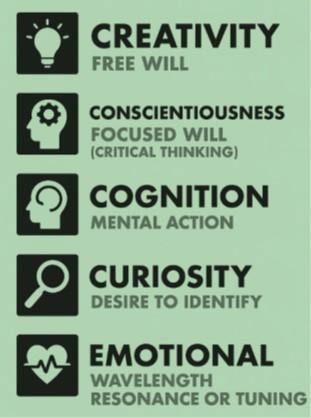
The nine domains describe what the human mind addresses as we look out into the world around us. There are five characteristics that describe what makes human intelligence living in the first place. They are not “skills” in the usual sense. They are the mechanics of living intelligence that no current artificial system can authentically possess, even when it can imitate them.
This matters because AI can be impressive at producing results in tasks, particularly language and logical operations. But high performance is not the same thing as living presence. A system can generate a convincing answer without possessing the human characteristics that make intelligence self- directed, meaningful, and responsible.
These five characteristics clarify the difference.
1) Creativity — free will
Creativity is free will in action. It is the capacity for true unpredictability through free-form thinking, including the ability to change direction without being forced by prior pattern. This is our ability to decide to do something for no reason. Like just not go to work or school today or have a strawberry instead of chocolate shake. You could argue that we had been having chocolate for too long and so it was obvious we would soon choose strawberry or we imagined the taste of strawberry momentarily and just went with it. The fact remains that we just went with something in an instant. No algorithm can be built to go in a new direction from nothing some logic has to be entered in, even if it just a switch. That switch has to be given a reason, or a human has to turn it.
Either way, machines have no free will.
In plain terms, creativity is the ability to deliberately dissolve or suspend a prevailing mental model not to change behavior within it, but to release the structure of the model itself. To rearrange, take an image and “blur ” it like impressionist art is different from a former realism. Or it means to overwrite entirely with a new form. Humans can set aside inherited representations, enter a conceptual null, and originate new form
without being governed by prior pattern. For example, a human can decide that “sky above, ground below” when painting is not a given at all they can decide to paint a picture as if from above looking down. They can begin from absence of structure rather than from correction or inversion.
Machines can rearrange patterns they are given; they cannot will the absence of pattern as a starting point.
Creativity is not merely making something that looks new. It is choosing newness. It’s free will. Unpredictable.
2) Conscientiousness — focused will with bifurcation
Conscientiousness is focused will with bifurcation. It is the capacity to deliberately withhold action or thought in order to evaluate while holding more than one mental representation at the same time. One line of attention remains stable and governed; other possibilities are held in parallel for comparison. This is also known as critical thinking.
This is the root of what people loosely call critical thinking: the willed ability to pause, to hold a mental “open space”, and to keep attention steady while contrasting, checking, and deciding among alternatives. The bifurcation is essential. Without it, attention collapses into impulse, certainty, or reaction. It stays singular, linear.
Machines can delay output. They do not want to refrain because they have no innate will. They do not experience obligation, care, or responsibility. Conscientiousness is not a behavior pattern; it is a volitional quality the desire to do something well, to do it carefully, and to seek a position, sometimes a decision.
This characteristic is inseparable from ethical intelligence. Conscientiousness provides the ethical pause: the interior space in which judgment, restraint, and time-governed evaluation become possible at all because the will is focused and critical thinking is occuring.
3) Cognition — to know with or without thinking
Cognition is the action of knowing, including the ability to reshape mental constructs so knowledge becomes owned and portable.
Humans do not merely store information. They can adopt knowledge so fully that it becomes a new foundation for thought such that they no longer think about it. They can reorganize how the world appears in mind-space. They can also sometimes know without stepwise analysis arriving at understanding without being able to show every intermediate computation.
Machines compute. Humans can know, without necessarily thinking .
This does not mean humans are always right. It means human knowing is not identical to symbolic calculation. Cognition includes adoption, integration, and reconfiguration of inner architecture.
4)
Curiosity desire to identify
Curiosity is the compulsion to identify unknowns.
The mind resists leaving an unknown as an unaddressed vacuum. It seeks to name, resolve, explore, or at least temporarily label the unknown so it no longer remains loose and indeterminate. This is not merely a learning preference; it is tied to identity formation and coherence of the individual being themselves.
Curiosity is often treated as a personality trait, but it behaves more like a living drive. It expands into frontiers, presses into gaps, and insists on making sense. It seeks orientation and ownership bringing what is unknown into a stable relationship with the self. This drive is likely connected to the fact that the human being itself has a quality that is non-material, a “spark” that cannot be seen and yet whose presence is sensed on an MRI machine and noticed as “living,” and this quality of invisible-but-still-there is perhaps what compels humans to bring coherence to anything that is not yet defined. We are constantly defining ourselves, and everything else.
Machines can be programmed to search. They do not experience the pressure of the unknown. They do not desire identification. Curiosity is not an output; it is a living compulsion that directs attention.
5) Emotional resonance — wavelength tuning
Emotional resonance is wavelength-based tuning among humans. It is the living capacity to co -regulate, synchronize, and share meaning through real-time energetic interplay.
Humans do not only exchange words. They exchange states. Groups can stabilize or destabilize through resonance. Classrooms can shift in seconds through shared mood, shared attention, shared tension, shared release. Music, rhythm, proximity, and presence can change what people are capable of doing and feeling in that moment.
Machines can only imitate empathic language. They do not resonate. They do not co -tune. They do not enter the resonance humans occupy when they are together. Emotional resonance is not a script; it is a living dynamic.
Why these characteristics matter for education
I don’t believe the five characteristics are optional as constructs of how we understand humanity. They describe what is distinctively human in kind not merely in degree from machines.
• Without creativity, humans would be driven primarily by genetically inherited patterns rather than originating new form.
• Without conscientiousness, humans become reactive rather than governed.
• Without cognition, learning collapses into superficial copying.
• Without curiosity, growth gives way to compliance.
• Without emotional resonance, meaning and belonging erode.
This is why the Age of AI is not merely a technology issue; it is a human development issue. Understanding what makes humans different is what allows AI to be used in ways that elevate, rather than replace, human agency.
AI can generate language and logic. If schooling defines intelligence primarily by those metrics, learners will increasingly confuse machine fluency with human worth. The correction is not to reject AI. The correction is to strengthen the living characteristics that keep humans in governance.
How the five characteristics relate to the nine domains
The nine domains describe arenas of intelligence. The five characteristics describe the living mechanics that animate those arenas, while data logic provides the evaluative mechanics that discipline their use.
• Creativity fuels new form across domains.
• Conscientiousness enables careful evaluation across domains.
• Cognition makes learning deep and portable across domains.
• Curiosity directs attention and exploration across domains.
• Emotional resonance links human minds in shared meaning across domains.
In summary: the domains describe what the mind addresses; the characteristics describe how living intelligence moves within them.
Chapter 7 Why Smart People Look “Bad at School”
Imagine if I started telling you a story about a spaceship that was oloid-shaped with a weird light and that it wobbled in movement. I was grinning as I was saying this because I’m thinking, “of course it wobbled, ha ha,” but you’re not on the same page at all. You don’t know that oloid shapes would always wobble so you’re definitely not on the same page with me. I’ve totally lost you, most likely when I said “oloid.”
You may have even had the fleeting thought, “does she mean trapezoid or some other “oid” shape that math people seem prone to throw around?”
Or you thought “there she goes again, throwing out big vocabulary, is she trying to make me feel like an idiot or what is going on here?” The thing is, I wasn’t. I was just communicating from my frame of reference.
You should have stopped me with “Oloid?” Because probably everything after that word is a blur and off-putting . Oloid is a strange, rounded-like 3D shape that rolls in a dizzying, noncircular wobble looking exactly like a piece of alien technology. It’s an actual geometric shape.
It is formed by placing two identical circles perpendicular to each other, so that the center of each circle lies on the edge of the other and then wrapping a tight "skin" around them. The Look: It resembles a twisted, aerodynamic hull or a sleek, metallic capsule compressed by intense gravitational forces. If you saw this shape you would think my story was true because it looks so scientific and, well, alien.
If I were to show you a picture or an actual physical model, you’d instantly “get it.”


If I were to go into depth about the Wobbling motion and how that would work in outer space, how If placed on a flat surface, the oloid does not roll straight like a wheel; it performs a mesmerizing, rhythmic stagger, if you’d never seen an oloid, you’d stare at me like I’m boring you. I’ve taken you straight into the world of engineering without any intervening steps In fact, it’s very easy to be bored when people do this to you you were given an exhausting mystery.
In other words, three things happened to you with this story:
1) I threw a word at you that you most likely never heard before - oloid. Then I defined it later. Congratulations if you held on and read the later definition.
2) I talked of it as a shape you’d never seen and whose description is hard to visualize, but luckily, I added actual pictures in this book. Otherwise, you might still be in a mystery.
3) I took my story into the stratosphere of engineering when I rattled on about the features of how this shape would move, when you might not be an engineer and needed a whole lot more mini-steps to get to a minor point of understanding of what all that meant. I left you behind at the definition and the shape.
Being left behind is now common in schools. Learning just keeps pouring at you without regard to your having missed something along the way, maybe something pivotal to all the rest.
By the time students reach school, learning capacity is already present. What often fails is not intelligence, motivation, or effort, it is study itself. Specifically, three parts of study that can be huge obstacles.
This chapter names three obstacles that repeatedly prevent learning from taking hold, regardless of curriculum, technology, or instructional quality. These obstacles are structural, not personal. When they are left invisible, schools misattribute failure to students. When they are recognized, they can be addressed directly.
The obstacles appear across age levels, subjects, and systems. They are especially destructive in an AI-mediated environment, where surface fluency can hide shallow understanding.
Obstacle One: No mass
The first obstacle to study is the absence of sufficient mass. This means there is no physical representation a student can imprint. Absence of mass happens when instruction refers to things the learner has never physically encountered so those words arrive without weight, texture, dimension or sensory presence.
Example: Students are assigned a science project to germinate wheat. The instructions state that before planting, the wheat stalk must be threshed, then placed into soil with water to begin germination.
What happens: Several students hesitate immediately. Their only reference for wheat is a loaf of bread. They have never seen a wheat stalk, felt the husk, or observed grain separating from chaff. The word stalk and the word thresh have no size, texture, movement, or physical reality in their minds.
They may copy the steps from the worksheet or search for the term, but the process does not stabilize. The task feels confusing and fragile because there is no tangible “thing” for the mind to work with.
What failed: The students were not blocked by ability or effort. They lacked mass. The lesson assumed a physical referent the learners did not possess.
AI accelerates this obstacle when information becomes effortless to retrieve but is missing all mass and so rarely stays present long enough for ownership. Students skim, sample, and move on. Study never begins.
Obstacle Two: Too steep a gradient
The second obstacle is gradient.
Learning fails when what is being asked exceeds the learner’s current capacity without intermediate steps. The jump is too large. Effort increases, but progress does not.
This obstacle appears when:
– assumptions about prior knowledge are incorrect,
– abstraction increases too quickly,
– directions compress multiple steps into one,
– or expectations leap instead of build.
When the gradient is too steep, learners experience confusion that feels like failure. Eventually, many disengage not because they cannot learn, but because the next foothold is unreachable.
AI can intensify this obstacle by presenting polished explanations that skip the terrain between novice and expert understanding. The output looks clear. The learner is left behind.
Obstacle Three: Bypassed definitions
The third obstacle is the most common and the least recognized.
Study collapses when core terms or ideas are used without underpinnings of explicit meaning. When definitions are assumed rather than secured, thinking becomes unstable.
This can happen with new words and incompletely defined words that have multiple meanings, even small words like “the,” “and,” and the word “run,” which has 645 definitions, covering everything from physical movement ("to run a race") to machinery ("the engine is running"), management ("to run a business"), and even politics ("to run for office").
This obstacle shows up when:
– words or symbols (as in math) have no prior definition to the learner - they are “blanks,”
– words have incomplete definitions,
– words are wrongly defined or misdefined - “off” in some way,
– words cannot be determined from context,
– words are introduced faster than they are understood,
– archaic and uncommon meanings are used,
– jargon or non- dictionary meanings are used,
– abbreviations and acronyms not priorly explicitly spelled out are used,
– learners mimic understanding while actually being “blank” about that word.
Bypassed definitions produce false fluency. Students sound knowledgeable while holding little internal coherence. They repeat and even use words that actually have no meaning behind them cognitively. Note that this is one of the clearest reasons live human teaching needs to remain in the education construct.
Bypassed definitions are especially dangerous with AI, which excels at producing fluent language. Without careful attention to definitions, learners may confuse articulation with understanding and never realize the gap. They often resort to memorization and mimicry to try to express a passing standard.
Why these obstacles persist
These three obstacles are not new. They are the base code of the human adoption and interchange of ideas and all learning. They persist because schools rarely see them as design problems of knowledge accumulation. Teachers are not educated in these areas, being the primary reason for students not learning, although they are used intuitively by most teachers.
What changes when obstacles are recognized
When these obstacles are made visible, instructional decisions change.
• Teachers check for understanding differently.
• Teachers remediate by a return to definitions and lack of mass first, then ensure gradients are full done from the first point of definition or mass loss so nothing in between is lost.
• Full conceptual understanding returns because teachers check for restatement, “state this concept in different words,” not just memorization.
• The design of gradients are smoothed through intermediate steps.
• Definitions are intentionally introduced, not just stated.
Most importantly, student behavior begins to make sense. Resistance, confusion, or disengagement is reinterpreted as missing information, not evidence of incapacity.
All three obstacles require a new intentionality in the architecture of teaching and learning to address.
• Intention to be mindful of presenting mass, real life learning artifacts students can touch and maneuver, or at least pictures.
• Intention to scaffold correctly and slow abstraction so learning is secured at each point.
• Intention to stop and resolve the meaning of words before moving on.
In an environment that rewards speed and coverage, restraint feels countercultural, but no learning at all occurs when these are missed.
How to catch an obstacle
Schools can catch these obstacles before they compound.
• Indicators of no mass include scattered recall and shallow transfer.
• Indicators of steep gradient include effort without progress.
• Indicators of bypassed definitions include a marked “blankness,” even a sort of “reeling” mentally, and perhaps fluent talk without accurate understanding or application.
These signals are diagnostic, not punitive. They tell educators where design, not learners, needs adjustment.
How the obstacles relate to the nine intelligence domains
The three obstacles to learning are not separate from the intelligence domains. They describe common points where the mind cannot stabilize representation, regardless of domain. Each intelligence domain operates through a specific representational system symbolic, relational, structural, spatial, embodied, ecological, or temporal.
When mass is missing, the mind lacks a concrete referent from their Formational Intelligence to anchor any other domain. When gradient is too steep, sequence collapses and domains that require build-up cannot engage. When definitions are bypassed, symbolic and conceptual domains appear fluent while remaining internally blank. In all three cases, intelligence does not disappear; it becomes inaccessible. The indicators in the following chapter show what intelligence looks like when these obstacles are removed and representation is secured.
Why this matters now
In an AI-saturated environment, these obstacles become easier to miss and more costly to ignore. Output smoothness can conceal fragility. Automation can outpace understanding which is why teachers are intent at catching “AI cheating . ” A proper AI system should probably be cognizant of these obstacles in a learning environment and always be capable of these three things:
• Providing instant definitions (click- on) or pop -up look-up enabled
• Providing pictures and visual models
• Sequencing ideas and academic standards correctly
If schools do not actively design against these obstacles, they risk producing students who appear capable but lack durable study habits and judgment.
I personally believe study is not a personality trait. It is a condition created or prevented by design.
Imagine how much IQ could be affected when education is delivering on learning without obstacles.
Chapter 8 — Intelligence Domain Equality
I believe that equality, or a closer approximation of it, of the nine intelligence domains should lead to a new and very powerful actualization across all of mankind. Potentially a renaissance of skills display, of the numerous gifts given humanity.
Equity in education has been framed for decades as a resource problem, an access problem, or a policy problem. While each of those matters, they all rest on a more fundamental question that is rarely addressed directly:
What forms of intelligence does the system recognize as legitimate?
This chapter argues that equity begins before resources, programs, or interventions. Equity begins at the level of recognition.
When a system recognizes only a narrow slice of human intelligence, it creates inequity even when intentions are good. When a system recognizes the full architecture of intelligence, equity becomes structural rather than corrective.
Belonging is not psychological; it is structural
Belonging is commonly discussed as a social or emotional outcome. In reality, belonging is a structural signal: it answers the question, “Is there a place for me?”
When a person’s capabilities are recognized, belonging follows naturally. They find their fit, they represent who they really are. When a person’s capabilities are invisible by institutions, no amount of affirmation by family and friends compensates for life-long structural exclusion. The suffering created is real, so the answer needs to be real.
This is why many people feel disconnected even in environments that emphasize inclusion. Inclusion that does not recognize contribution remains superficial. Kindness alone doesn’t cut it.
Without recognition there is also the added issue of people tending to become tribal, defensive of their unique identity, rather than be fully realized individuals.
Misrecognition produces false hierarchies
When systems recognize only a narrow definition of intelligence, they produce hierarchies that appear natural but are not.
These hierarchies are often mistaken for merit. In reality, they reflect alignment between a learner’s strengths and the system’s recognition model.
Learners whose intelligences align with the dominant model are advanced, accelerated, and affirmed. Learners whose intelligences fall outside that model are often slowed, separated, or directed away from opportunity.
The resulting disparities are then attributed to background, motivation, or ability rather than to recognition bias embedded in the system.
This is how inequity persists without malicious intent. It starts with an inequality of the domains of intelligence.
Why overcorrection misses the point
In response to inequity, systems often attempt to correct outcomes rather than definitions. New programs, compensatory strategies, and parallel tracks are added without changing what intelligence the system recognizes as central.
This creates two unintended effects.
First, learners continue to feel categorized rather than seen. Second, the system becomes more complex without becoming more accurate.
True equity does not require separate recognitions for different racial groups. It requires a single, fuller recognition model that reflects the whole human mind. Yes, merit will still matter, but it needs to matter across every domain of how humans use intelligence.
Developing legitimate tests
If a capability can grow through guided practice, feedback, and experience, then education has a responsibility to develop it.
Language and mathematical reasoning can be developed.
So can self-regulation.
So can social calibration and cooperation.
So can empathy for other life forms, ecological and life-systems awareness.
So can structure and forms thinking.
So can spatial reasoning and design.
So can rhythm, motion, and coordination.
So can judgment, timing, consequence thinking, and attention governance.
A short note about modern psychology and measurement
Modern psychology has long leaned on traditional measures of cognition and general intelligence. Schools often inherit that stance and treat it as settled.
There is no need to reject psychology for what that field thinks is its field this book is about human intelligence as unsettled science, a frontier. But one that now makes sense for a purpose greater than being interesting.
What I’m asserting through the research in this book is that we had a mismatched set of intelligence domains without internal coherency or external applicability to all areas our minds concern themselves with and we need to do something about that because we are coincidentally in the Age of AI. We have been pigeonholing all humans into only two of the areas and if they didn’t fit, we shrugged.
Now’s our chance to leverage the new coherency to grow human intelligence in forgotten areas. It requires schools to stop pretending measurement history equals the full map of the human mind.
Contribution reframes identity
One of the most powerful shifts that occurs when multiple intelligences are recognized is a change in identity.
Students stop asking, “Am I smart?” They start asking, “What can I contribute?”
As contribution becomes visible, competition gives way to coordination. Diversity becomes operational rather than symbolic. The consequences of narrow intelligence recognition will only become more pronounced as AI systems grow more automated and scaled.
Creating a World that Welcomes Everyone
People familiar with systems will tell you that every part of the system carries a role, a meaning. We see this in life when we notice that rain cleans the air even though we might not like having to be out in the rain. We have funeral directors who manage the sad moment of death so that the living can grieve and carry out a meaningful burial. Just because we ourselves might not want to be a funeral director doesn’t mean that the role is not important.
Tens of thousands of roles in life are meaningful for the major system of community living. Not everyone is a senior executive or break-through scientist, but they farm, cook and clean-up so people can eat. They have meaning and happiness in doing a good and even great job, full of stories and adventures along the way. Managing a farms pests by introducing chickens who eat up the bugs and save the crop, a burnt meal and then a brilliant new recipe, a family moment of celebration at a restaurant so memorable because the service was warm and politely helping the celebration.
The roles we think of right now as less are not. They are part of the whole. It’s only our mental framework that puts roles into degrees of value. A great sorting of competencies is part of the human condition, but devaluation of roles starts with what is recognized as important from the beginning in education.
Equity as system design
Seen clearly, the equality of how we recognize the nine human intelligences is not the same as a feeling to be cultivated or a mandate to be enforced. It starts with equality of the meaning of human intelligence, leading to equity, but more than that, the reason equity matters is hardly ever stated, which is:
It matters because when everyone faces in the direction of their own personal best productivity, happily lending their unique contribution to everyone and everything else, we face in the same direction of increased human survival with reduced friction, even while we create an abundance of new industry. We win.
Equity is an attitude of everyone-for- everyone, not just one, or some-against- everyone. That’s not to say that there won’t be disparity not everyone will be at the executive top level, but they will be recognized for their contribution and effort.
Chapter 9 — What Actually Matters Now
As I mentioned in the preface, something very real has shifted with AI now on the scene, and it is far from over in creation of change.
For a long time, schools could define intelligence narrowly and still function well enough. Language and logical reasoning dominated because they worked for the demands of the time. They produced measurable output. They scaled. They supported the kinds of roles most people were being prepared for.
That world does not exist in the same way anymore.
Artificial intelligence has entered the system and it is remarkably capable in the two domains schools have emphasized most. Not perfectly. Not universally. But often enough that the old signals of intelligence good writing, correct answers, fluent explanation can now be simulated.
A
Rule Changer
The issue is not that machines can think like humans. The issue is that schools have been using student work in math and language as the proof of thinking…and machines can now generate those primar y proofs.
When that happens, two things become unavoidable:
First, if AI can do it and there is a chance of “cheating,” then what AI can do is no longer a reliable proxy for raw human intelligence.
Second, whatever has not been measured becomes more important.
One of those comes immediately to the fore:
Human intelligence only functions correctly when it operates across all domains in balance, even though a person might be more gifted in one.
When one domain dominates especially the self- domain it distorts perception, narrows judgment, and produces decisions that undermine the very conditions needed for survival.
Intelligence is not domain -specific. It is cross- domain or it is incomplete.
For example, when the self- domain is overweighted and the natural domain is excluded, a person can make decisions that appear rational in the moment but are destructive over time because they fail to recognize that the natural system is not external, but continuous with their own survival. The air they breath and water they drink are part of their own continuity.
As another example, when the in-group domain is overweighted and the human domain is excluded, people can make decisions that appear loyal or justified within their group while damaging the greater good of all of mankind. These decisions generate friction, conflict, and suffering over time because they fail to
recognize that other groups are not separate from the larger system of human continuity on which their own stability depends.
In other words, intelligence requires recognizing all domains as interdependent and applying awareness across them. To ignore domains is to misread reality. That is the shift.
The opportunity is that when attention expands beyond the two domains we have historically emphasized, the remaining domains open a much larger range of human capabilities.
Big upside
The big upside is not just that we’ll finally be fair, it’s that we may explode humanity’s ingenuity and the creation of jobs that aren’t necessarily tech oriented, while attaining new levels of judgement and ethics never before seen over AI. There could be a whole range of new industries that develop around AI that are more human oriented and that use AI to do things like prototyping.
Thus far, almost everything that has ever happened with technology is really great, but then there are things that happen that are very bad like security breaches and massive loss of data that put millions of people at risk. This happens on repeat because there are bad actors in the world.
And usually, government has lagged behind after the damage to put laws in place that nevertheless are never complete. The change and risk keep coming.
So, we stand at a crossroads where once AI is deeply embedded in the system, the relative value of different intelligences shifts. Not in theory practically.
The most valuable human capabilities become:
– knowing when to and when not to act, ethical judgement and prediction
– noticing what doesn’t fit, what’s missing
– coordinating with others in real time, all human-to-human service
– adapting in environments where rules are not given
– building or fixing what cannot be pre-scripted, art, experience, music
– holding responsibility for consequence with confidence
– being able to use all nine of the intelligences with cross- domain coherence
We can only image the number of jobs that could be being created because these values are forced to the fore. Yet they won’t be if we can’t even see them.
The “missing seven” stop being just interesting as an option, they’re a humanity survival mechanism.
Chapter 10 — Misfitting Structure
For over a century, schools have emphasized two domains of human intelligence language and logical reasoning. That emphasis shaped not only curriculum, but the entire structure of schooling. Now AI does those two things well.
Yet, long before AI entered the classroom, there was an unresolved condition built into schooling: one adult, many learners, moving through the same material at the same time.
In practice, this was never fully true.
A typical classroom serves students who are:
• several grade levels apart in readiness
• moving at different speeds
• entering learning from different cognitive starting points
Yet instruction is still built as if the group were uniform.
Teachers adapt as best they can, splitting attention, layering assignments, adjusting pacing but the structure itself remains unchanged. Over time, this produces a quiet split.
Some students remain aligned to the pace. Others drift behind or ahead until they are effectively on separate paths.
The system acknowledges this through remediation, intervention, and alternative placements. But those are adjustments within the structure, not changes to it.
Why the Structure Strains
That variation is compressed into:
• grade-level expectations
• shared pacing
• whole-group instruction
Because those are administratively manageable in the old pattern of one-to -many teaching and learning.
For a long time, this compression held imperfectly, but sufficiently because the goal was narrow: performance in language and logical reasoning.
But once intelligence is understood as multi- domain, and once thinking is understood to originate from different domains for different learners, that compression becomes even harder to sustain.
What AI Adds
AI does not create this complexity. It amplifies it.
Students can now:
• access explanations instantly
• generate language-based output with ease
• move quickly past surface-level tasks
But what becomes visible is this: student work products can be produced without corresponding depth of learning.
So, while:
• production accelerates
• only appearance of competence improves the underlying cognitive variation remains and in some cases, becomes harder to detect.
The contradiction sharpens for both teachers and learners using large language model AI only: output becomes easier while learning remains inherently uneven.
The Structural Reality
What I discovered years ago about the missing component of logistics in education sharpened during the pandemic.
Across classrooms, there was a consistent pattern: learning does not naturally synchronize. This was even more apparent when some students learned just fine without being on video conferencing classes while others achieved very little and ended up grade levels behind after the pandemic.
The model we have today in most schools was synchronized for efficiency.
But the natural state looks different:
• some learners need extended time to ground concepts
• some move rapidly through abstraction
• some require movement, space, or interaction to stabilize thinking
• some need repeated passes through gradients
A single pace cannot accommodate all of these simultaneously. What results is familiar:
• some are held back by pacing
• some are left behind by it
• both are interpreted as differences in ability rather than structure
A Direction Begins to Emerge
It became clear that some students need the social energy of fellow learners to advance, and all needed teachers if only for check-ins to instigate their continued progress and catch any misunderstandings.
This led me to conclude that:
1) learning must separate from single shared pace, but 2) learning still needs live teaching and social intersection with peers.
So a system needed to happen that enabled independent progression within a shared environment.
Students move:
• from where they actually are, whatever grade-level course makes sense for them
• through material at a pace that fits their learning
• forward when ready
• personalized within guardrails for interest and learning disabilities At the same time:
• they remain in a live environment even if that is sometimes from a distance or the teacher is remote
• when a teacher is physically on the same campus, regular classes are scheduled while any colearners not on the campus who are supposed to intersect for the class can be remote and viceversa when the teacher is on the other campus(es)
• they continue to engage with peers
• they still participate in shared instruction
The classroom does not disappear. It reorganizes. Teachers move, students stay in study rooms until calendaring sets the live classes in a pattern following pace, pulling the right students from wherever they are into cohorts. A tricky algorithm to build, but possible.
Where Time AI Enters
Historically, this kind of structure was difficult to manage. Tracking individual progression across many learners, coordinating group moments, and maintaining coherence required more logistical capacity than a classroom could realistically support.
Time-based AI systems what can be understood as Time AI operate differently from content-generating AI. Where language AI organizes around text and output, Time AI organizes around sequence, timing, and coordination. It does not primarily generate answers or build content like Generative AI.
It manages:
• progression over time
• alignment of learner readiness
• intersection points between individuals and groups In practical terms, this allows:
• learners to move independently through material
• cohorts to form dynamically when readiness aligns
• live instruction to occur at points of shared relevance
Classes are no longer fixed solely by schedule. They are triggered by convergence when enough learners reach the same point and benefit from shared instruction. The whole group disaggregates along lines of pace.
This is not personalization in the sense of endless divergence. It is coordination across variation.
Not Fully Independent, Not Fully Synchronized
The logistics needed became a new kind of AI, one that learns from time to make judgement calls independently about what needed to happen with which teachers and learners. What begins to take shape is not an extreme.
Students are not entirely independent, as in fully asynchronous models. They are not locked into wholegroup pacing either. Instead:
• progression is individual
• intersection is collectively determined by batches called cohorts
What This Enables
I saw that when structure shifts in this direction, something else becomes possible. Learners can be placed into any grade level with personalization and still be intersected with live teaching on demand. The teaching moment is no longer a full 45 minutes to an hour, it’s fractionalized to accommodate just the live verbalization and discussion leadership of teachers between study assignments.
That fractionalization moves teachers to “performative” and pre-scripted live teaching only using any method they put into a system of step > meet > step > meet courses. Students “enroll” in each class meet when they individually complete a step of study. The Time AI accumulates students into those meetings and sets the class meet to all calendars when it achieves the right size of cohort which can be anywhere from one to a hundred students.
Now core subjects, especially grades four-twelve can run entirely as pace-based. I learned from educators that it would be better to keep kindergarten-third grade in whole groups. Time AI can still run in three levels for those grades: supported, on-level and extension. The group remains largely together.
Now students can challenge themselves with their core learning and arrive with more time for other subjects. Based on this work in human intelligence, it’s hoped that those are subjects that are going to develop the seven missing domains.
For many learners, this changes their relationship to school. They may be placed in lower grades than their age group and intersect with others of their age in cohorts in some subjects, but they may also be placed in higher grades in subjects that fit the intelligence skills of other domains.
This is no different than giving students running behind constant remediation work. Separating students out in whole groups is probably more visible to them and others than letting them independently pace in the course level that is right for them.
Why This Is Difficult
This transition is not incremental and given the way we have been teaching and learning for over a century, it is not easy for people to grasp initially. It makes how any one day goes in school look more randomized. It unburdens teachers such that it saves an estimated fifty percent of their time. Time they can now use in more one- on- one help with learners running behind to accelerate them. Time that can be used to create custom interest courses for gifted students.
It touches:
• scheduling
• assessment
• teacher roles
• coordination across large groups It requires:
• flexibility
• visibility into learning states
• tolerance for variability And it introduces design questions a school must work out:
• How to pilot by grade, subject, a convergence of an existing “online” program with live classes?
• What age groups?
• What schools could be saved that are under enrolled but could now have a shared matrix of live teaching even when there is only a very small number of students?
• What must remain shared?
• How to reorient the teachers, families, and learners.
I have found these are not abstract questions. They are practical problems of reorganization at scale. The upsides are almost unbelievable in this pattern shift, but the human resistance to change is always there.
What Can Be Said Clearly
What I can say is this: a shift to use the logistics of Time AI is, for all intents and purposes, the only thing that can make real personalization a reality given the constraints of teacher staffing, and family demand for achievement and flexibility.
This is not because the current system and the people in it are doing less than their best, it’s because the rules and student body have changed. The expectation is achievement-for-all, fit to each one. There is just too much friction between that expectation and the whole-group -by-age structure.
As long as the goal was primarily performance in two domains, the compression could be managed by adding a bunch of flex time and remediation and stay-after-school and homework.
But if intelligence is actually multi- domain, and if thinking originates from different places in different learners, the mismatch increases. Especially if we decide to develop all the intelligence domain gifts of individuals.
Conclusion — A Necessary Correction
The premise of this book is simple, but its implications are not.
Human intelligence is not narrow. It has never been.
What has been narrow is the way we defined it. For a long time, that condition was manageable. Gradually, what we could measure became what we believed was real, and the only relevant things.
And what we could not measure or did not value faded into the background.
What the Revision Does
The nine- domain model is not an expansion for variety. It is a correction toward completeness.
It reframes intelligence as:
• something the mind does continuously
• across multiple areas of reality
• requiring recognition, development and restructuring , not just performance
What Becomes Visible
Once a correction is made, several things come into focus:
• intelligence appears in places it was not previously recognized
• misjudged learners become easier to understand
• thinking is no longer limited to words and symbols
• learning obstacles can be overcome
• machines can be harnessed to ensure personalized pace and path on a whole other level than has existed so far
And perhaps most importantly: The qualities that define human intelligence are no longer confused with the things machines can generate.
What Is Not Claimed
This is not a claim that all differences in outcome disappear if schools and work implement:
• recognition of all nine domains
• awareness of the five characteristics of humans that machines don’t do
• apply methods that remove the obstacles of study
• and adapt structures of learning and work training.
I’m not claiming that all people will perform equally across domains. That would be a foolish thing to claim. I’m only saying that research shows that we are at a critical pivot point -- and we need to do something about what was found.
Developing human intelligence matters. Recognition of that as urgent, and as an equity issue, is very important.
We can no longer rely on a partial definition of human intelligence and expect it to hold.
A Necessary Correction
The chapters of this book hopefully establish a corrected map of human intelligence and explain why we should feel compelled to develop more than words and numbers skills in an AI-saturated world.
Each appendix that follows exists to make the framework usable. The goal is not to label people, but to recognize how intelligence actually operates, where it is strong, where it is underdeveloped, and how learning and work environments either cultivate or suppress it.
The revision to the nine human intelligence domains, and the rest of this book, is a necessary correction to help humanity thrive.
Appendix A- Human Intelligence Indicators
What These Indicators Are
These indicators are not academic standards, not personality traits, and not social- emotional benchmarks. They are observable signs of how intelligence operates and becomes visible across learning experiences.
Each indicator describes how a domain shows up in action through behavior, decision-making, communication, and problem-solving when learning is properly supported. They are designed to help educators recognize intelligence that is already present but often invisible under narrow measures.
In other words, these indicators do not define what students should become. They help educators notice what students are already doing when intelligence is engaged.
What These Indicators Are Not
To avoid confusion and misuse, it is important to be explicit about what these indicators do not do.
• They are not ratings of character or worth.
• They do not label students by type or identity.
• They are not prescriptive sequences or developmental stages.
• They are not intended to be used as checklists for compliance.
They are a recognition tool, signs or indicators.
Structure of the Indicators Grid
The grid that follows organizes indicators across three complementary lenses:
• What the Mind Addresses
The area of reality the domain engages (e.g., self, others, meaning, quantity, systems, time).
• Primary “Language” Used
The form of representation the domain relies on (e.g., symbols, structure, rhythm, relational signals).
• Five Human Characteristics in Action
How creativity, conscientiousness, cognition, curiosity, and emotional resonance appear within each domain not as traits, but as operating mechanics.
Each row is designed to be read independently or in comparison with others. No learner will express all indicators equally, that defies the human condition of our being all different in myriad ways. The aim is not uniformity, but accuracy of recognition.
HUMAN INTELLIGENCE INDICATORS
These are indicators of how intelligence operates and becomes visible across learning experiences
The 9
Human Intelligence Domains The 5 Human Characteristics
These are WHAT the mind addresses
Human Intelligence Domain What the Mind Addresses Primary “Language” Used
1. IntrapersonalSelf Me Internal state, identity, regulation, resilience
2. InterpersonalOthers My Family Relationships, coordination, trust, group dynamics
3. LinguisticLanguage / Meaning Groups
Meaning, narrative, precision, interpretation
4. Logical–MathematicalQuantity Mankind
Quantity, order, pattern, formal relations
5. NaturalisticLife Systems Plants & Animals Living systems, cycles, interdependence
6. FormationalStructure / Physics / Workflow Matter Form, causality, systems, build logic
Biologic state language (sensation, energy, regulation signals; self-monitoring of thought)
Relational signal language (attention, tone, timing, reciprocity, repair)
Symbolic language (words) — spoken & written
Quantity/relation al language (numbers, symbols, equations, structures)
Life-pattern language (empathic recognition of living processes)
Structural / vector language (form, constraint, workflow, architecture)
7. Motional = Energy / Rhythm / Action Energy Motion, force, rhythm Energy / resonance language (movement, cadence, synchronization)
8. IncorporealDesign Space Dimension, potential, origination, nothing (vs. something)
Spatial / Novel language (symbol-light; form emerging from absence)
9. EthicalJudgment / Consequence Time Time is the only constant inconstant = consequence, priority, justice Time-governed governance language (sequence, delay, pace, irreversibility)
These are mechanics, not SEL traits, How the mind applies intelligence.
1. Creativity free will (origination); ability to originate from null, not variation
1.1 - Origination of a new self-strategy (e.g., inventing a personal focus or recovery method not taught).
2.1 - Inventing a new way to coordinate roles or repair group function.
3.1 - Originating a new framing, metaphor, or narrative structure not remixing known phrases.
4.1 - Inventing a new representation, analogy or pathway to solve a quantitative problem.
5.1 - Imagining alternative living-system arrangements or interventions for plants, animals, environment.
6.1 - Designing a new structure, workflow, or system configuration from scratch.
7.1 - Inventing new movement patterns, rhythms, or energetic approaches.
8.1 - Origination of form from absence; imagining what does not yet exist.
9.1 - Origination of a new course of action that sequences steps over time to preserve future options and fairness.
2. Conscientiousness focused will + pause +split-attention, critical thinking
1.2 - Pausing to notice internal state before acting; self-regulating effort or attention deliberately.
2.2 - Pausing before responding in conflict; holding multiple perspectives simultaneously.
3.2 - Choosing words carefully; revising language to reduce ambiguity or harm.
4.2 - Pausing to check assumptions, steps, or constraints before proceeding.
5.2 - Restraint in acting upon life systems; pause to consider ripple effects.
6.2 - Holding multiple structural options; pausing before locking a design.
7.2 - Modulating force, tempo, moment of action or pace with intentional restraint.
8.2 - Holding open spatial possibilities without rushing to finalize form.
9.2 - Pausing or delaying action to weigh second- and third-order consequences across short-, mid, and long-term time horizons.
3. Cognition adoption of knowing (not symbol copying)
1.3 - Recognizing “I actually understand this” vs. “I see” and adjusting approach.
2.3Understanding another’s intent clearly, not just their words or role.
3.3Demonstrating ownership of meaning by explaining ideas in multiple ways.
4.3 - Knowing why a method works, not just executing procedures.
5.3Understanding cycles and interdependence beyond rote facts.
6.3 - Seeing how parts causally fit together and why failure would occur.
7.3 - Knowing when motion is aligned vs. misaligned with intent.
8.3 - Knowing a design internally before externalizing it.
9.3 - Knowing why a decision is right not only now, but when revisited over time as conditions, impacts, or information change.
4. Curiosity compulsion to identify unknowns
1.4 - Identifying an internal unknown (e.g., “Why do I lose focus here?”) and wanting to resolve it.
2.4 - Seeking to understand what others are thinking or needing without assumption.
3.4 - Identifying unclear definitions or meanings and wanting to sharpen them.
4.4 - Questioning patterns, anomalies, or unexplained results in data or quantities.
5.4 - Desire to identify how a living system functions or adapts.
6.4 - Identifying inefficiencies, failure points, or missing links in a system.
7.4 - Exploring how changes in rhythm or force affect outcomes.
8.4 - Exploring spatial “what-ifs” and alternative configurations.
9.4 - Allocating time to investigate what is unknown, missing, or unresolved before committing..
5. Emotional Resonance real-time co -regulation and shared energy
1.5Self-calibration through shared rhythm or presence.
2.5 - Real-time co -regulation of group energy, tone, or pace.
3.5 - Adjusting language live based on audience response and shared meaning.
4.5Synchronizing problem-solving pace with partners or group timing.
5.5 - Empathic alignment with living processes, rhythms, or life conditions.
6.5Coordination with others during build, repair, or system execution.
7.5Synchronization of movement or energy with others or things in real time.
8.5 - Shared quiet or focus while space or design emerges collaboratively.
9.5 -Judging timing by sensing collective readiness, risk, and the cost of acting at the wrong moment.
Appendix B - The Nine Domains as Languages Grid
Representation + Communication (Internal and External)
Intelligence Domain Internal Representation (How the Mind Encodes Reality) What Is Exchanged / Communicated Why This Is a “Language”
1. Intrapersonal
2. Interpersonal
Biologic reverse-channel: cell → brain → mind and mind → body. Encodes reality via bio-electric wavelengths, chemical signals, pain/inflammation, physiological processes, and self-monitoring of thought genesis.
Relational signal encoding via attention, proximity, tone, timing, trust, hierarchy, and belonging dynamics.
3. Linguistic
4. Logical (Mathematical)
5. Naturalistic
Symbolic meaning encoding using words, syntax, narrative, definition, and metaphor.
Quantitative and relational encoding: number, proportion, sequence, categorization, formal consistency.
Life-to-life empathic encoding: perception of other living beings as meaningful extensions rather than objects.
6. Formational
7. Incorporeal
Vector and structure encoding in mind-space: direction, force paths, constraints, workflows, architectural relations in matter.
Spatial / geometric attention encoding, often symbol-free. Generation of null mind-space, spatial relations, proportion, absence.
8. Motional (Energy)
9. Ethical (Time-Governed)
Resonance and wavelength encoding: rhythm, frequency (Hz), intensity, timing, momentum, stillness.
Temporal integration and translation across all domains; encoding sequence, delay, consequence, irreversibility.
Internal state signals (stress/calm, fatigue/energy, hunger/satiation), pain/inflammation cues, hormonal changes, inner narrative about emerging thoughts.
Emotional undercurrents, inclusion/exclusion signals, cooperation cues, conflict and repair signals, social timing.
Spoken and written words, definitions, stories, symbolic meaning and nuance.
Quantities, ratios, comparisons, graphs, equations, taxonomies, logical constraints.
Signals of vitality, distress, growth, decline; empathy/sympathy; secondarily, life-patterns such as cycles, seasons, and habitats.
Directionality, load paths, sequencing, transformation routes, build logic expressed as artifacts, diagrams, systems.
Location, scale, orientation, emptiness, potential form before materialization.
Motion, cadence, vibration, force, synchronization/desynchronization, energetic presence.
Timing of action/inaction, trade-offs, prioritization, downstream effects across life, matter, space, energy.
Meaning is communicated through bodily state and self-regulation rather than symbols. The human mind “reads” and “writes” through internal condition management.
Meaning is carried through interaction patterns. Communication occurs through relational calibration rather than content alone.
A formal external symbol system enabling shared meaning, abstraction, and transmission beyond direct presence.
A standardized language for comparing and structuring quantitative relationships across contexts and time.
A primary life-communication system where meaning is carried through empathy and sympathetic resonance with other life.
A language for organizing matter to function. It communicates how structure must be arranged to work, not just how much.
A geometric, attention-scoping language where meaning exists in space, size, and absence without symbols.
A tuning-fork language where life communicates through energy alignment before symbolic content.
A meta-language that translates all other domain signals into governed action across time and consequence.
Appendix C — Data Logic
Educators often say they want students to learn “critical thinking.” The problem is that critical thinking is rarely defined in a way that can be practiced, checked, and strengthened.
Data Logic is a definition that can be applied. It consists of recognizing things like “bad source,” and positives like “contextualized importance.”
Data Logic is the human discipline of evaluation. It is the process by which information is inspected, sorted, weighed, and cleared before action is taken or withheld.
Data Logic is:
• the inspection of claims, explanations, answers, solutions, and reports
• the identification of positives (elements that strengthen correctness or validity)
• the identification of errors (elements that weaken or invalidate correctness)
• the weighing of positives and errors before commitment It operates prior to belief, agreement, or decision.
Data Logic is not:
• persuasion
• debate
• statistics alone
• belief testing
• ideology
• intent attribution without evidence
• always “goal-oriented”
The Ledger Mechanism
Human evaluation occurs through a ledger, consciously or unconsciously. This is the ongoing “math” of the human mind.
As information is inspected, elements are entered as:
• Positives factors that support confidence, correctness, or sufficiency
• Errors factors that undermine confidence, correctness, or sufficiency
A conclusion is justified only when the ledger is adequately cleared.
The complete catalog of positives and error types (pluses and minuses) is defined elsewhere in this book. What matters here is the act of disciplined inspection.
The Core Evaluation Sequence
Regardless of age or role, Data Logic follows a consistent internal order:
1. What is being asked or claimed?
2. What information is present?
3. What information is missing?
4. Are there detectable errors?
5. Are there sufficient positives?
6. Or should action be paused, revised, or be withheld?
This sequence is mechanical, not moral.
Why Data Logic Is Essential Now
In an AI-mediated environment, outputs are increasingly fluent, fast, and confident. Surface coherence can obscure missing steps, wrong definitions, and substituted information.
Data Logic is the human safeguard against:
• automation bias
• false fluency
• premature certainty
It restores restraint at the moment when speed pressures are high.
Why Practice Is Required
Data Logic cannot be mastered through explanation alone. It strengthens only through repeated inspection of real situations, especially those that look mostly right.
For that reason, the next appendix provides a starter set for practice, not a full training curriculum.
Full List of Data Logic Precepts:
Data error points:
1. Altered Sequence – Data presented in an incorrect order.
2. Added Time – Additional, unverified timestamps introduced.
3. Dropped Time – Missing or removed timestamps.
4. Omitted Point – Key data points missing.
5. Falsehood – Inclusion of incorrect or misleading information.
6. Altered Importance – Distorted weight given to certain data.
7. No or Wrong Goal – Data misaligned with its intended purpose.
8. Surface Explanation Only – Lack of depth in interpretation.
9. Bad Source – Unreliable or biased data origin.
10. Contrary Facts – Conflicting information within the dataset.
11. Wrong Definition(s) – Incorrect terminology or conceptual errors.
12. Other Intention(s) – Data used for unintended purposes.
13. Missed Conclusion – Lack of logical synthesis from data.
14. Missed Step – Skipping crucial analytical steps.
15. Misplaced or Added Inapplicable Information – Irrelevant data inclusion.
16. Wrong Topic/Subject Area – Data attributed to an incorrect domain.
17. Substituted Information – Replaced facts without verification.
18. Wrong Application – Misuse of data in analysis or decision-making.
19. Partial Application – Selective usage, leading to bias.
20. Overevaluation – Overstated significance of data.
21. Wrong Form – Inaccurate data structure or representation.
22. Wrong Motion – Incorrect process flow in data handling.
Data Positive points:
23. Correctly Sequenced Facts – Logical and chronological order maintained.
24. All Related Facts Known – Comprehensive dataset available.
25. On-time or Correctly Timed – Proper timestamps assigned.
26. Factual/Proofs – Data is verifiable and evidence-based.
27. Contextualized Importance – Relevant weight given to data points.
28. Adequate Information – Sufficient data for accurate conclusions.
29. Right Goal – Data aligns with intended objectives.
30. Right Source – Reliable and validated data origins.
31. Right Topic/Subject Area – Data correctly categorized.
32. All Steps Completed – No gaps in analytical processes.
33. Applicable Information – Data relevance ensured.
34. Data in the Same Classification – Consistency in grouping.
35. Facts About Identities Are Identical (Identification Correct) –No mismatches in identity-based data.
36. Things That Are About Similarities Are Similar – Logical consistency.
37. Differences Are Different (Differentiation) – Proper distinction in data.
38. Creative/Additional Information – Enhances understanding without distortion.
39. Unexpected Application – Innovative but valid data usage.
40. Nothing Wrong – No identifiable data issues.
41. Right Form – Proper data structuring.
42. Right Motion – Correct handling and process flow.
1. Sequence & Time Integrity Altered sequence; added time; dropped time Correctly sequenced facts; on-time or correctly timed
2. Completeness Omitted point All related facts known; adequate information
3. Truth & Verifiability Falsehood; bad source; wrong definition(s) Factual / proofs; right source
4. Importance & Weighting Altered importance; overevaluation Contextualized importance
5. Goal Alignment No or wrong goal; other intention(s) Right goal
6. Depth of Explanation Surface explanation only Adequate information
7. Internal Consistency Contrary facts
Facts about identities are identical; things that are about similarities are similar; differences are different
8. Logical Closure Missed conclusion Right answer; nothing wrong
9. Process Integrity Missed step All steps completed
10. Relevance Misplaced or added inapplicable information; wrong topic/subject area; substituted information Applicable information; right topic/subject area
11. Correct Use / Application Wrong application; partial application
Creative/additional information; unexpected application (valid)
12. Form & Representation Wrong form Right form; data in the same classification
13. Motion / Process Flow Wrong motion Right motion
1–3 ↔ Positives 23, 25
7, 12 ↔ Positive 29
28
32
15–17 ↔ Positives 31, 33
18–19 ↔ Positives 38–39
42
Appendix D — Practicing Data Logic: Starter Set
This appendix introduces how Data Logic is practiced, without attempting to replace live facilitation, extended scenario libraries, or full implementation training.
The Practice Protocol (Minimal Form)
Practicing Data Logic follows a simple, repeatable protocol:
1. A scenario is presented (a student response, decision, report, or output).
2. The evaluator identifies:
o what is being asked or claimed,
o what information is present,
o what appears missing.
3. Findings are entered into a ledger as positives or errors.
4. Only after inspection does the evaluator decide:
o proceed,
o revise,
o seek more data,
o or withhold action.
The discipline lies not in speed, but in restraint delaying conclusion until inspection is complete.
Starter Practice Scenarios
The following scenarios are intentionally few. They demonstrate how Data Logic operates, not the full range of situations it applies to.
Starter Scenario 1 Fluent but Off-Target
A response is articulate, accurate, and well-structured, but addresses a different question than the one asked.
Practice emphasis:
Separating fluency and fact correctness from task alignment.
Starter Scenario 2 Speed Without Sufficiency
An answer is delivered rapidly and confidently but omits steps or justification.
Practice emphasis:
Distinguishing confidence and speed from a clear evaluation.
Starter Scenario 3 — Decision Pressure With Incomplete Data
A leadership decision is supported by correctly formatted data that omits known contextual factors. Practice emphasis:
Identifying omission and partial application despite surface completeness.
How to Use This Starter Set
This starter set may be used:
• individually for self-inspection,
• in small group discussion,
• or as a brief professional learning exercise.
Important: The practice scenario’s should probably be frames only for a real-life example imagined by the user so that the practice can be applied with specifics. They are not intended for grading, scoring, or competition. Its function is to make reasoning visible.
What This Appendix Does Not Provide
This appendix does not include:
• a full scenario library,
• facilitation scripts,
• timed or competitive formats,
• scoring systems,
• or role-specific drill sets.
Those belong to extended practice environments, where judgment develops over time through guided repetition.
Looking Ahead
Readers who find that Data Logic immediately changes how they read, assess, and decide often want to strengthen it as a habit particularly in classrooms, leadership contexts, and AI-mediated decision environments.
Deeper practice, scenario libraries, and facilitated drills are intentionally positioned beyond the book, where learning can mature through engagement rather than exposition.