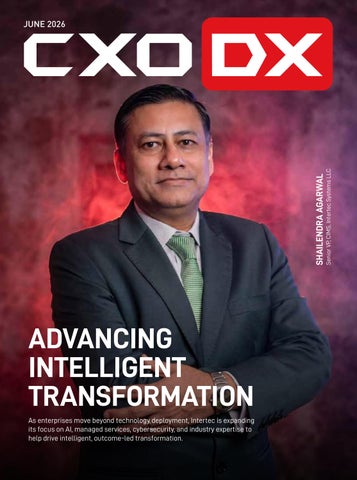

ADVANCING INTELLIGENT TRANSFORMATION
As enterprises move beyond technology deployment, Intertec is expanding its focus on AI, managed services, cybersecurity, and industry expertise to help drive intelligent, outcome-led transformation.
SHAILENDRA AGARWAL




REBUILDING THE DIGITAL ENTERPRISE IN THE AI ERA
For much of the past decade, enterprise technology strategies were shaped by a fairly consistent set of priorities. Organizations focused on cloud adoption, application modernization, digital transformation, and creating increasingly connected technology environments. Technology investments may have focused mostly on enabling data to move across systems, applications, clouds, and geographies with growing speed and flexibility. Success was often based on how quickly organizations could digitize processes and connect different parts of the business.
Artificial intelligence is beginning to challenge some of those assumptions, with the focus now shifting towards strengthening the foundations required for robust enterprise AI deployments. Recent conversations with technology leaders suggest that AI is not simply adding another layer to existing technology environments. Instead, it is exposing the limitations of architectures, governance models, operating structures, and data strategies that were designed for a different era.
Discussions around AI are now seeing an increased emphasis on governance, data quality, infrastructure readiness, operating models, and organizational capability. None of these are new priorities, but AI is elevating their importance and exposing weaknesses that organizations could previously afford to live with.
The shift is also evident in the market itself. Technology providers are expanding their focus beyond products and platforms to help customers address business outcomes, industry requirements, and operational challenges.
Perhaps most significantly, organizations are recognizing that the next phase of AI will not be defined by experimentation alone. Pilots can demonstrate potential, but enterprise value requires something more durable. It requires operating models that can scale, governance structures that can evolve, and architectures that can support increasingly intelligent and autonomous systems.
In many ways, the industry may be entering a period of enterprise rebuilding because the demands being placed on a company’s digital foundations are changing. The organizations that succeed will likely be those that use this moment to strengthen the underlying capabilities that turn innovation into sustainable business value.
RAMAN NARAYAN
Co-Founder & Editor in Chief narayan@leapmediallc.com Mob: +971-55-7802403
Ali Raza Designer
R. Narayan Editor in Chief, CXO DX
SAUMYADEEP HALDER
Co-Founder & MD
saumyadeep@leapmediallc.com Mob: +971-54-4458401
MALLIKA REGO
Co-Founder & Director Client Solutions mallika@leapmediallc.com Mob: +971-50-2489676
16
As enterprises move beyond technology deployment, Intertec is expanding its focus on AI, managed services, cybersecurity, and industry expertise to help drive intelligent, outcome-led transformation.
Yasser Abdullah, CEO - MEA at Jarltech Gulf, shares his insights on the evolving Middle East market for POS, mobility, and Auto-ID solutions
Select technology leaders from Saudi Arabia share their perspectives on the governance, data, infrastructure, and organizational capabilities required to operationalize AI at scale.
Shereen Faisal, Project Manager and AI & Data Scientist at the Nasser Centre for Science and Technology, Bahrain, shares her insights on AI governance and the foundations required for responsible AI adoption at scale.
Richard Tworek, Chief Technology Officer at Riverbed, discusses how AI-powered observability and autonomous IT operations are helping organizations shift from reactive troubleshooting to prevention-first digital experiences. 14
Marwan Abouzeid, Principal Digital Strategy Consultant at Backbase, explores how orchestration, governance, and platform strategy will define the next phase of digital transformation in the UAE.
Sofiane Benna, Chief Operations Officer at Ankabut, shares insights on cloud adoption, AI governance, cybersecurity, and the digital ecosystems enabling smarter educational institutions.
Ahmed Rashad, Sr. AI Specialist, Middle East & Africa at Nutanix, explores why enterprises across MEA must modernize infrastructure, embrace sovereign AI principles, and simplify operations to scale AI beyond pilot projects.
Guru Sethupathy, General Manager - AI Governance at Optro, discusses how AI-powered governance, continuous compliance, and unified risk management are helping organizations strengthen resilience in an increasingly complex regulatory landscape.
Michael Byrnes, Sr. Director, Solutions Engineering META at BeyondTrust, explores the growing threat of wiper attacks, why they differ fundamentally from ransomware, and the identity-centric security strategies organizations need to prevent irreversible cyber disruption.
CISCO INTRODUCES SECURITY INNOVATIONS TO SUPPORT ENTERPRISE AI AGENT ADOPTION
With end-to-end security across AI actions, Cisco is helping organizations confidently deploy AI agents at scale
At RSA Conference 2026, Cisco introduced solutions to address AI security issues and remove a top barrier to agent adoption.
“AI agents aren't just making existing work faster; they're a new workforce of co-workers that dramatically expand what organizations can accomplish,” said Jeetu Patel, President and Chief Product Officer at Cisco. “Projects shelved for lack of resources are now within reach. The only limit is imagination, and security teams are the key to unlocking this opportunity by making the agentic workforce safe enough to trust."
Cisco is extending Zero Trust Access to AI agents, holding them accountable to a human employee and securing agentic actions. New Duo IAM capabilities integrate with novel MCP policy enforcement and intent-aware monitoring in Cisco Secure Access to enforce strict access control, uniquely helping organizations gain full visibility and governance over their agentic
workforce.
Cisco is democratizing the industry-leading capabilities of AI Defense by launching Cisco AI Defense: Explorer Edition. After signing up, users can begin red teaming the AI models and applications that will be deployed into agentic workflows to uncover susceptibility to attacks and measure risk posture before deployment. This toolkit enables AI developers, AppSec teams, and security researchers to build and secure AI agents.
Cisco has introduced DefenseClaw — a secure agent framework designed to eliminate friction between development and security. By integrating a suite of essential open source tools — including Skills Scanner, MCP Scanner, AI BoM, and CodeGuard — DefenseClaw helps ensure that every skill is scanned and sandboxed, every MCP server is verified, and every AI asset is automatically inventoried, enabling

Jeetu Patel
President and Chief Product Officer, Cisco
developers to deploy secure agents with greater speed and confidence.
Splunk, part of Cisco's security portfolio, has already moved to embed AI capabilities into key SOC workflows. Today, it is further evolving the SOC from reactive to proactive.
INFOBLOX COMPLETES AXUR ACQUISITION
Combines digital risk protection and protective DNS to detect, disrupt, and block threats earlier in the attack lifecycle
Infoblox has completed its acquisition of Axur, a global provider of AI-powered external threat discovery and digital risk protection. With the close of the acquisition, Infoblox expands its preemptive security capabilities to address a growing class of digital threats and risks across the external attack surface that are outside customers’ direct control, enabling organizations to identify and stop them sooner.
With Axur, Infoblox will launch Digital Risk Protection Services (DRPS), which scans more than 40 million URLs daily using multi-modal AI to discover and validate threats, including phishing, brand abuse, executive impersonation, and credential exposure across the web, social platforms, mobile apps, and the dark web. The service confirms real abuse and automates the takedown of attacker infrastructure at scale.
Infoblox will also turn external threat intelligence into immediate action by feeding DRPS findings directly into Infoblox Threat Defense. This enables organizations to block malicious destinations while take-
downs are in progress, identify internal assets communicating with those destinations, and attribute the associated risk back to the organization within minutes of discovery.
In addition, DRPS will serve as the foundation for Continuous Threat Exposure Management as the first capability within Infoblox Exposure Management. The platform will expand in stages over the coming months to deliver an ongoing, measurable approach to reducing risk across an organization’s full attack surface.
“Infoblox is extending its leadership in preemptive security by expanding its ability to take down malicious infrastructure before it can be weaponized against enterprises,” said Scott Harrell, president and CEO of Infoblox. “By combining Axur’s external threat discovery, takedown and threat intelligence with Infoblox’s DNS-based security and intelligence, we expand Infoblox’s preemptive protection beyond enterprises’ perimeter and into arenas like social media, app stores and the dark web.”

President and CEO, Infoblox
The acquisition also enhances Infoblox Threat Intel by incorporating complementary skills, research capabilities, and data sources. The combined perspective will provide richer context into emerging threats, improve attribution, and enable earlier, more proactive disruption, particularly as attackers use AI to scale phishing, impersonation, and fraud campaigns globally.
Scott Harrell
HPE DELIVERS UNIFIED PRIVATE CLOUDS AND DATA PLATFORMS
New private cloud, storage, and data protection solutions simplify operations, strengthen resilience, and accelerate AI data pipelines
HPE announced new GreenLake innovations across private cloud, storage, and data protection that reshape how enterprises modernize infrastructure and accelerate AI data readiness. GreenLake delivers a cohesive approach that enables organizations to modernize virtualized and cloud-native workloads without forcing customers into fragmented, multi-vendor tools or risky migrations.
“Enterprises are rapidly modernizing for AI and cloud-native runtimes and this transformation is placing new demands on how environments are managed, protected, and scaled,” said Fidelma Russo, EVP & GM, Hybrid Cloud & CTO at HPE. “With these innovations, we’re helping organizations adopt a unified operating model that brings together private cloud, data, and protection, simplifies migration from legacy platforms, strengthens resilience, and delivers superior TCO to operate at scale.”
HPE Private Cloud now offers Kubernetes
for unified management of virtual machines (VMs) and containers on a single platform, with independent scaling for cloud-native workloads.
By offering unified infrastructure, operations, and data in an integrated, single-vendor solution, HPE Private Cloud gives customers greater control and consistent operations, helping reduce costs and manage risk. HPE also provides a streamlined upgrade path to the enterprise edition of HPE Morpheus Software.
The new HPE Private Cloud system is built on the latest HPE ProLiant Compute Gen12, delivering improved performance per watt, higher workload consolidation, and enhanced security with HPE Integrated Lights-Out (iLO). HPE Zerto Software now enables live workload migration from VMware environments to HPE virtual machines with continuous data protection, helping organizations migrate with minimal disruption while maintaining enter-

prise-grade protection and ultra-fast recovery from cyber events.
New integrations for the Veeam Data Platform provide data protection for HPE Private Cloud, while HPE StoreOnce integration delivers efficient, space-saving backup and real-time replication with near-zero RPO/RTO recovery.
HPE is also expanding its unified data layer with new native file storage, additional scale-out block storage, and agentic AI management to accelerate AI data pipelines and transform how data is managed, protected, and activated across the enterprise.
NTT DATA SURVEY HIGHLIGHTS PRIVACY AND SOVEREIGNTY CONCERNS AROUND ENTERPRISE AI
Demands for privacy and sovereignty expose limits of architectures built for centralized and borderless data flows
NTT DATA has released new research showing that enterprise AI is outgrowing the architecture and infrastructure beneath it as data privacy and sovereignty requirements tighten. The research finds a widening split between enterprises that are redesigning AI for control, locality and security, and organizations still layering AI into environments that were not built to support these requirements.
For years, enterprise architecture moved data across systems, clouds, applications and borders with increasing speed and efficiency. AI is exposing the limits of that model. Private and sovereign AI have become critical considerations.
NTT DATA’s 2026 Global AI Report: A Playbook for Private and Sovereign AI reveals a gap between what organizations know they need and what they are ready to build:
• More than 95% of respondents say pri-
vate and sovereign AI are important, but only 29% are prioritizing sovereign AI in a concrete, near-term way.
• About 35% of CAIOs identify building, integrating and managing complex AI models in private or sovereign environments as their top barrier to adoption, and nearly 60% of AI leaders cite cross-border data restrictions as a major challenge.
• Only 38% report high confidence in their cloud security posture—a critical foundation for both private and sovereign AI.
Private and sovereign AI are related, but distinct. Private AI focuses on protecting sensitive enterprise data, controlling access and limiting exposure. Sovereign AI focuses on ensuring that AI systems, data and operating environments meet jurisdictional, regulatory or national and regional control requirements.
"As AI evolves, private and sovereign approaches are testing enterprise readiness,"

said Abhijit Dubey, CEO and Chief AI Officer, NTT DATA, Inc. "The organizations that are succeeding are going beyond regulatory compliance and risk mitigation. They are building the operating foundation for AI that can perform across markets, jurisdictions and business environments. Our research shows AI leaders are pulling ahead by treating architecture, infrastructure and governance as strategic requirements."
Fidelma Russo EVP & GM, Hybrid Cloud & CTO, HPE
Abhijit Dubey CEO & Chief AI Officer, NTT DATA, Inc.
GENETEC URGES STRONGER CREDENTIAL GOVERNANCE FOR PHYSICAL SECURITY
Organizations should eliminate default and shared credentials
Genetec is urging organizations to strengthen credential governance across connected physical security systems, as AI accelerates the scale and sophistication of cyber threats.
For organizations managing connected cameras, access control systems, servers, and cloud services, weak or poorly governed credentials can expose sensitive operations and create new pathways into organizations. This includes the passwords used to connect directly to devices themselves, which are often overlooked but can provide a direct entry point if not properly managed.
“AI is changing the speed and scale of cyber risk,” said Firas Jadalla, Regional Director, Middle East, Turkey and Africa, Genetec Inc. “Attackers can now move faster and are using AI to impersonate people, tailor social engineering attacks, uncover vulnerabilities at scale, and evade detection. To respond, organizations need to actively govern access and identity across their systems, not just set controls once and
hope they hold.”
These risks are already affecting organizations that manage physical security systems. The recent Genetec Enterprise Physical Security in the Cloud Era research, which was based on insights from more than 7,300 physical security professionals worldwide, found that 58.7% of organizations have experienced an increase in phishing and smishing attacks, while 41% reported a rise in overall physical or cyber incidents. Social engineering was identified by 43.5% as a leading attack vector.
Genetec is encouraging organizations to move beyond isolated credential controls and adopt a governancefirst approach to identity management in physical security environments, including:
• Organizations should eliminate default and shared credentials, enforce strong authentication such as passkeys, and adopt multi-factor authentication (MFA) to reduce common attack entry points.
• Bringing IT and physical security teams
GROUP-IB LAUNCHES PREVYN AI
New cognitive core orchestrates agentic research and assistive response to outpace machine-speed threats
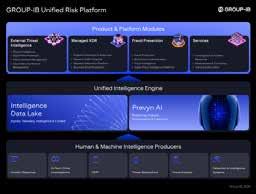
Group-IB has announced the launch of Group-IB Prevyn AI. As the cognitive core of the Group-IB Unified Risk Platform, Prevyn AI transforms Group-IB’s data lake into rapid insights in Threat Intelligence and decisive actions in Managed XDR.
Built to address the “execution gap” facing modern security teams, Prevyn AI moves beyond simple chatbots to provide
a foundational reasoning capability designed for adversary-centric analysis. The system is powered by Group-IB’s intelligence Data Lake, accumulated from decades of active cybercrime investigations, local insights from its Digital Crime Resistance Centers around the globe, and collaboration with international law enforcement.
Within Group-IB Threat Intelligence, Prevyn AI functions in an agentic mode, coordinating 11 specialised agents to carry out complex, adversary-focused intelligence and research. These agents—including experts in malware, threat actors, and dark web monitoring—are modeled on real High-Tech Crime investigative logic. This adversary-centric approach allows the platform to identify attacker intent and infrastructure staging before attacks launch, moving security from a reactive to a predictive posture.

together helps apply consistent security standards, improve visibility into access risks, and coordinate incident response.
• Organizations should manage physical security infrastructure with the same rigor as other mission-critical systems, including regular access reviews, controlled updates, and partnerships with trusted technology partners that support long-term security, transparency, and operational resilience.
In Managed XDR, the system operates in assistive mode to reduce the operational burden of SOC work. Prevyn AI analyzes alerts, generates incident reports, and prepares structured remediation workflows. This allows analysts to execute complex responses with a single click, ensuring that defenders can respond at the pace required to fight weaponized, machine-speed attacks.
Designed for high-stakes and regulated environments, Prevyn AI features a structural analyst-in-the-loop architecture. Every AI recommendation requires human approval before execution, ensuring that business-critical decisions remain under human control and align with emerging global AI governance expectations such as DORA and the EU AI Act.
“Threat Actors are already operating at machine speed, and defenders cannot respond at the pace required when investigations remain manual. The name Prevyn comes from ‘pre-vision’. Our goal is to move security from reactive to predictive, helping teams identify Threat Actor intent and infrastructure before an attack even launches.” said Dmitry Volkov, CEO of Group-IB.
Firas Jadalla
Regional Director, META, Genetec Inc.
MANAGEENGINE ROLLS OUT AUTONOMOUS AI CAPABILITIES ACROSS ITS SUITE
The company's commitment to data privacy and sovereignty helps customers adopt AI agents with confidence
ManageEngine, a division of Zoho Corporation and a leading provider of enterprise IT management solutions, announced the rollout of Zia Agents, the company's proprietary AI-powered autonomous agent, across its digital enterprise management suite. Built within a secure and privacy-compliant framework, these agents can orchestrate and execute tasks without the need for intervention. This marks a milestone in the company's vision of enabling truly autonomous IT environments.
"The frontier models are great for all-purpose use but are not often efficient for specific areas like enterprise IT. We take great care in building AI technology that is not only purpose-built but also provides value in terms of cost and long-term use. We are excited to bring autonomous AI capabilities to our offerings and provide a reliable platform for our customers to achieve efficient outcomes," said Rajesh Ganesan, CEO, ManageEngine.
ManageEngine’s autonomous AI capabili-
ties include prebuilt agents that can be deployed with a single click, while Zia Agent Studio enables users to build custom agents from scratch or configure them using natural language prompts. These agents are fully customizable, giving users control over configurations, tools, and the underlying knowledge base.
For more complex workflows, ManageEngine supports multi-agent orchestration, allowing a master agent to coordinate specialized subagents and seamlessly route tasks to the most appropriate agent. The company also emphasizes responsible AI adoption, ensuring that customer data is never used to train AI models. Administrators can define guardrails for agent behavior, while built-in observability provides a comprehensive audit trail of agent actions.
Additionally, ManageEngine tools support the standard Model Context Protocol (MCP), enabling customers to integrate them with third-party large language models (LLMs) and agentic AI platforms.
VEEAM UNVEILS INTELLIGENT RESOPS FOR THE AGENTIC AI ERA
This new Veeam solution add-on, powered by the Veeam DataAI Command Graph, unifies data context and recovery
Veeam Software announced Veeam Intelligent ResOps, a new solution that unifies data context and recovery. As agentic AI accelerates change at machine speed, Intelligent ResOps gives teams the insight they need into their data to quickly understand impact and recover precisely – without broad rollbacks when something happens. Intelligent ResOps is the first resilience offering on the new Veeam DataAI Command Platform and helps organizations back up and retain data more intelligently, prioritize incident response with clear context on what changed (including AI-driven changes), and restore only the impacted data – reducing risk, disruption, and recovery time.
Veeam Intelligent ResOps is the first of a new generation of resilience capabilities built for the Agentic AI era where data context, identity and AI activity are insep-
arable from AI. Microsoft 365, the world’s most popular Software-as-a-Service (SaaS) application and where much of an organization’s sensitive, regulated data resides, is the first supported workload.
At the core of Veeam Intelligent ResOps is the DataAI Command Graph. This unified intelligence layer continuously maps data, users, permissions, AI agents, activity, and protection status to deliver actionable context across environments. This context helps teams understand what data they have, what matters most, what’s at risk, and what’s protected so that they can act faster before, during, and after incidents. Intelligent ResOps is currently not a standalone offering, it is sold as an extension of the core Veeam resilience solutions on the Veeam DataAI Command Platform.
“Too many enterprises are flying blind

Rajesh
Ganesan
CEO, ManageEngine
With the launch of Zia Agents, the focus shifts from AI-enabled assistance to autonomous execution across IT service management, full-stack observability, endpoint management, and security operations. These agents are built on the same Zia agentic platform shared across the ManageEngine suite, making it easy to enable native cross-product intelligence without custom integration overhead

Rehan Jalil
President of Products
and
Technology,
Veeam
without clear visibility into what data they have, what changed, and what’s truly at risk,” said Rehan Jalil, President of Products and Technology at Veeam. “In this agentic AI era, resilience can’t be reactive. Veeam Intelligent ResOps is the only solution that connects data, identity, and AI context with recovery actions across production and backup, powered by the DataAI Command Graph, so organizations can quickly pinpoint impact and restore only what they need—nothing more”.
WSO2 LAUNCHES AGENT MANAGER
New, open platform aims to balance innovation and risk management in the era of AI agents
WSO2 announced the beta launch of WSO2 Agent Manager, an open control plane for AI agents, giving enterprises a unified way to identify, govern, secure, and scale agents across environments. As organizations move from AI experimentation to production, WSO2 Agent Manager addresses a critical gap: bringing visibility, control, and accountability to autonomous agents operating across the enterprise.
Organizations are accelerating adoption to avoid being left behind, driven by the promise of non-linear productivity gains that agentic systems can unlock. However, operational maturity is lagging behind. Many teams are forced to choose between moving fast with limited visibility and control, introducing significant unmanaged risk, or slowing progress to build operational frameworks for each runtime and environment. According to Gartner, more than 40% of agentic AI projects are expected to be canceled by 2027 due to
rising costs, unclear value, and insufficient risk controls.
WSO2 Agent Manager extends WSO2’s long-standing role as the enterprise control layer into the era of AI, making agents from being invisible to first-class, governed participants in enterprise systems.
“AI agents introduce a fundamentally new challenge. Their autonomy and probabilistic behavior make them powerful but also difficult to control,” said Rania Khalaf, Chief AI Officer at WSO2. “With WSO2 Agent Manager, we’re bringing agents into the enterprise fabric where they are no longer invisible processes, but identified, governed, accountable entities that can be securely operated at scale.”
As enterprises deploy increasing numbers of agents, many are encountering “agent sprawl” with limited coordination, inconsistent controls, and growing compliance risks, often compounded by fragmented tooling across frameworks, runtimes, and

hyperscalers. WSO2 Agent Manager addresses this by establishing a centralized system of record for all agents, enabling organizations to innovate freely by choosing the frameworks that best fit their use cases while maintaining a consistent approach to agent operations. This includes unified governance, performance insights, and policy enforcement for agents running both within Agent Manager and across external environments.
PALO ALTO NETWORKS TO ACQUIRE PORTKEY TO SECURE THE RISE OF AI AGENTS
Establishes the AI Gateway as mission-critical control plane for autonomous agents
Palo Alto Palo Alto Networks has announced its intent to acquire Portkey, a pioneer in AI Gateways. Portkey delivers a critical centralized control plane to manage and protect autonomous AI agents, already processing trillions of tokens per month with the low latency required for agent-to-agent communication. By ensuring that security governance never comes at the expense of developer speed, Portkey allows enterprises to accelerate AI innovation with confidence.
Portkey will serve as the AI Gateway for Prisma AIRS, acting as the central nervous system that can monitor, route, and secure every AI transaction across the enterprise.
Lee Klarich, Chief Product & Technology Officer of Palo Alto Networks said, "As autonomous agents join the enterprise workforce, they also become a new, unmanaged attack surface. By integrating Portkey into Prisma AIRS, organizations will be able to confidently deploy and
govern AI agents. With Portkey, we are providing enterprises with visibility into all their agentic traffic, and enabling them to control and protect against agentic threats."
By establishing Portkey as the AI Gateway for Prisma AIRS, the unified architecture allows organizations to move autonomous workloads into production with built-in security, reliability and management.
Following the close of the transaction, Portkey will be the AI Gateway for Prisma AIRS, inspecting AI traffic and enforcing security and governance policies for prevention at runtime, to identify threats and safeguard data. By enforcing AI Identity Security, it will apply strict least-privilege controls to every agent interaction, ensuring all AI workloads remain secure and compliant.
Centralized artifact management allows seamless versioning and secure access

control across all AI models, agents, and MCP servers, transforming fragmented AI experiments into a disciplined, global production engine. In addition, organizations can now eliminate "bill shock" and dramatically reduce operational costs through caching techniques and granular quotas, while accessing over 3,000 LLMs and MCP tools via a unified interface.
Rania Khalaf Chief AI Officer, WSO2
Lee Klarich
Chief Product & Technology Officer, Palo Alto Networks
ACRONIS LAUNCHES CYBER FRAME FOR SERVICE PROVIDERS
New AI-powered, protected by default infrastructure platform gives partners greater control, stronger margins, and faster time to market
Acronis, a global leader in cyber protection, has announced the launch of Acronis Cyber Frame, a new hyperconverged infrastructure (HCI) and infrastructure-as-a-service (IaaS) platform purpose-built for service providers.
Designed specifically for managed service providers (MSPs), cloud service providers (CSPs), hosting providers, and telcos, Acronis Cyber Frame enables partners to deliver, protect, manage, and automate build, deliver, and monetize infrastructure services on their own terms by combining virtual machines, networking, and storage with Acronis’ natively integrated cyber protection, management, and automation. This approach helps improve business outcomes with more predictable pricing, stronger resale margins, and a better fit for regional, sovereign, and legacy virtualization replacement opportunities.
At a time of disruption in legacy virtualization, increasing hyperscaler cost pressures, and rising demand for regional and sover-
eign cloud solutions, Acronis Cyber Frame gives service providers a new path to regain control of their infrastructure strategy and margins.
“Service providers are rethinking their infrastructure strategies in response to major market shifts and need infrastructure that fits their business,” said Gaidar Magdanurov, President at Acronis. “Acronis Cyber Frame brings infrastructure, protection, and management together in a single, natively integrated platform, helping partners simplify complexity and achieve stronger margins from their infrastructure services.”
Acronis Cyber Frame offers a flexible deployment model that allows partners to choose how they build and scale their infrastructure business:
• Acronis Cyber Frame Cloud: A fully hosted option that enables rapid time to market with no upfront infrastructure investment

Gaidar Magdanurov President, Acronis
• Acronis Cyber Frame Local: A partner-hosted deployment model providing full control over infrastructure, economics, performance, and data location
Every workload deployed on Cyber Frame includes built-in backup and disaster recovery, security and threat protection, and remote monitoring and management (RMM). By integrating these capabilities natively, Cyber Frame reduces operational complexity, eliminates tool sprawl, and enables partners to deliver secure infrastructure services from day one.
SAS EXPANDS SAS VIYA WITH GOVERNED AI ASSISTANTS AND AGENTIC AI CAPABILITIES
New AI assistants and agent infrastructure help business and analytics teams move from experimentation to governed, production-ready intelligence

SAS, a global leader in data and AI, announced expansions to SAS Viya that advance the platform’s agentic AI features, introducing new AI assistants, agent infrastructure and acceleration tools. Together, these updates build on SAS Viya’s existing AI foundation, helping organizations move from isolated generative AI use cases to governed, production-ready intelligence at scale.
New SAS Viya features include SAS Viya Copilot, a family of AI assistants
embedded across the analytics life cycle; the SAS Viya Model Context Protocol (MCP) Server, which uses the open MCP standard to expose SAS Viya analytics and decisioning capabilities as tools for AI agents; and the SAS Agentic AI Accelerator, a curated framework for building, governing, and deploying AI agents within SAS Viya.
SAS leadership emphasized the importance of human judgment in scaling agentic AI responsibly.
“The role of human expertise in operationalizing agentic AI is not diminished by automation; it's elevated,” said Jared Peterson, Senior Vice President, Global Engineering at SAS. “With SAS Viya, organizations can pair copilots and agents with human judgment, trusted data and
enterprise governance, so AI doesn't just generate outputs but drives responsible, real-world decisions.”
SAS Viya Copilot is a governed, conversational AI assistant embedded directly into the SAS Viya platform, designed to work alongside human experts inside production-grade analytics workflows. It helps organizations analyze data, build models and make decisions across the analytic life cycle while maintaining enterprise-grade security and oversight.
Current SAS Viya Copilot capabilities include general Q&A across core Viya applications, including data discovery, model pipeline development, model management, decision intelligence, and environment management. The platform also provides code acceleration with AI-generated SAS and Python code, documentation, and explanations; model pipeline guidance with intelligent recommendations, next steps, and explainability; and conversational dashboarding with AI-driven data enrichment, natural language dashboard creation, and automated insights. In addition, it supports visual investigation with AI-assisted search and AI-powered case and alert narratives.
IBM EXPANDS ITS AI OPERATING MODEL CAPABILITIES
Next-generation agent orchestration and agentic development give enterprises a unified way to plan, build, deploy, and govern AI agents at scale
At its annual Think conference, IBM announced its most comprehensive expansion of enterprise AI and hybrid cloud management capabilities to date. Products and capabilities unveiled today include the next generation of IBM watsonx Orchestrate for multi-agent orchestration, IBM Confluent to bring real-time data to AI, IBM Concert platform for intelligent operations, and IBM Sovereign Core for operational independence.
The announcements address the defining challenge facing enterprises: many have invested heavily in AI, but only few believe it is paying off. The products and capabilities unveiled today address this gap for enterprises.
“Across the Middle East and Africa, the next phase of AI will not be defined by experimentation, but by how deeply it is embedded into the way enterprises operate,” said Saad Toma, General Manager, IBM Middle East and Africa. “Successful enterprises are moving from isolated AI projects to an operating model where agents, data, automation, hybrid cloud, governance and sovereignty work together by design. That is how AI moves from ambition to productivity, from pilots to measurable business value, and from fragmented adoption to transformation at scale.”
AI requires a new operating model, built on four integrated systems working together: agents through coordinated AI that executes and adapts across the business; data through real-time, connected information that gives teams a shared view of what's happening; automation through end-to-end infrastructure and automated workflows that scale across processes; and hybrid through operational independence for sovereignty, governance, and security that allows AI to run consistently and with controls. Each is a separate priority that enterprises are chasing. Together, they represent a fundamental shift from improving parts of the business to changing
how the business operates. Today's announcements represent the next evolution of IBM's portfolio, to deliver against the operating model.
As organizations move from deploying a handful of agents to managing thousands, built by different teams on different platforms, the core challenge shifts from building agents to keep them governed and auditable in near real time.
IBM is announcing the next generation of watsonx Orchestrate (available in private preview), evolving it into an agentic control plane for the multi-agent era, where organizations can deploy agents from any source with consistent policy enforcement and accountability.

Alongside watsonx Orchestrate, IBM recently announced IBM Bob (generally available), an agentic development partner designed for the enterprise, partners with developers to build agents with security and cost controls built in.
For most enterprises, data is siloed and without meaning. To effectively power agentic systems with up-to-date data, IBM is delivering, real-time, AI-ready data foundation through its recent acquisition of Confluent for real-time data streaming built on Kafka and Flink technologies, and pairing new capabilities coming to watsonx.data with a real-time context layer for AI.
IBM is announcing IBM Concert platform (available in public preview), an AI-powered operations platform to move organizations from passive monitoring to coordinated, intelligent response. Where traditional tools capture metrics, the Con-
cert platform brings systems together. It correlates signals together into a single view across applications, infrastructure, network, without requiring organizations to rip and replace existing tooling.
IBM is also announcing the general availability of IBM Sovereign Core, a platform that embeds policy at the infrastructure runtime level, so governance can be addressed as regulatory requirements evolve, while prioritizing workload portability. IBM Sovereign Core includes an extensible catalog that organizations can curate for their own users, with their own applications, or populated with pre-vetted IBM, third-party and open-source software and services from an ecosystem of partners that includes: AMD, ATOS, Cegeka, Cloudera, Dell, Elastic, HCL, Intel, Mistral, MongoDB and Palo Alto Networks.
Built on open, enterprise-grade technologies like Red Hat OpenShift and Red Hat AI, IBM Sovereign Core enables organizations to extend existing investments across hybrid and partner environments.
EVERPURE REDEFINES CYBER RESILIENCE WITH DATA MANAGEMENT
In the age of AI, storage and data management determine business survival when the perimeter fails.

Everpure has reinforced its Enterprise Data Cloud vision, defining the storage layer as the last line of defense in modern cyber resilience.
As AI weaponizes zero-day vulnerabilities and automates sophisticated attacks, CISOs are no longer fighting at human speed. Everpure is leading the transition to an 'outside-in' security model that assumes perimeter failure and guarantees the storage layer remains an uncompromisable point of recovery. By using immutable snapshots, the Everpure architecture transforms restoration into an instantaneous experience, eliminating the manual processes that traditionally inflate Mean Time to Recover (MTTR). To prevent an attacker or rogue AI from weaponizing this speed, Everpure places humans at the governance gate. Recovery is immediate; data destruction is impossible without verified oversight.
"The modern enterprise is defined by its data, yet most organizations are flying blind, treating their most valuable asset as a commodity to be warehoused," said Prakash Darji, General Manager of Digital
Experience at Everpure. "We are doubling down on that reality. By architecting our platform to be both data-aware and inherently resilient, we aren't just managing data— we are delivering an insurance policy against the chaos of the AI era. We are giving our customers the certainty that no matter what happens at the perimeter, the heartbeat of their business stays strong."
Everpure's Enterprise Data Cloud delivers guaranteed data recovery, turning days of downtime into minutes. An isolated, intelligent control plane governs data across on-premises and cloud environments and preserves the integrity of the recovery point itself, so even an attacker who gains administrative access cannot corrupt, tamper with, or delete protected copies.
Everpure keeps a verified, immutable version of the truth available at all times, protecting customers against both immediate data loss and the long-tail risk of silent corruption that can surface months after an attack– countering the 72% of ransomware-affected organizations that never fully recover their data.
This architecture enables three core outcomes:
Autonomous Resilience ensures continuous operations through upgrades, patching, and active attacks. Powered by the Everpure Protect service, it correlates external threat signals with storage-level insights to trigger preemptive hardening. Working alongside Everpure Fusion, it functions as an automated active defense layer, remediating configuration gaps and enforcing security standards across every endpoint to keep active defenses operating at peak efficacy.
Trusted Recovery is built around a Hu-
man-in-the-Loop (HITL) mandate that requires multi-party, out-of-band authorization for any sensitive data action. Enforced by Everpure Fusion, this governance model uses Security Presets to eliminate configuration drift and ensure SafeMode snapshots remain active by default. Even if an adversary or rogue AI gains administrative control of the production environment, the data layer remains isolated and ready for verified restoration.
Economic Predictability helps organizations avoid the ransom-versus-recovery gamble at a time when the average cost of a data breach has reached $4.44 million. Through Evergreen//One, customers gain access to predictable, subscription-based economics that align infrastructure costs with usage while eliminating the financial impact of disruptive upgrades and downtime.
Recovery in Hours Instead of Weeks
In a recent incident with a Fortune 100 customer, attackers compromised identity and compute layers using stolen credentials. Despite the devastation, the data layer remained untouchable. Everpure’s strict administrative separation prevented attackers from accessing, modifying, or deleting protected SafeMode snapshots—even with global administrator privileges. This foundation of verified trust allowed the organization to restore revenue-critical operations in hours rather than weeks.
Contextual Intelligence
Understanding the data itself is the next frontier of defense. With the closing of the 1touch acquisition, Everpure is adding a critical dimension to its resilience pillar: context. By integrating 1touch’s advanced data discovery with the Enterprise Data Cloud, Everpure customers gain a continuous, 360-degree view of the data landscape. This intelligence maps the vital links between business applications and their underlying data, ensuring that when a recovery is required, the most critical operations are restored with absolute priority and precision.
DELL TECHNOLOGIES UNVEILS DELL DESKSIDE AGENTIC AI
Expands the Dell AI Factory with NVIDIA, giving enterprises a local, secure and cost-predictable foundation for production-ready agentic AI from the desk
Dell Technologies has introduced Dell Deskside Agentic AI, a new addition to the Dell AI Factory with NVIDIA that gives workgroups the ability to deploy and scale agentic AI workflows locally without the cost, latency and data sovereignty constraints of cloud-only approaches. With the NVIDIA OpenShell runtime now supported across the entire Dell AI Factory with NVIDIA, enterprises benefit from a single security and policy enforcement layer from deskside workstations to Dell PowerEdge XE servers.
The Dell AI Factory with NVIDIA delivers an enterprise-ready path from the desk where decisions are made to the data center where they scale. For agentic AI workloads of various sizes, organizations can break even versus public cloud API costs in as little as three months with Dell Deskside Agentic AI. Deskside systems keep inferencing local, costs predictable and data secure, giving businesses greater control over their AI environment. NVIDIA OpenShell gives developers and IT teams a secure, sandboxed environment to build, deploy and govern AI agents across the Dell AI Factory with NVIDIA from workstations to servers. Teams can build and iterate more freely while reducing exposure to unpredictable cloud inference costs, bandwidth expenses and IP risks.
A complete solution for production-ready deskside agentic AI
Dell Deskside Agentic AI is built around the reality that roughly over 50% of agentic workflows run on open-weight models. This is where the 30-billion to 284-billion parameter model range performs bulk reasoning that efficiently drives operations forward. From coding assistants and research agents to highly secure, private AI assistants for regulated industries, the solution offers a range of Dell high-performance workstations, each sized for different workload and budget requirements. These pair with the NVIDIA NemoClaw reference stack and Dell Services to handle heavy AI workloads wherever they make the most economic sense. With Dell Deskside Agentic AI, organizations

can reduce spend up to 87% compared to cloud APIs, over two years.
Dell Pro Max with GB10: Compact and power-efficient system for small-scale, individual agent prototyping, starting with 30 billion up to 200 billion parameter models.
• Dell Pro Precision 9: Enterprise workstation towers featuring Intel Xeon 600 processors for workstation and up to five NVIDIA RTX PRO Blackwell Workstation Edition GPU configurations, providing scalable performance for workhorse-class GPU workloads and supporting models from 30 billion to 500 billion parameters.
• Dell Pro Max with GB300: Powered by the NVIDIA GB300 Grace Blackwell Ultra Desktop Superchip and Dell’s exclusive MaxCool technology for peak efficiency, this platform is purpose-built for inference of frontier-level AI models from 120 billion up to 1 trillion parameter models.
• NVIDIA NemoClaw reference stack: An open-source foundation for securely managing always-on AI agents built on OpenClaw, the agentic framework that powers persistent, autonomous, multistep AI workflows on local hardware. The stack combines high-performance NVIDIA Nemotron open models for reasoning and coding, and OpenShell's secure runtime — all part of the NVIDIA Agent Toolkit for building and orchestrating long-running agents.
• Dell Services: End-to-end guidance through the full agentic AI lifecycle –from initial strategy and hardware deployment to workflow alignment, agent prioritization and ongoing optimization – accelerating time-to-production and closing internal AI skills gaps.
Reliable framework for every workload
Deploying agentic AI in production requires a consistent framework that protects sensitive data, integrates with current operations and covers the full infrastructure stack. NVIDIA OpenShell, now supported across the entire Dell AI Factory with NVIDIA, gives organizations a sandboxed environment to build, deploy and govern agents with privacy and security controls at runtime. It spans Dell high-performance workstations through Dell PowerEdge XE servers on Canonical Ubuntu and Red Hat AI in the Dell AI Factory with NVIDIA. Developing and deploying agents closer to data improves governance, security and operational control.
NVIDIA AI-Q 2.0 blueprint support gives organizations a tested foundation to deploy multi-agent workflows handling research, decision support and complex tasks, accelerating the move from pilot to production. Now available as the Dell-NVIDIA AI-Q 2.0 Reference Architecture, powered by Dell AI Data Platform, it is engineered for demanding on-premises workloads in regulated industries including financial services, public sector and manufacturing.
BUILDING A ZERO-DISRUPTION FUTURE
Richard Tworek, Chief Technology Officer at Riverbed, discusses how AI-powered observability and autonomous IT operations are helping organizations shift from reactive troubleshooting to prevention-first digital experiences.
How does Riverbed's latest launch set to redefine the digital employee experience with the promise of 'zero-disruption'? What are those specific bottlenecks employees typically face in their digital workplace?
The shift we're driving isn't just about faster incident response. It's about preventing incidents altogether. For decades, IT has operated reactively. Users hit a problem, they report it, and then IT scrambles to fix it. But that model is obsolete given today's budget challenges and environment. With increasing digital dependence, employees face annoying productivity zapping friction from applications that hang, network latency that impacts response time, and devices that slow down mid-workflow. IT depends on users to report issues, reproduce them, and wait for resolution. That's asking employees to participate in troubleshooting instead of letting them focus on work.
Zero Disruption changes the fundamental premise. By combining full-fidelity operational data with autonomous AI, we identify and resolve issues before employees feel them. Riverbed's 25 years of application and network expertise gives us the data foundation and contextual intelligence that point products simply cannot match. Prevention beats participation every time.
Discuss briefly the highlights of the 6 new innovations integrated with Riverbed Aternity?
We're announcing six capabilities that work together as a unified system for prevention-first operations. Riverbed IQ 4.0 is the intelligence layer. It moves beyond AI-assisted insights to enable authorised AI-driven actions including intelligent workflow creation, natural language interaction, and personalised operational experiences. IT defines what the AI is allowed to do and under what conditions.
Riverbed Q is the conversational interface, bringing that intelligence into the tools IT teams already use such as Microsoft Teams, ServiceNow, and Slack, so they work where they are rather than jumping between platforms.
AI Assurance addresses a critical gap. As AI embeds across enterprise workflows, organisations need visibility into AI adoption, shadow AI usage, operational costs, and agentic behaviour. That observability has to live in your operational platform, not in disconnected tools.
Aternity Replay 2.0 extends from individual user sessions to fleet-wide visibility, so IT teams can see what employees experienced across the organisation without asking them to reproduce

Richard Tworek Chief Technology Officer,
Riverbed
issues. High Frequency Analytics captures telemetry at 1-second resolution, catching the short-duration and intermittent issues that traditional monitoring misses.
APM+ brings deep application intelligence directly into IT workflows, connecting deep application behaviour at the server and inside the application to employee experience. Data Express accelerates data movement at 10x traditional speed, which is critical for AI initiatives and cloud migrations.
Together, they form a unified foundation offering full-fidelity data collection, intelligent autonomous action, and the speed to prevent disruption before it happens.
How does Riverbed IQ 4.0 help organizations move from AI-assisted workflows toward autonomous IT operations? With IQ 4.0, we've introduced an "agentic framework" wherein
» INTERVIEW
IT defines the conditions under which AI can act, what actions are authorised, and where human oversight is required. To be clear, it's not about unchecked automation, but rather governed autonomy. This is what differentiates the framework from assisted workflows. Where assisted AI surfaces insights and recommendations, IQ 4.0 takes action. It creates intelligent workflows, learns from outcomes, and adjusts. Over time, repetitive remediation becomes automatic, freeing IT teams from reactive firefighting.
For this to work as organisations expect, our agentic framework operates with deep contextual awareness across devices, applications, and networks. It understands efficacy and impact scoring and knows whether an action will actually solve the problem and what the blast radius is. Most importantly, it enables organisations to move at their own pace, starting with low-risk automations and expanding as confidence builds.
AI Assurance introduces observability around AI usage and agentic behavior. Why is visibility into enterprise AI activity becoming critical today?
As AI becomes embedded into enterprise workflows, governance cannot be treated as a separate operational layer. Organisations need visibility into how AI is behaving within the same environment where they're already managing employee experience and IT operations.
Riverbed is in a unique position because we understand agent behaviour through our application performance management technology, we see the network traffic generated by agents, and we understand how the agent or application is behaving on the customer's endpoint. That's a complete picture most platforms can't provide.
Organisations are seeing a growing need for operational AI observability, which means understanding AI adoption, shadow AI activity, costs, and agentic behaviour in context with application and network performance. Integrating those capabilities directly into the platform helps customers observe AI as part of day-to-day operations rather than through disconnected tooling. It's about operational visibility, not surveillance. Understanding what's happening in your environment so you can govern it responsibly.
As digital workers and AI agents become part of enterprise operations, can Aternity monitor them as well? Do they experience the same operational issues as human users, or a completely different set of challenges?
Yes, Aternity can monitor digital workers and AI agents by leveraging our APM+ tool. The digital or agent is instrumented with the open standard reporting tool OTel. Our workspaces dashboard then reports observed activity and resource consumption.
Aternity Replay 2.0 expands visibility from individual sessions to fleet-wide experiences. How does this improve root cause analysis and troubleshooting?
The traditional troubleshooting model has a built-in problem. IT can't reproduce the issue, users can't describe exactly what happened, and you're left guessing at the cause. Aternity Replay 2.0 solves that by capturing what employees actually experienced as a detailed operational record, not a video, across your entire fleet.
From a governance perspective, organisations maintain control over how Replay is configured and where it's deployed. All sensitive data is obfuscated within the interface and isn't even captured or stored. The focus is on operational diagnostics, helping IT understand what employees experienced so issues can be resolved faster, especially in large, distributed environments where intermittent problems are difficult to reproduce.
Fleet-wide visibility means you're not waiting for one user to report a problem. You can identify patterns across thousands of employees such as when a workflow failed for 200 users this morning and address systemic issues immediately. For root cause analysis, Replay eliminates the "can't reproduce" trap entirely. When issues are intermittent or environment-specific, you have the evidence you need. You move from hypothesis-driven troubleshooting to evidence-based diagnosis, which is how you reduce both MTTR and escalations.
As enterprises become more dependent on digital operations, is operational resilience becoming as important as cybersecurity itself?
Cybersecurity remains fundamentally the most important priority. A breach can directly compromise data integrity, privacy, and trust in ways that other operational failures cannot. That said, the two domains are becoming tightly interconnected. The Riverbed Platform and our observability solutions play a key role in bridging this gap: by providing full-fidelity visibility across applications, networks, and endpoints, we surface incidents, anomalies, and performance degradations that may signal underlying cybersecurity threats.
Due to the dependency of digital operations, in many cases, what initially appears as a performance issue or service degradation can be an early indicator of a security event. This convergence reinforces that while cybersecurity must remain the top priority, operational resilience, enabled by deep observability, is essential to detecting, understanding, and responding to security risks before they escalate.
Looking ahead, what will distinguish organizations that successfully operationalize autonomous IT from those still operating reactively?
Bottom line will be productivity, not only the IT department but the end users themselves and applications critical to the mission of the enterprise or federal agency. Autonomous IT will approach “non-stop” operations where IT can focus on other mission critical enterprise requirements.
Successful organizations will shift their operating model from ticket-driven workflows to prevention first engineering, where success is measured in avoided incidents, not resolved ones. In contrast, reactive organizations will remain constrained by siloed tools, low-confidence data, and organizational reluctance to delegate action to automation leaving them stuck in detect-and-respond cycles and the burden is back to the end user.
Ultimately, the differentiator will be confidence at scale: confidence in the data, confidence in the AI, and confidence in the governance model that allows enterprises to act before disruption occurs.
ADVANCING INTELLIGENT TRANSFORMATION
As enterprises move beyond technology deployment, Intertec is expanding its focus on AI, managed services, cybersecurity, and industry expertise to help drive intelligent, outcome-led transformation.
As enterprises accelerate AI adoption, the conversation is shifting beyond models and use cases. Organizations are increasingly looking for partners that can help them align technology investments with business outcomes, navigate industry-specific challenges, and support long-term transformation initiatives.
For Intertec Systems, that evolution mirrors its own journey over the past three decades. What began as a traditional systems integration business has steadily expanded into a broader digital transformation practice spanning cloud, cybersecurity, managed services, data platforms, AI, and industry-focused solutions.

R. Narayan
Shailendra Agarwal Senior VP, CIMS, Intertec Systems LLC
According to Shailendra Agarwal, Senior Vice President, CIMS, Intertec Systems LLC, the company's growth has been shaped by its ability to evolve alongside changing customer priorities while maintaining long-standing relationships.
He says, "Today, the company enjoys strong brand recognition across the GCC and is widely regarded as a trusted technology partner. What makes us particularly proud is not only the longevity of the business, but the relationships we have built along the way."
Those relationships have translated into strong customer and employee retention, something Shailendra believes has helped the company build both continuity and expertise.
"Our customer retention levels remain consistently high, exceeding 90 percent in many cases, which reflects the trust our clients place in us. Equally important is our employee retention. Many members of our team have been with Intertec for more than 20 years, which is unusual in the technology industry."
That stability has also enabled the company to expand beyond its traditional roots as a systems integrator.
"We started as a traditional systems integrator, but today we are a digital transformation partner helping organizations modernize infrastructure, adopt cloud and AI technologies, strengthen cybersecurity, and transform business operations through intelligent applications and services," adds Shailendra.
From Infrastructure to Transformation
The role of the systems integrator has changed significantly in recent years. As organizations pursue digital transformation initiatives, technology decisions are increasingly linked to business priorities such as productivity, customer experience, resilience, governance, and operational efficiency.
For Intertec, that has meant building capabilities across both infrastructure and applications rather than operating within a single technology domain. This has increased demand for partners that can connect infrastructure, applications, and operational processes into a cohesive transformation strategy.
"Among regional, homegrown systems integrators, Intertec is one of the leading players. We have built strong capabilities across both infrastructure and applications, which gives us a unique position in the market," says Shailendra.
On the infrastructure side, the company today works across servers, storage, networking, cybersecurity, cloud, data platforms, AI, and managed services. The applications side of the business has also expanded considerably.
»
Shailendra elaborates, "We support customers throughout the lifecycle, from consulting and architecture design to implementation, operations, and managed services. We have established strong practices around Enterprise Asset Management, Microsoft Business Applications, digital transformation platforms, and industry-specific solutions."
Supporting those initiatives is a development center in India with approximately 200 professionals focused on digital transformation projects and the development of industry-focused intellectual property.
"This combination of infrastructure expertise, application capabilities, and managed services allows us to engage customers at multiple levels of their transformation journey," adds Shailendra.
Industry expertise as a key differentiator
Technology implementation alone is no longer enough. As organizations digitize core business processes and modernize operations, industry expertise is becoming a key differentiator. That shift prompted Intertec to sharpen its focus on a number of vertical markets.
Shailendra says, "Industry specialization has become a major focus area for us. About five years ago, we made a conscious decision to move beyond a generalist approach and focus more deeply on specific verticals."
Today, healthcare, transportation, banking, government, and large enterprise organizations represent the company's primary focus sectors. Healthcare provides one of the strongest examples of this strategy. Rather than focusing on standalone technology deployments, Intertec has developed platforms designed to support broader healthcare ecosystems.
"Each of these industries faces unique challenges and requires specialized solutions rather than generic technology implementations. We have developed platforms that help healthcare regulators manage and oversee healthcare ecosystems, including healthcare providers, pharmacies, doctors, drug registration processes, and citizen-facing services," adds Shailendra.
These solutions are designed to support compliance, operational efficiency, and service delivery while addressing sector-specific regulatory and operational requirements.
The same philosophy extends to government and insurance sectors.
He adds, "Similarly, we have developed solutions and frameworks for government organizations, insurance providers, and other sectors. The objective is not simply to implement technology but to create repeatable solutions that address real business challenges within specific industries."
Building Intellectual Property
While systems integration remains a core capability, the company's strategy focuses on developing solutions that can be adapted across organizations while retaining the flexibility required for customer-specific needs.
He adds, "Our strategy is to build frameworks and solutions that address common industry challenges while remaining flexible enough to be adapted to individual customer requirements."
Across healthcare, insurance, and government sectors, these platforms provide a common foundation while reducing the need to
start from scratch for every deployment. As AI becomes more pervasive, those platforms are also evolving.
"This approach accelerates deployment, reduces implementation risk, and helps customers achieve business outcomes more quickly. We continue to invest in enhancing these platforms by incorporating new technologies, including AI and advanced analytics capabilities," adds Shailendra.
Moving AI Beyond Experimentation
Many organizations are today working through how to translate AI investments into measurable business outcomes. At Intertec, AI is viewed as the next phase of digital transformation rather than a standalone initiative.
"We see AI as a natural extension of digital transformation. Organizations have spent years digitizing processes and generating data. The next step is using that data intelligently to drive better decisions, automate processes, and improve business outcomes," says Shailendra.
Rather than building foundational AI models, the company focuses on helping customers identify practical use cases and establish clear objectives.
He adds, "Our role is not to build foundational AI models ourselves. Instead, we focus on helping customers identify the right use cases, establish clear business objectives, and implement solutions that deliver measurable value."
One challenge that continues to surface is the gap between experimentation and return on investment.
"Many organizations are experimenting with AI without fully understanding how it aligns with their business priorities. As a result, a significant percentage of AI initiatives struggle to demonstrate meaningful return on investment," says Shailendra.
The goal, he adds, is to help customers move beyond proof-of-concepts toward practical deployment.
"Successful AI projects begin with business outcomes rather than technology. Organizations need clarity around the problem they are trying to solve, the data required, the governance framework, and the metrics that will define success. Our approach is to guide customers through this process and help them move from experimentation to practical deployment."
The nature of AI discussions has evolved considerably over the past 18 months.
"Today, customers are increasingly focused on outcomes. They want to understand how AI can improve productivity, reduce costs, enhance customer experiences, strengthen decision-making, or create new revenue opportunities, " says Shailendra.
At the same time, governance is emerging as a critical component of AI adoption strategies.
He adds, "There is also growing awareness around governance, security, and responsible AI. Organizations recognize that AI adoption must be accompanied by clear policies, controls, and accountability mechanisms."
As enterprises scale AI initiatives, the ability to balance innovation with governance is becoming just as important as selecting the right technologies.
Walking the talk
Intertec's AI journey extends beyond customer engagements. The company has also begun applying AI within its own operations to improve efficiency and productivity.
"We strongly believe that organizations should first transform themselves before advising customers on transformation initiatives," says Shailendra.
One of the most visible examples has been proposal generation. Traditionally, proposal development requires significant effort from sales, consulting, and technical teams. By combining AI with institutional knowledge, the company has streamlined much of that process.
"By leveraging AI and our organizational knowledge base, we have automated large portions of this process. The result is improved productivity, faster response times, and greater consistency," adds Shailendra.
Additional initiatives are underway across operations, knowledge management, and productivity enhancement.
"These initiatives help us improve efficiency while also providing practical experience that can be shared with customers," he adds.
Security, Governance, and Trust
Cybersecurity remains one of the company's fastest-growing business areas, reflecting the increasingly complex threat landscape facing enterprises.
"The threat landscape is becoming increasingly complex, and organizations recognize that cybersecurity is now a business priority rather than simply an IT concern," says Shailendra.
The company's cybersecurity capabilities span network security, data security, governance, risk and compliance, security operations, managed security services, and AI governance.
Its Network Operations Center and Security Operations Center
“Traditional systems integration remains an important part of our business, but intellectual property allows us to create greater value for customers and differentiate ourselves in the market. Our strategy is to build frameworks and solutions that address common industry challenges while remaining flexible enough to be adapted to individual customer requirements.”
provide 24x7 monitoring and support, helping customers strengthen security posture while addressing skills shortages and operational challenges.
As AI adoption accelerates, governance is becoming increasingly intertwined with cybersecurity.
Shailendra adds, "Organizations need clear visibility into how AI systems are trained, how data is accessed, and how decisions are made. Ethical AI, transparency, and accountability will become essential components of enterprise AI strategies."
Building for the Next Phase
Despite the growing focus on cloud and AI, Intertec believes infrastructure remains fundamental to enterprise transformation.
"We do not see infrastructure becoming less important. On the contrary, modern infrastructure is becoming even more critical as organizations accelerate digital transformation and AI adoption," says Shailendra.
Hybrid environments that combine on-premises infrastructure with multiple cloud platforms are becoming the norm, particularly for organizations balancing innovation with regulatory and sovereignty requirements.
AI workloads are also driving demand for advanced data platforms, scalable architectures, and increased compute capacity.
Intertec works with leading cloud providers including Microsoft Azure, AWS, and Huawei Cloud, helping customers build data lakes, analytics platforms, AI environments, and hybrid cloud architectures.
At the same time, managed services continue to play an increasingly important role in enterprise technology strategies.
"Today, organizations want to focus on their core business rather than managing increasingly complex technology environments," he adds.
Managed infrastructure, managed security, and managed application services have become major growth areas, supported by the company's NOC, SOC, shared services capabilities, and regional presence. This extensive breadth of capabilities has helped Intertec emerge as a trusted technology partner for organizations across the region, even as it competes with global systems integrators.
"In many cases, we compete successfully with much larger global systems integrators," quips Shailendra.
Looking ahead, AI will remain central to the company's growth strategy.
"Ultimately, our vision is to strengthen our position as a leading digital transformation and AI partner in the region. As organizations move from experimentation to large-scale adoption, they will need trusted partners capable of combining technology expertise, industry knowledge, governance, and execution capabilities,” concludes Shailendra.
As enterprises move deeper into the AI era, success will depend not only on technology adoption but on the ability to combine data, governance, cybersecurity, cloud, and industry expertise into a cohesive strategy. Intertec's evolution reflects that broader market shift and the increasingly important role technology partners play in helping organizations translate innovation into measurable business outcomes.
» INDUSTRY INSIGHT
POWERING SMARTER ENTERPRISE OPERATIONS
Yasser Abdullah, CEO - MEA at Jarltech Gulf, shares his insights on the evolving Middle East market for POS, mobility, and Auto-ID solutions, highlighting key industry trends, changing customer expectations, and the future of enterprise technology.
According to Yasser, the business landscape for POS, mobility, and Auto-ID solutions in the Middle East is dynamic and rapidly evolving.
“We are witnessing an accelerated adoption of digital and mobile solutions as enterprises across retail, logistics, and other sectors strive to enhance efficiency and improve customer experiences,” he explains. “Customers are no longer looking for hardware alone; they increasingly seek integrated platforms that provide real-time visibility, operational intelligence, and actionable insights.”
Industry Sectors Driving Growth
Retail, logistics, and healthcare are currently among the strongest growth drivers for Jarltech across the region.
Yasser highlights that each sector has its own operational priorities. “Retailers are focused on enabling omnichannel experiences, self-service capabilities, and frictionless checkout processes. Logistics and warehousing operations are prioritizing automation, faster fulfillment, and improved data accuracy. Meanwhile, healthcare providers continue to invest in mobility and data capture technologies to enhance patient safety and strengthen inventory management.”
Evolving Customer Expectations
Discussing customer expectations, Yasser notes that the market has undergone a significant transformation in recent years.
“Businesses today demand seamless integration, rapid deployment, and solutions that deliver measurable operational efficiencies,” he says. “Retailers are increasingly embracing mobile POS and self-checkout technologies, while logistics organizations are seeking real-time data and visibility to support informed decision-making and reduce manual intervention.”
Shifts in Buying Decisions
As organizations balance cost pressures with modernization initiatives, buying be-
havior is becoming increasingly strategic.
“Enterprises are evaluating total cost of ownership and long-term scalability rather than focusing solely on upfront costs,” Yasser explains. “They want solutions that are easy to deploy, provide a fast return on investment, and integrate smoothly with existing workflows and business processes.”
Jarltech’s Evolution Beyond Distribution
Yasser emphasizes that Jarltech has evolved beyond the role of a traditional distributor to become a true value-added partner.
“We now provide solution design, integration support, and business enablement tools to help accelerate deployment and improve outcomes for our partners,” he explains. “Our objective is to help customers adopt new technologies efficiently, effectively, and with confidence.”
From Innovation to Necessity

acknowledges. “Recent global disruptions have reinforced the importance of proactive planning, while currency fluctuations and rising component costs require careful pricing and procurement strategies.”
Technologies such as RFID, mobile POS, self-checkout systems, and intelligent data capture have transitioned from optional innovations to essential business tools.
“These solutions are now critical to maintaining competitiveness in today's market,” Yasser affirms. “The demand for greater speed, accuracy, and customer satisfaction is driving organizations to embrace these technologies as core operational requirements.”
Challenges Facing the Channel
Despite the opportunities, the regional channel continues to face several challenges.
“Supply chain unpredictability, inventory management complexities, and pricing pressures remain ongoing concerns,” he
Future Trends and Outlook
Looking ahead, Yasser believes that cloudbased enterprise solutions, automation, and AI-driven analytics will play a major role in reshaping the regional market.
“The continued growth of e-commerce and omnichannel retail is driving investment in smart warehousing and enterprise mobility solutions,” he says. “In addition, sustainability initiatives and green supply chain practices will become increasingly important as businesses align with both global trends and regional mandates.”
With its evolving portfolio, value-added services, and strong partner ecosystem, Jarltech is well-positioned to navigate these market changes and continue driving innovation across the regional POS, mobility, and Auto-ID landscape.
POWERING THE DIGITAL CAMPUS
Sofiane Benna, Chief Operations Officer at Ankabut, shares insights on cloud adoption, AI governance, cybersecurity, and the digital ecosystems enabling smarter educational institutions.

Sofiane Benna Chief Operations Officer, Ankabut
Why has Ankabut chosen to remain strictly within the education and research ecosystem?
Education and research are at the heart of Ankabut’s strategy and not because of limitation. The sector has its own unique focus on aspects such as reliability, security, and interoperability, among others. Our role is not to become a general-purpose cloud service provider, but to provide infrastructure, managed services, and digital capabilities designed around the needs of schools, universities and research institutions. The High-Performance Computing (HPC) services, Mozoon Cloud, cybersecurity, Data/ AI platforms, and advanced network connectivity all sit within that purpose: helping institutions build secure, connected, and future-ready education and research environments.
Discuss some of the recent milestones and announcements, including strategic partnerships, in brief.
Ankabut is progressing from network connectivity and infrastructure services to broader digital enablement for the education and research environments, as evidenced by our recent milestones. Partnerships and programmes that promote cloud usage, digital learning, digital experience, research computing, cybersecurity, and institutional resilience fall under this category. Each announcement is a component of a larger plan to introduce reliable technology into the industry in a way that is pertinent to regional needs and in line with national priorities. The emphasis is on assisting institutions in addressing actual issues related to integration, scalability, security, and digital preparedness rather than simply adding more solutions.
How is the role of a national research and education network evolving beyond connectivity?
The function of a national network for research and education has changed dramatically. Although it is still fundamental, connectivity is no longer the whole picture. Today's national networks have evolved to orchestrate an ecosystem of partners and services and operate a high-performance data exchange environment for collaborative research and access to resources and applications. Institutions require digital experience platforms, research computing infrastructure, cybersecurity services, identity and access services, secure cloud environments, and the capacity to link systems across campuses and partners. For Ankabut, this entails evolving from a network provider to a more comprehensive digital enablement partner. We will support our clients in developing a foundation for AI, data-driven decision making, digital education, and collaboration.
How can educational institutions balance AI adoption with governance, privacy, and digital sovereignty?
AI technology has the capacity to revolutionise the field of education, but only if the approach towards it is principled and systematic. Governance policies that clearly outline the access, gathering, storage and audit of data for AI technologies need to be established by institutions. Safeguarding student information, records, and research outputs becomes particularly important in an educational setting. When we see that educational institutions use cloud-based AI systems, it raises the issue of whether the institution's data is kept on servers located somewhere else and what law applies to that data. By providing cloud services that are safe, compliant and local, Ankabut allows educational institutions to embrace innovation while maintaining safety, compliance and data sovereignty.
» INTERVIEW
What are the biggest infrastructure gaps institutions still need to address?
Fragmentation is one of the largest gaps faced by educational institutions. Fragmentation and siloes are not at a single level, but across critical layers of the digital ecosystem. At the cloud infrastructure layer, many institutions operate multiple hosting environments that were not designed to work together and scale digital services effectively.
Although many organisations have made investments in digital platforms, these platforms frequently function independently. However, in an ecosystem, the layers of data and AI, as well as the core platforms of LMS, SIS, ERP, Research Management Systems, and classroom technology, are often siloed and work independently from each other. Information collected from such platforms does not flow well into one another, making the process of creating a holistic user experience difficult.
Also, there is an absence of data governance practices, personnel empowerment, cybersecurity maturity, and scalability. Without a cohesive ecosystem and properly aligned and harmonised data, the concept of intelligent campuses becomes unsustainable, and trust in AI-based decision-making is reduced.
To tackle this issue, institutions need to do more than implement individual solutions. They require a cohesive, safe, and connected digital ecosystem in which all components can work together and help build smarter campuses and better governance practices.
Do you see immersive learning moving into mainstream education delivery?
Immersive and interactive learning is becoming increasingly popular, but it needs to be embraced strategically. The goal is to turn passive learning into something that is more actively engaged. Virtual labs, simulations, interactive videos, and extended reality, for instance, will make learning more engaging and practical whenever physical limitations such as cost, security, and accessibility stand in the way. Ankabut's partnership with WeVideo, for instance, makes interactive video learning more possible and gives teachers new opportunities to engage in personalised teaching. However, massive-scale immersive learning is dependent on certain infrastructure components. Immersive environments need stable connections, low latency, security for information processing, and software able to handle simultaneous heavy computing across an entire organisation. Our work centres on building the underlying infrastructure that enables learning by experience to move from being a proof-of-concept technology to a standard practice.
How is hybrid learning changing expectations around cloud infrastructure and digital experience platforms?
Institutions have greater demands for their technology due to the hybrid learning model. Institutions cannot just provide a seamless experience for the administrator, teachers, and learners; they need to ensure consistency, flexibility, security, and scalability in all their technologies used. It is not enough to have various systems for delivering content, facilitating collaboration, delivering learning in classrooms, or learning remotely. Platforms that can collaborate and support the entire educational journey are essential for institutions. With the help of digital experience platforms, data, and AI solutions, and cloud infrastructure, institutions will
be able to make everything in their digital ecosystem work in unity toward a seamless personal journey of each student. We aim to help institutions to excel at hybrid education by giving them the appropriate foundation for it—creating a flexible, scalable, and consistency-focused learning environment for every step of the educational process.
Discuss Ankabut’s focus on enabling research collaboration through high-speed, low-latency connectivity.
In the modern research environment, cooperation, information, and a well-equipped and highly secure computing infrastructure are essential factors. Exchange of data sets, utilisation of hightech computers, and free collaboration between universities are crucial for researchers today. Ankabut helps in achieving this by offering access to infrastructure needed for research processing, fast and low-latency connections, and networking capabilities. We strive to provide the research and education community of the United Arab Emirates with a solid base for connectivity and collaboration. Connectivity becomes more than just a technical function as research needs change; it becomes a basis for discovery.
Are schools and universities doing enough to address cybersecurity threats?
Even as cybersecurity knowledge has evolved, the attack surfaces have become more intricate. Educational institutions are open systems, operating on a wide range of devices and platforms for an equally diverse population. This openness, which makes education possible, is what also makes education one of the main targets of cyberattacks. Despite this fact, there are still some organisations that view cybersecurity as an extra step rather than something that should come naturally as part of their system. The process of cybersecurity must permeate everything, from the infrastructure and the platform to the policy and even individual behaviour. With Ankabut, educational institutions can achieve both freedom to innovate and resilience to attacks.
“We aim to help institutions to excel at hybrid education by giving them the appropriate foundation for it—creating a flexible, scalable, and consistency-focused learning environment for every step of the educational process.”
BEYOND THE PILOT: SCALING ENTERPRISE AI
R. Narayan
Saudi technology leaders share their perspectives on the governance, data, infrastructure, and organizational capabilities required to operationalize AI at scale.

Mubarak Alshahrani CIO, KSUMC-Riyadh
As organizations move beyond AI experimentation, governance, data, infrastructure, and operational readiness are emerging as the foundations for scaling AI across the enterprise.
Saudi Arabia's AI ambitions are moving beyond experimentation as organizations focus on deploying and managing AI at scale. Technology leaders are prioritizing governance, data, infrastructure, and organizational capabilities to support the next phase of AI adoption.
From experimentation to operationalization
The first wave of AI adoption focused largely on proving that the technology could work. Today, most organizations have moved beyond that stage. The focus is increasingly on integrating AI into day-to-day operations in a way that delivers sustained value.
For Vishal Soni, Senior Project Manager Digital Transformation at SAMA, managing AI at scale means embedding AI into everyday workflows while establishing the governance and ownership structures required to support long-term adoption.
"Managing AI at scale today means introducing AI tools into everyday workflows with robust governance, clear ownership, and systematic training so that the technology delivers consistent productivity and measurable gains rather than isolated, mistrusted ex-
periments."
Mohamed Gharib, Director of Information Technology, Sofitel Riyadh Hotel & Convention Centre, sees a similar shift taking place across enterprises.
"For me, managing AI at scale means moving from experimentation to operationalization. Many organizations have already proven that AI works; the challenge now is ensuring it operates reliably, securely, and consistently across the business. Similar to any enterprise system, AI requires governance, monitoring, performance management, and clear ownership."
Mohamed believes the true value of AI emerges only when it becomes part of normal business operations rather than remaining a standalone initiative.
"The real value comes when AI becomes part of daily operations and contributes measurable improvements to productivity, customer experience, and decision-making."
In healthcare, the conversation extends beyond operational efficiency to patient outcomes and trust. Mubarak Alshahrani, CIO, KSUMC-Riyadh, believes managing AI at scale requires organizations to create an ecosystem where technology, people, infrastructure, and governance work together.
"Managing AI at scale can mean different things in different sectors, but some themes are common everywhere. Managing AI at scale in Saudi healthcare means creating a trusted AI ecosystem where technology, data, infrastructure, and people work together to deliver safer, faster, and more patient-centered healthcare while maintaining governance and ethical responsibility."
For Mubarak, organizations must ensure AI is used responsibly and securely while delivering meaningful improvements in productivity and outcomes.
Beyond the pilot
A key challenge seen across sectors is the difference between running a successful pilot and operating AI across an enterprise.
Pilots are often conducted within controlled environments, using limited datasets, clearly defined objectives, and relatively small user groups. Enterprise deployments introduce entirely different levels of complexity.
Vishal says, "A pilot can be confined to a limited, controlled environment using dummy data, which allows quick validation with minimal governance, whereas enterprise-wide AI demands mature governance, robust security, privacy safeguards, and continuous monitoring to assess and mitigate broader operational risks, especially in Saudi Arabia where AI governance is still evolving."
Healthcare organizations face similar challenges when moving beyond testing environments.
"The biggest difference between a successful AI pilot and operating AI across the enterprise, especially in Saudi healthcare, is moving from proving that the technology works to ensuring it delivers consistent, safe, and measurable value at scale," says Mubarak.
He notes that enterprise deployments expose organizations to challenges that are often invisible during pilot phases.
"When AI is deployed across an enterprise, organizations start encountering real-world data, edge cases, unexpected user behavior, and integration challenges that were not visible during testing. Scaling AI also requires governance, monitoring, cost management, and ongoing model improvements. What works in a controlled environment may need substantial changes before it can reliably support thousands of users.”
Mohamed believes operational readiness often becomes a bigger challenge than the technology itself.
"A pilot typically focuses on proving a concept within a controlled environment, while enterprise deployment introduces challenges related to integration, security, scalability, user adoption, and support. In my experience, technology is rarely the biggest obstacle; operational readiness is."
He adds that organizations need to ensure AI systems are aligned with business objectives and integrated into existing workflows.
"Organizations must ensure that AI solutions are integrated into existing workflows, supported by reliable data, and aligned with business objectives. Success at scale requires sustainable processes, not just successful technology demonstrations."
Governance moves centre stage
As AI adoption expands, governance is rapidly becoming one of the most important topics in enterprise AI discussions.
Vishal points to established governance frameworks and centralized operating models as effective approaches.
"The AI Risk Management Framework, and a centralized AI Center of Excellence with model inventory and lifecycle controls show
“Many organizations have already proven that AI works; the challenge now is ensuring it operates reliably, securely, and consistently across the business. Similar to any enterprise system, AI requires governance, monitoring, performance management, and clear ownership.”

the greatest effectiveness at scale. However it should be tailored to each organization's risk profile, governance needs, demands, sensitivity and nature of work."
Healthcare organizations face an even broader governance challenge, where patient safety, data privacy, cybersecurity, and regulatory requirements intersect.
"In healthcare, the most effective AI governance frameworks are those that combine clinical safety, data governance, cybersecurity, regulatory compliance, and operational accountability," says Mubarak.
He believes successful governance requires more than oversight committees.
"A successful model is usually not a single committee; it is an operating structure that manages AI across its entire lifecycle, from idea to deployment and continuous monitoring."
At the same time, he acknowledges that governance itself continues to evolve.
"AI governance is still evolving, and many regulations are yet to fully mature. While governments are gradually catching up, one positive trend I've noticed is the introduction of AI simulator at earlier stages of learning, including medical colleges and training centers.”
Looking ahead, Mubarak believes governance will increasingly depend on a combination of standards, regulation, and broader AI literacy.
Innovation with responsibility
Rather than viewing innovation and governance as competing priorities, many organizations are working to balance both through structured deployment models and stronger controls.
Vishal highlights the use of sandbox environments and phased deployments.
Vishal Soni
Senior Project Manager
Digital Transformation, SAMA

Mohamed Gharib Director of Information Technology, Sofitel Riyadh Hotel & Convention Centre
"Organizations use sandboxed pilots, incremental roll-outs, and embed continuous compliance checks into MLOps pipelines to protect data and manage risk."
He notes that many organizations continue to prefer offline or on-premises AI models where data sensitivity is a concern.
"Most of the organizations like ours, prefer offline AI models or on-premises models to safeguard against data leaks and effective control."
Mubarak shares a practical example from a healthcare project where AI capabilities were introduced without exposing sensitive information to external models.
"A good example comes from a project I worked on where we wanted to add AI capabilities without exposing any client data to external models to maintain confidentiality. We had to ensure that sensitive information such as passwords, API keys, and confidential client data never left the application."
The project also required controls around API usage, costs, and data handling.
"At the same time, we managed costs by limiting unnecessary API calls, controlling token usage, and caching responses instead of generating the same output repeatedly. The goal is to innovate quickly while making sure security, privacy, and financial controls remain intact."
Mohamed believes organizations should embed governance from the beginning rather than adding it later.
"Organizations should not view innovation and governance as competing priorities. The most successful approach is to establish clear policies and guardrails that enable teams to innovate while protecting sensitive data and maintaining compliance."
For him, AI initiatives should be treated with the same rigor as other critical enterprise systems.
“AI initiatives should undergo the same level of risk assessment as any other critical business system. Security, privacy, and governance need to be incorporated from the design stage rather than treated as an afterthought."
Mubarak believes the challenge is not choosing between innovation and governance, but striking the right balance between the two. “As for governance, I believe the best approach is finding the right balance, providing enough freedom for creativity and innovation while putting sensible safeguards in place to prevent misuse, harm, or abuse.”
Data remains the foundation
Across all three sectors represented in these discussions, data quality, accessibility, and governance emerged as critical foundations for AI success.
According to Vishal, "High-quality and governed data is the foundation of successful AI; poor data leads to model drift, bias, and erodes long-term business value. Further the data classification ensures the control and sensitivity of information played upon."
Healthcare organizations face similar realities.
"In healthcare, data quality, accessibility, and governance are the foundation of long-term success for enterprise AI initiatives," says Mubarak.
He stresses that AI performance depends directly on the quality of the underlying data.
"AI models are only as reliable as the data they learn from and operate on. Data quality is one of the biggest factors that determines AI performance. If the data is inaccurate, incomplete, or noisy, the model's outputs will also be unreliable."
Accessibility also plays a critical role.
"Accessibility is equally important because AI becomes far more valuable when people can easily use it without high infrastructure or hardware costs."
Mohamed echoes these concerns, and he says, "Data quality is one of the most important factors determining AI success. Even the most advanced AI models cannot deliver reliable results if they are built on incomplete, inaccurate, or inconsistent data."
He argues that organizations must continue investing in governance frameworks that ensure data remains accurate, secure, and accessible throughout its lifecycle.
“Organizations must invest in data governance frameworks that ensure data is accurate, accessible, secure, and properly managed throughout its lifecycle. Strong data foundations directly translate into better AI outcomes and higher business confidence in AI-driven decisions."
Building infrastructure for the AI era
While traditional enterprise infrastructure remains important, organizations are increasingly looking at hybrid architectures and more flexible deployment models to support AI workloads.
Vishal points to the growing role of hybrid cloud and edge computing.
"Though in my organization most of the deployed infrastructure is on-prem, hybrid-cloud architectures, which are easily scalable, and edge-compute nodes are becoming standard to support growing AI workloads and real-time agents."
Mohamed sees similar trends emerging across enterprises.
"AI is driving demand for more scalable and resilient infrastructure. Beyond computing power, organizations need secure networks, high-performance storage, reliable cloud connectivity, and robust cybersecurity controls."
As AI becomes more deeply integrated into enterprise environments, infrastructure requirements are also becoming more complex.
Mohammed adds, "As AI agents become increasingly integrated with enterprise systems, infrastructure must also support real-time processing, automation, monitoring, and governance. The focus is shifting from simply hosting applications to enabling intelligent and autonomous business operations."
Building AI ready organizations
Deploying AI successfully at scale requires organizations to build new capabilities, redefine responsibilities, and establish cross-functional models that bring together technology, risk, governance, and business stakeholders.
According to Vishal, organizations need a much broader set of capabilities than traditional technology programs typically require.
"AI ethics, risk expertise, strong data ownership, MLOps engineering, and cross-functional governance structures are now critical for scaling AI. The budget allocations for the infrastructure will play a key role in the deployment model (cloud, hybrid or on-Prem)."
As AI becomes more deeply embedded into business operations, technology leaders are increasingly recognizing that organizational readiness can be as important as technological readiness. Skills related to governance, model operations, data stewardship, and responsible AI are becoming essential components of enterprise AI strategies. At the same time, decisions around infrastructure investment continue to influence how organizations balance cloud, hybrid, and on-premises deployment models.
The next phase of AI adoption
As organizations continue to scale AI initiatives, attention is increasingly turning toward agentic AI and autonomous systems. According to Vishal, one of the most successful examples today can be found in AI-driven customer service environments.
"Organizations are increasingly deploying AI-driven chatbots which act as autonomous digital workers to handle customer care operations. This is currently the most successful cross-industry use case."
He expects broader adoption of agentic AI as organizations gain confidence in successful deployments.
"Further similar successful deployment use cases will see more adaptation of agentic AI by the industry."
At the same time, leaders recognize that scaling AI will require new capabilities across governance, engineering, risk management, and organizational structures.
Looking ahead
While AI adoption continues to accelerate across Saudi Arabia, these experts agree that the next phase of growth will be shaped less by technology itself and more by governance, data, infrastructure, and organizational readiness.
Vishal believes organizations must focus on strengthening governance frameworks, investing in robust data infrastructure, deploying responsible AI practices, and developing talent capable of managing AI operations.
While productivity gains, efficiency improvements, and better decision-making are frequently cited as outcomes of AI initiatives, many organizations continue to struggle with measuring those benefits in a consistent way.
According to Vishal, the challenge is compounded by the absence of widely accepted frameworks for evaluating AI returns across different industries and use cases.
"Because standardized metrics are lacking, leaders often struggle to quantify both tangible and intangible AI benefits, a unified AIROI framework is essential as a forward-looking measure. While new businesses can more easily track commercial ROI, established firms must account for a mix of direct and indirect gains."
Mohamed highlights responsible AI governance, cybersecurity, data quality, and measurable business outcomes as key priorities for the coming years.
"Organizations that succeed will be those that establish strong governance frameworks while maintaining the agility to innovate. Ultimately, AI should be treated as a strategic business capability rather than a standalone technology initiative."
The common thread running through these opinions is that AI at scale is becoming less about experimentation and more about execution. As organizations move beyond pilots and into enterprise-wide deployments, success will increasingly depend on the ability to operationalize AI responsibly, govern it effectively, and align it with measurable business outcomes.
“AI governance is still evolving, and many regulations are yet to fully mature. While governments are gradually catching up, one positive trend I've noticed is the introduction of AI simulator at earlier stages of learning, including medical colleges and training centers.”
BUILDING RESILIENT GOVERNANCE
Guru Sethupathy, General Manager - AI Governance at Optro, discusses how AI-powered governance, continuous compliance, and unified risk management are helping organizations strengthen resilience in an increasingly complex regulatory landscape.
As regulatory environments become more complex across the Middle East, how are enterprises rethinking GRC from a compliance function into a broader business resilience and governance strategy?
Regulation is certainly a driver, but forward-thinking organisations have already been on a path of looking at GRC beyond a regulatory exercise. The events of recent months have validated this approach as practically overnight, resilience became the prime focus. If your organisation treated GRC purely as compliance, it likely existed as documentation with little ability to guide rapid evolution of systems.
AI, in particular, has changed and expanded the surface area of business risks:
• performance, reliability, and bias
• privacy and security
• auditability and explainability
• human risk working with AI systems
Organisations are not waiting for the regulatory environment to stabilise, they are moving forward on governance to manage the business risks listed above. The new era of GRC must be continuous, intelligent, and connected. This requires an AI-powered system of action continuously monitoring and verifying controls in real time. On top of that, there must be an orchestration layer that connects the risk dots, the compliance policies and controls, and the workflows. And finally, humans over-the-loop for review, accountability, and intervention.
Ultimately, GRC is evolving into a resilience strategy because governance is much more than compliance. It now directly impacts an organisation's ability to innovate safely, respond quickly, and maintain trust.
How essential is it that organizations treat compliance as a continuous process rather than a periodic exercise in today’s risk environment?
It's not optional anymore. The traditional model with its annual audits, and quarterly compliance checks was designed for a different era. It assumed risk evolved slowly enough that you could catch it in periodic reviews.
Guru Sethupathy General Manager - AI Governance, Optro

Today, especially with AI systems, risk plays out in real time. You've got systems performing tasks and decisions continuously. By the time you discover it in a quarterly review, dozens of risks have already manifested. AI is continuous, so governance needs to be too. The only viable response is governance that moves at the same speed as the systems it's trying to govern. That means
continuous monitoring, real-time alerting and controls that prevent problems rather than just recording them after they happen. It's a different operational model entirely as you're no longer looking for problems in periodic reviews, you're watching systems as they run and acting before impact propagates. Organisations that haven't made this shift are honestly flying blind.
Optro has been positioning itself around AI-powered and agentic GRC capabilities. How do you see AI fundamentally changing the way enterprises approach governance, risk, and compliance over the next few years?
The fundamental change is from reactive to proactive. Traditional GRC is built on the idea that you document what happened, assess whether it was compliant, and then correct course. That's inherently backward-looking.
AI flips that. Instead of periodic reviews, you have continuous visibility into what's actually happening in your systems in real time. This means you can introduce controls that actively shape behaviour before problems occur.
Practically, this means you can deploy sentinel models that intercept biased or flawed outputs before they reach users. You can apply least-privilege principles so AI agents only operate within defined boundaries. You can embed human oversight at the moments that actually matter, rather than trying to police everything after the fact.
How can automation and AI help move audit functions from manual operations toward more strategic risk analysis?
Audit has traditionally been reactive and labour-intensive, requiring teams to manually gather evidence, test controls, and reconstruct what happened. That's expensive and it pulls auditors away from the work that actually creates value.
Automation changes this fundamentally. When you have continuous, automated monitoring of AI systems you eliminate the need for auditors to manually hunt down evidence. It's already there, automatically logged and timestamped. That alone frees up enormous capacity.
But the real shift is what you do with that freed capacity. Instead of spending 80% of their time on evidence collection, auditors can spend it on analysis. They can challenge the assumptions built into models, identify emerging risks before they propagate, and work with business teams to drive strategic improvements to how systems are governed.
AI-driven recommendations add another layer. Rather than flagging every anomaly, the system surfaces the most material risks in context. Auditors can then focus their expertise where it matters. The outcome is a fundamental shift in the audit function's value. You move from "did we follow the rules?" to "are we building resilience into how we operate?"
With organizations operating across hybrid environments and multiple regulatory frameworks, what are the biggest challenges enterprises face in maintaining a consistent compliance posture?
It's fragmentation, plain and simple. You've got policies documented in one place, technology operating in another, and over-
sight scattered across teams that often don't even talk to each other. Infosec sees one set of risks, compliance sees another, audit is working from a third baseline. To be clear, they're not necessarily working at cross-purposes. It’s just that they just don't have a shared view of what's actually happening. Now layer on multiple jurisdictions with conflicting requirements, and it gets genuinely complicated. You can satisfy one framework and accidentally expose yourself under another. Or you end up with redundant controls in some areas and blind spots in others.
The real trap is that organisations often try to solve this by adding more governance. More policies, more documentation, and more sign-offs aren’t the fix for this problem. Instead, this just adds friction without fixing the underlying problem: these teams are still operating independently with different data. You can't connect siloed functions with more bureaucracy.
What actually matters is visibility and alignment. When infosec, risk, compliance, and audit can see the same systems, the same risks, and understand how decisions made in one area ripple into another, that's when you get consistency. AI risk doesn't respect organisational boundaries. A data issue in engineering affects compliance. A model bias affects both risk and legal exposure. If teams are working blind to each other, you're vulnerable by definition.
How does Optro’s platform approach help organizations move toward a more unified GRC model for visibility across risk, compliance, cybersecurity, and audit functions? We approach this as an orchestration problem. The platform serves multiple critical functions simultaneously.
First, it creates comprehensive visibility. Every AI system, application, and use case comes into a single inventory. You can't govern what you can't see, and most organisations are shocked by how much AI is actually running in their environments.
Second, it translates policies into enforceable technical controls. High-level compliance requirements become concrete guardrails embedded in your AI stack. That's where the real governance happens – not in documents, but in what the systems of action can actually enforce in real time.
Third, it creates a shared operational view. Instead of infosec, risk, compliance, and audit working from different signals, they all see the same data, the same risks, and the same controls. When everyone understands what's being governed and why, alignment becomes natural rather than forced.
Fourth, automation and intelligent recommendations reduce the friction. Rather than teams manually triaging every alert or decision, the platform suggests the most effective controls for each risk context. That accelerates response and reduces reliance on individual expertise.
Taken together, this creates a framework wherein policies, technology, and people operate in sync rather than at odds. You're no longer trying to bolt governance onto a system after it's built. You're weaving governance into the fabric of how systems are designed, deployed, and operated.
BUILDING TRUST THROUGH AI GOVERNANCE
Shereen
Faisal, Project Manager and AI & Data Scientist at the Nasser Centre for Science and Technology, Bahrain, shares her insights on AI governance and the foundations required for responsible AI adoption at scale.

Shereen Faisal Project Manager and AI & Data Scientist, Nasser Centre, Bahrain
How would you evaluate the current pace and structural maturity of enterprise AI adoption across Bahrain’s digital economy and its key industry verticals?
Enterprise AI adoption is progressing at a strong and encouraging pace. Organisations are increasingly moving beyond general awareness and beginning to deploy practical applications of AI across operations, customer service, decision-making, automation, analytics, and knowledge management. This growing momentum shows that AI is no longer viewed only as an emerging technology, but as a capability that can support real business improvement.
At the same time, structural maturity is developing as organisations gain more experience. Many are starting with focused use cases and proof-of-concepts, which is a healthy stage in the adoption journey. These early initiatives help organisations build confidence, understand data requirements, identify operational benefits, and develop internal knowledge before scaling AI more widely.
The most positive development is that organisations are becoming more aware that successful AI adoption requires more than technical implementation. There is increasing attention on governance, data quality, cybersecurity, workforce readiness, accountability, and measurable business value. This shift indicates that AI maturity is strengthening, as organisations begin to build the foundations needed for sustainable deployment.
Overall, the pace of adoption is strong, and structural maturity is moving in the right direction. Organisations that continue to combine experimentation with governance, business alignment, and capability-building will be well positioned to scale AI responsibly and achieve long-term value.
Is there currently sufficient institutional awareness regarding AI governance frameworks, and how can technology leaders position these frameworks as strategic drivers of innovation rather than regulatory bottlenecks?
Awareness of AI governance has grown significantly in recent years, particularly as organisations move from experimenting with AI to deploying it in business-critical processes. There is a much stronger understanding today that successful AI adoption depends not only on technical performance, but also on factors such as accountability, transparency, risk management, data quality, security, and human oversight.
However, awareness does not always translate into implementation. Many organisations understand the importance of governance conceptually but are still developing practical frameworks that can be integrated into day-to-day operations. This is a natural stage in the maturity journey, as governance capabilities often evolve alongside AI adoption itself.
One of the biggest opportunities for technology leaders is to reposition governance as a business enabler rather than a compliance requirement. Governance should not be presented as a set of restrictions imposed on innovation. Instead, it should be viewed as the framework that allows organisations to innovate with confidence, scale solutions more effectively, and build trust among
stakeholders.
In practice, governance helps organisations make better decisions, clarify accountability, improve project outcomes, manage risks proactively, and create consistency across AI initiatives. It provides the structure needed to move from isolated experiments to sustainable enterprise-wide adoption. Without governance, organisations may achieve short-term success, but they often face challenges when attempting to scale AI across multiple functions or business units.
Technology leaders can reinforce this message by demonstrating the tangible value that governance delivers. When governance helps accelerate approvals, improve stakeholder confidence, reduce project risk, strengthen data management, and support successful deployment, it becomes clear that governance is not slowing innovation—it is creating the foundation that allows innovation to succeed and grow sustainably.
What are the primary operational and structural challenges that organizations typically encounter when attempting to deploy governance guardrails across the AI lifecycle? Many organisations can define governance principles on paper, but translating those principles into practical processes that teams consistently follow across the AI lifecycle is where the real challenge begins.
One common challenge is ownership. AI initiatives often involve multiple stakeholders, including business teams, data specialists, technology teams, cybersecurity professionals, risk managers, and legal or compliance functions. Without clearly defined roles and responsibilities, accountability can become fragmented, making it difficult to determine who is responsible for decisions, approvals, monitoring, and ongoing oversight.
Data governance is another significant challenge. AI systems depend heavily on the quality, availability, security, and integrity of data. In many organisations, data is distributed across multiple systems, managed by different departments, and subject to varying standards. Establishing consistent controls around data quality, access, lineage, and usage is often a prerequisite for effective AI governance.
Organisations also face challenges in maintaining governance throughout the entire AI lifecycle. Governance is frequently concentrated during project approval or development stages, while less attention is given to deployment, monitoring, model drift, performance degradation, and ongoing risk assessment. As AI systems evolve, governance mechanisms must evolve with them.
From a structural perspective, another challenge is balancing agility with oversight. Organisations want innovation teams to move quickly, but they also need sufficient controls to manage risk and maintain trust. Successful governance frameworks achieve this balance by applying oversight proportionate to the level of risk rather than imposing the same controls on every AI initiative.
What specific, methodology-driven approaches do you recommend for preparing an organization’s infrastructure and workforce to sustain full-scale AI deployments?
Preparing an organisation for full-scale AI deployment requires
a methodology that combines technical readiness with organisational capability building. AI should not be treated as a one-time technology implementation, but as an enterprise capability that requires scalable infrastructure, reliable data, clear governance, and a workforce that understands how to work with AI responsibly.
From an infrastructure perspective, organisations should begin by establishing a standardised and scalable architecture. This includes adopting a composable, API-first approach, where AI services can be integrated into existing systems through reusable and controlled interfaces. This allows organisations to avoid isolated AI solutions and instead build capabilities that can be expanded across departments and use cases.
Organisations should also implement MLOps and AgenticOps practices to manage the AI lifecycle in a structured way. MLOps supports model development, testing, deployment, monitoring, retraining, and performance management. AgenticOps extends this discipline to autonomous AI agents by managing agent behaviour, task execution, escalation rules, human oversight, and operational boundaries. Together, these practices help ensure that AI systems remain reliable, traceable, secure, and continuously improved after deployment.
Another important requirement is the creation of AI-ready data hubs. These hubs should provide high-quality, well-governed, secure, and accessible data for AI use cases. This requires clear data ownership, data quality rules, metadata management, access controls, lineage tracking, and integration mechanisms. In parallel, organisations should establish hybrid and scalable compute environments that can support experimentation, production workloads, model training, inference, and future expansion while balancing performance, cost, resilience, and data sensitivity.
Workforce preparation should focus on capability building and cultural change. Establishing an AI Center of Excellence helps define standards, provide technical and governance guidance, coordinate AI initiatives, and share lessons learned across the organisation. This would be supported by role-based upskilling and learning programmes for executives, business users, technical teams, compliance teams, and operational staff, ensuring that each group understands AI according to its responsibilities.
Organisations should also redesign processes rather than simply adding AI tools to existing workflows. Full-scale AI deployment often changes how decisions are made, how approvals are handled, how risks are escalated, and how performance is measured. Ethical oversight and change management should therefore be embedded from the beginning to build trust, support adoption, and ensure that AI systems remain aligned with organisational values, regulatory expectations, and business objectives.
Finally, implementation should follow a phased approach. Organisations can begin with priority use cases, validate the architecture and governance model, measure outcomes, capture lessons learned, and then scale gradually. This reduces implementation risk while creating a sustainable foundation for long-term AI adoption.
BEYOND AUTOMATION: ELIMINATING BANKING FRICTION
Marwan Abouzeid, Principal Digital Strategy Consultant at Backbase, explores why automation alone has failed to remove friction from banking journeys and how orchestration, governance, and platform strategy will define the next phase of digital transformation in the UAE.

Marwan Abouzeid
Principal Digital Strategy Consultant, Backbase
If there is one expectation that defines modern banking, it is frictionless service. Customers are no longer comparing banks solely with one another, but with the seamless, oneclick conveniences they experience across so many facets of daily life. Research shows that more than 88% of customers prioritise experience when choosing a financial provider, and in the UAE, where digital adoption is high, expectations are even sharper.
UAE banks have made significant progress in response. Account opening, once a branch-bound exercise, can now be completed
via an app in minutes, while customer service has shifted from long wait times to real-time, digital-first interactions. Despite these advances, friction has not disappeared. It has simply moved deeper into the process, surfacing in slower decisions, manual handoffs, and fragmented workflows that customers still feel, even if they cannot always see them.
When process efficiency plateaus
This is not a question of effort or investment. UAE banks have invested heavily in automation and digitisation, but much of this has focused on optimising individual processes rather than rethinking end-to-end workflows.
Lending origination is a clear example. A typical SME loan application involves trade licence verification, credit bureau checks, Emirates ID validation, employment confirmation, income assessment, credit decisioning, and often, Islamic product classification.
While many of these steps are impressively automated, the process as a whole still spans multiple systems, teams, and decision points. That fragmentation creates reliance on human coordination. Documents are chased, approvals are escalated, and exceptions are resolved manually across functions. The result is cycle times of 10–20 days for SME loans and 5–7 days for retail lending, with additional delays for Sharia compliance. The components may be efficient, but the overall journey remains disjointed.
The agentic AI misconception in banking
According to IBM, 86% of executives believe AI agents will significantly enhance process automation by 2027. It is therefore unsurprising that banks are looking to agentic AI as the next step forward. However, there is a risk that banks repeat the same pattern of chasing marginal efficiency gains.
If AI is applied to optimise isolated tasks rather than orchestrate entire workflows, the gains will remain incremental. Rather than resolving fundamentally fragmented processes, more sophisticated tools risk adding complexity without materially improving outcomes.
The constraint is not what technology can do within a step, but how effectively those steps are connected. Until front, middle, and back-office processes operate as a unified flow, meaningful reductions in cycle time will remain out of reach.
The build-versus-buy trade-off
The urgency to address this is growing. Digital-native lenders and embedded finance players are already making credit decisions in hours rather than days, forcing traditional banks to rethink how they close the gap.
The instinctive response is often to build. On the surface, developing orchestration capabilities in-house offers control and the promise of tailored solutions. However, in the UAE context, this quickly becomes complex and resource-intensive. In a market where speed is becoming a competitive differentiator, multi-year build cycles risk eroding any advantage before it is realised.
Additionally, integrating with local regulatory and data ecosystems such as AECB, Emirates ID, MOHRE, and the FTA is not a one-time effort. These connectors require continuous maintenance and alignment with evolving regulatory expectations, while governance frameworks must keep pace with increasing scrutiny around AI and financial crime.
Additionally, integration and upkeep drain engineering capacity away from innovation — every sprint cycle spent patching connectors, maintaining custom APIs, or resolving data inconsistencies is a sprint cycle not spent building features that grow revenue. The backlog fills with technical debt instead of product value. This introduces a significant opportunity cost, particularly as competitors accelerate time-to-market using pre-built capabilities, shipping new journeys in weeks while internal teams are still in maintenance mode.
This does not make building the wrong choice, but it does change the equation. The full cost including financial, operational, and competitive consideration must be understood before committing to it.
The hybrid model of modernisation
A more pragmatic approach could be to balance speed with control through a hybrid model, or what industry experts often refer to as progressive modernisation. By leveraging a platform as a foundational backbone, banks can accelerate initial deployment using proven, out-of-the-box journeys, reducing time-to-market without unnecessary reinvention.
From there, the model evolves as banks gain insight into customer behaviour and operational gaps. Journeys can be extended, refined, and customised to support differentiation, allowing institutions to move quickly at the outset while retaining the flexibility to innovate over time.
Building for the UAE market
However, speed of transformation alone is not enough. The ability to orchestrate effectively depends on platform credibility, and
in the UAE, that credibility is defined by how well local nuances are handled.
KYC and customer due diligence must integrate seamlessly with national identity systems and regulatory frameworks, while financial crime operations need to support real-time monitoring, case management, and reporting aligned with local expectations. SME lending workflows must connect multiple data sources without introducing manual bottlenecks, and call centre operations must bridge digital and human interactions without disrupting the customer experience.
Islamic finance represents the most critical test. Products such as Murabaha, Ijara, and Wakala are central to the UAE market, yet many platforms do not support them natively. This often results in workarounds that reintroduce complexity, extend timelines, and increase operational risk. A platform that cannot handle these requirements from the outset will struggle to deliver true end-toend efficiency.
Governing the next layer of complexity
Once banks begin to address orchestration and platform fit, a new layer of complexity naturally emerges: how these increasingly intelligent workflows are governed. Governance is not a parallel concern, but a necessary extension of orchestration at scale.
As AI agents are introduced into workflows, the challenge shifts from enabling automation to controlling it. Processes must be fully traceable, with clear audit trails capturing how decisions are made and executed. Authorisation frameworks need to define the boundaries within which agents can operate, while human oversight remains embedded in critical decision points.
In a market shaped by tightening regulatory expectations, particularly around AI and financial crime, these capabilities are essential. Governance is no longer a back-end requirement; it is a core design principle that will increasingly shape platform selection.
Getting the sequence right
For UAE banks, the advice is simple: resist the impulse to lead with technology and focus first on getting the sequence of decisions right.
Start with an honest build-versus-buy assessment. This cannot just be the version that fits the initial business case, but the one that accounts for the full costs along the journey including regulatory connector maintenance, governance infrastructure, engineering opportunity cost, and a market that is not standing still.
Once that question is settled, platform selection becomes clearer. The right platform is the one that meets UAE-specific requirements without compromise and delivers production-ready regulatory integration, Islamic finance workflows that need no custom rebuild, and governance that holds up under CBUAE examination.
BUILDING AI-READY INFRASTRUCTURE
Ahmed Rashad, Sr. AI Specialist, Middle East & Africa at Nutanix, explores why enterprises across MEA must modernize infrastructure, embrace sovereign AI principles, and simplify operations to scale AI beyond pilot projects.
Across the Middle East and Africa, Generative AI has rapidly moved from experimentation to enterprise priority. Banks are deploying AI-powered fraud analytics, governments are integrating AI into digital citizen services, telecom providers are automating customer engagement, and energy companies are exploring AI-driven operational optimization across distributed assets.
But while many organizations have successfully launched AI pilots, far fewer are prepared for what comes next: scaling AI into a secure, resilient, and economically sustainable business capability. That is now the defining challenge for CIOs across the region.
The first wave of enterprise AI adoption was relatively straightforward. Organizations tested cloud-hosted large language models, experimented with productivity assistants, and explored customer-facing use cases. Yet moving from isolated pilots to enterprise-wide deployment is exposing significant operational realities.
AI at scale demands far more than access to powerful models. It requires infrastructure capable of handling GPU-intensive workloads, high-speed data processing, distributed operations, governance controls, and increasingly complex AI orchestration.
For many organizations across MEA, existing infrastructure simply was not designed for this level of demand.
The Infrastructure Gap Behind AI Ambitions
The Middle East has emerged as one of the world’s fastest-growing AI investment markets. Governments in the UAE and Saudi Arabia continue to accelerate national AI strategies, while African markets including South Africa, Kenya, and Nigeria are driving AI adoption across fintech, telecommunications, healthcare, and agriculture.
However, AI ambitions are accelerating faster than enterprise infrastructure modernization.
Many organizations still operate fragmented IT environments built primarily for traditional enterprise applications. These architectures often struggle to support the compute intensity and operational complexity associated with modern AI workloads.
The challenge becomes even greater in regulated industries. Financial institutions across the Gulf must balance AI innovation with strict data residency and compliance requirements. Govern-

Ahmed Rashad Sr. AI Specialist, MEA, Nutanix
ment entities increasingly prioritize sovereign control over AI models and sensitive data. Energy and industrial organizations operating across remote sites require low-latency inferencing closer to operational environments.
As a result, enterprises are beginning to realize that AI strategy is no longer just a technology discussion. It has become an infrastructure, governance, and sovereignty discussion.
Why Sovereign AI Is Becoming a Regional Priority
One of the biggest shifts emerging in enterprise AI is the growing importance of sovereign infrastructure models. As organizations train proprietary AI systems using internal intellectual property and operational data, the AI model itself becomes a strategic asset. This is pushing many enterprises away from relying solely on centralized public cloud environments and toward hybrid operating models that provide greater visibility and control.
This trend is particularly relevant in the Middle East. Governments and regulated sectors increasingly want assurance that critical data, AI models, and operational workflows remain under
national or organizational oversight. Concerns around privacy, regulatory compliance, and geopolitical risk are accelerating investments in sovereign cloud and hybrid AI environments across the region.
For enterprises, this creates a balancing act: maintaining cloud agility while ensuring governance, resilience, and control across distributed environments.
The organizations succeeding in this transition are moving toward unified operating models capable of supporting applications, data, AI services, and security consistently across core datacenters, cloud platforms, and edge locations.
The Rise of Agentic AI
The next phase of AI evolution will make these infrastructure challenges even more significant.
The industry is now moving toward agentic AI - systems capable of autonomously executing tasks, coordinating workflows, and interacting with enterprise systems with limited human intervention.
Unlike traditional AI interactions that typically involve a single query and response, agentic AI environments may involve multiple AI models operating simultaneously. One model may generate content, another may validate compliance, while others interact with enterprise applications or retrieve operational data in real time.
This dramatically increases the operational demands placed on enterprise infrastructure.
Organizations must now think about:
• Managing distributed AI workloads efficiently
• Securing autonomous AI agents
• Governing AI decision-making processes
• Controlling escalating GPU and infrastructure costs
• Maintaining operational consistency across hybrid environments
For enterprises across MEA, these are becoming immediate operational concerns rather than future considerations.
Why Edge AI Will Matter in MEA
The importance of edge AI will also grow significantly across the region. MEA organizations often operate highly distributed environments spanning multiple cities, countries, and remote industrial locations. Oil and gas facilities, smart city infrastructure, banking networks, logistics hubs, and telecommunications operations all generate enormous volumes of real-time data outside centralized datacenters. Sending every AI workload back to a centralized cloud environment is often impractical due to latency, bandwidth limitations, cost, or sovereignty concerns.
This is accelerating demand for edge AI architectures capable of processing data closer to where it is created. In sectors such as energy, transportation, manufacturing, and public services, edge
inferencing will become essential for enabling real-time decision-making while maintaining operational resilience.
For many MEA enterprises, the future of AI will not be entirely cloud-based or entirely on-premises. It will operate across hybrid and edge environments simultaneously.
AI Success Will Depend on Operational Simplicity
As AI adoption matures, one reality is becoming increasingly clear: competitive advantage will not come from simply deploying AI tools faster than competitors. It will come from operationalizing AI more effectively.
Organizations that succeed will be those capable of scaling AI securely, efficiently, and consistently across increasingly complex environments without creating unsustainable operational overhead.
That requires simplifying infrastructure operations, modernizing governance models, and creating platforms that allow IT teams to manage applications, data, and AI services through unified operational frameworks.
In many ways, the AI transition resembles earlier shifts toward virtualization and hybrid cloud adoption. The technology is transformative, but long-term success ultimately depends on operational execution.
Across MEA, enterprises are entering a phase where AI strategy and infrastructure strategy are becoming inseparable. The organizations that modernize now — building resilient, sovereign-ready, hybrid AI operating environments — will be best positioned to turn AI from an experimental technology into a longterm economic advantage.
“Financial institutions across the Gulf must balance AI innovation with strict data residency and compliance requirements. Government entities increasingly prioritize sovereign control over AI models and sensitive data.”
WIPER ATTACKS – THE CLEAN SLATE NOBODY WANTS
Michael Byrnes, Sr. Director, Solutions Engineering META at BeyondTrust, explores the growing threat of wiper attacks, why they differ fundamentally from ransomware, and the identity-centric security strategies organizations need to prevent irreversible cyber disruption.
The Middle East is a prime hunting ground for cyberthreat actors. In 2024, the United Arab Emirates (UAE) was the second most targeted nation in the Middle East & North Africa (MENA) region, accounting for almost one in every eight (12%) incidents, at an average cost of US$2.9 million. The UAE’s Gulf neighbors are also popular targets. In the second half of 2025, Saudi Arabia was the MEA region’s fifth most frequently targeted country, and during the same period, Qatar’s telecoms infrastructure was attacked more than 1,500 times.
It is the motives behind these attacks that cause the varying concern levels among cybersecurity professionals. If an adversary is motivated by money, security postures can be devised that center on making breaches too difficult to be profitable. Additionally, in the worst ransomware scenario, if an organization pays out, they can often recover. But what if the attacker’s sole purpose is chaos for chaos’ sake? In an era in which a significant portion of a business is digital, irreversible destruction will likely lead to a market exit.
Irreversible destruction is what a wiper attack is all about. Wipers are malware designed for a single purpose – to erase data and make recovery impossible. Part of the process is the corruption of storage media and the functional dismantling of infrastructure. Legacy malware is sneaky and looks for ways to increase dwell time and extort payment. Wipers have simpler goals. They seek to put an end to normal operations by deleting files and overwriting disk structures. They seek out virtual machines and destroy them. They eradicate configuration files and obliterate operating systems. In many cases recovery – and hence, business continuity – is made technically impossible.
Monetization vs eradication
To communicate just how dangerous wiper attacks are, it is worth reinforcing the difference between them and other, more traditional attacks. Ransomware is an entire industry that includes ini-

Michael Byrnes Sr. Director, Solutions Engineering META, BeyondTrust
tial access brokers (IABs), salespeople, and support staff. It is designed to incentivize payment by offering recovery as a product. Ransomware attackers are ruthless and unethical, but they understand the value of the transaction. If recovery is not delivered on payment, then once word gets around, subsequent victims will have no reason to pay up. That is why data is encrypted instead of destroyed. Even where double extortion (data is also exfiltrated and leaked to the world if payment is not made) applies, there is scope for response, bargaining, and remediation.
There is no response window for a wiper attack. The most successful ones make sure there is no means of recovery. Files are not merely deleted. Backups and system mirrors are eliminated. Wipers overwrite master boot records (MBRs), master file tables (MFT), and other files with gibberish, compromising forensic recovery. They may even target high-availability (HA) systems and Disaster-Recovery-as-a-Service (DRaaS). There is no bargaining, no ransom demand, and no recovery key because the adversary is operating outside a business model. They prioritize eradication over monetization.
Wipers go for sabotage. When they strike, organizations can have just a few minutes before their networks are offline and critical systems become permanently inaccessible. But given all that wipers achieve, we can already see the means of our protection. None of the damage to primary and business-continuity systems is achievable without privileged access. So, with the right identity security, organizations can prevent wiper attacks. Our best defense is a strong security posture with identity-centric systems capable of detecting a wiper’s initial payload. Privilege escalation in a well-designed identity ecosystem will take days, or perhaps even weeks. The identification of key systems may take many more days. If the targeted enterprise can identify the anomalous activity, it can lock out compromised identities and prevent the deployment of the wiper.
Turned to dust
The aftermath of a wiper attack is not one of plan execution. There is no plan that can cover the digital wipeout associated with a wiper. With ransomware, there are things to do. After a wiper, businesses must rebuild from the ground up. No rubble, no basic systems remain. Business continuity simply does not apply. The machinery of enterprise has been demolished beyond repair.
Given today’s prevalence of geopolitical tensions, wiper attacks have become a clear and present danger. Nation-state actors and hacktivist groups could use them to further disrupt already fraught economies. Wipers are built for disruption at scale with the goal of bringing lasting harm rather than reversible damage. Therefore, a cybersecurity strategy that is built around recovery will be insufficient to thwart a wiper attack. Organizations must modernize their postures to combat all current risks. This means that while industry professionals have spent recent years arguing that prevention-first strategies were old-fashioned, we must now revisit that assumption to account for wipers.
The good news is that because of how wipers operate, many best practices still apply. We should implement the principle of least privilege; we should put in place robust identity governance; we should enact network segmentation. A comprehensive privileged access management (PAM) platform and persistent, air-gapped, offsite backups are also crucial. If destruction is the intent, then prevention must be the defense.
“None of the damage to primary and business-continuity systems is achievable without privileged access. So, with the right identity security, organizations can prevent wiper attacks. Our best defense is a strong security posture with identity-centric systems capable of detecting a wiper’s initial payload.”
AMD INSTINCT MI350P PCIE CARD
AMD introduced the new AMD Instinct MI350P PCIe Card, a dual-slot, drop-in GPU inference accelerator designed to make AI more accessible, scalable, and right-sized for enterprises looking to deploy inference on premises without major changes to existing power, cooling, or rack infrastructure.
As the fastest path to enterprise GPU deployment, the MI350P expands the AMD full-stack AI portfolio with a drop-in PCIe solution that helps customers maximize AI ROI through cost-efficient performance while simplifying adoption through the open ROCm ecosystem. As part of the AMD Enterprise AI portfolio, the MI350P provides enterprises with a scalable path to move AI from pilot to production without vendor lock-in, costly rewrites, or architectural compromise.
Designed to help organizations prepare for the agentic AI era, AMD Instinct MI350P PCIe cards are built for standard aircooled servers and enable AI inference within existing data center environments. Available in systems supporting up to eight accelerator cards, the platform is designed to support small, medium, and large AI models for inference and retrieval-augmented generation (RAG) pipelines.
AMD Instinct MI350P PCIe cards are engineered to deliver high AI performance while helping simplify deployment and reduce costs, enabling organizations to move from evaluation to real-world AI outcomes.
Highlights:
• Native support for lower-precision MXFP6 and MXFP4 formats, delivering high throughput.
• Sparsity acceleration support for most mainstream 8-bit and 16-bit precisions.
• Estimated 2,299 TFLOPS and up to 4,600 peak TFLOPS at MXFP4, which AMD says is the highest performance currently available in an enterprise PCIe card.
• Estimated 144GB HBM3E memory with bandwidth of up to 4TB/s.
• Open ROCm ecosystem and low- and no-cost development stack options designed to simplify deployment and help lower operating expenses.
DELL PRO 7 SERIES 14
The Dell Pro 7 Series 14 is Dell’s thinnest 14-inch Pro laptop, combining a compact design with AI-enabled performance for modern business users. Powered by Intel Core Ultra Series 3 processors, the laptop supports Copilot+ PC experiences and features an integrated Neural Processing Unit (NPU) capable of delivering up to 49 TOPS to accelerate AI-driven tasks. Available with Windows 11 Pro, the system is designed to support productivity, collaboration, and emerging AI workloads in a portable form factor.
The laptop features a 14-inch WUXGA display with anti-glare technology and low-power options, helping to deliver a comfortable viewing experience while optimizing power consumption.
Configurations include LPDDR5X memory, SSD storage, integrated Intel graphics, and an FHD+ IR camera that supports video collaboration and facial-recognition sign-in. Select configurations also offer Intel vPro technology, providing enhanced manageability and security capabilities for business environments.
Built on Intel’s latest AI PC platform, the Dell Pro 7 Series 14 combines AI acceleration with the performance and mobility required by today’s professionals. The system is part of Dell’s Pro portfolio and is designed to bring AI-enabled computing capabilities, business-focused features, and modern productivity tools together in a sleek and lightweight 14-inch device.
AXIS COMMUNICATIONS ZONE 1/DIV 1-CERTIFIED PTZ CAMERA
Axis Communications has introduced an explosion-protected PTZ camera certified ATEX, IECEx, and NRTL (SGS) for use in Zone 1/Division 1 environments. Ideal for health and safety applications, this robust camera can detect potential issues before they become critical, helping create safer workspaces.
AXIS X1100 Explosion-Protected PTZ Camera delivers excellent 4K image quality with 31x optical zoom. Its video-based smoke and fire detection monitors early signs of fire in combustible environments, helping reduce fire risks. Built on ARTPEC-9, it supports AV1 codec and provides accelerated performance to run impressive analytics applications on the edge. For instance, AXIS Object Analytics can detect people in restricted areas and supports safety compliance with hard hat detection.
Made from marine-grade stainless steel (316L), this robust, durable, and weather-resistant camera can handle extreme temperatures from -60°C to 60 °C (-76 to 140°F). It supports Ethernet and fiber (SFP) connections and 110–230V power. Furthermore, Axis Edge Vault, a hardware-based cybersecurity platform, safeguards the device and offers FIPS 140-3 Level 3 certified secure key storage and operations.
Certified for potentially combustible environments, Axis has a broad portfolio of explosion-protected cameras and accessories to suit any environment and application.

Highlights:
• Globally certified for Zone 1/Div 1
• Excellent 4K image quality with 31x optical zoom
• Analytics to detect smoke, fire, and PPE violations
• Robust and durable in extreme environments
• Built-in cybersecurity with Axis Edge Vault
Highlights:
• The Dell PowerEdge R9825 (dual-socket, 3U) and R9815 (single-socket, 2U) feature 6th Gen AMD EPYC processors
• Both R9825 and R9815 systems scale up to an impressive 256 cores per system, ensuring heavy-duty multi-threaded processing.
• Increased I/O bandwidth to demanding workloads without requiring liquid cooling or data center retrofits.
• R9810 offers a high-end, single-socket 2U option built for next-generation Intel server processor, codenamed Diamond Rapids

65% OF ANALYSTS SAY AI WORKS BEST WITH BUSINESS-LED LOGIC
Poor data quality or governance is responsible for nearly half of failed AI and analytics projects
Alteryx, an AI-ready data and analytics company, released its “2026 State of Data Analysts in the Age of AI” report, revealing that while AI is becoming central to business decision-making, human oversight remains critical to ensuring AI-generated outcomes are trusted and actionable. The research found that analysts spend nearly four hours per week validating and correcting AI-generated outputs, while poor data quality and governance continue to undermine AI and analytics initiatives. The findings also show that AI works best when the people closest to the business stay involved, with 65% of analysts saying AI and agentbased systems are most productive when the logic is managed at the business level. As organizations accelerate toward more agentic AI systems, the need for trusted data, governed logic and workflows, and human oversight continues to grow.
Human Oversight Still Remains Central in the Age of Agentic AI
Businesses are quickly adopting more advanced AI capabilities, like agentic AI, but, on the contrary, analysts are now spending more time reviewing, validating, and guiding AI-generated work. Over half (59%) expect to use AI agents to generate insights within the next year, and many are already using them to draft communications (59%) and manage workflows (54%).
Nearly half (46%) prefer a human-in-the-loop approach where AI systems require human approval before taking action, while only 3% are comfortable with fully autonomous AI. The findings suggest that as AI becomes more embedded in business processes, trust, oversight, and human judgment remain essential to ensuring outputs are accurate, explainable, and aligned with business needs.
Data Challenges Continue to Limit AI Success
Even as AI adoption grows, ongoing issues with data quality, access, and governance continue to slow progress and limit AI effectiveness. Analysts say either poor data quality or governance is responsible for nearly half (47%) of failed AI and analytics projects, making it the biggest barrier to AI success.
Most (79%) analysts believe their data is ready for AI at scale, yet the day-to-day reality looks much different. Analysts still spend an average of nearly 6 hours each week preparing and cleaning data, plus nearly another 4 hours reviewing and correcting AI-generated outputs, checking for issues such as incorrect calculations, inconsistent metrics, or responses that don’t align with company policies and definitions. Governance concerns are also rising, with access control and data exposure (42%) ranking as the top issue, followed closely by regulatory compliance (41%).

AI Becomes Core to Business Decision-Making
Nearly all analysts surveyed (96%) say they use AI tools in their work every day, and organizations are already seeing the impact. Among IT leaders, 85% report noticeable gains in employee productivity, while 79% say AI is helping teams make decisions faster.
Half (50%) of analysts and 62% of IT leaders say that most or almost all business-critical decisions are now influenced by AI insights.
The biggest challenge organizations face is helping business leaders understand and trust AI-generated outputs, with 43% saying interpreting and explaining AI insights remains a key barrier. At the same time, companies continue embedding AI into core technologies like cloud data warehouses (40%) and business intelligence tools (39%), making AI an increasingly central part of how businesses operate.
The Evolving Role of the Data Analyst
Analysts increasingly see AI as a collaborator that changes how work gets done, not a replacement for human expertise. In fact, 82% say automation is making them more effective by helping them work faster and focus on higher-value tasks.
As AI becomes more embedded in everyday operations, the role of the analyst is evolving from producing insights to guiding how AI systems operate. Over the next five years, 40% believe changing skill requirements will have the biggest impact on their responsibilities, while 36% point to the growing importance of real-time analytics. The findings suggest that analysts and operational teams will play an increasingly important role in defining, validating, and evolving the business logic AI systems rely on to deliver trusted, repeatable outcomes.