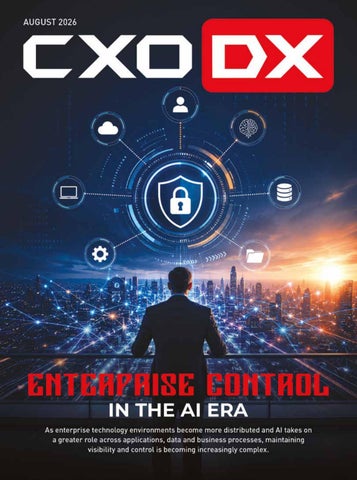
AUGUST 2026 / CXO DX
1
2
CXO DX / AUGUST 2026
» EDITORIAL
ENTERPRISE IT AT AN INFLECTION POINT Enterprise technology priorities are continuing to evolve as AI adoption gathers pace and organizations look at putting these investments to work across their businesses. While AI remains high on the agenda, there is also a growing focus on the infrastructure, data and operational foundations required to support these deployments at scale. AI workloads are creating new demands around accelerated computing and better utilization of GPU resources, while bringing compute closer to where enterprise data resides. At the same time, hybrid and private cloud models continue to have relevance as organizations balance performance and scalability with security, data sovereignty and regulatory requirements. Containers are also seeing greater adoption as enterprises look to deploy AI-enabled applications across different environments. There are other considerations as well. For industrial organizations operating in an environment of continuing supply chain volatility, having visibility across facilities and operational networks can help them respond faster when disruptions occur. Regulations are meanwhile becoming more demanding, requiring enterprises to go beyond documented compliance policies and demonstrate that appropriate technical controls are actually in place. The emergence of Agentic AI adds another consideration for CIOs. As AI agents begin to access enterprise data, interact with applications and potentially initiate actions, organizations will need greater visibility into what these systems are doing and the authority under which they operate. Identity and access controls will therefore need to extend to these non-human identities as well. Going forward, enterprises will need to bring these different priorities together. Infrastructure, data, cloud, cybersecurity, governance and operational systems can no longer be addressed entirely in isolation. The ability to maintain visibility and control across these increasingly connected environments will be key to translating technology investments into greater agility, resilience and business value. For CIOs, choices made in one area will increasingly have implications across the wider technology environment and, ultimately, the business.
R. Narayan
narayan@leapmediallc.com Mob: +971-55-7802403
SAUMYADEEP HALDER Co-Founder & MD
saumyadeep@leapmediallc.com Mob: +971-54-4458401
...................
RAMAN NARAYAN Co-Founder & Editor in Chief
...................
Editor in Chief, CXO DX
MALLIKA REGO Co-Founder & Director Client Solutions
mallika@leapmediallc.com Mob: +971-50-2489676
.........................................................................................................................................................................................................
Ali Raza Designer
PUBLISHED BY - Leap Media Solutions LLC
REGISTERED OFFICE: Office 10, Sharjah Media City | www.cxodx.com AUGUST 2026 / CXO DX
3
» CONTENTS INTERVIEW
20 » BUILDING THE FOUNDATIONS FOR AI AT SCALE Ahmad Saad, Regional Manager GCC at Liferay, discusses the importance of connecting fragmented systems and enterprise knowledge while bringing greater orchestration across AI, data and workflows
14 COVER STORY
14 » ENTERPRISE CONTROL IN THE AI ERA As enterprise technology environments become more distributed and AI takes on a greater role across applications, data and business processes, maintaining visibility and control is becoming increasingly complex.
NEWS INSIGHT
22 » FROM AUTOMATION TO INTELLIGENT PROCUREMENT Francesco Colavita, SVP, MEA & APAC at JAGGAER, discusses the growing momentum around procurement transformation in the Middle East and how AI is reshaping sourcing, supplier management, contracts and spend management.
COLUMN
24 » THE PRODUCTIVITY PARADOX Zakaria Haltout, Group VP for META at Workday, discusses how AI is reshaping productivity and contributing to a culture of performative busyness in the modern workplace.
11 » ACRONIS ACCELERATES AI-NATIVE STRATEGY TO ADVANCE AUTONOMOUS IT 25 » FROM THE PLANT FLOOR TO NETWORK-WIDE FOR MSPS VISIBILITY 12 » NUTANIX ENTERPRISE When supply chains rupture, the winners are those who can see everyCLOUD INDEX REVEALS AI thing, writes Gururaj Purohit, Product DRIVING CONTAINER Portfolio Expert, MEA, AVEVA ADOPTION IN SAUDI ARABIA 26 » RETHINKING APPSEC SCANNING WITH AI
Asma Zubair, Director of Product Management at Qualys, explores how AI-powered scan optimisation can help enterprises address the growing complexity and cost of application security testing.
4
CXO DX / AUGUST 2026
28 » RETHINKING ENTERPRISE STORAGE WITH STAAS Patrick Smith, CTO EMEA at Everpure, discusses how Storage-as-a-Service (STaaS) can give enterprises greater flexibility as storage requirements and business priorities continue to change.
30 » BUILDING THE GCC’S CYBER RESILIENCE IN 2026 Haider Pasha, Chief Security Officer, EMEA at Palo Alto Networks, discusses the evolving cyber threat landscape across the GCC and why AI-driven defence, stronger regional collaboration and early preparation for quantum-era risks will be critical to building longterm cyber resilience
32 » MOVING BEYOND SOVEREIGNTY LABELS TOWARDS REAL DATA CONTROL Nick Loumakis, Regional Vice President – Middle East and Turkey at Cloudera, discusses why data residency alone does not equate to true data sovereignty and why organisations need greater control over how their data, infrastructure and AI models are accessed, governed and moved.
34 » FROM COMPLIANCE POLICIES TO TECHNICAL PROOF
Apu Pavithran, CEO & Founder of Hexnode, discusses why tightening data protection, cybersecurity and AI regulations across the Middle East are changing how enterprises approach compliance.
REGULARS
06 » NEWS 36 » TECHSHOW 38 » TRENDS & STATS
» NEWS
DXC INTRODUCES DXC PRIVATE CLOUD+ Private Cloud+ is a hybrid private cloud powered by Dell infrastructure and operated by DXC OASIS, built for enterprises and governments running sensitive and regulated workloads. DXC Technology has announced that its DXC Private Cloud+ is now generally available. The solution delivers public cloud–like flexibility and pricing while maintaining full control over sensitive data and workloads. Powered by Dell Technologies infrastructure like servers, storage, and cyber resilience solutions and operated by DXC OASIS, DXC's intelligent orchestration platform, Private Cloud+ helps organizations innovate more easily while still meeting strict requirements for data security, compliance, and sovereignty, at a time when enterprise cloud strategies are rapidly evolving. As governance, security, data sovereignty, and industry-specific requirements become just as critical as scale, global organizations across industries are moving beyond a single-cloud approach and building multicloud portfolios that offer greater choice and control. Private Cloud+ adds a powerful new option—combining the economics and agility of hyperscale with the control of private cloud, while providing a unified
platform to connect data centers, integrate with public clouds, and prepare for AI workloads. "Customers across industries from manufacturing to transportation, insurance and more want hyperscale economics, flexibility, and AI-readiness in a true hybrid environment, one that works across what they already run and the public clouds they depend on. Until now, they've had to compromise. Private Cloud+, powered by Dell and operated by DXC OASIS, ends that trade-off and enables them to be ready as AI workloads increase," said Chris Drumgoole, President, Global Infrastructure Services, DXC. Hosted in DXC’s data centers and orchestrated by DXC OASIS with a Human+ approach, Private Cloud+ supports the full range of enterprise workloads, including VMs, containers, data, backup and resiliency, and private AI. Private Cloud+ is available in three edi-
Chris Drumgoole
President, Global Infrastructure Services, DXC tions: Core, a multi-tenant private cloud with consumption-based pricing; Dedicated, a single-tenant environment offering full isolation of compute and storage with data sovereignty; and Government, a hardened edition with advanced security controls for government agencies and regulated industries, operated by cleared domestic personnel.
CLOUDERA AND VAST DATA PARTNER TO DELIVER AI DATA PLATFORM ACROSS HYBRID ENVIRONMENTS The joint solution eliminates GPU starvation and accelerates enterprise AI Cloudera has announced a strategic partnership with VAST Data to deliver a unified AI factory, a scalable production environment where data is continuously ingested, refined, governed, and delivered to AI models for training and inference. This infrastructure is available for enterprises operating across on-premises environments and public clouds, enabling a consistent AI operating model while allowing organizations to deploy AI services wherever performance, compliance, and cost requirements are best met. The collaboration integrates Cloudera’s next-generation containerized data services with the VAST AI Operating System, which unifies high-performance storage, database, and global namespace capabilities to power large-scale AI, analytics, and mission-critical data workloads. This data-platform layer, based on the NVIDIA AI Data Platform reference design, turns latent enterprise data into AI-ready data that fuels the AI factory. As organizations race to deploy generative and agentic AI, many are discovering that
traditional architectures were not designed to support continuous AI pipelines spanning data preparation, training, inference, and analytics. One consequence is GPU starvation, where expensive accelerator clusters sit idle waiting for data. The joint solution addresses this challenge by ensuring data can move efficiently through the AI lifecycle while keeping GPUs continuously fed with high-throughput, low-latency data, dramatically improving utilization, performance, and return on investment. Cloudera’s lakehouse architecture provides portable, containerized data services, including data engineering, streaming, analytics, machine learning, and AI, all deployable consistently across hybrid and multi-cloud environments. Together, VAST’s AI OS, leveraging the NVIDIA AI Data Platform reference design, with NVIDIA-accelerated computing, transforms latent enterprise data into activated AI-ready data, while Cloudera delivers data engineering, analytics, governance, and AI services on top.
Abhas Ricky
Chief Business Officer & GM, Applied AI, Cloudera “Enterprises are investing billions in GPUs, yet many struggle to achieve full utilization due to data bottlenecks,” said Abhas Ricky, Chief Business Officer & GM, Applied AI at Cloudera. “Our partnership with VAST eliminates GPU starvation and enables customers to build true AI factories—where data flows seamlessly from ingestion to insight.” AUGUST 2026 / CXO DX
5
» NEWS
NETAPP ACQUIRES DATAPELAGO TO ADVANCE AI-READY DATA INFRASTRUCTURE Embedding GPU-accelerated intelligence enables enterprises to easily discover, govern, and activate data for AI and analytics at the source NetApp announced it has acquired DataPelago, a California-based AI data infrastructure company recognized for its innovative approach to eliminating data processing bottlenecks for AI and analytics workloads. The acquisition marks a foundational expansion of NetApp's portfolio, enabling GPU-accelerated data processing aligned directly with the storage layer. With this acquisition, NetApp establishes itself as the company that makes zero-copy activation of enterprise data for AI real. AI is the defining platform shift of our era, but enterprises are discovering that their greatest bottleneck is preparing, governing, and activating their data fast enough to put AI into production. The key to accomplishing this objective is to enable accelerated computing where the data is created and stored. DataPelago solves this
challenge by fundamentally reimagining where accelerated compute happens: at the data layer, not above it. "As AI models and the chips that power them get ever more effective, enterprises need data infrastructure that is just as intelligent and powerful to harness the potential of their data," said George Kurian, Chief Executive Officer at NetApp. "NetApp is leading the industry in helping customers drive innovation and generate business value by giving them full command of their most important asset: their data. With DataPelago, we are extending our ability to help customers understand and process their data with the agility required to unleash competitive advantage.” DataPelago's core technology, Nucleus, is a universal data processing engine that uses heterogeneous accelerated comput-
George Kurian
Chief Executive Officer, NetApp ing across CPUs and GPUs to process data where it lives. By processing data at the storage layer rather than moving it to external compute clusters, Nucleus reduces infrastructure costs by up to 80 percent and delivers performance up to 10 times faster than conventional approaches.
OPTRO LAUNCHES ‘OPTRO PARTNER CONNECT’ TO POWER GLOBAL GRC ECOSYSTEM GROWTH The new partner program offers partners flexible ways to go to market, extensive enablement, and marketing support, helping partners win with the premier GRC Intelligence Platform. Optro (formerly AuditBoard), a leading AI-powered GRC Intelligence Platform empowering enterprises to transform risk into opportunity, has announced the formal launch of Optro Partner Connect. The new partner program offers partners flexible ways to go to market, a comprehensive suite of enablement, certification, technical, and co-marketing support, and a clear, predictable path to expand into new markets, deepen their service offerings, and drive lasting customer outcomes. Optro Partner Connect replaces legacy frameworks with a modular design centered around distinct partner tracks, initially launching with Advisory Partners and Solution Providers, and a transparent tier structure in which benefits grow as partners do. Because benefits are tiered, partners will know exactly what they can access and unlock at each stage of their journey with Optro. Supporting every partner is a dedi-
6
CXO DX / AUGUST 2026
cated Partner Center of Excellence (PCoE): a team solely focused on partner success that guides firms through onboarding and ongoing “everboarding,” helping partners reach their first wins sooner and maintain a clear line of sight on their next stage of growth. "Partners are a critical growth engine for Optro, and Optro Partner Connect ensures our ecosystem's experience matches the enterprise-grade quality of our platform," said Scott Whitlock, Global VP of Alliances and Channels at Optro. "By moving away from transaction-only metrics and adopting a holistic evaluation of capacity and competency, we are giving our partners a clear blueprint to build highly profitable services practices around our GRC Intelligence Platform." A differentiator of the program is Optro’s roadmap to weave an AI layer throughout
Scott Whitlock
Global VP of Alliances and Channels, Optro the partner experience to give partners back time and help them win by automating repeatable manual tasks, surfacing real-time co-sell guidance in the field, and personalizing each partner’s onboarding so they can spend less time on administration and more time on value creation.
» NEWS
SOPHOS LAUNCHES SOPHOS FUSION FOR AI-NATIVE CYBERSECURITY Built for a threat landscape reshaped by AI, Sophos Fusion unites security operations, endpoint, network security, identity, email, and cloud into one defense system Sophos, a global cybersecurity leader, announced Sophos Fusion, an AI-native cybersecurity defense system, built to deliver a coordinated response to AI-era threats. A cybersecurity defense system is an emerging category in the industry: a single, open architecture where every control point, every service, every data source, and every analyst operates as one, whether the control point is native or third-party. Every new source enhances the system, accelerating outcomes while reducing overhead. Sophos Fusion is the evolution of Sophos Central, the system that 625,000 organizations worldwide trust every day, now rebuilt on one open architecture incorporating Secureworks Taegis analytics, following the acquisition of the company in 2025. It leverages agentic AI to con-
nect and synchronize every control point across the whole environment. Sophos proves the system’s efficacy and scalability in its own operation, running the world’s largest agentic SOC with over 40,000 customers worldwide: 52 percent of cases are resolved entirely by AI, and the average time from alert to a fully automated response is 89 seconds. Additionally, Sophos Endpoint is designed to stop entire classes of attacks based on behaviors, such as memory abuses, data encryption and exfiltration, or other human or AI attacker tradecraft. “As AI increases the speed, scale, and complexity of attacks, organizations need a modern connected, intelligent, and adaptive defense,” said Joe Levy, chief executive officer, Sophos. “Sophos Fusion is built as a defense system optimized for Human-AI workflows. We bring the most complete solution to a new category, a
Joe Levy
CEO, Sophos
timely advancement demanded by the AI era.” Sophos Fusion offers endpoint protection, endpoint detection and response (EDR), extended detection and response (XDR), next-gen SIEM, identity threat detection and response (ITDR), managed detection and response (MDR), network security, email, cloud, and advisory services as one defense system. It is open as well as native.
DELINEA LAUNCHES NEW PARTNER PROGRAM Delinea Partner Advantage Program brings codified rules of engagement and AI-powered enablement to channel Delinea, a leading runtime identity security platform that governs what humans, machines, and AI agents do once they have access, has announced the launch of the Delinea Partner Advantage Program. The new comprehensive framework is built to deliver proven identity security technology, protected discounts, and ease of doing business. Developed with direct partner input, including a global partner listening survey, the Delinea Partner Advantage Program is designed to address the most persistent pain points in the channel: margin erosion, channel conflict, and ambiguous rules of engagement. The program gives partners a clear, structured path to deliver identity security outcomes to their customers and provides a foundation for predictable, profitable growth. Beyond protecting discounts, the program is structured to help partners compound the value of every customer relationship they build. “Partners don’t care about your partner program,” said Scott Goree, senior vice
president of channel and alliances at Delinea. “They care about technology that works, protected discounts, and a vendor that’s easy to work with. We built this program around what partners told us they actually need.” The Delinea Partner Advantage Program is built around three core tenets – Protect, Align, and Scale – and introduces a modern structure designed to support how partners work today. The program includes codified rules of engagement, with clear deal registration, teaming protections and Earned Incumbency discounts to protect partners that invest in customer relationships and reward their ongoing contribution. It also provides AI-driven enablement through just-in-time training and certifications, alongside an AI-powered partner portal. In addition, streamlined processes, tools and automation are designed to provide greater channel autonomy by reducing friction across the quote-to-cash journey, allowing partners to spend less time navigating vendor complexity and more time selling.
Scott Goree
SVP of Channel and alliances, Delinea
To support partners at every stage of their relationship with Delinea, the program offers three tiers: Elite for leading at scale, Premier for growing practice depth, and Select for building expertise. AUGUST 2026 / CXO DX
7
» NEWS
CENSYS AND RILIAN LAUNCH OPERATION DIGITAL SHIELD IN UAE The initiative identifies and addresses sensitive assets in government, civilian and humanitarian agencies, strengthening cyber resilience in the country. This joint initiative follows the previous partnership announcement between the two companies in December 2025.
Censys is partnering with Rilian, a technology provider of agentic AI solutions, to launch Operation Digital Shield in the United Arab Emirates. By combining cybersecurity intelligence, and automated cyber defense strategies, the initiative intends to strengthen the protection and integrity of cybersecurity assets across Critical National Infrastructure (CNIs) in the UAE.
Meriam ElOuazzani, VP META at Censys said, “Protecting critical infrastructure and sovereign data requires more than visibility alone, calling for practical defense mechanisms. Through Operation Digital Shield, Censys’ unparalleled internet intelligence capabilities and Rilian’s in-depth knowledge of security orchestration, automation and sovereign cyber defense, the companies remain committed to ensuring organizations stay ahead of emerging cyber threats, providing actionable insights.”
The program extends its protective reach to vital civilian organizations such as hospitals, energy, utilities and other critical national infrastructure, presenting visibility into exposed attack surfaces and helping organizations detect attacks at the speed of AI. It is built upon a three-pillar framework encompassing emergency response, civilian protection and team preparedness. The model delivers real-time intelligence to Computer Emergency Response Teams (CERTs) and Cyber Commands. This provides insights such as national exposure assessments, alerts on critical vulnerabilities, and oversees Industrial Control Systems and Supervisory Control and Data Acquisition (ICS/SCADA). Moussalam Dalati
General Manager, France, Middlefor Europe Ryan Elzein, Regional Director Africa, Liferay andEast theand Middle East at Rilian said, “Operation Digital Shield locates sensitive data and highlights at-risk systems within CNIs. This, in return, enables organizations to gain clarity regarding the gaps in security systems, prioritizing critical issues and strengthening overall cybersecurity. The initiative will help strengthen cyber resilience spanning key sectors, supporting the initiative’s broader expansion in the META region.”
REDINGTON EARNS FRONTIER DISTRIBUTOR DESIGNATION IN MICROSOFT AI CLOUD PARTNER PROGRAM The designation strengthens Redington's ability to help partners scale cloud and AI adoption, accelerate customer success, and deliver greater business value through Microsoft technologies.
Redington, a leading technology aggregator and innovation catalyst, announced that it has earned the Frontier Distributor designation within the Microsoft AI Cloud Partner Program. The Frontier Distributor designation recognizes distributors that consistently enable partner success through scale, readiness, and execution, demonstrating strong operational maturity, partner enablement capabilities, and measurable customer impact.
technology; it is about helping customers solve business problems faster, operate more intelligently, and create measurable value. This designation gives us access to enhanced capabilities, programs, and resources that will further strengthen how we support partners globally – enabling them to innovate with confidence, accelerate customer success, and differentiate themselves in a rapidly evolving market."
With this designation, Redington joins Microsoft distribution partners worldwide recognized for accelerating partner readiness and driving enterprise-scale adoption of Microsoft technologies.
The Frontier Distributor designation enhances Redington’s ability to support channel partners with deeper capabilities across the Microsoft ecosystem, strengthening engagement from enablement through to execution.
"Earning the Frontier Distributor designation reflects the maturity of the Microsoft ecosystem we have built and our shared commitment to helping partners navigate the next wave of AI-led transformation," said Sayantan Dev, Global Head, Software Solutions Group, Redington. "The opportunity ahead is not simply about deploying
For partners across the Middle East, India, Turkey, and Africa, this translates into faster time-tovalue through scalable go-tomarket frameworks, stronger technical expertise across AI, cloud, security, and business applications, and improved execution of complex enterprise and multicountry transformation projects.
8
CXO DX / AUGUST 2026
Sayantan Dev
Global Head, Software Solutions Group, Redington
Partners also benefit from enhanced access to Microsoft programs, incentives, and solution architecture expertise, greater consistency in deployment and lifecycle support, and strongerreadiness to lead AI-driven transformation initiatives.
Your ENABLER for CYBERSECURITY, CLOUD, DATA AND AI CLOUD
DATA
Secure, scalable cloud transformation without compromise
Protect, govern and unlock the full value of your data
CYBERSECURITY
AI
Proactive threat detection, response and resilience, 24/7
Harness AI safely, from strategy to secure deployment
INTELLIGENT, INTEGRATED SECURITY Built for the AI Era MEET OUR EXPERTS AT GISEC GLOBAL 2026 STAND H3-A100 | DEC, EXPO CITY
AUGUST 2026 / CXO DX
9
» NEWS
CLOUD BOX TECHNOLOGIES PARTNERS WITH MULTIPLE UNIVERSITIES LAUNCHING AI
AI Lab is a hub for innovation across Generative AI, Data Science, Business Analytics, Intelligent Automation and AI-based applications. Cloud Box Technologies, a leading systems integrator and IT services specialist in the Middle East, announced a strategic Memorandum of Understanding (MoU) with multiple universities in the UAE to establish AI Lab, an advanced AI-focused Centre of Excellence (CoE). The partnerships mark a significant and unique approach towards advancing AI adoption across the region. It combines applied learning, industry-led delivery, and integrated innovation to create a practical, solution-oriented ecosystem. This scalable model drives talent development and delivers real-world outcomes. AI Lab is a hub where innovation tracks will span Generative AI, Data Science and Business Analytics, Intelligent Automation, and AI-based business applications. The objective is to create a strong tie-up that brings students, faculty, and industry leaders together to tackle everyday challenges. Ranjith Kaippada, Managing Director of Cloud Box Technologies, said, “The estab-
lishment of Centre of Excellence shows our commitment to building a talent ecosystem that is future-ready. We have designed AI Lab as a platform where innovation meets application, equipping students to work on real-world AI challenges while gaining industry-relevant skills. As AI adoption is increasing in the region, these initiatives will help them in understanding and utilizing its full potential. It will be crucial in shaping the next generation of AI professionals and strengthening the UAE’s position as a global AI leader.” Globally, and particularly in the UAE, AI is adopted at scale and needs industry-ready talent. The AI Lab addresses this gap by nurturing innovation and paving the way for both AI-ready businesses and individuals. Emerging technologies like this increase efficiency, help with smarter decision-making, and subsequently provide a stronger competitive edge. Furthermore, the AI Lab supports the UAE’s
Ranjith Kaippada
Managing Director of Cloud Box Technologies
strong focus on AI leadership and digital transformation by empowering enterprises and advancing the national innovation ambition. The highlight of the initiative is the meaningful connection between academia and industry and the immersive learning experience with real-life executions.
SANDBOXAQ TO BRING LARGE QUANTITATIVE MODELS TO GOOGLE CLOUD’S MARKETPLACE
AQCat for materials discovery will be available first, followed by AQPotency for drug discovery SandboxAQ has announced it will make its Large Quantitative Models (LQMs) accessible through Google Cloud’s Marketplace. Through this marketplace listing, users will be able to tap rigorous, physics-grounded scientific models directly from the conversational AI tools they already use, with no specialized code or infrastructure required. LQMs are AI models built on real-world lab data and scientific equations, engineered for the more than $50 trillion global quantitative economy including sectors such as biopharma, energy, advanced materials, and financial services. By offering LQMs within GCP Marketplace, SandboxAQ extends the reach of its LQMs across more channels and more large language models, while Google Cloud strengthens its capabilities in healthcare and drug discovery. "Bringing our LQMs to Google Cloud’s Marketplace will put the rigor of first-principles science directly into the hands of every researcher, in the tools they already
10
CXO DX / AUGUST 2026
use," said Jack D. Hidary, CEO of SandboxAQ. "Pairing the reasoning of a frontier model such as Gemini with the quantitative precision of our LQMs is a powerful combination.” The collaboration builds on SandboxAQ's broader strategy of connecting its LQMs to leading large language models, following its recent integration with Anthropic's Claude. Coming in Q3, AQCat will be SandboxAQ's first LQM available in Google Cloud’s Marketplace. It targets the most critical first step in catalyst and materials discovery, adsorption energy calculation, which is a measure of how strongly molecules bind to a catalyst surface. This allows researchers to rapidly identify and prioritize the most promising candidates before committing costly modeling and lab resources to full evaluation. AQCat delivers gold-standard accuracy at a fraction of the time and cost, unlocking materials screening at a scale that
Jack D. Hidary CEO, SandboxAQ
was previously out of reach. SandboxAQ's drug discovery models are also coming to the Google Cloud’s Marketplace. AQPotency, available in Google Cloud’s Marketplace Q3, will let researchers computationally identify and prioritize the most promising binders at high throughput, evaluating thousands of candidates in a fraction of the time and cost of traditional screening.
» NEWS INSIGHT
ACRONIS ACCELERATES AI-NATIVE STRATEGY TO ADVANCE AUTONOMOUS IT FOR MSPS Upcoming capabilities span a unified console, actionable intelligence, autonomous service desk, and agentic workflows Acronis, a global provider of an AI-native cyber platform for MSPs and IT departments, today unveiled the next phase of capabilities, bringing protection, infrastructure, management, business intelligence, and autonomous execution into a single user experience. Presented during the Acronis Accelerate: The Journey to Autonomous IT event, the demonstration of new capabilities builds on a series of major product launches delivered since January 2026 and advances Acronis’ vision for an AI-native operating environment in which technicians, business teams, and AI agents can work together within one natively integrated platform. Acronis organizes its AI-native strategy around its “By AI, With AI, For AI” framework: using AI to accelerate secure product development; embedding AI, intelligence, and automation into the services MSPs use every day; and enabling partners to protect, manage, and automate services for increasingly AI-driven customer environments. Rather than adding isolated AI features to disconnected products, Acronis is building capabilities on its AI-native Acronis Cyber Platform. “AI-native is not a feature label for Acronis. It is the design principle we used for our platform, and it is the approach that guides how we build and operate our products, and how we help partners run and grow their businesses,” said Jan-Jaap Jager, CEO of Acronis. “Our goal is to give MSPs one environment in which people and AI agents can work together securely, transparently, and at scale. The products Acronis is delivering this year bring that goal to life.” Advancing from AI assistance to autonomous execution Acronis is expanding its AI-native platform with new innovations that help MSPs reduce operational friction, surface new business opportunities, and automate increasingly complex workflows. The next phase of Acronis Cyber Platform brings together four connected capabilities, including: • Acronis Cyber Console: A single, AI-native MSP workspace bringing protection, management, automation, and infrastructure together with one user experience for technicians, business teams, and AI agents. • Acronis Cyber Intelligence: An actionable intelligence layer providing transparency across operations, customer contracts, and protected endpoints. Cyber Intelligence is designed to identify service gaps and hidden revenue opportunities while helping partners anticipate issues, reduce ticket volumes, and make faster decisions. • Acronis Service Desk: Autonomous ticket workflows designed to address alert and context overload through automated enrichment, analysis, and remediation. Extensible integrations will allow service desk workflows to incorporate context and actions from across an MSP’s technology ecosystem.
Jan-Jaap Jager CEO, Acronis
• Acronis Cyber Studio: A workspace for creating and controlling deterministic and agentic workflows. MSP teams will be able to use natural language to design automations and agent-driven processes while retaining visibility, governance, and control over their execution. Together, these capabilities are designed to help MSPs progress from greater visibility and AI-assisted decision-making to proactive intelligence, workflow automation, and governed autonomous execution. Delivered through a single, natively integrated platform, they help reduce the complexity, integration burden, and context switching associated with managing separate AI, service desk, and automation point solutions. Acronis Cyber Frame now offers integrated migration workflows to help partners move workloads from VMware and Microsoft Azure to Cyber Frame Cloud or Cyber Frame Local, supporting staged migration and controlled cutover. This added capability gives MSPs and cloud service providers a choice between Acronis-hosted Cyber Frame Cloud and partner-hosted Cyber Frame Local. Since January 2026, Acronis has expanded its platform with four major launches: Acronis Archival Storage, Acronis MDR by Acronis TRU, Acronis GenAI Protection, and Acronis Cyber Frame. Together, they extend the platform across long-term data retention, managed threat detection and response, AI governance, and protected infrastructure to strengthen the foundation for more automated MSP operations. AUGUST 2026 / CXO DX
11
» NEWS INSIGHT
NUTANIX ENTERPRISE CLOUD INDEX REVEALS AI DRIVING CONTAINER ADOPTION IN SAUDI ARABIA Containers underpin modern application strategies in the Kingdom Nutanix, a leader in hybrid multicloud computing, today announced the Saudi Arabia findings of its eighth annual Enterprise Cloud Index (ECI) survey and research report, highlighting how organizations in the Kingdom are rapidly embracing AI while navigating challenges related to governance, infrastructure readiness, and data sovereignty. The findings show that AI adoption is reshaping enterprise IT strategies across Saudi Arabia, driving increased demand for modern application architectures. Containers are emerging as a critical enabler of this transformation. At the same time, organizations face growing complexity as they scale AI initiatives, particularly around visibility, control, and alignment between IT and business functions. Looking ahead over the next three years, the majority (85%) of IT executives in Saudi Arabia expect the level of application containerisation within their organisation to increase, as organisations increasingly adopt containers to run AI-enabled applications. Most (72%) believe that AI is accelerating their organisation's adoption of containers in a meaningful way, including 24% who think it is accelerating adoption to a great extent. Among those using containers to run AI-enabled applications, a strong majority (82%) are building new applications in containers, either as the primary approach or alongside containerising legacy applications. There are also multiple drivers for executives to adopt or increase the use of containers in the next 12 months, with performance (45%), data security (45%) and cost considerations (45%) each ranking high among the motivations. At the same time, IT professionals are facing challenges in controlling how AI applications are implemented across the enterprise. Most IT executives in Saudi Arabia (77%) believe that the use of AI tools and agents outside official oversight creates business risk, compared with the global average of 87%. Some 65% have encountered AI applications or agents being implemented by employees in non-IT functions, compared with 79% globally. Meanwhile, 70% believe that silos between business units and IT stand in the way of their organisation's overall performance and ability to execute technology initiatives effectively to at least a moderate extent, compared with the global average of 82%. Data sovereignty is also influencing infrastructure decisions, with 78% of executives in Saudi Arabia rating it as a high priority or a must-include consideration. More than half (53%) feel the need to run their infrastructure within a single country, whether on-premises or through a local cloud region, due to security or data protection concerns, compared with 57% globally. Enterpris-
12
CXO DX / AUGUST 2026
Talal Alsaif Regional Director, Central Gulf, Nutanix
es in Saudi Arabia are also more frequently running their containerised applications on the public cloud (52%) than on-premises or on a private cloud (43%). “Saudi organizations are moving quickly from AI experimentation to real-world deployment, but success depends on having the right foundation in place,” said Talal Alsaif, Regional Director, Central Gulf, Nutanix. “The findings highlight a clear opportunity for enterprises in the Kingdom to modernize their infrastructure with a hybrid multicloud approach that supports containers, strengthens governance, and ensures data sovereignty. By aligning IT and business strategies, organizations can unlock AI’s full potential while managing risk and maintaining control.” The global Enterprise Cloud Index report, now in its eighth year, surveyed 1,600 IT, cloud, and engineering decision-makers worldwide, including respondents from the Kingdom of Saudi Arabia, to assess enterprise progress in cloud adoption, containerization, and AI deployment.
Building AI resilience:
Secure what′s next
The future belongs to organizations that can move fast — securely. CPX makes that possible with an integrated approach built on three pillars: Advise – Protect - Operate
Come explore our cyber and physical services and solutions. Visit us at stand
A80, Between Hall 1 & 3
CPX.NET AUGUST 2026 / CXO DX
13
» COVER STORY
ENTERPRISE CONTROL IN THE AI ERA
As enterprise technology environments become more distributed and AI takes on a greater role across applications, data and business processes, maintaining visibility and control is becoming increasingly complex.
F
or much of the past decade, enterprise technology environments have become increasingly spread across cloud, SaaS, on-premises infrastructure, and multiple data platforms. As organisations adopted new applications and cloud services, APIs and integrations helped connect these environments, but also added to the complexity technology teams need to manage. In response to the growing complexity of these environments, we have seen the emergence of cloud management platforms, observability tools, security controls, identity platforms and increasingly sophisticated approaches to data governance. Yet the underlying challenge has continued to grow, as an enterprise can have visibility into individual parts of its technology estate without necessarily having a coherent view across the entire environment. Artificial intelligence is now adding another dimension to that challenge. With a growing number of organisations moving beyond copilots towards AI agents capable of accessing applications, retrieving enterprise data, invoking APIs and potentially initiating actions, visibility can no longer stop at infrastructure, applications and users. Enterprises increasingly need to understand what an AI system accessed, why a decision was made, what authority it operated under, and what happened as a result.
14
CXO DX / AUGUST 2026
Therefore, it is becoming less about whether enterprises have enough monitoring tools and more about whether their existing approaches to visibility, identity and governance are capable of keeping pace with a technology environment that is both distributed and increasingly autonomous.
Visibility moves beyond infrastructure The problem actually predates agentic AI. Enterprises already operate across multiple clouds, SaaS platforms, on-premises infrastructure and data platforms, often with different monitoring systems, policies and ownership structures across these environments. For Fayid Kadambodan, Assistant Director – Enterprise Solutions at Dubai Integrated Economic Zones, this changes what visibility needs to deliver at the CIO level. Infrastructure dashboards remain important, but they provide only part of the picture when business services depend on multiple interconnected environments. “The challenge is no longer simply managing complexity; it is maintaining control at the speed of complexity. Enterprises today operate across multiple clouds, SaaS platforms, legacy environments and data ecosystems, often with fragmented monitoring, policies and ownership.”
» COVER STORY He adds, “From a CIO perspective, visibility must move beyond infrastructure-level dashboards to a single business and risk view of the technology landscape. We need to know not only what is running, but what it means for business continuity, security, compliance and customer outcomes. You cannot govern what you cannot see, and you cannot secure what you do not understand.” That fragmentation can create a paradox. While enterprises are collecting more telemetry than ever before, they may still struggle to establish a common operational picture. Muhammad Affan Habib, Director of Information Technology Department, Sharjah Maritime Academy, sees fragmentation itself as the primary challenge. Different environments generate their own identities, configurations and security signals, frequently managed through different teams and platforms. “The primary challenge is fragmentation. Each platform generates its own identities, configurations, logs, and security signals, often managed by different teams and tools. This creates blind spots, inconsistent policies, and uncertainty over who owns each risk.” “Enterprises need a unified operational view supported by accurate asset inventories, centralised observability, consistent policy enforcement, and clearly defined accountability. Visibility must extend beyond infrastructure health to include identities, data flows, third-party dependencies, and automated decisions. Without this shared context, organisations may collect large volumes of telemetry but still lack the insight required to act quickly and confidently.” The challenge, therefore, is not simply about gaining more visibility, but connecting technical visibility with enough context to understand what is happening across a business process and whether intervention is required
Agentic AI adds a new layer of complexity Agentic AI makes that requirement more urgent because enterprises are no longer dealing only with systems that respond predictably to predefined instructions. Traditional applications operate within relatively well-understood boundaries. Agents potentially introduce a different operating model, where software can interpret context, choose between actions and interact dynamically with other enterprise systems. Sameer Joshi, an AI, Data & Transformation Leader based in Riyadh, describes this as a change in the nature of enterprise complexity. “AI is changing the nature of enterprise complexity. Until now, we largely governed systems, integrations, data and human access. With Agentic AI, we are introducing another participant into the operating environment, one that can interpret information, interact with multiple systems and increasingly initiate actions.” The distinction becomes particularly significant in large organisations where a single process can already traverse several business and technology platforms. Sameer argues that once intelligence is introduced across such an environment, determining whether the underlying AI model works is only the starting point. “When intelligence is introduced across such an environment, the challenge is not simply whether the AI model works. You need to understand which data informed it, which business process it
Fayid Kadambodan Assistant Director – Enterprise Solutions, Dubai Integrated Economic Zones touched, who had authority over the resulting decision and what happened after that decision.” He adds, “As AI becomes more autonomous, traditional technology observability will therefore not be enough. Enterprises will increasingly need decision and action traceability, the ability to reconstruct the chain from data and context, through AI-generated intelligence and human judgment, to the resulting business action.” It represents a significant expansion of observability. Monitoring whether an application, API or infrastructure component was available remains necessary, but an AI-enabled process creates additional questions around context, intent, authority and outcomes. Eyad Kashkash, Chief Technology Officer at Daman Markets Financial Services, similarly sees AI as something that operates horizontally across the enterprise rather than as another discrete application within the technology stack. “AI is redefining the enterprise technology landscape. It is not merely another application added to the architecture, but something that can operate horizontally across business processes, cloud services, APIs, data platforms and enterprise applications.” As that happens, he believes enterprises will need to extend the concept of observability itself. “As Agentic AI matures, observability will need to mean more than simply monitoring systems; it will also need to cover actions and decisions. There will be a need for an audit trail covering everything from the human instruction and context provided, through the data accessed and tools invoked, to the output and final action taken.” He adds, “The opportunity is considerable, but autonomy without visibility and control can quickly become an operational and security risk.” Visibility in an AI-enabled enterprise therefore needs to extend across the chain from data to decision and action. AUGUST 2026 / CXO DX
15
» COVER STORY because the person deploying or using it has that access. It needs its own identity, defined permissions, purpose and boundaries. Enterprises should be able to answer: Who authorised this agent? What can it access? What can it do? Under what conditions? And when must a human intervene?” He adds, “I believe enterprises will increasingly need to distinguish decision authority from execution authority. An agent may have sufficient intelligence and access to recommend a decision, but that should not automatically give it authority to execute it.” The implication is that IAM may need to evolve beyond controlling access to resources towards governing the context and authority under which an action is performed. Eyad describes this as a possible transition towards Identity, Context and Authority Management.
Muhammad Affan Habib Director of IT Department, Sharjah Maritime Academy
Identity becomes a critical control layer If agents are going to participate in enterprise processes, identity becomes one of the most immediate areas where existing control models need to evolve. The enterprise identity landscape was already expanding beyond employees and customers. Applications, APIs, workloads, service accounts and automation platforms have created large populations of machine identities. Agentic AI adds identities that may not only access resources, but interpret information and act on it. Fayid believes this requires IAM to answer a much broader set of questions. “Identity and access management needs to evolve from asking ‘Who are you?’ to asking ‘What are you, what are you authorized to do, on whose behalf, and why?” “AI agents should have their own governed identities, with least-privilege access, clear ownership, time-bound permissions and continuous monitoring. Every significant action should be traceable and attributable.” Eyad reaches a similar conclusion, arguing that agents should be treated as first-class non-human identities rather than extensions of the employees using them. “An AI agent should not simply inherit the broad privileges of the employee using it. Access needs to be justified by the task at hand and follow the principles of least privilege, explicit authorisation and just-in-time access.” But access alone may no longer be enough. The ability to retrieve information is fundamentally different from the authority to modify a record, approve a transaction or initiate an irreversible action. This is where Sameer draws a useful distinction between decision authority and execution authority. “An AI agent should not automatically inherit broad access simply
16
CXO DX / AUGUST 2026
“We are reaching a point where IAM can no longer be concerned only with who is making a request. It also needs to establish what is making the request, on whose behalf, for what purpose and under what authority. In that sense, IAM is evolving towards what could be described as Identity, Context and Authority Management.”
Governing non-human identities The expansion of machine identities is not a new security issue, but greater autonomy changes the potential consequences of poorly governed access. A conventional service account might execute a predefined task. An AI agent could potentially choose between actions based on changing context and interact with several systems as part of the same process. Sameer sees the combination of access and autonomy as the defining difference. “The issue is not simply the growing number of non-human identities; it is the combination of access and autonomy.” “A traditional service account generally executes a predefined process. An AI agent can potentially interpret context, select between actions and interact dynamically with several applications. That changes the risk profile considerably.” Controls therefore need to address not only authentication and permissions but also what agents are allowed to do once access has been granted. Sameer adds, “That requires stronger identity lifecycle management, least-privilege access, segregation of duties and continuous monitoring, combined with controls specifically designed for autonomy — transaction limits, permitted actions, escalation thresholds, human approval points and the ability to immediately suspend an agent.” Muhammad Affan similarly argues that enterprises need to distinguish between different levels of agent authority. “Organisations must also distinguish between what an agent can read, recommend, modify, and approve. Privileged or high-risk actions should require additional verification or human authorisation. This creates an auditable chain linking the agent, its human owner, the data accessed and the action performed.”
» COVER STORY
Eyad Kashkash CTO, Daman Markets Financial Services
Sameer Joshi AI, Data & Transformation Leader
This could become particularly important as agents begin participating in regulated or business-critical processes. An agent analysing a transaction is one level of autonomy; authorising it is another.
ingly important as regulation and data sovereignty requirements begin influencing not just where workloads reside but how AI systems consume and process information.
The principle, as Eyad puts it, is straightforward:
Eyad expects regulation to play a more direct role in architecture as a result.
“The greater the autonomy given to an AI agent, the stronger the identity, monitoring and control framework around it needs to be.”
Following the data Identity is only one part of the control challenge. AI also increases the importance of understanding how data moves across an enterprise. Data may now travel between SaaS applications, cloud platforms, analytics environments, APIs, retrieval systems and AI models. Knowing where sensitive information was originally stored is no longer sufficient if organisations cannot follow how it is subsequently accessed and used. Muhammad Affan argues that this requires visibility throughout the data lifecycle. “Enterprises need end-to-end data visibility built on automated data discovery, classification, lineage, and continuous access monitoring. These capabilities should identify sensitive information, track how it moves between systems and shows whether it is being used by employees, applications, third parties or AI agents.” AI expands this requirement further because organisations may also need visibility into the information supplied to models and the outputs they generate.
“An enterprise needs to understand where its data is stored and processed, which AI models have access to it, whether data is crossing jurisdictions, which third parties are processing it, and whether those providers retain or reuse that information.” This is likely to reinforce the importance of capabilities including classification, lineage, encryption, audit logging and policy-based workload placement. It could also influence where different types of AI are deployed, with the architecture determined increasingly by the sensitivity and regulatory profile of individual use cases.
Governance starts to converge Cloud governance, cybersecurity, data governance and AI governance have generally evolved as separate disciplines. There were good reasons for doing so as each addressed a different area of technology risk and required specialist expertise. AI is making those boundaries harder to maintain at the operational level. An AI-enabled business process might depend simultaneously on cloud infrastructure, enterprise data, identities, APIs, models and business applications. Trying to govern each element independently risks creating gaps between controls. Fayid argues that these areas now form an interconnected risk ecosystem.
He adds, “For AI environments, visibility must extend to prompts, training and retrieval sources, generated outputs, and agent actions. The objective is to maintain a reliable chain of custody throughout the data lifecycle without restricting responsible innovation.”
“Cloud, cybersecurity, data and AI are now one interconnected risk ecosystem. Where the workload runs, what data it accesses, who or what can access it, and how AI uses that data are no longer separate questions.”
The ability to establish that chain of custody will become increas-
He adds, “I believe organizations need one enterprise risk view, AUGUST 2026 / CXO DX
17
» COVER STORY common control principles and shared accountability, while allowing specialist governance disciplines to continue operating where necessary.” This does not necessarily point towards creating another overarching governance organisation. In fact, the contributors broadly agree that specialist disciplines still have an important role. For Sameer, what is required is an integrated control model rather than one giant governance framework. “An AI agent could potentially consume operational data, use an enterprise data platform for context and initiate an action in a core business application. That one action can cross cybersecurity, cloud, data, AI and business-process governance. The answer is not necessarily one giant governance framework. It is an integrated control model with clear ownership and common decision points.” The speed of AI-enabled processes makes this particularly relevant. Governance mechanisms built primarily around retrospective reviews may struggle when the time between insight and action is compressed from days or hours to seconds. He adds, “Governance cannot remain predominantly retrospective; increasingly, controls need to become executable at the moment an action is about to occur.” Eyad advocates a federated approach in which specialist teams retain their expertise while controls are connected around business services and use cases. “The objective is not necessarily to consolidate every governance function into one team. It is to give the enterprise a common control and visibility layer across them.
“As AI becomes more autonomous,
“There is limited value in creating another AI governance committee simply to sit on top of several existing governance structures. What organisations need is a unified view of technology risk,” he adds. This does not mean governance necessarily needs to become centralised. Rather, different controls need to work together around the same business outcome
More tools don't necessarily mean more control As enterprise technology environments have expanded, new layers of complexity have often been met with new specialised tools and platforms. Cloud management, observability, cybersecurity, data security and AI governance can each generate their own dashboards and alerts. Individually, those tools may work exactly as intended while collectively making it harder to establish a single view of what has happened. Sameer says, “You can therefore have five dashboards telling you that five systems are healthy without having one view explaining why a business outcome failed.” That is an important distinction for the next phase of enterprise observability. The objective should not necessarily be to replace every specialist platform with one system, but to connect technical signals to business processes and outcomes. “I favour consolidation where capabilities are becoming commoditised and specialisation where there is a genuine risk or business requirement demanding deeper capability. The objective should not be a single tool for everything; it should be a coherent control plane with as few blind spots as possible.” Eyad makes a similar point from the governance perspective. “Executives and boards do not need five dashboards providing five different perspectives on the same business service. They need to know whether that service is secure, resilient, compliant, properly controlled and operating within the organisation’s risk appetite.”
traditional technology
From observability to accountability
observability will therefore not be
Enterprise environments are unlikely to become less distributed. SaaS, hybrid cloud, APIs, data platforms and increasingly specialised infrastructure will continue to coexist. AI will not reverse that complexity; in many cases, it will operate across it.
enough. Enterprises will increasingly need decision and action traceability, the ability to reconstruct the chain from data and context, through AI-generated intelligence and human judgment, to the resulting business action.”
18
CXO DX / AUGUST 2026
Simply adding another management layer or dashboard, however, is unlikely to address the wider challenge. The more significant shift is in what enterprises expect visibility to provide. Infrastructure health remains fundamental, but it increasingly needs to be connected with identity, data, context, authority and business outcomes. As AI agents acquire greater autonomy, enterprises will also need the ability to reconstruct how decisions were reached and determine whether resulting actions remained within established boundaries. As enterprises move towards greater levels of AI autonomy, maintaining this visibility will become increasingly important. Organisations will need to determine where autonomy makes sense, establish clear boundaries around what agents can do and ensure that appropriate controls remain in place. This will require greater coordination across infrastructure, data, identity, AI and business processes as these environments become increasingly interconnected.
HOSTED BY
OFFICIAL GOVERNMENT CYBERSECURITY PARTNER
OFFICIALLY SUPPORTED BY
MIDDLE EAST AND AFRICA’S LARGEST CYBERSECURITY EVENT
SCAN HERE
GET FREE VISITOR PASS
SPONSORS & PARTNERS
#gisecglobal gisec@dwtc.com
AUGUST 2026 / CXO DX
19
» INTERVIEW
BUILDING THE FOUNDATIONS FOR AI AT SCALE As organisations across the GCC look to move AI initiatives beyond pilots, greater attention is being placed on the data, content and technology foundations required to support enterprise-wide deployments. Ahmad Saad, Regional Manager GCC at Liferay, discusses the importance of connecting fragmented systems and enterprise knowledge while bringing greater orchestration across AI, data and workflows. He also highlights why governance, data sovereignty and deployment flexibility will be critical as organisations seek to scale AI securely and translate investments into measurable business outcomes. Why do many AI initiatives struggle to move beyond pilots and proofs of concept? Organisations across the region are investing significantly in AI, and the ambition is clear. However, AI's effectiveness depends entirely on the quality and connectivity of the data, content and systems it operates across. When these remain fragmented i.e, when content sits in silos, workflows are disconnected, and enterprise systems are not integrated, AI cannot move from experimentation to meaningful business outcomes. This is not a technology gap. It is a foundation gap. Liferay's approach has always been to enable organisations to connect their existing systems, unify content and data, and deliver consistent digital experiences across channels. That connected foundation is precisely what allows AI to function at scale rather than remain confined to individual pilots. What role do content, data, and enterprise knowledge play in scaling AI? They are the prerequisite. AI is only as useful as the information it can access and act upon. Most enterprises have significant volumes of content and data, but it remains locked inside disconnected systems and legacy applications. Until that changes, AI will reflect that fragmentation rather than resolve it. Organisations need a unified layer that brings content, data and enterprise knowledge together, making it accessible, structured and actionable. That is what allows AI to move from isolated use cases into organisation-wide value and better digital outcomes. This why the most forward-thinking enterprises are investing in unified digital platforms that connect systems, content and data as a single, coherent foundation Why orchestration is becoming the next priority for technology leaders? Because deploying AI tools is not the same as deploying AI at scale. Organisations across the GCC have been acquiring AI ca-
20
CXO DX / AUGUST 2026
Ahmad Saad Regional Manager GCC, Liferay
» INTERVIEW data sovereignty as organisations deploy AI at scale
“AI now touches business, marketing, technology, service and operations simultaneously, making siloed ownership of those functions unsustainable. The most successful organisations are those where business and technology teams work from a single platform.”
pabilities rapidly, but without orchestration, those capabilities remain disconnected. The priority now is coordinating AI agents, content, data and workflows into coherent, enterprise-wide operations. Liferay AI Hub supports multi-agent orchestration, allowing organisations to coordinate specialised AI agents into end-to-end business workflows, with human oversight built in. Use cases already span content automation, predictive audience segmentation, compliance review and customer service triage. For technology leaders, this is no longer a future consideration, it is the next immediate priority. How AI is reshaping collaboration between business, technology, and customer experience teams AI is breaking down boundaries that have existed for decades. AI now touches business, marketing, technology, service and operations simultaneously, making siloed ownership of those functions unsustainable. The most successful organisations are those where business and technology teams work from a single platform. Low-code development is central to this, enabling business teams to build, configure and iterate independently without depending entirely on IT. The Content Marketing Platform brings content strategy, planning and execution into one coordinated operation, giving all teams real-time visibility and significantly faster time to market. Solutions such as Liferay AI Hub orchestration layer works alongside the DXP to enable organisations to build and deploy AI agents that automate content creation, workflows and business processes. Through a secure connection with leading LLMs, it grounds all AI interactions in enterprise data, permissions and governance already managed.
It is non-negotiable. As AI moves from pilot to production, the stakes around data governance rise significantly. In regional markets like Saudi Arabia, the UAE, Qatar and Kuwait, data sovereignty requirements are clearly defined and continuing to evolve. Organisations need platforms that offer genuine deployment flexibility; cloud, on-premise and hybrid, so regulatory requirements shape the architecture rather than the other way around. Liferay DXP is the only DXP fully available with all its functionalities on Google Cloud Marketplace in Saudi Arabia, in direct alignment with the Kingdom's Cloud First Policy. What will differentiate organisations that successfully realise long-term value from AI investments It comes down to having discipline in how AI investments are sequenced. The organisations that will realise long-term value are those that built the right foundation first; flexible, composable architecture that connects disparate systems without vendor lockin, a unified content supply chain, and an integrated data layer. AI is on track to contribute an estimated $320 billion to the Middle East economy by 2030. Those that capture meaningful value will be the ones that invested in making AI deployable, governable and scalable, moving from ambition to measurable business outcomes. That is the conversation we are having across the region with partners including Deloitte, PwC, Moro Hub, Wipro & Protiviti, Netways, and Code81
“Liferay's approach has always been to enable organisations to connect their existing systems, unify content and data, and deliver consistent digital experiences across channels. That connected foundation is precisely what allows AI to function at scale rather than remain confined to individual pilots.”
How do you look at the importance of governance, trust, and AUGUST 2026 / CXO DX
21
» INTERVIEW
FROM AUTOMATION TO INTELLIGENT PROCUREMENT Francesco Colavita, SVP, MEA & APAC at JAGGAER, discusses the growing momentum around procurement transformation in the Middle East and how AI is reshaping sourcing, supplier management, contracts and spend management. and indirect spend categories, move beyond procurement teams and become a much broader business priority. For JAGGAER, the opportunity is not simply to digitise procurement, but to help organisations build procurement functions that are more intelligent, resilient and adaptable to current and future changes. Which verticals in the Middle East are seeing the strongest demand for procurement modernisation, and are sectors such as real estate, government, energy, manufacturing and financial services approaching transformation differently? We are seeing strong momentum across the market, particularly among government entities, construction, telecommunications and discrete and process manufacturing (including Oil & Gas and chemical). What differs is the business problem each sector is trying to solve.
Francesco Colavita SVP, MEA & APAC, JAGGAER
How important is the Middle East to JAGGAER’s global growth strategy, and what kind of traction are you currently seeing for source-to-pay and procurement transformation solutions across the region? It’s an extremely important growth market for us because so many of the region’s priorities converge in procurement and supply chain. Governments and enterprises are digitising rapidly, economies are diversifying, AI adoption is accelerating and new requirements, such as eInvoicing, are changing how organisations operate across the region. At the same time, recent logistics disruptions have reminded businesses just how exposed they can be to supply chain risk and how suppliers represent a critical factor in the business strategy. Procurement sits at the intersection of all these issues. It determines how effectively an organisation manages suppliers, controls spend, plans appropriate demand strategy, responds to disruption, and turns data and processes into better decisions. That is why we are seeing source-to-pay transformation, including direct
22
CXO DX / AUGUST 2026
For construction and manufacturing, resilience has become critical. Supplier diversification and better visibility across the supply base can help organisations respond much faster when a particular supplier, geography or logistics route is disrupted. Government has a different set of priorities. Efficiency matters, but transparency, accountability and fair competition are equally important. Digital procurement gives public entities a more consistent and auditable way to engage suppliers. That can help governments set the standard for the wider market, while making opportunities more accessible to international companies and innovators that want to compete for regional projects. JAGGAER has been expanding its AI strategy towards agentic AI and more autonomous procurement workflows. Where do you see agentic AI delivering the greatest value across sourcing, spend management, contracts and supplier management over the next few years? I would avoid looking for one killer use case because the starting point will differ by organisation. Instead, I would offer examples of several areas worth exploring. In sourcing, an agent could generate an RFx, identify suitable suppliers and evaluate responses against changing business requirements. In supplier management, it could continuously as-
sess financial, logistics and regulatory signals, then recommend mitigation before disruption occurs. At a strategic level, agents could model trade-offs between cost, resilience, sustainability and speed, rather than optimising for a single objective. In contracting, they could analyse previous negotiations, model different terms and suggest clauses or negotiation strategies. The important question for procurement leaders is therefore not “where can AI do everything?” It is “where can I give AI greater agency today while maintaining the right level of human judgement and control?” With JAI now enabling employees to interact with procurement data and policies through natural language, are there any early adoption trends or measurable outcomes that you are seeing, and how do you expect these capabilities to evolve towards more autonomous procurement? The early results are very encouraging. Customers using JAI are expecting support tickets to fall by 50% in the first year, while we are seeing time savings across more than 40 workflows. In some cases, adoption has grown by as much as 1,000% week-on-week. What interests me most is what that tells us about adoption. When employees can simply ask a procurement question in natural language and receive an answer grounded in their organisation’s own policies and data, you remove a lot of the friction that traditionally limits procurement technology. The evolution from here is from answering, to recommending, to acting. JAI can increasingly identify issues and opportunities, suggest the next best action and ultimately orchestrate more complex workflows, while retaining human oversight where judgement or accountability requires it. As AI becomes more deeply embedded in procurement decisions and workflows, how is JAGGAER addressing governance, data security, regulatory compliance and human oversight, particularly for organisations operating across different jurisdictions in the Middle East? For us, governance cannot be something added after AI has been deployed. It has to be designed into the workflow and our AI framework has been built considering security and compliance around AI as one of the main pillars. This is why at JAGGAER, we’ve simultaneously invested in the AI functional framework, as well as the AI security framework, obtaining the ISO 42001 (AI Act certification). That means establishing clear boundaries around what AI can do autonomously and where human approval is required. Compliance checks should sit inside the process rather than being applied retrospectively, and AI-generated recommendations need to be explainable, traceable and auditable. This becomes particularly important in the Middle East because organisations may operate across several jurisdictions, each with different regulatory and data requirements. There is no single governance setting that works everywhere. The objective should be controlled autonomy. AI can analyse enormous volumes of in-
formation and accelerate decisions, but organisations must retain visibility over how those decisions are reached, who is accountable for them and when a human needs to intervene. The important question for procurement leaders is therefore not only “is AI automated processes or supporting users?” It is “have you selected a secure and certified AI technology in procurement ?” The IMKAN deployment in the UAE has focused on areas including sourcing, supplier management, contract management and spend analytics, with procurement cycle times expected to fall by 25%. What does this implementation tell you about the outcomes Middle East customers now expect from procurement transformation? IMKAN is a good example of how expectations have changed. Procurement transformation is no longer judged simply by whether you have digitised a manual process. Customers want measurable business outcomes. As you rightly highlighted, for IMKAN, procurement cycle times are expected to fall by 25%, while automation is expected to reduce time spent on manual tasks by more than 40%. But the wider objective is just as important. Better supplier management, contract visibility and spend intelligence can help the business mobilise projects faster, manage costs and work with the right suppliers. That matters enormously in sectors such as real estate, where procurement performance ultimately affects project delivery. Looking ahead over the next two to three years, how do you expect enterprise procurement in the Middle East to evolve, and what role will AI, autonomous commerce and deeper supplier intelligence play in that transformation? The technology will evolve quickly, so I think the more useful question for organisations is whether they are building the foundations to take advantage of whatever comes next. First, get the data right. Autonomous systems cannot make reliable decisions when supplier, spend and contract data is fragmented or inconsistent. Second, rethink processes rather than simply putting AI on top of existing workflows. Third, invest in people. Procurement professionals will increasingly need skills in data interpretation, AI oversight and strategic supplier management. Next, establish governance before autonomy becomes widespread. Organisations need clear rules around accountability, auditability and when humans intervene. Finally, focus on an AI framework versus a feature function approach; this is the meaning of an AI scaling approach to support the future evolution in procurement. If you get those foundations right, you do not need to predict exactly what procurement will look like three years from now. You create an organisation capable of adopting new capabilities safely and quickly as they emerge.
AUGUST 2026 / CXO DX
23
» COLUMN
FROM THE PLANT FLOOR TO NETWORK-WIDE VISIBILITY
When supply chains rupture, the winners are those who can see everything, writes Gururaj Purohit, Product Portfolio Expert, MEA, AVEVA Today, success depends on more than efficiency. Manufacturing performance relies on how fast and flexibly capacity can be moved or absorbed. If the supply chain dries up, how fast can the plant pivot to another supplier? What does the forecast look like? Where can production be offloaded from one factory to another? It’s about understanding real-time supply and demand, forecasting dynamically, and translating that insight all the way through to the manufacturing floor – to the people turning the wrenches and assembling the product. That shift – from local control to network-wide responsiveness — is redesigning what optimal industrial operations look like. And sitting at the center of it is HMI and SCADA. For most of their history, these systems had one purpose: they let operators see and control what was happening inside a facility. HMI is the interface operators use to monitor and control processes. SCADA aggregates and distributes real-time data from physical assets. For decades, both were confined to single sites.
Gururaj Purohit Product Portfolio Expert, MEA, AVEVA
A
s I write this, the global economy remains on tenterhooks. The Strait of Hormuz – a chokepoint through which roughly a fifth of the world's oil passes daily – has been persistently disrupted by geopolitical standstill. And it’s not just energy; it’s the artery for vital chemical inputs for plastics, fertilizers and industrial manufacturing. These shocks ripple through supply chains, tightening margins from chemicals producers to construction, agriculture and consumer goods. Meanwhile, erratic sanctions, tariffs or even announcements can take a refinery or plant offline at a moment’s notice. But, as critical as the situation is, it is no longer an isolated occurrence. We are living in an age of volatility. Since the pandemic, energy market swings, trade frictions and tighter financial conditions are part of the global economic fabric – underpinning a more complex and unpredictable global system. Operational architectures in this environment must assume continuous disruption. Networks need to be capable of reconfiguring themselves – not if disruption hits, but when. One moment, a refinery is producing, and the next it isn't. And somewhere in a control room on the other side of the world, an operator is staring at a screen trying to answer a question that efficiency models were never designed to answer: now what?
24
CXO DX / AUGUST 2026
That began to change as industrial infrastructure started to converge with the kind of cloud-based architecture that had already transformed every other sector. Sensors became cheaper, and networks became faster. The gap between operational technology (OT) and information technology (IT) began to close. What has materialized is something quite different. The screen now shows many facilities. It can also show historical patterns, live forecasts, and engineering data sitting alongside the operational picture. As well as monitoring the situation, the system provides the context to understand what it means – and what to do next. Decisions can happen in minutes rather than days. Take the global top 20 dairy business, Agropur. The 29-plant company, with $9 billion in annual revenues, now visualizes overall equipment effectiveness (OEE) trends through geographically connected visualization capabilities. Previously, all its plants operated independently without shared visibility, which limited operational efficiency and problem-solving. Today, through digitizing its legacy industrial model, it has standardized and integrated operational data across sites and centralized it into a single view. The result is better reporting and the ability to plan production in real-time across the network. Not only have the results been transformative across North America, they also lay the foundation for industrial agility. HMI and SCADA are becoming the layer that connects data and software across industrial operations – not just the interface. They provide the as-it-happens operational layer to maintain output when individual plants fail. For decades, industrial companies optimized for efficiency and justin-time supply. That world is gone. Agility is the primary survival requirement of the business world – and it starts with connected data and systems. For the operators staring at those screens, the ability to see across the entire network – and react in a way that is informed and nimble – represents the future of resilience in uncertain times.
» COLUMN
THE PRODUCTIVITY PARADOX
Zakaria Haltout, Group VP for META at Workday, discusses how AI is reshaping productivity and contributing to a culture of performative busyness in the modern workplace. Since the dawn of the internet, countless studies have raised concerns around an overreliance on technology and its impact on critical thinking, creativity, and even memory retention. Consequently, as modern work becomes defined by switching between emails, online meetings, and digital workflows, experts are taking a closer look at the cognitive effects of constant digital engagement. Research suggests that fragmented work environments make sustaining focus more difficult, while also increasing mental fatigue. Emerging evidence also indicates that our newfound reliance on AI-generated output can, in some circumstances, lead to less original ideas and more predictable outcomes. At the same time, growing discussion around “cognitive offloading” also highlights technology’s growing influence on how we think and work.
Zakaria Haltout Group VP for META, Workday
The modern workplace has become something of a paradox. Despite unprecedented investment in digital systems and artificial intelligence being designed to simplify the workplace, employees are feeling more overwhelmed than ever. Technologies have undoubtedly increased speed and connectivity, and yet many workers say most days are spent navigating fragmented systems, responding to notifications, and managing an endless flow of information. It’s a disconnect that raises an important question: if technology makes the workplace more efficient, why does the work itself feel increasingly exhausting? Recent research suggests that the issue may not be a lack of productivity, but the way productivity is now measured. A study by Workday, which surveyed more than 6,000 AI users, found that 97% of employees still enjoy their roles, while almost 9 in 10 say they feel connected to their organization’s goals. However, 43% describe their work as busy but not productive. This phenomenon could be described as “hollow busyness” – visible activity that creates the appearance of progress without fulfillment. Employees report that they spend a significant portion of their day transferring information between disconnect systems, managing communications, and coordinating workflows, with 1 in 4 estimating they lose over seven hours per week to repetitive tasks. Therefore, as employees become increasingly rewarded for remaining constantly available rather than the value of their contributions, it appears responsiveness is now a measurement of success.
While some behavioral analysts argue that AI risks diluting critical thinking, others contend that it effectively reduces administrative burden, allowing employees to dedicate time to higher-value work. Nevertheless, the challenge facing organizations today is ensuring that technology removes friction rather than introducing new layers of complexity. Employees already recognize this distinction, and while many report time saving through AI, nearly 40% observe that a significant volume of those gains is lost correcting errors, verifying outputs, or reworking information. Moreover, 77% identify their navigation of workplace systems as a primary source of stress. Perhaps this points to a broader issue within the modern enterprise, where digital tools have been introduced to solve isolated problems in lieu of improving the employee experience overall. Studies show that when employees spend a significant portion of their day searching for context, reconciling information, or managing fragmented workflows, they have less capacity for strategic thinking, creativity, and innovation. Full immersion, therefore, becomes progressively difficult in environments optimized for constant availability. However, this is where the real opportunity lies. The next phase of workplace transformation must be guided by intentionality. In contrast, instead of introducing more technology, organisations should focus on embedding intelligence into workflows that reduce complexity, improve clarity, and support how people work most effectively. This also requires employers to reconsider how productivity appears on the outside. For decades, organisations have rewarded visible activity; responsiveness, availability, and volume. In an automated world, however, the most valuable work might actually be the least visible. The organisations that thrive in the digital era will not necessarily be those with the most technology, but those that use technology more deliberately. Modern technology was never intended to make work busier. Its initial purpose was to remove barriers and create space for employees to showcase their unique thinking. If employers can strike that balance, they will unlock a form of productivity that delivers stronger business outcomes, while also giving employees greater opportunity to think clearly, create meaningfully, and progress with purpose. AUGUST 2026 / CXO DX
25
» COLUMN
RETHINKING APPSEC SCANNING WITH AI
Asma Zubair, Director of Product Management at Qualys, explores how AI-powered scan optimisation can help enterprises address the growing complexity and cost of application security testing.
I
n the tech-savvy United Arab Emirates (UAE), where digital services and AI-enabled transformation are central to public- and private-sector competitiveness, enterprise applications have become the front door to customer experience. On Google Play alone, according to one source, as of February 2025, more than 820 Emirati developers had uploaded upwards of 2,300 apps, accounting for more than 2 million downloads. Unfortunately, the security provisions that protect those apps from adversarial interference have been unable to scale in parallel. Application portfolios now span business units, cloud environments, APIs, and frequent release cycles. Security programs must therefore scan more assets, more often, without slowing down the teams that build them. This misalignment has not occurred because of inaction or underinvestment. It has occurred because app ecosystems’ growth has outpaced that of security models. If an organization builds a large enough app portfolio across business units, regions, development teams and perhaps even brands, scale emerges as a problem. Available time and resources may be dwarfed by the ecosystem. Full scans remain necessary for validation and compliance, but they are often too broad and time-consuming to run before every release. In API-heavy, cloud-native, and multi-cloud environments, the challenge is even harder: the estate changes continuously, and static scan profiles can become stale as quickly as applications are updated.
Asma Zubair Director of Product Management, Qualys
It is likely that AppSec reviews will reveal gaps that can no longer be mitigated by old measures — the problem is operational, not theoretical. Many organizations try to compensate with adjacent approaches like policy-as-code, external attack surface management, IDE-based scanning, or automated remediation. These approaches matter, but only address certain parts of the development lifecycle. They help define policy, discover assets or respond to detected issues. We are still left with the scaling issue and how it affects scanning efficiency.
A helping hand from adaptive scanning The core challenge is how to optimize vulnerability testing for each application, without relying on static scan profiles that must
26
CXO DX / AUGUST 2026
» COLUMN be manually updated with each version. AI-powered scan optimization addresses this by profiling an application and generating a detection plan appropriate to its current version — structure, technology stack, and observed behavior. While periodic full scans will still be needed for major technology, functionality or architecture changes in the application, the AI approach is a major step towards addressing application estate sprawl. Under this model, there will be reduced dependency on manually maintained scan templates and static detection profiles. The AI-powered scanning system profiles each application and creates its own detection plan, prioritizing relevant checks based on application behavior and structure. By combining validation and operational scans, security teams get appropriate coverage across releases, and the engineering function does not face the unwelcome friction of running full scans before the deployment of every new version. Bench tests have shown that scan times decrease by up to 80%, while meaningful coverage is maintained. This strategy does not skip checks; it conducts them where they matter most. In some environments, high-frequency scanning can increase cost because platforms such as CMS systems, API gateways, or cloud infrastructure may be priced or constrained by request volume. In others, excessive scan traffic consumes application capacity or forces security teams to negotiate scan windows based on operational limits rather than risk. DevSecOps can review whether scan frequency has a direct relation to platform cost and bring this up at the next budget meeting. Then they can encourage decision makers to migrate from static, one-size-fits-all scan configurations to the more dynamic AI-driven profiling. AI can drill down into an application’s stack dependencies and tailor a scan to fit the chain. This will reduce redundant or low-value checks, lowering scan overheads, without turning routine security testing into a manual tuning exercise.
achieved, pressured engineering teams will come up with ways to circumvent security testing requirements. AI-powered scan optimization can be used to automate the scoping of each scan to the application’s current version. By making scans laser-relevant to the application’s current state, the scans will be fast enough to run for every build, while remaining accurate enough to be trusted. UAE enterprises and their DevSecOps teams have an opportunity to address the AppSec burden before it becomes too overwhelming to address. AI can automate the mundane, repetitive scan-planning tasks, leaving security teams to get involved at prearranged critical validation milestones. The result will be a more sustainable application security operating model: one that supports faster releases, broader coverage, lower operational friction, and stronger trust between security and engineering.
“DevSecOps must make security testing compatible with CI/CD build pipelines, so that comprehensive protections remain in place as app demands grow. This
For AppSec leaders, this creates a stronger business case. The discussion is no longer only about finding vulnerabilities. It is also about reducing unnecessary scan load, controlling platform costs, and making security testing sustainable at enterprise scale. To validate the value added by automation, scan duration, request volume, scan completion rates, detection quality and coverage quality over time should be evaluated together to ensure that reductions in scan traffic do not degrade detection accuracy. When AppSec scales up, the organization will discover that redundant scan loads are reduced, which lowers infrastructure and platform costs. So, when bringing a security case to stakeholder colleagues, AppSec managers are backed by a robust, cost-based narrative.
may be as straightforward
Building trust across builds
schedules.”
as establishing scan times that are acceptable for development teams and fit in with their release
DevSecOps must make security testing compatible with CI/CD build pipelines, so that comprehensive protections remain in place as app demands grow. This may be as straightforward as establishing scan times that are acceptable for development teams and fit in with their release schedules. If this compatibility cannot be AUGUST 2026 / CXO DX
27
» COLUMN
RETHINKING ENTERPRISE STORAGE WITH STAAS Patrick Smith, CTO EMEA at Everpure, discusses how Storage-as-a-Service (STaaS) can give enterprises greater flexibility as storage requirements and business priorities continue to change. He explores the benefits of consumption-based models in helping organisations scale capacity, manage costs more predictably and reduce the risks associated with longterm infrastructure commitments. He also outlines why architecture, strong SLAs and genuine consumption-based pricing are critical considerations when evaluating STaaS offerings.
Patrick Smith CTO EMEA, Everpure
M
ore than two thousand years ago, the Roman philosopher Pliny the Elder mused that the only thing we can be certain of is uncertainty itself. Fast forward to 2026 and this ancient idea still rings true. Today’s macroeconomic landscape is being shaped by uncertainty including a dynamic geopolitical environment, rapidly changing IT requirements, and fierce AI-driven competition to name a few, all applying pressure to purchasing decisions.
Enter Storage-as-a-Service (STaaS)
The reality is that no organisation has a crystal ball in terms of where to invest, but some solutions have already been stress tested by COVID-era disruptions and tariff turmoil. Customers are gravitating towards solutions that provide flexibility; a model that delivers constant innovation, transparency, predictability, and protects investment from economic volatility.
STaaS offers a practical answer to uncertainty by giving organisations the flexibility to meet business demand quickly and easily, scaling up or down as needs change, without locking themselves into rigid, capital-intensive commitments. This is a compelling benefit for organisations that frees up capex resources generally associated with long term depreciation and allows them to react
28
CXO DX / AUGUST 2026
STaaS is a subscription model focused on the flexible consumption of data storage, allowing organisations to forget about predicting demand and the challenges of capacity management. Instead, consumers focus on the performance they need and where it’s needed; be it on premises, a Co-Lo, in the cloud, or any combination, and pay for it based on usage.
» COLUMN when needs evolve or new demands arise during the financial year. By aligning storage investment more closely with actual business needs, organisations receive greater room to adapt as priorities shift, helping them preserve cash, avoid overprovisioning, and respond faster to changing operational and business demands.
Not all STaaS is created equal As demand for STaaS grows, many providers are repackaging traditional storage offerings as subscriptions, often something more akin to a regular lease rather than a service model. That’s not all; unless the underlying technology has been built for an as-a-Service model it’s likely to disappoint. True STaaS depends on foundational capabilities at the architecture level, such as being able to deliver non-disruptive upgrades, seamless scalability, and operational simplicity; without this, providers can struggle to meet customer expectations around performance, security, resilience, and sustainability. That is where strong SLAs become critical, holding providers accountable when outcomes fall short. Without robust SLAs in place, customers are not protected from missed service levels and vendor accountability is limited, often less binding Service Level Objectives (SLOs) replace meaningful SLAs. When done correctly, an SLA-backed STaaS offering removes much of the complexity and risk associated with data storage and reduces friction, costs and complications associated with delivering a data platform across the enterprise.
What to look out for Flexible STaaS offerings can give organisations strategic options and levers to scale when needed and manage costs more predictably. They should be founded on architectures that are designed to be continuously updated in place, non-disruptively, delivering lifecycle management without expensive upgrade cycles. At their best, these models: • Offer true consumption-based pricing backed by clear SLAs, without transferring hardware management burdens back to the user. • Deliver the ability to scale capacity up or down without penalties. • Provide a range of performance tiers and protocols to meet every possible business demand. • Shift a meaningful portion of risk onto the provider, enabling more stable and predictable economics for long-term planning. • Provide a cloud-like experience without requiring a commitment to public cloud. • Shield organisations from potential spikes in the cost of the underlying hardware. • Guarantee transparent renewals designed to keep customer data estates modern, with consistent costs and manageable overheads.
Taming the uncertain For enterprises planning capacity increases or storage refreshes, AI projects, or cloud repatriations over the next 12–24 months, the questions to ask vendors are clear: • Does the vendor consumption model genuinely transfer risk away from the organisation, or simply repackage it? • How easily can the organisation scale capacity up or down without penalties or lock-in? • What SLAs do the vendor guarantee for performance, availability, and support, and what happens if those commitments aren’t met? Some vendors will deflect the hard questions and look to undermine competitor offerings. It’s crucial to find an honest and transparent partner that sticks to the facts, holds themselves to consistently high standards, and provides a clear, stable path forward.
“Flexible STaaS offerings can give organisations strategic options and levers to scale when needed and manage costs more predictably. They should be founded on architectures that are designed to be continuously updated in place, non-disruptively, delivering lifecycle management without expensive upgrade cycles.”
AUGUST 2026 / CXO DX
29
» COLUMN
BUILDING THE GCC’S CYBER RESILIENCE IN 2026 Haider Pasha, Chief Security Officer, EMEA at Palo Alto Networks, discusses the evolving cyber threat landscape across the GCC and why AI-driven defence, stronger regional collaboration and early preparation for quantum-era risks will be critical to building long-term cyber resilience. While the Gulf region continues to advance digitally at remarkable speed, this progress comes with heightened cybersecurity responsibilities. Threats are evolving, and today’s adversaries aren’t just after data, they are probing systems that support entire economies. In fact, the average cost of a data breach for an organisation in the Middle East stands at $7.2 million, the second highest globally, according to IBM’s 2025 Cost of a Breach report, a figure that puts into perspective the real-world business impact of not being fully prepared.
High-value sectors under siege The financial, energy, and industrial sectors recorded the highest total breach costs in the Middle East in 2025. These industries form the backbone of national economies, making them high-value targets for both financially motivated cybercriminals and state-sponsored actors.
Haider Pasha Chief Security Officer, EMEA, Palo Alto Networks
T
he Gulf Cooperation Council (GCC) countries are home to some of the world’s most strategic infrastructure. From powering global energy markets to leading smart city and AI innovation, the region sits at the intersection of geopolitical significance and rapid digital transformation. But this progress also brings unintended exposure. As critical infrastructure becomes increasingly connected and grows in complexity, it becomes an attractive target for sophisticated threat actors, many of whom operate across borders with speed and precision.
30
CXO DX / AUGUST 2026
The trend is unlikely to abate in 2026. Unit 42, Palo Alto Networks’ threat intelligence unit, is tracking an increased risk of wiper attacks related to the current conflict with Iran. Unit 42 conducted an in-depth investigation into conflict-themed phishing lures identifying 7,381 related phishing URLs spanning 1,881 unique hostnames. Recent threat activity demonstrates a widespread wave of financial fraud, credential harvesting and illicit content distribution targeting both enterprise and consumer sectors.
From borderless breaches to regional crisis While these attacks vary in scale, they share one common factor: the ability to ripple across borders. A ransomware strike in one country can affect supply chains across the region. That’s why the threat landscape today is a GCC-wide concern rather than just a national issue. The infamous Colonial Pipeline ransomware attack, which disrupted fuel distribution across the East Coast of the United States, may have taken place outside the region and half a decade ago, but its lessons remain deeply relevant in the Middle East today: The incident revealed how a cyberattack on a single company could escalate into a national crisis. For the GCC, where energy production and distribution are more centralised, such an incident could have an even wider economic and political impact.
» COLUMN
GCC organisations can no longer rely solely on perimeter defenses. Threat actors today are exploiting identity, cloud misconfigurations, and even third-party vendors to find their way in. Many are also leveraging artificial intelligence to scale phishing, write malware, and impersonate legitimate users. The region must therefore stay ahead not only in tools, but in mindset.
AI and Quantum: New frontiers in cyber risk and readiness Artificial Intelligence is rapidly reshaping the cybersecurity landscape. On one hand, it equips defenders with faster detection and response capabilities, while on the other hand, it gives attackers new tools to scale their operations with automated phishing campaigns, shape-shifting malware, and the ability to impersonate legitimate users with alarming precision. But while AI is today’s battleground, quantum computing represents the next big shift. Although still emerging, quantum capabilities could eventually break the encryption that secures everything from financial transactions to national infrastructure. Preparing for quantum disruption isn’t science fiction; it’s business continuity planning. For GCC businesses, 2026 will likely mark the start of more structured planning for quantum resilience. This means reviewing which systems rely on vulnerable encryption, engaging vendors that support post-quantum cryptography, and mapping out phased migrations that don’t compromise performance or security. The organisations that start early will be better positioned to adapt when quantum becomes real. It is also vital for organisations to improve their protection of sensitive data now, given that cybercriminals are already harvesting data with the intention of decrypting it once they have access to the quantum computing tools to do so.
How the GCC is uniting against threats No organisation can face this threat landscape alone. Governments across the GCC are recognising this, investing in national strategies and forming partnerships with the private sector to enhance cyber resilience. Saudi Arabia’s National Cybersecurity Authority has committed more than SAR 4 billion ($1.06bn) to national initiatives. The UAE’s Dubai Cyber Security Strategy is built around safeguarding smart infrastructure and national data. Qatar has released a comprehensive strategy through 2030, emphasising preparedness, threat response, and local capacity building. These are more than just policy statements. Across the region, we’re seeing cross-sector cyber drills, real-time threat intelligence exchanges, and efforts to train and retain cybersecurity talent. These joint actions show that public-private collaboration is foundational. Meanwhile, cybersecurity spending across the Gulf is projected to surpass $32.6 billion by 2030, according to a report from Grand View Research.
Six steps to strengthen cyber resilience in the GCC To turn awareness into action, GCC organisations, especially those managing critical infrastructure, should focus on these five strategic steps: 1. Embrace AI for smarter threat detection and response: Traditional, perimeter-based security alone can’t keep up with today’s threats. AI-powered tools are required to give security teams the visibility they need to spot unusual behavior across networks, endpoints, and the cloud before it escalates, and to protect the AI tools that organisations use as part of their business. 2. Start planning for a quantum future: Quantum computing could soon break today’s encryption standards. Now is the time to assess risks, identify and protect your most sensitive data, and work with vendors offering NIST approved post-quantum solutions. 3. Strengthen public-private collaboration: Cyber threats affect everyone, so collaboration is essential. Regular crisis simulations, information sharing, and coordinated efforts with regulators and industry peers can help organisations respond faster and more effectively. 4. Make Zero Trust the default approach: Trust nothing by default. In a world of increasingly sophisticated attacks, trusting everything inside your network is risky. Adopting a Zero Trust model with granular access controls and constant verification helps limit exposure, even when attackers do get in. 5. Take a proactive approach to managing identity security: With attackers exploiting the rapid proliferation of machine identities such as service accounts, APIs, and bots by targeting unmanaged or over-privileged credentials, it is essential for organisations to gain visibility of, and manage, their machine identities with the right tools. CISOs must take a comprehensive approach that includes strong provision for managing increasingly complex identity security, shortening lifecycle of TLS certificates, securing AI agents, and training teams to be vigilant against social engineering attacks. 6. Bring cybersecurity into the boardroom: Cyber risk isn’t just an IT issue, it’s a business issue. Leadership teams need to be regularly updated on threat trends, potential vulnerabilities, and the long-term security roadmap. Making cybersecurity a leadership priority ensures it gets the investment and attention it deserves. The good news is that momentum is growing: Regional awareness is rising, budgets are growing, and more local talent is entering the cybersecurity workforce. But the threat landscape is evolving faster, and staying ahead requires not just vigilance, but vision. Cybersecurity is now a strategic pillar for national resilience. By acting decisively through shared intelligence, proactive defense, and quantum preparedness, the GCC can secure its most critical assets and lead global conversations on what digital safety truly looks like.
AUGUST 2026 / CXO DX
31
» COLUMN
MOVING BEYOND SOVEREIGNTY LABELS TOWARDS REAL DATA CONTROL Nick Loumakis, Regional Vice President – Middle East and Turkey at Cloudera, discusses why data residency alone does not equate to true data sovereignty and why organisations need greater control over how their data, infrastructure and AI models are accessed, governed and moved.
A
bank stores its customer data in a data centre in Riyadh or Dubai. A telecom company keeps its network records within national borders. During the next compliance audit, both organizations check the sovereignty box and move forward. However, the real sovereignty challenge remains unsolved. This is where we need to understand the concept of sovereignty washing. It refers to the assumption that storing data within national borders automatically means an organization has full control over its digital assets. Data residency answers the question of where the data is physically stored today. It does not address the larger questions around who controls access, who manages the underlying infrastructure, what limitations exist within vendor agreements, or how easily an organization can move its data when circumstances change. Data sovereignty goes beyond location by maintaining control, flexibility, and independence over critical digital assets. The key question organizations need to ask is simple. If regulations changed tomorrow, if a vendor adjusted its terms, or if geopolitical conditions shifted, could they continue operating without disruption? Could they move their data, workloads, and AI models to another infrastructure provider without requiring a multi-year, multi-million-dollar transformation?
Nick Loumakis Regional Vice President – Middle East and Turkey, Cloudera
For many organizations and particularly those operating in highly regulated sectors, the answer remains uncertain. This is the gap that sovereignty washing often hides.
The importance of data sovereignty
technology environments.
The global sovereignty cloud market is expected to grow from $154 billion in 2025 to $824 billion by 2032, representing sustained growth at a steady CAGR of 27%. This growth indicates rising investments from organisations seeking greater control over their data, infrastructure, and digital operations while reducing risks linked to overdependence on external providers.
A company may store its data locally, but if it depends entirely on a single provider’s systems, formats, or processes, its ability to adapt can become restricted. The challenge lies in understanding whether the organization has the freedom to make decisions about its data and technology in the future. This conversation has become even more important as artificial intelligence (AI) becomes a core part of business operations.
Organizations today rely on cloud platforms for scalability, innovation, and efficiency. Simultaneously, they are becoming more aware of the challenges that come with limited control over their
The surge in AI integration has raised the importance of data sovereignty. Organizations need to look beyond where their data is
32
CXO DX / AUGUST 2026
» COLUMN stored and understand where AI models are operating, who manages updates, and how sensitive information is being used. AI models trained on enterprise data can become valuable strategic assets. For example, a fraud detection model built using a bank’s transaction data represents years of investment, insights, and business intelligence. If an external provider has significant control over how that model is updated, retrained, or accessed, the organization risks losing visibility and influence over a critical asset. This is why sovereignty in the AI era requires a broader approach. Organizations need control over the full lifecycle of their digital assets, including how models are developed, managed, updated, and transferred.
What real sovereignty looks like The UAE’s development of local AI models, including Falcon and Oryx, offers a regional example of how digital sovereignty can be approached more effectively. By developing AI capabilities locally, organizations and institutions can maintain greater control over data security and governance. The value extends beyond keeping sensitive data within national borders, as organizations now have greater influence over how AI systems evolve and operate. The focus shifts toward who has visibility, control, and decision-making authority over critical data assets throughout their lifecycle. For organizations looking to strengthen their data sovereignty, three areas require attention. First, jurisdictional oversight requires organizations to have verifiable control over where and how their data is processed. Data residency alone does not provide complete assurance, as enterprises need visibility into the systems handling their information and the ability to demonstrate compliance across different regulatory environments. Second, data security and governance must be embedded across every infrastructure environment. Customer-managed security controls, consistent policies, and centralized governance frameworks allow organizations to protect sensitive information while maintaining operational flexibility across cloud, hybrid, and on-premises environments. Finally, organizations need comprehensive operational insight across their entire data estate. Metadata visibility and enterprise-wide data lineage provide a clearer understanding of how data moves, where it is used, and who has access to it. This level of transparency helps reduce business risk, simplify regulatory alignment, and support more informed decisions around data management.
The shift from compliance to control Data sovereignty is especially important for industries such as banking, telecommunications, and government. These sectors of-
ten have the strongest focus on compliance due to the sensitive nature of the information they manage and the regulatory requirements they must follow. Even so, meeting compliance standards alone does not always translate into complete control. An organization can satisfy residency requirements while still depending heavily on external providers, facing restrictive agreements, or experiencing challenges when attempting to move its digital assets elsewhere. The more important question is whether the organization can make independent decisions about its technology environment. Sovereignty should not be viewed as a limitation on innovation or cloud adoption. Instead, it provides a framework for building stronger and more resilient digital ecosystems. The organizations that succeed in the future will be those that use technology strategically while maintaining control over their digital foundations. The true measure of sovereignty is determined by an organization’s ability to adapt, move, and make decisions when circumstances change. As regulations become stricter and AI increases the value and sensitivity of data, digital independence will become increasingly important. Moving beyond sovereignty labels towards real data control enables organizations to maintain continuous availability and compliance without sacrificing innovation.
“By developing AI capabilities locally, organizations and institutions can maintain greater control over data security and governance. The value extends beyond keeping sensitive data within national borders, as organizations now have greater influence over how AI systems evolve and operate.”
AUGUST 2026 / CXO DX
33
» COLUMN
FROM COMPLIANCE POLICIES TO TECHNICAL PROOF Apu Pavithran, CEO & Founder of Hexnode, discusses why tightening data protection, cybersecurity and AI regulations across the Middle East are changing how enterprises approach compliance.
F
or a long time, breach response moved in stages. Security teams would spend weeks identifying an anomaly, conducting a forensic investigation, isolating affected systems, and looping in legal counsel and compliance teams before drafting a public disclosure. For the Middle East, that grace period of treating regulatory alignment as an aspirational milestone is officially over. Under data protection frameworks like Saudi Arabia’s Personal Data Protection Law (PDPL), organizations may have as little as 72 hours to notify the relevant authority after becoming aware of a qualifying breach. That window leaves very little room for guesswork. Within three days, an enterprise must not only understand the nature of the attack but also evaluate which data may have been compromised, who was affected, and the remediation measures taken to contain the incident. This is where many compliance programs start to break down. A written policy may satisfy an audit checklist, but it cannot reconstruct an incident, prove device status, or produce a reliable trail of action within the 72-hour window.
Why legacy IT is fracturing under modern regulations The modern enterprise footprint spans hybrid-work models, cloud-native workflows, and third-party tools. Data is constantly moving between endpoints, users, identities, applications, and unmanaged services. Without the right technology, IT teams struggle to know what assets exist, where sensitive data is going, and which risks need attention first. This visibility crisis is further compounded by the rapid rise of artificial intelligence (AI). Generative AI and localized LLMs have surpassed executive boardrooms into everyday employee workflows. This has created a growing layer of “shadow AI” in which employees upload sensitive corporate data, source code, and intellectual property into unvetted AI platforms. When data residency or sector-specific privacy laws mandate that personal information should remain within national borders, this unmonitored flow is an active regulatory violation. Because most firms lack centralized visibility to monitor data exfiltration, they remain blind to these leaks until it is far too late to meet a 72-hour reporting deadline.
34
CXO DX / AUGUST 2026
Apu Pavithran CEO & Founder, Hexnode
The pressure is intensified by the Middle East’s cybersecurity skill gap. According to a survey, 44% of regional organizations reported a lack of qualified IT security staff. That shortage leaves internal teams responsible for more devices, more data movement, new AI risks, and stricter compliance expectations, often without the capacity to investigate and respond at the speed regulators now require.
Why penalties are just the tip of the iceberg When organizations assess the risk of non-compliance, they often focus on the most visible consequence: financial penalties. Under Saudi Arabia’s PDPL, for example, certain violations can carry
» COLUMN fines of up to SAR 5 million, or roughly $1.3 million. But the true cost of non-compliance cuts far deeper than the penalty itself. In today’s highly competitive economy, compliance is the foundation of B2B trust. A failed audit or missed breach notification window can raise difficult questions from customers, partners, insurers, and regulators. It can slow procurement, weaken renewal conversations, and make the organization appear less reliable at the at the very moment it needs market confidence. It can also increase leadership scrutiny. Where technical safeguards are missing, incomplete, or poorly documented, executives may be expected to explain why reasonable controls were not in place. The issue is no longer only whether a breach occurred, but whether the organization can show that it had the visibility, policies, and response mechanisms needed to manage the risk. Non-compliance can also create operational drag. Regulators may require corrective action, independent audits, stricter reporting, or changes to how personal data is processed. For IT teams, that can mean shifting resources away from planned projects and toward urgent remediation. What begins as a compliance failure can quickly become a business continuity problem.
Making compliance visible, continuous, and scalable Organizations cannot meet a 72-hour breach response window if compliance work begins only after something goes wrong. By then, teams are already trying to reconstruct events under pressure: which device was involved, what data it accessed, whether it was encrypted, who the user was, what controls were active, and what remediation steps were taken. To survive the non-compliance gridlock, a more sustainable approach is continuous compliance. Instead of treating compliance as a manual oversight, enterprises need controls that are built into everyday IT operations. Asset inventory, policy enforcement, access control, encryption status, location awareness, and audit logs should be continuously updated, not assembled after the attack. A practical starting point is automated asset tracking. When security, identity, and device management data are brought into a unified view, IT teams can instantly verify every endpoint accessing corporate data, whether those devices meet security requirements, and whether data handling aligns with internal and regulatory policies. This is where unified endpoint management becomes important. A UEM platform such as Hexnode helps teams apply security configurations consistently across operating systems, track compliance deviations in real time, and generate logs that support audit and reporting requirements. Capabilities such as remote lock, remote wipe, encryption enforcement, and containerization also help protect corporate data when a device is lost, compromised, or used in violation of policy.
to set access conditions: only verified users on compliant devices can access corporate applications and data. That connection between user identity and device posture is what turns compliance from a checklist into an enforceable control. Now, recent guidance from the Central Bank of the UAE (CBUAE) has raised expectations for how licensed financial institutions adopt and govern AI and ML systems. Regulated organizations need a clear view of where AI tools are being used, what data those tools can access, who is accountable for them, and whether they are operating within approved controls. The technical stack must therefore support a live inventory of AI systems, continuous monitoring of AI usage, and the ability to restrict or disable tools that fall outside approved policy. The direction of travel is clear. As privacy, cybersecurity, and AI rules mature across the Middle East, enterprises will not be judged by the policies they publish, but by the controls they can prove in practice.
“In today’s highly competitive economy, compliance is the foundation of B2B trust. A failed audit or missed breach notification window can raise difficult questions from customers, partners, insurers, and regulators.”
Endpoint control becomes stronger when it works with identity. Integrating UEM with an identity provider enables organizations AUGUST 2026 / CXO DX
35
» TECHSHOW
SYNOLOGY DVA7400 Synology has launched DVA7400, the company's flagship Deep Learning Analytics appliance for large-scale surveillance. Running entirely on-premises, the DVA7400 manages camera fleets across multiple sites and delivers advanced AI video analytics while ensuring full data ownership. Built on a 2U 12-bay rackmount chassis, the DVA7400 processes up to 100 high-resolution camera feeds while running 40 real-time deep learning analytics tasks simultaneously. All recordings and AI metadata are processed and stored on the appliance, keeping data within the organization's own infrastructure and supporting regulatory compliance. The DVA7400 also serves as a central management server, orchestrating camera fleets and servers across multiple sites through the Central Management System (CMS) in Synology Surveillance Station. With Semantic Video Search, operators can query video archives from all 100 recording feeds using natural language, turning hours of manual footage review into seconds. A dedicated hardware accelerator processes these searches on isolated resources, ensuring the DVA7400's 40 real-time deep learning analytics tasks continue at full performance. For complex investigations, the DVA7400 adds Attribute Search to filter targets by visual identifiers such as clothing color or vehicle type, License Plate Recognition for access control, and Find Repeated Objects1 to reconstruct an individual's movement across locations. These capabilities complement the DVA7400's
real-time analytics, including Face Recognition, Crowd Detection, Intrusion Detection, and People and Vehicle Counting. Highlights: • The Synology DVA7400 provides a robust, high-capacity solution for mission-critical surveillance. • A 12-bay rackmount design that grows with your surveillance needs. • Exceed compliance standards with high-capacity storage designed for long-term footage retention, facilitating compliance with demanding legal discovery requirements. • Set virtual boundaries and receive smart alerts the moment people or vehicles cross from a designated direction. • AI-powered analytics for existing camera fleets
DELL 14S Powered by Series 3 Intel Core Ultra processors with built‑in AI, the Dell 14S delivers faster creativity, smoother visuals, and effortless multitasking, while quietly improving calls, searches, and functional performance without extra setup or battery drain. Dell 14S delivers up to 97% higher multitasking performance versus the previous generation, helping move seamlessly between apps, creative tools, and demanding workloads. With builtin AI acceleration and up to 50 TOPS NPU, these laptops deliver responsive performance exactly where it’s needed. Designed with purpose, it combines innovation, durability and meticulously crafted design with thoughtfully engineered features to elevate the way you work, create and live. Designed as a productivity hub, the keyboard features intelligent shortcuts and intuitive controls to make every interaction smarter and faster. A vibrant 14‑inch, 16:10 display that gives you more room to work and stay connected, wherever the day takes you. From cinematic streaming to precise photo editing and creative multitasking, the 14‑inch FHD+ OLED display with 300 nits brightness and 100% DCI-P3, rich color pairs with AI powered performance in a lightweight design built for immersive productive work anywhere. A responsive Gorilla Glass touch screen for smooth, precise interaction and lasting durability for daily work and creativity.
36
CXO DX / AUGUST 2026
» TECHSHOW
AXIS W111 BODY WORN CAMERA Wearable cameras help deter incidents and positively influence behavior, for both the public and the wearers. As a result, demand continues to grow, including in retail, healthcare, and transportation. To meet the need, Axis Communications has introduced its latest lightweight, workplace-ready camera: AXIS W111 Body Worn Camera. This body worn camera from Axis offers all-day battery performance, supporting 16 hours in standby mode, and between 10 hours (720p) and 7.5 hours (1080p) of recording. In addition, an updated magnetic mounting system ensures secure wear, even in fast-paced environments. It captures excellent image and audio for forensic usability and documentation, and it’s compatible with AXIS Body Worn Live for real-time streaming. Built on open standards, it integrates seamlessly with AXIS Camera Station as well as third-party on-prem or cloud-based VMS solutions. The system supports scalable storage without compromising image quality and enables easy, efficient retrieval of footage. Designed with strong cybersecurity, including end-to-end encryption, it also complies with data protection and privacy regulations, enabling use in sensitive environments such as healthcare.
Highlights:
• Flexible, secure mounting options
• Lightweight and compact (99g, 82.5x55x19 mm)
• Open standards for easy integration
• Battery that lasts all day
• End-to-end encryption and strong cybersecurity
Highlights: • Built as Copilot+ PCs, the Dell 14S brings AI directly to the device without any cloud dependency or setup. • Sturdy, stylish three-piece aluminum chassis with polished accents for a striking dual finish. Available in calming Frost Blue or moody Celestial Blue. • A smart 3-knuckle hinge design keeps the interior clean and streamlined. • Enjoy richer, louder audio with dual 4W speakers and Smart Amp - delivering deep bass, clear detail, and distortionfree sound for gaming, streaming, and calls.
AUGUST 2026 / CXO DX
37
» TRENDS & STATS
WORLDWIDE IT SPENDING TO GROW 14.2% IN 2026, TOTALING $6.37 TRILLION Data Center System and IaaS Spending Viewed as Drivers for Largest Infrastructure Project Ever Attempted by Humanity Worldwide IT spending is expected to reach $6.37 trillion in 2026, up 14.2% from 2025, according to the latest forecast by Gartner, Inc., a business and technology insights company. “Data center systems and infrastructure as a service (IaaS) are the top growth segments, reflecting accelerating investment in AI infrastructure, cloud platforms, and intelligent applications,” said John-David Lovelock, Distinguished VP Analyst at Gartner. “Building the compute capacity required for AI is the largest infrastructure project ever attempted by humanity. Driven by the expansion of AI workloads and demand for high-performance computing, hyperscalers and enterprises are rapidly scaling next-generation data center capacity.” These trends underscore that AI infrastructure, AI-enabled cloud platforms and advanced software ecosystems will remain the most attractive segments for capitalizing on the strong expansion in global IT spending (see Table 1). "Despite the strong growth in spending, this is not a rising tide lifts all boats market trend,” said Lovelock. “Technology budgets are being strained by inflation, supply shortages, rising hardware and memory costs, AI funding initiatives and shifting priorities."
Revised Growth Projections Reflect AI-Driven Market Expansion In this latest forecast update, total IT spending has been revised upward with stronger growth projections, reflecting increased confidence in overall market expansion. The revision places greater emphasis on AI-related spending, with incremental growth increasingly concentrated in segments directly benefiting from AI adoption, while traditional segments show comparatively modest changes.
38
CXO DX / AUGUST 2026
“IT spending growth is being fueled by rising investments in AI infrastructure and software. Organizations are spending more on AI optimized servers, cloud services, and AI-ready software as they expand their AI efforts, while hardware markets continue to adjust to semiconductor and memory supply constraints,” said Lovelock. “The fastest growth is expected in AI-related infrastructure, cloud services, and software, reflecting the strong focus on building and scaling AI capabilities across the enterprise.” Gartner’s IT spending forecast methodology relies heavily on rigorous analysis of the sales by over a thousand vendors across the entire range of IT products and services. Gartner uses primary research techniques, complemented by secondary research sources, to build a comprehensive database of market size data on which to base its forecast.
“The fastest growth is expected in AI-related infrastructure, cloud services, and software, reflecting the strong focus on building and scaling AI capabilities across the enterprise.”
AUGUST 2026 / CXO DX
39
40
CXO DX / AUGUST 2026