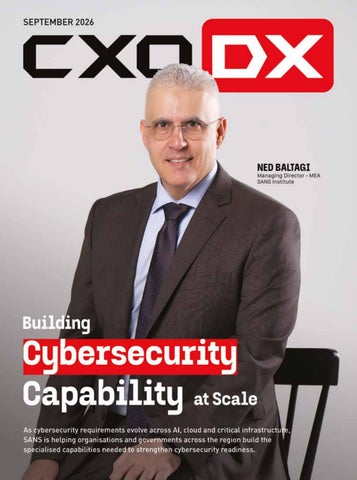
SEPTEMBER 2026 / CXO DX
1
ANYTIME, ANYWHERE
UNINTERRUPTED 4G INTERNET The G403C is an ideal solution for areas with or without wired Internet, including homes, businesses, events, cottages, and RVs.
Easy, Cable-Free Setup Insert your SIM card and get connected right away.
G403C
4G LTE N300 Wi-Fi ROUTER
2
CXO DX / SEPTEMBER 2026
» EDITORIAL
CYBERSECURITY AT A TURNING POINT With its 15th edition this year, GISEC Global adopts a new home as it moves to the Dubai Exhibition Centre (DEC) in Expo City Dubai. Over the years, the event has grown alongside a cybersecurity industry that has itself undergone considerable change. This year's edition comes at another interesting juncture, with AI and especially Agentic AI beginning to reshape both the threat landscape and how organisations approach cyber defence. The expansion of multi-cloud environments, connected infrastructure and applications has already widened the enterprise attack surface. The rapid adoption of AI is now adding another dimension. As autonomous agents gain access to enterprise data, applications and APIs and potentially initiate actions, questions around identity, permissions and accountability are becoming increasingly important. At the same time, AI is changing the threat landscape itself, allowing attacks to be executed with greater speed and sophistication while also giving cybersecurity teams new capabilities around detection, investigation and response. These shifts are explored from different perspectives across three features in this edition. One looks at how cybersecurity vendors see the threat landscape evolving, including the growing focus on Agentic AI, non-human identities, critical infrastructure and greater clarity across expanding security environments. Another brings together enterprise cybersecurity practitioners to discuss the growing importance of identity, the convergence of IT and OT, and the broader shift towards cyber resilience. In our cover story, we also look at the cybersecurity skills challenge and why building specialised capabilities will be critical as AI, cloud and digital infrastructure continue to evolve. Going forward, AI will become more capable and autonomous, while cybersecurity threats and enterprise technology environments will continue to evolve. Keeping pace will require organisations to bring together technology, security, business knowledge and the right skills as they navigate the next phase of digital transformation.
R. Narayan
narayan@leapmediallc.com Mob: +971-55-7802403
SAUMYADEEP HALDER Co-Founder & MD
saumyadeep@leapmediallc.com Mob: +971-54-4458401
...................
RAMAN NARAYAN Co-Founder & Editor in Chief
...................
Editor in Chief, CXO DX
MALLIKA REGO Co-Founder & Director Client Solutions
mallika@leapmediallc.com Mob: +971-50-2489676
.........................................................................................................................................................................................................
Ali Raza Designer
PUBLISHED BY - Leap Media Solutions LLC
REGISTERED OFFICE: Office 10, Sharjah Media City | www.cxodx.com SEPTEMBER 2026 / CXO DX
3
» CONTENTS FEATURE
18 » REWRITING THE CYBERSECURITY PLAYBOOK
As enterprise attack surfaces expand and AI increases the speed and sophistication of cyber threats, cybersecurity strategies are having to evolve. With Agentic AI introducing new questions around identity, access and autonomy, organisations are also looking at how greater automation can strengthen defence without compromising visibility and control
14 COVER STORY
14 » BUILDING CYBERSECURITY CAPABILITY AT SCALE As cybersecurity requirements evolve across AI, cloud and critical infrastructure, SANS is helping organisations and governments across the region build the specialised capabilities needed to strengthen cybersecurity readiness.
NEWS INSIGHT
11 » GISEC GLOBAL 2026 LAUNCHES CYBER FIRST 12 » ACCESS CONTROL EMERGES AS A GOVERNANCE AND CYBERSECURITY PRIORITY IN THE MIDDLE EAST 13 » 53% OF ORGANIZATIONS STRUGGLE TO TRANSLATE BUSINESS CONTEXT INTO AI
4
22 » CYBERSECURITY BEYOND THE PERIMETER
As enterprise environments become more connected and Agentic AI introduces new identities and autonomous actions, cybersecurity strategies are evolving to address new risks around identity, access, automation, critical infrastructure and resilience.
INTERVIEW
26 » ENABLING CYBER RESILIENCE AND AUTOMATION Aji Joseph, Cybersecurity Director at Clouds Dubai, discusses the growing role of AI in security operations, demand for identity and managed security services, and the company's plans to expand its portfolio and channel presence across the region.
28 » BUILDING SMARTER CONNECTED NETWORKS Sakkeer Hussain, Director – Sales and Marketing, D-Link Middle East and Africa (MEA), discusses Wi-Fi 7, cloud-managed networking, 5G and industrial connectivity, and the evolving role of channel partners.
30 » SECURING THE SHIFT TO AGENTIC AI Eljo J P, Chief Business Officer & Director, Finesse, discusses how the company is integrating AI and Agentic AI into its digital transformation portfolio
CXO DX / SEPTEMBER 2026
31 » FROM DOMAIN EXPERTISE TO DEEPER ENGAGEMENT
Dr. Mohan Babu Murugesan, Group CEO, Bit Secure IT Infrastructure discusses the company’s evolution over the past decade
COLUMN
32 » FROM FASTER FIXES TO ZERO DISRUPTION Charbel Khneisser, SVP Solutions Engineering, Global, at Riverbed Technology, discusses why traditional measures such as MTTR and ticket volumes are becoming less relevant
34 » RETHINKING AIRPORTS AS EXPERIENCES
Hesham Fayed, President, Middle East, Africa & Turkey at DXC Technology, discusses how connected data, AI, automation and integrated digital ecosystems can help airports improve passenger journeys, strengthen operational resilience and create new sources of commercial value.
34 » RETHINKING OPERATIONAL RESILIENCE Sean Sebring, Global Manager – IT Solutions Engineering at SolarWinds, explores why organisations need a more measurable approach to resilience that reflects their ability to adapt to continuous change.
REGULARS
06 » NEWS 40 » TECHSHOW 42 » TRENDS & STATS
Building AI resilience:
Secure what′s next
The future belongs to organizations that can move fast — securely. CPX makes that possible with an integrated approach built on three pillars: Advise – Protect - Operate
Come explore our cyber and physical services and solutions. Visit us at stand
A80, Between Hall 1 & 3
CPX.NET SEPTEMBER 2026 / CXO DX
5
» NEWS
MANNAI INFORMATION TECHNOLOGY OPENS REGIONAL MIT KSA's capabilities span ConnectHEADQUARTERS IN RIYADH ed Cities and Sports Technology, Digital With the Riyadh RHQ, MIT KSA aims to provide strong innovation-led growth and customer support aligned with the Kingdom’s digital transformation initiatives Speaking on the RHQ opening, Alekh Grewal, Group Chief Executive Officer of Mannai Corporation QPSC said, “Saudi Arabia is one of the region’s largest and fastest-growing digital economies and the establishment of the regional headquarters in Riyadh represents a defining step in MIT KSA’s local growth strategy. It reflects our long-term commitment to supporting the Kingdom’s ambitious digital transformation agenda and Vision 2030 objectives.”
Mannai Information Technology Saudi Arabia (MIT KSA), part of Mannai Corporation QPSC, opened its new regional headquarters (RHQ) in Riyadh, marking a significant investment in Saudi Arabia’s digital economy and a new phase in the company’s long-term commitment to expanding its footprint in the Kingdom.
Lakshimi Narayanan, General Manager, Mannai Information Technology Saudi Arabia added, “The Riyadh headquarters will serve as a central platform for strengthening customer partnerships, accelerating local delivery capabilities, and expanding the company’s footprint across key sectors in the Kingdom. As Saudi Arabia builds on its position as the region’s largest digital talent cluster, our office will also play a critical role in nurturing local talent company.”
Transformation and Intelligent Platforms, Apps, AI and Cybersecurity, Cloud Transformation and Digital Workspaces, Enterprise and Hyperscale Infrastructure, and EPC and Technology Contracting — delivered through a global partner ecosystem. The company is prioritising engagement across government, smart cities, banking and financial services, energy and utilities, healthcare, education, transportation and logistics, and enterprise and critical infrastructure sectors. “Saudi Arabia remains a strategically important market for the Group, noting that MIT KSA’s expansion is anchored in decades of trust, execution capability, and a consistent focus on delivering value-driven technology solutions across complex enterprise environments,” Khalid Mannai, Vice Chairman, Executive Committee, Mannai Corporation QPSC explained. “This milestone reflects MIT KSA’s continued evolution as a trusted technology partner in the region and strengthens its position as a key enabler of digital transformation across enterprise and government sectors.”
DXC POWERS THE NEXT ERA OF WORK WITH DXC WORKPLACE SERVICES DXC Workplace Services helps organizations improve employee productivity and experience DXC Technology , a leading enterprise technology and innovation partner, has announced DXC Workplace Services, a new people-centered, AI-native workplace offering that reimagines the digital workplace around employee outcomes rather than technology. The offering helps organizations improve productivity, strengthen employee experience, and optimize IT operations that maximize existing technology investments without adding more tools. DXC Workplace Services is enabled by DXC OASIS, the intelligent orchestration platform that transforms managed services through Human+ agentic AI workflows, delivering people-first agentic operations that anticipate employee needs and drive proactive outcomes. Many organizations continue to operate fragmented tools, disconnected workflows, and reactive support models that create friction for employees and complexity for IT teams. DXC Workplace Services helps address these challenges by leveraging an
6
experience-led, productivity focused, and AI powered workplace journey approach that helps customers achieve their business outcomes without compromising experience. DXC Workplace Services applies experience design principles from the outset, helping ensure the workplace solution is intuitive, easier to use, and aligned to established ways of working. The new agentic support experience delivers proactive, intelligent IT support that meets employees where they are and lays the foundation for a better-connected workplace. With Workplace Services, agents and DXC experts deliver support through individual employees' preferred contact channel —email, chat, or voice— guiding employees and completing tasks for employees for faster, smarter, and easier support. “Enterprises should not have to choose between advancing business priorities, improving IT efficiency, and delivering
CXO DX / SEPTEMBER 2026
Kelly Candler
Global Offering Lead, Workplace & Business Process Services, DXC Technology a stronger employee experience. We designed DXC Workplace Services to help organizations achieve these objectives simultaneously by aligning workplace experiences to how employees work, reducing friction both within and across employees’ workplace environment to facilitate a seamless, wholistic experience,” said Kelly Candler, Global Offering Lead, Workplace & Business Process Services, DXC Technology.
» NEWS
MANAGEENGINE TO SHOWCASE AI-POWERED CYBERSECURITY CAPABILITIES Zia Agents, Unified Security, Endpoint Security, and Identity and Access Management To Take Center Stage at ManageEngine’s GISEC booth At GISEC 2026, ManageEngine, a division of Zoho Corporation will showcase its IT management portfolio, at booth H7, B155, with a focus on unified security platforms, endpoint security, and identity and access management (IAM), alongside the AI-driven security capabilities woven across its solutions. This year, AI-powered automation is the key focus for ManageEngine at GISEC. ManageEngine will showcase Zia Agents, its proprietary AI-powered autonomous agents, to demonstrate how IT and security operations can be transformed and made more efficient. Zia Agents can be deployed across ManageEngine's digital enterprise management suite, and operate within a secure, privacy-compliant framework, orchestrating and executing tasks end-to-end. On the security front, Zia Agents automate access reviews, alert correlation, investigations, EDR triage,
and device diagnostics, reducing manual effort and enabling security teams to focus on critical decisions. ManageEngine will also showcase Identity Access, the newest addition to Identity360, its cloud-based IAM platform for enterprises. Identity Access delivers unified, directory-independent access management across the entire workforce, and its applications, endpoints, and infrastructure, extending even to the environments that are hardest to secure consistently: hybrid, multi-OS, and unmanaged or nondomain-joined estates. Sujoy Banerjee, regional business director, ManageEngine said, “AI is becoming part of almost every organisation’s IT strategy, but we believe AI adoption cannot come at the cost of security or governance. AI should help teams automate repetitive tasks, improve incident resolu-
Sujoy Banerjee
Regional Business Director for the UAE, ManageEngine
tion, identify anomalies, and make faster decisions, while organizations retain visibility into what data is being used, where it is going, and who has access to it.” ManageEngine's message at GISEC 2026 centers on bringing IT operations and cybersecurity together: Organizations need visibility across their IT environment before they can secure and manage it effectively.
OPSWAT TARGETS HIDDEN CYBER THREATS WITH ‘SANITIZE THE UNSEEN’ AT GISEC 2026 Company brings AI Content Inspector, Nuclear Plant Model Reactor and complimentary CIP certifications to the Dubai conference OPSWAT, a global leader in critical infrastructure protection (CIP) cybersecurity solutions, announced its participation at GISEC Global 2026 at the Dubai Exhibition Centre. Under the theme “Sanitize the Unseen”, the company will illustrate why critical infrastructure protection requires content inspection and neutralising of threats at every file entry point, extending beyond traditional detection methods and including those powered by AI. That approach is on display in OPSWAT’s newly-launched AI Content Inspector, a proprietary engine for content authenticity and document fraud detection. The engine integrates with the MetaDefender platform for cloud and on-premises deployments, using specialised classifiers to detect AI-generated images, manipulated documents and other fraud indicators. AI Content Inspector strengthens defenses against a new class of file-borne risk: content that is safe from a malware perspective but fraudulent in meaning.
OPSWAT will also bring its interactive mobile CIP lab to GISEC to show how its technologies secure the different points at which files, devices and data enter critical environments. The booth will also include dedicated areas for OPSWAT’s Micro Lab and AI-powered technologies, where visitors can examine capabilities relevant to government, manufacturing, energy, banking and telecommunications organisations. A highlight this year is OPSWAT’s Nuclear Plant Model Reactor, which will demonstrate how coordinated IT and OT protections help to maintain the availability and integrity of critical infrastructure systems. Hussam Sidani, Vice President of META at OPSWAT said, "Sanitising the unseen means inspecting content thoroughly and removing potential threats before they can execute. That principle runs through everything we're bringing to GISEC, so visitors can see prevention, segmentation and control applied across the environments that
Hussam Sidani
Vice President of META, OPSWAT
matter most.” Additionally, OPSWAT Academy will offer every attendee who visits the company’s booth a complimentary CIP certification bundle, complete with continuing professional education (CPE) credits. Visitors to OPSWAT’s booth can also receive a complimentary copy of Founder and CEO Benny Czarny’s book, Cybersecurity Upside Down.
SEPTEMBER 2026 / CXO DX
7
» NEWS
TENABLE HIGHLIGHTS AGENTIC AI-DRIVEN EXPOSURE MANAGEMENT AT GISEC GLOBAL 2026 At GISEC, Tenable will demonstrate how these AI capabilities bridge the gap between exposure discovery and automated remediation. Tenable announced its participation at GISEC Global 2026, taking place at the Dubai Exhibition Centre (DEC), Expo City Dubai from 16-18 September. At the event, Tenable will showcase its Tenable One Exposure Management Platform, which unifies visibility across an organisation's entire attack surface. Building on this foundation, the company will highlight how its AI capabilities, including Hexa AI and AI Exposure, help close critical security gaps before attackers can exploit them.
across the Middle East than most organizations' security controls can keep pace with," said Maher Jadallah, Vice President, Middle East and Africa at Tenable. "Attackers are already using AI to find vulnerabilities faster than defenders can patch them. As initiatives like the UAE National Cybersecurity Strategy push organizations toward more resilient infrastructure, security teams need a clear, prioritized view of where they're exposed, not another disconnected tool."
As organizations across the Middle East continue their digital transformation journey and integrate generative AI into enterprise operations, security teams are facing an influx of expanding attack surfaces and rapid threat cycles. At GISEC Global 2026, Tenable will demonstrate how these AI capabilities bridge the gap between exposure discovery and automated remediation.
Visitors to GISEC can schedule briefings with Tenable security experts and experience live demonstrations of the Tenable One platform, including Tenable Hexa AI and AI Exposure, throughout the event at booth number H7-B130 in Hall 7.
"AI and cloud adoption are moving faster
Tenable One brings together two distinct AI capabilities. Tenable AI Exposure helps organizations discover, assess and secure how AI is being used across their environ-
Maher Jadallah
Vice President, MEA, Tenable
ments. Tenable Hexa AI is the platform’s agentic engine, using AI to coordinate agents, automate security tasks and accelerate remediation. Put simply, AI Exposure helps organizations secure their use of AI, while Hexa helps them use AI to improve security operations. Together, they advance Tenable’s preemptive security strategy by helping organizations reduce AI-related risk and act on cyber exposure more efficiently.
SNOWFLAKE POWERS KSA’S ZAHID GROUP'S DATA AND AI TRANSFORMATION Multi-year engagement creates a governed data foundation across Zahid Group
Zahid Group, one of Saudi Arabia's leading diversified business groups spanning heavy equipment, energy, transport and manufacturing, and others, has selected Snowflake, the AI Data Cloud company, as the strategic foundation for its enterprise data and AI transformation, giving the Group a scalable way to strengthen governance, advance AI adoption, and elevate customer experiences enterprise-wide. The relationship was formalized during a signing ceremony at Zahid Business Park in Jeddah, launching a multi-year investment that will strengthen productivity and support technology-led growth in line with Saudi Vision 2030.
8
With Snowflake, Zahid Group’s Digital Solutions Division is unifying data from across its business streams and departments on a governed, secure, centralized and scalable lakehouse platform. The next phase will use Snowflake Cortex AI to enable employees to engage with data through natural language, reducing reliance on traditional reporting and shortening the path from question to decision. Before adopting Snowflake, Zahid Group's data was dispersed across multiple systems, requiring extensive manual consolidation and resulting in reporting inconsistencies that slowed decision-making. As an early proof of value, the Cat-
CXO DX / SEPTEMBER 2026
erpillar Helios initiative demonstrated the power of secure, real-time data sharing through Snowflake. Building on this foundation, Zahid Group is now extending Snowflake's capabilities across its digital ecosystem, enabling real-time data streaming and integration with core platforms such as Infor and Salesforce. This connected architecture has standardized critical reporting processes, reducing month-end reporting cycles from days to hours, and in many cases minutes. Michel Nader, General Manager for the Middle East, Turkey & Africa, Snowflake, said: “Zahid Group is demonstrating how trusted data can become the foundation for enterprise AI at scale. Snowflake brings information closer to customers while providing leading AI capabilities to enable digital transformation across Zahid’s operating environment. We are proud to support the company’s next phase too, where employees can access trusted insights faster and strengthen the Group’s ability to create lasting and scalable value across its businesses.”
SEPTEMBER 2026 / CXO DX
9
» NEWS and Intel’s continued investment in local production not only advances nationHPE UNVEIL ‘SAUDI MADE’ SERVERS HPE's al production goals but also supports Saudi
The expansion of the HPE 'Saudi Made' portfolio introduces ProLiant Compute Gen12 servers powered by Intel Xeon 6 processors
HPE has launched the newest generation of 'Saudi Made' servers, advancing its portfolio of locally produced servers to include the HPE ProLiant Compute DL360 and DL380 Gen12 models. Built at the alfanar facility in Riyadh and powered by Intel Xeon 6 processors, the new systems support Saudi Arabia's ambitions to strengthen local technology production and further diversify the economy.
"We are excited to take the production of locally built HPE 'Saudi Made' servers to the next level," said Mohammad Alrehaili, VP & Managing Director for the Middle East at HPE. "Powered by Intel Xeon 6 processors, these new servers deliver the security, manageability, performance and energy efficiency, that Saudi organizations need to sustainably accelerate their digital transformation, providing them with infrastructure they can trust, giving them the confidence to run their most sensitive workloads. As we continue to invest in Saudi-based production, our commitment to supporting the Kingdom's Vision 2030 remains stronger than ever.”
Vision 2030 by enabling organizations to deploy secure, modern infrastructure closer to their data sources. This approach directly addresses the growing demand for digital sovereignty, supporting organizations in their ambition to process and store data within national borders, maintain visibility and control over their infrastructure, and comply with evolving data residency regulations. Building on the momentum of HPE's 'Saudi Made' initiative, the new HPE ProLiant Compute Gen12 servers deliver comprehensive security capabilities, simplified management, and performance optimization, enhanced with AI-driven insights. The systems are engineered to optimize performance, energy efficiency and cost with up to 41% better performance per watt compared to legacy enterprise systems and up to 65% in power savings per year. These advancements empower organizations across the region to tackle increasingly data-intensive workloads and the subsequent growth in power demands.
ZOHO NAMES BLUE OCEAN CORPORATION AS TRAINING and analytics, the ability to understand and AND CERTIFICATION PARTNER confidently use these tools is becoming an
The initiative aims to help students, professionals and partners build practical expertise in Zoho solutions and strengthen their digital skills and professional credentials.
ficial Zoho certification, boosting their skills and professional credentials.
Zoho Corp has signed a strategic partnership with Blue Ocean Corporation, a leader in training and consulting, naming the company an official Zoho training partner and certifier. This partnership will enable individuals—students, partners and working professionals—to build practical expertise in leveraging Zoho solutions, earning of-
10
The training and certification programmes will be available through Blue Ocean to a wide range of participants across MENA region with no eligibility requirements. Participants will be able to select programmes aligned with their professional interests and development goals, with training spanning key areas of business operations, including sales and marketing, finance, human resources, customer support, productivity and developer tools. “As more businesses adopt digital platforms to manage everything from customer relationships and finance to collaboration
CXO DX / SEPTEMBER 2026
integral part of professional development,” said Hyther Nizam Chief Executive Officer (CEO) for Middle East and Africa (MEA), Zoho. “We are seeing continued growth in the adoption of Zoho among businesses and users, which makes building practical Zoho expertise a valuable addition to an individual’s skillset. Through our partnership with Blue Ocean, we aim to make that expertise more accessible for students and working professionals.” “For Blue Ocean Corporation, this partnership represents the convergence of two powerful priorities: digital transformation and workforce development. The future of learning in MENA will be defined by how effectively we connect education with the realities of the workplace, and our partnership with Zoho is a significant step in that direction” said Dr. Sathya Menon, Chairman and Managing Director of Blue Ocean Corporation. Blue Ocean’s journey with Zoho began through its own digital transformation, using Zoho One and solutions including Zoho CRM and Zoho Books to support its day-to-day operations.
» NEWS INSIGHT
GISEC GLOBAL 2026 LAUNCHES CYBER FIRST World's third largest cybersecurity event enters a new era at Dubai Exhibition Centre with expanded global footprint, flagship leadership summit and new quantum security agenda Artificial intelligence is transforming the global cybersecurity landscape, strengthening cyber defences while simultaneously enabling faster, more sophisticated attacks. According to the World Economic Forum's Global Cybersecurity Outlook 2026, 94% of organisations expect AI to be the biggest driver of cybersecurity change over the coming year, while 87% identify AI-related vulnerabilities as the fastest-growing cyber risk. Against this backdrop, GISEC Global 2026, organised by inD, a joint venture between the Dubai World Trade Centre (DWTC) and Informa, enters a new chapter at Dubai Exhibition Centre, Expo City Dubai, from 16–18 September 2026 under the theme ‘Cyber First: The New Digital Order.’ GISEC Global, the world's third largest cybersecurity event and the Middle East & Africa's most influential cybersecurity platform, will open its 15th edition this month having expanded 20 percent year-on-year, reflecting increasing international demand for cybersecurity innovation, collaboration and investment. Hosted and endorsed by the UAE Cyber Security Council, Dubai Electronic Security Center (DESC), Ministry of Interior and Dubai Police, GISEC Global 2026 will bring together more than 25,000 cybersecurity professionals, 750+ exhibiting brands, 350+ expert speakers and participants from 180+ countries to address the defining cybersecurity challenges shaping the future of the global digital economy. H.E. Dr Mohamed Al Kuwaiti, Head of the UAE Cyber Security Council, said, "Artificial intelligence, geopolitical instability and the rapid evolution of digital technologies are fundamentally reshaping the cybersecurity landscape. As cyber threats become increasingly sophisticated and interconnected, no single nation or organisation can address these challenges alone. He added, “The UAE is committed to fostering international collaboration, advancing cyber resilience and building trusted digital ecosystems that enable innovation and sustainable economic growth. GISEC Global 2026 will bring together governments, industry and the global cybersecurity community to develop practical solutions that help safeguard our shared digital future." H.E. Yousuf Hamad Al Shaibani, Chief Executive of the Dubai Electronic Security Center said, “GISEC Global has consistently been an important platform for DESC to engage with the cybersecurity community, exchange expertise and advance Dubai’s cyber resilience. This year, we are building on that momentum with the second editions of two of our flagship competitions, the Dubai Cyber Challenge – Government Edition, and the School of Cyber Defense, giving university students across the UAE an opportunity to demonstrate and develop their skills. Together, they reflect our continued investment in strengthening cyber capabilities at every level, from developing the next generation of talent to advancing the skills of professionals safeguarding our government entities.” Trixie LohMirmand, Executive Vice President, inD, said, "The
digital economy can only thrive if it is built on trust, resilience and secure innovation. Today, cybersecurity is no longer solely a technology issue. It is fundamental to economic growth, national resilience and international competitiveness.” “At a time when cyber threats are no longer isolated IT issues but direct challenges to economies, sovereignty and public trust, GISEC Global becomes a critical platform that helps nations strengthen resilience, accelerate capability, and connect with the world’s foremost cybersecurity leaders.” Cyber First: A new era of cybersecurity leadership Reflecting cybersecurity's growing role in national resilience, economic competitiveness and digital trust, GISEC Global 2026 introduces Cyber First as its overarching strategic theme and thought leadership platform, recognising that cybersecurity has evolved beyond a technical discipline to become a boardroom, government and national priority. At the heart of Cyber First is the new Cyber First Leadership Summit, which will bring together ministers, national cyber authorities, global CISOs and technology leaders to examine the geopolitical impact of artificial intelligence, digital sovereignty, nation-state cyber threats and the resilience of tomorrow's digital economies. Confirmed speakers include H.E. Dr Mohamed Al Kuwaiti, Head of the UAE Cyber Security Council; Subra Kumaraswamy, SVP & CISO, VISA, USA, Alex Attumalil, Global CISO, Under Armour (USA); and Roeland Delrue, Co-founder & COO, Aikido Security (Belgium), with additional international government leaders. The expanded conference programme reflects a rapidly evolving cyber landscape, where artificial intelligence, quantum computing, dual-use technologies, geopolitical instability and critical infrastructure resilience are reshaping the global security agenda. SEPTEMBER 2026 / CXO DX
11
» NEWS INSIGHT
ACCESS CONTROL EMERGES AS A GOVERNANCE AND CYBERSECURITY PRIORITY IN THE MIDDLE EAST Genetec highlights why organisations need to consider it as part of their wider cybersecurity and governance strategies. “As access control becomes more connected to enterprise networks and business applications, it can no longer be managed in isolation from wider cybersecurity and governance strategies,” said Hassan Makki, Area Sales Director at Genetec Inc. “For organizations across the Middle East, consistent policies, shared visibility and closer collaboration between physical security and IT teams will be essential to managing risk as operations continue to grow and become more interconnected.” Standardization strengthens access governance As organizations expand, governance often becomes more difficult to maintain. New facilities, acquisitions, contractors, temporary workers, and evolving organizational structures can introduce complexity into even the most well-managed environments. Managing access control for a single facility is very different from overseeing dozens of locations across multiple regions. As organizations grow, security teams must manage more access requests, frequent role changes, and compliance across multiple sites. At the same time, access control systems are becoming more connected to identity management platforms, business applications, and corporate networks. Access control was once considered primarily a door-management function, it is now closely connected to identity, cybersecurity, compliance, operational technology and enterprise risk. This shift is particularly relevant in the Middle East, where the continued expansion of smart cities, critical infrastructure and large-scale commercial and government environments is creating more connected and complex security operations.
Different locations may use different processes for credentialing employees, approving access requests or reviewing permissions. Security teams may also be managing multiple systems while trying to enforce common policies without a complete view of their operations. Without a clear governance framework, inconsistencies begin to accumulate. Employees may retain access for longer than necessary. Access privileges may vary from one location to another, and security teams may struggle to determine which policies should apply at different locations. As the number of sites and users grows, manual processes become increasingly difficult to sustain, and the likelihood of errors increases. Standardization therefore becomes essential to scaling access control effectively.
Access control is part of the enterprise attack surface
Shared visibility supports better access decisions
Access control systems generate and store sensitive information, connect to enterprise networks, and often integrate with other business systems. Readers, controllers, credentials, and management software are now part of the same risk conversation as endpoints, networks, cloud services, and identity platforms. If compromised or poorly governed, they can create exposure that is both digital and physical.
Access control becomes harder to manage consistently without accurate information. Yet many organizations struggle to gain a complete view of permissions, credential activity, and security events across all locations and systems.
Organizations want greater visibility into system health, stronger oversight of administrative access, and confidence that vulnerabilities can be addressed before they become larger problems. This includes understanding whether communications are encrypted, how users are authenticated, how quickly software updates can be applied and whether policies are consistently enforced across locations.
12
CXO DX / SEPTEMBER 2026
Access to reliable information helps organizations make better decisions and respond more effectively when issues arise. It also supports collaboration between physical security, IT, compliance, and risk management teams that may all have a stake in access-related decisions. For organizations across the Middle East, clear governance, consistent policies and shared visibility will be essential to scaling access control while managing evolving cyber and physical security risks.
» NEWS INSIGHT
53% OF ORGANIZATIONS STRUGGLE TO TRANSLATE BUSINESS CONTEXT INTO AI New Alteryx research finds 80% of organizations expect AI spending to increase over the next two years, yet more than half struggle to operationalize the business knowledge AI needs to deliver business value growth or broader business impact (39%). More than one-third (35%) say the ability to measure AI ROI will be one of the capabilities that most distinguishes technology leaders from their peers. According to the research, 77% of IT leaders agree that business context, including the rules, definitions, and operational knowledge that shape how their organizations operate, is essential for producing accurate and relevant AI outputs. Yet more than half (53%) say their organization struggles to translate that business context into the systems and workflows AI depends on.
Andy MacMillan CEO, Alteryx
Alteryx, Inc., an AI-ready data and analytics company, released its "2026 IT Leader Research: The State of AI Ownership, Agents, and ROI” report, revealing that organizations are entering a new phase of AI maturity where success is no longer defined by AI adoption alone, but by the ability to translate AI investment into measurable business outcomes. Among 1,400 IT leaders surveyed globally, 80% expect AI spending to increase over the next two years, while 69% report moderate or significant ROI from their AI investments. Yet despite growing investment and early returns, more than half (53%) say their organization struggles to translate business context into AI systems and workflows. At the same time, 77% agree business context is critical to producing accurate and relevant AI outputs, underscoring a widening gap between AI ambition and operational readiness. AI investment continues to accelerate as organizations move beyond experimentation toward enterprise-scale deployment. Eighty percent of organizations expect AI spending to increase over the next two years across infrastructure, workflow automation, data platforms, and governance. With that investment comes greater accountability. Technology leaders are increasingly measuring AI success through productivity improvements (53%), cost reduction (45%), and revenue
The challenge isn't simply giving AI more data. It's giving AI the business logic that tells it how the business actually works. While AI can analyze information and generate responses, it cannot consistently apply company-specific rules, policies, thresholds, and decision criteria unless that knowledge is built into the workflows it uses to make decisions. Much of that business logic still lives in spreadsheets, macros, documentation, email threads, and the expertise of the people closest to the work. AI should be grounded in the rules and logic the business already trusts. “Our research highlights a growing gap between AI ambition and enterprise-scale execution,” said Andy MacMillan, CEO of Alteryx. "Organizations have proven they're willing to invest in AI, and many are already seeing returns. But scaling AI requires more than better models. It requires making the business knowledge people use every day available to the systems making decisions.” Despite years of investment in data democratization, only 18% of organizations report that business users have fully self-service access to cloud data. Most organizations continue to rely on IT or data teams for routine data access and analytics, with 38% describing a mixed model and 15% saying business users remain largely dependent on technical teams. The findings suggest this dependency extends beyond productivity. The employees with the deepest understanding of how the business operates are often the same people waiting on IT to access the data needed to build, validate, and improve AI workflows. That disconnect makes it more difficult to embed business context into enterprise AI systems, limiting AI's ability to generate meaningful business outcomes. The research also points to a growing consensus that AI performs best when technical expertise and business expertise work together. Two-thirds of technology leaders say AI and agent-based systems are most productive when managed within the line of business. Additionally, 71% believe AI initiatives are most successful when IT and business teams collaborate closely. SEPTEMBER 2026 / CXO DX
13
» COVER STORY
Building
Cybersecurity Capability at Scale As cybersecurity requirements evolve across AI, cloud and critical infrastructure, SANS is helping organisations and governments across the region build the specialised capabilities needed to strengthen cybersecurity readiness.
C
ybersecurity across the Middle East has undergone a significant shift as governments and enterprises pursue increasingly ambitious digital transformation programmes. Security is no longer viewed primarily through the lens of technology protection. It has become closely connected with national resilience and the ability of organisations to sustain their broader transformation initiatives. For SANS Institute, which has had a longstanding presence in cybersecurity training globally and across the region, that shift has also changed the nature of its role. “Cybersecurity in the Middle East has moved from being primarily a technical concern to a strategic priority tied to national resilience, economic growth and digital transformation. As a result, our role has expanded from developing individual practitioners to helping organisations and governments build sustainable cybersecurity capability at scale,” says Ned Baltagi, Managing Director (MEA) at SANS Institute.
clearly. Its adoption introduces risks around models and data, but the exposure extends considerably further as AI becomes connected with enterprise applications, APIs and data sources and agents are given greater levels of access. SANS has identified unverified models, data leakage, compliance risks and AI-enabled cyber threats among the emerging challenges accompanying AI adoption. Ned argues that these risks should not be viewed independently. “Data leakage, unverified models and weak governance are all significant, but the real challenge is that these risks intersect. Employees can expose sensitive information through AI services, developers can introduce models without sufficient validation, and AI agents can receive access to enterprise systems before organi-
“The conversation today is more about whether organisations have the right skills for the transformation underway. That means developing specialised practitioners, leaders and critical-infrastructure professionals while creating continuous pathways to keep those capabilities updated,” he adds. That question is becoming particularly relevant as investment in AI, cloud and digital infrastructure accelerates across the Gulf. The pace at which new technologies can be deployed is not necessarily matched by the speed at which organisations can develop the expertise required to govern and secure them. Ned sees the gap less as a simple shortage of cybersecurity professionals and increasingly as a shortage of specific capabilities. “Investment is accelerating rapidly, but skills development does not always move along with it. AI makes this particularly visible because organisations can deploy new capabilities quickly; but the security expertise needed to govern, test and protect them takes longer to develop.” Ned adds, “The biggest readiness gap is specialised capability rather than simply headcount. Organisations need practitioners with deeper expertise across AI security, cloud, incident response and OT. They also require professionals who can work across those disciplines rather than treating them as isolated domains.”
AI expands the security challenge AI illustrates this changing cybersecurity challenge particularly
14
CXO DX / SEPTEMBER 2026
Ned Baltagi Managing Director - MEA SANS Institute
» COVER STORY sations have established appropriate identity, permission and oversight controls.” The security boundary therefore needs to extend beyond the AI model itself. “Where organisations can underestimate exposure is the ecosystem surrounding the model. Security must extend to data, APIs, RAG pipelines, agents, model supply chains and emerging integrations such as Model Context Protocol. Protecting the model alone does not protect the AI system,” says Ned. This wider ecosystem also raises questions about how organisations assess their AI security maturity. SANS's AI Security Maturity Model uses the three pillars of Protect, Utilise and Govern and defines five stages of maturity. Ned sees many organisations moving away from reactive approaches, although there remains a considerable journey ahead. “Many organisations appear to be navigating the transition from reactive, policy-emerging approaches toward more defined and risk-informed AI security. More mature organisations distinguish themselves through evidence rather than policy alone.” Ned adds, “They know which AI systems and agents they operate, what data those systems can access, who owns them, how identities and permissions are controlled, and how security controls are tested. Governance is particularly important because the SANS model treats it as a ceiling on overall AI security maturity.”
AI changes both sides of cybersecurity The impact of AI is not limited to creating another technology environment that needs to be secured. It is simultaneously changing the capabilities available to attackers and defenders. Attackers can use AI to increase the speed and scale of existing techniques, while security teams can apply it across investigation, detection engineering, simulation and response. For Ned, however, this does not diminish the importance of cybersecurity practitioners. “AI is accelerating both sides. Attackers can use it to increase the speed and scale of reconnaissance, social engineering and other adversary activities. Defenders can use it to accelerate investigation, detection engineering, threat simulation and response.” “Human expertise remains to be the differentiator. Cybersecurity professionals need to understand prompt injection, RAG, agentic systems, model supply chains and AI governance while also learning to AI safely in their existing security disciplines. AI literacy has become a core cybersecurity capability rather than a niche specialisation,” adds Ned. This is already changing the profile of cybersecurity roles. SANS is expanding its training and certifications into areas including offensive AI, red-team automation, model integrity and AI operations, reflecting the additional capabilities practitioners will increasingly require. Ned elaborates, “Cybersecurity roles are expanding rather than simply being replaced. Red teamers need to test LLMs, AI agents and model supply chains; defenders need AI-assisted investigation and automation skills; and architects need to understand identity, permissions and integrity across AI systems.”
The greatest demand, Ned expects, will increasingly be for people who can operate across previously distinct technology and security disciplines. “The strongest demand will likely be for practitioners who can bridge disciplines: cybersecurity and AI, offensive and defensive security, cloud and automation, or governance and technical implementation. The future practitioner will be expected not only to operate security controls but also to test, validate and automate them.”
From a headcount gap to a skills gap The cybersecurity talent shortage itself is hardly new. What is changing is the nature of that shortage. For years, the discussion has centred on whether organisations have enough cybersecurity professionals. While headcount remains important, the growing complexity of enterprise environments means that the presence of a security team alone does not necessarily indicate whether an organisation possesses the capabilities required to defend its technology environment. Ned points to SANS's 2026 global workforce research, which found that 60% of organisations reported that their teams lacked the right skills to defend against current threats. “Yes, headcount still matters, but it no longer captures the full challenge. SANS's 2026 global workforce research found that 60% of organisations reported that their teams lacked the right skills to defend against current threats. This highlights a capability problem as much as a staffing problem.” Ned adds, “AI, cloud and OT make this more pronounced because each requires specialised knowledge. The more useful workforce questions are, which capabilities must exist within the organisation, which roles require them, and how will those skills remain current as technologies and threats evolve?” That last question is becoming particularly important because the useful life of cybersecurity knowledge is shortening as technologies and attacker techniques evolve.
Continuous learning becomes operational Traditional cybersecurity training has often been periodic. Typically, practitioners used to attend a course, gain a certification, and subsequently apply that knowledge in their roles. The pace of change across AI, cloud and cybersecurity increasingly challenges that model. “Cybersecurity skills now have a much shorter operational shelf life. AI capabilities evolve, cloud platforms change and adversaries continually adapt their techniques. Training delivered periodically cannot be the only mechanism organisations use to maintain readiness,” says Ned. SANS's Falcon 180 initiative reflects a move towards a continuous-learning model by giving practitioners extended access to training while they continue with their day-to-day responsibilities. Ned adds, “Falcon 180 reflects a continuous-learning approach. It gives practitioners extended access to training so they can learn, revisit material, work through labs and apply capabilities alongside their day-to-day responsibilities. Enterprises need to treat skills development as an ongoing component of cybersecurity operations SEPTEMBER 2026 / CXO DX
15
» COVER STORY rather than an occasional intervention.” The ability to apply that knowledge under real operating conditions is equally important. Hands-on labs, simulations and cyber ranges can expose weaknesses that may remain invisible when cybersecurity knowledge is assessed only conceptually. “They are essential because understanding a technique conceptually is very different from responding to it under pressure. During an incident, practitioners must interpret incomplete information, select the right tools, test hypotheses and make decisions quickly.” He adds further, “Hands-on labs, cyber ranges and simulations develop that operational capability. They also expose weaknesses that classroom knowledge alone cannot reveal. These can include missing telemetry, unclear escalation processes, access problems and poor coordination between teams.”
Building capability at national scale The challenge becomes larger when cybersecurity capability is considered at a national rather than organisational level. SANS has partnered with the UAE Cybersecurity Council around expanding access to advanced cybersecurity training and certifications. Ned sees cooperation between government, industry and training organisations as fundamental to developing capabilities at this scale. “They are critical because national cyber capability cannot be built by one organisation alone. Governments can establish strategic priorities, industry understands operational requirements, and training organisations can provide structured skills development and mechanisms for validating those capabilities.” “The UAE demonstrates the value of aligning these elements around national cyber resilience. Regional initiatives such as the Gulf Edition of the SANS AI Security Maturity Model can further support that alignment by giving organisations a common framework for assessing AI security readiness and prioritising capability development,” adds Ned.
“That creates demand for professionals who understand both cyber risk and physical consequence. IT security practitioners need stronger knowledge of industrial architectures and protocols, while engineers and OT professionals need cybersecurity skills. Building that shared technical language is particularly important across energy, utilities and manufacturing,” he elaborates.
Keeping pace with the threat landscape The same pace of change that creates challenges for enterprises also creates a challenge for cybersecurity education itself. Training programmes need to evolve quickly enough to address new technologies, vulnerabilities and attack techniques while remaining grounded in operational realities. Ned says SANS relies on practitioners working directly with the technologies and threats covered by its courses to keep curricula connected with developments in the field. “SANS courses are developed and taught by practitioners working directly with the technologies and threats covered in training. That connection to operational practice allows emerging attack techniques, defensive approaches and lessons from the field to move into curricula as the environment changes.” AI provides a current example. “SANS has introduced training covering areas such as agentic systems, Model Context Protocol security and emerging AI attack surfaces, while the Gulf Edition of the AI Security Maturity Model helps organisations apply a structured, regionally relevant approach to assessing and improving their readiness,” he adds. As technologies and threats continue to evolve, Ned believes the underlying model for cybersecurity education will have to evolve with them. “Cybersecurity education has to operate according to the technology and threat speed rather than on a traditional academic cycle.”
IT and OT converge While AI is creating one new set of capability requirements, the continuing convergence of information technology and operational technology is creating another. Across energy, utilities, manufacturing and other critical infrastructure sectors, increased connectivity, remote access and digitalisation are bringing enterprise technology and industrial environments closer together. But the consequences of a cybersecurity incident in an OT environment can extend beyond information and systems to physical operations, availability and safety. Ned says, “IT and OT can no longer be treated as separate disciplines. Increased connectivity, remote access and digitalisation are connecting enterprise technology with operational environments, while OT continues to have requirements around safety, availability and process continuity that traditional IT security approaches cannot ignore.” For cybersecurity professionals, this convergence creates the need to understand both cyber risk and its potential physical consequences.
16
CXO DX / SEPTEMBER 2026
“The strongest demand will likely be for practitioners who can bridge disciplines: cybersecurity and AI, offensive and defensive security, cloud and automation, or governance and technical implementation. The future practitioner will be expected not only to operate security controls but also to test, validate and automate them.”
SEPTEMBER 2026 / CXO DX
17
» FEATURE
REWRITING THE CYBERSECURITY PLAYBOOK As enterprise attack surfaces expand and AI increases the speed and sophistication of cyber threats, cybersecurity strategies are having to evolve. With Agentic AI introducing new questions around identity, access and autonomy, organisations are also looking at how greater automation can strengthen defence without compromising visibility and control.
O
ver the past decade or more, cybersecurity has steadily moved to the forefront of enterprise IT strategies. More recently, with the rapid expansion of multi-cloud environments and especially the advent of Agentic AI, attack vectors have proliferated, and complexities have increased, while attacks themselves are becoming more intelligent. This has made the task of cybersecurity practitioners increasingly complex.
From securing critical infrastructure and gaining greater visibility across enterprise attack surfaces to managing non-human identities and harnessing AI for cyber defence, the priorities themselves are continuing to evolve. For Hussam Sidani , Vice President of META at OPSWAT, one area of particular concern is critical infrastructure. He says, “At the start of this year, we warned that attackers would increasingly target critical infrastructure sectors operating on tight margins, including healthcare, water and regional energy providers. Against the backdrop of recent regional developments, that concern has only intensified. These are precisely the services societies cannot afford to lose, yet many operate complex environments where downtime, patching and major technology changes are difficult.” Walid Natour, Director – Security Engineering at Tenable, points to the increasing speed of attacks as another significant change. He says, “The Middle East cybersecurity landscape has reached a pivotal tipping point driven by rapid cloud adoption, digital transformation and widespread AI integration. Advanced AI models now discover vulnerabilities and create exploits in hours rather than months, effectively collapsing the remediation window and leaving human-speed defenses behind.” He believes the challenge over the next 12 to 24 months will increasingly be one of identifying which exposures matter most. “The primary challenge will not be finding security bugs, but cutting through massive alert noise to identify and fix the small fraction of exposures that form viable attack paths to critical assets. Organizations can no longer rely on reactive 30-day patch cycles or siloed point solutions.”
A wider attack surface The expansion of enterprise technology environments is making this prioritisation more difficult. Cloud, identities, connected de-
18
CXO DX / SEPTEMBER 2026
Hussam Sidani Vice President of META, OPSWAT
vices, OT and AI do not necessarily create risks independently. Weaknesses across these different areas can increasingly be combined to create attack paths into critical systems. Walid argues that traditional approaches based around fragmented scanning and point solutions struggle to provide this wider context. “Modern attackers rarely rely on a single isolated vulnerability. Instead, they chain together minor software flaws, misconfigured cloud buckets, unmonitored connected devices and excessive identity permissions to construct viable attack paths straight to core enterprise assets.” “The most significant security gaps emerge at the intersections of dynamic cloud environments, identity entitlements, shadow AI usage and operational technology.” Meriam ElOuazzani, Vice President for Middle East, Turkey, and Africa at Censys, similarly sees convergence as an important concern.
» FEATURE “CISOs should be most concerned about convergence: espionage, extortion, credential theft, and exploitation of exposed services increasingly share the same paths into an organization. As cloud, OT, and digitization programs expand, the challenge is keeping an equally current view of the exposure they create.” Meriam believes that organisations need to understand their environments from the perspective of what an attacker can see. “The priority is to know what is exposed, who owns it, and what needs to change first.” Hussam sees another limitation in security architectures that depend heavily on detecting malicious activity after it has entered an environment. “The bigger problem is that many security architectures still assume detection should be the primary line of defence. As the attack surface expands, that becomes an increasingly difficult race to win. You are asking defenders to recognise every malicious file, behaviour or interaction, quickly enough to stop it, while attackers only need one thing to slip through.” Detection remains necessary, he says, but should operate alongside prevention. “Organisations should be asking what content genuinely needs to enter a sensitive environment, how it should be inspected, what potentially dangerous elements can be removed before entry, and where data flows can be restricted altogether.” “That changes the security equation. Instead of relying entirely on recognising an attack after it appears, you reduce the opportunities available to the attacker in the first place,” adds Hussam.
Agentic AI changes the identity equation While organisations are already dealing with increasingly distributed attack surfaces, Agentic AI introduces a different challenge because software is beginning to receive greater autonomy within enterprise environments. Mortada Ayad, VP of Sales – META at Delinea, sees enterprise-scale deployment of AI agents as one of the most significant developments CISOs will need to address. “These are not passive tools waiting to be prompted. They can access systems, process sensitive data, trigger workflows and act on our behalf. Yet we are not always applying the same common sense we would with a new employee. You would never welcome an intern on Monday morning, hand them the keys to every critical system and wish them luck. But that is effectively what happens when an agent receives broad, permanent privileges.” “This is why the CISO needs to be involved in the conversation from the start. Every agent needs a clear identity, an owner and access limited to the particular task, system and time required,” he adds. Hussam also sees identity and access as a primary vulnerability as agents become more autonomous. “Agents that act autonomously, chain decisions together, and hold credentials to interact with other systems make identity and access the primary vulnerability. Accumulated machine identi-
Walid Natour Director – Security Engineering, Tenable
ties, API keys, and service accounts can produce overprivileged agents where there is no consistent method to revoke access when an agent is retired or compromised.” The risks extend beyond credentials. Prompt injections embedded within webpages, documents or emails can potentially alter agent behaviour, while multi-step decision chains can allow an error or manipulation introduced at one stage to carry into subsequent actions. Hussam argues that existing Identity and Access Management and Privileged Access Management approaches therefore need to extend to non-human agents, including unique identities, scoped permissions and credential rotation. He also sees a continuing requirement for human approval around high-impact activities. “High-impact actions such as financial transactions or data deletion should require human approval regardless of an agent's general autonomy, and third-party agent supply chains warrant the same vetting applied to any software vendor.” Meriam makes a similar distinction between what an AI system knows and what an agent is permitted to do. “The risk is not only what the model knows; it is what the agent is allowed to do.” “Cybersecurity strategies should govern every agent as an identity-bearing actor. Each needs a named owner, least-privilege access, narrow credentials, and human approval for high-impact actions.” For Mortada, however, access itself is only part of the problem. The next requirement is understanding and controlling what happens after access has been granted. “The biggest blind spots typically appear after access has been SEPTEMBER 2026 / CXO DX
19
» FEATURE licious files before execution, improving detection speed and reducing false positives. But he cautions against treating AI as a reason to automate every security decision. “AI should therefore strengthen, rather than replace, layered controls such as multiscanning, sandboxing, Content Disarm and Reconstruction and deterministic data-flow controls. The test is simple. Does AI make the environment safer and the decision better without compromising uptime, control or trust?” Meriam similarly expects AI to change the SOC, but sees the quality of the underlying context as critical to the reliability of automation. “The SOC will get faster and more distributed across AI agents and human analysts. The hard part is that agents amplify whatever data they receive.”
Meriam ElOuazzani Vice President - META, Censys
She adds, “AI can take on enrichment, correlation, rechecks, and parts of triage, but automation is only as reliable as the context behind it. Outdated infrastructure views, weak historical context, and assets that never appear in internal telemetry can push the wrong conclusion forward at machine speed.” Human analysts, she says, continue to own judgement and escalation, making it important that the data behind an automated decision can withstand scrutiny.
granted. Traditional security asks whether an identity should be allowed into a system. With AI agents, that is only the beginning. An agent may be perfectly entitled to access a database or API, but still take an action that exceeds its task, exposes sensitive data or creates operational risk.”
Critical infrastructure raises the stakes
Mortada adds, “Organisations need visibility into which agents exist, what they can access and what they are actually doing. More importantly, they need to control the action itself. That is how you contain the blast radius, whether the agent is malicious, compromised or simply overenthusiastic.”
For Walid, one of the principal challenges is managing cybersecurity risk across complex cyber-physical environments without disrupting production or operational availability.
The challenge becomes particularly significant across OT and ICS environments, where cybersecurity decisions have to take account of availability, physical operations and safety.
The same capabilities that make AI useful within enterprises are also changing the speed and nature of cyberattacks.
“Many organizations rely on fragmented alerts and manual asset tracking, leaving them blind to dormant PLCs, shadow IT, and unmanaged IoT devices across their environments. Furthermore, as OT networks increasingly converge with IT and cloud environments, boundary violations and toxic identity permissions expose critical infrastructure to lateral movement.”
Mortada sees AI removing friction across different stages of an attack, from personalised phishing to what happens once an attacker has entered an environment.
He sees safe, continuous asset discovery, targeted threat intelligence and greater operational context as necessary to prioritise the exposures that pose the greatest risk to physical operations.
“AI can help map the environment, identify valuable identities, find excessive privileges and work out potential routes between systems. If one path is blocked, an autonomous agent can adapt, try another and continue without waiting for a human operator to make the next decision.”
Hussam points to another dimension of OT risk: weaknesses can sometimes be much more ordinary than the sophisticated attacks receiving the greatest attention.
AI accelerates attack and defence
“That changes the rhythm of an attack. Breaches no longer have to progress through a slow, predictable sequence. They can become adaptive, multi-stage campaigns that escalate faster and reach deeper before the security team fully understands what is happening,” he adds. At the same time, AI is giving defenders greater ability to analyse information and automate elements of security operations. Hussam sees a practical role for predictive AI in improving decisions around data flows, including identifying potentially ma-
20
CXO DX / SEPTEMBER 2026
“A USB drive can bypass layers of network security in seconds. An employee can trust a familiar-looking supplier email. A maintenance process can remain unchanged for years simply because it has always been done that way. AI makes those ordinary weaknesses more exploitable. Phishing, impersonation and reconnaissance can now be produced faster, more cheaply and far more convincingly.” For him, resilience requires understanding how systems are actually being used and reducing the opportunity for threats to enter sensitive environments.
» FEATURE “Detection will always matter, but in OT, preventing a threat from reaching the system is far preferable to discovering it once it is already there.” Mortada approaches the same problem from the perspective of privileged access and the different operational priorities that have traditionally shaped OT environments. “The hardest part of OT security is accepting that the people involved have been solving for a different kind of risk. In enterprise IT, a locked account is usually an inconvenience. In an OT environment, it could mean that a technician cannot respond to a fault, a production line stays down, or a safety system cannot be reset.” This helps explain why practices such as shared administrator accounts, long-lived service credentials and standing vendor access can persist. Mortada elaborates, “Problems arise when standard IT fixes are imposed without understanding why the workaround existed. Remove a shared break-glass account without providing an equally fast alternative, and the next emergency response may be slower, not safer. Rotate a service credential without mapping its dependencies, and the process it supports may fail. In OT, an availability failure can become a safety incident. Trading one risk for another is not progress.”
Mortada Ayad VP of Sales – META, Delinea
He quips, “The answer is to make secure access easier than the workaround.”
More tools, or greater clarity? As attack surfaces have expanded, enterprises have also accumulated more cybersecurity technologies. Hussam puts the emphasis on clarity. “The risk with tool proliferation is that organisations can become very good at measuring security activity without necessarily understanding where they are genuinely vulnerable. Before adding another platform, CISOs should know which systems matter most, how an attacker would realistically reach them and which weaknesses would make that path possible.” While consolidation can reduce complexity, he argues that reducing tool counts should not itself become the objective. “The objective is better security. Start with the attack path and the operational risk, then decide which capabilities you genuinely need.” Walid sees disconnected tools creating operational friction, data silos and visibility gaps, with analysts having to manually connect telemetry from different systems. “Consequently, the industry is accelerating toward consolidation around unified platforms built on common exposure data layers. Consolidating security signals across IT, cloud, identity, OT and AI into a single context layer allows organizations to correlate disparate findings and understand true, interconnected business risk.” Meriam also expects consolidation to continue, but similarly cautions against treating fewer consoles as the end goal. “Tool proliferation can become part of the problem when each
product sees only a fragment of the same risk. Adding another control does not help if analysts still have to reconcile disconnected views before they can act.” She adds, “Teams need a common data layer that connects external exposure, internal telemetry, cloud context, and posture.” For her, the ultimate measure is how quickly a security team can establish what is exposed and demonstrate what action it has taken. Mortada adds that consolidation also has a financial dimension as organisations balance existing cybersecurity spending with new AI investments. “Organisations are being asked to invest in AI, often without receiving a massive increase in security spending. Rationalising the existing stack can release money and capacity for those new priorities.” But he also cautions against simply pursuing the smallest possible vendor count. “The aim should be to remove duplication, close gaps and get technologies working together around shared context and common data. Ten disconnected tools are not automatically better than 20, just as one enormous platform is not automatically the answer to everything.” Enterprises increasingly need visibility across infrastructure and exposures while also meeting requirements around where sensitive information and security telemetry reside. For CISOs, the challenge will be to bring these elements together while maintaining resilience across IT, cloud and critical operational environments, and ensuring that greater automation does not come at the expense of oversight and control. SEPTEMBER 2026 / CXO DX
21
» FEATURE
CYBERSECURITY BEYOND THE PERIMETER As enterprise environments become more connected and Agentic AI introduces new identities and autonomous actions, cybersecurity strategies are evolving to address new risks around identity, access, automation, critical infrastructure and resilience. defenses. Attackers are increasingly exploiting stolen credentials, privileged access, and trusted identities while leveraging generative AI to create sophisticated phishing, deepfake, and social engineering campaigns.” Karthik Hemachandran, Information Security Manager at Albatha, similarly sees identity becoming the new perimeter, but points specifically to the limitations of treating successful authentication as proof that a user or session can be trusted. “The biggest change I see is identity becoming the new perimeter. We have dealt with AiTM-style attacks where credentials, MFA and even device registration can be abused, so a successful login does not automatically mean a trusted user anymore. Once an attacker gets a valid session, traditional perimeter controls are far less effective.”
Anoop Kumar Head of Information Security Governance Risk and Compliance, Al Nisr Publishing
W
ith organisations now operating across increasingly diverse and connected IT environments spanning multi-cloud, private cloud, edge devices and a growing range of endpoints, the cybersecurity challenge continues to become more complex. The advent of Agentic AI adds another dimension, as autonomous agents emerge as a non-human workforce with privileged access to enterprise data, applications and systems. This is also changing some of the assumptions that have traditionally shaped cybersecurity strategies. Protecting the network perimeter remains important, but enterprises increasingly need to understand who or what is accessing their systems, how that access is being used, and how quickly an incident can be contained when traditional defences are bypassed. For Anoop Kumar, Head of Information Security Governance Risk and Compliance at Al Nisr Publishing, identity has become central to this changing threat landscape. He says, “The cybersecurity landscape has evolved to become more identity-centric, AI-driven, and resilient against traditional
22
CXO DX / SEPTEMBER 2026
Waqas Butt, Digital Transformation and AI expert, sees a broader shift from isolated attacks towards increasingly coordinated attacks spanning identity, cloud, third parties and AI-enabled applications. “The biggest concern is no longer simply protecting the network perimeter; it is controlling who or what is authorized to access critical data and systems.”
AI changes the threat equation The rapid adoption of generative AI is adding another dimension to this landscape. Attackers can use AI to accelerate activities that previously required greater time, expertise and manual effort, while Agentic AI potentially takes this further by enabling systems to plan and execute sequences of actions with limited human intervention. Anoop sees this reducing some of the traditional barriers for threat actors. “Generative and Agentic AI are transforming the cyber threat landscape by enabling attackers to automate reconnaissance, create highly convincing phishing and deepfake campaigns, and execute sophisticated attacks at scale. AI is lowering the barrier to entry for cybercriminals, while Agentic AI introduces autonomous capabilities that can adapt, plan, and carry out multi-step attacks with minimal human intervention.” Karthik makes a similar point but also highlights a different risk
» FEATURE
Karthik Hemachandran Information Security Manager, Albatha
Waqas Butt Digital Transformation and AI expert
inside the enterprise. The same accessibility that allows attackers to use AI more easily can enable employees to create applications, automations, and agents without necessarily understanding the security implications.
lege access, identity verification, continuous authentication and granular authorisation as important controls, alongside policy guardrails, activity monitoring, audit trails and human approval for higher-risk actions.
“AI is useful, but it is also making bad ideas easier to execute quickly. Attackers can now scale phishing, social engineering and even basic malware development with much less skill than before. Internally, the same issue exists in a different form, where employees can build applications, automations or agents without fully understanding security or architecture.”
Karthik takes a similar view.
Waqas sees AI increasingly becoming part of the attack itself, while also creating a new attack surface around enterprise AI deployments.
For higher-risk activities, he sees a continuing need for approval gates and segregation of duties, as well as the ability to quickly revoke an agent's access if something goes wrong.
“Threat actors can use AI to automate reconnaissance, create highly convincing social engineering, accelerate vulnerability discovery, generate malicious code and adapt attacks at scale.”
Waqas also argues that AI agents should be treated as a distinct class of enterprise identity rather than simply another application account.
At the same time, he points to risks including prompt injection, data leakage, model manipulation, malicious tools and compromised AI agents. “Organizations therefore need to secure not only AI models, but the entire ecosystem of data, identities, tools, APIs and agents surrounding them.”
“Every agent needs a defined owner, purpose, identity, lifecycle and risk classification. Access should follow least privilege and preferably just in time authorization, with permissions limited to the specific task the agent is performing. Every action must be attributable, auditable and reversible where possible.”
Agentic AI brings identity and autonomy together
His underlying principle is straightforward as he quips, “An agent may act autonomously, but it should never operate without accountability.”
As enterprises move beyond generative AI towards agents that can interact with applications, APIs and enterprise data, the security question begins to extend beyond protecting the AI model itself. An agent capable of initiating an action effectively becomes another identity within the enterprise environment, but one that may be able to operate autonomously and at machine speed. Anoop believes these agents will need to be governed with a level of rigour similar to privileged users. He identifies least-privi-
“I would treat an AI agent almost like a privileged service account, except potentially more powerful. It needs a clear owner, a defined business purpose, least privilege, proper logging and limits on what actions it is allowed to perform.”
AI moves into cyber defence While AI is increasing the capabilities available to attackers, it is also beginning to change how security teams detect, investigate and respond to threats. The shift could be particularly significant in SOC environments, where large volumes of alerts and telemetry have traditionally required considerable analyst time. SEPTEMBER 2026 / CXO DX
23
» FEATURE Anoop sees AI improving the speed of threat detection, alert triage, investigation and response, but does not see this eliminating the need for human involvement.
patching everything immediately. Good architecture, asset visibility and controlled access matter far more than adding another security appliance and hoping for the best.”
“The future lies in a human-in-the-loop model, where AI delivers speed and scale, while security professionals provide judgment, context, and accountability, creating more resilient and efficient security operations.”
Waqas similarly cautions against simply extending conventional IT controls into operational environments.
Karthik sees the immediate opportunity in taking repetitive work away from SOC analysts. “We are already moving towards more automation around alert enrichment, BEC patterns, suspicious device activity and identity-related threats. I am comfortable automating triage, correlation and well-defined containment actions where the risk is understood.” There are, however, limits to how far he would allow this autonomy to extend. “What I would not automate blindly are decisions that could materially affect the business, such as disabling critical accounts or stopping production services. AI should make analysts faster and better informed, not remove accountability,” he adds. Waqas similarly expects routine and lower-risk responses to become increasingly autonomous, while retaining human approval for actions such as shutting down critical systems, changing major privileges or affecting business operations. “The right model is not ‘human versus AI’; it is AI-speed execution with human accountability.”
IT and OT risks converge The changing cybersecurity landscape is not limited to enterprise IT. As operational environments become more connected to enterprise networks, cloud platforms, IoT and remote-access technologies, cyber incidents can increasingly have consequences beyond data loss or system availability. Anoop points to the expansion of the attack surface as previously isolated systems become more connected. “This convergence means that cyber incidents can have real-world operational, safety, and financial consequences, impacting production, utilities, transportation, and other essential services.” Karthik sees the challenge partly in organisations underestimating the extent of this connectivity. “IT and OT convergence worries me mainly because organisations often underestimate how much they are actually connecting. In environments covering factories, healthcare, retail and automotive operations, segmentation cannot just exist on a diagram.” He also points to a fundamental difference in the risk profile of operational environments. “OT also has a different risk profile because availability and safety can be more important than simply
24
CXO DX / SEPTEMBER 2026
“Traditional IT controls cannot simply be imposed on operational environments where availability and safety are paramount.” This requires asset visibility, segmentation, identity-based access, continuous monitoring and tested recovery procedures, but also closer coordination between cybersecurity, operations and engineering teams rather than treating IT and OT security as separate disciplines.
From cyber defence to cyber resilience Perhaps one of the broader changes taking place is in what enterprises expect from cybersecurity itself. Prevention and detection remain essential, but the growing sophistication and speed of attacks is also increasing the focus on what happens when those controls do not prevent an incident. Anoop sees a clear shift towards cyber resilience. “While prevention and detection remain essential, organizations increasingly recognize that some attacks will inevitably bypass defenses. The key differentiator is now the ability to contain incidents quickly, maintain critical operations, and recover with minimal disruption.” Waqas similarly sees resilience moving beyond being purely a security objective. “Prevention remains essential but no organization can realistically assume that every attack will be stopped. Cyber resilience is therefore becoming a business capability rather than simply a security objective.” That puts greater emphasis on identifying mission-critical processes, isolating compromised environments quickly, restoring systems and data reliably, and maintaining operations during disruption. Across these different areas, the direction of cybersecurity is becoming broader. Identity is taking on greater importance as traditional perimeters become less distinct, AI is increasing the speed of both attack and defence, and autonomous agents are creating another class of identity that enterprises will need to govern. At the same time, IT and OT convergence is bringing digital and operational risks closer together. The challenge for cybersecurity teams will increasingly be to manage these changes while retaining visibility, accountability and the ability to keep critical operations running when an attack succeeds.
Your ENABLER for CYBERSECURITY, CLOUD, DATA AND AI CLOUD
DATA
Secure, scalable cloud transformation without compromise
Protect, govern and unlock the full value of your data
CYBERSECURITY
AI
Proactive threat detection, response and resilience, 24/7
Harness AI safely, from strategy to secure deployment
INTELLIGENT, INTEGRATED SECURITY Built for the AI Era MEET OUR EXPERTS AT GISEC GLOBAL 2026 STAND H3-A100 | DEC, EXPO CITY
SEPTEMBER 2026 / CXO DX
25
» INTERVIEW
ENABLING CYBER RESILIENCE AND AUTOMATION
Aji Joseph, Cybersecurity Director at Clouds Dubai, a value-added cybersecurity distributor and security services provider in the Middle East, discusses the changing threat landscape, the growing role of AI in security operations, demand for identity and managed security services, and the company's plans to expand its portfolio and channel presence across the region. adopting AI-augmented defence capabilities to counter AI-powered attacks, and, most importantly, securing and patching legacy systems that can otherwise undermine even the most advanced security investments. Clouds Dubai has built a portfolio spanning areas such as identity and privileged access, data protection, digital risk, cloud-native security and SOC technologies. Which cybersecurity segments are currently seeing the strongest demand, and where do you see the biggest opportunities over the next few years? We are seeing strong traction in Identity and Access Management (IAM) and Privileged Access Management (PAM) solutions. Demand is also growing significantly for Data Security Posture Management (DSPM) and Data Loss Prevention (DLP). Email Security and Archiving continue to perform well, as email remains the leading attack vector. In addition, organisations are increasingly investing in Cloud Security Posture Management (CSPM), Continuous Exposure Management, and Patch Management. With external threats continuing to rise, there is also strong demand for Digital Risk Protection, Brand Monitoring, and Dark Web Monitoring solutions. We also see huge demand for OT Security products.
Aji Joseph Cybersecurity Director, Clouds Dubai
How do you see the cybersecurity landscape evolving across the UAE and wider Middle East, and which threats and technology trends are currently having the greatest impact on customer security priorities? Cyberattack volumes in the UAE have risen considerably, as threat actors increasingly use AI tools to scale and automate their operations. AI is reshaping both offence and defence, while deepfakes are undermining trust in traditional voice and video verification. At the same time, legacy infrastructure remains a significant yet often overlooked vulnerability. Organisations must therefore shift their focus towards cyber resilience rather than prevention alone, assuming that compromise is possible and preparing for machine-speed detection and response. Key priorities should include maintaining control over data and infrastructure,
26
CXO DX / SEPTEMBER 2026
How is AI changing the requirements of the SOC and? What role do you see AI-driven automation playing across detection, investigation and response? AI is transforming the cybersecurity landscape by enabling greater automation within Security Operations Centres (SOCs). AI-driven capabilities help organisations detect threats faster, respond more effectively, and take timely, informed action. AI-driven solutions can analyse vast volumes of security data in real time, identify unusual behaviour, correlate alerts, and detect potential threats much faster than traditional methods. By automating repetitive tasks such as alert triage, incident prioritisation, threat investigation, and response workflows, AI helps reduce the workload on security teams and allows analysts to focus on more complex threats. It also enables organisations to respond more quickly and take informed, proactive action before an incident causes significant damage. What are your current SOC services? We offer a comprehensive SOC-as-a-Service model that enables customers to access advanced security monitoring and incident response capabilities through a flexible subscription. Our service includes SIEM, SOAR, intrusion detection, threat hunting, digital
» INTERVIEW forensics, incident response, and other essential SOC capabilities, supported by 24/7 monitoring and assistance from experienced cybersecurity professionals. We also provide customised SOC engagement models, including Build-and-Transfer, where we design, implement, and hand over a fully operational SOC to the customer, and Build-and-Operate, where we establish and manage the SOC on the customer’s behalf. These flexible models allow organisations to select an approach that best aligns with their security requirements, internal capabilities, operational objectives, and budget. Identity has become an increasingly important attack vector as enterprises manage privileged users, third-party access, machine identities and increasingly AI-driven environments. How do you see identity and privileged access security evolving in response? Identity has become one of the primary attack vectors, as compromised credentials—particularly privileged accounts—can provide attackers with extensive access to an organisation’s systems and data. AI has further increased this risk by enabling threat actors to develop and test more sophisticated methods of credential theft and identity compromise. Once attackers obtain valid credentials or privileged access, they can move across the network, access critical resources, and perform malicious activities that are difficult to detect and stop. Solutions such as WALLIX help organisations protect privileged credentials from theft and misuse while securing and monitoring third-party access without relying on traditional VPNs. Secure Remote Access management is also experiencing strong demand across Operational Technology (OT) environments, where unauthorised access can disrupt critical infrastructure and business operations. Identity and Access Management solutions are increasingly using AI to analyse user behaviour and enable real-time anomaly detection across both human and non-human identities, including service accounts, applications, machines, and automated processes. This helps organisations identify suspicious activity earlier, enforce appropriate access controls, and respond more effectively to identity-based threats. Are customers and partners increasingly looking for a combination of technology and managed security expertise rather than individual security products? We are seeing strong demand for professional and managed services alongside the cybersecurity products we distribute. Customers increasingly rely on solution providers not only for implementation and configuration, but also for ongoing optimisation, monitoring, maintenance, and support. This is where Managed Security Service Providers (MSSPs) add significant value by helping organisations operate their security solutions effectively, address skill gaps, respond to evolving threats, and maximise the value of their technology investments. As a value-added distributor, how is your role with channel partners changing as cybersecurity becomes more specialised and customers demand stronger technical expertise, implementation capabilities and managed services? At Clouds Dubai, we provide comprehensive pre-sales and postsales support to all our channel partners. Most of the solutions in our portfolio require strong technical expertise throughout the sales cycle, as well as during implementation, integration, configuration, and ongoing optimisation. We deliver these services
end-to-end, enabling our partners to promote and deploy our solutions with confidence. We also provide technical and sales training to partners who work closely with us, helping them build the capabilities required to address customer needs effectively. In addition, our experienced team of engineers delivers professional services for leading infrastructure and cybersecurity technologies beyond our distribution portfolio. What are the key growth priorities for Clouds Dubai over the next two to three years in terms of expanding the vendor portfolio, strengthening the channel ecosystem and growing the company's presence across the Middle East? We are looking to expand our portfolio by partnering with innovative vendors that offer AI-powered capabilities in data governance and data management. Our focus is on solutions that help organisations discover, classify, protect, manage, and derive greater value from their data while meeting evolving regulatory and compliance requirements. AI will play an increasingly important role in automating data classification, identifying sensitive information, improving data quality, detecting risks, and enabling better-informed business decisions. At the same time, we plan to strengthen and expand our channel network across key GCC markets, particularly Oman, Qatar, Bahrain, and Kuwait. We aim to collaborate with capable system integrators, managed service providers, and IT solution providers that have strong local expertise and established customer relationships. Through technical enablement, sales training, joint customer engagements, and ongoing pre-sales and post-sales support, we intend to help our partners confidently position, implement, and support our solutions in their respective markets.
“We are seeing strong demand for professional and managed services alongside the cybersecurity products we distribute. Customers increasingly rely on solution providers not only for implementation and configuration, but also for ongoing optimisation, monitoring, maintenance, and support.”
SEPTEMBER 2026 / CXO DX
27
» INTERVIEW
BUILDING SMARTER CONNECTED NETWORKS Sakkeer Hussain, Director – Sales and Marketing, D-Link Middle East and Africa (MEA), discusses the next networking upgrade cycle, growing demand for Wi-Fi 7 and cloud-managed infrastructure, opportunities around 5G and industrial connectivity, and the evolving role of channel partners. How do you see the networking industry evolving across the Middle East- what trends are shaping the demand? The Middle East region is heading towards a future of intelligent, faster, and interconnected network environments, fueled by the growth of cloud computing, AI, IoT, and digital transformation. There is now a huge demand for networks that not only perform at high levels but also offer security, scalability, and manageability. Wi-Fi 7, 5G, cloud-based networking such as D-Lite by D-Link Cloud Solutions, switching, and smart AI solutions like AQUILA PRO AI are some examples of what customers have their eyes on. There is a trend where the emphasis in both consumer and business environments is changing from connectivity to a smarter connection experience. With Wi-Fi 7, multi-gigabit switching, 5G and increasingly connected environments gaining traction, where do you see the next major upgrade cycle for enterprise and SMB networking?
Sakkeer Hussain Director – Sales and Marketing, D-Link MEA
We see the next upgrade cycle being focused on Wi-Fi 7 technology, multi-gigabit switching, and cloud managed networking infrastructure. SMBs and enterprises require more bandwidth in order to facilitate their cloud applications, AI workloads, video, Internet-of-things (IoT) technology and ever-growing number of connected devices. D-Link Wi-Fi 7 access points, multi-gigabit switches, and D-Lite Cloud Solutions can be used by companies to deploy fast and easy-to-manage networks. The challenge here lies not only in the replacement of existing technologies, but rather in the construction of an entire infrastructure. Cloud-managed networking has become an important focus for D-Link, including the expansion of the Nuclias portfolio. How is customer demand for centralised and cloud-based network management evolving, and what are D-Link's key areas of focus here? The need for cloud-managed networking is increasing as enter-
28
CXO DX / SEPTEMBER 2026
» INTERVIEW prises search for an easier way to provision, control, and manage multiple network devices. The centralized approach allows for better visibility by IT professionals and partners, as well as simplifying the process of managing networks in various locations. D-Link continues to expand in the area of Nuclias and D-Lite Cloud Solutions, incorporating cloud-managed access points and switches with emphasis on ease of deployment, scalability, and remote management. D-Link has expanded beyond its traditional networking portfolio into areas such as industrial networking, 4G/5G M2M and IIoT connectivity. How significant are these segments becoming for the company, and where do you see the strongest opportunities? These segments have become very relevant now that connectivity is not only expanding outside of offices and homes but has extended into factories, infrastructure, transportations and other connected domains. Industrial Networking, 4G/5G Connectivity and IIoT offer possibilities where the need for connectivity becomes very crucial. This is an area which has great potential for applications which have need for wireless, monitoring and secure data communication. The product line of D-Link offers great scope to leverage our network knowledge. How has D-Link's business performed across the Middle East over the past year, and which markets and solution categories are currently contributing most strongly to your growth? D-Link continues to see strong opportunities across the Middle East, supported by demand for business networking, Wi-Fi, switching, 5G and connected solutions. SMB networking remains an important growth area, while Wi-Fi 7, cloud-managed solutions, 5G and industrial networking are opening new opportunities. We are also seeing growing interest in solutions such as D-Lite Cloud and AI-powered AQUILA PRO AI as customers look for smarter and easier-to-manage connectivity. Our channel remains central to this growth, and continued partner engagement and technical enablement are key priorities. How is your partner strategy evolving as customers move towards more integrated, cloud-managed and solution-led networking, and what new capabilities do you expect partners to develop? Our channel strategy is evolving from a traditional product-focused approach towards a more solution-led and value-driven model. Partners increasingly need to understand cloud management, Wi-Fi 7, AI-powered networking, cybersecurity and the wider business benefits of these technologies. Through training, technical workshops and enablement, we are helping partners build the skills needed to design and support complete networking solutions. We see partners becoming trusted technology ad-
visers who can combine D-Link’s networking, switching, cloud and connectivity solutions to solve real customer challenges. There have been some challenges as well for the industry this year due to the supply chain disruptions? Is the outlook getting better now? Supply chain challenges have highlighted the importance of resilience, planning and maintaining strong relationships across the channel. The situation has become more manageable, and we are seeing greater stability compared with the most challenging periods. At D-Link, we continue to work closely with our distributors and partners to improve planning and respond quickly to changing market requirements. As demand grows for Wi-Fi 7, 5G, cloud-managed networking and advanced switching, we remain focused on maintaining reliable supply while continuing to bring new technologies to the region.
“We see the next upgrade cycle being focused on Wi-Fi 7 technology, multi-gigabit switching, and cloud managed networking infrastructure. SMBs and enterprises require more bandwidth in order to facilitate their cloud applications, AI workloads, video, Internet-of-things (IoT) technology and ever-growing number of connected devices.”
SEPTEMBER 2026 / CXO DX
29
» INTERVIEW
SECURING THE SHIFT TO AGENTIC AI
Eljo J P, Chief Business Officer & Director, Finesse, discusses how the company is integrating AI and Agentic AI into its digital transformation portfolio, the evolution of its Cyberhub SOC, and the growing importance of AI governance, data protection, identity controls and security around enterprise use of LLMs. As a company that focuses on digital transformation services, how have you integrated AI into your portfolio over the years? Are agentic AI-related services part of what you now offer in the market? At Finesse, we see AI as a fundamental enabler of the next phase of enterprise digital transformation. Over the years, we have evolved our portfolio to help organisations identify and prioritise high-value AI opportunities, build the right technology and data foundations, and embed AI, analytics and automation into their business operations. Today, our focus is increasingly extending to Agentic AI, enabling enterprises to move beyond traditional automation towards intelligent systems that can reason, orchestrate workflows and take action with greater autonomy. However, we believe the value of Agentic AI will ultimately depend on how responsibly and securely it is deployed. Our approach is therefore built around Advising, Enabling and Securing—advising organisations on where AI can create meaningful business value, enabling the technology and transformation required to scale it, and securing AI environments, data and applications throughout their lifecycle. Finesse has been expanding its focus on cybersecurity through Cyberhub SOC and its AI-powered SOC capabilities. How is the SOC evolving as AI and automation take on a greater role in threat detection, investigation and response? Through Cyberhub, Finesse is evolving the SOC from a traditional, largely reactive monitoring function into a more intelligent, proactive and AI-driven security operation. AI and automation can help security teams process vast volumes of security data, correlate events, identify emerging threats, prioritise high-risk alerts and accelerate investigation and response. This enables security teams to reduce manual effort and focus their expertise on the threats that matter most. At the same time, we recognise that AI introduces a new set of security risks. Our approach therefore extends beyond using AI for cybersecurity to securing AI itself. Finesse provides a GenAI security framework covering governance and guardrails, AI security assessments, and technologies such as a GenAI Broker/LLM Gateway that can provide real-time content filtering, prompt-injection protection and data sanitisation between enterprise environments and GenAI platforms. For customers, the result is faster and more effective threat detection and response, reduced alert fatigue, stronger protection of sensitive data, and greater visibility into AI interactions. Ultimately, we see the future SOC as an intelligent security layer that not only detects and responds to conventional threats, but also helps organisations securely adopt and scale AI. What new requirements are you seeing from customers in areas such as AI governance, data protection, identity and ac-
30
CXO DX / SEPTEMBER 2026
Eljo J P Chief Business Officer & Director, Finesse
cess management, and securing the use of LLMs? As organisations accelerate AI adoption, the conversation is rapidly shifting from "How do we use AI?" to "How do we use AI securely and responsibly?" Customers are increasingly recognising that AI governance is no longer optional—it is a business imperative. We are seeing growing demand for comprehensive AI governance frameworks that establish clear policies, guardrails and accountability for the responsible use of AI, while ensuring compliance with evolving regulatory and industry requirements. At the same time, organisations want greater visibility into how AI systems access, process and share enterprise data. Another key priority is securing the use of Large Language Models (LLMs). Enterprises are looking for mechanisms to prevent sensitive data exposure, defend against prompt injection and other AI-specific threats, and maintain complete auditability of AI interactions. Solutions such as GenAI Brokers and LLM Gateways are becoming increasingly important, providing a secure control layer between enterprise environments and external AI platforms through capabilities such as content filtering, data sanitisation and policy enforcement. Identity and Access Management is also taking on a much broader role in the AI era. As AI agents become more autonomous, organisations need robust identity governance, least-privilege access, continuous authentication and policy-based controls to ensure that both human users and AI agents access only the information and systems they are authorised to use.
» INTERVIEW
FROM DOMAIN EXPERTISE TO DEEPER ENGAGEMENT Dr. Mohan Babu Murugesan, Group CEO, Bit Secure IT Infrastructure discusses the company’s evolution over the past decade, its focus on complex enterprise environments, and the growing opportunities around intelligent networking, cybersecurity, managed services and AI-ready infrastructure. What are the services that your company provides in the market. Bits Secure is an end-to-end IT infrastructure solutions and services company. We cover networking, cybersecurity, data centers, servers and storage, unified communications, ELV systems and managed services. What differentiates us is the depth within each domain. We have dedicated specialists across networking, security, servers, storage, telecommunications and ELV, so customers get integrated solutions backed by strong subject-matter expertise.We engage across the full lifecycle - design, implementation, integration, monitoring and ongoing support. As technology evolves, we are also strengthening our capabilities around AI-ready and intelligent infrastructure. In parallel, our distribution business stocks and supplies products from leading technology brands to our channel partners. This combination of specialist engineering, end-to-end delivery and product availability allows customers to rely on us as a single, accountable technology partner. What have been some significant milestones for the company, and how does the company plan to scale its go-to-market expansion? Over the past 11-plus years, we have grown steadily, expanded across the UAE and into Oman, and, more importantly, evolved from a small integrator into a specialist-driven organization capable of delivering mission-critical enterprise projects. Looking ahead, our growth strategy is centered on deeper enterprise engagement, stronger OEM partnerships, and scaling our managed services, cybersecurity capabilities and AI-ready infrastructure. At the same time, our distribution and channel business gives us another route to market and helps us extend our reach through partners. Do you provide solutions and services to both enterprise and SMB segments, or is either the larger focus? From day one, our primary focus has been enterprise customers, supported by domain specialists across key technology areas. We do serve SMB clients, but our core strength is in complex, mission-critical environments. We support sectors such as healthcare, banking and financial services, education and hospitality, where availability, security and business continuity are vital. That's why we invest in deep domain expertise and robust support to ensure long-term reliability for our customers. Elaborate on the data center services you provide. We provide end-to-end data center solutions across the passive foundation, such as cabling, racks and intelligent physical connectivity, as well as the active stack - servers, storage, networking and converged platforms - with security built in throughout.Increasingly, we're leaning into intelligent, AI-assisted management to give
Dr. Mohan Babu Murugesan Group CEO, Bit Secure IT Infrastructure
clients clearer visibility, faster diagnostics and smarter control over their environments.The goal is to create an environment that remains secure, scalable and easier to manage as needs evolve. What cybersecurity solutions do you offer? Is this a segment of increasing focus for the company? Cybersecurity is becoming an increasingly important part of our portfolio. We provide security solutions covering endpoints, networks, threat detection and intelligent monitoring, supported by our technical team and specialist security capabilities.Looking ahead, cybersecurity and managed security services are a major growth area for Bits Secure. Our vision is to further strengthen integrated monitoring capabilities over time. How do you see the demand for networking in the current market? What kind of solutions are seeing higher traction, and how significant is networking to your portfolio and overall business? Networking demand is strong and evolving. Customers expect networks to be intelligent, provide visibility, support segmentation and security, and integrate with analytics and automation. We're seeing higher traction for AI-enabled management, Zero Trust architectures, SD-Branch, SD-WAN and secure wireless solutions. A modern network should be able to monitor its environment, identify anomalies, generate meaningful alerts and, wherever possible, automate remediation before there is a business impact. For many clients, networking has become the foundation for security and digital operations. It is a core part of the Bits Secure portfolio and a key revenue driver. More importantly, it is an area where we differentiate ourselves through architecture, specialist engineering and lifecycle support - not simply through product deployment. SEPTEMBER 2026 / CXO DX
31
» COLUMN
FROM FASTER FIXES TO ZERO DISRUPTION
Charbel Khneisser, SVP Solutions Engineering, Global, at Riverbed Technology, discusses why traditional measures such as MTTR and ticket volumes are becoming less relevant, and how self-healing systems, unified operational data and AI-driven remediation can help make uninterrupted work a new measure of IT performance. across the Middle East, where enterprises are racing to build some of the world’s most digitally mature workplaces, “after the fact” is no longer acceptable. Regional AI adoption inside enterprises climbed from 62% in 2023 to 84% in 2025, and the appetite is not for smarter alerts, it is for systems that act before an employee ever notices something went wrong. When infrastructure can sense a failure forming and correct it automatically, MTTR stops being a badge of honor and starts looking like a record of every disruption a system failed to prevent. The metric IT has optimized for decades is quietly becoming obsolete. IT organizations have spent years trying to modernize by optimizing ticket handling. When the industry expanded self-service, introduced chatbots and automated triage, it improved throughput but it shifted the operational burden from the helpdesk to the employee. The ticket may have disappeared from the dashboard, but the friction of identifying and addressing the root cause of a problem persisted. The digital workforce is most effective when it has uninterrupted access to systems and solutions. That experience requires a proactive, preventative approach rather than relying on a service desk’s ability to quickly react. It’s why the next phase of enterprise IT must be the Era of Zero Disruption.
Charbel Khneisser SVP Solutions Engineering, Global, Riverbed Technology
F
or forty years, the IT service desk has measured itself on how fast it can fix what just broke. Mean time to resolution (MTTR) became the chief metric every helpdesk was built to chase and every leadership team learned to read. But a faster fix is still resolution only after the fact, and
32
CXO DX / SEPTEMBER 2026
Zero Tickets is a Burden Shift, not a Solution The industry has spent years treating lower ticket volume as a sign of progress and efficiency. However, zero tickets does not mean zero disruption. If employees have to stop working, search a portal for a solution or explain the same issue multiple times, the burden of remediating an IT challenge has been redistributed away from the service desk and onto the workforce. There is also a further layer of disruption, when the help desk must re-engage and interrupt employees again to diagnose the issue. The goal is to reduce friction, improve the digital employee experience (DEX) and enhance productivity, yet most support resources only emerge after that friction has reached and disrupted the end user, rather than identifying and resolving problems without needing
» COLUMN to involve them at all. The stakes are especially high in a region where employees have already made up their minds about AI’s value. Roughly 80% of Middle East workers say AI has improved their productivity, and 87% report it has improved the quality of their work, according to PwC’s 2025 Middle East Workforce Hopes and Fears survey. That confidence is evidence that employees are ready for AI to do more than watch, they expect it to act. Self-healing systems transform this legacy approach by correlating signals across the full experience. Leveraging cross-domain context, including device health, network conditions, application behavior and user workflow data and back-end performance, IT can turn symptoms into understanding. Distinguishing isolated noise from emerging failure supports prioritized action by determining whether an issue is singular or shared, while autonomous AI catches problems early and fixes them automatically before user experience is impacted at scale.
Self-Healing is a Data Problem, not an AI problem Most organizations believe the most challenging part of implementing AI is choosing the appropriate model. In practice, the hardest part is providing AI with a dependable operational foundation. If the underlying data is partial or the visibility is fragmented, the output and analysis will be as well. It’s why self-healing systems require more than automation. They need centralized, high-fidelity data that is complete, granular and stable enough to support real-time correlation across the entire digital estate. The public sector offers an early glimpse of what this looks like at scale. The UAE’s Proactive Government Performance System, launched in 2025, processes more than 150 million data points a month to generate upwards of 50,000 proactive insights a year. This empowers government agencies to intervene before performance gaps become visible failures. Enterprise IT is now facing the same inflection point. Self-healing systems are also underpinned by experiential context. Metrics alone will not always detail what an employee went through. For example, a system can appear healthy at a dashboard level while a workflow feels broken to the person trying to complete it. The most mature prevention models combine telemetry with workflow and experiential context so IT can not only see that something degraded, but also where it disrupted the employee’s ability to work. This enables AI models to detect patterns sooner, connect signals across domains, identify likely root causes and initiate the right remediation inside defined guardrails.
The Most Important Metric is Uninterrupted Work
tween AI that advises and AI that protects productivity. The cost of digital friction does not always show up as a major outage or a flood of tickets. More often, it appears as the small interruptions that drain time across the enterprise. Think of the login that fails just before a meeting, the workflow that stalls at a critical moment or the collaboration tool that forces a restart right before a customer call. These may seem minor on their own, but at scale, they become a meaningful tax on productivity, confidence and employee satisfaction. Since traditional support models only count what gets reported, not all the work employees absorb, retry or abandon is documented. This is why the next maturity model for enterprise IT is uninterrupted work. The center of the operating model must move upstream from the helpdesk to systems that sense problems early, correlate across domains, pinpoint root cause and resolve issues before employees lose momentum. Nowhere is the opportunity to lead on this shift clearer than in the Middle East, where national digital agendas are already pushing government and industry toward prediction over reaction. The Era of Zero Disruption is a shift in responsibility away from the employee and back to the system. MTTR measured how effectively we recovered from disruption. The next era of IT will be defined by how rarely employees experience it in the first place.
“The digital workforce is most effective when it has uninterrupted access to systems and solutions. That experience requires a proactive, preventative approach rather than relying on a service desk’s ability to quickly react. It’s why the next phase of enterprise IT must be the Era of Zero Disruption.”
Executives should understand the fundamental difference beSEPTEMBER 2026 / CXO DX
33
» COLUMN
RETHINKING AIRPORTS AS EXPERIENCES
Hesham Fayed, President, Middle East, Africa & Turkey at DXC Technology, discusses how connected data, AI, automation and integrated digital ecosystems can help airports improve passenger journeys, strengthen operational resilience and create new sources of commercial value.
I
n the Middle East, airports are much more than infrastructure. They are symbols of national ambition. Particularly over recent years and against the backdrop of large-scale economic transformation programmes, airports are increasingly instruments of economic growth. Consequently, the region’s aviation growth targets are among the most ambitious globally. Saudi Arabia, for example, is targeting more than 330 million passengers annually by 2030, while Dubai International (DXB) set another global record by welcoming 95.2 million guests in 2025. Programmes such as the development of new airports, the expansion of existing hubs, and the rapid growth of trade, tourism and pilgrimage flows point to a future in which airports play a far more strategic role than simply moving people from A to B. And against the backdrop of the current geopolitical situation, the operational challenges too are rapidly evolving. Capacity still matters, but it is no longer enough. The real question now is how the region designs airports that are not just bigger and busier, but adaptive, resilient, commercially smarter and capable of delivering seamless experiences at scale, consistently, day after day.
From infrastructure delivery to end-to-end journeys This shift in thinking is already visible. The region’s aviation projects are increasingly framed not just as construction programmes, but as experience-led developments — from passenger-centric terminal layouts to digitally enabled journeys designed to reduce friction and uncertainty. Travellers, after all, do not experience airports as a collection of systems. They experience a single journey, starting at the drop-off point and ending at the aircraft door. Delays at security, unclear wayfinding or disconnected information quickly shape perceptions not only of the airport, but of the country itself. What distinguishes leading airports globally is not how much technology they deploy, but how effectively that technology is inter-connected. Middle East airports are already adopting self-service kiosks, biometrics, smart signage and connected devices. The real opportunity lies in how these elements work together. A biometric gate in isolation may speed up a single check. Connected into a broader data ecosystem, it becomes part of a responsive operation that can anticipate congestion, redeploy staff dynamically and smooth passenger flows across the entire terminal. This typically involves coordination across airport authorities, airlines
34
CXO DX / SEPTEMBER 2026
Hesham Fayed President, META, DXC Technology
and ecosystem partners to align data strategies across stakeholders. This end-to-end mindset aligns closely with the region’s broader ambition of delivering premium, intuitive experiences for tourists, business travellers and pilgrims alike, at a scale few other geographies are attempting.
Designing differently: greenfield ambition meets operational reality That ambition is reinforced by the region’s unique position in the global aviation landscape. Few territories are simultaneously building new airports from the ground up while operating large,
» COLUMN high-volume hubs undergoing continuous expansion. Projects such as King Salman International Airport illustrate the complexity of regional development. While often described as greenfield, it represents both expansion and transformation of the existing King Khalid International Airport. Operations continue while new infrastructure is developed around the current airport, demonstrating how greenfield ambition and brownfield realities frequently coexist. Dubai’s Al Maktoum International Airport expansion similarly reflects long-term capacity planning while the Emirate continues operating one of the world’s busiest hubs at Dubai International.
new commercial possibilities. Across the region, airports are experimenting with AI-driven marketplaces that enable travellers to browse and purchase duty-free items before they even reach retail zones, transforming dwell time into engagement and spend. This ability to create value beyond efficiency ensures airport investments not only enhance the passenger journey, but also unlock new revenue streams and deliver stronger returns. In doing so, airports are reinforced as economic engines, not just transport assets.
Designing for the next decade, not just today
At the same time, major airports in Jeddah, Riyadh, Doha, and Abu Dhabi present a different, equally important reality. These are live, mission-critical environments where transformation cannot come at the expense of daily operations. Here, progress depends on phased modernisation: strengthening what already exists, integrating new capabilities carefully, and aligning digital upgrades with physical expansion to minimise disruption.
The Middle East’s aviation momentum is undeniable. Yet the choices being made now will shape airport performance for decades to come. The airports that thrive globally are those that think beyond individual projects, focusing instead on adaptable foundations that can evolve as volumes, expectations and business models change.
For the sector, success will not come from choosing between greenfield or brownfield approaches, but from mastering both. The ability to modernise intelligently, and without pausing operations, while designing future airports to scale seamlessly will ultimately determine long-term success across the entire aviation ecosystem.
By connecting people, processes and data into integrated digital ecosystems, the region’s airports have the opportunity not only to keep pace with global leaders, but to redefine what scale, experience and value creation look like in modern aviation. This rare combination of greenfield ambition and operational maturity offers a once-in-a-generation chance to design airports not just as infrastructure, but as impactful, enduring experiences.
Data, not devices, will determine performance As this ecosystem grows more complex, a common thread begins to emerge. Performance is no longer driven by individual tools or point solutions, but by the data they generate and how that data is used. Across modern airports, technologies such as IoT sensors, digital twins and integrated platforms provide real-time visibility into how people, assets and infrastructure are actually behaving. That visibility fundamentally changes decision-making. Maintenance shifts from reactive fixes to predictive interventions. Passenger flow teams can identify pressure points before queues form. Even during terminal upgrades, data helps manage disruption while keeping travellers informed and confident. For airports across the region, scale amplifies this impact. As the facilities increasingly function as transit hubs, tourism gateways and commercial destinations simultaneously, data becomes the connective layer that aligns operations, planning and passenger experience into a single, coherent system.
Creating value beyond efficiency Operational efficiency remains essential, but in this next phase of the region’s aviation journey, it is only the starting point. Increasingly, airports are being designed to contribute directly to revenue growth, visitor satisfaction and national competitiveness.
“For the sector, success will not come from choosing between greenfield or brownfield approaches, but from mastering both. The ability to modernise intelligently, and without pausing operations, while designing future airports to scale seamlessly will ultimately determine long-term success across the entire aviation ecosystem.”
Artificial intelligence and automation are accelerating this shift. Predictive analytics allow airports to move from reacting to issues to anticipating them in real time. At the same time, AI is opening SEPTEMBER 2026 / CXO DX
35
» COLUMN
RETHINKING OPERATIONAL RESILIENCE
Sean Sebring, Global Manager – IT Solutions Engineering at SolarWinds, explores why organisations need a more measurable approach to resilience that reflects their ability to adapt to continuous change.
C
ybersecurity has long had a name for the gap between appearance and reality: security theatre. It’s the practice of creating visible signs of protection without meaningfully reducing risk. Today, operational resilience is developing the same problem. Many organisations believe they’re resilient because they have incident response plans, monitoring tools and recovery procedures. Those things matter, but they were largely designed for a world where disruption was predictable. A cyberattack. A hardware failure. An outage. When the objective was to restore service as quickly as possible, these measures did indeed deliver. But resilience itself has changed, and much of that confidence hasn’t changed with it. Today’s disruptions are less likely to arrive as isolated incidents than as a steady accumulation of change. AI is reshaping applications and workflows. Employees expect to work from anywhere, often on personal devices. Digital services have become the primary customer experience rather than a supporting channel. Resilience is no longer just about recovering from failure. It’s about adapting continuously without creating new operational risk.
A Peek Behind the Confidence Curtain Sean Sebring Global Manager – IT Solutions Engineering, SolarWinds
This changing reality helps explain an interesting contradiction. In SolarWinds’ 2025 IT Trends Report, nine in ten respondents described their organisations as resilient. Yet confidence dropped sharply when they were asked about the capabilities modern resilience increasingly depends on. Only 38% felt prepared to support AI, 26% believed they could effectively manage bring-your-owndevice environments, and fewer than half felt equipped to support increasingly distributed workforces. The contradiction doesn’t stem from IT teams overstating their capabilities. It’s that many organisations are still measuring themselves against an outdated definition of resilience.
36
CXO DX / SEPTEMBER 2026
SEPTEMBER 2026 / CXO DX
37
» COLUMN The survey reinforces this point. Cybersecurity remains the area where confidence is strongest, with just over half of respondents saying they feel well prepared. That’s hardly overwhelming, but it stands out because cyber threats are one of the few challenges that still fit the traditional resilience model. Organisations have spent years building playbooks, refining response processes and investing in established controls. AI adoption, workforce flexibility, and increasingly interconnected digital environments, on the other hand, don’t fit those playbooks nearly as neatly. They demand different capabilities, different operating models and, in many cases, different ways of measuring success.
Behind the Scenes That’s where another finding becomes particularly significant. Nearly half of respondents said they don’t use mean time to detect, acknowledge or resolve incidents as a resilience metric. Whether because these measures are difficult to capture or simply not prioritised, the result is the same: organisations lose one of the few objective ways to test whether resilience is actually improving. Without meaningful measurement, resilience becomes something organisations assume rather than demonstrate. That is exactly how resilience theatre persists. Not through deliberate deception, but because there is no objective measure rigorous enough to expose the gap between confidence and capability.
Admission of Cost That distinction matters because resilience is no longer just in service of keeping the lights on. It is an imperative to innovation. Every major technology initiative now carries operational consequences. Rolling out AI agents, enabling broader device choice, expanding into new markets or launching digital services all increase complexity. If leaders don’t have confidence in how those changes affect operational resilience, transformation inevitably slows. Projects become more cautious, governance becomes heavier, and opportunities take longer to reach customers, even when the underlying technology is ready. The biggest cost therefore isn’t necessarily the next outage. It’s the innovation that never happens, and the competitive advantage that erodes, because organisations aren’t certain their foundations can support it.
Flipping the Script This is also why resilience can’t be solved simply by adding more technology. The instinct may be to respond to change by buying additional tools, and hope that greater visibility will automatical-
38
CXO DX / SEPTEMBER 2026
ly create greater resilience. However, in practice, disconnected tools often add complexity without improving understanding. Visibility isn’t the same as clarity. A platform bought to project resilience, without the relationships and processes to back it, is simply a more expensive prop. Instead, real resilience starts with understanding how systems, people, data and processes depend on one another. It requires identifying where operational bottlenecks exist, where ownership is unclear and where small failures have the potential to cascade across the organisation. Only then can technology address clearly defined problems instead of creating the appearance of control. To navigate the next decade successfully, organisations need confidence that is measurable and defensible, tested against today’s operating environment rather than yesterday’s definition of resilience. Because resilience isn’t defined by how confidently an organisation says it’s prepared. It’s defined by how well that confidence stands up when conditions change.
“Digital services have become the primary customer experience rather than a supporting channel. Resilience is no longer just about recovering from failure. It’s about adapting continuously without creating new operational risk.”
HOSTED BY
OFFICIAL GOVERNMENT CYBERSECURITY PARTNER
OFFICIALLY SUPPORTED BY
MIDDLE EAST AND AFRICA’S LARGEST CYBERSECURITY EVENT
SCAN HERE
GET FREE VISITOR PASS
SPONSORS & PARTNERS
#gisecglobal gisec@dwtc.com
SEPTEMBER 2026 / CXO DX
39
» TECHSHOW
AI LAPTOP BY e& e& announced the launch of its first AI-powered laptop, the “AI Laptop by e&”, for enterprise customers in the UAE. The laptop is equipped with on-device AI capabilities, including built-in large language models (LLMs), that are specifically optimised for Snapdragon X Series processors from Qualcomm Technologies, Inc. and enable users to run AI workloads directly on the device, even without internet connectivity. Purpose-built for security, privacy and data sovereignty, the laptop keeps data and AI processing local to the device, making it ideally suited to government, enterprise and other regulated environments in the UAE.Unlike traditional AI tools that depend heavily on cloud connectivity, the AI Laptop by e& features built-in, on-device large language models (LLMs) and edge AI, allowing complex AI capabilities to run offline with low latency while enabling designated AI workloads and sensitive data to be processed and stored locally on the device.Optimised for high-performance and regulated industries, the device is engineered to meet the security and compliance requirements of government, financial services, healthcare, education, logistics and remote field operations. The AI Laptop by e& will be available in configurations with Snapdragon X Elite and SnapdragonX Plus processors. The S114 Elite features a 12-core Snapdragon X Elite processor, up to 32GB of LPDDR5X memory and up to 1TB of PCIe Gen5 storage, while the S1-14 Plus includes an eight-core Snapdragon X Plus processor, 16GB of LPDDR5X memory and 512GB of PCIe Gen4 storage. Highlights: • On-device AI processing: Built-in LLMs and edge AI enable
designated AI workloads to run locally, including offline operation without internet connectivity. • Data sovereignty and security: Sensitive data and AI processing can remain on the device, supporting privacy, security and compliance requirements in regulated environments. • Snapdragon X Series performance: Available with Snapdragon X Elite or Snapdragon X Plus processors, with configurations offering up to 32GB LPDDR5X memory and 1TB PCIe Gen5 storage. • Enterprise deployment and management: Enterprise-grade security and centralised IT management support scalable deployment across departments, locations and remote operating environments. • 14-inch QHD connectivity and mobility: Both models feature a 2880 × 1800 QHD display with 100% sRGB coverage, Wi-Fi 7, Adreno graphics, a 65Wh battery, 65W USB-C charging and Windows 11 Pro.
ASUS EXPERTBOOK B5 FLIP G2 Designed for students who need a versatile device for study, research and entertainment, the ASUS ExpertBook B5 Flip G2 combines a 360-degree convertible design with AI-enabled performance and a lightweight form factor. The laptop can be used in laptop, tablet, tent and display modes and is powered by up to an Intel Core 7 Series 3 processor with a built-in 17 TOPS NPU and Intel Graphics. Weighing 1.34kg and measuring 14.9mm, the ExpertBook B5 Flip G2 features an aluminium chassis with a Gentle Gray finish. Its 14inch NanoEdge display offers an 84% screen-to-body ratio, a 16:10 panel and 400 nits of brightness, along with TÜV Rheinland-certified eye-care technology. An optional touchscreen and garaged stylus provide additional flexibility for note-taking and interactive work. The laptop meets MIL-STD 810H US military-grade durability standards and incorporates a spill-resistant keyboard, reinforced hinges and strengthened I/O ports. Security features include a fingerprint sensor integrated into the power button and a physical webcam shield. Connectivity includes dual Thunderbolt 4 USB-C ports, HDMI 2.1, two USB-A ports and a combined headphone and microphone jack. ASUS has also incorporated recycled materials into the device with a focus on sustainability and long-term reliability.
40
CXO DX / SEPTEMBER 2026
» TECHSHOW
D-LINK DMS-1250 SERIES SMART SWITCHES The DMS-1250 Series is D-Link’s newest family of Multi-Gigabit Ethernet smart switches. It provides multi-Gigabit connectivity, Power over Ethernet (PoE) capability, multiple management interfaces and advanced layer 2 features. The DMS-1250 Series provides a high-performace solution to expand your network and adapts to your business needs. The DMS-1250 Series provides full 2.5 Gbps Ethernet ports to significantly upgrade network performance with increased bandwidth suitable for Wi-Fi 6 applications such as high-speed streaming environments. It also provides additional 10 Gbps Ethernet ports and SFP+ ports for high-speed uplink connections and increase overall efficiency of data network. The DMS-1250 Series includes 8-port, 16-port, and 24-port PoE models. All models support the 802.3at standard, while the 18port and 24-port models also support 802.3bt, providing a higher power budget of up to 475W to power devices such as video phones, cameras, and Wi-Fi APs to fulfill a wide range of business needs. PoE models also support innovative PoE functions such as Perpetual PoE, which delivers uninterrupted power to connected powered devices (PD) even when the power sourcing equipment (PSE) switch is booting.
Highlights: • Lightweight and compact (99g, 82.5x55x19 mm) • Battery that lasts all day • Flexible, secure mounting options • Open standards for easy integration • End-to-end encryption and strong cybersecurity
Highlights: • 360-degree convertible design: Supports laptop, tablet, tent and display modes, with an optional touchscreen and garaged stylus. • AI-enabled performance: Up to Intel Core 7 Series 3 processor with a built-in 17 TOPS NPU and Intel Graphics. • • Portable and durable: 1.34kg, 14.9mm profile and MIL-STD 810H durability, with a spill-resistant keyboard and reinforced components. • Display, security and connectivity: 14-inch 16:10 NanoEdge display with 400-nit brightness, fingerprint sensor, webcam shield, dual Thunderbolt 4 USB-C, HDMI 2.1 and two USB-A ports.
SEPTEMBER 2026 / CXO DX
41
» TRENDS & STATS
GARTNER FORECASTS THE MARKET FOR SECURING AI WILL REACH $4.8 BILLION IN 2027 AI application security will remain the largest spending category as organisations increase investments to address emerging risks around AI agents, access controls and prompt injection. The market for securing AI is growing rapidly, projected to reach almost $4.8 billion in 2027, a 68.7% increase over 2026, according to Gartner, Inc., a business and technology insights company. By 2028, the market is forecast to reach almost $7.7 billion. "This surge is driven by the urgent need for enterprises to secure AI systems, address emerging vulnerabilities and strengthen defenses against sophisticated cyberthreats," said Shailendra Upadhyay, Senior Principal Analyst at Gartner. "This is compounded by growing vulnerabilities and supply chain attacks involving third-party and open-source software in AI projects. Without adequate security and visibility controls, enterprise AI initiatives face a high risk of failure." Gartner predicts over half of successful cyberattacks on AI agents are expected to exploit access control weaknesses and prompt injections by 2029. There is a growing need for organizations to identify, monitor and protect AI models from these unique threats, which is driving the adoption of advanced AI security solutions. To build a strong defense, businesses need to combine their existing security systems with specialized AI security tools. “Traditional security tools often treat AI applications like any other software and need significant updates to address AI-specific threats," said Upadhyay. "Specialized solutions, such as AI usage control and application security, will see rapid growth as solutions that address these challenges.” The market for securing AI is divided into four main areas: AI application security, AI usage control, AI governance platforms, and AI gateways. This includes a range of software and platforms designed to help organizations use AI safely, responsibly, and in
42
CXO DX / SEPTEMBER 2026
line with regulations. AI application security will remain the largest spending category in 2027, forecast to reach almost $851 million, followed by AI usage control at $749 million. However, AI usage control will experience the largest growth of 73%, followed by AI gateway at 70.9%. “As defenses like AI runtime protection and dedicated gateways become more reliable, organizations will gain confidence in these tools, accelerating adoption,” said Upadhyay. “At the same time, as businesses expand their AI initiatives, the need for specialized AI security solutions will further grow, especially as autonomous AI introduces new vulnerabilities beyond the reach of traditional monitoring.”
Market Competition According to Gartner, competition in the securing AI market varies depending on the segment. For AI governance platforms and AI gateways, which often build on existing enterprise systems for governance, data, and API management, major vendors are likely to maintain their lead by adding AI features or integrating specialized products. On the other hand, the AI application security and AI usage control segments are seeing a wave of startups entering the field. "As the market grows, we can expect increased consolidation and acquisitions, with larger cybersecurity companies buying these startups to broaden their offerings," said Upadhyay. "Overall, the fast-paced growth in this space is fueling intense competition among vendors as they vie for market share."
SEPTEMBER 2026 / CXO DX
43
44
CXO DX / SEPTEMBER 2026