THE QUARTERLY LEADERSHIP AND PERFORMANCE JOURNAL OF THE LMA WINTER 2021 | ISSUE 49 | £7.50
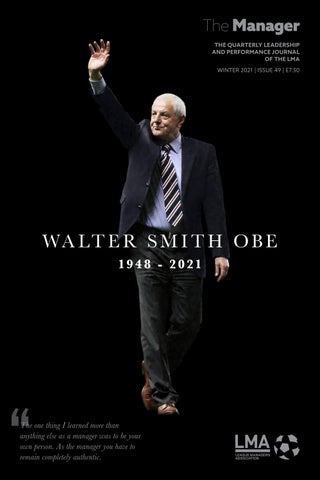
The one thing I learned more than anything else as a manager was to be your own person. As the manager you have to remain completely authentic.
WHILST THERE ARE CHALLENGES THAT YOU HAVE TO DEAL WITH ON YOUR OWN, I’VE FOUND IT OFTEN HELPS TO TURN TO OTHER PEOPLE. WHENEVER I FELT UNSURE OF ANYTHING I KNEW I COULD TURN TO CERTAIN FRIENDS AND MANAGERIAL COLLEAGUES AND ASK THEM FOR HELP OR ADVICE. THEY WERE ALWAYS EXTREMELY HELPFUL, BECAUSE THEY HAD AT SOME POINT BEEN THROUGH SOMETHING SIMILAR. WALTER SMITH OBE
THE LMA INSTITUTE OF LEADERSHIP AND HIGH PERFORMANCE The LMA Institute of Leadership and High Performance is established to provide CPD-accredited vocational in-career learning and personal development for the managers, coaches and performance support teams across English football.
PROUDLY SUPPORTED BY
WELCOME
AN INSPIRATION TO ALL As we approach the halfway point of the season, it has been great to see both an outstanding level of football and the return of fans to the stadiums. Fans are the heartbeat of the game and their return has been unanimously welcomed by all. We also congratulate LMA President Gareth Southgate OBE on England’s FIFA World Cup 2022 qualification, and Steve Clarke and Rob Page for guiding Scotland and Wales to the tournament’s play-offs. This October, we were sad to lose one of British football’s greatest managers, Walter Smith OBE, who amassed an incredible 21 trophies with Rangers. Walter personified dignified leadership and a relentless enthusiasm for football. Since his retirement, he played a truly invaluable role in supporting and developing the next generation of football managers and coaches, most recently as an LMA Technical Mentor. I know that many of you were fortunate enough to know Walter and would agree that his willingness to share his experiences and offer guidance to our members, partners and friends was an inspiration to all. The LMA continues to be concerned about the culture of abuse that is so damaging to the game’s reputation and that has a negative impact on the individuals within it. We are aware of the depth of feeling that exists within the LMA membership and we share the strong desire to see change. Solutions are to be found both through regulation and by ensuring that all abuse in football becomes socially unacceptable. The LMA is in discussions with the other game stakeholders to find a viable and effective way forward. The LMA continues to provide health and wellbeing, and legal support to all its members and their families, and we are in regular ongoing contact with our members on many aspects of their personal and professional lives. LMA members and their families also have access to 24/7 mental and emotional wellbeing support, as well as ongoing training, CPD education and guidance. As we look ahead to 2022, we will continue to strive for positive change in football and play our part in supporting future development across the game. Richard Bevan, LMA Chief Executive
03
EDITOR’S LETTER
Often, it’s the toughest challenges and the most gruelling experiences that shape us, as people, leaders and managers. We learn fastest and gain most in strength and resilience not during our purple patches, but rather when our abilities and perseverance are tested to the limit, often without much in the way of reward. Reflecting on his managerial baptism of fire at Bury, Chorley Assistant-Manager Andy Preece says, “Any challenge now seems achievable. I genuinely believe that if I hadn’t been through that experience at the start I wouldn’t be the manager or person I am today.” Two years into Preece’s tenure as Player-Manager, Bury went into administration and he found himself leading the side through an intensely difficult period. “An awful lot is expected of you in that situation, he says. “You’re dealing with players and staff who aren’t getting paid and who are worried about their families, disgruntled fans, and constant personnel changes, with different people coming in and out of the club.” Preece is far from alone in having faced a truly uphill challenge as a young manager just starting out on his career journey. When you’re working with minimal budgets, little professional support, constant change and upheaval, and often low morale and confidence in the team, just avoiding relegation and keeping the stadium half full can be a huge feat. Preece did much more than that, taking Bury to the League Two playoffs the season after it went into administration, and while his achievements didn’t receive the recognition they deserved, he has shown huge proactivity in furthering his learning and seeking out new opportunities to demonstrate his potential. Read more about his story on page 30. In this highly competitive field, where the headline numbers often hide people’s true achievements, determination, positivity and courage are the name of the game. Alice Hoey, Editor
EDITOR Alice Hoey alicehoey1@gmail.com EDITOR FOR THE LMA Sue McKellar sue.mckellar@leaguemanagers.com ART DIRECTOR Ian Cherry ian.cherry@leaguemanagers.com SENIOR WRITER Mark Farthing mark.farthing@leaguemanagers.com PUBLISHER Jim Souter jim.souter@leaguemanagers.com
BUSINESS DEVELOPMENT Adam Tarrant adam.tarrant@leaguemanagers.com
COVER PHOTO Action Images PHOTOGRAPHY Action Images, Rangers FC, Manchester United FC PRINT PARTNER Jellyfish Solutions Limited
This magazine is printed on responsibly sourced uncoated paper and uses vegetable-based inks. Please recycle responsibly.
The League Managers Association, St. George’s Park, Newborough Road, Needwood, Burton upon Trent DE13 9PD The views and opinions expressed by contributors are their own and not necessarily those of the League Managers Association, its members, officers or employees. Reproduction in whole or in part without written permission is strictly prohibited.
www.leaguemanagers.com
LEAGUE MANAGERS ASSOCIATION
05
WINTER 2021 ISSUE 49
AGAINST ALL ODDS Chorley’s Andy Preece on achieving incredible feats with minimal resources.
30
44
8
ON THE COVER: WALTER SMITH OBE. THE LMA PAYS TRIBUTE.
PITCH PERFECT A baseball perspective from mental skills coach David Franco.
38
29 34 38 48
48
63
70
63 64 68
THE EXPERT Scott Peltin & Jogi Rippel Are you ready to lead, personally? IN-DEPTH You’re welcome A good ‘onboarding’ process can make all the difference to performance. FIRST PERSON Opening up the race Josh Apiafi on diversity initiatives in horseracing. KEY TAKEAWAYS Adopt the beginner’s mind Former international RU player Nigel Redman. THE EXPERT Ed Morris Where are we with Long Covid? HEALTH & WELLBEING Temples of doom Dealing with headaches and migraines. 10 IDEAS Self-promotion Bigging yourself up without bragging.
70
IN-DEPTH A lifetime’s work Executive Coach Zena Everett on taking control of your career journey.
74 79
MENTAL WELLBEING Too much to manage How being overwhelmed can change your thinking. HOW TO: Walk
“He was a great friend of mine for years and years” Sir Alex Ferguson CBE LMA Board & Hall of Fame Member
A T R I BU TE TO
WA LT E R S M I T H O B E 19 4 8 - 2 0 21
All at the League Managers Association are so deeply saddened by the loss of our very close friend, LMA Member Walter Smith OBE, who has passed away at the age of 73.
Following his highly-esteemed career in management, Walter quickly became an integral part of the LMA team. He was dedicated to giving back to the game and, for the past five years, he has been working as an LMA Technical Consultant and Mentor to current Premier League managers and has also worked tirelessly in sharing his advice and guidance with those who are newer to coaching and management.
Manchester City Manager and LMA Member Pep Guardiola said: “I am so very sad to hear the news of Walter Smith’s passing. “I was of course very aware of Walter’s impressive management career before I came to the Premier League. Through his role as Technical Consultant for the LMA, I have had the opportunity over the past five years to get to know him and see what a humble, insightful and very genuine man he was. “I always enjoyed spending time with Walter and we had been planning to have dinner together again. “I feel very fortunate to have had the chance to get to know him.”
LMA Executive Committee member David Moyes added: “I looked up to Walter with so much respect. He was such a great Scottish manager but, to me, he was an even better man. He was honourable, he showed great dignity, and always demonstrated such class. He was a true friend and mentor, and a man I feel privileged to have known. He will always be remembered fondly.”
“Walter was a great person to be around and a pleasure to be managed by. He was a hero of mine growing up, watching him winning trophies at Rangers and getting the opportunity to eventually work with him at Everton was something I couldn’t refuse. “Everton was the right club at the wrong time for him. However he gave everything in very difficult times and I genuinely believe under most other managers the club would have been relegated and lost its proud record of top flight football. “I worked with Walter again with Scotland and Rangers during successful times and he became so much more to me than my boss.” David Weir
“Ongoing learning and development is essential for all managers and the webinars, manager development and mentoring programmes that the LMA provide are an invaluable resource.“ Walter Smith
To become a successful manager you need drive and determination, so it’s only natural to put the job before other things. Regardless of what you do, it’s always on your mind; it’s all encompassing and separating yourself off from it is a big part of managing your own resilience. Walter Smith
Paying tribute, LMA Chairman Howard Wilkinson said: “I am devastated to hear of the passing of my very good friend Walter Smith, a Scottish legend who amassed 21 trophies at Rangers. “His ever respectful, polite and modest manner and demeanour gave no clue as to his remarkable career and success in both Scotland and England. Walter’s achievements, knowledge and character put him up there with the very best. “In the very earliest days of the LMA Institute of Leadership and High Performance, when we invited Walter to share his career insights with the wider LMA membership, he gave his time freely. In a Q&A session with his former Chief Executive, Martin Bain, he shared openly and honestly insights from across his extensive career in management, and this was very much appreciated by everyone who felt privileged to be in attendance.”
LMA Chief Executive Richard Bevan added: “For very many years, Walter has been a close friend and supporter of the LMA and, in more recent times, he has generously given his time to support and mentor others working across the professional game. “It is impossible to express how valuable that support has been for his fellow members, and I have no doubt that Walter had so much more to offer.”
“Although Walter was only with the team for a short period, his impact on the group was significant, leaving me and the rest of the players with invaluable messages to take forward at that time.
Ally McCoist said: ‘He means everything to a lot of folk. He was my boss, my coach, my second father and then turned into one of my best friends.”
Everyone knew immediately that he was a winner, determined to make us better, support the manager and help us to achieve everything we could that year.
Graeme Souness remembered: “Walter Smith was my rock at Rangers. The overriding memory I’ll have of him is not of football but as a friend. If you were drawing up a list of people to be in the trenches with, Walter would be top of mine. “His knowledge of football was fabulous and he was fabulous to be around. He loved a laugh, loved football stories, but when business was to be done, he quickly went into that mode. Walter never changed. He was wise when he was young.” LMA Hall of Fame Member José Mourinho said “I always enjoyed Walter’s company… he was a top man”.
We spent fantastic moments together as a group, winning the FA Cup. That day will always stand out to me as it was one of the first trophies that I won. It was special for the squad, the manager and of course, Walter. He instilled extra belief in me every day whilst I was developing, training to be the best, to demand the ball, be brave and strong. Those sessions helped me so much at the start of my time in Manchester and stuck with me throughout my career. Everyone knows the imprint that he has had on British football and his legacy will never be forgotten.” Cristiano Ronaldo
Sir Alex Ferguson CBE remembered: “He was a great friend of mine for years and years. “In Walter you were dealing with a man with great moral compass in how he lived his life and the friendship he offered so many people. His contribution to football with Dundee United, Rangers, Scotland, Everton and Man United was immense. “He had a wonderful connection with people because he was a great listener: that was one of his greatest qualities. He listened and showed an interest in people and helped everyone he could. It’s such a loss to the game and to everyone that knew him.”
Paying tribute, LMA Member Steven Gerrard said: “Walter was an incredible leader and a very successful manager. “I always found Walter to be so insightful and will always value the important nuggets of advice that he shared with me. He was honest and genuine and made me a better person. I’ve been the lucky one to spend time with him.”
The thoughts of all at the LMA are with Walter’s wife Ethel, his sons Neil and Steven, his grandchildren, of whom he was so proud, and all of his family and friends at such a sad time.
14
LEAGUE MANAGERS ASSOCIATION
IN TRIBUTE
PAUL MARINER 1953-2021
Having played as a centre forward for Plymouth Argyle, Ipswich Town, Arsenal and Portsmouth, as well as making 35 appearances for England, Mariner spent the later years of his playing career in Australia and the US. It was stateside, while playing for Albany Capitals, that he began to coach and he embarked on it full time when he hung up his boots in 1993. Mariner started out as Assistant Manager for Harvard Crimson before moving to New England Revolution, again as Assistant Manager, for f ive years. Following his return to the UK in 2009, he took the reins at his former club, Plymouth, for a year, as Head Coach and then brief ly Manager. He later returned stateside to Major League Soccer side Toronto FC as Director of Player Development and then Head Coach.
HAVING FACED HIS TEAMS AS A MANAGER, I REMEMBER PAUL AS A TOUGH OPPONENT AND A GREAT TEAM PLAYER. HIS ENTHUSIASM AND PASSION FOR THE GAME WAS APPARENT THROUGHOUT HIS PERFORMANCES.
PAUL WAS VERY HIGHLY RESPECTED AS A PLAYER AND A MANAGER, AND WE PARTICULARLY REMEMBER HIM FOR HIS KINDNESS AND GENEROSITY TO HIS FELLOW COACHES. HE WAS ALWAYS KEEN TO WELCOME COLLEAGUES WHO WANTED TO LEARN FROM HIS EXPERIENCES COACHING OVERSEAS.
HOWARD WILKINSON LMA CHAIRMAN
RICHARD BEVAN LMA CHIEF EXECUTIVE
15
16
LEAGUE MANAGERS ASSOCIATION
IN TRIBUTE
LEN ASHURST 1939-2021
Len Ashurst spent the best part of his playing career at Sunderland, where he notched up an incredible 458 games over 13 years, a club record for an outfielder. He moved to Hartlepool in 1971, where he became Player-Manager and began a career in management that would last 22 years and take him across the globe. Ashurst’s achievements include pulling Sheff ield Wednesday back from the brink of relegation in the 1975/76 season and, at Newport County, achieving promotion, winning the Welsh Cup and reaching the quarter-f inals of the European Cup Winners’ Cup. He achieved promotion with Cardiff City in the second of his two spells with the club before returning to manage his beloved Sunderland, taking them to their f irst League Cup f inal. Ashurst then took his expertise further af ield, coaching with the Kuwait and Qatar national football teams before becoming Manager of Qatari club AlWakrah and Sri Pahang in Malaysia. During the later years of his management career, Ashurst worked with The FA as an administrator and with the Premier League as a match delegate. He was inducted into the LMA Hall of Fame in 2014.
LEN WAS A REAL BRICK IN THE OLD WALL THAT WAS FOOTBALL MANAGEMENT AND HE WILL BE SORELY MISSED BY ALL WHO KNEW HIM. HE WAS THE SALT OF THE EARTH, RESPECTFUL, KIND AND ALWAYS LOOKING OUT FOR OTHERS. HOWARD WILKINSON LMA CHAIRMAN
17
WIN BETTER THE WORLD'S MOST EXTENSIVE LIBRARY OF PROFESSIONAL COACHING SESSIONS AT YOUR FINGERTIPS
elitesoccercoaching.net “I wish I’d had it when I started coaching” Sir Alex Ferguson “A fantastic magazine” Arsène Wenger “l look forward to receiving every issue” Jose̓ Mourinho
CELEBRATING 10 YEARS AS THE COACHES’ CHOICE
In recent months, the LMA Hall of Fame 1000 Club has welcomed three new members: José Mourinho, Steve Bruce and David Moyes. The 1000 Club is a celebration of success and longevity. In a profession where time can often be an all too rare commodity, 1000 Club members have exhibited an enduring quality, achieving a truly prodigious amount.
Jose
IN JOINING THE LMA HALL OF FAME 1000 CLUB, HE ADDS LONGEVITY TO HIS ARRAY OF MANAGERIAL ATTRIBUTES WHICH HAVE ENABLED HIM TO WIN AN INCREDIBLE 25 TROPHIES IN THE PAST TWO DECADES.
Primeira Liga x2 Taça de Portugal Supertaça Cândido de Oliveira UEFA Champions League x2 UEFA Cup Premier League x3 FA Cup Football League (EFL) Cup x4 FA Community Shield Inter Milan Serie A x2 Coppa Italia Supercoppa Italiana La Liga Copa del Rey Supercopa de España Manchester United FA Community Shield UEFA Europa League
Howard Wilkinson, LMA Chairman
To be inducted into the LMA 1000 Club is an achievement that I am proud of and I thank the LMA for remembering this milestone. José Mourinho, LMA Hall of Fame Member
BEING IN THE COMPANY OF SOME WONDERFUL MANAGERS WHO HAVE REACHED THIS MILESTONE IS A GREAT HONOUR FOR ME. David Moyes, LMA Hall of Fame Member
LMA MANAGER OF THE SEASON
2002-03 LMA MANAGER OF THE SEASON
2004-05
LMA MANAGER OF THE SEASON
2008-09
Football League Second Division FA Community Shield
David
Many congratulations David on reaching 1000 games, which is an absolutely fantastic achievement. You are joining an elite club of managers in the LMA 1000 Club Hall of Fame and you thoroughly deserve all of the plaudits that come your way. Sir Alex Ferguson CBE, LMA Board & Hall of Fame Member
Steve
FA Cup Runner-Up EFL Championship Runner-Up x2 Football League Championship Play-Offs Winner x2
HE IS A PASSIONATE FOOTBALL MAN, WITH THE DRIVE AND DETERMINATION TO SUCCEED IN EVERY ROLE TO WHICH HE IS APPOINTED, BUT ALSO THE HUMILITY AND COMPASSION YOU WOULD EXPECT OF A GREAT MANAGER. Richard Bevan, LMA Chief Executive
It was very special for me to manage my 1000th match as Newcastle manager and join the 33 other members of the LMA Hall of Fame 1000 Club, which of course includes my former manager Sir Alex Ferguson and fellow Geordie Sir Bobby Robson. Steve Bruce, LMA Hall of Fame Member
The Langham, London Celebrate The Everyday
When The Langham, London opened its doors in 1865, it set a new standard in luxury. That spirit of innovation and celebration endures today. From sipping cocktail creativity in Artesian to indulging in the finest dishes at Roux at The Landau, one of the capital’s most beautiful dining spaces, you really don’t need an excuse to visit us. To meet, to eat or to relax – whatever your reason, celebrate the everyday with us.
1c Portland Place, Regent Stree, London W1B 1JA T (44) 020 7636 1000 F (44) 020 7323 2340 langhamhotels.com/london
THE LEADER
27
MAKE YOUR NEXT EVENT A VIRTUAL SHOWSTOPPER ✔️ The only XR studio in London to host virtual, hybrid or live events, either pre-recorded or via live streaming, in our spacious and flexible Westbourne Suite.
Royal Lancaster London, Lancaster Terrace, London, W2 2TY +44 207 551 6115 | royallancaster.com | events@royallancaster.com
THE LEADER
THE EXPERT
SCOTT PELTIN & JOGI RIPPEL Are you ready to lead, personally? Scott Peltin and Jogi Rippel are the founders of Tignum. Tignum has over 15 years’ experience working with high-level leadership teams, helping them to enhance their personal readiness and achieve their potential.
One of the hottest topics
Two of the biggest challenges
when it comes to a leader’s
to personal readiness are
performance is personal
fatigue (physical, cognitive and
readiness. For years, the
emotional) and having a mindset
focus has been on functional
primed for success. Since game
readiness and role readiness,
day often follows a long week of
but the margins are getting
practice, press and difficulties,
tighter, and the game is
it’s easy to show up fatigued.
changing.
This is ironic since so much effort and attention goes into making
FOR YEARS, THE FOCUS HAS BEEN ON FUNCTIONAL READINESS AND ROLE READINESS.
Functional readiness is about
sure athletes are fully recovered
having things like adequate
so they can bring their best to
education and qualification
the game. Yet, many coaches
for that leader’s function (e.g.
show up for the games sleep-
finance, HR, supply chain,
deprived, emotionally drained,
coaching). Role readiness is
and experiencing brain fog.
about having the talent to perform the critical jobs for that
In the heat of the game, there is
role sufficiently.
simply too much to cognitively
Both functional readiness and
personally ready coach must
role readiness are important,
prepare their mindset for
focus on. For this reason, a
but in many ways they are just
how they will deal with the
the ticket that gets you onto
challenges and emotions to
the pitch. Personal readiness
come. Sometimes lucky leaders
is about how you show up,
win a game, but personally ready
how primed your brain is to be
leaders win championships.
mentally agile, how emotionally capable you are to deal with the challenges, and how able you are to multiply the energy of those you lead.
29
AGAINST ALL ODDS Throughout his career, Andy Preece has achieved incredible feats with minimal resources, including, as Assistant Manager, taking nonleague Chorley to the fourth round of the FA Cup. Alice Hoey asked him about his baptism of fire and his continued positivity.
“Bury was my first job and I think what happened in those four years really set me up for the rest of my coaching and management career.” Many managers feel thrown in at the deep and, despite their best efforts, ill prepared. For Preece, that included “shaking buckets in supermarkets, selling players, and doing anything just to keep the club afloat.” Preece had only just started his B-Licence when Bury went into administration and says the challenges he faced in that period were so tough and so broad that it left him feeling that he could face anything his career might throw at him.
PREECE IS THE FIRST BLACK ENGLISH COACH TO HAVE LED A TEAM INTO EUROPE, HAVING DONE SO IN SUCCESSIVE SEASONS WITH AIRBUS UK.
THE LEADER
Words: Alice Hoey Photography: Reuters / Action Images
Behind the scenes “A lot is asked of you in a situation like that,” he says. “You’re dealing with players and staff who aren’t getting paid and who are worried about their families, disgruntled fans, constant personnel changes, with different people coming in and out of the club, and all the while you still have to try to get good results on the pitch.” Preece had to stand up and be the leader, which isn’t easy when you’re 33 years old with little or no experience. What’s more, Preece was Player-Manager so faced intense pressure to perform both on and off the pitch. “For 12 months or so I didn’t have an assistant, so I was handling pretty much everything on my own,” he says. “It was incredibly tough, but it does mean that any challenge now seems achievable and I genuinely believe that if I hadn’t been through that experience at the start I wouldn’t be the manager or person I am today.” Incredibly, in his last season with Bury, and despite having one of the lowest budgets in the league, Preece succeeded in taking them to the League Two playoffs. Given the huge disadvantages that he had to overcome, his achievement should have opened doors. Frustratingly for Preece, it somehow passed under the radar. Undeterred, he took up a PlayerManager post at Conference North side Worcester City, taking them from the bottom four to achieve three consecutive top 10 finishes and reaching the second round of the FA Cup. He achieved the same feat in
the FA Cup with Northwich Victoria, bringing in vital revenue for both clubs, before moving to Welsh PL factory team Airbus UK. There, in his first two seasons in charge, Preece led a team that had never finished in the top half of the league to second in the table and qualification for three successive Europa Leagues. Brave new world Preece also has experience abroad, helping to develop players in Vietnam. He had worked previously with the academies at Fleetwood and Blackpool and had visited the set up at Wolves to see how it operated day to day, but this was an altogether different prospect and a challenge he relished. Even as his flight was about to take off he had his reservations, he recalls. “It was no small thing to leave quickly for a role I didn’t know that much about, to go to work in a different culture and language, and to be away from my family for a year.” He has no regrets, however, grateful for what proved to be an incredible life experience and an opportunity to grow further as a manager. “I’m really proud of what we put together, and it was important for me personally at the time, because it reinvigorated me and I returned to the UK with fresh self-belief and positivity.” Winning partnership When the role of Assistant Manager at Chorley came along, Preece was initially reluctant, as he was used to being the decision maker. However, it was Manager Jamie Vermiglio’s first
ANDY PREECE HAS MANAGED 700 ELITE GAMES, WITH OVER 300 WINS UNDER HIS BELT.
THE LEADER
role and, having played under Preece at Northwich, he was keen to have his support. “The fact that I’d previously been Jamie’s manager could have made it a difficult relationship, but it wasn’t. We had always stayed in touch and had a good connection, and we have huge respect for each other professionally,” says Preece. “A headteacher by trade, and an incredible manager, Jamie comes at leadership from a different angle so we’re learning a lot from one another.” The duo have certainly had an incredible start – winning promotion in their first season, then reaching the fourth round of the FA Cup, knocking out Wigan, Peterborough and Derby in the process. “We were pinching ourselves, because while some non-league teams get that far, it isn’t usually by beating the calibre of opposition that we did.” Unsurprisingly, he’s glad he took the role. “It would have been easy not to, to be pig-headed and say, I’m not going from manager to assistant, but it’s been incredibly rewarding and I’m proud of what we’ve achieved here,” he says. “My role has gone from coming in twice a week for a few hours to being full-time Director of Football, setting up a massive education programme and overseeing the academy, there are some great people around me who I can learn a lot from, and we’re starting to see all the hard work pay off, with eight players coming through into our first team squad.” Preece believes the key is understanding your players and finding a way of playing that really
plays to their strengths. “Over the years I’ve found ways to win games using different styles of play, each time getting the best out of the players I had and ensuring they understood their roles and responsibilities,” he says. “Ultimately, you have to find a way to win games quickly and for that you have to be adaptable. I doubt I would have survived as long as I have in the game without that adaptability.” The fact that Preece has held such a variety of positions is also a string to his bow, demonstrating his adaptability. As well as having been player-manager, head of academy and now assistant manager he has scouted and done media work. “That means I have a thorough allround understanding of the workings of a football club, from top to bottom,” he says. “I’ve seen the game from different perspectives and so now at Chorley I know what people need from one another and what they’re going through because I’ve been there. That’s a real advantage.” Ups, downs and ups It’s fair to say that Preece’s career trajectory has been far from smooth, with financial difficulties and administrations at Bury and Northwich Victoria resulting in relegations beyond his control. Yet he has embraced the challenges and, despite the hurdles, has overachieved in every role. Aware of the many great managers out there and the scarcity of good opportunities available, he has always looked for ways to push himself out of his comfort zone and to
improve, completing his A-Licence, Pro-Licence, the LMA Diploma in Football Management, the PFA’s On the Board programme, and now the LMA Mentors course. “I’ve been mentoring, informally, in my current role as Assistant Manager of Chorley – I think many of us do so throughout our lives, often without realising it - but the mentoring course has helped me to formalise it and give it more structure,” says Preece. “I now have a much better understanding of what a mentee might need from me and how to provide that. Mentoring isn’t about giving the other person advice or solutions, it’s about helping them find them, and there’s a real skill to that.” He admits he didn’t anticipate how personally fulfilling he would find the course, which has seen him dedicate more time and energy to supporting his mentee. “It’s incredible to see the person you’re mentoring go on to achieve new things, but also it reaffirms how valuable your experience is. That boosts your confidence,” says Preece, who adds that there are many managers and coaches out there who, like him, haven’t yet had the chance to fulfill their potential. “Sharing the experiences and challenges I’ve had has been fantastic, because I know that sometimes you need someone else to help you realise your strengths and the real value in what you’ve done. A little push and a little guidance can make all the difference.”
ONBOARDING When a new member joins the team there’s a lot to take in, from where to hang their coat to the organisation’s culture. If they are ‘onboarded’ well, however, they’ll hit the ground running.
YOU’RE
WELCOME
WORDS: ALICE HOEY
Onboarding, or ‘organisational socialisation’, to give it its even more daunting title, is the process of introducing a new team member to an organisation so that they understand what they need to do, how and why. By the end of the process, they should feel confident and able, feel a welcome part of the team, and understand what values and behaviours go with that. Essentially, the more effective your onboarding process, the quicker your new recruit will be able to find their feet and start doing what they do best.
help them feel at home, and equip them with the basic knowledge they need to turn up on time and perform at their best. Some organisations will provide a written welcome pack of sorts to refer to, but all will prioritise the personal approach. Player Liaison Officer Phil Lythgoe is the first point of contact for new signings arriving at Norwich City. Having already installed them in a local hotel while he tries to find them suitable rental accommodation, he’ll talk them through the packed integration day that lies ahead.
“We’ll give them a tour of the grounds, give them their squad number, show them their locker, and go through all the little details Given that all this requires focus, it’s important they’ll need to know when they start,” says that basic things like their schedule, where they Lythgoe. “Throughout the day, they’ll also put their things and who to go to for what don’t have meetings with the key people they’ll be get in the way. The initial part of onboarding, working with: our Head of Physio and Head ‘orientation’, is therefore where you show the of Strength and Performance, and Sporting new team member around their physical Director Stuart Webber.” workplace, and possibly also their digital one, The grand tour
34
LEAGUE MANAGERS ASSOCIATION
THE LEADER
WELCOME. BIENVENIDO. SALUT. PRIVET. KHUSH AMDEED. BINE ATI VENIT. YŌKOSO. HUĀNYÍNG.
SETTING THE TONE FOR WHAT KIND OF MANAGER YOU ARE IS ALSO KEY; WHAT THEY CAN EXPECT FROM YOU AND WHERE DO YOU DRAW THE LINE BETWEEN PROFESSIONAL AND PERSONAL?
If time allows they will also try to arrange a meal with owners Delia Smith and Michael Wynn-Jones, so when they leave they know all the logistics and what’s expected of them, but also feel welcomed warmly into the fold. Bedding in The lengthier and arguably more important element of onboarding is called ‘relational onboarding’ and it’s the process of building the relationships the new recruit needs to be as effective as possible. They’ll also develop a deeper understanding of what it means to be part of your team, asking, for example: what are the short and long term goals of the organisation, its core values and history, and how do these drive it forward as a team? Who is responsible for what and who can I turn to for help and support? What is expected of me as a member of this team, not just in terms of my role and responsibilities but also my conduct and attitude? They might find the answers to some of these questions in your written code of conduct or on the posters you have on the wall, but others will need to be experienced and absorbed over time. “We explain to our new recruits that Norwich City is a club with a big focus on community and family,” says Lythgoe, “but they also find that out very quickly once they’re here, especially after they’ve played a few home games. It all tends to fall into place in the first four or five weeks.” Setting the tone for what kind of manager you are is also key; what they can expect from you and where do you draw the line between professional and personal? This is especially important if you have worked with them before, because roles and people change and it’s easy for the boundaries to become blurred. Team effort It’s worth remembering that, while onboarding naturally focuses on the needs of the new recruit, it will only be truly effective if you involve the rest of the team. The work you do with the group before and after their new teammate arrives will reduce the chances of cracks appearing as you evolve your side, and keep the additional support you need to provide to a minimum.
35
According to Lythgoe, word spreads fast and the players tend to know well in advance who is joining the squad. There’s still, however, a process in place to ensure they’re brought up to speed on who their new teammate is, why you decided to sign them and how it might impact on their own roles. Rather than simply announcing their arrival, find ways to help everyone get to know one another, professionally and personally. “Supporters expect the players, old and new, to just click together on the pitch, but it’s not as easy as that,” says Lythgoe. “It can be a big culture change for some players, especially those coming up from lower leagues or the academy, and also from Europe. They often find the intensity of training in the Premier League difficult,” he adds. “We sometimes train well into the evenings, so they’re long days. It can take a while for new players to settle into that routine, not to mention adapting to the different culture and way of life.” One way Lythgoe has found to help young academy players come up into the squad is to assign them with a mentor within the group, normally someone playing in a similar position. This mentor or ‘buddy’ approach helps them feel at ease in their new environment, and they’re likely to learn more quickly by having someone willing to share their experience and field their questions. Too much, too soon How long your onboarding process is will depend on how much and how complicated the information is that you need to share and what they
36
need to know in order to hit the ground running. While it might be tempting to brain dump everything on them as quickly as possible, it’s worth considering whether this is necessary or beneficial. It may be better to take a ‘need to know’ approach, and to build up their understanding as you go along. “It’s a difficult balance,” admits Lythgoe, “because you want to try to answer as many of the questions they might have at the start as possible, but you also need to avoid overwhelming them. There’s an awful lot to take in on our integration day and there will always be follow-up questions over the days and weeks that follow. Every player is different, and often I’ll be asked something I’ve never been asked before.” Another pitfall to avoid is to make assumptions about what the new hire already knows about the organisation or club. While you might not want to teach grandma to suck eggs, it’s better to start with the fundamentals than miss out chunks of your onboarding because you assume they don’t need it.
SUPPORTERS EXPECT THE PLAYERS, OLD AND NEW, TO JUST CLICK TOGETHER ON THE PITCH, BUT IT’S NOT AS EASY AS THAT. IT CAN BE A BIG CULTURE CHANGE FOR SOME PLAYERS.
LEAGUE MANAGERS ASSOCIATION
THE LEADER
YOU WANT TO TRY TO ANSWER AS MANY OF THE QUESTIONS THEY MIGHT HAVE AT THE START AS POSSIBLE, BUT YOU ALSO NEED TO AVOID OVERWHELMING THEM. The final stage in the onboarding process is follow up and feedback. It’s essential that you identify any gaps in the new team member’s understanding, anxieties or other issues early on, before they get in the way of their performance. For Lythgoe, as he’s in regular contact with new signings from the start, this feedback tends to be an ongoing and informal affair.
However he does make a point of scheduling a face-to-face session with each new recruit around a month in. “I’ll sit down with them to check if everything is ok, because sometimes there are things away from the club that are worrying them and that I may be able to help with,” he says. “The less they have on their mind off the pitch, the better they will be able to perform at their best on it.”
37
The murder of George Floyd was a wake-up call for the world, and for me. Around the world, in most sport and business, awareness of the importance of diversity and inclusion was moving up the agenda, but horse racing lagged behind.
THE LEADER
OPENING UP THE RACE FIRST PERSON
Former amateur jockey Josh Apiafi was part of the founding management team at Betfair before becoming CEO of the Professional Jockeys Association and launching the loyalty programme Rewards4Racing.com. Now more widely known as Sky Sports Racing’s presenter, Apiafi is spearheading a programme of initiatives to ensure horse racing becomes a more diverse and inclusive sport in years to come.
Photography: Reuters / Action Images
THE LEADER
In horse racing, not many people look like me. Of the top 500 senior executives in our sport, only two are from ethnic minority groups (up from one a year ago), while only three of the 450 professional jockeys in the UK are non-white. Draconian views are sadly still common – I’ve had one senior board member ask me in the last year, ‘so what do we call you people now?’ You can’t change something like that overnight. The murder of George Floyd was a wakeup call for the world, and for me. Around the world, in most sport and business, awareness of the importance of diversity and inclusion was moving up the agenda, but horse racing lagged behind. I decided, therefore, to try to get my own house in order, to address these issues in horse racing. Hopefully that would then be a building block towards societal change.
If you can’t see it, you can’t be it. Over the last year, I have been presenting a series of programmes called Leading the Way on Sky Sports, interviewing leading figureheads within the horse racing industry to talk about diversity and inclusion and their journeys into and within the sport. It is important to get a diverse range of faces out there for teenagers to aspire to, because you can’t feel a sense of belonging when no-one looks like you. You need to be able to see someone, like Ashleigh Wincheard (who is Travelling Manager to leading racehorse trainer Neil Mulholland) on the screen or on a poster, and say to yourself, ‘she looks like me’. The photo (left) is from a programme I made in 2020 called ‘The Uncomfortable Race’. I interview a group of black Generation Z racing fans about their experiences and views on horse racing in relation to diversity and inclusion. The guys pictured, all under the age of 23 and all on different pathways within our sport, had reached out to me at the start of my campaign. It was fascinating to bring them together and to learn from one another’s experiences. It’s a challenge to engage people in racing. Having watched the World Cup, you can feel inspired to go outside and kick a ball in your garden, but if you watch the Derby, you can’t just pop to a local racehorse trainer and jump on a racehorse! What that means is we have to make the most of the entertainment side of the sport, and engage people through the amazing stories behind the individuals in racing. The Formula One documentary series ‘Drive to Survive’ was a huge success because it made people who weren’t previously fans of F1 care about who wins or qualifies. It made it personal.
Horse racing must be m
The pathways into horse racing are poorly defined. Various funding initiatives and academies exist to introduce young people to the sport, but these are predominantly part of a pathway to become a jockey or a work rider in a stable. There is a fantastic initiative called ‘Racing to School’, which gives children a behind-the-scenes experience of a raceday. In 2019, they brought 15,000 school kids to experience racing. However, what we found was there was nowhere for them to go next, to continue their fan journey with the sport. We are now implementing ways to continue that engagement, including a parents and guardian’s week in the summer holidays, where those children can bring their parents for a similar experience. The next step is to launch a young person’s racing club. The aim is to ensure that if you are 18 or younger, whatever your background, creed, colour or religion, there is somewhere to land to further your engagement within the sport. New media is essential in achieving that. Yet in horseracing it’s very limited. I asked every marketeer within the sport about their strategy on TikTok,
Snapchat, YouTube and Twitch and was met with blank faces. Gen Z are already there, waiting to be engaged, and we have to offer them creative content. I’m having ongoing conversations with TikTok’s UK management team, discussing racing’s relationship with the platform with a view to building a strategy for consistent content next year. When the next generation isn’t engaged with your marketing channels it’s difficult to reach them directly to inform them about your sport. You can however, engage the organisations who do have that access, like inner city youth schemes and inner city county councils. That’s how I believe we can start to make significant changes to the diversity of our sport. Horse racing must be more reflective of society. If not, it will never be attractive to the next generation of fans and employees. Sustainability, and diversity and inclusion are very close to the hearts of young people and important when determining who they will engage with. Setting aside those that ride horses, if you asked 100,000 teenagers what they want to be when they grow up, not one of them will say they want to work in the
racing industry. A major part of the challenge for me is therefore ensuring that working in horse racing is an option for all young people, no matter what walk of life they are from. Sky has given me a platform to bring about change. Around the time of George Floyd’s murder, I was asked by one of my fellow presenters live on air for some quick wins where horse racing could start to enact change. I talked about the British Horseracing Authority (BHA) graduate course, an incredible course providing great opportunities for work placements at renowned international industry stakeholders. The course had been running for over 30 years, but you had to be a graduate to qualify for entry. Having left school at 16 to work in racing, people with my educational background never had the opportunity to apply and that only served to widen the gap between the haves and have nots. Over the last 30 years, fewer than 10 people on the course have been from ethnic minority groups. The following week, I was asked by the BHA to present my ideas and six weeks later the course was changed to the British Horseracing Development course, open to everyone. Quick win – tick!
more reflective of society.
We developed the Racing Media Academy to engage the next generation. In April 2022, 10 applicants from diverse backgrounds will take part in a week’s residential course at the racing school at Newmarket, before going to one of the many industry firms we’ve collaborated with on a 6-10 week placement. We want to ensure that young people from all backgrounds have the opportunities they deserve to work in the horse racing industry. My aspiration is that in years to come those representing the sport will be far more diverse than has traditionally been the case. Sky, RacingTV, Racing Post, Racetech and Equine Productions have all signed up to ensure the success of the Academy.
I got my resilience and determination from my dad. An orphan, he joined the lowest ranks of the RAF working his way up to becoming a pilot, he then became the first black commercial pilot; there are still very few today. I gained strength from the fact I was different from everyone else; I thought then (and still do), ‘I’ll show you’. It was my challenge and I’ve never bucked a challenge. It’s 30 years since I left home at 16 and moved 250 miles away to a full-time job in racing. I’ve had to be confident of my own ability because everything I’ve achieved in my sport, I’ve done myself. I set up my first business some 25 years ago and I’ve been independent all the way through.
Change at leadership level will take longer. It’s difficult to change the make-up of your board if you don’t have a fixed period of tenure; if that’s the case you should be looking seriously at how long people are able to hold onto those positions for. In my opinion, it isn’t healthy for an organisation if everyone is of the same demographic; you won’t get diverse thinking or a diverse range of perspectives and experiences. The world’s most successful organisations are those with the most diverse workforces.
I’ve been mentoring three of the guys from The Uncomfortable Race programme. While I have no official experience in mentoring, I do have experience of being a nonwhite person in the horse racing industry, and have had to overcome many hurdles and barriers throughout my career. Hopefully I can use that experience to ensure they and others won’t have to.
We want to ensure that young people from all backgrounds have the opportunities they deserve to work in the horse racing industry. My aspiration is that in years to come those representing the sport will be far more diverse than has traditionally been the case.
THE LEADER
Our natural tendency is to let the situation we’re in dictate our perspective, but elite performers understand that perspective is a choice, says mental skills coach David Franco.
Words: Alice Hoey Photography: Reuters / Action Images
Seattle Mariners shortstop J.P. Crawford throws to first base after fielding a ground ball against the Oakland Athletics during the sixth inning at T-Mobile Park.
THE LEADER
“In baseball, players no longer see mental skills as something you need only when things aren’t going your way,” says Franco, who was until recently Peak Performance Coach at the Seattle Mariners and now Mental Skills Coordinator for the Texas Rangers. “They understand that you don’t have to be weak in order to get stronger.” ‘Mental skills’ and ‘mental health’ have, in recent years, shaken off their negative connotations and there’s now an understanding across sport, business and other high-performance environments that they play a central role in our performance and development. Indeed, bringing in a mental skills coach like Franco to work not just with the players but with their coaches and managers is fast becoming standard across elite sport. “That’s exciting,” he says, “because there’s still so much room for improvement in this area. For a long time, coaches and leaders in sports, business and in other walks of life acknowledged the link between mental skills and performance, but it was rarely discussed or worked on in much detail. That’s now changed, and conversations around things like being able to control your mind and emotions, and how to stay in the moment when surrounded by chaos have become a normal and productive part of training and development.”
strength and conditioning work or training drills, Franco sees the impact of his work everyday. “It’s in the way that the coaches and players speak to one another, the language they use, and the knowledge they have around peak performance,” he says. “For example, I love to see them talking to one another about their routine for the 15-second funnel. In baseball, this is what we call the crucial interval between pitches, so having a good mental routine to control what’s going in in your mind during that funnel is a massive part of on-field performance. When it’s a close game, the crowd is going wild and the atmosphere is electric, what happens in the minds of the pitcher and the batter in those 15 seconds between pitches can determine whether you win or lose. “We therefore have to help the players calm their minds and avoid falling into the mind traps that have previously taken them into a poor mental space. They need routines to focus on the right things at the right time.” That’s what mental skills are, he adds. They can be defined as simply thinking about the right things at the right time. “For a hitter that will mean seeing the baseball and committing to their plan for that pitch,” he says, “while for a pitcher, it’ll be knowing what pitch you’re going to throw and throwing it with full conviction.”
Commit to hit
Control the controllable
While there’s still no reliable or accurate way to quantify or track the benefits of mental skills coaching on performance as one would, say,
While any team will be hungry for good results, Franco believes you should never be focused on achieving that aim, especially given you have
46
no direct control over final results. Instead, it’s better to concentrate on the things you can directly affect, those processes you have in place for things like the 15-second funnel. “Something as simple as taking a deep breath and visualising the pitch that you want to throw can give your mind somewhere to go, regardless of what’s going on around you and the million different distractions vying for your attention.” That doesn’t, he adds, mean you don’t care about the results, or that you’re going to be any less bothered by a loss or a bad performance. It simply means you’re taking ownership of it and are using it as a way to motivate yourself and continue your development. “Sometimes we can learn a lot from bad performances,” he says, “other times it’s better to put them behind you immediately and look forward to the next day.” Live, breathe baseball Given the intense nature of the baseball season it’s especially important that players are able to put a performance behind them and move on. With around 162 games in total, some professionals will play almost every day for months on end with few days off. Unsurprisingly, many find it hard to leave the sport at the stadium at the end of the game. “To get through the season and keep playing at a high level for that long period of time, it’s crucial that we look at what they do off the field in terms of their physical and mental recovery and their overall mental health,” says Franco. “A big part of our mental skills work with the players
LEAGUE MANAGERS ASSOCIATION
and their coaches is therefore about helping them develop routines so they can process what happened and then leave it at the field. It’s really important that they can go home and get back to being a dad, husband or friend.” A communication curveball Given the intense schedule of training and competition that the players are accustomed to, when the Covid pandemic hit it was a particularly challenging period. Players were confined to their homes not just around the US but around the world, unable to interact and communicate in the way which they were accustomed.
Conversations around things like being able to control your mind and emotions, and how to stay in the moment when surrounded by chaos have become a normal and productive part of training and development.
“Right at the start we knew we had to get everyone talking to each other as much as possible, so we set up lots of Zoom calls with the players in small groups,” recalls Franco. “Initially we mapped out all the mental skills we’d need to talk through with them, but by the second week we realised that what was really important was just to connect people and let them dictate the content of the calls. Some groups read books together, others made presentations to one another or talked about the news stories they’d seen on TV. Ultimately, it was about maintaining a sense of camaraderie and connection.” While you can work on your individual mental skills, fostering a healthy group mentality is, after all, the key to peak performance in a team sport. “You have to get the players to buy into the idea that when you play for something greater than yourself, and you’re aiming to win for the team, it takes a lot of pressure off you as an individual and it makes you all better players.”
47
7 KEY TAKEAWAYS
ADOPT THE BEGINNER’S MIND Speaking at the LMA’s Autumn Leadership Forum, former international rugby union player Nigel Redman worked through some of the questions we should ask ourselves and our teams, and explained how our knowledge can sometimes hold us back.
1
VISION AND PURPOSE My starting point when working with teams is always to ask, who are you and what do you stand for? What messages do you want people to walk away with and why are you doing what you do in the first place? Many teams seem to be lost at the moment; they’ve forgotten who they are and where they’ve come from.
2
WHAT DO YOU ASPIRE TO? Winning is just an outcome. What does success really look like to you and how can you articulate that? I worked with British Swimming as Elite Coach Development Manager and saw how they changed their understanding of success from winning medals to simply swimming the season’s best at the biggest meet of the year. They went from a three medal sport to a six medal sport in a four-year cycle. Get everything right, they say, and the medals will come to you. Define success and align it with your values.
3
HOW FAR IS TOO FAR? What are you prepared to do to be successful, and what are you not prepared to do? When we’re under pressure, perhaps facing the sack, do we change the way we do things? It’s important that we understand how far we’re prepared to go to change performance and that we have people around us prepared to manage up and tell us when we’ve crossed the line and are not being true to ourselves.
4
TALK ABOUT IT Wouldn’t it be great if we truly valued the contribution of everyone in the team, if we could have open, frank conversations, debate things and then go out united? In that situation, you may not all agree with the decision, but you’ll get behind it because you feel that you were listened to and your opinion was valued.
48
LEAGUE MANAGERS ASSOCIATION
THE LEADER
5
BE PASSIONATE ABOUT LEARNING Don’t assume you have all the answers, even if you think you’re the best qualified person in the room. Sometimes our knowledge can be our biggest inhibitor because we think we know about something and hide behind it. But sometimes it’s our lack of understanding – not just of the technical or tactical side of things, but of the people around us and of what we’re here to do - that causes us real problems.
6
STUDY THE PROBLEM Often we come up with solutions without really stopping to understand what the problem is. Be curious and explore it, because otherwise the answer you come up with might not be the best one. People sometimes think that asking questions suggests they don’t have the answers; they think their credibility is all wrapped up in what they know. But it’s good, because you’re exploring new territory.
7
SEEK DIVERSE OPINIONS If we get a load of football experts in a room to solve a problem we’ll get a load of football solutions, but if we look at the problem from a variety of perspectives and get different people to talk about it, we’ll come up with a range of possibilities. You can then personalise that for your own sport. Debate it with your people to see what it might look like in your environment. Put it through your own filters.
49
PA S T,
M E E T
P R E S E N T
OLD-SCHOOL LONDON GLAMOUR OUTSIDE, C H I C F I V E - S TA R LU X U R Y I N S I D E
LONDON | EDINBURGH | GLASGOW | MANCHESTER HELLO@KIMPTONFITZROYLONDON.COM | +44 (0)20 7123 5000 KIMPTONFITZROYLONDON.COM 1-8 RUSSELL SQUARE, LONDON WC1B 5BE
LMA NEWS
51
ROUND UP
LMA EVENTS & CORPORATE ACTIVITY
52
LEAGUE MANAGERS ASSOCIATION
LMA NEWS
LMA Ambassadors Mark Bowen, Paul Clement, Steve Coppell, Les Ferdinand, Mark Hughes, Steve McClaren, Richard O’Kelly, Martin O’Neill and Chris Wilder attended the LMA Annual Golf Day, in association with Prostate Cancer UK, held at The Grove. LMA Ambassadors Phil Brown, Steve Coppell, Chris Hughton, Harry Kewell, Sammy Lee, Fabrice Muamba, Steve Staunton and Kit Symons supported the GRS Football Tournament at St George’s Park. Steve Martin, CEO of Influence at Work, delivered a session with Castrol EMEA senior leaders. Sam Allardyce and Alan Shearer attended a dinner and Q&A at the Etihad Stadium, Manchester, sharing their leadership insight and experiences with the Anglian Home Improvements team. Ebony Rainford-Brent and Michael Holding took part in an online Black History Month Q&A for T. Rowe Price employees. Roberto Martinez supported Mondelēz International’s Growing Here Week with a Q&A hosted by Sky Sports Presenter Jess Creighton. Emma Hayes delivered an on-stage Q&A at Leigh Valley Sports Centre for Nike.
53
ROUND UP
LMA INSTITUTE ACTIVITY LMA Autumn Leadership Forum In October, the LMA Autumn Leadership Forum
psychology of winning teams. The final session
took place at The Belfry Hotel and Resort.
was delivered by Nigel Redman, Head of Team Performance at the RFU, who discussed building
The first session was delivered by former
high-performance teams in elite sport.
Lieutenant Colonel Gerry Osborne, McChrystal Group, on the ‘Team of Teams Theory’. Osborne
The day closed with a panel discussion involving
was followed by Professor Dave Collins, Grey
LMA Members Michael Duff and Shelley Kerr and
Matters Performance, who presented on the
rugby league coach Brian McDermott.
54
LEAGUE MANAGERS ASSOCIATION
LMA NEWS
SUPPORTED BY
MATT LITTLE
OWEN EASTWOOD
Matt Little, Strength and Conditioning Coach
Performance Coach Owen Eastwood, who currently
to Andy Murray for 13 years, discussed elite
works with the England senior men’s football team
performance, leadership development and building
and the British Olympic team, reflected on the role
coaching teams.
of energy within high performance environments.
ZENA EVERETT
PROFESSOR BINNA KANDOLA OBE
Arbuthnot Latham’s Head of Client Propositions,
Professor Binna Kandola OBE explored some
Simon Coll, hosted a webinar on the key issues
examples of modern racism and why this is a
affecting global markets and their impact on
problem, in particular in terms of wellbeing. He also
investment. There were presentations by Co-Chief
explained how leaders across all fields can be active
Investment Officer Gregory Perdon and Chartered
allies.
Financial Planner Chris Allen.
55
ROUND UP
LMA TECHNICAL ROUND-UP The LMA has continued its programme of Technical events, offering a new way for members to learn from both their peers and other experienced industry voices. These events focus on some of the challenges and issues most relevant to managers in the game today.
Science of Performance In September, the first LMA Technical Performance Clinic of the season took place, hosted by former Olympian Gail Emms. The three keynote speakers focused on the science of performance: James Collins, Nutritionist at Intra Performance Group, Dr Charles Pedlar, Chief Scientific Officer at Orreco, and Dr Kate Hays, Head of Performance Psychology at EIS.
LEAGUE MANAGERS ASSOCIATION
LMA NEWS
Coaching Masterclass The LMA’s second Technical Performance Clinic of the 2021/22 season took place at St. George’s Park. LMA Members Roy Hodgson and Ray Lewington delivered a practical coaching session, followed by a debrief and Q&A.
THE LM A CHARI TY Benevolent Community Education
THIS IS AN ADVERT FOR THE LMA CHARITY IN THE GAME
NOW WE HAVE YOUR ATTENTION... We provide support to those who have fallen on difficult times. We provide specialist care, advice or assistance to those in need. We engage our members in local, national and international community projects. We deliver profile, visibility and support to our trusted charity partners.
WE CARE. WE MAKE A DIFFERENCE.
During the recent lockdown the LMA’s charity, In the Game, has been more active than ever. Our starting point is our commitment to helping our members and their families, but we continue to provide valuable support to our communities and our trusted charity partners. If you would like more information or to make a donation to the charity you can do so by calling the LMA office on 01283 576350 or by visiting our Just Giving page justgiving.com/inthegame.
OFFICIAL CHAIRTY PARTNERS
SUPPORTED BY
LMA NEWS
GRASSROOTS
The LMA continued its support of grassroots football by delivering coaching sessions with its ambassadors. Raising money for the charity Kids Out, LMA Ambassador Paul Tisdale delivered a session in Wiltshire to a team of young and enthusiastic players from Derry Hill United U11s. LMA Ambassador Gareth Ainsworth supported a charity coaching session for a team of U16 girls in Reading. This was an auction prize donated to Special Olympics GB.
59
PERSONAL WELLBEING & PERFORMANCE SPONSORED BY
61
Specialists in ACL Reconstruction, 3D Biomechanical Analysis and Rehabilitation Sports Surgery Clinic is a centre of excellence in Orthopaedics, Sports Medicine and Rehabilitation with world class facilities situated on its campus with concierge VIP service from Dublin airport five minutes away. SSC caters for all the medical needs of elite athletes and their medical teams including orthopaedic review, surgery, MRI, 3D biomechanical analysis and residential rehabilitation stays. For more information or to organise an appointment contact: sportsmedicine@sportssurgeryclinic.com
www.sportssurgeryclinic.com
PERSONAL WELLBEING & PERFORMANCE SPONSORED BY
THE EXPERT
DR ED MORRIS
Where are we with Long Covid? Dr Ed Morris is a Consultant Anaesthetist in the NHS and Medical Governance Advisor to the Premier League.
At the beginning of 2021 we
Elite athletes are therefore in a
were just beginning to recognise
very low risk group, although
that some people recovered
several players and coaches
faster than others after Covid-19
from the professional game
infection, and that a few people
have spoken publicly about their
seemed to be left with ongoing
experiences of Long Covid.
symptoms of breathlessness, fatigue or ‘brain fog’.
The Zoe study’s latest data estimates that around one in 45
As time has passed and more
ONE IN 45 PEOPLE STILL HAVE SYMPTOMS OF LONG COVID MORE THAN 12 WEEKS AFTER THEIR INITIAL INFECTION.
people still have symptoms of
research has been done, we
Long Covid more than 12 weeks
understand more about what
after their initial infection. Dr
happens after Covid-19. Studies
Hodes makes the additional point
by the NHS and the online
that still feeling unwell after that
‘Zoe’ study (which collects data
time might actually be a sign of
from volunteers globally) have
another, possibly serious illness,
enabled us to learn a lot about
and so it is vital to be checked out
who might be affected by longer-
by a doctor if your recovery is not
term problems.
complete.
Dr Simon Hodes is a GP in
For most fit, healthy, young
London with a special interest
people Covid-19 is likely to be a
in Long Covid. He says that
mild illness with a full recovery.
the definition of Long Covid is
Older staff in the professional
evolving and it is now accepted
game, particularly those with
that some people may take
other medical problems, may be
between four and 12 weeks to
at increased risk.
get over their initial infection with ongoing cough, shortness of
Vaccination is highly effective
breath or tiredness as common
and safe and helps to protect the
symptoms. Those most at risk
whole club and community, and it
are patients who were so ill they
is also the best protection against
ended up in hospital, those aged
the debilitating effects of Long
over 50, obese patients and
Covid.
smokers.
LEAGUE MANAGERS ASSOCIATION
63
PERSONAL WELLBEING & PERFORMANCE SPONSORED BY
HEALTH & WELLBEING
THE TEMPLES
OF DOOM
WORDS: ALICE HOEY
What causes a headache and how do you know if what you’re experiencing is anything to worry about? Alice Hoey investigates one of our most common pains. Headaches are so common that most people accept them as part of life, and when one hits we tend to either grin and bear it or reach for a box of painkillers. Just because headaches are common, though, doesn’t mean they are trivial; in fact, they are a major cause of work absenteeism and can have a serious impact on professional performance and quality of life. The word ‘headache’ is a very generic term used to describe pain in any area of the head, but this pain can present itself to varying degrees, in various ways, including a piercing or burning sensation or a pulsing ache, and in different areas, including the temples, behind the eyes, the base of the skull and the bridge of the nose. When you get a headache, the pain you feel isn’t anything to do with the brain, which has no pain sensors, but instead is caused by an inflammation of the nerves, blood vessels or muscles that surround it. In many cases, this is brought on by triggers, such as dehydration, stress or strain, but in others there is no obvious cause.
Types of headaches Headaches like this, which stand alone and are not linked to any other illness or disorder, are classed as ‘primary headaches’ and when they’re severe or frequent they are known as headache disorders. The most common of the headache disorders is the tension headache, which tends to present as a dull ache on both sides of the head, possibly accompanied by neck ache and a feeling of pressure behind the eyes. The cluster headache, meanwhile, is considered the most severe of the primary headache disorders. This is characterised by pain in the head that can occur repeatedly, on and off throughout the day for many weeks, or even months. Migraine headaches are also very common, affecting one in seven of us, and three times as many women as men. Migraines can be particularly debilitating, characterised by a throbbing pain that typically lasts for many hours or even days, and accompanied by other symptoms, such as sensitivity to noise and light, and nausea. Headaches that are not caused by a trigger, but rather are connected to another medical condition are classed as ‘secondary headaches’. Thankfully these are far more rare, but causes include hypertension, brain tumor, aneurysm, meningitis and neck or brain injury.
64
In Partnership with
PROTECTING YOUR WORLD Kerry London are proud to be the trusted insurance broker to the LMA. With over 35 years’ experience, and as a Lloyd’s of London accredited broker, Kerry London are well positioned to offer bespoke insurance advice for individuals and their families.
Invaluable Advice, Comprehensive Protection Kerry London offers a tailor-made service for your personal insurances. Our dedicated private clients team is here to advise on a range of insurances: Home Insurance
Travel Insurance
Competitive buildings and contents cover for homeowners.
We specialise in travel insurance for sports players from one off cover to multi-trip solutions.
Motor Insurance
Art and Jewellery
We cover all types of vehicles and have solutions for owners of specialist and vintage cars.
We can insure your valuable pieces as part of your home insurance solution, or as standalone items.
Tel: 01923 211290 Email: lma@kerrylondon.co.uk Web: www.kerrylondon.co.uk
KL0219-2103
SPONSORED BY
IF YOU’RE EXPERIENCING A PATTERN OF HEADACHES THAT IS NEW TO YOU, IT’S A GOOD IDEA TO SEEK MEDICAL ADVICE.
Warning signs Given that headaches are so common, it can be difficult to know what is normal and when to be concerned. As a general rule, if a headache comes on very suddenly and is very severe you should seek medical advice immediately, as it could be indicative of something more serious going on. The same advice goes for a headache that is accompanied by other symptoms, such as a stiff neck, fever, nausea, vomiting, nausea and confusion, or if it follows a blow to the head. Likewise, if your headaches are preventing you from doing your job or living your life normally, if they are severe or frequent, or you’re experiencing a pattern of headaches that is new to you, it’s a good idea to seek medical advice. Your doctor will seek to identify the potential causes and triggers
COMMON TRIGGERS 1. Alcohol 2. Depression 3. Emotional stress related to family and friends, work or school. 4. Excessive use of medication 5. Eye, neck or back strain 6. Bright lighting and excessive noise
of your headaches and will work with you to find ways to manage them. These may be medical, lifestyle-based or a combination of the two. Keeping a headache diary, where you make a note of every headache, its severity, what you feel and where, will help the doctor considerably in their assessments. Remedies In most cases, thankfully, it’s possible to deal with a headache effectively yourself. This starts with trying to identify, and minimise exposure to, your personal triggers (see the box), and discovering the remedies that work best for you. By far the most common response when a headache hits is to take paracetamol, ibuprofen or aspirin, but while moderate use of over-thecounter painkillers is often effective, it’s important to keep tabs on how often you’re relying on them. Ironically, around five per cent of people actually suffer from more headaches as a result of overuse of painkillers. Other effective non-medical treatments include going somewhere dark and quiet for a while, applying a cold compress and drinking coffee or another caffeinated drink. Both caffeine and the application of something cold have the effect of reducing the dilation of the blood vessels around the brain and slowing nerve conduction, reducing inflammation. Alcohol, meanwhile, is best avoided as this has the opposite effect, dilating the blood vessels and increasing the likelihood of pain around the brain. As dehydration and a build up of tension are common triggers of headaches it’s also very important to ensure you drink water throughout the day to stay hydrated, and take regular breaks from work. Periods away from the screen, where you look into the distance for a while to allow your eyes to rest, are especially important in reducing the chance of eye strain. Taking regular exercise and ensuring you get sufficient sleep are both also thought to reduce the likelihood and severity of headaches.
7. Weather changes
67
SPONSORED BY
10 IDEAS
SELF PROMOTION 1 2 3 4 5
MAKE YOUR VOICE HEARD No-one likes a braggart, but it’s necessary to toot your own horn every now and then if you don’t want your achievements to pass under the radar. The more highly competitive the professional environment you work in, the less likely it is that others will toot it for you. BE AUTHENTIC While a colleague may be able to rave loudly about their recent success without raising any eyebrows, if you’re known to be quieter or more introverted, it will jar with people. Try to find a way of talking about yourself that feels natural and not at odds with your personality. DRIP FEED If you give people the lowdown on everything you’ve achieved on a project in one go it’s likely to come across as a boast. The key is to maintain regular communication with peers and superiors, so you can keep them updated with progress as you go along. BEHIND THE BOAST When someone brags too often or gratuitously it’s usually because they are actually insecure about their own abilities or achievements and need validation from those around them. They may either fear being ‘found out’ for their shortcomings or have very high expectations of themselves. WORD OF MOUTH The more you help others, whether in the form of mentoring and coaching or providing professional and moral support to peers and colleagues, the less you will need to talk about yourself. After all, nothing you say can beat a positive endorsement from someone else.
68
LEAGUE MANAGERS ASSOCIATION
PERSONAL WELLBEING & PERFORMANCE
6 7 8 9 10
IT’S YOU, NOT ME Given we rarely achieve anything completely on our own, one way to bring our successes to light without appearing boastful is to focus on the people who helped us along the way. “Look at what the team did last week!” FIND THE RIGHT MOMENT Self-promotion can be very subtle if done in context. Instead of giving a stock response when asked ‘how are things going?’ or ‘how’s your week been?’ elaborate on any progress or small wins you and the team have made. Be passionate and positive. BIG IT UP, IN SMALL PRINT If there’s a place for shouting about your achievements it’s on your CV, portfolio and social media accounts. Keep this information up to date, not just with the practicalities of what you’ve done, but the impact it has made on outcomes and people. Back this up with stats or other evidence where possible. GET A MENTOR As well as providing guidance on how to selfpromote, online and in person, a mentor will boost your confidence by helping to root out your hidden talents and achievements. Be open and honest with them to get the most from the relationship. WRITTEN RECORD You can only share your progress if you know what it is. Keep a daily written record of any gains you’ve made, however small, the skills you’ve improved and the lessons you’ve learned. Sharing that periodically will reflect positively on you and hopefully inspire others.
69
PERSONAL WELLBEING & PERFORMANCE SPONSORED BY
FIRST PERSON Following her recent LMA Insight Series Webinar, organisational psychologist and Executive Coach Zena Everett shares her advice on taking control of your career journey.
A LIFETIME’S WORK Psychologist and philosopher William James was right when he said, “Most people live in a very restricted circle of their potential being.” We can all continue to improve and do better in our careers, but fear and ego often get in the way. We need to adjust our expectations and base our decisions on what is really important to us. Think about who you are comparing yourself to. Who do you think is judging you? How are you defining success, and is that realistic? When making decisions about whether to stay in a role or where to take your career next, it shouldn’t be other people’s expectations, but your own values that act as your GPS. When a job is right for you it fills you with energy, because it resonates with your
70
values, whether they are to constantly learn new things, have the freedom to spend lots of time with your family, make a real contribution, have autonomy at work or be challenged intellectually. Think about what’s really important to you. The feeling of having some control over our careers is important to us all. There used to be a sense that it was down to your employer to look after you and give you direction. Now, we go to work to feel part of something, but we also want to be in control and know that we’re continually gaining skills and knowledge. Then, when we feel that the job or organisation is no longer right for us, we may choose to take those skills elsewhere.
Slow burner I like the definition of a career as ‘an evolving sequence of a person’s work experience over time.’ The idea that in your life you will have a period of education, get a job, stay with that organisation for most of your life and then retire with a good pension is outdated, partly because we now tend to live much longer. In reality, you might have a career interspersed with periods of parenting or study, embark on a side project in tandem with your job or take time out for a sabbatical. Indeed, the latest figures show that we have, on average, 14 different job changes in our lifetimes, and nine career iterations. But when a career is taken in a new direction it almost always happens gradually over a period of time. Stories of people suddenly succeeding in something radically different are found only in the media. In reality, it’s a slow iterative process
of gathering new ideas and experience. Research shows that, for most of us, when we change jobs it’s largely about reaching for the next patch of safe ground. That makes sense; focus on gathering skills, knowledge and networks, see what the next step feels like and keep building. If there is a particular role you aspire to or a career change you would like to make, it can help to make a list of 10 qualities of someone in that role. Picture that person, their manner, confidence, skills and network. Who do they surround themselves with? What learning, development and network building might you need to do over time to bridge the gap? It’s a good idea to dust off your CV every now to see how it feels and whether anything seems outdated. Skills and knowledge that were once essential in your job might no longer be so relevant. It’s important to remember that even if we don’t change jobs regularly we do need to keep learning and developing and upgrading.
71
PERSONAL WELLBEING & PERFORMANCE SPONSORED BY
RESEARCH SHOWS THAT, FOR MOST OF US, WHEN WE CHANGE JOBS IT’S LARGELY ABOUT REACHING FOR THE NEXT PATCH OF SAFE GROUND.
Reach out While fear and ego tend to be the most common career derailers, we also need to be able to tolerate uncertainty if we’re to add to our potential. Not knowing what the future looks like can make us feel ill at ease if we’re not comfortable with change and ambiguity, so it’s important to think about what you can do to manage that feeling. One effective way is to draw on your personal and professional networks. Having a strong network is crucial for career success; it is a source of new opportunities, ideas and opinions, and innovation. Think about who is in your network, who has your back and whose back you have. That may mean looking outside of your immediate professional sphere. For example, if you’re looking for work, reach out to the other parents at the school gates, the regulars you meet at the gym, and your associates from previous jobs. Building your network can be as simple as thinking about who you know who you might want to have a coffee with. Always start by going to your immediate network rather than simply hoping that someone will call you up out of the blue. However, remember also that a network is only truly useful if it’s a source of different perspectives; it’s no good just having people around you who all think the way that you do; it’s likely they will simply repeat back to you the thoughts already in your head.
LEAGUE MANAGERS ASSOCIATION
Mentoring relationships can be particularly good at helping us to appreciate different perspectives as well as making us more aware of our blind spots, the things that we are unaware of but that others know. Regular feedback is crucial to this; it is the key to doing well at work. High performers tend to rate themselves in a similar way to how their colleagues would rate them in terms of their strengths and weaknesses. In other words, successful people have fewer blind spots. Whenever there’s an event worthy of feedback, seek it out. Who can you get trusted feedback from and who might you give it back to? Marmite, not vanilla Another common mistake people make when trying to succeed in their career or move onto the next step is to try to appeal to everyone. We make out that we’re good at lots of things when we’re not. It’s also not what employers want – they’re more likely to want quite specific skills or traits. Often, when someone has moved on a lot in their career it’s because they’ve tried to be too generic and haven’t identified what it is that really makes them stand out. You have to flip your focus so you look outwards and think about what value you add to your organisation, the problems that you uniquely can solve for other people. What’s your legacy? When applying for roles, it’s a good idea to present this kind of information in the form of case studies, rather than just giving your own personal opinion. What have you actually done that demonstrates the point? What do people think of you? What happens when you’re not there and what do people come to you for? Build a picture of what you have to offer. When the facts speak for themselves you don’t have to blow your own trumpet.
73
SPONSORED BY
SPORTS PERFORMANCE PSYCHOLOGY
TOO MUCH TO MANAGE WORDS: ALICE HOEY
74
LEAGUE MANAGERS ASSOCIATION
PERSONAL WELLBEING & PERFORMANCE
When we feel ‘overwhelmed’ we feel a sudden strong emotion, have a sense that things are too much to handle or feel defeated. But, says Dr Tim Rogers, these definitions illustrate that it all starts with interpretation.
Describing the teachings of Viktor Frankl, Stephen Covey said, “Between stimulus and response there is a space. In that space lies our freedom and our power to choose our response. In our response lies our growth and our freedom.” Being able to recognise when we’re beginning to feel overwhelmed and to create more of that space is important, but it’s not as easy as it sounds. After all, when we feel overwhelmed the mind is a fog of thoughts and emotions, and it’s difficult to think about any one thing with complete clarity. What’s more, there may be a sense of being rushed, of having little time to think and act, so responses become more impulsive and atypical. With your focus temporarily on what feels urgent rather than what really matters, you can’t perform at your best as a leader.
Short-term coping, long-term costs Dr Tim Rogers says when we feel overwhelmed we are much more likely to resort to emotional coping than problem-based coping. “This means that we make choices and decisions based upon how we feel in the moment, whether that’s a state of being in denial, self-blaming or just venting OVESIMUS CRITERIAM our emotions, rather than breaking down OCTU VID CAED SCERVIS. challenges more practically VO, UNUM OBULISto strategise and find effective solutions.” CONSUS. NIHILIBEFERI
CIAE AVERICAET FIRMIS,
We’re much more likelyNERO when overwhelmed to CONS FAUTEM PL. LEMUROB SESSENTIN DI opt out of important events, with consequences in INPROXIMMO ES IN lives. “Opting out our professional and personal takes away the feeling of stress in that moment, but it will only be short-lived until we realise that the task still needs to be done. It can also lead to us missing out on opportunities,” says Dr Rogers. “The more we avoid important and meaningful people, places, situations or challenges, the smaller our lives get and the more we potentially miss out on.”
75
PERSONAL WELLBEING & PERFORMANCE SPONSORED BY
Distraction strategies can also feel helpful in the moment, but there, too, there may be longer term costs. “The time we waste could otherwise be well spent in getting to grips with the task at hand,” says Dr Rogers. “Procrastinating, overthinking and ruminating, too, can result in large periods of time spent caught up in our thoughts and not being effective when we need to be.” Confidence is a skill The sense of being overwhelmed ultimately stems from a negative perception of the situation we’re facing, the risks it presents and our ability to cope and respond effectively. This is of course more likely if we lack confidence or self-belief, if we have a tendency to place unrealistic expectations on ourselves or have anxiety about what others expect from us. “Moments in which we feel overwhelmed can seem controllable, and we can feel paralysed or powerless,” says Dr Rogers, “but this is a long way from the truth. Finding ways to increase self-confidence and self-efficacy – managing the ‘inner demons of doubt’ - can make a dramatic difference to the way our brains interpret the world around us.” Confidence is a skill that we can all work at, as is self-awareness. “If we can notice our thoughts about threats and loss we can, with practice, decide to approach tasks with a sense of challenge, relishing what there is to be gained, rather than fear what might be lost. With good self-awareness we also know what kind of situations and preparation allow us to function best.” Healthy routines
of us underestimate how long tasks will take, are reluctant to delegate and forget that our energy reserves are finite and must be managed throughout the course of the day. Having good routines is important here, including regular breaks to reset, recover and reflect. This will also provide the space to pull yourself up and say ‘this is too much’, ‘I need to slow down’ or ‘I could do with some help here’. What’s more, if you realise you’ve missed breaks that were in your daily schedule, that in itself should be a red flag that things are getting on top of you, physically or mentally. The network of people you have round you plays a vital part, too, in spotting when you’re working at full capacity, or when you’re running low on physical or mental energy. When you surround yourself with people who know you and who you trust, and with whom you are honest and authentic, you have the reassurance that someone will place a supportive hand on your shoulder when things are getting too much or when your decisions or responses are not normal for you. Sometimes it takes someone else to help us create the time and space we need to stop, take some deep breaths and reflect on what’s going on inside our heads. Once you have begun to unjumble your thoughts and emotions you can start to find see things from a more rational standpoint and find some practical solutions to whatever is going on. That might mean prioritising and delegating if we are overwhelmed with work, or talking things through with a trusted confidant, mentor or professional if you’re feeling more mentally or emotionally overwhelmed. Learning to say no is important, but even more so is asking for help.
While it’s often rooted in negative thinking, the feeling of being overwhelmed can also be compounded or even sparked off by poor planning and energy-management. Many
77
UCFB’S GLOBAL INSTITUTE OF SPORT
MASTER THE GLOBAL SPORTS INDUSTRY | UK CAMPUSES | ONLINE & GLOBAL STUDY HUBS |
Explore our range of online and on campus Master’s degrees, executive education courses and professional qualifications in football, with access to the most iconic stadiums worldwide. Visit GIS.sport/themanager
THE LEADER SPONSORED BY
HOW TO WALK
1.
PICK UP THE PACE According to one study, walking for just 2.5 hours a week can cut the risk of heart disease by around 30 per cent. Regular brisk walking has also been linked to improved circulation and digestion and better core strength and balance.
FROM A TO B As walking with good posture is more efficient, you’ll conserve energy, and put less strain on muscles, ligaments and joints. Keep your head up and shoulders down and
2.
back, swing your arms gently from the shoulders, and tighten your core.
3.
DON’T LOOK DOWN We do it all the time while walking when we check our phones, but looking down too often puts unnecessary strain on the neck. To avoid back and shoulder strain, meanwhile, try to keep your spine long and straight, rather than slouching.
A STEP FORWARD Given the often frenetic nature of daily life, it’s good to slow things down periodically and go, literally, at your own pace. Taking just 30mins each day to
4.
walk can be brilliant for mental wellbeing, whether it’s to lose yourself in your own thoughts, catch up on a podcast or listen to the birds.
5.
BE MINDFUL Mindfulness can be practised on the move and helps to calm a busy mind. Focus on each step and breath you take while walking and clench and unclench your fists. Listen carefully to the different sounds and sights around you.
6.
WALK IT OFF Depending on your weight, you could burn between 200 and 350 calories walking at a regular pace on flat ground, but add some hills into the mix and you’ll increase this by around a third. Carrying a backpack for extra weight will also intensify the workout.
79
UNRIVALLED LUXURY EXCLUSIVE ST JAMES’S ADDRESS
thestaffordlondon.com @StaffordLondon
TheStaffordLondon
thestaffordlondon
16-18 St James’s Place London SW1A 1NJ United Kingdom T +44 (0)20 7518 1234 E reservations@thestaffordlondon.com
THE GAME
81
THE GAME
A chance to watch and learn
As part of the Premier League’s Professional Player to Coach Scheme and Coach Inclusion and Diversity Scheme, coaches visited Southampton to gain valuable insight to help their own development.
The Professional Player to Coach Scheme (PPCS) is delivered in partnership with the Professional Footballers’ Association Charity and the EFL, with all placements at EFL clubs. It aims to increase the number of black and Asian players who transition into full-time coaching roles in the professional game. The Coach Inclusion and Diversity Scheme (CIDS), launched in 2020/21, is for male and female non-PFA members and those with no fulltime coaching experience and features placements at Premier League clubs. Both schemes seek to support the Premier League’s aim of improving diversity and coaching pathways for black, Asian and other minority ethnic groups in football, as laid out in its No Room for Racism Action Plan and Elite Coaching Plan. Coaches go on 23-month work placements, CIDS at Premier League clubs and PPCS at EFL clubs,
helping them to achieve full-time positions where they can become role models for the next generation of coaches from diverse backgrounds. Iffy Onuora, Head of Equality, Diversity and Inclusion at the Premier League, says that events like the fact-finding trip at Southampton aim to give the coaches an idea of a club’s approach to coaching. “There’s a frustrated older generation who have never had the opportunity to coach or manage,” Onuora said. “We want to try to ensure that this younger generation of coaches have more opportunities to give back to the game than those that went before them.” For former Walsall and Rotherham United forward Darren Byfield, visiting Southampton will have a lasting impact. “There are things I’ve learned that have changed my way of thinking, my own philosophy,” he says.
83
Santander X Entrepreneurship Awards 2021
Over the past few months the LMA has supported the Santander X Entrepreneurship Awards 2021. In October, 70 of the UK’s top student and graduate businesses pitched across quarterfinal and semi-final stages, culminating with the National Final on 6 October. The final five businesses pitched to an esteemed panel of judges, which included Santander UK Chairman William Vereker and three-time Olympic world champion and entrepreneur Dame Jessica EnnisHill, for the chance to win up to £75k worth of business support. Seema Jaswal hosted the National Final live at Wembley Stadium. Santander X is Santander’s global platform for entrepreneurship. To find out more visit: www.santanderx.com
On life’s journey we’re here to help you go further
At Arbuthnot Latham we have a dedicated team who focus on sports professionals at every stage of their careers. The breadth of our service offering across banking, lending, financial planning and investment management means we can help you, your family and your business interests. As the chosen partner of the LMA we are happy to offer a second opinion on any financial matter for members during a free initial consultation - contact Head of Business Development Nick Gornall on mobile 07341 088163 or email at nickgornall@arbuthnot.co.uk for an initial conversation.
THE GAME
From dreams to reality
Embarking upon a self-build project can be daunting and it takes determination, patience and fortitude to make it happen. With the right partners, however, turning your dreams into reality needn’t be a nightmare. Obtaining development finance can be difficult at the best of times, and self-build projects are notorious for overrunning and exceeding budgets. Finance can be expensive and it’s much easier to buy an established property with a straight mortgage, which is much cheaper and easier to obtain. In the case of one Arbuthnot Latham client, the plot had already been secured, but the development loan was proving difficult to obtain. We took out the original finance and supported the development of the project with a gross development value of £6.5m through the combination of an acquisition loan and development loan.
Over the period of the build, we were able to work with the respective professional teams to see the project through to practical completion. The loans were then converted into a more conventional mortgage facility at a more reasonable price. Being a relationship-led organisation with both private and commercial banking capabilities, Arbuthnot Latham enjoys a dedicated real estate team with years of experience. The bank is flexible and entrepreneurial in the way it uses its capital to support client borrowing requests. Often, when someone buys a plot of land and designs and builds a home, their motive isn’t profit or returns; it’s a labour of love, an ambition. That’s why for Arbuthnot Latham it is never about just lending money, it’s about helping to deliver on our clients’ dreams. To find out more, contact Nick Gornall, Head of Business Development, at nickgornall@arbuthnot.co.uk or call on 07341 088163.
87
THE HUB THAT UNLEASHES YOUR FOOTBALL
POTENTIAL Join over 2000 elite teams to train at the home of England football. the only camp with the combination of international standard pitches, a premium hotel, world class facilities and the only venue in the UK officially recognised as a FIFA Medical Centre of Excellence.
Contact us to create a fully bespoke training camp to meet your requirements: 15 pitches (including Wembley replica) Three artificial pitches including indoor 3G S&C gym Hydrotherapy suite Human performance lab and rehabilitation Team building activities Ideal base ahead of away fixtures in the Midlands Dates available for summer and winter training camps
SGPTrainingCamp @theFA.com TheFA.com/sgp 01283 576200
THE GAME
England Para Football Camps
This October saw the England Blind Football team and England Cerebral Palsy (CP) team use St. George’s Park for their training camps. SGP is home to the Tony Larkin pitch, one of only two blind football pitches in the UK on which teams can play competitive games. The pitch has kick boards down the side to help with orientation and has three sections that guides and coaches help the team to navigate through. The training sessions were in preparation for a competitive fixture against Germany in November.
England’s CP team hosted inspirational 13-yearold Fulham fan, Rhys, who lives with Cerebral Palsy. After posting a video on TikTok making a save, Rhys was subject to abuse, but turned the negative situation into a positive by raising money for charity. After a visit to Wembley in October, Rhys was invited to train with the England CP team at SGP.
89
JUST A MOMENT Rangers Manager Walter Smith salutes the Ibrox faithful at the final whistle after finishing his final home match in charge.
Visit btsport.com