Queda prohibida la reproducción total o parcial de este libro, en cualquier formato o por cualquier medio, sin la autorización escrita del editor. Todos los materiales contenidos en este ejemplar están protegidos por la Ley Federal del Derecho de Autor y la Ley Federal de Protección a la Propiedad Industrial en México y las leyes correlativas en otros países.
ISBN: [Número ISBN]
Primera Edición: Abril 2026
Primera Impresión: Abril 2026
Editorial: Ethoria Educación
Av. Mirador 3300 Colonia Las Águilas 31214, Chihuahua, Chihuahua, México.
Dirección editorial: Stefany Bremer y Michael Kochendorfer.
Edición literaria: Marissa Alejandra Gutiérrez Pizarro, Keila Ochoa Harris y Alisa Elizabeth Mathes.
Dirección creativa: Alexa Daniela Medina Hinojos.
Diagramación: Merari Silva y Andrea Gonzáles.
Diseño de portada: Merari Silva y José Ángel Osorio Cuellar.
Ilustración: José Ángel Osorio Cuellar.
Impreso en México.
•
•
•
•
In this unit, students will:
• Identify teacher, boy, and girl.
• Understand and follow classroom instructions.
• Student Book (SB) 1 + Activity Book (AB) 1
• Unit Flashcards
• Audios
• Teacher, boy, girl.
• Stand up. Sit down. Make a circle. Sit in a circle.
Additional Vocabulary
• Welcome
• NA
• Poster-sized construction paper
• Pictures of boys and girls.
Lesson 1
Begin
Start the lesson.
• Sing the Hello Song.
• Practice Today is (Monday).
Focus
Introduce themselves.
Main Objective: Recognize teacher, boy, and girl.
New Language: teacher, boy, girl.
Recycled Language: NA
Resources: SB page 2.
Materials: NA
• Say, My name is (your name). Point to a student. Ask, What's your name?
• Help students say, My name is (student's name).
• When everybody has introduced themselves, say, Welcome! I am so happy to be your teacher.
Additional Activity: poster-sized construction paper
Identify the characters of the book.
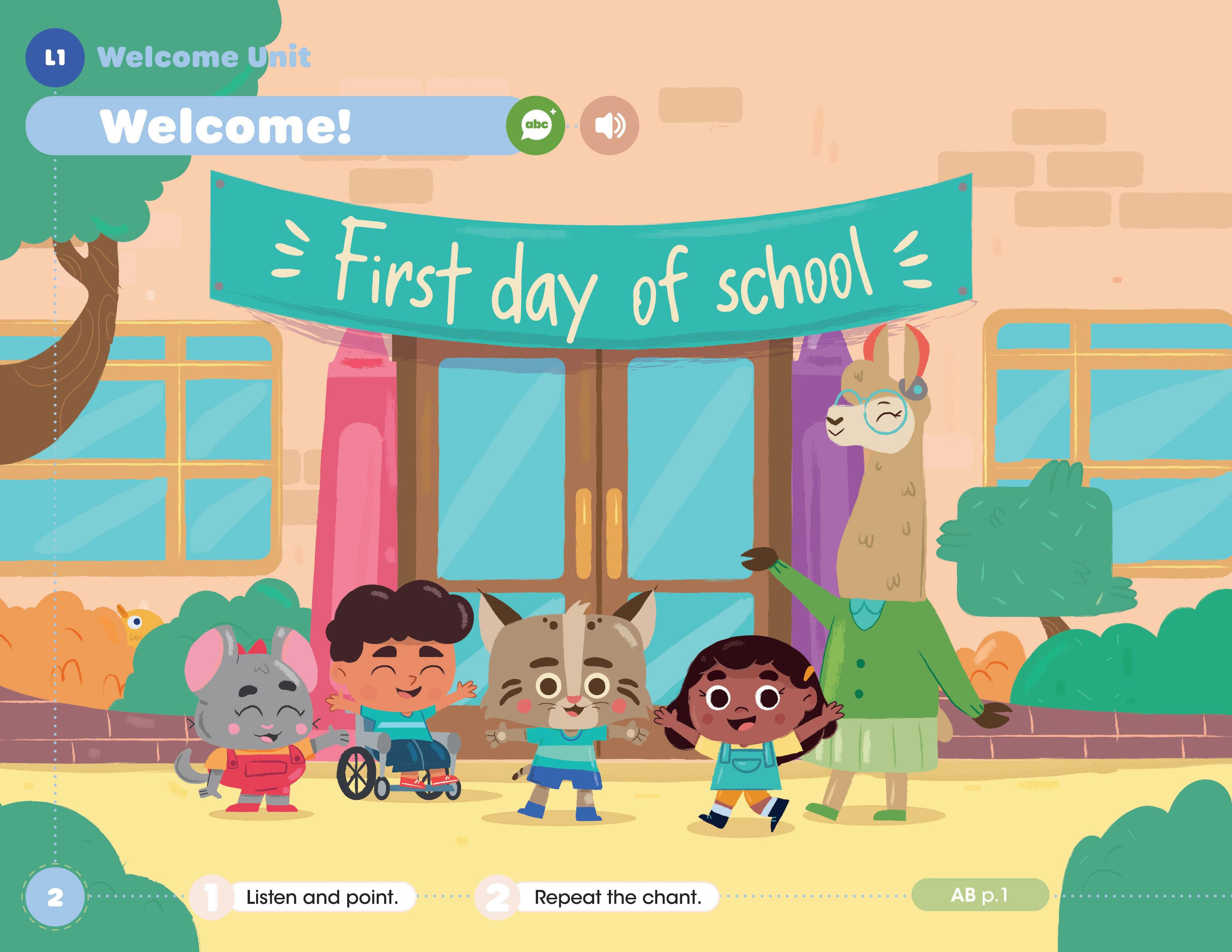
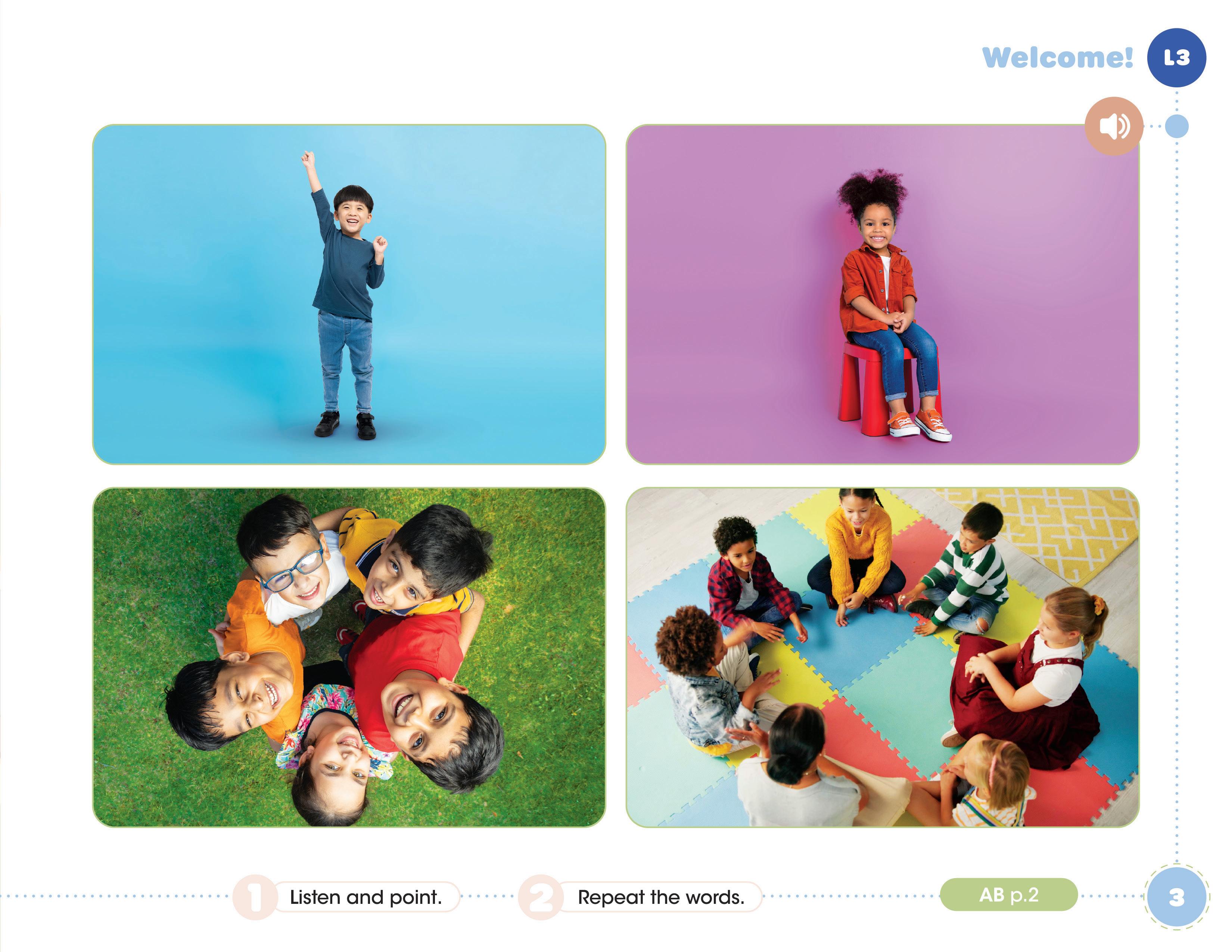
• Display SB page 2 to the class. Point to the title "Welcome!" and read it out loud. Then ask, What do you see? This is Miss Llama. She's a teacher. This is Matt He's a boy. This is Lily. She's a girl. This is Bob, and this is Connie.
• Point to yourself and say, I am a teacher. Point to a boy and say, He is a boy. Point to a girl and say, She is a girl.
• Help students open their Student Books to page 2. Play the Welcome Unit Chant and have students point to Miss Llama, Matt, and Lily as they hear teacher, boy, or girl. Repeat the chant all together.
Do
Practice identifying boys and girls.
• Divide the class into boys and girls. Stand in the middle.
• Play the Welcome Unit Chant. This time, ask students to point to you when they hear the word teacher. When they hear the word boy or girl, they should point to the correct group.
• Say the Welcome Unit Chant and point again.
Learn Reflect
Finish the lesson.
• Help students reflect on the lesson. Say, Today we learned three new words. Who is your English teacher? Can you point to a (girl) in the classroom?
• Sing the Goodbye Song.
Additional Activity: Make a Welcome Sign
Write on a poster-sized construction paper the word Welcome. Have students color and decorate the sign. Place it on a wall.
Welcome Chant
Look!
A teacher! Look!
A boy! Look!
A girl!
Welcome to school!
Audio: Hello Song, Welcome Unit Chant, Goodbye Song.
Lesson 2
Start the lesson.
• Sing the Hello Song.
• Practice Today is (Monday).
Review girl, boy, and teacher.
• Place the Welcome Unit Flashcards (1-3) on different walls of the classroom.
• Say, I will say a word. Walk to the correct flashcard. Ready? (Teacher).
• Repeat several times.
Identify boy and girl.
• Display AB page 1 to the class. Ask, What do you see? Point to the girl and say, She's a girl. Point to the boy and say, He's a boy.
• Help students open their Activity Books to page 1. Ask them to color bot pictures.
• When they have finished, say, If you are a (girl), point to the (girl). Well done!
Practice an attention-getter song.
• Sit in a circle. Say, It's important to listen to your teacher. Let's learn a song to help us pay attention. I will ask a question, and you will answer.
• Play the Can You Hear Me Song once. Model some motions, like touching your ear when listening or clapping on the last two lines.
• Sing it several times. Remember to use this song any time you need student to quiet down and pay attention.
Main Objective: Identify teacher, boy, and girl.
New Language: NA
Recycled Language: teacher, boy, girl.
Resources: AB page 1, Welcome Unit Flashcards (1-3).
Materials: NA
Audio: Hello Song, Can You Hear Me Song, Goodbye Song.
Additional Activity: poster-sized construction paper, pictures of boys and girls.
Additional Activity: Boy and Girl Collage
Divide a poster-sized construction paper into two. Write boys on one side and girls on the other side. Hand out pictures of boys and girls. Have each student glue their picture in the correct place.
Try This
It's important to memorize the names of your students. Make nice, colorful name tags. They will help you learn their names and it will increase print awareness.
Finish the lesson.
• Help students reflect on the lesson. Say, Today we saw the words boy and girl again Raise your hand if you are a boy. Raise your hand if you are a girl.
• Sing the Goodbye Song.
Lesson 3
Begin
Start the lesson.
• Sing the Hello Song.
• Practice Today is (Monday).
Review girl, boy, and teacher.
• Play the Welcome Unit Chant and have students join you.
• Say, We will say the chant again. This time, if you are a boy, raise your hand when we say boy. If you are a girl, raise your hand when we say girl.
• Say the chant two more times.
Recognize classroom instructions.
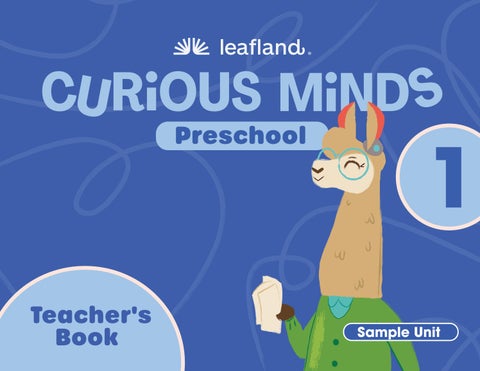
• Display SB page 3 to the class. Ask, What do you see? Look! This boy is standing up. Can you stand up? This girl is sitting down. Can you sit down? These children are making a circle. We can make a circle. These children are sitting in a circle. We can sit in a circle.
• Help students open their Student Books to page 3. Play the Welcome Unit Q&A audio and have students point to the correct pictures as they listen.
• Play the audio one more time. This time, have students repeat and point.
Practice following instructions.
• Say, Listen and do what I say. Boys, stand up. Girls, stand up. Girls, sit down Boys, sit down.
• Practice different instructions, alternating between girls and boys.
Finish the lesson.
• Help students reflect on the lesson. Say, Today we learned some instructions. Can you stand up? Can you sit down?
• Sing the Goodbye Song.
Main Objective: Recognize and practice classroom instructions.
New Language: Stand up. Sit down. Make a circle. Sit in a circle.
Recycled Language: teacher, boy, girl.
Resources: SB page 3.
Materials: NA
Audio: Hello Song, Welcome Unit Chant, Welcome Unit Q&A, Goodbye Song.
Additional Activity: NA
Additional Activity: Let's Do It Quietly
Give students instructions to stand up and sit down quietly. They should not make big noises with their chairs or tables. Repeat several times and praise them for their effort.
Welcome Instructions
Teacher: Stand up.
Teacher: Sit down.
Teacher: Let's stand in a circle.
Teacher: Let's sit in a circle.
Lesson 4
Start the lesson.
• Sing the Hello Song.
• Practice Today is (Monday).
Practice sitting down and standing up.
• Model and say, Stand up. Sit down.
• Say, Now listen to what I say and do it. Say the instructions again, but don't model the motions this time. Check students' comprehension.
Identify the Welcome Unit classroom instructions.
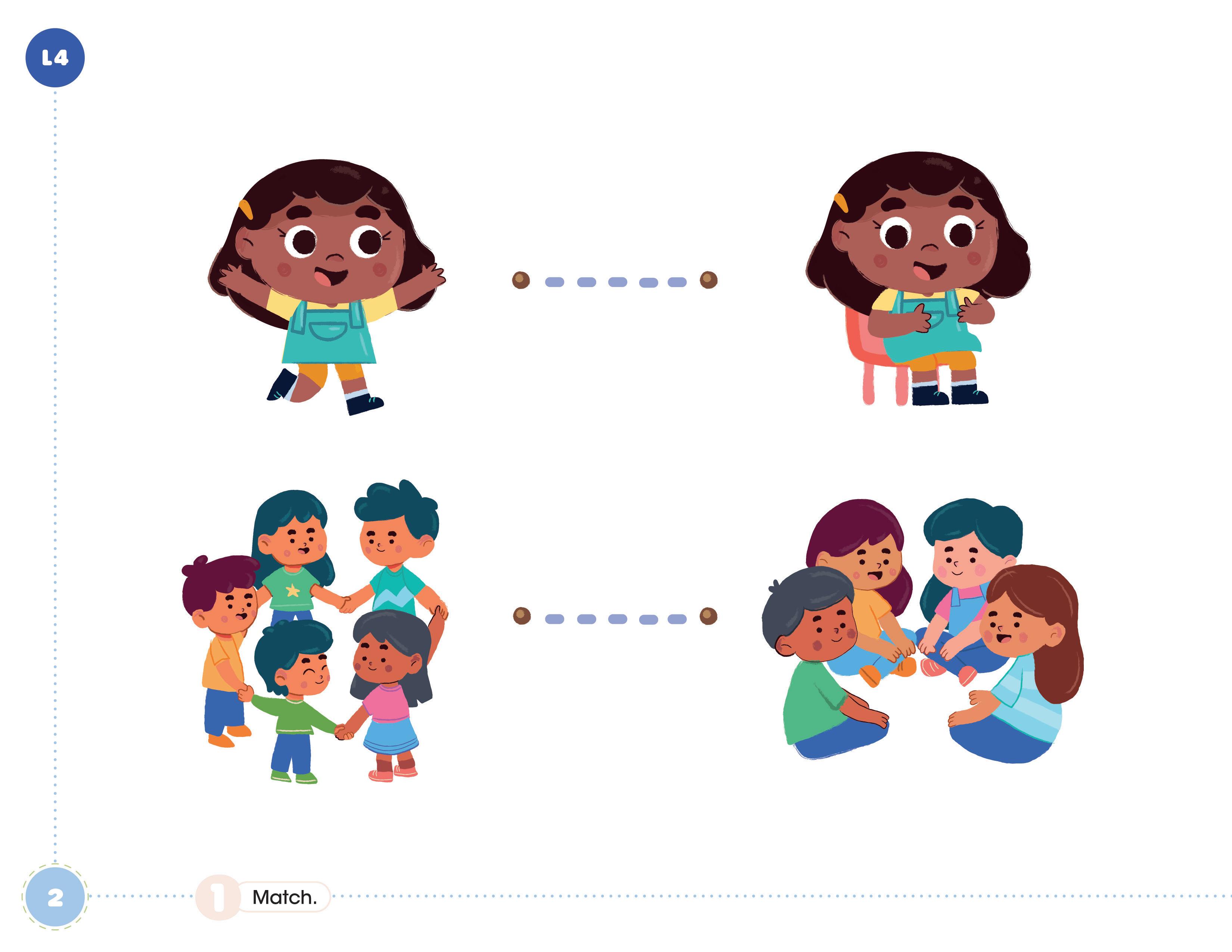
• Display page AB page 2 to the class. Point and say, This is Lily. Lily is standing up. Here, Lily is sitting down. Now look at the students. First, they are making a circle. Now, they are sitting in a circle.
• Help students open their Activity Books to page 2. Model and say, Follow the first line with your finger. Now, follow the second line. Then, say, Let's use a crayon. Monitor and help if needed. Begin
Review girl, boy, and teacher.
• Ask students to close their eyes.
• Hide the Welcome Unit Flashcards (1-3) around the classroom.
• Say, Help me find the (teacher). Have students find the flashcards and say the correct word as they hand them over.
• Repeat several times so that the majority of students can have a chance to find a flashcard.
Finish the lesson.
• Help students reflect on the lesson. Say, Today we practiced some words. Are you a teacher or a student? Are you standing or sitting down?
• Sing the Goodbye Song.
Main Objective: Identify classroom instructions.
New Language: NA
Recycled Language: Stand up. Sit down. Make a circle. Sit in a circle.
Resources: AB page 2, Welcome Unit Flashcards (1-3). Materials: NA
Audio: Hello Song, Goodbye Song.
Additional Activity: NA
Additional activity: Finding Teachers
Give a tour around the school. Every time you see a teacher, point and say, Look! A teacher! Have students greet the teachers they meet.
Students at This Age
Don't be discouraged if, at the beginning of the year, the routines take more time than expected. Remember that the more you practice, the faster they will catch up. Don't give up!
Objectives
In this unit, students will:
• Identify vocabulary about school.
• Reproduce: It's a (book).
• Learn the value: Take care of school supplies.
• Identify the number 1.
• Count up to 1.
• Associate the /p/ sound with the letter Pp.
• Make a backpack craft.
Unit Vocabulary
• Backpack, book, pencil, crayon.
Additional Vocabulary
• Excited, careful, school, pizza, panda.
Unit Grammatical Structure
• It's a (book).
Additional Grammatical Structure
• Take care of.
Numbers/Shapes/Concepts
• One (1).
Phonics
• Pp, /p/.
• Pencil, pizza, panda.
Unit Overview Unit 1 Unit 1 - Ready for School
Unit Resources
• Student Book (SB) 1 + Activity Book (AB) 1
• Printable and Cutout Pages
• Unit Flashcards
• Audios/Videos
• Assessment Chart
Unit Materials
• Backpacks
• Books
• Pencils
• Crayons
• Broken crayon or pencil
• Plastic jar
• Tape
• Non-transparent bag
• Poster-sized construction paper
• Colorful tissue paper
• Paper bags
• Foam paper
Additional Activity Materials
• Labeled school supplies
• School supplies
• Play dough
Lesson 1
Main Objective: Recognize backpack, book, pencil, and crayon.
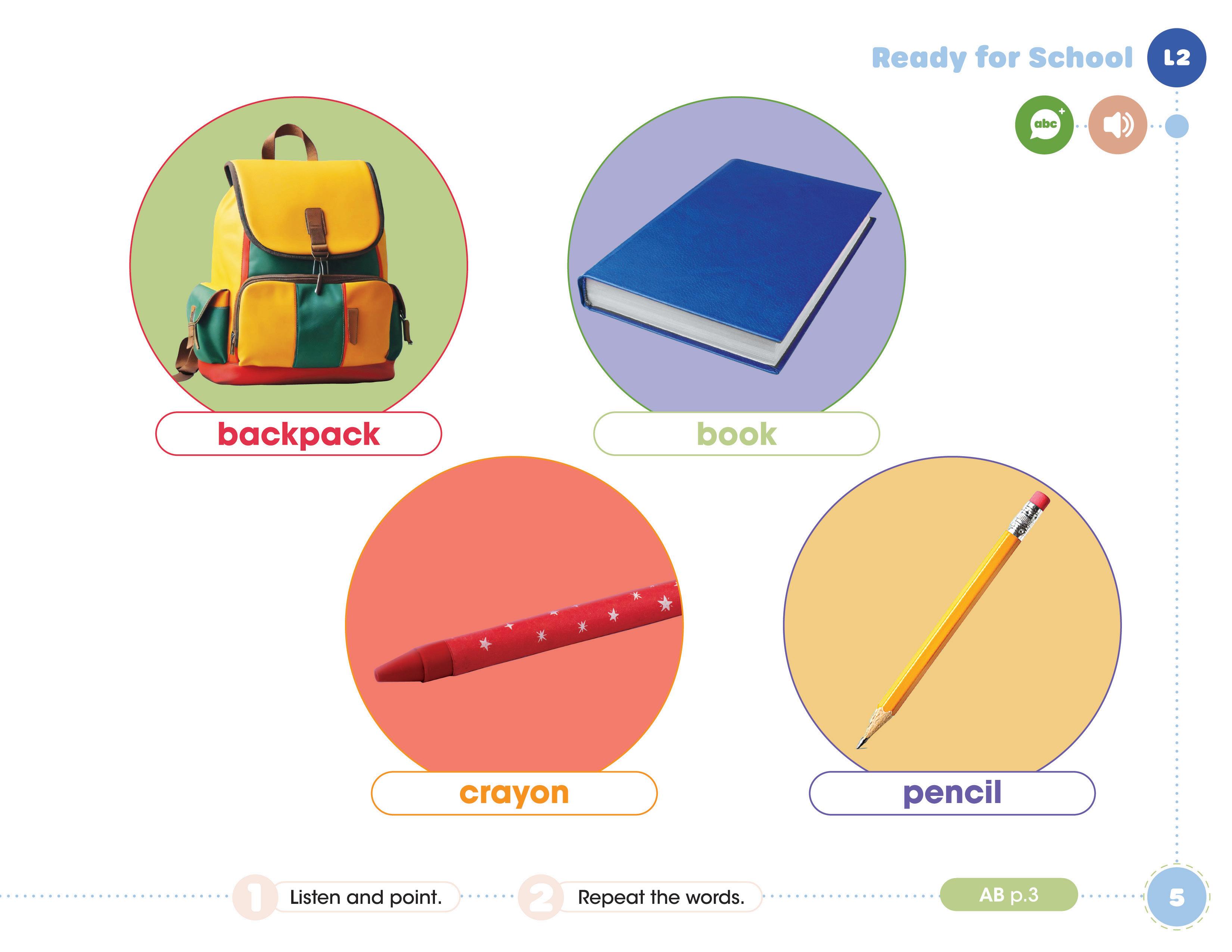
New Language: backpack, book, pencil, crayon.
Start the lesson.
• Sing the Hello Song.
• Practice Today is (Monday).
• Sing the Days of the Week Song.
Review boy, girl, and teacher.
• Display the Welcome Unit Flashcards (1-3) one by one. Have students say each word out loud.
• Ask, Where do teachers work? At school. Who else goes to school? Boys and girls. And what do boys and girls bring to school? Let's learn some new words.
Name school supplies.
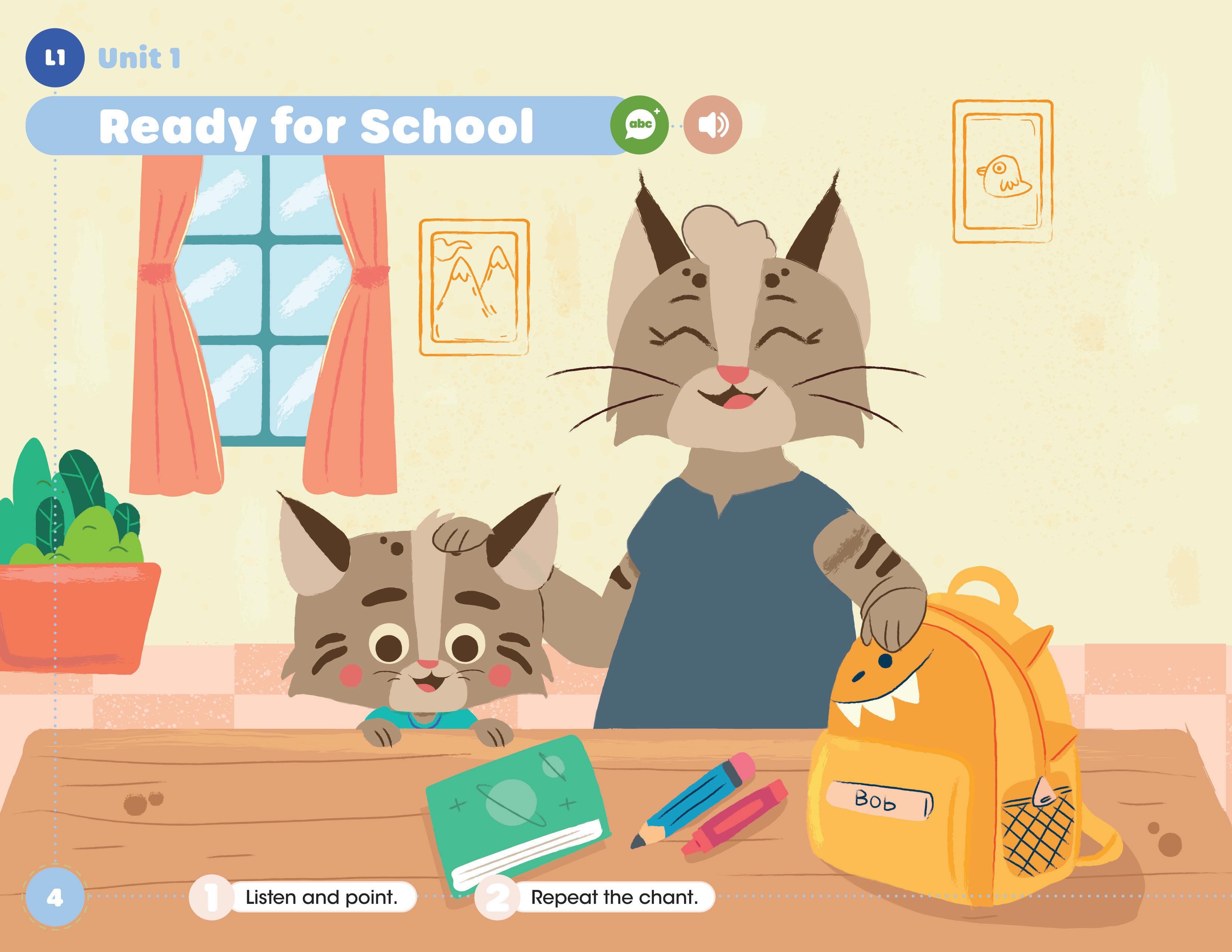
• Display SB page 4 to the class. Point to the title "Ready for School" and read it out loud. Point and say, This is Bob. This is Bob's mom. What are they doing? Allow for a few answers. Then say, They are packing Bob's backpack. Point to each picture and say, This is a pencil. This is a book. This is a crayon.
• Say, Let's listen to a chant about school supplies. Play the Unit 1 Chant.
• Help students open their Student Books to page 4. Play the chant again and have students point to the school supplies as they are mentioned. Repeat the chant all together.
Practice identifying school supplies.
• Place a book, a pencil, a crayon, and a backpack on a table.
• Show a school object and ask, Is this a (book)? If the answer is yes, students nod. If the answer is no, students shake their heads.
• Repeat with different objects.
Begin Reflect Do Learn Focus
Finish the lesson.
• Help students reflect on the lesson. Say, Today we learned four words. Can you point to your (backpacks)? Who can bring me a (crayon)?
• Sing the Goodbye Song.
Recycled Language: teacher
Resources: SB page 4, Welcome Unit Flashcards (1-3).
Materials: a book, a pencil, a crayon, and a backpack.
Audio: Hello Song, Welcome Unit Chant, Goodbye Song.
Additional Activity: labeled school supplies.
Additional activity: Find Your Name
Have students identify the name tags on their books. Have them point to their names and say them out loud. Tell students that letters make words. Ask them to find some other school supplies with their names on them.
Unit 1 Chant
Backpack, book, crayons, too!
Pencil, yes!
Ready for school!
Lesson 3
Start the lesson.
• Sing the Hello Song.
• Practice Today is (Monday).
• Sing the Days of the Week Song.
Review backpack, book, pencil, and crayon.
• Say, Let's watch a video and remember the school supplies we have learned.
• Play the Unit 1 Vocabulary Video. Have students answer the questions and repeat the words in the video.
• Say, That was a fun game! Now we know backpack, book, pencil, and crayon.
Put the stickers in the correct place.
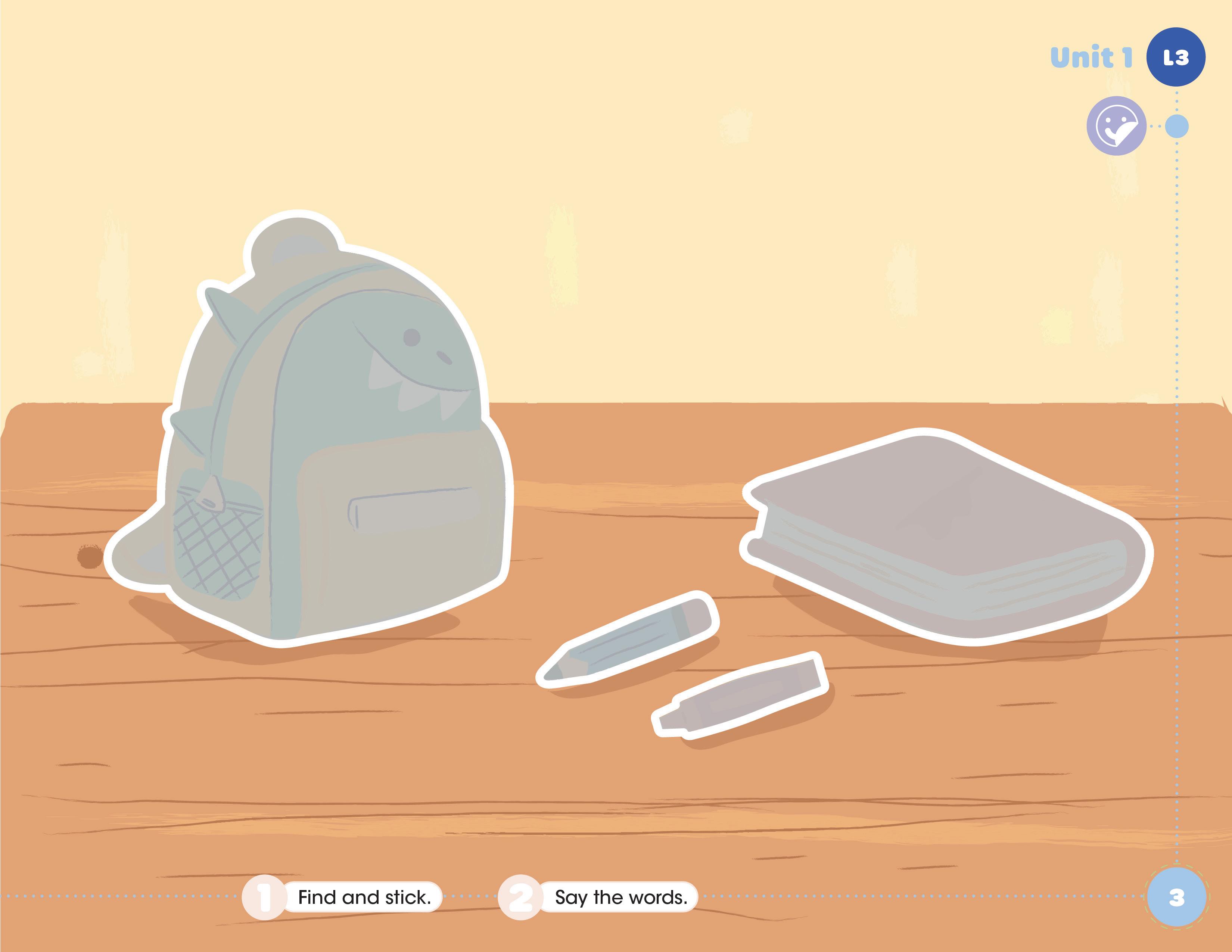
• Display AB page 3. Say, What do you see? It's a desk. Some objects are missing. Can you guess what they are?
• Help students go to the Sticker Page in their book and point to the school supplies.
• Instruct students to remove and place the stickers, one at a time, in the correct place on the page. Monitor and encourage students.
Do
Practice recognizing school supplies.
• Have students make a circle. In the middle, place a backpack, a book, a pencil, and a crayon.
• Say, (Student's name), stand up and show me a crayon. Check if the student holds up the correct object.
• Give every student a turn. Record your observations in the Assessment Chart.
Finish the lesson.
• Help students reflect on the lesson. Say, Today we worked with stickers. What objects were on the page? What objects are on your desk?
• Sing the Goodbye Song.
Main Objective: Distinguish between backpack, book, pencil, and crayon.
Make two teams. Place a backpack, a pencil, a crayon, and a book on the other side of the classroom for each team. Say to the first student on each team, Bring me a (pencil). Students run and bring back the correct object. Repeat until everyone has had a turn.
Teaching Tips and Tricks
Eye contact is an important part of the student-teacher relationship. When you want a specific student to do a task or answer a question, first name the student. Wait until they make eye contact with you before asking a question or explaining the task to them.
• Divide the class into two teams. Place two pencils, two crayons, and two books on a table.
• Give one backpack to a student on each team. Then say, Pack a pencil and a book. The first student to place the items inside the backpack gets a point.
• Repeat with different students.
Practice following a story.
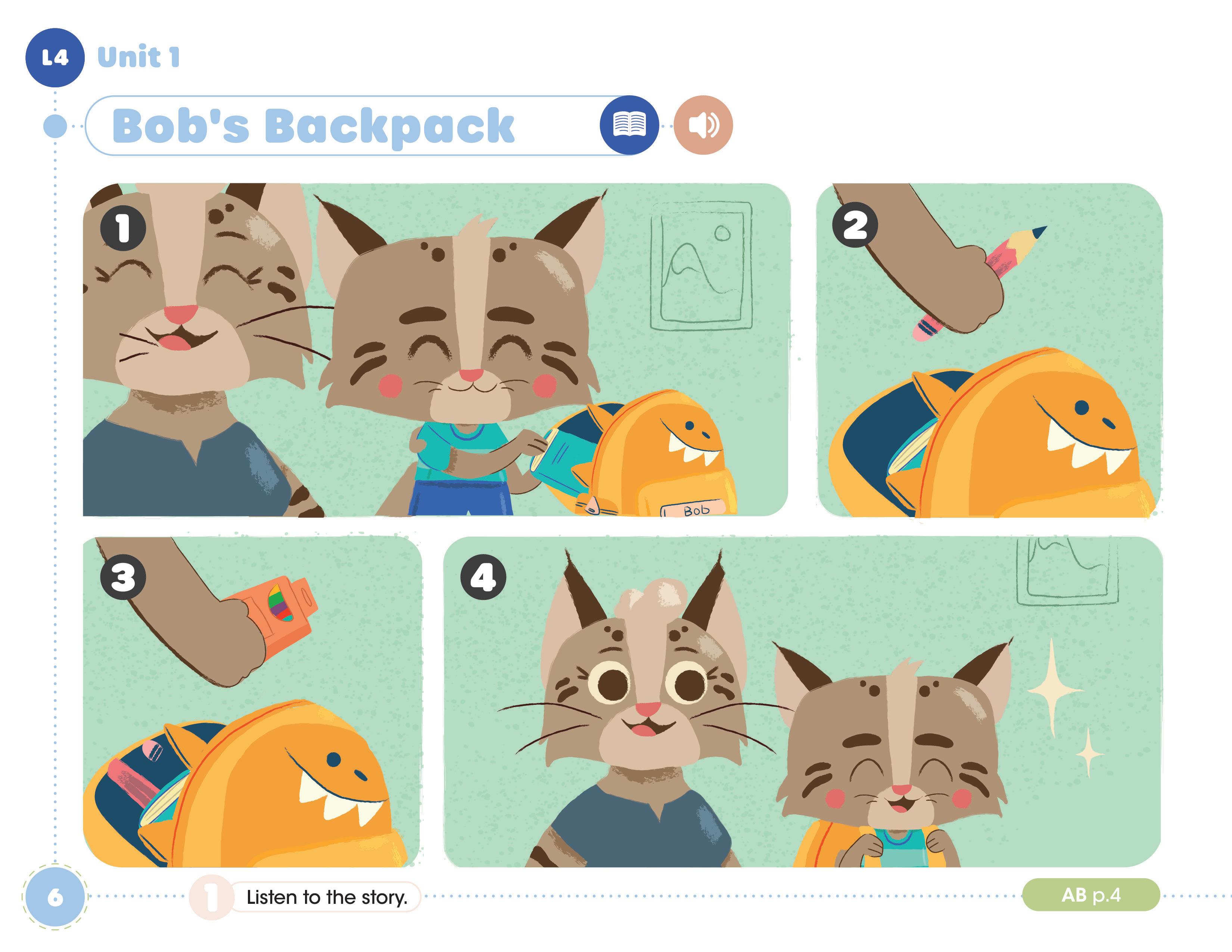
• Display SB pages 6 and 7 to the class. Point to the title "Bob's Backpack" and read it out loud. Say, Let's read a story together.
• Have students open their Student Books to page 6. Let them look carefully at each picture. Ask, Who are they? What are they doing?
• Say, Now, let's listen to the first part. Follow the story and point to each picture. Play the Unit 1 Story. Pause in the middle and ask, What are they packing? Where is Bob going?
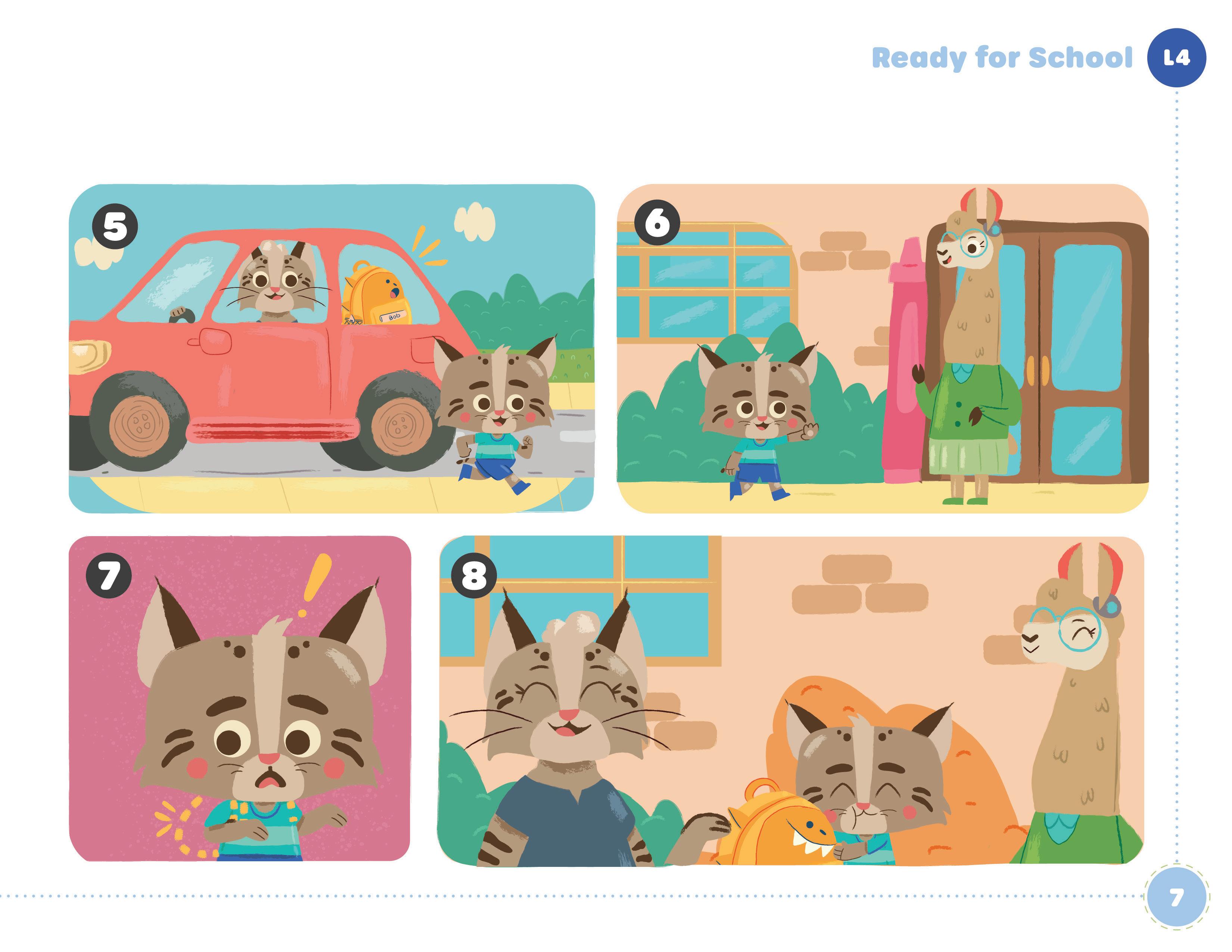
• Have students look at page 7. Ask, Who takes Bob to school? Is Bob happy? Where is his backpack? How does the story end? Play the second half of the story as students follow along.
• After the story, ask, What happens first? Next? At the end? What is your favorite part?
Identify backpacks in the classroom.
• Walk around the classroom and grab a backpack. Ask, Is this Bob's backpack? Whose is it? Yes! It's (student name)'s! Make sure you show all the backpacks to make students feel part of the group.
Finish the lesson.
• Help students reflect on the lesson. Say, Today we read a story. What did Bob pack first? Who helped Bob?
• Sing the Goodbye Song. Begin
Audio: Hello Song, Unit 1 Story, Goodbye Song.
Additional Activity: Unit 1 Chant.
Additional Activity: Chant and Act
Play the Unit 1 Chant. Have students say the chant as they act out putting objects inside an imaginary backpack.
Bob’s Backpack Story
Book...
Pencil...
Crayons...
Backpack. Good job! Ready for school?
Yes! I am so excited!
Have a good day.
Welcome to school, Bob!
Thank you, mom!
Bob! Here is your backpack!
Bob
Bob
Bob
Miss Llama
Hi, Miss Llama. Oh, no! Where is my backpack?
Lesson 5
Start the lesson.
• Sing the Hello Song.
• Practice Today is (Monday).
• Sing the Days of the Week Song.
Main Objective: Identify the main character in a story.
New Language: NA
Recycled Language: backpack, excited.
Resources: SB pages 6 and 7, AB page 4. Materials: NA
Review the Unit 1 Story.
• Have students sit in a circle and open your book to SB pages 6 and 7. Point to the pictures in the story. Ask, What is Bob packing? Where is his backpack at the end?
• Read out loud or play the story to the class. Change the tone of voice for each character and enjoy the time with your students. If students want to read or listen to the story one more time, do it.
Practice identifying the main character.
• Display AB page 4 to the class. Ask, Who are they? Bob and Bob's mom. They are the people in the story. But one of them is in the story all the time. Who is it? Yes! Bob! The story is about Bob.
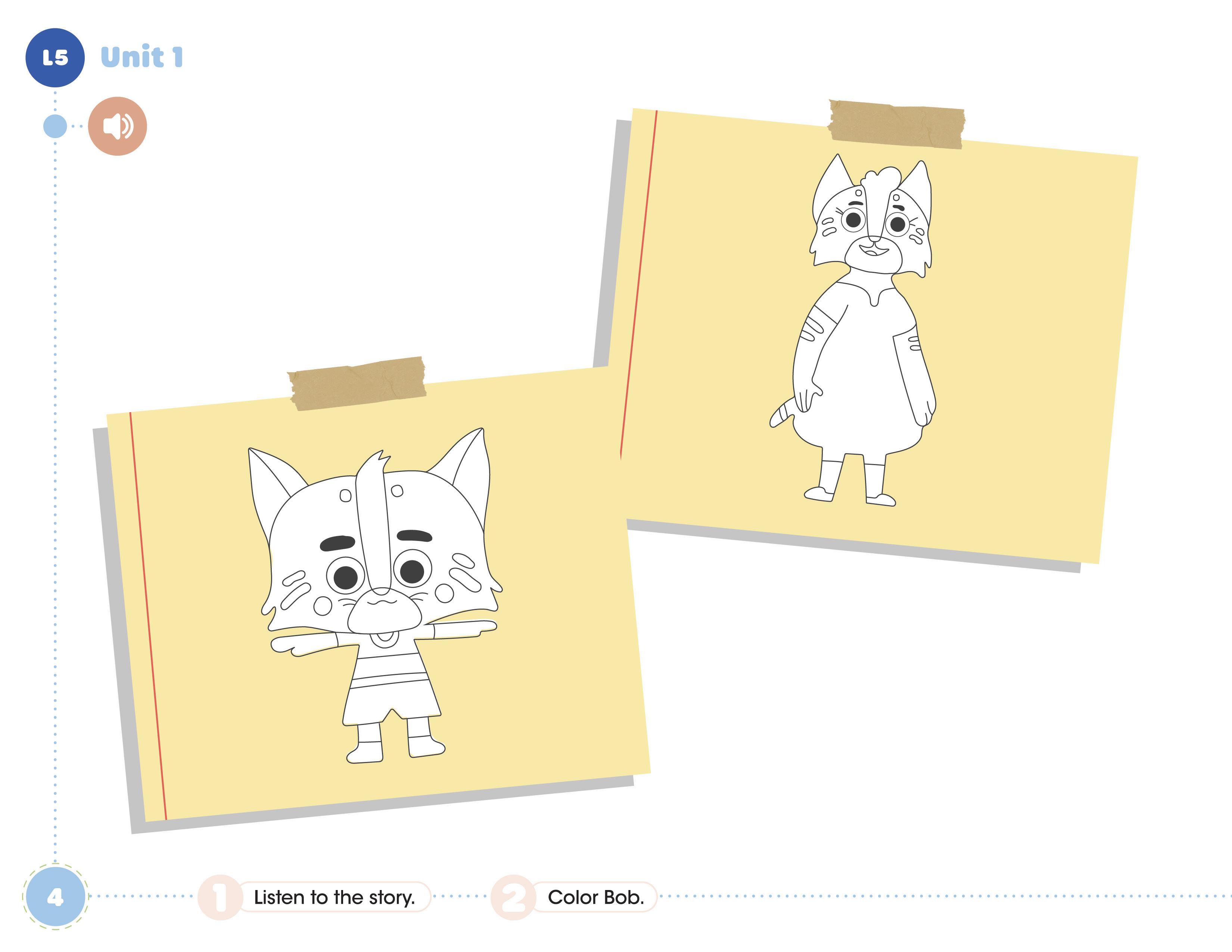
• Help students open their Activity Books to page 4. Ask students to point to Bob and to his mom. Say, Let's color Bob. Give them time to color while you monitor and check.
Visualize the word excited.
• Display SB page 7 in your book. Point to picture 5 and ask, How is Bob feeling? Do you remember what he says? He's excited.
• Ask students what excited means. Then say, When I'm excited, I (clap) or (jump). What do you do when you feel excited?
• Have students make facial expressions or actions to represent feeling excited.
• Ask, When do you feel excited? Give them examples like their birthday, Christmas, or their first day of school.
Learn Reflect Focus Do
Finish the lesson.
• Help students reflect on the lesson. Say, Today we read the story again. How is Bob feeling in the story? Can you show me an excited face?
• Sing the Goodbye Song.
Additional Activity: Act It Out
Ask for three volunteers. Assign a role to each student: Bob, Bob's mom, and Miss Llama. Give them a backpack, a pencil, and a book. Put two chairs together to simulate a car. Have them act out the story. You can play the audio again if that helps. Repeat with different students.
A Caring Classroom
Sometimes preschool students get overly excited and make others feel uncomfortable. Model how to show excitement in a healthy way. Say, We laugh, but not too loud. We jump, but then we stop. We hug, but we do it gently.
Audio: Hello Song, Unit 1 Story, Goodbye Song.
Additional Activity: Unit 1 Story, backpack, pencil, book.
Lesson 6
Start the lesson.
• Sing the Hello Song.
• Practice Today is (Monday).
• Sing the Days of the Week Song.
Compare brand-new and broken objects.
• Show a brand-new pencil or crayon to the class. Say, What is this? Yes!
A (pencil). It's a new (pencil).
• Take out a broken pencil or a crayon. Ask, What's wrong with this (pencil)? Have you seen (pencils) like this? Can you color with them? Allow for different answers.
Become familiar with the value of taking care of school supplies.
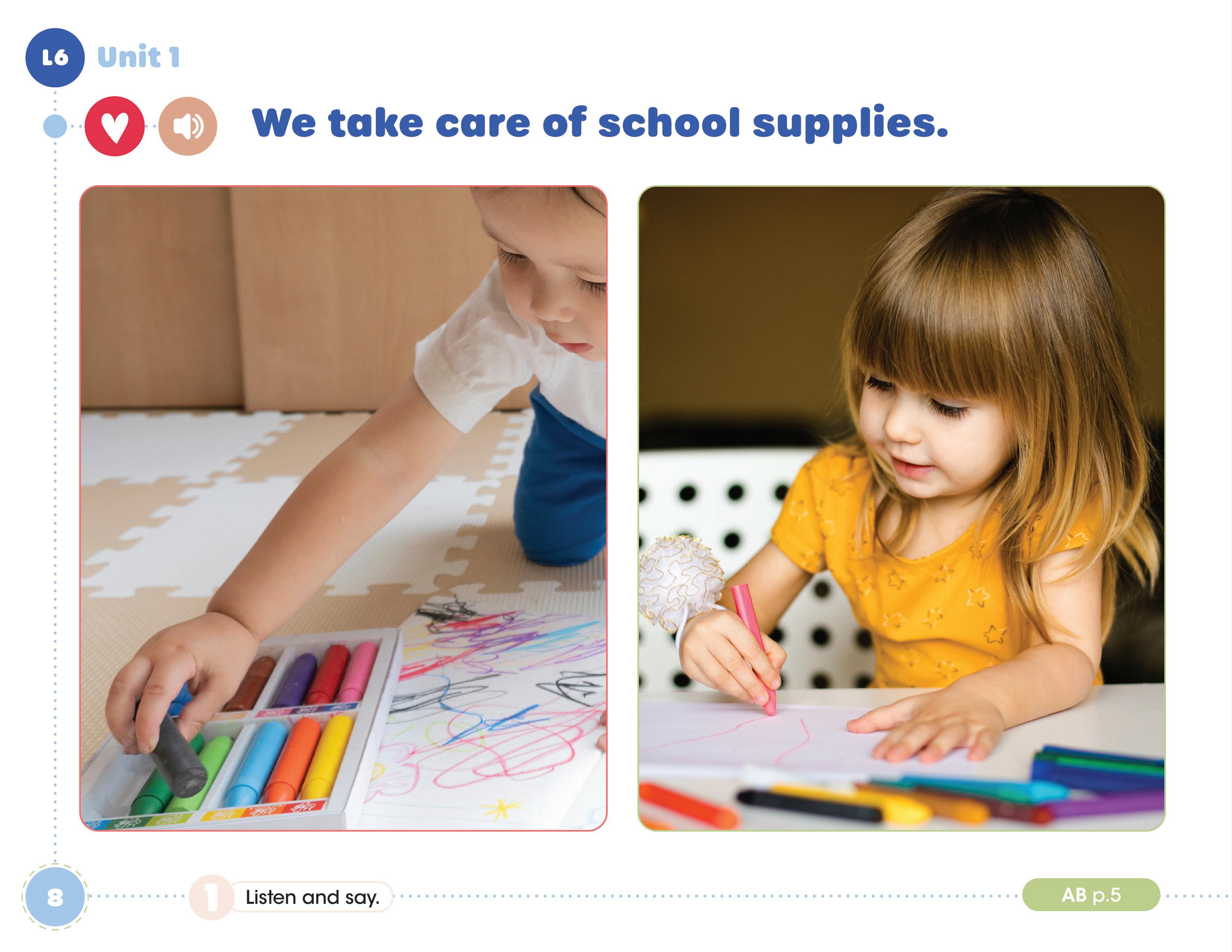
• Have students open their Student Books to page 8. Read the value: "We take care of school supplies."
• Point to the pictures one at a time and say, Look at the pictures! What are the children doing? What are they using?
• Play the Unit 1 Value audio and have students point to each picture. Ask, How are the children coloring? They are careful.
• Play the audio again. Pause after every sentence for students to repeat.
• Show the brand-new (pencil) of the Begin section. Say, Let's take care of our new (pencils).
Practice taking care of school supplies.
• Take out a piece of white paper. Hold a crayon in the air and say, Crayon.
• Place the crayon on the piece of paper and start coloring. Say, I'm coloring. I'm careful when I color. I color gently. Can you color gently too?
• Give each student a piece of paper and their crayons and let them fill the page with gentle, careful strokes. Repeat the word careful as they color.
• Display their drawings and praise their efforts.
Finish the lesson.
• Help students reflect on the lesson. Say, Today we learned how to take care of our school supplies. What do you use to color? Show me how to color gently.
• Sing the Goodbye Song.
Main Objective: Identify the value: Take care of school supplies
New Language: careful; Take care of.
Recycled Language: crayon, pencil.
Resources: SB page 8.
Materials: pencil, crayon, broken pencil, crayon.
Audio: Hello Song, Unit 1 Value, Goodbye Song.
Additional Activity: books.
Additional
Activity:
Careful with Books
Bring some books to the classroom. Have the students tell you what they are. Model how to flip the pages carefully. Say, Books are special too. We should take care of them. Give each student a book and ask them to turn the pages gently. Thank them for taking care of your books.
Unit 1 Value
Boy: I take care of my crayons. Girl: I am careful when I color.
Lesson 7
Start the lesson.
• Sing the Hello Song.
• Practice Today is (Monday).
• Sing the Days of the Week Song.
Practice the Unit 1 Chant.
• Play the Unit 1 Chant and have students chant along.
• Play the chant again and say, Jump when you hear the word crayons.
Make a pencil holder.
• Hold up some crayons and ask students, Where do you keep your crayons?
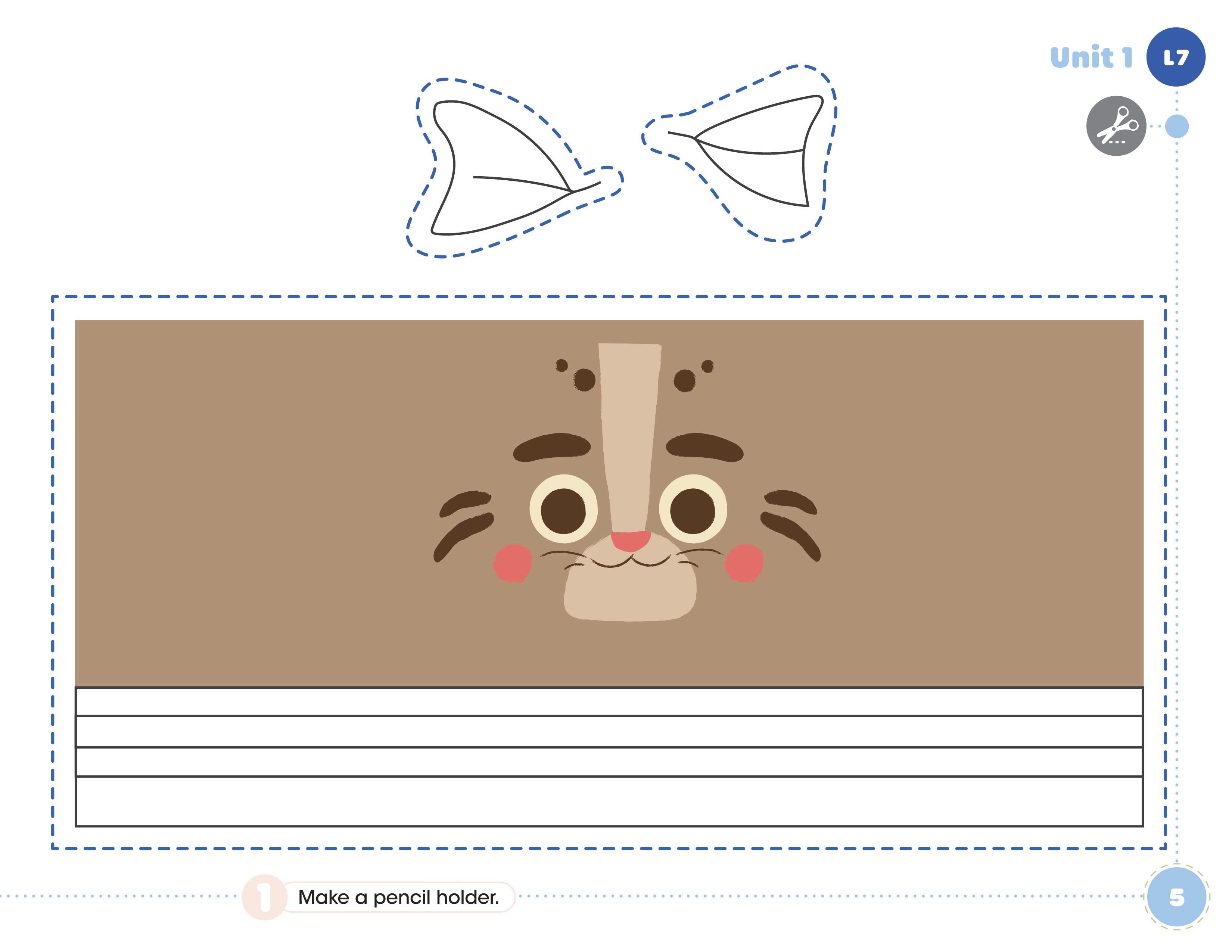
Let's make a pencil holder that looks like Bob.
• Distribute AB page 5.
• Have students take out their crayons and color Bob's ears and t-shirt. Remind them to be careful and color gently. Ask students to cut along the lines. Help students as needed.
• Give each student a plastic jar. Use glue or tape to place the bigger piece of paper around the can and place Bob's ears at the top. Monitor and help.
• Write the name of each student on their pencil holders.
Practice taking care of school supplies.
• Have each student place their pencil holders on the table.
• Say, Every object in our classroom has a place. We can use our pencil holder to keep our pencils and crayons. When we put our school supplies in their place, we take care of them.
• Ask students to put a pencil or a crayon in their pencil holders. Go around and ask, What is that? Good! You are taking care of your school supplies.
Finish the lesson.
• Help students reflect on the lesson. Say, Today we found a new way to take care of our school supplies. Can you show me your craft? What can we keep in here?
• Sing the Goodbye Song.
Main Objective: Practice the value: Take care of school supplies.
New Language: NA
Recycled Language: crayons; Take care of.
Resources: AB page 5.
Materials: one plastic jar per student, tape, pencils, crayons.
Audio: Hello Song, Unit 1 Chant, Goodbye Song. Goodbye Song.
Additional Activity: NA
Additional Activity: Ned Says
Simulate a bird's voice and move your arms as wings. Say, Hi. It's Ned. Give instructions to the class using Ned's voice. Girls, stand up. Boys, sit down. Girls, show me a crayon. Boys, show me a pencil. Everybody, make a circle. Everybody, sit in a circle.
Pronunciation Guide
Crayon has different pronunciations according to the region people live in. The most common is /ˈkrā-ˌän/. The correct pronunciation of the first syllable is with a long a as in cake
Resources: SB page 9, Unit 1 Flashcards (4-7). Materials: crayon.
Identify school supplies.
• Show the Unit 1 Flashcards (4-7) one by one and review the words.
• Pick a student to come to the front. Ask, What is this? Yes! It's a (book). Go put the flashcard next to a (book). What is that, class? Yes! That's a (book).
• Repeat with different students and flashcards.
Identify It's a (book) in a song.
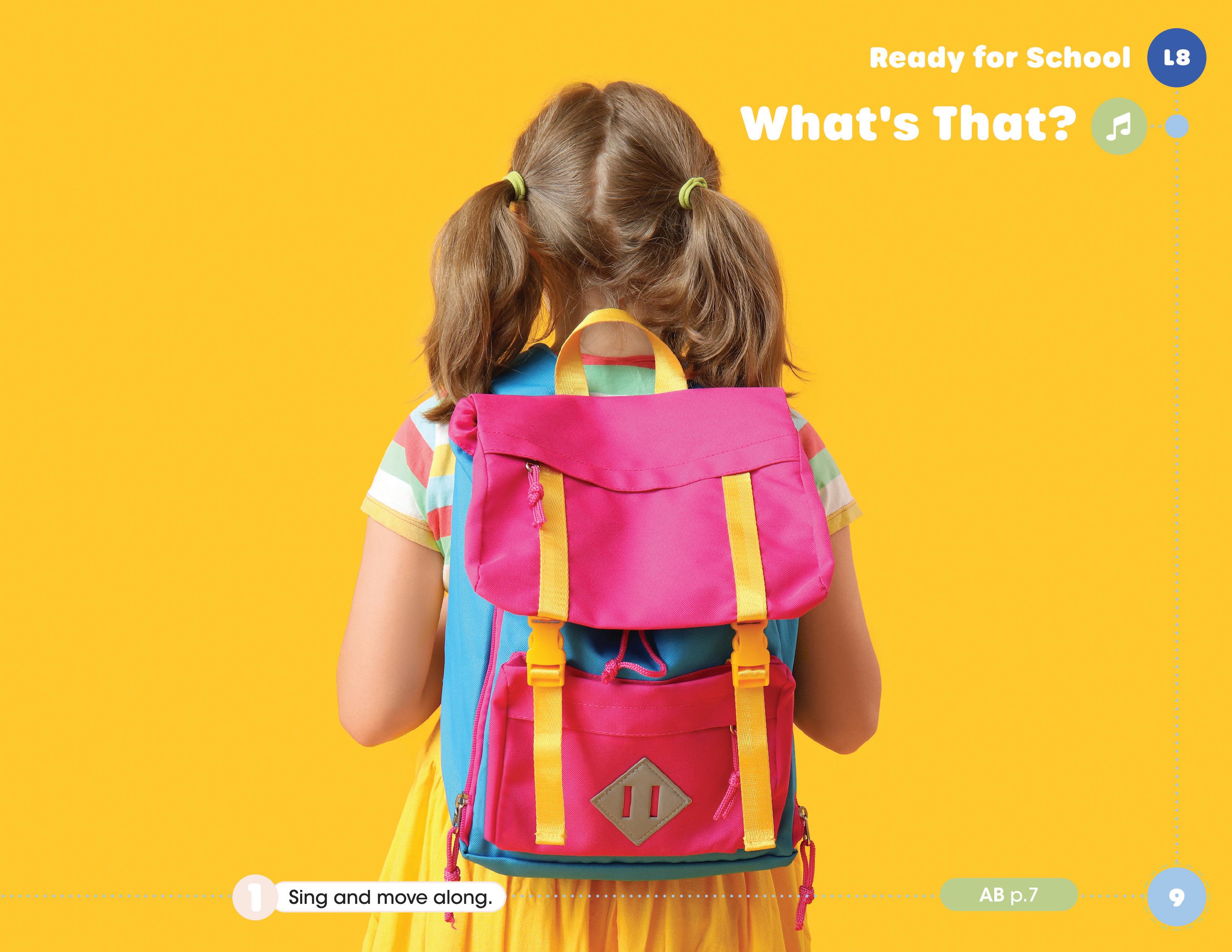
• Display SB page 9. Point to the picture and ask, Do you see a boy or a girl? What is this on her back? Let's sing a song about school supplies.
• Say, First, let's watch the video. Play the Unit 1 Song Video and listen to the song.
• Discuss the words that students know from the song. Ask, What can I color with? Where do you put all of your school supplies?
• Play the Unit 1 Song Video again. Come up with movements for students to imitate.
• Say, Now, let's stand up and sing! Play the Unit 1 Song. Sing and move all together.
• Ask, What question did we repeat in the song? Yes, "What's that?"
Do
Practice the structure It's a (book).
• Sit in a circle. Have a crayon and the flashcards for backpack, book, pencil, and crayon ready
• Play the Unit 1 Song. While the music is playing, pass the crayon around the circle. When the music stops, show a flashcard to the student with the crayon and ask, What's this? The student answers, It's a (book).
Learn Reflect Focus
Finish the lesson.
• Help students reflect on the lesson. Say, Today we learned a song. What was the song about? What did we pass around in the game?
• Sing the Goodbye Song.
Audio/Video: Hello Song, Unit 1 Song Video, Unit 1 Song, Goodbye Song.
Additional Activity: NA
Additional Activity: What's That?
Have students take turns pointing to something in the class. Have them ask, What's that? Answer, It's a (window). Encourage them to practice the question, even if they haven't learned all the new words yet. Students will listen and start making connections.
Unit 1 Song - What's That?
What's that?
//It's a book!//
What's that?
//It's a pencil!//
What's that?
//It's a crayon!//
What's that?
It's a backpack! I'm going to school!
Lesson 9
Begin
Start the lesson.
• Sing the Hello Song.
• Practice Today is (Monday).
• Sing the Days of the Week Song.
Practice the Unit 1 Song.
• Choose four volunteers to come to the front. Hand out a backpack, a pencil, a crayon, and a book.
• Ask them to raise their school object when they hear their word in the song.
• Play the Unit 1 Song and sing along. Repeat with different students.
Match pictures with objects.
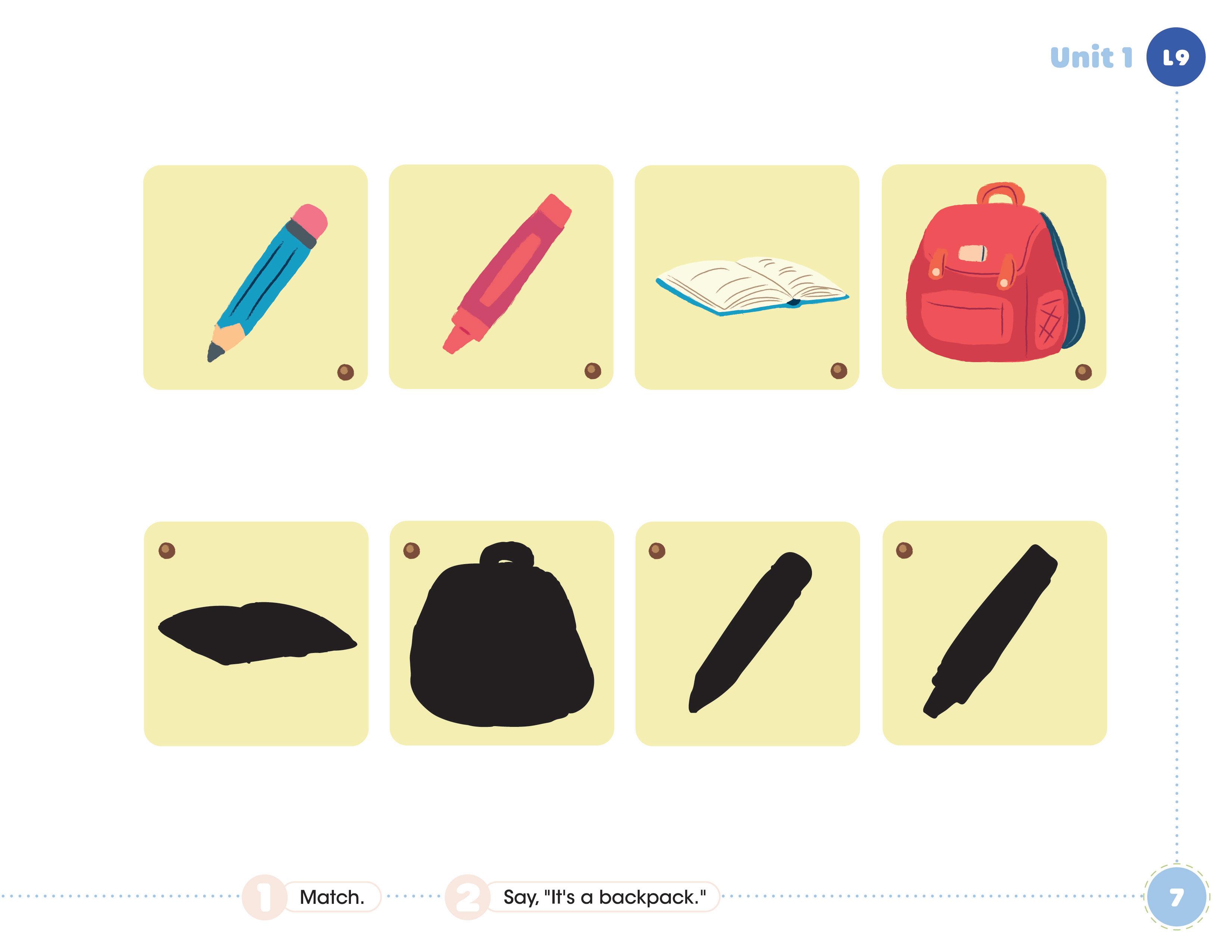
• Display AB page 7, and say, Look! What's that? Point to the pencil and say, It's a pencil.
• Trace a line from one pencil to the other with your finger. Repeat with the crayon, book, and backpack.
• Help students open their Activity Books to page 7. Instruct them to trace a line with a crayon to match the objects. Monitor and help when necessary.
• Walk around the classroom and point to pictures in students' books, asking, What's that? Students answer, It's a (crayon).
Say, It's a book
.
• Put a backpack, a pencil, a crayon, and a book inside a non-transparent bag.
• Ask a student to come to the front and take out an object from the bag.
• Ask, What's that? Student answers, It's a (pencil).
• Make sure every student has a turn. Record your observations in the Assessment Chart.
Finish the lesson.
• Help students reflect on the lesson. Say, Today we practiced the words we have learned. What did we use to trace the lines in our book? What did we find in the bag?
• Sing the Goodbye Song.
Main Objective: Practice: It's a (book).
New Language: NA
Recycled Language: backpack, book, pencil, crayon; It's a (book).
Ask students to close their eyes. Draw a picture of a pencil on the board. Have students open their eyes. Ask, What's that? Students answer, Pencil. Repeat with backpack, book, and crayon.
Grammar Compass:
Contractions combine two words into a shortened form. We use contractions in our everyday conversations. However, it is important to use both the contraction and the long form of phrases like it's/it is in order to help reinforce students' auditory memory of both forms.
Materials: backpack, book, pencil, crayon, poster-sized construction paper.
Review backpack, book, pencil, and crayon.
• Hold up a backpack. Ask, What's this? Yes! A backpack. One backpack. Hold up one finger and say, One.
• Repeat with book, pencil, and crayon.
Learn
Associate the number one with the correct pictures.
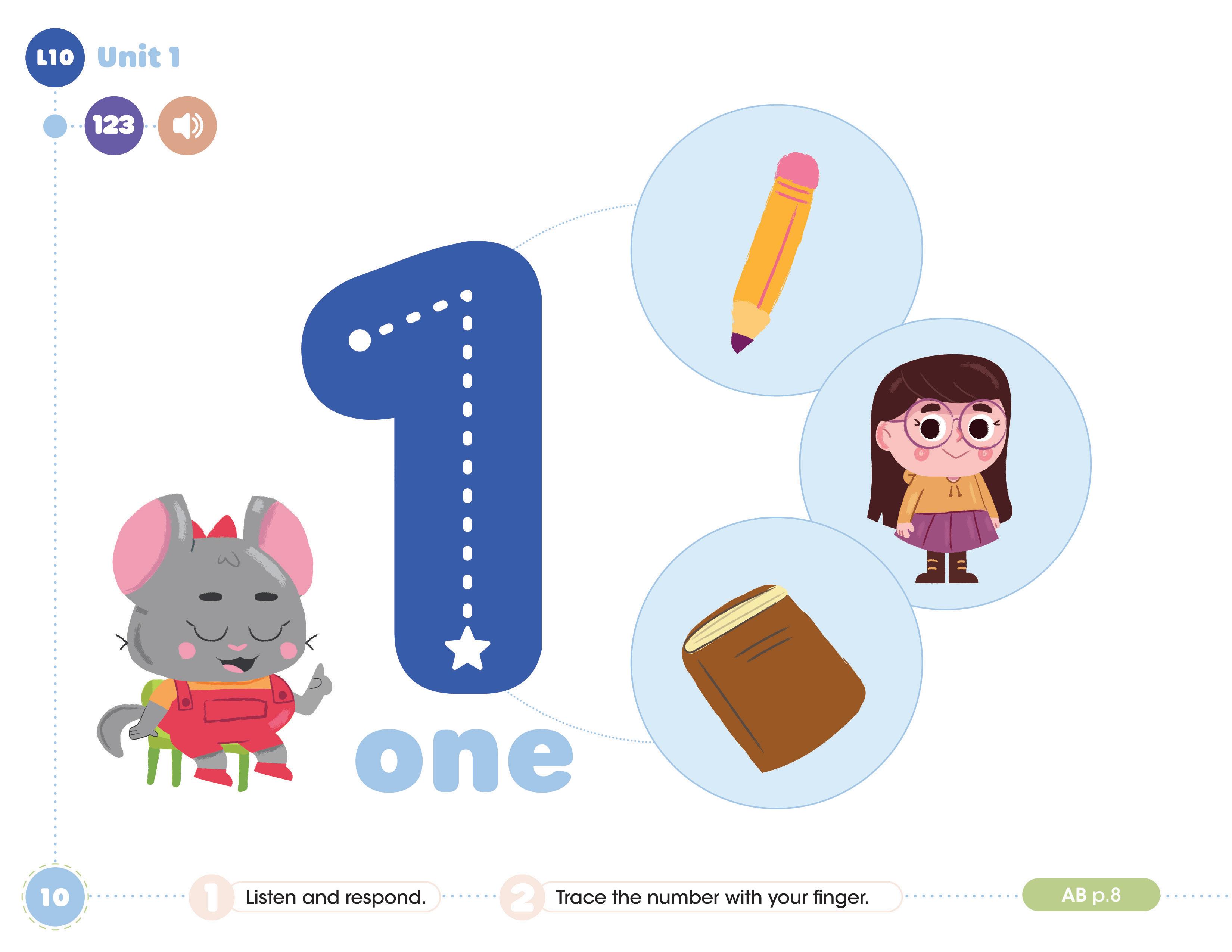
• Display SB page 10. Say, Look at the page. This is the number one. Can you show me one with your finger? What do you see in the pictures? One pencil. One girl. One book.
• Help students open their Student Books to page 10. Ask them to point to the pencil, the girl, and the book.
• Play the Unit 1 Numbers audio. Monitor whether students are pointing to the correct pictures. If not, model it one more time.
• Play the audio again and have students answer the last question.
• Ask students to trace the big number 1 with their fingers.
Do
Make a number 1 poster.
• Draw a big number 1 similar to the one on SB page 10 on a poster-sized construction paper.
• Invite two students at a time to come and color a section. As students color, have them say, One.
• Repeat until every student has had a turn and the poster is complete.
Reflect Focus
Finish the lesson.
• Help students reflect on the lesson. Say, Today we learned the number one. How many backpacks do you have? How many teachers do you see?
• Sing the Goodbye Song.
Audio: Hello Song, Unit 1 Numbers, Goodbye Song.
Additional Activity: pencils, crayons.
Additional Activity: Make a Big One
Divide the class into pairs or trios. Ask each group to make a big 1 by putting pencils or crayons together. Monitor and encourage students to make the number bigger by adding more crayons.
Unit 1 Numbers
Connie: This is the number one! I see one pencil. I see one girl. What else can you see?
Begin
Start the lesson.
• Sing the Hello Song.
• Practice Today is (Monday).
• Sing the Days of the Week song.
Practice the Welcome Unit Chant.
• Ask students to stand up. Play the Welcome Unit Chant and say the chant all together.
• Play the audio again and pause after each section. Say, A teacher. One teacher. A boy. One boy. A girl. One girl.
• Ask one boy and one girl to come to the front. Say the chant one last time and point to yourself and to each student along with the chant.
Learn
Count the number of teachers.
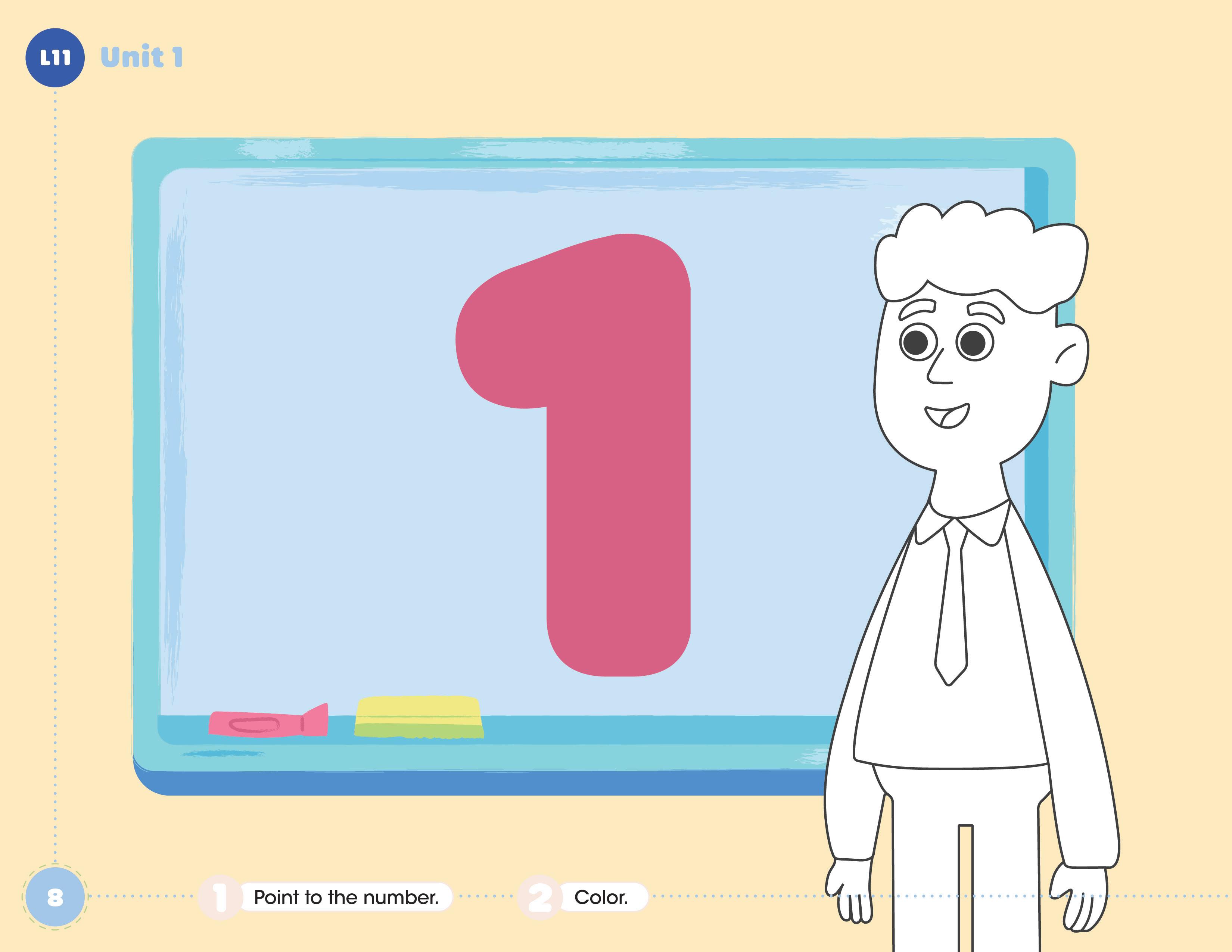
• Display AB page 8 to the class. Point to the pictures and ask, What do you see? What number is this? Who is this? How many teachers do you see?
• Help students open their Activity Books to page 8. Ask students to point to the number 1. Then have them trace it with their fingers.
• Students color the teacher on the page.
Do
Practice saying the word one.
• Ask students to make a circle. Go to the middle of the circle to model the activity.
• Close your eyes and slowly spin around until students say, Stop! Then point to a student, open your eyes, and say, One (girl). The student you chose goes to the middle of the circle and you take the student's place.
• Have that student spin around until the class says Stop! The student then points and says, One (boy). The new student then takes their place in the center.
• Repeat several times.
Reflect
Finish the lesson.
• Help students reflect on the lesson. Say, Today we practiced the number one. Show me one crayon. Say one in a soft voice. Say one in a loud voice.
• Sing the Goodbye Song.
Main Objective: Count up to one.
New Language: NA
Recycled Language: one, teacher, girl, boy.
Resources: AB page 8.
Materials: NA
Additional Activity: NA
Additional activity: Find One
Ask students to identify objects in the classroom that there are only one of. It could be one door, one window, one board. It doesn't matter if they don't know the words in English; just have them point to the object and say, One.
Students at This Age
The first month of school can be difficult for some students as they learn new routines and spend more time away from home. Find one-on-one moments during the day to get to know your students better. Find out what interests them and talk about it. Share something that you like about them. Building these connections can make all the difference as you start the year.
Audio: Hello Song, Welcome Unit Chant, Goodbye Song.
Lesson 12
Begin
Start the lesson.
• Sing the Hello Song.
• Practice Today is (Monday).
• Sing the Days of the Week Song.
Main Objective: Identify school supplies in pictures
Review prior knowledge related to the video's theme.
• Say, We are in school. Are you happy? Allow for some answers.
• Say, We can find many different objects in schools. Where can you see (pencils)? And (books)?
Observe different places in a school.
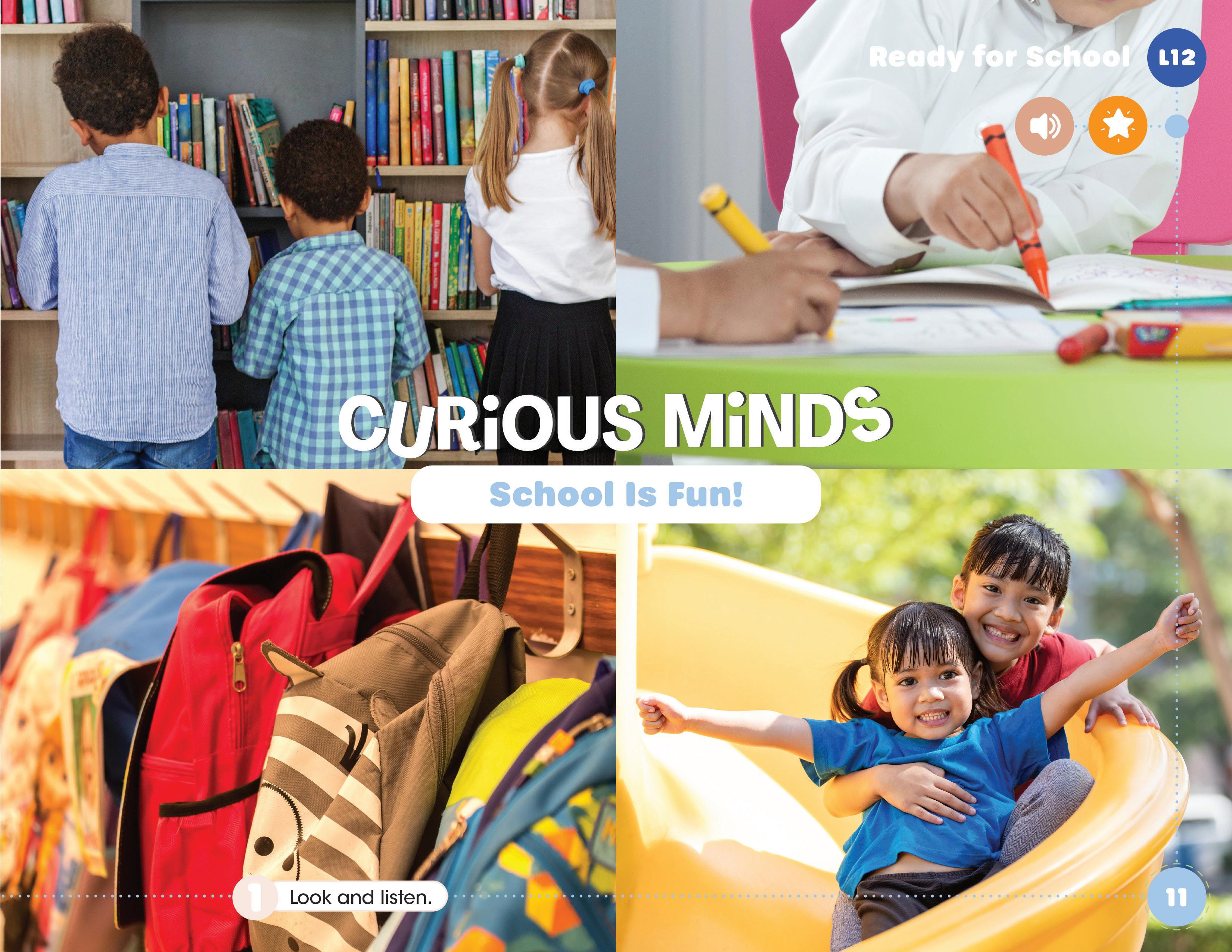
• Say, Let's watch a video about a big school. Play the Unit 1 Curious Minds Video. Ask questions like, Where were the kids in the video? What objects did you see?
• Play the video again. This time, pause occasionally and ask students what school supplies they see.
• Help students open their Student Books to page 11. If you didn't show the video, play the Unit 1 Curious Minds audio.
• Say, Point to the (backpacks). Point to the boys and girls. The most important person in a school is you!
Do
Make a crown.
• Hand out a copy of the Unit 1 Curious Minds Printable to each student. Say, What is that? It's a crown. This is to help us celebrate your first year in school. It says, “Welcome to School!”.
• Instruct students to cut the pieces of paper.
• Fit the paper around their heads and fasten it with tape.
• Have students say the Welcome Unit Chant while wearing their crowns.
Learn Reflect Focus
Finish the lesson.
• Help students reflect on the lesson. Say, Today we saw pictures about schools. What objects did you see? Where can you find crayons?
• Sing the Goodbye Song.
Audio/Video: Hello Song, Unit 1 Curious Minds, Unit 1 Curious Minds Video, Welcome Unit Chant, Goodbye Song
Additional Activity: NA
Additional Activity: Give a Tour
Have students line up and visit other classrooms and places in their school. As you go from place to place, point out the backpacks, books, crayons, and pencils that you see.
Unit 1 Curious Minds
Title: School Is Fun
Bob: This school is big.
Miss Llama: Can you find some books?
Bob: Yes.
Miss Llama: What about crayons?
Bob: I can see them.
Miss Llama: What else can you see?
Bob: Some backpacks!
Miss Llama: There are so many things to do at school!
Bob: School is fun!
Lesson 13
Begin
Start the lesson.
• Sing the Hello Song.
• Practice Today is (Monday).
• Sing the Days of the Week song.
Main Objective: Associate the /p/ sound with the letter Pp.
New Language: pizza, panda.
Recycled Language: pencil.
Resources: SB page 12.
Materials: NA
Identify the /p/ sound.
• Hide a pencil behind your back. Ask students to guess the object.
• When they do, show them the pencil and say, Sounds make words. One of the sounds in pencil is the /p/. Pencil begins with /p/.
• Have students identify letters in their books or in the classroom. Tell them that those letters represent sounds. Write a P on the board. See if they can find the letter P in their books or classrooms.
Recognize the /p/ sound.
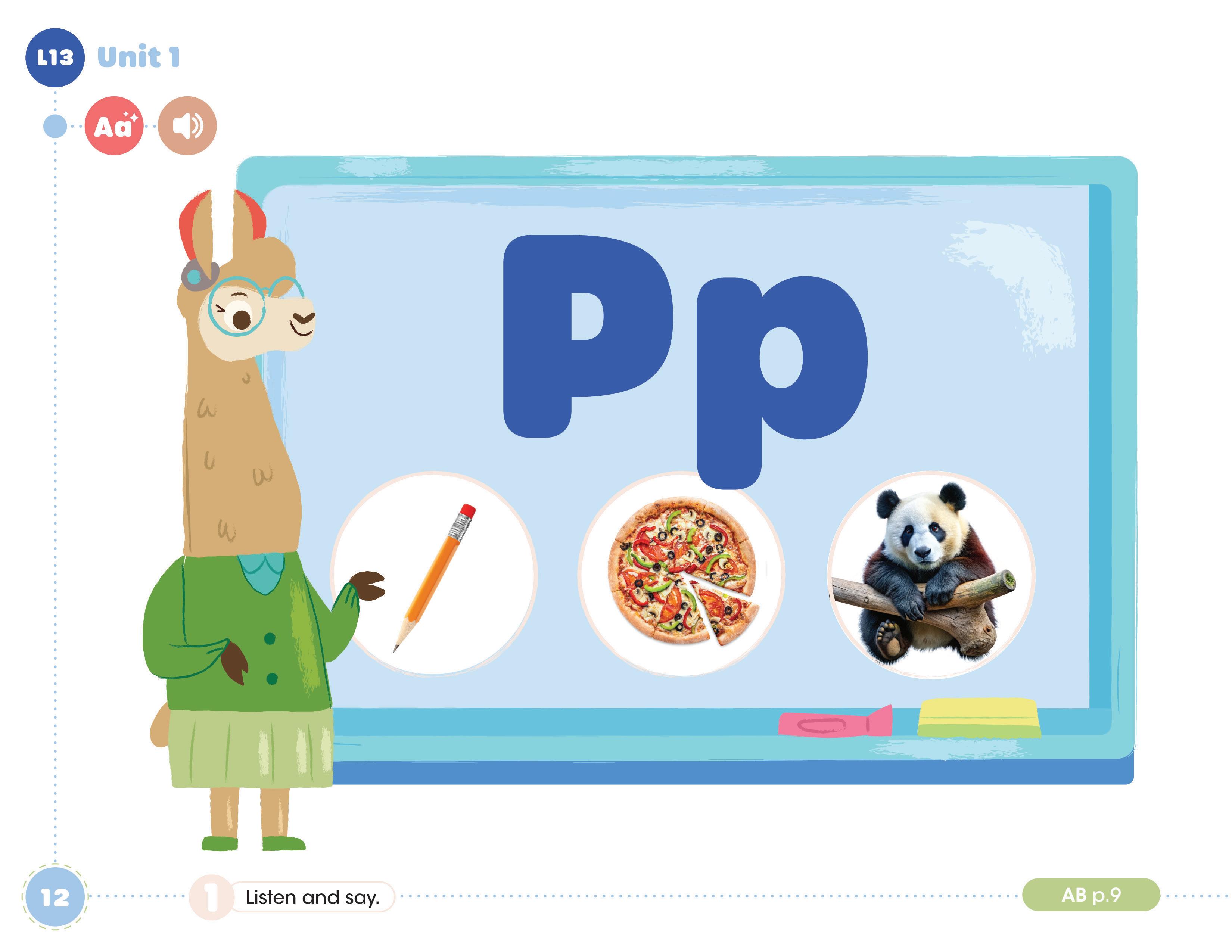
• Display SB page 12 to the class and point to the picture of the pencil. Ask students what else they can see on the page. Say, This is a pizza, and this is a panda.
• Play the Unit 1 Phonics audio and point to the pictures as they are mentioned.
• Help students open their Student Books to page 12. Play the audio again and have students point to the letter and the correct pictures as they are mentioned.
Relate the /p/ sound with the word panda.
• Ask, What animal starts with the sound /p/? Yes! Pandas! Pandas are bears. They are white and black. Let's walk like pandas. Have students go to the floor and move on their hands and feet. Say, /p/, /p/, pandas.
• Have students act out other verbs like swim, climb, and eat. Repeat the sound /p/ as students move around.
Finish the lesson.
• Help students reflect on the lesson. Say, Today we learned a new sound. What school object begins with /p/? What animal begins with /p/?
• Sing the Goodbye Song.
Audio: Hello Song, Unit 1 Phonics, Goodbye Song.
Additional Activity: play dough.
Additional Activity: P for Play Dough
Tell students that play dough starts with /p/. Ask students to make a pencil, a panda, and a slice of pizza out of play dough.
Unit 1 Phonics
Miss Llama:
Listen to this new sound! /p/… /p/.
Repeat after me: /p/, /p/.
The letter P can make the /p/ sound.
Do you see the letter P? Point to the letter P.
Let's look at some words that begin with /p/.
Point to the pencil. Pencil begins with /p/.
Repeat after me: /p/, /p/, pencil.
Point to the pizza. Pizza begins with /p/.
Repeat after me: /p/, /p/, pizza.
Point to the panda. Panda begins with /p/.
Repeat after me: /p/, /p/, panda.
What's our sound today?
Yes! The letter P makes the /p/ sound.
Begin
Start the lesson.
• Sing the Hello Song.
• Practice Today is (Monday).
• Sing the Days of the Week Song.
Main Objective: Identify the letter Pp.
New Language: NA
Recycled Language: pencil, panda, pizza.
Resources: AB page 9, Unit 1 Phonics Printable. Materials: colorful tissue paper.
Practice the Unit 1 Song.
• Hold a pencil and ask, What's that? What's the first sound in the word pencil? Yes! /p/.
• Play the Unit 1 Song. Have students sing along and say the sound /p/ when they hear the word pencil.
Recognize the grapheme P.
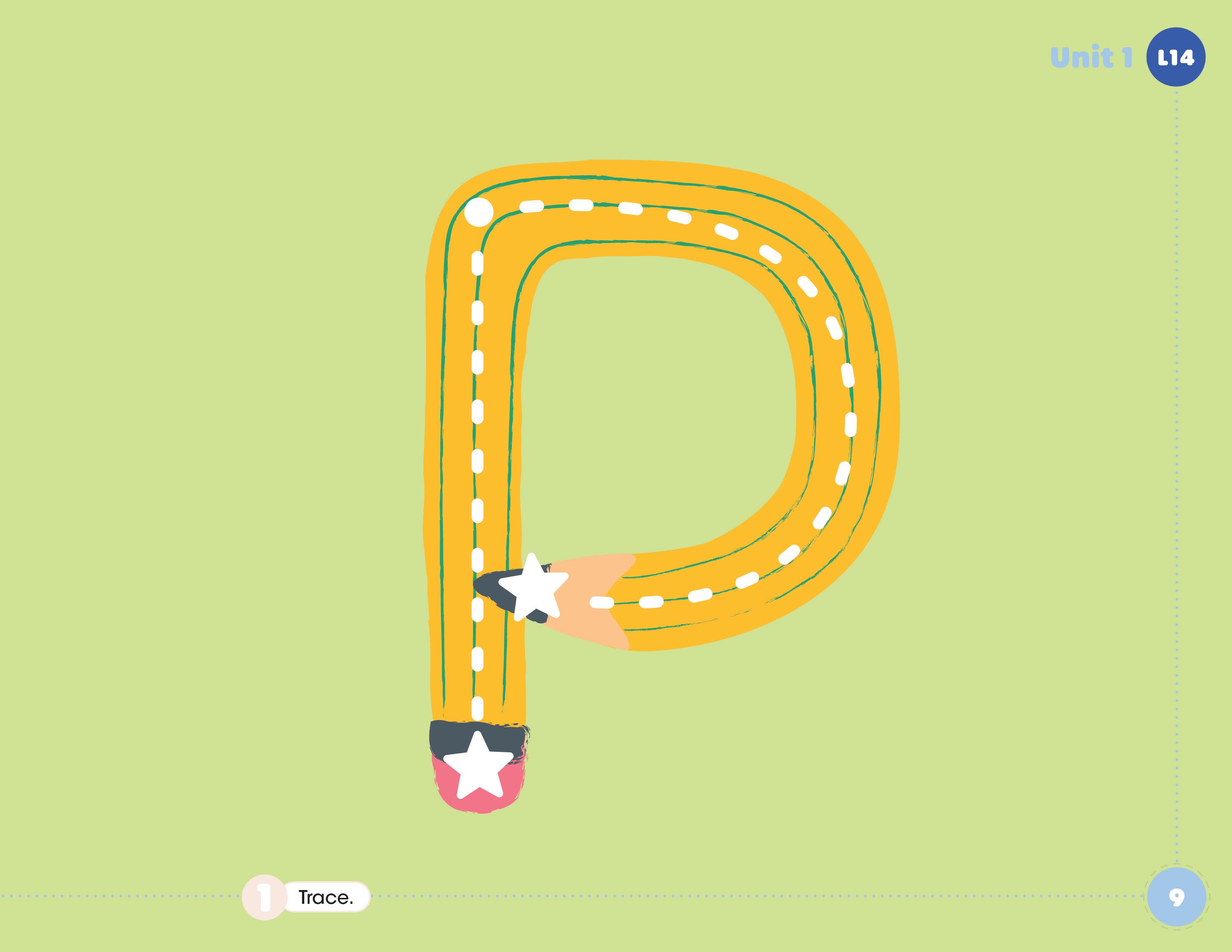
• Display AB page 9. Ask, What do you see? It's a pencil. P is for pencil. /p/, /p/, pencil. Look how I trace the letter P. I start on the dot. I finish in the star. Trace the letter P with your finger.
• Help students open their Activity Books to page 9. Ask students to trace the dotted line with their fingers while saying, /p/, /p/, pencil.
• Say, Now, take a crayon. Trace the letter P. Start in the dot. Finish on the star. Model how to trace the dotted lines. Have students do the same.
Recognize the grapheme p.
Audio: Hello Song, Unit 1 Song, Goodbye Song.
Additional Activity: NA
Pandas spend ten to sixteen hours of their day just eating. But they don't eat pizza; they eat bamboo! Learn
• Distribute pieces of colorful tissue paper to every student. Ask them to tear bits of paper and then crumple them up. Collect as many crumpled pieces as you can.
• Hand out a copy of the Unit 1 Phonics Printable to each student.
• Have students glue the pieces of crumpled-up tissue paper on the p. Practice saying the /p/ sound as students work.
Finish the lesson.
• Help students reflect on the lesson. Say, Today we worked with the letter Pp. Can you trace a P in the air? What food starts with (p)?
• Sing the Goodbye Song.
Additional activity:
Tell students to clap every time they hear a word that begins with /p/. Slowly say, Pat, book, pip, pit, backpack, pen, parrot, teacher, pizza, girl, panda, top, boy, pencil, crayon.
Curiosity Corner
Lesson 15
Begin
Start the lesson.
• Sing the Hello Song.
• Practice Today is (Monday).
• Sing the Days of the Week Song.
Main Objective: Rhow an understanding of. Vocabulary: backpack, book, pencil, crayon. Structure: It’s a (book).
Resources: SB pages 6 and 7, AB page 10, Assessment Chart. Materials: backpack, pencils, crayons, books.
Audio: Hello Song, Unit 1 Assessment, Goodbye Song
Review the Unit 1 Story.
• Have students sit in a circle. Open your book to SB pages 6 and 7. Display the story "Bob's Backpack." Ask, Do you remember this story? What happened in the (first) picture?
• Ask questions for every scene and review the vocabulary words.
Learn
Identify Bob's school supplies.
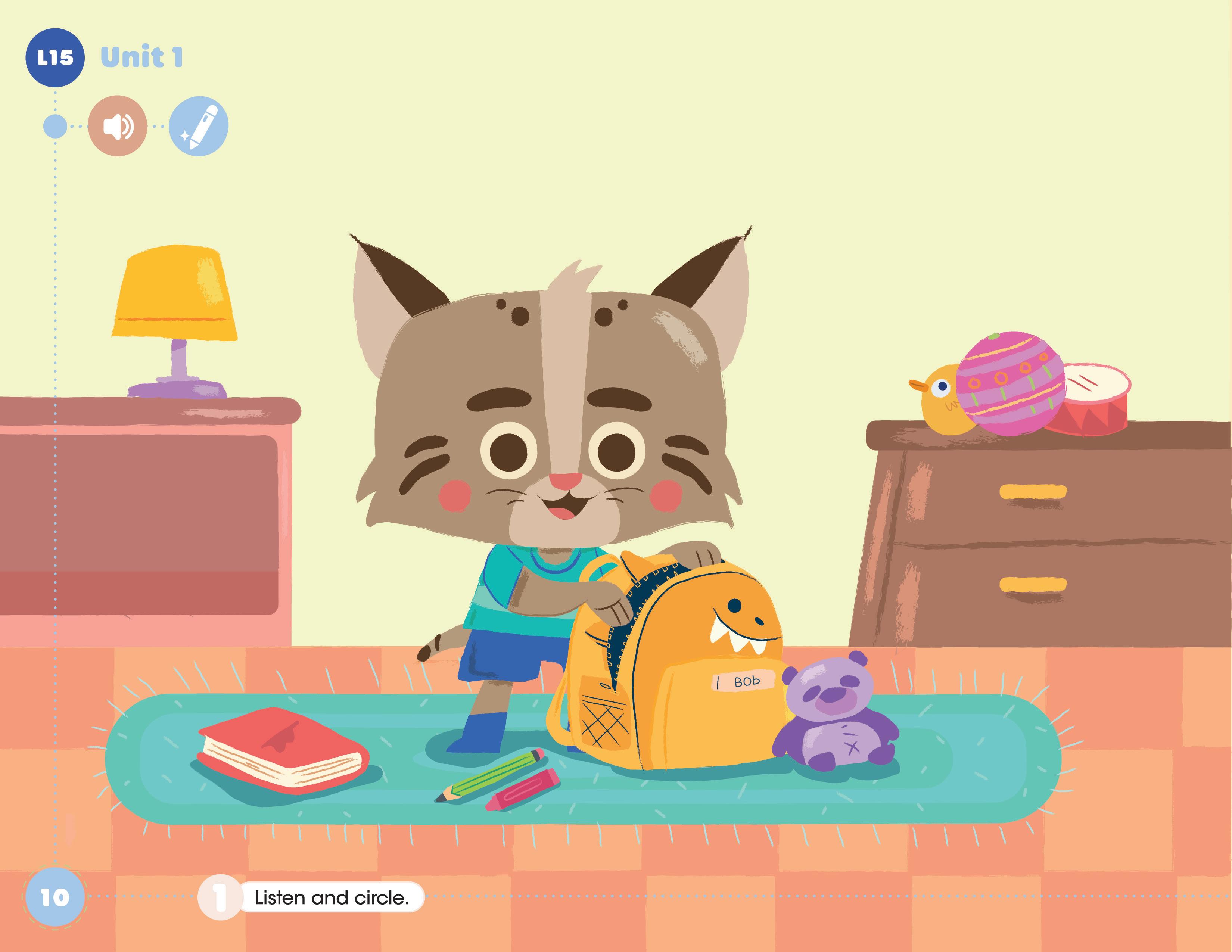
• Display AB Page 10. Ask, Where is Bob? What is he doing? Bob is packing his backpack. Let's listen carefully.
• Play the Unit 1 Assessment audio. Point to each school object as Bob mentions them. Model how to draw a circle using a crayon. Ask, What does Bob need for school?
• Help students open their Activity Books to Page 10. Give each student a crayon.
• Play the audio again. Have students circle the objects Bob is packing.
• Monitor and record observations in the Assessment Chart.
Do
Name school supplies in a full sentence.
• Place crayons, pencils, and books inside a backpack.
• Have students sit in a circle. Pass the backpack to the student sitting next to you. Ask the student to take out an object. Ask, What's that? The student answers, It's a (pencil).
• Repeat until everybody has had a turn.
• Record your observations in the Assessment Chart.
Reflect Focus
Finish the lesson.
• Help students reflect on the lesson. Say, Today we saw Bob's school supplies. What did Bob pack in his backpack? What do you pack in your backpack?
• Sing the Goodbye Song.
Additional Activity: school supplies.
Additional Activity: Up and Down
Tell students to stand up and sit down. Say, Up, and point up with your finger. Say, Down, and point down with your finger. Ask students to put a pencil, a book, and a crayon on their tables. Give instructions and say, Pencils up, pencils down. Crayons up, crayons down. Books up, books down.
Unit 1 Assessment
Bob: Look! My backpack!
I need a pencil. Point to the pencil. Circle the pencil. I need a book. Can you find the book? Circle it. This is my backpack!
I'm ready for school!
I have a pencil and a book! Great job!
Lesson 16
Begin
Start the lesson.
• Sing the Hello Song.
• Practice Today is (Monday).
• Sing the Days of the Week Song.
Main Objective: Make and describe a backpack.
New Language: NA
Recycled Language: backpack, crayon; It's a (book).
Resources: SB page 13. Materials: paper bags, foam paper.
Practice the Unit 1 Chant.
• Play the Unit 1 Chant and say it together.
• Ask students to stand up and say it again.
Learn
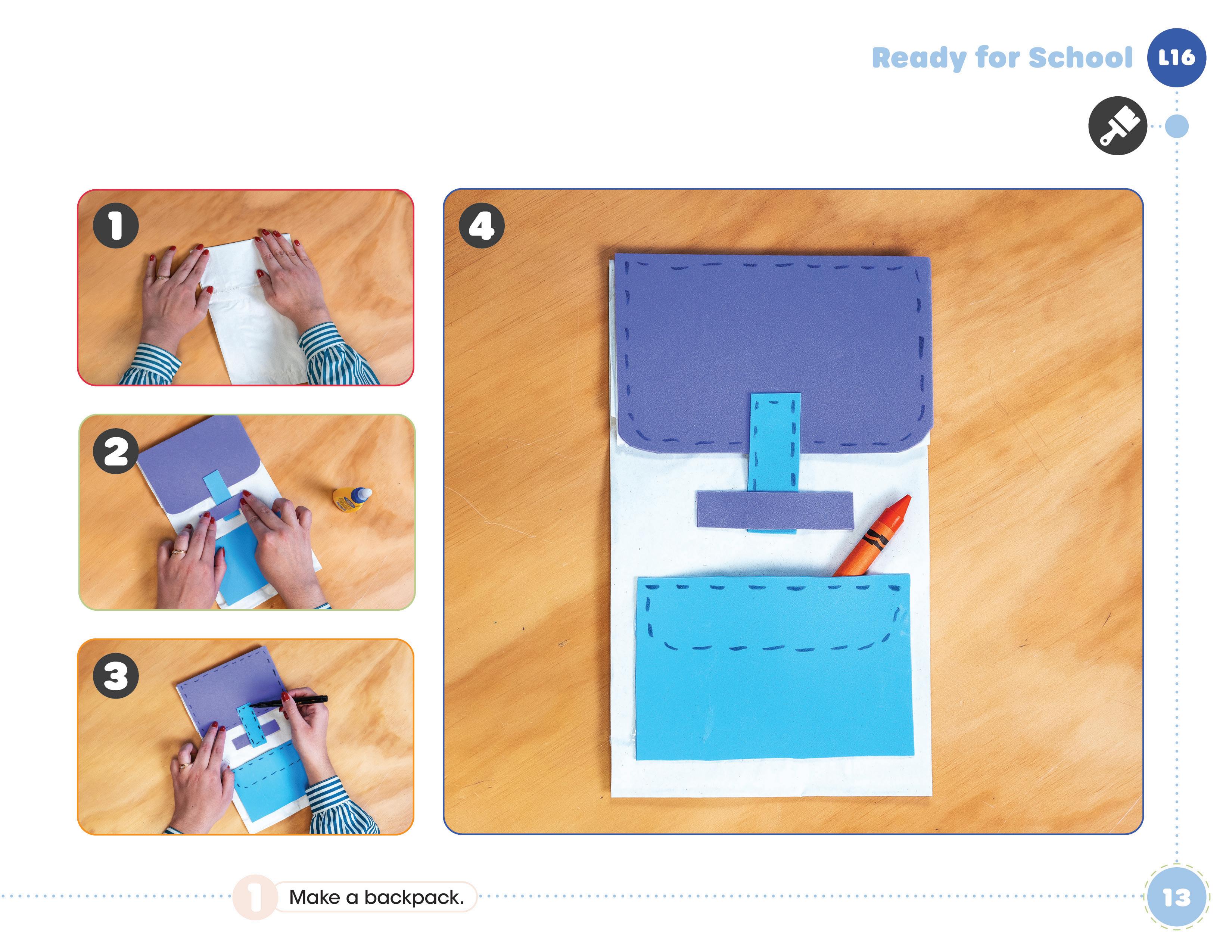
Make a paper backpack.
• Help students open their Student Books to page 13. Ask what is happening in every picture. Say, We are going to make a backpack. We are going to use paper. I will show you how to do it, and then you do it.
• Give each student a paper bag. Model how to fold the top of the bag so it can close. Monitor and help if needed.
• Distribute the different pieces of foam paper and model how to glue them to the bag. Make sure the big pocket can be opened.
• Students can draw sewing stitches with a black marker or decorate as they choose.
• Place a crayon or a pencil inside the pocket.
Do Focus
Use learned language to talk about their craft.
• Sit in a circle. Every student should have their backpack craft with them.
• Ask, What is that, (student's name)? Yes, a backpack. What is inside the pocket? Yes, a (pencil).
• Praise students for their creativity and effort in coloring their backpacks.
Reflect
Finish the lesson.
• Help students reflect on the lesson. Say, Today we made a beautiful craft. What did we make? What can we put inside a backpack?
• Sing the Goodbye Song.
Audio: Hello Song, Unit 1 Chant, Goodbye Song.
Additional Activity: Unit 1 Song.
Additional Activity:
Celebrate the end of Unit 1. Play the Unit 1 Song and have students sing and dance around. Ask them to show their craft when singing the line "‘It's a backpack" and loudly say "I'm going to school."
Try This
Recycle crayons. Use a big jar to place broken or small pieces of crayons. At the end of the year, you can donate crayons to smaller schools or charities. You can also use them to create art pieces or make your own crayons.