THE VIRTUE OF IMPATIENCE: WHY LEADERS NEED DISCIPLINED URGENCY
CULTURE IS BUILT BY FRICTION MANAGERS
HOW TO MANAGE TEAM FOCUS WHEN EFFORT ISN'T THE PROBLEM
WHAT'S REALLY BEHIND THE DROP IN EMPLOYEE ENGAGEMENT?
PROCRASTINATION OR AVOIDANCE?
LET US KNOW
If you are encouraged or provoked by any item in the LEADERS DIGEST, we would appreciate if you share your thoughts with us.
Here’s how to reach us: Email: corporate@leadinstitute.com.my
Leader’s Digest is a monthly publication by the Leadership Institute of Sarawak Civil Service, dedicated to advancing civil service leadership and to inspire our Sarawak Civil Service (SCS) leaders with contemporary leadership principles. It features a range of content contributed by our strategic partners and panel of advisors from renowned global institutions as well as established corporations that we are affiliated with. Occasionally, we have guest contributions from our pool of subject matter experts as well as from our own employees. The views expressed in the articles published are not necessarily those of Leadership Institute of Sarawak Civil Service Sdn. Bhd. (292980-T). No part of this publication may be reproduced in any form without the publisher’s permission in writing.
The Human Stewardship of AI
The integration of artificial intelligence (AI) into human life has elicited a spectrum of responses. On one hand, many embrace its potential to enhance efficiency, particularly in the domains of information retrieval and data analytics. On the other hand, a segment of society remains cautious, raising legitimate concerns about the accuracy, reliability, and validity of AI-generated outputs.
Concurrently, issues surrounding academic integrity among both educators and students, coupled with a growing tendency toward over-reliance and intellectual complacency, risk diminishing the perceived value of AI. Such concerns, while valid, should not obscure the transformative capabilities of AI. When applied appropriately, AI can generate extensive bodies of knowledge, conduct sophisticated analyses with precision, and perform tasks that would otherwise demand considerable human capital and time. To disregard the relevance of AI even within prudent and well-regulated boundaries may ultimately impede operational efficiency and limit overall productivity.
Nonetheless, as a technology engineered by humans, AI is inherently subject to limitations and imperfections. At the end of the day, the main purpose of AI is to improve human judgment. It is therefore incumbent upon human judgment and discernment to guide its application, ensuring that outputs remain accurate, ethical, and of high quality.
Within the context of leadership, the human role remains paramount. Leaders must continue to act as responsible stewards, exercising sound judgment, demonstrating moral courage in decision-making, and upholding accountability for all actions taken. Regardless of the sophistication of the technologies employed, the essence of leadership lies in the integrity, wisdom, and responsibility of the individual.
Datu Dr. Azhar Bin Haji Ahmad Chief Executive Officer
Leadership Institute of Sarawak Civil Service
The
AI Productivity Paradox: The New Wine, Old Wineskin Problem
BY ROSHAN THIRAN
The New Wine of Generative AI Cannot Be Blended
Into The Old Wineskins of 20th-Century Bureaucracy
In 2025, tens of thousands of white-collar workers were laid off under the banners of efficiency, automation, restructuring, and AI-enabled productivity. At IBM, Meta, Salesforce, Duolingo, Klarna, and later Amazon, the message was unmistakable: the future of work was being rewritten in real time. Then in August 2025, MIT's NANDA initiative released a study that should have ended the celebration. Across hundreds of enterprise generative AI deployments, 95% had produced no measurable impact on the bottom line.
The clearest confession of this gap came from one of the CEOs who had cheered the loudest. In early 2024, Klarna's Sebastian Siemiatkowski stood on a stage in Stockholm and announced that a single AI assistant was now doing the work of 700 customer service agents, saving $40 million a year. Investors cheered. A little over a year later, he began bringing humans back into the customer experience conversation, he quietly began hiring humans again — admitting in a public interview that cost had become "a too predominant evaluation factor." Translation: they had measured the wrong thing. Klarna had not failed at using AI. Klarna had succeeded at the wrong thing. And that, in one sentence, is the story of corporate AI in 2026. As someone who plays football as a striker trying to always score goals to win games, I know a fundamental truth: having the most advanced, high-tech football boots on the pitch doesn't guarantee a single goal if your team's formation is a complete mess. Right now, the business world is buying the most expensive football boots on the planet, called Artificial Intelligence, but many companies are still playing in a formation designed for another century. We have been here before.
Back in my early career days at ExxonMobil and GE in the 1990s, we lived through a very similar phenomenon. We were rolling out massive IT infrastructure, putting a desktop computer on every desk, and staring at our balance sheets waiting for the magic to happen. It didn't. In fact, in 1987, the Nobel Prize-winning MIT economist Robert Solow famously quipped, "You can see the computer age everywhere but in the productivity statistics." Back then, we called it the Productivity Paradox.
This paradox refers to the unexpected lag between the massive investment and widespread adoption of information technology—such as rolling out desktop computers and IT infrastructure in the 1980s and 90s—and the lack of corresponding growth in national productivity statistics.
The data is sobering. MIT's NANDA initiative found in August 2025 that roughly 95% of enterprise generative AI pilots produced no measurable impact on the P&L. McKinsey's most recent State of AI report tells the same story from a different angle: most companies have widely adopted AI tools, but almost none can point to enterprise-level value creation. We're writing emails faster, generating code quicker, producing reports at light speed — and we cannot find the productivity in the books. Why? Because we are making the exact same mistake we made in the '80s and '90s.
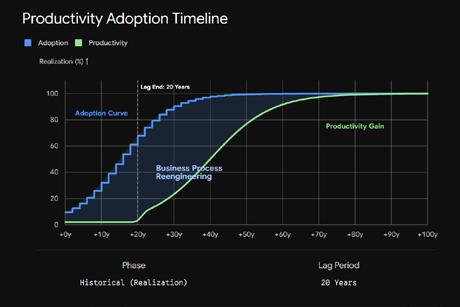
To understand how to break this cycle, we have to look back. When electricity was introduced to factories in the 1880s, productivity didn't increase for almost 40 years. Why? Because early factory owners simply replaced their single massive steam engine with a massive electric motor, keeping the old, convoluted belt-driven layout. It wasn't until the 1920s, when they realized electricity allowed them to restructure the entire factory floor into an assembly line, that productivity skyrocketed. The same lag happened when computers were introduced and it took 20 years.
We've been here before: The 1980s Computer Paradox. Source: iStock
The lag between productivity and adoption for computers also took more than 20 years, similar to what was experienced by electricity (40 year lag). Image by Roshan Thiran
You cannot layer a transformational technology over a legacy foundation. Instead of the computer, the problem was that companies installed computers into old workflows, old hierarchies, old scorecards, and old assumptions about work.
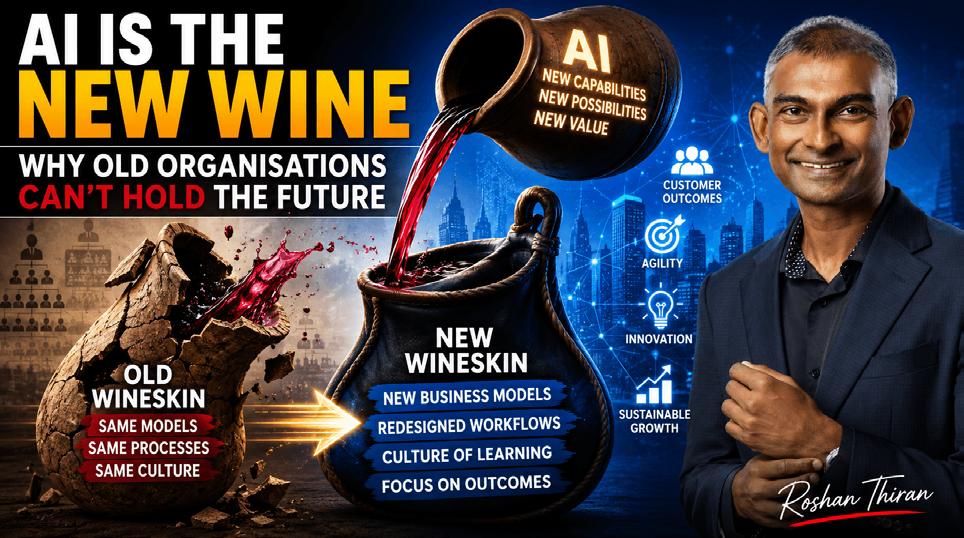
This is not a new teaching or insight—almost two thousand years old—Jesus made this point, "And no one pours new wine into old wineskins. Otherwise, the wine will burst the skins, and both the wine and the wineskins will be ruined." AI is the most potent new wine of our generation. If we pour it into the rigid, hierarchical, siloed old wine-skins of 20th-century corporate management, things will break. New capacity requires a new container. Force it into the old one, and you lose both.
The old wineskin was not evil. It had served its season. Bureaucracy, hierarchy, process control, annual planning, functional departments, and managerial approvals helped organisations scale in the industrial age. They created order. They reduced chaos. They allowed large companies to coordinate thousands of people across markets.
But every wineskin has a limit. What once preserved value can eventually prevent fermentation. What once created stability can later suffocate movement. That is the danger facing leaders today. We are not being asked to despise the old wineskins. We are being asked to recognise when they can no longer carry the pressure of the new wine.
The Paradox Question
The real question, then, is not, “How do we use AI?” That is too small. The deeper leadership question is, “What kind of organisation can actually hold the power of AI without bursting?”
This is where the Science of Transforming Organisations, or SOTO, becomes critical. If AI is the new wine, then the wineskin is the organisation itself: its business model, structure,
processes, and alignment systems. Pouring AI into old business models simply produces faster inefficiency. Pouring AI into old structures produces faster bureaucracy. Pouring AI into old processes produces faster exhaustion. Pouring AI into old cultures produces faster distrust.
The work of AI transformation is therefore not tool adoption. It is organisational redesign. Here are some ideas of how you can do it for your business in these 4 different dimensions:
1. The Business Model: Don’t Pour New Wine Into an Old Value Proposition
In the '90s, traditional bookstores tried to use computers to track their physical inventory better. Amazon used computers to eliminate the physical bookstore entirely. Blockbuster used data to track late fees; Netflix used it to stream directly to living rooms.
Right now, most companies are using AI as a "horizontal copilot"—a fancy tool to help an employee write an email or generate a report 10 percent faster. That is mere cost-cutting, not value creation. We need to shift to vertical, agentic AI, where the business model itself is reimagined. Instead of asking, "How can AI help our customer service reps answer phones faster?" we should be asking, "How does AI allow us to predict and solve the customer's problem before they even pick up the phone?"
AI shouldn't just optimise your current model; it should make your current model obsolete. Here is how three massive legacy industries are successfully tearing down their old wineskins today:
John Deere: From Selling Iron to Selling Outcomes
John Deere is a nearly 200-year-old company built on heavy iron, steel, and horsepower. They did not treat AI as a simple back-office efficiency tool, but executed a massive business model pivot.
With the launch of their fully autonomous 8R tractors and AI-driven "See & Spray" computer vision (which distinguishes weeds from crops in real-time, reducing chemical usage by up to 77%), Deere isn't just selling tractors anymore. They are shifting to a "Tech-as-a-Service" model. They now charge farmers based on outcomes—precision yields and chemical savings. By building a massive data moat from over 370 million acres of connected farmland, John Deere is transitioning from a cyclical heavy equipment manufacturer to an intelligence subscription service, targeting 10% of their total revenue to come from software and subscriptions by 2030.
Big Pharma: From "Lab Roulette" to Computing Medicine
For decades, traditional pharmaceutical drug discovery was essentially a multi-billion dollar roulette wheel. You threw incredible amounts of money at massive physical labs, hoping that 10% of your molecules would survive clinical trials. Because of the massive overhead, Big Pharma routinely ignored rare diseases because there was "no market" for them.
Today, thanks to AI systems like Google DeepMind's AlphaFold 3, the entire business model is flipping from physical "market medicine" to algorithmic "computing medicine." Companies like Isomorphic Labs are using AI to predict 3D protein structures and simulate how molecules interact before they ever touch a physical lab. The model shifts from manufacturing chemicals to licensing algorithmic discoveries. This radically lowers the cost curve, allowing these new AI-driven platforms to target rare diseases that legacy companies deemed unprofitable for 30 years.
Industrial Logistics: From Tracking to "Agentic Task Forces"
In my early days at GE, supply chain optimisation meant human planners staring at spreadsheets and reacting to delays. Today, legacy industrial giants like the BMW Group are blowing up that reactive model.
Using AI platforms like SORDI.ai, BMW has created highly accurate digital twins of their factories. But they aren't just using AI to give humans better dashboards; they are creating agentic workflows. Supply chain AI agents are talking directly to compliance AI agents, running thousands of simulations, predicting bottlenecks, and re-routing resources autonomously. They eliminated the manual middleman entirely, shifting the business model from "managing a supply chain" to "orchestrating an autonomous network."
The Litmus Test for Your
Business:
Three questions cut to whether you are transforming your business model or merely decorating it:
1. Are you still charging customers for inputs—hours, units, licences, transactions—or are you charging for the outcomes AI now lets you guarantee? John Deere is shifting from selling tractors to selling yield. What is your equivalent move?
2. If your AI strategy succeeded beyond your wildest projections, would it obsolete your most profitable product? If the answer is no, you are optimising—not transforming. Isomorphic Labs is willing to make traditional drug discovery economically irrelevant. Are you willing to make your current cash cow irrelevant before someone else does it for you?
3. If a competitor with no legacy, no sunk costs, and no internal politics launched tomorrow with the same AI capabilities you have today, what would they build that you cannot? The gap between their answer and yours is the size of your old wineskin.
Leadership Warning
The deepest trap in AI-era business model design is using the technology to defend the existing model rather than to invent the next one. Boards will applaud you for using AI to make your cash cow 10% cheaper to milk. Almost none of them will warn you when a competitor uses AI to render the cow itself irrelevant. The Blockbusters and Kodaks of this decade will not die because they ignored AI. They will die because they used AI to optimise the very business model that AI was built to replace.
Pharma Trial-and-error physical lab testing
Logistics Human-managed dashboards & tracking
Subscribing to autonomous crop yields
Algorithmic protein simulation & licensing
Autonomous "Agentic" supply chain networks
2. Structure: Don’t Pour New Wine Into Old Silos
The traditional corporate org chart—with its rigid hierarchies and isolated departments—was designed to manage human communication bottlenecks. AI does not remove every bottleneck, but it changes where the bottlenecks live. The old bottlenecks were often information bottlenecks. The new bottlenecks are design, trust, governance, and decision-rights bottlenecks. If you introduce rapid AI capabilities into a rigid hierarchy, you just create massive traffic jams at the middlemanagement approval layer. We need to move away from functional silos (Marketing, HR, Finance) and toward crossfunctional, mission-driven "pods."
During my time at General Electric, Jack Welch famously championed the "boundaryless organisation." I watched Welch say it in person at Crotonville. I watched our division try to do it. And I watched, three years later, the silos quietly reassemble themselves under different names. Not because anyone was malicious — because in a world where information moves through human meetings, you needed the silo to keep the cognitive load manageable. The silo was never the problem. It was the symptom of how information moved.
Industry The Old Wineskin (Legacy Model)
The New Wine (AI Business Pivot)
Agriculture Selling heavy machinery (one-off hardware)
(SaaS)
AI changes that variable. For the first time, information doesn't have to move through humans to be useful. Which means the cognitive justification for the silo—the one nobody ever said out loud—is finally gone. AI does not remove the need for expertise, but it does remove many of the excuses for fragmentation.
Recently I read a sentence again written 2000 years ago, "Just as a body, though one, has many parts, but all its many parts form one body…" Think of the human body. One body, many parts—but the nervous system communicates instantly across all of them. The hand doesn't need a meeting to know what the foot is doing. For decades, our companies have operated like dismembered bodies: the marketing hand with no idea what the operations foot was up to. AI, finally, can act as the corporate nervous system—but only if we let the body be one.
In 2026, AI acts as the central nervous system, allowing the organisation to finally operate as one unified body. Here is how that changes the actual anatomy of a business:
A. How People Are Organised: The Rise of the "Outcome Pod"
The traditional corporate org chart is a vertical hierarchy designed to pass information up and pass orders down. This created a massive layer of "traffic cop" middle managers whose primary job was just moving data from one silo to another.
We are seeing a brutal correction to this. In late 2025, Amazon announced about 14,000 corporate job cuts as part of a broader push to reduce bureaucracy, simplify layers, and adapt to AIenabled ways of working. By early 2026, further corporate reductions were reported. But the real lesson is not “cut managers.” The real lesson is that AI exposes structures whose main job was to move information around.
Instead of organising people by function (e.g., all the finance people sit together), AI-native organisations are structuring people into cross-functional Outcome Pods. According to recent Stanford enterprise research, AI agents don't fix broken processes; they amplify them. If you drop an AI agent into a siloed hierarchy, it just creates bottlenecks faster.
• The Shift: Middle managers are no longer "people supervisors" managing task execution. The AI executes the tasks. The human leaders have become "orchestrators" and "exception handlers." You don't manage the process anymore; you manage the parameters of the AI, stitching things together and stepping in only for high-stakes, human-centric decisions.
B. Go-To-Market (GTM): The Death of the Handoff
Nowhere were silos more toxic than in Go-To-Market strategies. The old playbook was rigid: Marketing generated leads, threw them over the wall to Sales Development Reps (SDRs) who qualified them, who then handed them to Account Executives (AEs) to close, who finally passed them to Customer Success. Customers hated this fragmented experience.
Today, AI has entirely collapsed that funnel.
• The Shift: We are seeing the rapid deployment of Autonomous Revenue Teams. AI agents now act as the ultimate SDR, operating 24/7, analyzing intent signals, and responding to inbound queries within seconds. By integrating data across the entire customer journey, the AI doesn't just sell; it predicts churn and identifies upsell opportunities simultaneously. We are seeing startups in 2026 hit product-market fit in 6 to 9 months—half the time it took just a few years ago—while dropping their customer acquisition costs by up to 50%. The GTM team is no longer segmented by funnel stage; it is a single, unified brain focused entirely on customer lifetime value.
C. Policy Formulation: From Static Manuals to Dynamic Guardrails
In the past, formulating corporate policy meant a group of executives writing a 100-page PDF manual, putting it on a company intranet, and praying employees followed it. Compliance was reactive—you only knew someone broke the policy after the damage was done.
When you empower AI agents to execute workflows, you cannot rely on a PDF manual.
• The Shift: In 2026, policy and governance are built into the workflow. It is known as "embedded governance." Instead of writing a policy about data privacy, organisations code Role-Based Access Control (RBAC) and audit gates directly into their internal AI architecture. The AI agent cannot physically execute an action that violates the policy.
• Dynamic Adaptation: Furthermore, policies are no longer static. If a supply chain AI detects a geopolitical disruption, the procurement policy can dynamically adjust its risk parameters in real-time, routing approvals for new vendors to a human overseer instantly, rather than waiting for a quarterly policy review board.
The Litmus Test for Your Structure: Are your teams organised around the functions they perform, or the outcomes they are supposed to deliver? If it's the former, your structure is blocking your technology and productivity gains.
Leadership Warning: Flattening an organisation is not the same as transforming it. Removing managers without redesigning decision rights, workflows, accountability, and culture merely creates chaos with fewer adults in the room. AI-native structure is not leaderless. It is differently led.
3. Processes: Don’t Pour New Wine Into Broken Workflows
When organisations first encounter a powerful new technology, their instinct is to bolt it onto their existing way of doing things. They look at a broken, inefficient process and say, "How can AI make this broken process run faster?"
This is where the productivity paradox traps us. MIT economist Erik Brynjolfsson identified a dangerous phenomenon here called the "task composition effect." Here is how it works: Every job is made up of a mix of tasks—some are easy and repetitive; some are highly complex and emotionally taxing. When a company introduces AI, it usually automates the easy 80 percent of the job.
What happens to the human worker? They are left with a highly concentrated batch of the most difficult, complex, edge-case problems. The worker doesn't actually save time; they just experience severe cognitive burnout because they never get a "break" doing the easy stuff (ie The worker does not become free; the worker becomes the permanent dumping ground for complexity). You haven't made them more productive; you've just made their job infinitely harder.
To see real returns, we must stop automating tasks and start reengineering end-to-end workflows. Recent field research from Harvard Business School and INSEAD proved this: Startups that trained their teams on workflow reorganisation (not just how to use AI tools) generated 90% higher revenue and needed 40% less capital than those who just handed their employees the tools. At Leaderonomics, when we dive into the Science of Transforming Organisations (SOTO), we emphasise that true transformation requires looking at workflows holistically.
Here is how leading businesses are shifting from tasks to workflows:
The Coffee Shop Queue: A Lesson in Systems Thinking
Consider a non-AI example that perfectly illustrates this mindset: Starbucks. When Starbucks faced long queues, the obvious "task" fix was to hire more baristas. But that would have just crowded the workspace.
Instead, they mapped the entire system. They realised that custom drink requests created bottlenecks, baristas were walking too far for supplies, and the order system ran in parallel with preparation rather than in sequence. By simplifying the menu layout, repositioning equipment based on movement patterns, and adding order-ahead capability, they fixed the workflow. They achieved shorter wait times, higher sales per hour, and happier staff—without adding headcount. The lesson for AI is simple: before you automate the barista, understand the queue.
When you automate a task without mapping dependencies, you just shift work somewhere else. If AI helps marketing generate leads 10x faster (a task), but sales can't process them, you haven't improved the business; you've just buried sales.
Transforming Construction: From Paper to Custom Reasoning Systems
The construction industry is notorious for running over budget and behind schedule, often bogged down by manual estimating and field management processes that haven't changed in decades.
A company called Myte Group is changing this by building custom reasoning systems. Instead of using generic AI to answer questions (a task), they embed domain expertise— construction-specific constraints, codes, and practices—into AI workflows.
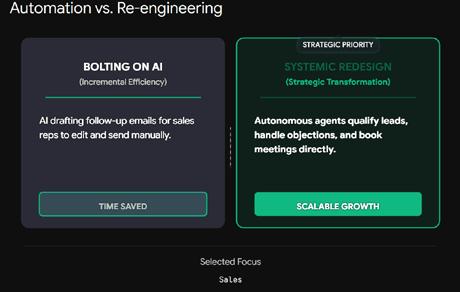
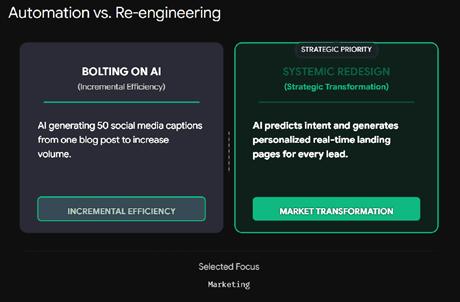
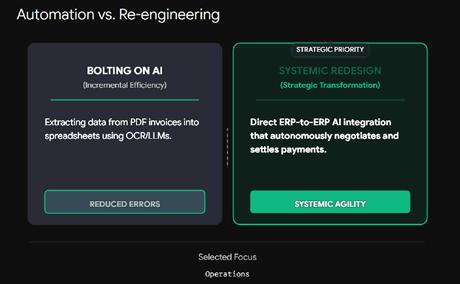
An Example of Bolting on AI vs Doing a Redesign in the Sales Space. Info-graphic created by Roshan Thiran
Infographic from Roshan Thiran
Rather than automating the task of typing up an estimate, the AI compresses entire planning timelines. What used to take weeks to create roadmaps and estimate costs now takes hours. By programming experience into the workflow, they provide full visibility with flowcharts and timelines that can be audited. The result? Some companies have cut delays by 30% and reduced costs by 20% on major projects.
The AI Audiobook Supply Chain
In the publishing world, producing an audiobook has always been an expensive and slow workflow involving recording, editing, and distribution. Most authors simply skipped it.
Spotify didn't just create a tool to read text aloud (a task). They are turning AI audiobook creation into a complete publishing workflow. By integrating ElevenLabs into Spotify for Authors, they are positioning themselves at the start of the audiobook supply chain, allowing authors to generate audiobooks without the massive overhead. They aren't just speeding up recording; they are re-engineering how a book gets from the author's computer to the listener's ears.
The Litmus Test for Your Processes:
Are you using AI to do a single step faster (e.g., "drafting an email"), or are you redesigning the system so that the step isn't needed in the first place?
4. Culture: Don’t Pour New Wine Into Outdated Mindsets & Belief Systems
Years ago, at one of the global companies I worked in, the CEO stood in front of 3,000 employees and declared us a "digitalfirst" enterprise. The slides were beautiful. The standing ovation was loud. We walked out of that town-hall convinced something fundamental had shifted. By Friday, nothing had shifted at all.
That same week, the procurement system still required four signatures for a $200 software licence. The performance review still rewarded hours logged, not problems solved. The bonus pool still flowed toward the loudest voices in the room, not the wisest. By Monday, every employee in that auditorium had
quietly returned to the behaviours the system was paying them to perform.
This is a lesson I have watched companies relearn every five years for three decades. You cannot “speech” your way into a new culture. You can only design your way into one.
If business model is the what of an organisation, structure is the who, and process is the how, then culture is the why people actually do anything at all. It is the deepest layer of the wineskin, and the most stubborn. You can rebuild every other layer—pivot your offering, flatten your hierarchy, re-engineer your workflows—but if your culture still pays people to hide failure, hoard information, and resist anything that threatens their turf, the new wine of AI will sour the moment it touches the container.
Recent data from Deloitte shows that organisations that heavily invest in change management are 1.6 times more likely to exceed their AI expectations. But "change management" has become one of the most abused phrases in modern business. For most companies, it is shorthand for posters, townhalls, and an offsite. None of that is design. All of it is theatre. Transformation is not a software update. It is a renewal of how people think. The oldest wisdom from Paul of Tarsus on this is brutally simple: do not conform to the patterns you inherited; let your mind be made new. Culture change without cognitive change is theatre.
This is where, at Leaderonomics, we lean hard on what we call the Budaya framework—the conviction that most organisations don't have a culture problem. They have a design problem dressed up as a culture problem. Culture is not what leaders announce. Culture is what the system repeatedly rewards, tolerates, measures, and remembers. Change the design, and the culture follows. Change only the messaging, and nothing follows at all.
To build a culture that can actually hold the new wine of AI, leaders must intervene across three layers simultaneously: the Experiences people have every day, the Beliefs they hold about what's normal, and the Actions the system rewards or punishes. Touch only one, and the culture snaps back. Touch all three together, and the wineskin starts to stretch.
A. Experiences: Make the Right Behaviour the Easiest Behaviour
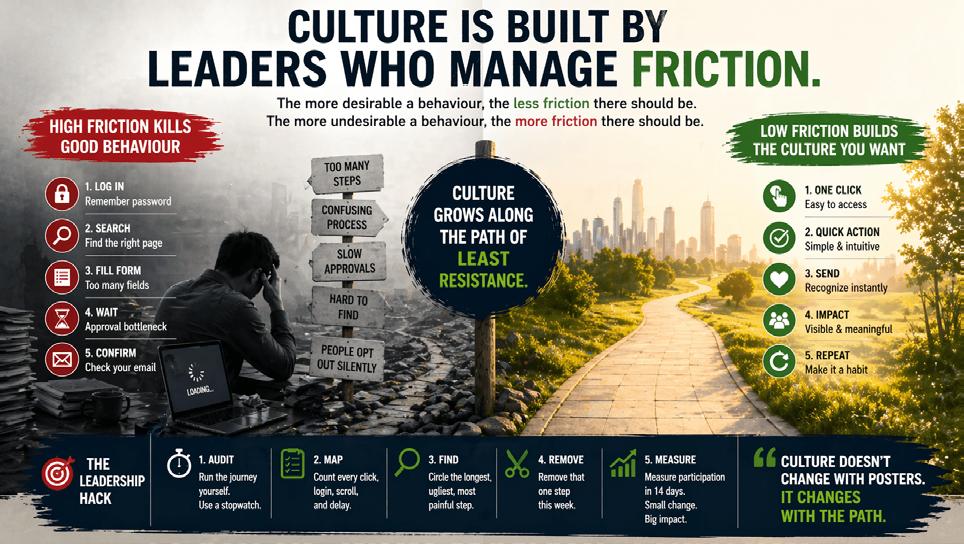
Culture grows along the path of least resistance. This is one of the most underestimated truths in organisational design.
If you want your team to adopt a new AI workflow but the platform requires five clicks, a slow VPN login, and a security approval bottleneck—while the old manual way takes one click
The Budaya Culture System →
and zero permissions—they will bypass the AI every single time. Not because they don't believe in transformation. Because friction always wins.
I have seen leaders spend millions on AI licences, then lose 80% of usage within ninety days because a single login step took too long. The behaviour you want to encourage must be the behaviour that costs the least energy. Friction is to culture what gravity is to physics—silent, constant, and undefeated.
The leadership move here is mundane but powerful. Run the journey yourself with a stopwatch. Open the AI tool the way your most reluctant employee would. Count the seconds, the clicks, the permission walls, the dead-end error messages. Then ruthlessly remove the longest, most painful step. Then do it again next quarter. And again. Culture changes not when leaders preach the right behaviours, but when the right behaviours become easier than the wrong ones.
B. Beliefs: Engineer the Social Proof of "People Like Me Use AI"
People don't change because we tell them what they should do. They change because they see what people like them already do.
The cleanest illustration of this is Robert Cialdini's famous hotel towel experiment. A standard sign asking guests to reuse towels "to help save the environment" produced modest results. The researchers then changed the sign to read: "75% of guests who stayed in this room reused their towels." Reuse jumped by 26%. The mechanism was social proof—not a moral appeal, but a quiet signal that this is what people like me do here.
If you want to drive AI adoption, telling employees "AI is the future" is noble but weak. It's the towel sign that doesn't work. What works is making peer behaviour visible. Pilot AI tools with influential, respected teams first—the people others already watch—and then make their wins wildly transparent. A dashboard that shows "83% of your peers in product used AI to save 4 hours this week" will shift more behaviour in seven days than seven townhalls will in seven months.
We don't follow the crowd in general. We follow the crowd that looks like us. The leader's job is to make sure the right crowd is visible first.
C. Actions: Break the Silence Tax
The most valuable AI innovations in your company will not come from the C-suite. They will come from the frontline workers who actually touch the friction every day—the analyst who knows where the reports are duplicated, the salesperson who knows which steps in the funnel are wasteful, the operations lead who knows which handoffs are pure theatre.
But here is the terrifying reality: research shows that even when employees have improvement ideas, 40% never raise them. Leaders almost always assume the reason is fear. It is not. By a factor of nearly two-to-one, the reason is futility. Employees stay silent because they believe nothing will happen anyway. One dismissed idea teaches an employee "don't bother" faster than ten welcomed ones teach "do bother." This is the Silence Tax—and in an era of rapid AI experimentation, it is lethal. You cannot transform what you cannot hear.
Breaking it requires two disciplines. The first is borrowed from improv comedy: the rule of "Yes, and...". When a frontline worker suggests a wild idea for an AI agent, the first response from a leader shapes the next ten ideas. A "No, but..." kills the room. A "Yes, and..." accepts the premise, builds on it, and tells everyone watching that ideas are safe here.
The second discipline is closing the loop visibly. Not every idea must be implemented—but every idea deserves a response. A culture where ideas disappear into a black hole will go silent within a quarter. A culture where ideas come back with a thoughtful yes, no, or "not yet, here's why" will keep generating ideas for years.
There is one final test for this: the Townhall Test. Culture is revealed not when the CEO is speaking, but when the CEO has stopped speaking. If your culture only operates when leadership is in the room, you don't have culture. You have events.
Where Culture Actually Lives: In the Rewards System
The three levers above—friction, social proof, voice—are the daily interventions. But they all eventually feed into the deepest layer of the wineskin: what the organisation rewards.
This is where most AI transformations quietly die. A CEO announces that the company must become AI-first. The townhall is energetic. The slides are beautiful. The consultants nod wisely. Then Monday arrives, and every employee returns to the same KPIs, the same approval rituals, the same budgeting cycles, the same fear of intelligent failure, the same bonus formulas that reward output volume over outcome quality. Culture is not what leaders announce. Culture is what the system pays people to do.
So the final question every senior leader must ask is brutal in its simplicity. Do people get rewarded for using AI to eliminate unnecessary work, or only for looking busy? Are teams encouraged to redesign workflows, or merely expected to produce more output with fewer people? Do managers celebrate experiments that reveal bad assumptions, or punish teams for not getting it right the first time? Are AI wins shared across the organisation, or trapped inside heroic pockets that never scale?
The old wineskin rewards activity, hours, and headcount. The new wineskin rewards learning velocity, customer outcomes, ethical experimentation, and cross-functional trust. Until your reward system reflects the second list, your culture will keep producing the first.
One data point worth holding onto: real-time listening platforms show that employees who give recognition are trusted nine times more than those who don't. Most companies focus on making sure everyone receives recognition. The multiplier comes from getting more people to give it. As AI takes over the mechanical tasks, the uniquely human work—noticing, naming, and celebrating the good in one another—becomes the most strategic act a leader can model. When enough people begin doing that daily, culture stops being something written on the wall and becomes something carried in the room.
The Litmus Test for Your Culture
Walk into your office tomorrow and ask three questions. Is the AI behaviour you want easier or harder than the old behaviour it replaces? Can your employees name three peers—by face, not by title—who are already using AI well? And when someone fails intelligently using AI, does the system reward the learning, or punish the failure?
If the answer to any of those is the wrong one, no amount of communication will fix it. You don't have a culture problem. You have a design problem wearing a culture costume.
Leadership Warning
Culture is the slowest of the four wineskins to change, and the fastest to revert. Most leaders dramatically overestimate how much culture they can shift in a year, and dramatically underestimate how much they can shift in five. The work of redesigning experiences, beliefs, and rewards is not glamorous. It will not generate a press release. But it is the only work that determines whether the new wine of AI ferments into something extraordinary—or bursts the skin and leaves you with nothing but the smell of what could have been.
The Bottom Line
AI (our new wine) is not exposing a technology gap. It is exposing the design assumptions our organisations were built on. That every silo, every approval layer, every quarterly KPI was a coping mechanism for human cognitive load. And now that AI removes the coping requirement, the scaffolding we built on top of it is collapsing under its own weight—and we're blaming the technology for the collapse. The only way to forward (and to release its value) is to redesign the wineskins: business model, structure, process, and culture/alignment.
The AI productivity lag may not take forty years like electricity. It may not even take twenty like the computer age. But it will take longer than impatient executives expect—because technology adoption is fast, and organisational transformation is slow.
The companies that win this decade will not be the ones with the most AI tools. They will be the ones brave enough to redesign their wineskins: their business models, their structures, their workflows, their incentives, their rituals, their leadership behaviours.
For two thousand years, leaders have known a simple truth: new wine demands new containers. AI is simply exposing how many of our organisations were never designed for transformation. They were designed for control.
The new wine is already here. The only question left is whether we have the courage to honour what got us here, release what can no longer carry us, and build something worthy of what is coming.
Roshan Thiran
Roshan is the Founder and “Kuli” of the Leaderonomics Group of companies. He believes that everyone can be a leader and "make a dent in the universe," in their own special ways. He is featured on TV, radio and numerous publications sharing the Science of Building Leaders and on leadership development. Follow him at www.roshanthiran.com
Inspire Courage to Act
BY DAN ROCKWELL
Creating the confidence to take action
One option is a choice. Many options make a dilemma.
I work with leaders in the throes of a dilemma. I asked one leader, “Six months from now, what will you regret not doing?” He saw the path instantly.
The issue becomes courage after you see the path.
Coaching Isn’t Advising
Sometimes I give advice. But my heart is in coaching. That’s about people uncovering their own path. I often use forwardfacing questions.
Good coaching creates clarity.
Great coaching leads to action.
Two Practices
Coaching rests on two practices:
• Asking forward-facing questions.
• Giving candid feedback.
Sometimes ignorance helps.
I coach leaders in industries where I have zero expertise. Not knowing the “right answer” makes curiosity easier.
The power of coaching isn’t what you know. It’s seeing people and staying curious.
Courage Rises
Clarity without action changes nothing. Movement fuels courage.
Coaches push toward behavior-based action.
• What would you like to do this week?
• What conversation needs to happen today?
• What’s the bravest thing you can do?
Coaching isn’t handing out answers. It’s crafting forward movement.
Giving Answers
Everything isn’t a coaching moment. Leaders set direction. They explain context. And set boundaries.
Direction is a map. Coaching builds the legs.
When you can, give decision-power to people. Every decision someone makes grows their confidence.
• Give answers slowly.
• Ask forward-facing questions quickly.
After someone finds clarity, ask, “What will you do next based on this conversation?”
Rockwell
Dan Rockwell is a coach and speaker and is freakishly interested in leadership. He is an author of a world-renowned leadership blog, Leadership Freak.
Source: Dona Mara from Lummi AI
Dan
The AI Anxiety Gap Is Five Different Voyages
BY MAVERICK FOO
Navigating the five levels of the AI-enabled workplace.
Every organisation right now is like a ship sailing through fog. Leadership keeps announcing the speed and the destination. “We are going faster. We are more efficient. AI is the future.”
On deck, the crew is sailing blind. No clear governance. No visible guardrails. No lighthouse in sight. And nobody is asking how the crew is actually doing.
The efficiency story sounds great from the bridge. On deck, it sounds very different.
One Ship, Five Different Voyages
One ship is not one experience. It is many. Inside most organisations, there are at least five very different people navigating the same AI fog, each with a different worry, each needing a different kind of signal from leadership.
The First Mates
These are your middle managers. Stuck mid-ship. Told to mandate AI use while reassuring their teams that nobody is getting replaced. Two-faced by necessity. Quietly exhausted by it. EY’s Agentic AI Workplace Survey found 61% of desk workers feel overwhelmed by the constant influx of new AI information, and middle managers carry that weight twice, once for themselves and once for every direct report asking what it all means.
The Deckhands
Here are your frontline and operational staff. They are doing quiet math in their heads. “The moment I show I can do this with AI, I am giving them one more reason to let me go.” So they hold back on purpose. Not out of incompetence, but out of self-preservation. Pew Research found 52% of US workers are more worried than hopeful about the future use of AI in the workplace. And despite all the productivity promises, Upwork’s 2024 study found 77% of employees using AI say their workload has actually increased, not decreased
The Lookouts
Your AI champions and early adopters. They see further than everyone else. Sounds like a gift. Until you realize they carry the weight of what is coming before anyone else is ready to hear it. That is anticipatory anxiety, and it is lonely. Upwork‘s same 2024 study found 71% of full-time employees using AI report burnout, while 65% were struggling with their employer’s demands on their productivity. Your best sailors are often the closest to the edge, and they are the getting their enthusiasm sucked dry.
The Engineers Below Deck
Your specialists and compliance folks. They are asking questions nobody is answering. “Can I put this into Perplexity? Is Gemini allowed for client data? Who owns this call?” The silence they get back is louder than any policy document. A global KPMG and University of Melbourne survey of 32,352 workers across 47 countries found only 34% of employees say their organisation has a policy guiding generative AI use, and 66% admit to using AI tools without knowing if it is allowed. When the rules are not named, shadow AI is not a discipline problem, it is a governance vacuum.
The Captain
The leadership team. Often secretly anxious too. Confused by dropping token costs. Unsure which models to back. Unable to show any of it because shareholders want an AI strategy yesterday. The numbers show the disconnect plainly. Microsoft’s 2025 Work Trend Index found 86% of Malaysian leaders are confident they can use AI to expand workforce capacity, while 83% of workers say they lack the time or energy to actually learn it.
Same ship. Same fog. Five very different voyages. No clear direction. No shared movement.
Why Generic AI Initiatives Keep Stalling
Most leaders try to fix all five with one motivational message. One generic training. One awareness talk. One tool rollout.
It does not work. Each role is sailing with a different worry. Each one needs a different signal.
This is why so many AI initiatives stall quietly. Not because the strategy is wrong, but because the people executing it are navigating completely different storms, and nobody has named it. MIT NANDA’s 2025 State of AI in Business report found 95% of organisations see no ROI from AI, while only 5 percent achieve significant value. NBER’s 2026 firm-level data backs this up: 69% of firms actively use AI, yet 9 in 10 report no measurable impact on productivity. The gap between access and adoption is enormous, and it is rarely a technology problem.
When the lookout is given the deckhand’s talk, they feel unseen. When the deckhand is given the captain’s talk, they feel threatened. When the engineer is given the first mate’s talk, they are left with unanswered operational questions. The cost is not only lost productivity. It is lost trust.
Four Moves to Close the Anxiety Gap
Four moves, one for each anxiety named above. Treat them as an operating frame for the quarter.
Move #1 – Install the lighthouse
Publish AI governance in plain language with three clear zones: encouraged, restricted, prohibited. The lighthouse does not stop the ship. It keeps the ship away from the rocks. Your engineers below deck stop asking the same questions into the fog.
Move #2 – Turn on the radio
Create real two-way channels. Regular check-ins that ask what people are experiencing, not only what they are producing. The captain’s uncertainty becomes leadable. Deckhands stop doing their quiet math alone.
Move #3 – Issue the right navigation tools
Replace generic AI 101 training with role-based learning paths. Show the accountant AI for reconciliation. Show the marketer AI for briefs. Relevance is what turns motivated compliance into genuine adoption.
Move #4 – Run drills
Short cycles. Protected practice time. Structured routines reduce anxiety even when the answers are still incomplete. Confidence comes from doing the thing and surviving, not from a slide deck.
Implications for Leaders and L&D
ӹ Segment your AI communication by role, not just by seniority. A middle manager’s worry is different from a deckhand’s worry, even when they sit in the same training room. EY found organisations with clear AI communication see 92% reporting positive productivity impact, compared with 62% without.
ӹ Make the captain’s uncertainty visible. When leaders quietly hide their own AI anxiety, everyone else learns to hide theirs too, which quietly kills the conditions for honest adoption.
ӹ Treat compliance and governance questions as a first-class conversation, not a footnote. The engineers below deck effectively set the ceiling for what everyone else feels safe trying.
Ending Thought
The AI Anxiety Gap is not one gap. It is five. Each role on your ship is navigating a different storm, and the cost of missing that is not dramatic failure. It is the quiet kind. Initiatives that never quite land. Adoption numbers that never quite match the investment. People who smile in training rooms and go back to doing things the old way.
If you are leading AI inside your organisation and something feels stuck, the problem may not be your tools, your training budget, or your people. It may be that five different voyages are happening underneath one strategy, and only one of them is being spoken to.
This article was originally published on Maverick Foo's LinkedIn.
Maverick Foo
Maverick Foo is the founder of Radiant Institute, where he specializes in Workplace AI and AI Leadership Enablement. Driven by a career-long fascination with applied psychology and human decision-making, Maverick transitioned from a two-decade tenure in marketing and positioning to the forefront of the AI revolution. Rather than viewing AI as a mere technical tool, he treats it as cognitive leverage, focusing on the psychological frameworks that drive adoption and human-AI collaboration.
A three-time TEDx speaker and the youngest recipient of Vistage Malaysia’s Speaker of the Year award, Maverick bridges the gap between high-level strategy and practical application, helping organisations integrate AI assistants as thinking partners to transform professional performance and long-term habits.
What 500,000 Customer Interviews Reve ale d About Leadership
BY DARRELL HARDIDGE
Reputation is earned in moments.
There is a quiet assumption that runs through most organisations and it’s costing them more than they realise. If revenue is holding, complaints are low, and the team seems engaged, then the business is in good shape. The brand is being managed. The reputation is fine.
It’s not fine. That assumption—what I call the ‘Great Assumption’—is one of the most dangerous beliefs a leader can hold.
Over the past two decades, my firm has conducted more than 500,000 phone-based interviews with high-value customers of businesses across Australia and the world. The clients we work with span industries from automotive to financial services, from construction to technology. What those interviews have revealed, consistently and across every sector, is this: the gap between what leaders believe about their reputation and what their customers, teams, and suppliers actually experience is almost always wider than anyone expects.
That gap is not a marketing problem but a leadership problem and closing it is one of the most powerful strategic decisions a leader can make.
Source: Freepik
The Reputation Misconception
Most organisations treat reputation as a downstream function. Something that emerges from good product, good service, and good PR. They delegate it to marketing teams, measure it through Net Promoter Scores and customer satisfaction surveys, and consider the matter handled. But reputation is not a by-product. It’s a system. And like any system, it either runs with intention or it runs by default.
When reputation runs by default, leaders are essentially allowing their most important strategic asset to be shaped by chance. They let it depend entirely on the mood of a frontline team member on a Tuesday afternoon, inconsistency of an onboarding process, or a slow response to a supplier's request. None of these seem significant in isolation, but cumulatively, they determine whether a business is trusted or merely tolerated.
The stakes are higher than most leaders realise. Trust is the foundation of customer relationships and the operating system of the entire organisation as well. A 2017 study by Paul J. Zak found that employees at high-trust companies reported 74% less stress, 106% more energy at work, and 50% higher productivity. What the data confirms is that trust is a structural metric and it flows, or fails to flow, from the top of the organisation down. That flow determines everything: how teams perform, how customers are treated, and ultimately, what reputation the market assigns to the business.
The Distinction That Changes Everything
In our research, we draw a consistent distinction that surprises most leaders when they first encounter it: the difference between a satisfied customer and an appreciative one.
Satisfaction, as a strategic goal, is insufficient. A satisfied customer is one whose expectations were met. They received what they paid for. They have no complaints. But they have no particular loyalty either. If a competitor offers a marginally better price, a faster turnaround, or a more convenient experience, the satisfied customer will leave—quietly and often without warning.
An appreciative customer is fundamentally different. Appreciation is an emotional state. It’s the feeling a customer has when they believe a business genuinely cares about their
outcome and not just the transaction. Our data shows that appreciative customers are dramatically more likely to return, to refer others, and to forgive the occasional error. They say things like, "I wish more businesses were like you." That sentence— heard across thousands of interviews—is the clearest signal that a reputation is working.
The shift from satisfaction to appreciation is a cultural shift. It’s driven by how leaders define success internally, what behaviours they model, and what they measure and reward. It’s not an easy change, so not every leader is willing to make it.
Reputation Has Four Dimensions
Through our diagnostic work with organisations, we have found that reputation operates across four primary leverage zones, each of which is within a leader's direct sphere of influence.
1. Customer Experience
Businesses must look beyond service delivery and pay attention to the emotional aspect of every interaction. Are customers made to feel valued, or merely processed? Are their expectations managed proactively, or managed only when something goes wrong?
2. Team Culture
Culture is the cradle for reputation. How an organisation treats its people—the clarity of its expectations, the consistency of its leadership, the degree of psychological safety it creates— shapes how those people treat everyone else. Reputation cannot exceed culture.
3. Supplier Relationships
This is the dimension most leaders underestimate. How a business treats its suppliers determines the access, responsiveness, and goodwill it can draw on when conditions are difficult. The best-performing businesses in our research become the preferred customer of their suppliers. That is a strategic advantage that rarely appears on a balance sheet but is felt in every supply chain disruption, every capacity crunch, every moment of market pressure.
4. Investor and Owner Confidence
Not just financial confidence but belief in the leadership, the mission, and the long-term direction of the organisation. Reputation, internally and externally, shapes the quality of that belief.
Making Reputation Measurable
One of the most common objections leaders raise when we begin this conversation is that reputation is too intangible to manage. You can’t put reputation on a spreadsheet or set a KPI for trust.
That objection is understandable, but it’s wrong
Reputation is measurable. Not through NPS alone—that metric captures a single moment and a single dimension—but through a diagnostic approach that maps how an organisation is experienced across every touchpoint, from the first point of contact to the ongoing relationship. What do customers actually say when no one from the company is listening? What do team members say when they are asked directly, and anonymously, how well the organisation lives its stated values? What do suppliers say about how they are treated relative to other customers?
These questions, asked consistently and rigorously, produce data. And data produces insight. And insight produces the ability to act with precision rather than assumption.
The organisations that treat reputation as a measurable system rather than a vague aspiration are the ones that consistently win. Not just in revenue, though the commercial outcomes are real and significant. They win in talent retention, in supplier access, in customer lifetime value, and in resilience. When conditions become difficult, as they inevitably do, the organisations with the strongest reputations have the deepest reserves of goodwill to draw on.
Of course, none of this happens without leadership intention. That is the central point. A brilliant reputation is the result of thousands of small decisions—decisions about how to handle a complaint, how to onboard a new team member, how to respond to a supplier's problem, how to communicate during uncertainty.
Leaders set the standard for all of them through behaviour, not branding.
Where to Begin?
For leaders who want to move from assumption to intention, the starting point is honesty. Specifically, the willingness to ask the questions that most organisations avoid.
ӹ Not "Are our customers satisfied?" but "Do our customers feel genuinely appreciated?"
ӹ Not "Is our team engaged?" but "Do our people trust that leadership says what it means?"
ӹ Not "Do our suppliers deliver?" but "Do our suppliers see us as a partner they want to invest in?"
The answers to those questions will reveal the gap. Once that gap is seen clearly, it becomes the most important strategic agenda a leader can pursue. It’s time we treat reputation as a leadership strategy. For the organisations already willing to do so, you have the competitive advantage.
The #1 most trusted business in any market does not get there by accident. It gets there because its leaders decided that reputation would be the result of how they lead, not how they promote.
That decision is available to every leader. The question is whether you will make it.
Darrell Hardidge
Darrell Hardidge is a reputation researcher, keynote speaker, and the author of Having the #1Reputation. His firm has conducted more than 500,000 customer interviews across Australia and internationally, developing a diagnostic framework used by organisations seeking to measure and build market-leading reputations.
Why Does Life Feel So Heavy? (And What to Do About It)
BY GREGG VANOUREK
Understanding the emotional weight so many are carrying today
If you find yourself asking why does life feel so heavy right now—and if you’re vaguely anxious even when you don’t know why—you’re not alone. Something real is happening to all of us. And we need to understand why.
There are three main factors driving our contextual discontent:
1. Disruption
Disruption isn’t just change. It’s change that’s outpacing our current ability to adapt. It leaves us scrambling to find our footing while the ground keeps moving. That’s the defining experience of this moment in history we’re in. What makes it especially heavy is this: we’re not facing one disruption right now. We’re facing four.
ӹ Economic Disruption: We’re faced with rising costs, unaffordable homes, and a strange job market. Young people especially are feeling locked out. Many people are doing everything right—working hard and saving what they can— but still finding that the life they imagined keeps drifting beyond their grasp. The home they want has become a fantasy. The job market sends mixed signals. College degrees don’t open the doors they used to. For younger people, there’s a sobering realization that the economic escalator their parents rode may have stopped moving. The social contract has been torn to shreds.
ӹ Geopolitical Disruption: The global order that once felt stable no longer does. We’re watching wars unfold in real time on our phones. Alliances that once seemed permanent are being renegotiated or even trashed by leaders. We’re witnessing the resurgent rivalry between great powers. And we’re suspecting that the leaders who were supposed to be managing all of this may not have it quite as in hand as we’d like.
ӹ Technological Disruption: Screens consume so many of our waking hours. Social media strains our mental health. AI is rapidly reshaping whole industries. We didn’t sign up to become test subjects in a decades-long experiment on human attention, but that’s effectively what happened. And the results are alarming. The platforms said to connect us have left many people feeling more isolated, more agitated, and less sure of what’s actually true. Parents watch children disappear into devices and feel the unnerving gap between recgonizing the problem and not knowing what to do about it. Layered on top of all of that comes AI, with its jarring capacity and unsettling speed. It’s moving faster than our political institutions, our education systems, or our own sense of place in the word can comfortably absorb. And it’s accelerating.
ӹ Pandemic Disruption: Though we’d like to pretend otherwise, we’re still recovering from the global coronavirus shock. From the lockdowns, the closures, the social isolation. Those wounds haven’t fully healed. For millions of people, the pandemic didn’t end so much as it dissolved into everyday life, leaving behind a residue that’s hard to describe and harder to shake. Strained relationships. Interrupted careers. Abandoned businesses. Altered workplaces. Shocked school systems. Lost childhood years. The world carried on, but underneath something shifted under our feet.
Source: Matthew Henry from Unsplash
Each of these disruptions alone is a lot to absorb. Together, the economic, geopolitical, technological, and pandemic disruptions create a hum of ambient dread that’s now the oppressive invisible background of our everyday life—a hum we stop noticing because it never goes away.
2. Uncertainty
We live in an age of profound uncertainty. Questions abound: Will prices come down? Will the job market stabilize? What kind of world are we leaving our children and grandchildren? How will climate change reshape the world in the years to come? What will happen with income inequality, and with democracy? How will AI change our lives?
The human mind craves predictability because it helps us feel safe, plan, and move forward with confidence. When the future grows murky, our minds work overtime, scanning for threats and rehearsing worst-case scenarios. All this uncertainty pulls us into an exhausting mental doom loop.
3. Disconnection
Underneath the disruption and uncertainty lies something quieter and perhaps more corrosive: disconnection. In many ways, we’re less connected to each other than we have been in generations. Screens have replaced many of the human moments that nourish us. Our polarized media environment has made it harder to share common ground—or even a shared sense of reality—with our neighbors and friends. The pandemic years accelerated what was already happening, normalizing isolation in ways we are only beginning to reckon with.
"For many of us, our lives are busy… but not as meaningful as we’d like. Our days are productive… but not as joyful as we’d like. Our lives are overly full… but not as fulfilling as we’d like."
We’re also increasingly disconnected from ourselves. When clickbait content and breaking news compete for every spare moment of our attention, our inner life—our wise inner voice that guides us—gets crowded out. We stay busy. We’re perpetually distracted and often numb. At some point, the path inward gets paved over.
Why Does Life Feel So Heavy and What Can You Do About It?
What to do about all this disruption, uncertainty, and disconnection that’s weighing us down and pulling us apart? Of course, there’s no app for this. No quick fix.
But there are things you can do to stay grounded.
First, in the wake of disruption, drop anchor.
Anchor yourself in things that endure: your humanity, your purpose, your values, your family, your community, your faith. You can weather the storm better when you have something solid to grasp hold of.
Second, in the wake of uncertainty, seek clarity. You can’t control the future, but you can know yourself. Get clear on who you are and what matters most. That clarity becomes your compass when everything else shifts.
And third, in the wake of disconnection, reconnect. The forces pulling you away from yourself and others are relentless and well-resourced. The forces holding you together require your active choice and disciplined attention. So put down the screen. Call your friend. Sit in silence long enough to hear yourself think. Return to your faith, your community, your own vast and mysterious interior. Reconnection isn’t handed to you. You have to claim it.
When you’re caught in the middle of cascading upheaval, it makes sense to ask, Why does life feel so heavy? Asking this question doesn’t signal weakness. It’s a completely normal response to the weight of our current world. And heaviness isn’t destined to become defeat or overwhelm.
Dropping anchor, seeking clarity, and reconnecting aren’t distant ideals to aspire to when life settles down. They’re practices for recentering now, in the middle of the chaos and the noise.
The storm may not let up soon. But you can steady yourself within it.
Drop anchor. Get clear. Reconnect.
Postscript: Inspirations on What to
Do When Life Feels So
Heavy
ӹ “She stood in the storm, and when the wind did not blow her way, she adjusted her sails.” -Elizabeth Edwards, author, attorney, and activist
ӹ “We don’t even know how strong we are until we are forced to bring that hidden strength forward.” -Isabel Allende, author
ӹ “There is peace even in the storm.” -Vincent van Gogh, Dutch painter
ӹ “Resilience is knowing that you are the only one that has the power and the responsibility to pick yourself up.” -Mary Holloway, physician and philanthropist
ӹ “What matters most is how well you walk through the fire.” -Charles Bukowski, German-American poet
ӹ “A genius is the man who can do the average thing when everyone else around him is losing his mind.” -Napoleon Bonaparte, French emperor
ӹ “A good person dyes events with his own color… and turns whatever happens to his own benefit.” -Seneca, ancient Roman Stoic philosopher
ӹ “Divide the fire and you will sooner put it out.” -Publilius Syrus, Latin writer
ӹ “The only way to make sense out of change is to plunge into it, move with it and join the dance.” -Alan Watts, British-American writer
ӹ “It is not in the still calm of life or the repose of a pacific situation that great characters are formed. The habits of a vigorous mind are formed in contending with difficulty. Great necessities call out great virtues.” -Abigail Adams, letter to son, John Quincy Adams, 1780
Wishing you well with it. –Gregg
This article was originally published on Gregg Vanourek's LinkedIn.
Gregg Vanourek
Gregg Vanourek is an executive, changemaker, and award-winning author who trains, teaches, and speaks on leadership, entrepreneurship, and life and work design. He runs Gregg Vanourek LLC, a training venture focused on leading self, leading others, and leading change. Gregg is co-author of three books, including Triple Crown Leadership (a winner of the International Book Awards) and LIFE Entrepreneurs (a manifesto for integrating our life and work with purpose and passion).
Why Continuous Feedback and AI are Replacing Annual Reviews
BY ROSHAN THIRAN
Traditional performance management is broken. Companies spend an average of 210 hours per manager per year on performance management activities, yet only 14% of employees strongly agree that performance reviews inspire them to improve (Gallup, 2023). The problem isn't just inefficiency—it's that our current systems were designed for a different era of work.
Annual performance reviews, rigid KPIs, and top-down goal-setting worked when jobs were predictable and hierarchies were clear. Today's knowledge work demands something different: continuous feedback, real-time insights, and performance systems built on trust rather than surveillance.
This shift isn't just theoretical. Research shows that 89% of hiring failures are due to attitudes rather than technical skills (Leadership IQ, 2020), and companies with strong feedback cultures see 14.9% lower turnover rates (ClearCompany, 2020). The question isn't whether to evolve your performance management—it's how quickly you can adapt.
What Are Continuous Performance Reviews?
Continuous performance reviews replace the traditional annual or quarterly review cycle with ongoing feedback conversations. Instead of waiting months to address performance issues or recognize achievements, managers and team members engage in regular, real-time discussions about progress, challenges, and development.
The core principles of continuous performance management include:
Frequent Touchpoints: Weekly or bi-weekly conversations replace lengthy annual reviews. Research by Gallup (2020) found that employees who receive feedback weekly are 2.7 times more likely to be engaged at work.
Forward-Looking Focus: Rather than dwelling on past performance, continuous reviews emphasize future development and removing obstacles. This approach aligns with growth mindset research showing that process-focused feedback builds resilience better than outcome-focused recognition (Dweck, 2016).
Two-Way Dialogue: The best continuous performance systems encourage employees to provide upward feedback and participate actively in goal-setting. Studies show that employees who feel heard are 4.6 times more likely to feel empowered to perform their best work (Salesforce, 2019).
Context-Aware Timing: Feedback happens when it's most relevant—after project completions, during challenges, or when new opportunities arise. This immediacy prevents small issues from becoming major problems.
The shift to continuous feedback isn't just about frequency. It's about creating what researchers call "psychological safety"— the belief that one can speak up without risk of punishment or humiliation (Edmondson, 1999). When team members trust that feedback is developmental rather than punitive, they become more receptive to coaching and more likely to take intelligent risks.
How AI Is Transforming Performance Tracking
Artificial intelligence is revolutionizing how organizations track and manage performance, moving beyond subjective manager opinions to data-driven insights. But the goal isn't to replace human judgment—it's to augment it with better information.
Real-Time Behavioral Analytics
AI can analyze communication patterns, collaboration frequency, and feedback quality to provide objective performance indicators. For example, research from MIT's Human Dynamics Laboratory found that communication patterns predict team success more accurately than individual intelligence, personality, or skills combined (Pentland, 2012).
Modern AI systems can track:
ӹ Feedback Quality: Natural language processing can assess whether feedback is specific, actionable, and growthoriented
ӹ Recognition Patterns: AI can identify who gives and receives recognition, helping managers understand team dynamics
ӹ Engagement Indicators: Behavioral data like participation in discussions and peer collaboration provides leading indicators of performance
Predictive Performance Insights
AI excels at identifying patterns humans might miss. By analyzing historical data, AI can predict which team members might be at risk of disengagement or burnout before it becomes obvious. Research by Visier (2023) found that predictive analytics can identify flight risk up to 9 months before an employee actually leaves.
The key is using AI to surface insights, not make decisions. At Happily.ai, we've found that the most effective approach is providing managers with real-time data about team health and engagement, then facilitating human conversations based on those insights.
Personalized Development Recommendations
AI can analyze individual work patterns, strengths, and growth areas to suggest personalized development opportunities. This moves beyond one-size-fits-all training programs to targeted skill development that aligns with both individual aspirations and organizational needs.
However, implementing AI in performance management requires careful consideration of privacy, bias, and transparency. The goal should be empowering better conversations, not creating a surveillance system that undermines trust.
Why Traditional Frameworks Fail When Trust Is Low
OKRs (Objectives and Key Results), KPIs (Key Performance Indicators), and other performance frameworks can be powerful tools—but only when there's sufficient trust between managers and team members. Without trust, these systems often backfire.
The Measurement Paradox
When trust is low, employees game the metrics rather than pursue meaningful outcomes. This phenomenon, known as "Goodhart's Law," states that "when a measure becomes a target, it ceases to be a good measure" (Goodhart, 1975). Research by Harvard Business School found that overemphasis on metrics can reduce intrinsic motivation and lead to ethical shortcuts (Ordóñez, 2009).
Consider a sales team with aggressive KPIs but low psychological safety. Team members might:
ӹ Focus on easy, short-term wins rather than building longterm relationships
ӹ Avoid sharing leads or best practices with colleagues
ӹ Withhold information about potential problems to avoid appearing unsuccessful
The metrics improve, but actual performance suffers.
The Feedback Loop Problem
Traditional frameworks assume that feedback flows freely between managers and team members. But research shows significant perception gaps in management effectiveness. Studies indicate that 59% of managers believe they regularly give recognition, while only 35% of employees feel recognized (Gallup, 2024).
When trust is absent:
ӹ Feedback becomes filtered: Team members tell managers what they want to hear rather than what they need to know
ӹ Goals become imposed: Top-down objective setting without input leads to poor buy-in and misaligned priorities
ӹ Metrics become weaponized: Performance data is used for punishment rather than development
The Innovation Killer
Low-trust environments with rigid performance frameworks stifle innovation. When people fear that failure will be held against them, they avoid taking the intelligent risks that drive breakthrough results. Research by Amy Edmondson (2019) found that psychological safety is essential for learning behavior in organizations.
Teams with high trust and effective performance systems show measurable advantages:
ӹ Faster project completion: Google's Project Aristotle found psychological safety was the top predictor of team effectiveness
ӹ Greater innovation: High-trust teams take more intelligent risks when facing complex problems
ӹ Fewer errors: Team members are more willing to admit and correct mistakes
Building Trust-Based Performance Systems
The solution isn't abandoning performance frameworks—it's building systems that prioritize trust alongside measurement. Here's how forward-thinking organizations are making this shift:
Start with Relationships, Not Metrics
Before implementing any performance framework, invest in building strong manager-team relationships. Research shows that the quality of the manager-employee relationship explains 70% of the variance in employee engagement (Gallup, 2020).
Effective strategies include:
ӹ Manager training in feedback skills: Teaching managers how to give specific, actionable, and growth-oriented feedback
ӹ Regular relationship check-ins: Separate conversations about development from performance evaluation
ӹ Upward feedback opportunities: Creating safe channels for team members to provide input on management effectiveness
Design for Transparency and Context
Trust grows when people understand how decisions are made and how their work contributes to larger goals. This means:
ӹ Clear goal-setting processes: Involve team members in creating objectives rather than imposing them
ӹ Regular context sharing: Help employees understand how their work connects to customer outcomes and business success
ӹ Open data access: When possible, share performance data broadly rather than keeping it siloed
Focus on Enablement Over Evaluation
The best performance systems help people succeed rather than just measuring success. This requires:
ӹ Obstacle identification: Regular check-ins focused on removing barriers to performance
ӹ Skill development support: Connecting performance conversations to growth opportunities
ӹ Resource allocation: Ensuring teams have what they need to achieve their goals
Use AI to Augment, Not Replace Human Judgment
AI should enhance manager effectiveness, not eliminate the human element of performance management. The most successful implementations:
ӹ Provide insights, not verdicts: AI surfaces patterns and trends for managers to explore with their teams
ӹ Maintain privacy and agency: Team members understand what data is collected and how it's used
ӹ Focus on team health: Use AI to identify when teams need support rather than which individuals to punish
The Path Forward: Continuous Evolution
The future of performance management isn't about finding the perfect system—it's about building adaptive systems that evolve with your organization and workforce. This requires embracing experimentation, measuring what matters, and remaining focused on the human relationships that drive performance.
Organizations leading this transformation share common characteristics:
ӹ They measure engagement and well-being alongside traditional performance metrics
ӹ They invest in manager development as a core business capability
ӹ They use technology to facilitate better conversations, not replace them
ӹ They treat performance management as an ongoing process, not an annual event
The companies that get this right will have a significant advantage in attracting and retaining top talent. In a world where the best people have choices about where to work, the quality of performance management becomes a key differentiator.
Moving Beyond Broken Systems
Traditional performance management was designed for a predictable world that no longer exists. Today's organizations need systems that can adapt quickly, provide real-time insights, and build trust rather than undermine it.
The shift to continuous performance management supported by AI isn't just about efficiency—it's about creating workplaces where people can do their best work. When done well, these systems help managers become better coaches, help employees grow faster, and help organizations perform better.
At Happily.ai, we've seen firsthand how the right combination of continuous feedback, AI-powered insights, and trustbuilding practices can transform organizational performance. The question isn't whether your performance management system needs to evolve—it's whether you'll lead that evolution or be forced to catch up.
The future belongs to organizations that can measure what matters while never forgetting that performance, ultimately, is about people. And people perform best when they trust their leaders, understand their purpose, and have the support they need to succeed.
Tareef Jafferi
Tareef is a product-focused innovator passionate about data, design, and using tech for good. He believes technology should make us better: happier, and healthier.
The Virtue of Impatience: Why Leaders Need Disciplined Urgency
BY MICHELLE GIBBINGS
Source: Amino from Lummi AI
Great leaders know when waiting becomes costly. Patience is praised as a leadership virtue. We admire the leader who listens before acting, holds steady under pressure, and gives people the time they need to adjust.
In many moments, that kind of patience is exactly what’s needed.
But patience has a shadow side.
In organisations, patience can become a polished name for delay. It looks like waiting for perfect alignment, more data, the right timing, or another round of consultation. It sounds reasonable, even mature. Yet while everyone is waiting, the problem deepens, opportunity narrows, and your team members observe that inertia is safer than action.
So, what’s the alternative when you’re navigating complexity and striving to drive meaningful change? The alternative, more useful virtue is disciplined impatience.
What Disciplined Impatience Is (and Is Not)
Disciplined impatience is not the kind that snaps at people, rushes decisions, or treats dissent as obstruction.
Instead, it’s the refusal to become comfortable with avoidable delay. It’s the restless energy that says, “This matters, and we need to move.” It’s the capacity to hold urgency and thoughtfulness simultaneously. It’s also a constructive approach to challenging the status quo.
You don’t have to look too far at work to find a list of reasons to wait. Your workplace is full of systems, habits, and routines that are designed to preserve what already exists.
Professors Michael Hannan and John Freeman’s foundational work on structural inertia showed how organisations can become deeply resistant to change because reliability, accountability, and repeated routines are built into operating structures1. Later, Harvard Professor Clark Gilbert distinguished between two distinct forms of inertia: resource rigidity, where organisations fail to shift investment, and routine rigidity, where they fail to change how work gets done2. In other words, organisations don’t stand still because people are lazy, but because the system is built to keep moving in familiar ways.
That’s why change needs leaders who are impatient in a disciplined way. They notice the cost of the status quo before others are ready to name it. They are willing to challenge inherited assumptions, press for clearer decisions, and ask the uncomfortable question: “What are we protecting by not changing?”
Opportunity Does Not Wait for Full Readiness
This matters because resolving issues and taking advantage of opportunities rarely wait for perfect preparation or the perfect time.
Management expert, Professor Peter Drucker, argued that innovation comes from the disciplined search for opportunity3. Some opportunities arise within the organisation, such as unexpected successes, process gaps, or internal inconsistencies. Others emerge from outside it, through shifts in industry structure, demographics, customer expectations, perception or new knowledge.
That distinction matters. If you look only inward or wait until external signals become impossible to ignore, you will move too late. As a result, the advantage will have already shifted to someone else.
Disciplined impatience keeps you scanning, questioning and moving before certainty arrives.
Disciplined Impatience Changes How leaders Make Decisions
Speed is often framed as the enemy of rigour. Sometimes it is. For example, when leaders rush, ignore dissent or act on instinct alone, speed becomes recklessness.
But speed and rigour are not opposites.
Professor Kathleen Eisenhardt’s research on strategic decisionmaking found that in high-velocity environments, effective leaders make faster decisions not because they think less, but because they structure their thinking better4. They use timely information, consider multiple alternatives, draw on advice, and create clear processes for moving forward.
The disciplined impatient leader does not say, “We don’t have time to think.” They say, “We don’t have time to think badly.”
And part of thinking well under pressure means knowing where a deliberate pause protects better outcomes, which is explored further in intentional friction in leadership
They create enough structure to act: a clear decision frame, agreed thresholds, fast feedback loops and explicit ownership. They understand that endless deliberation can feel responsible while quietly becoming a more sophisticated form of avoidance.
Ask yourself, where is slow deliberation currently masquerading as diligence?
The Courage to Take a Stand
Disciplined impatience also fuels the courage to act.
In organisational research, “taking charge” describes the voluntary and constructive effort to initiate workplace change5. It is the person who sees that something could work better and chooses to do something about it. Most organisations say they want this behaviour. However, challenging the way things are done can disturb established power, surface unresolved tension, and expose the gap between stated values and lived practice.
That is why impatience needs courage. It also requires emotional discipline. Without it, urgency can easily be misread as ego, frustration or self-interest.
Three Guardrails for Disciplined Impatience
When you bring all these threads together, disciplined impatience operates with three clear guardrails.
Guardrail One – Impatient About Progress, But Patient With People
The most effective change leaders don’t confuse resistance with laziness. They recognise that people may need time to understand what is changing, what it means for them, and what support they will have. They listen carefully, not to dilute the change, but to make the path more workable. They also create space for concerns to be raised, without allowing every concern to become a veto or a block to progress.
This means holding firm conviction about the destination while remaining genuinely open about the path. It means accelerating the decision without dismissing the person. And it means having courageous conversations early, rather than letting ambiguity quietly erode momentum.
Remember, the enemy is avoidable delay, unclear ownership, and performative consultation. Direct your restlessness there, not at the individuals navigating change with genuine effort.
Guardrail Two – Think Like a Scientist: The Power of Small Experiments
Secondly, be impatient for learning, not perfection. Move through small, smart experiments rather than large, slow bets. Prioritise what you can discover over what you can control.
When the future is uncertain, you cannot wait for all the unknowns to become known. This is where experimentation becomes essential, along with the ability to fail intelligently.
As Professors Mark Cannon and Amy Edmondson recommend, organisations need to learn to fail intelligently, using deliberate experimentation to generate insight while minimising cost6.
This can start by thinking like a scientist. Start with a hypothesis which you test in a contained way. Then, pay close attention to what happens. Learn from the result, and where needed, adjust and repeat the process.
Not every experiment will work, but each experiment should teach you something useful, so you can reduce uncertainty through purposeful action.
Leaders who frame change this way shift the cultural narrative from “We can’t afford to fail” to “We can’t afford not to learn.”
Guardrail Three – Be Impatient In Service of Purpose
Thirdly, your team members are more likely to follow urgency when they can see what it protects, improves, or makes possible. So, connect the pace to the point.
Research shows that proactive behaviour is more likely to be valued when it is seen as prosocial7; that is, in the service of the team, work, customer or the organisation’s purpose. Your impatience earns trust when people understand what it is for.
This is where insight, integrity and influence intersect. The most effective change leaders are transparent about why they are pushing, not just that they are pushing. They explain the purpose behind the urgency, acknowledge the impact on others, and invite people into the work of moving forward.
When people understand the reason for the pace, they are far more likely to move with you.
Your Leadership Challenge
Patience still has its place. Leaders need patience to listen, build trust, and stay steady when change is messy.
But when patience becomes a reason to postpone the hard conversation, avoid the decision, or wait for certainty that will never arrive, it stops being a virtue.
So your challenge this week: where are you letting patience protect the status quo? And what would you do differently if you trusted that disciplined impatience is exactly the leadership quality this moment requires?
Michelle Gibbings
Michelle Gibbings is a workplace expert and the award-winning author of three books. Her latest book is 'Bad Boss: What to do if you work for one, manage one or are one'. www.michellegibbings.com.
Culture is Built by Friction Managers
BY MICHELLE GIBBINGS
Source: Macrovector from Magnific
Where expectations meet reality at work Lately, I’ve been reflecting on how culture is often built by leaders who know how to manage friction.
The more desirable a behaviour is, the less friction there should be. The more undesirable a behaviour is, the more friction there should be. That sounds simple. But I think many organisations miss this entirely.
We spend a lot of time talking about values. About mindsets. About employee engagement. About transformation. But very little time asking a brutally practical question:
"How hard is it for people to actually do the behaviour we claim we want?"
Take most workplace programmes, recognition platforms, feedback tools, learning systems, wellness portals, and innovation channels. Most of them do not fail because the idea is bad.
They fail because the path is annoying.
An extra login. A clunky interface. A slow approval step. A page nobody can find. A form too long. A process that feels like applying for a visa just to say “thank you” to a colleague.
And then leaders sit in a room wondering why participation is so low. But the answer is often painfully unsexy: the behaviour did not fail. The path failed.
That is why I keep coming back to this idea that leaders are, whether they realise it or not, friction managers
If you want a culture of recognition, but it takes six clicks, a login, a dropdown menu, and a manager approval to recognise someone, then let me save you some time: You do not have a recognition culture. You have a recognition obstacle course.
If you want a culture of feedback, but giving feedback feels risky, bureaucratic, or exhausting, people will not suddenly become noble warriors of candour. They will stay quiet.
If you want a culture of learning, but accessing the learning platform feels harder than watching a Netflix documentary, people will postpone it forever and then tell you they were “too busy.”
This is where a lot of leaders get culture wrong. They think culture is mostly an inspiration problem. So they communicate more. But culture is often a design problem
And design, at its core, is about friction.
What do we make easy? What do we make difficult? What do we remove? What do we force? What do we automate? What do we bury under layers of process until only the most stubborn saints remain?
I have a strong belief that culture grows in the direction of the path of least resistance. So if you want more of a behaviour, reduce friction. If you want less of a behaviour, increase friction.
ӹ Want more collaboration? Make cross-functional access easier.
ӹ Want more recognition? Make appreciation immediate and simple.
ӹ Want more coaching? Build it into the manager rhythm, not as an optional extra.
ӹ Want less politics? Increase transparency. Add decision rules. Reduce hidden channels of influence.
ӹ Want less reactive firefighting? Force a pause before escalation. Add reflection before action. Build friction into impulsive behaviour.
This is why some bad cultures are so resilient. Not because the people are evil or the values are wrong. But the system has made the wrong behaviours easy. Gossip is easy. Blame is easy. Escalation is easy. Silence is easy. Avoidance is easy.
Meanwhile, the right behaviours are expensive. Thoughtful feedback is hard. Recognition is buried. Learning is clunky. Collaboration is slow. Asking for help feels dangerous.
And then we wonder why culture does not change. Of course it does not. The system is coaching people every day.
So here is a very practical leadership exercise: Pick one voluntary behaviour that matters most in your culture right now. Recognition. Feedback. Learning. Coaching. Knowledge sharing. Collaboration.
Then do something radical: Run the journey yourself.
From the employee’s real starting point. Use a stopwatch. Count every click. Every login. Every page load. Every scroll. Every moment of confusion. Every step where a human being might say, “Aiya, forget it.”
Write each step down. Then circle the longest, ugliest, most irritating step. And remove that one step this week. Not next quarter. This week. Because the step that kills participation is almost never the one discussed in the strategy deck. It is the tiny bit of sludge in the middle. And sludge is deadly because it is silent.
People do not complain much. They just opt out quietly.
That is why leaders must become students of friction. Because culture is not only what you preach. It is what your systems permit with ease.
So yes, cast vision. Yes, talk about values. Yes, inspire people. But after the speech, go audit the clicks. Because in the end, great leaders are the ones who set the path toward expectations.
Finally, that is how culture is actually built.
Roshan Thiran
Roshan is the Founder and “Kuli” of the Leaderonomics Group of companies. He believes that everyone can be a leader and "make a dent in the universe," in their own special ways. He is featured on TV, radio and numerous publications sharing the Science of Building Leaders and on leadership development. Follow him at www.roshanthiran.com
How to Manage Team Focus When Effort Isn't the Problem
BY TAREEF JAFFERI
Source: Dona Mara from Lummi AI
Why busy teams still miss the mark
Most teams that miss their goals were not lazy. They were busy. Everyone shipped things, closed tickets, and ended the week tired. The work just never added up to what mattered.
That is the part of managing team focus that catches managers off guard. The visible signal is effort, and effort looks healthy. The hidden problem is alignment: how much of that effort actually rolls up to the goals the team is supposed to move. A team can run at full speed for a quarter and still drift, because nobody could see the gap between activity and priority until the results came in.
Team focus is the degree to which a team's day-to-day work connects to its stated goals. Managing it means watching that connection in real time, not auditing it after the quarter ends. Happily.ai is a Culture Activation platform that makes team focus visible to managers as work happens, so effort can be redirected while it still counts.
Best for managers who suspect their team is busy on the wrong things but can't yet see where the effort is going.
What Managing Team Focus Actually Means
Most "focus" advice is about the individual: block your calendar, kill notifications, single-task. That advice is fine, but it solves the wrong problem for a manager. A team of perfectly focused individuals can still be collectively unfocused if each person is focused on something different.
Managing team focus comes down to three questions a manager has to answer every week:
1. Effort: What is the team actually spending energy on right now?
2. Alignment: How much of that effort connects to a goal that matters?
3. Completion: Is the work moving to done, or quietly carrying over week after week?
Notice that only the first question is about activity. The other two are about direction and progress. Managers who track activity alone (tasks closed, hours logged, standups attended) measure motion and miss drift. The job is not to generate more effort. It is to make sure the effort already happening points the same way.
Why Team Focus Slips: The Alignment Gap
Here is the mechanism. Work enters a team faster than priorities get set. A customer escalates. A teammate asks for help. A new idea sounds urgent. Each of these is a reasonable thing to spend an afternoon on. None of them arrive labeled with which goal they serve, or whether they serve one at all.
So people do the reasonable thing in the moment. They take the work. Over a few weeks, a layer of unaligned effort builds up underneath the team's real priorities. It feels productive because it is genuinely hard work. It just isn't the work that moves the goal.
This gap is well documented at the strategy level. Research by Kaplan and Norton, the creators of the Balanced Scorecard, found that 95% of a company's employees are unaware of, or do not understand, its strategy. If people can't connect their work to the goal, they default to whatever is loudest. The result is a team that is fully occupied and only partly aligned.
Four signals tell you the alignment gap is widening:
ӹ Unaligned work. Tasks that don't map to any current goal. Not bad work, just disconnected work.
ӹ Carried-over work. The same item shows up unfinished week after week. It survives because nobody decides whether it matters.
ӹ Effort pooling in the wrong place. Most of the team's energy lands on a goal that isn't the priority, while the priority starves.
ӹ Invisible focus. The manager genuinely doesn't know what the team is working on between check-ins, so the gap stays hidden until results.
Each of these compounds. An unaligned task this week becomes a carried-over task next week, which becomes a quarter of pooled effort in the wrong place. The earlier you catch it, the cheaper it is to fix.
A Framework for Managing Team Focus
You can close the alignment gap with a weekly rhythm. The point is to make focus a thing you steer, not a thing you discover in the postmortem.
1. Make focus visible before you try to manage it
You cannot redirect effort you cannot see. Start every week by getting the team's actual work in front of you in one place: what each person is focused on, in their words, not a status you inferred. Visibility is the precondition for everything else. A manager who learns what the team worked on three weeks late is doing forensics, not management. For the live version of this, see our team alignment audit guide.
2. Tie every piece of work to a goal, or leave it unaligned on purpose
Take each focus item and ask: which goal does this serve? Most should map cleanly. Some won't, and that is fine. The discipline is to make the choice consciously. Leaving an item unaligned is a legitimate decision when the work falls outside current goals (a favor, a fire, a learning project). What you want to eliminate is unaligned-by-accident: work that nobody ever decided about. Alignment is a yes or a deliberate no, never a shrug.
3. Watch effort, not just task counts
Five tiny tasks and one substantial project are not the same week, but a task counter treats them identically. Look at where the team's real effort is concentrated, then compare that against your priorities. If 70% of the week's heavy lifting landed on a secondary goal, you have a problem a task list will never show you. Effort is the unit that reveals where focus truly went.
4. Catch carried-over work in week two, not month three
When the same item lingers unfinished across multiple weeks, treat it as a signal, not a guilt trip. Carried-over work usually means one of three things: it is blocked, it is bigger than it looked, or it secretly isn't a priority. All three deserve a decision. Surface lingering items early and ask the simple question: do we finish this, resize it, or drop it? The cost of an undecided task is that it quietly consumes attention every single week.
5. Close the loop weekly
Managing focus is a rhythm, not a one-time reset. Each week: see the work, align it, check where effort went, clear the carryover, then reset for the week ahead. This matters most exactly when priorities change. When a company pivots, reorganizes, or resets goals for a new quarter, focus management is the infrastructure that lets a team re-point its effort fast instead of running for weeks on last quarter's map. A clear weekly loop is what makes a leader's new call actually land in the work.
How Happily Helps You Manage Team Focus
The framework above is doable by hand. It is also exactly the kind of weekly bookkeeping that slips when the week gets busy. Happily.ai turns the rhythm into something a manager sees at a glance.
The Focus Board lays out the team's work across three columns: Pending Alignment, Open, and Done. The columns are not arbitrary. An item only reaches Open once it is both unfinished and linked to a goal. Anything not yet connected to a goal sits in Pending Alignment, where it stays visible until someone decides where it belongs. The board makes the alignment gap impossible to ignore, because unaligned work has its own column instead of hiding inside a long task list.
Each focus card carries the detail that makes a decision possible: who owns it, which goal it links to, an effort score, and a "carried over" flag when the same item has lingered across weeks. A card suggests the next move directly, whether that is Align to goal, Review progress, or Reduce load for someone carrying too much.
Goal Aligned % answers the alignment question with one number. It is effort-weighted, not a task count, so it tells you what share of the team's real effort actually rolls up to your goals. Goal Attention then breaks that effort down by goal, and flags the two failure modes by name: Unaligned focus and effort linked to goals outside your team's priorities. This is the difference between sensing your team is off and seeing exactly where.
The Team Map shows the same team as people rather than tasks: each person ringed by their health and check-in signal, so you can read who is thriving and who is quietly stretched. Focus and wellbeing sit side by side, because the person buried in carried-over work is usually the person about to burn out.
Layered on top, a daily reflection surfaces patterns a busy manager misses, like a teammate who keeps raising a concern that hasn't been answered yet, paired with one concrete next action. This is Culture Activation in practice: the platform doesn't just measure focus, it prompts the small daily moves that keep a team aligned. That is how Happily reaches 97% adoption against a 25% industry average, and why the focus view holds up week after week instead of becoming another dashboard nobody opens.
Focus
Management vs. Activity Tracking
Core question What got done? What got done that mattered? Unit measured Tasks, tickets, hours Effort weighted by goal alignment Unaligned work Invisible, blends in Surfaced in its own column Lingering work Just an open task Flagged as carried over, forces a decision
When you learn After the quarter While the week is still moving Manager's role Report on output Redirect effort in real time
When to Manage Focus More Actively
Choose lightweight focus management if your team is small, goals rarely change, and you already see everyone's work daily. A weekly conversation may be enough.
Choose structured focus management if any of these are true: the team is scaling, priorities shift often, you manage through other managers, or you keep getting surprised by where the quarter landed. The bigger the gap between what you can see and what the team is doing, the more a focus system pays for itself.
If you want the manager-effectiveness case behind this, managers account for 70% of the variance in team engagement. A manager who can see and steer focus is operating on the single highest-leverage surface they have.
Frequently Asked Questions
What is team focus management? Team focus management is the practice of keeping a team's day-to-day work connected to its goals. It watches three things: where effort is going, how much of it aligns to priorities, and whether work is moving to done or carrying over.
How is managing team focus different from project management? Project management tracks whether tasks get completed. Focus management asks whether the right tasks are being worked on in the first place. A team can be excellent at finishing work and still finish the wrong work.
Why do busy teams still miss their goals? Because effort and alignment are different things. Work enters a team faster than priorities get set, so a layer of unaligned-but-reasonable work builds up. The team stays fully occupied while only part of its effort moves the goal.
What is the alignment gap? The alignment gap is the distance between how hard a team is working and how much of that work connects to its goals. It widens quietly through unaligned tasks and carried-over work, and usually only shows up in the results.
Is Happily.ai worth it for a 150-person company? Happily. ai fits growing companies where managers are scaling past the point of seeing every person's work directly. If your managers are getting surprised by where the quarter landed, the Focus Board and Goal Aligned % give them back the visibility they lose as the team grows.
The One Thing to Remember
Your team's problem is rarely effort. It is almost always alignment. Make the work visible, connect each piece to a goal or consciously leave it out, watch where effort actually pools, and clear the lingering items before they calcify. Do that weekly, and focus stops being something you discover in the postmortem and becomes something you steer.
Tareef Jafferi
Tareef is a product-focused innovator passionate about data, design, and using tech for good. He believes technology should make us better: happier, and healthier.
What's Really Behind the Drop in Employee Engagement?
BY TAREEF JAFFERI
Why engagement initiatives fail and how leaders can create lasting commitment
When engagement is low, the instinct is often to hand the problem to HR or People and Culture. I've seen it countless times. HR leaders are asked to return to the executive team with a list of initiatives designed to lift engagement. Flexible working arrangements, reward and recognition schemes, wellbeing programs, team events and other workplace perks often make the list.
While these initiatives may create some positive movement, their impact is limited if the day-to-day experience the people you lead have with you remains unchanged. They may appreciate the benefits on offer, but if they don't know what's expected of them, are rarely recognised for their contribution, receive little feedback or development, or feel left in the dark about decisions that affect their work, engagement is unlikely to improve in any meaningful or lasting way.
Engagement isn't primarily driven by workplace perks. It's shaped by the day-to-day experiences the people you lead have with you.
The Leader's Influence
Research consistently shows that the direct manager has a significant influence on engagement, with Gallup suggesting that managers account for around 70% of the difference in engagement levels between teams. Yet many leaders don't realise just how much influence they have. When engagement is low, it's easy to point to organisational culture, restructuring, workload or external pressures. What is often overlooked is the role you play in shaping the everyday experiences that either build or erode engagement.
After 30 years in leadership and 20 years coaching and facilitating, I've come to believe that many engagement strategies miss the mark because they focus on engagement itself rather than the experiences that create it.
The Experiences That Create Engagement
The people you lead want clarity around what is expected of them. They want to know their contribution matters. They want opportunities to learn, grow and have meaningful input. They want to feel supported when challenges arise and recognised when they do good work. When you consistently create these experiences, engagement tends to follow. It isn't something that can be manufactured through a survey, a reward program or a wellbeing initiative. It is the outcome of how well you connect with, support, challenge and develop the people you lead.
Making Relationships a Priority
Engagement needs to be a priority for you as a leader, not something delegated to HR. Not something measured once a year. And not something addressed only when survey results decline.
It starts with making relationships a priority. Taking the time to understand who the people you lead are, what matters to them, how they work best and where they want to grow. It means showing them you see them, noticing their effort, acknowledging their contribution and being genuinely present in your interactions, not just when things go wrong. In practice, that means protecting one-on-one time, not as a status update, but as a genuine conversation about how they're going, what they need and where they want to head. It means getting curious about what drives them, how they prefer to work and what support actually looks like for them personally. And it means making their growth a priority, not an afterthought. That might mean having a conversation about where someone wants to be in two years or simply asking what would make their current role feel more meaningful. Small, intentional moments that signal you are invested in them as a person, not just as a performer.
These aren't complicated leadership practices, but they are often the first things sacrificed when workloads increase, deadlines loom and competing priorities take over. Yet they are the very things that help the people you lead feel valued, supported and connected to their work.
Engagement Follows Connection
You can continue to invest in initiatives, surveys and workplace programs, and many of them have value. But none of them can replace the influence you have on the experience of the people you lead. Because engagement isn't built through initiatives.
It's built through relationships.
Kylie Paatsch
Kylie Paatsch, author of The Connect Effect, is a sought-after leadership coach, speaker and facilitator who has worked with thousands of senior leaders across Australia and internationally. She helps senior leaders lead themselves, their leaders and those around them with greater clarity, confidence and impact.
Procrastination or Avoidance?
BY TAREEF JAFFERI
Confronting the real obstacle
Most people don’t actually have a time management problem.
They have a procrastination problem.
But if we’re being completely honest, procrastination isn't just about time. It is almost always a form of avoidance.
We often tell ourselves we’re busy. But the reality is, we aren’t avoiding the work itself; we are avoiding the specific things that make us uncomfortable.
For example, we know we need to give feedback to a team member whose performance isn’t up to par. Yet, we put off that conversation because we don’t want things to get awkward or trigger a difficult reaction. Consequently, the issue doesn't get resolved in a day or two. It drags on for weeks because we are simply avoiding it.
The feedback stays shelved. We keep holding onto responsibilities we should have offloaded because letting go feels too risky.
Avoidance isn't always obvious. It often hides behind things that look "productive":
ӹ Overworking to avoid making a tough decision.
ӹ Doing tasks yourself instead of delegating.
ӹ Overthinking as a substitute for taking action.
We are often rewarded for this, at least in the short term. There’s no conflict, no tension, and no immediate risk.
Soon, everything grinds to a halt. You and your team get stuck behind a bottleneck you’ve imposed on yourselves.
ӹ If you avoid conflict, you are choosing comfort over clarity.
ӹ If you withhold feedback, you are choosing to be liked over helping someone grow.
ӹ If you refuse to delegate, you are choosing control over scale.
ӹ If you keep overworking, you are choosing burnout over leadership.
Doing more is easy. The real work—the kind that moves the needle—is finally confronting what you’ve been choosing to ignore.
Truth to be told, we already know what that is. We know who we need to talk to. We know which decisions we’ve been stalling on. We know which tasks we should no longer be holding onto.
We just haven’t acted yet.
Before you waste energy on the wrong problem, get clear: Is it truly procrastination, or is it avoidance?
Start there. It won’t be easy, but the cost of staying in denial is far higher than the cost of facing the truth head-on.
Amirah Nadiah
Amirah Nadiah holds an academic background in Malay Language and Linguistics. This foundation, combined with her passion for reading and staying current on contemporary issues, enables her to maintain a sharp awareness of diverse topics. As a Content Editor, she specializes in translation and is actively involved in creating engaging and compelling content.
Source: Vishes from Lummi AI
If you want to build something great, you should focus on what the change is that you want to make in the world