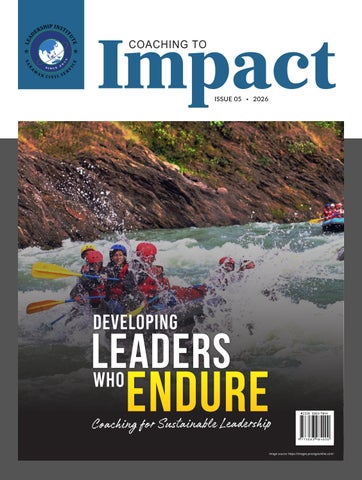
ISSUE 05 • 2026
Developing
Leaders Who
ENDURE
Coaching for Sustainable Leadership Image source: https://images.prestigeonline.com/
Editor-in-Chief
Datu Dr. Azhar Bin Haji Ahmad
Editor
Diana Marie Capel
Content Contributors Helena Ului Certified Master Performance Coach (ICF Accredited Program) Masteries Practitioner (IAC) Certified and Licensed Counsellor (KB12867 PA12479)
Developing Leaders Who Endure Coaching for Sustainable Leadership Issue 05 2026 Copyright © 2022 by Leadership Institute of Sarawak Civil Service Coaching to Impact is a twice yearly publication by the Leadership Institute of Sarawak Civil Service, dedicated to advancing civil service leadership and to inspire our Sarawak Civil Service (SCS) leaders with contemporary leadership principles. It features a range of content contributed by our strategic partners and panel of advisors from renowned global institutions as well as established corporations that we are affiliated with. Occasionally, we have guest contributions from subject matter experts as well as from our employees. The views expressed in the articles published are not necessarily those of Leadership Institute of Sarawak Civil Service Sdn. Bhd. (292980-T).
Niresha Nirnala Certified Enterprise Coach (CEC)
Sahzan Osman Certified and Licensed Counsellor (KB13355 PA12971)
Graphic Designers Awang Ismail Bin Awang Hambali
Abdul Rani Bin Haji Adenan
No part of this publication may be reproduced in any form without the publisher’s permission in writing. Published by Leadership Institute of Sarawak Civil Service Jalan Sultan Tengah, Rampangi, Santubong, 93050 Kuching, Sarawak. Let us know If you are encouraged or provoked by any item in the Coaching to Impact, we would appreciate if you share your thoughts with us. Here’s how to reach us: Email: corporate@leadinstitute.com.my
2
Coaching to Impact I Issue 05 I 2026
Read this issue online at https://www.leadinstitute.com.my/coaching-to-impact/ or Scan the QR code.
Table of
Content 06
Coaching for Sustainable Leadership: Lessons from Motherhood
08
Coaching for Sustainable Leadership
12
Taking the Journey: Evoking Awareness Starts With Us
14
Why Do We Coach? And How Do We Know If It’s Working?
18
Values-Based Coaching: Building Synergy in a Complex World
22
The Spiritual Principles of Empowerment
Coaching to Impact I Issue 05 I 2026
3
From the
Editorial Desk
DEVELOPING LEADERS WHO ENDURE Leadership is tested not when the path is easy, But when the journey becomes uncertain, demanding and prolonged.
As Sarawak moves towards its aspiration of becoming a developed and high-income state by 2030, the Sarawak Civil Service stands at the heart of a transformation that extends far beyond policies, programmes and projects. It is fundamentally a leadership journey, one that requires leaders who can sustain momentum, navigate complexity and inspire others to remain committed to a shared purpose. The question, therefore, is not simply whether we have capable leaders today. Do we have leaders who can endure, and who can develop others to lead beyond them? The challenges before us are evolving rapidly. Digitalisation and artificial intelligence are reshaping work and decisionmaking. Generational expectations are changing. Citizens demand greater responsiveness and value. Economic and social challenges are becoming increasingly interconnected. In such an environment, yesterday’s leadership approaches may not always be sufficient for tomorrow’s challenges.
We need leaders who are agile in thinking, resilient in adversity, Grounded in values and committed to continuous learning.
Datu Dr. Azhar Bin Haji Ahmad Chief Executive Officer Leadership Institute of Sarawak Civil Service
4
Coaching to Impact I Issue 05 I 2026
This is where coaching becomes particularly relevant. Coaching creates space for leaders to pause amid the demands of leadership, reflect, question assumptions, gain perspective, and discover possibilities. It encourages leaders not merely to provide answers, but to ask better questions; not merely to direct others, but to develop them; and not merely to solve today’s problems, but to build the capacity to face tomorrow’s challenges.
“A sustainable leader does not create dependency. A sustainable leader creates capability.” For the Civil Service, this distinction is critical. Sarawak’s transformation cannot rest on a handful of exceptional individuals. Leadership capability must be multiplied across the organisation and transferred across generations. When leaders coach, they create opportunities for others to think, learn, take ownership and grow. In time, leadership becomes less about individual performance and more about institutional strength. Coaching also reminds us that sustainable leadership begins with reflection. Amid targets, deadlines and operational pressures, leaders can become consumed by what is urgent and lose sight of what is important. Coaching provides the opportunity to step back and ask fundamental questions: What are we trying to achieve? Why does it matter? What kind of organisation are we building? And what legacy are we leaving for those who come after us? These are not merely personal questions. They are questions of institutional sustainability and public service purpose.
The leaders who endure will not necessarily be those who carry every burden themselves. They will be those who know when to lead, when to listen, when to challenge, when to empower and when to develop others to take the lead. This is the deeper promise of coaching. It is about transforming experience into learning, learning into capability, and capability into sustained performance. It is about building a culture where every conversation can become an opportunity for growth, and every leader accepts responsibility for developing another leader. Sarawak’s journey does not end in 2030. 2030 is a milestone, not the destination. The leadership capability we build today will determine not only whether we achieve our aspirations by 2030, but whether we have the capacity to sustain and advance that progress long afterwards.
As we approach 2030, the measure of leadership should therefore not be how much one leader can accomplish alone, but how much leadership capacity he or she leaves behind.
The challenge before us, therefore, is clear: Let us not merely develop leaders who can deliver. Let us develop leaders who can endure. Leaders who remain grounded when circumstances change. Leaders who remain courageous when challenges intensify. Leaders who continue learning when they become experienced. And leaders who develop others so that the organisation becomes stronger than any one individual. To lead sustainably is to make ourselves less indispensable and our institutions more capable. That is the leadership Sarawak needs for 2030 and beyond.
"Do not judge me by my success, judge me by how many times I felt down and got back up again." Nelson Mandela
Coaching to Impact I Issue 05 I 2026
5
Coaching for Sustainable Leadership
Lessons from Motherhood Helena Ului
Certified Master Performance Coach (ICF Accredited Program), Masteries Practitioner (IAC), Certified and Licensed Counsellor (KB12867 PA12479)
Leadership is often discussed in boardrooms, leadership seminars, and organisational strategies. We talk about vision, performance, and results. Yet, some of the most profound leadership lessons are learned not only in offices or meeting rooms, but also in the quiet and often challenging moments of everyday life.
Leadership Begins with Self-Awareness
For me, one of the most transformative leadership journeys began when my second daughter was diagnosed with Autism Spectrum Disorder (ASD) and Global Developmental Delay at the age of two. At that time, I was still navigating my professional responsibilities while learning how to support my child’s developmental needs. Like many parents who receive such a diagnosis, the journey was filled with uncertainty, learning, and moments of emotional reflection. Over time, however, this experience began to shape the way I understood patience, resilience, and the importance of empathy qualities that are also fundamental in leadership. Balancing professional responsibilities, family life, and the unique needs of my child has not always been easy. Like many working parents, I navigate multiple roles every day as a professional, a mother, a partner, and a caregiver. There are days when the expectations from each role feel overwhelming, especially after a demanding day at work, when I return home and my daughter is experiencing a meltdown. Yet through these moments, I began to realise that the principles of coaching that I practise professionally have also become a guiding compass in my personal life. Coaching has not only shaped the way I work with others, but it has also shaped the way I lead my own life.
As a mother of an autistic child, self-awareness became necessary. There are days when patience is tested, routines are disrupted, and emotions run high. In those moments, the question becomes: Do I react, or do I respond? Coaching has taught me the power of pausing, reflecting, and choosing a response with intention. This same principle applies to leadership in organisations. Sustainable leaders are not those who react quickly to every challenge, but those who take time to understand situations, regulate their emotions, and respond thoughtfully. Through self-awareness, leaders develop resilience the ability to endure and grow despite challenges.
6
Coaching to Impact I Issue 05 I 2026
One of the most fundamental principles of coaching is selfawareness. Coaches often encourage individuals to pause, reflect, and understand their own thoughts, emotions, and responses. This process is essential for leaders who wish to grow sustainably.
The Power of Empathy and Understanding
Endurance Through Growth
Parenting a child with autism has profoundly reshaped my understanding of empathy. I have learned that every child on the autism spectrum experiences the world in their own unique way. Communication, emotions, and behaviours may not always follow what society considers typical. This journey requires patience, compassion, and, most importantly, the willingness to see the world through their eyes.
The theme of sustainable leadership highlights the importance of endurance. Enduring leaders are not defined by perfection, but by their ability to keep learning, adapting, and growing. Parenting a child with autism is a journey of continuous learning. Each milestone, each challenge, and each small success teaches patience and perseverance. There is no single manual that prepares a parent for this experience. Instead, it requires openness, curiosity, and resilience.
Coaching similarly emphasises deep listening and empathy. A coach does not impose solutions but seeks to understand the individual’s experience. Through powerful questions and attentive listening, a coach creates a safe space for growth and discovery. In leadership, empathy is no longer optional; it is essential. Leaders who understand their people, acknowledge their challenges, and support their development build stronger and more sustainable organisations. My journey as a mother constantly reminds me that leadership is not about control it is about understanding.
Coaching reinforces this mindset. It encourages individuals to see challenges not as failures, but as opportunities for reflection and growth. This growth mindset is what allows leaders to sustain themselves over time. When leaders embrace learning rather than fear mistakes, they cultivate organisations that are resilient and forward-looking.
Leadership That Endures Sustainable leadership is not only about professional competence; it is also about the ability to remain grounded, compassionate, and resilient in the face of life’s complexities. My journey as a mother of an autistic child has gradually deepened my belief that leadership is, at its core, deeply human. It reminds me that leadership is not merely about directing others or achieving outcomes, but about cultivating patience, practising empathy, taking time to reflect, and having the courage and humility to continue growing through life’s experiences. Coaching provides the framework that supports this kind of leadership. It encourages individuals to explore their values, strengthen their emotional intelligence, and develop the resilience needed to navigate both personal and professional challenges. Ultimately, sustainable leadership is about endurance — not just the endurance of organisations, but the endurance of the people who lead them. And sometimes, the greatest leadership lessons come from the roles we never expected to be our greatest teachers.
Helena Ului For Helena Ului, coaching is more than a profession-it is a space where people discover possibilities, build confidence, and unlock their potential. Helena leads the Department of Coaching with a strong belief in the transformative power of coaching, striving to foster a culture where people feel heard, valued, and empowered to grow. Her work focuses on helping individuals recognise their strengths, navigate challenges, and turn insight into meaningful action. She is a Certified Master Performance Coach through an ICF-accredited programme, a Masteries Practitioner with the International Association of Coaching (IAC), a Certified Train-the-Trainer, and a Certified Training and Development Professional. She is also a Registered Counsellor with the Lembaga Kaunselor Malaysia (KB12867, PA12479).
Coaching to Impact I Issue 05 I 2026
7
Why coaching leaders is less about supporting them to do more, and more about supporting them to become aware of who they are being.
Coaching for
Sustainable Leadership Sari Marsden, PCC Coach and Trainer at The Coach Partnership and The Works Partnership, Co-Author of Fit to Lead
8
Coaching to Impact I Issue 05 I 2026
The Question Beneath Leadership I spend a lot of time working in the space of leadership, and one question keeps surfacing: how do I stay in this for the long run and still stay true to myself? In public service, leadership unfolds across shifting terrain. Some moments demand perseverance; others call for adjustment. Yet many leaders still equate endurance with pushing harder, carrying more, and staying strong at all costs. That is not endurance. That is overextension. So, what if the question is not how much more you can carry but how you are carrying it? This is where coaching becomes essential not as a tool to fix leaders, but as a stabilising space during change and uncertainty. It offers a place to pause, recalibrate, and move forward with intention rather than reaction. What shapes leadership is not simply workload, but the perspective leaders operate from. Two people can face the same demands and create very different results. Why? Because each of us is a different observer. An ontological approach brings this into focus. At its simplest, the word “ontological” refers to the study of human beings who we are and how we show up. It looks beyond what leaders do, to how they think, feel, and carry themselves their body, presence, and mood and how these shape their impact. Leadership is not a set of skills; it is a way of being.
Leadership Is Relationship
Start With Who
One of the core ideas in Fit to Lead is simple: leadership is a relationship. It is how you show up such that others choose to follow you.
As Marcus Marsden outlines in Start With Who, before strategy and action, there is the leader. The question is not only what should I do, but who am I being while I do it?
Which raises a more confronting question: why would people choose to follow you?
And when the pressure rises who are you being?
Everything in leadership happens in relationships. Decisions are shaped through conversations. Trust is built or broken through interactions. Culture is formed through repeated ways of engaging. In public service, hierarchy may secure compliance, but it cannot generate commitment. Commitment is evoked through how you listen, speak, and engage. So here is a simple check: what happens to people in your presence? Do they expand or do they hold back ?
This challenges the usual approach of moving quickly into solutions. Action matters, but without awareness, change rarely lasts. Ontological coaching shifts this by making the invisible visible. It creates space for leaders to notice patterns that usually go unseen how they interpret situations, how they react, and the impact they generate. From there, new possibilities open up not just in what leaders do, but in how they see and how they show up, especially in moments of pressure. The result is leadership that is more grounded, intentional, and sustainable over time.
If leadership is relational, then the work of leadership is in the quality of relationship you create. It sounds simple, but it is not because we each see the world differently. Creating relationships that work requires the capacity to navigate those differences with clarity and care. A coaching culture supports leaders to develop that capacity so others can grow and contribute. Sustainable leadership is not passed down. It is built through people and across the system.
Coaching to Impact I Issue 05 I 2026
9
Coaching as Capacity Building Sustainable leadership looks less like performance management and more like an athlete’s practice. It requires knowing when to push and when to pause, recognising signals early, and choosing to reset rather than quit. Athletes do not stay on the path because it is easy; they stay because they have learned how to return after fatigue, setbacks, and loss of momentum. Leadership is no different. Yet many leaders operate as if they must always be “on” always certain, always ahead. That is not endurance; that is unsustainable. Coaching builds long-term capacity not just to perform in the role, but to grow into it. This is especially critical for emerging and middle leaders, who are often promoted based on capability but underprepared for the relational demands of leadership.
From Reaction to Response Public service leaders operate in constant change. Under pressure, familiar patterns emerge tightening control, moving faster without alignment, or avoiding difficult conversations. As Chalmers Brothers outlines in Language and the Pursuit of Happiness, leadership operates across three domains: language, mood, and body. Under pressure, language sharpens, mood shifts, and the body contracts. This does not stay with the leader; it spreads. One consistent pattern I see: leaders believe they are listening but they are not. Not fully. Not to what is said, and certainly not to what is unsaid. This is not a skill gap. It is a way-of-being gap. Listening is not a technique; it is the outcome of being open. An ontological lens brings the body into focus. How we stand, breathe, and hold tension shapes how we perceive situations, make decisions, and relate to others. Leadership is not only cognitive; it is embodied. Coaching supports leaders to notice these patterns and shift from reaction to response. Sometimes the shift is simple: pause, breathe, listen again. Small shifts in posture, breath, and orientation can create the conditions for openness, and change the conversation entirely.
10
Coaching to Impact I Issue 05 I 2026
Reflection in Relationship One of the biggest contributors to leadership fatigue is not just workload, but leading without reflection. As Terrie Lupberger highlights in The Uncommon Wisdom at Work, stepping back is essential not only to review results, but to observe how we operate. Reflection on your own can only take you so far. We are still seeing through our own filters. The shift happens when you bring your discovery into a coaching conversation. Working with a coach deepens what you see and sharpens your awareness. Without this, leaders remain in motion solving, responding, deliveringwithout questioning whether it is working or the impact they are having. So, when was the last time you truly stopped and allowed yourself to see?
Leadership That Endures Sustainable leadership is not about one strong leader. It is about building a system where leadership can continue beyond any one individual. Coaching supports a critical shift from giving answers to creating thinking, from taking ownership to building ownership in others, and from driving results to growing people who can deliver them. Over time, leadership becomes shared. Leaders create leaders. That is what allows it to endure. This is not about having endless energy or getting everything right. It is about staying present, adapting, and returning to what matters. There is also a truth many leaders resist: you cannot do this alone. Leadership is relational, yet many avoid support believing they need to have the answers or that it is faster to handle everything themselves. Over time, this disconnects leaders from others and becomes unsustainable. The real challenge is not capability, but the capacity to ask for support especially in environments where doing so is seen as weakness. Ontological coaching offers a space where leaders can see what they cannot see on their own, be challenged, explore new perspectives, and act in alignment with their values. Sustainable leadership is not about having all the answers. It is about having the support to keep going and keep becoming. In that sense, coaching is not a luxury. It is part of what makes leadership sustainable.
Sari Marsden Sari Marsden is an executive coach, leadership trainer, and co-author of Fit to Lead, exploring the connection between the body, leadership, and performance. A Professional Certified Coach (PCC) with the International Coaching Federation (ICF), she has over 20 years of experience in personal development and coaching, specialising in leadership development, executive presence, peak performance, and somatic intelligence. Before coaching, Sari spent more than 15 years in fitness, including as an elite Nike Training Club trainer and Team Singapore athlete, earning gold medals in Southeast Asian fitness physique competitions. Born in Indonesia and based in Singapore, she works extensively across Asia with leaders and organisations.
Coaching to Impact I Issue 05 I 2026
11
Taking the Journey Evoking awareness starts with us Gavin Shaskolsky Executive and Leadership Coach, Managing Director of GSI Coaching, BusSc, LLB, CCP
It is tempting to portray ourselves as optimistic, present and engaged at all times. However,the human experience and truth are far from this, at least in my experience. Being present, committed and impactful requires us to build grit, endurance, and a mindset of fulfillment in our own lives. The deeper we are willing to dig into our own truth, experience and lived wisdom, the more powerful, authentic and effective we will be in curating our clients’ journeys of self-discovery and sustainable growth. Evoking awareness is a consistent, dedicated practice of returning to the present moment. It is a commitment that starts with me as the coach. Like planting the seeds of Chinese bamboo, which take over five years to sprout from the earth, if well-tended, and then shoot up to over 25 meters in around five weeks, so too our daily commitment to repeated habits and rituals enables us to grow a deep root structure across all dimensions of our lives. As we care for the seeds of daily practice, we grow our own healthy ecosystem that nurtures the Chinese bamboo in each of us to serve ourselves, others, and society. Not only do we get to benefit from the fruits of the seeds we planted and cared for so carefully and tenderly; these same fruits become accessible and available to others in their leadership of themselves, their teams and organizations when we partner with them on their coaching journey.
12
Coaching to Impact I Issue 05 I 2026
I think of my daily practices as an oasis that I drink deeply from at the start and end of each day through my meditation, running and journaling. I then dip into the oasis in gaps in my day through short breaks, skipping, snacking, walking outside, meditating to recharge, listening to a podcast to refresh and replenish my resources as the day’s journey unfolds. This becomes a practice of multiplying simple daily practices into my weekly rhythm and my embodied lifestyle. It helps me to be rooted in my practices, the rituals that enable me to oscillate the expenditure of my energy and the recovery of it through pausing, engaging, retreating and leaning in as my rhythm unfolds in my daily life. Each client engagement builds muscles of endurance, vitality, presence and confidence that enable me to guide another person’s intimate journey through uncomfortable climbs, uncertain valleys, rocky terrain and powerful moments when the visibility ahead is crystal clear and the north star guides the way forward. I believe that to be at our best as coaches requires consistent commitment and effort. The dedication to choose to rest rather than respond to another email, to take 30-60 seconds between activities or in meetings, at traffic lights, walking between meetings, to put our hands on our stomach and notice the rise and fall of our breath rather than flicking ineffectively through our social media feeds; or to turn our devices to ‘flight mode’ between certain hours after work (e.g. 6 to 8:30 p.m.), then extend this time to buy back our down time and reclaim our bedrooms as a sanctuary, keeping devices out!
It is our small, simple practices that create the depth of presence for our clients to do their best thinking in, not whether we are pushing hard all day in ‘doing mode.’ The more we repeat the small things, the more powerful the container we create for others to grow and thrive in. Our culture keeps tempting us to do more, to be more, yet it is our ability to resist these seductive whispers that sets us apart as coaches. It is up to us to choose to recover, to befriend silence and deepen our connection to something greater than us that evokes awareness in others and enables the magic of coaching to take place. Building on these foundations, we are better placed to evoke awareness in others. Our partnership begins with a gentle walk through the garden of their lives. We pause to recognize, appreciate and emphasize the strengths, competencies and capabilities that flourish in their gardens, while observing the weeds of feelings, memories, limiting beliefs and behaviors that need to be uprooted for them to lead more fulfilling, impactful and rewarding lives. Lives that will enable them and others to enjoy all the elements and features of their blooming gardens.
As our partnership with our clients deepens, we help them prune and tend to their plants of vitality and energy through attuned observations, while getting stuck into the dirt with consistent and fierce empathy, as we help replace their ineffective narratives of struggle with a new story of a flourishing and fragrant ecosystem. As we move towards the closure of our partnership with them, we pause at the gate, look back with joy and recognize that we have guided yet another human being to be more comfortable in discomfort, more proud and embodied in their strengths and more courageous in walking a clear path ahead with deeper awareness, accountability and impact. Containing these elements of evoking awareness is the intention and ability to connect with something greater than ourselves, to invite forces and energies beyond our conscious minds to support, hold and curate the coaching journey. Whether we call this god, nature or something else, it is often these energies that enable the magic to take place in the coaching partnership. Whether we connect to these forces through prayer, meditation, vision quests, hiking or any other form, acknowledging the mystery and power beyond us that shapes the coaching partnership enables us to remain humble servants of the people, teams and organizations we have the privilege to guide on these sacred, life-changing journeys. This article originally published on Choice Magazine Volume 18, No 4.
Gavin Shaskolsky Gavin is an executive coach who has spent over two decades coaching more than 1,000 business leaders across 80+ countries and six continents. He works with leaders navigating growth, complexity, transition, uncertainty, and increasing responsibility across diverse industries, including technology, finance, government, healthcare, and education. Known for his calm presence, deep attention, and thoughtful challenge, Gavin helps leaders slow down, think clearly, and move beyond reactive problem-solving. Drawing on approaches including Thinking Environment, Gestalt, Process Work, and human performance disciplines, he supports leaders to develop greater self-awareness, clarity, perspective, and the courage to lead deliberately and sustainably.
Coaching to Impact I Issue 05 I 2026
13
Why Do We Coach?
And how do we know if it’s working? Professor Richard E. Boyatzis, PHD University Professor of Case Western Reserve University, and a Professor in the Departments of Organizational Behavior, Psychology, and Cognitive Science.
14
Coaching to Impact I Issue 05 I 2026
We coach to help others. We want to help them discover and live better lives and enhance their contribution at work, at home and in society. While the same could be said of a good bartender, teacher, cleric or parent, how would someone coaching another person know or suspect that what they are doing is working?
Our research on coaching impact and process over the last 30 years shines a light on three desirable outcomes of coaching. First, we want to help someone discover, articulate and/or reaffirm their commitment to a personal vision and sense of purpose. Second, we want to help someone learn or change their behavior in ways that will bring them closer to their personal vision and sense of purpose. Third, we want to help someone create or maintain resonant relationships with others to assist in their change efforts. Achievement of any or some combination of these should be considered effective coaching. By now readers may be wondering, what happened to the “presenting problem” that the client proposes at the beginning of the coaching process? The resolution of a problem is either a key part of the personal vision and better ways to get there, or it is irrelevant to the client finding a better life and more effective work. Some coach certification associations and coach training programs claim that coaching ONLY occurs when the coach takes the client’s presenting problem as the purpose and process for their time together. However, problemcentered coaching suggests that the coach has the answers. This approach is fundamentally flawed, as people are not simply problems to be diagnosed and resolved. It’s like a person feeling ill, checking Web MD and diagnosing their disease, checking the internet further and determining the best treatment and appropriate drugs. Then the person visits their internist and tells them what they are suffering from and how to treat it. We would label that process as unethical and irresponsible medicine. Why does anyone think that this approach would result in coaching a person to change in a sustainable way? Our behavioral, neurological and hormonal research and publications have shown that people are open to new ideas and others when they are in the Parasympathetic Nervous System arousal and Default Mode Network neural activation. We call the combination of these states the Positive Emotional Attractor (PEA). We have gone even further to show and explain how coaching to the PEA is called “coaching with compassion.” All other approaches that impose an intended outcome fall into what we call coaching to the Negative Emotional Attractor (NEA) and coaching for compliance. Coaching within the context of a problem or to a specific goal also arouses the NEA state and dramatically limits the sustainability of the client’s efforts. Two examples of executives who benefited from coaching to these various outcomes will help illustrate. These stories are brief versions of those appearing in our forthcoming book, Helping People Change (Harvard Business School Press, Summer, 2019).
Coaching to Impact I Issue 05 I 2026
15
Case Study 1 Darryl Gresham was a vice president of IT at a mid-sized company. When asked to discuss his personal vision or dream for the future, he told of promoting Promise Keepers (a Christian-based organization for African-American men). When pushed further about work in his desired future, he gave what the coach thought was an escape fantasy driving a long-distance truck. It was an odd dream for a highly active and successful executive who had an IT placement service consulting company on the side. Through a variety of exercises and questions, the coach helped Darryl articulate his dream of helping inner-city teenagers to see computers and IT as a way out of their life of limited options. Without jeopardizing his regular job and consulting business, Darryl began offering special workshops in the local high school and community college for youth from a local city that had some of the highest poverty and lowest literacy rates in the U.S. He felt energized and reawakened in life. Darryl pursued his two jobs and avocation with a passion and enhanced his performance in all arenas. Helping him to articulate his personal vision was the most potent help his coach could provide Darryl.
Case Study 2 Another highly successful executive, Bob Schaffer, was the top compliance and audit executive at a major bank. But he had grown to be obese and it was threatening his life. Working with his coach, Bob reiterated his desire to lose weight. His coach asked him to place this goal in the context of a personal vision. He began to see himself running marathons with his wife, looking forward to his daughters’ weddings and spending vacations playing with future grandchildren. Once his vision was in place for a revitalizing context of his goal, he began to examine different ways to work on the goal. One change in his typical behavior was to hire a personal trainer and begin working out three times a week with the trainer. Bob lost over 100 pounds, began running with his wife and has kept fit for over 10 years. Meanwhile, his excitement at work grew and he took over a major function within which he is setting new performance standards. In both cases, Darryl and Bob had developed a mutually caring and resonant relationship with their coach. Developing the competencies to create and foster such relationships was a new boost to their sense of efficacy. Along with their renewed personal vision, their sense of efficacy enabled them to sustain their efforts toward the new vision. The coaching was effective because each had shown progress on all three major desired outcomes of coaching. The three types of desired outcomes of coaching are more than just a research agenda. They are at the heart of the integrity of the coach and coaching. The detailed psycho-physiological research has shown us the internal mechanisms that this approach to coaching invokes and provides a basis for sustaining efforts at change. Monitoring progress on all three outcomes following or during the coaching is essential to good coaching!
16
Coaching to Impact I Issue 05 I 2026
Suggestions for Further Development Since this approach may not seem easy for coaches, further reading, reflection or study may help. But if you have an active learning style and want to try something with clients, the first step is to ask your new client, before any feedback or significant time spent discussing their problems or goals: “If your life were perfect in 10 to 15 years, what would your life and work be?” Ask them to describe the image they see in their mind. If they get stuck, ask them to elaborate. If the person has trouble dreaming, ask them a more playful starter question: “If you won $50,000,000 after tax in the lottery, how would your work or life change?” This articles was originally published on Choice Magazine Volume 17 No. 1.
Professor Richard E. Boyatzis Richard E. Boyatzis is a distinguished University Professor of Case Western Reserve University, and a Professor in the Departments of Organizational Behavior, Psychology, and Cognitive Science. He has a BS in Aeronautics and Astronautics from MIT and Ph.D. in Social Psychology from Harvard. His more than 200 scholarly and 50 practitioner articles examine sustained, desired change, leadership, emotional intelligence, competency development, coaching, neuroscience and graduate education. He is ranked in the top 2% in PLOS Biology and the top .05% of all worldwide scientists by Scholar GPS, for 2023 - 2025. His Coursera MOOCs have over 2 million visitors and are enrolled from 215 countries. His 10 books include: the international best-seller, Primal Leadership with Daniel Goleman and Annie McKee; Helping People Change with Melvin Smith and Ellen Van Oosten; and the new The Science of Change: Discovering Sustained, Desired Change from Individuals to Organizations and Communities.
Coaching to Impact I Issue 05 I 2026
17
VALUES-BASED COACHING Building synergy in a complex world Maureen Bridget Rabotin PCC (ICF), EIA , ESIA (EMCC)
18
Coaching to Impact I Issue 05 I 2026
The 360° feedback showed that my client’s stakeholders expected him to be more affirmative, more direct and more of a risk-taker. During the triad meeting between my coaching client, the corporate sponsor and myself, the subdued nature of my client was overwhelming. Immediately following the meeting, questions like “where would you like to start?” and “what goals do you want to focus on as a priority?” were racing through my mind as we headed to his office for our third out of ten coaching sessions contracted by the U.S.-based headquarters. As we sat down, I simply asked, “how do you feel?” It was then that I saw confusion spread across his face. More than confusion, there was an internal conflict of values surfacing from deep within. “I get along with everybody,” he said, “I just don’t seem to understand how I can focus on these goals set by my stakeholders. There’s just been so much going around here ever since the acquisition.” As the project team leader, my client, whom we’ll call Emmanuel, thought he had learned all there was to know about developing key leadership competencies such as influencing, inspiring and empowering others. Little had he realized what he would encounter when integrating a virtual team found not only across different time zones, but across cultural and linguistic divides.
Coaching to Impact I Issue 05 I 2026
19
Universal Values and Cultural Values Politicians exalt them, companies engrave them, parents transmit them, and our environment shapes them...but what exactly are values? How do we portray our values? How do they influence our beliefs, assumptions, attitudes, and behaviors? And above all, how can we develop synergy by understanding the values that drive our behaviors? In today’s flattened world, there appears to be an added importance to the exploration of values – and their cultural influences. Let’s start by looking at the complexity of where our values come from. Personal values are influenced by gender, social class, religion, rituals, and traditions. National values are influenced by politics, regionalism, and local customs. Today, many companies searching to motivate and align teams around the world define core values based on their mission statements and headquarters’ corporate culture which, when communicated to the company’s overseas divisions, take on characteristics of their own. What happens when these culturally-biased values are shipped offshore or to overseas sites? More and more companies going through the globalization process are adopting generic core values, often with an AngloSaxon bias, and expecting the foreign entities to abide by them. Needless to say, confusion, tension and misunderstandings are often the result.
Emmanuel Back to Emmanuel, and his conflict of values. During that third coaching session, Emmanuel chose four values from a list which were important to him, and eliminated two. His choice of relationships, modesty, cooperation and reputation enabled us to shed a different light on how he was feeling. Especially when he came to the conclusion that his stakeholders would most likely have chosen values similar to what they identified in their responses on the 360° feedback: initiative, openness/directness, and risk-taking. By the end of our session, Emmanuel defined the behaviors he would associate with the values he had chosen. We reviewed his takeaway which had him feeling much more confident as to how he was planning to put the stakeholder feedback into action. Our next session was in three weeks’ time. As coaches, what do we need to know about culture – ours and that of our clients? The feeling of culture is similar to the feeling of swimming in a calm, cool pool. The only way you can see how deep the water is, is to climb out of the pool and look back down into its depth. Do that with yourself: step back, listen to and observe just how deep your cultural assumptions and expectations influence your every day. We have learned not to be judgmental. Still, we do not always understand, especially in a crisis, what makes us revert back to experiencing such strong feelings of right vs. wrong. The good news is that this reaction is physiologically normal. Recent research in the field of neuroscience has proven that our brain scans our environment in search of what is familiar. Our brains are “social-beings” looking for compatibility and cohesion; the physiological meaning of resonance. Our brains have become hard-wired through our life experiences and develop a sense of expectations as a means of survival. When what we encounter does not fit into our norm, the initial reaction is one of rejection (e.g., “that is not how it is done back home, so it must be wrong.”).
20
Coaching to Impact I Issue 05 I 2026
Getting Past the Hard-wiring My fourth session with Emmanuel found him once again stretching his comfort zone, but not in ways I had imagined. He was pleased to announce that he had become much more affirmative, had been tracking specific actions he had taken and would even be able to include these new behaviors in his upcoming IDP (Individual Development Plan, an annual behavioral review). Then the confusion appeared once again with him saying: “I don’t think the guys on the team really appreciate my new attitude.” So having looked at the cultural values and issues arising from contextual situations, we now needed to look at the linguistic divides. What does it mean to be more affirmative? More of a risk-taker? More direct, especially in a culture that tends to value rapport, relationships, and modesty, i.e., don’t rock the boat social interactions with protocol and formality esteemed. Through our coaching sessions, Emmanuel discovered a deeper meaning to what being an authentic leader is all about. He was able to develop a totally new perspective on how he could be true to his values while finding culturally acceptable behaviors that enabled him to reach his and his stakeholders’ goals. He learned to be affirmative while preserving relationships. He is now a calculated risk-taker by understanding the importance of the lessons learned process. His communication style is direct while integrating the need for formality and protocol. By surfacing awareness and shifting his perspective on value-driven behaviors, the successful project launch and an improved bottom-line proved he can find coherence in conflict.
On the Road to Synergy In our role as coaches in organizations, we need to empower our clients to reach out to their colleagues from around the world in a quest for synergy. The goal is to go beyond the cultural differences that initially seem to jump out at us. National borders have come down as we fly east to west, country to country, accumulating frequent flyer miles and experiencing subtle differences that can translate into stressful encounters. Mind you, it’s not the obvious differences or traditional behaviors that strike us as insurmountable. It’s the little things. We can all learn how to hand over a business card with two hands in Japan, but how can we get past learning the action of delivering the business card with two hands to understanding the respect that comes with the meaning of learned, culturally-enforced values of formality and hierarchy that dictates that behavior? By stepping out of our hard-wired expectations and climbing out of our comfort zones, we can enable ourselves and our coaching clients to grow into truly global citizens of the world. Values drive our behaviors and why we do things; they are the triggers to how we feel about something – the impression of right vs. wrong. Values-based coaching enlightens us and increases our capacity to develop both cultural and emotional intelligence which together lead to Cultural Synergetic Intelligence. This article was originally published on Choice Magazine Volume 8 No. 1.
Maureen Bridget Rabotin Maureen is a Global Executive Coach and Coach Supervisor with over 20 years’ experience supporting executives through leadership transitions, international assignments, and cultural change. Her corporate background includes roles as a European Product Leader in medical diagnostics and Asian-Pacific Export Director. She later transitioned into intercultural training and executive coaching, specialising in emotional intelligence and global leadership. Maureen helps clients discover strengths, shift perspectives, develop practical action plans, and build on their natural talents through reflection and thought-provoking questions. She holds a degree from Northeastern University and postgraduate qualifications in organisational supervision, with certifications in team coaching and psychometric assessments. Her motto: “Born with Talent, Shaped by Culture, Stronger with Strengths.”
Coaching to Impact I Issue 05 I 2026
21
The Spiritual Principles of Empowerment
Five key ideas that will change your coaching practice Fran Fisher MCC- ICF Fran Fisher, MCC, founder of Academy for Coach Training, the Center for Living Your Vision, and Living Your Vision Foundation.
22
Coaching to Impact I Issue 05 I 2026
The skills of professional coaching are based on time-honored spiritual principles of personal empowerment. One of the best known is from Confucius: “If you give a man a fish, you feed him for a day. If you teach a man how to fish, you feed him for a lifetime.” Assisting individuals to find and sustain self-understanding for personal and professional gain is a modern-day application of this ancient and universal principle. Coaching is a highly effective means of empowering people to access their inherent personal wisdom and strengths. It’s a call to action a process leading to greater personal and professional satisfaction and fulfillment.
The following five principles are key to facilitating client empowerment. 1. The client is seen as whole, capable, and resourceful. They are held personally accountable for their actions.
2. The Coach promotes the client’s wholeness and life balance.
Most people don’t really appreciate advice. What they desire is support and discipline in doing what they already know works.
The part can never be well unless the whole is well.
Marianne Williamson, author This foundational principle is a significant and distinguishing factor that separates professional coaching from other traditional “helping” professions. For example, with mentoring, the client looks to the mentor as a guide. With counseling, the client looks to the counselor for guidance. With consulting the client looks to the consultant as the expert. The coaching relationship is a partnership between two experts. The coach is the expert of the coaching process; the client is the expert of the coaching content, i.e. their life/work.
Plato The coach holds a contextual framework of wholeness and balance for the client. This allows the client to achieve a healthier state of mind, body, and spirit. In nature, the healthiest environments are widely diverse and deeply interconnected, sustaining a delicate balance. Conversely, unhealthy environments are out of balance. This unhealthy state eventually results in system exhaustion, and overall decline. This is where systems attract disease. When a plant receives consistent watering and nourishment, it thrives. When water and nourishment is provided sporadically, the plant or animal struggles to survive. Coaches observe and reflect where the client is energized and where the client’s energy is low or drained. When we consciously move toward balance, fulfillment is more accessible. We experience a sense of purpose and the freedom to make better choices.
Coaching to Impact I Issue 05 I 2026
23
3. Coaches support their clients to aim for the goal and embrace the learning process.
The definition of success has changed. It is not only survival, it is the quality of every moment of your life. . .the being. Success is not a destination, a place you can ever get to; it is the quality of your journey.
Jennifer James, author Energy and aliveness are available in the process but rarely in the result itself. Clients can experience success, satisfaction, and fulfillment as they embrace the quality of their own journey. Through the partnering relationship, the coach supports the client in appreciating the value of learning and self-discovery as they take each step towards their desired outcome. Consider these success factors: » Establish clarity. What is your client passionate about? » Empower his or her commitment to achieving the desired goal. » Facilitate letting go of attachment to the form of the result. » Champion and praise the learning and self-discovery. Coaches continuously support the client to evaluate their results. Have the client revise their plan step-by-step, based on their own pace of learning. The client’s path may be challenging and uncertain along the way. Partnering with a professional coach ensures support and intention for the client to maximize learning and all the possibilities for richer and more satisfying outcomes.
24
Coaching to Impact I Issue 05 I 2026
4. Coaches focus on the client’s goals.
You cannot teach a man anything. You can only help him find it within himself!
Galileo Highly effective coaches assist clients to stay on track by facilitating the client’s movement in whatever direction they choose. The coach honors this principle by remaining nonjudgmental and non-attached to the goals the client wants to achieve. The coach, then, provides a safe environment for clients to explore, experiment, gain clarity, and discover their personal truths, values, beliefs, and inherent wisdom. Without judgment, unsolicited opinions, or advice, the client can hear his or her own “voice” more clearly and often for the first time. Unsolicited advice from the coach diminishes the client. It sends a message that they are not whole, capable, or self-resourceful. When the client is empowered to discover their own learning from within and achieve their own outcomes, they experience more confidence and self-esteem. Also, when judgment is not present, fear is reduced. In the absence of fear, emotions such as creativity, joy, and passion can be unleashed.
5. Coaches promote the use of empowering language.
Language is power. When we speak, we exercise the power of language to transform reality.
Julia Penelope, author
Language originates from thoughts and feelings. The words a client uses indicate thoughts, and thoughts impact actions. Words and phrases that clients’ use are clues that help the coach identify underlying—possibly subconscious—beliefs and attitudes that may be blocking their forward movement. The use of empowering language catapults the client to new levels of energy, responsibility, and personal power.
More corporations today are beginning to harness the power of coaching to create new leadership trends. This is most visible in the growth of system partnerships, more teamwork, and management collaboration. Firms are intentionally focusing on enhancing creativity and innovation, and bringing more soul into the workplace. Coaching facilitates a transformational process, raising consciousness for thriving as a human being in a rapidly changing world. This article was originally published on Choice Magazine Volume 3 No. 4.
Words combined with sound (voice) are energetic vibrations. They impact the body’s energy centers and have the inherent capacity to provide power (energy) or take power (energy) away. Words convey underlying messages to our energy centers, creating physical, emotional, mental, and spiritual responses within others and ourselves. By practicing these five empowerment principles, coaches help individuals tap into their personal awareness and support them in making empowering choices. Clients deepen their self-discovery, increase creativity, enhance partnerships, and expand synergy, wholeness, balance, and spirituality.
Fran Fisher Fran Fisher is a Master Certified Coach, visionary leader, international speaker, and published author. She specializes in mentoring experienced coaches for their MCC accreditation. Fran is recognized internationally as one of the pioneers for coaching. She founded one of the first coach training schools accredited by the International Coach Federation, served as a founding ICF Executive Board member as Chair of the Credentialing Development Committee, and she has been serving as an ICF credentialing assessor since 1998. In 2022, Fran received the honor of the highly esteemed ICF Circle of Distinction Award. Fran’s vision is a world where everyone is enjoying a rich and fulfilling life, living true to their essence, life purpose, and values. She believes this is what the world needs of us—to be true to ourselves—and that coaching is the contribution we can make for this transformation in our world.
Coaching to Impact I Issue 05 I 2026
25
26
Coaching to Impact I Issue 05 I 2026
A leader is best when people barely know he exists, when his work is done, his aim fulfilled, they will say: we did it ourselves. Lao Tzu
Coaching to Impact I Issue 05 I 2026
27
“
Strive not to be a success, but rather to be of value. Albert Einstein
Leadership Institute of Sarawak Civil Service Jalan Sultan Tengah, Rampangi, Santubong, 93050 Kuching, Sarawak. Email: corporate@leadinstitute.com.my