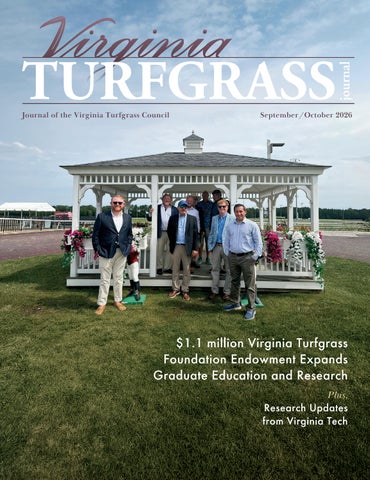
Journal of the Virginia Turfgrass Council
September/October 2026
$1.1 million Virginia Turfgrass Foundation Endowment Expands Graduate Education and Research Plus,
Research Updates from Virginia Tech
ace
18 holes
every day
HELPS DELIVER COURSE PERFECTION.
With it, you can connect, guide and manage daily operations with a real-time view from any internet device. Monitor dozens of pieces of equipment. Assign crews to tasks. Control overhead, irrigation and more. Connect with Finch and Revels to schedule a Pro Golf demo.
FinchTurf.com | RevelsTractor.com
AGRONOMIC LAWN MANAGEMENT
(757) 563-8588 FertilizeWithALM.com 404 N E TW ORK STATI O N C H ES AP EAK E, VA 23320 1258 PROGRES S R O AD S UFFO LK VA 23434 2401 B OW LAN D PAR K WAY V I R G I N I A BEAC H VA 23454
NO W HI RI N G Motivated individuals can expect to make $50,000+ their first full year after training. Health Insurance Dental Insurance Matching 401K
Training and Certifications Paid By Company 7 Paid Holidays Community Involvement Flexible & Supportive Work Environment
S C A N TH E Q R COD E TO LEAR N MO R E A B OU T CA R E ER S W IT H ALM
Journal of the Virginia Turfgrass Council | September/October 2026
10 7
12
9 UPCOMING EVENT
DEPARTMENTS
7 Belmont Short Course
5 Index of Advertisers
RECENT EVENT
9 Blacksburg Field Day
6 President’s Message from Wes Bray
8 Director’s Corner from Beck Stanley
COVER STORY
10 $1.1 Million Virginia Turfgrass Foundation Endowment Expands Graduate Education and Research FEATURE
12 Research Updates from Virginia Tech
4 | VIRGINIA TURFGRASS JOURNAL September/October 2026 www.vaturf.org
8 Virginia Tech Turf Team 18 Industry News On the Cover: VTC’s Board of Directors recently met at Colonial Downs. 75% of races at the track are run on turf.
INDEX OF ADVERTISERS
SAND BASED SOD WITH INFILTRATION RATE OF 11 IN/HR
www.cgcfields.com TENSILE SRENGTH 88% GREATER THAN 1” THICK CUT SOD SHEAR STRENGTH 43% GREATER THAN 1” THICK CUT SOD
Agronomic Lawn Management.................. 3 www.FertilizeWithALM.com
Burlingham Seeds............ Inside Back Cover www.burlinghamseeds.com
Carolina Green Corp................................. 5 www.cgcfields.com
Revels Tractor Co. Inc...... Inside Front Cover www.revelstractor.com
Greene County Fertilizer Co...................... 5 www.greenecountyfert.com
McGill Premium Compost......................... 18 www.mcgillsoilbuilder.com
Smith Seed Services.................................. 18 www.smithseed.com
Smith Turf & Irrigation............................... 20 www.smithturf.com
Find this issue, Events and More:
THETURFZONE.COM
Virginia Turfgrass Council (VTC) serves its members in the industry through education, promotion and representation. The statements and opinions expressed herein are those of the individual authors and do not necessarily represent the views of the association, its staff, or its board of directors, Virginia Turfgrass Journal, or its editors. Likewise, the appearance of advertisers, or VTC members, does not constitute an endorsement of the products or services featured in this, past or subsequent issues of this bimonthly publication. Copyright © 2026 by the Virginia Turfgrass Council. Virginia Turfgrass Journal is published bimonthly. Subscriptions are complimentary to members of VTC. POSTMASTER: Send change of address notification to VTC, P.O. Box 5989, Virginia Beach, VA 23471. Postage guaranteed. Thirdclass postage is paid at Jefferson City, MO. Printed in the U.S.A. Reprints and Submissions: Virginia Turfgrass Journal allows reprinting of material published here. Permission requests should be directed to VTC. We are not responsible for unsolicited freelance manuscripts and photographs. Contact the managing editor for contribution information. Advertising: For display and classified advertising rates and insertions, please contact Leading Edge Communications, LLC, P.O. Box 246, Brentwood, TN 37024.
GRASS SO GREEN THAT WE NEEDED AN EXTRA “E” Our Liquid Nutritionals & Specialty Fertility Products Are Blended To Feed Plants, Improve Soil Fertility & Build Topsoil
Healthy Turf starts with Greene County Fert. Ship Direct. Pro support always included.
GreeneCountyFert.com Journal of the Virginia Turfgrass Council | 5
President’s Message
Summer’s been tough, are you ready for Fall?
O
ur industry has had many challenges this year: environmental, regulatory, and personnel come to mind.
Hot, dry, tough working conditions, struggling turf, and irrigation (or is it irritation) systems have worked overtime. Widely scattered thunderstorms and weed pre-emergent breaking down much too early in the season… all of which has made this season very challenging.
Virginia Turfgrass Journal is the official publication of The Virginia Turfgrass Council 140 Green St Salem, VA 24153 540-871-9001 beckallenstanley@gmail.com PUBLISHED BY Leading Edge Communications, LLC P.O. Box 246 Brentwood, TN 37024 info@leadingedgecommunications.com VTC OFFICERS President Wes Bray Lawns & Gardens Plus 757-422-2117
Now comes Fall with its own unique challenges. Hustling to get the lawns seeded will soon consume many of us. It is time to dust off the aerators and slit seeders that have been waiting for their chance to shine. Hopefully you had them serviced during your summer ‘slow time’.
Vice President Harris Wheeler, CTP Richmond Public Schools (retired) 804-475-4561
Then comes the leaves (or pennies from heaven, as I say). Most of us love a mature tree until the day you show up for service and they all decided to fall down last night.
Secretary / Treasurer Ray Funkhouser PBI Gordon (retired)
Adding to our challenges, Fall is the ideal time for landscape installations, color pocket change- outs of seasonal annuals, soon to follow with irrigation winterizations. The coming time change and shorter days makes working efficiently a must. Hard work now produces the quality lawn and landscapes our clients expect and rely on us to produce. Our biggest challenge is labor, or more specifically, trained labor that you can count on to show up and perform under diverse environmental conditions. Now is the time to start making plans for the outstanding educational and training opportunities the Virginia Turfgrass Council and the VTC Environmental Institute have scheduled for the upcoming winter season. The Belmont Short Course in early December sells out every year (space is limited), so register soon. Come to the Bay in January at the Virginia Tech Agricultural Research and Extension Center in Virgina Beach offers training, education, networking and VTC-EI service project along with Virginia Tech research updates. In February, the Fredericksburg Road Show allows members to complete pesticide re-certification and keep up to date with the latest research from the Virginia Tech Turf team. Other programs worth your time are the Certified Turfgrass Professional course from Virginia Tech, the Virginia Certified Horticulturist certification through the Virginia Nursery and Landscape Association and The DCR Nutrient Plan Management Writer. So, make plans now because the very busy Fall season will be here and gone soon. Don’t miss these great opportunities that help you become the industry expert your clients are looking for.
Wes Bray
VTC President 6 | VIRGINIA TURFGRASS JOURNAL September/October 2026 www.vaturf.org
Past President Phil Bailey, CGCS Isle of Wight County Parks & Recreation 757-572-1981 VTC DIRECTORS Sam Burris Jack Findling Jesse Johnson Richard Linsday Bruce Sheppard T.J. Skirsky Craig Zeigler VTC ADVISORY MEMBERS OF THE BOARD Mike Goatley, Ph.D. (Chair) Shawn Askew, Ph.D. Alejandro Del Pozo-Valdiva, Ph.D. Jeffrey Derr, Ph.D. David McCall Ph.D. Dan Sandor, Ph.D. Cynthia Smith, Ph.D. EXECUTIVE DIRECTOR / DIRECTOR OF PROGRAMS Beck Stanley VIRGINIA TURFGRASS FOUNDATION Brandyn Baty 757-585-3058
Upcoming Event
DID YOU KNOW? VTC Members enjoy FREE online, on-demand recertification hours. Photo Credit: https://henrico.gov
LAWN AND
LANDSCAPE SHORT COURSE December 1 – 3, 2026 Belmont Recreation Center Henrico, Virginia
N
ews flash! VTC’s 2026 Lawn and Landscape Short Course will be held at Belmont Recreation Center (1600 Hilliard Road, Henrico, Virginia) December 1–3, with space limited this year due to demand. Attendees can expect to gain valuable knowledge from expert instructors and, in the words of Aristotle (probably), “those who attend the Belmont Short Course will make excellence a habit.” He totally, definitely said that. But seriously, members and guest attendees applaud the high quality instruction and credit the course with enhancing their career growth and trajectory. Held on the sacred grounds of Sam Snead’s 1949 PGA Championship victory, Belmont Recreation Center (once the home of Hermitage Country Club) provides a fantastic venue for this annual gathering. Don’t miss this chance to get an upper hand on your competition and network with industry leaders and select vendors.
Registration is open now!
We value our member and guest attendee feedback on this event. If there is something you or your company would like to see added to this course or one of our many educational offerings, please do let us know. Contact Beck Stanley at 540-871-9001 to provide feedback or join the VTC today.
https://vaturf.org/short-course/
Journal of the Virginia Turfgrass Council | 7
Virginia Tech Turf Team
Director’s Corner
LEAD BY EXAMPLE
The
year is flying by and by the time this edition reaches you, football will have returned and we will be approaching the World Series as the September management window opens for lawns all across the Commonwealth. Last year at our Belmont Short Course, Dr. Mike Goatley delivered an incredible lecture about these management windows, how to seize on them, and more importantly - how to capitalize on them. This year, we will welcome back Dr. Goatley, Dr. Jeff Derr, Dr. Alejandro Del-Pozo, and many others - including renowned golf architect Lester George, state officials at DEQ, and our friends at NALP. It is always our hope for members to find the rewards of this industry, to grow their businesses year after year, and to continue leading by example in their communities. That is why we put in months of time preparing for the Belmont Short Course, keeping the cost to attend as low as possible, and offering the limited seating to members first. Look out for announcements on our social media and email blasts for registration details.
Shawn D. Askew, Ph.D. Virginia Tech 435 Old Glade Road Blacksburg, VA 24061 540-231-5807 askew@vt.edu Alejandro Del Pozo-Valdiva, Ph.D. Virginia Tech Hampton Roads Agricultural Research Station 1444 Diamond Springs Rd. Virginia Beach, VA 23455 757-363-3900 adelpozo@vt.edu Jeffrey F. Derr, Ph.D. Virginia Tech Hampton Roads Agricultural Research Station 1444 Diamond Springs Rd. Virginia Beach, VA 23455 757-363-3912 jderr@vt.edu
Of course, this time of year finds us planning for the 2027 Virginia General Assembly session, where we have already learned that bills to ban leaf blowers and implement new, high taxes on landscaping services will be considered by legislators. But we will be there to educate elected officials and their staff on our needs, and thanks to your support, we are well positioned to find success again this coming year.
Mike Goatley Jr., Ph.D. Virginia Tech 420 Smyth Hall Blacksburg, VA 24061 540-231-2951 goatley@vt.edu
Thank you for what you do to ensure a greener tomorrow,
David McCall, Ph.D. Virginia Tech 435 Old Glade Road Blacksburg, VA 24061 540-231-9598 dsmccall@vt.edu
Beck Stanley
VTC Executive Director
SAV E T H E DAT E
DECEMBER 1 – 3, 2026
Lawn and Landscape Short Course Belmont Recreation Center Henrico, Virginia DETAILS ON PAGE 7
8 | VIRGINIA TURFGRASS JOURNAL September/October 2026 www.vaturf.org
Dan Sandor, Ph.D. Virginia Tech 170 Drillfield Dr. 411 Price Hall Blacksburg, VA 24061 540-231-9775 dsandor@vt.edu WITH SUPPORT FROM: Thomas P. Kuhar, Ph.D. Virginia Tech Dept. of Entomology 216 Price Hall 170 Drillfield Drive Blacksburg, VA 24061 540-231-6129 tkuhar@vt.edu
Recent Event
DID YOU KNOW? The VTC educates over 1,000 professional applicators each year.
END OF AN ERA
FINAL “OFFICIAL” GOATLEY GOLF AND
FIELD DAY
IN BLACKSBURG
The
VTC applauds our friends at the Foundation for another successful Goatley Golf & August Field Day in Blacksburg. With Dr. Goatley’s retirement coming up in March, it was a bittersweet couple of days. After golf, the VTC presented Delegate Lily Franklin with our Outstanding Legislator Award for her commitment to understanding both the economic impact of turfgrass and the amazing contributions of academic staff at Virginia Tech. Thank you for taking the time to learn about what our industry needs to grow, Delegate!
Journal of the Virginia Turfgrass Council | 9
Cover Story
$1.1 million Virginia Turfgrass Foundation endowment expands graduate education and research Established through decades of partnership and philanthropy, the endowment creates lasting opportunities for graduate students while supporting industry-focused turfgrass research.
By Tyler Baugrass
A
$1.1 million endowment established by the Virginia Turfgrass Foundation is creating lasting opportunities for graduate students in Virginia Tech’s School of Plant and Environmental Sciences, strengthening cutting-edge turfgrass research while advancing sustainable solutions for the turfgrass industry. Decades in the making, the endowment represents a milestone in the longstanding partnership between Virginia Tech and the Virginia Turfgrass Foundation. Established in 1988, the Virginia Turfgrass Foundation promotes the benefits of natural grass and works exclusively with the Virginia Tech Turfgrass Team in funding research that provides homeowners and industry professionals with strategies and tools to achieve the highest possible quality turfgrass with the fewest required management inputs. While the foundation has supported turfgrass research at the university for nearly 30 years, leaders from both organizations came together in 2017 with a renewed vision: to build a permanent, impactful funding model that could meaningfully support graduate education. “While we always appreciate the support on smaller, short-term projects that meet immediate industry needs, our goal was to move the needle — to truly support graduate students, their research, and the future of the turfgrass industry,” said David McCall, associate professor and Extension turfgrass pathologist.
From vision to endowment That vision led the foundation’s leaders and Virginia Tech faculty members to explore how to maximize donor dollars for longterm impact. With guidance from alumni and industry partners, the foundation focused on building a true endowment — a permanent fund designed to generate annual support rather than provide short-term funding. A significant portion of this funding came from the Virginia Tech Turfgrass Research Classic Golf Tournament, which has raised more than $500,000 for the foundation. Additional contributions from industry partners and supporters also helped grow the fund, which is held in an endowment and brokerage account and drawn from annually. “This wasn’t about a one-time gift,” said Brandyn Baty, executive director of the Virginia Turfgrass Foundation. “We wanted something sustainable that would support students year after year, long after any one event or campaign.” Key foundation leaders involved in re-envisioning how the endowment supported Virginia Tech research included alumni Eric Frazier ‘00 and Dean Whitehead ‘99, along with Jim Wilson and Jeff Everhart, two honorary Hokies whose longstanding support has helped strengthen the partnership.
Full support for graduate students Unlike many funding sources that support a portion of a student’s education through sponsoring specific projects, the Virginia Turfgrass Foundation endowment is designed to fully fund a graduate research assistantship. The foundation has committed to supporting at least one new graduate student annually, with the potential to support multiple students as the endowment continues to grow. “Giving students the opportunity to pursue graduate education without financial uncertainty changes everything,” McCall said. “It allows them to focus on innovation, discovery, and impact.” The first student supported by the foundation was Elisabeth Kitchin M.S. ‘25, whose master’s degree research set the standard for what the endowment could accomplish. Now a doctoral student, Kitchin also manages the university’s turfgrass research facility at Independence Golf Club in Midlothian. “Beyond just the financial support, the foundation and the broader Virginia turfgrass industry have provided me with an abundance of mentorship, encouragement, and guidance throughout my time as a graduate student,” Kitchin said. “As a young professional entering the turfgrass industry, I have felt genuinely supported by the researchers, educators, superintendents, and industry professionals around me.”
10 | VIRGINIA TURFGRASS JOURNAL September/October 2026 www.vaturf.org
Photo 1: Graduate Research Assistant Sam Kreinberg preps turfgrass for in-ground sensor installation. Photo courtesy of David McCall.
Photo 2: The Virginia Tech Turfgrass Pathology team uses drones and tracer dye at nighttime to evaluate the precision and accuracy of GPS sprayers at the Virginia Tech Golf Course in Blacksburg. Photo courtesy of David McCall.
Precision, technology, and sustainability Kitchin’s research focuses on precision turfgrass management, including the use of machine learning models to identify turfgrass diseases such as dollar spot, a common fungal disease that plagues the turfgrass industry. By improving the accuracy of disease identification and treatment, her work helps reduce unnecessary pesticide applications, saving costs and minimizing environmental impacts. She and endowment-supported student Sam Kreinberg, the first official graduate research assistant funded under the new longterm endowment structure, both focus on precision irrigation management — studying when, where, and how much water is needed across golf courses, sod farms, and home lawns.
Photo 3: Doctoral student Elisabeth Kitchin M.S. ‘25 (at right) updates the turfgrass industry during the annual Virginia Tech Turfgrass Research Field Day. Photo courtesy of David McCall.
The endowment also enhances Virginia Tech’s close collaboration with the Independence Golf Club, where both Kitchin and Kreinberg conduct extensive research. This on-course research opens the doors for additional collaborations with the United States Golf Association, Syngenta Professional Solutions, and numerous other industry partners.
Lasting Impact For the Virginia Turfgrass Foundation, the endowment reflects not just financial support, but a long-term commitment to students and the land-grant mission of Virginia Tech. “This is about investing in people,” McCall said. “When you invest in graduate students, you invest in research, sustainability, and the future of an entire industry.”
Kreinberg joined the turfgrass program in fall 2025 after completing his master’s degree at the University of Arkansas. His research integrates advanced technology and data-driven tools to help turfgrass managers make more informed decisions, improving water efficiency while maintaining high-quality playing surfaces.
As the endowment continues to grow, foundation leaders hope to expand the number of students supported — ensuring that the partnership between Virginia Tech and the Virginia Turfgrass Foundation continues to thrive for generations of students to come.
“These students are using technology to solve real-world problems,” said Mike Goatley, professor and Extension turfgrass specialist. “Their work directly benefits the turfgrass industry while supporting sustainability and environmental stewardship.”
“The endowment allows us to attract great young women and men equipped with the knowledge, work ethic, and personality to succeed,” Goatley said. “The students serve as our program’s bridge to the future of turfgrass science.”
This article was originally published at https://news.vt.edu/articles/2026/07/VTF_endowment_expands_graduate_education.html and is reprinted with permission. | 11
Feature
The VTC is YOUR direct connection to lawmakers, regulators, and leading academic research.
Treatments (applied biweekly):
Potassium Acetate improves shade tolerance associated with carbohydrate metabolism in creeping bentgrass Taylor Flanary, Mike Goatley, and Xunzhong Zhang School of Plant and Environmental Sciences Virginia Tech, Blacksburg, VA
Introduction and Objectives Potassium is one of the major essential nutrients in turfgrass management. Potassium acetate is a unique form of potassium available to plants because the acetate may provide a direct carbon source for plant metabolism, especially under stressful environments such as low light or shade. This study evaluated effects of potassium acetate on shade tolerance of creeping bentgrass as measured by plant growth, visual quality, biomass production, non-structural carbohydrates (TNC), and root growth.
Materials and methods Greenhouse pot trial. We harvested mature ‘A4’ creeping bentgrass plugs (4" diameter) from field plots and transplanted into 6 inch pots filled with fine sand and 10% calcined clay on February 15, 2023. The bentgrass was maintained at 0.6 inch and fertilized at 0.2 lb/1000 ft2 at transplanting and then 0.15 lb N/1000 ft2 biweekly thereafter. After about 8 weeks of nonstressed growth with optimum temperature, water, fertilizer, and light in greenhouse conditions. We initiated treatments as listed below, with all other management variables kept identical for the treatments. The product “Stress Relefe” containing 25% potassium derived from potassium acetate obtained from Harrell’s in April 2023 was used for this trial. We tested 4 treatments with 4 replications. The treatment solutions (listed below) were applied to the canopy with the same amount of water applied to the control (treatment #1). Immediately after treatment, the grass was subjected to artificial shade conditions. A frame was installed on the bench of the greenhouse and covered with black knit high-density polyethylene shade cloth, placed on the top of the frame and the cloth was placed about 20 inches above the grass canopy. This allowed 70% photosynthetic active radiation (PAR) to reach the canopy. The grass was kept well irrigated and light intensity, air temperature, and relative humidity were monitored hourly in the greenhouse.
1. Fertilized control biweekly (0.10 lb N/1000 ft2 from fertilizer 28-8-18 biweekly) 2. K acetate 3 fl oz/1000 ft2/week + fertilized control biweekly 3. K Acetate 3 fl oz/1000 ft2/biweekly + fertilized control 4. K Acetate 6 fl oz/1000 ft2/biweekly + fertilized control The stress period of the trial lasted for 8 weeks and a total of 4 treatment applications were made to the plugs. Turf quality, physiological responses, clipping production, leaf protein content, and non-structural carbohydrates were measured biweekly. At the end of the trial, root biomass was measured.
Results and Discussion Turf quality Foliar application of the potassium acetate product at 3 and 6 fl oz/1000 ft2 biweekly improved turf quality relative to the control as measured on Day 14 and day 28, and all three potassium acetate rates improved turf quality relative to the control as measured at Day 42 and 56, Fig. 1). The best turf quality was achieved when potassium acetate was applied at 3 fl oz/1000 ft2 biweekly as measured at the end of the trial.
Photochemical efficiency The potassium acetate at all rates improved PE relative to the control as measured from day 14 through day 56.
Leaf chlorophyll content The potassium acetate at all rates improved chlorophyll content relative to the control as measured from day 14 through day 56. Among the treatments, potassium acetate at 3 fl oz/1000 ft2 every 14 days tended to have better effects on chlorophyll content.
Clipping production. There was no significant difference in clipping production among the treatments. Clipping weight tended to increase as the potassium acetate rate increased.
Total soluble protein content. We found the protein measurement is more stable relative to amino acid content, so we measured leaf total soluble protein content in replacement of amino acid content. The potassium acetate significantly increased protein content in the leaf tissues as measured from day 28 through day 56. The total soluble content tended to increase as the potassium acetate rate increased.
Leaf non-structural carbohydrate content The potassium acetate at 3 fl oz/1000 ft2 weekly improved leaf glucose content when compared to the control as measured at day 56.
12 | VIRGINIA TURFGRASS JOURNAL September/October 2026 www.vaturf.org
The potassium acetate at all rates improved leaf fructose content as measured at day 14. The potassium acetate at 3 fl oz/1000 ft2 biweekly improved fructose content as measured at day 28 and 42. At the end of the trial, potassium acetate at 6 fl oz/1000 ft2 biweekly improved fructose content relative to the control. The potassium acetate at all rates improved leaf sucrose content when compared to the control as measured at day 56, with the treatment at 3 fl oz/1000 ft2 weekly having better effects. The potassium acetate at 3 fl oz/1000 ft2 weekly also improved sucrose content when compared to the control as measured at day 14 and 42. The potassium acetate at all rates improved leaf total nonstructural carbohydrate (TNC, glucose + Fructose + sucrose) content when compared to the control as measured at day 56, with the treatment at 3 fl oz/1000 ft2 weekly having better effects. The potassium acetate at 3 fl oz/1000 ft2 weekly also improved TNC content when compared to the control as measured at day 14 and 42.
Root biomass Foliar application of the potassium acetate product at 3 fl oz/1000 ft2 weekly or biweekly and 6 fl oz/1000 ft2 biweekly improved root biomass relative to the control. The greatest root biomass was found in the grass treated with potassium acetate at 3 fl oz/1000 ft2 biweekly (Fig. 2). Summary. Foliar application of potassium acetate improved turf quality, photochemical efficiency, leaf chlorophyll content, leaf protein and nonstructural carbohydrate content when compared to a non-treated control in creeping bentgrass managed under shade stress conditions. The potassium acetate treatments also improved root biomass relative to the control. No consistent differences in turf quality and physiological responses among the three potassium acetate treatments were found in this study. The potassium acetate applied at 3 fl oz/1000 ft2 weekly tended to have larger effects on leaf sucrose and TNC. The results of this study suggest that foliar application of potassium acetate may improve creeping bentgrass performance under shade environments.
Fig.1. Turf quality response to potassium acetate application as measured at the end of the trial (day 56).
Journal of the Virginia Turfgrass Council | 13
Feature continued
Investigating effects of Antisalt and CalPlus on creeping bentgrass quality and physiological fitness under salt stress Xunzhong Zhang 1, Mike Goatley 1, Maude Focke 1, Taylor Motsinger 1, Berit Smith 2, and Graham Sherman 1 School of Plant and Environmental Sciences; 2 Department of Biochemistry Virginia Tech, Blacksburg, VA
Introduction and Objective Salt stress is one of the major limiting factors in turfgrass management in many areas. Various agronomic and chemical approaches have been used to alleviate salt-induced injury to turfgrass. Antisalt and CalPlus are two products which have been documented to improve plant tolerance to salt stress. The objective of this study was to investigate if foliar application of Antisalt and CalPlus at two different rates affects physiological fitness and quality of creeping bentgrass under salt stress conditions.
Research Procedure Mature ‘A4’ creeping bentgrass plugs (4” diameter) were collected from field plots and transplanted into 6-inch pots filled with fine sand with 10% calcined clay in mid-September 2024. The bentgrass was maintained at 0.6 inch and fertilized biweekly. After about four weeks of non-stressed growth under optimum temperature, water, fertilizer, and light conditions, the grass was treated with the two products at two rates of the products each on October 8, 2024. There were 6 treatments with 4 replications. The product solution (rates listed below) was applied to the canopy, and the same amount of water was applied to the controls (treatments #1 and 6). The treated grass was grown in a controlled environment growth chamber at 71.6 ºF day (12 h)/64.4 ºF night, light intensity at 400 µmol m-2 s-1, 12 h photoperiod, and 65% relative humidity. After 12 h of the initial treatment, we initiated salt stress treatment. Sodium chloride (NaCl) solution at 2 ds/m concentration was added first, and then 4 ds/m concentration, and 6 ds/m concentration, and finally 8 ds/m concentration at 48 h after initiation of salt stress treatment. The salt concentration in the growth media was maintained at about 8 ds/m level during the trial by monitoring the salt concentration with a portable TDR-300 meter. The grass was irrigated with salt water and fresh water alternatively in order to maintain water content near field capacity and EC level at about 8 ds/m during the trial.
The treatments include 1). Fertilized control (0.15 lb N/1000 ft2 biweekly) + salt stress; 2). Antisalt at 3 fl oz/1000 ft2 biweekly + salt stress; 3). Antisalt at 9 fl oz/1000 ft2 biweekly + salt stress; 4). CalPlus at 3 oz/1000 ft2 biweekly + salt stress; 5). CalPlus at 9 oz/1000 ft2 biweekly + salt stress; and 6). Fertilized control, non-salt stress. Flobond LX50 Antisalt was provided by SNF Inc. (Riceboro, GA) and CalPlus was from Harrell’s (Lakeland, FL). The rate of N fertilization (from 28-8-18) for treatments #2, 3, 4, and 5 was the same as control treatments #1 and 6.
Measurements The stress period of the trial lasted for 8 weeks with a total of 4 treatment applications. Bentgrass growth and physiological responses were measured biweekly. Root growth characteristics and viability were measured at the end of the trial. In addition, leaf tissue nutrient levels (N, P, K, Na, Ca, S, Mg) were determined with the ICP method. The data were subjected to an analysis of variance and where appropriate, mean separations were performed with a protected Fisher’s least significance difference test at a 5% probability level
Results and Discussion Leaf color and green leaf percentage (GL) Salt stress reduced leaf color ratings. CalPlus application at the two rates improved leaf color ratings relative to the control as measured from day 14 through day 56. Application of Antisalt also improved leaf color rating at 3 fl oz/1000 ft2 at day 14, 28, and 56 when compared to the control (Fig. 1). The GL declined in response to salt stress. CalPlus application at the two rates improved GL as measured at day 28, day 42, and day 56. Antisalt at 3 fl oz/1000 ft2 also improved GL when compared to the control as measured at day 42 and 56.
Clipping production and relative clipping weight Salt stress reduced plant growth and clipping production. Application of Antisalt and CalPlus at the two rates alleviated clipping reduction as measured at day 56. Salt stress reduced relative clipping weight, and Antisalt and CalPlus treatments has greater relative clipping weight than the salt control as measured at day 56.
Leaf chlorophyll and carotenoids Salt stress reduced chlorophyll and carotenoids content. Application of CalPlus at the two rates increased chlorophyll content
14 | VIRGINIA TURFGRASS JOURNAL September/October 2026 www.vaturf.org
Fig. 1. Turf quality responses to Antisalt and CalPlus in creeping bentgrass under salt stress (December 3, 2024).
Fig. 2. Root growth responses to Antisalt and CalPlus in creeping bentgrass under salt stress (December 3, 2024).
relative to the salt control at day 42 and 56. Antisalt treatment at the two rates also increased chlorophyll content relative to the salt control at day 42.
Root growth characteristics, relative root weight (RRWT) and viability
Similarly, application of CalPlus at the two rates increased carotenoids content relative to the salt control at day 42 and 56. Antisalt treatment at the two rates also increased carotenoids content relative to the salt control at day 42.
Antisalt and CalPlus at 9 fl oz/1000 ft2 increased root biomass, length, surface area, volume, viability, and relative root weight when compared to the salt control (Fig. 2). Antisalt and Calplus at 3 fl oz/1000 ft2 also improved root viability relative to the salt control.
Leaf photochemical efficiency (PE) and antioxidant SOD activity Salt stress reduced PE. CalPlus treatments improved PE relative to salt control as measured from day 14 through day 56. Antisalt treatments also improved PE as measured at day 28, 42, and 56. Application of Antisalt and CalPlus at the two rates improved antioxidant enzyme SOD activity when compared to the salt control measured at day 42 and 56.
Leaf nutrients (N, P, K, Ca, S, Mg) Application of Antisalt at 3 fl/1000 ft2 and CalPlus at 9 fl oz/1000 ft2 improved leaf N and S content relative to the control. Antisalt increased P content and CalPlus at both rates increased leaf Ca, S, and Mg content relative to the control.
Summary. Applications of CalPlus at 3 and 9 fl oz/1000 ft2 and Antisalt at 3 fl oz/1000 ft2 improved leaf color, clipping production, photosynthetic pigments, photochemical efficiency, antioxidant SOD activity, and root growth and viability. Antisalt at 9 fl oz/1000 ft2 also increased clipping production, photochemical efficiency, leaf chlorophyll, carotenoids, SOD activity, root biomass, and viability relative to the salt control at selected sampling dates. Antisalt at the low rate increased leaf N, P, and S content relative to the control, and CalPlus at both rates increased leaf Ca, S, and Mg content and also leaf N content at the high rate. In general, no consistent differences were observed between the two rates of CalPlus. Antisalt at 3 fl oz/1000 ft2 tended to have better effects on leaf color and physiological fitness, and Antisalt at 9 fl zo/1000 ft2 tended to have greater effects on root growth. Overall, the results of this study indicated foliar application of Antisalt and CalPlus at the two rates may improve salt stress tolerance by enhancing physiological fitness, leaf color, and root growth in creeping bentgrass. Journal of the Virginia Turfgrass Council | 15
Feature continued
Evaluating effect of Fercristal Summum Nitro and 18-3-6 with UMAXX fertilizer on turf quality and nutrient efficiency in perennial ryegrass and bermudagrass Xunzhong Zhang 1, Mike Goatley 1, Berit Smith2, Taylor Motsinger 1, and Sydney Hook 1 1 School of Plant and Environmental Sciences; 2 Department of Biochemistry Virginia Tech
Introduction and Objective Improvement of nutrient use efficiency, especially nitrogen, is an important issue in turfgrass management with respect to plant health, quality, economics and environmental protection. New technology has been used to develop fertilizers which may have high nutrient use efficiency when compared to traditional fertilizer such as ammonium nitrate. The objective was to evaluate effect of Fercristal Summum Nitro (FSN) and 18-3-6 with UMAXX for improving N uptake and turfgrass performance in comparison with ammonium nitrate in perennial ryegrass and bermudagrass turfgrasses.
Turf quality, fresh clipping weight, photochemical efficiency, leaf chlorophyll content, leaf protein, leaf proline, and leaf nitrogen content were measured biweekly during the period of 56 days. Root growth characteristics including root biomass, length, surface area, diameter, and volume were measured at the end of the trial. The data were analyzed with an analysis of variance and mean separations were performed with a protected Fisher’s least significance difference at 5% probability level.
Results and Discussion Turf quality Foliar applications of Fercristal Summum Nitro (FSN) and 183-6 with UMAXX (abbreviation: UMAXX) improved turf quality when compared to the control (ammonium nitrate, AN) as measured from day 14 (July 22) through Day 56 (Sept. 2) in bermudagrass and perennial ryegrass. On average, both SSN and UMAXX consistently increased turf quality ratings relative to the control (Fig. 1a, b).
Leaf chlorophyll content Foliar applications of FSN and UMAXX increased leaf chlorophyll content when compared to the control (ammonium nitrate as measured at day 42 (August 19) and Day 56 (Sept. 2) in bermudagrass and at day 29 (August 5) in perennial ryegrass. On average, both SSN and UMAXX increased chlorophyll content relative to the control in bermudagrass and also SSN in perennial ryegrass.
Materials and Methods
Photochemical efficiency
Perennial ryegrass (cv. ‘Gray Hawk’) and bermudagrass (cv. ‘Latitude 36’) plugs (4" diameter) were collected from field plots and transplanted into 6-inch pots filled with fine sand plus 10% calcined clay in early June 2025. The grasses were trimmed, irrigated, and fertilized regularly. After about 4- weeks of nonstressed growth with optimum temperature, water, fertilizer, and light, the pots were grown in a controlled environment growth chamber at optimum growing conditions. The three treatments were arranged in a randomized block design with four replications. These treatment solutions were uniformly applied to the canopy: 1). Control standard ammonium nitrate at 0.10 lb N/1000 ft2 2). Fercristal Summum Nitro at 0.1 lb N/1000 ft2 3). 18-3-6 with UMAXX at 0.10 lb N/1000 ft2 biweekly. All nitrogen in the 18-3-6 with UMAXX is stabilized with dicyanodiamide and N-(in-butyl)-thiophosphoric triamide and the product contains 0.1% iron. The FSN contains 20.5% nitrogen and 18 amino acids. The soluble sustainable nitrogen (SSN) technology was used to improve nitrogen use efficiency.
Foliar applications of FSN improved leaf photochemical efficiency when compared to the control (ammonium nitrate) as measured from day 14 (July 22), day 28 (August 5), and day 56 (Sept. 2) in bermudagrass and day 42 and 56 in perennial ryegrass. In addition, UMAXX treatment improved photochemical efficiency relative to the control as measured at day 56. On average, both SSN and UMAXX consistently increased photochemical efficiency relative to the control.
P and K and micronutrients were applied to all pots as base nutrients to support normal growth. Additional P and K in forms of potassium chloride and triple phosphate for treatments #1 and 2 were used to match P and K input for treatment #3. All treatments received no additional N inputs, and non-N nutrient solution was applied biweekly.
Leaf protein, N content, and estimated N use efficiency (NUE)
Clipping production Foliar applications of FSN and UMAXX increased clipping fresh weight when compared to the control (ammonium nitrate) as measured at day 42 and 56 in bermudagrass (except for UMAXX at day 56) and day 28, 42 and 56 in perennial ryegrass. On average, both FSN and UMAXX consistently increased clipping production relative to the control.
Foliar applications of FSN and UMAXX increased leaf protein and N content when compared to the control (ammonium nitrate) as measured at day 42 and 56 in bermudagrass, and day 28, 42 and 56 in perennial ryegrass. On average, both FSN and
16 | VIRGINIA TURFGRASS JOURNAL September/October 2026 www.vaturf.org
Fig. 1. Turf quality responses to foliar applications of Fercristal Summum Nitro (SSN), 18-3-6 with UMAXX and ammonium nitrate in bermudagrass (a) and perennial ryegrass (b) (day 56, September 2, 2025).
A
B
Fig. 2. Root growth responses to foliar applications of Fercristal Summum Nitro (SSN), 18-3-6 with UMAXX and ammonium nitrate in bermudagrass (a) and perennial ryegrass (b) (day 56, September 2, 2025).
A
B
Fig. 3. Root growth response to potassium acetate application as measured at the end of the trial (day 56).
UMAXX increased leaf protein and N content in the two turfgrass species. Based on total N input and total leaf N uptake, the NUE was estimated. The FSN and UMAXX increased the N use efficiency by 12.7% and 12.9%, respectively, in bermudagrass, and 19.5% and 8.3% in perennial ryegrass, when compared to ammonium nitrate.
Leaf amino acid proline content Foliar applications of FSN and UMAXX increased leaf proline content when compared to the control (ammonium nitrate) as measured from day 14 (July 22) through day 56 (September 2) in bermudagrass (except for UMAXX at day 14) and perennial ryegrass (except for SSN at day 14). On average, both SSN and UMAXX consistently increased leaf proline content in all three turfgrass species.
Root growth characteristics and viability Foliar applications of FSN and UMAXX increased root biomass, length, surface area, and volume when compared to the control (ammonium nitrate) in the two turfgrass species (Fig. 2 a, b). In addition, FSN treatment improved root viability relative to the control in bermudagrass and UMAXX improved root viability relative to the control in perennial ryegrass (Fig. 2a, b). Summary. Foliar applications of Fercristal Summum Nitro (FSN) and 18-5-6 with UMAXX improved turf visual quality, physiological fitness, leaf protein and N content, amino acid proline content, and root growth when compared to the control (ammonium nitrate) in bermudagrass and perennial ryegras under normal growth conditions. No consistent differences in the measured parameters were found between Fercristal Summum Nitro and 18-3-6 with UMAXX. Journal of the Virginia Turfgrass Council | 17
Industry News
TRINITY TURF
MT. JACKSON, Va. — Trinity Turf, Inc. is proud to announce the opening of its newest wholesale distribution location in Mt. Jackson, Virginia, at the longtime home of Valley Fertilizer. For nearly 100 years, Valley Fertilizer served farmers, landscapers, businesses, and retailers throughout the Shenandoah Valley and surrounding region with quality products, knowledgeable service, and lasting customer relationships. While Valley Fertilizer has closed its doors, Trinity Turf is honored to continue serving the community from this historic location.
Begins New Chapter at
VALLEY FERTILIZER LOCATION
Founded in 2004, Trinity Turf has grown into a trusted wholesale supplier of fertilizer, grass seed, agricultural seed, erosion control products, ice melter, and plant protection products throughout Virginia and the surrounding region. The company views this transition as an opportunity
in Mt. Jackson
McGill SportsTurf Premium Compost improves turf aesthetics by adding beneficial microbes to soils, improving nutrient uptake, and increasing porosity in heavy clay soils while improving water capacity in light sandy soils. Create a healthier soil environment and safer playing surface by applying 1/8" – 1/4" of McGill Premium Compost.
For more information go to mcgillsoilbuilder.com or call 844.362.1161 634 Christian Chapel Church Road • New Hill, NC 27562
to build upon the legacy established by Valley Fertilizer while remaining committed to exceptional service and dependable products. “No one can replace what Valley Fertilizer meant to this community,” said Kurt Fellenstein, President of Trinity Turf, Inc. “Our goal isn’t to fill those shoes, but to honor that legacy by earning the trust of customers through the same values of integrity, service, and strong relationships.” As part of that commitment, Trinity Turf is pleased to announce that longtime Valley Fertilizer employees Tracy Meadows and Jason Burkett have joined the company as Customer Service Specialists. “Tracy and Jason have been a trusted resource for customers for many years,” Fellenstein said. “Their experience, product knowledge, and dedication make them an invaluable part of our team, and we’re excited they will continue serving the customers who have relied on them for so long.” From its Mt. Jackson location, Trinity Turf will offer a full line of wholesale fertilizer, turf and agricultural seed, erosion control products, ice melting products, and plant protection solutions while maintaining the responsive, personalized service customers have come to expect. “We’re grateful for the opportunity to serve this community,” Fellenstein added. “We look forward to building on the strong foundation that Valley Fertilizer created and earning our place as a trusted partner for years to come.”
BLEND
About Trinity Turf, Inc. Trinity Turf, Inc. is a wholesale distributor serving agricultural, turf, landscape, and erosion control professionals throughout the Mid-Atlantic and Southeast region.
18 | VIRGINIA TURFGRASS JOURNAL September/October 2026 www.vaturf.org
DO THE RIGHT THING. At Smith Turf & Irrigation, doing the right thing is more than a slogan – it’s our promise. We believe every decision matters. Every detail counts. Every challenge is an opportunity to do and be better. When you choose STI, you’re deciding on a partner that still values integrity, trust and responsibility and it’s been that way for over 100 years. Do the right thing. Choose a company that does too.
NORTH CAROLINA | SOUTH CAROLINA | VIRGINIA | TENNESSEE | BERMUDA