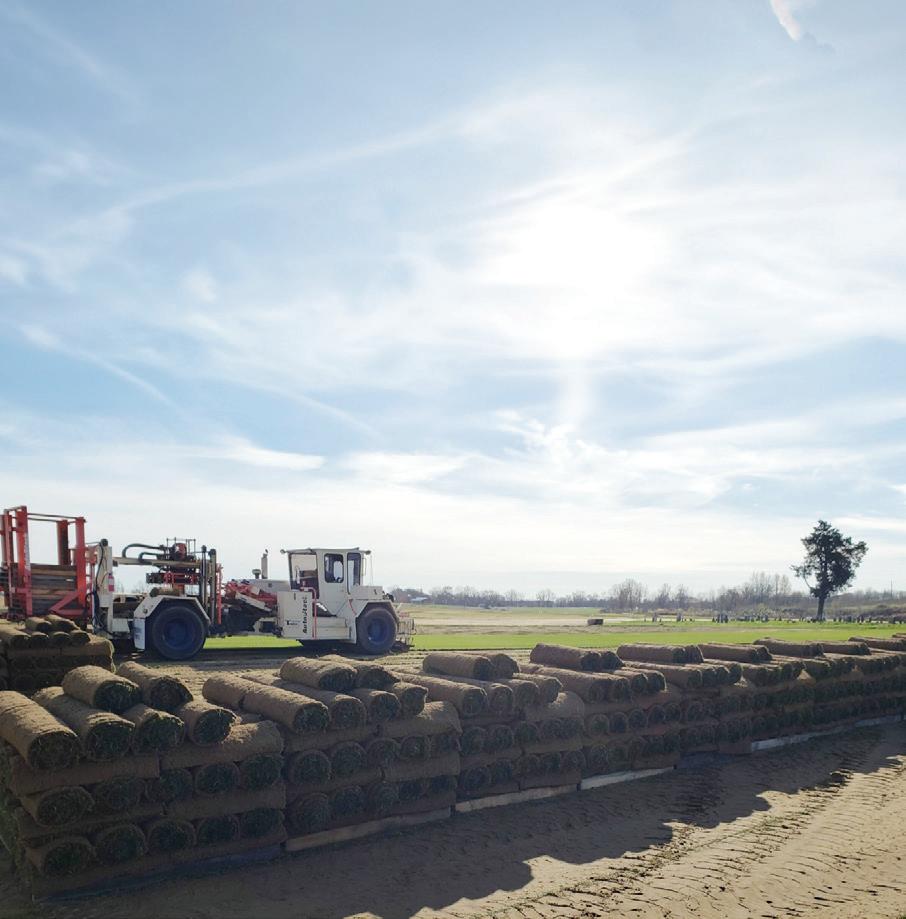
Experience Superior Turf with TifTuf ®
In just seven years, TifTuf®’s installation of over 2 billion square feet has saved more than 48 billion gallons of water. It’s the only Bermudagrass to top National Turfgrass Evaluation Program trials 93% of the time, far ahead of Tahoma at 73%. Recognized for its drought tolerance, TifTuf® is the USDA Specialty Crop Research Initiative’s standard for future university testing and has earned the #1 ranking in the USDA/NTEP ET-Based Water Deficit Research Trial.
TifTuf ®’s water efficiency has garnered numerous awards, including the Smart Approved Water Mark from Australia’s Water Services Association, the Georgia House and Senate’s Extraordinary Water Conservation award, and the

Georgia Association of Water Professionals’ Water Wise Award. It’s also named the Turfgrass of Choice by Southern Living Inspired Communities.
TifTuf® is the most produced proprietary Bermudagrass globally, with more produced in the U.S. than all other varieties combined worldwide. It is the preferred choice for new golf courses, sports fields, and residential and commercial landscapes, and it’s the only Bermuda
sold through Home Depot and Lowe’s by Harmony Outdoor Brands.
While others check boxes, TifTuf® redefines them. Experience the exceptional quality and innovation of TifTuf® turfgrass.






O All In It Together

ur industry only succeeds because most of us know that working together and sharing of knowledge and information makes us stronger. Networking with other segments of the Lawn and Landscape industry that may be outside the normal services you provide can result in better understanding challenges and in resourcefulness different associated industries rely on for success.
Years ago, I attended a regional green industry event and noticed the golf program included several topics on health and best practices for maintaining greens and fairways. This got my attention because of the market segment we serve, the high value residential client. I perceived that we could gain good insider information about managing turf, after all most clients were members of one or more country clubs and they all wanted lawns that looked like country clubs.
When I looked at the speaker list, I knew I wanted to listen. Most were Virginia Tech and other college professors, research specialists and students working towards degrees. Safe to say my eyes were opened to the vast amount of time and effort these individuals invested in order to help our industry succeed.
Applying this newfound knowledge I was able to discuss with clients the feasibility and efforts required for their dream of having a lawn that “looks like a golf course.” News flash, the look can’t be achieved with once-a-week mowing. End result, some clients opted for more service while others appreciated my educating them on the challenges.
I have found over the years that attending other industry events focused on their specific segment continued to help our business succeed. Once we attended an all-day workshop on growing hydrangeas. Paula and I were the only ones there not in the business of growing hydrangeas. Speakers were again the Virginia Tech professors, researchers, students and growers sharing what works and what not to do. The knowledge gained has helped us maintain many beautiful hydrangea gardens over the years.
Collaborating with others in academia and industry is what’s made our industry strong and respected. We all need to keep this in mind when others are willing to work with us.
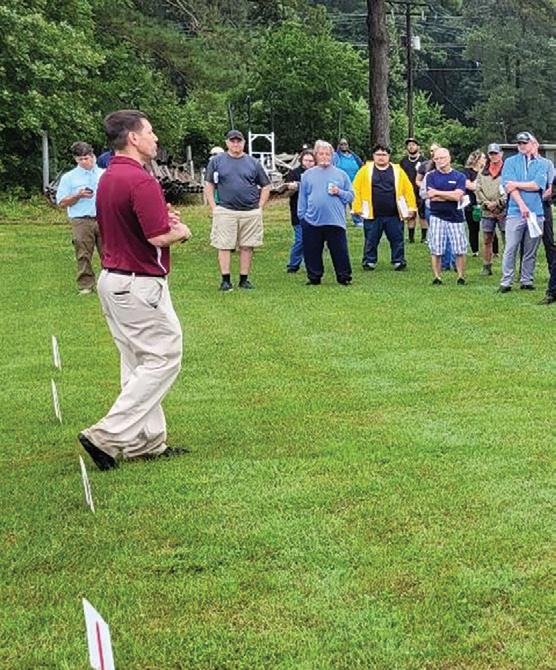
This June 25th another great opportunity for collaborating will happen at the Virginia Tech Virginia Beach facility. The VTC is proud to partner with Virginia Tech for the 16th annual Turfgrass Research Field Day. Come and find out what works, what doesn’t work, and what’s in the works.
We will also welcome demos from Synatek/Husqvarna with robotic mowers, Stihl with gas and battery equipment comparisons, and many other longtime friends. Register today on our website and bring a friend.
Wes Bray VTC President
Virginia Turfgrass Journal is the official publication of The Virginia Turfgrass Council 140 Green St Salem, VA 24153 540-871-9001 beckallenstanley@gmail.com
PUBLISHED BY
Leading Edge Communications, LLC 206 Bridge Street, Suite 200 Franklin, Tennessee 37064 615-790-3718
Fax: 615-794-4524 info@leadingedgecommunications.com
VTC OFFICERS
President Wes Bray Lawns & Gardens Plus 757-422-2117
Vice President Harris Wheeler, CTP Richmond Public Schools (retired) 804-475-4561
Secretary / Treasurer
Ray Funkhouser PBI Gordon (retired)
Past President
Phil Bailey, CGCS Isle of Wight County Parks & Recreation 757-572-1981
VTC DIRECTORS
Sam Burris
Jack Findling
Jesse Johnson
Richard Linsday
Bruce Sheppard
T.J. Skirsky
Craig Zeigler
VTC ADVISORY MEMBERS OF THE BOARD
Mike Goatley, Ph.D. (Chair)
Shawn Askew, Ph.D.
Alejandro Del Pozo-Valdiva, Ph.D.
Jeffrey Derr, Ph.D.
David McCall Ph.D.
Dan Sandor, Ph.D.
Cynthia Smith, Ph.D.
EXECUTIVE DIRECTOR / DIRECTOR OF PROGRAMS Beck Stanley
VIRGINIA TURFGRASS FOUNDATION
Brandyn Baty 757-585-3058
www.meadowspringturf.com

Turf Zone
www.theturfzone.com
Turfgrass Group Inside Front Cover www.theturfgrassgroup.com
Virginia Turfgrass Council (VTC) serves its members in the industry through education, promotion and representation. The statements and opinions expressed herein are those of the individual authors and do not necessarily represent the views of the association, its staff, or its board of directors, Virginia Turfgrass Journal, or its editors. Likewise, the appearance of advertisers, or VTC members, does not constitute an endorsement of the products or services featured in this, past or subsequent issues of this bimonthly publication. Copyright © 2026 by the Virginia Turfgrass Council. Virginia Turfgrass Journal is published bimonthly. Subscriptions are complimentary to members of VTC. POSTMASTER: Send change of address notification to VTC, P.O. Box 5989, Virginia Beach, VA 23471. Postage guaranteed. Thirdclass postage is paid at Jefferson City, MO. Printed in the U.S.A. Reprints and Submissions: Virginia Turfgrass Journal allows reprinting of material published here. Permission requests should be directed to VTC. We are not responsible for unsolicited freelance manuscripts and photographs. Contact the managing editor for contribution information. Advertising: For display and classified advertising rates and insertions, please contact Leading Edge Communications, LLC, 206 Bridge Street, Suite 200, Franklin, TN 370643394, (615) 790-3718, Fax (615) 794-4524. Deadlines are the first of the month prior to the following month’s publication. (Example: August 1 for the September issue.)





A Growing Membership
It’s
been another rewarding and busy Spring for our growing membership. This year, we came out of winter with three sold out events in a row - the Belmont Short Course, Come to the Bay, and Road Show. We then welcomed several new Diamond, Platinum and Gold Level members, including our first product partnership of the year with EarthaPro. If you haven’t heard of it, check it out. You won’t be disappointed with their cutting edge, AI-powered software that will make your business flow seamlessly. As part of our partnership with EarthaPro, VTC members enjoy significant discounts on all of their plans.
We also wrapped up the legislative session in Richmond, where we enjoyed several victories over leaf blower bans, product targeting, new taxes proposed on landscaping services, and more. As you have probably noticed, we are increasingly under attack in Richmond. That is why we spend so much time educating our membership on the realities of how fragile this industry can be when misinformation spreads. It is also why our Board of Directors has committed to long term, effective engagement with lawmakers. Those efforts are paying off - and your support means more now than ever before.
As we look ahead to our June Field Day at the Hampton-Roads AREC, keep in mind Diamond Level members pay no fees to set up displays at the June Field Day, and get guaranteed space at all of our events. So if you’ve been thinking about leveling up and showing your support for the VTC and our hard work, now is the time. We expect another sold out crowd, and we will be offering low-cost recertification courses for anyone who needs them.
Thank you all for your support of Virginia’s green industry. Enjoy the warm weather and reach out to me anytime if I can be of assistance.
Beck Stanley Executive Director
Shawn D. Askew, Ph.D. Virginia Tech 435 Old Glade Road Blacksburg, VA 24061 540-231-5807
askew@vt.edu
Alejandro Del Pozo-Valdiva, Ph.D. Virginia Tech
Hampton Roads
Agricultural Research Station 1444 Diamond Springs Rd. Virginia Beach, VA 23455 757-363-3900 adelpozo@vt.edu
Jeffrey F. Derr, Ph.D. Virginia Tech
Hampton Roads
Agricultural Research Station 1444 Diamond Springs Rd. Virginia Beach, VA 23455 757-363-3912 jderr@vt.edu
Mike Goatley Jr., Ph.D. Virginia Tech 420 Smyth Hall Blacksburg, VA 24061 540-231-2951 goatley@vt.edu
David McCall, Ph.D. Virginia Tech 435 Old Glade Road Blacksburg, VA 24061 540-231-9598 dsmccall@vt.edu
Dan Sandor, Ph.D. Virginia Tech 170 Drillfield Dr. 411 Price Hall Blacksburg, VA 24061 540-231-9775 dsandor@vt.edu
WITH SUPPORT FROM: Thomas P. Kuhar, Ph.D. Virginia Tech Dept. of Entomology 216 Price Hall 170 Drillfield Drive Blacksburg, VA 24061 540-231-6129
tkuhar@vt.edu

Virginia Turfgrass Journal allows you to get your message directly in the hands of your customers. The magazine is a key benefit of membership in the Virginia Turfgrass Council – providing valuable research, education, and industry information to each member. Readers can also access the Digital Edition through The Turf Zone website. Archived issues ensure that your advertising will be seen indefinitely, for long-ranging impact. VTC members include:
We A Message for VTC Members from the Virginia Department of Environmental Quality
are reaching out on behalf of DEQ’s Water Supply Planning and Analysis team regarding the Virginia Water Withdrawal Reporting Regulation (9VAC25-200).1 This regulation requires users withdrawing groundwater or surface water in Virginia to report annual water withdrawals if withdrawals exceed 1 million gallons per month for crop irrigation purposes or 10,000 gallons per day for all other purposes (300,000 gallons per month). Users that fall below these thresholds or are otherwise exempted from the regulation are encouraged to report voluntarily.
Water reporting data provided through the annual reporting process allows DEQ to better understand how water use throughout the Commonwealth impacts surface water and groundwater resources, evaluate whether current water sources can meet future needs, and protect beneficial uses. Water reporting data for 2026 is due to DEQ no later than January 31, 2027. In preparation for the 2026 reporting cycle, our team is conducting an initiative to increase registration of agricultural facilities across the Commonwealth through the distribution of targeted outreach materials.
Water reporting data is considered in the development of regional water supply plans2 (required by 9VAC25-7803) and in the water withdrawal permitting process, which includes a
simulation of total reported water use within the watershed. Increased availability of water reporting data from agricultural facilities may facilitate more accurate long-term planning of water resources by informing regional water demand projections for agriculture. Additionally, agricultural producers may benefit from reporting annual water withdrawals; a few potential benefits are listed below:
• Increasing efficiency: comparing current withdrawals to reported withdrawals can provide insight into potential issues at the facility by identifying periods of unusual use (e.g., line breaks, leaks, and other water loss)
• Drought awareness: users who report withdrawals are notified when the Virginia Drought Monitoring Task Force4 establishes or expands drought advisories affecting their region, and as new drought-related tools developed by DEQ become available
• Documenting use: reporting annual water withdrawals is the best way to document use for the facility (e.g., when applying for a permit)
• Planning for the future: calculating and reporting annual water withdrawals may help users to predict and plan for future water needs (e.g., when expanding operations)
We are hoping to partner with the Virginia Turfgrass Council, given your extensive network of agricultural producers,
to increase awareness of the annual reporting process and potential benefits. Would you be willing to assist us with this initiative by sharing these targeted outreach materials with your network (e.g., through inclusion in an upcoming newsletter)?
Outreach materials are available on DEQ’s Agricultural Water Use Resource Center webpage5, including the Annual Water Withdrawal Reporting Agricultural Brochure6, the Water Estimation Tool for Agricultural Withdrawals7, and the Water Withdrawal Dashboard8. Folks may contact the water supply planner serving their region9 with any questions regarding the annual reporting process or associated outreach materials.
Please let us know if you have any questions; we would be happy to set up a phone call to discuss.
Thank you for your consideration
Kati
McCall
Water Supply Planner, Office of Water Supply Virginia Department of Environmental Quality 1111 East Main Street, Suite 1400 Richmond, VA 23219 (804) 350-4079

WEBLINKS
1. https://law.lis.virginia.gov/admincodefull/title9/agency25/ chapter200/
2. https://www.deq.virginia.gov/water/water-quantity/watersupply-planning
3. https://law.lis.virginia.gov/admincode/title9/agency25/ chapter780/
4. https://www.deq.virginia.gov/water/water-quantity/drought
5. https://www.deq.virginia.gov/water/water-quantity/watersupply-planning/water-withdrawal-reporting/agricultural-wateruse-resource-center
6. https://www.deq.virginia.gov/home/ showpublisheddocument/32965/639045898091070000
7. https://datascience.deq.virginia.gov/Water-Budget-Estimation/
8. https://datascience.deq.virginia.gov/Water-Withdrawals-View/
9. https://www.deq.virginia.gov/home/ showpublisheddocument/35647/639122736120970000
LAWN
EARTHAPRO
HIGHLANDS GOLF SYNATEK
16th Annual HRAREC Turfgrass Field Day & Pesticide Recertification
THURSDAY, JUNE 25, 2026
Virginia Tech • Hampton Roads Agricultural Research and Extension Center 1444 Diamond Springs Road • Virginia Beach, VA 23455
Virginia Tech in conjunction with the Virginia Turfgrass Council will be hosting a turfgrass field day on June 25, 2026 at the research station in Virginia Beach. Pesticide recertification credits will also be available for categories 3A, 3B, 5A, 6, 8, 10, and 60. For additional information on the tour contact Jeffrey Derr, Virginia Tech, at (757) 737-2650, email jderr@vt.edu, or for preregistration and sponsor information Beck Stanley, VTC, at (540) 871-9001, email beckallenstanley@ gmail.com. Preregistration information for this and other VTC events can be found at the events page of the VTC website http://www.vaturf.org. Please preregister so we have an accurate count for lunch.
Preregistration is required for lunch and for the Pesticide Recertification class.
SCHEDULE
7:30 am – 8:00 am Registration for Pesticide Recertification Class and Tour
8:00 am – Noon Field Tour of Turf Plots and Pesticide Recertification
Noon – 1:30 pm
Lunch, Vendor Product Demonstrations
1:00 pm – 4:00 pm
Pesticide Recertification Class resumes
The trials will be informative for golf course superintendents, sports turf managers, lawn care professionals, landscapers, parks and recreation employees, sod growers, extension personnel, and others in the turf industry.
Trials that will be shown include:
Pre- and postemergence control of grasses, sedges, and broadleaf weeds in cool- and warm-season turf
Insect management in turf and ornamentals
Variety trials for tall fescue, zoysia
Pollinator garden
Cost (includes lunch):
VTC Members: $40 all day (includes lunch)
Nonmembers: $60 all day (includes lunch).
Join the VTC and attend all day for $100.
Preregister at this website: https://vaturf.org/hr-arec-field-day

WEDNESDAY, MAY 6, 2026
Virginia Turfgrass Council members heard from representatives of Woods Rogers Law Firm and Brown Brother Harriman, the oldest private investment bank in the country, for a Spring Webinar Series gathering covering Mergers & Acquisitions.

Give Yourself the Edge in Managing Sedges in Lawns and Landscape Beds
By Jeffrey Derr and Adam Nichols
edges are major weed problems in turf and landscape ornamentals, as well as in crop production, including container- and field-grown nursery crops. Although there are annual sedges that occasionally are problems in these areas, the major problems are perennial species. Having an understanding of their taxonomy and life cycle will aid you when developing a control program.
Sedges are monocots, which mean they have one seed leaf when they germinate. Grasses are also monocots, but they are in a different plant family, the Poaceae, as opposed to sedges, which are in the Cyperaceae or sedge family. So do not use the term “nutgrass” when referring to yellow nutsedge. Yellow nutsedge is not a grass and it is confusing to use a term that implies that it is a grass. You may ask “But what about broomsedge – isn’t that a grass?” Well, yes, but that is a topic for another article!
The distinction between grasses and sedges is especially important when discussing chemical control. Most of our sedge herbicides do not affect grasses and most of our grass herbicides do not affect sedges. Here is some help in separating grasses from sedges. Grasses have round or flattened stems, generally have a
ligule (either a membrane or fringe of hairs where the leaf blade meets the leaf sheath), and have two-ranked leaves (leaves appear from 2 sides of the stem). Sedges have triangular stems (sedges have edges), lack a ligule, and the leaves are three-ranked (come out from the three sides of the stem. When I taught the weed science class, I would slip in yellow nutsedge when we had the lab on grass identification to see what the students would do with it. They obviously struggled with it when trying to fit yellow nutsedge into a grass key.
Major species:
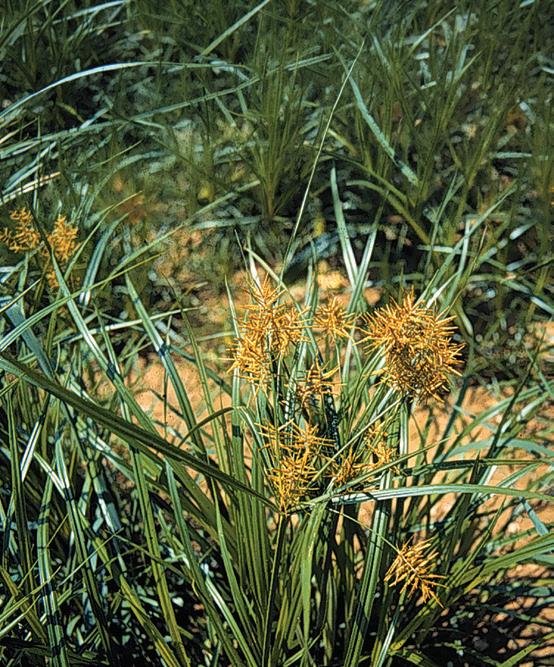
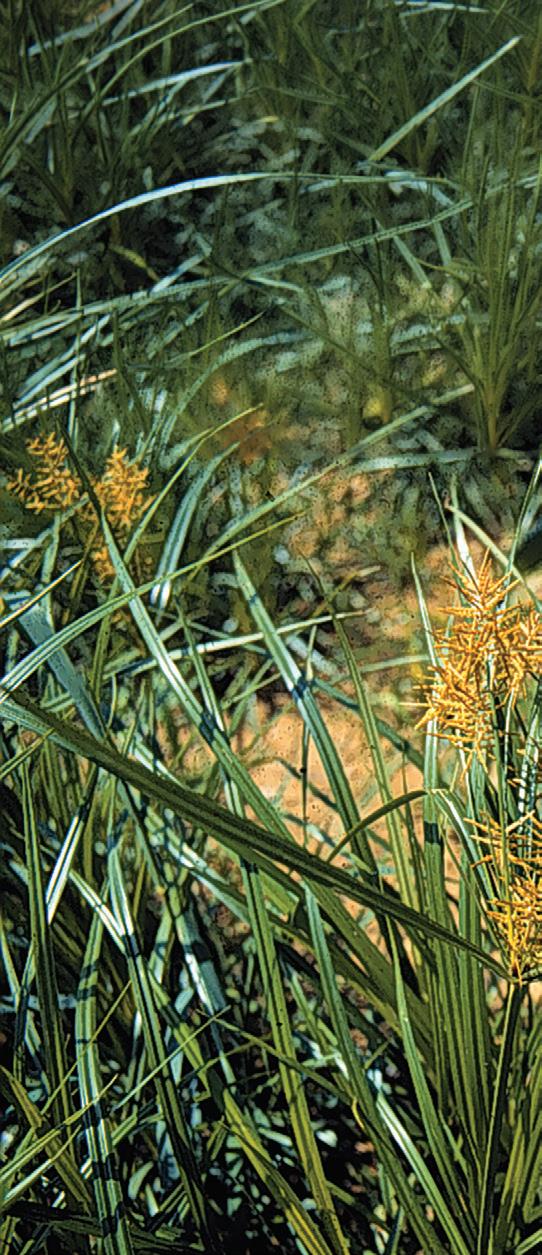
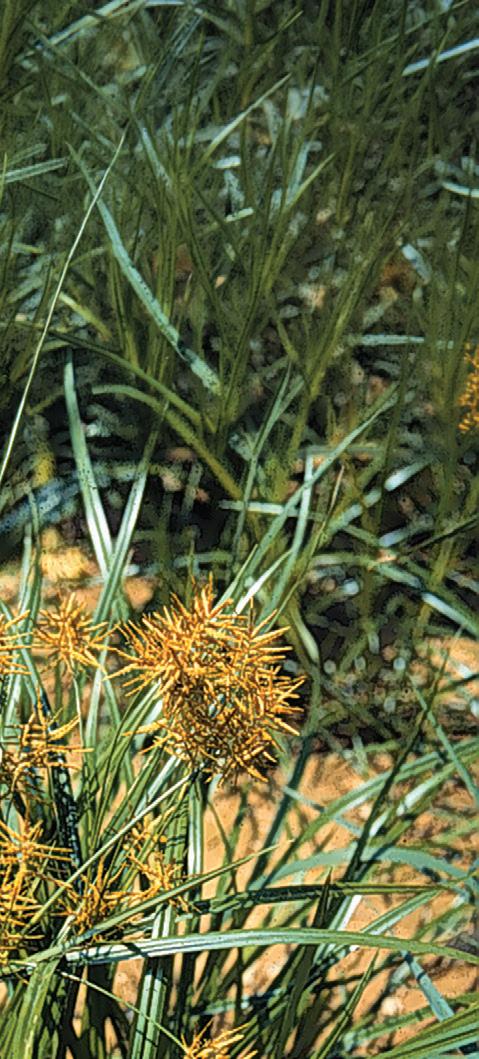
The most common sedge infesting turfgrass and ornamental beds is yellow nutsedge, a weed that occurs throughout Virginia. Yellow nutsedge is a perennial that spreads primarily through vegetative means. Rhizomes produce roughly ¼ to ½ inch long, tan to brown tubers in summer and fall. These tubers overwinter and then send up new shoots in the spring. Above-ground parts of the plant die with a killing frost. Although yellow nutsedge will produce seed, it does not appear to be an important factor in the spread of this species. Leaves are shiny and yellowish-green (Figure 1).
Purple nutsedge, similar to yellow nutsedge, also is an herbaceous perennial that spreads by tubers and rhizomes. Leaves of purple nutsedge tend to be darker green than yellow nutsedge. The tubers are the same size as those for yellow nutsedge but are dark brown or purplish brown. Tubers of purple nutsedge have a bitter taste while those of yellow nutsedge have a sweet or almond-like flavor. Purple nutsedge has a purplish-brown seedhead, while yellow nutsedge has a, well, yellow seedhead. In a turf situation, however, you probably will not see the seedheads of either species, especially in frequently mowed sites, but seedheads would develop in ornamental beds if uncontrolled. Yellow nutsedge leaf blades have a long, sharp point while purple nutsedge has a blunt tip. However, this also may not be apparent in a mowed situation.
Why is it important to tell yellow from purple nutsedge? Certain herbicides, such as bentazon, mesotrione, metolachlor, and sulfentrazone, are more effective on yellow than purple nutsedge, while other products work well on both species, such as halosulfuron. Purple nutsedge is predominantly a problem in southeastern Virginia. Purple nutsedge is found predominantly in the South while yellow nutsedge is found essentially throughout the contiguous 48 states.
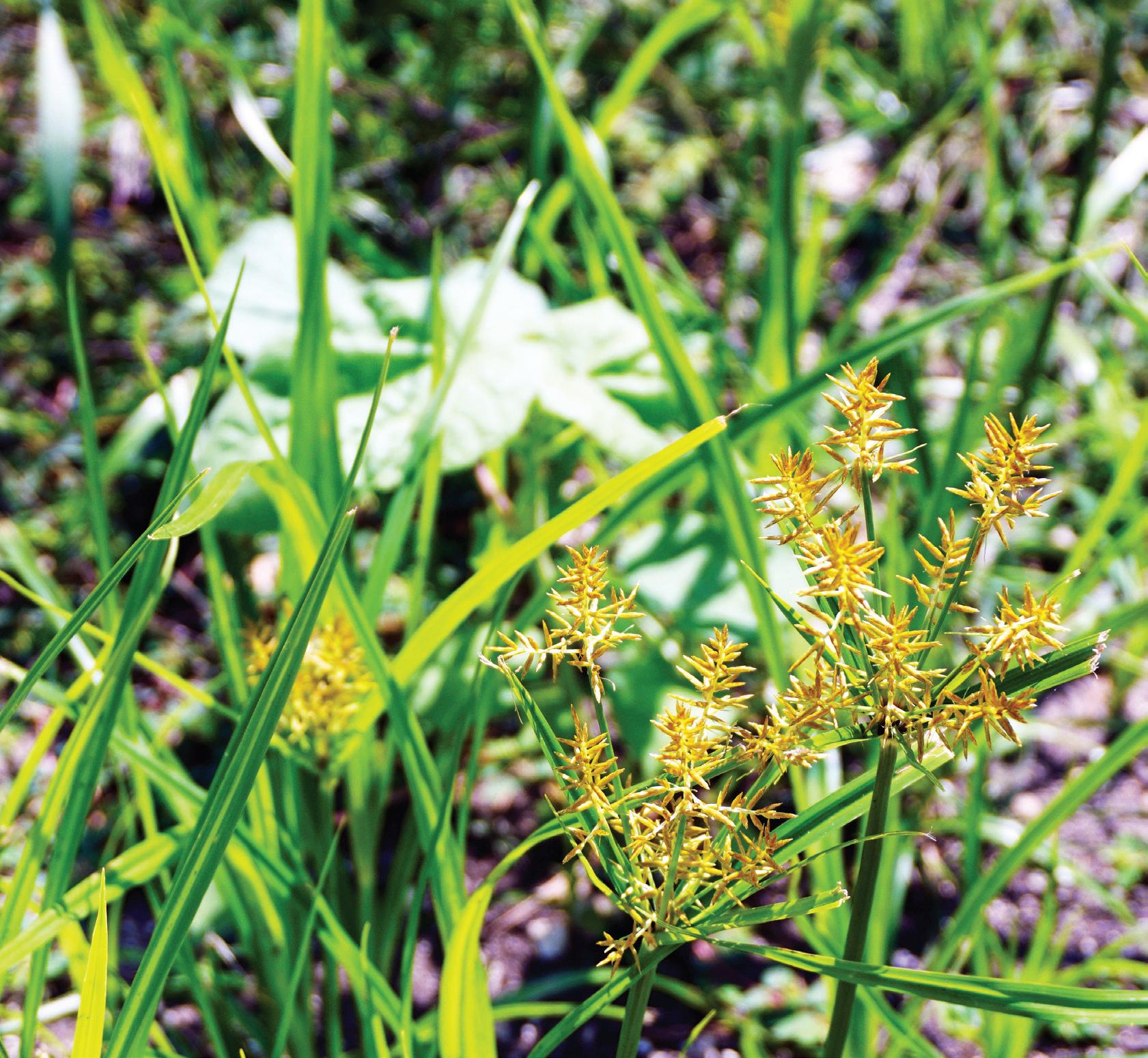
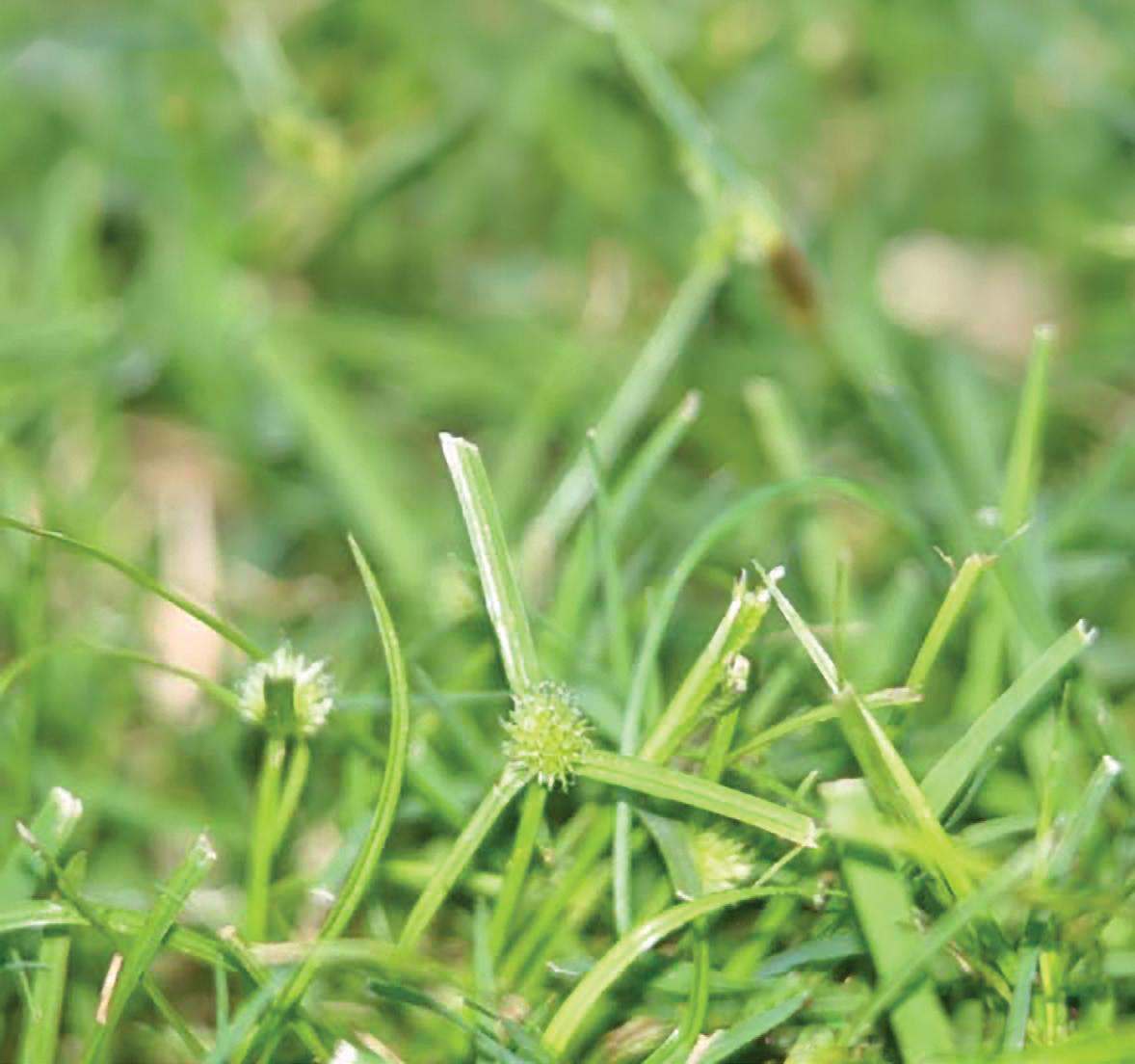
Another sedge group that has spread rapidly in Virginia is kyllinga. To me, kyllinga in bloom looks like a green ball about the size of a pea sitting on 3 green leaves ( Figure 2 ). There are both annual and perennial kyllinga species but the ones of greatest concern are the perennials green and false green kyllinga. Kyllingas will also have a triangular stem but lack the tubers formed by yellow and purple nutsedge. The perennial kyllingas spread not only by rhizomes, but readily by seed, probably a factor in their spread, as they can flower below mowing height. We grow false green kyllinga by seed for our trials. Chemical control for kyllingas is very similar to that for yellow nutsedge.
The primary annual sedge that I have seen in turf areas is compressed sedge. Rice flatsedge is an occasional annual weed in container production. We had fragrant flatsedge come in as a contaminant in plants I purchased from down south and it has been the most aggressive grower of the sedge species we have evaluated. These three sedge species spread strictly by seed and thus are easier to control than perennial sedges.
Figure 2. False green kyllinga spread by seed as well as by rhizomes.
Figure 1. Yellow nutsedge has shiny, 3-ranked leaves and yellow seedheads.
Factors favoring growth of sedges
Sedges grow best in warm temperatures, moist soil, and high sunlight. I usually do not see yellow nutsedge emergence until early April or later, depending on how quickly it warms up in the spring. Yellow nutsedge grows best in May through August, similar to that for bermudagrass. The sedges are not necessarily that much more competitive than turf species, but they can rapidly take advantage of any openings in the canopy. I always remember one of our former students who was working on halosulfuron when it was being developed. He had trouble getting yellow nutsedge to establish in his Kentucky bluegrass plots but where he killed out the bluegrass for his plot borders, he saw a nice straight line of yellow nutsedge in the killed strips!
One problem with managing yellow and purple nutsedge is tuber dormancy. Not all tubers send up shoots at the same time. Some shoots will emerge in May, some in June, and some in July. Also, some tubers may not send up shoots until the following year or two. Most tubers are viable for only 2 to 3 years, but some can remain viable for 10 years or longer. So if one has an established stand of yellow or purple nutsedge they wish to eradicate, it will be a multi-year project. Even if you achieve 100% control in a season, you probably will see nutsedge emergence the following year.
Cultural Control of sedges
Maintaining a thick stand of turf will help restrict the development of sedges, especially in the spring when nutsedge shoots emerge from the underground tubers. Overseed and fertilize cool season grasses in the fall to have a thick, competitive stand when sedges resume growth in late spring. Avoid scalping turf as this opens up the canopy for invasion by sedges,
crabgrass, and other weed species. Control insect and disease pests to prevent thinning of the turf. Avoid overwatering turf and ensure proper soil drainage to prevent excessively wet soil. Monitor new sod or ornamental plant installations to insure that nutsedge or kyllinga has not hitchhiked along with the sod or nursery plants.
Avoid any stress that adversely affects turf growth. I always think of a turf situation I was asked to investigate. They had applied fluazifop in a backpack sprayer for bermudagrass control in tall fescue. Not only was the bermudagrass controlled, so was the tall fescue. It is hard to determine a spot-treatment rate of fluazifop that will be safe in tall fescue. They reseeded and ran the irrigation frequently in summer, which led to an excellent stand of compressed sedge. The cause of the sedge infestation was the initial turf damage caused by improper herbicide application.
Yellow nutsedge is hard to control using hand weeding as plants can break at the soil line, leaving the underground tubers and rhizomes. Tilling can spread the tubers, increasing the area of infestation.
Chemical control of yellow nutsedge
Learn the active ingredients listed in Tables 1 and 2. Some of these herbicides are sold in combination with other herbicides but I have only listed single active ingredient products that we have tested. There are a number of combination products that contain a sedge herbicide but also other herbicides for either broadleaf or grass control. For example, Sublime contains mesotrione, triclopyr, and dicamba. If you know the active ingredients, you will have a good idea as to how that combination product will perform.
Table 1. Postemergence herbicides for yellow nutsedge control in cool-season turf and tested at our research station.
1). Preemergence control in turf
I frequently am asked about the availability of preemergence herbicides for nutsedge control. Actually, I prefer postemergence applications for yellow nutsedge control since this weed usually occurs in patches and thus fits well into spot-treatment programs. The problem with a preemergence application is that one would have to treat the entire lawn since the chemical must be applied prior to sedge emergence, unless one mapped out the previous year exactly where nutsedge was growing in a turf stand. The other reason favoring postemergence control of nutsedge is that few preemergence chemicals are available for turf use. Some postemergence herbicides, such as halosulfuron (SedgeHammer, Prosedge), mesotrione (Tenacity), and sulfentrazone (Dismiss) do have a degree of preemergence control, but I consider that a bonus following postemergence application.
In bermudagrass, zoysiagrass, and certain other warm-season grasses, there are registrations for Pennant Magnum, Tower, and FreeHand for residual control of yellow nutsedge. These herbicides are much more effective on yellow compared to purple nutsedge and have generally short residual control. Also, we have seen delayed greenup with this group. However, we do use these products in ornamental beds.
2). Preemergence control in ornamental beds
We do focus on preemergence herbicides in ornamental beds due to general lack of selective postemergence herbicides for overtop use. Products to consider include metolachlor (Pennant Magnum) and dimethenamid (Tower), both of which are oil-based formulations and thus should be applied as a directed spray, as well as the granular herbicide FreeHand, which contains
dimethenamid plus pendimethalin. FreeHand is probably a good choice for most landscape bed situations. It can be applied to certain annual flowers (but not begonia) and a wide range of perennials and woody ornamentals. Apply in March or in early April in eastern Virginia and a little later in western parts of the state. Reapply about 6 or 8 weeks later to extend the length of yellow nutsedge control.
3). Postemergence control in cool-season turf
I have divided up the herbicides to ones registered for use in tall fescue, Kentucky bluegrass, and perennial ryegrass (Table 1) and those registered for use in bermudagrass and zoysiagrass (Table 2). I have listed the trade names we have tested. You may find other trade names for these active ingredients. The two tables cover the primary treatments available for sedge control in turfgrass. The same herbicides that are used for yellow nutsedge control in turf are utilized for kyllinga control. MSMA is not included as it is only registered for use in golf, sod production, and highway rights-of-way.
Bentazon and sulfentrazone are the fastest-acting chemicals in this group, probably because they predominantly have a contact action. Injury symptoms in yellow and purple nutsedge can be seen within a few days of application, especially when applied under warm conditions. Repeat applications will generally be needed sooner for bentazon than the other products. For example, a second application of bentazon is generally made one to two weeks after the first one. We have found pyrimisulfan to be the slowest acting herbicide in this group of chemicals, with halosulfuron and imazosulfuron intermediate in speed of action. Of the pyrimisulfan products, we have seen better yellow nutsedge control with Arkon compared to Vexis.
bentazon
flazasulfuron
halosulfuron
imazaquin
imazasulfuron
mesotrione
sulfentrazone
sulfosulfuron
trifloxysulfuron
pyrimisulfan
Basagran
Katana
SedgeHammer, Prosedge
Scepter
Celero
Tenacity
Dismiss
Certainty
Monument, Recognition
Vexis, a granular product, and Arkon and Aethon, sprayable formulations
Table 2. Postemergence herbicides registered for use in bermudagrass and zoysiagrass and tested at our research station.
One benefit of mesotrione is that it can be used at seeding time or on young stands of cool-season turf. The other products generally can only be used on established turf.
We did a trial last year looking at the impact of simulated rainfall on yellow nutsedge control in our rain-out shelter. When we irrigated one hour or one day after a sulfentrazone application, we saw effective yellow nutsedge control, but control decreased when irrigation was withheld until one or two weeks after application. It appears root uptake is an important component of sulfentrazone’s activity against yellow nutsedge and thus rain or
irrigation is needed within a week after application. Halosulfuron gave excellent yellow nutsedge control, even when irrigation was withheld until one or two weeks after application.
We often grow yellow nutsedge in containers for control trials to supplement what we do in the field. In one container trial, we collected yellow nutsedge tubers that formed after herbicide application. Tubers were much smaller when plants were treated with halosulfuron or pyrimisulfan compared to sulfentrazone (Figures 3 and 4). This should result in less competitive yellow nutsedge in subsequent growing seasons.
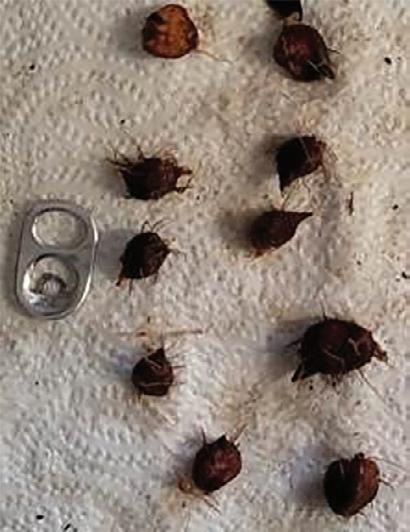
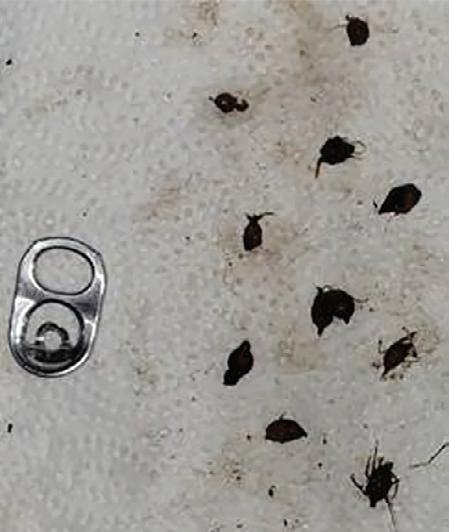
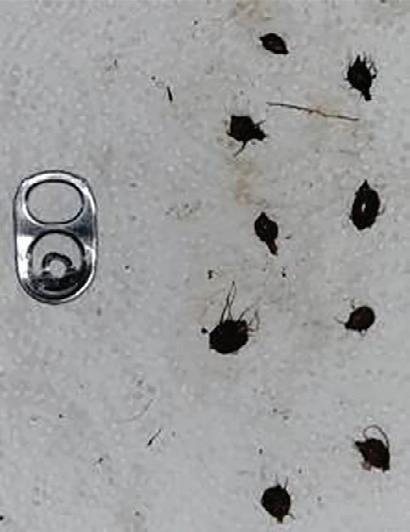
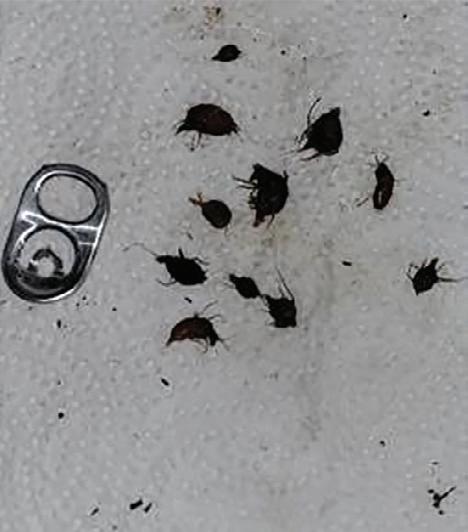
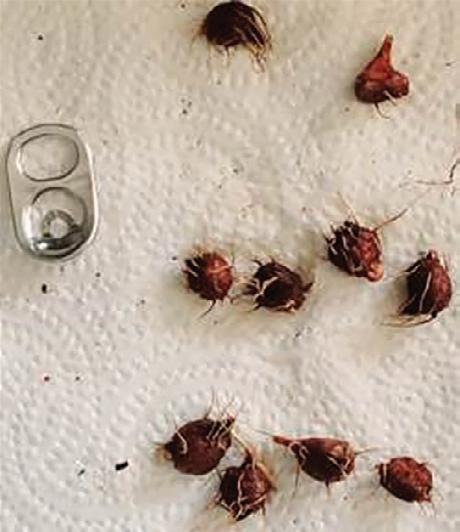
Figure 3. Yellow nutsedge tubers from untreated (left) and pyrimsulfan – (center and right) treated pots.
Figure 4. Yellow nutsedge tubers from untreated (left), halosufuron-treated (middle), and sulfentrazone-treated pots (right).
Bentazon and sulfentrazone are much more effective on yellow compared to purple nutsedge. This shows why we need to identify these two species. One needs to address purple nutsedge differently than yellow nutsedge. Halosulfuron and imazosulfuron are equally effective on yellow and purple nutsedge. Work by other researchers suggests imazosulfuron is the most effective treatment for false green kyllinga (Dr. Matthew Elmore, Rutgers University). We also have seen good control of false green kyllinga with imazosulfuron.
Sulfentrazone is sold in combination with other herbicides, such as with prodiamine under the trade name Echelon. Sulfentrazone is a component of combination herbicides Surge, Q4Plus, and Avenue South but the concentration of sulfentrazone is lower than in Dismiss, resulting in more suppression than control of yellow nutsedge.
One will generally add some type of adjuvant to these postemergence herbicides. Nonionic surfactants are generally recommended for most of these chemicals but check the label for instructions on adjuvant addition. Addition of a methylated seed soil or crop oil concentrate may increase toxicity of certain chemicals to nutsedge, but also may increase the potential for crop injury especially under hot, humid conditions. Read the product label for specific directions on adjuvant use.
Postemergence control in bermudagrass and zoysia
A number of the products are the same for warm-season grasses as for cool-season grasses, but mesotrione is not listed as it injures bermudagrass. Certain products used for removing cool-season grasses from warm-season turf are effective for controlling sedges are added, including flazasulfuron, sulfosulfuron, and trifloxysulfuron. Aethon was added to the warm-season list but not cool-season turf as it also contains penoxsulam, which can
injure tall fescue. Along with pyrimisulfuron, imazaquin, flazasulfuron, sulfosulfuron, and trifloxysulfuron are slower-acting herbicides since they are systemic in plants and travel to the growing points. Imazaquin has been less effective in our trials for yellow nutsedge control than the other herbicides listed. Flazasulfuron, halosulfuron, sulfosulfuron, and trifloxysulfuron will control both yellow and purple nutsedge.
Postemergence
nutsedge control in ornamentals
Around trees and shrubs, directed sprays of bentazon, halosulfuron, or sulfentrazone can be applied for yellow nutsedge control. Minimize contact with the leaves of the ornamentals. We do not have selective herbicides that can be sprayed overtop of
ornamentals plants for sedge control. Nonselective herbicides, such as diquat, glufosinate, or glyphosate can be applied for sedge control if kept totally off ornamental plant leaves. A common question I receive is how to control emerged yellow nutsedge in liriope beds. We have seen injury from bentazon and halosulfuron, especially in variegated types, although plants outgrew the damage, and we observed reduced flowering from halosulfuron. Best to utilize preemergence applications of FreeHand to minimize the need for hand weeding or postemergence applications
Jeffrey Derr and Adam Nichols are based at Virginia Tech’s Hampton Roads Agricultural Research and Extension Center in Virginia Beach.
GRASS SO GREEN THAT WE NEEDED AN EXTRA “E”



BackOffice Software Built for the Field:
How EarthaPro Is Changing the Game for Small Green Industry Businesses
By Courtney, Co-Founder & Head of Growth, EarthaPro

IfAbove: The EarthaPro dashboard gives operators a real-time view of tasks, invoices, and weekly revenue from any device.
you run a small lawn care or turfgrass operation in Virginia, you already know the job does not end when the trailer drops the ramp at the end of the day. It moves indoors, to invoices that need to go out, schedules that need updating, and customer records that live in a notebook somewhere in the truck. For years, green industry professionals have made do with tools that were not built for them: generic accounting software, whiteboard schedules, and spreadsheets that multiply faster than crabgrass.
EarthaPro was built to change that. It is a back-office software platform designed specifically for small lawn care, landscaping, and pest control businesses, and it is now available at every budget level, including a free tier for operators who want to get organized before spending a dime.
“I made the switch to EarthaPro from LMN and it is one of the best decisions I have made for my business. I get paid faster, everything is organized, and for the first time the software actually feels like it was built for someone like me.”
Andrew, lawn care operator, St. Louis, MO
Built for Small Teams, Not Corporate Suites
The typical EarthaPro customer runs a business with one to five employees. They are owner-operators who got into the trade because they love the work, not because they wanted to become software administrators. Most have been juggling QuickBooks and a handwritten schedule for years, and the back-office burden grows as their customer base expands.
EarthaPro was designed from the ground up for businesses that do not have time to learn a complex system. The interface is mobile-first, setup is fast, and new users are paired with a free onboarding call so they are running on day one, not still figuring out the software.
Chemical Tracking: A Feature That Actually Matters
What EarthaPro Handles
So You Do Not Have To
At its core, EarthaPro handles the back-office functions that small field service businesses lose the most revenue to: scheduling, invoicing, payment tracking, and customer record management. With EarthaPro, operators can send invoices immediately after a job is done right from their phone on the job site, see unpaid invoices at a glance, and track job profitability without building a spreadsheet.
For Virginia turfgrass and lawn care professionals, chemical application recordkeeping is not optional. It is a regulatory requirement. Many small operators are still handling this with paper forms that get lost or damaged in the field. EarthaPro’s chemical tracking logs application records digitally, tied directly to the customer and job record. When a client asks what was applied to their property last season, the answer is a few taps away. For pest control operators, this documentation also builds professional credibility and holds up to regulatory scrutiny.
It is one of the areas where EarthaPro most clearly distinguishes itself from generic business software. Platforms that were not built for the green industry simply do not think about chemical logs. EarthaPro treats it as a core feature.
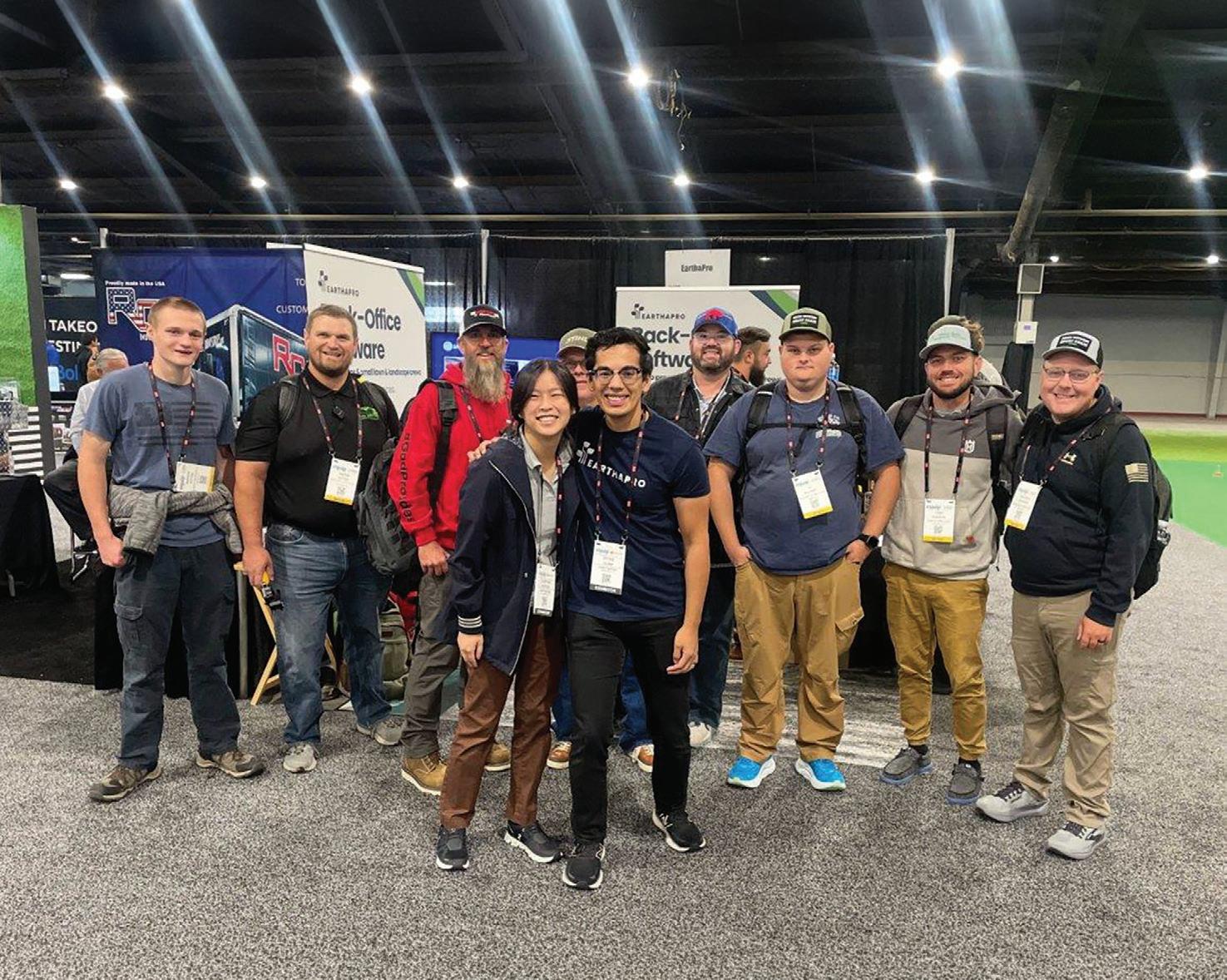
Above: The EarthaPro team connecting with green industry professionals at Equip Expo 2025.
Plans for Every Stage of Your Business
EarthaPro now offers three tiers so operators can start wherever makes sense for their business and grow from there. The Free tier gives solo operators access to core tools at no cost, making it easy to get organized before committing to a paid plan. The Solo Package is built for one-person operations ready to run more professionally, and the Pro Package is designed for growing businesses that need multi-user access, QuickBooks integration, route optimization, chemical tracking, automatic batch invoicing, and hands-on support. See the full feature comparison below.
Why This Matters for Virginia Turfgrass Professionals
Virginia’s lawn care and turfgrass market is competitive. The operators who are winning are the ones who have their operations dialed in. That does not mean they have the biggest crews or the fanciest equipment. It means they know what they billed, what they collected, and what each job actually cost them. EarthaPro exists to give small operators that same operational clarity without the complexity or the price tag that comes with enterprise software.



BUILDING THE TURFGRASS MANAGER PIPELINE:
A Call for IndustryAcademic Partnership
By Jay McCurdy

The
larger turfgrass and landscape industry has a labor issue—mainly that there’s not a reliable pipeline for accessing young and capable employees. I have this conversation almost weekly when discussing the state of the industry and how my role in a “turfgrass program” relates. I’m now in my 12th year at Mississippi State University, so I no doubt have some ownership of the problems. But I also wanted to relay to a wider audience just what some of the solutions might be to solve this problem. Yes, higher industry pay might help, but there’s more to the story than just that.
Our landscape management industry includes a broad range of job titles, but most of us reading this magazine are either bootson-the-ground landscape managers (ex. superintendents, lawn care professionals, sports field managers, sod producers, equipment managers, etc.) or are somehow involved in the industry/ supply side (sales, accounts, research and development, chemical, equipment, etc.). We know the technical mastery and skill required to do this job. We know the rewards and challenges. Nevertheless, I find the perspective from academia is often a little different from what it was when I was a practitioner.
We are all concerned about a shrinking pipeline of new professionals entering our field. Turfgrass academic programs are often criticized for producing too few graduates, and those graduates are said to be underprepared for the demanding, multifaceted roles that await them. The same is said for students fresh out of high school. There’s always a debate about whether it’s generational or whatnot. Maybe there’s something to that, but what, pragmatically, can we do to figure all this out?
The issue is more complex than a simple academic shortfall. The challenges facing turf programs reflect deeper structural and cultural dynamics within the larger society, as well as within the green industry and our academic institutions. I think we need to embrace a new model of mutual investment between academia and industry in order to restore vitality and sustainability to the profession. Whatever the model, it must redefine recruitment, enhance the talent pool, and demonstrate that green-industry roles are both professionally rewarding and personally sustainable.
This essay outlines a vision for such a partnership, built on five key principles: shared recruitment, broader inclusion, job-quality reform, experiential learning, and a mutual commitment to long-term workforce development.
The Myth of the One-Way Pipeline
Turfgrass academic programs are too often viewed as workforce development pipelines. In this paradigm, universities are expected to “turn out” graduates who are job-ready, immediately employable, and long-term loyal to the industry. These are ambitious goals that can only be achieved through industry partnerships. Universities cannot solve structural labor shortages in isolation. For starters, the looming demographic cliff, where student enrollment drops due to fewer babies having been born ~18 years ago, is self-evident. We have to reframe the relationship as a two-way street: industry leaders and employers must engage as co-investors in the success of the next generation.
The declining number of turfgrass students is not solely a turf problem—it mirrors trends across many science, technology, engineering, agriculture, and mathematics (STEAM) disciplines. Yet in turf, the impact is more acute. Fewer students are entering, and those who do are frequently drawn away by careers with higher salaries, greater mobility, and more stable work-life balance—fields like wildlife biology, ecology, food science, and agricultural engineering. If return on investment (ROI) for college interests you, I highly recommend Preston Cooper’s Is College Worth It? A Comprehensive Return on Investment Analysis article.
If the green industry wants to retain talented, committed professionals, it must work with academic programs to create clearer, more appealing, and more stable career pathways for students entering the field.
Recruitment: A Shared Responsibility
One of the most common critiques from green industry professionals and hiring managers is that turf programs are not doing enough to recruit students into the field. In truth, recruitment cannot be the sole responsibility of faculty or universities. Few high school students grow up dreaming of becoming a golf course superintendent, especially if they’ve never been exposed to the role or the science behind it. Lots of kids grow up mowing lawns, but do they view that as a stable profession? How many golf course superintendents leave the industry for better working hours or more stable family lives? The stories of our profession are not always positive. How do we improve that?
Meaningful recruitment requires visibility, storytelling, and early engagement. That means:
• Hosting and organizing Golf Course Superintendents Association of America’s (GCSAA’s) STEAM program, First Green

• Industry professionals visiting high schools, FFA programs, and 4-H events to talk about careers in turf and to give hands-on help managing facilities.
If we want to build a workforce that reflects the broader demographics of our society, the turfgrass industry must actively recruit from historically underrepresented communities, including women, students of color, and first-generation college students. Many turf programs sit within land-grant institutions with a mission to serve all citizens of their state. Partnerships with historically Black colleges and universities (HBCUs), tribal colleges, and community colleges offer promising avenues for talent development.
Additionally, the industry must take steps to ensure that students from diverse backgrounds are not only recruited but also retained. That means:
• Paid internships with real mentorship, not just summer labor. This is something our industry does well. Though pay and working conditions could always be improved, I understand the financial realities for most businesses— margins matter, and you can’t pay a 20-year-old more than your loyal long-time employees.
• Hosting youth days, career shadowing, or field trips in coordination with FFA, agricultural teachers, 4-H, and Extension educators.
• Alumni sharing their stories, not just of agronomic challenges overcome, but of career development, family stability, and lifelong learning.
Academic programs can support these efforts with marketing materials, introductory coursework, event production, and advising. Industry partners can develop their own materials, and my academic colleagues and I would be happy to collaborate. But unless the industry is willing to support or do the work, recruitment will remain a leaky pipeline. The Golf Course Superintendents Association of America has promoted its First Green program and has invested heavily in promoting the profession to kids in FFA. This is a good example of how we might target youth to entice them into our profession.
Reaching the Future of the Profession
A second issue compounding recruitment challenges is the profession’s lack of demographic diversity (this isn’t a DEI discussion!). This is not simply a turfgrass issue; it reflects broader underrepresentation across many STEAM fields. However, the profession’s visual and cultural homogeneity isn’t always inviting to those from different socioeconomic or cultural backgrounds. That’s to say very little of the lack of female representation—it’s improving. Still, it lags considerably behind many other attractive career fields for the same candidate pool we are competing for.
• Scholarships and travel support to attend GCSAA and regional turfgrass conferences. GCSAA and our regional events have done a great job supporting our students. Our state and regional associations have covered almost all the costs for our students attending events like Deep South. GCSAA allows students and academic advisors to attend the Golf Show for free. They allow students to be members for free. We just have to cover flight and meal costs—sell more hats and pullovers!

• Storytelling campaigns that highlight successful professionals in our industry. Barry Stewart hosts MSU Turf Seminar speakers, and I’m sure he’d love to hear from those of you who can share your secrets to success and happiness.
If the profession remains perceived as culturally insular or exclusionary, we will continue to miss out on a generation of bright, capable professionals who simply chose other welcoming fields.
Students attending local and national conferences benefit from the wisdom and experience of generations of turfgrass managers.
Career Quality: The Hidden Cost of Turnover
Recruitment efforts alone are not enough if the jobs themselves are perceived as undesirable. One of the most pressing challenges facing the green industry is career sustainability and burnout Even for students who graduate from turf programs and enter the profession, the early-career reality can be discouraging.
Starting roles are often physically demanding, geographically isolating from home, and poorly compensated relative to the skill and responsibility required. I won’t disagree: early careers are hard in many professions, and ours has a history of heartiness and resilience that we pride ourselves on. And that’s great, but let’s face it, positions frequently involve long hours, especially in golf and sports fields, weekend shifts, and high turnover. Relocation is common, placing strain on young professionals with families or community ties. Burnout is not only likely, but it’s also all too often expected.
In many cases, internships play a decisive role. While some students have transformative experiences, others emerge disillusioned. Internships are often where students determine whether they see a long-term future in the profession. Unfortunately, too many internships treat students as temporary labor rather than future colleagues.
Our profession must take a hard look at its entry-level roles and ask:
• Are we investing in mentorship or extracting labor?
• Are we helping build careers or merely filling seasonal gaps?
• Are we creating a profession that values work-life balance and career advancement?
Until the industry addresses these questions honestly, retention will remain low, and turf programs will struggle to retain students who see more stable options elsewhere.
Experiential Learning and Academic Alignment
To ensure that students are prepared for professional success, universities must evolve as well. Turfgrass programs must incorporate not only plant science and weed control, but also:
• Business management and budgeting
• Communication and conflict resolution
• Human resources and leadership
• Sustainability, data analytics, and emerging technologies
Faculty must engage in continuous dialogue with industry professionals to align curricula with real-world expectations. This can happen through advisory boards, curriculum reviews, and co-developed experiential learning opportunities.
Meanwhile, the industry must treat internships and co-ops as educational experiences, not just temporary employment. Golf courses that offer structured mentorship, performance feedback, and leadership development will not only see better short-term productivity, but they’ll also help shape the long-term workforce of the profession.
The Role of Associations
The Sports Field Management Association (SFMA), GCSAA, and other professional landscape associations have a unique opportunity to lead systemic change. Many in the industry look to them for guidance, advocacy, and professional standards. But as organizations, they can:
• Develop and promote best practices for internship mentorship
• Recognize organizations that invest in student development
• Partner with academic programs on workforce development grants
• Support early-career professionals through networking and continuing education
Just as importantly, associations must continue to help shift cultural expectations within the profession. That means promoting superintendent and field manager roles as executive leadership positions, not just agronomic technicians. It means celebrating the intellectual and managerial skills required to succeed in this career, and advocating for compensation, stability, and respect commensurate with those demands.
Learning from Other Industries
Much can be learned from adjacent fields. Engineering, for example, has long faced similar challenges: rigorous academic programs, intense internships, and high attrition. Yet leading companies and associations in that field have invested heavily in university partnerships, student engagement, and early-career support.
Top manufacturing and technology firms fund campus recruiting, sponsor capstone projects, offer paid site visits to facilities, and offer career ladders with clear promotion timelines. These students, like our own, are not afraid of hard work. They are attracted by clear career outcomes and structured support along the way.
There is no reason the green industry cannot offer the same. But doing so requires a shift in mindset: from “you have to earn your place” to “we will invest in you as the future of our profession.”
A Vision for the Future
In many places, these goals are already occurring, but here are just a few to imagine as being widespread:
• High school students attend “turf career days” hosted by their local superintendent and Extension agent.
• Universities and employers codesign internships that develop not just technical skills, but leadership and confidence.
• Interns feel welcomed and valued from their first day on a golf course.
• Assistant superintendents are mentored, paid fairly, and see clear paths to advancement.
• Associations and turf programs work side by side to tell the story of a modern, rewarding profession.
This future is not only possible but also essential. The alternative is the status quo, or worse, decline: fewer students, fewer assistants, more burnout, and an aging workforce with no one ready to take the reins.
Conclusion: A Call to Shared Action
The challenges facing the profession are real, but they are not insurmountable. What is required is not blame, but shared responsibility. Universities must modernize curricula and deepen student support. Turfgrass managers must invest in mentorship and help reshape early-career roles. Our industry associations must lead with vision, coordination, and advocacy.
Ultimately, this is about stewardship of the profession itself. The same care, foresight, and commitment that turfgrass managers bring to managing turf must now be brought to cultivating the future of the workforce.
Fine and Tall Fescue
Regular and Shortcut Bluegrass
Kevin Driscoll Cell: 609-760-4099 | Office: 856-769-9555
KDriscoll@EastCoastSod.com
The author would like to thank Barry


Stewart for his suggestions and edits to this article.