Vol. 27/NO. 3
Fall 2026
The Official Publication of The Tennessee Nursery and Landscape Association
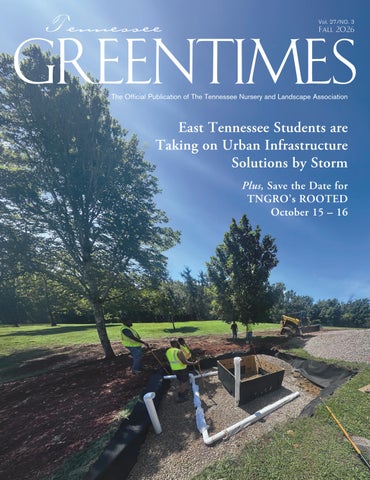
East Tennessee Students are Taking on Urban Infrastructure Solutions by Storm Plus, Save the Date for TNGRO’s ROOTED October 15 – 16
0
% 60 + 7 year *
warranty
FOR MONTHS
= predictable payments / better cash flow on compact construction equipment
request a quote
EAST KNOXVILLE WEST KNOXVILLE
CHATTANOOGA
CROSSVILLE
SEVIERVILLE
TRI-CITIES
MCMINNVILLE
865.546.1414
423.698.6943
931.456.6543
865.595.3750
423.323.0400
931.314.2291
865.218.8800 @STOWERSCAT
@STOWERSCAT
@STOWERS_MACHINERY
STOWERS MACHINERY CORPORATION
STOWERSCAT.COM
Vol. 27/NO. 3 • Fall 2026
The Official Publication of The Tennessee Nursery and Landscape Association
C O V ER ST O RY East Tennessee Students are Taking on Urban Infrastructure Solutions by Storm
10
FEA TURE Economic Corner – Key Economic Factors Impacting the Green Industry
14
U PC O MI NG E V ENT S TNGRO’s Rooted............................................................................................................. 8 TNLA Golf Classic............................................................................................................ 9
DEPARTMENTS From the President............................................................................................................ 6 TNLA Sponsors................................................................................................................. 6 News from TNLA.............................................................................................................. 7 Index of Advertisers......................................................................................................... 12
4
tennessee greentimes FALL 2026
FE A TU R E Rooted in Plants, Relying on Science, Designing for People
16
The Tennessee Nursery and Landscape Association serves its members in the industry through education, promotion and representation. The statements and opinions expressed herein are those of the individual authors and do not necessarily represent the views of the association, its staff, or its board of directors, Tennessee Greentimes, or its editors. Likewise, the appearance of advertisers, or their identification as Tennessee Nursery and Landscape Association members, does not constitute an endorsement of the products or services featured in this, past or subsequent issues of this quarterly publication. Copyright ©2026 by the Tennessee Nursery and Landscape Association. Tennessee Greentimes is published quarterly. Subscriptions are complimentary to members of the Tennessee Nursery and Landscape Association. Third-class postage is paid at Jefferson City, MO. Printed in the U.S.A. Reprints and Submissions: Tennessee Greentimes allows reprinting of material. Permission requests should be directed to the Tennessee Nursery and Landscape Association. We are not responsible for unsolicited freelance manuscripts and photographs. Contact the managing editor for contribution information. Advertising: For display and classified advertising rates and insertions, please contact Leading Edge Communications, LLC, P.O. Box 246, Brentwood, TN 37024.
North Pole Arb
Franklin’s Gem Boxwood
China Girl Holly
Emerald Green Arb
Sullivan Cypress
Winterthur Viburnum
Excelsa Arb
Member of the Boxwood Blight Cleanliness Program with University of Kentucky. OFFICE PHONE: 606-346-0863 • FAX: 606-346-2139 • MIKE’S CELL: 606-706-1620 EMAIL: brownsnursery@yahoo.com
Green Giant & Nigra Arbs
Sprinter Boxwood
American Boxwood
Gem Box Inkberry
Nova Taxus
Uptight Boxwood
Green Mtn. Boxwood
Green Gem Boxwood
Steeds Holly
Popcorn Viburnum
Chicagoland Green Boxwood
Hicksi Taxus
Firelight Hydrangeas & Sprinter Boxwoods
Densiformis Taxus
Pragense Viburnum
Polar Gold Arb & Sky Pencil Holly
Wintergem Boxwood
MIKE BROWN’S WHOLESALE NURSERY, LLC. • 525 HOLTZCLAW LANE • HUSTONVILLE, KY 40437
From the President Sam Kinsey
I
hope this finds everyone well. We have had a pretty wet summer here in East Tennessee. I think in the last letter I asked for just the right amount of moisture, we may be past that a little bit. I know I can’t hardly keep up with my grass. We just had our first TNLA Legislative Luncheon. I believe that it went well and everyone in attendance found it to be a good event. We had a good turn out of members and legislators, UT extension, and TDA representatives. Look for that event in future years to come.
TNLA would like to thank the following companies for being Membership Sponsors
GOLD Membership Sponsors Barky Beaver BASF Blankenship Farms and Nursery Boyd & Boyd Nursery BWI of Memphis Cam Too Camellia Nursery, Inc. Carpe Diem Farms Douglas & Lanier Agency Drees Plant Wholesalers Farm Credit of Mid-America Flower City Nurseries H & R Agri-Power Farm & Turf Haller’s Landscaping & Nursery, Inc. Home Nursery, Inc. Lawn Doctor Legacy Labor Mid-South Nursery Mike Brown’s Wholesale Nursery Nashville Landscape Systems NYP Pirtle Nursery, LLC Randall Walker Farms Riverbend Nurseries, LLC RJV Equipment Swafford Nursery Tennessee Valley Nursery, Inc. TN Wholesale Nursery Triangle Nursery, Inc. Warren County Nursery, Inc. Youngblood Farms, LLC
SILVER Membership Sponsors Botanico, Inc. Dayton Bag & Burlap Co. GreenForest Nursery Kinsey Gardens, Inc. Old Courthouse Nursery Rusty Mangrum Nursery
6
tennessee greentimes FALL 2026
The TNGRO’s Rooted trade show is just around the corner. The booths are filling up, but we can always make more room. If you want to show, please contact us soon. Our trade show committee has been working to bring in more visitors than ever. We have done more marketing this year than ever before and are expecting a great turnout. The best marketing we can do is through our members spreading the word, so continue to get the word out. Help us make this show a success. The TNLA Board is also looking for a Third Vice President to join the board in 2027. If you or someone you know may be interested, please contact our office at (931) 473-3951 or mail@tnla.com.
The Tennessee Greentimes is the official publication of The Tennessee Nursery & Landscape Association, Inc. 115 Lyon Street McMinnville, TN 37110 (931) 473-3951 Fax (931) 473-5883 www.tnla.com Email: mail@tnla.com Published By Leading Edge Communications P.O. Box 246 Brentwood, TN 37024 Email: info@leadingedge communications.com Editors Dr. Bill Klingeman Dr. Amy Fulcher Associate Editors Dr. Karla Addesso Dr. Becky Bowling Dr. Midhula Gireesh Dr. Nar Ranabhat TNLA Officers President Sam Kinsey Kinsey Gardens
The golf tournament will be on October 2nd at McMinnville Country Club. Please get your teams and sponsorships in soon. If you don’t have a whole team, don’t worry we will help get you on one. I am looking for a team, so contact the office if you want to play.
1st Vice President Trista Pirtle Pirtle Nursery
Football season is just around the corner, so that means cooler weather is also coming. I can say that I am ready for fall. Go Vols!”
3rd Vice President Keith Youngblood Youngblood Farms, LLC
Sam Kinsey
Secretary-Treasurer Bryan Tate Mid-South Nursery
TNLA President
TNGRO’s Rooted Trade Show
2nd Vice President Jason Peace Home Nursery, Inc.
Associate Director Eli Eldridge EBE Land Services
Lebanon, TN
Ex-Officio Ozzy Lopez Ozzy’s Lawncare and Hardscape Services
TNLA Golf Classic
Executive Director Danae Bouldin
October 15 – 16, 2026
October 2, 2026 McMinnville, TN
Assistant Director Blake Higgins
News from TNLA
Calling All Producers:
Water Issues Affecting Your Nursery By Amy Fulcher, Extension Specialist and Professor, University of Tennessee Anthony V. LeBude, Extension Specialist and Professor, N.C. State University
Cold Hardy Zone 6 | Cold Tolerant Zone 7 | New Hybrids Zone 8 & 9 Liners and 1, 3, 5, 7 | 15 and 20 Gallons Available | Wholesale Only
Sarah A. White, Extension Specialist and Professor, Clemson University
(800) 758-8121 | CamTooCamellia.com 805 OAKBURY COURT | GREENSBORO, NC 27455
We
are embarking on the third “Next Ten Years: Strategic Vision of Water Resources for Nursery Producers”, which began in 2004 and was last updated in 2016. We aim to capture current trends in water availability, water quality, and irrigation technologies. We recognize that this white paper is only as good as the information that we receive from nursery producers. Please help us accurately reflect real-world issues surrounding this critical nursery resource! The survey is only 3 questions and takes less than 5 minutes! Your response is anonymous.
tennessee greentimes FALL 2024
7
Upcoming Events
8
tennessee greentimes FALL 2026
tennessee greentimes FALL 2026
9
Cover Story
East Tennessee Students are
Taking on Urban Infrastructure Solutions by Storm By Jaq Payne, Kayla Stuart, Aoife Whitaker, Dr. Sharon Jean-Philippe (UT School of Natural Resources), and Dr. Jon Hathaway (UT Civil Engineering)
Table 1. A list of tree species that, depending on site-specific conditions, can be good candidates for use in Gravel Tree Stormwater System (GTSS) installations. Shade tolerance*
Mature height*
Mature width*
River birch (Betula nigra)
Full sun
30 – 40 ft
20 – 30 ft
Bald-cypress (Taxodium distichum)
Full sun, part sun / shade
50 – 70 ft
20 – 30 ft
Tree Species
Swamp white oak (Quercus bicolor)
Full sun
50 – 60 ft
50 – 60 ft
Sweetgum (Liquidambar styraciflua)
Full sun
60 – 75 ft
40 – 75 ft
American sycamore (Platanus occidentalis)
Full sun, part sun / shade
75 – 100 ft
50 – 70 ft
Further research is needed to confirm the viability of each species. Current installations in TN include river birch (Betula nigra) and bald-cypress (Taxodium distichum). *Source = Morton Arboretum Tree and Plant Database (https://mortonarb.org/plant-and-protect/trees-and-plants/)
Figure 1. Example of an installed Gravel Tree Stormwater System (GTSS) beside an impervious asphalt parking lot.
Figure 2. Early process of GTSS installation with a lined, excavated pit filled with gravel and with inlet (white) and outflow (black) drainage piping.
10
tennessee greentimes FALL 2026
W
hen rain falls on Tennessee, we feel it. From flooded parking lots to basements filling with water, the stormwater rushes over compacted soils, cement, and asphalt, causing widespread damage to our infrastructure and homes. The causes and consequences are a complex problem, yet scientists and educators at the University of Tennessee, Knoxville (UTK) are working on a solution: the Gravel Tree Stormwater System, or GTSS (Figure 1). The team is also developing a place-based curriculum to help area-wide K-12 students understand the importance of the urban green infrastructure that surrounds us and learn about ways to improve the beneficial impacts of designed and enhanced features. These GTS systems are now being installed adjacent to parking lots, sidewalks, and other concrete or impervious surfaces at public parks, in right-of-way areas, and on school campuses. An example may be seen at the Holston River Park, in Knoxville, TN. Stormwater naturally moves from higher elevation parking lots and sidewalks into the GTSS (Figure 2, 3), where the water is slowed and filtered by a water-loving tree and the surrounding soil. From the GTSS, any excess water empties into a drainage area and flows into a nearby body of water (Figure 4). This process gives students a real-world example of the tangible ways that designed green infrastructure can reduce damage from stormwater and improve urban neighborhoods. Students will get to observe four major functions of the GTSS as selected trees (Table 1) grow in the built system at their schools (Figure 5): (1) The tree absorbs dissolved nutrients and other pollutants. It filters polluted runoff from heavy rains before it reaches nearby waterways. (2) Transpiration, or water release from the leaves of the tree, pulls water out of the soil. The drier soil holds more stormwater, increasing the stormwater storage capacity of the area the tree is planted in. (3) Stormwater flows through the built system rather than over steep soil slopes, reducing erosion. (4) Rainfall hits the leaves and branches of the canopy, reducing the intensity and allowing the GTSS and surrounding soil layer to absorb more stormwater.
The GTSSs that are installed on public school property will become part of everyday teaching and learning. The Urban Forestry team at UTK is building a locally-focused curriculum to help K-12 students understand how stormwater moves across our landscape. These future environmental stewards get hands-on lessons in why green infrastructure matters for stormwater in urban areas, and specifically in their neighborhood. “Students in urban environments often miss out on many opportunities compared to those in other areas, especially in environmental sustainability,” said Jake Albright, third-grade teacher at Green Magnet Steam Academy, one of the Knoxville public schools that are participating in the project. Public-school teachers give feedback during and after in-school educator training sessions. Their input has helped to shape the new curriculum that has to be adapted to different grade level sections and must meet Tennessee’s academic standards. Students get new science-based lessons that teachers can use inside and outside the classroom. The GTSS curriculum is divided into workbooks by grade level sections: K-2, 3-5, 6-8, 9-12. Each workbook comes with step-by-step instructions for each lesson, printable data collection sheets, and conversation and writing prompts that connect concepts with program objectives and core ideas. Student experiences include chemistry simulations of what compounds and pollutants stormwater picks up as it travels across parking lots and roads. Students can grow their own plants and use them to track how water affects root and shoot growth. Educators can even have students play a game where they get to behave like water molecules as they “flow through” the water cycle. As these students explore the effects of pollution on First Creek and learn how the actions they and neighbors take at home can affect their local watershed, they are developing new skills in scientific inquiry, data collection and interpretation, reading and understanding informational texts, and writing about their experiences. At the same time, the GTSS on their campuses can be used to connect classroom curriculum to both natural and built environments. Albright pointed to how this type of curriculum can have an unseen ripple effect:
Figure 3. More gravel added to the GTSS system with vent pipe riser installed in background. Perforated holes in the ground fabric-wrapped tree planting box are shown. Tree roots can exit the holes and grow into the surrounding gravel.
Figure 4. Pit gravel can be “finished” by topping with a layer of river rock. The tree planting box holds soil in preparation for installing the chosen tree species (see Table 1 for options).
Transpiration pulls water out of soil through leaves, increasing soil capacity to hold stormwater (2)
Figure 5. A graphic illustration of a Gravel Tree Stormwater System (GTSS) functioning (image designed by Jaq Payne).
Leaves and branches slow down rainfall (4)
Polluted runoff enters system, reducing erosion & capturing pollutants (1, 3)
Dissolved nutrients and pollutants absorbed by tree (1)
Excess stormwater drains into surrounding soil (2)
Cover Story Continued “Students may use this hands-on opportunity to realize that they can make an even greater impact on their community by doing this work themselves, giving back through their occupation and the work they may do one day.” In addition to traditional public-school students, Knoxville is also home to many visiting students and refugees who have had limited formal education or who had their schooling interrupted. Some of these students are often also learning English for the first time and in a school setting that is completely new to them. “Adapting the curriculum for students unfamiliar with formal education has been an interesting challenge,” expressed Jaq Payne, one of the curriculum builders. “We work to focus on the assets [that] these students bring to their classrooms, for example, by inviting them to verbally share their past experiences with storms, floods, and agriculture as a structured part of the class discussion.” By connecting professional development for teachers with studentcentered activities, the project transforms each GTSS into a long-term educational resource. Teachers gain new tools for teaching science, engineering, environmental literacy, and place-based learning, while
Figure 6. The inside of the wrapped tree box shows circular holes that, once the landscape fabric is trimmed away, allows tree root penetration into the gravel after the GTSS system outer bed is filled.
students gain meaningful opportunities to investigate local environmental challenges and learn how trees can be a part of the solution. Although these efforts are currently focused in Knoxville, any educator or child interested in what happens to rain after it leaves the cloud can use the curriculum. To explore the drafted Stormwater Curriculum for Grades K-5, visit: https://naturalresources.tennessee.edu/extensionurban-forestry/
GRASS SO GREEN THAT WE NEEDED AN EXTRA “E” Our Liquid Nutritionals & Specialty Fertility Products Are Blended To Feed Plants, Improve Soil Fertility & Build Topsoil
Index of Advertisers
Blakenship Farms and Nursery.................................... Back Cover www.blankenshipfarmsandnursery.com Bowling’s Nursery, Inc.....................................3 www.bowlingsnursery.com Brown’s Nursery.................................................5 Cam Too Camellia Nursery, Inc....................7 www.camtoocamellia.com Coosa Valley Turf Farms.............................. 19 www.coosavalleyturffarms.com Greene County Fertilizer Co....................... 12 www.greenecountyfert.com Herd Farms Nursery...................................... 19 www.herdfarmsnursery.com Leading Edge Communications................ 13 www.LeadingEdgeCommunications.com Pender Nursery, Inc....................................... 15 www.pendernursery.com
Healthy Turf starts with Greene County Fert. Ship Direct. Pro support always included.
GreeneCountyFert.com 12
tennessee greentimes FALL 2026
Richey Nursery Company, LLC.....................7 www.richeynursery.com Stowers Machinery Corporation....................... Inside Front Cover www.stowerscat.com Turner & Son’s Nursery...................................7
Don’ t Miss Out ! PROMOTE YOUR BUSINESS IN THE NEXT ISSUE OF
TENNESSEE GREEN TIMES
There is no better way to reach an audience of horticultural professionals in the State of Tennessee than through Tennessee Green Times magazine. This niche audience consists only of qualified prospects in your industry. Readers can also access the Digital Edition through the issuu.com website. Archived issues ensure that your advertising will continue to be seen indefinitely, for long-ranging impact. TNLA Members Include:
Nursery Growers
Garden Centers
Landscape Contractors
Contact us today to learn about effective advertising strategies that target nursery and landscape industry professionals.
sales@leadingedgecommunications.com
Landscape Architects
Feature
Key Economic Factors Impacting the Green Industry
Figure 1
ECONOMIC CORNER
Figure 1. U.S. Leading Economic Index through 2026. S O U R CE : The Conference Board (https://www.conference-board. org/topics/us-leading-indicators, accessed 8/11/2026; last updated 6/2026).
Figure 2
By Alicia Rihn, PhD. University of Tennessee Department of Agricultural and Resource Economics
Figure 2. U.S. Leading Economic Index Component Contributions.
Figure 3. U.S. Housing Starts from 2016 to 2026.
Figure 3
S O U R CE : The Conference Board (https://www.conference-board. org/topics/us-leading-indicators, accessed 8/11/2026; last updated 6/2026).
S O U R CE : Trading Economics (https:// tradingeconomics.com/ united-states/housing-starts, accessed 8/11/2026).
14
tennessee greentimes FALL 2026
S
Between February and August 2025, the LEI decreased 2.8% while the CEI increased 0.6%. As detailed in Figure 2, the main components negatively impacting the LEI are consumer expectations, new orders and building permits. U.S. housing starts align with ornamental plant sales and landscape projects. U.S. housing starts from 2016 to 2026 are presented in Figure 3. In 2026, housing starts were “1.52K thousand” units (which is equivalent to about 1,520,000 million units) in March, followed by 1.41K thousand units in April, 1.2K thousand units in May, and 1.43K thousand units in June. Multi-family starts increased 76.3% in May relative to the 41% decline in April, while Single-family starts have been declining primarily driven by high prices and mortgage rates. As of August 2026, U.S. 15-year mortgage rates were 6.01% (vs. 5.5% in August 2025) and the 30-year mortgage rate averaged 6.69% (vs. 6.2% in August 2025; FreddieMac, 2026). Unemployment rate also influences sales but have remained steady at 4.1% in July 2026 (down by 0.1% since June; Trading Economics, 2026). Overall, end customer interest in ornamental plants is higher than pre-pandemic years but has plateaued since 2023 with economic uncertainty inhibiting sales. The number
AT PENDER NURSERY
The LEI includes ten economic indicators to assess the overall direction of the economy in the future (blue line, Figure 1) while the Coincident Economic Index (CEI) presents the current state of the economy (black line). In May and June 2026, the CEI increased and all components included in the metric were positive. The LEI increased 0.1% in May 2026 but decreased 0.2% in June 2026 resulting in a slower rate of decline than that observed in 2025. Weak consumer expectations and fewer building permits are the primary components negatively impacting the U.S.’s LEI in early 2026 (Figure 2).
PERENNIALS
Discover Diversity
everal U.S. economic indicators typically align with green industry performance, including the Gross Domestic Product (GDP), Leading Economic Index (LEI), and housing starts. The U.S. GDP is the value of all goods and services and an indicator of the overall health of the economy. As of Q2 in 2026, the GDP value of the U.S. was $32.48 trillion (U.S. Bureau of Economic Analysis via FRED®, 2026).
TREES
ORNAMENTAL GRASSES
PH: 919-772-7255 FX: 919-773-0904 www.PenderNursery.com 2620 Wall Store Road Garner, NC 27529
of housing starts will impact demand for ornamental plant purchases and landscaping services. Often this impact occurs with a slight delay given that contracts are arranged prior to changes in demand. In the current market, plant sales are likely to be similar to conditions that we experienced in 2025, however, observed trends will likely vary in 2027 depending on the state of the economy and related indicators.
WOODY ORNAMENTALS
If you are interested in staying up to date with these economic indicators, the www.tradingeconomics.com website provides the GDP, housing starts, and many other indicators. The LEI is available at www.conference-board.org
tennessee greentimes FALL 2026
15
Feature
Rooted in Plants,
Relying on Science,
Designing for People By Clint Wayman, Assistant Professor Department of Plant Sciences – Sustainable Landscape Design
The
most successful landscape designers do more than create beautiful places. They learn to see landscapes as living systems – dynamic environments shaped by ecology, people, and time. At the University of Tennessee’s Department of Plant Sciences, that perspective has long shaped the education of students pursuing an interest in landscape design. Today’s Sustainable Landscape Design concentration, one of six concentrations offered within the department, continues that tradition by bringing together plant science, ecology, and design thinking to prepare graduates for careers throughout the green industry. For program alumni Chloe Reeves and Courtney Wolfe, that foundation has become the cornerstone of their professional practice. Although their careers have taken different paths, both reflect on an educational experience grounded not only in design, but in plants, soils, ecology, and the relationships that intertwine. Both later chose to pursue graduate study in landscape architecture, yet each points back to the broad foundation developed in Plant Sciences as the lens through which they continue to approach design today. Reeves (Figure 1), a 2018 Plant Sciences B.S. graduate, now works as a Designer with Hawkins Partners (https://www.hawkinspartners. com/) in Nashville, Tennessee. Her projects range from waterfront parks to mixed-use developments where public open space plays a central role in community life. While much of her early career focused on conceptual design, she has increasingly embraced the technical aspects
16
tennessee greentimes FALL 2026
of project development, consultant coordination, evaluating design alternatives, and stewarding projects from ideas through construction. For Reeves, however, these contracted projects are only a part of what makes the profession rewarding. “The people I work with are my favorite part of the job,” she explains. “I love design…, but what keeps me motivated is collaborating with a great team to solve complex design challenges.” That collaborative spirit extends beyond the office. One of the experiences she values most involved partnering with Orphan Outreach, a 501(c)(3) non-profit organization focused on at-risk children, to help design and build a playground and garden space for a school in Guatemala (Figure 3). Traveling with her family to help construct portions of the project provided an especially rich experience (Figure 4). “It showed me that even small, thoughtfully designed spaces can have a meaningful impact on people’s lives.” Several states away in Charlottesville, Virginia, Wolfe (B.S. Plant Sciences, 2021) (Figure 5) has found herself drawn toward many of the same values. As a Project Designer with woman-owned firm Wolf Josey Landscape Architects (https://www.wolfjosey.com/), her work spans private residential landscapes, parks, gardens, and campus projects, carrying ideas from early concept development through construction and long-term landscape management.
Figure 1. Chloe Reeves, Landscape Designer (Plant Sciences B.S., Class of 2018).
Figure 2. (above) Children at the Orphan Outreach facility in Guatemala explore, play and grow in the outdoor recreation area (photo courtesy of Chloe Reeves).
Figure 3. (left) A design plan for the Orphan Outreach facility and play area (photo credit, Chloe Reeves).
Figure 5. (below) Courtney Wolfe, Landscape Designer (Plant Sciences B.S., Class of 2021).
Figure 4. Purposeful plant placement softens the corner area of a shaded meeting area at the Orphan Outreach facility (photo courtesy of Chloe Reeves).
Feature
Among the projects that have shaped her career most is the Loth Springs Natural Area in Waynesboro, Virginia. What began as an effort to restore a culverted spring (Figure 6) evolved into a public riverfront park where wetlands, meadows, forests, and accessible waterbodies now support both wildlife and community recreation (Figure 7).
Figure 6. Aerial view of the Loth Springs Natural Area greenway and park in Waynesboro, Virginia designed by Wolf Josey Landscape Architects (Photo by Paul Josey).
“Within days of daylighting [the spring], we saw aquatic life return and it has been especially rewarding to watch the community rediscover and return to their river,” she shares. “Observing simple moments of rest and enjoyment, like someone sitting on a bench or finding respite under a shade tree, remind me why I chose this profession.” When asked, Reeves and Wolfe both point back to similar, formative educational experiences at UT-Knoxville, and describe a broad education rooted in plant science, field experience, and faculty mentorship.
Figure 7. Functional elements and plants selected for the designed Loth Springs Natural Area greenway restored aquatic life and revitalized ecosystem services beginning with project completion (Photo by Paul Josey).
Reeves recalls that “[studying] everything from nursery management and turfgrass to design and soil sciences… gave me a broad understanding of the many fields connected to plants.” She emphasizes, “that it shows you so many different career paths that are within the plant industry.” She further noted that working for the UT Gardens, the flagship botanical garden for the State of Tennessee, strengthened her plant knowledge, while design courses with (retired) Professor Garry Menendez shaped her outlook within the profession. Together, those experiences gave Reeves more than technical knowledge – they taught her to view landscapes as interconnected systems and introduced her to the breadth of careers available within the plant sciences. For Wolfe, some of her most memorable student experiences came in the field. She still remembers learning plant identification with Dr. Andy Pulte, “even in the pouring rain, with wet paper…” and developing an appreciation for plants that continues to inform every design decision she makes in the office. She also credits Professor Mike Ross, “for the various opportunities he offers students to get their hands dirty. Hands-on experience with plants and soil is invaluable in this field.”
Figure 8. Greenway and park users experience shade and wildlife along Waynesboro’s Loth Springs Natural Area greenway in Virginia (Photo by Sophie Gonzales).
18
tennessee greentimes FALL 2026
“My background in plant sciences shapes how I design,” Wolfe says. “It has prepared me to create spaces that are ecologically
GROWERS OF QUALITY TURF SINCE 1987
responsible with maintenance and long-term management built into the design process from the start rather than treated as an afterthought.” Reading their comments side by side, a thread of commonality emerges in how Reeves and Wolfe each describe professional success. Neither measures success solely by the completion of a project, but rather by successful collaboration, continual learning, stewardship, and creating places that people genuinely enjoy using. Reeves emphasizes the importance of remaining curious and embracing the reality that design is a practice of life-long learning. Wolfe echoes that perspective, encouraging young professionals to “learn, ask questions, make mistakes, and figure it out.” As the landscape professions continue to place greater emphasis on ecological performance, system resilience and long-term stewardship, the demand for professionals who can bridge science and design continues to grow (Figure 8). Graduates like Reeves and Wolfe remind us of the value of a multidisciplinary education, and the Sustainable Landscape Design concentration carries forward the educational philosophy embodied by these alumni by preparing students to think beyond aesthetics alone – to understand plants, soils, ecological processes, and the human experience as interconnected components of every landscape. Their careers remind us that truly sustainable landscape design is found years later – in restored ecosystems, restored communities, and the everyday moments that unfold within them. For more information about the projects and locations that have inspired these landscape designers, visit: Loth Springs Natural Area: https://www.waynesboro.va.us/1116/ Loth-Springs-Natural-Area
COOSA VALLEY TURF FARMS LLC MEMBER OF
TIFWAY 419 FESCUE www.CoosaValleyTurfFarms.com (256) 927-4228 • (256) 927-4758 FAX • cvtf@tds.net 900 County Road 492 • Centre, AL 35960
https://www.wolfjosey.com/works-urban/loth-springs Orphan Outreach – Guatemala: https://orphanoutreach.org/country/ guatemala For more information about the Department of Plant Sciences, and the Sustainable Landscape Design concentration, visit https:// plantsciences.tennessee.edu/ or contact Professor Clint Wayman.
Quality Liners You Can Count On! Phone: (931) 308-9274 • Cell Phone: (931) 308-9352 Email: herdfarms@gmail.com • www.herdfarmsnursery.com
ONLY T HE
SCAN FOR PRICING & AVAILABILITY
ST CALIBER
H G E I H
LANDSCAPE READY B&B AND #15 GALLON MATERIAL & FIELD READY ROOT PRUNED CONTAINER LINERS
CALL TODAY TO SCHEDULE A TOUR! 1151 PETIGAP RD MCMINNVILLE, TN 37110
FOR CONTAINER LINERS, CONTACT BETH: 931-205-9783 FOR B&B AND #15 MATERIAL, CONTACT KATIE BETH: 931-607-8818 OR JERRY: 931-273-9007