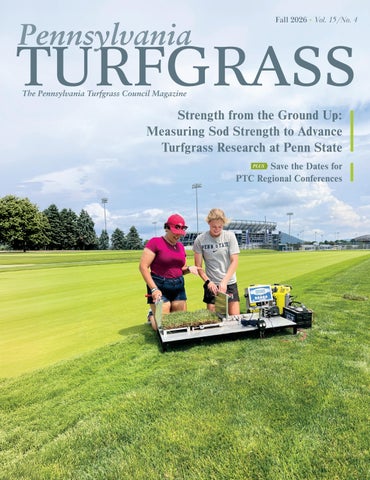
Fall 2026 • Vol. 15/No. 4
Strength from the Ground Up: Measuring Sod Strength to Advance Turfgrass Research at Penn State Save the Dates for PTC Regional Conferences PLUS
Vol. 15 / No. 4 • Fall 2026 Pennsylvania Turfgrass Council P.O. Box 99 Boalsburg, PA 16827 Phone: 814-237-0767 info@paturf.org www.paturf.org PUBLISHER Leading Edge Communications P.O. Box 246 Brentwood, TN 37024 info@leadingedgecommunications.com President Pennsylvania Turfgrass Editor Tom Bettle Penn State 724-321-0321 trb19@psu.edu Vice President Steve Craig Centre Hills Country Club 814-237-5414 Secretary / Treasurer Tanner Delvalle Fisher and Son Company 570-622-4225 Past President Rick Catalogna Harrell’s 412-897-0480
8
DIRECTORS John Chassard Lehigh Country Club
Upcoming Events Departments 6 Save the Date for PTC Regional Conferences
Cover Story 8 Strength from the Ground Up: Measuring Sod Strength to Advance Turfgrass Research at Penn State 2
Pennsylvania Turfgrass • Fall 2026
4 President’s Update 4 Penn State Turf Team 14 Industry News 14 Advertiser Index
Mike DeLeonibus 3 Lakes Golf Course Denny Fellers Baker Equipment Thomas Goyne Pittsburgh Steelers Rob Guthrie Little League International Chris Markel Grove City CC Pete Ramsey Range End Golf Club STAFF
Find this issue, Podcasts, Events and More: THETURFZONE.COM
Kristen Althouse Director of Operations
President’s Message
Looking Ahead
W
ell, here we are again. Summer is winding down, and if you’re anything like me, you’re probably wondering where the last few months went.
It seems like we went from spring cleanup straight into the heat of summer without much of a break. This was a hot and, in many places, dry summer. That combination can make things tough on turf, especially when you’re trying to keep fields and courses looking good while they’re getting plenty of use. For those working on sports fields, the summer months can be a grind. Fields don’t get a vacation just because the weather is hot. Practices, games, tournaments and camps keep coming, and the turf has to hold up. Golf courses face the same challenge. The demand doesn’t slow down just because the thermometer keeps climbing. We’re trying to manage turf stress, irrigation, traffic, disease pressure and everything else that comes with keeping grass healthy under heavy use. And somehow, we make it work. Now, as we move into fall, it’s a good time to take a breath and look back at the season. What worked? What didn’t? What will you do differently next year? Before we know it, winter will be here, and with it comes a little more time to step away from the daily routine and focus on learning. That’s why I want to encourage everyone to make plans now to attend one of the Pennsylvania Turfgrass Council’s regional conferences this winter. The Northeastern PA Conference will be held January 27 at Mohegan Casino Resort in Wilkes-Barre. The Eastern PA Conference follows on February 17 at the Shady Maple Conference Center in East Earl. Then, on February 24, we’ll wrap things up with the Western PA Conference, with the location still to be announced. I know it can be hard to step away from the job. There’s always another project that needs attention, even in the off season. But continuing education is part of doing this job well. Turfgrass management is always changing. New products, new equipment, research, regulations and management practices give us plenty to keep up with. And let’s be honest—these conferences aren’t just about sitting in a room listening to presentations all day. They’re a chance to talk with other people who do what we do. You can ask questions, compare notes and hear how somebody else handled a problem you might be dealing with right now. Sometimes one conversation can give you an idea that saves you time, money or a whole lot of headaches down the road. Most of all, I hope you’ll see these events as an investment in yourself and in the work you do every day. The people who maintain Pennsylvania’s sports fields, golf courses and other turf areas take a lot of pride in doing things right. Staying educated and staying connected helps all of us get better at what we do. So enjoy the cooler temperatures, take a little time to reflect on the season, and start making plans for winter. Pick the regional conference that works best for you—or attend more than one if you can. Thanks for all you do for Pennsylvania’s turfgrass industry, and good luck getting through the rest of the season.
Tom Bettle
President Pennsylvania Turfgrass Council
4
Pennsylvania Turfgrass • Fall 2026
Penn State Turf Team
Tom Bettle Turf Research Center Manager 724-321-0321 • trb19@psu.edu
Monoj Chhertri Professor of Turfgrass Science 814-863-3606 • mkc6518@psu.edu
Michael A. Fidanza, Ph.D. Professor of Plant & Soil Science 610-396-6330 • maf100@psu.edu
David R. Huff, Ph.D. Professor of Turfgrass Breeding and Genetics 814-863-9805 • drh15@psu.edu
Bradley Jakubowski Assistant Teaching Professor 814-865-7118 • brj8@psu.edu
John E. Kaminski, Ph.D. Professor of Turfgrass Science 814-865-3007 • kaminski@psu.edu
Timothy Lulis Teaching and Research Assistant 814-865-0697 • ttl101@psu.edu
Ben McGraw, Ph.D. Professor of Turfgrass Science 814-865-1138 • bam53@psu.edu
Dianne Petrunak Academic Adviser, Turfgrass Science and World Campus 814-863-0139 • dmp6@psu.edu
Max Schlossberg, Ph.D. Associate Professor of Turfgrass Nutrition / Soil Fertility 814-863-1015 • mjs38@psu.edu
Chase Straw Professor of Turfgrass Soils 502-229-9838 • cms9424@psu.edu
Don’ t Miss Out ! PROMOTE YOUR BUSINESS IN THE NEXT ISSUE OF
PENNSYLVANIA TURFGRASS
Pennsylvania Turfgrass will help you deliver your message directly to your customers and prospects. The magazine is a key benefit of membership in the Pennsylvania Turfgrass Council – providing valuable research, education, and industry information to each member. Readers can also access the Digital Edition through The Turf Zone website. Archived issues will ensure that your advertising will continue to be seen indefinitely, for long-ranging impact. PTC Members Include:
Golf Course Superintendents
Landscape Contractors
Commercial Grounds Managers
Sod Producers
Lawn Care Operators
Parks & Recreation Supervisors
Sports Turf Professionals
Equipment Suppliers
Contact us today to learn about effective and unique advertising strategies that target turf industry professionals.
sales@leadingedgecommunications.com
Upcoming Events
SAVE THE DATE FOR THE
Pennsylvania Turfgrass Regional Conferences
J AN U A R Y 2 7 , 2 0 2 7
Northeastern PA Turf Conference Mohegan Casino Resort in Wilkes-Barre
FEBRUARY 17, 2027
Eastern Pennsylvania Golf, Lawn, Landscape and Sports Turf Conference Shady Maple Conference Center in East Earl
Registration will open October 2026. PTC members qualify for reduced registration prices.
FEB R U A R Y 2 4 , 2 0 2 7
Western Pennsylvania Golf, Lawn, Landscape and Sports Turf Conference Hollywood Casino at The Meadows Washington, PA
6
Pennsylvania Turfgrass • Fall 2026
For more information, visit: paturf.org/events
ntic Atla d i the MService n i d #1Quality & e t a R for
ARE YOU A PRO? TAILORED PRICES & SERVICES FOR OUR GREEN INDUSTRY CLIENTS
TEAM@CENTRALSODMD.COM WWW.PLANTSOD.COM 410-827-5000
LANDSCAPE
HOMEBUILDER
GOLF
ATHLETICS
e it v a h Pick up any quantity ordelivered!
in NEWARK DE
PREMIUM STATE-CERTIFIED TURFGRASS FOR ANY APPLICATION
Fall 2026 • Pennsylvania Turfgrass
7
Cover Story
STRENGTH FROM THE GROUND UP:
Measuring Sod Strength to Advance Turfgrass Research at Penn State 1
Ava Veith1, Zineb Alouani1, Chase Straw1, David Huff1 Department of Plant Science, The Pennsylvania State University, University Park, PA 16802, USA
Why Sod Strength Matters Long-term turfgrass stability is not controlled by a single factor, but rather by the interaction of turfgrass species, cultivar genetics, rootzone properties, and management practices. Turfgrass failure often becomes visible when the surface can no longer resist shear forces, whether during an athlete’s planting and pivoting movement, excessive divoting from golf play, or sod breaking apart during harvest and handling. In research plots, these weaknesses may appear as inconsistent performance from one area to another. Across athletic fields, golf courses, lawns, and sod farms alike, structural weakness limits turfgrass performance. At the center of these issues is sod strength. Sod strength refers to the resistance of the turfgrass–rootzone system to tearing or shearing forces. It reflects how effectively roots and other plant structures reinforce the turfgrass-root system. In other words, sod strength represents the physical integrity created by the interaction between turfgrass biology and the soil beneath it. Traditionally, turfgrass performance has been evaluated visually through percent cover, color, density, and recovery after wear. While those indicators are important, they do not directly measure structural stability. A surface may appear dense yet still lack strong structural integrity. Likewise, it may recover quickly but remain vulnerable to tearing under load. By directly quantifying structural integrity, objective measurements of sod strength allow turfgrass professionals to better connect turfgrass genetics, growth habits, and management practices with real-world durability.
Expanding Turfgrass Research with Penn State’s New Sod Strength Tester With support from the Pennsylvania Turfgrass Council (PTC) Board of Directors, Penn State recently acquired a sod strength tester to expand its turfgrass research capacity (Figure 1). This equipment allows us to apply a controlled pulling force to turfgrass sod and directly measure the resistance of the turfgrassrootzone system before tearing or shearing occurs. Unlike visual ratings or indirect indicators of performance, the sod strength tester generates objective and repeatable measurements of turfgrass structural integrity. It quantifies how effectively the turfgrass-rootzone system resists separation under load and how the turfgrass canopy holds together under stress.
8
Pennsylvania Turfgrass • Fall 2026
These measurements help translate turfgrass biology into measurable performance data. With this tool, Penn State can now evaluate structural stability across a range of systems, including athletic fields, golf courses, lawns, and sod production. Ultimately, PTC’s investment strengthens our ability to evaluate how turfgrass species, cultivar genetics, and management practices influence measurable durability in real-world turfgrass systems.
Using the Sod Strength Tester in Turfgrass Research Several factors influence sod strength. Turfgrass species differ in growth habit and lateral spread, while cultivar genetics affect stolon and rhizome production, tillering capacity, and root mass. Rootzone composition influences the structural integrity of the turfgrass-rootzone system and moisture dynamics, and management practices such as fertility, irrigation, mowing height, traffic intensity, and cultivation further shape how the turfgrass system develops and responds to stress. By measuring sod strength, researchers can evaluate how these interacting factors influence structural performance under real-world conditions. At Penn State, the sod strength tester will be incorporated into multiple research initiatives led by faculty within the Department of Plant Science, including Dr. Chase Straw and Dr. David Huff. Across both cool- and warm-season turfgrass systems, this tool adds an objective measure of structural durability to traditional performance evaluations. By quantifying differences in resistance to tearing, it provides insight into structural integrity that may not be apparent through visual ratings alone. While cultivar evaluation is one important application, it represents only part of the sod strength tester’s broader research potential. Beyond cultivar trials, the equipment can be used to compare management strategies and evaluate long-term turfgrass performance under traffic. For turfgrass managers, these measurements connect directly to outcomes that matter, including reduced divoting, improved surface stability, and better recovery following repeated stress. By integrating sod strength into our research programs, we can provide clearer guidance on how species selection, cultivar choice, and management decisions influence real-world durability. The following sections highlight two graduate research projects that demonstrate how the sod strength tester is being used to address practical challenges facing turfgrass managers.
Figure 1. Penn State graduate students Zineb Alouani (left) and Ava Veith (right) using the sod strength tester.
Cover Story • continued
Evaluating Kentucky Bluegrass Cultivar Mixtures for Athletic Field Durability One of the first research applications of the sod strength tester will be within doctoral research conducted by Ava Veith, a Ph.D. student in Penn State’s Department of Plant Science under the advisement of Dr. Chase Straw (Figure 2). Her research focuses on athletic fields and how surface characteristics influence performance. Using the sod strength tester, she will compare Kentucky bluegrass cultivar mixtures to quantify differences in sod strength, recognizing that greater structural integrity and resistance to tearing are highly desirable for high-traffic athletic fields.
Kentucky bluegrass remains a foundational species for many coolseason athletic fields due to its rhizomatous growth habit, strong recuperative potential, and ability to form a dense, uniform playing surface. Its capacity to spread laterally through rhizomes allows damaged areas to recover following traffic. However, not all Kentucky bluegrass cultivars express the same level of rhizome production or structural strength. Differences in rooting density, rhizome aggressiveness, and canopy structure can influence how well a surface resists divoting and tearing during athletic play. This study centers on a new Kentucky bluegrass cultivar developed by Dr. David Huff that is believed to exhibit more aggressive
Figure 2. Penn State graduate student Ava Veith using the sod strength tester.
Figure 3. Penn State graduate student Zineb Alouani using the sod strength tester.
10 Pennsylvania Turfgrass • Fall 2026
rhizome production. The experimental cultivar will be incorporated into mixtures at varying percentages alongside commercially available Kentucky bluegrass cultivars that are already widely used on athletic fields. By adjusting the proportion of the new cultivar within each mixture, the research aims to determine whether increasing the proportion of rhizome-aggressive genetics translates into measurable gains in sod strength.
Specializing in Bentgrass Sod for Greens, Tees & Fairways. Fine and Tall Fescue Regular and Shortcut Bluegrass Kevin Driscoll
Cell: 609-760-4099 | Office: 856-769-9555 KDriscoll@EastCoastSod.com
For athletic fields, increasing sod strength is particularly desirable. Fields subjected to repeated cleat traffic must resist shear forces generated during cutting, pivoting, and acceleration. Greater sod strength can reduce divoting, improve surface stability, and help maintain more consistent footing across high-use areas. Even small improvements in structural integrity may influence how a field performs over the course of a season. Ultimately, this research will provide sports field managers with clearer guidance on selecting Kentucky bluegrass cultivar mixtures that maximize durability under high-traffic conditions.
Evaluating Cold-Tolerant Bermudagrass Cultivars for Structural Performance In addition to cool-season turfgrass research, the sod strength tester will also support graduate research led by Zineb Alouani, a master’s student in Penn State’s Department of Plant Science under the supervision of Dr. Chase Straw (Figure 3). Her research focuses on evaluating cold-tolerant bermudagrass cultivars for potential use in the transition zone and northern environments. Bermudagrass is widely used on athletic fields and golf courses in warmer climates due to its aggressive growth habit, excellent traffic tolerance, and ability to recover quickly from wear. However, cultivar performance can vary significantly, particularly when bermudagrass is grown outside of its traditional adaptation range. Cold tolerance, winter survival, and structural durability are key traits that influence whether a cultivar can perform reliably in cooler regions.
VISIBLE RESULTS • INVISIBLE SHIELD • THAT’S SARGE 2.0 •
ULTRA-RICH COLOR + UV PROTECTION =
HEALTHIER MORE RESILIENT TURF
NUMERATOR TECHNOLOGIES, INC.
www.NumeratorTech.com
Fall 2026 • Pennsylvania Turfgrass 11
Cover Story • continued
As part of this research, experimental cold-tolerant bermudagrass cultivars developed by Dr. Yanqi Wu at Oklahoma State University will first be established and propagated in greenhouse conditions before being transplanted into field research plots. Once established, the sod strength tester will be used
to quantify differences in sod strength and structural integrity among cultivars. By measuring how strongly the turfgrassrootzone system resists tearing forces, the equipment provides an objective way to evaluate structural performance beyond traditional visual ratings. Integrating sod strength measurements into bermudagrass evaluation will help researchers better understand how differences in growth habit, rooting characteristics, rhizome development, and lateral spread influence turfgrass durability. Ultimately, this work will contribute to identifying cultivars that combine cold tolerance with the structural resilience required for high-traffic turfgrass systems in the transition zone and beyond.
Why This Matters for Pennsylvania Turfgrass Managers For Pennsylvania turfgrass managers, this work aims to provide clearer, data-driven guidance. By incorporating sod strength measurements into ongoing research, Penn State can generate information that supports more confident decisions related to
Covers trusted by those who know...
EVERGREEN™ turf covers outsmart mother nature. Exclusive color lace coatings provide proven results.
FOOTBALL FIELD COVERS are made of superior strength material, providing protection from rain or snow.
TARPMATE™ AIR roller is a revolutionary storage and handling system for field covers. 2-3 people can roll out or roll up a 100’ wide cover.
An INFLATABLE FIELD COVER solves the problem of ongoing field maintenance during inclement and extreme cold weather.
Member of
From our supreme lightweight raincovers right to the classic vinyl ones, there are cover models and accessories to meet your specific needs.
12 Pennsylvania Turfgrass • Fall 2026
turfgrass species and cultivar selection. Rather than relying solely on appearance-based evaluations, managers will have access to objective performance data developed under Pennsylvania growing conditions. Importantly, this research is made possible through the support of the PTC and its members. PTC’s investment in the sod strength tester strengthens the connection between industry needs and university research efforts. As studies progress, findings will be shared through extension programming, publications, and outreach efforts to ensure that results are returned directly to the PTC community. The addition of this tool expands Penn State’s ability to address questions facing turfgrass managers while strengthening collaboration between university researchers and the turfgrass industry. Together, these efforts will help ensure that future research remains practical, regionally relevant, and focused on improving turfgrass performance across Pennsylvania.
Looking Ahead: Continued Collaboration in Turfgrass Research The Pennsylvania Turfgrass Council Board of Directors and its members play an important role in supporting turfgrass research at Penn State. Investments such as the sod strength tester strengthen the connection between industry needs and university research while creating new opportunities to better understand turfgrass performance. As these research projects develop, the findings will be shared through extension programming, publications, and outreach efforts to ensure that new knowledge is returned directly to the turfgrass professionals who support this work. Continued collaboration between Penn State researchers and the PTC community will help ensure that future research remains practical, relevant, and beneficial for turfgrass managers across Pennsylvania. We sincerely appreciate PTC’s continued investment in turfgrass research at Penn State. •
BLEND
Fall 2026 • Pennsylvania Turfgrass 13
Industry News
Advertiser Index
PTC Publishing Partner,
Aer-Core, Inc........................................ 7
LEADING EDGE COMMUNICATIONS,
Burlingham Seeds................................ 3
Announces New Leadership
W
www.aer-core.com
www.burlinghamseeds.com
Central Sod Farms of Maryland, Inc.... 7 www.centralsodmd.com
Coombs Sod Farms.............................13 www.coombsfarms.com
Covermaster, Inc.................................12
e’re excited to share some news about the next chapter for Leading Edge Communications.
Effective August 10, 2026, ownership of the business transitioned to Mike Hissong and Kevin Long. LEC founder Eddie Coutras, who has spent more than 30 years building Leading Edge into the company it is today, will remain involved in an advisory role to support the transition. While ownership is changing, you can expect continuity in the people you work with and will continue to be supported by the same team you know and trust. The new ownership team is committed to building on the strong foundation already in place and looks forward to serving you for many years to come. While you may see new ideas and improvements over time, our commitment to providing excellent products and services remains unchanged. We bring a long track record of owning and managing businesses and are truly excited to take LEC to the next level. Our belief and success have always come from exceeding our customers’ expectations. We sincerely appreciate your business and the trust you place in us. We look forward to continuing our relationship with you and welcoming you into this next chapter of Leading Edge Communications.
Additionally, please update our new address in your system.
Leading Edge Communications P.O. Box 246 Brentwood, TN 37024
Warm regards,
Mike and Kevin New Ownership Contact Information Mike Hissong – mike@leadingedgecommunications.com Kevin Long – kevin@leadingedgecommunications.com 14 Pennsylvania Turfgrass • Fall 2026
www.covermaster.com
East Coast Sod & Seed.......................11 www.eastcoastsod.com
Greene County Fertilizer Co................11 www.greenecountyfert.com
Leading Edge Communications........... 5 www.LeadingEdgeCommunications.com
Seedway..............................................13 www.seedway.com
Smith Seed Services...........................13 www.smithseed.com
Lawn & Golf Supply.......Inside Back Cover www.lawn-golf.com
The Turf Zone.......................Back Cover www.theturfzone.com
The Pennsylvania Turfgrass Council (PTC) serves its members in the industry through education, promotion and representation. The statements and opinions expressed herein are those of the individual authors and do not necessarily represent the views of the association, its staff, or its board of directors, Pennsylvania Turfgrass, or its editors. Likewise, the appearance of advertisers, or PTC members, does not constitute an endorsement of the products or services featured in this, past or subsequent issues of this publication. Copyright © 2026 by the Pennsylvania Turfgrass Council. Pennsylvania Turfgrass is published quarterly. Subscriptions are complimentary to PTC members. Presorted standard postage is paid at Jefferson City, MO. Printed in the U.S.A. Reprints and Submissions: Pennsylvania Turfgrass allows reprinting of material published here. Permission requests should be directed to the PTC. We are not responsible for unsolicited freelance manuscripts and photographs. Contact the managing editor for contribution information. Advertising: For display and classified advertising rates and insertions, please contact Leading Edge Communications, LLC, P.O. Box 246, Brentwood, TN 37024.
T H A N K YO U TO O U R PA R T N E R L AW N & G O L F S U P P LY F O R A D V E R T I S I N G W I T H U S S I N C E 2 0 2 3 !
Follow for TURFGRASS NEWS, RESEARCH & EVENTS linkedin.com/company/ theturfzone
x.com/theturfzone
facebook.com/ theturfzone
Contact us today to learn about effective and unique TurfZone marketing strategies that target turf industry professionals.
sales@leadingedgecommunications.com