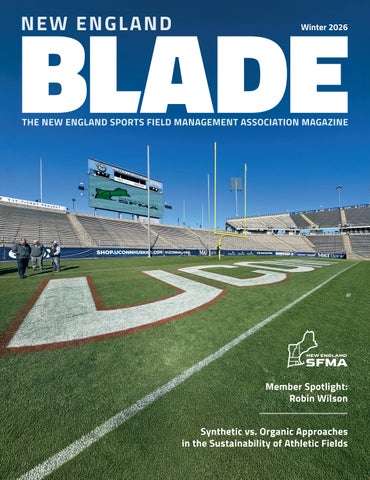
Winter 2026
Member Spotlight: Robin Wilson Synthetic vs. Organic Approaches in the Sustainability of Athletic Fields
T H A N K YO U TO O U R PA R T N E R G R E E N E C O U N T Y F E R T I L I Z E R C O. F O R A D V E R T I S I N G W I T H U S S I N C E 2 0 2 0 !
VISIBLE RESULTS INVISIBLE SHIELD THAT’S SARGE 2.0 ULTRA-RICH COLOR + UV PROTECTION = HEALTHIER MORE RESILIENT TURF
www.NumeratorTech.com
Low Impact Products for High Performance Landscapes
Athletic Fields
Premium Biochar
ADA Pathways
Topdressing
Bioretention
Golf Materials
READ CUSTOM SOILS 800.924.5335 readcustomsoils.com
9
10
12
CONTENTS • Winter 2026 RECENT EVENT 90 S ports Field Forum
MEMBER SPOTLIGHT 100 R obin Wilson
Grounds Manager Windham School District
FEATURE
DEPARTMENTS
120 S ynthetic vs. Organic Approaches
6 President’s Message
in the Sustainability of Athletic Fields Part 2: Effects on Soil Properties and Soil Health
8 NE-SFMA News
On the cover: Rentschler Field at Pratt & Whitney Stadium in East Hartford, CT was host to NE-SFMA’s Sports Field Forum on October 7, 2026. Photo Credit: Finch Turf
Directors
Board of Trustees
President
Tom Barry, CSFM Greens Farms Academy Greens Farms, CT
Mike Lueders Medfield, MA
President Elect Advancing professionalism in sports turf management and athletic field safety through education, research, and scholarships. The official publication of the New England Sports Field Managers Association (NESFMA), the New England Blade is dedicated to educating, advising, and informing members of the profession and furthering the goals of the Association. The New England Blade carries news and features related to the sports field management profession. Publisher is not responsible for unsolicited material and reserves the right to edit any article or advertisement submitted for publication and to refuse advertising not in keeping with the goals of the Association. Publisher assumes no responsibility for the validity of claims in connection with items appearing in the New England Blade. Mention of a commercial product does not imply endorsement by the New England Blade, NESFMA, or Leading Edge Communications, or preference over similar products not mentioned. The New England Blade is published quarterly. Subscriptions are complimentary to members of NESFMA. Presorted standard postage is paid at Jefferson City, MO. Printed in the U.S.A. Advertising: For display and classified advertising rates and insertions, please contact Leading Edge Communications, LLC, P.O. Box 246, Brentwood, TN 37024.
Find this issue, Podcasts, Events and More: TheTurfZone.com
Officers Art Goodhind Town of Natick Natick, MA
4 • New England BLADE • Winter 2026
6 Index of Advertisers
Ryan Bjorn Gillette Stadium Foxborough, MA
Treasurer
Andrew Carlisle, CGM Worcester Technical High School Worcester, MA
Past President
Chris McGinty Framingham Parks Department Framingham, MA
Official Chapter
Bryan Conant Nashua Parks & Recreation Nashua, NH Brendon Connor Holy Cross Worcester, MA Adam Ferrucci Read Custom Soils Wareham, MA Scott Lagana Turf Products Corp. Holden, MA Christopher Lilly Blackstone Valley Regional Technical Vocational High School Upton, MA Michael Malvoso Needham Parks & Forestry Needham, MA Scott Vose Tom Irwin Advisors Tyngsborough, MA
Edward Olsen Needham Parks & Forestry Needham, MA Victoria Wallace University of Connecticut Storrs, CT
Management Team Virginia Wood Executive Director Charissa Sharkey Membership Manager Peggy Benjamin Bookkeeper
New England Sports Field Management Association, Inc. 67 West Street Medfield, MA 02052 (508) 653-1241 NE-SFMA.org
TEAM
Synthetic Field Turf Maintenance Program
Revives and Restores the turf for safe play. • De-compaction of Infill • Deep Grooming • Rejuvenation • Magnetic Sweep • Vacuuming • Surface Cleaning • Rotary Brushing • Add Infill • Seam Repair • G-Max Testing
Speak with one of our Turf Experts today!
860.819.5062 | newenglandturfmanagement.com
Jim@newenglandturfmanagement.com
PRESIDENT’S MESSAGE
ADVERTISER INDEX
Greene County Fertilizer Co.............Inside Front Cover
Hello members and friends,
www.greenecountyfert.com Leading Edge Communications..... Inside Back Cover www.LeadingEdgeCommunications.com New England Turf Management........ 5
As I write this letter for the Blade, it is October 6. The day began with a cold start at 45 degrees and a frost advisory for the following day. Our New England weather has certainly begun its transition to cold mornings and diminishing daylight hours. I appreciate this change in season, as it marks a slightly calmer season when the turfgrass grows slower, pest pressures drop, mosquitoes fade away and winter projects will soon begin. Of course, we never quite know what a New England winter will bring. Last year certainly delivered its share of cold spells, including some particularly frigid February temperatures. For now, I’m looking forward to tomorrow’s gathering at Rentschler Field, a warm cup of coffee, and another opportunity to enjoy the camaraderie that makes our sports turf community so special. As we reflect on another busy and productive year, I want to thank everyone who has supported and participated in NE-SFMA’s programs and activities. From our annual meeting in Rhode Island to the baseball field renovation project in Roxbury, a terrific day on the golf course, our continued investment in future industry leaders, and an exciting event at a premier Connecticut sports venue, we’ve accomplished a great deal together. Each of these experiences reflects the strength of our association and the commitment of members who generously share their time, knowledge, and enthusiasm. Our association achieved many great goals this year and created moments for folks to remember for years to come. Finally, I would like to take a moment to remember Jim Connelly, who passed away on September 30. As one of NE-SFMA’s founding members, Jim played an important role in shaping the association we know today. He was a familiar and welcoming presence at the Regional Turfgrass Conference, a passionate advocate for our profession, and a respected leader whose vision helped bring sports turf professionals together across New England. Jim recognized early on the value of creating a regional organization where colleagues could exchange knowledge, build relationships, and advance their profession. His contributions helped lay the foundation for the strong community we enjoy today, and his legacy will continue to be felt for years to come.
www.newenglandturfmanagement.com PJC Organic............................................. 15 www.pjcorganic.com Read Custom Soils.................................. 3 www.readcustomsoils.com Slater Farms, LLC.................................. 11 www.slaternaturalfarms.com Smith Seed Services............................ 18 www.smithseed.com The Aquatrols Company..........................13, Back Cover www.aquatrols.com The Charles Hart Seed Company.... 15 www.hartseed.com The Turf Zone......................................... 18 www.theturfzone.com Turf Optix................................................... 7 www.turfoptix.com
As the holiday season approaches, we wish you and your families a joyful holiday season, a peaceful winter, and a happy, healthy New Year! Cheers,
Art Goodhind NE-SFMA President
ADVERTISERS, PLEASE NOTE The mailing address for Leading Edge Communications has changed. Please update your records: P.O. Box 246 Brentwood, TN 37024
6 • New England BLADE • Winter 2026
IN MEMORIAM
NE-SFMA NEWS
JAMES H. CONNELLY
Annual Meeting & Awards Lunch – March 3
1943 – 2 0 2 6 James “Jimmy” Connelly passed away peacefully on September 30, 2026. One of NE-SFMA’s founding fathers, Jimmy was a dedicated professional, respected industry leader, and cherished friend to many. His leadership, devotion to the profession, and indomitable spirit helped shape our association and left a lasting mark on the sports field management community. Jimmy’s contributions to our industry were many, but it is the friendships he built and the lives he touched that will be remembered most. All of us at NE-SFMA extend our heartfelt condolences to Jim’s beloved wife, Karen, and the entire Connelly family. We are grateful for Jim’s many years of friendship and service, and we will miss him greatly. Jimmy’s family has requested that memorial donations be made to Angel Flight NE which provides free angel flights and ground transportation so children and adults can access life-saving medical care. •
Mark your calendar for NE-SFMA’s popular lunch meeting scheduled for Wednesday, March 3 at 11:00 a.m. during the New England Regional Turfgrass Conference in Providence, RI. Join us as we review association accomplishments and plans for the year ahead. We’ll also present the Sports Field Manager and Commercial Partner of the Year awards, along with the Charles Mruk student scholarship. Watch your email for your invitation – and remember, this event is separate from NERTC registration, so please be sure to let us know by February 22 if you plan to attend.
Award Nominations Due December 10 Do you know a NE-SFMA member who has made significant contributions to the sports turf industry in New England? Help us recognize their achievement with your nomination for Sports Field Manager of the Year or Commercial Partner of the Year. Visit https://nestma.org/Awards&-Scholarships for details and an online nomination form. Deadline is December 10. The awards will be presented at NE-SFMA’s Annual Awards Meeting and Lunch on March 3, 2027 during the NERTC in Providence, RI.
Charles Mruk Scholarship In 2026, NESTMA awarded $1000 scholarship to Michael Doyle, a turfgrass management student at UMass-Amherst. Please help us spread the word that this scholarship (up to $1000) is available to a qualified student who is currently enrolled in a New England college/university and who is pursuing a career in the field of sports field management. The scholarship deadline is December 10. Application is available online at https://nestma.org/ Awards-&-Scholarships.
Membership Investment Many thanks to those who have signed on for 2027 NE-SFMA membership to date. Renewals are quick and easy online at NE-SFMA.org/Renew. Your continued financial support and involvement are important to our industry and appreciated by your association.
WELCOME NEW MEMBERS NE-SFMA is pleased to welcome the following professionals to our growing membership roster: Lou Allen
Hunter Moffatt
Cleveland, OH
Canton, MA
Pioneer Athletics
Astroturf Corp.
Volunteer Leaders Have you ever thought about what it might be like to serve on a NE-SFMA committee or the board of directors? If you’d like to know more about what volunteer leadership entails, please contact any of our current board members or the NE-SFMA management team for details.
Calling All Writers, Speakers & Sponsors
Paul Carey
Matthew Pepin
Sandown, NH
Sanford, ME
NE-SFMA’s education and communications committees bring fresh perspective and ideas to the membership through top notch educational programming and this quarterly publication. Do you have unique information to share via an article in The Blade or a meeting presentation? Outline your idea using this brief online form (NE-SFMA.org/educationform) and we will be in touch.
To learn more about the many benefits of NE-SFMA membership, visit NE-SFMA.org.
If you are a Commercial Partner interested in sponsoring NE-SFMA programs, please reach out to Charissa (csharkey@NE-SFMA.org) at the NE-SFMA office and we’ll help you find the opportunity that gives your company the maximum ROI. •
DLF Seed / Seed Research of Oregon
Chris Filadoro New England Sports Turf
Chelmsford, MA
Newfield Sand & Specialty Soils
8 • New England BLADE • Winter 2026
RECENT EVENT
Sports Field Forum Delivers Valuable Learning: On and Off the Field
B
eautiful fall weather, an impressive athletic field, and outstanding educational content made NE-SFMA’s recent Sports Field Forum at Rentschler Field at Pratt & Whitney Stadium a tremendous success. The well-attended event brought together sports turf professionals from throughout New England for a unique opportunity to combine classroom learning with practical, real-world applications. The program, Maximizing Playability: Leveraging Soil Surfactants to Enhance Playing Surfaces, featured Christian Baldwin, Ph.D., scientist, educator, and researcher with The Aquatrols Company. Dr. Baldwin shared valuable research and practical insights into how soil surfactants can improve moisture management, promote more consistent playing conditions, and enhance overall turfgrass performance. His presentation offered attendees a better understanding of how these products work and how they can be incorporated into everyday field management practices. Following the classroom session, attendees headed outdoors to the beautifully maintained natural grass field at Rentschler Field, home of UConn Huskies football and a popular venue for major concerts and special events. Head Sports Turf Manager James Lappetito and his experienced team provided a firsthand look at the challenges and strategies involved in maintaining a high-performance playing surface. The field session brought the earlier discussion to life, demonstrating how soil surfactants and other management practices are put to work to maintain field consistency, improve playability, and support athlete safety. The combination of classroom instruction and on-field learning was especially appreciated by attendees, who welcomed the opportunity to ask questions, exchange ideas, and gain practical knowledge they could take back to their own facilities. NE-SFMA extends its appreciation to Dr. Christian Baldwin, James Lappetito, and the Rentschler Field team for sharing their expertise and providing such an outstanding educational experience. We are also grateful to our event supporters: Read Custom Soils, PBI Gordon, and Tom Irwin, whose generous support helps NESFMA continue to deliver quality professional education. Finally, special thanks to Scott Vose and the other members of NE-SFMA’s Education Committee for their leadership, planning, and commitment to making this year’s Sports Field Forum such a success. Events like this demonstrate the value of learning from one another and the strength of our New England sports field management community. • Winter 2026 • New England BLADE • 9
NE-SFMA MEMBER SPOTLIGHT
Robin Wilson Grounds Manager Windham School District Windham, New Hampshire
NE-SFMA is proud to turn the spotlight on Robin Wilson, winner of SMFA’s 2025 High School Football Field of the Year award.
How did you get your start in the sports field industry? I kind of fell into the industry. In my early 20s, I owned a bakery in Pennsylvania, but after some difficult life events, my brother encouraged me to move to New Hampshire to be closer to family. It was one of the only times I’ve listened to him, and it turned out to be a pivotal decision! I returned to college and took a job at a local high school mowing and painting athletic fields. Before long, I got “bit by the turf bug.” What started as a job became a lifelong career and an unexpected passion. Where did you go from there? After graduating, I continued managing the high school’s athletic fields and grounds for 18 years. During that time, I worked with some wonderful people, including Athletic Director Bill Raycraft. When he moved to another district, he encouraged me to apply for the Grounds Manager position in Windham, NH. I took a chance and got the job! I’ve now spent 10 years managing more than 26 acres of grounds and athletic fields for the Windham School District. Who was your mentor when you were first starting out, and why? I owe so much to Kim Britton, Grounds Supervisor at St. Anselm College. Twenty-six years ago, Kim took me under her wing and has remained a mentor, friend, and constant source of support. She introduced me to incredible industry professionals, including Paul Carey, who has also been instrumental in my growth. Paul eventually introduced us to Kelly Lynch, opening the door to volunteering with the Women in Turf team and at the Little League Softball World Series. Both experiences have been life-changing, connecting me with passionate people eager to share their knowledge and showcase our industry’s opportunities. What’s the best business advice you’ve ever received? Take pictures! I take pictures ALL the time. They’re invaluable for documenting progress, showing how fields evolve, and communicating accomplishments. They’re also helpful when seeking advice from turf colleagues. Sometimes sending a few pictures and asking, “What do you think is going on here?” is the best way to learn. Of course, 20 years ago, before we had computers in our pockets, things were a little different! What is the next “gamechanger” you see on the horizon for the sports turf industry? The Women in Turf movement! More women are entering our industry, becoming successful leaders and role models. I’m proud to be part of this movement and excited about its impact. Through social media, volunteering, mentoring, and sharing experiences, women are highlighting the opportunities in sports turf. But it’s bigger than women alone. Everyone who shares knowledge, encourages newcomers, and gets involved helps make our profession stronger and more welcoming. Bringing new people into the industry expands our talent pool, introduces fresh perspectives, and demonstrates that sports turf is a rewarding career, not just a job. I’m excited to see what the next generation accomplishes! What’s your favorite or most useful equipment, product, and technology? • Equipment: John Deere 3046 with 60" 1st Products Aeravator • Products: Pure Seed Products • Technology: Anything with GPS!
10 • New England BLADE • Winter 2026
Slater Farms integrates high-quality sand, gravel and organic products into its numerous diverse offerings supporting the playful side of life.
COMMERCIAL
RECREATIONAL
Slater Farms provides products and commercial operations including but not limited to landscaping, well drilling, nurseries, farming, and field construction.
We provide core products to support recreational activities including but not limited to golf courses, sports fields, volleyball, squash courts, and equestrian.
We listen to your needs and our production process will ensure consistency and quality to enable your success.
Our manufacturing facility produces damp and dry products necessary to support your specifications.
Slater Farms is a division of
SPECIALTY Our state of the art facility includes washing, drying, screening, blending, and packaging and is dedicated to achieving your specifications. We can help you reach your objectives. Whether it’s a unique root zone performance specification or a high visibility wetlands reclamation project, our resources are available to you.
T: 401-766-5010 | F: 401-762-4976 | E: Info@slaternaturalfarms.com
www.slaternaturalfarms.com
What advice would you share with people starting out in sports field management?
Having people who understand the challenges and rewards of our work is invaluable.
I have a few rules to live by, some passed along to me and others learned through experience.
I especially appreciate the lack of ego in this industry. People genuinely want to share knowledge and help each other succeed. Whether you’re just starting out or have decades of experience, everyone has something to contribute and something to learn.
First, don’t forget to breathe. This industry is rewarding but demanding, with long days, unpredictable weather, tight deadlines, and unexpected challenges. You don’t have to know everything immediately. Second, always be willing to learn. Ask questions, listen, and never be afraid to admit you don’t know something. Some of the best lessons come from those working alongside you. Third, take pride in your work. What we do directly impacts athletes, students, schools, and communities. Even the little things matter. Finally, appreciate how far you’ve come. Be open to opportunities, support others, and remember that mistakes aren’t the end of the world. Some of my greatest growth has come from difficult situations. Can you share a bit about your family life and what you enjoy doing in your free time? My family’s love and support mean everything. My wife and I have four adult children, and I have nine siblings, so life is busy! I enjoy fly fishing, traveling with family and friends, getting back into golf, and woodworking. There’s always a project happening at our home! What have you enjoyed most about being a NE-SFMA member? Building relationships. The connections I’ve made through NE-SFMA have become lifelong friendships, mentorships, and professional partnerships.
NE-SFMA is more than a professional organization. It’s a community that cares about the profession and each other. That camaraderie is what I value most. Is there anything else you’d like to share with fellow NE-SFMA members? I’d like to thank everyone who has volunteered for NE-SFMA over the past 36 years, from board and committee members to those working quietly behind the scenes. This organization thrives because people generously give their time and energy. Special thanks to Vickie Wallace and Mary Owen, the “OG Women,” and to Virginia Wood and Charissa Sharkey for everything they do behind the scenes. I’m also thankful to those who have helped throughout my career. I certainly wouldn’t have earned an SFMA Field of the Year award without the guidance, support, and hard work of so many people. Kim Britton, Paul Carey, Justin Santos, Brian Lucini, and countless colleagues have all contributed to my journey. I’m incredibly grateful for the people and relationships this industry has brought into my life. That, more than anything, is what makes this industry so special. • Winter 2026 • New England BLADE • 11
FEATURE
Synthetic vs. Organic Approaches in the Sustainability of Athletic Fields: II. Effects on Soil Properties and Soil Health By Dr. William M. Dest, University of Connecticut – Storrs and Dr. J. Scott Ebdon, Emeritus Professor, University of Massachusetts – Amherst
Study Objectives Continuous applications of natural organic fertilizers potentially improve soil health by increasing soil fertility and organic matter. Changes to various soil chemical properties (nutrient content), physical properties (soil bulk density, soil aggregate stability) and biological properties (total soil carbon) when using natural organic fertilizers could potentially influence overall microbial activity and plant health. Long-term comparisons over several years between organic and synthetic management were previously discussed in New England Blade (Fall 2026 issue). Clear benefits in terms of better traffic (wear) tolerance were demonstrated when using synthetic fertilizers and conventional management over organic (natural) fertilizers. In this issue of New England Blade, synthetic and organic management effects on soil properties and soil health under eight years of simulated traffic are presented. The results presented here are a summary of previously published (peer-reviewed) studies by the authors (Dest and Ebdon, 2025).
Study Area The study was established in 2010 on Kentucky bluegrass (KBG) sod at the Troll Turf Center, South Deerfield MA (University of Massachusetts – Amherst). The soil is a native silt loam with a sand, silt, and clay content of 24.4, 66.6, and 9.0%, respectively, and soil organic matter (SOM) content of 2.7%. The sod was inter-seeded yearly in combination with simulated traffic and aeration practices. Simulated traffic (wear) using the D.S.1 traffic simulator (Canaway, 1976) was fall applied weekly from 2010 to 2017. The total traffic applied yearly using the simulator was equivalent to 24 soccer games in the center areas-high wear areas (Canaway, 1981). A blend of turf-type perennial ryegrasses (PRG) seeded at a rate of 7 lb./1000ft2 and a blend of KBG at 2 lb./1000ft2 were applied with simulated traffic to cleat-in seed. 12 • New England BLADE • Winter 2026
Photo 1. Studded disk with torque wrench used to measure surface traction, weighted with 75 lb. plates.
Synthetic or organic management practices were main plots. Main plots were split as subplots according to height of cut (HOC, 1.25 inch mowed with reel mowers 2 to 3 times weekly and 2.5 inch mowed once weekly with rotary mowers). Approximately ¼ of the subplots received wear treatments. Synthetic practices included yearly chemical fertilizers and pesticides. Hand-weeding, biological fertilizers (leaf compost and naturally derived organics) with biological controls (corn gluten, parasitic nematodes) were used in the organic plots. Both approaches received the same yearly N of 4 lb./1000ft2. Fertilizer P2O5 varied with the N source because of the low N content (high product spread rate) of the organic sources. Organic plots received 1.1 lb. P2O5/1000ft2/yr compared to 0.36 lb. P2O5 for synthetic.
Rotational Traction – Results Rotational traction was measured using a device described by Canaway and Bell (1986). The device comprised a 6-inch steel disc with six football studs spaced at intervals around the disc (Photo 1). The disc was weighted with 75 lb. plates and dropped from a 6-inch height so that the studs fully penetrated the surface. The torque required for the studs to tear (break) the surface was measured and is reported as Nm (Newtonmeter). Four measurements were taken in September on wear treated plots and then averaged.
Don’t Miss Out
on Your Rewards!
Sign Up Now!
2027 Early Order Program
EARLY ORDER HAS NEVER BEEN EASIER WITH THE AQUATROLS COMPANY! Once signed up, start earning points during the ordering windows listed below. Points are awarded as soon as your distributor reports the purchase, and points can be redeemed at any time for an array of rewards including Visa gift cards, distributor account credits, and a wide range of merchandise options.
BOOK EARLY FOR MAXIMUM EARNINGS! Place your qualifying product order during the month of October and earn extra points. See website for complete details. MUST BE ENROLLED IN APPROACH PRIOR TO PURCHASE TO EARN POINTS.
Scan for full details, or visit: https://aquatrolscompany.com/approach
FEATURE • continued Traction ranged from 39 to 64 Nm (Table 1); which are above the minimum standard of 25 to 35 Nm (Aldous, 1999; Canaway et al., 1990). Traction readings above 70 Nm are reported by players in surveys as unsatisfactorily high (Aldous et al., 2005). Rotational traction values of 25 to 55 Nm are preferred by players. In our study rotational traction values (Table 1) were consistent with player preferences. In a survey conducted by Dest and Ebdon (2011) involving 12 high school and college athletic fields, they reported an average traction in the soccer field-center areas (goal-to-goal) to be 39.8 Nm with a range of 28.8 to 48.3 Nm. Our overall average traction of 50.8 Nm is approximately 28% higher than the survey average suggesting slightly better traction for the athlete under the simulated traffic conditions of our study. Traction measured in these studies were conducted using the same device (Photo 1). Repeated overseeding with PRG into KBG sod under traffic is likely changing the stand composition from KBG to predominantly PRG (Dest et al., 2009). Generally the lower (1.25-inch) HOC exhibited twice the turf density under traffic than 2.5-inch HOC (32 vs. 17 shoots/inch2). Better traction is often observed with greater grass cover under traffic (Dest et al., 2009; Holmes and Bell, 1986). Organic and synthetic management practices exhibited no difference in traction (50.6 vs. 51.0 Nm, respectively). Height of cut affected traction (Table 1) depending on the year. Traction at the 1.25-inch HOC was 10% higher during three of the eight years evaluated (2013, 2014, 2016) while during the first year (2010) traction was observed to be 20% higher at the taller HOC (2.5-inch). For traction values above the 55 Nm threshold, only 3 of 16 traction values would be categorized as non-preferred by players.
Table 1. Traction between height of cut (HOC) and year under simulated traffic from 2010 to 2017. Traction (torque, Nm) is the force required to cause slip between the grass surface and cleated shoe fixed with 75 lb. weight.
The higher density under traffic at the lower HOC (1.25-inch) is the principal reason for the better wear tolerance observed at the lower HOC; which was discussed in the previous article of New England Blade (Fall 2026 issue). Organic and synthetic management practices afforded identical turf densities (25 shoots/ inch2) and therefore were similar in rotational traction afforded to athletes.
Soil pH and Soil Available Phosphorus – Results In 2010, 2013 to 2017 soil samples were taken (three per plot) to a depth of 3.0 inches to measure soil pH and soil available P (ppm). Soil pH was measured in a soil-to-water ratio of 1:1 with a glass electrode and soil available P was measured using the modified Morgan procedures. Measurements were made in September before fall fertilization and overseeding. Generally, as years progressed, soil pH declined with years (r = –586, p ≤ .001, n = 96) (Table 2). Under synthetic management using urea (as SCU) and strongly acidifying ammonium-sulfur based fertilizers such as ammonium sulfate (21–0–0), soil pH declined by 0.85 pH units with year (Table 2). Only a 0.5 pH unit drop was observed in eight years using organic based fertilizers applied as leaf compost (1.1–0.5–0) (Photo 2), corn gluten (9–0–0), and plant-animal residue (8–3–5). Except for one year (2014), organic management was consistently higher in soil pH (above 6.0). The more favorable soil pH (above 6.0) in the case of organic practices potentially eliminates the need for lime applications and is one of the benefits to turf managers to using the organic approach compared to synthetic practices.
HOC (inch)
2010
2011
2012
2013
2014
2015
2016
2017
1.25
52.2d
50.7de
48.5e
45.5f
64.2a
41.5gh
55.0c
52.3cd
2.5
62.7a
49.8de
48.8e
39.0h
58.2b
43.2fg
51.8d
49.7de
Significance†
*
NS
NS
*
*
NS
*
NS
Within and between columns and rows, means followed by the same letters are not significantly different. †NS, nonsignificant between HOC within year. *Significant at the .05 level between HOC within year.
Photo 2. Leaf composts used on organic plots had less effect on soil pH compared to synthetic practices. Synthetic and organic fertilizers were applied at the same N rate.
14 • New England BLADE • Winter 2026
The Chas. C. Hart Seed Co. Here for you since 1892!
More than just seed! We have the products, resources and expertise to ensure your field is always healthy and tournament ready. Main Warehouse: 304 Main Street Wethersfield, CT 06109 hartsturfpro.com
P: 860-529-2537 F: 860-563-7221 E: turf@hartseed.com T: @HartsTurfPro
Winter 2026 • New England BLADE • 15
FEATURE • continued
Despite repeated use of leaf composts over eight years (equivalent to 730 lb./1000ft2), soil available P was never an environmental concern based on final soil P levels under organic management (Table 2). The organic system highest soil available P level of 26.5 ppm is considered slightly above optimum using the modified Morgan procedure. That said, there is the possibility of a negative impact to turf and to the environment if P containing fertilizers are added. As such, fertilizing sites testing above the optimum should be avoided by not applying P containing fertilizers (Bierman et al., 2010). When compared to 16 ppm of soil available P measured in nonfertilized areas, synthetic plots increased by only 18% (to 18.8 ppm) whereas organic plots increased in soil available P by as much as 66% (to 26.5 ppm) (Table 2). Compared to the synthetic program, there may be a stronger case for more regular soil testing for available P with repeated applications of organic amendments to turfgrass soils.
Composted leaf materials applied annually at 91 lb. per 1000ft2 as used in our study (Photo 2), has the potential to increase aggregate stability because of the binding abilities of SOM. Traffic increases soil bulk densities (i.e., soil compaction tendencies). Better soil stability has the potential to lower soil bulk densities (BD) under traffic. A biologically active soil containing SOM and its close relative, soil organic carbon (SOC), are more predisposed to aggregate stability (Watts et al. 2001). To that end, SOC was measured during the fall (2015 to 2017) from three soil samples using high temperature combustion (1100°C) methods and SOM was measured from loss on ignition in 2010 and 2013 to 2017 (Table 3).
Table 3. Soil organic matter (SOM, %) comparing management system (synthetic and organic) with year.
Soil Health – Results Predominantly silty soils (i.e., Troll Turf Center silt loam) form aggregates (secondary structure) that are less stable. As a measure of resistance of soil structure to mechanical, wind or water breakdown, soil aggregate stability (SAG, %) was measured from years 2013 to 2017. Optimal aggregate stability requires the frequent input of fresh organic matter residues typical of organic programs.
Table 2. Soil pH (upper section) and soil available P (ppm, lower section) comparing management system (synthetic and organic) with year.
SOM (%) Management
2010
2013
2014
2015
2016
2017
Synthetic
2.62f
3.53d
3.60d
3.20e
3.27e
3.30de
Organic
2.65f
4.15bc
4.63a
4.12c
4.20bc
4.45ab
Significance†
NS
*
*
*
*
*
Within and between columns and rows, means followed by the same letters are not significantly different. †NS, nonsignificant between management within year. *Significant at the .05 level between management within year.
Soil pH Management
2013
2014
2015
2016
2017
Synthetic
6.53bc
6.17e
6.37cd
5.68f
5.80f
Organic
6.75a
6.30de
6.67ab
6.37cd
6.22e
Significance
*
NS
*
*
*
Soil available P (ppm)
Table 4. Lower soil bulk densities (BD) under traffic with organic management can improve aeration and lower mechanical impedance to rooting. Small changes in BD within the same soil (Troll Turf Center silt loam above) can be beneficial.
Management
BD†
SOM
SOC
SAG
Soil P Soil pH
Management
2013
2014
2015
2016
2017
Synthetic
1.28
3.2
2.0
23.3
16.4
6.11
Synthetic
13.6f
16.9d
18.8c
17.1de
15.4e
Organic
1.23
4.0
2.3
25.5
19.9
6.46
Organic
17.5cd
16.8d
26.5a
20.6b
18.3cd
Years (no.)
3
6
3
4
5
5
Significance
*
NS
*
*
*
Significance
*
*
*
*
*
*
Within and between columns and rows, means followed by the same letter are not significantly different. †NS, nonsignificant between management within year. *Significant at the .05 level between management within year. 16 • New England BLADE • Winter 2026
†BD: bulk density (g cm-3). SOM: soil organic matter (%). SOC: soil organic carbon (%). SAG: soil aggregate stability (%). Soil P: soil available phosphorus (ppm). * Significant at the .05 level between management approaches within variable.
Organic management promoted 25% more SOM compared to synthetic practices based on overall means (synthetic vs. organic, 3.2 vs. 4.0%, respectively, Table 4). As years progressed (Table 3), SOM increased (r = 0.469, p ≤ .001, n = 96), especially under organic practices (r = 0.691, p ≤ 0.001, n = 48) compared to the synthetic approach (r = 0.369, p = 0.027, n = 48). Generally, SOM is positively correlated with the age of the turf system as continuous growth and death of turfgrass roots and other plants tissues contribute to SOM (Cheng et al., 2008; Petrovic, 1990; Sapkota et al., 2020).
aggregate stability under eight years of simulated traffic especially in the last year of the test. The benefits to amending turfgrass soils with organic materials is a slow process. Results of this study and our companion study in New England Blade suggests competing benefits. Synthetic practices provide better wear tolerance while organic practices promote better soil health. A properly implemented best management approach combining synthetic and organic practices may be an appropriate option, which has been successful in reducing pesticide use in golf (Rossi and Grant, 2007).
Previous research supports the notion of limiting organic matter to avoid the loss in macropores, decrease infiltration, and the loss in wear tolerance and surface hardness (Baker et al., 2001; Carrow, 1998, 2004a, 2004b). Carrow (1998, 2004a, 2004b) found surface organic matter accumulation beyond 3.0 to 5.0% can be problematic under traffic. Our measured SOM for both organic and synthetic practices (Table 3) are consistent with SOM thresholds recommended by Carrow. Compared to synthetic management, soil aggregate stability increased by 10% with organic practices along with 20% higher SOM, 15% higher SOC and 6% higher soil pH (Table 4). The organic approach (Table 4) has the potential to promote greater soil aggregation and stability under the repeated mechanical stresses of the traffic simulator used in our study (Photo 3). The greatest benefits to resisting breakdown in soil structure under traffic was most apparent in the last year of our eight-year study (2017) when soil aggregate stability was 75% higher with organic practices (24.6%) compared to synthetic management (14.0%). Like SOM (Table 3), soil aggregate stability develops slowly over time and the effects are not immediate. Generally, in short term studies (i.e., 2-years), no difference between organic and synthetic practices are observed in SOM or soil bulk densities. Further evidence to the benefits of SOM and the additions of organic material to turfgrass soils is the lower soil bulk densities (Table 4) observed under simulated traffic indicating lower soil compaction tendencies (Photo 4).
Photo 3. The 350 lb. slip-wear simulator fitted with metal cleats used to apply traffic to plots (2010 to 2017). At termination of the study, traffic equivalent to over 500 soccer games had been simulated. The additions of organic materials to turfgrass soils show the potential to increase SOM under traffic to improve soil health (i.e., soil aggregated stability) in the later years of the test.
Soil BD for the Troll Turf Center silt loam under no traffic was 1.16 g cm-3 compared to 1.23 and 1.28 g cm-3 observed under traffic for organic and synthetic practices, respectively. Additions of organic material to turfgrass soils lower soil bulk density by increasing SOM, which dilutes soil mineral matter (Bero and Soldat, 2022; Cogger, 2005; Dest and Ebdon, 2011; Sapkota et al., 2020). Organic practices used in this study such as leaf composts and organic fertilizers enhanced both SOM and SAG more than synthetic practices that rely solely on recycling of grass clippings, all of which contribute to SOM formation (Strom et al., 1992).
What We’ve Learned – Organic vs. Synthetic In most years, organic practices were associated with better soil health as the result of higher (favorable) soil pH, 20% higher soil available P, 25% higher soil organic matter, and lower soil bulk density under traffic compared to synthetic practices. Organic management also increased soil health by increasing
1.23 g cm-3
1.28 g cm-3
Photo 4. Lower soil bulk densities (BD) under traffic with organic management can improve aeration and lower mechanical impedance to rooting. Small changes in BD within the same soil (Troll Turf Center silt loam above) can be beneficial. Winter 2026 • New England BLADE • 17
FEATURE • continued REFERENCES Aldous, D.E. (1999). International turf management handbook. Dep. of Environ. Hortic. and Res. Manage., Univ. of Melbourne, VIC, Australia, and CRC Press, Boca Raton, FL. Aldous, D. E., Chivers, I.H., and Kerr, R. (2005). Player perceptions of Australian Football League grass surfaces. Int. Turfgrass Soc. Res. J. 10(Part 1):p. 318-324.Association of American Plant Food Control Officials. (2017). Official publication. AAPFCO, West Lafayette, IN.
Baker, S. W., Binns, D.J., Cook, A., and Mooney, S.J. (2001). The performance of cricket pitches in relation to soil type and moisture content. Int. Turfgrass Soc. Res. J. 9(Part 2):p. 469-478.
Canaway, P.M. (1976). A differential slip wear machine (D.S.1.) for the artificial simulation of turfgrass wear. J. Sports Turf Res. Inst., 52, 82-99.
Bero, N. J., and Soldat, D.J. (2022). Effect of topdressing of compost, compost tea, and various fertilizers on soil and lawn characteristics. Int. Turfgrass Soc. Res. J., 14, 110-120.
Canaway, P. M. (1981). A comparison of real and artificial wear. J. Sports Turf Res. Inst., 57, 108-121.
Bierman, P. M., Horgan, B.P., Rosen, C.J., Hollman, A.B., and Pagliari, P.H. (2010). Phosphorus runoff from turfgrass as affected by phosphorus fertilization and clipping management. J. Environ. Qual. 39, 282-292.
Canaway, P.M., and Bell, M.J. (1986). Technical note: An apparatus for measuring traction and friction on natural and artificial playing surfaces. J. Sports Turf Res. Inst., 62, 211-214. Canaway, P. M., Bell, M. J., Holmes, G., and Baker, S. W. (1990). Standards for the playing quality of natural turf for association football. In R. C. Schmidt, E. F. Hoerner, E. M. Milner, & C. A. Morehouse (Eds.), Natural and artificial playing fields: Characteristics and safety features (pp. 29–47). Philadelphia, PA: American Society for Testing and Materials. https://doi.org/10.1520/STP25 347S Carrow, R. (1998). Organic matter dynamics in the surface zone of a USGA green: practices to alleviate problems. In 1998 Turfgrass and Environmental Research Summary, USGA, Far Hills, N.J.
BLEND
Carrow, R.N. (2004a). Surface organic matter in creeping bentgrass greens. Golf Course Management 72(5):96-101. Carrow, R.N. (2004b). Surface organic matter in bermudagrass greens: A primary stress? Golf Course Management. 72(5):102-105. Cheng, Z., Richmond. D.S, Salminen, S.O, and Grewal, P.S. (2008). Ecology of urban lawns under three common management programs. Urban Ecosyst.11:177–195 DOI 10.1007/s11252-008-0048-9 Cogger, C. G. (2005). Potential compost benefits for restoration of soils disturbed by urban development. Compost Science and Utilization, 13(4), 243–251. https://doi.org/10.1080/1065657X.2005.10702248
Follow for TURFGRASS NEWS, RESEARCH & EVENTS
Dest, W.M., Ebdon, J.S., and Guillard, K. (2009). Differentiating between the influence of wear and soil compaction and their interaction of turfgrass stress. Int. Turf. Soc. Res. J., 11, 1067– 1083. Dest, W.M., and Ebdon, J.S. (2011). Study: Natural turf use levels. Sports Turf Magazine. Study: Natural turf use levels | SportsField Management (sportsfieldmanagementonline.com) Dest, W. M., and Ebdon, J. S. (2025). Sustainability of athletic field turf comparing organic and synthetic practices under two heights of cut. Crop Science, 65, e21317. https://doi.org/10.1002/csc2.21317 Holmes, G., and Bell, M. J. (1986). Playing surface hardness and tennis ball rebound resilience. Journal of the Sports Turf Research Institute, 62, 207–210. Petrovic, A.M. (1990). The fate of nitrogenous fertilizers applied to turfgrass. Environ Qual. 19:1–14.
linkedin.com/company/ theturfzone
x.com/ theturfzone
facebook.com/ theturfzone
sales@leadingedgecommunications.com
Rossi, F. S., and Grant, J.A. (2009). Long term evaluation of reduced chemical pesticide management of golf course putting turf. Int. Turfgrass Soc. Res. J. 11, 77-90. Sapkota, M., Young, J., Coldren, C., Slaughter, L., and Longing, S. (2020). Soil physiochemical properties and carbon sequestration of urban landscapes in Lubbock, TX, USA. Urban Forestry & Urban Greening. 56, 44203. DOI: 10.1016/j.ufug.2020.126847 Strom, P.F., Murphy, J.A., and Indyk, H.W. (1992). Minimizing waste disposal: grass clippings. Rutgers cooperative research & extension fact sheet (Publication Number FS389). Full-text Pdf Available upon request. Watts C.W., Whalley, W.R., Longstaff, D.J., White, R.P., Brookes, P.C., and Whitmore, A.P. (2001). Aggregation of a soil with different cropping histories following the addition of organic materials. Soil Use and Management 17, 263-268. •
18 • New England BLADE • Winter 2026
Don’ t Miss Out ! PROMOTE YOUR BUSINESS IN THE NEXT ISSUE OF
NEW ENGLAND BLADE
New England Blade allows you to get your message directly in the hands of your customers across New England. The magazine is a key benefit of NESFMA membership – providing valuable research, education and industry information. Readers can also access the Digital Edition through The Turf Zone website. Archived issues will ensure that your advertising will continue to be seen indefinitely, for long-ranging impact. The New England Sports Field Management Association are:
Sports Turf Managers
Public Works Managers
Coaches & Athletic Directors
Industry Suppliers
Stadium & Facility Managers
Directors of Parks & Recreation
Architects, Engineers & Field Builders
Educators
Contact us today to learn about effective and unique advertising strategies that target turf industry professionals.
sales@leadingedgecommunications.com
Don’t Miss Out
on Your Rewards!
Sign Up Now!
2027 Early Order Program
EARLY ORDER HAS NEVER BEEN EASIER WITH THE AQUATROLS COMPANY! Once signed up, start earning points during the ordering windows listed below. Points are awarded as soon as your distributor reports the purchase, and points can be redeemed at any time for an array of rewards including Visa gift cards, distributor account credits, and a wide range of merchandise options.
BOOK EARLY FOR MAXIMUM EARNINGS! Place your qualifying product order during the month of October and earn extra points. See website for complete details. MUST BE ENROLLED IN APPROACH PRIOR TO PURCHASE TO EARN POINTS.
SEE WEBSITE FOR QUALIFYING PRODUCTS AND COMPLETE PROGRAM DETAILS aquatrolscompany.com/approach