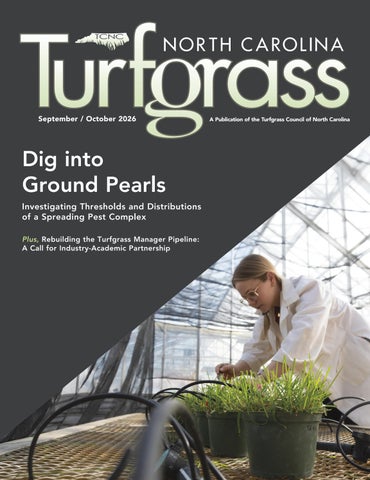
September / October 2026
Dig into Ground Pearls Investigating Thresholds and Distributions of a Spreading Pest Complex Plus, Rebuilding the Turfgrass Manager Pipeline: A Call for Industry-Academic Partnership
A Publication of the Turfgrass Council of North Carolina
PRO GOLF MAKES IT HAPPEN. Manage equipment and crews on your course even when you’re offsite within John Deere Every day you’re pulled a dozen directions. Dealing OnLink Golf Course Management Solutions. Learn how ourmonitoring technology and equipwith crews, equipment, controlling overhead ment can take your game to the next level at FinchTurf.com or RevelsTractor.com. and irrigation long before the sun comes up. Pro Golf lets you manage every aspect of your course from any connected device. Making it easier for you to lead your team from the location of your choice. Connect with Beard Equipment or Revels to schedule a Pro Golf demo.
BeardEquipment.com | RevelsTractor.com
A St. Augustine without the Call Backs
Superior Shade Tolerance
Superior Cold Tolerance
The NEXT Generation of Raleigh is Here Raleigh St. Augustine was a hit in the 1980s. 45 years later, it is time to update your turfgrass offerings. Sola® St. Augustine delivers everything you trust about Raleigh plus improved shade tolerance, drought tolerance and disease resistance. Developed by NC State University. Built on proven performance. Ready for 2026.
FutureProofTurf.com
Table of Contents September / October 2026
FEATURE
S T U DE N T COR N E R
MOR E FE ATUR E S
14 Rebuilding the Turfgrass
20 Dig into Ground Pearls:
From the President
Manager Pipeline: A Call for Industry-Academic Partnership
Investigating Thresholds and Distributions of a Spreading Pest Complex
TCNC Deluxe Members NC State Turf Team Calendar of Events New Members News from TCNC NCCTP Program
Find this issue, Events and More: TheTurfZone.com
Index of Advertisers
6 8 8 9 9 10 12 23
The Turfgrass Council of North Carolina (TCNC) serves its members in the industry through education, promotion and representation. The statements and opinions expressed herein are those of the individual authors and do not necessarily represent the views of the association, its staff, or its board of directors, North Carolina Turfgrass, or its editors. Likewise, the appearance of advertisers, or TCNC members, does not constitute an endorsement of the products or services featured in this, past or subsequent issues of this bimonthly publication. Copyright © 2026 by the Turfgrass Council of North Carolina. North Carolina Turfgrass is published bi-monthly. Subscriptions are complimentary to members of TCNC. Presorted standard postage is paid at Jefferson City, MO. Printed in the U.S.A. Reprints and Submissions: North Carolina Turfgrass allows reprinting of material published here. Permission requests should be directed to TCNC. We are not responsible for unsolicited freelance manuscripts and photographs. Contact the managing editor for contribution information. Advertising: For display and classified advertising rates and insertions, please contact Leading Edge Communications, LLC, P.O. Box 246, Brentwood, TN 37024.
Photo Credit: Ana Sapp
14 4 North Caro lina Turf gra ss
20 w w w . turfgra s s c ounc i l n c . o r g
S e p t e m b e r / Oc t o b e r 2 0 2 6
DO THE RIGHT THING. At Smith Turf & Irrigation, doing the right thing is more than a slogan – it’s our promise. We believe every decision matters. Every detail counts. Every challenge is an opportunity to do and be better. When you choose STI, you’re deciding on a partner that still values integrity, trust and responsibility and it’s been that way for over 100 years. Do the right thing. Choose a company that does too.
NORTH CAROLINA | SOUTH CAROLINA | VIRGINIA | TENNESSEE | BERMUDA
From the President
Dear Turfgrass Council of NC Members, What a summer it has been. Turfgrass Field Day at Lake Wheeler on August 12 brought together attendees for a day of research, conversation, and learning. We’re grateful to everyone who joined us and to the NC State faculty, staff, and students who made it such a valuable day. As we move into fall, I want to turn your attention to something that shapes everything TCNC does: the people who serve on our board. Our board members are working industry professionals who give their time to make sure this organization continues to deliver for its members. They set the direction for TCNC's advocacy, education, and research investments. They build the partnerships that open doors for our members. And they make sure that the turfgrass industry in North Carolina has a seat at the table when decisions are being made. Serving on the board is a chance to shape the future of a profession you have dedicated your career to. If you have ever thought about getting more involved, I want to encourage you to seriously consider it. We are always looking for passionate, dedicated members who are willing to bring their experience and perspective to this work. It’s a fantastic way to network, learn from peers, and stay connected to everything North Carolina turfgrass. We also have our final regional meeting of the year coming up in November in the Winston-Salem area. Details will be shared soon on our website. These regional gatherings are a great opportunity to ask questions, share ideas, and learn more about how TCNC operates and how you can be part of it. I hope to see you there! Thank you for your membership and for everything you contribute to this industry. Best regards,
North Carolina Turfgrass is the official publication of the Turfgrass Council of North Carolina P.O. Box 641 Wake Forest, NC 27588 984.301.5460 www.turfgrasscouncilnc.org
CHIEF STRATEGY OFFICER Marcy Cottle info@turfgrasscouncilnc.org 984.301.5460
Published by: Leading Edge Communications, LLC 206 Bridge Street Franklin, TN 37064 615.790.3718 Fax 615.794.4524 info@leadingedgecommunications.com
TCNC OFFICERS PRESIDENT Wilson Sutton Walnut Creek Country Club Goldsboro, NC
VICE PRESIDENT Greg Harris Leap Frog Land Care, Inc. Fuquay-Varina, NC
TREASURER Jonathan Richardson, NCCTP NCCTP Chairman Green Resource Dunn, NC
Wil Sutton
President Turfgrass Council of North Carolina
PAST PRESIDENT Kevin Herrmann Green Group, the Division of Turf Masters Brands Raleigh, NC
DIRECTORS Alpha Jones Duke University Durham, NC
Spencer Thomas Keith Hills Country Club Lillington, NC
6 North Caro lina Turf gra ss
TCNC Deluxe Members
NC State Turf Team
Companies wishing to support TCNC with multiple members can join as Deluxe Members. Deluxe Memberships can be purchased in one of three tiers: 1–5 employees; 6–10 employees; or 11+ employees.
CROP AND SOIL SCIENCES
If you'd like to learn more about the Deluxe Membership, please contact the TCNC office at 984.301.5460 or info@turfgrasscouncilnc.org.
Thank You to Our DELUXE MEMBER ORGANIZATIONS Barefoot Lawn Care and Landscaping Services
LawnMasterNC Incorporated
Canopy Lawn Care
Leapfrog Landcare
Carol Woods Retirement Community
McConnell Golf
City of Asheville Parks and Recreation
NaturaLawn of America (Raleigh)
Rocky River Sod
Emerald Green
SiteOne
ETM Coastal
Southern Ag
Fairway Green of Charlotte
Sod Solutions Southern Seeds, Inc.
Fairway Green of Raleigh
The Biltmore Company
Fayetteville Tech
The Sunrock Group
Gates Four Golf and Country Club
Town of Garner
GrowinGreen Inc. Helena Agri JRM Inc. Keck Co Turf and Ornamental Services Keith Hiils Golf Club Landscaping Unlimited, Inc.
Dr. Navdeep Godara Assistant Professor Turf & Forage Weed Science ngodara@ncsu.edu Emily Erickson Crop Science Lecturer 919.513.2034 emily_erickson@ncsu.edu Dr. Ray McCauley Extension Associate 919.515.2647 rkmccaul@ncsu.edu Dr. Susana Milla-Lewis Professor & University Faculty Scholar 919.280.3443 susana_milla-lewis@ncsu.edu
Dr. Grady Miller Professor & Extension Specialist 919.515.5656 grady_miller@ncsu.edu Dr. Rob Richardson Associate Professor & Extension Specialist 919.515.5653 rob_richardson@ncsu.edu Dr. Wei Shi Professor 919.513.4641 wei_shi@ncsu.edu Dr. Qiyu Zhou Assistant Professor 313.782.2892 qzhou9@ncsu.edu
Quality Turf
City of Raleigh Parks and Recreation
Green Resource
Dr. Travis Gannon Assistant Professor 919.515.2647 travis_gannon@ncsu.edu
Town of Morehead City Triangle Chemical Company Turf Mountain Sod, Inc.
ENTOMOLOGY AND PLANT PATHOLOGY
Dr. Terri Billeisen Extension Associate 919.515.7464 tlhoctor@ncsu.edu
Lee Butler NC State Turf Diagnostics Lab 919.513.3878 ebutler@ncsu.edu
Dr. James Kerns Professor and Extension Specialist 919.513.4820 jpkerns@ncsu.edu
HORTICULTURE SCIENCE
UNC – Chapel Hill Vandemark Farms Wake Forest University Weed Man
Dr. Danesha Seth Carley Director, Southern IPM Center & Associate Professor 919.513.8189 danesha_carley@ncsu.edu
Renewal as of May 2026 Don't see your company's name?
www.turffiles.ncsu.edu/people/
Renew today at www.turfgrasscouncilnc.org
8 North Caro lina Turf gra ss
w w w . turfgra s s c ounc i l n c . o r g
S e p t e m b e r / Oc t o b e r 2 0 2 6
Welcome New Members
continued | Green Light on Sod Calendar of Events
Larry Brown Weed Man Lake Norman / Charlotte / Salisbury / Fort Mill / Rock Hill
Doug Bullock Fairway Green Charlotte & Raleigh, NC
Shelby Choate Carolina Colours Golf Club New Bern, NC
Amy Cuthbertson Fairway Green Charlotte & Raleigh, NC
Larry Lancaster Small Town Landscaping, LLC Tarboro, NC
Jack Mascarenhas NCSU Raleigh, NC
Fayetteville Pesticide Safety School October 7 – 8
N.C. Cooperative Extension | Cumberland County Center, 301 E Mountain Dr, Fayetteville, NC 28306
October 21 – 22
Mountain Horticultural Crops Research and Extension Center, 455 Research Drive, Mills River, NC 28759
Mills River Pesticide Safety School
Rocky Mount Pesticide School
October 27 – 28
1175 Kingsboro Rd, Rocky Mount, NC 27801
Newton Pesticide Safety School November 4 – 5
N.C. Cooperative Extension – Catawba County Center, 2760 US Hwy. 70 SE, Hickory, NC 28602
November 9
Raleigh Pesticide Safety School
8:30 AM – 5:00 PM
4001 Carya Dr, Raleigh, NC 27610
December 15 – 16
N.C. Cooperative Extension | Johnston County Center, 2736 NC-210 STE. A, Smithfield, NC 27577
Smithfield Pesticide Safety School
Steven Oliver Falling Creek Golf Kinston, NC BLEND
Joshua Perruquet Morehead City Morehead City, NC
David Rolens-Havel Emerald Green, Inc Whittsett, NC
Matthew Stewart VillageScapes Lawn Care & Outdoor Lighting Clemmons, Lewisville, Advance, and Bermuda Run, NC
Southern
Greg Whittlesey Fairway Green Charlotte & Raleigh, NC
Specialty Equipment, Inc.
Alan Yates
New, Used & Refurbished • Ease of Operation • Low Operating
Fairway Green Charlotte & Raleigh, NC
Solid & Dependable Rotary Finishing Mowers
Over 50 Years of Harvesting Innovation
Email: jim@ssequip.net
Website: ssequip.net
Costs • Single Axle Truck Use
Brian Young Fairway Green Charlotte & Raleigh, NC
Office: 877-366-5399
Mobile: 352-284-8029
A P u b l i c a t i o n o f t h e T u r f g r a s s C o u n c i l o f No rth C aro l i n a 9
News from TCNC
10 North Carolina Turf gr a ss
w w w . t urfgra s s c ounc i l n c . o r g
S e p t e m b e r / Oc t o b e r 2 0 2 6
2 0 2 6 P ART N E RS P L A TIN U M
G OLD
SILV E R
A Pu b l i c a t i o n o f t h e T u r f g r a s s C o u n c i l o f No rth C aro l i n a 11
Fast Facts about the NCCTP
NCCTP Program
Enrollment Requirements:
Become a NC Certified Turfgrass Professional!
The
North Carolina Certified Turfgrass Professional (NCCTP) program is a comprehensive program developed to enhance the technical competency of turfgrass professionals, while elevating their professional image, that of your business and of the turfgrass management industry. Administered by the Turfgrass Council of North Carolina, the NCCTP designation confirms your expertise in turfgrass management to prospective customers and your peers.
Reasons to Begin Earning Your NCCTP Designation Today he NCCTP program increases and enhances your turfT grass industry knowledge, career, and business development through a course of study of in-depth coverage of the science of turfgrass management. The NCCTP designation offers immediate confidence and credibility of turfgrass management practices to customers and prospective employers. Promote and market yourself as a North Carolina Certified Turfgrass Professional. • Use the NCCTP logo on your business materials. • Use NCCTP pins, uniform patches, and vehicle decals. • Your TCNC Member Directory listing is distinguished with the NCCTP designation.
We Are Partnered With The NC State Turfgrass Professional Short Course The NC State Turfgrass Professional Short Course, a comprehensive turfgrass education program, is offered at select NC State Extension offices and at NC State University. This Short Course offers a full curriculum of the science of turfgrass management as well as Continuing Education Credits for NCDACS Pesticide and NCLCLB Landscape Contractors’ license holders, and it will help you prepare for the NCCTP exam. This Short Course is recommended but not required to take the NCCTP exam.
12 North Carolina Turf gr a ss
w w w . t urfgra s s c ounc i l n c . o r g
old a current TCNC membership. If not currently a H member, go to www.turfgrasscouncilnc.org and click ‘JOIN NOW’ to join online or download an application. Have a minimum of one full year of work experience in the turfgrass industry. Agree to the Certified Turfgrass Professional Code of Ethics as detailed on the application form. Submit: • A current and valid NC Pesticide Applicators license •A completed NCCTP application (current TCNC members may apply online). • NCCTP Program Application: $150 • Self-Study Materials: $50 • Exam Fee: $50
Curriculum and Exam urriculum covers nine core areas: Turfgrass CharacterisC tics; Establishing Turfgrass; Soils & Nutrient Management; Cultural Practices; Pests & Integrated Pest Management; Pesticides & Plant Growth Regulators; Landscape Safety & Pesticide Use; Calculations & Calibration; Turfgrass Business & Economics. Candidates have six months from the date of their enrollment acceptance to complete the NCCTP exam. Candidates have six hours to complete the exam and must score 80% or more on each section to receive the NCCTP designation. Exams can be taken at the TCNC office in Raleigh during normal business hours, or arrangements can be made at your local NC State Extension location. Exams will not be graded if any application information is missing or if TCNC membership status cannot be confirmed. Please allow two to three weeks for exam grading and reports. Upon successful completion of the exam, candidates will receive communication with their results and either next step options or their graduation packet.
Maintenance Requirements Maintain a current TCNC membership as a means of demonstrating ongoing support for the industry. Submit an annual $50 renewal fee, which supports the NCCTP program and related promotional activities. Designation year is the same as the TCNC membership year, from July 1st to June 30th. Hold a current NC Pesticide Applicator’s License. Subscribe to, actively support and uphold the TCNC Certification Code of Ethics. The NC Certified Turfgrass Professional designation (NCCTP), the NCCTP logo and related programs materials are the trademarked property of the Turfgrass Council of North Carolina and cannot be used without TCNC’s written permission. For additional information, contact TCNC at 984.301.5460.
S e p t e m b e r / Oc t o b e r 2 0 2 6
Don’ t Miss Out ! PROMOTE YOUR BUSINESS IN THE NEXT ISSUE OF
NORTH CAROLINA TURFGRASS
North Carolina Turfgrass allows you to get your message directly in the hands of your customers across North Carolina. The magazine is a key benefit of TCNC membership – providing valuable research, education and industry information. Readers can also access the Digital Edition through The Turf Zone website. Archived issues will ensure that your advertising will continue to be seen indefinitely, for long-ranging impact. The Turfgrass Council of North Carolina are:
Golf Course Superintendents
Landscape Contractors
Commercial Grounds Managers
Sod Producers
Lawn Care Operators
Parks & Recreation Supervisors
Sports Turf Professionals
Equipment Suppliers
Contact us today to learn about effective and unique advertising strategies that target turf industry professionals.
sales@leadingedgecommunications.com
Feature
Building the Turfgrass Manager Pipeline:
A Call for Industry-Academic Partnership By Jay McCurdy
The issue is more complex than a simple academic shortfall. The challenges facing turf programs reflect deeper structural and cultural dynamics within the larger society, as well as within the green industry and our academic institutions. I think we need to embrace a new model of mutual investment between academia and industry in order to restore vitality and sustainability to the profession. Whatever the model, it must redefine recruitment, enhance the talent pool, and demonstrate that green-industry roles are both professionally rewarding and personally sustainable. This essay outlines a vision for such a partnership, built on five key principles: shared recruitment, broader inclusion, job-quality reform, experiential learning, and a mutual commitment to long-term workforce development.
The Myth of the One-Way Pipeline
The
larger turfgrass and landscape industry has a labor issue—mainly that there’s not a reliable pipeline for accessing young and capable employees. I have this conversation almost weekly when discussing the state of the industry and how my role in a “turfgrass program” relates. I’m now in my 12th year at Mississippi State University, so I no doubt have some ownership of the problems. But I also wanted to relay to a wider audience just what some of the solutions might be to solve this problem. Yes, higher industry pay might help, but there’s more to the story than just that. Our landscape management industry includes a broad range of job titles, but most of us reading this magazine are either boots-onthe-ground landscape managers (ex. superintendents, lawn care professionals, sports field managers, sod producers, equipment managers, etc.) or are somehow involved in the industry/supply side (sales, accounts, research and development, chemical, equipment, etc.). We know the technical mastery and skill required to do this job. We know the rewards and challenges. Nevertheless, I find the perspective from academia is often a little different from what it was when I was a practitioner. We are all concerned about a shrinking pipeline of new professionals entering our field. Turfgrass academic programs are often criticized for producing too few graduates, and those graduates are said to be underprepared for the demanding, multifaceted roles that await them. The same is said for students fresh out of high school. There’s always a debate about whether it’s generational or whatnot. Maybe there’s something to that, but what, pragmatically, can we do to figure all this out?
14 North Carolina Turf gr a ss
w w w . t urfgra s s c ounc i l n c . o r g
Turfgrass academic programs are too often viewed as workforce development pipelines. In this paradigm, universities are expected to “turn out” graduates who are job-ready, immediately employable, and long-term loyal to the industry. These are ambitious goals that can only be achieved through industry partnerships. Universities cannot solve structural labor shortages in isolation. For starters, the looming demographic cliff, where student enrollment drops due to fewer babies having been born ~18 years ago, is self-evident. We have to reframe the relationship as a two-way street: industry leaders and employers must engage as co-investors in the success of the next generation. The declining number of turfgrass students is not solely a turf problem—it mirrors trends across many science, technology, engineering, agriculture, and mathematics (STEAM) disciplines. Yet in turf, the impact is more acute. Fewer students are entering, and those who do are frequently drawn away by careers with higher salaries, greater mobility, and more stable work-life balance—fields like wildlife biology, ecology, food science, and agricultural engineering. If return on investment (ROI) for college interests you, I highly recommend Preston Cooper’s Is College Worth It? A Comprehensive Return on Investment Analysis article. If the green industry wants to retain talented, committed professionals, it must work with academic programs to create clearer, more appealing, and more stable career pathways for students entering the field.
Recruitment: A Shared Responsibility One of the most common critiques from green industry professionals and hiring managers is that turf programs are not doing enough to recruit students into the field. In truth, recruitment cannot be the sole responsibility of faculty or universities. Few high school students grow up dreaming of becoming a golf course superintendent, especially if they’ve never been exposed to the role or the science behind it. Lots of kids grow up mowing lawns, but do they view that as a stable profession? How many golf course superintendents leave the industry for better working hours or more stable family lives? The stories of our profession are not always positive. How do we improve that?
S e p t e m b e r / Oc t o b e r 2 0 2 6
Southern Agricultural Insecticides, Inc. is a distributor of pesticides, fertilizers, potting soils, and horticultural supplies with locations in Florida and North Carolina. MANUFACTURERS OF… Blue Colorant
Soluble 10–30–20
Chelated 5% Iron
Soluble 30–7–14
Chlorpyrifos 2.5% G
Soluble 20–20–20
Chlorpyrifos Mole
Spreader Sticker
Mole Cricket Bait
Surfactant for
Defoamer
Herbicides
Latron B–1956
Tank Cleaner
Methylated Seed Oil
Turf Green
Snail Bait
Tweak
Soil Acidifier
12–0–0–6% iron
Soil Wetting Agent
DISTRIBUTORS FOR… AMVAC Andersons Aquatrols BASF Bayer BioSafe Systems Bioworks Certis Corteva Agriscience Envu FMC Gowan LebanonTurf Milliken
Milorganite Nufarm OHP Old Castle PBI / Gordon Quali-Pro Rightline SePRO Sipcam Agro Solo Sunniland Syngenta UPL Yara
GOLF COURSE SALES STAFF Jim Wells — West Central Florida . . . . . . . . . . . . . . . . . . . . (941) 720–2712 Roger Welker — East Coast Florida . . . . . . . . . . . . . . (772) 260–0282 Kevin Downing — South Florida. . . . . . . . . . . . . . . . . . . . . . . (561) 427–4501 Jeff Strother — Southwest Florida . . . . . . . . . . . . . . . . . . (941) 270–0470 Andrew Wampler — Western Carolinas . . . . . . . . . . . (828) 674–2594 Brandon Hicks — Central North Carolina . . . . . (336) 906–0803
Boone, NC (828) 264-8843 Hendersonville, NC (828) 692-2233 Palmetto, FL (941) 722-3285
Nathan Biggs — North Carolina. . . . . . . . . . . . . . . . . . . . . . (704) 996–5125
FREE DELIVERY AVAILABLE
www.SOUTHERNAG.com
Feature | continued
Meaningful recruitment requires visibility, storytelling, and early engagement. That means: • Hosting and organizing Golf Course Superintendents Association of America’s (GCSAA’s) STEAM program, First Green.
If we want to build a workforce that reflects the broader demographics of our society, the turfgrass industry must actively recruit from historically underrepresented communities, including women, students of color, and first-generation college students. Many turf programs sit within land-grant institutions with a mission to serve all citizens of their state. Partnerships with historically Black colleges and universities (HBCUs), tribal colleges, and community colleges offer promising avenues for talent development. Additionally, the industry must take steps to ensure that students from diverse backgrounds are not only recruited but also retained. That means:
• Industry professionals visiting high schools, FFA programs, and 4-H events to talk about careers in turf and to give hands-on help managing facilities.
• Hosting youth days, career shadowing, or field trips in coordination with FFA, agricultural teachers, 4-H, and Extension educators. • Alumni sharing their stories, not just of agronomic challenges overcome, but of career development, family stability, and lifelong learning.
• Paid internships with real mentorship, not just summer labor. This is something our industry does well. Though pay and working conditions could always be improved, I understand the financial realities for most businesses— margins matter, and you can’t pay a 20-year-old more than your loyal long-time employees. • Scholarships and travel support to attend GCSAA and regional turfgrass conferences. GCSAA and our regional events have done a great job supporting our students. Our state and regional associations have covered almost all the costs for our students attending events like Deep South. GCSAA allows students and academic advisors to attend the Golf Show for free. They allow students to be members for free. We just have to cover flight and meal costs—sell more hats and pullovers!
Students attending local and national conferences benefit from the wisdom and experience of generations of turfgrass managers.
Academic programs can support these efforts with marketing materials, introductory coursework, event production, and advising. Industry partners can develop their own materials, and my academic colleagues and I would be happy to collaborate. But unless the industry is willing to support or do the work, recruitment will remain a leaky pipeline. The Golf Course Superintendents Association of America has promoted its First Green program and has invested heavily in promoting the profession to kids in FFA. This is a good example of how we might target youth to entice them into our profession.
Reaching the Future of the Profession A second issue compounding recruitment challenges is the profession’s lack of demographic diversity (this isn’t a DEI discussion!). This is not simply a turfgrass issue; it reflects broader underrepresentation across many STEAM fields. However, the profession’s visual and cultural homogeneity isn’t always inviting to those from different socioeconomic or cultural backgrounds. That’s to say very little of the lack of female representation—it’s improving. Still, it lags considerably behind many other attractive career fields for the same candidate pool we are competing for.
16 North Carolina Turf gr a ss
w w w . t urfgra s s c ounc i l n c . o r g
• Storytelling campaigns that highlight successful professionals in our industry. Barry Stewart hosts MSU Turf Seminar speakers, and I’m sure he’d love to hear from those of you who can share your secrets to success and happiness. If the profession remains perceived as culturally insular or exclusionary, we will continue to miss out on a generation of bright, capable professionals who simply chose other welcoming fields.
S e p t e m b e r / Oc t o b e r 2 0 2 6
Triple Threat Tall Fescue | Common Centipede | Compadre Zoysia | Tifway 419 Bermuda
DMG TURF
The Triangle’s Premier Turfgrass and Sod Farm DMG Turf is a family owned and operated business, serving North Carolina with cool and warm season grasses. From residential projects to large commercial jobs including golf courses, athletic fields, and more, our commitment to customer satisfaction has been our top priority since 1999. Our friendly and knowledgeable staff are ready to serve you with delivery to your location, or you can schedule a pickup at our sod farm in Angier, NC.
dmgturf.com | 919.639.4027 | 997 Matthews Mill Pond Road, Angier, NC
Feature | continued
Career Quality: The Hidden Cost of Turnover Recruitment efforts alone are not enough if the jobs themselves are perceived as undesirable. One of the most pressing challenges facing the green industry is career sustainability and burnout. Even for students who graduate from turf programs and enter the profession, the early-career reality can be discouraging. Starting roles are often physically demanding, geographically isolating from home, and poorly compensated relative to the skill and responsibility required. I won’t disagree: early careers are hard in many professions, and ours has a history of heartiness and resilience that we pride ourselves on. And that’s great, but let’s face it, positions frequently involve long hours, especially in golf and sports fields, weekend shifts, and high turnover. Relocation is common, placing strain on young professionals with families or community ties. Burnout is not only likely, but it’s also all too often expected. In many cases, internships play a decisive role. While some students have transformative experiences, others emerge disillusioned. Internships are often where students determine whether they see a long-term future in the profession. Unfortunately, too many internships treat students as temporary labor rather than future colleagues. Our profession must take a hard look at its entry-level roles and ask: • Are we investing in mentorship or extracting labor? • Are we helping build careers or merely filling seasonal gaps? • Are we creating a profession that values work-life balance and career advancement? Until the industry addresses these questions honestly, retention will remain low, and turf programs will struggle to retain students who see more stable options elsewhere.
Experiential Learning and Academic Alignment To ensure that students are prepared for professional success, universities must evolve as well. Turfgrass programs must incorporate not only plant science and weed control, but also: • Business management and budgeting • Communication and conflict resolution • Human resources and leadership • Sustainability, data analytics, and emerging technologies Faculty must engage in continuous dialogue with industry professionals to align curricula with real-world expectations. This can happen through advisory boards, curriculum reviews, and co-developed experiential learning opportunities.
18 North Carolina Turf gr a ss
w w w . t urfgra s s c ounc i l n c . o r g
Meanwhile, the industry must treat internships and co-ops as educational experiences, not just temporary employment. Golf courses that offer structured mentorship, performance feedback, and leadership development will not only see better short-term productivity, but they’ll also help shape the long-term workforce of the profession.
The Role of Associations The Sports Field Management Association (SFMA), GCSAA, and other professional landscape associations have a unique opportunity to lead systemic change. Many in the industry look to them for guidance, advocacy, and professional standards. But as organizations, they can: •D evelop and promote best practices for internship mentorship •R ecognize organizations that invest in student development •P artner with academic programs on workforce development grants • Support early-career professionals through networking and continuing education Just as importantly, associations must continue to help shift cultural expectations within the profession. That means promoting superintendent and field manager roles as executive leadership positions, not just agronomic technicians. It means celebrating the intellectual and managerial skills required to succeed in this career, and advocating for compensation, stability, and respect commensurate with those demands.
Learning from Other Industries Much can be learned from adjacent fields. Engineering, for example, has long faced similar challenges: rigorous academic programs, intense internships, and high attrition. Yet leading companies and associations in that field have invested heavily in university partnerships, student engagement, and earlycareer support. Top manufacturing and technology firms fund campus recruiting, sponsor capstone projects, offer paid site visits to facilities, and offer career ladders with clear promotion timelines. These students, like our own, are not afraid of hard work. They are attracted by clear career outcomes and structured support along the way. There is no reason the green industry cannot offer the same. But doing so requires a shift in mindset: from “you have to earn your place” to “we will invest in you as the future of our profession.”
A Vision for the Future In many places, these goals are already occurring, but here are just a few to imagine as being widespread:
S e p t e m b e r / Oc t o b e r 2 0 2 6
• High school students attend “turf career days” hosted by their local superintendent and Extension agent. •U niversities and employers co-design internships that develop not just technical skills, but leadership and confidence.
GRASS SO GREEN THAT WE NEEDED AN EXTRA “E” Our Liquid Nutritionals & Specialty Fertility Products Are Blended To Feed Plants, Improve Soil Fertility & Build Topsoil
• Interns feel welcomed and valued from their first day on a golf course. • Assistant superintendents are mentored, paid fairly, and see clear paths to advancement. • Associations and turf programs work side by side to tell the story of a modern, rewarding profession. This future is not only possible but also essential. The alternative is the status quo, or worse, decline: fewer students, fewer assistants, more burnout, and an aging workforce with no one ready to take the reins.
Conclusion: A Call to Shared Action The challenges facing the profession are real, but they are not insurmountable. What is required is not blame, but shared responsibility. Universities must modernize curricula and deepen student support. Turfgrass managers must invest in mentorship and help reshape early-career roles. Our industry associations must lead with vision, coordination, and advocacy. Ultimately, this is about stewardship of the profession itself. The same care, foresight, and commitment that turfgrass managers bring to managing turf must now be brought to cultivating the future of the workforce.
The author would like to thank Barry Stewart for his suggestions and edits to this article.
Healthy Turf starts with Greene County Fert. Ship Direct. Pro support always included.
GreeneCountyFert.com
FORE SALE!
GREEN DIVOT MIX PREMIUM QUALITY SAND (40 lb. Bags or Bulk)
Topdressing Sand Black Topdressing Sand Bunker Sand Drill & Fill Blends Time to Buy Your Divot Mix for the Golf Season!
DIVOTS, INC.
Phone: 919-775-9732 • Email: sales@divotssand.com • www.DivotsSand.com 248 Palace Drive • Sanford, NC 27330
This article was originally published in Mississippi Turfgrass Magazine, Spring 2026 and is reprinted with permission. 19
Student Corner
DIG INTO
GROUND PEARLS Investigating Thresholds and Distributions of a Spreading Pest Complex By Lily Deeter, Peter Hertl, and Terri Billeisen
Figure 1. Immature cyst stages of A: Eumargarodes laingi and B: Dimargarodes meridionalis.
A
B
Photo Credit: Kenneth Geisert
Figure 2. Eumargarodes laingi (left) and Dimargarodes meridionalis (right) under magnification.
A
B
C
Figure 3. Photo tent and camera (A) photographing potted centipede container (B) artificially infested with ground pearls to investigate damage development and thresholds. Green pixels are selected and quantified in Image (C) to quantify damage.
20 North Carolina Turf gr a ss
w w w . t urfgra s s c ounc i l n c . o r g
G
round pearls (Hemiptera: Margarodidae) are severe insect pests of warm season turfgrass in North Carolina and much of the southern United States, spanning from Florida to California. These scale insects feed on grass roots fluids, causing distinctive circular dead patches turfgrass and frustration in homeowners, superintendents, and sod producers. No currently registered insecticides have shown consistent control for ground pearls (Chong, 2018; Thomson et al, 2021), likely due to their wax-protected cyst (Figure 1), the immature nymph stage that feeds on plant roots with piercing-sucking mouthparts. In addition, their subterranean habit and ability to remain encysted for years under adverse conditions make management of this insect challenging. As an insect family with over 100 species, ground pearls cause damage beyond managed turfgrass. Additional affected crops include grapevines in South Africa, wheat and barley in the Middle East, and sugarcane in Australia (García Morales et al., 2016). Two distinct ground pearl species infest North Carolina turfgrass: Eumargarodes laingi, known as the “pink ground pearl,” and Dimargarodes meridionalis, which is orange in the adult female life stage (Figure 2). While E. laingi cysts are typically a dull brown, beige, or pink (Figure 1B), the cysts of D. meridionalis are shiny yellow, orange, or white (Figure 1A). In North Carolina, these two species occur both separately and together in mixed infestations. As part of my dissertation research at NC State, I am investigating the ground pearl species complex and using distribution and life staging specifics to inform management. Understanding species abundance and impact may influence control approaches including product selection or timing. Greenhouse trials are ongoing to investigate and establish damage thresholds in centipedegrass, the most susceptible turfgrass species to ground pearl damage. Adult female ground pearls were introduced to potted grass containers at different densities and species combinations. Time to damage incidence is recorded as females lay eggs and establish a new generation of cysts. Damaged surface area will be estimated by individual
S e p t e m b e r / Oc t o b e r 2 0 2 6
container images using ImageJ software that quantifies green pixelation in each image. Containers are photographed every other week in a photo tent (Figure 3) to maintain consistent lighting. Results from this study will inform not only damage potential of each ground pearl species, but also the damage and tolerance thresholds when managing infestations. I am also actively collecting distribution data for both species within and beyond the state. Once believed to be a localized issue, ground pearl infestations have now spread across most of the Coastal Plain and well into the Piedmont (Figure 4). Infestations of D. meridionalis are typically found in mixed infestations with E. laingi along the coast, while E. laingi infestations are spreading west as far as Wake County. Distribution data is growing through collaboration with extension agents, homeowners, and the NC State Turfgrass Diagnostics Lab.
Figure 4. Distribution map of ground pearl infestations in North Carolina.
Confirmed Eumargarodes laingi (pink ground pearl) Confirmed infestations of both E. laingi and Dimargarodes meridionalis (orange ground pearl) Infestations of unconfirmed identitiy
A Pu b l i c a t i o n o f t h e T u r f g r a s s C o u n c i l o f No rth C aro l i n a 21
While I continue to characterize impact in North Carolina, my research on ground pearls will also investigate new pesticide formulations and emergence cycles to improve product application timing. I am also studying the evolution of this pest family using phylogenomics. Results from this research will help refine management procedures for ground pearls in North Carolina turfgrass and beyond.
Photo Credit: Ana Sapp
Student Corner | continued
References: [1] Chong, J. H. 2018. Ground pearls in turf. GCSAA, Lawrence, Kansas. https://www.gcmonline.com/course/ environment/news/ground-pearls-turf (accessed February 9, 2026). [2] Thomson, M.B., Campbell, S.D., Young, A.J. 2021 Ground pearls (Hemiptera: Margarodidae) in crops and pastures: biology and options for management. Crop & Pasture Science doi.org/10.1071/CP20235 ]3] García Morales M., Denno B.D., Miller D.R., Miller G.L., Ben-Dov Y., Hardy N.B. 2016. ScaleNet: A literature-based model of scale insect biology and systematics. Database. doi: 10.1093/database/bav118. http://scalenet.info [accessed July 17, 2026].
NO NEED TO SWEAT THIS SUMMER! Partner with Triangle for the best choices from the best companies in the world of nursery, landscape, and golf course care. With nine distribution points strategically located to serve the Southeast, good company is always just around the corner.
For more information visit www.trianglecc.com 2024
22 North Carolina Turf gr a ss
w w w . t urfgra s s c ounc i l n c . o r g
S e p t e m b e r / Oc t o b e r 2 0 2 6
Index of Advertisers SAND BASED SOD WITH INFILTRATION RATE OF 11 IN/HR TENSILE SRENGTHwww.cgcfields.com 88% GREATER THAN 1” THICK CUT SOD Beard Equipment......Inside Front Cover www.beardequipment.com
SHEAR STRENGTH 43% GREATER THAN 1” THICK CUT SOD 866-753-1707
Carolina Green Corp........................... 23 www.cgcfields.com
Divots, Inc........................................... 19 www.divotssand.com
DMG Turf, Inc..................................... 17 www.dmgturf.com
Green Resource....................Back Cover www.green-resource.com
Greene County Fertilizer Co.............. 19 www.greenecountyfert.com
Leading Edge Communications.......... 13 www.LeadingEdgeCommunications.com
Smith Seed Services.............................. 9 www.smithseed.com
Smith Turf & Irrigation.......................... 5 www.smithturf.com
Sod Solutions........................................ 3 www.SodSolutionsPro.com
Southern Agricultural Insecticides, Inc................................... 15 www.southernag.com
Southern Specialty Equipment............. 9 www.ssequip.net
Super-Sod.............................................. 7 www.supersod.com
The Turf Zone..................................... 23 www.theturfzone.com
Triangle Turf and Ornamental............ 22 www.triangleturf.net
FOLLOW FOR TURFGRASS RESEARCH, EVENTS & MORE
linkedin.com/company/ theturfzone
x.com/theturfzone
facebook.com/ theturfzone
Turf Mountain Sod, Inc....................... 23 www.turfmountain.com
Vandemark Farms............................... 21 www.vandemarkfarms.com
A Pu b l i c a t i o n o f t h e T u r f g r a s s C o u n c i l o f No rth C aro l i n a 23
Green-Resource.com
Be Confident Of Your Course Green Resource is one of the largest suppliers in the Southeast. Our team of experts provide solutions that produce results you can depend on. We are ready to help you.
TRIAD
5204 Highgreen Court Colfax, NC 27235
(336) 855-6363
CHARLOTTE
10404 Granite Street, Ste K Charlotte, NC 28273
(704) 927-3100
COASTAL
2407 Ocean Hwy, West Shallotte, NC 28459
(910) 363-1230
�- �;�! envu· � 5,�i!c! EVA" G
TRIANGLE
�=�:.:�
1218 Mangement Way Garner, NC 27529
(919) 779-4727
WINSTON
CHARLESTON
(336) 793-9230
(854) 999-4039
90 Piedmont Industrial Dr. 9492 Hamburg Road Winston-Salem, NC 27107 Charleston, SC 29456
Jnufarm
QUALi-PRO syngenta