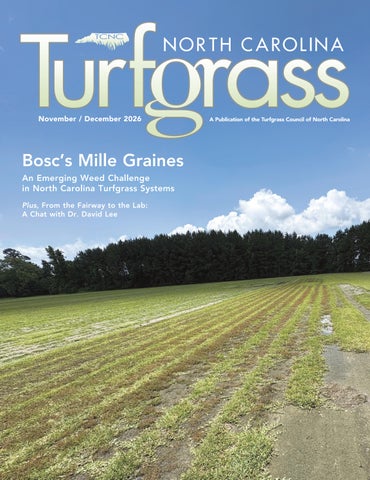
November / December 2026
Bosc’s Mille Graines An Emerging Weed Challenge in North Carolina Turfgrass Systems Plus, From the Fairway to the Lab: A Chat with Dr. David Lee
A Publication of the Turfgrass Council of North Carolina
Certified Bermudagrass From Coast to Coast
67 Producers | Grown in 19 States | 19,000 Acres of Production www.TheTurfgrassGroup.com
Follow for TURFGRASS NEWS, RESEARCH & EVENTS linkedin.com/company/ theturfzone
x.com/theturfzone
facebook.com/ theturfzone
Contact us today to learn about effective and unique TurfZone marketing strategies that target turf industry professionals.
sales@leadingedgecommunications.com
Table of Contents November / December 2026
MEMBER SPOT L I G HT
S T U DE N T COR N E R
MOR E FE ATUR E S
14 From the Fairway
20 Basalt as an
From the President
to the Lab: A Chat with Dr. David Lee
COVER STO RY
Alternative Topdressing Sand and Carbon Sequestration Strategy on Turfgrass Systems
NC State Turf Team Calendar of Events New Members
16 Bosc’s Mille Graines –
An Emerging Weed Challenge in North Carolina Turfgrass Systems
TCNC Deluxe Members
News from TCNC Read online: TheTurfZone.com
NCCTP Program Index of Advertisers
6 8 8 9 9 10 12 23
The Turfgrass Council of North Carolina (TCNC) serves its members in the industry through education, promotion and representation. The statements and opinions expressed herein are those of the individual authors and do not necessarily represent the views of the association, its staff, or its board of directors, North Carolina Turfgrass, or its editors. Likewise, the appearance of advertisers, or TCNC members, does not constitute an endorsement of the products or services featured in this, past or subsequent issues of this bimonthly publication. Copyright © 2026 by the Turfgrass Council of North Carolina. North Carolina Turfgrass is published bi-monthly. Subscriptions are complimentary to members of TCNC. Presorted standard postage is paid at Jefferson City, MO. Printed in the U.S.A. Reprints and Submissions: North Carolina Turfgrass allows reprinting of material published here. Permission requests should be directed to TCNC. We are not responsible for unsolicited freelance manuscripts and photographs. Contact the managing editor for contribution information. Advertising: For display and classified advertising rates and insertions, please contact Leading Edge Communications, LLC, P.O. Box 246, Brentwood, TN 37024.
14
4 North Caro lina Turf gra ss
16
w w w . turfgra s s c ounc i l n c . o r g
20
N ov e m b e r / D e c e m b e r 2 0 2 6
NORTH CAROLINA | SOUTH CAROLINA | VIRGINIA | TENNESSEE | BERMUDA
MAKING TALL GRASS SHORT & DRY GRASS WET FOR OVER 100 YEARS As the oldest, continuously operating Toro Distributor on the planet, we’ve pretty much seen it all. Which means when you need answers, equipment, parts or support, chances are we've solved it before – and we're ready to help again. While the equipment has changed, the technology has evolved, our commitment to our customers hasn't. That's why they have trusted us for generations.
From the President
A New Season Dear Turfgrass Council of NC Members, As we close out 2026, I find myself reflecting on all the organization has accomplished this year. From regional meetings to Field Day to the educational opportunities that kept us connected and informed, TCNC continues to show up for its members. This fall brought two great opportunities to connect. In September, we gathered at Dorothea Dix in Raleigh for an educational event that brought members together to learn and grow. And in October, our Regional Ambassador Cornhole Tournament gave members a chance to unwind, network, and build relationships outside the usual workday. Thank you to everyone who came out for both. Looking ahead, mark your calendar for our End of Year Meeting in Raleigh this December. It's a great chance to close out the year together and reflect on everything TCNC accomplished in 2026. Also, plan on joining us for the 2027 Turfgrass & Technology Conference in late January or early February, where we'll kick off another year of education, connection, and growth for our industry. This letter also marks a personal milestone for me. It's my last as your president. Serving this organization has been one of the great honors of my career, and I'm grateful for every member, board member, and volunteer who made these past years so meaningful. TCNC is heading into 2027 in great hands with Greg Harris of Leapfrog Landcare. As the year winds down, I want to thank you for your membership and everything you do for the turfgrass industry in North Carolina. Wishing you and your families a wonderful holiday season. Best regards,
Wil Sutton
President Turfgrass Council of North Carolina
North Carolina Turfgrass is the official publication of the Turfgrass Council of North Carolina P.O. Box 641 Wake Forest, NC 27588 984.301.5460 www.turfgrasscouncilnc.org
CHIEF STRATEGY OFFICER Marcy Cottle info@turfgrasscouncilnc.org 984.301.5460
Published by: Leading Edge Communications, LLC 206 Bridge Street Franklin, TN 37064 615.790.3718 Fax 615.794.4524 info@leadingedgecommunications.com
TCNC OFFICERS PRESIDENT Wilson Sutton Walnut Creek Country Club Goldsboro, NC
VICE PRESIDENT Greg Harris Leap Frog Land Care, Inc. Fuquay-Varina, NC
TREASURER Jonathan Richardson, NCCTP NCCTP Chairman Green Resource Dunn, NC
PAST PRESIDENT Kevin Herrmann Green Group, the Division of Turf Masters Brands Raleigh, NC
DIRECTORS Alpha Jones Duke University Durham, NC
Spencer Thomas Keith Hills Country Club Lillington, NC
6 North Caro lina Turf gra ss
TCNC Deluxe Members
NC State Turf Team
Companies wishing to support TCNC with multiple members can join as Deluxe Members. Deluxe Memberships can be purchased in one of three tiers: 1–5 employees; 6–10 employees; or 11+ employees.
CROP AND SOIL SCIENCES
If you'd like to learn more about the Deluxe Membership, please contact the TCNC office at 984.301.5460 or info@turfgrasscouncilnc.org.
Thank You to Our DELUXE MEMBER ORGANIZATIONS Barefoot Lawn Care and Landscaping Services
LawnMasterNC Incorporated
Canopy Lawn Care
Leapfrog Landcare
Carol Woods Retirement Community
McConnell Golf
City of Asheville Parks and Recreation
NaturaLawn of America (Raleigh)
Rocky River Sod
Emerald Green
SiteOne
ETM Coastal
Southern Ag
Fairway Green of Charlotte
Sod Solutions Southern Seeds, Inc.
Fairway Green of Raleigh
The Biltmore Company
Fayetteville Tech
The Sunrock Group
Gates Four Golf and Country Club
Town of Garner
GrowinGreen Inc. Helena Agri JRM Inc. Keck Co Turf and Ornamental Services Keith Hiils Golf Club Landscaping Unlimited, Inc.
Dr. Navdeep Godara Assistant Professor Turf & Forage Weed Science ngodara@ncsu.edu Emily Erickson Crop Science Lecturer 919.513.2034 emily_erickson@ncsu.edu Dr. Ray McCauley Extension Associate 919.515.2647 rkmccaul@ncsu.edu Dr. Susana Milla-Lewis Professor & University Faculty Scholar 919.280.3443 susana_milla-lewis@ncsu.edu
Dr. Grady Miller Professor & Extension Specialist 919.515.5656 grady_miller@ncsu.edu Dr. Rob Richardson Associate Professor & Extension Specialist 919.515.5653 rob_richardson@ncsu.edu Dr. Wei Shi Professor 919.513.4641 wei_shi@ncsu.edu Dr. Qiyu Zhou Assistant Professor 313.782.2892 qzhou9@ncsu.edu
Quality Turf
City of Raleigh Parks and Recreation
Green Resource
Dr. Travis Gannon Assistant Professor 919.515.2647 travis_gannon@ncsu.edu
Town of Morehead City Triangle Chemical Company Turf Mountain Sod, Inc.
ENTOMOLOGY AND PLANT PATHOLOGY
Dr. Terri Billeisen Extension Associate 919.515.7464 tlhoctor@ncsu.edu
Lee Butler NC State Turf Diagnostics Lab 919.513.3878 ebutler@ncsu.edu
Dr. James Kerns Professor and Extension Specialist 919.513.4820 jpkerns@ncsu.edu
HORTICULTURE SCIENCE
UNC – Chapel Hill Vandemark Farms Wake Forest University Weed Man
Dr. Danesha Seth Carley Director, Southern IPM Center & Associate Professor 919.513.8189 danesha_carley@ncsu.edu
Renewal as of May 2026 Don't see your company's name?
www.turffiles.ncsu.edu/people/
Renew today at www.turfgrasscouncilnc.org
8 North Caro lina Turf gra ss
w w w . turfgra s s c ounc i l n c . o r g
N ov e m b e r / D e c e m b e r 2 0 2 6
Welcome New Members Lucas Aiken
Don Fitzgerald
Robert Lovelace
Dan Traub
NaturaLawn of America Cary, NC
Turfwizards Sanford, NC
Trugreen Morrisville, NC
Trugreen Morrisville, NC
Maya Arline
Joe Floyd
Wright Lowery
Matthew Walker
Green Weed Free Raleigh, NC
Landmasters, Inc Dallas, NC
WrightOutside Landscaping and Design Raleigh, NC
Leap Frog Land Care Cary, NC
Elliot McDaniel
NaturaLawn of America Cary, NC
Ben Brackin
Mills Grant
Trugreen Greensboro, NC
New Life Turf Greer, SC
Mark Burgess
Matthew Hallet
Trugreen Morrisville, NC
Fairway Green Charlotte, NC
Green Weed Free Raleigh, NC
Kimberly Pearce Yard Smart Lawn Care Rolesville, NC
Willie Campbell
Allen Hudson
Turf Commander Landscape Design Inc. Charlotte, NC
Green Weed Free Raleigh, NC
Christopher DeStefano Trugreen Greenville, NC
Diamond Landscape Services, LLC Raleigh, NC
Green Weed Free Raleigh, NC
Steven Dunn
Joshua Leamnson
William Thompson
Trugreen Cary, NC
Trugreen Greensboro, NC
Trugreen Morrisville, NC
Calendar of Events
John King
Tyler Retzlaff Trugreen Morrisville, NC
Justin Weatherford
Christopher Wickline Trugreen Morrisville, NC
Jamie Wilkinson Landmasters Inc Dallas, NC
Tyrece Thomas
BLEND
November 4 – 5 Newton Pesticide Safety School N.C. Cooperative Extension Catawba County Center 2760 US Hwy. 70 SE Hickory, NC 28602
November 9 Raleigh Pesticide Safety School 4001 Carya Dr, Raleigh, NC 27610 8:30 AM – 5:00 PM
December 15 – 16 Smithfield Pesticide Safety School N.C. Cooperative Extension Johnston County Center 2736 NC-210 STE. A Smithfield, NC 27577
A P u b l i c a t i o n o f t h e T u r f g r a s s C o u n c i l o f No rth C aro l i n a 9
News from TCNC
10 North Carolina Turf gr a ss
w w w . t urfgra s s c ounc i l n c . o r g
N ov e m b e r / D e c e m b e r 2 0 2 6
2 0 2 6 P ART N E RS P L A TIN U M
G OLD
SILV E R
A Pu b l i c a t i o n o f t h e T u r f g r a s s C o u n c i l o f No rth C aro l i n a 11
Fast Facts about the NCCTP
NCCTP Program
Enrollment Requirements:
Become a NC Certified Turfgrass Professional!
The
North Carolina Certified Turfgrass Professional (NCCTP) program is a comprehensive program developed to enhance the technical competency of turfgrass professionals, while elevating their professional image, that of your business and of the turfgrass management industry. Administered by the Turfgrass Council of North Carolina, the NCCTP designation confirms your expertise in turfgrass management to prospective customers and your peers.
Reasons to Begin Earning Your NCCTP Designation Today he NCCTP program increases and enhances your turfT grass industry knowledge, career, and business development through a course of study of in-depth coverage of the science of turfgrass management. The NCCTP designation offers immediate confidence and credibility of turfgrass management practices to customers and prospective employers. Promote and market yourself as a North Carolina Certified Turfgrass Professional. • Use the NCCTP logo on your business materials. • Use NCCTP pins, uniform patches, and vehicle decals. • Your TCNC Member Directory listing is distinguished with the NCCTP designation.
We Are Partnered With The NC State Turfgrass Professional Short Course The NC State Turfgrass Professional Short Course, a comprehensive turfgrass education program, is offered at select NC State Extension offices and at NC State University. This Short Course offers a full curriculum of the science of turfgrass management as well as Continuing Education Credits for NCDACS Pesticide and NCLCLB Landscape Contractors’ license holders, and it will help you prepare for the NCCTP exam. This Short Course is recommended but not required to take the NCCTP exam.
12 North Carolina Turf gr a ss
w w w . t urfgra s s c ounc i l n c . o r g
old a current TCNC membership. If not currently a H member, go to www.turfgrasscouncilnc.org and click ‘JOIN NOW’ to join online or download an application. Have a minimum of one full year of work experience in the turfgrass industry. Agree to the Certified Turfgrass Professional Code of Ethics as detailed on the application form. Submit: • A current and valid NC Pesticide Applicators license •A completed NCCTP application (current TCNC members may apply online). • NCCTP Program Application: $150 • Self-Study Materials: $50 • Exam Fee: $50
Curriculum and Exam urriculum covers nine core areas: Turfgrass CharacterisC tics; Establishing Turfgrass; Soils & Nutrient Management; Cultural Practices; Pests & Integrated Pest Management; Pesticides & Plant Growth Regulators; Landscape Safety & Pesticide Use; Calculations & Calibration; Turfgrass Business & Economics. Candidates have six months from the date of their enrollment acceptance to complete the NCCTP exam. Candidates have six hours to complete the exam and must score 80% or more on each section to receive the NCCTP designation. Exams can be taken at the TCNC office in Raleigh during normal business hours, or arrangements can be made at your local NC State Extension location. Exams will not be graded if any application information is missing or if TCNC membership status cannot be confirmed. Please allow two to three weeks for exam grading and reports. Upon successful completion of the exam, candidates will receive communication with their results and either next step options or their graduation packet.
Maintenance Requirements Maintain a current TCNC membership as a means of demonstrating ongoing support for the industry. Submit an annual $50 renewal fee, which supports the NCCTP program and related promotional activities. Designation year is the same as the TCNC membership year, from July 1st to June 30th. Hold a current NC Pesticide Applicator’s License. Subscribe to, actively support and uphold the TCNC Certification Code of Ethics. The NC Certified Turfgrass Professional designation (NCCTP), the NCCTP logo and related programs materials are the trademarked property of the Turfgrass Council of North Carolina and cannot be used without TCNC’s written permission. For additional information, contact TCNC at 984.301.5460.
N ov e m b e r / D e c e m b e r 2 0 2 6
T H A N K YO U TO O U R PA R T N E R Q U A L I T Y T U R F, I N C . F O R A D V E R T I S I N G W I T H U S S I N C E 2 0 1 7 !
0UR REPUTATION IS GROWING
Emerald Zoysia
Raleigh St. Augustine Centipede Tifway 419 Bermuda
866.259.3064
qualityturfnc.com
Member Spotlight
From the Fairway to the Lab:
A Chat with Dr. David Lee
N
orth Carolina turf managers know the drill by now: warm-season and cool-season grasses side by side, droughts one year and deep freezes the next, and this fall bringing its own challenges. Fescue lawns and warmseason golf turf alike took a beating from the drought, and irrigation systems simply couldn’t replace what natural rainfall provides. It reminds us that the conditions here are some of the most demanding in the country. Dr. David Lee has spent his career managing that unpredictability, and this spring he stepped into a new role as Director of Agronomy at Green Resource. His path runs through some of the state's most respected turf programs: a PhD in Plant Pathology and Crop Science from NC State, two years as an Assistant Professor of Turfgrass Management at LSU, and more than a decade as Superintendent at Hope Valley Country Club before becoming Director of Golf Courses and Grounds at Forest Creek. Now, he's bringing that research background and hands-on experience to a broader advisory role, supporting turf managers across the region.
The “Roots” & Turf Management Philosophy Dr. Lee began working at Hope Valley in high school, which pulled him into the turf industry. Years later, when his mentor Bob Mashburn passed away, Dr. Lee was hired as his successor and went on to spend 13 years as Superintendent before moving to Forest Creek in 2019. He learned many lessons from those years. “Mother Nature is undefeated and expect the unexpected! Managing turfgrass in the Carolinas is one of the most difficult areas in the country. With warm and cool season grasses combined with droughts, hurricanes, deep freezes, and snowfalls every year is different and problems can be complex,” he explains. His time at LSU still shapes how he thinks, though maybe not in the way people expect. “I see myself thinking more as a superintendent,” he says. “Superintendents deal with so many real world problems that they often are the first observers of problems and begin to create management plans to solve them.” He credits NC State’s faculty with the systematic, long-term research that helps answer the questions superintendents raise in the field.
14 North Carolina Turf gr a ss
w w w . t urfgra s s c ounc i l n c . o r g
That two-way relationship between the course and the classroom now defines his regional work. Visiting different properties has shown him just how resourceful this industry is: “It is amazing to me to observe how guys use different techniques to solve similar problems. Superintendents are some of the most efficient and creative people when it comes to problem solving and producing results.”
The Science: Busting Myths & Best Practices Beyond the drought, Dr. Lee sees one area of turf science that’s overdue for more attention and that’s the soil microbiome. “There are a lot of products being sold on the market that claim to be beneficial. In theory, many of these products can be helpful,” he says, but he’s hoping research catches up soon so end users can act on solid evidence rather than marketing claims. A myth he’d love to retire is the appeal of the newest product on the shelf. “Nothing beats a basic, sound agronomic plan,” he says. “We can buy all the bells and whistles but if we don't have a solid soil chemical plan and the basic fertility all the other stuff doesn’t matter.” Walking a course, the first thing he checks is the quality of cut on the mowers. Clean, sharp, well-adjusted equipment makes a measurable difference in both turf health and how a course presents.
Looking Forward & the Lightning Round Dr. Lee sees his job now as a translation exercise. “I think understanding the research protocols and then taking practical solutions from the university to the end user,” he shares. “Sometimes what works in a laboratory or controlled environment will not be practical for the guys in the field. We all need to work together to adjust what works in the field so we can deliver effective solutions in the field.” Before we let him go, we put him through the lightning round. Favorite turfgrass variety? “Bermudagrass. It is forgiving! You can make a mistake and it usually will come back.” Mower blade sharpness philosophy? “It is critical for plant health and presentation.” Can a former superintendent play a round of golf without silently judging the turf? “NO!!” Thank you for sharing your story and insight with us, Dr. Lee!
N ov e m b e r / D e c e m b e r 2 0 2 6
Triple Threat Tall Fescue | Common Centipede | Compadre Zoysia | Tifway 419 Bermuda
DMG TURF
The Triangle’s Premier Turfgrass and Sod Farm DMG Turf is a family owned and operated business, serving North Carolina with cool and warm season grasses. From residential projects to large commercial jobs including golf courses, athletic fields, and more, our commitment to customer satisfaction has been our top priority since 1999. Our friendly and knowledgeable staff are ready to serve you with delivery to your location, or you can schedule a pickup at our sod farm in Angier, NC.
dmgturf.com | 919.639.4027 | 997 Matthews Mill Pond Road, Angier, NC
Cover Story
Bosc’s Mille Graines An Emerging Weed Challenge in North Carolina Turfgrass Systems By: Venkateswar Reddy Yelkur 1, Navdeep Godara 2, Ray McCauley 3 1 Graduate Research Assistant, 2 Assistant Professor, 3 Extension Associate, Department of Crop and Soil Sciences, NC State University, Raleigh, NC 27695
Figure 1. Bosc’s mille graines mature plant with multiple shoots (left), opposite leaves, smooth stem and prominent sepals (middle), and a woody taproot (right).
Figure 2. Bosc’s mille graines growing within a zoysiagrass canopy (left); dense weed infestation in a recently harvested zoysiagrass sod field (middle); and weed infestation in St. Augustinegrass sod production field following harvest, before turfgrass regrowth and canopy closure (right).
16 North Carolina Turf gr a ss
w w w . t urfgra s s c ounc i l n c . o r g
N ov e m b e r / D e c e m b e r 2 0 2 6
B
osc’s mille graines [Oldenlandia boscii (de Candolle) Chapman] is becoming an increasingly problematic broadleaf weed in turfgrass systems in North Carolina. Native to the southeastern United States, Bosc’s mille graines is a perennial species in the Rubiaceae family and is commonly found in moist or seasonally wet turfgrass areas, roadsides, and other disturbed habitats. It has a prostrate growth habit and can form dense, mat-like patches within the turfgrass canopy. Bosc’s mille graines can be identified by its linear to elliptic, opposite leaves; highly branched, smooth, green to reddish stems; and deep, woody taproot (Figure 1). The inflorescences have sepals that are visible from aboveground and produce four tiny, white petals from July through September before the plant enters dormancy during the winter months (Figure 1). Bosc’s mille graines can invade turfgrass rapidly because mature plants can produce more than 15 shoots, with each shoot producing multiple seed capsules containing more than 100 seeds per capsule. Consequently, weedy plants that escape control measures can contribute substantially to replenishing the soil seedbank for subsequent growing seasons. Once established, the deep taproot and prostrate growth habit allow Bosc’s mille graines to persist and regrow following routine mowing. These biological characteristics can aid in successful invasion of Bosc’s mille graines in sod production fields and lawns, where infestations can reduce turfgrass aesthetics, quality and sod marketability (Figure 2). Recently harvested sod fields and other disturbed areas may be particularly vulnerable because soil disturbance exposes previously buried weed seeds to light, creating favorable conditions for germination and establishment (Figures 2, 3). In the past two years, several sod producers across North Carolina have reported increasing infestations of Bosc’s mille graines following sod harvest (Figure 2). Traditional programs utilizing a single application of synthetic auxin herbicides failed to provide acceptable control of Bosc’s mille graines in warmseason turfgrasses and led to weed seedbank buildup following escapes (Figure 3). Although native to this region, Bosc’s mille graines is a relatively new weed in North Carolina turfgrass systems and its appearance can be confused with other weeds of the Rubiaceae family.
Finally, something they can agree on
Raeford, NC | 910-875-6141 | 800-927-1479 | CarolinaTurfFarms.com
Southern Specialty Equipment, Inc.
New, Used & Refurbished • Ease of Operation • Low Operating
Solid & Dependable Rotary Finishing Mowers
Over 50 Years of Harvesting Innovation
Email: jim@ssequip.net
Website: ssequip.net
Costs • Single Axle Truck Use
Office: 877-366-5399
Mobile: 352-284-8029
A Pu b l i c a t i o n o f t h e T u r f g r a s s C o u n c i l o f No rth C aro l i n a 17
Figure 3. Bosc’s mille graines seedlings emerging soon after sod harvest in a production field (left) and developing into mature plants with multiple shoots few weeks later (right).
Several other problematic Rubiaceae weeds common in turfgrass settings are Florida pusley, old world diamond-flower, poorjoe, and Virginia buttonweed. Among these species, Bosc’s mille graines can be easily confused with poorjoe because of their similar appearance. The two species can be distinguished by several characteristics. Bosc’s mille graines has smooth stems, whereas poorjoe has noticeable hairs on its stems and fruit. Bosc’s mille graines flower sepals are visible from above and located close to the petals, while poorjoe has smaller sepals that are positioned at the base of the flower. Misidentification can allow Bosc’s mille graines to establish, replenish the soil seedbank, and make future management efforts more challenging.
Factors Affecting Weed Germination Bosc’s mille graines germination is dependent on soil temperature, soil moisture and light. Most seedlings emerge from seeds near the soil surface, where they are exposed to light (Figure 3). Weed germination is limited when seeds are buried more than 1 inch deep. Warm temperatures favor germination, with emergence occurring when day and night temperatures are above 77 and 50 F, respectively, and increasing as temperatures rise. Soil moisture also plays an important role in germination. Bosc’s mille graines can germinate when soil moisture is greater than 20% of field capacity, suggesting that even relatively small amounts of rainfall or irrigation may provide enough moisture for germination. Understanding these temperature and moisture requirements may help turfgrass managers improve the timing of preemergence (PRE) herbicide applications. Based on historical weather patterns, late February may be an ideal time to apply PRE herbicides before conditions become favorable for Bosc’s mille graines germination. Rubiaceae weeds can be difficult-to-control in turfgrass systems because of limited preemergence (PRE) and postemergence (POST) herbicide options. Effective weed control often requires multiple herbicide applications, increasing management costs.
PRE Herbicides Bosc’s mille graines has the capacity to produce large quantities of seed, preventing new seedling establishment is critical for long-term management. Effective use of PRE herbicides can reduce weed establishment, limit the development of new infestations, and minimize replenishment of the soil seedbank. NC State University Turfgrass Weed Science Program conducted
18 North Carolina Turf gr a ss
w w w . t urfgra s s c ounc i l n c . o r g
field studies to assess the efficacy of different PRE herbicide programs for Bosc’s mille graines control in bare ground conditions. Sequential applications of Coastal (active ingredients – simazine, prodiamine, imazaquin) at 32 fluid ounces per acre, Gallery (active ingredient - isoxaben) at 31 fluid ounces per acre, Pendulum AquaCap (active ingredient - pendimethalin) at 49 fluid ounces per acre, Pennant Magnum (active ingredient – S-metolachlor) at 41 fluid ounces per acre, Ronstar (active ingredient - oxadiazon) at 3 pounds of active ingredient per acre, Specticle Flo (active ingredient - indaziflam) at 6 fluid ounces per acre, and Tower (active ingredient – dimethenamid-P) at 32 fluid ounces per acre provided excellent control of Bosc’s mille graines (> 90% control) up to 12 weeks after treatment. These herbicide products can be used on established turfgrass; however, users should consult the product label for specific species and cultivar tolerance and application rate restrictions, particularly for oxadiazon-based products. Preemergence herbicides should be irrigated with 0.25 to 0.5 inches of water following application. In our research studies, sequential applications were made at 6-week interval with initial application during first week of March; however, users should consult the individual product label for the recommended re-application interval, sod harvest and establishment interval. Because these studies were conducted under bare ground conditions, herbicide efficacy may differ in established turfgrass due to greater microbial degradation and high organic matter content affecting herbicide availability.
POST Herbicides Field trials were conducted to evaluate POST herbicide programs for Bosc’s mille graines control in ‘Empire’ zoysiagrass and ‘Sola’ St. Augustinegrass. Sequential applications (first application in June followed by another application in July) of Avenue South (active ingredients – 2,4-D, dicamba, penoxsulam, sulfentrazone) at 64 fluid ounces per acre, Sublime (active ingredient – dicamba, mesotrione, triclopyr) at 32 fluid ounces per acre, Trimec Classic (active ingredient – 2,4-D, dicamba, mcpp) at 64 fluid ounces per acre, a tank mixture of Trimec Classic at 32 fluid ounces per acre with Quicksilver (active ingredient - carfentrazone) at 2.1 fluid ounces per acre controlled Bosc’s mille graines 80% or greater. A single application was insufficient to provide season-long weed control, and sequential applications at 4-week interval were required. Herbicide applications should be avoided when turfgrass is under heat or drought stress, as these conditions can increase the risk of phytotoxicity.
N ov e m b e r / D e c e m b e r 2 0 2 6
Sequential applications of Avenue South at 64 fluid ounces per acre, Trimec Classic at 64 fluid ounces per acre and Trimec Classic at 32 fluid ounces per acre tank-mixed with QuickSilver at 2.1 fluid ounces per acre can provide effective POST control of Bosc’s mille graines in established bermudagrass and zoysiagrass. In St. Augustinegrass, Avenue South at 64 fluid ounces per acre and Trimec Classic at 29 fluid ounces per acre tank-mixed with QuickSilver at 2.1 fluid ounces per acre can be used for POST control but will cause transient injury to turfgrass. Turfgrass will recover from transient herbicide injury by 8 weeks after application. Sublime herbicide can be used on zoysiagrass and St. Augustinegrass, when temporary turfgrass bleaching is acceptable for up to 8 weeks following application.
Conclusions
FORE SALE!
GREEN DIVOT MIX PREMIUM QUALITY SAND (40 lb. Bags or Bulk)
Topdressing Sand Black Topdressing Sand Bunker Sand Drill & Fill Blends Time to Buy Your Divot Mix for the Golf Season!
DIVOTS, INC.
Phone: 919-775-9732 • Email: sales@divotssand.com • www.DivotsSand.com 248 Palace Drive • Sanford, NC 27330
Successful management of Bosc’s mille graines begins with proper identification, early detection, and limiting the spread of the weed in turfgrass systems. New infestations should be removed or controlled before plants produce seed, thereby limiting further additions to the soil seedbank. Because this weed is currently more prevalent in some sod production fields, clean mowing and harvesting equipment before moving between fields to prevent the spread of weed seeds. When purchasing sod, sprigs, or other plant material, ensure that the material is free of Bosc’s mille graines. Practitioners should integrate PRE and POST herbicide programs when weed infestations are observed. PRE herbicides can reduce seedling establishment and should be considered as a preventive strategy in areas with a history of heavy infestation. PRE applications should be timed before weed germination period, as these herbicides will not control established weeds. Where feasible, rotating herbicides with different modes of action can help reduce the risk of herbicide resistance. When relying on POST herbicides to control established weed populations, sequential applications may be necessary to improve control and reduce the potential for weed escapes.
FOLLOW FOR TURFGRASS RESEARCH, EVENTS & MORE
linkedin.com/company/ theturfzone
x.com/theturfzone
facebook.com/ theturfzone
A Pu b l i c a t i o n o f t h e T u r f g r a s s C o u n c i l o f No rth C aro l i n a 19
Student Corner
Basalt as an Alternative Topdressing Sand and Carbon Sequestration Strategy on Turfgrass Systems By David Toscano and Qiyu Zhou
M
ineral sands are essential to the construction and maintenance of golf courses, where they are used in putting green construction, bunkers, and topdressing. Topdressing sand is especially important to modern golf course agronomy because it helps create firm, fast putting surfaces. This sand is typically quartz-based and is extracted from terrestrial, fluvial, or coastal deposits. Because these deposits are finite, quartz sand is becoming increasingly scarce, particularly the medium to medium-coarse particle sizes that golf courses require. Sands derived from calcium- and magnesium-rich silicate minerals, such as basalt and dunite, are a potential alternative. Basalt is a dark-colored igneous rock formed by the rapid cooling of lava at or near the Earth’s surface. It is among the most abundant rock types on Earth and is already used in construction, road bases, and railroad ballast because of its strength and durability. Finer fractions of crushed basalt (<5 mm) are typically an industrial waste product left over from crushing boulders for roads and buildings, and basalt can also arise as a byproduct of quarrying other materials, such as limestone, granite, or metal ores. Because most basalt sand is an industrial byproduct rather than a purpose-mined material, its use generally carries a lower carbon footprint than mining virgin quartz sand for golf course use. A field experiment evaluates whether coarse basalt sand can substitute for quartz-based topdressing sand of a similar particle size distribution without compromising turfgrass functional and visual quality. The trial is conducted on sand-based putting greens under two application rates, on both creeping bentgrass and bermudagrass, with turfgrass quality, ball roll distance, firmness, and total organic matter monitored throughout. Basalt sand is darker than quartz sand, which may help warm putting surfaces in spring and support earlier green-up. In warmer climates and during summer drought periods, however, the darker color may exacerbate heat stress, particularly on cool-season grasses. Both heat stress and spring green-up are being monitored on the two grass species.
Above: Aerial view of field experiment
Crushed basalt at a much finer size (<100 µm) is the material relevant to Enhanced Rock Weathering (ERW), a promising strategy for removing CO₂ from the atmosphere that has been investigated across a range of agricultural systems because it can potentially pair carbon dioxide removal with co-benefits to soil and crop productivity. The approach works by accelerating the natural weathering of silicate rocks through the application of finely ground rock to soil.
Right: Soil Sample
20 North Carolina Turf gr a ss
w w w . t urfgra s s c ounc i l n c . o r g
Southern Agricultural Insecticides, Inc. is a distributor of pesticides, fertilizers, potting soils, and horticultural supplies with locations in Florida and North Carolina. MANUFACTURERS OF… Blue Colorant
Soluble 10–30–20
Chelated 5% Iron
Soluble 30–7–14
Chlorpyrifos 2.5% G
Soluble 20–20–20
Chlorpyrifos Mole
Spreader Sticker
Mole Cricket Bait
Surfactant for
Defoamer
Herbicides
Latron B–1956
Tank Cleaner
Methylated Seed Oil
Turf Green
Snail Bait
Tweak
Soil Acidifier
12–0–0–6% iron
Soil Wetting Agent
DISTRIBUTORS FOR… AMVAC Andersons Aquatrols BASF Bayer BioSafe Systems Bioworks Certis Corteva Agriscience Envu FMC Gowan LebanonTurf Milliken
Milorganite Nufarm OHP Old Castle PBI / Gordon Quali-Pro Rightline SePRO Sipcam Agro Solo Sunniland Syngenta UPL Yara
GOLF COURSE SALES STAFF Jim Wells — West Central Florida . . . . . . . . . . . . . . . . . . . . (941) 720–2712 Roger Welker — East Coast Florida . . . . . . . . . . . . . . (772) 260–0282 Kevin Downing — South Florida. . . . . . . . . . . . . . . . . . . . . . . (561) 427–4501 Jeff Strother — Southwest Florida . . . . . . . . . . . . . . . . . . (941) 270–0470 Andrew Wampler — Western Carolinas . . . . . . . . . . . (828) 674–2594 Brandon Hicks — Central North Carolina . . . . . (336) 906–0803
Boone, NC (828) 264-8843 Hendersonville, NC (828) 692-2233 Palmetto, FL (941) 722-3285
Nathan Biggs — North Carolina. . . . . . . . . . . . . . . . . . . . . . (704) 996–5125
FREE DELIVERY AVAILABLE
www.SOUTHERNAG.com
Student Corner | continued
The principle behind ERW is relatively simple. When water interacts with CO₂ from the atmosphere in the soil, it forms carbonic acid (H₂CO₃). This weak acid reacts with silicate minerals in basalt, causing the rock to dissolve and release elements such as calcium (Ca²⁺) and magnesium (Mg²⁺), as well as bicarbonate (HCO₃⁻). Natural rock weathering is a slow geological process that can take thousands of years. ERW accelerates this process by increasing the surface area and reactivity of silicate minerals. One of the major challenges is accurately monitoring and verifying of the weathering process associated with carbon removal. A comprehensive mass-balance approach requires tracing changes in Ca and Mg across soil, plant tissue, and leachate to estimate carbon sequestration which is a difficult undertaking under field conditions. The TiCAT method, which uses titanium as an immobile tracer to estimate silicate rock weathering, was developed to address this challenge but had never been evaluated on turfgrass sites. To compare these two approaches, the initial experiment evaluating both fine and coarse basalt were conducted in mesocosms under greenhouse conditions. These experiments provide early evidence on whether the TiCAT method can be effectively applied to estimate carbon sequestration in turfgrass systems.
22 North Carolina Turf gr a ss
w w w . t urfgra s s c ounc i l n c . o r g
Beyond its carbon sequestration potential, existing research in row-crop agriculture suggests that fine basalt application can offer additional co-benefits: raising soil pH in a manner similar to lime, improving plant and soil health, and increasing nutrient use efficiency. To test whether these co-benefits extend to turfgrass systems, a field experiment is being conducted on bermudagrass grown on native soil, representing management regimes typical of golf course fairways and roughs, sod farms, and home lawns. Turfgrass visual quality and soil physical characteristics are being monitored to determine whether these co-benefits hold for turfgrass stands.
Authors David Toscano and Qiyu Zhou North Carolina State University
N ov e m b e r / D e c e m b e r 2 0 2 6
Index of Advertisers Carolina Green Corp............................... 23 www.cgcfields.com
GRASS SO GREEN THAT WE NEEDED AN EXTRA “E”
Carolina Turf Farms, Inc......................... 17 www.carolinaturffarms.com
Our Liquid Nutritionals & Specialty Fertility Products Are Blended To Feed Plants, Improve Soil Fertility & Build Topsoil
Divots, Inc............................................... 19 www.divotssand.com
DMG Turf, Inc......................................... 15 www.dmgturf.com
Green Resource........................Back Cover www.green-resource.com
Greene County Fertilizer Co.................. 23 www.greenecountyfert.com
Quality Turf, Inc.................................. 9, 13 www.qualityturfnc.com
Smith Seed Services.................................. 9 www.smithseed.com
Smith Turf & Irrigation.............................. 5 www.smithturf.com
Healthy Turf starts with Greene County Fert. Ship Direct. Pro support always included.
GreeneCountyFert.com SAND BASED SOD WITH INFILTRATION RATE OF 11 IN/HR TENSILE SRENGTHwww.cgcfields.com 88% GREATER THAN 1” THICK CUT SOD SHEAR STRENGTH 43% GREATER THAN 1” THICK CUT SOD 866-753-1707
Southern Agricultural Insecticides, Inc... 21 www.southernag.com
Southern Specialty Equipment............... 17 www.ssequip.net
Super-Sod.................................................. 7 www.supersod.com
The Turf Zone..................................... 3, 19 www.theturfzone.com
The Turfgrass Group.....Inside Front Cover www.theturfgrassgroup.com
Turf Mountain Sod, Inc........................... 19 www.turfmountain.com
Vandemark Farms................................... 22 www.vandemarkfarms.com
A Pu b l i c a t i o n o f t h e T u r f g r a s s C o u n c i l o f No rth C aro l i n a 23
Green-Resource.com
Be Confident Of Your Course Green Resource is one of the largest suppliers in the Southeast. Our team of experts provide solutions that produce results you can depend on. We are ready to help you.
TRIAD
5204 Highgreen Court Colfax, NC 27235
(336) 855-6363
CHARLOTTE
10404 Granite Street, Ste K Charlotte, NC 28273
(704) 927-3100
COASTAL
2407 Ocean Hwy, West Shallotte, NC 28459
(910) 363-1230
�- �;�! envu· � 5,�i!c! EVA" G
TRIANGLE
�=�:.:�
1218 Mangement Way Garner, NC 27529
(919) 779-4727
WINSTON
CHARLESTON
(336) 793-9230
(854) 999-4039
90 Piedmont Industrial Dr. 9492 Hamburg Road Winston-Salem, NC 27107 Charleston, SC 29456
Jnufarm
QUALi-PRO syngenta