July / August 2026
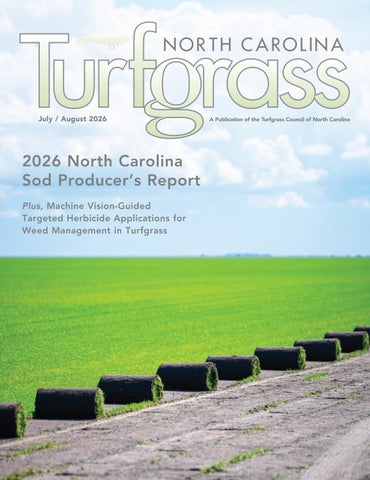
2026 North Carolina Sod Producer’s Report Plus, Machine Vision-Guided Targeted Herbicide Applications for Weed Management in Turfgrass
A Publication of the Turfgrass Council of North Carolina
PRO GOLF MAKES IT HAPPEN. Manage equipment and crews on your course even when you’re offsite within John Deere Every day you’re pulled a dozen directions. Dealing OnLink Golf Course Management Solutions. Learn how ourmonitoring technology and equipwith crews, equipment, controlling overhead ment can take your game to the next level at FinchTurf.com or RevelsTractor.com. and irrigation long before the sun comes up. Pro Golf lets you manage every aspect of your course from any connected device. Making it easier for you to lead your team from the location of your choice. Connect with Beard Equipment or Revels to schedule a Pro Golf demo.
BeardEquipment.com | RevelsTractor.com
A St. Augustine without the Call Backs
Superior Shade Tolerance
Superior Cold Tolerance
The NEXT Generation of Raleigh is Here Raleigh St. Augustine was a hit in the 1980s. 45 years later, it is time to update your turfgrass offerings. Sola® St. Augustine delivers everything you trust about Raleigh plus improved shade tolerance, drought tolerance and disease resistance. Developed by NC State University. Built on proven performance. Ready for 2026.
FutureProofTurf.com
Table of Contents July / August 2026
COVER STO RY
S T U DE N T COR N E R
MOR E FE ATUR E S
14 2026 Sod Producers’
20 Machine Vision-Guided
From the President
Report for North Carolina
Targeted Herbicide Applications for Weed Management in Turfgrass
TCNC Deluxe Members NC State Turf Team News from TCNC NCCTP Program Calendar of Events New Members
Find this issue, Events and More: TheTurfZone.com
Index of Advertisers
6 8 8 10 12 13 13 23
The Turfgrass Council of North Carolina (TCNC) serves its members in the industry through education, promotion and representation. The statements and opinions expressed herein are those of the individual authors and do not necessarily represent the views of the association, its staff, or its board of directors, North Carolina Turfgrass, or its editors. Likewise, the appearance of advertisers, or TCNC members, does not constitute an endorsement of the products or services featured in this, past or subsequent issues of this bimonthly publication. Copyright © 2026 by the Turfgrass Council of North Carolina. North Carolina Turfgrass is published bi-monthly. Subscriptions are complimentary to members of TCNC. Presorted standard postage is paid at Jefferson City, MO. Printed in the U.S.A. Reprints and Submissions: North Carolina Turfgrass allows reprinting of material published here. Permission requests should be directed to TCNC. We are not responsible for unsolicited freelance manuscripts and photographs. Contact the managing editor for contribution information. Advertising: For display and classified advertising rates and insertions, please contact Leading Edge Communications, LLC, 206 Bridge Street, Suite 200, Franklin, TN 37064, 615.790.3718, Fax 615.794.4524.
14 4 North Caro lina Turf gra ss
20 w w w . turfgra s s c ounc i l n c . o r g
July / August 2026
NORTH CAROLINA | SOUTH CAROLINA | VIRGINIA | TENNESSEE | BERMUDA
Back to Basics For 100 years we’ve seen how fast things change. But through it all, one things remains constant: the basics. The kind of quality you feel. The kind of service you demand. The kind of trust that’s earned, not just promised.
As we enter our next century, we’re leaning on what built us. Honest work. Exemplary service. Real relationships. Because the best way forward… is back to basics. Here’s to the next 100.
From the President
Investing in Solutions Dear Turfgrass Council of NC Members, Summer is in full swing, and with it comes some of the most exciting opportunities we have to offer as an organization. Whether you're looking to deepen your knowledge, connect with researchers, or grow as a leader, we have something for you. I'm proud to share that TCNC's commitment to the long-term health of our industry continues to translate into real investment. Through our partnership with the NCSU Ag Foundation, we recently supported $120,000 in research grants for the Turfgrass Research & Extension Endowment. These grants empower NC State researchers to pioneer new solutions in soil health, sustainable management, and the innovations that will shape how we work for years to come. The Water & Soil Symposium was on July 9th in Raleigh, NC. This event, supported through our partnership with the NC Green Industry Council, is a valuable opportunity to engage with topics that directly impact your work. Save the date for NC State’s annual Turfgrass Field Day on August 12, 2026, from 7:30 am to 2:00 pm at the Lake Wheeler Turfgrass Field Lab. This is one of the best opportunities of the year to explore ongoing research trials, connect with faculty, staff, and students, and stay current with what's happening in the industry. TCNC members attend for just $10, which is a significant savings from last year's rate. Simply make sure your membership is up to date and plan to be there. Thank you for your continued membership and for the work you do every day. Best regards,
Wil Sutton
President Turfgrass Council of North Carolina
North Carolina Turfgrass is the official publication of the Turfgrass Council of North Carolina P.O. Box 641 Wake Forest, NC 27588 984.301.5460 www.turfgrasscouncilnc.org
CHIEF STRATEGY OFFICER Marcy Cottle info@turfgrasscouncilnc.org 984.301.5460
Published by: Leading Edge Communications, LLC 206 Bridge Street Franklin, TN 37064 615.790.3718 Fax 615.794.4524 info@leadingedgecommunications.com
TCNC OFFICERS PRESIDENT Wilson Sutton Walnut Creek Country Club Goldsboro, NC
VICE PRESIDENT Greg Harris Leap Frog Land Care, Inc. Fuquay-Varina, NC
TREASURER Jonathan Richardson, NCCTP NCCTP Chairman Green Resource Dunn, NC
PAST PRESIDENT Kevin Herrmann Green Group, the Division of Turf Masters Brands Raleigh, NC
DIRECTORS Alpha Jones Duke University Durham, NC
Spencer Thomas Keith Hills Country Club Lillington, NC
6 North Caro lina Turf gra ss
TCNC Deluxe Members
NC State Turf Team
Companies wishing to support TCNC with multiple members can join as Deluxe Members. Deluxe Memberships can be purchased in one of three tiers: 1–5 employees; 6–10 employees; or 11+ employees.
CROP AND SOIL SCIENCES
If you'd like to learn more about the Deluxe Membership, please contact the TCNC office at 984.301.5460 or info@turfgrasscouncilnc.org.
Thank You to Our DELUXE MEMBER ORGANIZATIONS Barefoot Lawn Care and Landscaping Services
LawnMasterNC Incorporated
Canopy Lawn Care
Leapfrog Landcare
Carol Woods Retirement Community
McConnell Golf
City of Asheville Parks and Recreation
NaturaLawn of America (Raleigh)
Rocky River Sod
Emerald Green
SiteOne
ETM Coastal
Southern Ag
Fairway Green of Charlotte
Sod Solutions Southern Seeds, Inc.
Fairway Green of Raleigh
The Biltmore Company
Fayetteville Tech
The Sunrock Group
Gates Four Golf and Country Club
Town of Garner
GrowinGreen Inc. Helena Agri JRM Inc. Keck Co Turf and Ornamental Services Keith Hiils Golf Club Landscaping Unlimited, Inc.
Dr. Navdeep Godara Assistant Professor Turf & Forage Weed Science ngodara@ncsu.edu Emily Erickson Crop Science Lecturer 919.513.2034 emily_erickson@ncsu.edu Dr. Ray McCauley Extension Associate 919.515.2647 rkmccaul@ncsu.edu Dr. Susana Milla-Lewis Professor & University Faculty Scholar 919.280.3443 susana_milla-lewis@ncsu.edu
Dr. Grady Miller Professor & Extension Specialist 919.515.5656 grady_miller@ncsu.edu Dr. Rob Richardson Associate Professor & Extension Specialist 919.515.5653 rob_richardson@ncsu.edu Dr. Wei Shi Professor 919.513.4641 wei_shi@ncsu.edu Dr. Qiyu Zhou Assistant Professor 313.782.2892 qzhou9@ncsu.edu
Quality Turf
City of Raleigh Parks and Recreation
Green Resource
Dr. Travis Gannon Assistant Professor 919.515.2647 travis_gannon@ncsu.edu
ENTOMOLOGY AND PLANT PATHOLOGY
Dr. Terri Billeisen Extension Associate 919.515.7464 tlhoctor@ncsu.edu
Lee Butler NC State Turf Diagnostics Lab 919.513.3878 ebutler@ncsu.edu
Dr. James Kerns Professor and Extension Specialist 919.513.4820 jpkerns@ncsu.edu
Town of Morehead City Triangle Chemical Company
HORTICULTURE SCIENCE
Turf Mountain Sod, Inc. UNC – Chapel Hill Vandemark Farms
Dr. Danesha Seth Carley Director, Southern IPM Center & Associate Professor 919.513.8189 danesha_carley@ncsu.edu
Wake Forest University Weed Man
Renewal as of May 2026 Don't see your company's name?
www.turffiles.ncsu.edu/people/
Renew today at www.turfgrasscouncilnc.org
8 North Caro lina Turf gra ss
w w w . turfgra s s c ounc i l n c . o r g
July / August 2026
Don’ t Miss Out ! PROMOTE YOUR BUSINESS IN THE NEXT ISSUE OF
NORTH CAROLINA TURFGRASS
North Carolina Turfgrass allows you to get your message directly in the hands of your customers across North Carolina. The magazine is a key benefit of TCNC membership – providing valuable research, education and industry information. Readers can also access the Digital Edition through The Turf Zone website. Archived issues will ensure that your advertising will continue to be seen indefinitely, for long-ranging impact. The Turfgrass Council of North Carolina are:
Golf Course Superintendents
Landscape Contractors
Commercial Grounds Managers
Sod Producers
Lawn Care Operators
Parks & Recreation Supervisors
Sports Turf Professionals
Equipment Suppliers
Contact us today to learn about effective and unique advertising strategies that target turf industry professionals.
sales@leadingedgecommunications.com
News from TCNC
10 North Carolina Turf gr a ss
w w w . t urfgra s s c ounc i l n c . o r g
July / August 2026
2 0 2 6 P ART N E RS P L A TIN U M
G OLD
SILV E R
A Pu b l i c a t i o n o f t h e T u r f g r a s s C o u n c i l o f No rth C aro l i n a 11
Fast Facts about the NCCTP
NCCTP Program
Enrollment Requirements:
Become a NC Certified Turfgrass Professional!
The
North Carolina Certified Turfgrass Professional (NCCTP) program is a comprehensive program developed to enhance the technical competency of turfgrass professionals, while elevating their professional image, that of your business and of the turfgrass management industry. Administered by the Turfgrass Council of North Carolina, the NCCTP designation confirms your expertise in turfgrass management to prospective customers and your peers.
Reasons to Begin Earning Your NCCTP Designation Today he NCCTP program increases and enhances your turfT grass industry knowledge, career, and business development through a course of study of in-depth coverage of the science of turfgrass management. The NCCTP designation offers immediate confidence and credibility of turfgrass management practices to customers and prospective employers. Promote and market yourself as a North Carolina Certified Turfgrass Professional. • Use the NCCTP logo on your business materials. • Use NCCTP pins, uniform patches, and vehicle decals. • Your TCNC Member Directory listing is distinguished with the NCCTP designation.
We Are Partnered With The NC State Turfgrass Professional Short Course The NC State Turfgrass Professional Short Course, a comprehensive turfgrass education program, is offered at select NC State Extension offices and at NC State University. This Short Course offers a full curriculum of the science of turfgrass management as well as Continuing Education Credits for NCDACS Pesticide and NCLCLB Landscape Contractors’ license holders, and it will help you prepare for the NCCTP exam. This Short Course is recommended but not required to take the NCCTP exam.
12 North Carolina Turf gr a ss
w w w . t urfgra s s c ounc i l n c . o r g
old a current TCNC membership. If not currently a H member, go to www.turfgrasscouncilnc.org and click ‘JOIN NOW’ to join online or download an application. Have a minimum of one full year of work experience in the turfgrass industry. Agree to the Certified Turfgrass Professional Code of Ethics as detailed on the application form. Submit: • A current and valid NC Pesticide Applicators license •A completed NCCTP application (current TCNC members may apply online). • NCCTP Program Application: $150 • Self-Study Materials: $50 • Exam Fee: $50
Curriculum and Exam urriculum covers nine core areas: Turfgrass CharacterisC tics; Establishing Turfgrass; Soils & Nutrient Management; Cultural Practices; Pests & Integrated Pest Management; Pesticides & Plant Growth Regulators; Landscape Safety & Pesticide Use; Calculations & Calibration; Turfgrass Business & Economics. Candidates have six months from the date of their enrollment acceptance to complete the NCCTP exam. Candidates have six hours to complete the exam and must score 80% or more on each section to receive the NCCTP designation. Exams can be taken at the TCNC office in Raleigh during normal business hours, or arrangements can be made at your local NC State Extension location. Exams will not be graded if any application information is missing or if TCNC membership status cannot be confirmed. Please allow two to three weeks for exam grading and reports. Upon successful completion of the exam, candidates will receive communication with their results and either next step options or their graduation packet.
Maintenance Requirements Maintain a current TCNC membership as a means of demonstrating ongoing support for the industry. Submit an annual $50 renewal fee, which supports the NCCTP program and related promotional activities. Designation year is the same as the TCNC membership year, from July 1st to June 30th. Hold a current NC Pesticide Applicator’s License. Subscribe to, actively support and uphold the TCNC Certification Code of Ethics. The NC Certified Turfgrass Professional designation (NCCTP), the NCCTP logo and related programs materials are the trademarked property of the Turfgrass Council of North Carolina and cannot be used without TCNC’s written permission. For additional information, contact TCNC at 984.301.5460.
July / August 2026
Calendar of Events
SAND BASED SOD WITH INFILTRATION RATE OF 11 IN/HR TENSILE SRENGTHwww.cgcfields.com 88% GREATER THAN 1” THICK CUT SOD SHEAR STRENGTH 43% GREATER THAN 1” THICK CUT SOD 866-753-1707
August 12, 2026 Turfgrass Field Day 3920 Dr. Bill Gilbert Way Raleigh, NC 27603 7:30 am – 2:00 pm
September 9, 2026 Greensboro Pesticide Safety School N.C. Cooperative Extension Guilford County Center 3309 Burlington Rd Greensboro, NC 27405 BLEND
Welcome New Members
Jeffrey Gaylor Southern Turf Solutions Greenville, NC
Trevor Hart The North Carolina Arboretum Asheville, NC
Jacob Reeves Pureseed Rolesville, NC
A Pu b l i c a t i o n o f t h e T u r f g r a s s C o u n c i l o f No rth C aro l i n a 13
Cover Story
2026 SOD PRODUCERS’ REPORT FOR NORTH CAROLINA By Grady Miller Professor, Turfgrass Management Crop and Soil Sciences
In
March 2026, North Carolina State University conducted its eleventh annual survey of producers to examine the inventory and pricing of North Carolina sod.
Overview • The supply of bermudagrass sod is expected to be greater in 2026 than 2025, but 26% of surveyed producers are still anticipating shortages. • The supply of zoysiagrass is expected to be greater in 2026 compared to 2025, but 20% of producers anticipate shortages. • Twenty-one percent of producers expect shortages of centipedegrass in 2026. • Twenty-nine percent of producers expect shortages of tall fescue in 2026. • The supply of St. Augustinegrass is expected to be significantly lower in 2026 compared to 2025, with 66% of producers anticipating shortages.
Survey Details Twenty-one producers representing the following farm sizes completed the anonymous online survey: • Less than 200 acres (nine respondents) • 201 to 500 acres (four respondents) • 501 to 800 acres (three respondents) • More than 800 acres (five respondents) The North Carolina Sod Producers Association (NCSPA) membership records suggest that the number of completed surveys represents 50% of the sod farms in North Carolina. The number of farms with the respective farm sizes suggests that the survey represents the majority of the sod production acreage in the state.
Inventories We obtained inventory estimates for bermudagrass, zoysiagrass, centipedegrass, St. Augustinegrass, tall fescue, Kentucky bluegrass, and tall fescue and Kentucky bluegrass mix. These estimates were based on anticipated sales for 2026 and availability of sod. An inventory rating of excellent means that more than 10% of demand was expected to be met; adequate means that supply was expected to be equal to demand; poor means that a shortage of more than 10% was expected. Bermudagrass is being grown by 19 (90%) of the surveyed producers. Bermudagrass is currently the most popular turfgrass species grown by North Carolina sod producers. For 2026, 68% of bermudagrass producers rated their inventory as adequate; 5% rated inventory as excellent, and 26% projected shortages. 2026 was the third year since 2020 without an increase in the number of producers projecting bermudagrass inventory shortages (Figure 1).
• Producers reported price changes of 2% or less for warm-season turfgrass species in 2026, except for a 5% price reduction in St. Augustinegrass. For cool-season grasses, a 12% decrease is expected for tall fescue; no price change is expected for Kentucky bluegrass; and a 9% increase is expected for tall fescue and Kentucky bluegrass mix. • There was a 37% increase of growers reporting that they grew proprietary grasses and a 16% increase of growers reporting that they grew certified sod. • Production acreage is projected to increase in 2026 by an amount similar to 2025 (19%). • Landscape contractors continue to be the primary market for North Carolina sod producers, accounting for 67% of sales. • The average number of full-time employees per producer increased by 112% in 2026. • Average sod sales increased 116% from 2024 to 2025, with 57% of producers reporting increased sod sales in 2025.
14 North Carolina Turf gr a ss
w w w . t urfgra s s c ounc i l n c . o r g
Figure 1. Percentage of bermudagrass, tall fescue, and zoysiagrass producers reporting adequate to excellent supply for the past six years.
July / August 2026
Triple Threat Tall Fescue | Common Centipede | Compadre Zoysia | Tifway 419 Bermuda
DMG TURF
The Triangle’s Premier Turfgrass and Sod Farm DMG Turf is a family owned and operated business, serving North Carolina with cool and warm season grasses. From residential projects to large commercial jobs including golf courses, athletic fields, and more, our commitment to customer satisfaction has been our top priority since 1999. Our friendly and knowledgeable staff are ready to serve you with delivery to your location, or you can schedule a pickup at our sod farm in Angier, NC.
dmgturf.com | 919.639.4027 | 997 Matthews Mill Pond Road, Angier, NC
Cover Story | continued
Zoysiagrass is being grown by 15 (71%) of the surveyed producers, which made this grass the second-most-popular turfgrass species grown by North Carolina sod producers in 2026. This is the first year that zoysiagrass has been in the second-mostpopular position. For 2026, 60% of zoysiagrass producers rated their inventory as adequate; 20% rated their inventory as excellent; and 20% projected shortages.
The average on-farm price for St. Augustinegrass was 5% lower than in 2025.
Centipedegrass is being grown by 14 (67%) of the surveyed producers, making it the third-most-popular turfgrass species grown by North Carolina sod producers. For this year, 79% of centipedegrass growers reported adequate to excellent inventory, whereas 21% anticipate shortages.
Tall fescue + Kentucky bluegrass on-farm prices in 2026 ranged from $0.34 to $0.72 per square foot (averaging $0.50), while delivered prices ranged from $0.38 to $0.69 per square foot (averaging $0.53). The average on-farm price of tall fescue and Kentucky bluegrass mix increased by 9% compared to 2025.
St. Augustinegrass is being grown by six (29%) of the surveyed producers. For this year, 34% of St. Augustinegrass growers reported adequate to excellent inventory compared to 83% in 2025, with 66% anticipating shortages. The significant drop in inventory in 2026 compared to 2025 suggests that St. Augustinegrass has increased in popularity.
Kentucky bluegrass on-farm price in 2026 was $0.50, while the delivered price was $0.56 per square foot. The on-farm price was the same in 2026 as 2025.
Tall fescue is being grown by seven (33%) of the surveyed producers. For 2026, 71% estimated that they would have adequate to excellent inventory, but 29% anticipated a shortage (Figure 1). Tall fescue + Kentucky bluegrass is being grown by nine (43%) of the surveyed producers. For 2026, 89% rated their inventory as adequate to excellent, with 11% anticipating shortages. Kentucky bluegrass is being grown by one (5%) of the surveyed producers. That producer anticipates inventory shortage.
Pricing Pricing information included costs for on-farm purchase and truckload orders delivered to the closest urban market or within 100 miles of the farm. All costs were reported as price per square foot of sod. Table 1 summarizes the average sod prices by species. Bermudagrass on-farm prices in 2026 ranged from $0.30 to $0.62 per square foot (averaging $0.41), while delivered prices ranged from $0.30 to $0.99 per square foot (averaging $0.47). The average on-farm price for bermudagrass decreased about 2% from 2025. Zoysiagrass on-farm prices in 2026 ranged from $0.40 to $1.05 per square foot (averaging $0.59), while delivered prices ranged from $0.40 to $1.03 per square foot (averaging $0.65). The average on-farm price for zoysiagrass increased about 2% compared to 2025. Centipedegrass on-farm prices in 2026 ranged from $0.25 to $0.62 per square foot (averaging $0.38), while delivered prices ranged from $0.30 to $0.67 per square foot (averaging $0.43). The average on-farm price for centipedegrass was the same in 2026 as 2025. St. Augustinegrass on-farm prices in 2026 ranged from $0.53 to $0.65 per square foot (averaging $0.60), while delivered prices ranged from $0.57 to $0.74 per square foot (averaging $0.64).
16 North Carolina Turf gr a ss
w w w . t urfgra s s c ounc i l n c . o r g
Tall fescue on-farm prices in 2026 ranged from $0.43 to $0.51 per square foot (averaging $0.43), while delivered prices ranged from $0.48 to $0.60 per square foot (averaging $0.53). The average on-farm price of tall fescue decreased 12% compared to 2025.
Figure 2 provides a six-year perspective of average sod prices that shows fluctuations of average price per square foot in particular species since 2021. The percentage change reported for each grass in 2026 compared to 2025 was: bermudagrass, -2%; zoysiagrass, +2%; centipedegrass, no change; St. Augustinegrass, -5%; tall fescue, -12%; tall fescue + Kentucky bluegrass, +4%; and Kentucky bluegrass, no change. Figure 3 provides the average sod price ranges and the sale price in the middle of the dataset (median price) for 2026. Table 1. Average North Carolina Sod Prices in 2026
(# of growers responding)
Turfgrass Produced
On-the-Farm price / sq ft
Delivered* price / sq ft
Bermudagrass (19)
$0.41
$0.47
Zoysiagrass (15)
$0.59
$0.65
Centipedegrass (14)
$0.38
$0.43
St. Augustinegrass (6)
$0.60
$0.64
Tall fescue (3)
$0.48
$0.53
Tall fescue + Kentucky bluegrass (9)
$0.50
$0.53
Kentucky bluegrass (1)
$0.50
$0.56
* Delivered to either the closest urban market or within 100 miles of the farm.
July / August 2026
continued | Cover Story
NO NEED TO SWEAT THIS SUMMER! Partner with Triangle for the best choices from the best companies in the world of nursery, landscape, and golf course care. With nine distribution points strategically located to serve the Southeast, good company is always just around the corner.
For more information visit www.trianglecc.com 2024
Figure 3. Price ranges (per square foot) of the turfgrass species sold on-farm by North Carolina producers in 2026. The horizontal line in the center of each bar represents the median price.
Figure 2. Historical perspective of average prices for North Carolina sod from 2021 to 2026.
A Pu b l i c a t i o n o f t h e T u r f g r a s s C o u n c i l o f No rth C aro l i n a 17
Cover Story | continued
Predicted Price Changes
Proprietary Grass
While a few producers predicted increased prices for particular grasses, most expected overall sod prices to remain steady in 2026. Some producers of cool-season species expect price decreases. Producers reported the following price expectations for each grass species:
In 2026, 62% of the growers reported that they grew some proprietary grasses on their farm. This represents a 38% increase from 2025. The average percentage of their grasses that were proprietary was 38%, with a reported range among individual growers of 1% to 71%.
• Bermudagrass—32% expect price increases; 58% expect prices to remain steady; 10% expect prices to decrease.
Certified Grass
• Zoysiagrass—33% expect price increases; 67% expect prices to remain steady. • Centipedegrass—36% expect price increases; 57% expect prices to remain steady; 7% expect prices to decrease. • St. Augustinegrass—50% expect price increases; 50% expect prices to remain steady. • Tall fescue—17% expect price increases; 83% expect prices to remain steady. • Tall fescue + Kentucky bluegrass—44% expect price increases; 56% expect prices to remain steady. • Kentucky bluegrass—100% expect prices to remain steady.
18 North Carolina Turf gr a ss
w w w . t urfgra s s c ounc i l n c . o r g
In 2026, 52% of the respondents grew some certified sod. This represents a 16% increase from 2025. The average amount of certified grass was 54% of their total sod acreage. Fifty percent of these producers charged higher prices for certified grass—$0.03 to $0.06 more per square foot.
Freight Among the respondents, 52% charged a flat rate for delivery; 38% charged on a per-mile basis; and 10% either did not charge for delivery or included it in the sod price. Reported freight rates for 2026 averaged $4.00 per mile, an 11% decrease compared to 2025. Eleven respondents reported flat freight rates of $225 to $1,200 per shipment with a mean of $363, although these rates vary depending on other factors, such as the distance from the farm.
July / August 2026
continued | Cover Story
Seventy-six percent of the respondents indicated that they include freight prices in their price quotes to customers, while 24% invoiced the freight charges separately. Five percent of respondents charge an unloading fee. Eightyfive percent of respondents make additional drops on loads. The low-end charge for additional drops on a load was $25; the high-end charge was $250; and the average cost for additional drops was $85. Several respondents reported that the charge depended on the distance between drops and that charges may be divided between buyers.
Fuel Surcharge Ten percent of respondents added a fuel surcharge in 2026, which is double the percentage reported in 2025. Relative fuel prices each year influence this practice.
Pallet Cost Recovery Thirty-five percent of respondents charge a deposit on pallets and expect them to be returned. Sixty-five percent build the pallet’s cost into the sod sale, and no return is expected.
Sod Size Cost Adjustments Twenty-nine percent of respondents adjust cost based on harvested sod dimensions.
Employees The 21 respondents reported an average of 17 full-time employees in 2026, a 112% increase from 2025. A significant portion of this increase may be explained by sizes of the 2026 respondents' farms. The 2026 survey had a significantly greater response rate from farms of more than 500 acres and fewer responses from farms of less than 500 acres. The number of full-time employees ranged from 1 to 185, with a median of 8. Only one producer reported more than 30 employees. The number of seasonal employees ranged from 0 to 127, for an average of 10. Only one producer reported more than 16 seasonal employees. The median number was 2.
Total Sod Sales Based on the 18 respondents who provided data, the total sod sales for 2025 ranged from $40,000 to $31.5 million. The average sod sales was $4.09 million (a 116% increase from 2024). Reported sod sales totaled $73,790,745. Fifty-seven percent of the respondents indicated that their sales increased in 2025; 19% reported a decrease; and 24% reported that sales remained the same. These figures represent a significantly stronger outlook on sales compared to 2025 reports, which may also reflect the greater number of larger farms that responded to the 2026 survey.
Summary
Price Changes Asked how often they adjust their prices, 52% of respondents indicated that they adjust prices as needed; 48% adjust prices yearly.
Credit Card Convenience Fee Forty-three percent of respondents charge a convenience fee for credit card purchases.
Sales by Industry Segments Table 2 shows the industry segments that purchase North Carolina sod. For 2025, the producers estimated that landscape contractors were their biggest customer segment, accounting for 67% of sales. The next-largest segments were homeowners and sports/athletics, 13% and 9%, respectively. Golf courses and retail garden centers represented 6% and 4% of the market, respectively. Brokers were the smallest segment at 1%. The overall rankings were the same in 2026 as 2025, with decreased sales to landscape contractors (-5%) and homeowners (-2%) and increased sales to the sports/athletics sector (+2%), golf courses (+1%), retail garden centers (+3%), and brokers (+0.5%).
Notably, 2025 marked a rebound for sod sales following two years of decreased sales in the sod industry, based on our annual surveys. Following a year of significant price increases for sod, average prices for most species in 2006 were similar to or slightly less than the previous year. A greater range in prices was noted in 2026 compared to 2025. The total acreage of sod appears steady, with a small amount of growth indicated. Survey respondents projected shortages for all grass species in 2026. Table 2. Ranking of Industry Segments for 2025 Sales of Turfgrass Produced in North Carolina Industry Segment
Rank
(Change from previous year)
Average (%)*
Landscape Contractors
1 (same)
67
Homeowners
2 (same)
13
Sports / Athletics
3 (same)
9
Acreage in Production
Golf Courses
4 (same)
6
Five percent of respondents indicated that they reduced sod production acreage during 2025, and 5% expected to reduce production in 2026. Sixty-two percent of respondents indicated that they increased acreage during the previous three years; the average percentage of increase in acreage was 19%.
Retail Garden Centers
5 (same)
4
Brokers
6 (same)
1
*Average percentage of total sales.
A Pu b l i c a t i o n o f t h e T u r f g r a s s C o u n c i l o f No rth C aro l i n a 19
Student Corner
Machine Vision-Guided Targeted Herbicide Applications for Weed Management in Turfgrass By Brooke Heikkila
In
recent years, a variety of new spot spraying technologies have been introduced into agriculture that uses machine vision and artificial intelligence to selectively treat weeds. Targeted spraying opens the door to use nonselective herbicides or novel herbicide admixtures that were previously too expensive or injurious to turfgrass when applied as broadcast treatments. Targeted applications can substantially reduce herbicide use by lowering spray volume and treated acreage, providing both environmental and economic benefits. The first commercial machine vision-guided spot sprayer for turfgrass was recently launched at the 2026 GCSAA Conference and Trade Show; however, limited research has been conducted to quantify its benefits or optimize its use for turfgrass weed management.
Brooke Heikkila, an MS student in Godara’s Lab at North Carolina State University, is developing practical weed density thresholds and herbicide admixtures to optimize machine vision-guided targeted applications for turfgrass weed management (Figure 1). Brooke received her BS in Environmental Science from the University of Minnesota and recently completed the USGA Greenkeeper Apprenticeship Program. She is passionate about making meaningful contributions to the North Carolina turfgrass industry and is focused on developing innovative, practical solutions for turfgrass managers. Brooke’s thesis research project, funded by Turfgrass Council of North Carolina, focuses on investigating different herbicide admixtures to control false-green kyllinga (Kyllinga spp.) in fairways, with the goal of improving weed control efficacy and resistance management strategies through targeted applications. In her recent work, they documented that turfgrass managers can use nonselective herbicides like glyphosate or tank mixtures that involve herbicides from different modes-of-action to control false-green kyllinga with minimal injury risk to desirable turfgrass on fairways. These targeted applications reduced the amount of herbicide volume used and treated area by at least 75% compared to traditional broadcast treatments. Although machine vision-guided sprayers require a substantial upfront investment, the magnitude of herbicide reduction has the potential to generate significant annual cost savings for turfgrass managers just in few years. Future work will focus on understanding how these savings will vary throughout a year-long management plan when combating a diverse spectrum of weed including grasses, sedges, and broadleaf weeds, using targeted applications.
Figure 1. A machine-vision guided targeted sprayer (ALBA research sprayer prototype, Ecorobotix Inc.) applying herbicide + spray pattern indicator dye to annual bluegrass in dormant bermudagrass.
20 North Carolina Turf gr a ss
w w w . t urfgra s s c ounc i l n c . o r g
July / August 2026
Southern Agricultural Insecticides, Inc. is a distributor of pesticides, fertilizers, potting soils, and horticultural supplies with locations in Florida and North Carolina. MANUFACTURERS OF… Blue Colorant
Soluble 10–30–20
Chelated 5% Iron
Soluble 30–7–14
Chlorpyrifos 2.5% G
Soluble 20–20–20
Chlorpyrifos Mole
Spreader Sticker
Mole Cricket Bait
Surfactant for
Defoamer
Herbicides
Latron B–1956
Tank Cleaner
Methylated Seed Oil
Turf Green
Snail Bait
Tweak
Soil Acidifier
12–0–0–6% iron
Soil Wetting Agent
DISTRIBUTORS FOR… AMVAC Andersons Aquatrols BASF Bayer BioSafe Systems Bioworks Certis Corteva Agriscience Envu FMC Gowan LebanonTurf Milliken
Milorganite Nufarm OHP Old Castle PBI / Gordon Quali-Pro Rightline SePRO Sipcam Agro Solo Sunniland Syngenta UPL Yara
GOLF COURSE SALES STAFF Jim Wells — West Central Florida . . . . . . . . . . . . . . . . . . . . (941) 720–2712 Roger Welker — East Coast Florida . . . . . . . . . . . . . . (772) 260–0282 Kevin Downing — South Florida. . . . . . . . . . . . . . . . . . . . . . . (561) 427–4501 Jeff Strother — Southwest Florida . . . . . . . . . . . . . . . . . . (941) 270–0470 Andrew Wampler — Western Carolinas . . . . . . . . . . . (828) 674–2594 Brandon Hicks — Central North Carolina . . . . . (336) 906–0803
Boone, NC (828) 264-8843 Hendersonville, NC (828) 692-2233 Palmetto, FL (941) 722-3285
Nathan Biggs — North Carolina. . . . . . . . . . . . . . . . . . . . . . (704) 996–5125
FREE DELIVERY AVAILABLE
www.SOUTHERNAG.com
Figure 2. Ongoing study at the Lake Wheeler Turfgrass Field Lab in Raleigh, NC examines how weed infestation level affects herbicide savings and treated area when using the ALBA machine vision–guided spot sprayer compared to broadcast applications.
Student Corner | continued
GRASS SO GREEN THAT WE NEEDED AN EXTRA “E” Our Liquid Nutritionals & Specialty Fertility Products Are Blended To Feed Plants, Improve Soil Fertility & Build Topsoil
Healthy Turf starts with Greene County Fert. Ship Direct. Pro support always included.
GreeneCountyFert.com 22 North Carolina Turf gr a ss
w w w . t urfgra s s c ounc i l n c . o r g
July / August 2026
While these cost savings are encouraging, differences between targeted and broadcast spraying may diminish at higher weed densities. To address this concern, Brooke is conducting an additional study to evaluate how herbicide usage from targeted applications varies across different infestation levels of annual bluegrass (Poa annua L.) in turfgrass (Figure 2). Even at 30% annual bluegrass cover, which is substantially higher than the typical weed cover observed on managed sites, targeted applications resulted in a 35% reduction in spray volume used compared to broadcast applications. Although many of these experiments are ongoing and require validation across multiple site years, it is exciting to answer these important questions to assist practitioners with the adoption of this new tool and develop application thresholds. These early results are positive indicators of machine vision-guided spot sprayers’ ability to reduce herbicide usage, lowering turfgrass managers’ annual herbicide budget and decreasing environmental pesticide loads. Brooke’s goal is to provide turfgrass managers with the practical evidence they need to see how machine vision-guided spot spraying could impact their budget, flexibility, and long-term turfgrass sustainability.
Advertiser Index Beard Equipment..........Inside Front Cover www.beardequipment.com
Carolina Green Corp............................... 13 www.cgcfields.com
FORE SALE!
GREEN DIVOT MIX PREMIUM QUALITY SAND (40 lb. Bags or Bulk)
Divots, Inc............................................... 23 www.divotssand.com
Topdressing Sand Black Topdressing Sand Bunker Sand Drill & Fill Blends
DMG Turf, Inc......................................... 15 www.dmgturf.com
Green Resource........................Back Cover www.green-resource.com
Greene County Fertilizer Co.................. 22 www.greenecountyfert.com
Time to Buy Your Divot Mix for the Golf Season!
DIVOTS, INC.
Leading Edge Communications................ 9 www.LeadingEdgeCommunications.com
Phone: 919-775-9732 • Email: sales@divotssand.com • www.DivotsSand.com 248 Palace Drive • Sanford, NC 27330
Quality Turf, Inc...................................... 13 www.qualityturfnc.com
Smith Seed Services................................ 13 www.smithseed.com
Smith Turf & Irrigation.............................. 5 www.smithturf.com
Sod Solutions............................................ 3 www.SodSolutionsPro.com
Southern Agricultural Insecticides, Inc... 21 www.southernag.com
Southern Specialty Equipment............... 23 www.ssequip.net
Super-Sod.................................................. 7 www.supersod.com
Southern Specialty Equipment, Inc.
Triangle Turf and Ornamental................ 17 www.triangleturf.net
New, Used & Refurbished • Ease of Operation • Low Operating
Over 50 Years of Harvesting Innovation
Email: jim@ssequip.net
Website: ssequip.net
Costs
Turf Mountain Sod, Inc........................... 23 www.turfmountain.com
Vandemark Farms................................... 18 www.vandemarkfarms.com
Solid & Dependable Rotary Finishing Mowers
• Single Axle Truck Use
Office: 877-366-5399
Mobile: 352-284-8029
A Pu b l i c a t i o n o f t h e T u r f g r a s s C o u n c i l o f No rth C aro l i n a 23
Green-Resource.com
Be Confident Of Your Course Green Resource is one of the largest suppliers in the Southeast. Our team of experts provide solutions that produce results you can depend on. We are ready to help you.
TRIAD
5204 Highgreen Court Colfax, NC 27235
(336) 855-6363
CHARLOTTE
10404 Granite Street, Ste K Charlotte, NC 28273
(704) 927-3100
COASTAL
2407 Ocean Hwy, West Shallotte, NC 28459
(910) 363-1230
�- �;�! envu· � 5,�i!c! EVA" G
TRIANGLE
�=�:.:�
1218 Mangement Way Garner, NC 27529
(919) 779-4727
WINSTON
CHARLESTON
(336) 793-9230
(854) 999-4039
90 Piedmont Industrial Dr. 9492 Hamburg Road Winston-Salem, NC 27107 Charleston, SC 29456
Jnufarm
QUALi-PRO syngenta