ᐅᑌᒥᐣ Nico Williams
Biskaabiiyang | Returning to Ourselves
Nico Williams ᐅᑌᒥᐣ Biskaabiiyang | Returning to Ourselves April 14 – September 9, 2023
Curator Writer Editor Western Ojibwe Translation Photographer Publication Design Printing
Sonya Blazek Lauren Fournier Alison Kenzie Nations Translation Group Toni Hafkenscheid Otto Buj Aylmer Express
© 2025 Judith & Norman Alix Art Gallery ISBN 9781775334637 On behalf of the Judith & Norman Alix Art Gallery and the County of Lambton, we gratefully acknowledge the ongoing support of JNAAG members, donors, sponsors, and volunteers. About the Artist Nico Williams, ᐅᑌᒥᐣ (b. 1989) is a member of Aamjiwnaang First Nation (Anishinaabe), currently living and working in Tiohtià:ke | Montréal. In 2021, he graduated with a Master of Fine Arts in Sculpture from Concordia University. He has a multidisciplinary and often collaborative practice that is centred around sculptural beadwork. In 2021, he was awarded the prestigious Claudine and Stephen Bronfman Fellowship in Contemporary Art and is the winner of the 2024 Sobey Art Award. His work has been shown internationally and across Canada. Acknowledgments in the making of Biskaabiiyang | Returning to Ourselves Studio Production Manager: Samuel Guertin The studio team in Tiohtià:ke | Montréal: Molly Chamagne, Ioana Dragomir, Virginie Fillion-Fecteau, Alex Havenne, Christy Kunitzky, Laurel H. Rennie, Lydia Risi, Kuh del Rosario, and Aiden Throne. Acknowledgments in the making of Zhi-biindiged gwaya | Intrusion | Trespassing Studio Production Manager: Samuel Guertin The studio team in Tiohtià:ke | Montréal: Molly Chamagne, Ioana Dragomir, Alex Havenne, Christy Kunitzky, Laurel H. Rennie, Virginie Fillion-Fectea, and Kuh del Rosario. Archival beadwork Research: Franchesca Hebert Spence Special thanks to: Dr. Julie Nagam, Emily Fitzpatrick, Johnson Ngo, Linda Sheridan, Lynne Kozina, Dave Pineda, and Scott Seetoo. We acknowledge the support of the Canada Council for the Arts. @CanadaCouncil and #BringingTheArtsToLife List of Works (height x width x depth) Bang On Man!!!, 2022; 10/0 Czech glass seed beads, oil paint; 60 x 34 cm Bingo (Blue), 2019; 11/0 Japanese glass cylinder beads; 40.6 x 8.9 cm Bingo (Orange), 2019; 11/0 Japanese glass cylinder beads; 45.7 x 8.9 cm Bingo (Red), 2019; 11/0 Japanese glass cylinder beads; 41.9 x 8.9 cm Danger Tape, 2022; Japanese glass bugle beads; 7.5 x 914 cm Kellogg’s Loops, 2021; plastic beads, leather, thread; 71.1 x 50.8 cm Out and About, 2023; 11/0 Japanese glass cylinder beads, fake Gucci GC Supreme Kingsnake wallet; 14.6 x 15.5 x 8.3 cm Privé (blanche), 2022; Japanese glass cube beads, commander fabric and cotton; 38.1 x 45.7 cm Privé (bleu), 2022; Japanese glass cube beads, commander fabric and cotton; 38.1 x 45.7 cm Privé (lime), 2022; Japanese glass cube beads, commander fabric and cotton; 38.1 x 45.7 cm Privé (rose), 2022; Japanese glass cube beads, commander fabric and cotton; 38.1 x 45.7 cm Privé (rouge), 2022; Japanese glass cube beads, commander fabric and cotton; 38.1 x 45.7 cm They came in many numbers, 2023; vinyl linen; 304.8 x 109 cm Zhi-biindiged gwaya | Intrusion | Trespassing, 2022; 10/0 Czech glass seed beads, 8/0 Japanese glass cylinder beads, plastic, metal, river rocks; 365.8 x 365.8 x 80 cm. Courtesy of the Indigenous Art Collection, Crown-Indigenous Relations and Northern Affairs Canada. Library and Archives Canada Cataloguing in Publication
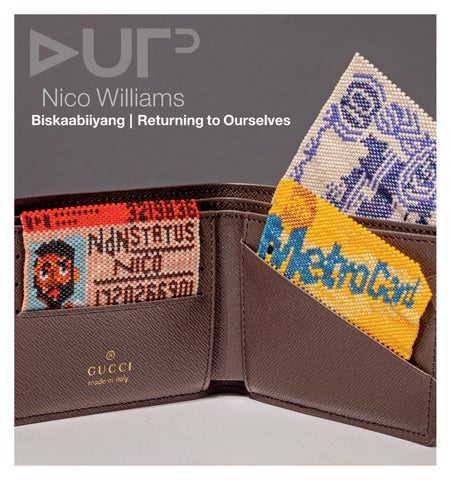
Title: Nico Williams ᐅᑌᒥᐣ : Biskaabiiyang | Returning to ourselves. Nico Williams otêmin : Biskaabiiyang | Returning to ourselves. Other titles: Biskaabiiyang | Returning to ourselves Names: Container of (work): Williams, Nico, 1989– Works. Selections. | Fournier, Lauren, 1989– writer of added commentary | Blazek, Sonya, organizer | Kenzie, Alison, editor | Judith & Norman ALIX Art Gallery, host institution, publisher. Description: Curator, Sonya Blazek; writer, Lauren Fournier; editor, Alison Kenzie; translation, Nations Translation Group. | Includes bibliographical references. | Text in Western Ojibwe translation and original English. Identifiers: Canadiana 20250292459 | ISBN 9781775334637 (softcover) Subjects: LCSH: Williams, Nico, 1989–—Exhibitions. | LCSH: Beadwork—Exhibitions. | CSH: First Nations beadwork—Exhibitions. | LCGFT: Exhibition catalogues. Classification: LCC NK3650.5.C34 W57166 2025 | DDC 745.5092—dc23 (cover) Out and About; Agajiing gaye Miziwe, 2023 (detail)
Nico Williams ᐅᑌᒥᐣ / ode’imin Biskaabiiyang | Bigiiweying April 14 – September 9, 2023 Gaa-niigaaniid Odoozhibii’ige Ona’ibii’ige Odaanakanootamaage Omazinaatesijige Mazinichigewin Naabibii’igewin
Sonya Blazek Lauren Fournier Alison Kenzie Nations Translation Group Toni Hafkenscheid Otto Buj Aylmer Express
© 2025 Judith & Norman Alix Mazinibii’igewigamig ISBN 9781775334637 Iwe Judith & Norman Alix Mazinibii’igewigamigong gaye Lambton Aki, ndoonji-miigwechiwi’aanaanig JNAAG gaa-onjiiwaad gaa-miigiwewaad zhooniyaa gaye gaa-anokiiwaad. Awe Omazinibii’ige Nico Williams, Ode’imin (b. 1989) Aamijiwanaang Anishinaabe ishkoniganing ontij, noongom dash Tiohtià:ke | Montréal anokii. 2021 gii-izhiseg ogii-giizhitoon ogikino’amaagoowin Mazinibii’igewin Niizh Mazinijii’igewin imaa Concordia Gichi-gikendaasoowigamig. Manidoominensag odaabaji’aa gii-mazinichiged niibiwa gegoon e-aabajitood gii-mazinichiged. 2021 gii-izhiseg, gii-miinaa Claudine and Stephen Bronfman Miigiwewin imaa Gii-mazinichiged Noongom gaye gii-bakinaage 2024 Sobey Mazinichigewin Bakinaagewin. Miziwe skiing gaye Gaanada Skiing waabanda’iwe. E-ikidong gii-ozhichigaadeg owe Biskaabiiyang | Gii-bigiiweying Dazhinjigaade. Mazinichigewin Ozhichigewin Gaa-naagajitood: Samuel Guertin Mazinichigewin gaa-anokiiwaad Tiohtia:ke | Montréal: Molly Chamagne, Ioana Dragomir, Virginie Fillion-Fecteau, Alex Havenne, Christy Kunitzky, Laurel H. Rennie, Lydia Risi, Kuh del Rosario, gaye Aiden Throne. E-ikidong gii-ozhichigaadeg owe Ji-biindiged gwayak | Maanzhi-biindigewin | Biindigeshkaage Mazinichigewin Ozhichigewin Gaa-naagajitood: Samuel Guertin Mazinichigewin gab-anokiiwaad Tiohtia:ke | Montréal: Molly Chamagne, Ioana Dragomir, Alex Havenne, Christy Kunitzky, Laurel H. Rennie, Virginie Fillion-Fectea gaye Kuh del Rosario. Gete-manidoominensi-mazinigwaasowin Gikenjigewin: Franchesca Hebert Spence Gichi-miigwech ogo: Dr. Julie Nagam, Emily Fitzpatrick, Johnson Ngo, Linda Sheridan, Lynne Kozina, Dave Pineda, gaye Scott Seetoo. Miigwech ndinaanaanig Gaanaa Aki Mazinichigewin Izhichigewin. @CanadaCouncil gaye #BringingTheArtsToLife Mazinichiganan Niibidebii’igan (epiitising x epitaak x enigokwaak) Mii iwe!!!, 2022; 10/0 Jek waasechiganaabik manidoominensag, zhizhoobiiga’igan; 60 x 34 cm Bingo (Ozhaawashkwaa), 2019; 11/0 Jaapaniiz waasechiganaabik ginwaabikizowaad manidoominensag; 40.6 x 8.9 cm Bingo (Miskowan), 2019; 11/0 Jaapaniiz waasechiganaabik manidoominensag; 45.7 x 8.9 cm Bingo (Miskwaa), 2019; 11/0 Jaapaniiz waasechiganaabik manidoominensag; 41.9 x 8.9 cm Naniizaanad Zhinoodaagan, 2022; Jaapaniiz waasechiganaabik manidoominensag boodaajigan; 7.5 x 914 cm Kellogg’s Loops, 2022; manidoominensag plastic onji, bashkwegin, gashkigwaajiganeyaab; 71.1 x 50.8 cm Agajiing gaye Miziwe, 2023; 11/0 Jaapaniiz waasechiganaabik manidoominensag, gaawiin aawanzinoon Goochii GC Ogimaa Ginebigowayaan zhooniyaawazh; 14.6 x 15.5 x 8.3 cm Baniibe (waabishkaa), 2022; Jaapaniiz waasechiganaabik manidoo-minensag, niigaanii inwegin gaye bagwaaniigin; 38.1 x 45.7 cm Baniibe (ozhaawashkwaa), 2022; Jaapaniiz waasechiganaabik, niigaanii inwegin gaye bagwaaniigin; 38.1 x 45.7 cm Baniibe (waabi-ozhaawashkwaa), 2022; Jaapaniiz waasechiganaabik, niigaanii inwegin gaye bagwaaniigin; 38.1 x 45.7 cm Baniibe (waabi-miskwaa), 2022; Jaapaniiz waasechiganaabik, niigaanii inwegin gaye bagwaaniigin; 38.1 x 45.7 cm Baniibe (miskwaa), 2022; Jaapaniiz waasechiganaabik, niigaanii inwegin gaye bagwaaniigin; 38.1 x 45.7 cm Niibiwa agindaasonan gii-bi-ayaawan, 2023; pzhiigin bagwaaniigin; 304.8 x 109 cm Ji-biindiged gwayak | Maanzhi-biindigewin | Biindigeshkaage, 2022; 10/0 Jek waasechiganaabik manidoominensag, 8/0 Jaapaniiz waasechiganaabik manidoominensag, banaastic, biiwaabik ziibii asiniig; 365.8 x 365.8 x 80 cm. Ogo miigiwewag Anishinaabe Mazinichiganan Gaa-ganawenjigaadegin, Ogimaa-Anishinaabe Gaa-izhi-wiijiindiwaad gaye Giiwedino Ogimaag Gaanada Aki. Judith & Norman Alix Art Gallery 147 Lochiel Street Sarnia, Ontario N7T 0B4 Canada www.jnaag.ca
The Judith & Norman Alix Art Gallery is a department of the Corporation of the County of Lambton.
Structural Return: Beadwork, World-Building, and the Boundaries of Belonging Nico Williams, a member of Aamjiwnaang First Nation (Anishinaabe) who currently lives and works in Tiohtià:ke | Montréal, returns to his home territory with Biskaabiiyang | Returning to Ourselves — his first major solo exhibition in the region. Presented at the Judith & Norman Alix Art Gallery, this exhibition marks both a literal return — to Sarnia, on the territory of his Nation — and a conceptual one. In “returning,” the works here do not look back in a simple or nostalgic sense, but instead engage in what Anishinaabe scholar Grace Dillon describes in Walking the Clouds: An Anthology of Indigenous Science Fiction as the work of Biskaabiiyang: “the process of returning to ourselves,” which involves “discovering how personally one is affected by colonization, discarding the emotional and psychological baggage carried from its impact, and recovering ancestral traditions in order to adapt in our post-Native Apocalypse world.” 1 Beading, for Williams, is a critical method of inquiry as well as an artistic medium rooted both in ancestral practices and cross-cultural exchange. In the artist’s hands, beading becomes a way of navigating memory, kinship, and power through an embodied, time-based process. The practice of beading — repetitive, intentional, even painstaking at times — in a way echoes the process of Biskaabiiyang: a structural reckoning with inheritance, and a reconstitution of meaning through creative form. By approaching “return” in this way, the artist invites us to consider how Indigenous knowledge systems persist and adapt in a perpetually colonial context not only through their content, but also through their form — through the way a work is made, through the attention it is given by both the artist and the audience, and through the structures it comes to form in space and time. Oftentimes, Williams returns to an object from memory and reproduces it slightly differently, if even simply through the material decision of beading. What results is an uncanniness that prompts the viewer to pause and look at something differently. Here in Sarnia, across fourteen works, Williams demonstrates how beadwork — long diminished in Eurocentric art historical discourse as mere craft, ornament, or “women’s work” — can serve as a powerful vehicle for structural and political critique. In Williams’s practice, the bead becomes a unit of thought, a modular logic, a microstructure that holds both pattern and deviation. Beading becomes a form of relational coding — a rhythmic act that encodes memory, kinship, and dissent into surface. Williams engages the everyday architectures of statehood and settlement — status cards, border markers, danger tape — and renders them differently. Beadwork becomes a mode of critical inquiry and imaginative reordering, its rhythmic logic offering blueprints for other ways of relating, remembering, and organizing space. His “sculptural geometries,” as he calls them, are not merely visually compelling forms that resemble familiar objects, but also conceptual frameworks — meeting points for technologies, stories, and lineages of knowledge. We see the exhibition’s structural logic initiated with Out and About (2023), where a counterfeit Gucci wallet is accompanied by beaded renderings of two significant items: the artist’s “NDN Status Card” and a $10 bill. While the wallet itself is not beaded, these inserts transform the work’s function and meaning. The bill, notably, references an earlier version of Canadian currency, specifically bank notes from 1971 to 1989 that featured Sarnia’s Chemical Valley. The bulbous forms depicted are Horton Spheres, used to store a mixture of butylene and butadiene in the production of synthetic rubber at the former Polymer Rubber Corporation plant. These industrial structures are emblematic of the over 60 large-scale facilities located within 25 kilometres of Aamjiwnaang and south Sarnia. Here, financial and state-issued objects — currency and status — are frozen in form, encased in beads that render them unopenable, luminous, and
conceptually dense. These works initiate a key proposition of the exhibition: that objects which sort and contain — whether financial, bureaucratic, or cultural — can be structurally reworked to reveal the limits and logics of the systems they once served. That logic sharpens in Danger Tape (2022), a nine-metre band of red and black bugle beads stitched into the unmistakable pattern of caution tape. The piece hangs gorgeously in space, not functional in the way of marking a space off, but presented as a kind of snaking sculpture. Where danger tape is usually provisional, disposable, and commanding, Williams’s version is dense, tensile, materially insistent — and commanding in a different way, aesthetically rather than institutionally. Indeed, its glint destabilizes its command, inviting viewers closer even as it warns them away from the presumed danger. Here, as elsewhere in the exhibition, Williams de-familiarizes everyday objects. Danger Tape does not signal danger in the way that danger tape usually does. Rather, it prompts multiple questions. Who determines what counts as dangerous, and for whom are those warnings meant? What might it look like to re-imagine danger and threat from another vantage point — namely, an Indigenous one, and/or a queer one, for example? These questions deepen in the Privé series — blanche, bleu, lime, rose, and rouge (all 2022) — hung like semi-figurative barriers in the gallery, and in the installation Zhi-biindiged gwaya | Intrusion | Trespassing (2022). “Privé,” referencing “private property,” evokes colonial enclosures and settler entitlement. The Privé works create a visual and spatial perimeter around a central sculptural installation: three beaded camping chairs, patterned with the Canadian, Québécois, and American flags, rest atop a bed of river stones. Viewers become implicated in the work’s spatial choreography, which enacts its own jurisdiction in this now uncanny world of the artist’s making. The chairs reference the leisure and entitlement of settlers camping in cabin country — a second home, in nature, that many settlers have access to, at the expense of Indigenous peoples who would otherwise live on that land and engage in traditional practices, like hunting and fishing. While cabin country in Ontario, which impacts much of Anishinaabeg territory, is at the fore of this installation, the Privé signs also bring to mind cases of Indigenous peoples being harmed in the name of settler claims to “private property” elsewhere, including on the farm. Here, in the space of the gallery, the chairs are meticulously beaded by Williams and his studio team, adorned with flags that are laden with the differential baggage of nationalism, patriotism, separation, and sovereignty. As an installation, these works function collectively, prompting reflection about who gets to rest here, and at what cost. If Zhi-biindiged gwaya maps zones of trespass, They came in many numbers (2023) gestures toward the aftermath: presence without documentation, movement without record. Created digitally and printed on vinyl with a linen-like finish, this large-scale work references ledgers, censuses, and logbooks — yet offers no legible narrative. It withholds names and numbers, offering only traces; its surface invites scrutiny, even as it refuses disclosure. With Kellogg’s Loops (2021), we shift to the domestic. The piece reconstructs the cereal box’s iconic logo using plastic children’s beads — distinct from Williams’s usual glass bugle beads — evoking childhood materials while intensifying their visual impact. In transforming this processed object of daily routine into a solid, beaded work, Williams raises questions about the banal ways colonial narratives enter the home. What cultural meaning do even our most mundane objects carry? Bang On Man!!! (2022) centres on a household rag, which Williams remembers from his grandmother’s kitchen, captured in time as if it was just used for cleaning. The beaded surface, layered with soft washes of oil paint, retains the gestures of folding and wiping. This easily overlooked object becomes a site of remembrance and dignity; the domestic is not sentimentalized but rendered with
gravity and precision. Williams’s work reminds us how beadwork can be a practice of honouring generational labour as personal as it is political. Moving from objects to systems, Bingo (Orange), Bingo (Blue), and Bingo (Red) (all 2019) take up the format of the bingo card. Many Indigenous artists, writers, and scholars have engaged with the bingo hall as a complex site for Indigenous communities. In playwright Tomson Highway’s The Rez Sisters (1986), for example, we follow a group of Indigenous women who live on a reserve as they place their respective hopes, dreams, and pain into the prospect of winning “the big bingo game.” As a place where people can gather, have fun, and even win money, the bingo hall can be a key space of gathering, fundraising, and ritual; it is also, as Métis scholar Warren Cariou has noted, a space sanctioned by structures of control that are tied to systems of economic constraint and settler governance. With their shimmering surfaces and systematic, fixed grids, Williams’s beaded bingo cards hold this contradiction in tender tension. In Biskaabiiyang | Returning to Ourselves, structure is not simply a matter of physical form — it is a field of social, cultural, and political architecture. Through beadwork — materially precise, relationally rich, and conceptually rigorous — Williams probes the deeper structures that shape how we live: those of access and exclusion, of memory and control, of kinship and capital. Through the logic and labour of beadwork, Williams engages with bureaucratic, domestic, and territorial systems at their points of contact with lived experience. His sculptures do more than respond to institutional frameworks; they transform them from within, reworking their logic through repetition, precision, and material intelligence. Biskaabiiyang, as enacted by the artist and his team in this exhibition, becomes a practice of return that is attentive to the residues of colonialism while insisting on the possibility of reimagining and renewal. These works are not conclusions; they are openings. They propose, refuse, and reframe. In their density and care, they invite us to consider how artistic practices grounded in kinship and memory might hold space for personal and collective sovereignty. Williams’s structures do not resolve; they hold. They make room. And in doing so, they enact the conditions for a future built differently. Beadwork, in Williams’s hands, becomes a medium of proposition and reconsideration: its rhythms suggest alternative structures of relation, care, and accountability. Through these forms, he invites us to ask: How might artistic practice enact jurisdiction? How might repetition become a form of rupture? And how might material engagement — rooted in memory, refusal, and relation — become a method for reimagining what structures are, and what they could be? In this way, Biskaabiiyang | Returning to Ourselves offers a new form of structural thinking that is at once aesthetic, political, and sovereign. Lauren Gabrielle Fournier is a settler writer, professor, and researcher of European and Ashkenazi Jewish descent. She holds a Ph.D. in Literature from York University and was the inaugural SSHRC Postdoctoral Fellow in Visual Studies at the University of Toronto. She lives in the UAE with her husband and son, where she is an Assistant Professor and Chair of Creative Industries at the Canadian University Dubai. Notes 1. See Dillon’s introduction, “Imagining Indigenous Futurisms,” in Walking the Clouds: An Anthology of Indigenous Science Fiction (Tucson: University of Arizona Press), 2012, 10.
(right) Kellogg’s Loops, 2021 (detail) (far-right; upper) Privé (lime); Baniibe (waabi-ozhaawashkwaa), 2022 (detail) (far-right; lower) Zhi-biindiged gwaya | Intrusion | Trespassing; Ji-biindiged gwayak | Maanzhi-biindigewin | Biindigeshkaage, 2022 (installation view) (over; left) Danger Tape; Naniizaanad Zhinoodaagan, 2022 (detail) (over; upper-middle and right) Bingo (Orange); Bingo (Miskowan), 2019 (over; lower-middle) Installation view
Gaa-bigiiwemagak: Manidoominensikewin, Ozhichigaadeg Aki, gaye Gaa-izhi-dibendaagozing Nico Williams, Aamajiwanaang Ishkoniganing onjii, Tiohtia:ke | Montréal dash izhidaa dananokii, giiwe gaa-onjiid Biskaabiiyang | Bigiiweyang — mii owe nitam waabanda’iwed odanokiiwin. Gii-achigaadeg imaa Judith & Norman Alix Mazinibii’igewigamigong, mii ezhi-giwed — imaa Sarnia, gra-ayaanid owiidanishinaabe’ — gaye inendamowining inake. “Gii-giiweng,” gaawiin wini michi-giiwe-inaabisii, owe da’igwach izhichige daabishkoo gaa-ikidod Anishinaabekwe Grace Dillon imaa mazina’iganing Bimoseng Aanakwadong: Anishinaabe Oshki-dibaajimowinan iwe Biskaabiiyang gaa-inaajimoomagak: “gi-giiwe-naanzikaadimin,” mii iwe “aan edoodaagoying gii-badagoshk-aagoowing, gii-webinamang gaa-inendamang, gaa-inishkaagowing iwe, gii-mikamang dash gete-izhichigewinan ni-anishinaabewiying noongom Anishinaabe Bangishimowin.”1 Manidoominensigwaasowin, ikido Williams, owiiji’igon ji-gagwedwed gaye ezhi-mazinichiged gete-izhichigewining gaye boongom gaa-aazhawiseg. Awe gaa-mazinichiged, mii ezhi-waawaabandang mikwenjigewin, inawenjigewin, gaye mashkawiziiwin iwe gii-inakamigizid. Gii-manidoominensikeng — naasaab gii-izhichigeng, maanoo, ngoding gaye ezanagak — miiwe ezhiseg Biskaabiiyang: enaanaagadawenjigaadeg iwe gaa-gii-miinigooying, ji-giiwe-ozhichigaadeg gegoon mazinichigeying. “Giiweying” owe nake, omazinichige ginandomigonaan ji-ganawaabandam-ang Anishinaabe gikendaasowinan gaye dash ji-aanjichigeying daabishkoo gii-badagonigooying, daabishkoo ini gaa-ayaagin, gaa-izhimazinichigeng, gaa-izhi-doodang gaa-mazinichiged gaye gaa-ganawaabiwaad, gaye dash ini izhichiganan gaa-ayaagin. Moozhag, Williams ogiiwe-waabandaan gewoon gaa-mikwendang ezhi-naasaabitood bangii bakaan, giimanidoominensiked e-doodang. Wiinge dash bakaanendaagwan e-andawenimind awe gaa-ganawaabid ji-jigibichiid bakaan gegoon ji-ganawaabandang. Omaa dash Sarnia, nashi-niiwinoon ini, Williams waabanda’iwe anion mazinigwaasowin — ginwesh agaasendaagwan wemitigoozhi mazinichige-win egichi-inenjigaadeg nawach, “ikwewag eta gaa-dazhiikamowaad e-inenjigaadeg” — wiinge dash zoongan iwe mazinichigewin. Mii ezhichiged Williams, awe manidoominens bezhigo inendamowining, bagakendamowin, mii imaa mazinichigewin gaye bakewin ezhiseg. Mazinigwaasowin dash banana ani-inenjgaade — naanaasaab e-izhi-ateg mikwenigewin, inawenjigewin. Williams odaabajitoonan endaso-giizhig gaa-ayaaying — mazinaakizonan, gaa-izhi-gikesing, naniizaanad zhinoodaagan — bakaan odizhitoonan. Miigisigwaasowining gidizhi-gagwedwemin e-oshki-atooying gegoonan, naanaasaab aaniish izhisemagan gegoon gaa-izhi-ganawaabandamang gegoon gii-mikwendamang gegoon, gii-zagakinigeying. Ini “omazinichiganan” gaaizhinikaadang gaawiin eta ji-ganawaabandaman daabishkoo aaniish gaagikendamang gegoonan — mii imaa ezhi-maamawi-biinjiseg gegoon, oshkiizhichigewinan, dibaajimowinan, gaye gaa-izhi-gikendamang gikendaasowin. Giwaabandaamin iwe waabanda’iwewin imaa Agwajiing gaye Miziwe (2023), gaa-ayaamagazinog Goochii zhooniyaawazh, manidoominensag aabadiziwag imaa: “NDN Anishinaabe Mazina’iganens” gaye $10.00. Gaawiin manidoominensikaadesinoon iwe zhooniyaawazh, gikenjigaade dash enwaadegin, wegonenan ini. Awe zhooniyaa, bakaan Gaanada Aki gii-izhinaagozi 1971 biinish, 1989 gii-mazinaakide Sarnia Bichibowin Gaa-izhi-waanadinaag. Gaa-babiikwadwaagin mii ini Horton Bikwaakwadoon, mii imaa ezhiganawenjigaadeg butylene gaye butadiene ji-ozhichigaadeg gaa-zhiibii-gishkaag imaa Polymer Rubber Corporation gaa-danakamigak. Ono ozhichiganana mii daabishkoo ini 60 gaa-michaagin waakaa’iganan imaa 25 km imaa Aamajiwanaang gaye zhaawanong Sarnia. Omaa zhooniyaa gaye godak ozhichiganan — zhooniyaa gaye ezhiseg — gaawiin maajiimagazinoonan, manidoominens aabadizi ji-baakisesinogin, ji-waasikwanegin, ji-mashkawaagin.
Ono ozhichiganan waabanda’iweman owe: gegoonan gaa-zagakinigeng gaye gaa-biinjisegin — maagizhaa zhooniyaa, zagakichigewin gemaa izhitwaawin — daa-giiwe-ozhichigaade ji-waabandamang ezhisegin. Naagwan iwe Naniizaanad Zhinoodaagan (2022), zhaangaso-mizid zhinoodaagan gaa-miskoziwaad gaye gaa-makadewiziwaad miigisensag gaagashkigwaanindwaa daabishkoo ayaangwaami-zhinoodaagan. Agoode iwe eminonaagwak, gaawiin e-aabajichigaadesinog. Daabishkoo dash gienbiong izhichigaade. Iwe naniizaanad zhinoodaagan aabadan webinigaade gaye gichiizhinaagwan, Williams gaa-doodang agaasin zaaminigaade gaye mashkawaa — gichi-izhinaagwan bakaan inake, onizhishin. Waasikwaa mii benji-wendak ji-ganawaabanjigaadesinog, awiya wii-waabandaan mii dash gaye e-wii-izhiinaabisig imaa. Omaa Williams, bakaan odizhitoonan bizhishig gaawaabandamang endaso-giizhig. Iwe Naniizaanad Zhinoodaagan gaawiin gigotaajisiimin iwe gaa-waabandamang daabishkoo gaa-inendamang waabandamang. Da’igwach gi-wii-gagwedwemin gegoonan. Daabishkoo iwe wegonen gaa-naniizaanat gaye awenenag gaa-naniizaanendamowaapan. Anion ge-izhinaagwakiban ji-naniizaanendamang giishpin anishinaabewiyin gemaa inini wiijii-ininiiman gaa-zaagi’aad. Ono gagwedwewinan waabanjigaadewan imaa Baniibe mazinichiganing, waabishkaa, ozhaawashkwaa, waabi-ozhaawashkwaa, waabi-miskwaa, miskwaa (gakina 2022) — agoodewan daabishkoo awiyag waakaa’iganing imaa gaye ozhichiganing Ji-biindiged gwayak | Maanzhi-biindigewin | Biindigeshkaage (2022). “Baniibe” dabishkoo awiya “gaa-dibendang aki” daabishkoo gaa-badagoshkaagewaad gaa-ozhitoowaad gaa-dibenjigewaad. Iwe Baniibe ozhichigaade gaa-naagwak gegoon gaa-waakaashkaag imaa naawiya’ii ozhichigan: nisinoon desabiwinan gaa-miigisigwadegin omazinitegin Gaanada aki Gwebek gaye Gichi-mookomaanakiing gakiiwe’onan. Wiikobinaawag gaa-ganawaabanjigewaad, mii go imaa ezhidibenjigewagak iwe omazinichige gaa-doodang. Ini desabiwinan daabishkoo gii-anweshinang gaa-izhiayaagin waakaa’iganan noopimiing — godak daawin wemitigoozhiwag gaa-izhibimaadiziwaad gaawiin wiinawaa anishinaabeg, wiinawaa aaniish daa-izhidaawag imaa akiing ji-anishinaabewichigewaad. Imaa noopimiing gaa-izhi-ayaagin ini waakaa’iganan omiiwishkawaawaa’ anishinaabe’ mii iwe gaa-naagwak imaa waabanjiganing Baniibe gaa-ozhibii’igaadeg niibiwa anishinaabeg maanzhidoodawaawag wiinawaa wemitigoozhiwag gaa-dibendamowaad anishinaabe aki. Omaa mazinibii’igewigamigong, mazinigwaadewan ini desabiwinan awe dash Williams gaa-doodang gaye gaa-wiidanokiimaad, gakiiwe’onan e-aabajitoowaad aki dibendaagoziwin e-dazhindamowaad iwe apii. Gaa-izhichigaadegin, minosewan ono, e-naanaagadawenjigaadeg gaadazhinjigaadeg awenen gaa-bi-namadabid gaye enangideg. Giishpin Ji-biindiged gwayak enaagotoomagak maanzhi-biindigewin, Niibiwa agindaasonan gii-bi-ayaawan (2023) waabanda’iwemagan gaa-izhiseg ishkwaawaach: omaa ayaang gaawiin e-ozhibii’igaadesinog, gaawiin maajiiwin. Daataanginiganing izhi-ozhichigaade gaye banaastigong ji-naagwak, daabishkoo bagwaaniigin, michaa owe niibiwa gegoon izhinaagwan daabishkoo zagakibii’igewinan — gaawiin dash dibaajimoomagazinoon. Ayaawan wiinzowinan gaye agindaasonan, bangii dash eta; daa-gichi-waabanjigaadeg, gaawiin dash gakina dibaajimoomagazinoon. Kellogg’s Loops (2021), daawining gidizhi-inaabimin. Owe ozhichigan ichiaabajichigaade makakong gaa-waabanjigaadeg, abinoojii miigisensag e-aabadiziwaad — gaawiin Williams gaa-nitaa-aabaji’aad — daabishkoo giiabinoojiiwing e-inendaagwak. Gii-aanjichigaadeg owe gaa-waabandamang endaso-giizhig, miigisensag gii-aabadiziwaad, Williams gagwedwe aaniin ezhibiindigemagak awe gaa-badagoshkaaged endaayin. Aan ekidoomagakin gaaaabajitooying endaaiing izhitwaawining izhi? Mii iwe!!! (2022) bagwaanish odaabajitoon, Williams emikwendang ookoman ojiibaakwewigamig, daabishkoo
e-wii-biinichigeng e-izhinaagwak. Gaa-mazinigwaadeg, zhizhoobiiga’igan e-aabadak, giiyaabi gii-biinichigeng izhinaagwan, biskiiginigeng gaye gizii’igeng. Owe ge-waabanjigaadesingiban, gi-mikwendaamin e-onizhishing; gaawiin maanendaagosinoon iwe endaaying gaa-aabadak boochigo gichi-inenjigaade. Williams gi-waabanda’igonaan aaniin miigisensiwigaasowin ge-izhiaabajichigaadeg ji-gichi-inendamang gegoon gaye nawach niibiwa. Iwe dash waabanda’iwzwin Bingo (Misko-ozaawaa), Bingo (Ozhaawash-kwaa), gaye Bingo (Miskwaa) (gakina 2019) bingong izhichigaade. Niibiwa Anishinaabe omazinichigeg, odoozhibii’igeg, gaye gekendaasowa-ad odaabajitoonaawaa ataagewigamig anishinaabekaang ji-inaajimowaad. Omashkiigoo odoozhibii’ige Tomson Highway gaadibaajimod Ishkoniganing Ikwewag (1986), daabishkoo, anishinaabekweg daawag ishkoniganing e-wii-gichi-bakinaagewaad iwe bingo gaa-ijigaadeg, aapiji wii-bakinaagewag. Mii imaa ataagewigamigong ezhimaawaji’idiwaad anishinaabeg, emooji-gitoowaad, ebakinaagewaad, gaye odoozhi’aawaan zhooniyaan ji-onji-ozhitoowaad gegoonan gaye niibiwa bakaan; mii ekidod Warren Cariou mii imaa gaa-badagoshkaagewaad ezhibagidiniwewaad ji-zhooniyaakeng gaye gii-dibenjigewaad igi. Gaa-waasikwaneg gaye gaa-gichiwisinging aabajichiganan, Williams omazinigwaasonan bingo mazina’iiginoonsan bakaan izhi-giigido. Imaa Biskaabiiyang | Bigiiweyang, gaawiin eta gaa-waabandamang — mii go iwe gakina gegoon gaa-izhi-gikendamang, gaa-dookoshkaagoying. Imaa miigisensiwigwaasowing — mayaa gii-inendaagwak, ewenoodak, niibiwa inendamowin imaa e-ateg, mii imaa Williams ezhi-waabanda’iwed aaniin ezhinaagwak ezhi-bimaadiziying: gaa-debinigaadeg gaawiin gaadebinigaadesinog, maamikawiwin, inawenjigewin gaye zhooniyaa. Gil-aabajichigadeg manidoominensikewin, Williams odazhindaan gaawaabandamang ozhibii’igewigamigong, endaayin, gaye gaa-izhi-dibendang awiya gaye gaa-izhidaad. Gas-ozhitood nawach niibiwa ikidoomaganoon agwajiing waakaa’iganing; biinjiya’ii onji-giigidoomaganoon, memoozhag egiigidoomagakin, mayaa, gaye gaa-gagiitaawendamoomagak nibwaakaawin. Biskaabiiyang, gaa-izhi-doodang awe omazinichige gaye owiijiiwaagana’, giiwemagan gaa-gii-izhi-gibichiiwaad igi gaa-badagoshkaagewaad megwaa dash e-andooshkamowaad giiwe-waabanjigewin gaye oshkiya’ii. Gaawiin giba’iganan nowe; baakinigemaganoon. Miigiwewag, aanawenjigewag, gaye oshki-waabanjigewag. Gas-izhiiyaamagakin, ginandomigoomin jiwaabandamang aaniin ezhi-dagwiimagak mazinichigewin inawendiwining gaye mikwendamowin ji-onji-maamawi-dibenindizoying gakina. Williams odoozhichiganan zoongi-ayaawan; gaawiin biigoshkaasinoonan. Zheyaamagan gaa-izhi-ayaagin. Giidoodaming, niigaan ani-izhiseg bakaan da-izhi-ozhichigem. Mazinigwaasowin, Williams gii-doodang, wii-onji-doodam gegoon gaye wii-giiwe-ganawaabandaan: bakaan dinookaanan ozhichiganan da-ayawan, ji-inawendamang, naagajitooying gaye ji-zagakibii’amang. Mii omaa, ezhigagwejiminang: Aaniin mazinichigewin ge-izhi-dibenjigemagak? Aaniin bizhishig naasaab izhichigeng ge-izhi-baashkisemagak? Gaye aaniin ozhichigewin — mikwendamang, aanawendamang, gaye inawendamang — ge-izhi-giiwemikwendamang wegonenan ozhichiganan, aaniin dash iwe ge-izhi-ayaagibaniin? Owe ichi, Biskaabiiyang | Bigiiweyang odoonji-ayaamin oshki-inendamowin wenizhishing, e-aabadak, gaye dibenindizong. Lauren Gabrielle Fournier wemitigoozhiikwe odoozhibii’ige, gikino’aoaage gikendaasoowigamigon, agaamakiing onjii. Phd Ozhibii’igewinin York Gichigikendaasoowigamig odoondin aan, gaye SSHRC Toronto Gichi-gikendaasoowigamigong ogii-ondinaan CU Dubai. UAE izhidaa onaabeman gaye ogozisan, gikino’amaage imaa gaye oniigaanishkaa Ozhichigewinan imaa CU Dubai. Ozhibii’iganan 1. Waabandan Dillon oniigaanibii’igan, “Waabandamang Niigaan Anishinaabe,” imaa “Bimoseng Aanakwadong”: Anishinaabe Oshki-dibaajimowinan (Tucson: Arizona Gichi-gikendaasoowigamig Ozhibii’igewin), 2022, 10.