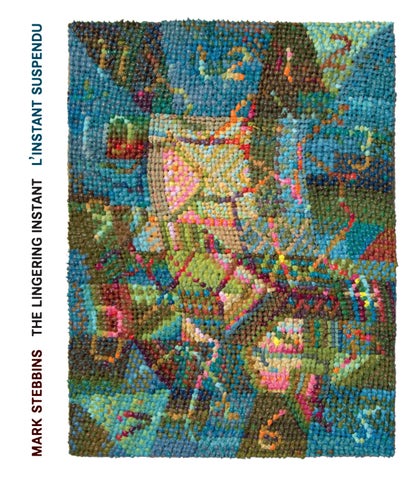
Mark Stebbins The Lingering
About the Artist
Originally from Point Edward, Stebbins now lives and works in London, Ontario. He holds a Bachelor of Fine Arts degree from Western University and a law degree from Dalhousie University’s Schulich School of Law. His work has been exhibited across Canada and internationally. A 10-year survey exhibition, Supersampler, was shown at Museum London (2025) accompanied by an extensive catalogue. Recent solo shows include Choeur d’échos (2025), Gathered Threads (2022), and Oblivion Souvenirs (2019) at Galerie Simon Blais, Montreal. Recent group exhibitions include Seoul, South Korea (2023); Beijing, China (2022); and London, UK (2022).
Stebbins’ work has been recognized with numerous awards, including Honourable Mention in the RBC Canadian Painting Competition (2010) and Best in Exhibition and Best in Drawing at the Toronto Outdoor Art Exhibition (2010). He was the recipient of the Halifax Mayor’s Award of Distinction in Contemporary Visual Arts (2009) and was named Emerging Artist of the Year by Visual Arts Nova Scotia that same year. He has been awarded grants by the Canada Council of the Arts and the Ontario Arts Council.
Stebbins’ works are included in the collections of the Canada Council Art Bank, Museum London, RBC Royal Bank, London Arts Council, Halifax Regional Municipality, and others, including private collections across North America, Europe, and Asia. He is represented by Galerie Simon Blais, Montreal; Canadian Fine Arts, Toronto; and Galerie PICI, Seoul. Learn more by visiting: https://markstebbins.ca/
À propos de l’artiste
Originaire de Point Edward, Stebbins vit et travaille aujourd’hui à London, en Ontario. Il est titulaire d’un baccalauréat en beaux-arts de l’Université Western et d’un diplôme en droit de la Schulich School of Law de l’Université Dalhousie. Ses œuvres ont été exposées à travers le Canada et à l’étranger. Une exposition rétrospective couvrant dix ans de son œuvre, intitulée Supersampler, a été présentée au Museum London (2025) et accompagnée d’un catalogue détaillé. Parmi ses expositions personnelles récentes, citons Choeur d’échos (2025), Gathered Threads (2022) et Oblivion Souvenirs (2019) à la Galerie Simon Blais, à Montréal. Il a également participé à des expositions collectives à Séoul, en Corée du Sud (2023), à Pékin, en Chine (2022), et à Londres, au Royaume-Uni (2022).
Le travail de Stebbins a été récompensé par de nombreux prix, notamment une mention honorable au Concours de peinture canadienne RBC (2010) et les prix « Best in Exhibition » et « Meilleur dessin » à la Toronto Outdoor Art Exhibition (2010). Il a reçu le Prix d’excellence du maire de Halifax en arts visuels contemporains (2009) et a été nommé Artiste émergent de l’année par Visual Arts Nova Scotia la même année. Il a obtenu des subventions du Conseil des arts du Canada et du Conseil des arts de l’Ontario.
Les œuvres de Stebbins font partie des collections de la Banque d’art du Conseil des arts du Canada, du Museum London, de la Banque Royale du Canada (RBC), du London Arts Council, de la municipalité régionale d’Halifax, ainsi que d’autres collections, notamment des collections privées en Amérique du Nord, en Europe et en Asie. Il est représenté par la Galerie Simon Blais, à Montréal ; Canadian Fine Arts, à Toronto ; et la Galerie PICI, à Séoul. Pour en savoir plus, rendez-vous sur : https://markstebbins.ca/
A Meeting of Divergent Images
Time, Labour, and Material in the Paintings of Mark Stebbins
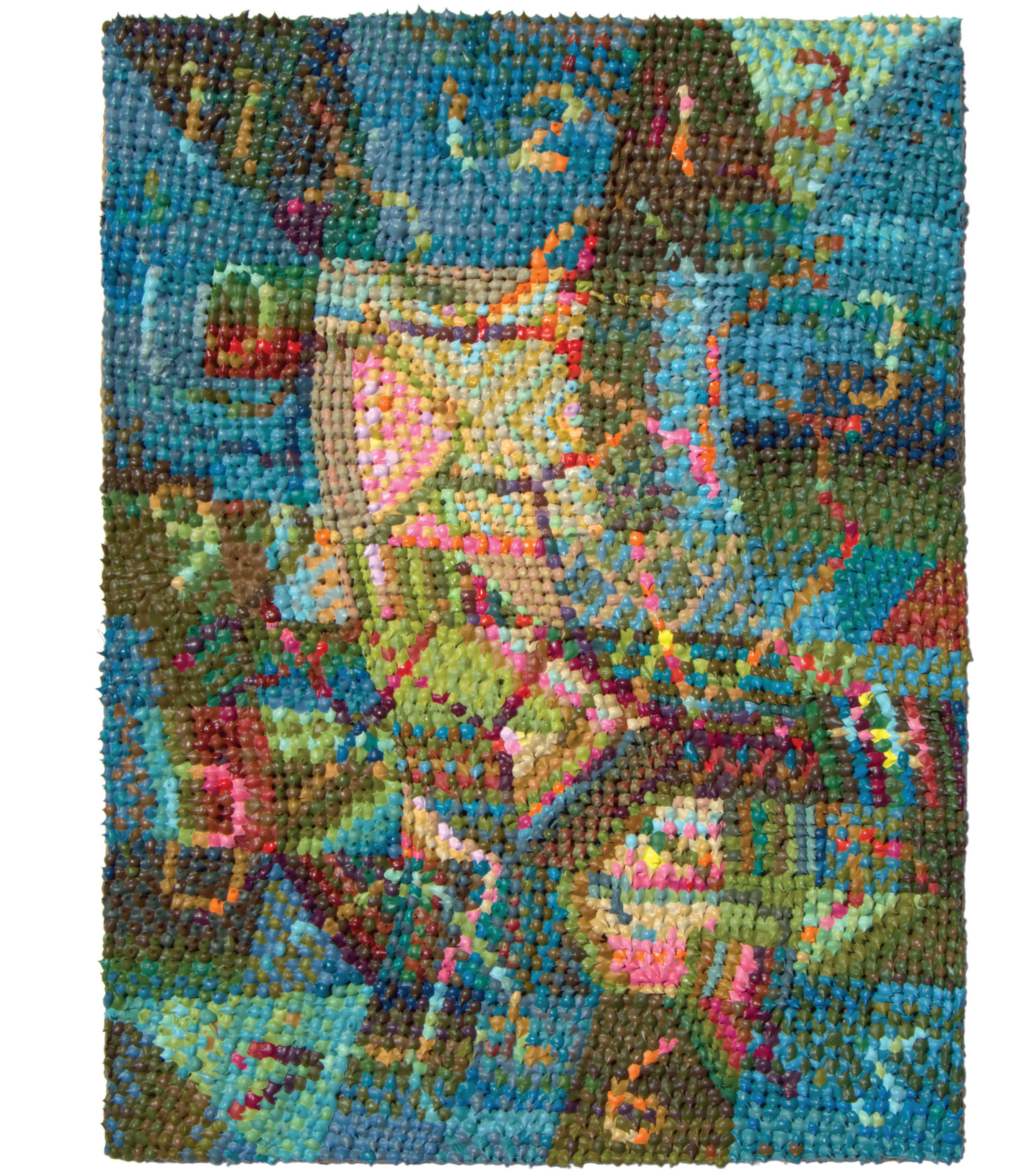
The numbers are slightly out of position in Clock (November) (2025). We, the viewers, tend to think of clocks as rounded objects that lend structure to the chaos of human experience. Here, however, each number is hopelessly warped and rendered in kaleidoscopic colours, as if negating the clock’s organizing logic. They surround a series of loose strings, curiously reminiscent of chemical diagrams. What exactly are the wavy yet angular forms occupying the background? The paint is applied in thick dabs that are almost sculptural and follow an underlying gridded architecture. If you stare at it long enough, the composition appears to oscillate from side to side. Either the clock is in flux, or time itself is profoundly unstable.
Clock (November) is one of the works included in Mark Stebbins’ exhibition
The Lingering Instant, which investigates Stebbins’ unfolding engagement with time, creative labour, and materiality. His work functions as a marker of time, serving as an archival document that encapsulates his lived experience over a given period. Each involves tremendous effort in researching, sketching, mapping colour schemes, reworking concepts, executing, and more, which is why even the smallest works take several months and sometimes years to complete. The profound creative labour involved in his practice reflects a conscious effort to stretch time, allowing for a slowness in the studio that resists the hyperaccelerated pace of contemporary digital media.1 In a similar vein, his emphasis on materiality in recent works serves as a critique of the mimicry of human creativity produced by Artificial Intelligence (AI). These unusual, viscous paintings — applied with syringes on burlap — have propelled his practice in new and rhizomatic directions.
Stebbins’ paintings represent seemingly divergent elements inspired by an array of sources, including nineteenth-century quilting traditions in Canada, AI image generators, family photographs, readymade studio materials, glitch aesthetics, and pointillism. His emphasis on contradictory images, patterns, and concepts recalls Georg Wilhelm Friedrich Hegel’s notion of dialectical thinking. For Hegel, the confrontation between opposing histories, theories, and experiences generates a tension in search of a resolution. “Contradiction,” he writes, “is the root of all movement and vitality; it is only so far as something has a contradiction within it that it moves, has an urge, and activity.” 2 The friction between the unresolved forces in Stebbins’ work prompts the audience to unpack them, resulting in what Hegel would term sublation (Aufhebung), or a higher mode of understanding.
A simple glance would fail to reveal the whole truth of Stebbins’ paintings. Only by slowing down and looking carefully can viewers find a semblance of resolution. On average, museum and gallery-goers spend only eight seconds looking at an individual artwork,3 but Stebbins’ work resists the ethos of rapid visual consumption that has defined Western culture since the proliferation of smartphone technology and proprietary digital media. His paintings insist, perhaps even necessitate, a deceleration of museological time as the sophisticated relationships between their details unfold slowly. This pause or suspension in the flow of time elicits an opportunity to linger over it, drawing meaning from the marrow of its imagery.
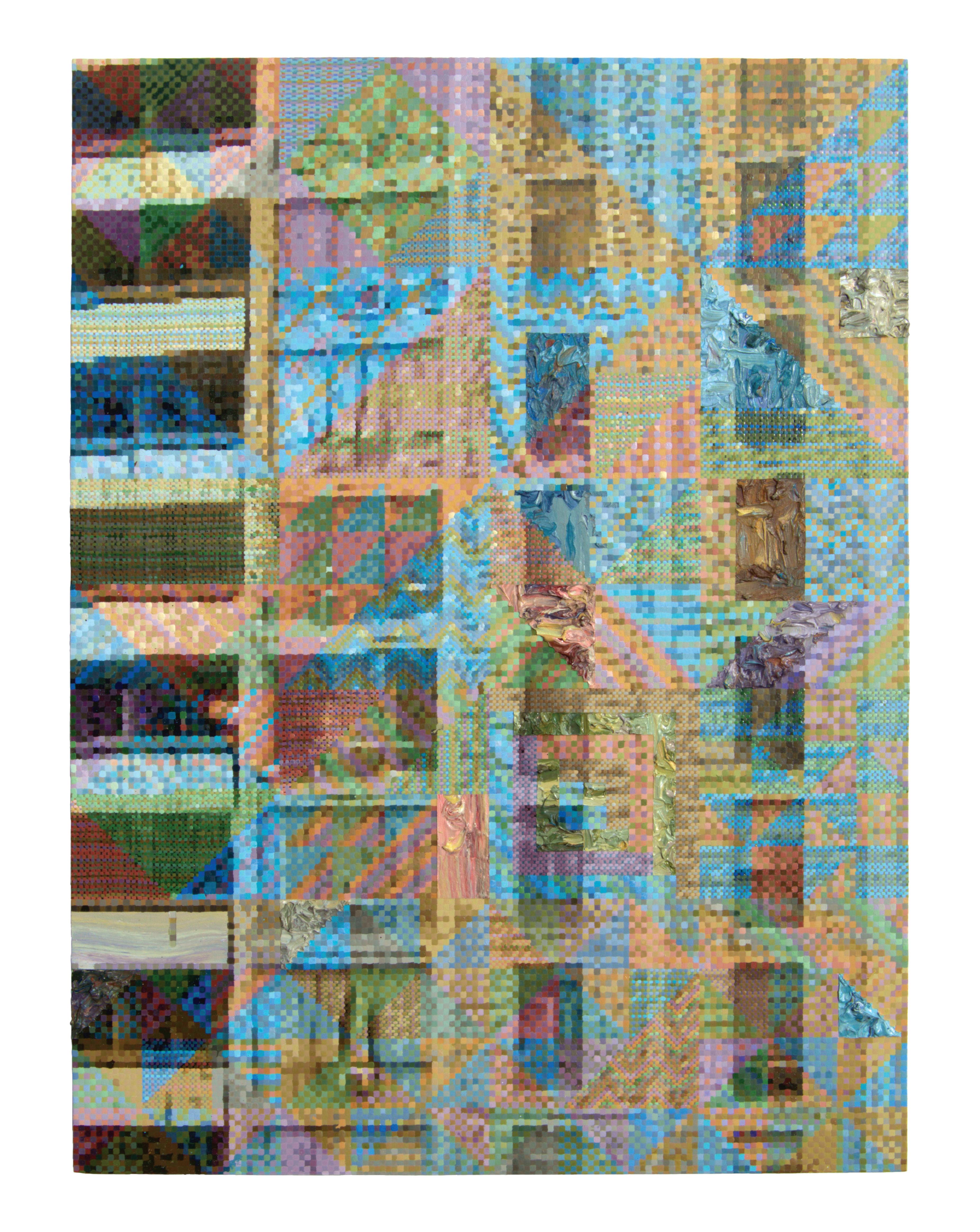
Take, for example, Monument (2024). The structural logic of the painting is ordered through images of quilts found in Ruth McKendry’s 1979 book Quilts and Other Bed Coverings in the Canadian Tradition, a remarkable study of quilting in nineteenth-century Ontario. These images are layered with a banal snapshot of an apartment building facade. The pixelated elements crash into the woven textiles and sections of rigorously-applied impasto paint, an area where Stebbins reminds the viewer that his creative labour is intrinsically tied to this painting. The added paradox of merging the quilts (made by women in private, domestic spaces) with the very public, pedestrian complex builds tension.
The title is a cheeky one. It may hint at the towering scale of the building itself, a canonization of Toronto Brutalism, or a kind of tombstone. Or perhaps it is the quilts that are being memorialized: let us not forget that they were stitched largely by women whose lives have passed and remain relatively unknown to the cultural history of Canada, yet are being given their due now, approximately 200 years later. With a growing list of contradictory implications, Monument may not be monumental at all. Instead, it appears to function as a sort of anti-monument, a rejection of grand ideologies or the veneration of powerful figures in favour of
Une rencontre entre des images divergentes le temps, le travail et la matière dans les peintures de Mark Stebbins
Dans Clock (November) (2025), les chiffres sont légèrement désaxés. Nous, les spectateurs, avons tendance à considérer les horloges comme des objets qui structurent le chaos de l’expérience humaine. Ici, cependant, chaque chiffre est irrémédiablement déformé et rendu dans des couleurs kaléidoscopiques, comme pour nier la logique organisatrice de l’horloge. Ils entourent une série de fils détachés qui rappellent curieusement des schémas chimiques. Que sont exactement ces formes ondulées, mais anguleuses qui occupent l’arrière-plan ? La peinture est appliquée par touches épaisses, presque sculpturales, qui suivent une architecture quadrillée sous-jacente. Si l’on fixe l’œuvre assez longtemps, la composition semble osciller d’un côté à l’autre. Soit l’horloge est en mouvement, soit le temps lui-même est profondément instable.
Clock (November) fait partie des œuvres présentées dans l’exposition de Mark Stebbins intitulée The Lingering Instant (L’instant suspendu), qui explore l’intérêt croissant de l’artiste pour le temps, le travail créatif et la matérialité. Son œuvre fait office de repère temporel, servant de document d’archives qui résume son expérience vécue au cours d’une période donnée. Chacune d’entre elles nécessite un travail considérable de recherche, d’esquisse, de mise au point des palettes de couleurs, de révision des concepts, de réalisation, et bien plus encore ; c’est pourquoi même les plus petites œuvres prennent plusieurs mois, voire parfois des années, à achever. Le travail créatif approfondi inhérent à sa pratique reflète un effort conscient pour étirer le temps, permettant une lenteur dans l’atelier qui résiste au rythme hyperaccéléré des médias numériques contemporains.1 Dans le même esprit, l’accent qu’il met sur la matérialité dans ses œuvres récentes sert de critique à l’imitation de la créativité humaine produite par l’intelligence artificielle (IA). Ces peintures inhabituelles et visqueuses — appliquées à la seringue sur de la toile de jute — ont propulsé sa pratique dans des directions nouvelles et rhizomatiques. Les peintures de Stebbins mettent en scène des éléments en apparence divergents, inspirés par un large éventail de sources, notamment les courtepointes canadiennes du XIXe siècle, les générateurs d’images alimentés par l’intelligence artificielle (IA), les photographies de famille, les matériaux d’artistes préfabriqués, l’esthétique du glitch et le pointillisme. L’accent qu’il met sur les images, les motifs et les concepts contradictoires rappelle la notion de pensée dialectique de Georg Wilhelm Friedrich Hegel. Pour Hegel, la confrontation entre des histoires, des théories et des expériences opposées génère une tension en quête d’une résolution. « La contradiction, écrit-il, est la racine de tout mouvement et de toute manifestation vitale ; c’est seulement dans la mesure où elle renferme une contradiction qu’une chose est capable de mouvement, d’activité, de manifester des tendances ou impulsions. » 2 Cette tension dans les œuvres de Stebbins incite le public à les décortiquer, aboutissant à ce que Hegel appellerait Aufhebung, ou un mode de compréhension supérieur.
Un simple coup d’œil ne suffirait pas à révéler toute la vérité des peintures de Stebbins. Ce n’est qu’en ralentissant le rythme et en observant attentivement que les spectateurs peuvent entrevoir une forme de réponse. En moyenne, les visiteurs de musées et de galeries ne consacrent que huit secondes à l’observation d’une œuvre d’art 3, mais le travail de Stebbins s’oppose à cette consommation visuelle rapide qui caractérise la culture occidentale depuis l’essor des téléphones intelligents et des médias propriétaires. Ses peintures exigent, voire imposent, un ralentissement du temps muséologique à mesure que les relations complexes entre leurs détails se dévoilent lentement. Cette pause ou cette suspension dans le passage du temps offre l’occasion de s’y attarder, en puisant le sens au plus profond de son imagerie.
Prenons, par exemple, Monument (2024). La logique structurelle du tableau s’articule autour d’images de courtepointes tirées de l’ouvrage de Ruth McKendry publié en 1979, Quilts and Other Bed Coverings in the Canadian Tradition, une étude remarquable de la courtepointe dans l’Ontario du XIXe siècle. Ces images sont superposées à un cliché banal représentant la façade d’un immeuble d’habitation. Les éléments pixélisés se heurtent aux textiles tissés et aux sections de peinture en impasto rigoureusement appliquée, une zone où Stebbins rappelle au spectateur que son travail créatif est intrinsèquement lié à ce tableau. Le paradoxe supplémentaire de la fusion des courtepointes (réalisées par des femmes dans des espaces privés et domestiques) avec ce complexe très public et banal crée une tension.
illuminating forgotten narratives or individuals. An act of remembrance, it is also a quiet celebration of ordinary lives.
According to Nicolas Bourriaud, “when the basic functions of our daily lives are slowly transformed into products of consumption [...] artists might seek to rematerialize these functions and processes, to give shape to what is disappearing before our eyes.” 4 As we dip our toes further into the pool of AI slop, where the endeavours of the human animal are progressively replaced by parroting machines, Stebbins moves further to the analogue — to physical material — for solace. This approach accounts for his marked shift from glitch aesthetics to historical textiles in 2021 as much as it does for a change in medium from thin acrylic ink on panels to thick acrylic paint on burlap.
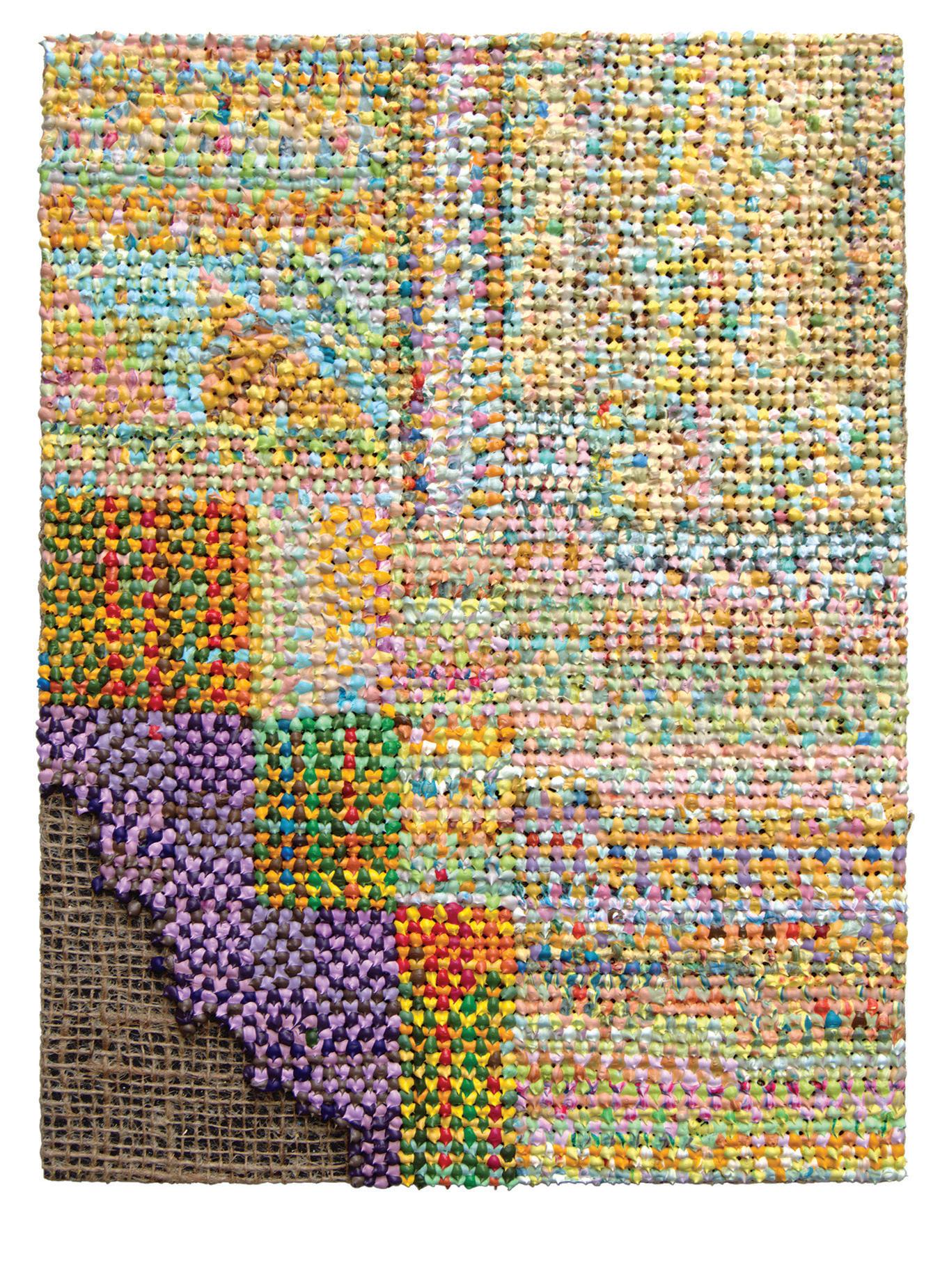
This Thing (2025) is one such example. In the work, raw burlap provides Stebbins with a natural, grid-like container for his paint, but it is also an art-historical nod that harkens back to the geometric abstraction of Agnes Martin or Piet Mondrian. The jute at the bottom left of the composition skirmishes with the lucid purple patch before transitioning into Stebbins’ signature labyrinth of patterns and matrices of colour. However, with This Thing, Stebbins is quite literally making and presenting an object. Nothing more, really. It basically ends there. A decade ago, this may have been perceived as an absurd act, a Dada-driven performance, but today it holds radical power in the face of AI’s incremental steps toward human erasure. The painting is an embodied articulation of presence — a stand-in for a signature, an uncompromising proclamation that “I made this.” 5
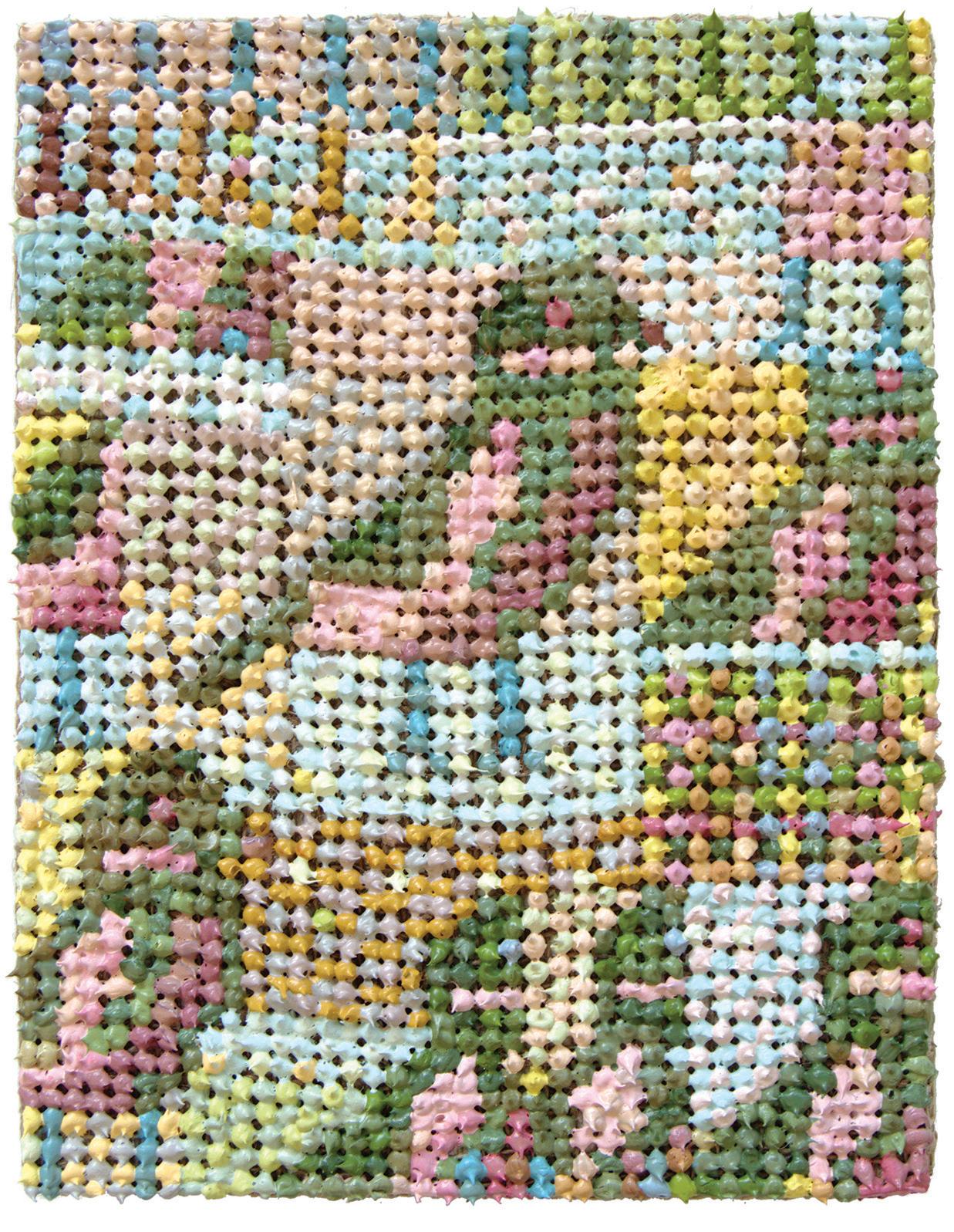
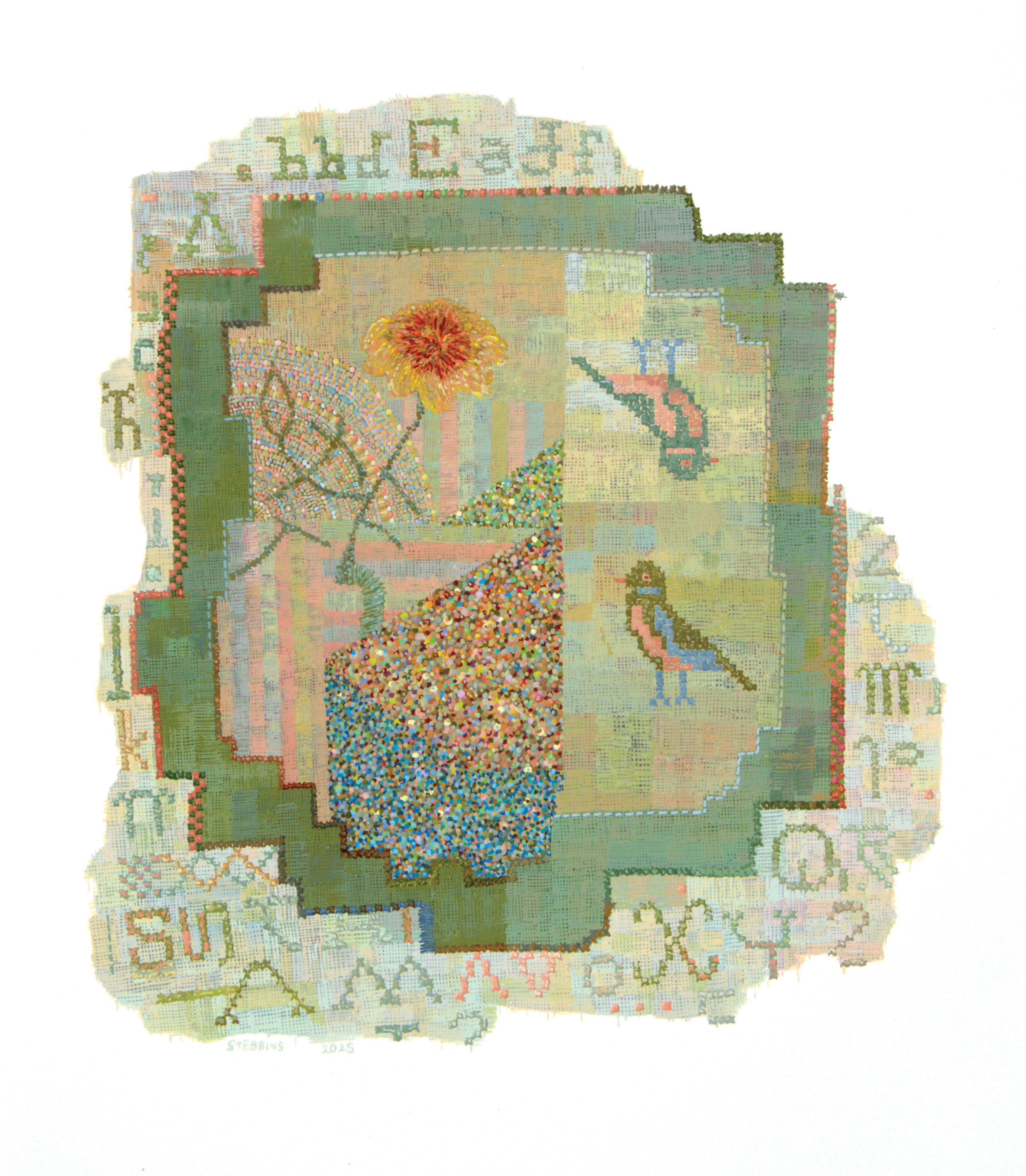
The toils of creative labour also factor into Echoers (2025), which takes cues from the work of nineteenth-century women, this time through embroidery samplers housed in the collection of Museum London. The samplers were traditionally produced by young women in Southwestern Ontario during the nineteenth century to demonstrate their proficiency in needlework. This skill was seen as a strong indicator for how well women could maintain domestic duties in daily life upon marriage. Very little is known about artist Jean Mackie, whose impressive sampler features stylized trees, an alphabet, flowers, deer, a house, and birds that Stebbins himself has sampled.
In the work, Stebbins positions the slow, laborious act of needlepoint against his rebuke of the near-instantaneous speed of AI image-generating software. Selections of Mackie’s charming birds are reproduced in the painting, though the upside-down copy shows signs of the slightest manipulation. The letters serve an aesthetic function by framing the entire composition, but as distorted simulations their appearance becomes more cryptic than coherent. Their uncanniness, wonkiness, and illogicality suggest the lurking presence of AI image generation in contemporary digital media but are not, in fact, the product of it. Echoers also speaks to the reverberation of iconography and ideas across time and technologies. Mackie’s sampler resonates with Stebbins centuries after its original creation, while digitized human knowledge bounces back through AI’s
Le titre choisi est facétieux. Il peut faire allusion à l’imposante stature du bâtiment lui-même, à une canonisation du brutalisme torontois, ou à une sorte de pierre tombale. Ou peut-être s’agit-il des courtepointes auxquelles on rend hommage : n’oublions pas qu’elles ont été cousues en grande partie par des femmes aujourd’hui disparues et qui restent relativement méconnues de l’histoire culturelle du Canada, mais auxquelles on rend enfin justice aujourd’hui, près de 200 ans plus tard. Avec une liste croissante d’implications contradictoires, l’œuvre Monument n’est peut-être pas monumentale du tout. Au contraire, elle semble fonctionner comme une sorte d’anti-monument, un rejet des grandes idéologies ou de la vénération des figures puissantes au profit de la mise en lumière de récits ou d’individus oubliés. Acte de commémoration, c’est aussi une célébration discrète des vies ordinaires.
Selon Nicolas Bourriaud, « lorsque les fonctions élémentaires de notre vie quotidienne se transforment peu à peu en produits de consommation […], les artistes pourraient chercher à rematérialiser ces fonctions et ces processus, afin de donner une forme à ce qui disparaît sous nos yeux ».4 Alors que nous nous enfonçons davantage dans le marécage des contenus générés par l’IA, où les efforts de l’animal humain sont progressivement remplacés par des machines qui ne font que répéter, Stebbins se tourne davantage vers l’analogue — vers la matière physique — pour y trouver du réconfort. Cette approche explique son passage marqué de l’esthétique glitch aux textiles historiques en 2021, tout autant que le changement de support, passant de l’encre acrylique fine sur panneaux à la peinture acrylique épaisse sur toile de jute.
This Thing (2025) est un exemple de ce changement. Dans cette œuvre, la toile de jute brute offre à Stebbins un support naturel, semblable à une grille, pour sa peinture, mais elle constitue également un clin d’œil à l’histoire de l’art qui renvoie à l’abstraction géométrique d’Agnes Martin ou de Piet Mondrian. La toile de jute en bas à gauche de la composition entre en confrontation avec la tache violette limpide avant de se fondre dans le labyrinthe de motifs et de matrices de couleurs caractéristiques de Stebbins. Cependant, avec This Thing, Stebbins fabrique et présente littéralement un objet. Rien de plus, en fait. Cela s’arrête là. Il y a dix ans, cela aurait pu être perçu comme un acte absurde, une performance d’inspiration dadaïste, mais aujourd’hui, cela revêt une puissance radicale face aux avancées progressives de l’IA vers l’effacement de l’humain. Le tableau est une articulation incarnée de la présence — un substitut à une signature, une proclamation sans compromis : « C’est moi qui ai fait ça. » 5
Les difficultés inhérentes au travail créatif sont également abordées dans Echoers (2025), qui s’inspire du travail des femmes du XIXe siècle, cette fois à travers des échantillons de broderie conservés dans la collection du Museum London. Ces échantillons étaient traditionnellement réalisés par de jeunes femmes du sud-ouest de l’Ontario au XIXe siècle afin de démontrer leur maîtrise du travail d’aiguille. Cette compétence était considérée comme un indicateur fiable de la capacité des femmes à accomplir leurs tâches domestiques au quotidien après leur mariage. On sait très peu de choses sur l’artiste Jean Mackie, dont l’impressionnant échantillon présente des arbres stylisés, un alphabet, des fleurs, des cerfs, une maison et des oiseaux que Stebbins a lui-même échantillonnés.
Dans cette œuvre, Stebbins oppose le geste lent et laborieux de la broderie à sa critique de la rapidité quasi instantanée des logiciels générateurs d’images par IA. Une sélection des charmants oiseaux de Mackie est reproduite dans la peinture, bien que la copie à l’envers montre des signes d’une manipulation infime. Les lettres remplissent une fonction esthétique en encadrant l’ensemble de la composition, mais en tant que simulations déformées, leur apparence devient plus énigmatique que cohérente. Leur caractère étrange, bancal et illogique suggère la présence latente de la génération d’images par IA dans les médias numériques contemporains, sans pour autant en être le produit. Echoers évoque également la réverbération de l’iconographie et des idées à travers le temps et les technologies. L’échantillon de Mackie résonne avec Stebbins des siècles après sa création originale, tandis que le savoir humain numérisé rebondit à travers les schémas algorithmiques de l’IA. Si le son original d’un écho s’atténue avec le temps et à travers l’espace, alors c’est une métaphore pertinente de la façon dont l’IA atténue l’activité humaine qu’elle est censée refléter.
algorithmic patterns. If the original sound of an echo diminishes over time and space, then it is an apt metaphor for how AI diminishes the human activity that it supposedly mirrors.
As often occurs in Stebbins’ work, the appearance of a simple detail — say, a bird — is never without purpose. In addition to their scrutiny of nineteenth-century domesticity and AI-generated muck, Echoers and especially Mackie’s Birds (Remix) (2024) shrewdly mourn our innate connection to flora, fauna, and the natural environment. Birds are among the strongest markers of climate change, given their sensitivity to temperature shifts, seasonal anomalies, and changing habitat ranges. The Canadian government bleakly estimates that by 2050, “one in four birds in Parks Canada places may need to find new homes as a result of increased greenhouse gas emissions.” 6 Stebbins’ inclusion of birds in his paintings extends beyond the reach of AI and into a broader concern about the Anthropocene — climate change and biodiversity loss due to the unsustainable human activity associated with so-called progress.7 They symbolize the presence of planetary decay and entropy under late-stage capitalism, reminding us that change in the future is realized at the brink of today. The enormous amounts of energy and material resources that accompany AI usage, and the construction of data centres to house it, have only exacerbated an already precarious issue.
Stebbins’ paintings are composed of a breadth of subject matter, materials, and concepts culled from the past and the present, and therefore function as a kind of transhistorical composite. The veritable mash-up and remix of elements and details into a single manifestation disposes of the rigid linearity of time, promotes the existential value of cultivating slowness, and responds to the information age by emphasizing real, tangible stuff. The things he creates and shares champion the potential of human creativity in the face of AI’s dehumanizing tendencies.
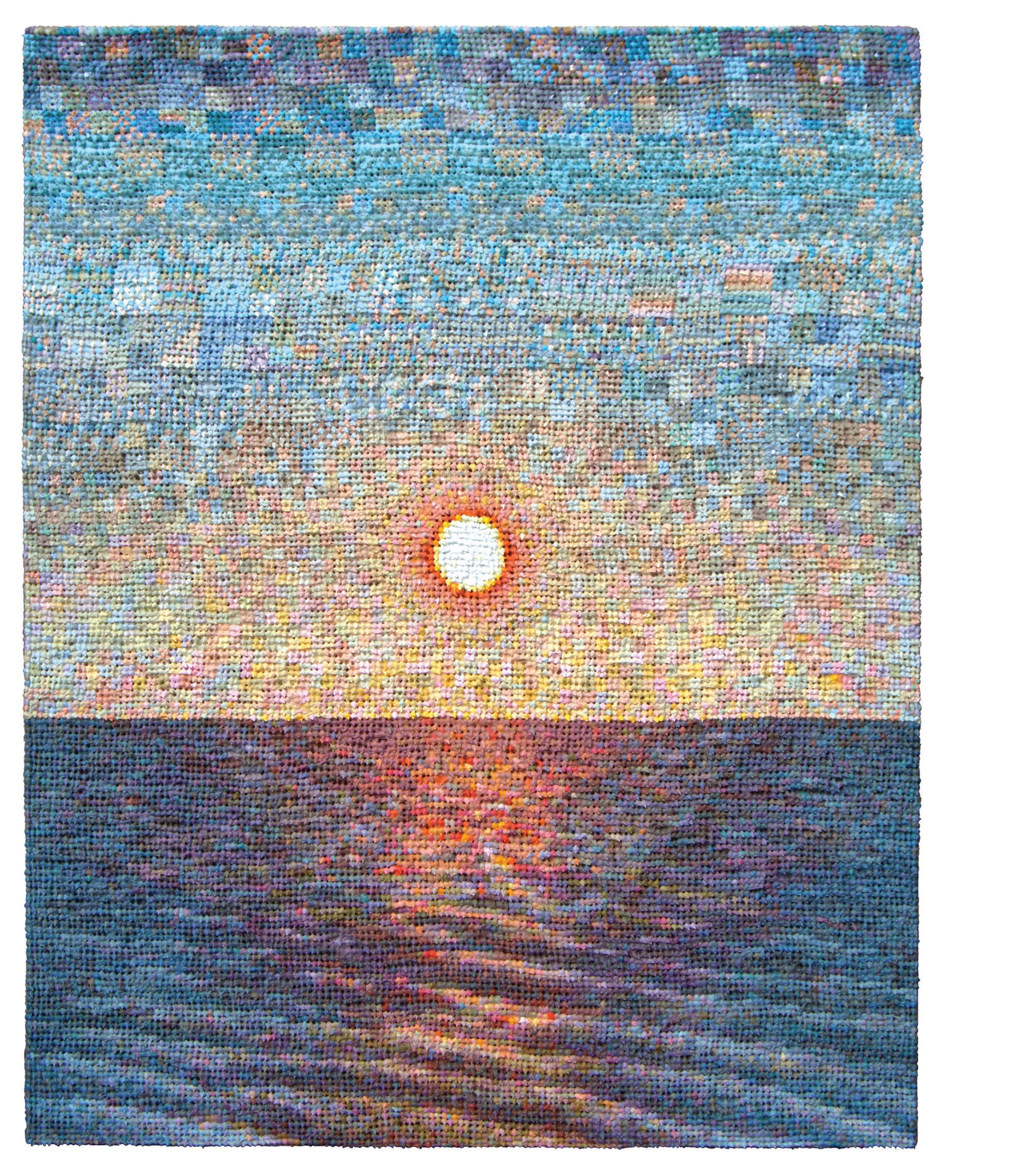
The title painting of the exhibition, The Lingering Instant (2026), has Stebbins’ primary objectives encoded within it. His largest work in years, it pictures an Edenic sunset soon to fall over the horizon. The blinding sun is tinged with a reddish haze, as if obscured by the smoke of recent wildfires. Its radiant glow illuminates a sky composed of textile grids that reference overlooked creative communities of the past. Like Echoers, the painting communicates that instances, actions, and choices impact, ricochet, and stick around over time. There is sublime beauty here, amplified by the sparkling effect of the iridescent and metallic pigment. But this sentiment is equally shared with the fleetingness of life and the heavy burden of death. So it goes. When grounded in the present, away from screens, the painting registers an embodied aesthetic experience, one where time drifts, if only for a moment.
Matthew Ryan Smith, PhD, is the Curator and Head of Collections at Glenhyrst Art Gallery in Brantford, Ontario; a Curatorial Researcher with The New York Historical; and the Literary Editor of First American Art Magazine. His writing has appeared in books and publications, including Border Crossings, Canadian Art, and Esse arts + opinions
Notes
1. Marks Stebbins quoted in Nora Saïeb, “Mark Stebbins interview with Nora Saïeb,” Galerie Simon Blais (October 17, 2025), https://www.galeriesimonblais.com/en/news/mark_stebbins_ interview_with_nora_saieb.
2. Georg Wilhelm Friedrich Hegel quoted in Andrew W. Hass, Hegel and the Art of Negation: Negativity, Creativity, and Contemporary Thought (Bloomsbury Publishing, 2013), 88.
3. Tate Modern, “A guide to slow looking,” (n.d.), https://www.tate.org.uk/art/guide-slow-looking.
4. Nicolas Bourriaud, Postproduction: Culture as Screenplay: How Art Reprograms the World (Lukas and Sternberg, 2002), https://iedimagen.files.wordpress.com/2012/01/bourriaudnicholas_postproduction.pdf.
5. Over 500 years ago, artist Jan van Eyck signed his painting The Arnolfini Portrait (1434) “Johannes de Eyck fuit hic,” or “Jan van Eyck was here” as an act of witness to the marriage between the work’s subjects. Today, Stebbins’ work archives a similar function, acting as a witness to the disempowering nature of artificial intelligence on humanity.
6. Government of Canada, “Birds and climate change: can they stay or will they go?” (June 5, 2023), https://parks.canada.ca/nature/science/climat-climate/oiseaux-birds.
7. See: Planetary Health Check, “Planetary Health Check 2025: A Scientific Assessment on the State of the Planet” (2025), https://www.planetaryhealthcheck.org/.
Comme c’est souvent le cas dans l’œuvre de Stebbins, l’apparition d’un petit détail — par exemple, un oiseau — n’est jamais fortuite. Outre leur examen minutieux de la vie domestique du XIXe siècle et de la bouillie numérique générée par l’IA, Echoers et surtout Mackie’s Birds (Remix) (2024) déplorent avec perspicacité la disparition du lien qui nous unit à la flore, à la faune et à l’environnement naturel. Les oiseaux comptent parmi les indicateurs les plus évidents du changement climatique, compte tenu de leur sensibilité aux variations de température, aux anomalies saisonnières et à la modification de leur habitat. Le gouvernement canadien estime de manière alarmante que d’ici 2050, « un oiseau sur quatre dans les endroits gérés par Parcs Canada devra peut-être se trouver un nouveau refuge en raison de l’augmentation des émissions de gaz à effet de serre ».6 L’intégration des oiseaux dans les peintures de Stebbins dépasse le cadre de l’IA pour s’inscrire dans une préoccupation plus large concernant l’Anthropocène — le changement climatique et la perte de biodiversité dus à l’activité humaine destructrice associée au soi-disant progrès.7 Ils symbolisent la présence de la dégradation planétaire et de l’entropie sous le capitalisme tardif, nous rappelant que le changement futur se concrétise à l’aube du présent. Les énormes quantités d’énergie et de ressources matérielles qui accompagnent l’utilisation de l’IA, ainsi que la construction de centres de données pour l’héberger, n’ont fait qu’exacerber une situation déjà précaire.
Les peintures de Stebbins s’appuient sur une vaste palette de thèmes, de matériaux et de concepts puisés dans le passé et le présent, formant ainsi une sorte de mosaïque transhistorique. Ce véritable mélange et remix d’éléments et de détails en une seule et même manifestation rompt avec la linéarité rigide du temps, met en avant la valeur existentielle de la lenteur et répond à l’ère de l’information en mettant l’accent sur ce qui est réel et tangible. Les œuvres qu’il crée et partage défendent le potentiel de la créativité humaine face aux tendances déshumanisantes de l’IA.
Le tableau qui donne son titre à l’exposition, The Lingering Instant (2026), incarne les principaux objectifs de Stebbins. Son œuvre la plus imposante depuis des années, elle représente un coucher de soleil édénique sur le point de disparaître à l’horizon. Le soleil aveuglant est teinté d’une brume rougeâtre, comme obscurci par la fumée des récents incendies de forêt. Sa lueur radieuse illumine un ciel composé de grilles textiles qui font référence aux communautés créatives méconnues du passé. À l’instar d’Echoers, le tableau exprime que les événements, les actions et les choix ont un impact, se répercutent et perdurent au fil du temps. Il y a ici une beauté sublime, amplifiée par l’effet scintillant des pigments irisés et métalliques. Mais ce sentiment est tout autant lié à la fugacité de la vie et au lourd fardeau de la mort. C’est ainsi. Lorsqu’on s’ancre dans le moment présent, loin des écrans, le tableau offre une expérience esthétique incarnée, où le temps s’étire, ne serait-ce qu’un instant.
Matthew Ryan Smith, PhD, est conservateur et responsable des collections à la Glenhyrst Art Gallery de Brantford, en Ontario ; chercheur en conservation à la New York Historical Society ; et éditeur littéraire du magazine First American Art. Ses écrits ont été publiés dans divers ouvrages et revues, notamment Border Crossings, Canadian Art et Esse arts + opinions
Notes
1. Marks Stebbins, cité dans Nora Saïeb, « Mark Stebbins Interview with Nora Saïeb », Galerie Simon Blais, 17 octobre 2025, en ligne : https://www.galeriesimonblais.com/en/news/ mark_stebbins_interview_with_nora_saieb
2. Georg Wilhelm Friedrich Hegel, Science de la logique, trad. Bernard Bourgeois, Paris, Vrin, 2015. 3. Tate Modern, « A Guide to Slow Looking », n. d., en ligne : https://www.tate.org.uk/art/ guide-slow-looking
4. Nicolas Bourriaud, Postproduction: Culture as Screenplay: How Art Reprograms the World, New York, Lukas & Sternberg, 2002, en ligne : https://iedimagen.files.wordpress.com/2012/ 01/bourriaud-nicholas_postproduction.pdf (traduction libre).
5. Il y a plus de 500 ans, l’artiste Jan van Eyck a signé son tableau Les Époux Arnolfini (1434) « Johannes de Eyck fuit hic », c’est-à-dire « Jan van Eyck était ici », afin de témoigner du mariage des personnages représentés. Aujourd’hui, l’œuvre de Stebbins remplit une fonction similaire en témoignant de la manière dont l’intelligence artificielle prive l’humanité de son pouvoir.
6. Gouvernement du Canada, « Les oiseaux et les changements climatiques : vont-ils partir ou rester ? », 5 juin 2023, en ligne : https://parks.canada.ca/nature/science/climat-climate/ oiseaux-birds
7. Planetary Health Check, « Planetary Health Check 2025: A Scientific Assessment on the State of the Planet », 2025, en ligne : https://www.planetaryhealthcheck.org/
(right) Echoers, 2025; acrylic ink on Yupo paper / encre acrylique sur papier Yupo; 30.5 x 25.4 cm; Private collection / Collection privée
Mark Stebbins
The Lingering Instant / L’instant suspendu April 17 – August 30, 2026 / 17 avril – 30 août 2026
Curator / Commissaire
Writer / Auteur
Editor / Réviseure
Translation / Traduction
Installation
Sonya Blazek
Matthew Ryan Smith
Alison Kenzie
Galerie Simon Blais
Tim Churchill, Shelly Mallon, Dale Workman
Photographer / Photographe Mark Stebbins
Publication Design / Otto Buj
Conception graphique de la publication
Printing / Impression
© 2026 Judith & Norman Alix Art Gallery
Aylmer Express
All artworks / Toutes les œuvres d›art © Mark Stebbins
ISBN 978-1-7753346-5-1
Acknowledgments
The Judith & Norman Alix Art Gallery and the County of Lambton gratefully acknowledge the support of JNAAG members, donors, sponsors, and volunteers. Sincere appreciation is extended to Galerie Simon Blais, Montreal, for their assistance in securing loans and for translating the publication.
The Gallery also extends deepest thanks to the individuals who loaned works to the exhibition: Simon Blais; Annie Dubeau and Guy Coutlée; David Merritt and Dawn Easton Merritt; Áine Stebbins; Rose and Paul Stebbins; and private collectors.
In addition to those named above, Mark Stebbins would like to thank Matthew Ryan Smith for his insightful text; Sonya Blazek for her curatorial vision; and Kathleen Lynch, Áine, and Xavier, whose love and support create a foundation that makes these artworks possible.
Remerciements
La Judith & Norman Alix Art Gallery et le comté de Lambton tiennent à remercier chaleureusement les membres, les donateurs, les sponsors et les bénévoles de la JNAAG pour leur soutien. Nous exprimons nos sincères remerciements à la Galerie Simon Blais, à Montréal, pour son aide dans l’obtention des prêts et pour la traduction de la publication.
La Galerie tient également à exprimer sa profonde gratitude aux personnes qui ont prêté des œuvres pour l’exposition : Simon Blais; Annie Dubeau et Guy Coutlée; David Merritt et Dawn Easton Merritt; Áine Stebbins; Rose et Paul Stebbins; ainsi qu’à des collectionneurs privés. En plus des personnes mentionnées précédemment, Mark Stebbins tient à remercier Matthew Ryan Smith pour son texte pertinent; Sonya Blazek pour sa vision curatoriale; ainsi que Kathleen Lynch, Áine et Xavier, dont l’amour et le soutien forment une base solide qui rend ces œuvres possibles.
Library and Archives Canada Cataloguing in Publication
Title: Mark Stebbins : the lingering instant.
Other titles: Lingering instant | Container of (work): Mark Stebbins. | Container of (expression): Mark Stebbins. French.
Names: Blazek, Sonya, organizer | Smith, Matthew Ryan, 1983– writer of added commentary | Container of (work): Stebbins, Mark, 1979– Paintings. Selections. | Judith & Norman ALIX Art Gallery, host institution, publisher.
Description: Curator: Sonya Blazek; writer: Matthew Ryan Smith; editor: Alison Kenzie | Published in conjunction with the exhibition titled The Lingering Instant, held at the Judith & Norman Alix Art Gallery from April 17, 2026 to August 30, 2026. | Includes bibliographical references. | Text in English and French.
Identifiers: Canadiana 20260131709E | ISBN 9781775334651 (softcover)
Subjects: LCSH: Stebbins, Mark, 1979– —Exhibitions. | LCGFT: Exhibition catalogs. Classification: LCC ND249.S6554 A4 2026 | DDC 759.11 —dc23
Catalogage avant publication de Bibliothèque et Archives Canada
Titre: Mark Stebbins : the lingering instant.
Autres titres: Lingering instant | Conteneur de (œuvre) : Mark Stebbins. | Conteneur de (expression) : Mark Stebbins. Français.
Noms: Blazek, Sonya, organisateur. | Smith, Matthew Ryan, 1983– auteur de commentaire ajouté. | Conteneur de (œuvre) : Stebbins, Mark, 1979– Peintures. Extraits. | Judith & Norman Alix Art Gallery, institution hôte, éditeur.
Description: Commissaire : Sonya Blazek; auteur : Matthew Ryan Smith; éditrice : Alison Kenzie. | Publié à l’occasion de l’exposition intitulée The Lingering Instant, tenue à la Judith & Norman Alix Art Gallery du 17 avril 2026 au 30 août 2026. | Comprend des références bibliographiques. | Texte en anglais et en français.
Identifiants: Canadiana 20260131709F | ISBN 9781775334651 (couverture souple) Vedettes-matière: RVM: Stebbins, Mark, 1979– —Expositions. | RVMGF: Catalogues d’exposition.
Classification: LCC ND249.S6554 A4 2026 | CDD 759.11—dc23
List of Works / Liste des œuvres
Height x width / Hauteur x largeur
From the collection of the artist unless otherwise indicated
Provenant de la collection de l’artiste, sauf indication contraire
90th Birthday Party, 2019; acrylic on wood panel / acrylique sur panneau de bois; 22.9 x 17.8 cm; From the collection of Rose and Paul Stebbins / Collection Rose et Paul Stebbins
Almost (Again), 2022; acrylic on wood panel / acrylique sur panneau de bois; 22.9 x 17.8 cm
Blanket, 2024–25; acrylic on burlap on wood panel / acrylique sur toile de jute sur panneau de bois; 35.6 x 35.6 cm; Private collection / Collection privée
Borderlines, 2024; acrylic on burlap on wood panel / acrylique sur toile de jute sur panneau de bois; 35.6 x 27.9 cm; From the collection of Simon Blais / Collection Simon Blais
Brittle Magic (Fireflies Around the Snake Fence), 2026; acrylic on burlap on wood panel / acrylique sur toile de jute sur panneau de bois; 50.8 x 40.6 cm
Clock (November), 2025; acrylic on burlap on wood panel / acrylique sur toile de jute sur panneau de bois; 40.6 x 30.5 cm
December Window, 2025; acrylic on burlap on wood panel / acrylique sur toile de jute sur panneau de bois; 35.6 x 35.6 cm
Duo, 2023–25; acrylic on wood panel / acrylique sur panneau de bois; 22.9 x 17.8 cm
Echoers, 2025; acrylic ink on Yupo paper / encre acrylique sur papier Yupo; 30.5 x 25.4 cm; Private collection / Collection privée
The End of August, 2026; acrylic on burlap on wood panel / acrylique sur toile de jute sur panneau de bois; 30.5 x 30.5 cm
is 5 / Thing With Cutouts, 2026; acrylic on burlap on wood panel / acrylique sur toile de jute sur panneau de bois; 40.6 x 30.5 cm
January Doorway, 2026; acrylic on burlap on wood panel / acrylique sur toile de jute sur panneau de bois; 25.4 x 20.3 cm
Janus Moment, 2026; acrylic on burlap on wood panel / acrylique sur toile de jute sur panneau de bois; 22.9 x 17.8 cm
June, 2024; acrylic on burlap on wood panel / acrylique sur toile de jute sur panneau de bois; 50.8 x 40.6 cm
The Light, 2018; acrylic on wood panel / acrylique sur panneau de bois; 25.4 x 25.4 cm
The Lingering Instant, 2026; acrylic on burlap on wood panel / acrylique sur toile de jute sur panneau de bois; 76.2 x 61 cm
Mackie’s Birds (Remix), 2024; acrylic on burlap on wood panel / acrylique sur toile de jute sur panneau de bois; 22.9 x 17.8 cm
Monument, 2024; acrylic on wood panel / acrylique sur panneau de bois; 40.6 x 30.5 cm
Mystery Plant, 2021–22; acrylic on wood panel / acrylique sur panneau de bois; 25.4 x 20.3 cm; From the collection of Annie Dubeau and Guy Coutlée / Collection Annie Dubeau et Guy Coutlée
Off Grid, 2025; acrylic on burlap on wood panel / acrylique sur toile de jute sur panneau de bois; 61 x 45.7 cm
Rebuilder, 2022; acrylic on wood panel / acrylique sur panneau de bois; 22.9 x 22.9 cm
Recollector, 2023; acrylic on wood panel / acrylique sur panneau de bois; 25.4 x 20.3 cm
Shaper, 2024; acrylic ink on Yupo paper / encre acrylique sur papier Yupo; 30.5 x 25.4 cm;
From the collection of David Merritt and Dawn Easton Merritt / Collection David Merritt et Dawn Easton Merritt
Shards, 2025; acrylic ink on TerraSkin paper / encre acrylique sur papier TerraSkin; 30.5 x 25.4 cm
Stars, 2024; acrylic on wood panel / acrylique sur panneau de bois; 20.3 x 20.3 cm; From the collection of Áine Stebbins / Collection Áine Stebbins
Vanishers, 2025–26; acrylic on burlap on wood panel / acrylique sur toile de jute sur panneau de bois; 25.4 x 20.3 cm
Waxing Crescent with Earthshine, 2026; acrylic on burlap on wood panel / acrylique sur toile de jute sur panneau de bois; 22.9 x 22.9 cm


Judith & Norman Alix Art Gallery 147 Lochiel Street
Sarnia, Ontario N7T 0B4 Canada www.jnaag.ca
&