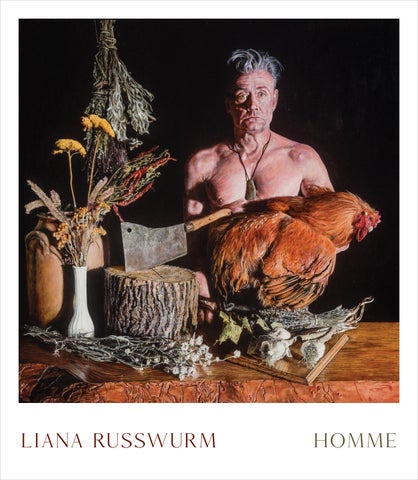
L i ana Rus swurm
H om m e
White Orchid, 2018
Gamer, 2026
The Reckoning Gaze: Subversion, Symbol, and the Male Body in Contemporary Still Life For centuries, Western art has organized ways of seeing through an unequal exchange of power. The male artist has traditionally been positioned as the observer, the female body as the object of observation, and the canvas as the stage upon which these dynamics are performed. The still life, a genre dismissed as humble or domestic, developed its quieter yet equally complex logic. It was a meditation on transience, a celebration of abundance, and a memento mori — a reminder of one’s mortality — disguised in the sheen of a peach or the droop of a dying tulip. Portraiture, meanwhile, concerned itself with the preservation of status, identity, and the outward performance of selfhood. What happens, then, when an artist takes these established traditions and disrupts their structures, creating images that unsettle, provoke, and compel the viewer to confront not only the work itself, but also the assumptions that shape the act of looking? Liana Russwurm’s exhibition Homme presents a body of work that is, at its core, a form of historical painting reimagined through a contemporary lens. The familiar language of portraiture and still life remains, but the position of the viewer has shifted. Drawing upon the compositional strategies and symbolic vocabularies of Old Master painting, Russwurm constructs images that feel both familiar and unfamiliar. Men, tattooed and bearing the marks of contemporary life on their bodies, sit behind tables arranged with fruit, flowers, and objects reflecting each sitter’s personality. These compositions recall the vanitas tradition, seventeenth-century Dutch genre painting, and the chiaroscuro of the Italian Baroque. Russwurm merges the conventions of still life and portraiture, creating a hybrid form that asks what it means to render a man as both subject and still life, and as both living presence and symbolic object. The Reversal of the Male Gaze At the centre of this body of work is a deliberate reversal of the male gaze. Laura Mulvey, a feminist film theorist, first introduced the concept of the male gaze in the mid-1970s, describing a mode of representation in which the viewer is positioned as male and the female body is presented for visual pleasure, scrutiny, or possession.1 This dynamic has shaped countless representations throughout art history, including such paintings as Titian’s Venus of Urbino (1538),2 Édouard Manet’s Olympia (1863),3 and Francis Bacon’s Portrait of Henrietta Moraes (1963).4 Through the portraits in Homme, Russwurm inverts this tradition. Rather than presenting masculinity through familiar symbols of strength, dominance, or control, she places male bodies within compositions associated with beauty, sensuality, and contemplation. Surrounded by flowers, fruit, and decorative objects, the men become subjects of a gaze historically directed toward women. Their bodies are not idealized. They are observed. The discomfort of the sitters reflects the broader question embedded within the exhibition: how do beauty, vulnerability, and objectification operate when the direction of the gaze is reversed? Vanitas Reimagined Each composition in Homme is layered with symbolic meaning, inviting slow and attentive looking. The tradition of vanitas painting evokes mortality, the fleeting nature of earthly pleasures, and the inevitability of decline. Russwurm does not recreate these traditions nostalgically. She reactivates them as a contemporary visual language. Dead flowers with seed pods, an axe (Death, 2021), and an animal skull (Bulldogger, 2026) serve as reminders of the memento mori. Russwurm’s work illustrates that beauty is temporary, that the body changes, and that all things eventually pass. The objects arranged on the tables, chosen collaboratively with the sitters, extend this conversation into the present. A ukulele, a gaming glove, and eyeglasses become contemporary relics, rendered with the same care and luminosity once given to oysters, silver vessels, and Venetian glassware. The result is a dialogue between past and present, between universal symbolism and experience.
The Italian Inheritance: Caravaggio and the Drama of Light
Russwurm’s visual language is inseparable from her formative period of study in Italy, where encounters with the Baroque masters, particularly the Italian painter Caravaggio (1571–1610), proved influential. There, she discovered the expressive possibilities of chiaroscuro, the dramatic interplay of light and shadow that gives an image both sculptural depth and psychological intensity. In Caravaggio’s work, light is never neutral. It reveals, conceals, and transforms. This influence can be seen throughout Homme, where the sitters emerge from darkness, their bodies illuminated against shadowed backgrounds. Flesh, muscle, bone, tattoos, and expressions become sites of attention. The lighting isolates each figure, creating images that feel simultaneously intimate and monumental. This engagement with Caravaggio’s legacy also appears in the controversial work of Canadian artist Attila Richard Lukacs, whose painting Fred (2014) 5 shares a striking visual dialogue with Russwurm’s Life (2026). Both paintings feature topless male sitters posed with poultry, transforming the unexpected pairing of human figure and animal into a charged symbolic encounter. In both works, the dramatic staging and confrontational gaze make the figure a subject of contemplation, inviting the viewer to reconsider how masculinity is embodied, interpreted, and represented. The Question of Beauty
At the heart of the exhibition is a sustained interrogation of beauty itself. Russwurm challenges conventional ideals by presenting men who are not uniformly young or untouched by time. Their bodies carry evidence of lived experience through their tattoos, age, individuality, and imperfection. In a visual culture saturated with idealized representations of masculinity, these paintings insist upon a kind of attention. Beauty, in Russwurm’s work, is found not in perfection but in particularity. Questions of body image and beauty emerge throughout the work, yet Russwurm approaches these themes without sentimentality or moral instruction. Russwurm does not tell the viewer what to see or how to respond. Instead, the paintings function as mirrors, reflecting the viewer’s own expectations, attractions, discomforts, and assumptions. They are offered as a provocation, providing a space for encounter, reflection, and dialogue. Conclusion: The Reckoning
What does it mean to sit for this kind of portrait? How does it feel to be arranged among objects, illuminated by light, and made visible through another person’s gaze? The unsettling nature of these portraits lies not only in the image itself, but in the journey of the sitter. Their experience begins with a private confrontation with their own bodies, marked by vulnerability and discomfort, and culminates in the public encounter of seeing themselves represented in a gallery space. In this reversal of the male gaze, the men occupy the dual roles of participant and subject, engaging with the unfamiliar experience of being seen. And they exist, like all of us, between the desire to be seen and the fear of being exposed. Ultimately, Russwurm’s work asks viewers to reckon with the politics of looking. It challenges us to consider who has historically been granted the privilege of the gaze and who has been subjected to it. It asks what beauty might become when separated from social expectations and reminds us that the memento mori exists not only in the fading flower, but also in the human body itself. Russwurm’s exhibition, Homme, is a contemporary reimagining of historical painting traditions. More importantly, it insists upon the strange, shifting nature of the present and on art’s enduring ability to teach us how to see. Laurie Rayner Langford is a Canadian writer and exhibiting assemblage artist based in Chatham, Ontario, with a B.A. from the University of Toronto and an M.A. from the University of Prince Edward Island. She works across historical fiction and mixed-media assemblage, collage, and printmaking, exhibiting throughout Canada and the USA. Her practice blends subversive humour with a critical eye toward gender, domesticity, and historical narrative, recasting familiar cultural iconography to unsettling effect. Notes 1. University of Kentucky. Research Guides: Film theorists: Laura Mulvey. Accessed at: https://libguides.uky.edu/film/theorists 2. See https://www.uffizi.it/en/artworks/venus-urbino-titian 3. See https://www.musee-orsay.fr/en/artworks/olympia-712 4. See https://www.francis-bacon.com/artworks/paintings/1960s 5. See https://mfineart.ca/macaulay-co-fine-art/artists/attila-richard-lukacs/
Bulldogger, 2026
Life, 2026
Ukulele, 2024
Liana Russwurm Homme
October 2, 2026 – March 20, 2027 Curator Writer Editor Photographer Publication Design Printing
Sonya Blazek Laurie Rayner Langford Alison Kenzie Toni Hafkenscheid Otto Buj Aylmer Express
Acknowledgments The Judith & Norman Alix Art Gallery and the County of Lambton gratefully acknowledge the support of JNAAG members, donors, sponsors, and volunteers. Artist Acknowledgments The artist acknowledges funding support from Ontario Arts Council and the Government of Ontario, Bluewater Power Distribution Corporation, Panopoly, and Mind Your Body.
© 2026 Judith & Norman Alix Art Gallery ISBN 978-1-7753346-6-8
About the Artist Liana Russwurm is a graduate of the Ontario College of Art and Design University. She completed a year of study in Italy and is currently based in Alvinston, Ontario. Her work has been exhibited across Canada and Europe and is held in public and private collections. List of Works Height x width Bulldogger, 2026; oil on panel; 106.7 x 106.7 cm Death, 2021; oil on panel; 106.7 x 106.7 cm Gamer, 2026; oil on panel; 106.7 x 106.7 cm Life, 2026; oil on panel; 106.7 x 106.7 cm Ukulele, 2024; oil on panel; 106.7 x 106.7 cm White Orchid, 2018; oil on panel; 106.7 x 106.7 cm Library and Archives Canada Cataloguing in Publication Title: Liana Russwurm : homme.
Names: Container of (work): Russwurm, Liana. Paintings. Selections. | Langford, Laurie (Artist), writer of added commentary. | Kenzie, Alison, editor | Blazek, Sonya, organizer | Judith & Norman ALIX Art Gallery, host institution, publisher. Description: Curator, Sonya Blazek; writer, Laurie Langford; editor, Alison Kenzie. | Published in conjunction with the exhibition Homme, held at the Judith & Norman Alix Art Gallery from October 2, 2026 to March 20, 2027. | Includes bibliographical references. Identifiers: Canadiana 20260261181 | ISBN 9781775334668 (softcover) Subjects: LCSH: Russwurm, Liana‚ —Exhibitions. | LCGFT: Exhibition catalogs.
(cover) Death, 2021
Classification: LCC ND249.R89 A4 2026 | DDC 759.11 —dc23
Judith & Norman Alix Art Gallery 147 Lochiel Street Sarnia, Ontario N7T 0B4 Canada www.jnaag.ca The Judith & Norman Alix Art Gallery is a department of the Corporation of the County of Lambton.