Lambton Musings LAMBTON’S HISTORY AND HERITAGE NEWSLETTER – WINTER 2026 www.heritagelambton.ca
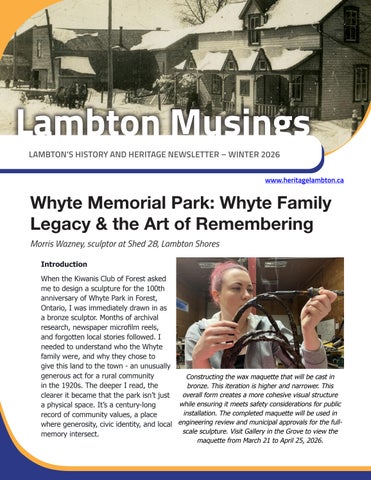
Whyte Memorial Park: Whyte Family Legacy & the Art of Remembering Morris Wazney, sculptor at Shed 28, Lambton Shores Introduction When the Kiwanis Club of Forest asked me to design a sculpture for the 100th anniversary of Whyte Park in Forest, Ontario, I was immediately drawn in as a bronze sculptor. Months of archival research, newspaper microfilm reels, and forgotten local stories followed. I needed to understand who the Whyte family were, and why they chose to give this land to the town - an unusually generous act for a rural community Constructing the wax maquette that will be cast in in the 1920s. The deeper I read, the bronze. This iteration is higher and narrower. This overall form creates a more cohesive visual structure clearer it became that the park isn’t just while ensuring it meets safety considerations for public a physical space. It’s a century-long installation. The completed maquette will be used in record of community values, a place where generosity, civic identity, and local engineering review and municipal approvals for the fullscale sculpture. Visit Gallery in the Grove to view the memory intersect. maquette from March 21 to April 25, 2026.
A Historical Thread My first clue came from land records. Whyte Memorial Park appears formally in 1926, which was curious, because local verbal history places the donation in 1925. The lot immediately beside the park site was owned by Duncan Whyte, so his involvement seemed obvious.
One of several articles campaigning for a new park in the Forest Free Press, 1925
Reading through the 1925 newspapers on microfilm, what emerged was an active, monthslong community desire for a park. An article about “The New Park Project,” described it as “a great benefit to the community and will help, especially among the younger generation, to foster a feeling of pride in the town”, speculation about a pool, pieces urging community clubs to have a common outdoor space. The need was clear long before the donor was named.
The turning point came when I found the obituary for Duncan’s brother, Harry Whyte, who died on April 24th, 1925. Later that year, council minutes recorded that a member of the Whyte family wished to leave a donation for a park specifically for children - a playground, something for the next generation. Duncan Whyte, already a civic figure, councilor, and an active voice in Forest’s political life, took that intention and made it real. Harry left $2,000 in 1925. Duncan contributed part of his own land and council approved it. The result is what we now know as Whyte Memorial Park.
The first time Whyte Memorial Park appears in land records, 1926
What struck me most while reading the archives was how modern their reasoning feels. A place for children. A place for community clubs. A place for gathering. A place that answers a real civic need. Park donations were uncommon then; it’s even more uncommon now. The decision made by the Whyte brothers was for the people, aspirational, and forward-thinking. This guided my sculptural reasoning. Design Philosophy My role as a sculptor became understanding how to translate a century of intention into a single form. The Whyte brothers built a space for children and community life; Kiwanis continues that ethos a hundred years later. The values that shaped the original park (care, community, and long-range thinking) set the foundation for the design.
The final monument will be a bronze sculpture of a curved red branch, an arch positioned at the diagonal entrance to the park. Its geometry follows the Fibonacci sequence, a mathematical pattern that shapes harmony in nature. Forest is a place defined by trees, seasonal cycles, and natural order; using a branching form allowed the monument to speak both to the land and to the history beneath it while symbolizing the branching nature of generational patterns.
First iteration proof-of-concept maquette for Monument, exploring the initial branch-like form and final red colouration
In winter, when the sky turns flat and the landscape loses its colour, a red arch against the snow becomes a point of contrast and hope. It establishes a clear threshold into the park, the same way the original donation created a new threshold for community life in 1925. The form places the memorial inside a natural language, while its scale establishes it as a civic landmark. Forest has no public monument; this would be the first. In 2025, the corner planter was removed in preparation for the sculpture. Kiwanis initiated the project, the municipality agreed to pursue it, and the Optimist Club supported the first phase of the sculpture’s development. Their support allowed me to create the scale model, complete the historical research, and build the narrative that accompanies the design which will eventually be presented on a bronze plaque alongside the finished sculpture. Project in Motion
One of several articles campaigning for a new park in the Forest Free Press, 1925.
For the monument to move into fabrication, further funding is required. The intention, research, model, and historical framework are now complete. What comes next is community alignment and financial support. A century ago, Forest built a park through shared effort. A century later, it will take another collective decision to carry this landmark forward. I extend sincere thanks to the Kiwanis Club of Forest, for initiating this centennial project; to Glen Starkey for his leadership; to the Municipality of Lambton Shores for supporting the development of a civic landmark; to the Optimist Club for supporting the first stage development and Scott Ferguson for being my point of contact with the Optimists; and to the Creative County Grant Program for committing $10,000 toward the 2026 phase of the project. My thanks also to Nicole and Danielle at the Lambton County Archives for their generosity and assistance throughout many long sessions with the 1925 microfilm. Anyone interested in supporting the next phase of this monument can contact Kiwanis for funding details.
A Quarter Century of St. Clair Township: The Amalgamation of Sombra and Moore Moore Museum Staff
When Sombra Township and Moore Township joined together at the start of 2001, it marked the beginning of a new chapter for our corner of Lambton County. Across Ontario, the province was encouraging municipalities to work together and streamline local government, and Lambton County saw significant shifts. Its number of municipalities dropped from 20 in 1997 to just 11 by 2001. Locally, County Council representation also changed, shrinking from 22 members in 1999 to 17 after the merger. For Sombra and Moore, longtime neighbours along the St. Clair River, amalgamation meant combining resources and reshaping how local services were delivered. The result was the Township of St. Clair, a new municipality built on the foundations and spirit of two historic communities. Sombra Township Sombra grew along the St. Clair River, defined by farming, river traffic, and tight-knit waterfront settlements. Places like Port Lambton, Wilkesport, and the village of Sombra formed early hubs of trade and community life, shaped by both Indigenous histories and waves of early settlers. The feel of Sombra was rural, steady, and deeply connected to the river. Moore Township To the north, Moore Township also shared an agricultural backbone but was influenced more heavily by industrial growth, particularly as Chemical Valley expanded. Corunna, Courtright, and Mooretown became lively centres where industry, neighbourhoods, and small businesses developed side by side. Moore had its own character, shaped by industry and rural traditions working in tandem. Despite their differences, both townships were linked by geography, history, and a shared sense of resilience. Preparing for a New Township By late 2000, public conversations about amalgamation were common. An editorial in The Beacon even pointed out that in some ways the area was “returning to the past,” since a St. Clair Township had existed briefly in the 1800s before being divided in 1850. But while the name echoed history, the two townships had long since grown into very different communities with their own priorities, philosophies, and ways of doing things.
Still, the amalgamation moved forward, guided by a transition committee made up of both mayors and members of council. The first election for the new Township of St. Clair was held on November 13, 2000. It proved a successful night for Sombra Township Mayor Joe Dedecker, who became the first mayor of the newly formed municipality and was also later selected as Lambton County’s deputy warden for 2001. One of the early success stories of amalgamation was the creation of the St. Clair Township Emergency Services Department. Fire Chief and Emergency Services Director Roy Dewhirst reported that the new, unified system was ready well ahead of the January 1st deadline. By the previous October, all six fire stations were already operating on a closest-station response model under the Lambton County Automatic Aid protocol—improving coverage and safety throughout the township. The transition committee had emphasized how vital emergency planning would be, and both fire departments rose quickly to the challenge. Other services (public works, waste management, parks, recreation programs, and community facilities) also benefited from being planned and managed together, rather than separately by two small municipalities.
Newspaper clipping from Joe Dedecker’s political campaign, 2000.
On January 1, 2001, the Township of St. Clair officially came into being, representing a stretch of communities from Corunna all the way to Port Lambton. But even as the new municipality took shape, the original identities of Sombra and Moore remained strong. Residents continued to honour their roots through museums, historical societies, community halls, and long-standing local events. At the same time, a shared township-wide identity began to grow. People embraced coordinated services, and community initiatives that connected villages up and down the river. The new township made steady use of its combined strength, mixing farmland, industry, and shoreline life, while also preserving cultural heritage and protecting the St. Clair River. A special plaque commemorating Moore Township’s 150th anniversary and the amalgamation of Sombra and Moore was unveiled on July 16, 2001. Commissioned by the Moore Sesquicentennial Committee, it was installed at the St. Clair Civic Centre on Emily Street in Mooretown. Present for the ceremony were clerk John DeMars; councillors Steve Miller, Pat AlexanderCarswell, Shirley Warner, and Jim Degurse; Steve Arnold; mayor Joe Dedecker; deputy-mayor Arnold Pole; and CAO Don Lougheed.
Moore Township 150th anniversary commemorative plaque.
More than two decades later, the story of Sombra and Moore lives on in the landscapes and traditions that shaped them. And the Township of St. Clair continues to reflect the best of both its predecessors—cooperation and community pride. As the township marks its 25th anniversary, it stands not just as a merged municipality, but as a place where histories meet, communities work together, and the river remains at the heart of it all.
Historic Recipe – Pumpkin Muffins Colleen McLean, Lambton County Archives
This historic recipe by Betti-Jo App comes to us from the Make, Bake and Create cookbook by Sunny Brooke Women’s Institute. Her grandparents were active members of the Petrolia community. Robert “Bob” Lee App (1918 – 1975) was the son of George C. App (1894 - 1952) and Josephine (Schneider) App (abt 1894 – 1988) App. Bob’s parents were both born in Kentucky and relocated to Indiana were George worked as a printer. Then, they moved to Detroit where Bob was born. Bob had one brother, George, that died at just six days old. Delphine “Del” King (1920 – 1975) was born in Brooke Township, Lambton County to parents Harold E. King (1897 – 1972) and Blanche (Lucas) King (1900 – 1980). By 1930 the family had moved to Michigan and in the 1940s, Del and her parents worked as florists in Detroit. Her father Harold also worked as printer. On October 25, 1940, Bob and Del were married in Detroit, Michigan. They moved to Indiana where Bob worked in the printing business but in 1950 the family moved to Petrolia. Bob and Del had three children, two sons and one daughter, and were blessed with six grandchildren, one being Betti-Jo App. Tragically on January 16, 1975, Bob and Del died in a motor vehicle accident. The following is an excerpt from the Petrolia Advertiser-Topic, published on January 15, 1975 (page 1):
Advertisement for King’s Flowers in Petrolia.
“Mr. and Mrs. App came to Petrolia on March 1, 1950 from Detroit where he had been a printer, and opened a florist shop in the Fletcher store on the south side of Petrolia Street east of Greenfield. From the first it was known as King’s Flowers ‘Fit for a Queen’ after a shop owned by Mrs. App’s father. A few years later it was moved to the present location on the opposite side of the street. The couple and their children lived upstairs. A year ago, they moved to their farm on the 10th line in Brooke.
Bob was an unabashed clown and prankster, but also a dedicated member of the Petrolia volunteer fire department, an enthusiastic fan of minor hockey, and a founding member of the unique Petrolia First Aid Corps and a member of Washington Lodge No. 260.
Mrs. App was a member of the Pillar Chapter, O.E.S, Detroit, and of the I.O.D.E. here. The couple leave a history of kindnesses and community services. Their flowers welcomed nearly every new business to town.” Bob and Del’s celebration of life saw eighteen Flower and Pallbearers, including many friends and local business owners/ professionals. A few notable participants were Robert Cunningham of Spic and Span Dry Cleaners, Charles Fairbank of VanTuyl and Fairbank, Jerry Brooks of Petrolia Sporting Goods, Ludvic Podolinsky of Podolinsky Equipment Ltd., medical doctor Dr. Frank Riedl, and veterinarian Dr. Robert Green. They were laid to rest in Mount Carmel Cemetery in Brooke Township.
Pumpkin Muffins by Betti-Jo App Ingredients 4 eggs 2 c. granulated sugar 1 ½ c. cooking oil 1-14-oz can pumpkin 3 c. unsifted all-purpose flour 1 tbsp. cinnamon 2 tsp. baking soda 2 tsp. baking powder 1 tsp. salt 2 c. raisins (may add nuts)
Cover from the Make, Bake, and Create cookbook.
Instructions In beater bowl beat eggs slightly. Add the sugar, oil and pumpkin and beat thoroughly. Measure into a sifter the flour, cinnamon, baking soda, baking powder and salt and sift these dry ingredients over the creamed mixture. Blend until smooth then stir in the raisins. Fill each greased muffin cup 2/3 full of batter. Bake at 400° for about 15 minutes or until done when tested with a toothpick.
Leaving a Legacy Before You Die Alan Campbell, Lambton County Branch of The Ontario Genealogical Society [Ontario Ancestors]
Ruthless. Nine weeks of ruthlessness. My wife and I decided in the span of two days that we were selling our house and moving into an apartment. The next nine weeks was a whirlwind of donating materials to the Mission, Goodwill and Restore - Habitat for Humanity; shredding unnecessary household records; and selling the contents of a workshop, garden tools and unwanted furniture. Where does leaving a legacy appear in this scenario? As a passionate family historian, I have/had reams of file folders, books and mementos. Prior to the move I was scanning research files and sharing them with a younger family historian, part of my extended family, who lives in the United States. This past summer I donated memorabilia from the time that my mother and father worked at Small Arms Limited in Long Branch, Ontario (now part of Mississauga) during World War II to Mississauga Museums. The staff there are also interested in memorabilia from my father’s employment at Victory Aircraft Limited in Malton. I will likely oblige them by donating those items to them as well. During our whirlwind of house clearing action, I weeded my book collection and allowed Lambton County Branch OGS first choice of the books. Then I sent a revised list of the books to the Lambton County Archives staff, who asked for a number of them. Some of them were sold via our Branch table at the Military Day at the Petrolia Discovery, with the proceeds going to the Branch.
Military Day table at the Petrolia Discovery.
Grade eight graduation pin from Thorndale Continuation School.
When cleaning, I found an item that I had forgotten I owned – my grade eight graduation pin from Thorndale Continuation School, Thorndale, Middlesex County. I matched it to the photo of my Grade 7/8 class of that year, a list of students who attended the graduation ceremony and half of my valedictorian address on the back of that list. I have no idea why I chose to tear off the signatures half of the page and throw away the rest of the speech. Thoughtlessness of youth, I suppose. I plan to donate these items to Middlesex Centre Archives in Delaware. Their museum does not represent all of Middlesex County, but the curator wants to hold them in the hopes that the feasibility study for a Middlesex County Archives leads to an actual county archive. In the meantime, she could use them as a representation of what can be held in the collection.
My daughter did not want to inherit the picture of my great grandparents, John Pratt and Margaret (Fitzgerald) Campbell, who lived in Bosanquet Township from 1872 until 1878 at which time they moved to Manitoba. It is now part of the Lambton County Archives collection. My love of writing has led to the submission of many articles about family members both close and distant to genealogical journals and newsletters in Ontario, Manitoba and Saskatchewan. My most recently published article is in the pages of the most recent Isle of Wight Family History Society Journal (England). I often get ensnared in writing mini family histories for unrelated families because they are intriguing. These I donate to the Lambton County Branch, the Lambton County Archives and occasionally to Lambton Heritage Museum. Basically, my message is this: Do not leave your historically valuable items for someone else to clear out of your residence after your death. Too much could end up in garage bags or a dumpster. Do distribute items to archives and museums in advance of your death. If you find it hard to part with items, take photos of them before you let them go. You could build an electronic book (a simple PDF) of these photos with an explanation of why they were important to you or your ancestors. This book could be shared with your family.
A pin that was reviewed and
Do reach out to archives and museums prior to your death and discarded through the confirm that they would like the items that you have to donate. review process. If they are Lambton County museums or the Lambton County Archives, the curators will be looking for the Lambton connection to the items that you have. If it is a common historical article they may have many of them already so could turn your potential bequest down. Don’t leave this job to your descendants, as they may get frustrated and garbage the lot. I ask my son and daughter if they want something before I donate it. Once donated, I tell them which repository accepted the item. Having seen to the preservation of a number of artifacts, I can now go back to compiling/writing more family stories to share while I am still alive.
A Tribute to a Dear Friend: Remembering Rick Jones David McLean, Forest Museum
For this edition of Lambton Musings, I pay tribute on behalf of all our museum’s volunteers to our dear friend and fellow volunteer, Rick Jones. Sadly, Rick passed away suddenly this past November at the age of 78. I first met Rick years ago at a local business. He approached me to express his enjoyment of a twopart article I had written for The Forest Standard about some local young men who participated in the Dieppe Raid during the Second World War and subsequently became POWs. Despite my strong ancestral ties to the area, I had not grown up in Forest and was just beginning to delve into its history. Rick, on the other hand, was a lifelong resident and had personally known the men I had written about. I was quite touched by his comments, feeling that my preliminary efforts to share local history had met with approval from “a local.” Rick’s deep appreciation for Forest’s history is what led him and his wife, Betty, to volunteer with the museum. He enjoyed sharing memories of the community from days gone by, enriching my own understanding of its past.Rick’s contributions went far beyond sharing memories. He utilized his exceptional craftsmanship and artistic skills as a maker of signs, furniture, and cabinets, and as a painter. The mural in the image accompanying this article is just one of several he painted that adorn the exterior of our building. His last project for us was the beautiful “Forest Home Bakery” sign, completed this past summer and now displayed above our collection of bakery artifacts. If you wish to see more evidence of Rick’s talent, just take a drive around the town, and you will see his sandblasted wood and hand-painted signs on many properties.
A special memory for me will always be working with Rick on the old-style carpenter’s bench you’ll find in our Workshop. Rick rightfully took the lead on the project, determining the design and measurements, while I did my best to accurately saw the boards. When we finished the assembly and installation, we agreed the bench was perfectly suited for the space and the numerous vintage tools displayed on and above it. Rick, we will miss you dearly. You left us and the people of Forest a wonderful visual legacy of your love for this community. Our deepest sympathies go out to Betty and all your family and friends.
Keeping Up with the Smiths and Pioneer Essentials Sombra Museum Staff
Keeping Up with the Smiths… Last year, we delved into the Abraham Smith family and the uncertain timeline of their settlement of Sombra Township to tell the story of their humble log cabin, known as the oldest still-standing structure in the former Sombra Township, and one of the oldest in Lambton County. Some questions were left unanswered. Shelley Lucier, John DeMars and David Lee cut the Ribbon at the Unveiling of the Smith Cabin Pavilion July 5, 2025
Is this the first home of Abraham Smith in Sombra? After delving through the accounts of Enoch Brown and other first and secondhand sources and documents, we determined that Abraham and his wife, Anna, had likely arrived in Sombra in the later spring or early summer of 1820, but definitely prior to August 1, 1820, the date of their daughter Rachel’s birth; she is the sixth Smith child, and first recorded to be born in Sombra. Paperwork dated 1823 affirms by two witnesses that Abraham had completed settlement duties related to land clearing and building a dwelling of at least 16 x 20 feet, larger than the size of our log cabin; this indicates that the Smiths would have already moved to a larger dwelling than our cabin by this time; by 1823, Abraham and Anna had 8 children, at least 6 of whom were living, so they would have needed a larger dwelling! Accounts also indicate that while the Smiths initially stayed with the Burnham family, they built their own cabin on the shore to the north of Burnham land, which aligns to the location of our cabin.
Updated Plaque on Smith Cabin at Sombra Museum Installed July 2025
Reaping What You Sew…
The sickle and the scythe are agricultural harvesting tools that have been used since the beginning of the agricultural revolution. The sickle was thought to have originated in southwest Asia sometime between 12,000 - 14,000 years ago. The scythe has been found to date back to 7000 BC but only replaced the sickle around the time of the 16th century.
The sickle is a tool consisting of a short handle and a long, hook shaped blade used to harvest fields of hay and grain. The curve of the blade and its compact size allows for onehanded use and makes for easy maneuverability in small areas. The scythe is the updated version of the sickle. While similar in design, its longer handle and blade allow the operator to remain standing to cut and harvest using broad sweeping motions to slice through crops and mow lawns. The scythe is more ergonomically efficient. When used correctly and with its weight properly distributed, it prevents muscle strain, and it can cover larger areas of land quicker.
Sickles and Scythe
Though both are becoming outmoded due to the mechanization of farming in Western culture, the sickle and scythe are still useful tools employed today here and around the world for gardening and cultivation. To Feed the Pioneer Spirit… When the first settlers—that is, the first Europeans who came with the intention of staying—arrived in Canada, there was very little in the way of food preparation and cooking technology. Many of them did receive rations from the British government consisting of flour, pork, and some beef and butter, but by 1789 these too were cut off. The new colonists were then forced to produce their own food, vastly different from the diet they were used to back home. By the turn of the 19th century, most settlers’ diets consisted of salted pork (no beef as cow feed was difficult to procure) supplemented with fish and game like racoons, wild turkeys, ducks, and pigeons, as well as crops like wheat, corn, potatoes, squash, and wild fruits and berries. But how did these settlers cook their food? Initially, almost all of the cooking would have been done inside a large iron bake-kettle placed directly in the fireplace. However, once supply chains were established, reflector ovens became the preferred mode of baking bread and roasting meat (though spit-roasting and boiling in the kettle were still used). The reflector-oven also included a removable tray that could collect the drippings from roasted meat, allowing settlers to actually deep fry some of their meat, fish, vegetables, and even batter products like doughnuts!
Iron Kettle and Ladle in the Bury House Kitchen
Cabin Stove
…and Preserve the Rural Tradition Canning was an essential skill for pioneer families living in rural areas. Before refrigeration was available, pioneers needed reliable ways to store food for winters or times when fresh produce and meat were not available. Canning provided a solution by allowing them to preserve the summer and fall harvests safely for months.
Water Bath Canner, Jars and Lifter on the Stove in the Bury House Kitchen
The process involved placing food – such as fruits, vegetables, jams and meats – into glass jars, then sealing and heating them to kill bacteria to create a vacuum seal. Early pioneers used wax or tin lids before the invention of metal tops with rubber seals. Boiling water baths were common for high-acid foods like fruits, while pressure canning was necessary for low-acid items like meats.
Canning required time, patience and careful technique to ensure safety. Entire days would be set aside during harvest season just for preserving food. Canning was hard work but gave families peace of mind knowing they had stocked shelves. For pioneers, canning wasn’t just a chore – it was a practical task that ensured survival and reduced waste.
Heritage Sarnia-Lambton Members Moore Museum
94 Moore Line, Mooretown, ON N0N 1M0 226-784-3340 Facebook Page
Plympton-Wyoming Museum 6745 Camlachie Road, Camlachie, ON N0N 1E0 Facebook Page
Lambton Heritage Museum 10035 Museum Road, Grand Bend, ON N0M 1T0 519-243-2600 Facebook Page
Oil Museum of Canada
2423 Kelly Road, Oil Springs, ON N0N 1P0 519-834-2840 Facebook Page
Arkona Lions Museum and Information Centre
8685 Rock Glen Road, Arkona, ON N0M 1B0 519-828-3071 Facebook Page
Sombra Museum
3476 St. Clair Parkway, Sombra, ON N0P 2H0 519-892-3982 Facebook Page
Lambton County Archives
787 Broadway Street, Wyoming, ON N0N 1T0 519-845-5426 Facebook Page
Forest-Lambton Museum
8 Main St. North, Forest, ON N0N 1J0 Facebook Page
Additional Contributors The Ontario Genealogical Society, Lambton Branch Facebook Page
Morris Wazney, Shed 28, Lambton Shores info@shed28.ca