Lambton Musings LAMBTON’S HISTORY AND HERITAGE NEWSLETTER – WINTER 2021
www.discoveriesthatmatter.ca
Snowmageddon Stories: Nature’s Raw Power and the Power of Community Nicole Aszalos, Lambton County Archives In November of 2020, the Lambton County Archives collaborated with Emergency Management Coordinators (EMCs) in the County of Lambton to capture your memories of the 2010 Major Snow Emergency, also known as Snowmageddon. Considered by many as one of the most monumental storms to grip the region for many years, Snowmageddon brought much of Southwestern Ontario to a standstill for multiple days. Ten years later, we recognized a unique opportunity to reflect on this event and capture the community’s history. We openly asked for your stories and images with a goal to preserve the collective memory for future generations, learn how we as individuals were impacted by and responded to the weather event, and what we learned from the event. The responses also help local EMC’s understand how individual households prepare for winter storms.
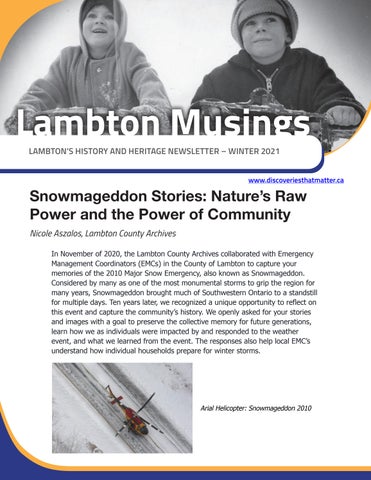
Arial Helicopter: Snowmageddon 2010
Snowmageddon Stories: Nature’s Raw Power and the Power of Community Continued... On Sunday December 12th, 2010 weather warnings started trickling in warning of an incoming winter storm.
“I remember the afternoon the storm had begun, posts were being made on Facebook stating that the police were reporting that the roads were getting bad and asked people to stay home unless absolutely necessary.” Shauna By the morning of December 13th, snow squalls halted the region. In the evening, Police used snowmobiles to assist a State of Emergency was declared in the stranded people. County of Lambton triggering the deployment of the Canadian Military to undertake rescue operations for stranded motorists, predominantly on Highway 402 and London Line. People waited patiently in their vehicles for word on what was happening.
“The day started normally enough, I set off on my trip to work in Sarnia which I had done many times over the previous 30 years traveling to various industries. As I passed the intersection for Highway 25 the snow was starting to come down a little more, traffic was moving slowly but not unusually slow, then it happened… we stopped and that was it for 36 hours.” - Mike “Around 7pm, I called into the OPP, gave them my name, phone number and make of my vehicle. I stated I was 6 months pregnant, without water and limited food but that I had left London with a full tank of gas. I was told I would be put at the top of the priority list. By 9pm, no sighting of any OPP or military. A snow plow came by, raising our hopes that we would soon start to move, however when asked, they stated they were there to rescue the stranded plow driver.” - Vicki Due to the intensity of the storm, the military helicopters were grounded until the snowsqualls subsided enough for it to be safe to fly. Emergency shelters and members in the community opened their doors to help those in need, offering food, water, and warmth. Local residents used their snowmobiles to reach stranded motorists sharing hot chocolate and snacks while offering to transport them to the shelters or their home for warmth and a place to sleep. It is this generosity and kindness from local residents to help one another that remains a lasting memory.
The intensity of the storm is displayed as a police cruiser is buried in the snow.
“That evening, the men slept wherever they could in our small, humble home. In the morning, they filled up on coffee and my husband and the men set out with the ATV plow and shovels to start digging out their vehicles and moving them into our laneway, out of the way of the plows. By mid-day on the 14th, London Line was clear and safe enough to drive on again. We exchanged emails and said our goodbyes and just like that, as quickly as they had come, our visitors were gone. We kept in touch with many of the visitors and we received lovely emails & cards and some very thoughtful care packages a few weeks later. One of the first men to arrive at our place that snowy night has even come to visit us a few times in years since. Snowmageddon was an intense storm that surprised many and took our community by force. It was amazing to see how our military and community gathered around all these stranded people in our township. We were very grateful to be able to offer our home as a refuge for those in their time of need and we will never forget those few days where strangers became like friends.” - Jessica & Jamie “We bundled up blankets pillows and TV sets and my kids walked them over to Wyoming Fairgrounds. It was a horrible storm but an excellent learning opportunity on reaching out to others in greater need.” - Heather In total, more than 300 vehicles and 1,500 motorists were stranded on the 402 and surrounding area roadways in snow squall conditions. The Lambton County Archives would like to thank everyone who contributed their story on this weather event.
Lambton County’s first responders.
Making Connections: The Blue Water Bridge Colleen Inglis, Lambton Heritage Museum The twin spans of the Blue Water Bridge are an iconic Lambton County landmark. The bridge arcs gracefully over the blue-green waters of the St. Clair River and marks the entrance to Lake Huron. The base of the bridge is a great place to go for a walk, eat French fries, or watch the ships and recreational boaters.
Making Connections: The Blue Water Bridge Continued... The story of the bridge construction follows a tradition of engineering innovations in Sarnia and Point Edward. In 1891, the St. Clair Tunnel opened between Sarnia and Port Huron. This remarkable feat of engineering created a submarine rail link between Canada and the United States. About 40 years later, in 1927, the first plans were made to build a bridge across the St. Clair River. With the growing popularity of the automobile, a road connection was now a necessity. After years of planning and delays, construction moved forward. Matching superstructures were built simultaneously from Port Huron and Point Edward. You can view incredible footage of the Blue Water Bridge construction on the YouTube channel of the Lambton County Archives. It also includes footage of the celebratory ceremonies once the bridge opened to the public. On May 24, 1938, hundreds of people gathered to watch the placement of the first piece of steel that would connect the Canadian and American sides. B.B. “Buck” Buchanan, a construction worker, walked the length of the emerging bridge. He became the first person to cross the 1,883m bridge from Canada to the United States. The Blue Water Bridge officially opened to pedestrians on October 8, 1938 (and traffic 2 days later). Ontario Premier M.F. Hepburn and Michigan Governor Frank Murphy met at the international boundary for a ribbon-cutting ceremony. Festivities included a marathon, a parade, a sailboat race, music, and a fireworks display.
Postcard of Blue Water Bridge construction, 1938. Picture of Blue Water Bridge construction, 1938. Courtesy of the Holland Paisley Collection, Lambton County Archives, H100-11.
By the 1990s traffic flow across the bridge was very heavy. Instead of widening or replacing the original bridge, a twin span was proposed. As with the original span, the bridge was built from both the American and Canadian sides at the same time, meeting in the middle. The second span opened on July 12, 1997. As in 1938, residents from both sides of the river were invited to walk across the bridge. Approximately 75,000 people took part. Standing at the base of the bridge, it is easy to overlook the differences between the aesthetically similar spans. The original cantilever truss-style span was built of steel. The second span was built in half-through arch-style of steel and reinforced concrete. The north, westbound span is the original bridge. The south, eastbound span is its twin. The original span is notable for its complex truss pattern and decorative concrete piers. The second span has a simpler look and is slightly wider and higher.
The Blue Water Bridge from the Canadian side. Note the differences between the new (foreground) and original (background) spans and piers.
At the start of 2020, about 14,000 vehicles crossed the Blue Water Bridge each day, including 6,000 trucks. The bridge is owned, operated, and managed by the Federal Bridge Corporation, along with several other border bridges. According to historian Edward Phelps, “In the Blue Water Bridge one sees a tangible example of the ongoing spirit of cooperation and friendship that has graced Sarnia and Port Huron throughout the course of their long history together.”
In the Darkness of Winter Staff, Moore Museum There are many aspects of winter which Canadians of every generation have enjoyed – snowy scenes, crisp cold air, snowmen, sledding, skating, cozy clothing and the warmth and scent of a fireplace.
Children on their sleds
One part of winter which seems most Canadians find objectionable, however, is the lack of daylight. If this is so for us in our time, with our electric lights and flashlight apps on our phones, imagine how this lack of light would have affected generations before modern lighting.
We generally think of candles as the predominant form of early lighting in Canada. The following excerpt from John C. Geikie’s book Adventures in Canada (which provides an account of life in the former Moore Township in the early to mid-19th century) however, indicates that even candlelight was a luxury: “Our candles were a branch of home manufacture in which we rather excelled after a time, though, to tell the truth, the quantity used was not very great. We had bought candle-moulds of tin, and put aside any fat suitable for candles, till we had enough to make what would fill them. . . . But we would not have made the fortune of any tallowchandler had we had to buy all we burned, for we only lighted one at tea, or for a minute or Getting ready to go skating! two on going to bed, or to enable someone to read, when a craving for literary food set in. Lumps of pine, full of resin, were our more customary style of illumination, its flaming brightness, leaping and flaring though it was, sufficing for our ordinary requirements. . . . In some houses I have known candles kept as sacredly for doing honor to a stranger as if they had been made of silver. A rag in some grease, in a saucer, usually served for a lamp, and an inch or two of candle was only brought out when a guest was about to retire. Many a time I have known even visitors, in the rough bush, sent to bed in the dark.” (Pages 307-8)
In comparison to this description of early lighting, envision the delight in later years when a “craving for literary food” could be satisfied reading by the light of an oil lamp! Source: John C. Geikie. Adventures in Canada; or, Life in the Woods [1882. Originally published in 1864 as George Stanley: or, Life in the Woods. A Boy’s Narrative of the Adventures of a Settler’s Family in Canada].
Moore Museum Gratefully Acknowledges the Financial Support of Its Community Moore Museum gratefully acknowledges the community-minded industries, businesses, organizations and individuals who have supported the ongoing heritage preservation and programming activities of the Museum, as well as sponsoring specific projects: • Ruby Bailey – in memory of Paul Bailey • Moore Community & Recreational Foundation - purchase of a wall-mount display case • Lambton Mutual Insurance Company • ARLANXEO Canada Inc. • Bruce & Margaret MacPherson • Susan, Scott and Laurie Shaw • Donation in memory of Reta Walton • Sally Townsend – in memory of Eva Dalrymple • Alice Gibb
Unidentified woman and child. Baxter family.
Lambton Heritage Museum Welcomes New Historic Building Dana Thorne, Lambton Heritage Museum The end of 2020 turned out to be very eventful for Lambton Heritage Museum! After over a year of discussions and planning, we welcomed a new historic building to our site. A 190-yearold log cabin was moved from Canatara Park to the museum grounds. It joins five other historic buildings that have also been moved to Lambton Heritage Museum from different parts of Lambton County. In order to move the cabin, the roof and floors were removed, and all of the logs were disassembled and numbered. These components were transported to the museum and most of it has been placed in storage, although the roof and floor have been placed on the concrete pad where the cabin will ultimately be rebuilt! All of these pieces now need to be put back together.
The cabin at its location on Lakeshore Road, with an addition on the right side.
This picture was published in The Observer on May 14, 1971, documenting the cabin’s move from Lakeshore Road to Canatara Park.
Once our fundraising efforts are complete, a professional who is experienced in working with log cabins will be hired to complete the reassembly and restoration. The community group “Save the Canatara Cabin” is working with Lambton Heritage Museum staff to fundraise $100,000.00 for the restoration work. A dedicated page, Canatara Cabin Fundraising, has been created on the museum’s website to promote this effort and allow for donations to be made online. You can also track the progress of our fundraising effort here. We welcome all levels of support, and are offering a variety of incentives depending on the level of your investment.
Many Lambton residents fondly remember visiting the cabin on special occasions and as part of the animal park in Canatara.
The Canatara Cabin is one of Lambton County’s oldest historic buildings. Originally built near Goderich in the 1830s, the cabin was used as a private residence for almost one hundred years. In the 1930s, Margaret Spaulding’s family purchased the cabin. She was the daughter of wellknown philanthropist Maude Hanna, who was instrumental in the establishment of Canatara Park in Sarnia. The cabin was dismantled and floated down Lake Huron in pieces to be reassembled at the Spaulding property on Lakeshore Road. Over the years, additions were made to the cabin, which was used as a private family cottage. Many notable visitors spent time there, including Nobel laureate Sir Frederick Banting.
The property was eventually sold to Sarnia contractor, developer, and City Councillor Lorne Hay. However, severe erosion began to threaten the The cabin roof dodges trees as it is carefully moved cabin at its lakeside perch. In to its new location on the grounds of 1971, the Hay family donated Lambton Heritage Museum. the cabin to the City of Sarnia. It moved for a second time to Canatara Park, where it was visited and loved by local residents. This final move to Lambton Heritage Museum represents the third (and final!) time that this incredible building has changed locations.
Oil Springs and the Oil Field Horse Erin Dee-Richard, Oil Museum of Canada James Miller Williams came to Enniskillen Township in the early 1850s, recognizing the potential of the raw bitumen which made up the black gum beds and went into the manufacturing business of refining illuminating oil. As the story goes, in 1858 while having a water-well dug for his crew, they struck a shallow oil pool! This well became North America’s first commercially successful oil well. From the beginning horses were used in the oil fields because of their ability to work in the dense soil. They would haul equipment to drilling sites, work pulley systems, and transport oil in wooden tanks to holding stations. Photos of Oil Springs in the mid-1800s show dozens of three-pole derricks dotting the skyline, sometimes only meters apart. The clay soil was often too thick to navigate and a horse employed to move well equipment could not make it very far. A new well would be dug where the horse stopped.
Robert Byers and 3 sons with horses working at three-pole derrick c. 1880s. From OMC collection
Outside the oil fields horses were equally helpful, as this was still the time before the automobile. In the town of Oil Springs there was a bus that ran up and down the street several times a day, which was frequently used by locals and people in the oil industry.
Horses were also vital in bringing in much needed clean drinking water. Seldom could a water-well be dug without striking oil in Oil Springs. Water had to be brought in from Lake Huron to the people of Oil Springs to avoid cholera and other diseases as the creek was often
The nearby Petrolia water tower and a water tank wagon. Postcard c. 1900. From LCA collection
contaminated from oil seepage. Transportation in this remote area of Upper Canada was challenging, and as speculators flocked to the region, swelling the population to 4000 people at its peak, the thick clay soil made navigating next to impossible. The Grand Trunk Railroad opened a station in Wyoming, 30km north of Oil Springs, in 1858. Before this, to get barrels to market required hard travel to Port Sarnia. Much easier to do in Bog shoes worn by horses to keep from sinking the wintertime when the grounds in the mud. From LHM collection were covered in snow and a sleigh could be used to transport barrels of crude oil. When the ground wasn’t frozen, horses and oxen would be up to their chests in mud travelling the route, known by locals as “the long canal”, to the train station. Bog shoes, made of wood with a strap, would be worn on hind hoofs and helped the horse from sinking into the quagmire. Throughout Petrolia and Oil Springs there were literally thousands of three-pole derricks to be seen; one stood atop each well. At the top of the derrick was a pulley which allowed rods and piping to be hoisted out of the well for repairs by the effort of a team of horses. Although gasoline engines could replace horsepower by 1900, producers in the Oil Heritage District continued to use horses until the 1950s. Horses were cheap to own, very versatile, and reliable.
Oil Springs oil field. From OMC collection
Without these endeavouring horses, work in the early days of the oil industry could never have been accomplished.
Oil Museum of Canada, National Historic Site Closed for Renovations Erin Dee-Richard, Oil Museum of Canada At the beginning of January 2021, the Oil Museum of Canada closed its doors to the public once again, but this time it was unrelated to a pandemic. The planned six month closure is to complete a $881,000 construction project. The project includes updating the main structure, equipment, and overhauling the main gallery exhibition. Along with installing a new heating and cooling system, the large, original curtain wall windows will be replaced with modern, insulated UV rated glass and fully re-opened, bringing the gallery space back to the original vision designed in 1960.
The original 1958 artist concept of the Oil Museum of Canada building. Renovations are designed to bring back this look and feel.
Funding to help with the cost of the renovation has been provided in part by the Alix Foundation, the Ontario Efficiency and Modernization Fund and the Department of Canadian Heritage. Although Covid-19 cancelled 60th anniversary celebrations planned in 2020, a celebratory grand re-opening is planned upon completion, anticipated to be in summer 2021. Follow us on Facebook and check our website for updates and behind the scenes.
Lambton County Branch of Ontario Ancestors [The Ontario Genealogical Society] Alan Campbell, Ontario Genealogical Society, Lambton Branch Genealogy or Family History researchers can email us at lambton@ogs.on.ca with genealogical research queries or for research advice. We are also maintaining contact with members and other researchers via our Facebook Group. We have a Lambton County Name Index that can be searched by the general public on our website. Our webinar on the topic of Finding Ontario Records on Family Search is broadcast on January 12, 2021 by presenter Stephen Young, Deputy Chief Genealogical Officer at FamilySearch. It will be accessible by members of our Branch in the Members’ Resources section of our website for a year. Our February 11, 2021 Zoom webinar at 7:00 p.m. will feature Kirsty Grey, a professional generalist living in England, who will talk about searching records in England. Register for this free webinar here.
Winners of the McGibbon Cup in Sarnia, 1921. D.M. Steadman, George Hay, G.G. Moncrieff, N. McDougall (skip).
Judy McGee and Virginia Crossley skiing down Christina Street, February 27, 1965.
Community Photo Challenge Lambton Heritage Museum and Lambton County Archives invite you to participate in a Community Photo Challenge! Use your spare time this winter to practice your photography skills with this fun activity. Vintage photographs from the Lambton Heritage Museum and Lambton County Archives’ collections have been selected for you to recreate or reimagine. Find a similar background, strike a similar pose, and click. Submit an entry in the Snow category or the People category. If you’re feeling ambitious and inspired, submit pictures in both! You can even use a great old picture in your personal collection that fits one of these categories, recreate your own Snow or People picture, and submit both the old and new photos. “We thought it would be fun to challenge the community to show-off their photography skills and recreate some historical images with us,” said Colleen Inglis, Educational Program Coordinator at Lambton Heritage Museum. “Our current feature exhibit, Capturing the Moment: Photography in Lambton County, inspired us to create this community challenge.” The exhibit is on display at Lambton Heritage Museum until April 10, 2021, although the museum is currently closed in conjunction with the provincial shutdown. You can participate by submitting pictures on the Community Photo Challenge webpage. You can enter as often as you like. Suitable entries will be displayed on the Lambton Heritage Museum website from March 1 – April 10, 2021. The deadline for submissions is February 19, 2021.
From the Snow category, “Pushing Out.” Courtesy Lambton County Archives collection.
From the People category, “Man and his Dog.” Courtesy Lambton County Archives collection.
Lambton Heritage Museum staff recreate a photograph that is part of the Capturing the Moment exhibit.
Heritage Sarnia-Lambton Members Moore Museum
94 Moore Line, Mooretown, ON 519-867-2020 Facebook Page
Plympton-Wyoming Museum 6745 Camlachie Road, Camlachie, ON 519-869-2357 or 519-869-4909 Facebook Page
Lambton Heritage Museum 10035 Museum Road, Grand Bend, ON 519-243-2600 Facebook Page
Oil Museum of Canada
2423 Kelly Road, Oil Springs, ON 519-834-2840 Facebook Page
Arkona Lions Museum and Information Centre 8685 Rock Glen Road, Arkona, ON 519-828-3071 Facebook Page
Sombra Museum
3476 St. Clair Parkway, Sombra, ON 519-892-3982 Facebook Page
Lambton County Archives 787 Broadway Street, Wyoming, ON 519-845-5426 Facebook Page
Forest-Lambton Museum 8 Main St. North, Forest, ON Facebook Page
Additional Contributors The Ontario Genealogical Society, Lambton Branch Facebook Page