Lambton Musings LAMBTON’S HISTORY AND HERITAGE NEWSLETTER – SUMMER 2022
www.discoveriesthatmatter.ca
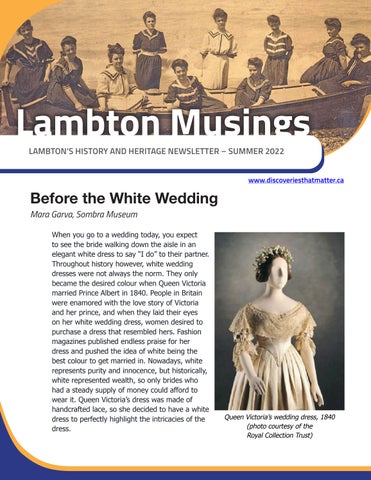
Before the White Wedding Mara Garva, Sombra Museum When you go to a wedding today, you expect to see the bride walking down the aisle in an elegant white dress to say “I do” to their partner. Throughout history however, white wedding dresses were not always the norm. They only became the desired colour when Queen Victoria married Prince Albert in 1840. People in Britain were enamored with the love story of Victoria and her prince, and when they laid their eyes on her white wedding dress, women desired to purchase a dress that resembled hers. Fashion magazines published endless praise for her dress and pushed the idea of white being the best colour to get married in. Nowadays, white represents purity and innocence, but historically, white represented wealth, so only brides who had a steady supply of money could afford to wear it. Queen Victoria’s dress was made of handcrafted lace, so she decided to have a white dress to perfectly highlight the intricacies of the dress.
Queen Victoria’s wedding dress, 1840 (photo courtesy of the Royal Collection Trust)
Before that, wedding dresses could be any colour, from deep shades of red to cream coloured silk. For many centuries, women typically did not have a special dress made for the day, they simply wore the nicest garment that was already in their closet. It could be any dress, as there were no specific styles or colours required. She could have worn her best Sunday church dress, or a dress that she had made herself. Women did this out of a need for practicality, so they could re-wear their dress and save money. A dark-coloured wedding dress was quite common, with most being black and brown. Women wore dark dresses because it hid any imperfections and stains in the fabric. Any colour could be worn but green was usually avoided, as it was unlucky. Green was the colour of the fairies, and it was believed that wearing it would cause rain to spoil the big day. During the Middle Ages, the desired colour changed. White still was not in fashion, as it was a colour associated with mourning and brides tended to avoid it. Blue became a popular colour, as it represented purity and was associated with the Virgin Mary and religion. Brides also believed that their husbands would stay true to them for eternity if they wore blue. If their whole dress was not blue, they would still adorn themselves with a blue item before walking down the aisle, like a ribbon tied around their leg. This is where today’s “something blue” tradition originated. For women that were wealthy, their dresses were created with luxurious fabrics such as velvet and satin. Deep jewel toned colours, like rich red, were common. Women that didn’t have a lot of money wore Wedding dress from 1742 dresses made from cheaper fabrics like cotton and wool. from the collection of the Museum of Fine Arts in Boston, The designs of the dresses copied the designs worn by the wealthy, and the colours remained mostly dark. Massachusetts There were more changes to wedding dresses during the Elizabethan era (1558-1603). Wedding dresses were full length and covered most of the body, with the neckline being the only skin that would show. Burgundy was a well-loved colour for dresses during this time. Wealthy women bought or had new dresses made for them, and they were typically lush and regal colours. Lower class women would wear their best gown and kirtle (outer petticoat), and typical colours ranged from yellow, red, and blue to grey, black, and tan. White still wasn’t brought to light as a popular choice, but Mary, Queen of Scots wore a white dress in 1559 for her wedding to the French heir, simply because it was her favourite colour. Around the world, there have been many different traditions for wedding dresses that have been reflected through colour, and some of these traditions are still in place today. In ancient Rome, brides wore long yellow veils that symbolized them as a torch, representing them bringing warmth and light to their marriage. In ancient Athens, brides wore long violet or red gowns with a girdle cinched at the waist. The girdle symbolized
purity and virginity and it would be removed by their husband after they were married. During the Zhou Dynasty in China over three thousand years ago, brides had to wear black robes with red trim and a visible white undergarment underneath, as authorities had rules in place over what clothing was allowed to be worn. The Han Dynasty came next, where rules were slightly relaxed and women were allowed to wear green in spring, red in summer, yellow in autumn, and black in winter. In China today, red is the traditional wedding dress colour as it symbolizes happiness and good fortune.
1880 taffeta wedding dress with removable skirt from Sombra Museum’s collection
Portrait of Sarah Ball (from the Sombra Museum archival collection)
Now we present two examples of non-white wedding dresses preserved in Sombra Museum’s collection. The first one is an 1880 light brown taffeta wedding dress, which is on display in our music room. The dress has a large bustle on the side, which was extremely common for dresses during this period. The rows of buttons seen down the front of the bodice were also prevalent in this era, and it features a short, removable train or dust ruffle, decorated with layers of quill-like tassels. The removable train meant that the entire dress would not need to be washed after a day of walking out in dusty, muddy, or wet streets, leading to less work for the wearer. The museum, along with the Sombra Historical Society, is currently undertaking a project to better preserve this dress for the future. The second is a two-piece, hand-sewn maroon silk blouse and skirt wedding ensemble worn by local milliner Sarah (William) Ball on her wedding day on December 27, 1882. It is stored in the museum’s archives and has been featured on exhibit at the Textile Museum of Canada. The blouse features puffed upper and tight lower sleeves typic of the era, as well as intricately decorated buttons.
Sarah Ball’s silk wedding blouse, made in 1882, seen from the front and back views. Notice the wider shoulders which taper to a very narrow waist, typical of the fashions of this time
Van Tuyl & Fairbank Heavy Hardware: Keeping Customers Happy for 154 Years Kalea Pottle, Oil Museum of Canada Van Tuyl and Fairbank Heavy Hardware (commonly shortened to Van Tuyl) was a staple in the town of Petrolia. The store was open for 154 years. It played a significant role in the establishment of Petrolia, having a huge impact not only on the town but the surrounding area even after the oil ran dry.
Pictured is a newspaper advertisement for John’s General Store, 1867. Photo courtesy of the Oil Museum of Canada
Even as drilling in the oil fields of Oil Springs was plentiful for John Henry Fairbank in the early years of the oil boom, he did not want to rely on oil as his sole income. In search of another business venture, he turned to the area now known as Petrolia.1 In 1864, John’s General Store was opened, selling grocery items and liquor. Fairbank was very strategic with the business as eventually the train station was built across from the store. 2 His final partner in the business, Major Benjamin Van Tuyl, helped catapult the hardware aspect of the store into success. The business went through multiple changes until Van Tuyl & Fairbank Hardware was settled in 1874. 3 The pair worked closely on the store until Van Tuyl’s death in 1900. It was a devastating loss for Fairbank, who chose to keep the Van Tuyl name on the storefront out of respect. 4
1
Gary May, “Setting Up Business,” in Hard Oiler! (Toronto, ON: Dundurn Press, 1998), pp. 65.
2
Brent Boles, “Historic Business Turns Attention to the Future,” The Sarnia Observer, April 14, 2016, sec. Scope, pp. 41-41.
3
Brent Boles, “Hardware Store Celebrates 150 Years,” Petrolia Topic, May 6, 2015.
4
Patricia McGee, “Chapter 11- VanTuyl and Fairbank Hardware Store,” in The Story of Fairbank Oil: Four Generations of the Family Producing Oil Longer than Anyone in the World (Petrolia, On: Words Unlimited Ink, 2004), pp. 161-171, 164.
5
Patricia McGee, “Chapter 11- VanTuyl and Fairbank Hardware Store,” in The Story of Fairbank Oil: Four Generations of the Family Producing Oil Longer than Anyone in the World (Petrolia, On: Words Unlimited Ink, 2004), pp. 161-171, 165.
6
Patricia McGee, “Chapter 11- VanTuyl and Fairbank Hardware Store,” in The Story of Fairbank Oil: Four Generations of the Family Producing Oil Longer than Anyone in the World (Petrolia, On: Words Unlimited Ink, 2004), pp. 161-171, 165.
7
Ibid, 166.
Pictured is the Fairbank Electric Kettle invented by Charles Fairbank Sr. in the 1960s. Shown is the heating element inside the pot that made it revolutionary. Photo courtesy of the Oil Museum of Canada
Throughout the years, the family business was passed down from generation to generation. Until his death in 1982, Charles Fairbank Sr. was the only owner to work in the store daily as manager. 5 It was during this time that one of many creative ideas was sparked within the walls of Van Tuyl. Charles Fairbank Sr. invented the Fairbank Electric Teapot in the 1960s. 6 What made the teapot different was that it contained a heating element inside that boiled water within minutes. Church groups assembled the teapots and they were sold at the hardware store. They became very popular; so much so that they were set to be listed in the Eaton’s Christmas catalogue. 7 This was quickly deflated by the Canadian Standards Association. The surveyor thought the teapots should be able to boil water for an hour. This was an impossible feat and inevitably the teapot boiled dry 8, along with the prospects of the Fairbank Electric Teapot.
Above is the solar powered stained-glass window titled “Before Oil and After” by Christopher Wallis and Barry Lorcini. The piece was unveiled at Van Tuyl & Fairbank Hardware, as it was commissioned and donated to the Town of Petrolia by Charlie Fairbank in 2012. This piece is designed to be portable but is installed at the Victoria Playhouse. Photo courtesy of Petrolia Heritage.com
In 1988, the hardware store switched over to a computer inventory system,9 pushing them into the modern era. In 2012, they dove into the world of solar power; adorning panels to the top of the store roof and introducing the Van Tuyl and Fairbank Solar company. A solarpowered illuminating-stained glass artwork was unveiled at the store,10 revolutionary in 2012, and even more revolutionary for a 100-year-old hardware store with part dirt floors. Theresa MacDonald became the first, and only, female manager of Van Tuyl and Fairbank Heavy Hardware in 2001. It was generally unheard of to have female employees or customers through Van Tuyl, much less as management. Theresa would be the last manager, as Van Tuyl closed for business with her retirement in 2019. 11
The reason for the closure, said Charlie Fairbank Jr., was the “dramatic change in times, so much so the store could not possibly keep up.” 12 But, after surviving the Great Depression, World War I and II, floods, fires, break-ins, and the introduction of the digital age, Van Tuyl and Fairbank Heavy Hardware kept the title of Oldest Family Run Hardware Store in Canada until its closure. “Keeping customers happy for 154 years…” noted Charlie Fairbank, “that’s an achievement.” 13 8
Ibid, 166.
9
Ibid.
10
Brent Boles, “Hardware Store Celebrates 150 Years,” Petrolia Topic, May 6, 2015
11
Jake Romphf, “Petrolia Hardware Store Shutting down after 154 Years,” The Sarnia Observer, August 2, 2019.
12
Jake Romphf, “Petrolia Hardware Store Shutting down after 154 Years,” The Sarnia Observer, August 2, 2019.
13
Ibid.
Bibliography Boles, Brent. “Hardware Store Celebrates 150 Years.” Petrolia Topic, May 6, 2015. Boles, Brent. “Historic Business Turns Attention to the Future.” The Sarnia Observer, April 14, 2016, sec. Scope. Dennis, Dave, and Lyn Dennis. “Van Tuyl and Fairbank Hardware Pivotal Player in Search for Oil.” Petrolia Topic, March 16, 1994. May, Gary. “Setting Up Business.” Essay. In Hard Oiler! The Story of Early Canadians’ Quest for Oil at Home and Abroad, 65. Toronto, ON: Dundurn Press, 1998. McGee, Patricia. “Chapter 11- VanTuyl and Fairbank Hardware Store.” Essay. In The Story of Fairbank Oil: Four Generations of the Family Producing Oil Longer than Anyone in the World, 161–71. Petrolia, On: Words Unlimited Ink, 2004. Romphf, Jake. “Petrolia Hardware Store Shutting down after 154 Years.” The Sarnia Observer, August 2, 2019. The Independent Staff. “Historic Hardware Store Celebrates 150 Years Friday.” Petrolia Lambton Independent, July 2015. Winch, Phil. “Historic Hardware Store Retains Strong Link with Past.” The Sarnia Observer, August 5, 1988.
Arthur Brittain, Watchmaker and Wyoming Businessman Nicole Aszalos, Lambton County Archives Local resident Arthur Brittain was a watchmaker and longtime Wyoming businessman. He was born in Liverpool, England in 1876 to William Brittain and Martha (Patty) Young. He was three years old when he arrived in Canada. The Brittain family initially settled in Bowmanville.
Arthur Brittain’s wallet and letter from Canadian Horological Institute
In 1894, Arthur graduated from the Canadian Horological Institute, an educational body that existed in Toronto from 1890 to 1913. Then, he completed his apprenticeship in London. In March 1895, Arthur made his way to Wyoming where he was employed by local jeweler, George Fisher.
In due course, Arthur started his own business and rented space on the northwest corner of Broadway Street in the store operated by E.C. Rice. By 1898, the business had moved to the southwest corner of Main Street. He lodged for a time at the home of his friend, Frank Rice, son of John A. Rice and Hannah (Nichol) Rice. In 1899, he married Barbara Ethel Blanche Anderson with whom he had three children, including Edith Dorothy (Nicholson) and William. Tragically, their daughter, Barbara Muriel, passed at the age of two in 1909. Arthur Brittain worked as a jeweler and watchmaker until his death in January of 1945. The site of his store was demolished in 1963 and later became the TD Bank. It is now home to the Plympton Wyoming Health and Wellness Centre. For more on the Brittain Family and the history of Wyoming, visit the Lambton County Archives!
The Route of the Cross Gordon MacKenzie, Plympton-Wyoming Museum In the 1920s, the Imperial War Graves Commission started removing the WWI wooden burial crosses from the graves and replacing them with the existing headstones that are present on the graves. The wooden crosses were apparently offered to families of the fallen or burned if they were not wanted. William Wright’s parents must have requested his cross. The date on the cross is October 5, but we know from records that William died on September 29. Perhaps October 5 is the date he was buried, not the date of his death.
William Wright’s burial cross
When William’s father John died, his mother Janet moved (with the cross, William’s medals, and a large picture of William) to her son Frank and his wife Marion’s house in Plympton Township. She took with him the cross, William’s medals, and a large portrait of him. Frank and Marion had three children – Murray, Doris, and Ruby. Murray remembers, as a small boy, seeing the cross at his place.
When Frank died, the cross and medals were passed to Doris and the picture stayed with Murray. Doris (Miller) Wright was interested in history and did talks at Remembrance Day about her Uncle William. At some point in time, the cross and medals were passed to the Royal Canadian Legion in Wyoming.
William Wright’s British War Medal, The Victory Medal and The Memorial (Silver Cross)
William Wright’s Next of Kin Memorial Plaque (Dead Man’s Penny)
The cross was stored in the Legion’s storeroom until the Plympton-Wyoming Historical Society started doing research on Plympton’s fallen soldiers. It was then offered to the PlymptonWyoming Museum. The Private William Wright Story On February 22, 1916, seventeen-year-old, “blueeyed, 5’8” tall” William Wright signed up, in Watford, to join the 149th Lambton Battalion of the Canadian Expeditionary Force. William was one of six children of John and Janet Wright who farmed in Plympton Township. The 149th Battalion trained in London and then at Camp Borden during 1916. They left for England from Halifax on March 28, 1917 aboard the S.S. Lapland. Their ship hit a mine 12 miles from Liverpool but was able to make port successfully.
Private William Wright
The 149th Battalion was broken up to fill other battalions, already short of soldiers due to the high casualty rate. William was sent to the 49th Battalion which was made up of the Loyal Edmonton Regiment. This regiment became part of the famous Princess Patricia’s Canadian Light Infantry (one of the remaining three infantry regiments currently in Canada).
The 49th Battalion was very active in the later stages of WWI. They participated in the second battle for Cambrai after the September 25, 1918, breakthrough of Canal du Nord. Cambrai was a strategic area for the German Army and blocked the Allied push into Germany. This period in the fall of 1918 was known as “the last 100 days” of WWI at the Western Front. William’s battalion attacked during the late night of September 28 and came under very high machine gun fire near the town of Tilloy (located about 1000 yards north of Cambrai). William was among 40 soldiers from the 49th Battalion killed in action on September 29, 1918. The battle map for the siege of Cambrai shows the objectives of all the battalions. You can see the narrow area assigned to the 49th Battalion and the village of Tilloy just on the north side of Cambrai.
The Monarchy in Lambton: A Royal Fascination Colleen Inglis, Lambton Heritage Museum In 2022, Canada celebrates the Platinum Jubilee of Her Majesty Queen Elizabeth II. It’s a wonderful opportunity to recall past royal visits to Lambton County and explore items in the Lambton Heritage Museum collection that reveal our fascination with royalty. Queen Elizabeth II is Canada’s longest reigning sovereign and the first to celebrate a Platinum Jubilee. This marks seventy years on the throne. She became queen following the death of her father, King George VI, on February 6, 1952. Her coronation was held over a year later on June 2, 1953 at Westminster Abbey. As Queen, Elizabeth II has made twenty-two official visits to Canada. In 1959, an extensive 45-day royal tour by the Queen and her husband, Prince Philip, Duke of Edinburgh, included stops in all provinces and territories. An important function of this tour was to officially open the St. Lawrence Seaway. The Queen and Prince Philip travelled along the seaway aboard HMS Britannia (the royal yacht). On this trip, Queen Elizabeth II made her one and only official stop in Lambton County, at Sarnia. Commemorative candy dish marking Queen Elizabeth II’s royal tour of 1959
Coloured lithograph of Queen Victoria and her son Edward, Prince of Wales
Queen Elizabeth II was not the first member of the British royal family to visit Lambton County. Nearly one hundred years earlier, nineteen-year-old Albert Edward, Prince of Wales, took the train from London to Sarnia as part of a royal tour. He was the eldest son of Queen Victoria and eventually became King Edward VII. He arrived in Sarnia on September 13, 1860. The beautiful St. Clair River provided a backdrop for his reception. There were seats for over 5,000 people. Spectators lined the wharf and others watched from steamers nearby. Mayor Thomas William Johnston welcomed the Prince.
The outlet of Lake Huron where it flows into the St. Clair River is a traditional First Nations gathering place. A grand council meeting of chiefs and warriors was held at Sarnia in the days before the Prince’s visit. A large contingent of Indigenous delegates later attended the Prince’s reception. Some wore traditional dress, while others wore European-style clothing. Henry Pahtahquahong Chase spoke on behalf of his people and one of the chiefs addressed the Prince in his native language with the aid of an interpreter. The Indigenous delegates each received a silver medal with Queen Victoria on one side and the Royal coat-of-arms on the other. The Prince was given a tomahawk and other items. The third son of Queen Victoria, Prince Arthur, Duke of Connaught and Strathearn, also made a memorable visit to Sarnia. As Governor-General of Canada, the Duke was present when Sarnia officially became a city on May 7, 1914. The Duke was accompanied by his popular daughter, Princess Patricia. In his welcoming address, Sarnia mayor Joseph B. Dagan said, “In testimony of our loyalty to the King and to your Highness as representative in Canada, and in the public expression of our affection and regard for all the members of your illustrious family, we have taken the liberty of selecting as a synonym for Sarnia the title of the Imperial City, thus linking the title of the Reigning House of the Empire with our young city’s name.” The pomp and excitement surrounding royal visits, parades, and events has left a legacy of recollections, photographs, and keepsakes. Over the years, some of these items and oral histories have made their way to Lambton Heritage Museum. During Queen Elizabeth II’s Platinum Jubilee, our royal fascination continues.
Watercolour sketch of Walpole Island Chief Menage with silver medal. It was presented to him by the Prince of Wales during the 1860 visit
Copper bugle with brass mouthpiece c. 1899. Given to Henry Gregory, who served with the Canadian Militia and during the Boer War (1899-1902). Gregory was a member of the honour guard for the Duke of Connaught during his 1914 visit to Sarnia
Mandaumin Library Plaque Dedication Jan Munro, Plympton-Wyoming Museum “The world belongs to those who read” The following is an excerpt from remarks delivered during the recent plaque dedication at Mandaumin Library. Friends, neighbours and interested local historians, welcome to Mandaumin Park. We are gathered here today to recognize Mandaumin’s first library. From its early beginnings at the Presbyterian Church across the road, then to a small building here at Mandaumin Park, it eventually became a member in a much larger system. Research has shown the people of Mandaumin were very proud of their early library and those sentiments are evident still today, regardless of the absence of a physical building. Too easily our early history can be lost to the ages. In today’s world, it has proven to become a common theme, in some instances denying what happened in the past, or perhaps just harbouring simple indifference to the past. In a letter to his brother on the subject of books, General Sir Isaac Brock stated, “I like to read a book quickly and afterwards revert to such passages as have made the deepest impression and which appear to me important to remember.” This plaque will serve as a brief historical note, for present and future generations, so that the early history of the library can be appreciated and not forgotten. On behalf of the Plympton-Wyoming Historical Society, I would like to present the Mandaumin Library commemorative historical marker. The PWHS would like to extend its thanks to the Lambton County Archives, the Windsor Library Archives, and members of the community for their input. A special thanks to the Town of Plympton-Wyoming for its generous support of this project. Wm Munro, Plaque Committee Plympton-Wyoming Historical Society This is the third historical plaque the PWHS has installed. Mandaumin Park is located at 3019 Confederation Line, Wyoming (near Mandaumin Road).
The Post Office Staff, Moore Museum For early Canadian settlers, communicating with friends and family was a difficult task. Many family members were spread out across the country. Without telephones, computers or cars, a letter was the most efficient way to speak to those who lived far away. Post offices Photograph from Moore Museum collection of the in early Canadian villages were often in a store and post office in the village person’s house, the train station, or a local store. Early settlers had to pay to receive their mail, but not to send it. As a result, it wasn’t uncommon to send a blank letter back home when travelling to inform your family of your safe arrival. This practice of sending letters to be intentionally unclaimed didn’t last long, as the Canadian government issued the first postage stamp in 1851 to streamline the process of mail delivery and to expect payment up front. Paper was small and expensive, but settlers were resourceful. They would write as small as possible, sometimes turning the paper sideways and writing across what was already written to maximize space. Folding your letter and sealing it with wax made the use of an envelope unnecessary. All the village mail would go to the same post office, so often the only address on a letter was a name and a town. Mooretown was the site of one such post office. James Bâby arrived in 1815 and was engaged in many operations. He built a dock which was used as a port of call for boats and for exporting timber. He also kept a store, and it was there that one of the first post offices in Lambton County was established (with another being established in Sarnia at the same time). The store and post office were in a log building. Bâby acted as the postmaster from the opening in 1837 until 1853. Then, the post office was moved into the village. In 1862, a petition was sent by township council to establish daily mail service, both ways, between Moore and Sarnia. The mail was carried by stagecoach until the Huron and Erie Railroad was built from Chatham to Sarnia in 1886, at which point it came by train. By 1900, mail was delivered This letter from our collection was written on birch bark to Mooretown four times a day, and the and sent to Corunna in the early 1900s. Note that no gap between family and friends began address was written on the envelope, simply a town and name of the recipient to close as the newly created postal service grew.
Lambton County Branch of The Ontario Genealogical Society [Ontario Ancestors] Alan Campbell, Ontario Genealogical Society, Lambton Branch (lambtonnewsletters@ogs.on.ca) Taking Off on Tangents One of the challenges that genealogists/family historians face is the numerous interesting stories of people that are brought to their attention by others or that they stumble upon by chance. The challenge lies in the fact that frequently these interesting stories have nothing to do with the personal research that these genealogists/family historians are compiling. Two of these challenges crossed my desk recently. The first was the recording of the death of Mary Naomi Treen 25 February 1884 at Point Edward. She was 13 years old at the time of her death and died from phthisis or pulmonary tuberculosis. According to an entry on the website Findagrave she was buried in Portland, Maine, the place of her birth. The first question that came to mind was, did the family return to Portland or was her body shipped back to be buried there? With the help of ancestry.ca and an Ancestry online tree that did have original documents associated with it, I went on a merry chase to confirm her parents and to track them from Portland to wherever. Then when I found her father’s Fenian Raid Application for a Grant, I had to look further as I have been attempting to track one for my great grandfather. Now you see what I mean! The second was the suicide of Lillian Saulter at Mackinac Island, Michigan 17 July 1893. She was working as a chamber maid. She rebuffed the attention of a soldier and was subsequently sexually assaulted. Suicide was her way of dealing with the situation. Her body was shipped to Petrolia to her aunt, Annie Stevenson, and she was buried there. What is unique for me is her Ontario death certificate. I had never come across a situation like that before where an American who died in the United States had an Ontario death record. Lillian Saulter death notice. Sarnia Observer 21 July 1893
I wonder if it was a requirement before she could be buried at Petrolia. According to newspapers of the day she left two letters behind. Numerous news articles were published in Canada and the United States with varying information, enough to “muddy the water.” To date I have found nothing that indicated she was ever in Canada prior to her burial. You can see the “hook” in this, a horrific story of a life snuffed at the age of 23 that encourages a researcher to build a picture of the victim. Additions to the Branch Website More historical books have been added to the Members’ Resources section of our website. Upcoming Branch Events
Webinars Unless otherwise noted, all webinars start at 7:00 p.m. September 15, 2022: Lambton’s One Room Schoolhouses (with Ed Dejong) Ed is the vice president of the Plympton-Wyoming Historical Society. Register here. October 13, 2022: My Irish Palatine Trip-Never Give Up the Search (with Donna Bjore) Donna is planning to search for Ireland Palatines who established roots mainly in Counties Limerick, Kerry, Tipperary and Wexford. She hopes to report on the finding of her Elizabeth and the right family connections.
Drop-In Sessions Drop-In Sessions are continuing through the summer. Register using this link for the Drop-In Session of August 29, 2022 and it will automatically register you for the series for the remainder of the year. These usually attract a small group of people and allow ample time for researchers to ask questions about resources and research strategies.
Heritage Sarnia-Lambton Members Moore Museum
94 Moore Line, Mooretown, ON N0N 1M0 519-867-2020 Facebook Page
Plympton-Wyoming Museum 6745 Camlachie Road, Camlachie, ON N0N 1E0 519-869-2357 or 519-869-4909 Facebook Page
Lambton Heritage Museum 10035 Museum Road, Grand Bend, ON N0M 1T0 519-243-2600 Facebook Page
Oil Museum of Canada
2423 Kelly Road, Oil Springs, ON N0N 1P0 519-834-2840 Facebook Page
Arkona Lions Museum and Information Centre
8685 Rock Glen Road, Arkona, ON N0N 1B0 519-828-3071 Facebook Page
Sombra Museum
3476 St. Clair Parkway, Sombra, ON N0P 2H0 519-892-3982 Facebook Page
Lambton County Archives
787 Broadway Street, Wyoming, ON N0N 1T0 519-845-5426 Facebook Page
Forest-Lambton Museum
8 Main St. North, Forest, ON N0N 1J0 Facebook Page
Additional Contributors The Ontario Genealogical Society, Lambton Branch Facebook Page