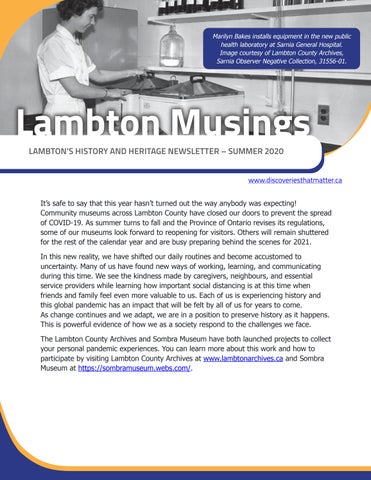
Marilyn Bakes installs equipment in the new public health laboratory at Sarnia General Hospital. Image courtesy of Lambton County Archives, Sarnia Observer Negative Collection, 31556-01.
Lambton Musings LAMBTON’S HISTORY AND HERITAGE NEWSLETTER – SUMMER 2020
www.discoveriesthatmatter.ca It’s safe to say that this year hasn’t turned out the way anybody was expecting! Community museums across Lambton County have closed our doors to prevent the spread of COVID-19. As summer turns to fall and the Province of Ontario revises its regulations, some of our museums look forward to reopening for visitors. Others will remain shuttered for the rest of the calendar year and are busy preparing behind the scenes for 2021. In this new reality, we have shifted our daily routines and become accustomed to uncertainty. Many of us have found new ways of working, learning, and communicating during this time. We see the kindness made by caregivers, neighbours, and essential service providers while learning how important social distancing is at this time when friends and family feel even more valuable to us. Each of us is experiencing history and this global pandemic has an impact that will be felt by all of us for years to come. As change continues and we adapt, we are in a position to preserve history as it happens. This is powerful evidence of how we as a society respond to the challenges we face. The Lambton County Archives and Sombra Museum have both launched projects to collect your personal pandemic experiences. You can learn more about this work and how to participate by visiting Lambton County Archives at www.lambtonarchives.ca and Sombra Museum at https://sombramuseum.webs.com/.
Moore Museum Update Laurie Mason, Moore Museum As of the writing of this article in late July Moore Museum’s site remains closed to the public for the safety of our community, visitors, volunteers and staff. While we cannot welcome you in person, staff are working behind the scenes to continue preserving the history of the former Moore Township section of St. Clair Township and sharing this heritage with you. While closed we have been carrying out many collections care and collections records management activities, including cataloguing of donated artifacts, such as these intriguing items: Champagne bottles from the wreck of the steamer Regina, one of the many ships lost in the Great Storm of 1913. Part of its cargo was champagne, which included these cleverly designed rubber straps to keep the “bubbly” from escaping during transit. These bottles were recovered by commercial diver Wayne Brusate in 1986 under a permit from the State of Michigan, Dept. of Natural Resources. A number of these Regina artifacts were then donated to various Great Lakes area museums. This toy washing machine was donated by a local resident from her collection of childhood toys. Dating to the mid-1900s, this toy was the perfect way for little girls to learn to do laundry at an early age! By turning the handle, the washer would agitate and there is even the wringer to remove the excess water from her dolls’ dresses before she hung them on the line. This toy was made by the Wolverine Supply and Manufacturing Company of Pittsburgh which was re-named the Wolverine Toy Company in 1962. As with other toy companies in the mid1900s, traditional gender roles were reinforced by the company’s products. Household appliances such as this washer were marketed for girls and pinball games and toys pointing toward a career outside the home were targeted at boys.
DID YOU ATTEND SCHOOL IN THE FORMER MOORE TOWNSHIP PRIOR TO 1963? Moore Museum is developing another virtual exhibit for our website, this one featuring brief histories and photos of the schools in the former Moore Township prior to centralization in 1963. There were 19 school sections in Moore, four of which were union schools – two shared with Sombra Township and two with Sarnia Township. The accompanying map shows the location of the schools.
If you have information on the history of any of these schools or photos, that you would be willing to share with us, we’d love to hear from you. We would appreciate details about any school in the township, but especially School Sections #6, #13 and #19 Moore as our research files contain no information at all for those three. Information can be sent to lmason@stclairtownship.ca. We look forward to hearing from you!
School Section #18, Moore – Courtright School
School Section #14, Moore
We are also adding more historical information to our website through other virtual exhibits. Currently available at www.mooremuseum.ca are “The Villages of Moore” and “Vanished Villages of Moore Township”. Each features many photos of these communities and brief histories. Currently in production are histories of the churches and schools that were a part of the social fabric of the former Moore Township. In addition to our Facebook page at www.facebook.com/mooremuseum we are now on Instagram @mooremuseum so you can watch for news from Moore Museum. For more information, you can call us at 519-867-2020 or reach us through the Contact Us page on our website. While visiting our website, please follow the link on the home page to our online survey. We very much appreciate input from our community and, as a thanks for your assistance, survey respondents will be entered in a draw (to be held on November 13, 2020) to win a 2021 family membership and $25 gift shop gift certificate.
The Renovation of the Arkona Lions Museum and Information Centre Glenn Stott, Arkona Lions Museum and Information Centre For the past 2 years the Arkona Lions Club under the guidance and enthusiasm of Museum curator/steward, Bob O’Donnell along with the support of the Ausable Bayfield Conservation Authority and the Arkona Lions Club, undertook a major renovation of the Museum and Information Centre located at the Rock Glen Conservation Area just outside of Arkona. The museum was moved to Rock Glen Park in 1986 when the original founder and curator Ted Baxter retired. All of the display cases as well as all the fossils and artifacts were housed in the newly constructed building located above the famous Rock Glen Falls. Visitors could walk around the museum and see the vast collection of items which covered over 400 million years of the earth’s history. For over 30 years this museum has served as a major centre of information about fossils and artifacts related to the Lambton County region. Bob O’Donnell and his committee became mindful of changes which needed to be made in not only the labeling, identification but also the display of the material in the museum to update it to new technology, new finds and new information which have come about in the fields of paleontology and archaeology over the past 30 years. The Arkona Lions Club commissioned new display cases to be made by a local carpenter, Peter Michielsen of Sylvan in 2019. As well, the Ausable Bayfield Conservation Authority installed new washroom facilities, and automatic doors to ease access to the Centre. Bob has utilized his vast knowledge of fossils and his network of compatriots to add very interesting and valuable items to the original collection. Improvements have been made to the ventilation and security systems to enhance both the environment and the security. It is the hope of the Museum committee and the Conservation Authority to enrich all aspects of the Centre for the support of the learning and knowledge of the general public as well as fossil/artifact enthusiasts.
Photos courtesy of Bob O’Donnell
The Arkona Lions Club with Bob’s leadership commissioned Lauren Clark, of Sarnia, to produce four large paintings which will enlighten the public about what the Centre will reveal to them when they tour. A new fluorescent mineral display as well as new large elite fossil items, a reorganization of the displays with thematic outlines, new paint and lighting will enhance everyone’s visit to the Centre. All these changes and more are currently being carried out during this COVID-19 period with the Centre being closed. Bob, the Lions and the Conservation Authority are utilizing this unique historic time to enliven, enhance and enrich the Arkona Lions Museum and Information Centre so that when it reopens in the Spring, 2021 it will be a totally new learning experience!
Ontario Ancestors: The Ontario Genealogical Society Updates Jane Teskey, Ontario Genealogical Society, Lambton Branch September 10th at 7:00 pm. Zoom Presentation, “Using Social Media for Genealogical Research” by Ben Dawson of London, Ontario. Email lambton@ogs.on.ca for the presentation link or find it on our Facebook page: https://www.facebook.com/groups/ontgensoc/. Did you miss the presentation on June 25th? Catch the video “Getting the Most Out of Lambton Branch website” with Alan Campbell and Jane Teskey at this link: https://vimeo. com/433460936/7da4526c97 Interested in purchasing a membership for Ontario Ancestors: The Ontario Genealogical Society? You can get a half price membership right now! It only costs an additional $12.00 to add Lambton County as your home branch. Make the most of your time at home by using the Lambton members resource site. More information online at https://ogs.on.ca/ shop/bundled-membership/
New Exhibit: Dedication, Grit, Passion: Farming & Animals in Sombra Kailyn Shepley, Sombra Museum
This post card from September 1913 advertising the Sombra Fair, shows that the agricultural spirit manifested early in the people of Sombra Township. The early settlers in the 1820s and 1830s logged and cleared the land, planting their crops by hand between the stumps, until eventually the forest gave way to the ploughed fields of Sombra clay, good for growing wheat, corn, beans, beets and other staples. In recognition of the significant role that agriculture played in the establishment and growth of the former Sombra Township, Sombra Museum presents the new exhibit “Dedication. Grit. Passion. Farming and Animals in Sombra” curated by summer student Kyra Ritchie. This exhibit highlights some of the hand tools used for cultivating crops and raising and working with animals on the farm. Photo credit: Sombra Museum Archives
Renovations to the Oil Museum of Canada Erin Dee-Richard, Oil Museum of Canada The Oil Museum of Canada, National Historic Site is undertaking a major renovation to improve the visitor experience, thanks in part to the generosity of The Judith & Norman Alix Foundation. Plans include the development of new museum exhibits and interactive learning experiences, improved visitor amenities, interpretation and signage. This work will see accessibility upgrades, the replacement of heating, ventilation and air conditioning equipment, and energy efficiency improvements including lighting replacement and new windows and doors for the 60 year old facility. The enhancements to museum exhibitions and interactive educational experiences at the site will facilitate innovative educational experiences and expose students in Lambton to the importance of STEM (Science, Technology, Engineering & Math) as part of Lambton’s history of oil innovation, and to the economy of tomorrow.
Artist rendering of new floorplan
(Oil)man vs. Nature Kate McGregor, Oil Museum of Canada When James Miller Williams arrived in Enniskillen Township in 1855, he encountered a largely untamed terrain. At that time, Charles and Henry Tripp were the only people attempting to profit from the local ‘gum beds.’ Shortly after his acquisition of the Tripp Brothers’ company, Williams discovered a reservoir of crude oil below the bitumen. This unearthing propelled a mass migration of men, all hoping to find their fortune in Enniskillen Township. Due to the potential riches associated with the seemingly abundant resource, an outlook began to develop among the oilmen regarding their relationship with the environment. Many believed that Mother Nature needed to be conquered to obtain the natural resource. This power struggle between man and the natural world greatly shaped their actions in the early years of the oil boom.
A gumbed showing bitumen at the surface
The actions of John Shaw exemplify this power struggle between man and the natural world. When Shaw arrived in 1860, he was hopeful that his property would immediately yield copious amounts of oil; however, his wells did not produce any crude in the first couple months. He continued to dig deeper into the ground to defeat the environment. Eventually, his efforts paid off as, “the oil [shot] up in a stream of six inches thick to a height of thirty feet….Many thousands of gallons were discharged, and to such an extent that the whole of the surrounding land [was] flooded” 1. According to the London Free Press, Shaw was “sorry to see [so much oil] wasted.” 2 Nineteenth century geologist, Alexander Winchell said, “the first flowing well was struck [on] January 11th, 1862, and before October not less than thirty-five wells had commenced to drain a store-house which provident Nature had occupied untold thousands of years in filling for the 1 2
“Fresh Burst at the Oil Springs,” The London Free Press, February 4, 1862, 3. “Fresh Burst at the Oil Springs,” 3.
uses - not for the amusement - of man.” 3 Winchell, like many men in the oil industry, perceived that these ‘flowing’ wells existed only for man’s benefit. This flippant attitude often ended with disastrous results for the environment, as the flowing wells were uncontrollable. When the Black and Mathieson well erupted, thousands of barrels of oil spilled out into the surrounding area. Oil “flowed into Black Creek and fouled the Sydenham River all the way downstream to Lake St. Clair.” 4 The solution to the oil slick was to “set fire to the oil thus flowing, which communicated along the line of the creek a considerable distance,” which also caused significant damage to the surrounding landscape.5 Despite a perceived domination, the environment and natural forces continuously thwarted the efforts of the oilmen in Oil Springs. Even though experts, such as Winchell, reported that there were vast caverns of oil underground, there is a finite supply of oil. During Oil Springs’ boom, oil was also extracted in Titusville, Pennsylvania. After only three years, the oil wells in Titusville had run completely dry due to the “reckless way in which [the] oil has been disposed of and wasted.” 6
Creation: a Popular View of Some of the Grand Conclusions of Science. New York: Harper and Brothers, 1870.
3 4 5 6
Alexander Winchell, Sketches of Creation: a Popular View of Some of the Grand Conclusions of Science, (New York: Harper and Brothers, 1870), 286. Gary May, Hard Oiler!: the Story of Canadiansʼ Quest for Oil at Home and Abroad, (Toronto: Dundurn Press, 1998), 44. G. L. W., “Petroleum: The Oil Fields of Canada West,” New York Times, April 2, 1866. “Petroleum Not Inexhaustible,” The Sarnia Observer, July 4, 1862, 2.
WWII - The Battle of the Atlantic Gordon MacKenzie, The Plympton-Wyoming Museum A virtual tour is available for viewing on our website, www.plymptonwyomingmuseum.ca The Plympton-Wyoming Museum’s major military exhibit this year focused on the Battle of The Atlantic starting with the Miracle of Dunkirk (80th anniversary) and the growth of the RCN, RCNR and Remembering the end of the Battle of the Atlantic and WWII (75 anniversary). The 5 year Battle of the Atlantic was the longest continuous operation of WWII.
Overview • Sept. 1st, 1939, Germany attacks Poland. Britain and France declare war on Germany. • Sept. 3rd, German U-boat sinks British passenger ship Athenia - 128 people, including women and children, are killed. • Germany continues attacking British shipping with submarines (U-boats) & surface ships. • Germany attempts to starve Britain into submission and defeat. • In May 1940, France falls and Britain stands alone against Germany. • Britain needs supplies from Canada, USA, and others to survive. • After the fall of the port facilities in France’s Atlantic ports and Norway’s west coast, Germany increases convoy attacks by subs, surface ships and air craft. • Germany sends coded attack messages to their U-boats by shortwave which are deciphered by the U-boat’s Enigma code machines • Shortly after war is declared, Canada’s naval contribution is to help protect the shipping convoys. • USA supports Britain’s war effort by sending supplies via the Lend Lease Act, and “unofficially” helps protect the convoys especially when USA merchant ships are being attacked. • Canada’s east coast becomes the co-ordination center for convoys to Britain but a huge gap of poorly defended Atlantic exists midway between Canada and Britain. • In 1940, convoy systems are weak and massive shipping losses occur. This period is known by Germany’s submarines (U-boats) as “happy times”. • After Dec 7th, 1941, USA declares war on Germany and officially becomes part of convoy security.
• Convoys are formations of 30-70 merchant ships protected by Naval escorts. • Operations extend from the St. Lawrence River, to the Caribbean, to Newfoundland, to Britain, to Russia, to the Spanish coast. • In early 1942, American convoy systems from the Caribbean and USA east coast are attacked mercilessly by U-boats now operating in US waters. The new USA convoy defense system is weak. This period is known as the 2nd “Happy Times” by U-boats. • By late 1942 and early 1943, the “tide begins to turn” against the U-boats. German Enigma codes are broken in late 1941, anti-sub tactics and electronic equipment is improved. Air coverage over the Atlantic gap is improved. • By mid-war, convoy escort ships have improved weapons systems. • March 1943 sees the last of the major U-boat attacks. 2 convoys attacked - 21 of 92 ships sunk. • By May 1943, 41 U-boats are sunk and this becomes “Black May” by Germany. • By late 1943 & 1944 Canada’s convoy role extends to all North Atlantic & expands to support groups (i.e. hunter groups) • By the end of WWII in 1945, Canada has the 3rd largest navy in the world with approximately 430 ships and 95,000 sailors. • Plympton-Wyoming Museum has details of Convoy Systems, Improved Weapon Systems and 3 terrific model ships from the small Fairmiles (Q 105 aka Duc D’Orleans) to Corvettes to Destroyers and Stories of Canadians who served.
Section School System Rachel Whiting, Lambton County Archives
School Section #24, Dawn Township
Early Rural Education Many of Lambton’s early settlers arrived during the 1830s and 1840s. At the time, Lambton County was an unbroken forest with many miles between homesteads and rural communities. Without formalized education, children were educated by their parents, welleducated neighbours or local religious institutions. The hardships of pioneer life limited educational pursuits to the winter months, as farm labour took precedence during the summer months. The quality of education varied greatly when educational opportunities existed at all.
The Section School Era The state of education in Canada West was surveyed by Governor-General Sydenham during the 1840s. He concluded that the education system was in need of reform, and attempted to establish a unified school system in the Province of Canada. However, the political atmosphere at the time - Anglophones versus Francophones, Catholics versus Protestants - dashed the hopes of a unified school system. Communities demanded the right to dictate their children’s educational influences. Instead, the Common Schools Act of 1846 was passed and laid the groundwork for the Section School system. The new Department of Education established a common curriculum and teacher training programs, while County School Boards ensured the quality of local education. Local ratepayers elected three trustees to run the school under the supervision of the County School Board. Most Lambton townships eventually established over twenty Section Schools, ensuring students did not travel more than two miles to receive their education.
S.S. #1, Euphemia (Shetland) The original Shetland School predates the formation of school sections in Euphemia Township during the 1870s. A log schoolhouse was built on the property of Thomas Moorhouse, located on the ‘V’ across from the current Shetland Library. This schoolhouse burned down, but was quickly replaced by a frame schoolhouse on the same property. In 1878, a brick schoolhouse was built at the southern edge of the village and the school was named S.S. #1, Euphemia (Shetland). The unique schoolhouse belfry housed a large brass bell and became a community landmark. Miss Elizabeth Wilson served as the first teacher of the new school until her marriage to Alexander Dobbyn in 1882. At the time, it was considered inappropriate for married women to work as teachers. The common curriculum included lessons in reading, writing and arithmetic. Students also participated in annual projects, such as the school garden, lawn maintenance, tree plantings, and ‘field trips’ to view wildflowers in the surrounding woods. Preparation for the annual Christmas Concert was also a cause for excitement in the entire community. The schoolhouse received numerous updates over the years, including the installation of gas heating in 1915. S.S. #1 was finally closed in June 1965 and students were sent to the new Euphemia Central School. The building was converted into a storage shed for Elliott’s Mill and was torn down in 1979.
S.S. #16, Enniskillen S.S. #16, Enniskillen (originally known as S.S. #8, Enniskillen) was situated on the north east corner of Lot 5, Concession 10 in Enniskillen Township (Petrolia Line between Fairweather Road and Plowing Match Road). An original schoolhouse was constructed in 1869, but the early history of this school section has been lost. The last S.S. #16 schoolhouse was built in 1906 by William Thorpe and Alfred Kirkpatrick, and used remnants of an earlier schoolhouse on the property. The new schoolhouse included numerous upgrades like cement gravel and a flagpole. The original wood-burning stove was replaced by natural gas heating in 1910. Over the years, S.S. #16 had numerous teachers from the local community, including: Miss Beulah Spurr (later Mrs. William Cuthbertson), Miss Ruth Churchill, Miss Elaine Hunter and Miss Dorothy McGuire. Students at S.S. #16 were fortunate enough to have an organ in their classroom, and music lessons were a popular annual project. The school eventually invested in a piano in 1928. S.S. #16, Enniskillen closed in July 1966 and students were sent to Lambton Centennial Central School in the fall. The schoolhouse has since been torn down, and the property is now a private residence.
The End of an Era The Section School system persisted in Lambton County for almost 100 years. The centralization of rural schools during the 1960s marked the end of the Section School era in Lambton County.
A County Named After Radical Jack Colleen Inglis, Lambton Heritage Museum Would you like to have a place named after you? The area now known as Lambton County was named in 1849, in honour of John George Lambton, the first Earl of Durham. His family name “Lambton” was chosen instead of his title “Durham” because there was already a Durham County in Canada West. John George Lambton (1792-1840) was born in London, England. He followed in his father’s footsteps and entered politics. Lambton earned the nickname ‘Radical Jack’ because he supported liberal causes and helped draft the Reform Bill of 1832. The resulting act changed Britain’s electoral system and extended the right to vote. In 1838, he was made governor general of British North America and came to Canada to investigate the causes of the rebellions of 1837-38. It didn’t go well. He quit before the end of the year and submitted a controversial report in January 1839. This report recommended the legislative union of Upper Canada and Lower Canada and outlined a framework for responsible government. John George Lambton didn’t live to see the fulfillment of his recommendations. He passed away in 1840. In 1841, Upper Canada and Lower Canada were united into a single Province of Canada. In 1848, responsible, local, self-government was established. His 1839 report played an important role in the development of Canadian democracy and the evolution of political independence from Britain. In spite of that accomplishment, he has been criticized because of his desire to assimilate French Canadians. Lambton Heritage Museum has its own ‘Radical Jack.’ Our lovable black cat, better known as simply Jack, is named after John George Lambton.
Portrait, The Earl of Durham (John Lambton), 1842. By Sir Francis Grant. Oil on canvas. From the collection of the Judith & Norman Alix Art Gallery. Gift of Ron Van Horne and Scott Ferguson.
Contributors The Ontario Genealogical Society, Lambton Branch
lambton.ogs.on.ca facebook.com/groups/LambtonBranchOGS
Sombra Museum
3476 St. Clair Parkway, Sombra, ON 519-892-3982 sombramuseum.webs.com facebook.com/sombramuseum
Moore Museum
94 Moore Line, Mooretown, ON 519-867-2020 mooremuseum.ca facebook.com/mooremuseum
Plympton-Wyoming Museum
6745 Camlachie Road, Camlachie, ON plymptonwyomingmuseum.ca facebook.com/Plympton-Wyoming-Historical-Society-286687844815040
Lambton County Archives
787 Broadway Street, Wyoming, ON 519-845-5426 lambtonarchives.ca facebook.com/lambtoncountyarchives
Lambton Heritage Museum
10035 Museum Road, Grand Bend, ON 519-243-2600 heritagemuseum.ca facebook.com/lambtonheritagemuseum
Oil Museum of Canada
2423 Kelly Road, Oil Springs, ON 519-834-2840 oilmuseum.ca facebook.com/oilmuseumofcanada
Arkona Lions Museum and Information Centre 8685 Rock Glen Road, Arkona, ON 519-828-3071 abca.ca/conservationareas/rockglen/ facebook.com/arkonalionsmuseum/
The popular art show has been rescheduled to this fall! Pre-booked tickets are required. Visit www.heritagemuseum.ca or phone 519-243-2600 to book your time.
September 2nd to 27th Wednesdays - Sundays 11am-4pm Open to 8:30pm on Thursdays Lambton Heritage Museum, Grand Bend