Lambton Musings LAMBTON’S HISTORY AND HERITAGE NEWSLETTER – SPRING 2021
Spring Has Sprung
www.discoveriesthatmatter.ca
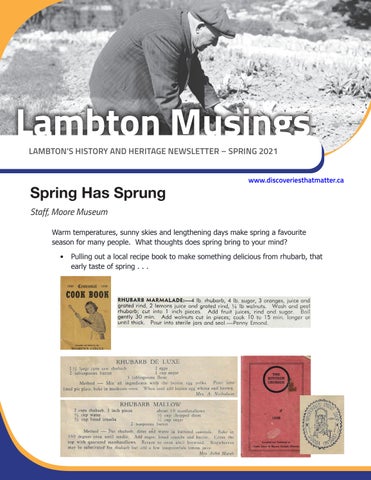
Staff, Moore Museum Warm temperatures, sunny skies and lengthening days make spring a favourite season for many people. What thoughts does spring bring to your mind? •
Pulling out a local recipe book to make something delicious from rhubarb, that early taste of spring . . .
Spring Has Sprung Continued... •
Spring on the farm - washing sheep to prepare for shearing . . .
“Happy Jack” MacDonald at Bear Creek in Brigden with an unidentified man washing a sheep. “Happy Jack” arrived in the Brigden area in 1875 at the age of 30 and lived there until he was in his 90s. Credit: Moore Museum collection
While washing of the fleece after shearing was probably the more common approach, washing of the sheep before shearing did occur. There is record of a mill at Appleton (eastern Ontario) where river washed wool actually commanded a better price as the wool was easier to work with than that from fleeces washed after shearing. Source: “The Mills of Appleton, Caldwell Woollen Mill, Community Stories, North Lanark Regional Museum, Almonte, Ontario,” in virtualmuseum.ca, March 23, 2021 (Community Stories)
•
Or, maybe your thoughts turn to the latest spring fashions – a new hat perhaps?
Spring hats from Moore Museum’s collection.
Spring/Summer Catalogue, 1901 - The T. Eaton Co. Limited.
All That Is Left is the Memories Sandy Burkhart, Forest-Lambton Museum All that is left is the memories. It took just two weeks to demolish over one hundred years of history. The old hotel on Main Street North in Forest is gone. It began life as the Johnson House in 1897, almost at the end of an era noted for grand hotels. Most towns in the mid to late 1800’s boasted of several inns. They were attracted by the proximity of 745 Roche Hotel and Town Hall. the railroad. Travel, even short distances usually necessitated an overnight stay. By 1911 however, changing times meant there were only two hotels remaining in Forest, The Franklin House and the Johnson House.
All That Is Left is the Memories Continued... Over the years as proprietors changed, the name changed as well as the character of the hotel. When the Johnson House opened the Forest Free Press offered this description, “The bar is one of the handsomest in Ontario and the house itself is one of the best in the province.” The hotel was sold and remodeled as the Roche House after the death of Mr. Johnson in 1900. Another transformation occurred in 1925 when with new ownership it became the Crinnean Hotel. In 1927 the Crinnian won the Ontario Motor League Award for a well-kept hotel. Each time the hotel was sold it underwent a name change and usually extensive improvements. In 1937 it was known as the Bosenberry. The proprietor C.E. Atchison was married to Anna Isobel Bosenberry, the then owner’s daughter. In 1948 Lindley Fraser became proprietor. At this time it featured the Doctor Stanton Room in honour of the Fraser’s famous racehorse. Doctor Stanton won many trophies throughout North America. W. Grendys bought the Fraser Hotel in 1952 and the name was changed, yet again, to The Forest Hotel. The Doctor Stanton Room would be remembered by many as it continued as a feature when the hotel became the Forest Sands. The official liquor licence was received for the Doctor Stanton Room in 1967. This was the first licence issued to sell beer and liquor by the glass since 1913. Needless to say the Sands was a popular weekend gathering spot. In May 1995 the hotel was renovated and reborn as the Victorian with its distinctive pink awnings reminiscent of the grand hotel that it began life as. It is best remembered as a charming place for an inexpensive lunch. Sadly the hotel was vacated not many years later and fell into disrepair despite plans to bring it back to its former glory. Fortunately the demolition crew saved a stained glass window, a door and a keystone which in the future will be on display at the Forest Museum.
The end of The Victorian hotel.
Note: Thank you to “Forest: Its Beginnings and More” by Mona Huctwith (Dancam Press, 2001)
Watford Enterpreneur: David Maxwell Nicole Aszalos, Lambton County Archives David Alexander Maxwell (1861-1930) was born in Metcalfe Township, the son of Thomas and Mary (Carroll) Maxwell. Thomas passed away when David was 9-years-old, leaving Mary with two young children. David was sent to apprentice with John Baimbridge, a blacksmith in Watford. Following his apprenticeship, David started his own successful blacksmith shop in Watford. David was known for his ingenuity. After the development of Henry Ford’s Quadricycle in 1896, David began Dave Maxwell and Friend and his Maxmobile. construction on his own horseless Photo courtesy of Warwick Township History carriage – the Maxmobile. The Committee Collection. engine block was cast by the Doherty foundry in Watford, while David bent and machined the crank shaft himself. The result was a single cylinder engine with a four-inch bore and a six-inch stroke, which drove the left rear wheel with a chain. The Maxmobile was completed in 1900 and became the first automobile in Canada. By 1910, David decided to modernize his automobile. He extended the dashboard, and brought the floorboards under the seat to protect the passengers (a response to a minor incident, in which Mrs. Maxwell’s skirts were torn off by the drive chain). Pneumatic tires were also added to improve the ride. The Maxmobile was capable of speeds up to 20 miles per hour, and had a range of 50 miles. David passed away on July 16th, 1930. The Maxmobile was gifted to the University of Western Ontario, on the condition that it be restored. Unfortunately, this restoration was not feasible and the Maxmobile was eventually acquired by London archaeologist Wilf Jury. After many years at the Fanshawe Pioneer Village, the Maxmobile was finally restored by Ross Saunders and Neil Werden. It is now housed at the Old Fire Hall Museum in Watford. Learn more about David Maxwell and the Maxmobile here, or contact the Lambton County Archives!
A Tale of Two Tunnels: The St. Clair Tunnel Colleen Inglis, Lambton Heritage Museum On April 9, 1891, Sarnia made headlines around the world. Steam whistles sounded on both sides of the St. Clair River as engine #253 made the first trip through the St. Clair Tunnel. The tunnel was an engineering marvel. Its construction captivated the world.
Ovens and McNeish made the first trip through the tunnel with conductor Nelson McKee, chief engineer, Joseph Hobson, and other Grand Trunk employees. Photo by J.S. Thom. When the St. Clair Tunnel was built, railways did more than just move goods. They were an essential means of travel and communication. When people talked about “the cars” they meant railcars not automobiles. The railway came to Sarnia in 1858. People and freight travelled by ferry across the St. Clair River at Point Edward before connecting with the railway again at Fort Gratiot, Michigan. Loading and unloading the ferries was labour-intensive and time-consuming. The ferries battled strong currents, Great Lakes shipping traffic, poor weather, and winter ice. By the 1880s there was a continuous backlog of freight in the Point Edward yard.
Sir Henry Tyler, president of the Grand Trunk Railway, and Joseph Hobson, chief engineer.
Building a rail bridge was impractical but building a tunnel was unprecedented. The thin layer of blue clay underneath the St. Clair River was soft and unstable. A tunnel attempt between Windsor and Detroit had failed. Sir Henry Tyler, president of the Grand Trunk Railway, recruited Joseph Hobson of Guelph as the chief engineer for the tunnel project. They chose a site downstream at Sarnia. After several unsuccessful tests, the only viable technique appeared to be shield tunneling. This method was pioneered by Marc Isambard Brunel beneath the Thames River in 1818.
The shield method of tunnel excavation involves moving a steel shell (shield) through soft earth. Hydraulic rams force the shield along. The shield protects the tunnel heading from collapsing until a permanent lining is in place. The St. Clair Tunnel required two shields. They were the largest in the world. One started on each side of the river and they met in the middle. The tunnel was lined with cast iron and masonry. Within the shields were platforms and partitions to provide support and protect the workers. Workers performed back-breaking labour, digging clay and loading it into carts hauled out of the tunnel by horses and mules. Other workers built the cast iron lining behind the shield. The men worked in a compressed air environment. Moving in and out of the tunnel meant moving through several airlocks to avoid getting “the bends,” a potentially fatal condition associated with scuba diving. Despite these precautions, three tunnel workers died. Tunnel workers made 17.5 cents an hour.
Tunneling shield sketch from special “Tunnel Opening Edition” of the Port Huron Daily Times, September 19, 1891. (originally published in Scientific American, August 1890)
St. Clair Tunnel, September 19, 1891.
Tunneling began in the summer of 1889. The two shields met one year later on August 30, 1890, only ¼ inch out of alignment. The tunnel formally opened on September 19, 1891. Construction was a great success, although the original steam locomotives could cause deadly gases to build-up in the tunnel. In 1908, the steam locomotives were replaced by electric locomotives that ran through the tunnel along a high voltage wire. This eliminated the noxious gases. In 1958, aging materials and high maintenance costs forced the switch to diesel engines. By the late 1980s, doublestack container trains and multilevel auto carriers were too tall to fit through the tunnel. The diameter of the tunnel could not be increased so CN decided to build a new tunnel. The new, bigger tunnel was built 30m north of the original. It was dug from the Canadian side to the American side using an earth boring machine affectionately dubbed Excalibore. After the opening of the new St. Clair Tunnel in 1994, the original tunnel was sealed.
CN commemorative postcard showing “Excalibore’s Crew,” December 8, 1994.
The construction of the original St. Clair Tunnel brought Sarnia to the world stage. The project required groundbreaking shield tunneling technology, cast iron tunnel lining, and excavation in a compressed air environment. Never before had a railroad passed beneath a river. Today, this incredible accomplishment is all too easily forgotten – underground, out of mind.
Souvenir china commemorating the opening of the St. Clair Tunnel.
Trilobite fragment with original label. This fossil was found during excavation of the original St. Clair Tunnel.
Moore Memories Two of Brigden’s Older Buildings are Removed Reprinted from The Sarnia Canadian Observer, June 7, 1938, p. 6 “Two of the older buildings in the village changed hands recently with the purchase by D. S. Hackney, of the Armstrong block and of the large barn at the rear of the Balmoral hotel by Joseph Patter [sic, Potter] In neither case was the purchase price given. The Armstrong building was built by the late William MacDonald, who conducted a general store business in it for several years. It was later This postcard image in Moore Museum’s collection enlarged by an addition built by shows two of the buildings referenced in the article A. Dawson. The original building – foreground shows the Armstrong building on the was used for many years by Brown southeast corner of Main (now Brigden Road) and Jane Streets and the Basswood Block appears in the and MacDonald for a general store, background on the northeast corner. and following the dissolution of this partnership R. B. Brown occupied it alone until the present R. B. Brown and Son store was built. Following this the store was purchased by John Armstrong and used for a variety of purposes until after fire destroyed the large Armstrong store across Main Street. Then the Armstrong hardware business was moved to the building, and continued there until a few years ago. At present part of the building is vacant, while Dr. W. H. Johnston, veterinary surgeon and hatchery operation occupies the remaining portion. There are several apartments on the second floor as well as a dentist’s office. Mr. Hackney, a local barber, will move his shop from the Basswood Block to the vacant section of the building and will also remodel part of it for living quarters. The Balmoral barn, which was built in 1906, at the time the hotel was erected by Frank Hyde, has been used to house local community auctions during the past few months. Two years ago it was used as a racing stable by George Boyle and other harness horse owners. It is of cement block construction and is being removed by Mr. Potter to his farm on the fourth concession, where it will be re-built as an implement shed.”
What’s the Plan, Man? Deanna Bullard, Oil Museum of Canada As many of you know, the Oil Museum is currently in the midst of renovations, with still a few more months to go. While the construction crew is busy building walls, taking out and putting in floors, uncovering windows and so many other things too numerous to mention, the museum staff is busy prepping for the moment that the construction is done. From then, the museum staff will be busy putting up the new exhibit. Many of you may be asking, “Just what does it take to make a new exhibit?” Let’s find out!
OMC under renovations
“What’s the plan”? This is the biggest question that museum staff ask themselves over and over. “The plan(s)” includes how to begin the renovation process, what artifacts to use and where the cases will go. However, the plan also includes the theme of the exhibit and what stories we want to tell, and how the stories will be told. After careful consideration, we decided to look at the original themes from the opening of the museum. The original themes have certainly stood the test of time, and the museum has 60 years of collecting that will help further enhance the exhibits. Now that the overall theme and stories have been chosen, the research, and the selecting of artifacts begins. Research starts at the museum within the collection records. Some of the artifacts come with their histories and others do not. The museum has extensive research files that staff may access, but many times, the staff must use outside sources.
Luckily, primary source material may be found at the Lambton County Archives. The selecting of artifacts can be difficult. The staff try and pick items that will best relate the history being told, and will be able to withstand the stress of being on exhibit. The Collections Coordinator and Curator must also measure each artifact to ensure that objects will fit into display cases comfortably even before leaving the safety of the collections vault. In the coming months, if you happen to drive by the Oil Museum of Canada, you may not see a “hive of activity” happening on the outside, but know on the inside, the staff is busy preparing for your next visit to the newly renovated museum.
OMC renovations are underway!
Lambton County Branch of Ontario Ancestors [The Ontario Genealogical Society] Alan Campbell, Ontario Genealogical Society, Lambton Branch (lambtonnewsletters@ogs.on.ca) Our Branch activities continue to be online due to the COVID pandemic. Our webmaster has been busy making our website easier to use. Our publications have been digitized so we can do an electronic surname search if you’re seeking someone who lived in Lambton County. Our upcoming free webinars are: Thursday, May 13th - 7p.m. Jen Baldwin, Findmypast. What’s new and how to get more from the search function. This is one of the large commercial genealogical sites that has lots of British and Irish records and indexes to them. Register for the webinar here. Tuesday, June 8th, 2021 - 7p.m. Mags Gaulden, Researching with DNA. Mags will give an overview of using DNA test information to make contact with other family members, or to help prove a lineage. Register for this free webinar here. As always we can be reached via lambton@ogs.on.ca for research advice or help with accessing online records. Join our Facebook Group in order to get regular updates about online events and great research discoveries.
Heritage Hour Lambton Calamities
Calamitous moments in our history test our resolve and challenge our resilience. Join museum professionals from across Lambton County as we explore manmade and natural disasters that have shaken our landscape for over 100 years.
List of Panelists: Nicole Aszalos, Lambton County Archives Bill Munro, Plympton-Wyoming Museum Jan Munro, Plympton-Wyoming Museum Laurie Mason, Moore Museum
This talk aired live on April 15. Watch the recording on the Heritage Sarnia-Lambton webpage.
David McLean, Forest Museum Erin Dee-Richard, Oil Museum of Canada Kailyn Shepley, Sombra Museum Greg Stott, Historian, University College of the North
Moore Museum Volunteer Service Awards Moore Museum is delighted to have had 8 of its dedicated volunteers honoured by the Ontario Honours and Awards Secretariat for long-term service as volunteers. These are the 2020 Ontario Volunteer Service Awards for which ceremonies were delayed by the pandemic. The awards ceremony was held virtually on February 17, 2021. The 2020 award recipients are: •
James Townsend – 20 years
•
Dave Beer – 10 years
•
Dan Hayward – 10 years
•
Dave Taylor – 10 years
•
John Richardson – 5 years
•
Cathy Seward – 5 years
•
Olivia Griffiths – youth
•
Carson Westfall – youth
Moore Museum is pleased to participate in the Ontario Volunteer Service Awards program to recognize the valuable contributions our volunteers make to the development and programming of the Museum.
Explore Local History Online Dana Thorne, Lambton Heritage Museum While the shift in seasons and the provincial vaccination campaign brings a feeling of hope that the end of the pandemic is in sight, we must remain vigilant and continue to limit our social interactions and stay at home as much as possible. Staff at Lambton Heritage Museum have missed welcoming the public to our facility, but we’ve been busy behind the scenes preparing online resources that you can enjoy from the comfort of your home. Check out our Museum @ Home page to explore some of these offerings, including the new Interactive Schooldays activity. In this activity, you can explore objects from the museum collection that were used in one-room schoolhouses across Lambton County over 100 years ago. There is also a selection of photographs that will test your observational skills with a series of questions and answers. Learn what it was like to be a student in the late 1800s and early 1900s! We’ve also launched a brand new Virtual Program on our Virtual LHM Education page. All our Virtual Programs are great for learning in the classroom, or exploring with the family at home! In Sweet Maple Syrup you will learn where maple syrup comes from and how it is made. You will also learn about the long history of making maple products in the Great Lakes region. The video clips in the Virtual Program include a visit to a local sugarbush, where we were hosted by Jeremy Robson. His family has been making maple syrup since about 1820!
Heritage Sarnia-Lambton Members Moore Museum
94 Moore Line, Mooretown, ON 519-867-2020 Facebook Page
Plympton-Wyoming Museum 6745 Camlachie Road, Camlachie, ON 519-869-2357 or 519-869-4909 Facebook Page
Lambton Heritage Museum
10035 Museum Road, Grand Bend, ON 519-243-2600 Facebook Page
Oil Museum of Canada
2423 Kelly Road, Oil Springs, ON 519-834-2840 Facebook Page
Arkona Lions Museum and Information Centre 8685 Rock Glen Road, Arkona, ON 519-828-3071 Facebook Page
Sombra Museum
3476 St. Clair Parkway, Sombra, ON 519-892-3982 Facebook Page
Lambton County Archives
787 Broadway Street, Wyoming, ON 519-845-5426 Facebook Page
Forest-Lambton Museum 8 Main St. North, Forest, ON Facebook Page
Additional Contributors The Ontario Genealogical Society, Lambton Branch Facebook Page