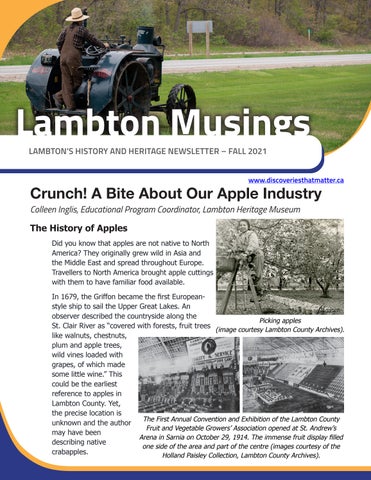
Lambton Musings LAMBTON’S HISTORY AND HERITAGE NEWSLETTER – FALL 2021
www.discoveriesthatmatter.ca
Crunch! A Bite About Our Apple Industry Colleen Inglis, Educational Program Coordinator, Lambton Heritage Museum The History of Apples Did you know that apples are not native to North America? They originally grew wild in Asia and the Middle East and spread throughout Europe. Travellers to North America brought apple cuttings with them to have familiar food available.
In 1679, the Griffon became the first Europeanstyle ship to sail the Upper Great Lakes. An observer described the countryside along the Picking apples St. Clair River as “covered with forests, fruit trees (image courtesy Lambton County Archives). like walnuts, chestnuts, plum and apple trees, wild vines loaded with grapes, of which made some little wine.” This could be the earliest reference to apples in Lambton County. Yet, the precise location is The First Annual Convention and Exhibition of the Lambton County unknown and the author Fruit and Vegetable Growers’ Association opened at St. Andrew’s may have been Arena in Sarnia on October 29, 1914. The immense fruit display filled describing native one side of the area and part of the centre (images courtesy of the crabapples. Holland Paisley Collection, Lambton County Archives).
Crunch! A Bite About Our Apple Industry Continued... The climate and soils of Lambton County are well-suited to fruit production, particularly apples. By 1808, Joseph LaForge had settled along the St. Clair River in what is now Sarnia. In 1826, he was interviewed by Mahlon Burwell, deputy-surveyor for Upper Canada. LaForge “had improved 12 acres. The log house was 18 x 18 feet, the log barn 30 x 30. There were 22 apple trees on the property.” Planting an orchard was a top priority for early settlers after clearing the land and building a home. In 1829, Roswell Mount surveyed Sarnia and Moore Townships. This map shows 16 acres of riverfront land cleared by Joseph LaForge (roughly between George Street and Wellington Street in present-day Sarnia). The LaForge Orchard is not named on Mount’s map but it is labelled on an 1857 plan of the same area.
In 1856, James Johnson moved to Lot 68 along the lakeshore in Bosanquet Township. His property had 100 apple trees. The previous owner, Alexander McPherson, hauled them through the woods on a sleigh from London. Johnson planted more fruit trees. He grew an extensive orchard of apples, pears, plums, cherries, quince, and peaches.
Preparation and Handling of Apples “Apples are extremely versatile. They are delicious raw and you can cook them many different ways. When stored in a cool, protected place, they keep for a long time. Apples can be dried, candied, or boiled to make applesauce or apple butter. The scraps can be pressed into cider, hard cider, or cider vinegar.” Fifteen-year-old Paul John Salter recorded this recipe for Boston Apple Pudding in his 1833 diary: Peel 1 doz. and half of good apples, take out the cores, cut them small, put into a stew pan that will just hold them, with a little water, a little cinnamon, 2 cloves, and the peel of a lemon, stew over slow fire till quite soft then sweeten with moist sugar, add the yolks of 4 eggs and one white, 1/6 lb. of good butter, ½ a nutmeg, the peel of a lemon grated and the juice of a lemon, beat all well together, line the inside of a pie dish with good puff pastry, put in the ingredients bake ½ an hour.
Apple barrels were labelled using stencils. These stencils indicate varieties of apples: King Pippin and Ben Davis.
The apples were picked, sorted, and packed into large wooden barrels, baskets, or boxes. Barrels of apples were transported by team or by train to Point Edward where they were loaded onto ocean liners destined for markets in Aberdeen, Edinburgh, Glasgow, and Liverpool. Over time, the overseas market declined. Apples were still shipped through the Great Lakes but travelled in the opposite direction, to Western Canada. By the early 1900s, the apple industry in Lambton County was thriving. Farmers and gardeners demonstrated their skills by entering produce in the local fair. In 1916, the Brooke and Alvinston Fall Fair awarded prizes for twentynine varieties of apple. Old varieties such as Stark, Fallawater, Maiden’s Blush, and Cabershaw are rare today.
Stenciled apple barrel lid indicating their origin, the packer, and the grade of the apples.
This postcard photograph by R. Jack helps visualize the huge number of apples exported from Lambton County.
Crunch! A Bite About Our Apple Industry Continued...
Three different types of apple parers: (1) Little Star lathe parer, patented in 1885; (2) New Lightning Edition arc parer, patented 1884; (3) Turntable parer called the Rocking Table, patented in 1882. Each parer can be clamped to the edge of a table. An apple is stuck into the forked tines. When the handle is turned, rotation of the gears causes the blade to rotate around the apple, or the apple to rotate around the blade.
Paring (peeling) apples is time-consuming. Apple parers come in many different shapes and sizes and make the task a bit easier. People gathered together for apple paring bees. They competed to see who was most skillful and whose parer was the most efficient. Large-scale processing of apples took place at apple butter factories and evaporators. Many small towns in Ontario had an evaporator but they were rare on individual farms. The Johnsons were an exception. Three sons of James Johnson, James Archibald, Daniel, and Colin, continued in the apple business. Dan Johnson became the first Fruit Commissioner for Canada.
Johnson Bros. advertisement.
At the evaporator, workers peeled and cored the apples. Then they were sliced and put through the drying process. Dried apples could be stored for a long time. As more and more people bought refrigerators, dried apples fell out of favour and apple evaporators became a thing of the past.
Today, each farm no longer has its own small orchard. Horticulturalists grow familiar varieties like Ida Red, Honeycrisp, and Red Delicious at prime fruit-growing sites in Lambton County. Apples continue to be a much-loved dietary staple. Fresh fruit, cider, and candy apples are highlights of every harvest season.
A Trip to Toronto Gordon MacKenzie, Plympton-Wyoming Museum In the summer of 1912, Maurie Trusler drove a new car (Chalmers Make) from Camlachie to Toronto, taking along several brothers and sisters plus a friend or two. Arthur Trusler, who went along for the ride, provides a firsthand account of the trip. There was no rural pavement in the province at that time, and no clearly defined highway routes. The trip required not less than a hundred stops to request directions and better roads. We got started right after dinner: and we reached London that night, the car going into the “McLaughlin” garage for repairs. We stayed at Uncle Selby’s and Aunt Ann’s and amazed all the family with the story of our trip, to that time. The next morning we got going eastward again, and after many twists and turns, reached Brantford after dark and put the car into another garage for more repairs. I remember going to a very grand hotel, to have supper. The third day, late in the afternoon, we ran into a very striking adventure, near Cooksville, on what was called, for many years “The Cooksville Hill”. The car, nearly at the top of the hill, stalled – the engine failed and the brakes failed to hold the car on the steep incline. However, there were several of us getting out and gathering rocks from the roadside in just an instant. With these we blocked the wheels, until, free of all passengers except the driver, the engine started again, and we managed the remaining distance to the top of the hill. It was the steepest and longest road hill I had ever seen. That night we arrived in Toronto, going to Dundas Street and presenting ourselves at Wat’s and Annie’s. Thus, in a trip touching three days, we accomplished the remarkable feat of going to Toronto, without the use of the railroad. This trip thirty years ago, consumed a matter of probably twenty-five or thirty hours of driving. In later years, with improved highways we were making the trip in ten hours, and later still in five. The trip we made, added to those that others made afterwards, is the only way the improvement would come about. Therefore, we not only got to Toronto – we made a contribution to progress. After the car was repaired again, in Toronto, and again on the way home, and Dad added the total cost of the trip – something over $150.00, he must have thought the contribution notable one. But he did not complain about it. Arthur C. Trusler, Letter to his mother, December 1942 Copied from the book “The Egremont Road” by Eleanor Nielsen.
The Coultis Brothers Sandy Burkhart, Forest Museum The following piece was copied from a handwritten article found in the archives of Forest Museum. The source is unknown. I have left the original author’s grammar and spelling. The article was edited for length only. Christmas 1943 Forest is a town on the Canadian National Railway some twenty-six miles from Sarnia and about five miles from Lake Huron, incorporated as a town in 1888. It is surrounded by a rich farming district and is a thriving centre, with well-ordered stores, fine homes, well-appointed public buildings, schools and churches. The name Forest was conferred on a station here by the Railway authorities from the fact of its having been located in a dense bush and the people were so well pleased with the name that in response to their petition it was conferred upon the Post Office which was opened the same year, 1859, with Robert Dyer as postmaster. It was incorporated as a town in 1888. It has the advantages of being close to Kettle Point and other summering points on Lake Huron. The census of 1921 gives its population as 1422 In 1870 Coultis Brothers Saw Mill was built. The timber was hewn by hand by George, William and John. These men built the mill. In 1871 the first whistle was blown by David. He was then 21 years of age. The first mill hands were Bill Burnett, Bill Kindle and Mr. Richard Nay. Lumber and timber was so much in demand that the saw mill ran night and day for several years. John Coultis was the first sawyer; Bill Kindle was the first fireman; and Bill Burnett was the first engine driver. The firm continued from 1870-1879. George Coultis left the firm and bought a mill at Port Franks. William Coultis’ health failed and he was forced to go farming. He purchased a farm on the Town Line near the present Mr. Garrett. Mr. John Coultis continued the saw mill business, taking in his brothers David, Alfred and Joseph as parteners. Joe was tail sawyer, Alfred was fireman, and Tom Dailey, brother-in -law, was general helper around the mill, piling lumber, measuring logs and running the skid way. From Main Street to the Catholic Church; Town Line to the 16th of Bosanquet, Town Line to the old grave yard served as a piling place for the logs three and four tier high.
They did mostly custom work and a little commercial. All the old standing verandas of this town at present trimmed with scroll work were all done by the laythe run by John Coultis. From that mill there was cut all the timber for mostly all of the barns built between Ravenswood and Blane’s Grove. A severe windstorm which passed over this community on Good Friday 1914 blew down the smoke stack of the saw mill which was operating from 1879 to the time it blew down. This finished the Act of Business of the Coultis Brothers, Forest. Some of the remnants are still standing on the old site.
Lambton County Branch Ontario Ancestors [Ontario Genealogical Society] Alan Campbell, Ontario Genealogical Society, Lambton Branch Some of our Branch members were active this past summer. Jane Teskey is working on a Mount Carmel Cemetery update. Pat spent a lot of time cleaning Zion Cemetery and Bradshaw Cemetery gravestones. She has two updated maps of interments for each cemetery. Pat, Jane and Alan facilitated a Lambton County Branch of Ontario Ancestors table at the Petrolia Heritage Committee Hillsdale Cemetery Tour. We were pleased to interact with “real” people again instead of seeing folks via Zoom. The Branch is still seeking volunteers who would like to take pictures of gravestones to help us update some of the cemetery transcripts that we have such as Mount Carmel, Black Creek, Oil Springs and Oil City. Contact Jane Teskey if you are interested. If you have a family history you would like to share with Lambton County Branch please contact Jane Teskey by email via her telephone number 519-882-0835. You can also call Alan Campbell at 519-542-3554. Upcoming Events All registration links can be found at here.
Thursday, November 11, 2021, 7:00 p.m. - Sheila Hewett, War Brides. Register for this free webinar here. Tuesday, December 14, 2021, 7:00 p.m. - Sandra Callis, Wikitree [What it is and how it can be used in genealogy]. Register for this free webinar here.
The Life and Pharmaceutical Career of Elizabeth Adamson Alyssa Hall, Oil Museum of Canada The Adamson family consisted of George, Elizabeth, and their daughters Annie, Dora, and Lucy. They moved to Oil Springs in 1863 following George’s appointment to the position of court clerk in Oil Springs. While the family was building their new home, they were approached by Dr. Samuel MacKlem, the town’s doctor. Dr. MacKlem asked George if he would be able to build an addition onto the family’s home, consisting of a doctor’s office and a drug store. Dr. MacKlem believed that the addition of these medical services would help develop the up-and-coming town of Oil Springs. The Adamson family agreed to build the addition, and shortly thereafter the Tontine Drug Store was open for business. After the drug store was opened, Elizabeth began assisting Dr. MacKlem with the general maintenance and upkeep of the store, acting as his pharmacy assistant. It was in this role that Elizabeth’s love Elizabeth Adamson of medicine was born. With the help and encouragement of Dr. MacKlem, Elizabeth was able to explore her newfound passion for medicine, eventually moving on to study the art and science of pharmacy at the University of Toronto. In 1871, she earned her pharmaceutical degree, becoming the first licensed female pharmacist in the province.
Following a smallpox outbreak in Oil Springs, Dr. MacKlem fell ill, and he decided to return to his hometown of Niagara Falls. Shortly after the move, Dr. MacKlem succumbed to his illnesses and died, leaving the town of Oil Springs without a doctor for many years. It was around this time that Elizabeth purchased Dr. MacKlem’s extensive stock of medicinal herbs and chemicals. She suggested that the store start to carry a wider and more complete variety of drugs and patent medications to better serve the needs of the Oil Springs community. As a working mother of five in a male dominated profession, Elizabeth had to overcome many obstacles and stereotypes throughout her lifetime and career. During Canada’s Victorian Era, it was not considered socially acceptable to be a working woman, especially if the woman was married and had kids. Instead, women were confined to the domestic sphere of the family home, where they were required to care for and nurture their children, while simultaneously completing domestic tasks such as cooking and cleaning. During this time, it was the male head of the household that was expected to be the primary breadwinner for the family, and men made up the majority of the workforce. Elizabeth continued to manage the Tontine Drug Store well into her late fifties. She kept the store afloat following the first Oil Springs oil bust by adding groceries to her inventory. In 1886, Elizabeth’s youngest daughter Lucy took over the management responsibilities of the pharmacy. It remained in the family for a few years until it was purchased by John Windlow. Elizabeth passed away in July of 1886, at the age of 61.
Advertisement for the Tontine Drug Store.
1
“Elizabeth Adamson,” Lambton County Museums: Oil Museum of Canada, accessed June 11, 2021.
Ernst W. Stieb, Gail C. Coulas, Joyce A. Ferguson, Robert J. Clark, & Roy W. Hornosty, “Women in Ontario Pharmacy, 1867-1927,” Pharmacy in History 28, no. 3 (1986): 125-134. 2
3
“Elizabeth Radcliffe’, Geni.com, November 26, 2014.
Trilobites and Snails and Corals, Oh My! Tesse Klompstra, Curatorial Assistant (Edited by Kailyn Shepley, Curator), Sombra Museum Sombra Museum recently received a collection of Devonian Era fossils that originate from Arkona, Ontario. The Devonian Era was around 57 million years long and was 416 to 359 million years ago. This era was known as the Age of Fish. At Sombra Museum, there are several trilobite fossils that give a visual to explain how trilobites lived and looked. In the far-left photo is a burrow built by trilobites. These burrows are believed to be used to avoid predators, or to feed. The photo in the middle, is a fossil of a trilobite. As you can see there are three well defined lobes on the trilobites back. This distinct feature is what trilobites are named after, trilobite meaning three lobes in Latin. In the photo on the right there is an exoskeleton of a trilobite’s head. When trilobites molt, their exoskeleton generally split up into two separate pieces (their head and their body). Therefore, so many trilobite fossils are found with one or the other molted exoskeleton piece, but more rarely both.
Trilobite burrows (left), and the molted exoskeleton of the body (centre) and head (right). Photos: ©Sombra Museum
The Sombra Museum now has a variety of other Devionian Era fossils such as corals, brachiopods (shells), and gastropods (snail). In the photo on the left there is a brachiopod (shell), this shell is more specifically named mucrospirifer thedfordensis and is common named lamp shell. Lamps shells were filter feeders and got their dinner from the water flowing past them. In the center photo there are two separate coral pieces. These are heliophyllum halli coral. The rings on the side of the coral have the same use as the rings on a tree and were used to date the coral fossils, as well as help date how long the Devionian Era was. Lastly, the photo on the right is a gastropod, which means it was a snail. Although this species of snail is extinct, there many other snails that live to this day and have similar physical features. Snails have made the most ecological adaptions over the eons, as more modern species can now be found in nearly all environments - fresh water, salt water (even in the frigid waters of the Arctic Ocean), and of course, on land – including in the desert!
Mucrospirifer thedfordensis or lamp shell (left), heliophyllum halli coral pieces (centre), grastropod or snail (right). Northern Lambton County and much of the area was once covered by ancient seas, and these lamp shells lived in muddy marine sediments and attached themselves to the seafloor. They are commonly found in Hungry Hollow, part of the Widder formation, along the Ausable River, and are named for the nearby town of Thedford, ON.
Upcoming Events Sombra Museum will be selling Craft-ernoon DIY fall craft kits for both adults and children throughout the month of October. Teen and adult crafters will make, stuff, and decorate their own rustic burlap pumpkin and younger children will receive a bundle of crafts and games to get them in the fall spirit! Visit our museum shop for more information and to purchase! Follow @SombraMuseum on Facebook and Instagram for the latest content and updates on activity kits, programming, and gifts as the Christmas and holiday season approaches.
Get in the holiday spirit with a guided tour through our 140-year-old Victorian home. We’re showcasing all of our creepiest artifacts, turning out the lights, and focusing tour information on topics like witchcraft, funerals, Victorian medical practices, and more! All ages are welcome! Note: This is a creepy guided tour with an eerie atmosphere but is not a haunted house with jump scares. COVID protocols, including masking and physical distancing, will be enforced. Limited numbers of tickets per time slot are available.
Petrolia Japanese Internment Camp Nicole Aszalos, Lambton County Archives This article features the little known story of the formation of a Japanese-Canadian Labor Camp in Petrolia during World War II. It includes the story of Yoshito ‘Tak’ Takahashi who was interned in this camp. During World War II, following the Japanese attack on Pearl Harbor, the Canadian federal government forcibly relocated and interned more than 23,000 Japanese-Canadians in British Columbia. Some of these individuals were brought to Ontario to serve with the Ontario Farm Service Force. About 350 of these men were scattered across nine area labour camps in Southern Ontario including Eatonville (Chatham), Essex, Palmyra, Dover, Glencoe and Petrolia. A portion of the “Crystal Palace” on the Petrolia fairgrounds was converted into a labour camp, and the workers assisted with the local sugar beet harvest. The Petrolia camp closed in November 1942. Only the Eatonville camp in Southern Ontario was open longer. Yoshito ‘Tak’ Takahashi was born on December 1st, 1921 in Vancouver, British Columbia, the son of Gihyoe and Fumi Takahashi. He was raised in Stevenson, British Columbia, where his father worked as a fish buyer. He attended Richmond High School, and later studied engineering at the University of British Columbia. Tak was a fourth year engineering student in 1942, when all Japanese-Canadian students were removed from the UBC Victoria campus. Like thousands of other Japanese-Canadians, Tak was sent east to alleviate labor shortages in Alberta, Manitoba and Ontario. He found himself at the Petrolia ‘Ontario Farm Service’ Camp, where he was employed on local sugar beet farms. After the Petrolia camp closed, the internees were sent to labor camps in Northern Ontario. During his time at Petrolia, Tak applied to the British Columbia Security Commission to continue his studies at the University of Saskatchewan. Unfortunately, he was not accepted:
‘An application from Y. Takahachi, British Columbia Japanese now in the farm service camp at Petrolia, Ont., to live in Saskatoon so that he could attend the University of Saskatchewan, was rejected by the city council last night. On a motion of Alderman A.M. Eddy, Takahachi will be advised that “in view of the very considerable opposition to the admittance of Japanese to Saskatoon,” his application will not be granted.’ Tak may have eventually continued his education at McGill, and is known to have lived in Montreal during the early 1950s.
Top Row, Left to Right: 1. Hap, Tak (Yoshito Takahachi), Ron, Tito, Rusty, Harold, Tahao, Willie, Ido 2. Slim, Mat, Goldie, [George Dowler], Richard, [Lew Gleeson], Tor, Mickey, [Lyle Ptolmey] 3. Harry, Kumy, Jimmy, Roy, Frank, Johnny, Slick, Joe, [W.P. MacDonald] This photograph of internees at the Petrolia ‘Farm Service Camp’ was found in a recent donation, along with a list of their full names and Japanese Registration Numbers. For more information about Lambton’s wartime history, please contact the Lambton County Archives.
The Seasons in Poetry Staff, Moore Museum Although most of us prefer the beauty of early autumn with its brilliant-coloured leaves over the dreary month of November, both months have inspired poetry. The following poems appeared in the Ontario Readers series in the 1920s. October’s Party October gave a party; The leaves by hundreds came, The Chestnuts, Oaks and Maples, And leaves of every name. The sunshine spread a carpet, And everything was grand; Miss Weather led the dancing, Professor Wind the band. The Chestnuts came in yellow, The Oaks in crimson dressed, The lovely Misses Maple In scarlet looked their best. All balanced to their partners And gaily fluttered by; The sight was like a rainbow New fallen from the sky. Then in the rustic hollow At hide-and-seek they played; The party closed at sundown, And everybody stayed. Professor Wind played louder; They flew along the ground, And then the party ended In hands across, all round. George Cooper Source: The Ontario Readers, First Book, 1923
NOVEMBER The leaves are fading and falling, The winds are rough and wild, The birds have ceased their calling; But let me tell you, my child, Though day by day, as it closes, Doth darker and colder grow, The roots of the bright red roses Will keep alive in the snow. And when the winter is over The boughs will get new leaves; The quail will come back to the clover, And the swallow back to the eaves. The robin will wear on his bosom A vest that is bright and new, And the loveliest wayside blossoms Will shine with the sun and dew. The leaves to-day are whirling, The brooks are all dry and dumb; But let me tell you, my darling, The spring will be sure to come. Alice Cary Source: The Ontario Readers, Second Book, 1923
November Storms While the Great Storm of 1913 is the most legendary of November storms on the Great Lakes, November has always been a dangerous month on the water. Many of the more recent shipwrecks have also occurred in November. On November 18, 1958, the steel freighter Carl D. Bradley was lost in Lake Michigan when she broke in half during a raging storm, with waves 30 feet high driven by 65 mph winds. Coast Guard rescuers were able to locate only two survivors – found on a life raft, 14 hours after the sinking. The remaining 33 crew members perished in the sinking. At 639 feet in length, the Bradley was the second largest ship lost on the Great Lakes. The Daniel J. Morrell was likewise broken in two by a November storm, this one on November 29, 1966. After the ship broke amid 25 to 30 foot waves on Lake Huron, the engine continued running, resulting in the stern section of the ship travelling almost 5 miles before it sank. All hands in the stern section were lost. Only one of the 29 crew members survived the sinking. Dennis Hale had been in the bow section and he survived two nights on a life raft in desperately cold temperatures. The largest ship (at 729 feet in length) to go down on the Great Lakes, the Edmund Fitzgerald is also the most recent and probably the best known due to Gordon Lightfoot’s song “The Wreck of the Edmund Fitzgerald”. The Fitzgerald left Superior, Wisconsin on November 9, 1975, loaded with taconite pellets. By November 10, gale warnings had been upgraded to storm warnings, with waves up to 16 feet. The ship suffered some damage, and the captain radioed the captain of the Arthur M. Anderson, which was sailing nearby, to accompany them to the relative safety of Whitefish Bay. By late afternoon, waves had increased to 25 feet. Losing the Fitzgerald off the radar caused the captain of the Anderson great concern and he contacted the Coast Guard again. The Coast Guard requested the help of the Anderson in searching for the Fitzgerald. The Anderson crew found debris and the two lifeboats from the Fitzgerald, but no sign of any of the crew. All 29 members of the crew had been lost to another November storm. Intensive searching by the Coast Guard with advanced equipment served to locate the wreck. The Fitzgerald was lying in two pieces on the bottom of Lake Superior, as shown in this model on display at Moore Museum.
Heritage Sarnia-Lambton Members Moore Museum
94 Moore Line, Mooretown, ON N0N 1M0 519-867-2020 Facebook Page
Plympton-Wyoming Museum 6745 Camlachie Road, Camlachie, ON N0N 1E0 519-869-2357 or 519-869-4909 Facebook Page
Lambton Heritage Museum 10035 Museum Road, Grand Bend, ON N0M 1T0 519-243-2600 Facebook Page
Oil Museum of Canada
2423 Kelly Road, Oil Springs, ON N0N 1P0 519-834-2840 Facebook Page
Arkona Lions Museum and Information Centre
8685 Rock Glen Road, Arkona, ON N0N 1B0 519-828-3071 Facebook Page
Sombra Museum
3476 St. Clair Parkway, Sombra, ON N0P 2H0 519-892-3982 Facebook Page
Lambton County Archives
787 Broadway Street, Wyoming, ON N0N 1T0 519-845-5426 Facebook Page
Forest-Lambton Museum
8 Main St. North, Forest, ON N0N 1J0 Facebook Page
Additional Contributors The Ontario Genealogical Society, Lambton Branch Facebook Page