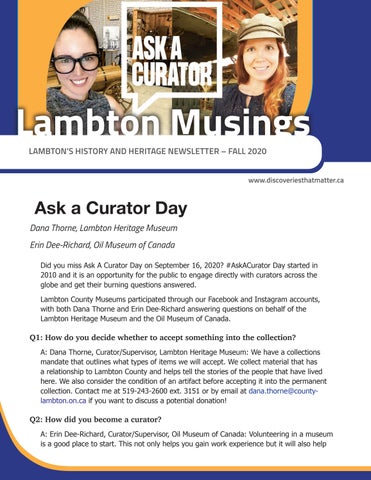
Lambton Musings LAMBTON’S HISTORY AND HERITAGE NEWSLETTER – FALL 2020
www.discoveriesthatmatter.ca
Ask a Curator Day Dana Thorne, Lambton Heritage Museum Erin Dee-Richard, Oil Museum of Canada Did you miss Ask A Curator Day on September 16, 2020? #AskACurator Day started in 2010 and it is an opportunity for the public to engage directly with curators across the globe and get their burning questions answered. Lambton County Museums participated through our Facebook and Instagram accounts, with both Dana Thorne and Erin Dee-Richard answering questions on behalf of the Lambton Heritage Museum and the Oil Museum of Canada.
Q1: How do you decide whether to accept something into the collection? A: Dana Thorne, Curator/Supervisor, Lambton Heritage Museum: We have a collections mandate that outlines what types of items we will accept. We collect material that has a relationship to Lambton County and helps tell the stories of the people that have lived here. We also consider the condition of an artifact before accepting it into the permanent collection. Contact me at 519-243-2600 ext. 3151 or by email at dana.thorne@countylambton.on.ca if you want to discuss a potential donation!
Q2: How did you become a curator? A: Erin Dee-Richard, Curator/Supervisor, Oil Museum of Canada: Volunteering in a museum is a good place to start. This not only helps you gain work experience but it will also help
you determine which area of the museum interests you the most. Whether it’s working with people in front of house duties, educating guests as a docent or museum educator, or working behind the scenes with the collection or preparing exhibits. There are lots of different programs that you can take to prepare you for a career in museums like the Ontario Museum Association Museum Studies program or higher education offerings from colleges and universities. That said, a lot of museum professionals don’t always have the straightest route to their current museum role and this helps bring diversity to the museum and the services they offer.
Q3: What is your favourite, most unusual artifact you have in your collection? A: Dana Thorne, Curator/Supervisor, Lambton Heritage Museum: There are so many to pick from! One incredible artifact is a prisoner’s box. After the Rebellion of 1838 in Upper Canada (now Ontario), over 1,000 men were jailed as traitors. Many prisoners carved delicate trinket boxes as gifts to loved ones, inscribed with verses expressing love for family and friends and celebrating freedom and liberty. The box in our collection was made by Captain George Barclay. He was convicted of high treason and sentenced to several years in prison followed by banishment. After a few years in prison, he was pardoned. Barclay completed this box on June 25, 1838. It was a gift for his daughter, with two separate inscriptions: Beauty is a flowe[r] that fades, Soon it falls in time’s cold shade, Virtue is a flower more gay, That never dies nor fades away Tho’ I be doom’d in Tyrants chains, To loiter to the tomb My mind will still while life remains Be plac’d on you and home.
Q4: What’s your largest object? A: Erin Dee-Richard, Curator/Supervisor, Oil Museum of Canada: Our 1918 Procor Limited tank car used for 40 years to transport bulk oil along the rail lines, is definitely the longest. Or maybe it’s the RA-38 #1 natural gas compressor which was one of three compressors used at the Dawn
Storage Plant. This object is so large that the building it is displayed in was built around it! The compressor was retired in 1992 after 50 years of service.
Q5: What’s the first museum you visited? A: Erin Dee-Richard, Curator/Supervisor, Oil Museum of Canada: I think the first museum I visited is the Royal Ontario Museum in Toronto. As a child I was fascinated and terrified of The Bat Cave. But since then, I’ve loved immersive galleries/experiences in museums.
Q6: If you could add something to the museum, what would it be? A: Dana Thorne, Curator/Supervisor, Lambton Heritage Museum: Lambton Heritage Museum should represent our entire community, and I’m interested in artifacts that will diversify our collection and better represent our local minority groups. I want all our visitors to see part of their personal experience reflected in our artifacts and our interpretation.
Q7: In the 1800s was special clothing worn to protect while harvesting the oil? (like rubber coated material) A: Erin Dee-Richard, Curator/Supervisor, Oil Museum of Canada: As far as we know, the short answer is no. From historic photographs and diaries of the time, the local oil workers wore typical Victorian labourers clothing. The #InternationalDrillers while abroad however, often wore a white muslin suit and a pith helmet.
Q8: Do you have a personal collection at home: A: Not surprisingly, many curators like to collect in their personal lives too. Learn about LHM Curator/Supervisor Dana Thorne’s personal collection, and why she might not be able to continue collecting these items in the future! Watch the video here.
Q9: Will you get a museum cat? A: Dana Thorne, Curator/Supervisor, Lambton Heritage Museum: This question was directed to my colleague Erin Dee-Richard at the Oil Museum of Canada, where they had a stray feline visitor on the grounds in recent weeks! The Oil Museum will not be getting an official museum cat, but this is a great chance to share about Lambton Heritage Museum’s cat, Jack. He lives in one of the large exhibition halls on our museum grounds and keeps the rodent population at bay. Jack is friendly and likes to give tours to visitors! He’s very curious, and you can see Jack checking out one of the artist demonstration that we had for Paint Ontario over the weekend.
Moore Museum Update Staff, Moore Museum Moore Museum’s site remains closed to the public for the safety of our community, visitors, volunteers and staff. While we cannot welcome you in person staff are working behind the scenes to continue our work of preserving the history of the former Moore Township section of St. Clair Township and sharing this heritage with you. You can watch for news from Moore Museum on our Facebook page or Instagram @mooremuseum. You can also call us at 519-867-2020 or reach us through the Contact Us page on our website.
Wartime Rationing Seeing empty shelves in grocery stores and limits on the purchase of certain items was a new experience for most of us during the early part of the COVID-19 pandemic, but these sights would have been commonplace to those who lived during World War II. Rationing was implemented in Canada in April 1942 by the Wartime Prices and Trade Board.
War ration books, Moore Museum collection
With food items and materials such as metals and gasoline being needed for the war effort, many products were rationed for home use. Purchase of sugar, tea, butter, coffee, meat, beer and wine at the store required not only money, but the appropriate ration coupon or token.
At times, even ration coupons and money would not be enough to obtain these items, as supplies were not available. Limits on staples such as meat and sugar required people to make changes in how they would normally prepare meals. Booklets, such as the one from Moore Museum’s collection pictured here, offered suggestions on making the most of your rations. The accompanying recipe from this booklet shows how a wide variety of meats could be used since various meats were in different ration groups. Wartime shortages and restrictions were seen in other ways as well. Stories are told of underwear with buttons due to shortage of
the rubber needed to make elastic and women painting a line up the back of their calves to look like they were wearing nylons. Since canned goods were hard to obtain, “victory gardens” became popular as people planted vegetables wherever they could.
German Christmas Pyramid Many of the traditions we associate with Christmas celebrations in Canada today -- the Christmas tree, nutcrackers, Advent calendars and gingerbread houses -- have their origins in Germany. The German tradition of a Christmas pyramid, however, has not been as widely adopted. For centuries, these carousel-style wooden decorations have been iconic German decorations. When the candles placed at the base of the pyramid are lit, the rising heat causes the rotor at the top to spin, moving the platforms and the figures on them. For home display, these pyramids range in size from a single level to those with as many as 5 platforms. In Germany, there are even large outdoor pyramids at Christmas markets, some huge enough to walk into! The Christmas pyramid pictured here, from Moore Museum’s collection, was brought to Canada from Germany by the late Paul Willock when he was stationed in Germany as part of his military service. Many pyramids feature nativity scenes like this one, but there are also those with forest scenes, animals or scenes of everyday life.
Christmas pyramid pictured
Home and Away: Sarnia-Lambton at War
On Remembrance Day, our panel of heritage professionals from across Lambton County recognized our war veterans. We discussed amazing stories about the sacrifices that were made by our military overseas, as well as the contributions of brave men and women on the home front.
List of Panelists: David McLean, Forest Museum Nicole Aszalos, Lambton County Archives Erin Dee-Richard, Oil Museum of Canada Gordon Mackenzie, Plympton-Wyoming Museum Kailyn Shepley, Sombra Museum Laurie Mason, Moore Museum Greg Stott, Historian, University College of the North
If you missed the live presentation, you can watch the recording now! https://www.youtube.com/watch?v=kZ45XaT-Y9s&t=1371s
Wansted Train Wreck Plaque Dedication Bill Munro, Plympton-Wyoming Museum The following are remarks from the official unveiling of the commemorative plaque to mark the Wanstead Train Wreck, which took place October 6, 2020.
Friends, neighbours, interested local historians and descendent relatives of the 1902 crash victims, welcome to the 1902 Wanstead wreck site commemorative marker unveiling. The PWHS decided to commemorate the 1902 train wreck here at Wanstead as one of its ongoing historical plaque committee projects. It was felt that it would be altogether fitting that we should do this. On December 26th, 1902 at approximately 10:10 in the evening, two trains, an eastbound freight and a westbound passenger, came into collision just southwest of here, killing 29 and injuring many others. We are recognizing those victims of the horrific carnage, those who died at the wreck scene and those who were grievously injured …. those who now belong to the ages. This plaque will serve as a brief historical notation for present and future generations so that the 1902 event here can be appreciated and reflected upon. On behalf of the Plympton-Wyoming Historical Society and the PWHS historical plaque committee, I would like to present the 1902 WANSTEAD TRAIN WRECK commemorative historical marker. The PWHS would also like to extend its thanks to the many others who provided photographs, anecdotes and research that contributed to help this project come to fruition. A special thanks to the Town of Plympton-Wyoming for its generous support with this project.
For those who would like to see the plaque and read the story, it is located about 5.5 kms from Wyoming (Confederation Line to Wanstead Rd), turn right, just past the Co-Operative office on the east side of the road.
Imperial Oil: The Driving Force of Allied Supply Chain Success By Haley Miller, Oil Museum of Canada, National Historic Site Behind the scenes of World War II, Imperial Oil Limited was providing the Allied soldiers with the materials needed to succeed in the war. The Allied air forces used 14 times more gasoline in one day than the Allied powers had used in the entirety of the First World War. Close to half of Imperial’s production supported the war effort.1 Imperial Oil had to find the oil to refine and sell. They held continuous geological surveys, searching throughout Canada for oil reservoirs deep below the ground surface. Even though the company didn’t find any new major oil fields during the Second World War, Canada’s biggest oil discovery, Leduc No. 1 (Alberta), was founded in 1947 due to extensive seismic surveys. The Leduc oil “discovery was certainly a reward for great perseverance, but equally important it marked the arrival of seismic as a key exploration tool.”2 With Imperial’s refineries working to maximize output, the company produced high-octane gasoline to fuel training aircraft in Canada as well as fighter planes flown in the direct line of battle. 3 High-octane fuel improved overall plane speed and performance leaving the Axis powers behind in the dust. Beyond the search for oil, Imperial had to refine it too. Imperial hoped to expand Norman Wells’ (Northwest Territories) oil production to 3,000 barrels of crude oil daily and exceeded this by January 19434 pulling 4,000 barrels a day.5 When the overall amount of oil pumped increased, Imperial Oil improved refining numbers as well. Even 1. Imperial Oil Limited, “On November 11, Imperial Remembers,” Accessed June 4, 2018, http://www.imperialoil.ca/en-ca/company/our-stories/community/on-november-11-imperial-remembers. 2. Robert D. Bott, Evolution of Canada’s Oil and Gas Industry, 24. 3. Barry Broadfoot and Mark Nichols, Memories: The Story of Imperial’s First Century as Told by its Employees & Annuitants (Don Mills, ON: Plow & Watters Printing Canada Ltd., 1980), 24. 4. Trevor Lloyd, “Oil in the Mackenzie Valley,” Geographical Review 34, no. 2 (1944): 275-307, doi: 10.2307/210122, 280. 5. Barry Broadfoot and Mark Nichols, Memories, 33.
in Newfoundland (which joined the Confederation of Canada in 1949), the company was made responsible for supplying all of the island’s petroleum products, while managing the crucial fishing, mining, lumber, and paper mill industries as well.6 Although finding and refining oil is an imperative part of the process, transporting the oil is just as important. One way Imperial transported their crude was by pipeline. Imperial contributed heavily to the Canol pipeline, an American and Canadian combined war effort project. After the loss faced by their naval force at Pearl Harbor, the Americans felt the invasion of Alaska was imminent and decided to defend Alaska by airplane, which would require a consistent supply of petroleum.7 It was Imperial Oil that stepped in to assist the American military planners in “an attempt to secure [an oil] supply from a source [i.e. Norman Wells] relatively close to Alaska and to transport it over a safe inland route.”8 Beyond the Canol pipeline, one “of the war’s best guarded secrets was ‘Operation Shuttle’ on the east coast, which kept oil supplies flowing to Great Britain during the two years before the U.S. declared war. The oil was gathered in a huge storage plant built and operated by Imperial at its Halifax refinery for the British Petroleum Board.”9 This operation was known by very few despite the amount of traffic at the refinery.10 Like military men on a top-secret mission, Imperial Oil contributed largely to the war in the most inconspicuous way. During the world wars, every citizen was expected to help in the war effort. Athol Mitchell, a female stenographer hired by Imperial, recalled the days before the war: “I remember the days when no woman could work at Imperial Oil when she became married and they never engaged a married woman. . . . The war changed everything — they took married women in, they took anybody they could get.”11 The remarkable perseverance of the Allied powers in World War II would not have been possible without petroleum company Imperial Oil Limited on their side. Not only did Imperial supply high-octane fuel for Allied fighter planes and important materials for the synthetic rubber-making Polymer Corporation, but it also contributed to the crucial refinement and transport of oil, employment of women, and a top-secret military mission. 6. Imperial Oil Limited, The Imperial Oil Review Vol. XXIX No. 3, Winter 1945, 7, http://www.glenbow.org/ collections/search/findingAids/archhtm/extras/iolpublications/review-v29n3.pdf. 7. Charles F. O’Brien, “The Canol Project: A Study in Emergency Military Planning,” The Pacific Northwest Quarterly 61, no. 2 (1970), 101. 8. Ibid., 101. 9. Imperial Oil Limited, The Imperial Oil Review Vol. XXXIX No. 4, Fall 1955, 18. 10. Ibid., 18. 11. Barry Broadfoot and Mark Nichols, Memories, 28.
Lost Mission of the Jesuits Glenn Stott, Arkona Lions Museum and Information Centre One of the enduring “folk stories” associated with the Ausable River is the ‘Lost Mission of the Jesuits’ which was recorded in Andrew Dixon’s booklet, “What Most People Don’t See at Grand Bend”.1 The original story was recorded in Pioneer Michigan Collections in 1884 with the interview of a Port Huron pioneer, Edward (Eduard) Petit, who once traded furs along the shores of Lake Huron in the 1820’s.2 Petit told the story of trading with a group of Chippewa in the neighbourhood of the Ausable River in 1828, forty miles from Sarnia. While waiting for the Chippewa to arrive, he wandered inland from the lake and came across a ruin of a house beside the Ausable. The house measured 40’ x 24’. At the south end of the ruin was an 18’ high chimney which was made of stone and was built on a stone. It had sunk into the ground somewhat but otherwise was well preserved. The ancient ruin was surrounded by a garden approximately 60’ by 100’. There were ditches and alleys throughout the garden. Most notable, however, was the presence of a huge oak tree growing inside the ruins. It was 3’ in diameter, and reached 60’ in height and must have been at least 150 years old. Petit asked an old Saguenay chief, Onicknick as to the background of the house. Onicknick stated that the house was built by a white man when his great-great-great-great grandfather was alive, when white men lived in all the country round but were not Frenchmen. In 1889, the same interview was recorded in the History of Middlesex County by Goodspeed. Onicknick stated the men were not French, but the editors reassured the readers that, “The building could not have been erected so far back by any white men except French Missionaries or adventurers. Onicknick was mistaken as to the lapse of time.”3 The story seemed to lapse into forgotten history. Historians such as Norman Gurd and James Coyne espoused the theory that indeed the Jesuit Missionaries established missions among the Attawandaron First Nation when Brebeuf and Lalement visited them in the years 1641-1642. The one located on the Aux Sables River was known as St. Francois. These “missions” were marked on the early French maps of 1656 and 1657 by DuCreux and Sanson. Therefore Petit’s story did much to give credit to the Jesuit Mission in the Aux Sables River area. Unfortunately, the site of the mission was lost. Several years ago, I researched the story of the ‘Lost Mission’ with a strong feeling that it 1. Andrew Dixon, What Most People Don’t See at Grand Bend, 1963. 2. Pioneer Michigan Historical Collections, Vol. V, 1884, Michigan Historical Society, pp.496-499. 3. Goodspeed, History of Middlesex County, p. 42.
could be found. I went to Pinery Park and talked with Park Naturalist, Terry Crabe about the Lost Mission on the Aux Sables. He said that if such a structure existed with a 3’ thick Oak tree growing in the middle, it would only occur in and around Port Franks as the Pinery and Grand Bend area were part of an Oak Savannah which produced stunted trees. My next visit was the head archaeologist with the Ministry of Culture and Citizenship in London. He reassured me he had heard of the story but the historic evidence did not support it. The maps of New France showing St. Francois on the Aux Sable were not accurate. They were made by two map makers who had never been to New France and recorded information with no real understanding of what they were recording. The archaeologist also stated that by 1600, Southwestern Ontario was abandoned by the Attawandaron due to their ongoing war with the Fire Nation of the Lake St. Clair area. Archaeologists have never found any post1600 Attawandaron artifacts west of the Grand River. If there were Jesuit missions among the Attawandaron they would have been located in the Hamilton-Niagara area, east of the Grand River! The archaeologist said one map maker, Francesco Guisseppe Bressani had created a map of New France in 1657, after having lived among the Jesuits at St. Marie Among the Hurons. His map showed all the Jesuit ‘missions’ to the Attawandarons, located east of the Grand River. Locals at Port Franks have known the story of the Lost Mission and some have ideas as to what happened to it. The sand dunes are thought to cover the mission, although the Port Franks dunes have been very stable for hundreds of years. Others said that the stones from Detail from Francesco Giuseppe Bressani’s 1657 map the chimney etc. were taken to build of New France showing settlements east of the Grand River. Courtesy of Library of Congress. G3400 1657 .B7 various buildings in Port Franks over the years. Others speculate that Petit had a very vivid imagination. It is important to note that when Petit had told his story in 1884, there were no theories of Vikings coming into the interior of North America. Petit gave us very detailed descriptions that suggest an actual sighting of something unusual. The difficulty is coming to grips with the “non-French” and the reference by Onicknick that the house was built at a time “when white men lived in all the country round.” If the age of the oak is reasonably accurate, that would date the “house” to have been built before 1678. That would have been almost 30 years after the Six Nations dispersed the Huron, the Petun and the Attawandaron from Western Ontario. Just after this time, the Ojibway in turn dispersed the Six Nations from Southwestern Ontario by 1701. Was there a period of time when “white men” came and traded among the Ojibway-Chippewa Nations throughout the area and perhaps were centred around the Ausable River? Perhaps the descendants of the First Nations living in our area have an answer. Nevertheless, Lost Mission of the Jesuits is a part of Lambton County’s folk history. While you are walking the numerous trails around Port Franks keep your eye open for remnants of Eduard Petit’s remarkable find.
Lambton County Branch of Ontario Ancestors [The Ontario Genealogical Society] Alan Campbell, Ontario Genealogical Society, Lambton Branch Genealogy or Family History researchers can reach us at lambton@ogs.on.ca with genealogical research queries or for research advice. We are also maintaining contact with members and other researchers via our Facebook group. Our upcoming webinar scheduled for December 10, 2020, has as its presenter Lesley Anderson, Ancestry.com’s Canadian representative. She will be talking about what early immigration and military records are available for Canada and how you can find them on www.ancestry.ca. This webinar is open to the general public as well. You can register to attend the webinar by clicking here. Genealogically related materials are added to our website on a regular basis. We have enshrined most of our family history book collection on our website, found here, in Members’ Resources in digitized format. These family history books can be accessed in paper form at the Lambton County Archives. The Members’ Resources are available for members of Lambton County Branch only but we have other materials that are open to all. December is an ideal time to join Ontario Ancestors, our parent organization, as a member. We have a half price deal if you join in conjunction with a present member of the organization. Contact lambton@ogs.on.ca or post on our Facebook group if you wish more information. For an additional $15 you can become a Lambton County Branch member.
On display at Lambton Heritage Museum until April 2021:
Capturing the Moment: Photography in Lambton County Complemented by a free digital lecture series with topics related to photography. Check out the Capturing the Moment feature exhibit page on our website for the full lecture list, and to watch recorded videos if you miss any of the lectures live!
Memories of Rural Life Enjoy the captivating work of local folk artist Annie McLaughlin. This feature exhibit explores rural landscapes and local families through Annie’s art and her memories.
We hope that you enjoy these holiday greetings, courtesy of the collection at the Lambton County Archives!
CHRISTMAS TREE CRAFT You will need: • 2 pieces of green construction paper • 1 strip of brown construction paper • Scissors • Tape
Keep busy at home this holiday season with this fun Christmas craft!
1. Carefully trace matching Christmas trees on two pieces of green construction paper and cut them out.
2. Create a slit in the middle of the tree about half the length down from the top of one piece.
3. Create a slit in the middle of the tree about half the length up from the bottom on one piece.
4. Slot the two trees together and tape them into position.
5. Take a strip of brown construction paper and form a loop that fits around the base of the standing tree.
6. Tape the ends of the loop together. Carefully tape the tree to the base. TIP: This will help the tree stand up.
Need a few pointers? Catch our instructional video on the Museum @ Home section of our website: www.heritagemuseum.ca Lambton Heritage Museum wishes you a safe and happy holiday season!
Heritage Sarnia-Lambton Members Moore Museum
94 Moore Line, Mooretown, ON 519-867-2020 Facebook Page
Arkona Lions Museum and Information Centre
8685 Rock Glen Road, Arkona, ON 519-828-3071 Facebook Page
Plympton-Wyoming Museum 6745 Camlachie Road, Camlachie, ON Facebook Page
Lambton Heritage Museum 10035 Museum Road, Grand Bend, ON 519-243-2600 Facebook Page
Oil Museum of Canada 2423 Kelly Road, Oil Springs, ON 519-834-2840 Facebook Page
Sombra Museum
3476 St. Clair Parkway, Sombra, ON 519-892-3982 Facebook Page
Lambton County Archives
787 Broadway Street, Wyoming, ON 519-845-5426 Facebook Page
Forest-Lambton Museum
8 Main St. North, Forest, ON Facebook Page
Additional Contributors The Ontario Genealogical Society, Lambton Branch Facebook Page