Lambton Musings LAMBTON’S HISTORY AND HERITAGE NEWSLETTER – FALL 2022
www.discoveriesthatmatter.ca
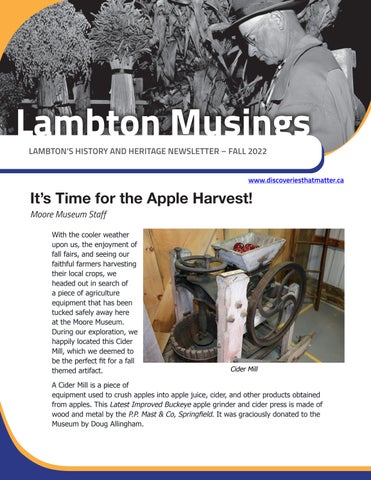
It’s Time for the Apple Harvest! Moore Museum Staff With the cooler weather upon us, the enjoyment of fall fairs, and seeing our faithful farmers harvesting their local crops, we headed out in search of a piece of agriculture equipment that has been tucked safely away here at the Moore Museum. During our exploration, we happily located this Cider Mill, which we deemed to be the perfect fit for a fall themed artifact.
Cider Mill
A Cider Mill is a piece of equipment used to crush apples into apple juice, cider, and other products obtained from apples. This Latest Improved Buckeye apple grinder and cider press is made of wood and metal by the P.P. Mast & Co, Springfield. It was graciously donated to the Museum by Doug Allingham.
There were two stages to the workings of the Cider Mill. First, apples were gathered and placed inside the large hopper on top. As the large side wheel was spun, the apples were ground and milled when they were fed through the rotating metal blades down at the base. The milled apples fell into a waiting slotted barrel below where the result of the milling creates a mass called “pulp.” For the second stage of the Cider Mill, the barrel of pulp is transferred to sit underneath a screw type press. A wood lid that fits just inside the barrel is then placed upon the pulp. While turning the press with the help of another steering wheel with handle grips, the pulp from the ground up apples is pressed to release the juice or “must.” It seeps out from the slats of the barrel through grooves in the base and into a waiting container. The solid parts of the apples remaining is called “pomace.” Once we located and chose the Cider Mill, we came across a few other accessories of apple harvesting close by, like the Apple Grader and Dryer. These are round metal circles that are linked together in a grid, and were used to size, core, and dry apples. And last, but not least, two Fruit Pickers. Fruit Pickers make gathering apples and other fruit from trees much easier. The Fruit Picker is both a simple and effective way of harvesting fruit that is just out of reach.
Apple Grader and Dryer
Fruit Picker
Wood is King David Wilson, submitted by Gordon Mackenzie for the Plympton-Wyoming Museum In Upper Canada, wood was the prime resource that settlers relied on. Nearly all facets of life in early settlements used wood. Fortunately, Upper Canada had an abundant supply of wood in both the coniferous and deciduous variety. Yes, wood was the King of the pioneer resources in the 1800s in Upper Canada. Trees provided settlers with a workable material to erect a wilderness home. Tall straight pines were cut down and logs of uniform size were gathered to construct the log cabin. The logs were squared with a broad-axe and notched at the ends for a secure corner fit. The adze shaped the logs. This tool required considerable skill to operate. A cross-cut saw cut rough planking from the logs to make floorboards, window frames, door frames, and boards for the door. Some planks were cut out to make furniture and shelves for storage. The making of planks was a slow and very tedious task. A saw pit was constructed. One man stood in a pit while the other stood on the log above him to operate the two handled cross-cut saw. After a community grew in size, a stream was dammed, and a sawmill powered by a waterwheel established. A vertical blade known as a muley saw cut the logs in a similar manner as the pitsawn logs. The sawmill was a great improvement and allowed the settlers more time for other important matters. In later years, the buzz saw (circular saw) made cutting logs into planks simpler and cheaper to accomplish. A settler might take six logs to the sawmill to be cut into boards and the miller would keep the boards from two of the logs as payment for his services. The sawn boards allowed farmers to erect drivesheds, barns, and other outbuildings needed on the farm. The arrival of the sawmill allowed construction of frame buildings, and many settlers were quick to construct a new frame home. In the first years of settler life in the wilderness, they fashioned most of their tools from wood. This included wooden spades, rakes, flails, and even a wooden plough and harrow to cultivate the land. Many times, farmers made the wooden handle, while the blacksmith mad the cast iron part of the tool. Quite often, these tools and handles were made after supper when the settler sat quietly by the fireplace and whittled out of a piece of wood. The clearing of land for crops was a major undertaking and often accomplished with a clearing bee. A group of farmers assembled at a given farm and began to cut down the forest. The logs and brush were hauled into a clearing to be burnt. The ashes were gathered and sold for the manufacturing of potash. The stumps were removed by a stumping machine. The stumps were then arranged in rows to form the first fences on the farm. Even in clearing the land, the wood brought income to settlers and assisted in enclosing their farms. Wood, wood, everywhere, could have been the slogan in early Upper Canada. These settlers were able to create a country out of the wilderness because they had a useable and workable natural resource called wood. Wood certainly was King!
Collection Highlight: Pressed Glass Colleen Inglis, Lambton Heritage Museum You will always find a selection of pressed glass on display at Lambton Heritage Museum. Have you seen this collection before? One of the more curious pieces is a diminutive top hat. Its whimsical shape conjures up visions of white rabbits and magic tricks. Glass has important qualities that make it a useful and desirable material. It does not conduct electricity; it is inert; and it transmits and focuses light. Glass is made from just three ingredients: sand, soda, and lime.
Pressed glass top hat.
Five thousand years ago, ancient Egyptians created objects from molten glass. The technique of blowing glass using a blowpipe developed around 100 BCE. The process was laborious and required great skill. In the early 1800s, technological advances made it possible for unskilled labourers to quickly produce pressed glass objects using a mold. Under these conditions, glass production in North America blossomed.
Pressed glass plate in maple leaf pattern.
The earliest Canadian glassworks opened in 1839. By 1900, many companies were in business. Their products included containers, window panes, lamp chimneys, and tableware. Pressed glass could be clear or coloured. Sets of tableware included different pieces such as goblets, plates, pitchers, and celery trays. Tableware patterns were created to suit every taste, from angular geometric to realistic images of people, animals, and objects.
Most pressed glass does not have a maker’s mark. North American companies shared their molds and made the same patterns. This makes it difficult to tell where a particular piece was made. The maple leaf pattern is believed to be uniquely Canadian. There are more than 600 pieces of pressed glass at the museum. The collection started with a donation by Fred Walden. It included the largest collection of pressed glass water pitchers in Canada. A further 200 pieces were donated by W.H. Hostetler. The richness of the museum’s collection makes it an important resource for pressed glass enthusiasts.
Pressed glass items on display. Note the top hat at the bottom right.
A behind-the-scenes look at pressed glass items stored in the Collections Centre at Lambton Heritage Museum.
The Forest Cenotaph Sandy Burkhart, Forest Museum One hundred years ago, the memorial monument erected by citizens of Forest was dedicated with these words: “To the Glory of God, and in honoured memory of the men of this community who during the Great War of 1914 – 1918, gave their lives for God, for King and Country, for loved ones, home and Empire, for the sacred cause of justice, I hereby dedicate this memorial.”
The Forest Cenotaph dedicated ceremony on October 22, 1922. This shows the cenotaph in its original location near the railroad station.
The dedication ceremony was held by Lieutenant-Governor, Colonel Harry Cockshut, in memory of the boys who laid down their lives in the First World War. The dedication took place October 22, 1922. Approximately 3,000 people attended.
The Forest Excelsior Band led a procession composed of veterans in uniform, Boy Scouts, and school children from the town hall to the cenotaph site on King Street, north of the railroad station. It would have been an impressive sight. At the memorial site, an Honour Guard was formed by veterans and Boy Scouts. In charge was Lieutenant-Colonel C.J. Woodrow (Sarnia), commanding the Lambton Regiment. Also included were Major Robertson (Sarnia), second-in-command, Major Williams (Arkona), commander of the Forest Company, and Water Middleton, in charge of the Scouts. The Lieutenant-Governor and his Aide-de-campe, Colonel Alexander Fraser, inspected the guard. The chairman was Dr. J.P. Hubbard. The names of those appearing on the cenotaph were read: Joseph W. Cole
Dr. A.E. Lloyd
Walter Venneear
Frederick Cole
John M. Patterson
John L. Warwick
Charles E. Cole
Ellsworth Rogers
Orville Wilson
The following names were added later: Gordon Ellerker, Lieutenant John W. Coultis, and Harry Jennings.
The last post was sounded by Lance-Corporal W. Taylor of the Royal Canadian Regiment. The soldiers’ memorial was paced in position by J. Rupp, local marble dealer. The statue of the soldier was made in Italy and shipping to Forest.
The Forest Cenotaph is moved to its new location in front of the Forest and Community Recreational Centre in 1950.
A modern view of the Forest Cenotaph.
In 1950, the statue was moved in front of the Forest and Community Recreational Centre. Forest has since built a new sports complex but Remembrance Day services are held here at the Townsend Line site each year to date. Recently, several Vimy Oak saplings were planted on the grounds. These saplings are true descendants of one of the Vimy Ridge acorns sent home to Canada by Lieutenant Leslie H. Miller. He named the trees grown from these acorns the Vimy Oaks. Descents of these Vimy Oaks were especially grown to mark the 100th anniversary of the Battle of Vimy Ridge and in remembrance of all the Canadians who fought in the First World War. Forest Museum will mark Remembrance Day with a window display as we are closed for the season after Thanksgiving. We have an interesting and evocative military display in the museum with many photographs and personal memorabilia from both WWI and WWII. Over the winter months, the museum volunteers will continue to improve displays and prepare new acquisitions for the summer season. We were fortunate to have two dedicated students working for us in the summer. Museum volunteers will be participating in a craft show at the Forest Legion in November to raise some much needed funds. We also have a calendar sale as a fundraiser. These will be available at the craft show as well as our Facebook page, @ForestLambtonMuseum. The calendars are $20 each and make thoughtful Christmas gifts. This year’s calendar features photos and stories about some of our more interesting and colourful artifacts.
Credits to Forest: Its Beginnings and More by Mora Huctwith, the Forest Legion webpage, and Forest Museum archives.
Haunted Happenings in Petrolia Lauren Ihrig, Lambton County Archives The month of October lends itself to timely discussions of haunted happenings and paranormal activity in the lead up to Halloween. This includes the buildings of Lambton County where ghostly sightings have been recorded and shared in local newspapers and folklore, alike! For this edition, we are sharing two instances of ghostly mentions in Petrolia… The first eerie encounter takes us to Petrolia’s historic Victoria Hall. In an article featured in the Sarnia Observer in October of 1999 and titled “Petrolia Victoria Hall said to have real Halloween ghosts”, former Victoria Hall manager Debra Walker tells of ghostly encounters, including a particular spirit who likes to sit in the front row aisle chair and another faceless apparition she once witnessed seated in the middle section of the theatre. Readers are also introduced to Henry “Harry” Brown – a Petrolia resident and murder victim discovered in Victoria Hall’s Furnace Room in March of 1949 by then Collection Photograph – Victoria Hall janitor George Jackson. Brown’s grandnephew Murray (9ED-E Victoria Hall 1) Brown (former Petrolia town Councillor from 1994 to 1997) shares about the ghost’s plausible identity and link to Brown’s family heritage in the same 1999 piece. Strange feelings felt when visiting Victoria Hall along with reported ghostly sightings are part and parcel of this tale. Looking back to a contemporary Petrolia Advertiser-Topic article, which ran on 17 March 1949, the paper goes into even greater detail as to the events which surrounded Brown’s untimely death. The paper outlined the shock felt within the community to learn of Brown’s murder at the hands of another local, 27-year-old Ralph Howlett. While 63-year-old Brown had served as “a former oil driller and globe-trotter,” Howlett was known in the community as a married, former refinery employee and army veteran. Brown’s death in 1949 was the first documented murder for the town since March of 1926.
Howlett’s arrest was not immediate as it was only after an autopsy of Brown’s body and discovery of a fractured skull and wound at the back of his head that foul play was suspected. It was surmised that the motive for the murder may have been robbery, once it was determined that Brown’s wallet “believed to contain considerable money” was first missing then located on the roof of another building. Later, Howlett would admit to “being in the company of Brown on the night of the fatality, and of having been engaged in a fight with him in the town hall.” Howlett was eventually found guilty of manslaughter and in September of 1949 was sentenced to nine years in prison. The second instance of a “thrilling ghostly visitation” predates the story of Mr. Brown and takes us over to Eureka Street, to the home of Mr. Hiram Bennett who lived there for a time in 1898. The following excerpt was taken from the Petrolia Advertiser & Canadian Oil Journal front page on 19 January 1898 and speaks of a “ghostly visitation” at the residence:
“Ghosts – Seldom does Petrolia have a thrilling ghostly visitation. We were notified yesterday that uncanny characteristics occurred at the house of Mr. Hiram Bennett, on Eureka St., on Sunday and Monday nights last. So mysterious were the actions of the furniture and the house generally that Mr. Bennett and wife are a badly scared people, as much so that they promptly left the premises on Monday night. They stoutly maintain that the house they have just left is haunted, and they cannot live in the same house with ghosts. No ghost actually appeared unto the household, but some mysterious cause opened the door in spite of efforts to close and latch it, the fire absolutely refused to burn, and the lamps danced jigs on the tables and cut up capers quite unbecoming to such sedate articles of usefulness. The tables performed antics that completely astounded the Bennett’s, and it is little wonder that they took fright and deserted such an unreliable and terror-inspiring habitation. If we have any experts on ghosts in Petrolia, now is the time for them to come forward and clear up a very strange and extraordinary case.”
“Ghosts” – Article from the Petrolia Advertiser & Canadian Oil Journal published 19 January 1898 (Front Page)
It would appear Hiram Chase Bennett and Margaret (Darch) Bennett lived in Petrolia at the time of their marriage in 1895. The former was born in Scugog Island near Port Perry, Ontario and the latter in London, Ontario. A passenger card registration for Mr. Bennett suggests that by August of 1898, the Bennetts were living in Detroit, Michigan where Mr. Bennett worked as a blacksmith and later as a tool smith. Hiram Bennett passed on 30 November 1931 and Margaret a decade later on 12 February 1941. For more on haunted happenings in Lambton, visit the Lambton County Archives!
Remembering the CGS Lambton Mike Brown, on behalf of Sombra Museum Fleet Safety Officer, Great Lakes Sector, Canadian Coast Guard
CGS Lambton
This April 19th, 2022 marked the 100th anniversary of the tragic sinking of the CGS Lambton and the loss of 22 souls aboard. The story of the CGS Lambton is one of Great Lakes folklore, superstition, and mystery. The ship foundered in one of Lake Superiors’ legendary and ferocious storms in early spring 1922, while commissioning seasonal light stations on Lake Superior. To this day, the wreck of the CGS Lambton, and the remains of her crew, have never been found. The CGS Lambton was built at Sorel, Quebec in 1909. She was commissioned in response to an increasing need for lighthouse re-supply vessels, since the governments network of lighthouses was at this time rapidly expanding towards the northern port of Lake Superior. Unlike the Coast Guard Ships of todays standards, the CGS Lambton was built more in the style of a yacht or small passenger vessel than a working ship required to do some light icebreaking and resupply work in Lake Superior. She had a thick steel hull with a wooden superstructure, and had some resemblances to a tugboat.
As stylish and nautical as the Lambton may have seemed with her fine lines, plate-glass cabin house, and traditional brass rail trimmings, she was hardly a practical vessel and she was barely capable of what was expected of her. She had a reputation amongst the rank and file as a dangerous ship, as it also apparently lacked critical distress, lifesaving, and communications equipment. In 1921, a year before the tragedy, George Johnston, then Superintendent of Fog Alarms at Parry Sound Base, after having transited on the Lambton in Lake Superior in the fall of that year, wrote that “Her lower decks were so low that even small seas came aboard, and her upper and deck housing were so light that a good sea could carry them away. She was slow and did not answer to her helm properly, and her steering gear was exposed and would freeze solid, if she were caught out in a sea in freezing weather. There was no accommodation for the keepers, and certainly not for their families. Her lifeboats and davits all had to be handled by hand, and on a slippery deck, that was very dangerous, if not impossible in a heavy sea, as the Lambton was very unsteady and rolled badly in any kind of sea.” All said, the Lambton was hardly suitable for Lake Superior in early spring or late fall.
Superintendent, Fog Alarms & Marine Agent, Parry Sound onboard the CGS Lambton
Spring Breakout: At the port of Sault Ste. Marie, the early spring of 1922 saw a small line-up of eager ships waiting for the last of the winter ice to clear out of Whitefish Bay so they could make their first runs of the season into the upper lake. Along with these ships, the CGS Lambton also fitted out at Sault Ste. Marie, after having spent the previous winter in layup there. She was commanded by Captain Alex Brown, then known as one of the best navigators on the Great Lakes at that time. Onboard was a crew of 22 personnel including five officers, 12 crew members, and five lighthouse keepers. Crewed by the Parry Sound Marine Agency, the CGS Lambton’s crew hailed from all over Ontario and her orders from the Parry Sound Agency were to deliver supplies and lighthouse keepers in central Lake Superior for the annual commissioning of the prominent light
stations- Isle Parisienne, Gargantua, and Caribou Island. The latter light station being a critical one for shipping in Lake Superior since it is located along the main shipping route. The CGS Lambton departed her berth at 10:30am April 19. She was accompanied by two other steamships - the SS Glenlivet and SS Glenfinnan. The small convoy lead by the CGS Lambton made slow way through ice-packed Whitefish Bay towards Caribou Island. Weather conditions were not favourable as heavy gales were sweeping the upper lakes from the northwest the day before. The three vessels struggled against the ice together, but pressed on, with the ice extending until well past Isle Parisienne. During the struggle the SS Glenfinnan became beset in the ice and the CGS Lambton came to her assistance and broke her out. During this maneuver there was a slight collision between the CGS Lambton and the SS Glenfinnan and CGS Lambton may have damaged her rudder as she was seen afterwards using emergency steering tackle. On the afternoon of April 19 the weather took a turn for the worse and at about 5:00 pm the winds increased to gale force. With conditions rapidly deteriorating, the two vessels following decided to turn back towards Whitefish Point to await better weather. The CGS Lambton, having decided to continue onwards was last seen about 40 miles above Whitefish Point. The ship was last seen by the steamship Midland Prince, the Captain and crew of which reportedly watched the lighthouse tender battle with giant waves, but were unable to render any assistance and, suddenly, the ship disappeared. No distress signals were seen or heard. One of the light-keepers onboard the CGS Lambton was George Penfold, the Chief Keeper at Caribou Island in 1921 and 1922. The lightkeepers in those days were expected to provide their own transportation to and from stations. However, in 1921, Mr. Penfold considered it unsafe to transport himself, and so he asked for assistance. The department agreed and, therefore, this was the first year that lightkeepers were being transported to the stations by a government vessel.
Marine radio message reporting the sighting of CGS Lambton’s wreckage.
The disappearance of the CGS Lambton remains mystery to this day. Only some small pieces of flotsam was recovered, and an empty lifeboat, with the name of the CGS Lambton on it, was found 20 days after the disappearance. A complete search of the shoreline of Lake Superior and the surrounding area of Caribou Island turned up no evidence of the ill-fated ship. It was later concluded that the CGS Lambton was lost with all onboard at about 6:00 pm on Wednesday, April 19th in the vicinity of Caribou Island during the exceptionally strong gale accompanied by snow from the northeast. Today, the name Lambton lives on in the Great Lakes area Coast Guard, perhaps fittingly in the Lifeboat Service: The CCGS Cape Lambton is the 47’ Motor Lifeboat assigned to the Port Dover Search and Rescue Station. As well, an Inshore Rescue Boat Station has been established at Port Lambton, along the St. Clair River. It is estimated that the wreck of CGS Lambton lies in the icy depths of Lake Superior somewhere near Lobby at Parry Sound CCG Base showing Caribou Island, perhaps within only 30 or 40 miles from remaining nameboard above photo of the the legendary wreck of the Edmund Fitzgerald which CGS Lambton foundered nearby in 1975. Some say the Lambton sails Lake Superior as a ghost ship, still searching for her lighthouses.
Western Lake Superior
The Oil Museum of Canada Over the Years Kalea Pottle, Oil Museum of Canada The Oil Museum of Canada, National Historic Site, has been part of the Oil Springs community since 1960. Built at the site of the first commercial oil well in North America, the museum plays a significant role in the preservation of the history of the oil industry, both nationally and globally. The museum building itself has seen two major renovations, one of which was recently completed and celebrated in 2022. On August 15th, 1957 the first official meeting on the establishment of an oil museum took place in Oil Springs between the Lambton Historical Society and the Oil Centennial committee. The Oil Centennial committee consisted of Oil Springs residents who “wanted to carry out a worthwhile project to commemorate Mr. [James Miller] Williams’ pioneer work in the field of oil drilling and refining” for the 100th anniversary of the digging of the first well (1858-1958). Along with the Society and Committee, representatives from British-American Oil, Imperial Oil, and Canadian Oil, local MPPs and MPs, various presidents of historical societies, and planning directors of Lambton County were in attendance at the project planning. The meeting confirmed the need and significance of building an oil museum, how it would be funded, and who would be responsible for coordinating the project. Certain members of both the Lambton Historical Society and Centennial Committee were voted in to form an executive committee that would manage the project. In December of the same year, ownership of the museum was accepted by Lambton County. It was agreed that the museum construction would be funded by oil and related industries in Canada and a project of the Lambton Historical Society. It would be built on Kelly Road in the Village of Oil Springs, on a site purchased then gifted by the Canadian Oil Companies Ltd, with completion and opening of the oil museum set for June of 1958 to coincide with the Village’s centennial celebrations. The projected cost was set at $100,000, which is equal to approximately $1 million today. The opening goal of 1958 was quite ambitious, and ultimately not obtainable. The main museum interior was designed by Austin Displays Limited which worked closely with the technical advisor to the Centennial Committee, Ruth Home. After completion, the original internal displays of the Oil Museum of Canada would be the “most modern in any Canadian museum.” The museum planning team’s philosophy for the site was to be as realistic as possible to the time-period of the oil boom, and to educate visitors on the history and significance of the area and oil drilling, along with its counterparts such as the science of oil and geology, or social history and the home life of drillers and their families; all presented in a chic and modern main museum building. To create this vision, the site on the grounds of the first well was excavated with its “hand hewn” timbers, a wagon-mounted drilling rig was restored to working order,
and the main gallery highlighted day to day living of oil men and their families with displays of clothing and lighting from the period. Also on display were souvenirs brought back from international drillers, and geology exhibits explaining how oil is formed.
Opening of the museum, 1960. From left to right; Bryan Cathcart (Minister of Travel and Publicity), and Lt. Gov. of Ontario Keiller Mackay. Photo courtesy of the Oil Museum of Canada
The high-profile opening day was July 1st, 1960. The official opening ceremony consisted of speeches and acknowledgement from many federal, provincial, and local politicians, with entertainment to follow, “an old hoedown”; a picnic lunch consisting of 1,500 barbequed chickens and guided tours. Approximately a thousand people attended the opening ceremony and two thousand in total went through the museum opening day. Leading the ceremony was Lieutenant Governor of Ontario, John Keiller Mackay. Speakers also included the Minister of Highways and Deputy Minister of Energy Resources, manager of the Canadian Oil Companies refinery, Lambton County Warden, and Reverend Shaw, grandson of Hugh Nixon Shaw.
Since the initial construction of the Oil Museum of Canada in 1960, the site has added to the grounds throughout the years. Additions included such as new outbuildings, and a picnic shelter. In 1991, work began on reconstruction of the main building which brought in temperature and humidity controls, a redesigned foyer, a new ceiling, lighting, a loading dock, added accessibility, and a mural painted by artist, George Rickard. The mural Reopening of the renovated museum, 1992. From left to right: Robert is a recreation of five oil scenes Tremain, John Kreig, Donna McGuire (Curator of the Oil Museum of Rickard had previously produced as Canada), Owen Byers (Lambton County Warden), Glen May, Larry ink drawings. O’Neill, Teneheove, Penny Phillips, Bill Bilton, and two unidentified men. Photo courtesy of the Oil Museum of Canada
Recently, the Oil Museum of Canada underwent extensive remodelling. The goal was to bring the museum back to the 1960 vision of learning about oil history in a modern building while looking out and seeing the oil fields where it all began. The main gallery reopened the curtain wall windows and updated exhibits (including signage and cases), interactive displays, and a refreshed gift shop. Workspace was created in the basement and a new layout in the main foyer. Even the outside was overhauled with new landscaping. Lastly, it replaced end of life equipment and building systems, some of which were from the original build. The museum reopened to the public in February 2022, and a reopening celebration took place on May 27, 2022 to much fanfare. Local politicians, Warden of Lambton County, oil industry representatives, Lambton staff and museum members attended the invitational event. Charcuterie-in-a-cup appetizers were as big of a hit as the 1960 barbequed chicken lunch. Charlie Fairbank, fourth generation of the Fairbank family and owner of Fairbank Oil, summed up the renovations wonderfully when he remarked, “I think it’s fabulous… (the museum’s) brought into this century, instead of the one the oil was discovered at.” The Oil Museum of Canada continues to be a highly significant site for preserving the history of oil. Although the building has changed over the years, the same goals of the 1960s are still held with the utmost importance today. The staff of the museum; past, present, and future, and all of those who contribute in any way are doing so “to a magnificent building with priceless treasures of early life in the area.” The Oil Museum of Canada, National Historic Site has done award-winning work in finding new ways to present the history, creating new exhibits, and collaborating with museums globally to educate the public on Lambton County’s rich oil history, and all aspects of the oil industry.
Reopening of the renovated museum, 2022. From left to right: Laurie Webb (Manager of Museums, Gallery, and Archives for the County of Lambton), Marilyn Gladu (MP for Sarnia-Lambton), Bob Bailey (MPP for Sarnia-Lambton), Kevin Marriott (Lambton County Warden), Ian Veen (mayor of Oil Springs), Erin Dee-Richard (Curator/Supervisor for the Oil Museum of Canada), and Andrew Meyer (General Manager of Cultural Services for the County of Lambton). Photo courtesy of the Oil Museum of Canada
Bibliography
Note: All articles and images were found in the compilation binder “Oil Museum of Canada Celebrating 50 Years 1960-2010” in the Oil Museum of Canada’s research library, aside from those published in 2022. “August Meeting on Oil Springs Museum Plan.” The Windsor Daily Star, July 29, 1957. Iden, Ralph. “Museum of ‘Folly’.” The Windsor Star, May 18, 1963. “Lieu.-Gov. Mackay Officially Opened Oil Museum Of Canada.” July 7, 1960. Morden, Paul. “Public Welcomed Back to the Oil Museum of Canada.” The Sarnia Observer, February 17, 2022. Morden, Paul. “Visitors Welcomed Back to the Oil Museum of Canada.” The Sarnia Observer, May 27, 2022. “MUSEUM OWNERSHIP GIVEN TO COUNTY.” The Petrolia Topic, December 12, 1957. “Oil’s Pioneering Spirit Captured on the Wall of Oil Springs Museum.” The Sarnia Observer, August 21, 1992. Reporter, Staff. “FINAL WORK IN PROGRESS FOR OIL MUSEUM OPENING.” The Sarnia Observer, June 28, 1960. Reporter, Staff. “FOR MUSEUM OPENING/Here’s Program At Oil Springs.” The Sarnia Observer, June 30, 1960. “Sign Contract For Interior Of Oil Springs Museum.” The Sarnia Observer, July 13, 1959. “Value of 1957 Canadian Dollar Today.” Inflation Tool. Accessed August 23, 2022. https://www. inflationtool.com/canadian-dollar/1957-to-present-value. Vega, Natalia. “Oil Museum Reopens after ‘Significant’ Renovations.” BlackburnNews.com. February 14, 2022.
Nostalgia – One Room Schools Alan Campbell, Facilitator/Newsletter Editor Lambton County Branch Ontario Ancestors [The Ontario Genealogical Society] Nostalgia…. At the Ontario Ancestors hybrid meeting this past September, Ed DeJong, a member of the Plympton-Wyoming Historical Society, talked about one room schools in Lambton County. The in-person attendees chatted with him for awhile after his presentation as a couple of them had attended a one room school in Plympton Township. This interaction brought back memories of beginning my teaching career in Lambton County in 1969 at Aberarder Public School in Plympton Township, as part of the county wide system that had been legislated into being in 1968. You too can indulge in nostalgia if you attended a one room school house in Lambton County because our webmaster, Jane Teskey, has been adding school pictures and histories to our website both 1970-71 Aberarder teaching staff. Front row from left on the landing page and in our Lorraine Carruthers, David Wilson, George Bice (principal), Alan Campbell, Mildred Cates, Maureen Weaver, back row Members’ Resources section. from left Margaret McGregor, Mary Ethel Douglas, Judy Check out what is on the landing Robbins, Gail Gilroy, Marilyn Carr, Mabel Van der Veen. page of our website now. Click on the button Lambton Schools Collection or the Lambton High-School Collection. Members of the Branch can access the material in Members’ Resources by signing in using their Ontario Ancestors email and password.
If you have teachers who taught in Lambton County in 1922, 1923, and 1924 among your ancestors, you may be interested in checking out the Lambton County Municipal & Legal Directories created for Lambton’s County Council. Actually, if you had other ancestors in Lambton County during those years you may wish to check out these directories. You can find them on the Internet Archive, which is free to access. You can find the above directories and a 1930 copy in our Members’ Resources as well. When you check out the items related to education on the landing page or the Members’ Resources section of our website, do see what else is there. Jane is adding many new items on a regular basis. By the time that you read this, Ontario Ancestors will be starting a membership renewal initiative for 2023. Learn more on our website. Upcoming Branch Presentations We have moved to hybrid meetings [webinar and in-person meeting at the same time]. The following two presentations will start a 7:00 p.m. EST Thursday, November 10, 2022 - Ken McKinlay – “A Soldier of the Great War: A Research Case Study” Tuesday, December 13, 2022 - Members coming together with stories and highlights of the last 3 years - Hosted by Jane Teskey and Alan Campbell Our in-person meetings are now being held in the gymnasium of the Jesus Christ of the Latterday Saints Church, 1400 Murphy Road, Sarnia. Please use the centre doors at the back of the church or the Family History Library access door on the north side of the building. Parking is on the north side of the church and at the rear of the church.
Heritage Sarnia-Lambton Members Moore Museum
94 Moore Line, Mooretown, ON N0N 1M0 519-867-2020 Facebook Page
Plympton-Wyoming Museum 6745 Camlachie Road, Camlachie, ON N0N 1E0 519-869-2357 or 519-869-4909 Facebook Page
Lambton Heritage Museum 10035 Museum Road, Grand Bend, ON N0M 1T0 519-243-2600 Facebook Page
Oil Museum of Canada
2423 Kelly Road, Oil Springs, ON N0N 1P0 519-834-2840 Facebook Page
Arkona Lions Museum and Information Centre
8685 Rock Glen Road, Arkona, ON N0N 1B0 519-828-3071 Facebook Page
Sombra Museum
3476 St. Clair Parkway, Sombra, ON N0P 2H0 519-892-3982 Facebook Page
Lambton County Archives
787 Broadway Street, Wyoming, ON N0N 1T0 519-845-5426 Facebook Page
Forest-Lambton Museum
8 Main St. North, Forest, ON N0N 1J0 Facebook Page
Additional Contributors The Ontario Genealogical Society, Lambton Branch Facebook Page