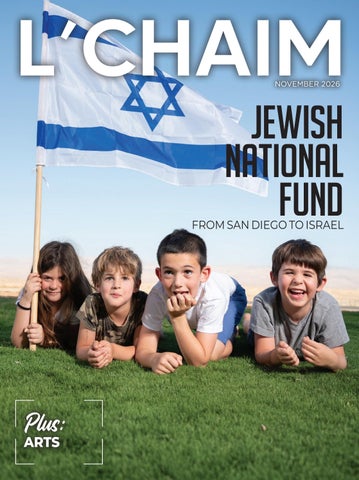
NOVEMBER 2026
jewish nationAL fund
FROM SAN DIEGO TO ISRAEL
Plus: ARTS
2
L’CHAIM SAN DIEGO MAGAZINE • NOVEMBER 2026
WWW.LCHAIMMAGAZINE.COM
3
contents
18
November 2026 • www.lchaimmagazine.com
in this issue... COVER STORY From San Diego to Israel: Jewish National Fund..................................................................................... 1000 WORDS Dekel Bar: Israeli Professional Pickleball Player............................................................................
16
08
FOOD Turmeric Healing Smoothie.........................................................................................................................
FEATURES
SEEING THROUGH THE SEA
12
16
18 20 22 24
Seeing Through the Sea.............................................................................................................................. New Leadership at Lamb's Players......................................................................................................
TURMERIC SMOOTHIE
Book Review: The Crypto Campaign.................................................................................................... The Gift that Came Full Circle: Walden Family Services........................................................... At Jerusalem Biennale, Artists Carry Jewish Memory from Ancestral Towns to the Moon.....................................................................................................
26
COLUMN
06 07
Prayers & Passages........................................
19
NEW LEADERS
Test Your Jewish IQ...................................
Mazel & Mishagoss..........................................
PUBLISHERS Diane Benaroya & Laurie Miller EDITOR-IN-CHIEF Alanna Maya CREATIVE DIRECTOR Laurie Miller
L’CHAIM SAN DIEGO, LLC (858) 776-0550 P.O. Box 27876, San Diego, CA 92198
ADVERTISING & SALES Diane Benaroya: dianeb@lchaimmagazine.com L’CHAIM SAN DIEGO MAGAZINE • NOVEMBER 2026
CIRCULATION & SUBSCRIPTIONS info@lchaimmagazine.com
COVER INFO: Courtesy JNF-USA
Copyright ©2026 L’Chaim San Diego LLC. All rights reserved. No part of this publication may be reproduced, distributed or transmitted in any form or by any means, including photocopying, recording, or other electronic or mechanical methods, without the prior written permission of the publisher, except in the case of brief quotations embodied in critical reviews and certain other noncommercial uses permitted by copyright law. For permission requests, write to the publisher, addressed “Attention: Permissions Coordinator” to: publisher@lchaimmagazine.com Published in San Diego, CA • www.lchaimmagazine.com
lchaimmagazine 4
LISTINGS & CALENDAR: calendar@lchaimmagazine.com
SUBSCRIBE ONLINE: www.lchaimmagazine.com/shop
CONTRIBUTORS Barbara Birenbaum, Franklin Felber, Donald H. Harrison, Jacob Kamaras, Stephanie D. Gittleman, Salomon Maya, Jana Mazurkiewicz Meisarosh, Mimi Pollack, Rachel Stern, Eva Trieger, Deborah Vietor, Cheri Weiss
ART DEPARTMENT lauriem@lchaimmagazine.com
EDITORIAL editor@lchaimmagazine.com ADVERTISING dianeb@lchaimmagazine.com
20
@lchaimmagazine
Your Real Estate Journey Starts Here Whether selling or buying, I’m here to guide you with care and experience.
With over 2 decades of Real Estate expertise, Kris Gelbart is no stranger to today’s ever changing market. With countless awards, recognitions, and certifications, Kris is your one-stop-shop for everything Real Estate.
Kris Gelbart
Cal DRE 01345809 858-395-0761 gelbartrealtygroup.com
Let us help you move forward. Making critically important family decisions in the aftermath of emotional life changes can be extremely difficult. Our dedicated family law attorneys can help you navigate the complex divorce process with clarity.
Divorce, high conflict child custody, alternative dispute resolution, and more.
Call 858-720-8250 or visit frfamilylaw.com for more information. Legal Experts with Humanity WWW.LCHAIMMAGAZINE.COM
5
TORAH l BY RABBI-CANTOR CHERI WEISS
prayers
& passages PAYING IT FORWARD
I
love Thanksgiving. It is by far my favorite holiday of the year. Even during the years my husband and I lived in Hawai‘i and my family lived thousands of miles away, we surrounded ourselves with friends to celebrate this special day. Our Thanksgiving mornings are always devoted to community service in some capacity, and the evenings to honoring those we love. You may find my partiality to this holiday curious given my commitment our own Jewish holidays, but it’s really not as much of a stretch as you might think. In fact, the Thanksgiving celebration is a perfect fit for Jews. It involves two things we love: food and gratitude! We are commanded in the Torah to thank God for the food we have eaten: “When you have eaten your fill, give thanks to the Eternal your God for the good land given to you.” — Deuteronomy 8:10. From these words, our Sages extrapolated the idea that we should thank God not only for our food, but for all the wonders and good fortune with which we have been blessed. This verse in our Torah is the origin of Birkat Hamazon, the series of blessings that Jews traditionally recite after a meal. Yet gratitude should extend beyond saying “thank you” to the Divine. Our Torah explicitly instructs us to care for others; to extend compassion, kindness, and whatever 6
L’CHAIM SAN DIEGO MAGAZINE • NOVEMBER 2026
means we have at our disposal to those who require our help: “For there will never cease to be needy ones in your land, which is why I command you: open your hand to the poor and needy kindred in your land” —Deuteronomy 15:11. To guide us, the Torah instructs us to fulfill specific laws. We are to leave the corners of our fields open to the poor so that they may gather what they need to sustain themselves. We are told to care for the widow, the stranger and the orphan multiple times in the Torah. We must include the less fortunate in our communal celebrations and holidays. All of this falls under the umbrella of the mitzvah (commandment) of giving tzedakah, which has come to mean “charity” but, in fact, comes from the Hebrew word for righteousness or justice. Giving to others is not merely a kindness; we give because it is the right and just thing to do. Today we call this paying it forward. While we may immediately think in terms of financial contributions, there are so many ways to express our gratitude. Even those with limited means are obligated to contribute to the well-being of others. We can volunteer our time in schools, hospitals, elder care facilities, animal shelters, or food pantries. Or we can donate items that we no longer need, such as clothing, household items, books, etc. (Animal shelters always
appreciate donated blankets and towels.) Find a cause that speaks to your heart and you will make a difference to someone! All of my Bar/Bat Mitzvah students are required to perform a mitzvah project of their choosing. Some raise funds for causes close to their hearts. One young lady recently collected over 1,000 books, which she then donated to Rady Children’s Hospital for her mitzvah project. Teaching children from a young age that they have the capacity to open their hearts to help others is perhaps the most important lesson we can impart to them as parents and educators. The Torah reminds us that everything we have in life is due to God’s beneficience: “Behold, to the Lord your God belong heaven and the heaven of heavens, the earth with all that is in it.” —Deuteronomy 10:14. It can be taken from us in the blink of an eye. (Read The Book of Job sometime!) May we be blessed with—and grateful for—abundance in this season of Thanksgiving, and may we pay it forward by sharing our blessings with others. RABBI-CANTOR CHERI WEISS IS AN INDEPENDENT LIFE-CYCLES OFFICIANT. LEARN MORE AT SANDIEGO-RABBI.COM
HUMOR | BY STEPHANIE D. GITTLEMAN
mazel
& mishagoss MAZEL TOV... BUT WAIT!
W
hen a Jewish couple announces their engagement, everyone’s thrilled! But there’s always one mashuganah second cousin (once removed!) who follows up “Mazel Tov” with “Nu? Prenup?” Of course, this document protects assets, property, and financial interests in the event of divorce. But this is a Jewish marriage—there’s far more important things to fight over. Therefore, behold: the recommended Jewish Prenuptial Agreement follows. SECTION 1: THE FOOD
In the event of divorce, custody of the family kishka recipe shall be awarded to whomever knows how to use kishka in a non-food sentence, i.e. as a verbal expression—To Wit—“I felt it deep down in my kishkes that our marriage wouldn’t last.” And under no circumstances may the secret tips for a juicier brisket be shared with the ex-husband’s new girlfriend. Both parties retain the right to say, “Nobody makes mandel bread like my Bubbe!” Fancy restaurant reservations are retained by the party who wrote the most Yelp reviews and the other spouse may cancel them out of spite. A deli is neutral territory. SECTION 2: CUSTODY OF CELEBRATIONS
High Holidays shall be divided equally. No inquiring if your ex-spouse is fasting. Chanukah shall be considered a minor holiday unless one side has an Aunt Hannah who insists otherwise and agrees to fry the latkes, but the menorah shall alternate households annually. Passover is subjected to a complex custody schedule since there are now four different seders, two conflicting family invitations, and one mother who says, “Of course you don’t have to spend it here,” while clearly meaning, “If you don’t spend
it here, I’ll never recover emotionally.” The Seder plate (which was antique and valuable) shall remain with the bride. The groom shall take possession of the cheap plastic one obtained at The Dollar Tree in 2018. In the event of disagreement, the matter shall be arbitrated by the only Jewish Auntie Arlene, who has absolutely no legal authority, but displays an air of sassy confidence. SECTION 3: FRIENDS AND FAMILY
Mutual friends are permitted to stay connected to both parties equally. However they’re prohibited from saying, “We truly adore you both!” because that’s highly suspicious. They must choose sides privately and then become paranoid that divorce is contagious and move on to make brand new, securely married couple friends. SECTION 4: CHILDREN
Both parties agree never to use offspring as pawns. Instead, they’ll be implemented as official go-between messengers, helping the kids feel important. Both parents shall maintain consistent rules regarding discipline. However, each parent reserves the right to say: “In my house, we do things differently.” And the parent who rents an apartment with a better swimming pool wins. If a child receives different punishments in each household, the parents agree not to interfere. However, if Mom says, “No phone for a week,” Dad may say, “Okay fine. You can use your phone here in my house.” But Dad may not say, “Your mother is being ridiculous” unless of course Mom is being ridiculous. SECTION 5: FUTURE GRANDKIDS
may not criticize the other grandparent for giving too much candy. This will be radically unenforceable. Grandparents shall refrain from competing over who is the “favorite.” This provision is expected to be ignored immediately. Disclaimer: Neither party shall prevent the following Bubbe utterances, “He’s a good boychick. Let him have another cookie.” Or “He threw the cookie jar at the television because he’s overly tired and just needs a nice nap.” SECTION 6: ADDENDUM
THE
JEWISH
MOTHER
Both parties agree the groom’s mother and bride’s mother shall remain angry with each other indefinitely. Neither may acknowledge the other at family functions for a minimum of three years. After three years, they may exhibit a polite nod. After five years, they can discuss the grands’ straight A report cards. At the seven-year mark they may finally admit, “You know something? I always liked her.” SECTION 7: FAMILY GOSSIP AND THE RECONCILIATION CLAUSE
Spouses are forbidden to discuss the dissolution of their marriage with anyone. Yet by dinner time, the entire extended family in Florida will find out and blame the mashuganah second cousin (once removed!) for manifesting the entire thing by having the chutzpah to bring up a pre-nup. The couple shall subsequently remarry, registering for the most expensive china pattern at Nordstrom. Oy! STEPHANIE D. GITTLEMAN WILL INJECT HUMOR INTO ANYTHING YOU HIRE HER TO WRITE. EMAIL HER AT THEQUOTEGAL@YAHOO.COM.
If grandchildren are born, both grandparents retain equal spoiling rights. The ex-spouse WWW.LCHAIMMAGAZINE.COM
7
L’CHAIM | BY BILL MOTCHAN | JNS.ORG
Dekel Bar, an Israeli professional pickleball player. Credit: Professional Pickleball Association. 8
L’CHAIM SAN DIEGO MAGAZINE • NOVEMBER 2026
L’CHAIM
1000
WORDS ISRAELI PROFESSIONAL PICKLEBALL PLAYER DEKEL BAR
D
ekel Bar wears a blue-and-white wristband. For Bar, a professional pickleball player with a No. 32 world ranking, the wristband is functional but also sends a message: that he is a proud Israeli. “Ever since Oct. 7, I’ve been wearing it,” Bar, 33, said. “It’s my way of showing support wherever I am playing, and a lot of people like that. I get a lot of good comments about it. I’m sure there’s a lot of people that don’t like it, but I feel like we should always do what we think is right and show support to our people.” Bar will be among the competitors vying for the top title at the national Pickleball World Championships beginning on Nov. 2 in Dallas. He made the finals of the tournament two years ago, and he has claimed three other titles in his professional career. His last win came in mixed doubles at the PPA Tour Red Rock Open in 2025. When he strides onto the court, he won’t be surprised to hear cheers from fans waving Israeli flags. “That has happened a few times,” he said. “The Jewish community has shown a lot of support wherever I go, which is very cool. There’s a little community in each place that we’ve gone to, and it’s always nice to see. And people come up to me after a match to chat. I have a lot of fans because of my Israeli heritage.” More than 24 million Americans play pickleball, according to a 2026 Sports & Fitness Industry Association report. It is now the fastest-growing sport in the United States, a title it has held for five consecutive years. The sport is also experiencing global growth, including in Israel. That wasn’t the case when Bar grew up in Haifa. He took up tennis when he was 9. “I played tennis professionally until I was 23,” he said. “Then I had some abdominal injuries, and I was out for a year-and-a-half and decided to stop. I started studying at IDC Herzliya University. I already knew about pickleball because I traveled with Collin Johns on the ATP Tennis Tour.” ATP is the premier worldwide professional tennis circuit. Collin Johns (world ranking No. 28) and his brother Ben Johns (world ranking No. 1) also achieved success after transitioning from tennis to pickleball.
“The Jewish community has shown a lot of support wherever I go, which is very cool. There’s a little community in each place that we’ve gone to, and it’s always nice to see." Bar went all in on pickleball in 2020. His tennis skills came in handy, but there was still a learning curve. “There are a lot of different shots in pickleball and a lot of different tactics, but tennis was a good background and base to start with,” he said. “In pickleball, there are different rules. I had to learn a lot of new shots and new techniques. You eventually understand the patterns of the game and how to win more points.” He also enjoyed the camaraderie of the professional pickleball community, which is far different than the nomadic life of a touring WWW.LCHAIMMAGAZINE.COM
9
L’CHAIM
Dekel Bar, an Israeli professional pickleball player. PHOTO BY: SYE WILLIAMS/PROFESSIONAL PICKLEBALL ASSOCIATION
tennis pro. “Getting into pickleball after tennis, it was so much more social,” he said. “You immediately have a lot of friends. People in the community were very welcoming. And I do like the fact that you have a partner. You have travel buddies or friends that you’re training with. You have meals with them. And you get to know people on a more personal level.” Like tennis and golf, pickleball touring pros must cover their own travel, lodging, equipment and entry fees. Bar helps offset those expenses with two other businesses he runs, Pickleball 360, an instructional video subscription service, and Pickleball Getaways. “I started Pickleball Getaways together with Ben Johns,” Bar said. “We have trips all over the world. Now, we’re up to about 20 trips a year. It’s a full-time gig, and it’s very, very fun.” The popularity of pickleball, Bar said, is due largely to it being available to players of all abilities. Age is not a barrier, nor is physical condition. Good hand-eye coordination is definitely a plus. Bar has that skill and, at 6-foot-3-inches, has a commanding presence. After injuries sidelined his tennis career, he didn’t initially think he would have a second chance at playing a professional sport competitively. He relishes the wins, the training, and even being 10
L’CHAIM SAN DIEGO MAGAZINE • NOVEMBER 2026
recognized by fans at airports while traveling. “I’m very blessed,” Bar said. “I don’t take it lightly, and I try to represent well.” He said that "it’s very cool that pickleball has grown so much, and to be in a position where kids and adults and people come and say how much they appreciate what I do, and to represent the country of Israel. I’ve been very, very lucky with pickleball.” This article was originally published at: https://www.jns.org/i-try-torepresent-well-says-israeli-professional-pickleball-player-dekel-bar
858-673-6340 | TheRemingtonClub@WQCalifornia.com 16925 Hierba Drive, San Diego, CA | The RemingtonClub.com
WWW.LCHAIMMAGAZINE.COM
11
COVER STORY | BY L'CHAIM STAFF
FROM SAN DIEGO TO ISRAEL BUILDING A FUTURE TOGETHER 12
L’CHAIM SAN DIEGO MAGAZINE • NOVEMBER 2026
COVER STORY
child returning to the playground. A farmer planting a new season’s crops. A teenager discovering that Jewish history is part of their own story. Israel’s future is shaped by moments like these—and by the people who make them possible. For Jewish National Fund-USA, that responsibility stretches from building Israel’s South and reimagining its North to nurturing the next generation’s connection to the Jewish homeland. Here in San Diego, it carries particular meaning through the community’s enduring bond with its sister region, Sha’ar HaNegev. That connection will take center stage November 12–15, when Jewish National Fund-USA brings its Global Conference for Israel to San Diego, inviting supporters to help write Israel’s next chapter.
A
TURNING SOLIDARITY INTO OPPORTUNITY
Jewish National Fund-USA’s work begins with a practical question: What makes a family choose to build its future in a community? The answer includes housing, employment, excellent schools, accessible healthcare, security, and places where neighbors can gather. Through interconnected “Circles of Impact,” the organization invests in these essentials together, helping communities become places where families can flourish. Its long-term vision seeks to attract 800,000 new residents to Israel’s North and South. Across the Negev and Galilee, that means developing communities, strengthening local economies, supporting people with disabilities, preserving heritage sites, and expanding educational opportunities. Since October 7, rebuilding devastated border communities has brought even greater urgency to this mission. For San Diegans, Sha’ar HaNegev makes that responsibility deeply personal. The region’s longstanding relationship with San Diego has created friendships spanning generations. Jewish National Fund-USA’s own strong partnership with the region complements that bond through investments in recovery and community life. One example is support for renovating the Sha’ar HaNegev Regional Athletic Complex, named in memory of former Mayor Ofir Libstein (z”l). Its significance extends beyond sports: shared spaces help restore belonging, confidence, and the rhythms of everyday life. “For many San Diegans, Sha’ar HaNegev is family,” says Ian
Merles, Jewish National Fund-USA Director, San Diego. “Our commitment means helping families return, helping children feel hopeful, and creating opportunities that give people every reason to stay. We are investing in the future we want them to have.” PROTECTING LIVES, SUSTAINING THE LAND
That future depends on water. Jewish National Fund-USA has helped build 250 reservoirs throughout Israel, storing recycled wastewater and runoff to support agriculture and conserve precious freshwater resources. Behind that number are farmers whose livelihoods depend on reliable irrigation and communities whose growth depends on resilient infrastructure. Protecting those communities also means equipping the people who respond when disaster strikes. As the official U.S. fundraising arm for Israel’s Fire and Rescue Authority, Jewish National Fund-USA supports firefighters with vehicles, protective equipment, and facilities. Its support for Emergency Response Centers strengthens coordination among local emergency services, helping communities respond when every second matters. Israeli ingenuity also carries benefits far beyond Israel. The Kasser Joint Institute for Food, Water, and Energy Security brings together Jewish National Fund-USA, the University of Arizona, and Israel’s Arava Regional Councils. Through applied research and practical technologies—including combining solar energy production with agriculture—the partnership helps vulnerable communities in arid regions address interconnected challenges of food production, water scarcity, and reliable energy. BUILDING A LIFELONG CONNECTION
Alongside this physical infrastructure, Jewish National FundUSA invests in Zionist engagement: helping young people understand their history, take pride in their identity, and find their own place in the Jewish story. At Muss High School in Israel, students experience that story where it happened, combining academic study with immersive exploration. The organization’s ambition is to engage 10,000 high school students annually by 2035. At the heart of this approach is a conviction: the best way to nurture a lifelong connection to Israel is to give young people time to live and learn there. Programs lasting six weeks or longer offer space for friendships, questions, discovery, and a familiarity that grows through everyday experience. The planned World Zionist Village in Be’er Sheva will extend that vision across generations. Bringing together a new Muss
WWW.LCHAIMMAGAZINE.COM
13
COVER STORY
(L-R) Shanee Zamir, Kayla Globerson, Ian Merles, Russell F. Robinson, Sarita Spiwak, Lauren and Sol Lizerbram
campus, educational experiences, and opportunities for global dialogue, it will create a place where people explore Zionism’s meaning and their responsibility for its future. A GLOBAL GATHERING, RIGHT HERE IN SAN DIEGO
These commitments will come together at the Global Conference for Israel, November 12–15, 2026, at the Gaylord Pacific Resort & Convention Center in Chula Vista. As Jewish National Fund-USA celebrates 125 years of impact, the gathering offers San Diego a chance to connect with a worldwide community committed to the land and people of Israel’s future. Featured speakers include Fauda co-creator and star Lior Raz, Pulitzer Prize-winning journalist Ronen Bergman, author Dara Horn, and Abraham Accords peace advocate Loay Alshareef. Their perspectives will bring depth to conversations about Israel, Jewish identity, and a changing Middle East. Alongside the speakers, inspirational gatherings and the world’s largest Zionist Expo will give participants opportunities to learn, connect, and celebrate. The purpose is to carry that energy beyond
14
L’CHAIM SAN DIEGO MAGAZINE • NOVEMBER 2026
the conference—into philanthropy, leadership, Israel experiences, and sustained involvement. “Hosting this conference is an opportunity for San Diego to show the strength of our community and the depth of our commitment,” says Ben Naman, PhD, Jewish National FundUSA San Diego Board President. “We want people to leave inspired, connected, and ready to act. Every person has something to contribute to Israel’s future.” For local residents, the gathering brings a global conversation close to home. It offers a place to ask meaningful questions, meet people who share a commitment to Israel, and discover where personal passions can make a difference. The invitation extends across generations, from young adults finding their voice to longtime supporters helping others find theirs. HELP BUILD THE JEWISH FUTURE BY DONATING AT JNF.ORG/DONATE. FOR GLOBAL CONFERENCE FOR ISRAEL DAY PASS DETAILS OR MORE INFORMATION ON HOW TO GET INVOLVED, CONTACT JNF-USA SAN DIEGO DIRECTOR IAN MERLES AT IMERLES@JNF.ORG OR CALL 858-824-9178 X859.
Baruch ata Adonai, Elohenu melech ha-olam asher kideshanu be-mitzvotav, ve-tzivanu le-hadlik ner shel Hanukah.
IN HONOR OF Sandy’s Grandsons, Jackson Evan Bold, Andrew Michael Roseman, Jason Gabriel Roseman, & Elliot Harrison Roseman; Granddaughter, Sydney Ilyse Bold; Daughter & Son-in-Law, Rochelle & Bill Bold; Son & Daughter-in-Law, Loren & Dana Roseman. - Sandy Roseman & Families
Law Offices of Charles S. Roseman & Associates Providing quality legal representation throughout California for over 54 years. Csroseman@adrservices.com Csroseman@rosemanlaw.com • Mediation/Arbitration Services • Worker’s Compensation Law • Business/Contract Law • ADR Services, Inc. • Product Liability Law • Insurance Law • Personal Injury Law • Professional Malpractice Law • ADA/ Personal Injury Law
• Civil Rights Law • Discrimination Law • Elder Abuse Law
(619) 544-1500 • Fax (619) 239-6411 • 1761 Hotel Circle South, Suite 250 · San Diego, CA 92108
WWW.LCHAIMMAGAZINE.COM
15
FOOD
16
L’CHAIM SAN DIEGO MAGAZINE • NOVEMBER 2026
FOOD
TURMERIC HEALING SMOOTHIE BY TAMAR ROTHENBERG, MS, RDN; AUTHOR, CANCER DIET FOR THE NEWLY DIAGNOSED
T
he root of the turmeric plant belongs to the ginger family. There is some evidence turmeric may help with conditions such as hay fever, mild depression, and knee osteoarthritis. Add the spice to soups, curries, roasted vegetables, eggs, or whatever makes you happy. Pairing turmeric with a source of fat can increase the absorption of curcumin, so I’m using coconut milk in this healing smoothie. Smoothies are a tasty way to pack more nutrition in your day. This smoothie offers the tropical flavors of refreshing pineapple, mango, and coconut, along with the anti-inflammatory spice, turmeric. This recipe and more can be found in my book, Cancer Diet for the Newly Diagnosed: An Integrative Guide and Cookbook for Treatment and Recovery.
Smoothies are a tasty way to pack more nutrition in your day.
TURMERIC HEALING SMOOTHIE
Serves 2 Ingredients 1 banana (fresh or frozen) 1 cup frozen pineapple chunks 1 cup frozen mango chunks ½ teaspoon turmeric ½ cup coconut milk (the type in the carton), or nondairy milk ½ cup water Directions 1. In a blender bowl, combine the banana, pineapple, mango, turmeric, milk and water. 2. Blend until you reach your desired consistency, and serve. Make it even easier: Buy fruit that is already pre-cut and frozen. A frozen banana makes this milkshake creamier, so freeze ripened bananas.
FORMULATIONS IN CANCER CARE; AND CO-LED THE CLINICAL STUDY, COPING WITH CANCER IN THE KITCHEN, PUBLISHED IN NUTRIENTS. TAMAR LENDS HER EXPERTISE TO SHARSHERET THRIVERS THROUGH NUTRITION EDUCATION. TAMAR IS ALSO A MEMBER OF THE US NEWS & WORLD REPORT HEALTH EXPERT PANEL. CHECK OUT TAMAR’S OTHER RECIPES IN HER BOOK, CANCER DIET FOR THE NEWLY DIAGNOSED: AN INTEGRATIVE GUIDE AND COOKBOOK FOR TREATMENT AND RECOVERY. VISIT TAMAR’S WEBSITE AT HTTPS://WWW.TAMARROTHENBERGRD. COM/ FOR MORE INFORMATION.
This recipe was submitted by the non-profit organization, Sharsheret: The Jewish Breast Cancer and Ovarian Cancer Community. If you or someone you love has been impacted by breast or ovarian cancer or has elevated genetic risk, contact Sharsheret for free support and resources. For more information, visit sharsheret.org or call (866) 474-2774.
TAMAR ROTHENBERG, MS, RDN, IS A REGISTERED DIETITIAN WHO SPECIALIZES IN BREAST AND OVARIAN CANCER IN HER PRIVATE PRACTICE IN SOUTH FLORIDA. SHE HAS A CERTIFICATE OF TRAINING IN VEGETARIAN NUTRITION AND HERBAL WWW.LCHAIMMAGAZINE.COM
17
FEATURE STORY
SEEING THROUGH THE SEA HOW ONE ASU PROFESSOR USES SATELLITES TO PROTECT CORAL REEFS
O
ne of the oldest ecosystems on the planet is constantly being researched by one professor. At Arizona State University Online, Dr. Jiwei Li is changing the narrative every single day for monitoring coral reefs and seagrass. Li holds an undergraduate degree in computer science and a master's and doctorate in geosciences/remote sensing. His doctoral research focused on using satellite imagery to detect water bodies. Born in China, he completed his undergraduate and master's studies in Beijing before earning his doctorate at UMass Amherst. Inspired from a young age by his exposure to the ocean as a child, he grew to love it and built a career around taking care of it. Coral reefs take up about 3.6 million square kilometers of the ocean floor. They represent a mere 1% of the ocean but are responsible for about a fifth of all marine life. That imbalance has led to years of research on this ecosystem, giving researchers new tools to monitor it. Despite the cyclical nature of a coral reef's lifespan, these organisms are very sensitive to the changing seasons, the level of sunlight received and everything in between. Monitoring means tracking whether reefs are bleaching at a different stage than usual, whether pollution is taking up their living space and how they grow and take over new areas. No stranger to the water or to collaborating with other professors and researchers, Li explains that most ocean remote sensing has historically focused on open water, where scientists track things like
18
L’CHAIM SAN DIEGO MAGAZINE • NOVEMBER 2026
chlorophyll levels and ocean currents in water too deep to see the bottom. Reefs are a different challenge. "Before you can study what's happening to a coral reef, you need to peel the seawater off, essentially strip away that signal to see what's underneath," Li said. "That's the majority of our effort: dealing with that limitation and finding ways to work around it." Much of the fieldwork, the actual diving and data collection, happens through collaborators at partner sites in Hawaii and the Caribbean. Li's role is what happens after: feeding millions of satellite images into deep learning models built on Google Earth Engine, a cloud computing platform that lets researchers scale their analysis from a single reef to an entire coastline or ocean basin. That scalability is also central to why Li believes ocean science belongs in the online classroom. Teaching in the ASU Online Ocean Futures program has allowed him to help those who are interested in caring for the ocean but may not be able to be near one. "We have the satellite, we have the ocean monitoring data, we have buoys," Li said. "If you're not in the field, you can still study the ocean. You just have to know how to gather the data, analyze it, and let it inform what happens next."
TEST YOUR JEWISH IQTM 1. What were the given English first and middle names of the witty twin advice columnists known worldwide as Ann Landers and Dear Abby? __ a. Sarah Rebecca and Rebecca Sarah __ b. Rachel Devorah and Devorah Rachel __ c. Miriam Shoshana and Shoshana Miriam __ d. Esther Pauline and Pauline Esther 2. According to the Talmud, a person should avoid being rigid like an unyielding cedar, and instead strive to bend like what? __ a. An olive branch __ b. A grapevine __ c. A reed __ d. A myrtle bough
Marcelo Bermann
American Painting
Fully Insured, since 1971 Lic.#505-334
AmericanPainting.Co • 858-255-4565
SINGING & SHARING a variety of traditional Jewish music We welcome new members! Email Rita for more info: rheller8@gmail.com
3. What is the meaning of the Israeli slang phrase, “End of the world, turn left” (Sof ha’olam smola in Hebrew and Ek velt in Yiddish)? __ a. An extreme nationalistic political viewpoint __ b. An imminent national crisis __ c. The middle of nowhere __ d. A complex mathematical riddle with no known solution 4. Which Jewish festival marks the culmination of the 49-day Counting of the Omer, celebrated on the 50th day following the start of the count on Passover? __ a. Sukkot __ b. Shavuot __ c. Shemini Atzeret __ d. Purim 5. Which inhabitant of Jericho aided the two spies that Joshua sent to reconnoiter the fortified city before Joshua led the Jewish nation to lay siege to it? __ a. The harlot, Rahab __ b. The oracle, Deborah __ c. The prophetess, Huldah __ d. The sorceress, Dinah
6. Which co-creator of Seinfeld and star of Curb Your Enthusiasm famously stormed out and quit his writing job at Saturday Night Live mid-season, only to return on Monday acting like nothing had happened? __ a. Jerry Seinfeld __ b. Larry David __ c. Garry Shandling __ d. Billy Crystal 7. How many humans and giraffes were aboard Noah’s ark? __ a. 2 humans, 2 giraffes __ b. 4 humans, 8 giraffes __ c. 8 humans, 14 giraffes __ d. 16 humans, 20 giraffes 8. Which political leader, a strong supporter of a Jewish homeland in Israel, wrote in 1920 that Jews “are beyond all question the most formidable and the most remarkable race which has ever appeared in the world”? __ a. Winston Churchill __ b. Woodrow Wilson __ c. Franklin D. Roosevelt __ d. Vladimir Lenin 9. What is the missing word in this maxim from Ethics of the Fathers? “If there is no _____, there is no Torah; if there is no Torah, there is no _____.” __ a. Knowledge __ b. Labor __ c. Study __ d. Flour 10. Which Jewish biochemist, without a doctoral degree, saved millions of lives and won the 1988 Nobel Prize in Medicine for pioneering rational drug design? __ a. Gertrude Elion __ b. Lise Meitner __ c. Rosalind Franklin __ d. Gerty Cori
Answers on page 29. ©2026 Felber, Starmark, Inc., all rights reserved
WWW.LCHAIMMAGAZINE.COM
19
FEATURE STORY
NEW LEADERSHIP AT LAMB'S PLAYERS MARKING THE THEATER'S 56TH SEASON BY EVA TRIEGER 20
L’CHAIM SAN DIEGO MAGAZINE • NOVEMBER 2026
FEATURE STORY
W
hen one hears the term “new leadership,” it is often accompanied by a sense of uncertainty or concern, yet when that change comes from within, and the principals involved are committed to continuing a reign of excellence, everybody wins. This is the case with Lambs Players Theatre, Coronado’s premiere venue, thrilling audiences since 1971. What began as a touring ensemble morphed into a year-round cadre of musicals, dramas and so much more. Occupying the historic Spreckels Building, the ensemble opened its current residence in 1994. The 55th season is closing out and the 56th season will usher in the next wave with Colleen Kollar Smith and Mike and Jennifer Bradford at the helm. In a recent Zoom call, I was able to learn more about the passing of the baton, and the trio’s commitment to furthering Lamb’s mission to tell good stories well. Each of these individuals comes to their post with a wealth of critical skills. Affiliated with Lamb’s theatre, Moonlight Amphitheatre and San Diego’s theatre community, it seemed natural and seamless for these three to step into the vacancy. Mentored by current Producing Artistic Director, Robert Smyth, Colleen Kollar Smith, performer, director, choreographer and cocreator of Mixtape, assumes the role of Artistic Director/Board Member. Her dedication to making the arts accessible is apparent in her work at UC San Diego and through her nonprofit work at Santa Fe Depot. Her first role with Lamb’s dates back to 2002. Over the next two decades, this talented woman went on to perform at a variety of area theatres and become recognized by the Critics Circle and receive global nominations for Best New Musical for her part in developing and directing the world premiere of Miracle on 34th Street: A Live Musical Radio Play. It was during her stint at Moonlight that she began working with Jennifer and Mike Bradford through community partnerships and fundraising. The trio is most interested in amplifying their mission of making good theatre accessible to all and furthering the dream initiated by Lamb’s Players. Jennifer and Mike bring a wealth of ideas, skills and energy to enhancing the vision through Moonlight’s Youth theatre program. The Moonlight Cultural Foundation sought to fill any gaps and find new ways to increase community engagement and reach patrons on both sides of the Coronado Bridge. The programs aim to reach youth who may have skills beyond acting by exploring tech work or set design. Jennifer Bradford, the incoming Chief Philanthropy Officer. has a decade of experience of leadership and strategic fundraising to Lamb’s. She specializes in community partnerships and was a driving force behind the Moonlight Youth Theatre. Her brilliant success at fundraising is nothing short of remarkable and thanks to her acumen, Moonlight saw the opening of a state-of-the-art facility. Married to Mike for more than 30 years, the duo told me that while they, themselves, are not often on stage, they created children who are better on stage, while Mike and Jennifer shine at the behind-thescenes facets of theatre. Mike Bradford is stepping into the role of Chief Business Officer. At his last post as Executive Director of Programming and Operations at Moonlight Stage Productions, Mike proved his talent for increasing revenue and accelerating operational efficiency.
Colleen Kollar Smith and Mike and Jennifer Bradford are committed to furthering Lamb's mission to tell good stories well. His extensive experience in Arts Education also demonstrated a measurable boost in enrollment from 120 students to more than ten times that annually! And somehow in his “spare time,” he managed to perform in Mamma Mia. It is rare and providential that the outgoing leaders have such a positive and close relationship with this incoming team. Their “seven month runway” will make for a smooth transition, enabling the new team to continue the mission without hiccups while evaluating what may be needed to build upon the past successes. With a supportive Board and many long-time patrons, they are off to a great start. And….speaking of Season 56, each show was carefully selected for maximum impact, joy and with an eye toward continuing Lamb’s legacy of “taking care of people.” The new leaders told me their fourpronged approach. They want patrons to: Feel at home, experience excellent customer service, to feel “you’re welcome here,” know that they are carrying and honoring Lamb’s legacy; and see Lamb’s as a beacon to other area theatres. The new season kicks off in March 2027 with musical, Bandstand, paying homage to military veterans. This will be followed by Clue, based on the 1985 film. Third in the new season is Come Sail Away: A Yacht Rock Experience, a tribute to rock musicals that conjures up good feelings from “back in the day.” Red is based on expressionist artist Mark Rothko, and his journey, Finally, the season closes out with Million Dollar Quartet Christmas. This holiday show recalls iconic American musicians in the back room at Sun Records. Tickets and subscriptions may be purchased at lambsplayers.org.
WWW.LCHAIMMAGAZINE.COM
21
BOOK REVIEW
The Crypto Campaign BY DEBORAH VIETOR
Cover art by James Shannon, courtesy of Leapfrog Press
C
ome along for an adventurous and educational ride with Sara and Daniel, cousins and best friends, as they participate in an electronic reward system their teacher calls “BinCoin.” As they collect trash and recycling to earn BinCoin, students begin to use the electronic rewards as a digital currency. Buying and selling items amongst themselves brings various pitfalls and mysterious happenings, both disrupting and distracting to the school. Why is a child paying oddly specific amounts of BinCoin to the class bully? Can the kids’ crypto knowledge assist a man whose real-world life savings is compromised? And who pulled the fire alarm during a critical visit from the State Board of Education, directly prior to a BinCoin block getting mined? 22
L’CHAIM SAN DIEGO MAGAZINE • NOVEMBER 2026
STEM, which stands for Science, Technology, Engineering and Mathematics, is the passion of author Pamela Cosman, a professor and Chair of the Department of Electrical and Computer Engineering at UC San Diego. The Crypto Campaign is the third book in her STEM Squad series for ages 9-12. The digital currency problems and their technical solutions unfold a tapestry of sophisticated cryptocurrency concepts, including mining blocks (validating and recording trades), cryptographic nonces (numbers used only once), mempools (temporary memory pools for unvalidated transactions) and double-spend attacks. The children figure out fixes for issues both complex and simple. Cryptocurrency is a powerful technology, but when it is used dishonestly, technically adept people need to put things right. Beyond the story, Cosman has cleverly added non-fiction information at the end of the book, “These Ideas in the Real World.” This informs our youth and adults alike how cryptocurrency actually works. Cosman illuminates us with examples of decentralized ledgers, gossip protocols, gas fees and the mempool, sending messages in the block, decentralized operations and how a block gets mined in the real world. Although these are sophisticated concepts, even for many adults, Cosman has a creative and uncanny method of explaining the ins and outs of cryptocurrency, along with the pros and cons (unique capabilities! many scams!). Published by Leapfrog Press in September 2026, The Crypto Campaign follows two earlier books in the STEM Squad series of engineering-focused fiction books for middle grades. The Secret Code Menace introduces the science of binary codes and error correction. Sara and Daniel developed a code to send secret messages during class. But when something goes horribly wrong during a field trip, the secret code plays an unexpected role. The Hexagon Clue teams Sara and Daniel as they work with new student Kevin to investigate thefts at the local factory. Armed with concepts from geometry and optimization, can they locate the thief? And how is their school involved? These and other scientific concepts are introduced in an engaging, intelligent and creative manner, presenting real world STEM concepts with a light touch. In her day job as a professor of Electrical and Computer Engineering at UC San Diego, Cosman engages with virtual reality, eye-tracking glasses, and video compression. Her work, akin to her stories, combines engineering and computer science with adventure, proving you never know when being tech savvy can save the day!
If I wouldn't have contacted Judith, my life would be very different. I wanted to thank Judith for the time and persistence to find me the right person. GIDEON S. IN SAN DIEGO
No one cares more about helping people than Judith. GIL H. IN LA JOLLA
WWW.LCHAIMMAGAZINE.COM
23
FEATURE STORY
The Gift that Came Full Circle
From a chance meeting in San Diego to a lifelong mother-daughter bond
PHOTO COURTESY OF NAYELY MÜLLER AND ARLENE LIEBERMAN
BY SHANNON LYNARD AND DENISE SCATENA
I
n 2008, Arlene Lieberman attended a Walden Family Services fundraiser at Pamplemousse Grille in Solana Beach. Among the evening’s speakers was a 19-year-old young woman named Nayely, who had spent much of her childhood in foster care. When the two were introduced, something clicked. “It was magic,” Arlene recalled. “Something happened, and I have no explanation.” Nayely was then a sophomore at Cal Poly Pomona, where Walden’s transitional housing support helped her concentrate on her education. During her remarks, she shared her experiences in foster care and spoke about a dream that seemed far beyond her reach: studying abroad in Paris. Arlene was determined to help make it happen. That summer, Nayely traveled to France to study at the Sorbonne. She emailed Arlene and sent photos documenting her adventures. When she returned to California, she asked to visit her new friend 24
L’CHAIM SAN DIEGO MAGAZINE • NOVEMBER 2026
in San Diego. During that visit, the two spent hours talking. More visits followed, along with regular conversations and an increasingly close relationship. “I was grateful Arlene believed in my dream of studying in Paris,” Nayely recalled. “But she became so much more than a supporter. She became family.” One weekend, as Nayely prepared to leave Arlene’s home, she said two words that changed everything. “Bye, Mom.” A RELATIONSHIP BUILT TO LAST
“Arlene didn’t just help me pursue an opportunity. She became someone I could count on through every stage of my life,” said Nayely. “Having someone who believed in me, celebrated my successes, and stood by me through the challenges made a lasting difference.”
FEATURE STORY
What began as an act of generosity developed into a motherdaughter relationship that has endured for nearly two decades. Arlene attended Nayely’s college graduation and celebrated when she was accepted into Columbia University to pursue graduate studies in social work. Before Nayely moved to New York, Arlene took her shopping for winter clothing to prepare her for an unfamiliar climate and a new chapter. After graduating from Columbia, Nayely joined the Peace Corps, serving in the Philippines, working to improve opportunities for children facing difficult circumstances. While overseas, Nayely met her future husband, Marko. Arlene cohosted their New Year’s Eve wedding in Los Angeles in 2015, with Nayely’s older sister, Vanessa, playing a major role in planning and hosting the celebration. Today, Nayely and Marko Müller live in Zurich, Switzerland, where she has built a successful business teaching English through a phonics program she developed herself. Despite the distance, the relationship remains strong. Arlene and Nayely speak regularly, share family milestones, and continue to celebrate one another’s lives. A LEGACY OF GIVING BACK
Arlene’s commitment to helping others began long before her involvement with Walden. Prior to entering the insurance industry, she taught second grade in an underserved community in Columbus, Ohio, where she witnessed firsthand the challenges facing children and families. She later built a 35-year insurance career and retired in 2016 as a principal of Barney & Barney. She also served as volunteer executive director of the Barney & Barney Foundation, helping direct charitable giving and community initiatives. Her approach to philanthropy was shaped by her mother and father’s generosity and a defining experience as a single mother. In those early years when Arlene faced financial hardship, her friend Ken Lautsch gave her $1,000 and helped care for her children, asking only that she pay his kindness forward someday. “I made him a promise that if I ever could, I would pay it forward,” Arlene recalled. “And I haven’t stopped.” That philosophy reflects the Jewish value of tzedakah, the practice of giving grounded in justice and responsibility, and chesed, loving kindness expressed through action. Arlene’s own story demonstrates how generosity can move from one person to another, creating opportunities that extend across generations.
Services. “We help bridge those gaps through transitional housing, educational support, and employment assistance as they build independence and plan for their futures.” Nayely’s experience shows why that support matters. Walden’s social workers helped her pursue college when she initially doubted it was possible. The encouragement she received opened the door to education, international service, and eventually a career and independence. THE GIFT COMES FULL CIRCLE
During the 2025 holiday season, Arlene received an unexpected request from Nayely and Marko. Rather than accepting monetary gifts Arlene traditionally sent for birthdays and holidays, the couple wanted to donate money to Walden. They had enjoyed a successful year and wanted to give to the organization which helped Nayely find her footing. They also asked Arlene to match their contribution. Nearly two decades after a young woman shared her dream of Paris at a fundraiser, she was now helping create opportunities for others. For Arlene, the gesture brought her philosophy of paying it forward full circle. “Watching Nayely build a beautiful life and give back to others has been one of my greatest gifts,” she says. What began as a chance meeting grew into a lifelong bond, proving that generosity can change lives for generations. As Walden looks toward its next 50 years, Arlene and Nayely’s relationship offers a glimpse of the lasting impact of human connection and access to opportunity. “Every young person’s path is different, but stability and guidance can make an enormous difference over time,” says Teresa. LEARN MORE ABOUT WALDEN FAMILY SERVICES AND ITS WORK SUPPORTING TRANSITIONAL AGE YOUTH AT WALDENFAMILY.ORG.
WALDEN’S NEXT CHAPTER
Arlene first became involved with Walden in the early 2000s through her work providing employee benefits. She joined Walden’s Board of Directors in 2013, served as board chair from 2015 through 2020, and recently returned to the board. As Walden celebrates its 50th anniversary, the organization is building on its longstanding history of serving children and families by expanding its focus on transitional age youth, ages 18 to 26. Young adults who are the same age as Nayely when she first met Arlene nearly 20 years ago. “Turning 18 doesn’t mean young people have the support they need to navigate adulthood,” said Teresa Stivers, CEO of Walden Family WWW.LCHAIMMAGAZINE.COM
25
FEATURE STORY
AT JERUSALEM BIENNALE, ARTISTS CARRY JEWISH MEMORY FROM ANCESTRAL TOWNS TO THE MOON BY TANIA SHALOM MICHAELIAN | JNS.ORG
I
t began with five broken plates. They had belonged to the grandmother of Argentine writer and traveler Dan Lande. After accidentally breaking them, he decided to take the pieces back to the Eastern European towns his grandparents had left behind. That first trip developed into “La Ruta de las Bobes,” an ongoing project in which Lande visits the birthplaces of other people’s grandparents, documents what he finds and leaves a fragment of an inherited plate behind. A selection of those journeys is being shown at the Jerusalem Biennale, which will officially close on November 12, alongside another Latin American exhibition that approaches Jewish continuity from a very different direction. While Lande returns to the places from which earlier generations departed, Mexican artist Alejandro Glatt is preparing to send a mezuzah to the moon. The two exhibitions form part of the Biennale’s seventh edition, which present works by more than 250 Israeli and international artists in 42 exhibitions at 21 venues across Jerusalem. This year’s theme, “De Profundis,” or “From the Depths,” draws on Psalm 130 and its opening words: “Out of the depths I call You.” A DIFFERENT SENSE OF TIME
Tammy Kohn, the Buenos Aires-based curator of “La Ruta de las Bobes,” first came across Lande’s work on his Instagram account, @rulodeviaje. Kohn began studying Jewish art at university in Jerusalem and later pursued an academic career in Israel and New York. After returning to Buenos Aires, she increasingly focused her research and curatorial work on Latin American Jewish art. 26
L’CHAIM SAN DIEGO MAGAZINE • NOVEMBER 2026
Kohn was drawn to the way Lande combined photographs with written accounts of the families and places he encountered. “From the moment I saw it, I was certain that it had to materialize into an exhibition, even if it was a small one with a little selection of the stories,” she said. Lande is both a writer and an experienced traveler, and he had already been sharing accounts of his journeys online. Breaking his grandmother’s plates pushed him to investigate his own family history. Then other people began approaching him. They asked him to look for a particular village or find some trace of the place their grandmother or grandfather had once known. From South America, Eastern Europe could seem deceptively small. Reaching isolated villages and finding the right people proved much more difficult. Lande would stay for several days, sometimes as long as a week, getting to know the people living there and trying to understand the place as it is today. At the same time, he remained in contact with the grandchildren and great-grandchildren whose family stories had sent him there. “He connected with the grandchild in South America and the people living today in such remote towns for us,” Kohn said. “He is really immersed in that reality with a different sense of time.” An online Bobes [grandmothers] Club grew around the travels, providing support and company while Lande was on the road alone. He shared his discoveries with its members as he went. The journeys have now produced more than 50 stories. Some are Jewish, while others concern non-Jewish families whose grandparents emigrated to Argentina, Uruguay and elsewhere in Latin America. One of Kohn’s favorites is the story of Paulina from Strečno, a town in present-day Slovakia. It ends with a piece of a plate being placed in
FEATURE STORY
Broken pieces of an inherited plate from Dan Lande’s “La Ruta de las Bobes” project, which traces family histories back to the towns earlier generations left behind. PHOTO BY RULODEVIAJE.COM.
the wall of a medieval castle. “The personal story turned into part of a town, the same way the town is part of Paulina and her descendants’ identity,” Kohn said. The fact that Paulina’s was not a Jewish story mattered to her. Although the project grew out of Lande’s Jewish family history, she said, it soon became recognizably Latin American. “Dan’s story is a little bit everyone’s story in Argentina, a country of immigrants,” she said. “There is something that is passed down from one generation to the next: the food, the inherited traditions, the plates.” QR LINKS AND AI RECORDINGS
The Biennale exhibition includes five photographic stories and a sixth presented on video, a small selection from the full project. QR codes link visitors to audio accounts in Spanish, English transcriptions and shorter English recordings. Lande was traveling while the exhibition was being prepared, so the shortened English recordings use an artificial-intelligence version of his voice. The English texts themselves were written by a person, Kohn stressed. The original Spanish recordings are longer and have the feel of podcast episodes. Kohn hopes visitors will save the links and listen to them later, even if they do not have time to hear the complete stories in the gallery. The plates in the photographs have not been repaired. Lande carries and leaves behind their broken pieces. Kohn interprets the fragments as belonging in two places at once. The people who emigrated remain part of their former towns, while those towns continue to shape descendants raised far away. “The plates that broke were not ‘just’ plates,” she said. “They were the last material memory that was left of the bobe.”
Showing the project in Jerusalem may also change the way some visitors encounter it. Israelis whose families came from Argentina or Uruguay may recognize Lande’s world, but the work has wider relevance in a country built largely by immigrants and refugees. BRINGING THE MEZUZAH TO OUTER SPACE
Alejandro Glatt’s contribution to the Biennale also began with a journey, although his work traveled much farther. Glatt is a third-generation Ashkenazi Jewish Mexican and describes himself as a multidisciplinary artist, Jewish cultural leader and proud Zionist. His work brings his Jewish and Mexican backgrounds together rather than treating them as separate identities. “Mexico gave me color, humor, sensuality, fruit and a certain creative chutzpah,” he said. “Judaism gave me memory, ritual, resilience, community and the responsibility to think about what we leave for the next generation.” Even his surname became material. After years of being asked whether he was “glatt kosher,” he began making what he calls Glatt Kosher Pop Art. “Instead of opening a kosher restaurant, I created kosher art,” he said. The papaya has appeared throughout his work as a symbol of Mexico, fertility, abundance and change. When cut open, Glatt said, the fruit resembles a small universe filled with seeds. In February 2024, an archival representation of one of his papaya works landed on the moon as part of Lunaprise, a cultural archive carried aboard the Odysseus spacecraft. The archive contained 222 art projects. “Tachlis, the practical truth, is that there isn’t a fresh papaya rolling around on the moon,” Glatt said. “But the papaya artwork, its image and everything it represents physically traveled there as part of the WWW.LCHAIMMAGAZINE.COM
27
FEATURE STORY
archive.” Afterward, he began thinking about what he could send to represent his Jewish identity. He chose a mezuzah. “If the papaya represents my Mexican identity, what object could represent my Jewish identity and its legacy?” he said. “The answer came very naturally.” His “Mezuzah to the Moon” project has been accepted for inclusion in a future lunar payload overseen by SpaceBlue, which also curated his participation in Lunaprise. The spacecraft, launch date and final physical form of the work have yet to be announced. The mission is expected to form part of a series of art, music and film projects in space planned between 2027 and 2030. At the Biennale, Glatt’s installation features five large mezuzah sculptures surrounded by 25 smaller ones. A video will explain the project and its proposed journey. Visitors will recognize the outline of the mezuzah and the Hebrew letter shin from a distance. Closer inspection reveals faces, organizations, family stories, historical material and references to contemporary Jewish culture. Glatt said the wall will become “a doorway without an actual door.” A mezuzah usually marks the entrance to a Jewish home. On the moon, at least for now, there is no home and no doorway. That absence is part of Glatt’s work. “If one day people live on the moon or somewhere even farther away, what will they place at the entrance to their homes?” he asked. “What will remind them of their ancestors?” He does not claim to be addressing the halachic questions raised by placing a mezuzah in space. He is using it as an artistic and cultural object, and as a prompt. “Can we build a new home without forgetting the first one?” he asked. “Can technological progress also carry spiritual memory?” For Glatt, Jerusalem is the right place to raise those questions. Its history is present in everyday life, he said, but that does not mean Jewish creativity must remain fixed in the past. “Jerusalem is not only a place to look backward,” he said. “It can also be a launch point for imagining the next thousand years of Jewish life.” Kohn put the relationship between past and future more simply. “Learning about our past to shape the future in the present is exactly what kept us alive for so many centuries,” she said. “It is having roots connected to the earth and the desire to grow beautiful green leaves.” This article was originally published at: https://www.jns.org/feature/atjerusalem-biennale-artists-carry-jewish-memory-from-ancestral-towns-tomoon
28
L’CHAIM SAN DIEGO MAGAZINE • NOVEMBER 2026
ANSWERS TO TEST YOUR JEWISH IQTM
1. d. Esther Pauline (Eppie) Friedman wrote the Ann Landers column. Her identical twin sister, Pauline Esther (Popo) Friedman, wrote Dear Abby. They were daughters of Russian-Jewish immigrants. 2. c. “A person should always be gentle as a reed and not unyielding as a cedar,” because a reed bends before all winds and survives, whereas a rigid cedar is uprooted (Ta’anit 20b). 3. c. Sof ha’olam smola humorously depicts an extremely remote or isolated location far out in the periphery. The popular 2004 Israeli comedy-drama film, Turn Left at the End of the World, cemented the phrase in modern pop culture. In Yiddish, ek velt literally means “corner of the world.” The phrase describes a location that feels absurdly far away, isolated, or inconvenient to reach, equivalent to saying “the ends of the earth” or “out in the boonies.” 4. b. Shavuot (the Festival of Weeks) falls on the 6th of Sivan, commemorating the Giving of the Torah (Matan Torah) at Mount Sinai (Lev. 23:15-16). Shavuot is one of the three pilgrimage festivals of the year, besides Passover and Sukkot, on which Jewish males in ancient Israel were obligated to journey to Jerusalem. 5. a. The biblical text describes Rahab as an ishah zonah, traditionally translated as a harlot or prostitute. When the king of Jericho demanded the spies be handed over, Rahab hid the spies on her roof under stalks of flax and misdirected their pursuers. In exchange for saving their lives, the spies swore an oath to spare her and her family during the conquest, an oath that Joshua honored. 6. b. After weeks of having his sketches cut before airing, Larry David snapped and stormed out of SNL in 1985 with a profanity-laced tirade. His furious departure and nonchalant return inspired George Costanza’s identical maneuver on Seinfeld. 7. c. Eight humans: Noah with his three sons, Shem, Ham, and Japheth, and one wife each (Gen. 7:13). Seven pairs of giraffes and all other kosher animals (Gen. 7:2). Giraffes are kosher, as are all animals that have split hooves and bring up their cud. Giraffes are almost never kosher slaughtered today due to animal welfare, conservation status, and logistical difficulty. 8. a. Churchill had many wealthy and powerful Jewish friends. He strongly supported Zionism among Jews as a counterweight to Bolshevism (Churchill and the Jews, by Martin Gilbert, p. 38). 9. d. Physical sustenance (flour) is needed to sustain spiritual life. But material success without ethics or purpose lacks direction and meaning (Pirkei Avot, Ch. 3, Mishnah 17). 10. a. Gertrude Elion developed groundbreaking targeted therapies for leukemia, malaria, herpes, and autoimmune diseases. She co-invented the antileukemia drug 6-mercaptopurine as well as azathioprine and acyclovir.
_____________________________________ 0–2 Talmid/Talmida (Student) 3–5 Melamed/Melamedet (Teacher) 6–8 Talmid Chacham/Talmidat Chacham (Scholar) 9 – 10 Gaon/Gaona (Genius) _________________________________________
Your comments are welcome at Felber@Jewish-IQ.com ©2026 Felber, Starmark, Inc., all rights reserved. WWW.LCHAIMMAGAZINE.COM
29
WWW.LCHAIMMAGAZINE.COM
31