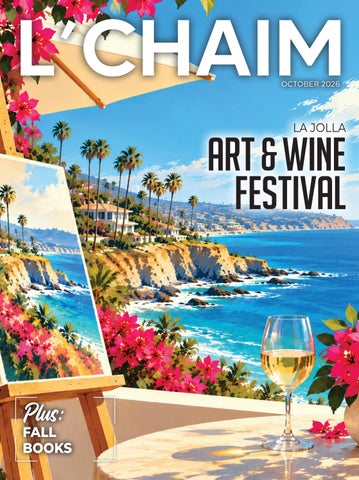
OCTOBER 2026
LA JOLLA
Art & Wine Festival
Plus:
FALL BOOKS
2
L’CHAIM SAN DIEGO MAGAZINE • OCTOBER 2026
WWW.LCHAIMMAGAZINE.COM
3
contents October 2026 • www.lchaimmagazine.com
in this issue... COVER STORY Art, Wine and Community: La Jolla Art & Wine Festival...................................................................... 1000 WORDS ‘Thrilled’ to be in New York City, Says New Israeli Deputy Consul General.................
08
FOOD Harira Moroccan Vegetable Soup........................................................................................................... FEATURES
12
12 ART & WINE
16
16
18 20
World ORT’s New School is First in Four Years................................................................................ RUTH: Holocaust Exhibit............................................................................................................................. Where David met Abigail, a Judean Desert-Area Trail
23 24 26 28
is Reviving Biblical Romance.....................................................................................................................
VEGETABLE SOUP
20
It's Awesome to be Jewish......................................................................................................................... Book Review: Born to Shine...................................................................................................................... Book Review: OCTOBER 7TH....................................................................................................................
COLUMNS
06 07
Prayers & Passages........................................
11
Test Your Jewish IQ...................................
Mazel & Mishagoss..........................................
PUBLISHERS Diane Benaroya & Laurie Miller EDITOR-IN-CHIEF Alanna Maya CREATIVE DIRECTOR Laurie Miller
HOLOCAUST EXHIBIT
L’CHAIM SAN DIEGO, LLC (858) 776-0550 P.O. Box 27876, San Diego, CA 92198
ART DEPARTMENT lauriem@lchaimmagazine.com LISTINGS & CALENDAR: calendar@lchaimmagazine.com
EDITORIAL editor@lchaimmagazine.com ADVERTISING dianeb@lchaimmagazine.com
CIRCULATION & SUBSCRIPTIONS info@lchaimmagazine.com
SUBSCRIBE ONLINE: www.lchaimmagazine.com/shop
CONTRIBUTORS Barbara Birenbaum, Franklin Felber, Donald H. Harrison, Jacob Kamaras, Stephanie D. Gittleman, Salomon Maya, Jana Mazurkiewicz Meisarosh, Mimi Pollack, Rachel Stern, Eva Trieger, Deborah Vietor, Cheri Weiss
ADVERTISING & SALES Diane Benaroya: dianeb@lchaimmagazine.com
Copyright ©2026 L’Chaim San Diego LLC. All rights reserved. No part of this publication may be reproduced, distributed or transmitted in any form or by any means, including photocopying, recording, or other electronic or mechanical methods, without the prior written permission of the publisher, except in the case of brief quotations embodied in critical reviews and certain other noncommercial uses permitted by copyright law. For permission requests, write to the publisher, addressed “Attention: Permissions Coordinator” to: publisher@lchaimmagazine.com Published in San Diego, CA • www.lchaimmagazine.com
lchaimmagazine 4
L’CHAIM SAN DIEGO MAGAZINE • OCTOBER 2026
@lchaimmagazine
Your Real Estate Journey Starts Here Whether selling or buying, I’m here to guide you with care and experience.
With over 2 decades of Real Estate expertise, Kris Gelbart is no stranger to today’s ever changing market. With countless awards, recognitions, and certifications, Kris is your one-stop-shop for everything Real Estate.
Kris Gelbart
Cal DRE 01345809 858-395-0761 gelbartrealtygroup.com
Let us help you move forward. Making critically important family decisions in the aftermath of emotional life changes can be extremely difficult. Our dedicated family law attorneys can help you navigate the complex divorce process with clarity.
Divorce, high conflict child custody, alternative dispute resolution, and more.
Call 858-720-8250 or visit frfamilylaw.com for more information. Legal Experts with Humanity WWW.LCHAIMMAGAZINE.COM
5
TORAH l BY RABBI-CANTOR CHERI WEISS
prayers
& passages HIDDUR MITZVAH: ADDING BEAUTY TO OUR JEWISH LIVES
I
f you have ever had the pleasure of decorating a sukkah (a temporary hut used during the holiday of Sukkot), you know how great it feels to beautify this space. Children delight in creating all sorts of artistic adornments to hang on the walls and frames: colorful paper chains, flowers fashioned out of newspaper or cupcake liners; and hand-drawn pictures of trees, flowers and other objects found in nature. Adults might hang Judaic-themed prints; and for a fresh fragrance, pine cones, cinnamon sticks and dried citrus fruit. The roof is made of any natural material that has grown from the earth yet allows the sky to be visible. Popular choices of sukkah roofing materials include palm fronds, evergreen branches, corn stalks, or woven bamboo mats—all of which add to the aesthetics of the structure. Strings of small lights may be hung, imitating the shimmering stars twinkling in the sky while creating a warm and cozy atmosphere. While there is no specific commandment to decorate a sukkah, the custom of doing so stems from the Jewish law of hiddur mitzvah—“beautifying the commandment.” The Torah commands us to rejoice during Sukkot (Z’man Simchatenu, or the Season of 6
L’CHAIM SAN DIEGO MAGAZINE • OCTOBER 2026
our Rejoicing). It is also a mitzvah to dwell in a sukkah for seven days. (Today, most people satisfy the commandment by eating their meals in the structure while the more observant may opt to sleep there as well.) Creating a lovely environment, however, is not technically part of that commandment. Instead, doing so is based on a Talmudic principle devised by the rabbis which stipulates that we should go above and beyond the bare minimum when fulfilling our obligations concerning certain types of mitzvot. The source of this rabbinic requirement is found in the Book of Exodus 15:2. After their successful escape from Egypt and crossing of the Red Sea, Moses and the Israelites sing: “God is my strength and my song and has become my salvation. This is my God whom I will glorify, the God of my father, whom I will exalt.” Through linguistic analysis, the sages in the Talmud interpreted these words to mean that God must be glorified and exalted in the most aesthetically pleasing way possible (Tractate Shabbat 133b). The fulfillment of certain mitzvot requires the use of ritual objects such as a wine goblet for making kiddush on Shabbat and holidays, a shofar to blow on the High Holy
Days, a lulav and etrog to shake on Sukkot, and mezuzot to hang on the doorposts of our homes. The sages determined that in order to honor the Divine to the best of our abilities, instead of using plain or ordinary objects, we must extend ourselves to purchase (or create) items that are truly special, encouraging us to spend up to 33 percent more than the cost of simple objects in order to ensure that we are using objects of real beauty. Perhaps our kiddush cup is made of silver, our shofar is of superior craftsmanship, our lulav and etrog bought from a vendor we know supplies the highest quality items, while our mezuzot have been enclosed in artistic casings and their tiny scrolls written in the highest quality ink by a first-rate professional sofer (scribe). Adding beauty to our Jewish celebrations enriches our aesthetic experiences, imbuing them with a sense of the extraordinary. In this way, we honor not only God, but our Jewish heritage. So, the next time you sit in a Sukkah, may its beauty fill you with the joy and delight this holiday is meant to bring. RABBI-CANTOR CHERI WEISS IS AN INDEPENDENT LIFE-CYCLES OFFICIANT. LEARN MORE AT SANDIEGO-RABBI.COM
HUMOR | BY STEPHANIE D. GITTLEMAN
mazel
& mishagoss WHAT WILL YOU DO WITH YOUR LIFE?
M
y son graduated from college. I am very proud of him. I won’t tell you his degree, but four years ago it was quite impressive. We’ve since discovered “impressive and “employable” are not synonyms, so I accompanied him to an appointment with a Jewish career counselor and here’s what happened. Mrs. Goldstein told my son to try a career in Jewish Sales. “I’ll train you right now,” she said. “Ready? Never ask, ‘Would you like to buy this schmatta?’ Instead you badger, ‘Nu? You’re really not gonna buy this schmatta after EVERYTHING I’ve done for you?’ My son blinked. He asked for another option. “So try a career in Jewish hospitality,” Mrs. Goldstein coaxed. My son listened intently, pen poised. “Just make guests feel so welcome, they’re afraid to leave because they’ll offend you.” Mrs. Goldstein apparently had many more Jewish occupations on her list. “How about a Jewish Travel Agent? Plan clients’ vacations around three things … where to eat, where to eat after that, and where is a comfortable place to sit and discuss where to eat tomorrow?” My son sighed. Sensing his discomfort, Mrs. Goldstein recommended Jewish Real Estate. “You show people a house and tell them, ‘This kitchen is beautiful.’ Then their mother says, ‘The kitchen is definitely too small.’ So you don’t sell the house to the mother.” At this point my son requested a vocation that didn’t involve being Jewish. I wisely kept quiet because Mrs. Goldstein was on a roll, had selective hearing, and began to rattle off five more Jewish professions. There was a Jewish Family Reunion Mediator, which is someone who specializes in determining who
is still angry at whom and why. There was also a strong need for a Yom Kippur Apology Consultant, assisting congregants who want to apologize without actually admitting they are wrong. My son may have blanched at this, so it was suggested he try becoming a Jewish Guilt Management Specialist, helping clients reduce guilt from, “I know I should have called my Aunt Gertrude” to a much more manageable “Gertie babe! You do understand the phone works both ways, right?” But my personal favorite was my son specializing in Grandchild Public Relations Management. The job description? Making sure Bubbe receives sufficient photos, FaceTime calls, and unsolicited updates so she doesn’t call every member of the family kvetching, “Nobody tells me anything. Does anyone know what Nathan does in preschool?” My son finally summoned up the chutzpa to inquire about a career in technology and suddenly there was a position in Jewish Artificial Intelligence. He asked what the work would entail and was told, “Reminding people it’s their sister’s birthday, telling family members they’re nothing but skin and bones, and recommending packing sweaters for trips to Florida.” My son openly stared at her and said, “But that’s not artificial intelligence. That’s…my mother.” And it was then, for one brief shiny moment I thought Mrs. Goldstein had actually hit upon my son’s true calling! She suggested he’d make a fantastic Professional Jewish Mother Interpreter, translating statements such as “Don’t worry, I’m fine” into “You have disappointed me deeply. Hold my hand and lead me to the nearest plotzing sofa.”
But it was when my (always hungry!) son asked about a career in the food industry, that a Portion Controller at a gentile restaurant was finally mentioned. You march into the kitchen, scrutinize the snively rack of lamb being placed on a diner’s plate, then admonish the chef by shouting, “You people call THAT a serving?” My son looked alarmed, so Mrs. Goldstein gently told him she just thought up the ideal job for him … a Professional Jewish Son! He looked at her suspiciously. “Relax” she said. “Your mama does everything. You just call her once a week, twice on her birthday, and for Mother’s Day, take her to D.Z. Akins. Let her send back her sweet n’ sour cabbage for being too spicy. Then allow her to say, ‘Well, as long as you’re gonna toss it in the garbage, pack it up, we’ll take it to-go.” I rejoiced at this scenario. “Yes!” I said, “So he can have it for lunch the next day during his long and arduous training at his Uncle Bernie’s law office. Because… wish us Mazel Tov … yesterday, Bernie the Attorney hired my boychick as a paralegal!” I triumphantly handed her his business card. Mrs. Goldstein looked incredulous, possibly wondering why we’d wasted all her time, so it was then I had to confess: I’m having a midlife crisis of my own (being a stale Jewish Humor Columnist) and had wanted to see what a Jewish Career Counselor did with herself all day long. Oy. STEPHANIE D. GITTLEMAN WILL INJECT HUMOR INTO ANYTHING YOU HIRE HER TO WRITE. EMAIL HER AT THEQUOTEGAL@YAHOO.COM.
WWW.LCHAIMMAGAZINE.COM
7
L’CHAIM | BY RIKKI ZAGELBAUM | JNS.ORG
Eyal David, deputy consul general of Israel in New York, at the Consulate General of Israel in New-York in Manhattan. PHOTO BY RIKKI ZAGELBAUM. 8
L’CHAIM SAN DIEGO MAGAZINE • OCTOBER 2026
L’CHAIM
1000
WORDS EYAL DAVID, DEPUTY CONSUL GENERAL OF ISRAEL
E
yal David, 40, was still unpacking boxes in his office at the Consulate General of Israel in New York three weeks into his new post as deputy consul general when he said that his time in the Big Apple was already “flying by.” “It feels like I’ve been here forever,” he said. “I don’t have time to unpack my boxes, because I’m out all the time.” The envoy arrived in New York after diplomatic postings in Nairobi, Kenya and Morocco, where he helped rebuild Israel’s official presence after the Jewish state and the kingdom renewed relations in 2021. David’s schedule was also rapidly filling ahead of Israeli Prime Minister Benjamin Netanyahu’s scheduled address to the United Nations General Assembly in Turtle Bay last month. “As you can imagine, the security surrounding the prime minister is very tight,” he said. “There are ongoing talks between our security team and the New York City Police Department.” New York City Mayor Zohran Mamdani said recently that he hadn’t encouraged protests against the Israeli premier, although he appeared to have first recommended that New Yorkers take to the streets. Some city police officers reportedly said that the mayor’s rhetoric would put cops at physical risk. Mamdani, who campaigned on having Netanyahu arrested and more recently said that he lacked that authority, said that he doesn’t plan to protest the Israeli leader. He called on federal authorities to arrest Netanyahu. David said that it is “unfortunate” that Mamdani is “anti-Israel” and that the mayor had “just a few weeks ago called us ‘monsters.’” “This use of this hate terminology—he needs to understand it, and elected officials need to understand that words have consequences,” David said. “When there is such rhetoric that is anti-Israel—and it’s not only anti-Israel, not only anti-Zionist, it’s anti-Jewish—we see the consequences on the street, and it can be very dangerous.” David spoke when he was filling in for Ofir Akunis, the consul general, who was in Israel. He described himself as “number two” to Akunis.
“I think it’s an important milestone in a career for each and every Israeli diplomat to understand that the United States is the biggest ally of Israel,” he said. “New York. Well, of course, we have Washington, the embassy. But New York is also the vibrant heart of the Jewish world.” A career diplomat who has spent nearly nine years in the Israeli Foreign Ministry, David said that the posting offers a chance to work at what he described as the Jewish state’s largest diplomatic mission in the world. “I see myself growing in the ministry,” he said. “I will, inshallah, be an ambassador one day, but I didn’t want to miss this opportunity.” David grew up in Tel Aviv in a family that he described as “masorati, so not completely secular, not completely Orthodox.” His family was “not at all” political, and it was his “childhood dream” to become a diplomat. “Being a diplomat is not politics,” he said. Akunis, the “number one here in New York,” is a political appointee, “but the number two is professional,” David said. To David, it “doesn’t matter which government is leading Israel.” “Whether it’s a right-wing government or a left-wing government or a center, I’m a civil servant,” he said. “Whoever the minister is, I’m among the other diplomats that serve the policy of Israel around the world.” As David unpacked, he shared a copy of a Moroccan newspaper that featured him on its front page when he left the country. He had been told that his departure would be covered, but assumed it’d be buried. “I was looking from the last page to the second page,” he said. “I didn’t even look at the cover, and then it’s on the first page. It was crazy.” The newspaper was in Arabic, a language which David speaks and reads. He also speaks French, the language he primarily used while posted in Morocco, and kept a Hebrew-Swahili dictionary on his desk in Kenya. WWW.LCHAIMMAGAZINE.COM
9
L’CHAIM
Eyal David, deputy consul general of Israel in New York, shows a copy of a Moroccan newspaper, which featured him on its front page when he left the country, in his new office in Manhattan. PHOTO BY RIKKI ZAGELBAUM.
David described his time in Morocco as a “honeymoon” and said his connection to the country is “forever.” “Kenya is always in my heart, because it was my first posting ever. The nature there is amazing,” he said. “But Morocco is forever. I will be the one who opened the liaison office after the resumption of relations, of course with the team.” Before entering the Foreign Ministry, David began doctoral research on white Jewish communities in sub-Saharan Africa. When the ministry later sent him to Kenya, the coincidence became a running joke among the diplomats in his cadet course. “I’m becoming the white Jewish community in sub-Saharan Africa, because I was sent to Kenya,” David said, laughing. There, the self-described “energetic” diplomat joined a cycling group with Rachel Ruto, whose husband, William Ruto, was then deputy president and is now president of Kenya. When David left Nairobi, he said, the first lady came to his home with members of the 10
L’CHAIM SAN DIEGO MAGAZINE • OCTOBER 2026
cycling group to say goodbye. “It’s something that you cannot expect in other countries,” he said. David also met three African presidents during his time on the continent: Uganda’s Yoweri Museveni, Tanzania’s John Magufuli and then Kenyan President Uhuru Kenyatta. “I even had a four-eye meeting with President Museveni of Uganda,” he said, referring to a private, face-to-face one. His encounter with Magufuli was less formal. “By chance, I met the president. I met him in an elevator,” David said. “It was my elevator pitch.” “Israel is a desert,” like Africa, he said. “They have many challenges also with their desert areas and also how to use technologies, many from Israel, to save money, to save water, to protect the environment in a better way.” In his new office in New York, photographs document a visit to Uganda and Knesset Speaker Amir Ohana’s trip to Morocco. David
TEST YOUR JEWISH IQTM also pointed to an artwork already hanging in the consulate commemorating Oct. 7. It is composed of swirling text messages sent on the day of the Hamas-led attacks. Asked about his dynamic with Akunis, who can have an outspoken personality, David said it was too early to tell. “Ask me in a few months,” he said, adding that he was eager and excited to "learn a lot" from the consul general. “It will be feeling like a year.” David shared Akunis’s criticism of Mamdani but said there is a “good balance” in New York City. He noted that both NYPD Commissioner Jessica Tisch and New York City Council Speaker Julie Menin are Jewish. “If he doesn’t want to listen to Israel or to be in touch with us, it’s OK,” David said, of the mayor. “We don’t need him. We have others. This is each one’s choice. We cannot impose ourselves on anyone who doesn’t want us.” David said that he arrived in New York with “a great thrill” about the work ahead. “It’s an important mission to Israel, to the connection with the Jewish organizations, with the Jewish world and also with the politicians from both sides, Democrats and Republicans, from five key states—Ohio, Pennsylvania, New York, New Jersey, Delaware,” he said. His goals include strengthening those relationships and showing Americans “the best that Israel has to offer” beyond just war, he said. Outside of work, David said that one of his New Year’s resolutions is to “find the balance between work and enjoying the city, which has many things to offer.” He spoke of “canoeing” in the river outside his apartment and going to see a Broadway show. The unmarried diplomat has another goal for his posting: to meet his partner. “Maybe here I will form a family,” he said. “Who knows? Only God.” He may already have help. “The minute they hear I’m single, I don’t even have to say that I’m looking,” David said. “They’re already looking for me.” “You know how the Jewish mothers are,” he said. THIS ARTICLE WAS ORIGINALLY PUBLISHED AT: HTTPS:// WWW.JNS.ORG/FEATURE/THRILLED-TO-BE-IN-NEW-YORKCITY-SAYS-NEW-ISRAELI-DEPUTY-CONSUL-GENERAL.
1. What is the minimum required frequency of marital relations owed to his wife for an unemployed man versus a sailor, according to the Talmud? __ a. Unemployed – every day; sailor – once per month __ b. Unemployed – every day; sailor – once per six months __ c. Unemployed – once per week; sailor – once per month __ d. Unemployed – once per week; sailor – once per six months 2. If an Israeli tells you they will be there b’erech at 5:00, when should you expect them? __ a. Exactly at 5:00 __ b. Around 5:00 give or take __ c. Somewhere between 5:30 and whenever traffic clears __ d. Not really that day at all 3. What is the traditional Yiddish name for the sweet braided yeast bread topped with streusel that literally means “grandmother”? __ a. Babka __ b. Mandelbrot __ c. Rugelach __ d. Kugel 4. What covert Israeli humanitarian operation in 1985 rescued more than 8,000 black Ethiopian Jews from catastrophic famine, civil war, and severe religious persecution and airlifted them via a clandestine transit route to Israel? __ a. Operation Magic Carpet __ b. Operation Entebbe __ c. Operation Moses __ d. Operation Solomon 5. Which legendary Jewish actor, who originated the role of the green-blooded, pointy-eared Mr. Spock on Star Trek, adapted the Vulcan salute from the traditional Jewish Priestly Blessing (Birkat Kohanim)? __ a. William Shatner __ b. Leonard Nimoy __ c. Walter Koenig __ d. Brent Spiner
6. Which of the four matriarchs laughed within herself upon overhearing that she would give birth to a son at the age of 90? __ a. Sarah __ b. Rebecca __ c. Rachel __ d. Leah 7. What is the Hebrew term for the canopy under which a Jewish bride and groom stand during their wedding ceremony? __ a. Sukkah __ b. Parochet __ c. Chuppah __ d. Aron kodesh 8. If someone made a tsimmes out of a small mishap, what did they do? __ a. Apologized profusely __ b. Resolved the mishap instantly __ c. Blew it out of proportion __ d. Ignored it completely 9. What protective items and actions are said by the Talmud to shield from a thousand demons at one’s left hand and ten thousand at one’s right? __ a. Wearing tefillin on the head and arm __ b. Placing mezuzahs on doorposts of the home __ c. Wearing tzitzit on the four corners of one’s garment __ d. All of the above 10. Which Jewish thoracic surgeon saved countless lives worldwide by introducing a medical procedure in 1974 that revolutionized treatment for one of the leading causes of accidental death? __ a. Dr. Paul Ehrlich __ b. Dr. David Baltimore __ c. Dr. Robert Jarvik __ d. Dr. Henry Heimlich
Answers on page 29. ©2026 Felber, Starmark, Inc., all rights reserved
WWW.LCHAIMMAGAZINE.COM
11
COVER STORY | BY L'CHAIM STAFF
ART, WINE & COMMUNITY AN UNFORGETTABLE WEEKEND AT THE LA JOLLA ART & WINE FESTIVAL
12
L’CHAIM SAN DIEGO MAGAZINE • OCTOBER 2026
COVER STORY or one unforgettable October weekend, the heart of La Jolla will once again become a colorful open air gallery filled with art, music, food, wine, families—and a community coming together for a cause. Returning to Girard Avenue on Saturday, October 10 and Sunday, October 11, 2026, from 10 a.m. to 6 p.m the free La Jolla Art & Wine Festival (LJA&WF) is expected to welcome tens of thousands of visitors to the Village for one of La Jolla’s most anticipated annual events. But behind the beautiful artwork, lively music and festive atmosphere is a mission that has defined the event since its beginning: supporting La Jolla’s public schools.
F
A FESTIVAL BORN FROM COMMUNITY
In 2008, La Jolla resident and community advocate Sherry Ahern decided it was time to bring a major fine art celebration back to La Jolla. From the beginning, however, Ahern envisioned something larger than an art show. She approached La Jolla’s five public schools, La Jolla Elementary, Bird Rock Elementary, Torrey Pines Elementary, Muirlands Middle School and La Jolla High School, with the idea that proceeds from the festival would directly benefit local students. Since its inception, LJA&WF has raised more than $1.7 million for local public schools, helping support programs in art, music, science, physical education, technology and more positively affecting thousands of students. Giving back is hardly new territory for Ahern. In 1998, she founded the La Jolla Open Aire Farmers Market through the Friends of La Jolla Foundation, with proceeds benefiting La Jolla Elementary School. Ahern also helped introduce something that has since become commonplace at farmers markets: artisans. “I was the first to bring artisans to a market,” she says. “It adds another layer that all customers love.” This popular Sunday market has become one of San Diego’s best-known community markets, bringing together farmers, vendors, neighbors and artisans each week. 170 ARTISTS. ENDLESS INSPIRATION.
At the center of the LJA&WF is the art. This year, approximately 170 artists will transform Girard Avenue into a spectacular outdoor gallery featuring painting, photography, sculpture, textiles, clothing, fiber art, mixed media and more. Artwork begins at accessible price points around $50 and extends into the thousands, giving both first-time buyers and experienced collectors an opportunity to discover something special and to meet the artists themselves. Visitors can hear the stories behind the pieces, learn about creative techniques and discover the inspiration that transformed an idea into a finished work of art. For seasoned collectors, the festival offers the thrill of discovering a new artist. For casual admirers, it offers the simple joy of walking through a beautiful seaside community surrounded by creativity.
FEATURED ARTIST: DOUG MERSKIN
This year’s featured artist, Doug Merskin brings an especially dynamic sense of movement in art to the festival. A Florida-based mixed media artist with studios in Florida and Southern California, Merskin draws from a background in construction and architecture. His work blends structure, experimentation and fluidity, often inspired by the oceans that have shaped his life. About seven or eight years ago, Merskin says his artistic direction began to change. He became fascinated by the idea of giving his work a sense of continuous movement rather than allowing the surface to remain visually flat. “Mimicking the flow of the water—the ocean, a lake or a river—gave me a totally different perspective of my creations,” he says. “I felt they became alive.” That sense of movement has become a signature of his work. Merskin generally begins each piece with a vision and a carefully selected color palette. The colors help determine the direction and movement of the fluid painting process. Only after the artwork has cured does another unexpected stage begin: sculpting. “People are always surprised to know that my pieces are created flat and that the sculpting process comes at the end,” he says. The finished works often seem to move beyond the traditional boundaries of a painting, combining color, form and dimension. For Merskin, water is more than a subject. It is part of his personal history. He grew up in South Florida surrounded by surfing, diving and sailing through the Caribbean. After moving to California at age 18, the Pacific Ocean also became inspirational. “The colors of the Atlantic Ocean and Caribbean Sea” continually find their way into his work, he says, alongside the powerful shades of the Pacific. One of his most personal works, “Mona Pass,” was inspired by sailing between the Dominican Republic and Puerto Rico through the Mona Passage, the strait connecting the Atlantic Ocean and Caribbean Sea. Merskin remembers seeing extraordinary bioluminescence in the water—glowing combinations of greens, blues and gold. He translated that experience into the artwork through turquoise, blues and golds infused with illuminating pigments that glow in the dark. For Merskin, the goal is not simply for people to look at his work. He wants them to feel something. “I want people to feel immersed in color and movement,” he says. “I want them to experience the same sense of energy, depth and freedom I find in the ocean and carry that feeling with them.” While audiences see the final artwork beautifully displayed, Merskin says the life of a working artist requires far more than creativity. Behind every finished piece are schedules, commissions, art shows, gallery events, travel, client meetings and the ongoing challenge of creating new work. Merskin and his wife travel throughout the country participating in shows, while he continues creating between
WWW.LCHAIMMAGAZINE.COM
13
COVER STORY
exhibitions and commissions. His advice to artists hoping to build a sustainable career is straightforward: “Go big.” That means believing in the value of the work, presenting it professionally, developing a business plan and remaining patient. “There will be shows where you make zero sales,” he says. “But the most important thing is to be consistent. Show up to the next art show.” Sometimes, he notes, collectors purchase a piece years after first discovering an artist. “Be flexible to changes and keep yourself curious.” That sense of curiosity also shapes Merskin’s dream collaborations. A lifelong lover of nature, he cites David Attenborough and Luis Sottil as inspirational figures who employ nature in their work. MORE THAN AN ART SHOW
While fine art is the heart of the weekend, the LJA&WF has developed into a full community celebration. Approximately 45,000 visitors make their way through the festival each October. A popular wine & beer garden, the only ticketed portion of the festival, welcomes guests ages 21 and over. With room for approximately 1,500 people, the garden combines wine and beer with live entertainment from the festival’s main stage. Live bands, roving performers, dance and circus-style entertainment help create an atmosphere that stretches well beyond a traditional art fair. Food is another major attraction. A gourmet food court and seating area gives visitors a place to recharge with favorites including pizza, Mexican and Greek cuisine, homemade ice cream and much more. On Wall Street, the Family Art Center, sponsored by Geppetto’s Toys, becomes an interactive playground for creativity and discovery. Activities range from art projects and storytelling to robotics and a petting zoo, with experiences designed for children from toddlers through tweens. Elsewhere throughout the festival, guests will find interactive murals, entertainment and a showcase of beautifully customized lowrider automobiles presented by Mike Davey Auto Body. 14
L’CHAIM SAN DIEGO MAGAZINE • OCTOBER 2026
The result is an event in which grandparents, parents, teenagers and young children can all find something to enjoy. A SECOND CHANCE
Another especially meaningful part of the festival can be found along the sidewalks. Adoptable animals, sponsored by Ark Antiques, give visitors the opportunity to meet dogs, cats and birds searching for permanent homes. More than 100 animals are adopted through the festival each year, turning an afternoon outing into a life changing day for families—and their newest four-legged or feathered companions. BID FOR A CAUSE
The festival’s extensive silent auction is another important fundraising element. Available both in person and online through OneCause, the auction includes an assortment of memorable experiences, products and original art donated by participating artists. The 2026 silent auction opens October 2, giving supporters an opportunity to begin bidding before festival weekend. Every purchase, bid and contribution ultimately connects back to the purpose established by Sherry Ahern nearly two decades ago: creating something beautiful for La Jolla while giving something meaningful back to its children. For two days, its village streets become filled with paintings, sculptures, music, conversations, families, food, animals awaiting adoption, glasses raised among friends and thousands of people discovering artists they may remember for years. “There’s something there for everyone,” Ahern says. And after more than $1.7 million raised for La Jolla’s public schools, that “something” has become much more than a weekend celebration. It has become a La Jolla tradition. THE LA JOLLA ART & WINE FESTIVAL RUNS OCTOBER 10–11, 2026; 10 A.M.–6 P.M. ON GIRARD AVENUE IN LA JOLLA. ADMISSION TO THE FESTIVAL IS FREE. WINE & BEER GARDEN ADMISSION IS TICKETED AND LIMITED TO GUESTS AGES 21 AND OVER. FOR MORE INFORMATION, EMAIL INFO@ LAJOLLAARTANDWINEFESTIVAL.COM
WWW.LCHAIMMAGAZINE.COM
15
FOOD
16
L’CHAIM SAN DIEGO MAGAZINE • OCTOBER 2026
FOOD
HARIRA MOROCCAN VEGETABLE SOUP BY SHARON GOMPERTS AND RACHEL EMQUIES SHEFF, THE SEPHARDI SPICE GIRLS
H
arira is a hearty, robust soup with a tomato base that is traditionally flavored with beef, lamb or chicken and lots of bones, but we love this very tasty vegetarian version. Harira is filled with fall harvest vegetables, butternut squash, sweet potatoes and carrots, that provide beta carotene, as well as garbanzos and red lentils, pulses that are rich sources of protein, fiber, folate and minerals like iron and potassium, this soup is nutritionally dense and low in fat. Parsley and cilantro, onions and celery, freshly grated turmeric, cumin and black pepper round out the flavor profile and up the antioxidant factor. Harira comes from the the Arabic word for silk which refers to the velvety smooth texture lent by a tedouira (thickener) made from flour and water. But in a nod to the trend for gluten-free food, we replaced the flour with an egg whipped with lemon juice. The red lentils soften quickly and add a pleasing creaminess to the soup. In Morocco’s cities, Harira is a popular, inexpensive street food, widely available in restaurants and market stalls. At streetside carts, this zesty soup is served in bowls that are then dunked in a bucket of tepid water and reused (environmentally friendly, but eek!). It is also customarily eaten by the Muslims to break the fast during Ramadan. And like so many other culinary influences, this soup has been adopted by the French Moroccan Jews to break the Yom Kippur fast. As the leaves turn orange, the days grow shorter and the air blows a little cooler, try this amazing soup. HARIRA MOROCCAN VEGETABLE SOUP (GLUTEN FREE)
Serves 8-10 Ingredients 1/4 cup olive oil 2 large onions, thinly sliced 3-4 celery stalks, sliced 2 large carrots, halved and sliced 1 large sweet potato, cubed 4 cups butternut squash, cubed 1 large potato, cubed 1 tablespoon fresh grated turmeric, or 1 teaspoon ground turmeric 1 teaspoon ground cumin 1 teaspoon black pepper 2 teaspoon salt 1 teaspoon harissa (paste) or dried red chile flakes/or harissa powder 1 bunch parsley, chopped 1 bunch cilantro, chopped 1 15 oz can diced tomatoes 2 tablespoons tomato paste
8 cups vegetable, beef, or chicken stock 1 15 oz can chickpeas, drained 1 cup red lentils, rinsed 1 large egg 1/3 cup of lemon juice Directions 1. Heat the oil in a large skillet over medium heat and sauté the sliced onions until they start turning golden. 2. Add the turmeric, cumin, harissa or chile flakes, salt and pepper and sauté with the onions until well coated. 3. Add the celery, carrots, butternut squash, sweet potato, and potato, stir and coat with spice mixture. 4. Add cup each of the parsley and cilantro, canned tomatoes, and tomato paste. 5. Add vegetable broth, bring to a boil. 6. Add the lentils and canned garbanzos and simmer for an hour. 7. Whisk the egg and lemon juice. Stir into the soup. 8. Simmer the soup about 5 minutes and serve, top with cilantro and parsley. Quick tip: If making this soup as a main course, you can add cut up pieces of thin egg noodle or a cup of rice or a cup of barley. THE SEPHARDIC SPICE GIRLS, SHARON GOMPERTS AND RACHEL EMQUIES SHEFF, HAVE BEEN FRIENDS SINCE HIGH SCHOOL. THE SEPHARDIC SPICE GIRLS PROJECT HAS GROWN FROM THEIR COLLABORATION ON EVENTS FOR THE SEPHARDIC EDUCATIONAL CENTER IN JERUSALEM. FOLLOW THEM ON INSTAGRAM, @ SEPHARDICSPICEGIRLS. VISIT SEPHARDICSPICEGIRLS.COM TO SEE MORE OF THEIR SEPHARDIC RECIPES WITH A MODERN TWIST!
This recipe was submitted by Sharsheret: The Jewish Breast and Ovarian Cancer Community, a nonprofit organization. If you or someone you love has been impacted by breast or ovarian cancer, or has elevated genetic risk, contact Sharsheret for free support and resources. For more information, visit sharsheret.org or call (866) 474-2774. Love to cook? Join Sharsheret in the Kitchen for “Zariz” with NYT Best Selling cookbook author and culinary writer Adeena Sussman and her sister, Sharon Wieder, RDN, on Sunday, October 11 at 9:30am PT when they present a cooking demo during the 2026 Sharsheret Summit. Also, learn about Sharsheret’s Pies for Prevention Thanksgiving sale, which was launched in 2008 by Adeena and Sharon in memory of their mother and grandmother. Register for this program and more at sharsheret.org/summit. WWW.LCHAIMMAGAZINE.COM
17
WORLD ORT ADDS NEW SCHOOL
PHOTOGRAPH BY NATHAN SZWERDSZARF.
FEATURE STORY
FIRST ADDITION TO GLOBAL NETWORK IN FOUR YEARS
W
orld ORT has affiliated a new school to its global network for the first time in four years, welcoming Colegio UE Moral y Luces “Herzl-Bialik” in Caracas, Venezuela. The milestone comes as Venezuela’s Jewish community works to rebuild after the earthquakes that struck the country in June. Founded in 1946, the school serves a Jewish community of some 4,000 people and enrolls 332 students from preschool through high school. The affiliation will strengthen its academic offering and raise its profile within the local community. The relationship predates the formal affiliation as students from the school have previously taken part in World ORT’s Ecology Summer School. World ORT had also been active in Venezuela previously, running education and vocational programs across the country, training students and craftsmen in trades including plumbing, electricity, and oil-industry crafts. Dov Ben-Shimon, World ORT Chief Executive Officer, said: “We are honored to officially welcome Colegio UE Moral y Luces ‘HerzlBialik’ to the World ORT network. “This affiliation has been years in the making, but its timing could not be more meaningful. Venezuela’s Jewish community is still recovering from the earthquakes that struck in June, and this school no longer has to face that recovery alone. It now has the full strength of a global network behind it, exactly when it’s needed most.” Deborah Mizrahi de Sananes, the school’s Board President, said: “We are deeply honored to become part of the World ORT network, connecting our students and educators with a worldwide community that shares our values of excellence, innovation, Jewish identity, and 18
L’CHAIM SAN DIEGO MAGAZINE • OCTOBER 2026
social responsibility. “This year, as we celebrate 80 years serving the Jewish community of Caracas, joining the World ORT network is a natural next step: it connects our legacy with a global vision for the future, creating new opportunities for our students, educators, and families.” The affiliation comes after years in which Venezuela’s Jewish community, and the country more broadly, has navigated significant political and economic challenges. In June, two devastating earthquakes struck Venezuela; while no members of the school community were physically harmed, the disaster affected many families and caused serious damage to the school’s facilities. WORLD ORT’S EDUCATIONAL NETWORK SPANS MORE THAN 30 COUNTRIES AND IS ACTIVE IN ALL FIVE CONTINENTS, SERVING MORE THAN 80,000 STUDENTS AND 200,000 BENEFICIARIES ANNUALLY. ACROSS THE US AND IN SAN DIEGO IN PARTICULAR, WORLD ORT COUNTS COMMITTED SUPPORTERS DEDICATED TO THE ORGANIZATION’S MISSION OF IMPROVING LIVES THROUGH EDUCATION AROUND THE WORLD. AS AN INTERNATIONAL PARTNER OF JEWISH FEDERATIONS OF NORTH AMERICA, IT IS BELIEVED TO HAVE HAD AN ORGANIZED LOCAL ORT PRESENCE SINCE AT LEAST THE EARLY 1980S. THE AREA NOW FORMS PART OF THE WEST COAST/SOUTHWEST REGION AND ITS REGIONAL DIRECTOR, JAIME FOX, IS LOOKING TO BRING REPRESENTATIVES FROM AROUND THE WORLD ORT NETWORK TO THE AREA TO SHARE THEIR STORIES. FOR MORE INFORMATION AND UPCOMING SPEAKERS, CONTACT JAIME FOX AT JAIME.FOX@ ORT.ORG OR (323) 966-0092.
858-673-6340 | TheRemingtonClub@WQCalifornia.com 16925 Hierba Drive, San Diego, CA | The RemingtonClub.com
WWW.LCHAIMMAGAZINE.COM
19
FEATURE STORY
RUTH: Remember Us the Holocaust Embarking on a new frontier
SDJA NEW LEADERSHIP THE ANNOUNCEMENT COMES ALONGSIDE EXPANDED STUDENT OPPORTUNITIES
20
L’CHAIM SAN DIEGO MAGAZINE • OCTOBER 2026
FEATURE STORY
R
emember Us The Holocaust (RUTH) is entering an exciting new chapter with a new exhibit at the San Diego Central Library downtown, new leadership and a renewed commitment to establishing a permanent Holocaust museum in San Diego. Since 2020, RUTH has presented exhibits throughout San Diego County, including Chula Vista, Rancho San Diego and most recently the La Jolla/Riford Library. The new Board of Directors aims to make the Central Library RUTH’s final temporary exhibit location and establish its own permanent museum in San Diego within two years. The downtown exhibit will be San Diego’s only dedicated public Holocaust exhibit giving visitors the opportunity to experience rare, authentic Holocaust-era artifacts, World War II historical objects, survivor testimony, photographs and personal items, many connected to survivors who rebuilt their lives in San Diego and Southern California. What makes RUTH’s exhibit unique is the combination of rare, authentic artifacts from concentration camps including AuschwitzBirkenau, preserved by survivors and by the children of those who perished. The survivor testimonies and personal stories include those with direct ties to San Diego County. The exhibit tells the stories of Jewish survivors as well as others persecuted during this time. Several survivors connected to the exhibit live in San Diego County and remain actively involved with RUTH, giving visitors a rare personal and direct connection to living history. Through these stories and artifacts, RUTH invites visitors to reflect on the consequences of antisemitism, bigotry, indifference and historical denial, lessons that remain relevant today. “We are very grateful to the San Diego County and the Downtown Central Library for giving RUTH a home for the next two years, but we already know this cannot be our final destination,” said Dr. Moises Salinas Fleitman, RUTH’s new Executive Director. “Memory needs an address. San Diego needs a permanent place where Holocaust history can be preserved, studied and passed from one generation to the next. Our goal is to make that permanent museum a reality within two years.” To help make the permanent museum a reality, Dr. Fleitman has been appointed RUTH’s new Executive Director. The former President of ORT University and author of numerous books and publications, Dr. Fleitman brings extensive experience in education, leadership and Holocaust awareness to RUTH as the organization enters its next chapter to establish a permanent museum. RUTH’s new Board of Directors brings together leaders with experience in Holocaust remembrance and education, advocacy, WWW.LCHAIMMAGAZINE.COM
21
FEATURE STORY
At a time when Holocaust denial and historical distortion continue to spread, RUTH emphasizes the role of artifacts as concrete evidence, testimony, and witnesses of history. business, the arts and public service. The Board is led by Founder and President Sandra Scheller, and includes Barry Soper, former attorney and author of “A Bum Deal: An Unlikely Journey from Hopeless to Humanitarian”; Ashley Levy, Associate Director of StandWithUs Southwest; Max Scheller, artist and RUTH contributor; David Beck Brown, internationally exhibited artist and World War II collector; Myssie McCann, real-estate broker and business leader; Jonathan Morales, recognized for his response during the 2019 Chabad of Poway synagogue attack; Jack Morgenstern, former chair of San Diego’s Yom HaShoah Committee; Liz Talpalatsky, daughter of Holocaust survivor Edith Palkowitz; and Alex Shah, San Diego real-estate developer 22
L’CHAIM SAN DIEGO MAGAZINE • OCTOBER 2026
and property-management professional. At a time when Holocaust denial and historical distortion continue to spread, RUTH emphasizes the role of artifacts as concrete evidence, testimony, and witnesses of history. These objects are not abstractions. They are material proof of persecution, survival, loss, and memory. Together with survivor stories, they help visitors confront the Holocaust through evidence that can be seen, studied, and remembered, which is becoming increasingly important as firsthand survivor history is lost. “History must be preserved and told, never forgotten,” said Sandra Scheller, founder and curator of RUTH: Remember Us The Holocaust. “As part of our mission, we are dedicated to collecting and preserving
very rare Holocaust and World War II artifacts, documents, photographs, and personal belongings that provide a tangible connection to the people and communities who lived through this history. Each artifact tells a story and represents a piece of history that may otherwise be lost forever. To continue this important work, we urgently need a permanent home where these artifacts can be safely preserved, displayed, and made accessible to the public.” The RUTH exhibit is open now at the Central Library, located at 330 Park Boulevard near Petco Park. The downtown location will make the exhibit more accessible to students, families, educators, and visitors from across the region because of the Central Library’s central location and access to public transportation, including trolley and bus routes. RUTH is seeking community support through donations, grants, matching gifts and other funding sources to help make a permanent museum a reality. Several potential sites in San Diego County are under consideration, while the organization focuses on building the financial support needed to secure and develop a permanent location. “We are so grateful to be exhibiting at the beautiful downtown library and welcome post and future patrons,” added Scheller. “We welcome the community to help and want the county to help us make this journey a reality and create a permanent Holocaust museum in San Diego that will be revered for generations.” RUTH: REMEMBER US THE HOLOCAUST PRESERVES HOLOCAUST SURVIVOR STORIES AND AUTHENTIC ARTIFACTS THROUGH EDUCATION AND PUBLIC ENGAGEMENT. ROOTED IN SURVIVORS CONNECTED TO SAN DIEGO AND SOUTHERN CALIFORNIA, RUTH IS WORKING TO ESTABLISH A PERMANENT HOLOCAUST MUSEUM IN SAN DIEGO SO THEIR HISTORY CAN BE PRESERVED FOR GENERATIONS TO COME. TO LEARN MORE, CALL (619) 728-RUTH OR VISIT REMEMBERUSTHEHOLOCAUST.ORG.
FEATURE STORY
Where David met Abigail The Judean Desert-area trail is reviving biblical romance BY ETGAR LEFKOVITS | JNS.ORG
I
t was a quintessential Biblical romance with all the trappings of a Hollywood action film: a young warrior on the run from a jealous king leading a band of outlaws through the desert, and a young woman trapped in a marriage to a wealthy, ill-tempered man. A newly opened nature trail on the edge of the Judean Desert, where the Bible recounts that the future King David first met his wife more than 3,000 years ago, is becoming a local hotspot for modernday marriage proposals and, locals hope, a catalyst for renewed faithbased tourism in an off-the-beaten-path corner of Israel. Even by Holy Land standards, it is not every nature trail that is lined with signs and interactive exhibits featuring Biblical passages from the Book of Samuel and the Book of Psalms. That is exactly what is planned for the newly opened “David’s Wanderings Path,” a nearly three-mile walking and cycling trail that runs along the desert edge ridge stretching from the agricultural community of Maon, south of Hebron, to nearby Carmel. The route through the desert-area wilderness is central to the Biblical account of the future king’s first encounter with Abigail, who, according to I Samuel, intercepted David with provisions to prevent him from attacking her husband, Nabal, after he refused to compensate David and his men for protecting his flocks. In a scene that could have come straight from a Hollywood script, Nabal died shortly afterward, and Abigail became David’s wife. The $1.6 million trail, launched earlier this year by the Israeli Tourism Ministry and the Mount Hebron Regional Council, will eventually include a coffee shop, electric off-road vehicle tours and overnight farm stays for Bible enthusiasts and desert travelers.
Originally envisioned as a link between nearby Jewish communities, the promenade’s sweeping desert views and three scenic overlooks have already made it a popular destination for local marriage proposals, echoing the Biblical love story. With an eye toward attracting both Jewish and Christian visitors, planners are also developing a Center of Psalms in the region, highlighting the prayers and songs traditionally associated with David during the years he hid in the Judean Desert while fleeing King Saul. “This promenade bridges the gap between a pristine natural landscape and the biblical tales of David and Abigail—and the wars of King David—that unfolded right here,” Eliram Azulay, head of the Mount Hebron Regional Council, said during a tour of the site. “Our deepest roots lie here: from the ‘Ground Zero’ of the Bible— the Cave of the Patriarchs, where Abraham walked and where our forefathers and foremothers are buried—to the presence of King David,” he said. “It encompasses numerous biblical sites entrusted to us to preserve and develop, and through them we discover who we are and what we are doing here.” THIS ARTICLE WAS ORIGINALLY PUBLISHED AT: HTTPS://WWW. JNS.ORG/FEATURE/WHERE-DAVID-MET-ABIGAIL-A-JUDEANDESERT-AREA-TRAIL-IS-REVIVING-BIBLICAL-ROMANCE
WWW.LCHAIMMAGAZINE.COM
23
FEATURE STORY
It's Awesome to Be Jewish Groundbreaking program instills Jewish pride in American teens BY ATARA BECK | JNS.ORG his desire to make a difference led to the creation of AKLA. THE DEVELOPMENT OF AKLA
A
KLA is derived from the Hebrew slang word (achla) for “awesome” or “cool,” and the 12- to 14-year-olds who participate in the five-week fellowship by that name agree that the program is indeed outstanding. AKLA ignites Jewish pride by showing teens what Jewish ingenuity and a sense of purpose can achieve. Through powerful, hands-on experiences, teens discover the remarkable ways Jewish individuals and ideas have shaped the world—from trailblazing advances in technology to culture, security and global innovation. By connecting these achievements to the values and heritage behind them, it helps young Jews see themselves as part of an extraordinary story and inspires them to carry that story forward with confidence, pride and purpose. The program, free of charge, was launched in Los Angeles in 2022, and its mission has only become more urgent amid the surge in antisemitism since the Oct. 7, 2023, Hamas massacre in southern Israel and against the backdrop of the ongoing war with Iran and the Israeli-Palestinian conflict. Jeff Polak, AKLA’s president and co-founder, said that the inspiration for the program came from his children’s experiences. According to Polak, the b'nei mitzvah programs his children attended were lovely, and many temples provided education, but “it was just, more or less, about how we can help everybody else and about being more sympathetic to the struggles and challenges of other communities.” There was nothing particularly exciting that would help children better understand their own community “at this really important stage in their lives,” he said. “And I saw that as being quite problematic.” Polak’s children are now in college and finishing high school, but 24
L’CHAIM SAN DIEGO MAGAZINE • OCTOBER 2026
AKLA, which began with 20 to 25 participants in Los Angeles, has expanded to 140 participants, and demand is growing rapidly. The program, which runs for five consecutive Sundays from Yom Kippur to Thanksgiving, has seen similar success in Chicago, where it launched with 50 to 60 participants, and 200 sign-ups are expected for the spring session. AKLA operates as an independent 501(c)(3) organization and was originally funded by the David and Janet Polak Foundation. More recently, it received support from Jewish National Fund for its expansion to Dallas. Polak said that the program initially targeted children ages 12 to 14 for b’nei mitzvah but has expanded to include 15-year-olds. He described how one temple that started with five or six youngsters has grown to 45 to 50 participants and requested a “2.0” version of the program for its older students. “What it is, in essence, is a pivot of thought process of it’s awesome to be Jewish. You come from an amazing culture. The accomplishments are beyond numerous. This is about holding heads up high and being proud,” he said. Making such an impression is especially valuable for 12- to 14-yearolds, he continued, “because that’s the first time when kids start seeing things through their own lens.” When highlighting the many notable Jewish contributions to medicine, one of the outings was to Cedars-Sinai Medical Center, where, Polak noted, most of the participants were born. They had no idea that famous Israeli violinist Itzhak Perlman had contracted polio as a child or that Drs. Jonas Salk and Albert Sabin—both Jews—developed vaccines to fight the disease. Nor did they know that the renowned hospital was founded by Jews in part due to the discrimination and exclusion that Jewish physicians and patients faced in other health-care settings. The teens also visited, among other places, Warner Bros. Studios, where they learned about Jewish immigrants’ profound impact on the entertainment industry. TEENS FEEL ‘EMPOWERED’
Several participants raved about the program on video, commenting on different aspects. One boy was particularly impressed by medical innovation in Israel and that a member of the Israel Defense Forces
FEATURE STORY who was shot and paralyzed is now able to walk again. “I think that’s really cool,” he said. “I really liked the VR,” said one girl. “I don’t like school, but it was really cool to learn with Albert Einstein.” “I loved how I was learning but in a fun way,” said another. “Other hospitals at the time wouldn’t let Jews in,” one boy said after visiting Cedars-Sinai. To which a girl added, “I like how the Jews decided to be a better person and let everyone in.” “I learned about all the things that Israel has invented and helped the world,” said another. “It means that I’m connected with a lot of people around the world who have done things to help the world. Maybe I can do something like that when I grow up,” another boy said. “I learned that a bunch of TV shows and superheroes are based on Jewish ideas,” said another. Some enjoyed play-acting a scene with the high priests in ancient Israel and were happy to learn about their culture. “It’s a part of me,” one girl said. “I learned that Israel is number one in drone technology,” a boy said, beaming. “It felt very empowering to learn how my culture and heritage protects people,” a girl said after a Krav Maga session. “It’s something we wish we didn’t have to do, but at a time like this, we’re lucky that we got the opportunity,” another said, referring to the current rise in antisemitic attacks. Yet another boy said: “My favorite part of AKLA has been the whole thing because every single time we go to AKLA, there’s a new theme like cinema or health or innovation, and it’s always better and better—learning about new things that Jewish and Israeli people do. It helps me to shape my future in a way that I wouldn’t think of before.” RESPONDING TO CLAIMS OF GENOCIDE, APARTHEID
“It’s a completely different approach of embedding and motivating and creating a positive energy and enthusiasm about the community,” Polak said. Participants who know about Israel’s contributions in medicine, high-tech and other fields would likely react by thinking, he said, “What are you talking about? Look at these hospitals; look at this community and all these amazing things that are taking place. It doesn’t translate.” AKLA’s approach, Polak continued, is not to engage in debates or try to persuade young people that opposing views are wrong. Plenty of organizations take an educational approach to confronting such arguments, he said, and he respects that work. AKLA, however, takes a different path. “People don’t want to be in this back-and-forth where it gets very contentious,” he said. Instead, Polak hopes the positive information about Israel and the Jewish people, and the experiences the teens gain through AKLA, will provide “a spark, if you will, to addressing these issues from a different perspective altogether.” THIS ARTICLE WAS ORIGINALLY PUBLISHED AT: HTTPS:// WWW.JNS.ORG/FEATURE/ITS-AWESOME-TO-BE-JEWISHGROUNDBREAKING-PROGRAM-INSTILLS-JEWISH-PRIDE-INYOUNG-TEENS
ANSWERS TO TEST YOUR JEWISH IQTM 1. b. Once per day for an unemployed man, because he has no physical labor or travel obligations, or for any man who has the time and energy to cohabit every day. Once per six months for a sailor, because sea voyages often lasted six months (Ketubot 61b-62a). 2. b. B’erech means “approximately” or “roughly” in Hebrew, a mainstay phrase in everyday Israeli scheduling. 3. a. Babka derives from the Slavic and Yiddish words for “grandmother” (bubbe), named for the pleated, skirt-like fluting of the traditional round cake molds. (Trader Joe’s sells chocolate babka that is to die for.) 4. c. Operation Moses was a covert rescue conducted by the Mossad and IDF, helping over 8,000 Ethiopian Jews (Beta Israel) escape from their Sudanese refugee camps and delivering them to the Jewish homeland. 5. b. Leonard Nimoy conceived the Vulcan salute from his Orthodox Jewish upbringing. As a child during High Holy Day services, he peeked at the Kohanim giving the Priestly Blessing and making the hand gesture forming the Hebrew letter Shin. Nimoy adapted the gesture and the blessing for Mr. Spock’s iconic blessing, “Live long and prosper.” 6. a. Sarah laughed, saying, “Shall I in truth bear a child, though I have aged?” (Gen. 18:10–13). Abraham named their son Yitzchak (Isaac), meaning “he will laugh,” memorializing his joy over his newborn son (Gen. 21:3). 7. c. The chuppah symbolizes the home the newlyweds will build together, open on all four sides just like the welcoming tent of Abraham and Sarah. 8. c. Tsimmes is an Ashkenazi stew of sweetened vegetables and fruits cooked for hours. Making a tsimmes means taking a simple matter and turning it into a prolonged, complicated mess. 9. d. Rav Huna said, “Each and every one of us has a thousand demons to his left and ten thousand to his right” (Berachot 6a). Wearing tefillin, placing mezuzahs, and donning tzitzit shield against this vulnerability by forming a complete spiritual perimeter around a person, guarding against sin and spiritual harm (Menachot 43b). 10. d. Henry Heimlich introduced the subdiaphragmatic abdominal thrust, creating an immediate, cost-free global medical standard that has saved hundreds of thousands from choking worldwide, including Ronald Reagan, Cher, Elizabeth Taylor, and Simon Cowell. At age 96, he personally saved a fellow resident of his retirement community who was choking on a hamburger.
_____________________________________ 0–2 Talmid/Talmida (Student) 3–5 Melamed/Melamedet (Teacher) 6–8 Talmid Chacham/Talmidat Chacham (Scholar) 9 – 10 Gaon/Gaona (Genius) _________________________________________
Your comments are welcome at Felber@Jewish-IQ.com ©2026 Felber, Starmark, Inc., all rights reserved. WWW.LCHAIMMAGAZINE.COM
25
BOOK REVIEW
A Gift that Glows:
You Were Born to Shine
In a season filled with beautiful things, the most memorable gifts are often the ones that carry a message.
I
n a season filled with beautiful things, the most memorable gifts are often the ones that carry a message. You Were Born to Shine by local author Becky Krinsky is one of those rare little treasures— thoughtful, uplifting, and designed to leave a lasting impression. Presented in both English and Spanish and paired with lovely illustrations, the book introduces Stella the Star, a radiant character who embodies confidence, optimism, creativity, and the joy of being exactly who you are. Through Stella’s gentle encouragement, young 26
L’CHAIM SAN DIEGO MAGAZINE • OCTOBER 2026
readers are reminded that their individuality is not only something to embrace, but something to celebrate. Krinsky’s message is refreshingly simple and wonderfully timeless: take chances, be creative, have fun, and never be afraid to let your true self shine. “Life is short, so take risks, be creative, and, above all, have fun. Enjoy every day and embrace the chance to be yourself. You are one of a kind, an original, and an extraordinary individual.” With its warm spirit, bilingual presentation, and beautifully positive message, You Were Born to Shine feels especially fitting for the holiday season. It is the kind of gift that goes beyond the moment—one that parents, grandparents, and loved ones can give with the hope that its message will stay with a child long after the wrapping paper is gone. Charming, encouraging, and full of heart, this is a book that reminds every young reader of something worth remembering: You were born to Shine!
WWW.LCHAIMMAGAZINE.COM
27
BOOK REVIEW
OCTOBER 7TH A novel by Allan Havis BY DEBORAH VIETOR
A
llan Havis takes readers on a deep and compelling journey into the period before, during and after the shattering events of October 7 in Israel. OCTOBER 7TH is an ambitious work, whose themes include ideological radicalization, antisemitism, captivity, political violence, family division, moral complacency and the difficulty of sustaining human connection in a time of fear and conflict. The October 7 attack and its aftermath profoundly affected Havis and led him first to create a 90-minute play. Yet the story held more characters, histories and intersecting conflicts than a drama could fully contain. He reconsidered the project as a literary novel, using the wider form to explore a larger range of lives and the complicated moral terrain in which they move. The novel opens in Gaza and enters a world marked by trauma, brutal captivity, ideological conflict and the consequences of violence. It does not offer readers a simple or comfortable path. Instead it asks them to confront lives altered by political extremism, inherited belief, personal grief, and fear of the other. The setting is urgent, but the novel’s concerns extend beyond a single place or event. Havis is interested in how individuals come to accept, resist or question the ideas that shape them. Havis draws his characters with the instincts of an accomplished dramatist and the care of a novelist. At first, readers encounter them through vivid and distinct impressions; as the narrative develops, their deeper fears, hopes, ambitions, loyalties, strengths, frailties and fates emerge. The novel follows a dozen principal characters whose lives touch, diverge, and sometimes collide in unexpected ways. Among them are a renowned Jewish corneal surgeon, her daughter and the daughter’s girlfriend, members of the surgeon’s extended family, an IDF soldier, captors, a controversial podcaster and his associate, a doctoral student from the Middle East and a Lebanese 28
L’CHAIM SAN DIEGO MAGAZINE • OCTOBER 2026
BOOK REVIEW
OCTOBER 7th asks what happens when public rhetoric, media voices, and online personalities inflame fear or turn suffering into spectacle. author whose rhetoric influences students and public conversation. Havis uses this wide cast not merely to present competing positions, but to show the emotional and personal pressures beneath them. The characters occupy sharply different political, religious and cultural worlds. Some are shaped by idealism; others by resentment, personal loss, fear, ambition, or the need to belong. The novel recognizes that people can become trapped psychologically as well as physically—by dogma, trauma, social expectation, and the conviction that their own viewpoint is the only moral one. One character observes, “The way idealism hardens into vigilance.” That thought resonates throughout the book. OCTOBER 7TH examines how deeply held beliefs can harden into certainty and how certainty can make empathy, conversation, and self-questioning increasingly difficult. It also asks what happens when public rhetoric,
media voices, and online personalities inflame fear or turn suffering into spectacle. The book’s movement among locations, dates, beliefs and actions is intentionally complex, reflecting the interwoven lives and competing narratives it portrays. Readers are asked to follow a large moral and emotional canvas, one in which no character’s choices occur in isolation. As the narrative unfolds, Havis repeatedly returns to the possibility of dialogue across divisions that might otherwise appear impossible to bridge. If a writer shaped by fundamentalist ideology can enter into an unlikely conversation with a liberal Jewish physician about Israel, identity, history, and responsibility, can readers also find a way to listen more carefully? If a young woman returns from a Birthright trip with beliefs different from those of her family and friends, what happens to the relationships on which she has relied? These questions are not easily resolved, but they invite reflection rather than retreat. The novel also asks readers to consider antisemitism and Holocaust denial, as well as the role public voices can play in spreading hatred or indifference. When influential figures use their platforms to distort history, diminish suffering, or deepen divisions, what responsibilities do listeners, readers, and communities have? Havis does not reduce these questions to slogans. He uses fiction to bring their consequences into intimate human focus. By dismantling inherited biases, does this novel surpass storytelling—does it challenge us to expand education on Jewish history and the Holocaust as a vital pathway to raising our collective awareness? These are only some of the questions raised in this thoughtprovoking and timely novel. JOIN ALLAN HAVIS FOR A FREE, CATERED BOOK TALK AT UC SAN DIEGO’S FACULTY CLUB OCT. 8. RESERVATIONS ARE AVAILABLE THROUGH UC SAN DIEGO’S ONLINE EVENT CALENDAR AT HTTPS://CALENDAR.UCSD.EDU/EVENT/BOOK-TALK-WITHALLAN-HAVIS-OCTOBER-7TH-NEWLY-PUBLISHED-NOVEL.
WWW.LCHAIMMAGAZINE.COM
29
30
L’CHAIM SAN DIEGO MAGAZINE • OCTOBER 2026
WWW.LCHAIMMAGAZINE.COM
31