





PUBLISHERS
Diane Benaroya & Laurie Miller
EDITOR-IN-CHIEF
Alanna Maya
CREATIVE DIRECTOR
Laurie Miller
CONTRIBUTORS
Barbara Birenbaum, Franklin Felber, Donald H. Harrison, Jacob Kamaras, Stephanie D. Gittleman, Salomon Maya, Jana Mazurkiewicz Meisarosh, Mimi Pollack, Rachel Stern, Eva Trieger, Deborah Vietor, Cheri Weiss
ADVERTISING & SALES
Diane Benaroya: dianeb@lchaimmagazine.com
SAN DIEGO, LLC (858) 776-0550 P.O. Box 27876, San Diego, CA 92198
EDITORIAL editor@lchaimmagazine.com
dianeb@lchaimmagazine.com
Copyright ©2026 L’Chaim San Diego LLC. All rights reserved. No part of this publication may be reproduced, distributed or transmitted in any form or by any means, including photocopying, recording, or other electronic or mechanical methods, without the prior written permission of the publisher, except in the case of brief quotations embodied in critical reviews and certain other noncommercial uses permitted by copyright law. For permission requests, write to the publisher, addressed “Attention: Permissions Coordinator” to: publisher@lchaimmagazine.com
Published in San Diego, CA • www.lchaimmagazine.com

When it comes to the creation of fine arts, I do not possess even the slightest shred of talent. I have absolutely no ability to draw, paint, sculpt, weave, or throw pottery. Nevertheless, I have a great admiration for those who possess artistic abilities in this arena, especially those who have been able to translate Jewish themes into their work.
Perhaps the most legendary of these artists is Marc Chagall (1887-1985). Born into a Chassidic Jewish family in Vitebsk, Belarus (then part of the Russian empire), the young artist made an early decision to incorporate his Jewish heritage into his work. Throughout his lifetime, Chagall’s brilliant paintings, stained glass windows, and creations in other mediums unapologetically reflected Jewish themes and history.
Other renowned artists of the modern era incorporated Jewish themes into their work—albeit not exclusively. Moritz Daniel Oppenheim (1800-1882) is widely considered to be the first Jewish painter of this era. His works included depictions of Jewish culture as well as secular portraits and literary scenes. Contemporary artist Judy Chicago’s Holocaust Project: From Darkness Into Light includes depictions of Shabbat and concentration camp photos. Painter and sculptor Amedeo Modigliani, painter Lee Krasner, and kinetic and op artist Yaacov Agam also fall into this category of artists.
The Second of our Ten Commandments has led to a historical misconception about the relationship between Judaism and art. Exodus 20:3-5 reads as follows: “You shall have no other gods besides me. You shall not make for yourselves a sculptured image, or any likeness of what is in the heavens above, or on the earth below, or in the waters under the earth.You shall not bow down to them or serve them...”
Some have understood these verses to mean that the creation of visual images— especially those which contained representational images of human beings—was forbidden lest these images be worshipped. Yet the rabbis in both the Mishnah (the earliest Rabbinic teachings on Jewish law) as well as the Shulchan Aruch (the largest code of Jewish law, compiled in the 16th century) were unable to reach a consensus regarding which specific types of images should be forbidden.
Jacques Picard, Professor Emeritus of the University of Basel, and author of Triumph and Trauma of Images, A Journey into Art History, Iconoclasm, Cult Controversy and Remembrance Culture, explains that what would have been forbidden in biblical times were “cultic figurative objects” designed specifically for worship, such as those figures of idols destroyed by Abraham that had belonged to his father.
Throughout the centuries, the talents of skilled Jewish artists have been lauded, beginning in the Bible with the artist Bezalel, chosen by God to lead all artistic work on the Mishkan (Tabernacle). “I have endowed him with a divine spirit of skill, ability, and knowledge in every kind of craft.” (Exodus 31:3). In 1932, the long-buried synagogue of Dura-Europas (in present-day Syria) was discovered by archaeologists, with an inscription dating back to 244 C.E. Extraordinary frescoes depicting people and biblical events were unearthed, including portraits of Moses and the Prophet Elijah, the Binding of Isaac and scenes from the Book of Esther. Between the 9th and 15th centuries, beautifully illustrated (“illuminated”) Jewish texts were popular, such as the Torah, High Holy Days prayer books, and Passover Haggadot.
Many artists of today are depicting Jewish topics on their own terms. Themes such as antisemitism, feminism, ritual, and social commentary are being portrayed in unique ways using a wide variety of visual media. May we all be inspired by Jewish artists’ many creative works, past and present.
RABBI-CANTOR CHERI WEISS IS AN INDEPENDENT LIFE-CYCLES OFFICIANT LEARN MORE AT SANDIEGO-RABBI.COM
Let me just say this upfront: I’m not pushy. I’m proactive. There’s a difference. Pushy is calling your daughter daily asking why she’s still single. Proactive is creating an entire televised dating experience to gently help her decide which of the three guys she’s dating should win her hand in marriage. Which is why when Rachel turned 24 and said, “Back off Mom, I’m focused on myself and my career right now,” I heard, “Please, Mom, produce a Jewish dating game show for me immediately!” And I listened. That’s how “So You Think You Can Be My New Jewish Son-In-Law?” (where the mother isn’t just meddling, she’s the host, the judge, the director, and quite frankly the real grand prize) came into existence.
Now bear with me here. Instead of the three shlubs she’s currently dating; the contestants will be three single Rabbis. And why not? This is my show and let’s be honest: Netflix needs a new hit! The Rules: Rachel sits on one side of the partition. The three rabbis sit on the other. I sit on a pedestal in the front row, with a clipboard and a pen that clicks very loudly when disappointed, visibly reacting to every answer like a woman whose future grandchildren are on the line— because they are.
A little about the contestants: Rabbi #1
The Traditionalist: Keeps kosher, observes Shabbat, hobby is dentistry. If he had a flaw, I would not acknowledge it. Rabbi #2
The Modern Charmer: Plays guitar, quotes philosophy and says things like, “Spirituality is a journey.” Rabbi #3 The Wild Card: He
greeted me with “Shalom, bruh!” I don’t know what that means, but I don’t like it. The very first question is asked by Rachel (who has obviously misunderstood who the star of this show is) as she inquires, “What’s your idea of a perfect date?” Rabbi #1: “We light candles, discuss Torah, and are home by 8:15.” (I nod. Sensible. Efficient. Slightly Amish, but we can work with it) Rabbi #2: Walk at sunset, meaningful conversation, music under the stars.” (Okay, who raised this one? Very poetic. Suspicious.) Rabbi #3: An escape room! (He wants to get away from me already??)
I quickly take over the next question. “If your mother-in-law calls daily, what’s your reaction?” Rabbi #1: “I welcome her wisdom.” (A mensch! I adore this man!) Rabbi #2: “I honor her … from a respectful distance.” (Distance? I’m already feeling slightly rejected.) Rabbi #3: “Boundaries, man. Totally.” (I click my pen 18 times and write, “Booted off the island” on my clipboard.) Next, I ask something trickier. “How do you feel about family?” Rabbi #1: “Family is everything.” (Ding! Correct answer!) Rabbi #2: “Family is the foundation of who we become.” (Also correct, but now he’s just showing off.) Rabbi #3: Depends. Are they chill? (I mouth “Call Security” to the Netflix producer.) “If you weren’t a Rabbi, what would you be?” I probe. Rabbi #1. A doctor. And I’ll bring you my homemade chicken soup if you sneeze.” Rabbi #2 An accountant and I’ll do your taxes, but we must stay honest. Rabbi #3 “Funny you should ask.
I got fired for being a Rabbi when I rode the waves during Tashlich, so now I have a new start-up.” (This requires clarification.) “And what does that mean?” I ask. “It’s hard to explain,” he responds. (No. It’s not. It’s unemployment with branding.)
During the commercial break, I corner the producer. “Let’s eliminate #3,” I whisper. He tells me that’s not how dating shows work. Sure, he has experience, but I’ve seen Love Is Blind. “Fine. Let’s accidentally eliminate him. A previously discarded shiksa girlfriend comes back into the picture with their lovechild who needs his long-lost father to give him surf lessons.” He stares at me. I stare back. This is how show biz negotiations work. With #3 escorted off the stage, it’s time for Rachel to choose her Rabbi. The music builds, the audience leans in …
I shout, “#1, NUMBER ONE!” She chooses Rabbi #2. Of course she does. The partition opens. They smile. There’s chemistry. There’s warmth. There’s potential. He’s actually pretty nice. Do I wish she’d chosen Rabbi #1, who would have had her married by Tuesday and producing grandkids by Thursday? Sure. But my daughter looks happy and technically that was the goal. Not to worry…I already have a new spin-off show for my son, graduating college this year: “So You Call Yourself a Good Wife For My Son??” Auditions will be held this fall.
STEPHANIE D. GITTLEMAN WILL INJECT HUMOR INTO ANYTHING YOU HIRE HER TO WRITE. EMAIL HER AT THEQUOTEGAL@YAHOO.COM.

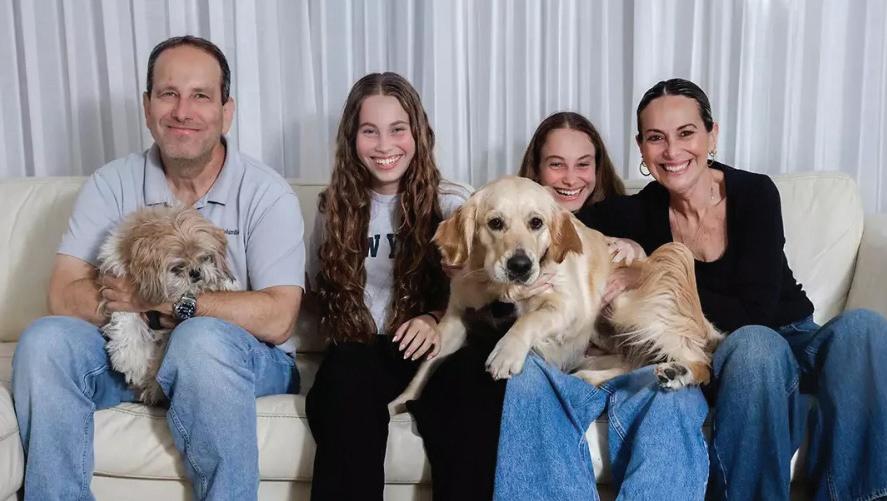
Aweek before he was killed in a terrorist attack at the Allenby Crossing with Jordan in September 2025, IDF Sgt. Oran Hershko, 20, was traveling in Greece with his father. He created an AI image of a golden retriever puppy sitting in his room and wrote to his family, “Is it too much to ask for a golden?”
A few months after his death, a dog named Goldie, of the exact breed and color he loved, arrived at the family home in Tel Mond in central Israel. “It was like a kind of legacy he left,” says his mother, Michal.
Since Oct. 7, 2023, thousands of bereaved families have been added to the circle of grief in Israel. Alongside financial aid and support workshops, the Friends of the Israel Defense Forces (FIDF) sought
to find an additional response—one that enters the home and assists families in their mourning.
The organization turned to the Therapeutic Riding and Canine Institute (TRCI) in Tel Mond, and together they created a first-of-itskind project in Israel: Kelev L’Derech (“A Dog for the Journey”)—to provide therapeutic dogs for bereaved families.
Michal Hershko, a teacher, shared the family’s story, “We have Mocha, a shih tzu that Oran loved very much. When FIDF approached us, my husband, Avi, and I decided that this time we would take a large dog. That had been the dream of Oran and his sisters, Gaia, 24, and
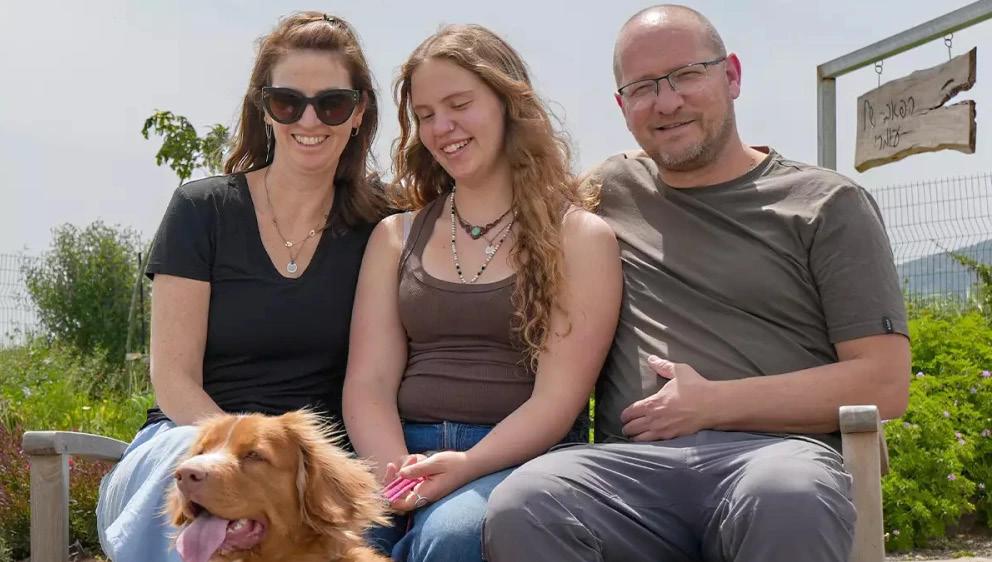
Lihi, 17. They kept saying the house felt empty. We wanted a big dog that you can feel its presence when you hug it, something with weight to fill that void. Today, we feel Goldie’s presence. It’s a grounding experience and provides a sense of security.”
Michal always visits Oran’s grave, located within walking distance of their home, with Goldie. “She comes there with us, lies patiently by the grave, and is simply present. She also wants to play and needs to go out, so you can’t neglect her. She demands attention, which forces us into a healthy routine.”
“Service dog programs for PTSD have existed for years,” explains Alex Ben-Melech, the project manager and a dog trainer at the TRCI institute. “But I hadn’t encountered this specific idea before. It touched me personally because I also lost two friends.”
The project has matched about 40 dogs with families in the past year.
The solution Ben-Melech developed entails three stages: First, the dogs are raised by foster families. Then, they undergo professional training. Finally, after getting to know the bereaved family, a precise matching process takes place based on age, energy, size and specific needs. “I match the dog to that specific family’s need. Some want a dog to go running with; others want a dog to lie down at night and rest its head on their leg. It’s about filling that silence.”
Dana Meir-Yung, a lawyer from Tel Aviv, is the widow of Sgt. Maj. (res.) Ofer Yung, 39, who was killed in February 2025 in a terrorist
shooting attack in northern Samaria. Dana was left with two children, aged 2 and 3.
“A few months after Ofer was killed, our family dog passed away. I told myself, enough with death, I need to bring new life into the home for the children,” Dana says. Through the project, she received Monty, a medium-sized hypoallergenic poodle. “He is truly charming, brings joy and interest into the home. The kids love him, and sometimes it feels like he fills a bit of the emptiness I feel in the evenings.”
Shirley and Tomer Schwartz, from Shadmot Dvora, a moshav near the Sea of Galilee, lost their son, Omri, a paratrooper officer killed in an encounter with terrorists in northern Gaza in December 2023.
The family received Sandy, a Nova Scotia retriever. Their daughter Ella explained, “The only thing we agreed on before joining the project was that she should be able to get us out of bed and maybe bring a smile to our faces. That’s what Sandy does. She makes us smile and gives back a lot of love.”
Brig. Gen. (res.) Liron Donnell, CEO of FIDF Israel, said, “In a single moment, the lives of bereaved families stop, and the house is filled with pain and a void that cannot be filled. Kelev L’Derech was born from the understanding that within the fracture, there is a deep need for points of light. They don’t replace those who are gone, but they do bring air back into the lungs and movement into a routine that had frozen.”
This piece was originally published by Israel Hayom.


1. Which of these Jewish movie stars did not fight in World War II?
a. Kirk Douglas
b. Mel Brooks
c. Tony Curtis
d. Edward G. Robinson
2. Which of these sounds is not made by a shofar on Rosh Hashanah?
a. Tekiah
b. Ra’am
c. Shevarim
d. Teruah
3. The word “challah”, which today means the braided loaf of bread eaten on Shabbat and holidays, had what original meaning in the Torah?
a. The Shabbat Queen
b. The portion of dough separated for the kohen
c. The meal-offering sacrifice

brand?
a. Johann Mercedes
b. Bernard Benz
c. Emil Jellinek
d. David Daimler
7. All the prohibitions in the Torah are in the form of “do not do”, except for which one that the Torah commands us to “keep a distance from”?
a. Falsehood
b. Fatuousness
c. Flattery
d. Fraud
8. Chaim Weizmann, the first president of the State of Israel, originally earned his living on the faculty of an English university in which department?
a. Political science
b. Economics
c. Chemistry
d. Medicine
d. Any leavened and baked grain product
4. Who is/was not a famous Jewish magician?
a. Harry Houdini
b. David Blaine
c. David Copperfield
d. Penn Jillette
5. Because Joseph’s brothers sold Rachel’s firstborn as a slave for 20 pieces of silver, equal to five shekels, the Torah commands Jews for all time to do what with the equivalent amount of money?
a. Redeem their firstborn son
b. Donate to a charity for widows and/or orphans
c. Donate to a synagogue or yeshiva
d. Donate to a fund for redemption of captive Jews
6. Mercedes-Benz was deeply involved in supporting the Nazi regime and its war machine in World War II. Which Jew played a crucial role in the creation and early success of the Mercedes
9. Rosh Hashanah, the Jewish New Year’s Day, is the anniversary of which date?
a. The first day of Creation
b. The sixth day of Creation
c. The seventh day of Creation (first Shabbat)
d. The date the Ten Commandments were given on Mt. Sinai
10. Which Israeli humanitarian organization is often among the first on the scene at global disasters, regardless of the country’s relationship with Israel? __ a. IsraAID __ b. Magen David Adom __ c. United Hatzalah __ d. ZAKA Answers on page 29.
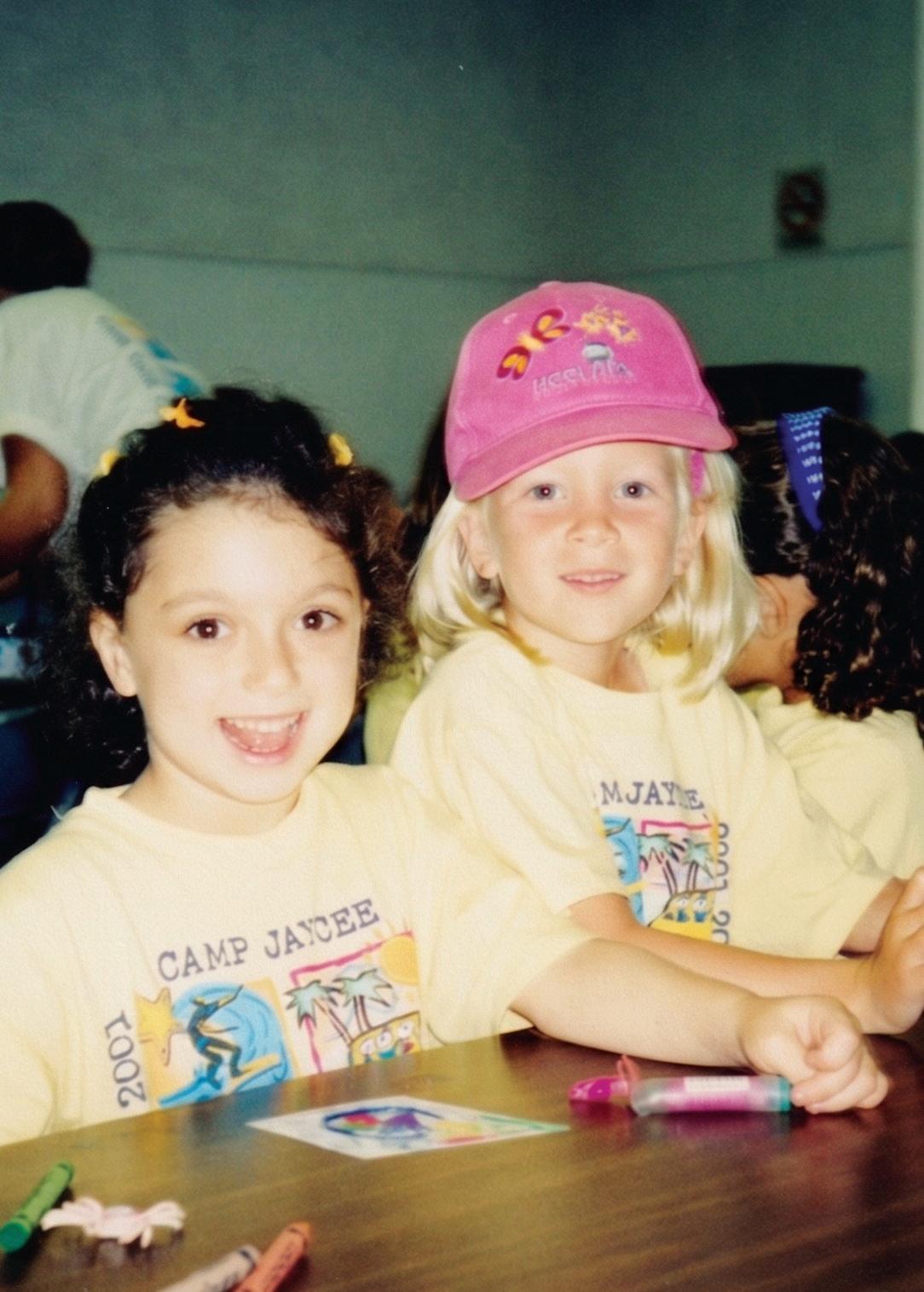
THEN AND NOW
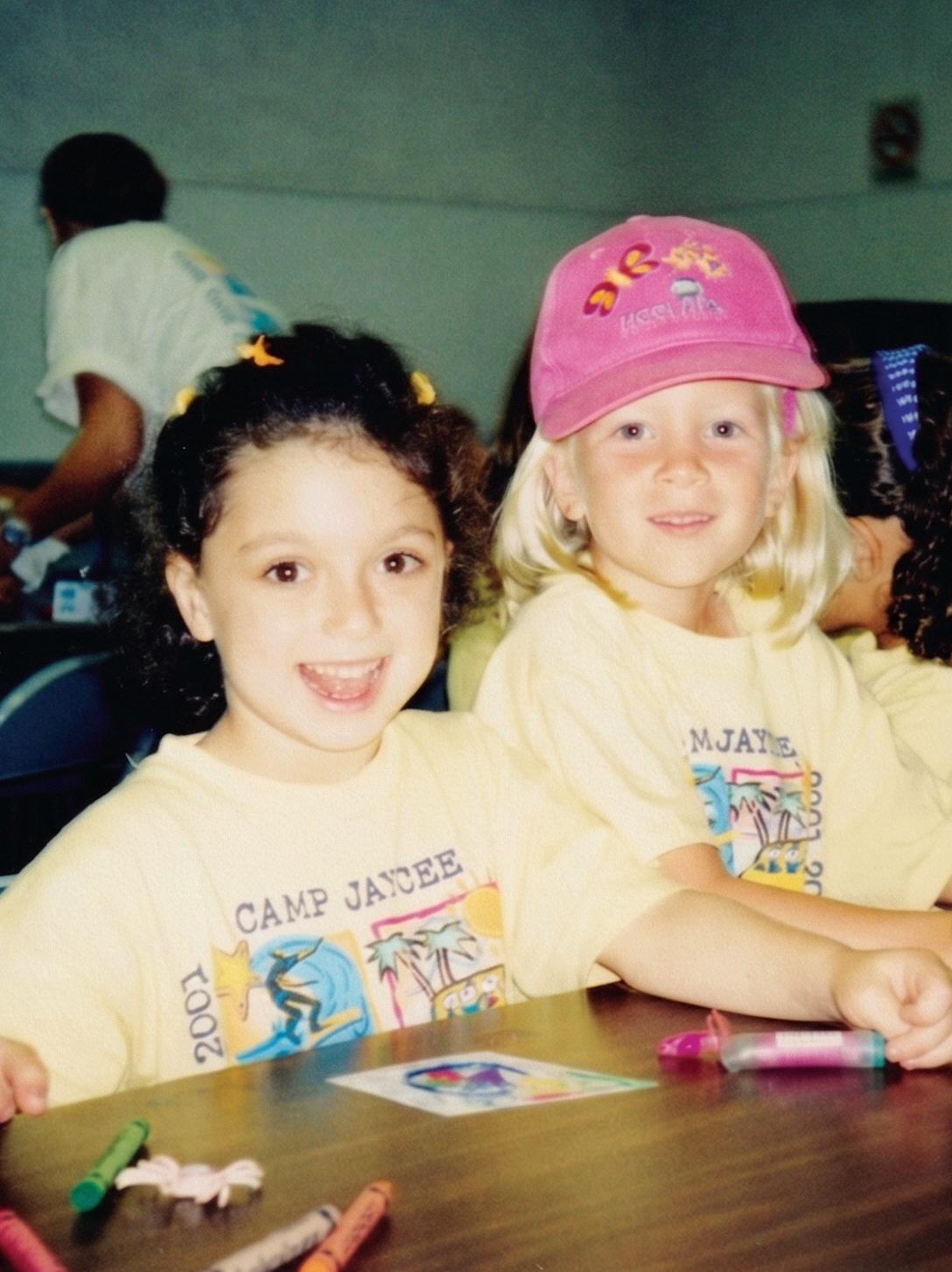
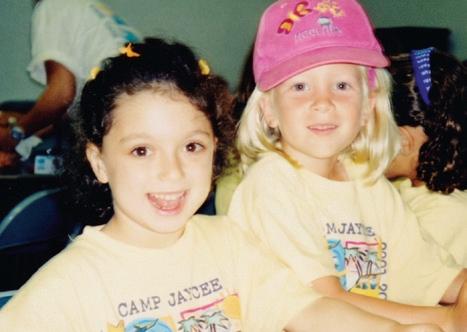
Camp Jaycee has served generations of Jewish campers for 80 years.
“I met my best friend at Camp JCC. We are still best friends.”
That is how Marcy Blumberg begins her story.
She was once a camper here. Now a parent of three campers. And today, she watches her son Joey wtalk the same path, from camper to counselor, on the very same field.
“Camp has been such a big part of my life,” Joey says. “I’ve made so many great memories.”
That is Camp Jaycee. For 80 years, that cycle has repeated itself. A child arrives. They make friends. They grow. They come back. And one day, they help create that same magic for someone else.
That is L’dor V’dor, from generation to generation.
Starting in the 1940s, Albert A. Hutler, then Executive Director of the United Jewish Fund, believed wholeheartedly in Jewish day camp. He knew it would change the landscape of Jewish life in San Diego.
The excitement over investing in something that would last only grew. “Everybody had a very strong sense that we were creating something that was going to have a future,” said Barbara London Rakov, reflecting on expanding Camp Jaycee to North City in the 1980s.
You can see it in the relationships that last decades. You can feel it in the traditions that bring everyone together. And you can hear it in the way people talk about camp, not just as a place, but as a part of who they are.
“You get to form such close bonds,” Joey shared. “I think it’s just such a good opportunity.”
That sense of belonging is intentional. Every part of Camp Jaycee is designed so that every child can see themselves here, and see what comes next.
“There could be a child that, at school, gets overlooked,” said Alma Hadash-Geiger. “But in the summer, you could make them feel like a king or a queen.”
Their experience shows up long after summer ends in a camper’s confidence, in friendships, and in the feeling that they belong somewhere.
It shows up every Friday, when camp gathers for Shabbat. Singing, dancing, celebrating together. As Marcy puts it, “No matter what happened during the week, you close out with a big celebration… and that brings me such joy.”
This is where connection happens. Where growth happens. Where life happens.
For over 80 years, Camp Jaycee has been shaping lives, one summer at a time.
For over 80 years, Camp Jaycee has been shaping lives, one summer at a time.
So what now?
First, we celebrate.
On May 31, we gather for the Campfire Gala, our biggest fundraiser of the year. It is a chance to honor the generations who built this community and to make sure it continues for the generations still to come.
And second, we look ahead to this summer.
Because right now, there is still time for your child to be part of this story.
To meet their people. To try something new. To come home each day a little more confident.
Or, as Joey says, “You’re missing out… it’s just such a fun place.”
Register today at campjaycee.com and give your child their best summer yet.
Camp Jaycee is 80 years strong.
And for every child who walks through those doors, it is just the beginning.
BUY YOUR TICKETS OR MAKE A GIFT TODAY: HTTPS:// GIVEBUTTER.COM/C/LFJCCCAMPFIRE.

BY
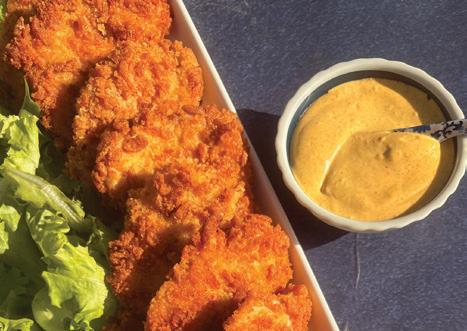
This recipe for chicken schnitzel includes marinating the chicken breast pieces in a mayo marinade. Then breading the chicken in a mixture of Panko, Bissli and potato starch. Crispy fried perfection.
Israeli Fried Schnitzel
INGREDIENTS
2 lbs chicken breast, cut into 1/2 inch thick and 3 to 4 inch pieces
1 cup mayonnaise
2 large eggs
1 tsp salt
1/2 tsp ground black pepper
1 tbsp Dijon mustard
2 garlic cloves, minced
2 cups Panko
2 small bags BBQ Bissli, crushed
1/2 cup potato starch
Avocado or vegetable oil, for frying Baby carrots, to place in frypan to prevent burnt specks
DIRECTIONS
1. In a deep dish, whisk together the mayonnaise, eggs, salt and pepper, mustard and garlic, until well combined.
2. Place the chicken pieces in the egg mixture and allow to marinate for 15 to 20 minutes.
3. In a large dish, mix together the Panko, Bissli and potato starch. Press the marinated chicken pieces into the breading and coat thoroughly. Place the schnitzel pieces on a dish.
4. Over medium high heat, warm a shallow layer of oil in a frying pan, then add the carrots. When oil begins to sizzle, carefully place the schnitzel in the pan, making sure not to crowd the schnitzel.
5. Lower heat to medium and fry for about 3 minutes on each side, until they are golden.
6. Drain the schnitzel on a paper lined dish. Serve hot.
Note: Schnitzel can be breaded a day ahead. Fried schnitzel may be stored in an airtight container for up to 5 days in the refrigerator.
THE SEPHARDIC SPICE GIRLS, SHARON GOMPERTS AND RACHEL EMQUIES SHEFF, HAVE BEEN FRIENDS SINCE HIGH SCHOOL. THE SEPHARDIC SPICE GIRLS PROJECT HAS GROWN FROM THEIR COLLABORATION ON EVENTS FOR THE SEPHARDIC EDUCATIONAL CENTER IN JERUSALEM. VISIT SEPHARDICSPICEGIRLS.COM TO SEE MORE OF THEIR SEPHARDIC RECIPES WITH A MODERN TWIST!
THIS RECIPE WAS SUBMITTED BY SHARSHERET: THE JEWISH BREAST AND OVARIAN CANCER COMMUNITY. SHARSHERET PROVIDES PERSONALIZED SUPPORT, LIFESAVING EDUCATION, FINANCIAL ASSISTANCE AND GENETIC COUNSELING TO EMPOWER THOSE FACED WITH OR AT INCREASED GENETIC RISK OF BREAST CANCER AND OVARIAN CANCER. FOR MORE INFORMATION ABOUT SHARSHERET, VISIT SHARSHERET.ORG. SHARSHERET IS A JEWISH NON-PROFIT ORGANIZATION THAT SUPPORTS EVERYONE, REGARDLESS OF BACKGROUND, RACE, GENDER, SEXUAL ORIENTATION, AGE, OR RELIGION.
BY TANIA SHALOM MICHAELIAN | JNS.ORG
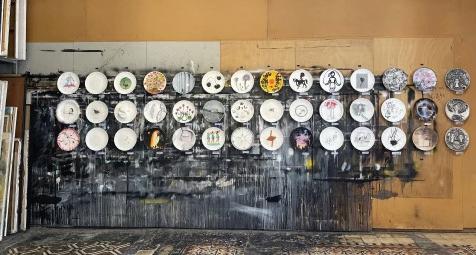
Adecade ago, 30-year-old Avi Miller would never have imagined standing in a Tel Aviv studio, looking at his artwork as part of a national exhibition.
As a teenager growing up in a Haredi family in Jerusalem, he made the difficult decision to leave full-time Torah study in a yeshiva and enlist in the IDF Paratroopers Brigade—a choice that isolated him from his family and, for a time, left him entirely alone.
“After eight months, my commander realized that I simply wasn’t going home when everyone else was, and he applied for me to become
a lone soldier,” he said.
Years later, standing among nearly 200 artists contributing to the “A Plate of Hope and Color” exhibition, Miller’s story has come full circle—his personal journey is now part of a collective act of support for soldiers like himself. His grandfather was the late sculptor, Prof. Dan Meller, and his father a gifted painter.
“I met my grandfather at a relatively late age, and only then did I discover that he was also an artist and sculptor,” Miller said.
His piece, “The King’s Son and I,” reflects that lineage. “Over the
years, I understood that there is nothing more important than family, and today I am once again in respectful and loving contact with them,” he said.
During the period when that connection was severed, the Lone Soldier Center in Memory of Michael Levin—the largest and longestestablished organization in Israel dedicated to soldiers serving without immediate family support—became his primary support network.
Levin was a U.S.-born lone soldier who moved to Israel to serve in the IDF’s Paratroopers Brigade and was killed in action during the Second Lebanon War in 2006 at the age of 22, becoming a symbol of dedication among lone soldiers from abroad.
For Miller, participating in the exhibition is also a way of paying it forward. “When people help you during difficult moments, it teaches you the value of giving,” he said. “Today, when I am in a more stable place, it feels natural to give back.”
AN
“A Plate of Hope and Color,” which opened on May 1 at the Uri Lifshitz Studio in Tel Aviv, brings together some 230 original artworks created on white ceramic plates by leading Israeli artists, all in support of the Lone Soldier Center.
The concept is simple but deeply symbolic. A plate evokes the idea of home—the family meal, the Shabbat table, the warm kitchen that lone soldiers so often go without.
Some come from abroad, leaving behind friends and family to enlist in an army in a country they feel is worth defending with their lives. Others, such as Miller, were born in Israel but grew up without a stable family network. All serve selflessly, but without the safety net most soldiers take for granted.
The center supports some 5,000 soldiers at any given time, offering mental health care, a warm home, hot meals and community assistance that extends from enlistment through five years after discharge.
The exhibition is the brainchild of the center’s president, Drorit Nitzani, who recruited curator Ronit Reik and designer Tami Chomsky to transform the idea into a full-scale cultural event.
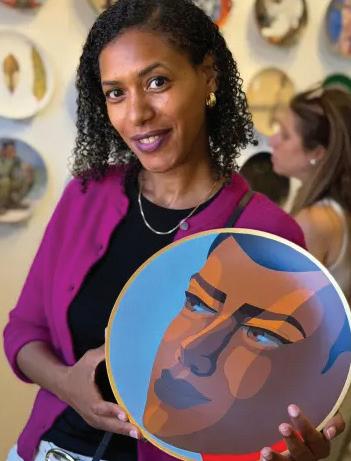
“Each of the artists received a ceramic plate and was asked to create their own personal ‘serving’ on it—a circular format, with no beginning and no end, that breaks away from the familiar canvas and invites freedom and creativity,” said Nitzani.
Speaking at the opening gala on May 1, she described the emotional experience of watching the project unfold: “One of the most moving moments for me was opening the plates as they came back from the artists, again and again. Every plate was a surprise. A whole world.”
The participating artists span Israel’s cultural landscape, including painters, sculptors, graphic artists and musicians, reflecting the diversity of Israeli society—Jewish, Druze and Arab alike.
The participating artists span Israel’s cultural landscape, including painters, sculptors, graphic artists and musicians, reflecting the diversity of Israeli society—Jewish, Druze and Arab alike.
Among them are artist Nirit Takele, Michal Rovner, sculptor Micha Ullman, Larry Abramson, Jan Rauchwerger, Yair Garbuz, Eli Shamir, Danny Kerman, Shai Azoulay, Boaz Noy, Vardi Kahana, cartoonist and illustrator Michel Kichka, Ilit Azoulay and Miriam Cabessa.
Well-known figures from the worlds of music and culture have also contributed, including singers Riki Gal, David D’Or, Yehudit Ravitz, Yehuda Poliker, Ivri Lider, Arkadi Duchin, Einat Sarouf and Liat Levi Kopelman.
“The plate became a surface for creation, just like a canvas. It was not an object to be beautified, but a conceptual field of action,” said
curator Ronit Reik. “This exhibition is not only about presenting art, but about showing art’s ability to rally around a greater cause and offer hope.”
Artists were asked to work outside their comfort zones on an unfamiliar surface—round, symmetrical, with no obvious “top” or “bottom.”
In a sense, this mirrors the experience of the lone soldier: arriving in an unfamiliar environment and learning to adapt, create and find footing without a map. For Takele, participation was deeply personal.
“The IDF protects Israel’s people,” she said. “As someone who served, I deeply respect anyone who chooses to defend this country, especially lone soldiers who come from abroad or serve without family here. If I can support them through my art, I do so wholeheartedly.”
Multi-award-winning singer-songwriter Ivri Lider described his contribution with characteristic warmth. The words on the plate he designed, he said, were “love” and “great success.”
“I was very happy to take part in this project, which is really very important and beautiful, with a very, very important purpose. The organization is amazing, and I’m happy to do what little I can to contribute and help.”
APPRECIATION FROM AFAR
The exhibition has also drawn responses from beyond Israel’s borders. Ari Gottesman, a former lone soldier and marketing executive originally from the United States who now lives in Tel Aviv, spoke to its broader significance.
“Seeing the artists and creative people in Israel standing behind us lone soldiers doesn’t only mean something to us on a personal level of making us feel less alone,” he said. “It also provides powerful, authentic tools that we can use to challenge the false narrative being told about us back home.”
He added: “In it, we can show the diversity of Israel, the complexity of emotions, and share the stories in a way that serves them up on a plate that is easy to digest, savor, and learn to appreciate.”
Also offering her perspective was Sherri Zigman, chairperson of the board of the Jewish Federation of Utah, who attended the opening gala as her daughter prepares to enlist as a lone soldier.
“Going to a fundraiser especially for her upcoming community meant so much to me,” she said. “I was so moved by the many beautiful plates and artists’ expressions at the Plates of Hope exhibit—art on every plate representing support for soldiers far away from home.”
Ayelet Nahmias-Verbin, chair of the Fund for Victims of Terror of the Jewish Agency for Israel and a former member of Knesset, placed the exhibition in a wider context.
“Plates of Hope and Color dedicated for the Lone Soldier Center
is another moving display of the strong solidarity of Israeli society to those who are carrying the heavy load for all of us,” she said. “This is a source of strength for us all.”
Each plate in the exhibition is priced at 2,000 NIS, with all proceeds going directly to the Jerusalem-based Lone Soldier Center in Memory of Michael Levin, which is due to open a new home in Tel Aviv in the near future. Works are available for purchase at the gallery and online for a limited time. The exhibition is open at the Uri Lifshitz Studio in Tel Aviv through May 8.
BY L'CHAIM STAFF

In a performance that weaves original music, dance and storytelling together onstage for a vibrant spectacle, theater group Teatro Punto y Coma will present Samuel, his Widow and the Whispering Flowers as part of the Lipinsky Family Jewish Arts Festival (Jfest) this month.
For more than 30 years, Teatro Punto y Coma has served as a creative home within the Ken Jewish Community (Ken), bringing together generations of actors, dancers, musicians, and artists in original productions that celebrate Jewish culture, storytelling, and communal connection. Samuel, his Widow and the Whispering Flowers continues the tradition, with a performance that weaves together music, dance and dramatic storytelling.
The original work is written by creator and storyteller David Chait and adapted for the stage by Monica Bauer Federman, with direction
by Pepe Stepensky and Sore Gordon. An original musical program performed by Music Director Andrew Mayer combines traditional melodies and contemporary compositions.
Told in Spanish with performers from the Ken, the story follows main character Sorele, whose husband has disappeared under mysterious circumstances. As fear and uncertainty about his whereabouts grow across the shtetl, the community rallies around Sorele to help the search. Themes of memory, faith, and resilience guide the characters on stage through a moving tale about love, solidarity, and the strength of community.
“Through movement, sound, and imagination, the performance invites audiences into a poetic journey where mystery and emotion unfold on stage, bringing to life a story that is both enchanting and thought-provoking,” the JFest website states.
As of 2026, JFest is now a fully independent nonprofit arts organization.
“After a period of generous fiscal sponsorship from the Lawrence Family JCC, we are deeply grateful for their partnership and support in helping the Festival reach this exciting new chapter,” organizers said.
Over the past three years, JFest has thrived—more than tripling in size and programming. Now presenting Tony Award–winning artists like Mandy Patinkin and Alex Edelman, developing original musicals such as There’s a Place for Us, and have expanded our signature Woman of Valor programs honoring extraordinary women across multiple communities.
Today, JFest presents three months of programs in twelve venues across San Diego and North County, to be announced the first week of April.
As an independent organization, JFest looks forward to celebrating Jewish culture, creativity, and community year-round.
BY RABBANIT DR. DEVORAH HALEVY
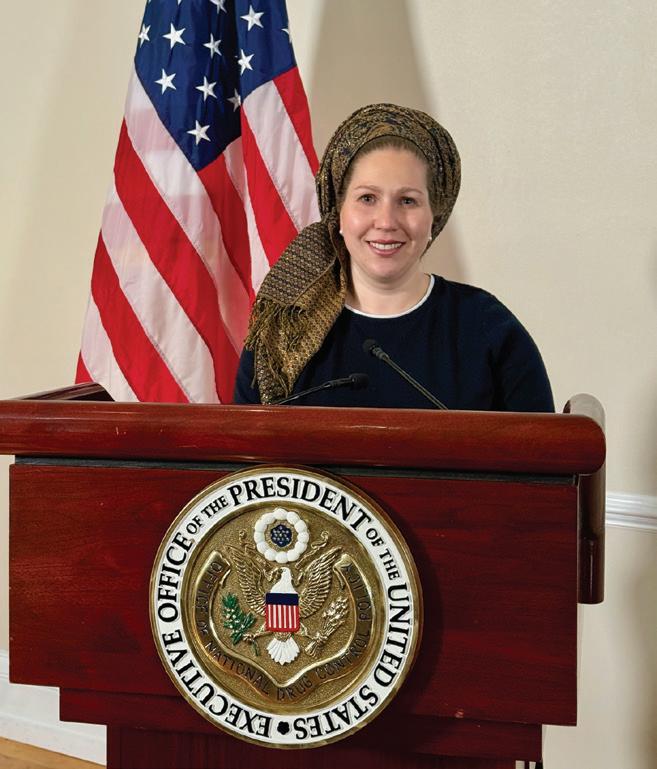
This past week, I was honored to represent the Jewish nation in Washington, D.C. at the National Drug Strategy Summit hosted by the Office of National Drug Control Policy, organized around its mission: “A safe and healthy America, where a drug-free life is the prevailing norm.”
The premise of the gathering was sober. Tens of thousands of Americans are lost to overdose each year; a public health catastrophe that has remade communities and emptied generations. I encountered an impressive federal response: researchers, clinicians, public officials, law enforcement, educators, and parents channeling personal loss into national advocacy. I had been invited to address, on a panel of faith leaders convened largely by Dr. Roneet Lev—a San Diego native and member of our local Shiviti community, Kehillat Shaar HaShamayim, and tireless advocate for faith in national strategy— what neither medicine nor policy can supply.
I argued that any serious approach must begin with a question prior to medicine: what is a human being? The opening of Genesis is a quiet rebuke to contemporary anthropology. The first deficit in the human story is loneliness. “It is not good for the man to be alone,” the text declares—and the corrective is not interior fortification but relationship. The modern thesis that maturity consists in autonomy and independence has pragmatic value and no anthropological truth. We were not designed to be self-contained.
Earlier in the same passage, the text presses further. The man is formed of dust, animated only when the Divine breath enters him; only then does he become a living soul. Ninety-six percent of the human organism is continuous with the animal kingdom; medicine is first tested on animal models. The remaining percent is what our institutions are least equipped to address: the Godliness within the person. Medicine cannot reach it. Policy cannot legislate it. No clinical intervention can heal what it is not designed to see.
This is the conviction that shapes my work as the Spiritual Leader of the Shiviti movement, which we cultivate in San Diego and around the world. Every community has a center and a periphery. The center is well-tended; communal participation is a protective factor whose empirical literature is not modest. The periphery is harder. Those not quite in and not quite out—whose suffering is silent because their place is uncertain—are those whom institutions, religious and clinical, are most likely to lose. They are also those whom a serious theology of the human person is best equipped to find.
I left Washington persuaded of two things at once: that the federal response to the addiction crisis is more thoughtful, and more genuinely cooperative across sector and creed, than its critics suppose; and that no policy architecture, however sophisticated, will reach the periphery without communities prepared to receive those who arrive there.
The periphery exists in every neighborhood, every congregation, every family. We all know who they are. Our obligation—as clinicians and educators, as neighbors and parents and faith leaders—is to refuse to forget them.
RABBANIT DR. DEVORAH HALEVY IS A RESEARCHER, PROFESSOR, CLINICIAN,AND CO-SPIRITUAL LEADER OF SHIVITI AND KEHILLAT SHAAR HASHAMAYIM.

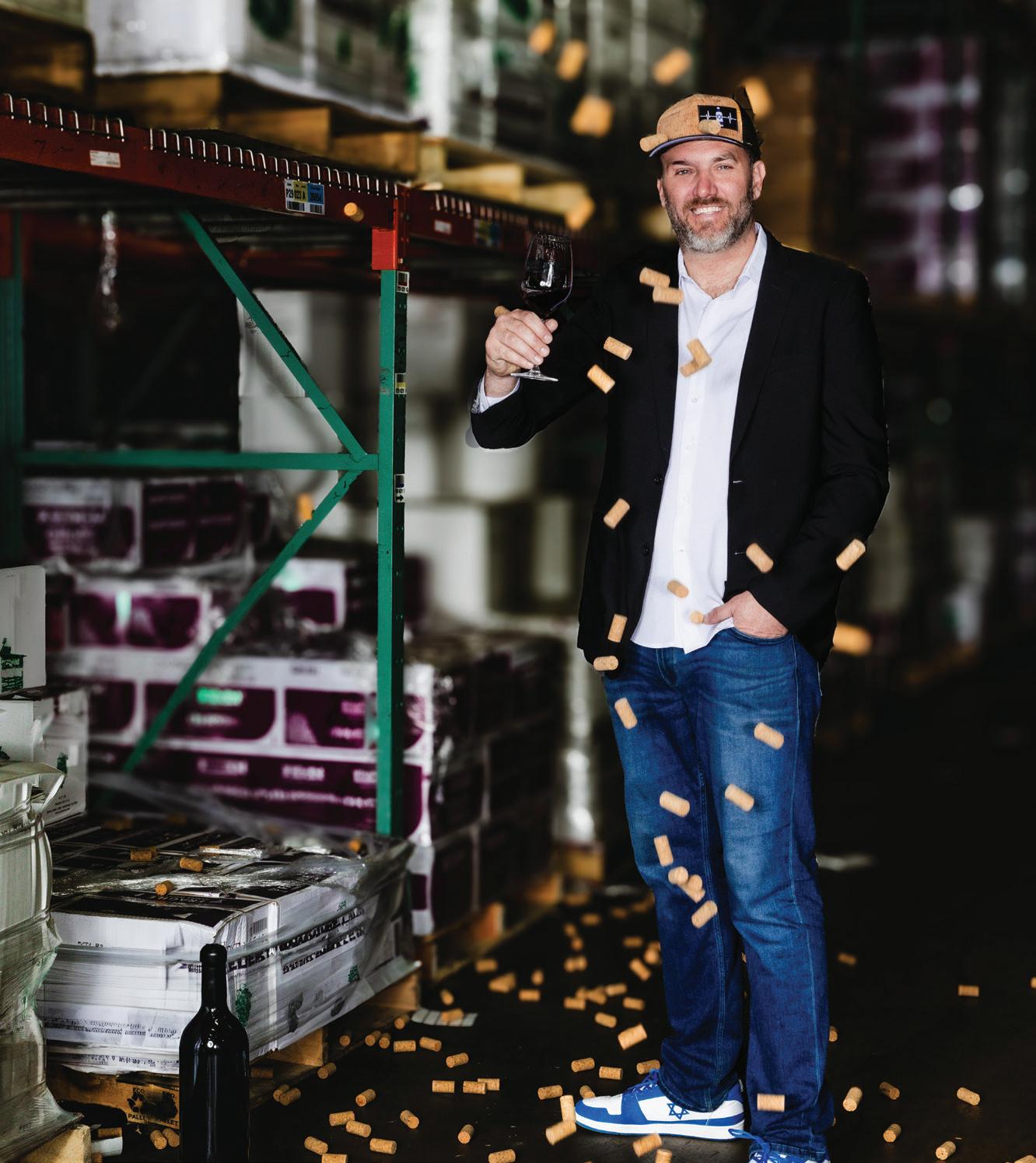
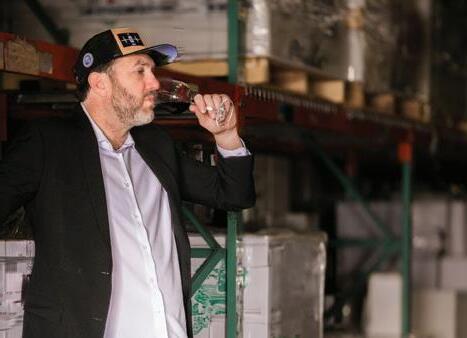
This spring, as wine lovers nationwide prepare to celebrate National Wine Day on May 25, the Wines of Israel offer a meaningful and memorable way to elevate the moment, promoting history, innovation and a vibrant Mediterranean spirit.
From the lush vineyards of the Upper Galilee to the rolling hills of Judea and the mountains surrounding Jerusalem, Israel’s diverse wine regions are producing bottles that reflect both place and purpose. These wines are increasingly recognized on the global stage for their quality, character, and unmistakable identity, bridging ancient
tradition with modern excellence.
“What makes Israeli wine so compelling right now is the balance, thousands of years of heritage paired with bold innovation. It’s a category that surprises people, and once they discover it, they come back for more,” said Josh Greenstein, Executive Director of IWPA.
The Israeli Wine Producers Association (IWPA) represents nearly 40 wineries across Israel, uniting boutique estates and leading producers under one banner to educate, inspire, and introduce U.S. consumers to Israel’s world-class wines. Together, they showcase a
category that is both deeply rooted and dynamically evolving.
Today’s Israeli wineries combine ancient techniques with cuttingedge viticulture, producing award-winning wines from both indigenous grapes and globally recognized varietals. These wines continue to earn acclaim from leading critics including Wine Spectator, Wine Enthusiast, Decanter, and James Suckling.
Argaman – A bold, Israeli-developed varietal known for its deep color and rich notes of blackberry, plum, and Mediterranean spice
Dabouki – A historic indigenous grape with roots tracing back to biblical times, now revived to produce crisp, mineraldriven white wines with refreshing acidity.
Alongside these heritage grapes, international varietals such as Cabernet Sauvignon, Syrah, Grenache, Chardonnay, and Sauvignon Blanc thrive across Israel’s varied climates and elevations offering both familiarity and discovery for wine lovers.
Israeli wines pair beautifully with seasonal cuisines. Cabernet Sauvignon or Syrah (from the Judean Hills pairs well with grilled meats, lamb, and hearty entrées. Mediterranean Blends (Grenache/ Carignan) are ideal with roasted chicken, shawarma, and smoky vegetables. Sauvignon Blanc or Marawi are bright and refreshing alongside salads, fish, hummus, and herb-forward dishes. Chardonnay (from the Galilee) complements roasted chicken, creamy pastas, and vegetable-forward plates. Rosé (from the Golan/Galilee) is crisp, elegant, and perfect for brunch, light fare, and warm-weather celebrations.
As Israel continues to gain recognition as one of the most exciting emerging wine regions in the world, its wines offer more than just exceptional quality plus a story of resilience, creativity, and cultural richness.
“There’s a deeper meaning when you pour Israeli wine,” added Greenstein. “It’s not just about what’s in the glass. It is about sharing a story, celebrating heritage, and creating new memories with the people you love.”
Israeli wines can be found in local liquor stores (sometimes in the Kosher wine section) and at Total Wine Locations in Mission Valley, Carmel Mountain Ranch and Eastlake/Chula Vista. The Israeli Wine Producers Association (IWPA) unites Israel’s diverse
“There’s a deeper meaning when you pour Israeli wine,” added Greenstein.
“It’s not just about what’s in the glass. It is about sharing a story, celebrating heritage, and creating new memories with the people you love.”
wineries under one mission: to elevate global recognition of Israel as a premier wine-producing country. Representing nearly 40 wineries, the association showcases wines that stand proudly alongside those from Italy, France, Spain, and Argentina while offering a unique story rooted in history and innovation. For updates, education, and winery highlights, follow @IsraeliWine and visit iwpa.com.
BY SHARON ALTSHUL | JNS.ORG
For nearly 2,200 years, it lay hidden in a cave above the Dead Sea.
Now, for the first time since 1968, the Great Isaiah Scroll has been unrolled to its full 24-foot length and placed on public display at the Israel Museum in Jerusalem, a rare exhibition museum officials are calling a once-in-a-generation opportunity.
“A Voice from the Desert: The Great Isaiah Scroll” is a highlight of exhibitions marking the museum’s 60th anniversary. The manuscript will be presented in its entirety for only four months. Strict conservation requirements allow 25 visitors at a time to enter the temperature-controlled Scroll Gallery for 10 minutes.
“This is the only complete biblical manuscript ever found so far,” curator Hagit Moaz said following a media tour. “It contains all 66 chapters of Isaiah. It is a unique opportunity, once in a generation, to come and see this magnificent scroll.”
The scroll is widely considered the crown jewel of the Dead Sea Scrolls. Of the thousands of fragments discovered in the Judean Desert beginning in 1947, including multiple versions of Isaiah, this is the most complete biblical manuscript ever recovered and one of the most consequential archaeological finds of the 20th century.
The modern story began in 1947 when a young Bedouin shepherd entered a cave near Qumran while searching for a stray goat. Inside clay jars, he found ancient manuscripts wrapped in linen. The
accidental discovery led to the recovery of more than 900 texts from 11 caves along the northwestern shore of the Dead Sea.
Displayed at the museum’s Shrine of the Book, dedicated in 1965, the original scroll is normally kept under highly controlled conditions, with only small portions shown at a time. A facsimile has been displayed in the central dome for decades.
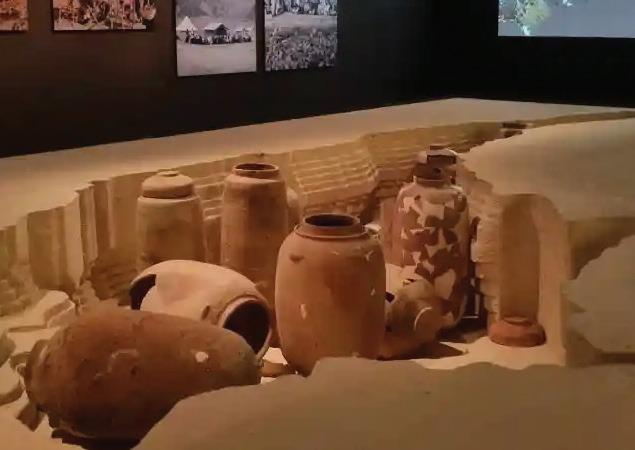
Visitors to the current exhibition first pass pottery jars resembling those in which the scrolls were discovered. A short introductory film traces the manuscripts’ journey from the caves of Qumran to Jerusalem before guests enter the stark white Scroll Gallery, where the parchment stretches across a specially designed case.
Column after column of Hebrew script flows across 17 sheets of stitched parchment measuring approximately 734 centimeters— more than 24 feet in length.
Radiocarbon dating and paleographic analysis place the Isaiah Scroll at approximately 125 BCE, roughly 1,000 years older than the previously known complete Hebrew manuscripts of Isaiah from the medieval Masoretic tradition.
Before the discovery of the Dead Sea Scrolls, the oldest complete Hebrew biblical manuscripts dated to the 10th century CE. The Great Isaiah Scroll allowed scholars to compare the Book of Isaiah across a full millennium of transmission.
Professor Noam Mizrachi of the Hebrew University’s Orion Center for the Study of the Dead Sea Scrolls noted that the ancient manuscript corresponds overwhelmingly to the version used today.
Isaiah’s passages, including “Comfort, O comfort My people” and the vision of nations beating “their swords into plowshares” and “The wolf shall dwell with the lamb,” resonated deeply in the religious atmosphere of the late Second Temple period.
scribes were involved. Additional research proposes it remained in circulation for decades before being stored in the Qumran cave.
Scholars associate the Qumran manuscripts with a sectarian Jewish community, often identified as the Essenes, who emphasized prophetic themes of redemption, divine judgment and the “End of Days.”
Isaiah’s passages, including “Comfort, O comfort My people” and the vision of nations beating “their swords into plowshares” and “The wolf shall dwell with the lamb,” resonated deeply in the religious atmosphere of the late Second Temple period.
Isaiah would later become one of the most frequently cited prophetic books in the New Testament, underscoring the shared scriptural heritage of early Judaism and Christianity.
Because parchment is highly sensitive to light and environmental change, the scroll can rarely be displayed in full. Carefully calibrated lighting and climate systems now protect the manuscript during this limited exhibition.
Discovered in the Judean Desert just months before the establishment of the State of Israel, the scroll has become more than an archaeological treasure. It stands as tangible testimony to continuity, linking the Jewish people of the Second Temple period to a sovereign Jewish state more than two millennia later.
From a cave near Qumran to a climate-controlled hall in Jerusalem, the Great Isaiah Scroll has endured conquest, exile, rediscovery and scrutiny. Its parchment bears the marks of age.
Textual comparison shows the scroll is approximately 95–98% identical to the Masoretic Text in modern Hebrew Bibles. Differences are largely spelling variations or minor grammatical shifts. There are no significant theological additions or deletions.
In academic circles, the implications were profound. At a time when some scholars suggested substantial alterations to the Hebrew Bible over centuries, the scroll demonstrated remarkable textual stability.
Written in Hebrew in a Herodian script, the manuscript preserves all 66 chapters of Isaiah with only minor damage, making it the only nearly complete biblical book among the Dead Sea Scrolls.
Marginal corrections and scribal notations reflect active engagement with the text. Recent technological analysis, including artificial-intelligence-assisted handwriting comparison, suggests two
Its words, however, ring out across the ages and its message remains relevant today: “Shout for joy, you who dwell in Zion!” An ancient voice from the desert now lies fully unrolled and speaking once again.

La Jolla & Encinitas
locations Open from 7:30am - 3pm everyday La Jolla (858) 454-8409 cottagelajolla.com
Encinitas (760) 854-4212 cottageencinitas.com


When you show this coupon. One per
Expires 5/31/2026



In Jewish life, art has always been the place where we wrestle—with ideas, power, ourselves, the Divine. From the prophets to Sholem Aleichem to contemporary playwrights, Jewish storytelling thrives on argument, paradox, and the uncomfortable truths that emerge when we refuse to look away. But in today’s climate, even within generous Jewish communal spaces, room for artistic diversity is shrinking faster than our 401(k)s during a Strait of Hormuz closing. I learned this firsthand through an experience that surprised me despite a fifty-year writing career.
Last summer, I was selected for the Jewish Climate Artists for California (JCAC) Incubator, a program housed at Coastal Roots Farm in Encinitas. The fellowship selected six artists exploring intersections of Jewish identity, climate justice, and aesthetics. Incubator was earnest and well intentioned. I entered with enthusiasm. My contribution was a wild, sardonic, dreampoem play—a surreal allegory exploring tensions between climate activism, celebrity culture, and the moral complexities of global politics. The play was not a polemic. It was a quirky fairy tale. It took no political position. Greta in Wonderland was a work of art— provocative, yes, but rooted in our Jewish tradition of illuminating contradictions. Yet as the months unfolded, it became clear that
Incubator was struggling with the very thing it had invited: artistic risk.
After internal deliberations, Incubator informed me that my play could not be presented under their banner. By December they shared newly formalized “content boundaries” prohibiting any script that “takes a political position on Israel or Gaza” or that might “inflame division around the conflict.” They also expressed concern about satirizing a prominent climate figure from Sweden, fearing it undermines community trust.
Incubator communicated respectfully and apologized for not giving these boundaries at the outset. But their censorship speaks to a larger challenge facing Jewish cultural spaces today. We are living through a moment of profound internal fracture. Jewish communities across the country are divided not only by external pressures—from campus hostility to geopolitical turmoil— but by internal, complex anxieties and a fear of saying the “wrong” thing.
In progressive Jewish realms, this anxiety often takes the form of avoiding anything that might be interpreted as a defense of Israel. In more traditional realms, it can manifest as suspicion toward artists who critique Jewish institutions or explore uncomfortable themes. The common denominator is terror—terror of alienating donors, terror of socialmedia
backlash, terror of controversy. Art cannot thrive in an atmosphere of fear. Jewish art, especially, depends on the freedom. Satire is a mirror with wit. It asks us to see ourselves with honesty, humor, and humility. When we lose that, we lose something essential—not only artistically, but spiritually. Our tradition is one of argument, midrash, reinterpretation, and even irreverence. We are a people who debate God; surely, we can tolerate a satirical play.
The deeper question is this: What kind of Jewish cultural life do we want to build in this era of spiritual fracture? One that avoids discomfort? Or one that trusts community enough to engage with it? My play will find another home. Art always does. My aim was not to mock, but to explore the contradictions of climate activism through a madcap, dreamlike lens. But the experience left me with a renewed conviction that Jewish creativity must not be hemmed in by paranoia— from the left, right, or center. Jewish art should challenge us and invite us to see the world—and ourselves—with sharp clarity. We are a strong people. That strength is not a threat to community. It is a gift.
ALLAN HAVIS IS A UCSD THEATRE PROFESSOR/JEWISH STUDIES FACULTY DIRECTOR, PLAYWRIGHT AND NOVELIST.
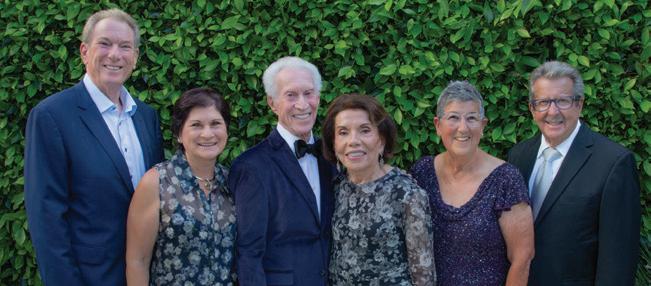
STRONG ROOTS, DEEP IMPACT: JEWISH FAMILY SERVICE HEART & SOUL GALA CELEBRATES COMMUNITY SUPPORT
It takes time and care to plant a tree. It requires sowing seeds and careful watering. It may need help standing up straight. When circumstances change, it needs extra TLC. Once it fully flourishes, the tree builds strong, deep roots. This is what Jewish Family Service does to support the San Diego community morning, noon and night.
JFS welcomed 500 guests to its Heart & Soul Gala with a “Rooted in Community” theme inspired by its work ensuring neighbors have access to healthy food and compassionate support.
Gala Chairs Marie Raftery and Dr. Robert Rubenstein and Honorary Chairs Evelyn and Ernest Rady welcomed guests, followed by remarks from San Diego Mayor Todd Gloria. JFS Board Chair Theresa Dupuis highlighted support for Holocaust survivors, families in its Safe Parking Program and 2,700 community members assisted during the federal government shutdown.
The event honored Jerri-Ann and Gary Jacobs and Tammy and Louis Vener for their visionary leadership strengthening Jewish life and dedicated volunteering. Trees were planted at JFS in lieu of awards in their honor. The evening was filled with hope and generosity as people heard stories of resilience from those JFS has served. Guests received seed packets to plant roots at home. JFS raised more than $2 million to support people of all ages, faiths and backgrounds. Learn more at jfssd.org.
SUMMER OF GROWTH AND DISCOVERY AT SD JEWISH ACADEMY San Diego Jewish Academy (SDJA) has announced a wide range of summer learning and camp opportunities for students of all ages, combining academic enrichment, outdoor exploration, athletics, and creative discovery.
“Summer at SDJA is about giving students opportunities to explore
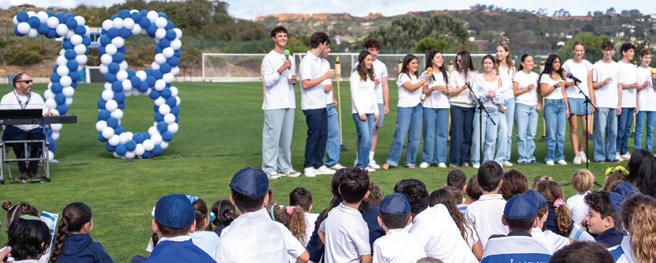
their interests, build new skills, and grow in confidence while being part of a vibrant community,” said Zvi Weiss, Head of School at SDJA.
For toddlers and preschoolers, Camp Carmel Creek ECC provides a joyful introduction to camp life with play-based learning, creativity, discovery, and outdoor adventures. For campers in grades K–6, specialty day camp where students select one of four adventure tracks each week including athletics, arts, science-tech and nature & outdoors.
Students entering grades 6-8 can participate in a series of half and full day specialty camps designed to develop creativity, innovation, and athletic skills. Programs include musical theater summerstock, samba futsal, sci-tech robotics, architects studio and pickleball. To help students prepare for fall sports seasons, SDJA will also offer athletics pre-season camps including flag football and girls indoor volleyball.
For High School Students, SDJA will offer the UC California Naturalist Certification, a unique five-week hybrid program open to students in grades 9–12. Participants earn official UC California Naturalist Certification and are eligible for four academic credits through a UC Davis transcript. Registration for SDJA Summer programs is now open at sdja.com/summer.
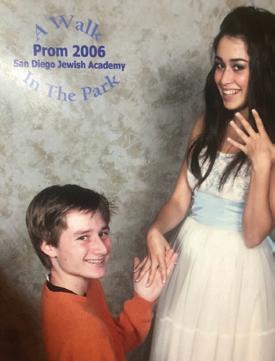
TONY NOMINATIONS RECOGNIZE TWO SDJA ALUMNI
Two former SDJA students are Tony nominees, 20 years after they attended their high school prom together. Micah Frank, son of Rabbi David & Davida Frank, has been nominated for his role as producer for Schmigadoon! While Charly Jaffe, daughter of Richard and Ann Jaffe, has been nominated for their role as co-producer for Cats: The Jellicle Ball. Mazel tov to both on their artistic achievements! The 79th Annual Tony Awards will be held in New York City on Sunday, June 7.
ADL INTRODUCES NEW RESOURCE: K-12 EDUCATOR ASSISTANT
ADL has a new AI resource called Ora which is intended for use in the classroom. ADL Ora is the first AI assistant built specifically for K-12 educators teaching about antisemitism, the Holocaust and Jewish identity. Named for the Hebrew word Ohr, meaning light, it’s trusted, personalized and free. The assistant does not access the internet, so you can be confident that responses are secure and come from only vetted materials.
ADL Ora is being shared with educators, museum professionals, and school leaders; and is soon to be a standard tool in classrooms across the country. Learn more at adl.org/adlai-k-12-education-assistant.




1. d. Robinson was desperate to fight, but was rejected because of his age, 48 in 1941. He served the war effort in many other ways and helped rescue Jewish refugees from Europe. Douglas was a communications officer in anti-submarine warfare. Brooks defused landmines during the Battle of the Bulge. Curtis joined the Navy after Pearl Harbor and witnessed the Japanese surrender from a submarine tender in Tokyo Bay.
2. b. Ra’am, or thunder, is not made by a shofar. Tekiah is one long blast. Shevarim is three medium-length blasts. Teruah is nine or more rapid staccato blasts.
3. b. The Torah commands that a portion of the dough used for baking bread be set aside for the kohen (Num. 15:20). The Torah calls the kohen’s portion a challah. Today we call a challah loaf by the name associated with this commandment.
4. d. Penn Jillette of Penn & Teller is of French-Canadian and English descent. Houdini, the son of a rabbi, is perhaps the most famous magician in history. Blaine, of Russian Jewish descent, sparked a “street magic” revolution. Copperfield, born to Jewish parents in New Jersey, is widely considered the most commercially successful magician in history.
5. a. In a ritual called Pidyon HaBen, meaning redemption of the firstborn son, the father redeems a baby boy who is the firstborn of his mother by paying five silver coins to a kohen, freeing the baby from the obligation of Temple service that was designated for firstborn sons in the Torah.
6. c. In 1900, Emil Jellinek, the son of a prominent Czech-Hungarian rabbi, commissioned a revolutionary car, the Mercedes 35 hp, which is widely considered the first modern automobile. He named his daughter Mercedes and had his surname legally changed to Jellinek-Mercedes.
7. a. Keep a distance from falsehood (Exo. 23:7). In Judaism, it is not enough not to lie. We are commanded to avoid anything that could contribute to falsehood in any way, like doing something that we might later have to lie about having done.
8. c. During World War I, Weizmann produced for the British Admiralty large quantities of acetone used in ammunition. He was active in the creation and development of the Weizmann Institute, Israel’s leading scientific center, and may be the greatest Zionist figure after Herzl.
9. b. The sixth day of Creation marked the creation of conscious beings, Adam and Eve, able to recognize their Creator and the inauguration of the King of the Universe. Also, since Adam and Eve were judged on that day for eating of the Tree of Knowledge, that set a precedent for Rosh Hashanah being the Day of Judgment on which all creation is judged and the fate for the coming year is decreed.
10. a. IsraAID provides disaster relief and long-term support worldwide, embodying the Jewish value of helping all of humanity in times of crisis. For example, while Syria and Israel have been in a state of war since 1948 and have no diplomatic ties, IsraAID in 2015 launched a massive, multi-year operation to assist Syrian survivors of the Syrian Civil War and the resulting global refugee crisis.
0 – 2 Talmid/Talmida (Student)
3 – 5 Melamed/Melamedet (Teacher)
6 – 8 Talmid Chacham/Talmidat Chacham (Scholar)
9 – 10 Gaon/Gaona (Genius)
Your comments are welcome at Felber@Jewish-IQ.com
©2026 Felber, Starmark, Inc., all rights reserved.