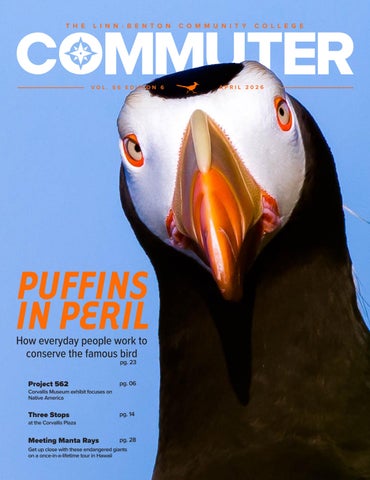

letter editor
from the
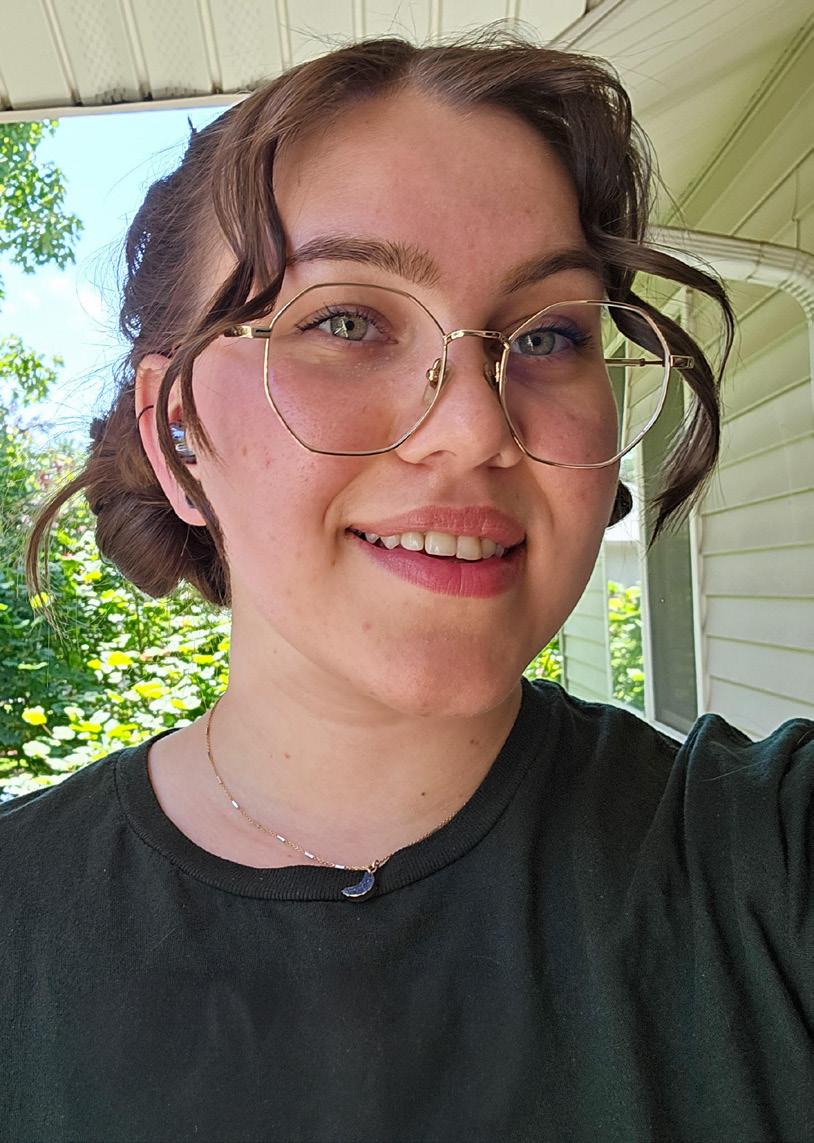
Spring has arrived here on campus! With the change of season we have plenty of new stories for you to read. Our writers have been working hard this year to provide the LBCC campus with new stories every month and this edition is no different. This month The Commuter features a variety of stories from interviews to local and campus news. We have a special feature on the puffins population in Oregon! You might have noticed that we added stickers to our monthly editions this year. These stickers are all designed by LBCC students! If you dream of making your own stickers think about submitting designs to The Commuter. And if you have an interest in writing, photography, or just what goes into creating a regular publication, get in touch with us!
Micah Teague Editor-in-Chief
about us join the team
The Commuter is the student-run magazine for LBCC, financed by student fees and advertising. Opinions expressed in The Commuter do not necessarily reflect those of the LBCC administration, faculty and students of LBCC. Editorials, columns, letters, and cartoons reflect the opinions of the authors. LBCC is an equal opportunity educator and employer.
letters welcome
The Commuter encourages readers to use its “Opinion” section to express their views on campus, community, regional and national issues. The Commuter attempts to print all submissions received, but reserves the right to edit for grammar, length, libel, privacy concerns and taste. Opinions expressed by letter submitters do not represent the views of The Commuter staff or the college.
Wanna get together? We’re really nice and fairly cool and we’d love to hear what you have to say. Not big on journalism but love to journal? Perfect. Are you a STEM major with major opinions? Let’s hear ’em. Like writing about ’80s film? Local animals? Snack hacks? Maybe you have a hefty folder of flash fiction on your laptop, just dying to be published and printed. Drop us a line. We’d love to meet you, read you, and support you. Think your ideas might be too weird or too niche for submission? Even better. The Commuter is an award-winning publication because of our wide range of contributions and our unique contributors. So reach out. We’ll be staring at our email inbox in the meantime, not an ounce of chill to be had.
editor-in-chief
MICAH TEAGUE
design editor
KAILYN MCQUISTEN
marketing director
JULIA NEVUS
office director
SKYLAR WILKERSON
advisor
ROB PRIEWE
contributors
ANTHONY DREWS
AYDEN HORTT
BRENDA AUTRY
EMILY KINKADE
GEORGE BENNETT
GRACELYN JOHNSON
ISAIAH BENES
JESUS SANDOVAL-URIBE
KENDRA COX
KRYSTAL OVERVIG
LILLY EBERHART-GARAH
MIKA WINDER
MIKE MCREYNOLDS
RENÉE SILVA
SAVANNAH WEST
SID MYDLAND
WYATT MARSHALL
sticker contributors
JESUS SANDOVAL-URIBE
in this issue:
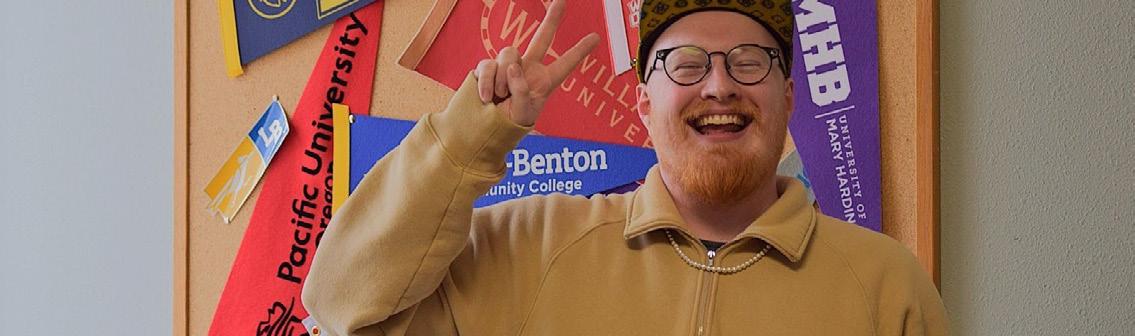
WANT TO SEE YOUR NAME HERE? JOIN THE TEAM!
From Musician to University Helper
Meet the former LBCC student helping the next generation transfer to universities – Nicholas May
Project 562
Corvallis Museum exhibit focuses on Native America

LB Behind the Scenes
Editing truth in the age of AI
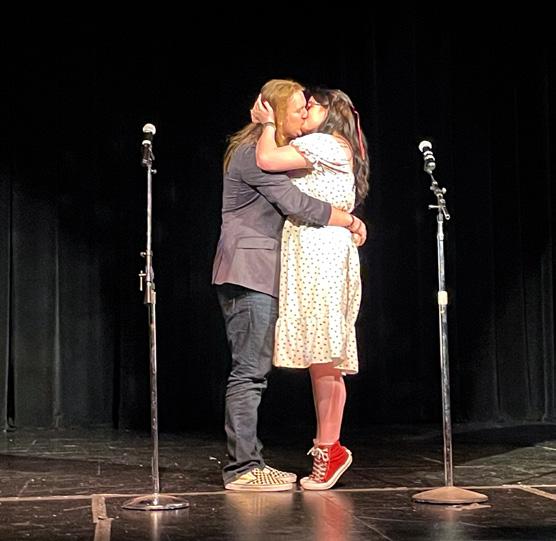
Tripp Auditorium’s February Talent Show Has Students Engaged
Talent show summary
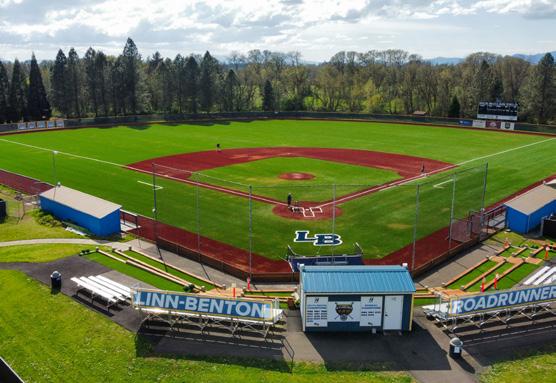
We Have a Brand New Ballfield
Baseball renovations almost complete
Puffins in Peril
How everyday people work to conserve the famous bird
04 06 08 23 28 10 18 14

Three Stops
20
No Kings in Corvallis
Thousands of protestors gather in

Meeting Manta Rays
Get up close with these endangered giants on a once-in-a-lifetime tour in Hawaii
at the Corvallis Plaza
Corvallis
cover photo by LISA HUPP/USFWS
From Musician to University Helper:
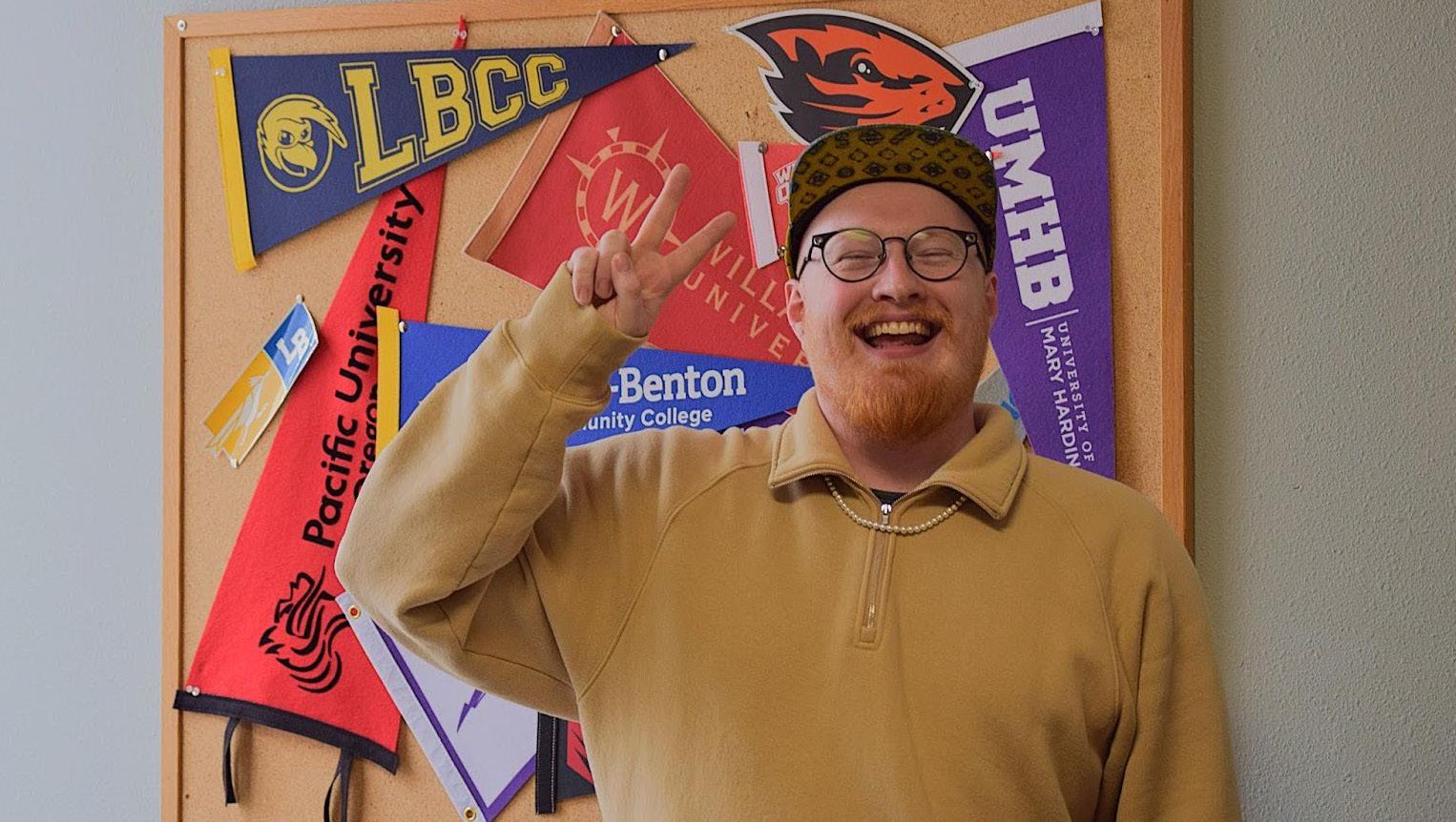
Meet the Former LBCC Student Helping the Next Generation Transfer to Universities – Nicholas May
words and photo by SKYLAR WILKERSON
FWe are "navigators." We handle the systems and the process. We’re the friendly people you talk to if OSU isn’t responding to you or if you just don’t know where to start.
or many students at LinnBenton Community College, the path to a four-year university can feel like a daunting maze of transferable credits, shifting deadlines, and intimidating applications. Whether a student is aiming for a "dream school" or simply trying to find their next destination, the logistics can be overwhelming.
At the center of this process is the LBCC Transfer Center – a small but high-volume office upstairs in Takena Hall dedicated to clearing the fog for more than 1,500 students each term.
Nick May, a program specialist for the Degree Partnership Program (DPP), pulled back the curtain on how the center works. He is a “navigator” who understands the students perspective firsthand. As a non-traditional student himself, May’s journey hasn't been a straight line. It’s been a winding path through student employment, pizza shops, and local music stages.
Beyond the spreadsheets and credit evaluations involved in his work, May is a fixture in the local music scene as the frontman for the band Skeleton Boy. In this Q&A, he discusses the "hard work" of booking a multi-state tour, the reality of being a non-traditional student at LBCC, and why the transfer center is about more than just a "pipeline" to Oregon State.
How do you describe what you do here at the Transfer Center?
We’re basically transfer specialists. A lot of our work is supporting dualenrolled students between LBCC and Oregon State, but we do a lot of "extra" stuff too. We help students navigate between where they are at LBCC and where they want to go next. Sometimes that means being a helping hand and connecting them to someone they’ve never met, and sometimes it means sharing valuable info about programs like dual enrollment.
You also work with high school students. What does that look like?
Our high school recruiting team often gets questions about Oregon State. Especially in rural areas, students might not be ready for the "whole OSU thing" yet. It can be intimidating to them. We step in to explain that there are other options besides just going straight to a university. We let them know that LBCC is an option, sometimes even for students in Portland who don't realize how close we are to Corvallis and Albany and more importantly just letting them know about their possibilities.
People often associate the Transfer Center strictly with Oregon State. Is that the only focus?
People often assume our goal is just to funnel people through the OSU pipeline, but that’s not the case. We just had our Oregon Transfer Days fair, and we had representatives from Nevada, Arizona, and Idaho. My goal is to broaden horizons. Places like OSU or PSU have big name-brand recognition, but we want to show students there are other opportunities – like "weird art schools" nearby or smaller universities that might be a better fit.
How is your role different from a traditional academic advisor?
Academic advisors tell you exactly what courses you need to take to graduate. Our office doesn’t do that. We are "navigators." We handle the systems and the process. We’re the friendly people you talk to if OSU isn’t responding to you or if you just don’t know where to start. We aren't necessarily focused on you getting an LBCC degree if that’s not your goal; we’re focused on the "other stuff" you need to do to get where you're going.
Can you give us an idea of the scale of your work? How many students are currently utilizing these transfer programs?
It’s a fair amount. We usually have about 1,500 students at LBCC who are part of the Degree Partnership Program and taking classes. That doesn't even factor in the traditional students who aren't in a specific program yet but still want to transfer eventually.
That sounds like a heavy workload for a single office.
It’s a pretty significant volume. I was just talking to my colleague, Christine, and she mentioned that since the start of the term, she had already processed 400 individual requests.
We’re a pretty small office considering how large our caseload is, but we stay busy making sure everyone gets where they need to go.
What is your biggest piece of advice for a first-year student who wants to transfer eventually?
First, maximize your time in those first few terms. If you do it correctly, you can start the dual enrollment process with just 24 transferable credits. You don't always have to spend two full years here before connecting with a university.
Second, and I tell all freshmen this is to check your email! That is always how people get into trouble. And finally, ask questions. Don’t just feel comfortable asking them; I encourage it.
Being a non-traditional student yourself, what was your own path like through LBCC and on to your next steps?
I’m definitely a non-traditional student. After I finished my associate degree here, I wasn’t initially convinced I was going to go on for a four-year degree. I was working at a pizza place and having a hard time balancing my schedule. Eventually, I got my foot in the door at LBCC through student employment at the First Resort.
Once I graduated with my associate degree, I realized I wasn't quite at the career level I wanted to be yet. My boss told me that to keep growing in this role, I needed to work on my bachelor’s. Since I came here (in this position), I have gotten a tuition waiver, so I’ve been able to take classes that fit into my path. It’s given me a really good perspective on what it’s like to be a "winding journey" student. When a 27-year-old comes in feeling “weird” because they didn't start college at 18, I can say, “Hey, you’re not weird. Welcome.” I can fall back on my own mistakes and my own winding journey to help them.
It’s given me a really good perspective on what it’s like to be a "winding journey" student. When a 27-yearold comes in feeling “weird” because they didn't start college at 18, I can say, “Hey, you’re not weird. Welcome.”
Outside of your work here on campus, I hear you’re involved in the local music scene. Can you tell us about that?
Yeah! I play guitar and sing in a band called Skeleton Boy. We’ve been around the Albany/Corvallis area since about 2016. It’s a huge part of how I process my emotions and understand the world. We actually have a small tour coming up over spring break through California, Nevada, and Washington.
Music has been a part of my life since the sixth grade. My mom actually gave me an ultimatum: I had to either join the choir or learn an instrument. She told me if I didn’t like it after a year, I could quit, but that it would be "good for my brain." I picked up the alto saxophone and loved it. I played all the way through my junior year of high school.
What led to the switch from saxophone to guitar and starting a band?
It was a bit of a transition period. A lot of my friends in the band were seniors and graduated, and at the same time, I was actually working on the school newspaper, which was a lot of fun. Around that time, I moved away from the saxophone and toward the guitar, and I just haven't stopped since.
For me, art and creation are ways to process my emotions. It’s really just about trying to understand how I feel about this crazy world we all live in.
What kind of theme does Skeleton Boy play?
We have a lot of cheeky little references in our song titles and things like that. I wouldn't necessarily say that it's that Y2K pop punk kind of sound. But from the nature of the age groups that we all are, there are a lot of late ‘90s, early 2000s.
There's also lots of goofy retro gaming things that we put into the music and stuff. We've got a tour coming up over spring break and I've just been taking screenshots from old PC first person shooters and just cropping them down, and then like adding text for our posters and stuff like that so it gives you an idea on our music.
Is the entire Skeleton Boy band going on tour?
It’s not a full-band tour just yet. We’re doing a week-long "test run," following a model a friend of ours used on the East Coast. She went out with just an acoustic guitar, played some coffee shop shows, and then brought the band back once she saw how it went.
That’s our plan. We’ll start in Northern California, move into midCalifornia, head over to Nevada, go up through Washington, and finally end the run back home in Corvallis.
What has the process of booking a multi-state tour been like for you?
It’s cool, but it is incredibly hard work. You spend so much time texting and emailing. I actually told a colleague recently that if I could go back in time and give my younger self advice on what being a "semi-professional" musician looks like, I’d still have to lie to him about how many emails it takes. He wouldn't believe it.
You really have to harden your heart a little bit. You’re presenting something you deeply care about – your art to people who sometimes want nothing to do with it. You just have to get used to sending a mountain of emails and hoping for a little bit of retention.
Does your creative side ever bleed into your office work?
Definitely. During the "ebbs and flows" of the term, outside of the rigid registration periods, I get to let my brain go a little bit. I help with posters and finding ways to make the transfer process feel a little more fun or exciting. It’s about taking something that seems like a rigid process and adding some “life” to it.
PROJECT 562
What would you take if your house was on fire?
“Project 562,” named for the 562 federally recognized tribes in the United States, answers this question through intimate, vivid, and varied digital photography of people from the recognized tribes throughout the United States. Tribal members volunteered themselves for the project and chose the location, scenery, clothing or objects within the photograph.
In a radical change from centuries of objectification, “Project 562” centers Native Americans as distinct tribes and individual people. It frames, literally and spiritually, the bodies, beliefs, and variety of Native American experience in the United States.
In doing so, it creates a digital archive of stunning photographs of thousands of Native Americans over the life of the project.
On a recent visit to the Corvallis Museum, a selected exhibition of “Project 562: Changing The Way We See Native America” curated by Natascha Adams exposes the range of the project and its concepts in a bright room overlooking a calm street in Kalapuya territory.
The Corvallis Museum holds a wide variety of rotating exhibits focusing primarily on Benton County history. Multiple current exhibits focus on Oregon State University’s Art
[Begay] has also placed himself in a library, firmly placing indigenous people in places of education, economy and in the here and now, not a blurry sepia image from the past.
Department history, OSU’s general history, Benton County history and women’s literary journal history in Corvallis. Indigenous items are included within other exhibits.
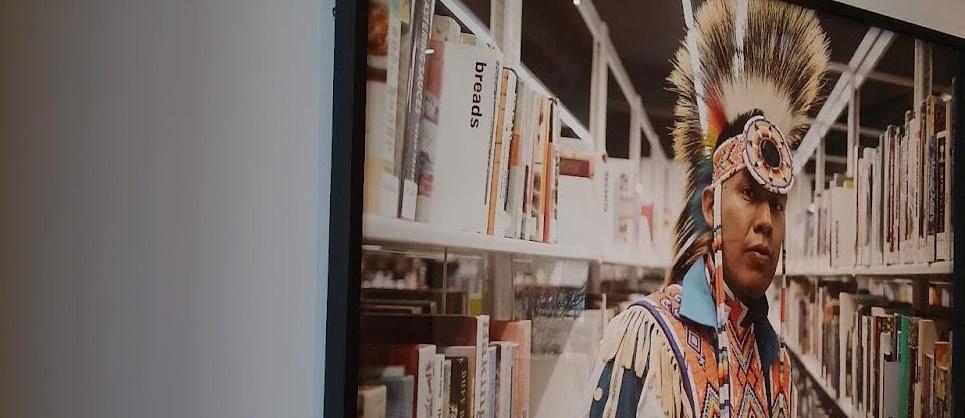
After walking through a “College Town” exhibit, one arrives at “Project 562.” Immediately upon entering the gallery, Orlando Begay of the Dine’ People, also known as Navajo, meets your gaze and establishes the tone for the entire exhibit in a large and colorsaturated photograph.
Posing in library stacks in his pow wow regalia, Begay’s eyes meet every person coming into the room. The perspective lines in the large photograph draw the eye to Begay’s face and porcupine quill and bead medallion headgear. A protector with a discerning countenance, Begay seems to be sizing up each person entering the space. He has also placed himself in a library, firmly placing indigenous people in places of education, economy and in the here and now, not a blurry sepia image from the past.
After stepping into the whitewalled gallery, one can see a variety of large photographs and a wall at the end filled with dozens of smaller portraits. A display of information providing context for “Project 562” stands directly in front of visitors at the entrance.
Museum curators have thoughtfully provided a charming education activity for children, and curious adults, to build their own camas roasting fire with fabric components. Several children’s picture books about indigenous lifeways are also available for children in the center of the gallery.
As a photographer, Matika Wilbur is skilled and precise. Her subjects, or rather co-creators, chose the locations, their clothing and the pose of their bodies. The locations and the environmental details inside the frame are widely varied and portray “Home” as experienced and defined by each of the co-creators.
Most have plants or plant materials from the home ecosystem of the people pictured. Some plants are used in clothing regalia or pictured as medicine. This provides a wide variety of texture in each of the photographs. In fact, the variety of materials in clothing and environment showcases the wide base materials, hues and textures present in each person’s home ecosystem.
In some photographs, the colors are slightly muted, almost melancholy or stark and in others the intensity leaps out of the frame. In all of the photographs, the limitations of two dimensions are challenged by changes in perspective, line, and composition.
Corvallis Museum focuses on Native America
▲ MATIKA WILBUR, Orlando Begay
words by RENÉE SILVA
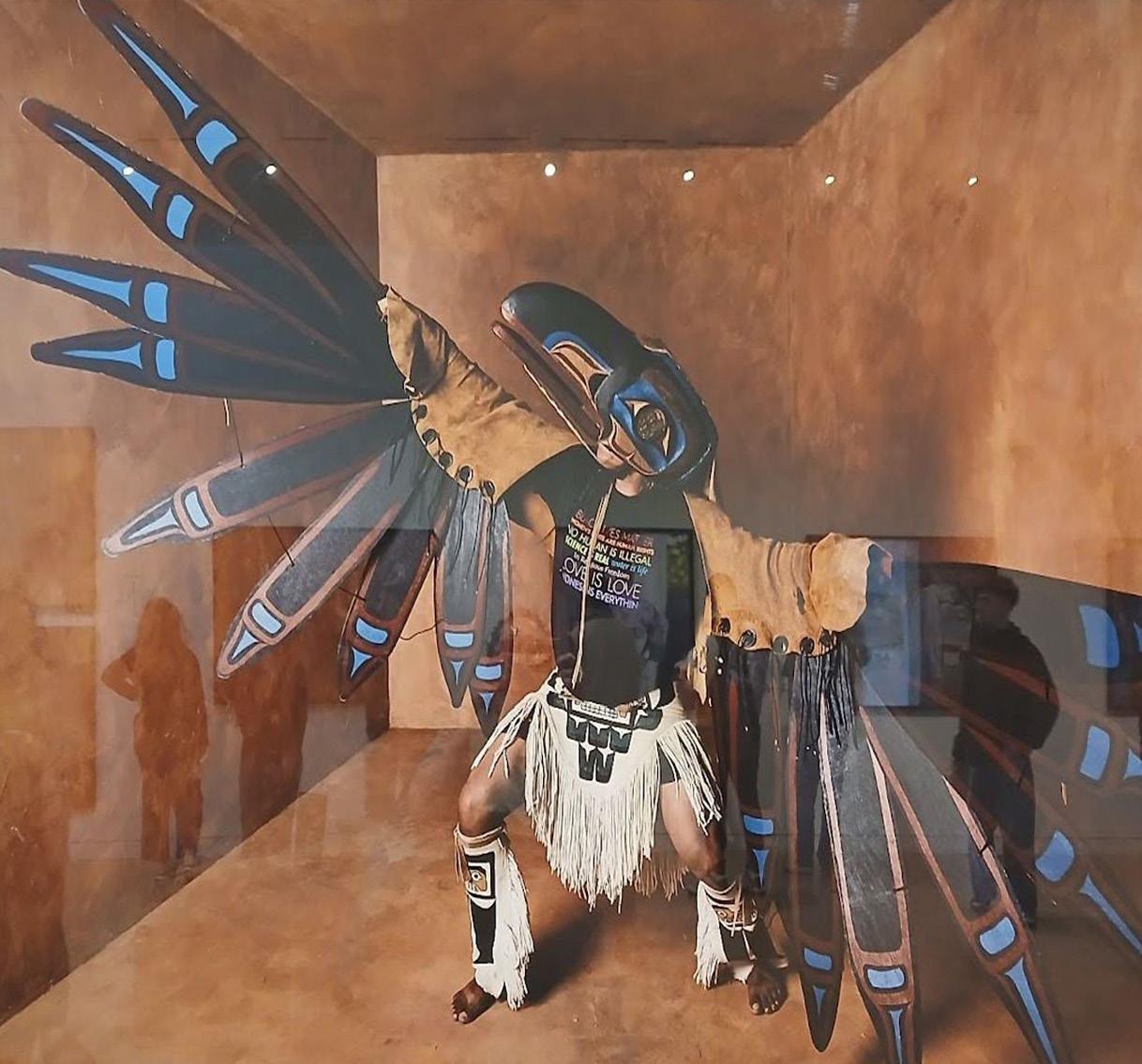
There is no one way to be indigenous and there is no one way to photograph indigenous people. The colors of the person’s clothing compliment the environment creating a seamless and special connection to the physical space providing a rich contrast to the natural environment.
This also evokes a feeling of human beings as a natural complement to the physical surroundings. Details such as the blue black of the Raven’s wings mirrors a real raven’s wings. As the dancer moves, the blue and black of the wings will flash and shimmer like a real raven’s wings.
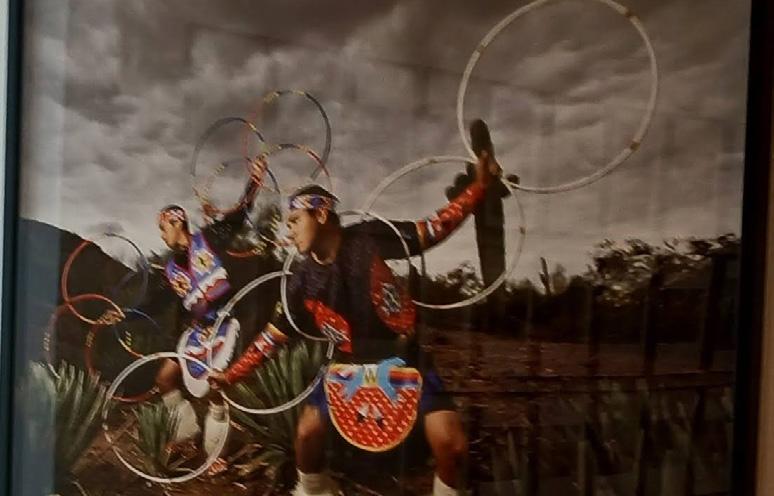
The presence of sky in many of the photographs creates a line from the Earth to the sky. Most people have chosen a physical context in which they feel most themselves, most content, or most powerful. Notice the hoop dancers create a line with hoops from the agave through the cactus in the background into the sky like the movement and flash of lightning bringing energy between the Earth and the sky. The dynamic movement, an energy exchange between the spaces with the human beings as moving conduit, observer, receiver and discharging element.
All ages are featured from in utero infants to elders into their eighties. Lines
on their faces and hands, engaged in the space which holds power for each person. Leon Black, an elder in the Southwest, is photographed in his everyday horse and ranch clothes in the corral space in black and white.
In another, a color photograph centers on an elder woman, Virginia Christman, in a vibrant richly hued red dress against red earth and a stormy sky with hands upraised in song. Her body completes a triangle of power against the dark sky as she stands in the front portion of the photograph. Lighter plants disappear along the perspective line into deep, rich, intense storm clouds and deep green hills. The home of the culture resides in these bodies and spaces as well as the environments or the clothing.
All these people seem to be choosing some reality that they each experience as home and a rebuilding of home in their larger communities. The clothing, the location, the activities represented, the time of life, all displaying parts of themselves as human beings feeling deeply at home where and how in the world makes them feel the most a part of themselves and their tribe.
In a photograph of a canoe before the Seattle skyline, balanced layers give equal space to each part of the environment
The clothing, the location, the activities represented, the time of life, all displaying parts of themselves as human beings feeling deeply at home where and how in the world makes them feel the most a part of themselves and their tribe.
inclusive of the human beings. With a forward stroke in progress, the cedar canoe in one mere moment will be away from the camera lens.
The sense of movement, indicating a larger theme of forward movement as nations, is prevalent in “Project 562.” The photographs are charged with kinetic power and a sense of movement or imminent energy.
Underneath these waters are the Southern Resident Orcas. Alki, a mother orca, carrying two dead newborns out of grief in just a few years lives in these waters. A lack of chinook salmon due to dams and other colonization activities has robbed her, and the people in this photograph, of the necessary food they have eaten for thousands of years.
When I see this photograph, I think of Alki, under those waters, trying to birth her own next generation. Like the coastal nations, orcas are matriarchal and matrilineal with mothers and grandmothers stewarding economics, education, cultural training, and family structures.
As I looked at the picture, I prayed the dams are pulled down and the chinook salmon greet the canoes and Alki’s family soon. Home is family and our relations are not only human beings. Home is all the relations and we must think of how our actions affect other families. Home is all inclusive; as above, so below.
Within photographer Matika Wilbur’s project, we can see what has survived a burning house. With rich depth of character and a complex, subject-focused point of view, native
Continued on page 9.
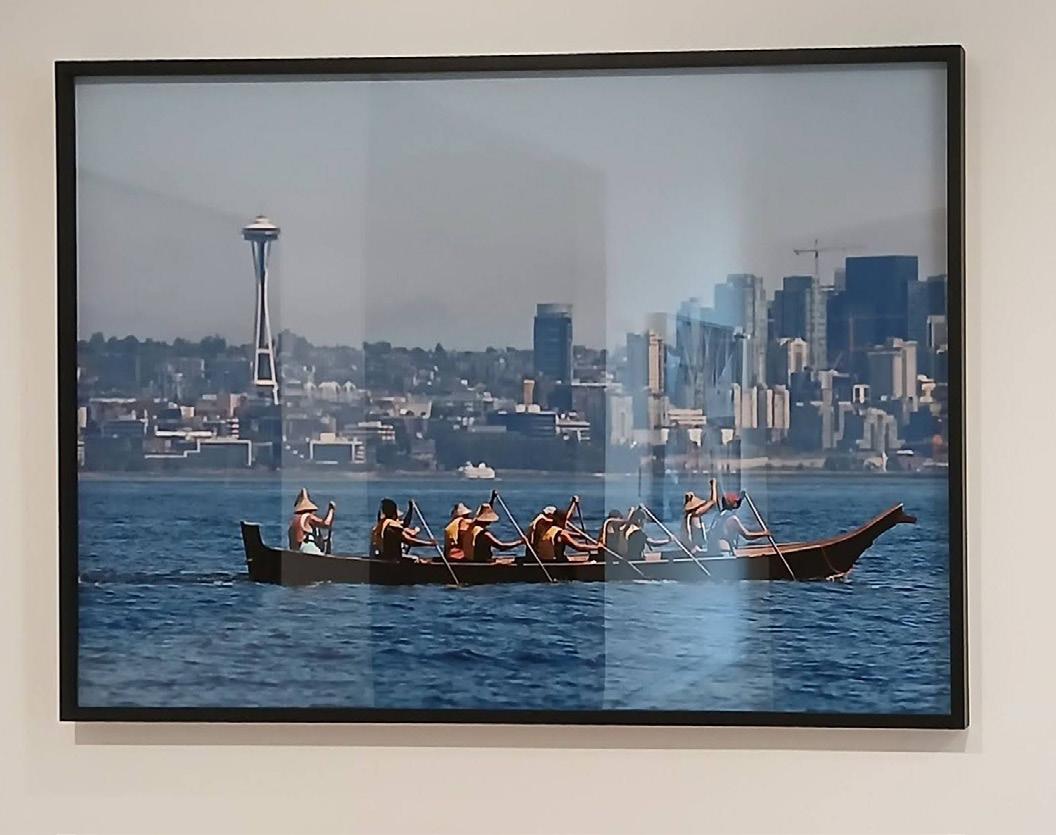
▲ MATIKA WILBUR, Cedar Canoe
▲ MATIKA WILBUR, Raven Dancer
words by SAVANNAH WEST
LB Behind the Scenes:
Editing Truth in the Age of AI
When most students hear “Wikipedia,” the reaction is immediate: don’t use it.
From Skepticism to Responsibility
When History Is Wrong Online
Small Edits, Big Impact
Who Gets to Decide What’s “True?”
The Challenge of Indigenous Knowledge Rethinking What We “Know” What This Has to Do With AI
A Skill That Lasts Beyond the Classroom
Rewriting the Narrative
For years, we’ve been told that it’s unreliable, non-academic, and off-limits in serious research. But in one anthropology class, that assumption gets flipped entirely.
Instead of avoiding Wikipedia, students are asked to edit it.
Anthropology instructor
Sarah Walker designed a class project that turns one of the internet’s most criticized sources into a hands-on tool for understanding misinformation, power, and who gets to shape history. Because Wikipedia is “edited by anybody, anywhere in the world,” Walker explains it gives “a snapshot of our cultural ideas, but also a snapshot of the distortions and misunderstandings of history, especially around Indigenous people.”
From Skepticism to Responsibility
As students begin working on the project, their attention turns from what they have heard about Wikipedia to how it actually functions.
Walker explains that students often believe something is true simply because it is written down. The project challenges that assumption directly by exposing just how inaccurate widely accessible information can be. As she puts it, “you can tell people till you’re blue in the face that history is a story and that what’s written isn’t always true, but they don’t really believe you until they see how wrong it is online.”
Once students begin editing, something shifts. Instead of
passively consuming information, they become responsible for it. Walker has found that “if we all take action, we can fix this. We can go in and change it,” and when students realize they have that kind of agency, “their whole attitude toward Wikipedia shifts.”
When History Is Wrong Online
As students dig into Wikipedia pages, especially those related to Indigenous histories, they begin to notice patterns that go beyond simple mistakes.
They find distortions.
In some cases, major historical figures are misrepresented in ways that soften or erase violence. For example, students encountered confusion between Smohalla and Chief Joseph (Heinmot Tooyalakekt), a leader of the Nimiipuu. Joseph was often mischaracterized as a religious prophet rather than a political and military leader influenced by Smohalla’s teachings.
In others, entire narratives reflect colonial perspectives rather than Indigenous ones. These are not just minor wording issues. They are systemic.
Students compare what they find online with Indigenousauthored sources and are often shocked by the differences.
The realization is uncomfortable but important. What we often think of as “neutral” information is shaped by power.
Small Edits, Big Impact
Some of the most meaningful changes students make are surprisingly small.
Walker points to a simple but powerful example: changing “the Maya were a people” to “the Maya
are a people.” While it may seem minor, she emphasizes that “the way you think about people is the way they manifest in your mind,” and using past tense can make it seem “like they’re gone.”
That shift from past to present tense challenges a deeper assumption that Indigenous cultures no longer exist. Language, students learn, carries weight.
Other edits are larger. Some students uncover major inaccuracies or missing context in entries about Indigenous leaders and communities. In one case, students examined how Kintpuash (Captain Jack), of the Modoc people, was incorrectly described online as having “committed suicide,” when historical evidence shows he was executed. In certain cases, correcting a page requires pushing back against long-standing narratives that have been repeated for years.
And that is not always easy.
Who Gets to Decide What’s “True”?
Wikipedia is not just a collection of facts. It is a community.
Students quickly discover that editing involves negotiation. Other editors may challenge changes, revert edits, or demand different types of sources. Some act as gatekeepers, protecting pages from vandalism but also sometimes resisting necessary updates.
Through this process, students learn that knowledge is not neutral. It is argued, defended, and shaped by people.
They also learn how to support their claims. As Walker explains, “if someone makes a claim and they don’t tell you why they think that, it’s the equivalent of me claiming,

‘there’s a unicorn outside and it’s yelling at me.’ It means nothing.”
Students learn to demand reasoning, to ask “why do you think that?” and to distinguish between claims and justified knowledge.
The Challenge of Indigenous Knowledge
One of the biggest tensions students encounter is between Indigenous knowledge systems and Western academic standards.
Wikipedia requires written, citable sources. But much Indigenous knowledge is oral, passed down through generations rather than published in academic journals. This creates a barrier.
To navigate it, students seek out Indigenous scholars who are working within academic systems and publishing research that can be cited. In doing so, they discover a wider range of voices than they might have encountered otherwise.
They also begin to recognize how academic standards themselves can exclude certain forms of knowledge.
Rethinking What We “Know”
As the project continues, students start to question things they previously took for granted.
For example, many enter the class believing Oregon has nine tribes. In reality, there are many more, including tribes that are not federally recognized. As Walker clarifies, “the State of Oregon has nine reservations—that does not mean Oregon has nine tribes.”
Students also learn that many commonly used tribal names, such as “Nez Perce,” are exonyms, or names given by outsiders, while communities may refer to themselves using their own languages, such as Nimiipuu.
These realizations complicate simplified narratives and highlight the depth and diversity of Indigenous histories.
Students also examined the story
of Chief Multnomah, often presented as a historical leader, and found it is largely rooted in myth rather than verifiable Indigenous history.
What This Has to Do With AI
The skills students develop in this project extend far beyond Wikipedia.
In an era where AI tools can generate answers instantly, the ability to question information is more important than ever. Walker notes that this kind of disinformation “has been going on forever, especially about Indigenous people,” and that AI is not creating the problem but accelerating it.
Rather than rejecting these tools, students are encouraged to use them critically.
Treat AI like a starting point, not a final answer.
Check sources. Verify claims. Ask questions.
A Skill That Lasts Beyond the Classroom
At its core, the Wikipedia project is not just about editing pages. It is about changing how students think.
Walker emphasizes this with a simple takeaway: “think for yourself.” When students learn how to get good information and evaluate it, they are better equipped to make decisions not just for themselves, but for their communities.
Continued from page 7.
peoples in the United States are finally front and center in their own depiction in digital media and photography.
Each person has chosen a location which feels representative and powerful to them as individuals and tribal members.
“Repatriation is the return of stolen or looted cultural materials to their countries of origin. Repatriation claims are based on law but, more importantly, represent a fervent desire to right a wrong — a kind of restorative justice — which also requires an admission of guilt and capitulation. This is what makes repatriations difficult: nations and institutions seldom concede that they were wrong,” Senta German wrote in an online article, “Repatriating Artworks” at www.smarthistory.org.
For those in Indian Country, there is an internal rematriation. While objects and bones may come home through a repatriation process, rematriation comes from within each individual from a relational point of view, giving and receiving from the whole, across time and space.
The rich diversity of nations and the individuals who make up those nations is on display in the photographs individually and collectively. It is an astounding collection of physical environments, compositions and color hues and values just as true as the variety of peoples and their homes.
“Project 562” demonstrates the magic of being at home in one’s own culture and one’s own role in creating and perpetuating home for this generation and the many next generations to come. View
Rewriting the Narrative
The idea behind the project is simple but powerful.
If everyday people do not participate in shaping the information systems we rely on, those systems will continue to reflect the same limited perspectives.
But if students step in, question what they see, and contribute thoughtfully, those systems can change.
One edit at a time.
CORVALLIS MUSEUM
Location: 411 SW 2nd St, Corvallis, OR 97333
Wed-Sat: 10 a.m. to 4:30 p.m.
Sunday: noon to 4:30 p.m.
Admission: $5 (Free for minors, OSU and LBCC students, and Oregon Trail EBT card holders.)
“Project 562: Changing The Way We See Native America” is available through July 19.
The museum is accessible by public transportation. Phone ahead for accessibility needs at 541-929-6230.
▲ MATIKA WILBUR, Hoop Dancers
Tripp Auditorium’s February Talent Show Has Students Engaged
words by COMMUTER STAFF
photos by LILLY EBERHART-GARAH
Is someone yacking in the parking lot? The flu is going around, but it could be for other reasons. Many people have a very big secret to keep. More parking lot vomit is likely. Two or three other people could pass out, including the replacement emcee, who has just come aboard.
Welcome to the LBCC talent show.
The school talent show ended with the student crowd raucous, impatiently chanting, demanding they wanted their way at the Tripp Auditorium on Feb. 19.
“You knew, maybe 20 minutes before it happened.”
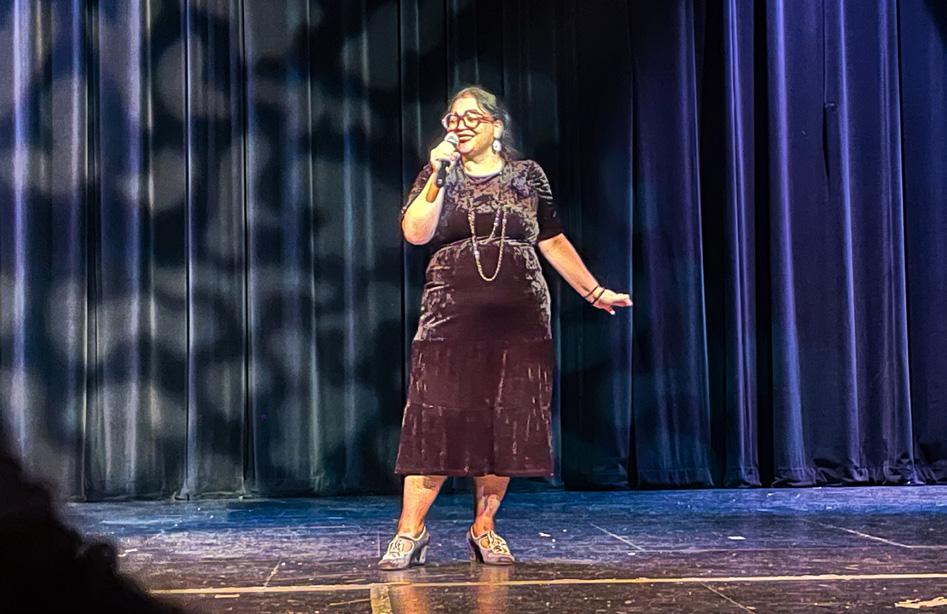
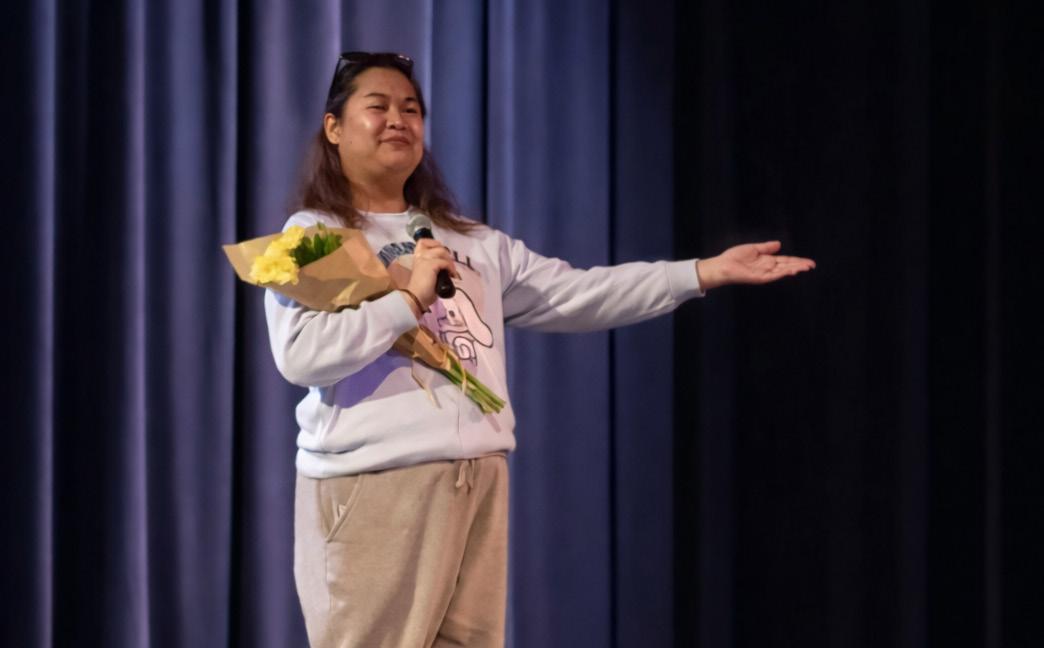
LBCC student talent show emcee Zhaine Raymundo recounts the circumstances behind her unexpected recruitment as the event host.
“I wanted it to go well because I was really excited for it. I was like, you know what? I'll pop a Tylenol between sets. It's OK.
I had little flashcards with what acts there was, but everything else was just on the fly. Other than that, I just kind of winged it. The next day I crashed. I kind of pushed myself a little bit too much.”
Even the host has got talent. “If I didn't have as much going on (I) would have joined. I performed in front of crowds to do a Filipino traditional dance before. So I thought about doing that again.”
So diversely talented, Raymundo was instead thrust into the gig of an impromptu stand up comedian … well, sit down, anyway. Seated with shades on. No, Raymundo was not too cool for the job, actually quite the opposite, she was so committed to her fill-in role, she should have been even more relaxed and reclined – at home, with the lights low.
Instead, there Raymundo was, in the Tripp Auditorium, in front of a big crowd. One a bit too loud for a dog who waits in the wings. Raymundo, to top it all off, has a concussion. Still, she soldiers on as host.
“They gave me a little seat and at
a point, one of our performers who I'm friends with (Georgie Jensen), she came up, she put the chair behind me and she forced me to sit. While I was just rambling off jokes to give time (for the judges to make their decision).”
In high school Raymundo was the school spokesperson for its robotics team and presented at a world championship, “so being on stage wasn't too bad for me.”
Sky Paul summed it up: “Huge kudos to Zhaine Raymundo. And Meei-Shiang and Jaymie Poujade for planning this great event. I know that them promoting the show via word of mouth is what got” such a great crowd.
With such surprises swirling behind the scenes, how do you begin?
“I heard a few people really putting themselves out there in a courageous way. So I thought, we'll just go first because we're not of that caliber at all,” said Instructor Annaliese Watson, explaining wanting to start off the show with something silly, a song that listed the countries of the world, with the help of several students.
The group didn’t get the chance to practice ahead of time. Watson didn’t need practice, owing to a long ago road trip that had as a soundtrack the catchy number from the Animaniacs cartoon.
“It's like really rapid fire and kind of ridiculous and funny. It relates loosely to anthropology, which is what I teach, because we study humans around the world.
It's actually quite easy to learn, even though it seems, like, impossible. It's one of those things that like once it's in your head, it's not going anywhere. I now can forget all manner of important information, but that song remains.”
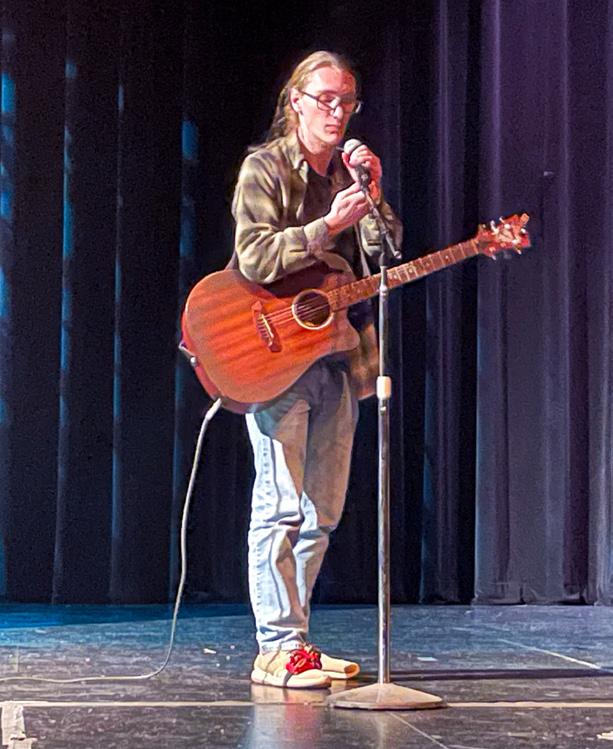
Hunter Steele appeared twice on stage. Playing solo guitar with the haunting and beautiful “Why" by Andrew York, which allowed him “time to focus on phrasing (and) dynamics.”
Steele has composed a few pieces of his own and plans to soon explore the
Read about the proposal from Tate's perspective on our website. Also, a twin brother's dare and a dog's heartbreaking but magical journey.
production side of music. “My career goal is to teach private guitar lessons.”
Steele also accompanied Melodie Barnett singing a soulful version of “Dreams" by Fleetwood Mac, which was voted the second best performance of the night.
Barnett should have gotten a behind the scenes award too.
“Mel definitely deserves some attention because she ran lights, sound, and performed which is no easy task,” said Steele.
Also appearing twice was Tate Haywood.
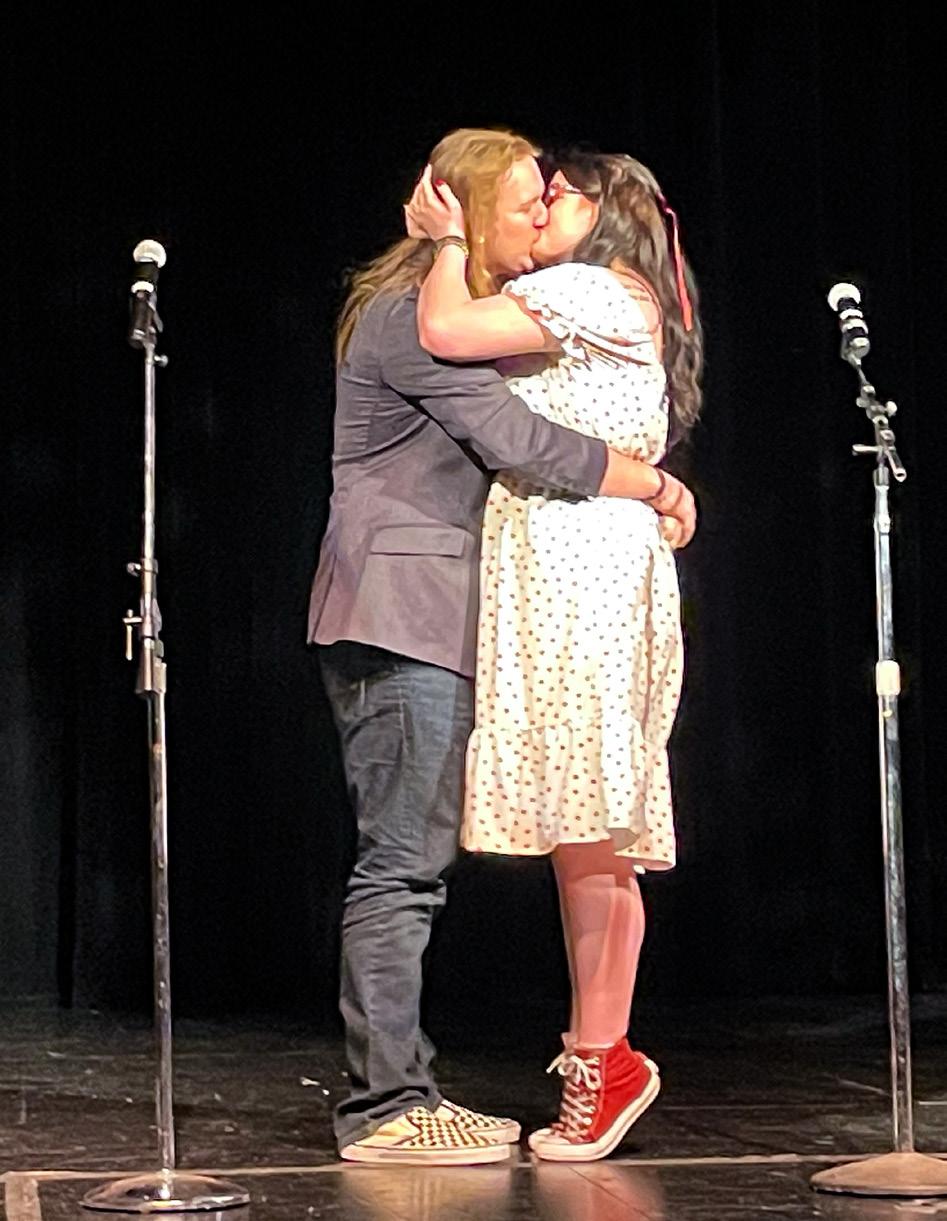
The first song from “Evil Dead the Musical,” “talks about her fiance getting killed (by demons) before they got married, which was ironic,” said Haywood.
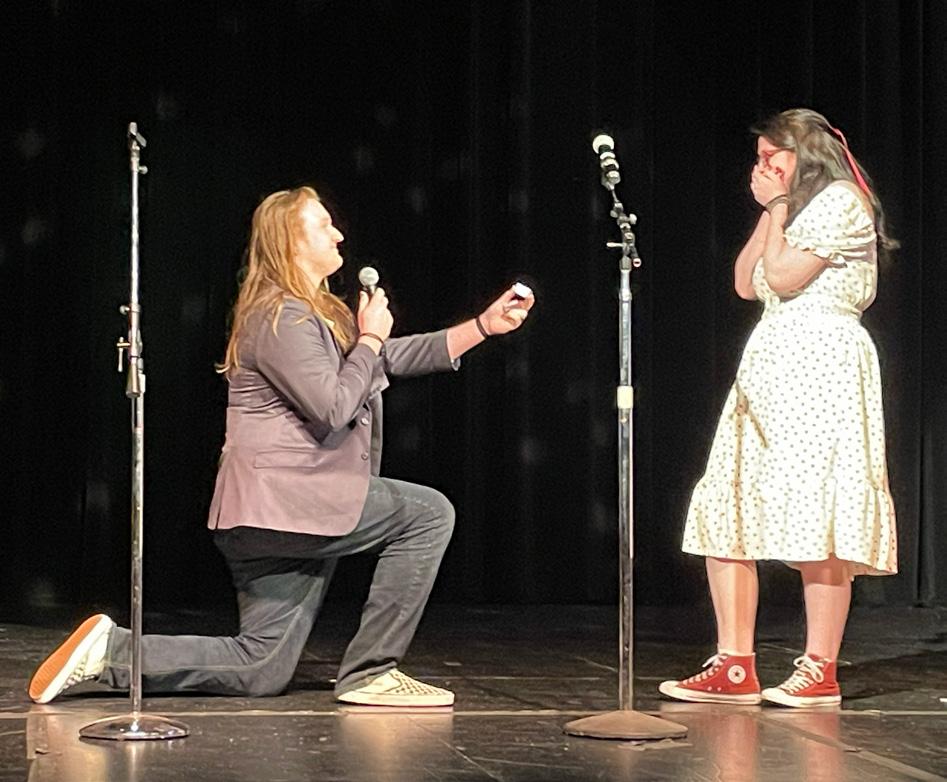
“We thought it'd be funny to have the proposal after,” said event planner Meei-Shiang Poujade.
Continued on page 12.
▲ Tate Haywood and fiancé.
▲ Georgie Jensen
Behind-The-Wheel
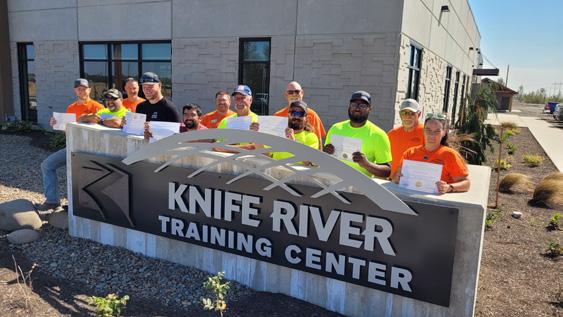
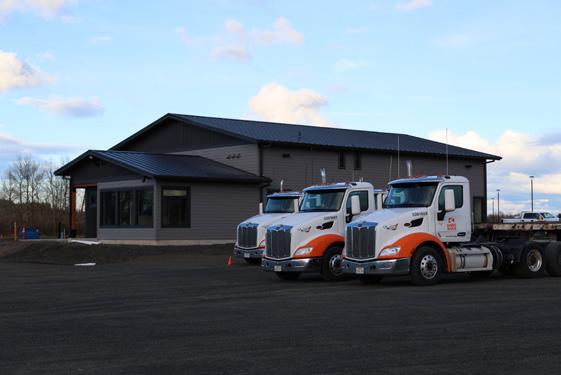
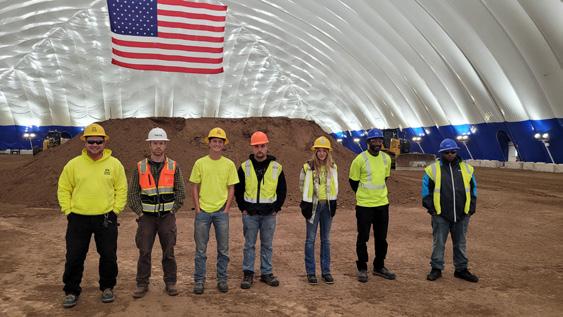
Train on 230 acres behind a closed gate before driving on public roads. We don’t rely on simulators. Students get real world experience and start driving and backing on the first day!
Unrestricted CDL
Our trucks are equipped with manual transmission and air brakes, ensuring graduates earn unrestricted Class A or Class B CDLs and are ready for the road—no matter the truck.
Experienced Instructors
Our instructors bring over 130 years of combined driving and teaching experience, delivering hands-on, industry-informed training that sets our students up for success from day one.



Continued from page 10.
“A Love Like Ours Will Never Die,” the couple sang for their second number, then he got down on his knee and got the biggest cheer of the night. The crowd was delirious in their shock.
“The other performers were equally as surprised as everyone else when the jaw-dropping proposal happened; no one except the event organizers knew about it beforehand,” said fellow performer Jason Miller.
“I knew right before because it was in my note cards and I almost gave it away. I was reading it off and then,” Raymundo admitted, “I went, oh, proposal. I shouldn't say that out loud. Skip.”
The talent is wonderful, but they are moving faster than rehearsals, much faster than the plan.
“It's like what do we do? Do we pull everybody back in?” Poujade explained. “Everyone's out in the lobby just mingling and having fun.”
“Congratulating the newly engaged,” added Raymundo.
They are about half an hour ahead of schedule. A plan completely reliant on
the scheduled time, because the second half of the program is full of students who are currently still in class. So the planners stall and acts come rushing in, straight from their classrooms.
Michelle Kyle “basically came in, threw her backpack at me and went on stage,” said Poujade, to sing “Wagon Wheel.”
Cory Stutz rocked perhaps harder than the crowd had ever heard a ukulele rock before. As many have in the past, Corey in his own style, also warned of the dangers of “The House of the Rising Sun.”
Then there was Denali Bosco, doing tricks with her dog Paisley. “My personal favorite was the dog. So cute. Like the most well behaved dog I have ever seen,” said Haywood.
Jason Miller: “Funnily enough, I'm not too big of a fan of Imagine Dragons. The extent of my knowledge of them stems from (a phase in) my middle school years. The song I played, "It's Time,” is a notable exception.”
Daniel Amezquita performed a sparse version of “The Goodness of God.” “I want(ed) to do a song that brings a message.”
Angel Chajon Estrada sang a song by Vicente Fernandez to honor the memory of a family member. “He was my great grandmother's favorite singer.”
Vayne Lim sang "So tired" by Kay Starr. “I chose that song because I could resonate with being a hopeless romantic. I felt nervous and unsure how I did during the performance” because of anxiety but “felt relieved and proud after the performance because I actually went up stage and did what I said I was going to do. I feel proud of LBCC for having so much talent.”
The competition was so intense even two encore calls and wonderful classical guitar playing earned Vlad Stancescu third place. Vlad was preparing to play
Escaping murderous bad men in Central America; from social anxiety to a Public Speaking major, from farm worker to Nursing student — Performer stories online.
lbcommuter.com
the songs, as he had long intended, as a gift for his mother’s birthday.
Even the crowd itself had musical chops. After the judges were sequestered outside the auditorium to anoint the winners, the impatient crowd launched into an impromptu group sing along acapella of “I Want It That Way.” As the judges continued their long deliberation, wrestling with such a tough decision, the audience chanted loudly for the final verdict. Boisterous laughter from the judges deliberation could be heard through the walls, apparently not at Raymundo’s time killing jokes.
Finally the unenviable selection had been made. Judge Jaxon Lee explained how difficult it was to select the winners, due to the abundance of talent. Luckily, he said, the winner was unanimous.
They all crowned Kaelynn Carroll the winner.
“We all became a close family because we were all sitting in the auditorium with each other and listening,and it was really cool because, like, Kaelynn and Tate and Melodie, they’re all singers, but they would all help each other,” said Poujade.
“I, as the MC, really enjoyed it. Even though I was thrown last minute into. It was very high energy,” Raymundo said. “I got feedback from other people and they wanted to see it happen again and for that to happen would need probably more volunteers or just more people in SLC. (It’s) a great place. We host all the events and so having more people is always the better.”
“The entirety of student leadership was so supportive of everything. Everyone was saying it was really hard not to let me know what was going on because they all knew,” newly engaged Haywood said.
“Everybody who was in that talent show was so talented. Like, I had no clue. But it doesn't surprise me at all that we have such a talented community of students. Every single person who was up on that stage, I would love to see them do something again.”
▼ Emcee Zhaine Raymundo
▲ Jason Miller

LBCC Clubs and the SLC are excited to announce our annual Spring Fest is happening Tuesday, May 12 Take a break from whatever you’re doing and join us for fun, games, and food. Most importantly, check out each club’s table, talk with them, take some freebies, and maybe even join a club or two? Over the years, students have really appreciated this highly-attended event . You don’ t want to miss out on this one! We’ll see you at our Mad Tea Party Spring Fest!
Can’ t Attend Spring Fest? No problem!
You can still get involved with clubs any time!
Peruse our active clubs online, come to a Council of Clubs meeting, or come into the Student Union to ask us questions about how to join clubs, create clubs, and re-ignite past clubs that just need someone to take over!
Current Active Clubs: Art , Command Zone (Magic the Gathering), Cheese Club, Table Top Games, Gardening, Estudiantes del Sol , Creative Writing, Poetry, Cozy Burrow (BUNNIES), and more clubs are waiting for more members to join!
CHECK OUT CLUBS!
FREE MONSTER SAMPLES AT SPRINGFEST!

THREE STOPS
at the Corvallis Plaza
words by LILLY EBERHART-GARAH
photos by AYDEN HORTT
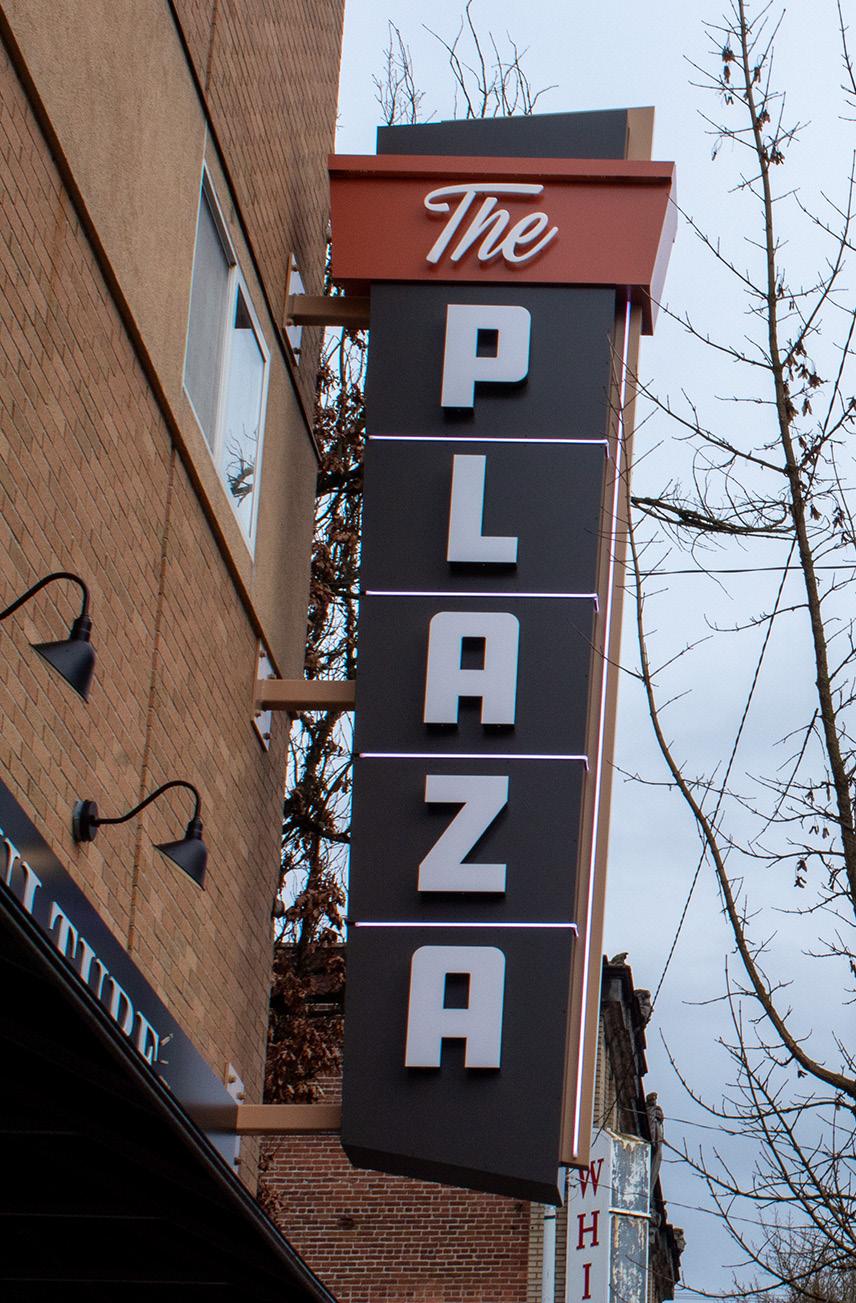
In February The Commuter featured the newly renovated Plaza on Fourth Street, a space now home to several local food businesses.
I stopped in to try the restaurants for myself.
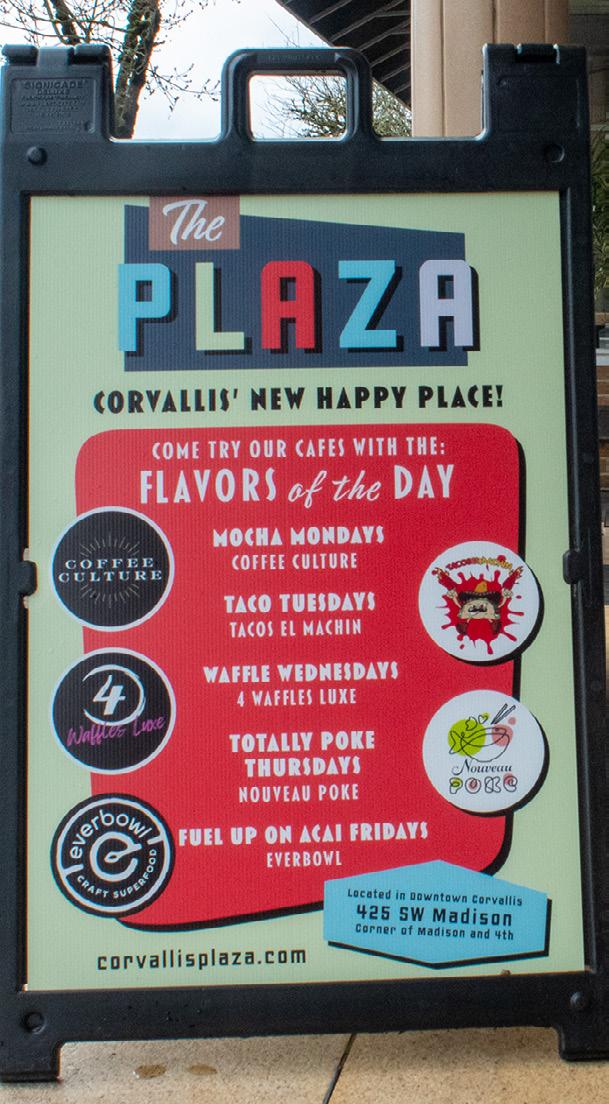
One of the newest arrivals there is a café called 4 Waffles Luxe, run by the Paradiso family. Until recently the business operated out of the basement of the Plaza, which means the food had already built a loyal following long before the café itself moved upstairs. This is always a good sign. If people are willing to go downstairs for waffles, the waffles are doing something right.
Mario Paradiso, who runs the café with his wife, greeted me between customers and explained that the waffles at the center of the menu grew out of a practical need at home. His wife has lived with celiac disease for many years, which meant that ordinary baking was not an option. After experimentation, the solution turned out to be a waffle recipe built from almond flour, rice flour, and tapioca starch.
Gluten-free baking has a reputation for being temperamental. Baked goods can come out dense, or with that unmistakable texture of something that is supposed to be “good for you”. These waffles do not have any of those undesirable qualities. They are light, soft, and springy, and if no one mentioned the word gluten you would likely never think to ask about it.
Paradiso has been cooking since childhood, which is exactly what you want to hear from someone handing you a waffle. 4 Waffles Luxe is very much a family operation. Paradiso runs the café with his wife, their daughter manages the shop, and their son also works there.
The menu has changed slightly since the move upstairs. The original kitchen served fried chicken with the waffles, also gluten-free, but the specialized enclosed fryer required for that setup costs around sixty thousand dollars, which is difficult to justify in a new space.
Paradiso said they are working on a different solution, which may take the form of a food truck that could travel between Corvallis, Albany, and Lebanon. In the meantime, the waffles themselves
have taken on a variety of new roles, including the one I had come to investigate: the C&W Reserve, a waffle sandwich, which I’m told is their most popular savory menu item.
The C&W Reserve arrived looking like a sandwich that wandered through breakfast on its way to becoming lunch.
Inside are sliced turkey, bacon, tomato, red onion, and arugula. The turkey is cut thicker than standard deli slices, giving it a little more presence. The bacon adds a smoky note that leans gently against the sweetness of the waffle, while the arugula contributes a light, welcome bitterness that keeps the whole thing from drifting too far into dessert territory.
The waffles hold the structure of the sandwich together surprisingly well. They are soft enough to bite through easily but firm enough to keep everything contained, a delicate engineering problem.
The plate also arrives with kettle style potato chips, a dill pickle, and a small container of maple mustard sauce.
The mustard in the sauce is light, not sharp or spicy, and the maple adds a syrupy sweetness that makes the sauce seem like it was made just for this sandwich, somewhere between breakfast and lunch and not entirely committed to either.
This sauce is dangerous, too, because at first you think it’s
for dipping, but dipping leads to a mess. The correct method, discovered after field testing, is to pour the sauce directly into the sandwich as you go, which keeps the whole operation stable and keeps your dignity intact. Don’t skip the sauce. It’s not an extra, it’s part of the design.
The pickle is sharp and heavily dill flavored, the sort that clears the palate with enthusiasm. The chips are the familiar kettle variety, reliably salty and crunchy enough that everyone nearby understands you are eating chips, which I consider part of the social contract.
The sandwich costs seventeen dollars, which places it comfortably in the current café sandwich range. It is filling without feeling heavy, and the waffle base gives it a character that is unusual without being showy or coming across as a gimmick. On Wednesdays, the café also offers four dollar waffles with syrup, which is a good way to try the basics without committing to a full sandwich.
After finishing the sandwich, there was still one more waffle waiting on the table, and this one made no attempt at modesty.
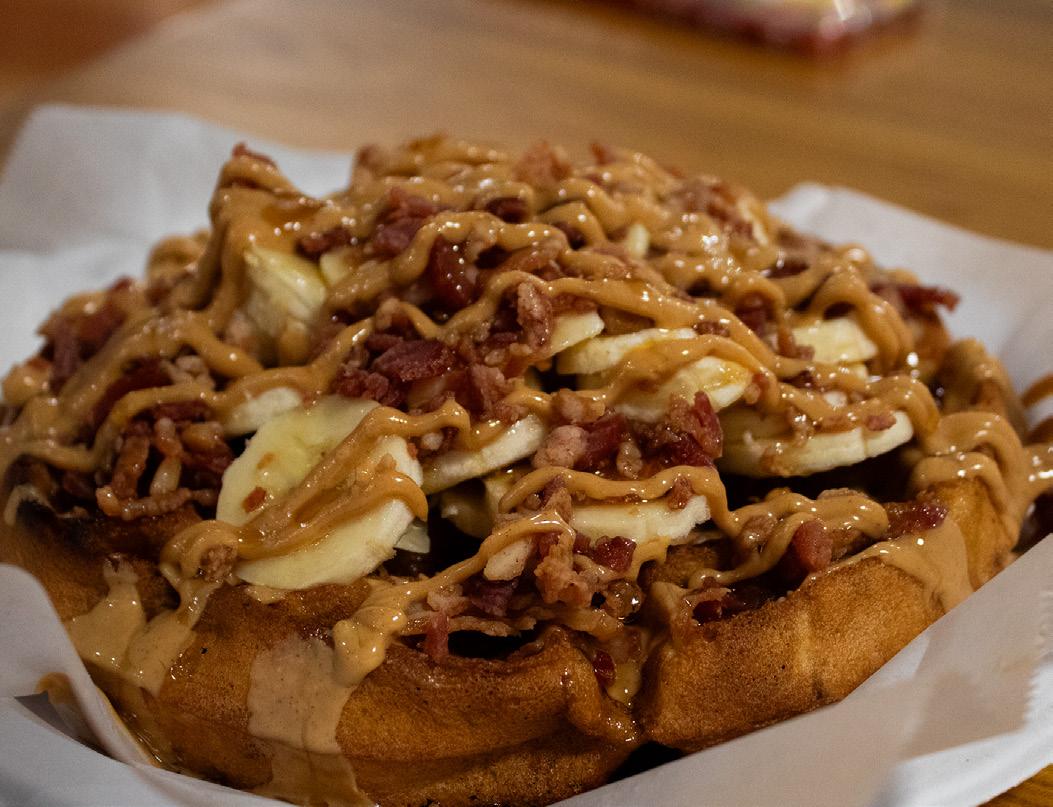
The dish is called The Elvis, which is a name that prepares you for excess, and then exceeds your expectations anyway.
The waffle itself is thick and golden, and before you even begin eating it you can see that it has been designed to support a considerable amount of topping. Sliced bananas are laid across the surface like roofing tiles, bacon bits are absolutely everywhere, and the whole thing is covered with a Reese’s peanut butter and maple syrup sauce that slowly works its way into every pocket of the waffle.
The waffle underneath all of this is noticeably crisp on the outside and soft in the middle, which turns out to be an excellent structural decision. The earlier waffle used for the sandwich had been soft so it could fold easily, but this one needs a little more strength in order to hold together under the weight of everything piled on top of it. The crisp exterior keeps the toppings in place while the inside stays tender enough to cut through without much effort.
The flavors are exactly what the name suggests. The peanut butter and
maple syrup blend into a sweet, sticky situation that pulls the bananas and bacon together. The bacon adds just enough salt to keep the whole thing from becoming pure dessert, although this is still not a dish for those who fear dessert.
At first glance the waffle does not look enormous, but once you begin working your way through the toppings it becomes clear that this is a substantial plate of food. It is the sort of thing you might order with the intention of sharing, perhaps on a date where neither of you mind getting a little sticky.
The real victory with 4 Waffles Luxe is simple. If you need gluten free food, it can be easy to feel like you must negotiate with the menu. At 4 Waffles Luxe the waffles just act like waffles. You eat them, you enjoy them, you forget about the whole gluten thing, and that is exactly what everybody wants.
Once you have eaten a waffle like the Elvis, the day is already out of control. You might as well keep going.
Something a little less sweet felt like a sensible next step, so I stopped at Tacos El Machin next.
Tacos El Machin announces itself before you see the menu. The smell of seasoned meat reaches you from several feet away, the kind of scent that makes it impossible to pretend you were just walking past. You can lie to yourself if you want, but you know you’re getting tacos.
I ordered a plate of tacos, including carne asada and pollo, which arrived neatly arranged and generously filled. Each taco was topped with finely chopped cilantro, small diced onions, and thin slices of radish, with several small wedges of lime on the side. The tortillas were doubled, two soft corn tortillas for each taco, which is how you know a serious taco joint. One tortilla is optimism. Two tortillas is experience.
The steak taco was the first one I tried, and the first thing I noticed was

that the meat had been chopped very finely instead of cut into strips. This turns out to be a very smart move. When the pieces are too big the steak can get dry, and then you’re sitting there with a taco that looks beautiful but eats like homework. Here the smaller cut keeps everything juicy and full of flavor.
A squeeze of lime brightens everything immediately, waking up the meat, the tortilla, and you.
The chicken taco has a softer texture. The meat is shredded and noticeably juicier, and as you eat it the juices settle into the tortillas. The seasoning is a little milder than the steak, but still spiced and well balanced. Before you realize it the taco is gone and you are holding nothing but the memory of a very good decision.
The menu also includes several more traditional cuts, including tripe, beef cheek, and lengua, which tells you right away that this kitchen believes in tacos. Even without those, the tacos here are generous and well made, and on Tuesdays they offer two dollar tacos, which makes it very easy to order more than you planned. I nearly dragged my feet as I made for my next stop.
The last restaurant I tried in the Plaza moves in a completely different direction.
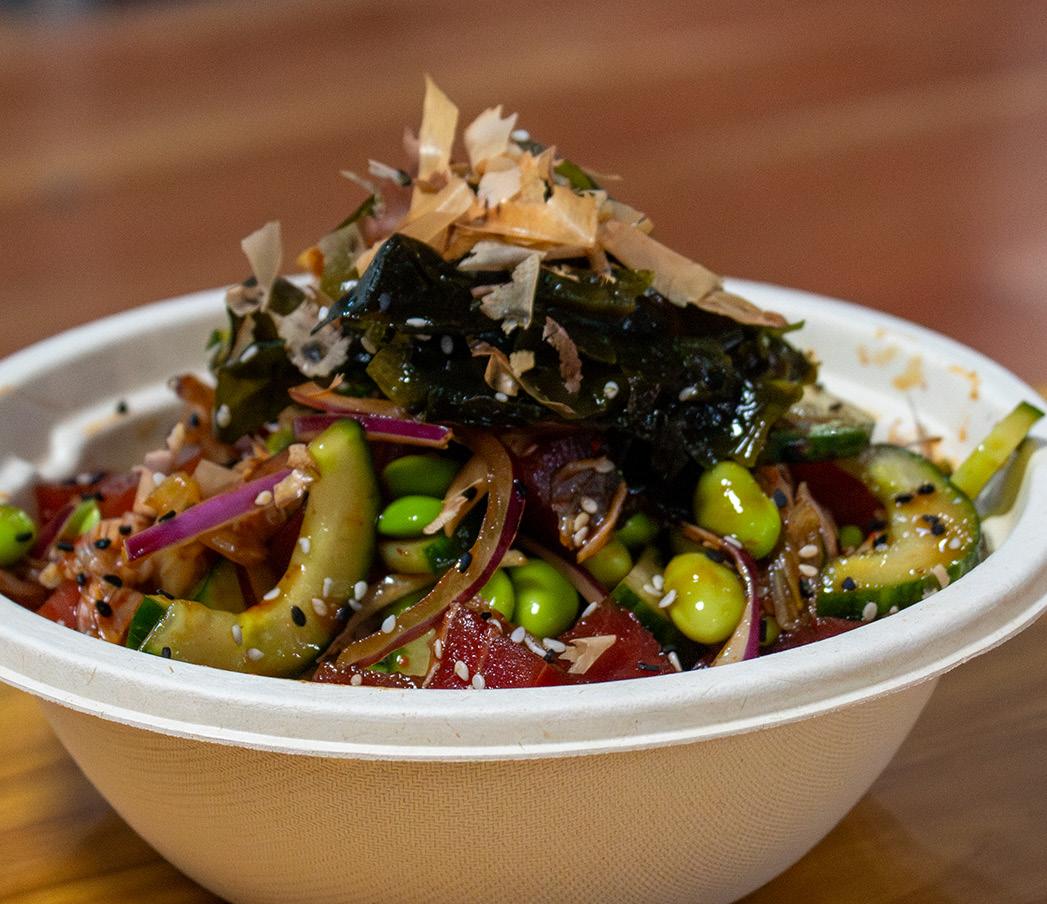
At Nouveau Poke, I ordered the Common Bowl. The poke bowl arrives looking almost like a small arrangement of elegant potpourri rather than a dish. In the center are glistening cubes of marinated shoyu tuna over furikake rice, topped with a small nest of seaweed salad, dotted with edamame, cucumber, kimchi, sesame seeds, all covered in a drizzle of ponzu sauce. Bonito flakes rest delicately on top like flower petals, completing the bouquet effect.
You look at the bowl and for a second you forget that earlier in the afternoon you ate a waffle with bacon and maple syrup on it.
The tuna immediately stands out. It is a deep red color, glossy in the light, and it has that clean, fresh oceanic scent that good fish always has.
The texture is very soft, almost buttery, and the shoyu marinade gives it just enough salt to bring out the flavor
without overpowering it. Around it, the vegetables create a mix of textures that keeps the bowl interesting from one bite to the next. The cucumbers and edamame are crisp, the seaweed has a gentle, slightly slippery bite, and the kimchi adds both softness and brightness.
The ponzu sauce ties everything together with a citrus note that keeps the dish feeling light, even though there is a generous amount of rice underneath. No single ingredient takes over the dish. There is enough tuna and vegetables that the bowl never turns into just rice with toppings.
After the sweetness of the waffle and the richness of the tacos, the poke bowl is very refreshing, the kind of meal that leaves you full but not weighed down.
Taken together, the three restaurants make a very convincing argument for spending more time in the renovated Plaza than you planned to. You come in for one thing, you smell something else, somebody puts a waffle in front of you, and before long you’re eating tacos and raw tuna and wondering when this became a full afternoon. This is what happens when good food becomes front and center: people stick around.
And if you happen to start with the waffles, no one will question your priorities.
▲ Nouveau Poke
▲ Tacos El Machin
▲ 4 Waffles Luxe


We Have a Brand New Ballfield AND IT IS BEAUTIFUL
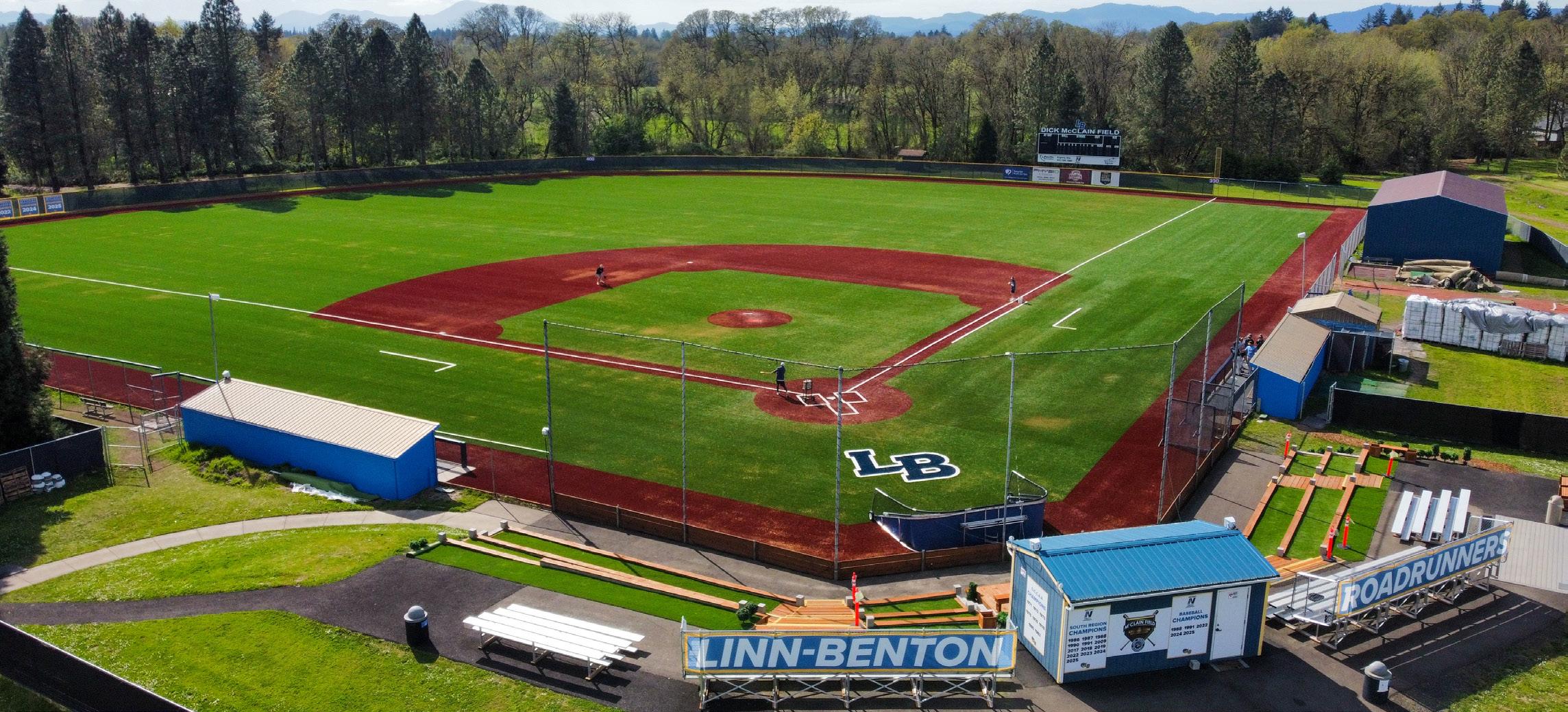
You may have noticed during fall term the dump trucks going in and out of the southwest parking lot carrying dirt out and carrying new dirt into the Linn-Benton baseball field. What was going on?
It turns out the old baseball infield turf was being replaced and new turf was extended to also cover the outfield. The stands for seating also were replaced.
To get the whole story, Director of Athletics Mark Majeski took time during spring break to answer some questions for the Commuter. Here’s what he had to say:
When did the idea for the renovation begin?
In 2023 we took a look at balances in our fundraising accounts. We had been putting aside money for several years, knowing that this project would have to happen at some point. Originally we were planning to just replace the infield (which was already turf, but at the end of its life). We knew we had enough money to replace the existing turf.
When we started talking with folks about the project, the question of doing the whole field came up and a few donors stepped up with sizable lead gifts to help make it a reality.
Did Coach Andy Peterson's success, having won the last two NWAC championships, help jump start the need for this renovation?
Yes, and no. The excitement of winning two titles in a row helps with people's awareness and excitement to be a part of a project like this. However, we were planning the renovation well before we won the two titles.
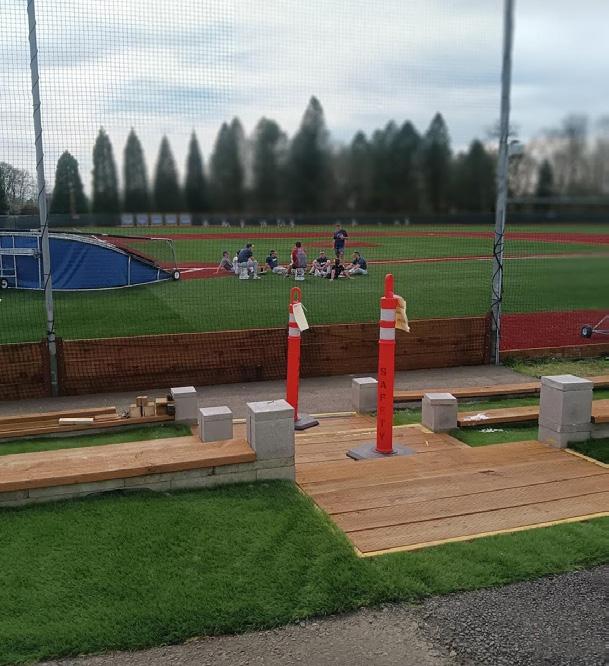
Who was involved in deciding what the design, material, and look of the ballfield's turf was going to be?
Coach, myself, campus facilities.
What was the overall cost and where did the funding come from?
Not all is complete yet for total costs, but this is a $1 million project. It is all donor-funded in close cooperation with the LBCC Foundation.
What part of this project are you most proud of?
The ability to get it done and the positive impact it will have on our program, the student-athletes and also the community.
Who were the contractors and when will the project be completed?
We used local contractors. The field still has some infill to be installed. The organic infill we chose requires sustained
Continued on page 21.
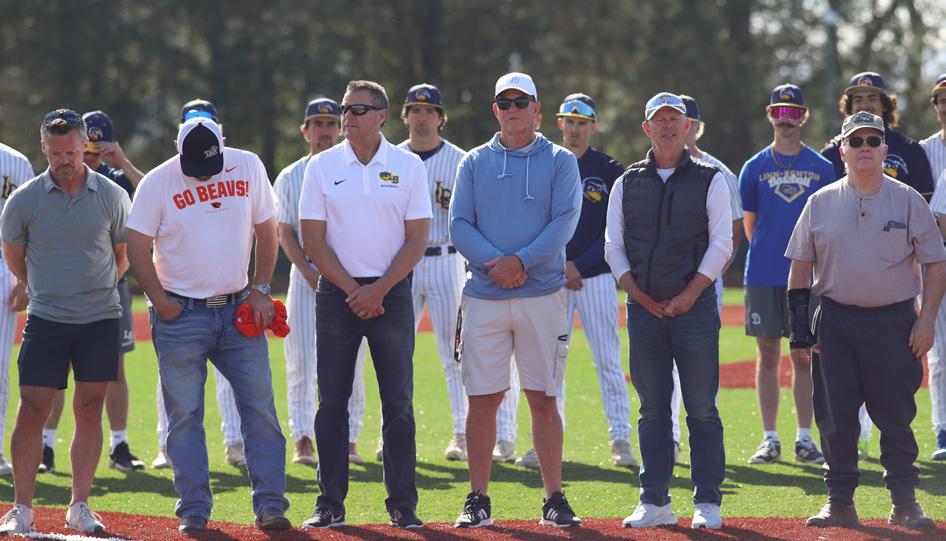
▲ JOE O'LEARY LBCC Baseball donors gather in front of home plate during the new field ceremony.
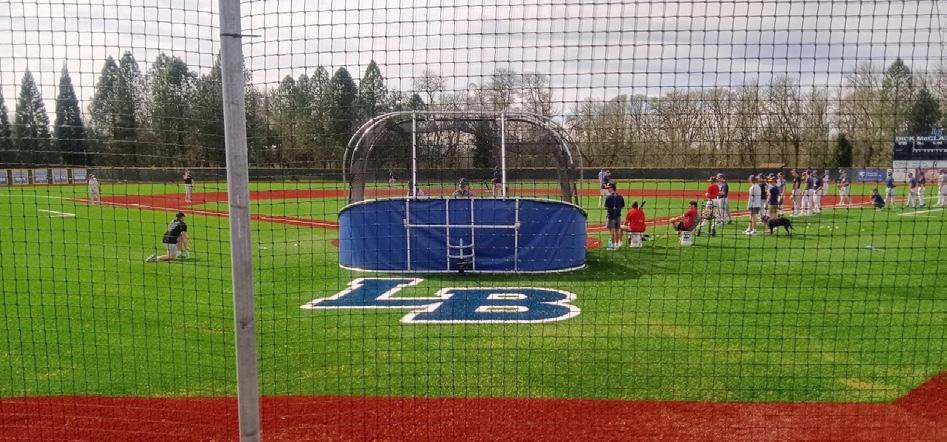
▲ MIKE MCREYNOLDS Players hanging out after practice on the new field.
▲ BRENDA AUTRY An overhead drone-view of the new field.
words by MIKE MCREYNOLDS AND NATHAN REAVIS
▲ MIKE MCREYNOLDS
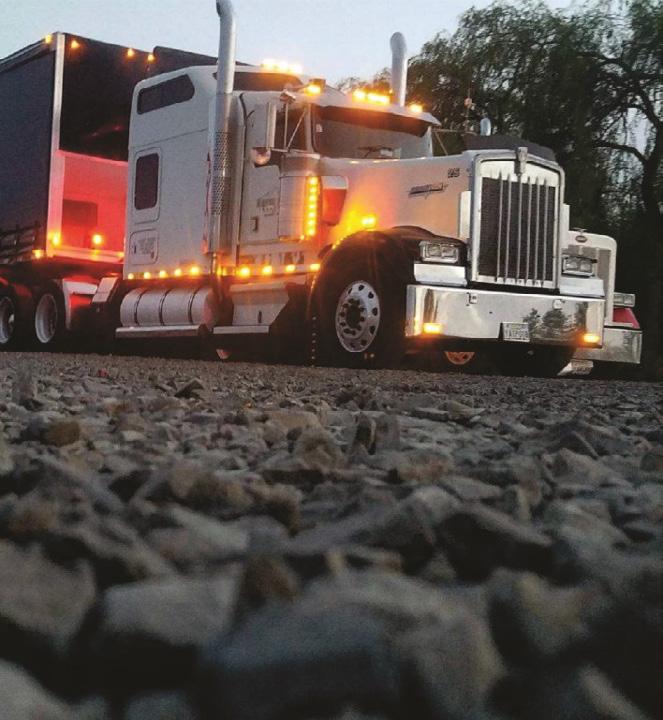
Come join us on the road to prosperity, job security and an opportunity to see the countryside as you have never been able to see it and get paid for it! Look at the sites through the windshield and wake up every morning with a new experience ahead of you. If you have the calling to travel this could be your ticket to fulfilling your dream. Don’t wait any longer; get started living your dream now!




No Kings in Cor vallis
words by MICAH TEAGUE
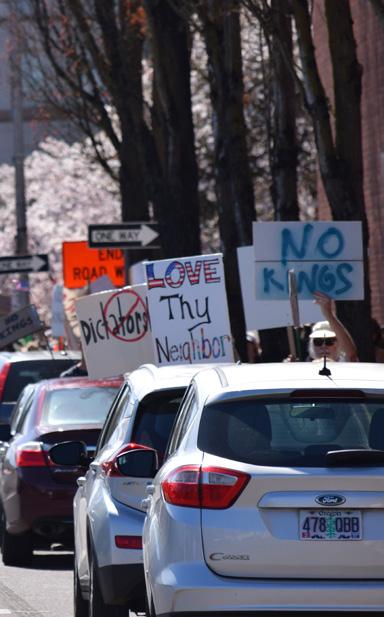
On March 28 millions of people throughout the United States took to the streets to participate in the “No Kings” protest. This is the third iteration of the No Kings protests. In June 2025 the first of this protest had over 2 million people in attendance, with over 2000 separate rallies throughout the country. The second being held in October 2025 saw an increase in attendance to over 7 million people. The latest protest had over 8 million people in attendance, making it one of the largest single-day protests in American history.
The Corvallis No Kings protest had thousands of people come out to participate on March 28 2026. Many people had hand made signs speaking out against Donald Trump, ICE, racism and demanding action from government officials to acknowledge and take responsibility for the authoritarian actions and policies of the Trump administration.





LOCAL
▲ MICAH TEAGUE
▲ MICAH TEAGUE
▲ SKYLAR WILKERSON
▲ MICAH TEAGUE
▲ SKYLAR WILKERSON
▲ SKYLAR WILKERSON
▲ MICAH TEAGUE


Continued from page 18.
dry weather to fully install properly, so the contractor will be back after the season to finish.The field is playable as is, but needs the additional infill for long-term use.
The official grand opening for Dick McLain Field was a March 28 doubleheader against the Clackamas Community College baseball team. LBCC beat the Storm 13-5 in game one and 5-4 in extra innings in game two.
The turf infield is an organic material from GreenplayUSA, a Merrick, New York, company that works with institutions all over the country.
“Yes, it has been an absolute blessing to have the full turf field, being able to practice every day rain or shine is a blessing and we are truly grateful for the donors that made it possible for the oneof-a-kind facility upgrades for a junior college,” said sophomore infielder Bryant Starr. “This program and school is like no other and isn't possible without the staff in our athletic department, and all the donors making sacrifices to see our program continue.
“Our individual and team growth is all due to the little details about the game,” Starr continued, “with this turf we can break down the game and really fine-tune the necessary problems to help push towards winning every pitch and game, to help lead to our overall goal of a three-peat NWAC title.”
This new turf technology replaces the commonly used rubber pellets and is more environmentally safe, according to LBCC’s website.
On its website, Greenplay notes: “Corkonut is blended using an exclusive, natural process utilizing only select pesticide-free coconut fibers and high-quality pure cork that is guaranteed to be environmentally friendly and human safe in every regard.”
Without the rubber pellets the field is more suited for baseball and does not have the "splash" often associated with rubber-filled fields.
“They love it, so they're really enjoying it,” Majeski said. “And they had to suffer as the project went through the fall, which wasn't anticipated.”


How everyday people work to conserve the famous bird PUFFINS IN PERIL
words by SID MYDLAND
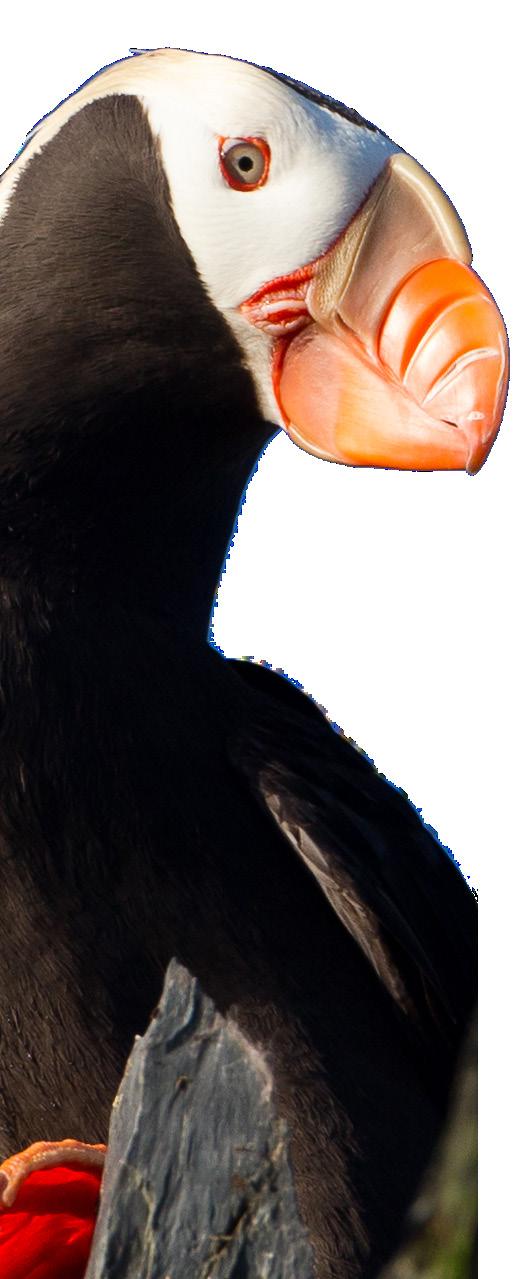
Long yellow eyebrows, chunky bodies, and bright orange beaks, the tufted puffin is easily the most charismatic bird off the Oregon coast.
With around 90% population decline in Oregon since 1998, the catastrophic loss has citizens and scientists alike bursting into action to save the iconic bird. Public education from groups such as the Haystack Rock Awareness Program, combined with locals' passion, and scientific research, can help these birds back from the brink.
I remember my first trip to Cannon Beach. A family member was working with one of the volunteer groups. They had spotting scopes scattered around Haystack Rock and volunteers answering questions. Despite the choppy waves and biting wind, all the beachgoers were filled with excitement.
I took a step up and looked into the spotting scope, and there was … nothing. My uncle helped me adjust it, and among the mountains of seabirds, I saw a flash of orange. It was my first time seeing a puffin in person, and I was hooked. Now every year I go back to see them nesting.
Every spring, tufted puffins come in from their winters at sea to breed at Haystack Rock. They return to the same covered hovel, often with their lifelong mate, providing protection for them and their puffling.
Haystack Rock is a giant sea stack on Cannon Beach, standing at 235 feet. It serves as a home and nesting ground for common murres, several species of cormorants, rhinoceros auklets, and even peregrine falcons. Surrounding the rock is the intertidal zone, rich with a complex web of creatures.
“Should scientists someday find life on other worlds in far reaches of space, the alien beings they encounter will probably be no more bizarre than the creatures that populate the intertidal zone on planet Earth,” notes author and naturalist Stephen Grace on his Tides and Trails website.
Each animal on Cannon Beach, from tufted puffins to sea slugs, has its role. But as puffins seemingly vanish, what can be done to protect this precariously balanced ecosystem?
No one knows Cannon Beach better than the Haystack Rock Awareness program, or HRAP, a program funded by the city. Director Lisa Habecker walked me through a day in the life.
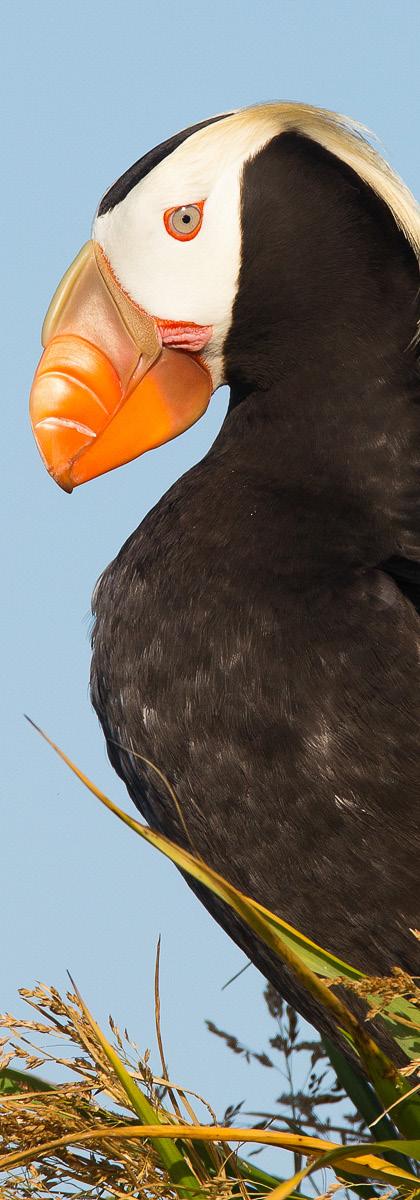
▲ LISA HUPP/USFWS, A tufted puffin near a burrow on Puffin Island, off the coast of Kodiak Island.
“We have an education and stewardship program that focuses on interactions with the public during low tide,” she said. The fragile ecosystem necessitates visitors to be gentle on some parts of the beach.
“We share knowledge about the nesting seabirds of the Oregon Islands Wildlife Refuge, and the intertidal animals of the state-protected marine garden,” she added.
The Oregon Islands National Wildlife Refuge spans the entire coast, protecting the wilderness islands whose cliffs provide perfect, secluded habitat for seabirds to mate. Habecker stresses the importance of education as the number one tool for the program’s work, in addition to dissuading beachgoers from causing harm, purposeful or not.
In general, the public is willing to learn. When the HRAP is out on the beach in their red vests and coats, lots of curious people will step up and see something new.
Nurse practitioner Amy Grace said, “I was a volunteer for the HRAP and not really into birds too much before that, but every day, setting up the spotting scopes, counting puffin nests, and showing them to excited visitors from all over the world (yes, the world) was really exciting.”
The people and visitors to Cannon Beach are not alone in their love of tufted puffins; scientists throughout their range work tirelessly to find explanations for all that is happening.
Former U.S. Fish and Wildlife scientist Tim Halloran worked researching the puffins at Cannon Beach for 14 years, retiring just last year. Halloran spoke about the puffin colony population at Haystack Rock.
“We're below 100 now. And we, for a long time, were averaging about 120. So it's gone down considerably,” he said, noting this concerning development for a species in decline.
Seabird population biologist Mark Hipfner explained that even as the puffin population disappears, the closely related rhinoceros auklets have remained stable.
Auks, such as the tufted puffin, have the highest wing loading of any bird, meaning that their wings are quite small compared to their body weight. Hipfner describes this as an “evolutionary compromise.” These birds are expending high amounts of energy in flight, but in return, they are essentially able to “fly” underwater. This unique trait is an easy way to identify auks.
“Being an [auk], flying is not their strong point, at least flying in the air,” explained Amy Grace. “Watching them leap off Haystack Rock and flap like mad is fairly fantastic.”
Their diet, composed of fish, requires them to dive deep. Powered by their wings, tufted puffins regularly dive to depths of 150 feet, but they have been observed to go as far as 360 feet under the sea surface.
▼
“We're below 100 now. And we, for a long time, were averaging about 120. So it's gone down considerably.”
ROY LOWE/USFWS, Haystack Rock at Cannon Beach.
As opposed to rhinoceros auklets, which are nocturnal, or active at night, tufted puffins are diurnal, meaning they are up during the day. Daytime activity makes them face additional challenges, such as competition and predation.
Seagulls, the little thieves, will do what they are known best for and try to steal food from the puffins. Puffins must then expend extra energy avoiding them while staying safe from predators.
Bald eagles in particular have become a problem for them. The conservation efforts for bald eagles have been massively effective, quadrupling their numbers since 2009; the downside is higher mortality from predation for puffins.
Halloran explained that the eagles at Cannon Beach are starting to perch on top of Haystack Rock for the first month or so at the beginning of breeding season. With a predator in the vicinity, the birds alter their behavior.
Colonies smaller than the one at Cannon Beach are more at risk, Hipfner explained.
“If an eagle is in the vicinity, the birds are all aware of it, and they'll fly to the ocean, and the eagles can't get them. But in these smaller colonies, there are not enough bir`ds keeping their eyes open for eagles.”
This vulnerability has had a large impact on their behavior, causing the puffins to flee from the threat.
“It creates this whole sort of climate of fear. They feel like they need a critical mass in terms of the number of other puffins that they want to be, socializing because of the constant threat from bald eagles. I think that's why the smaller colonies, especially in the southern portion of the range, are just blinking out,” Hipfner continued.
Predators are not the main source of population decline, that award goes to climate change.
As summers get hotter and oceans warm, climate change affects every living thing in the ecosystem. During heat waves puffins are going to prioritize their own survival. If it is too hot and
they cannot meet their needs, they may abandon their nests and eggs.
Incubating and raising a chick in that climate takes a heavier energy toll than in regular years. Simply incubating the egg takes around 43 days, with another 38 to 59 days before the puffling leaves the nest. During the puffling’s development, parents take shifts flying back and forth to offer many feedings throughout the day, diving over and over to take from a smaller pool of fish.
Getting food in the first place can be an issue for these birds. Warming oceans affect the fish too.
“So there doesn't really seem to be too much doubt that it's related to food, it's related to changing ocean conditions, and writ large it's probably being driven by climate change,” Hipfner said of the decline.
Tufted puffins feed on several species of fish and other sea creatures such as squid. A large amount of their diet along the Oregon Coast, including but not limited to Pacific sand lance, surf smelt, and rockfish are in decline. These fish are at risk due to habitat loss or alteration, chemicals, and overfishing. It seems that all the issues tufted puffins face have come down more heavily on them in the southern part of their range.
Focusing back on Cannon Beach, Halloran said, “There's been a lot more erosion on the colony, and a lot of that is because there are so many common murres.”
Common murres are the most common seabird to see nesting on Oregon shores.
“There's a lot of them on all the terraces and rocks and ledges, wherever they can find a spot to sit, and they crowd in shoulder to shoulder for breeding,” Halloran said.
With such a dense population, parts of the rock are wearing away, leaving less and less room for the puffins to nest.
A recent research project of Hipfner’s, which isn’t yet published, has found a difference between the northern and southern populations of tufted puffins: “We completed a whole genome sequencing analysis on tufted puffins,
▲ LISA HUPP/USFWS, A tufted puffin perches on a cliff next to a burrow.
and it turns out there is a genetic split.”
While the northern population has retained a larger number of birds, the southern population, such as those in Cannon Beach, has endured hemorrhaging loss.
The discovery of this split could prove crucial in getting southern tufted puffins listed under the Endangered Species Act, affording them more protections and providing extra funding for conservation efforts. Several years ago there was an attempt to get them listed, but partially due to that higher northern population, it was declined.
“But, you know, maybe that's not really strictly true,” Hipfner said. “That would suggest that it's something different about the puffins in the south versus the north and maybe we need to call them distinct population units.”
Listing this southern population could give these birds the chance they need to survive. Tufted puffins are currently an Oregon Conservation Strategy Species and are under the sensitive label. The Oregon Conservation Strategy is a statewide conservation plan for all people in Oregon. It provides incentives and grants for landowners who restore and properly steward their land that contains strategy species and habitats. While this does provide some help to puffins, having a federal listing could provide them with much greater support.
When an animal gets listed as threatened or endangered under the Endangered Species Act, the U.S. Fish and Wildlife Service has the power to implement conservation and action plans. This can sometimes involve captive breeding programs to increase population numbers, which has been successfully done with California condors, bringing their free-flying population from 22 to over 300.
While the puffin population in Oregon is at risk, it’s not too late to help. Each small action piling up could turn out to have major benefits. Habecker said decoys (a realistic fake) of tufted puffins are being put up in places where colonies used to nest, which could draw them back in.
People learning about tufted puffins and their issues, whether from the HRAP

in Cannon Beach or the Oregon Coast Aquarium in Newport, also brings more eyes to their needs. Also, research being done by people such as Hipfner helps others understand these issues on a deeper level.
To quote Hipfner, “They're fabulous. They're very charismatic. I think probably the most charismatic of the North Pacific seabirds.”
And he’s not alone. Habecker agrees: “To state the obvious, they are completely adorable.”
People have a passion for these magnetic birds. As they come in to breed after their cold winters at sea, so will people come into Cannon Beach to see them.
“I always recommend that people go out just at sunset,” Halloran said. “A few of them will come out and just sit outside of their burrows, or you may see some coming and going. And that's a very pleasant time to be out there.”

▼ ROBIN CORCORAN/USFWS, A tufted puffin swims with a mouthful of food.
▼ ROBIN CORCORAN/USFWS, A tufted puffin in flight just offshore.
Spring is Here! Get Involved in Student Life!
The SLC provides fun and free events for LBCC students! Plus, you can join us in the Student Union any time for free ramen and cof fee or to ask us questions. We also provide comf y couches, charging ports, and games galore, including a vintage arcade game machine! The Student Union is located in Forum 120 and open 9am-4pm Monday through Friday.
Follow us on Social Media --> https://linktr ee/lbccstudentunion
AGATE BEACH CLEAN UP 10am-1pm Lunch provided!
Make an air plant habitat with us and take it home! 18 APR 22 APR 26 APR 28 APR 30 APR
WANTED TABLE 11am-2pm in Takena Hall

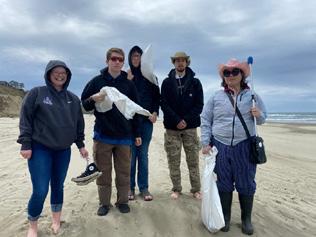
WAVERLY PARK CLEAN UP 11-2PM
Meet us in lower parking lot. Donuts & Coffee provided!
BREATHE & BLOOM: AIRPLANT EVENT! 11-1pm in Courtyard

Come to table, fill out a survey, play games, enter raffle, get a Monster Energy sample!

MINDFUL MARKET: MIDTERM SNACK EDITION 11-2pm in Courtyard FREE SNACKS!

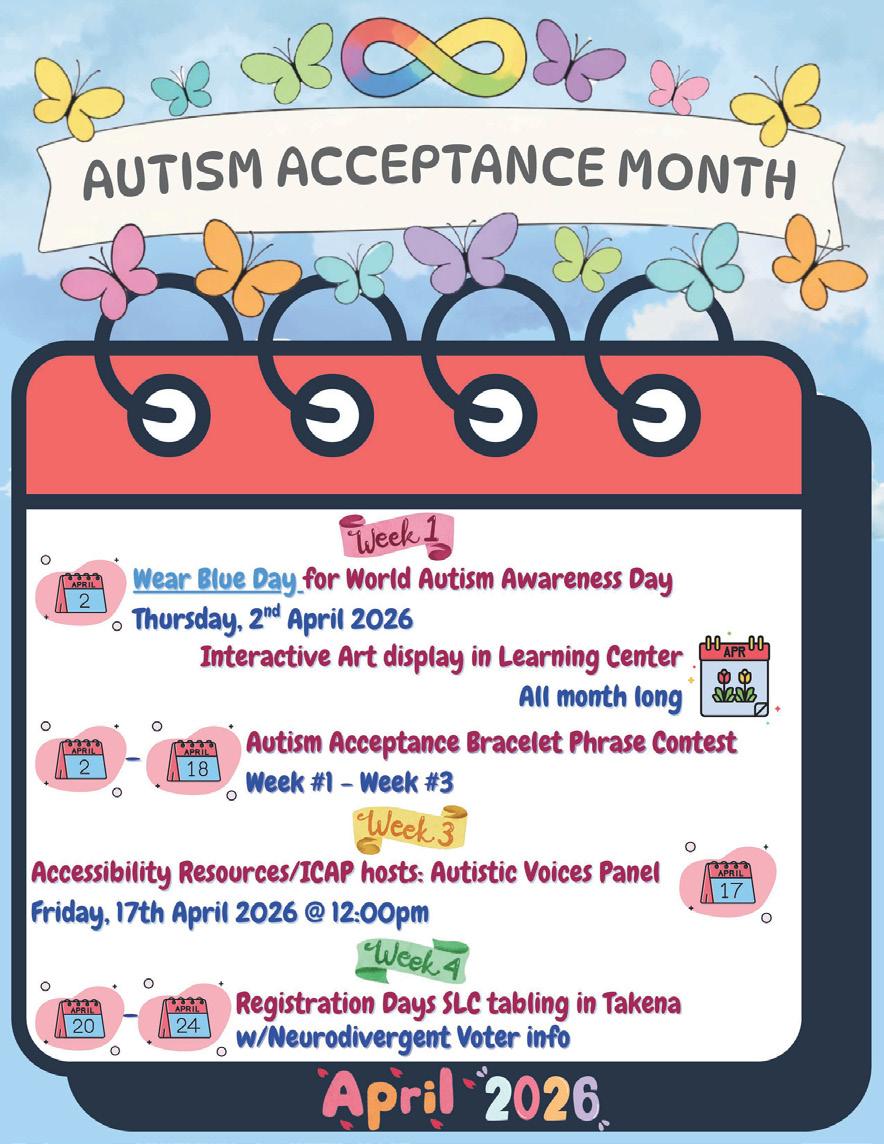
THESE ARE NOT ALL THE UPCOMING EVENTS, so scan the code! --> Tue, 5/5 12 pm - 3 PM @Forum-120
Meeting Manta Rays
Get up close with these endangered giants on a once-in-a-lifetime tour in Hawaii
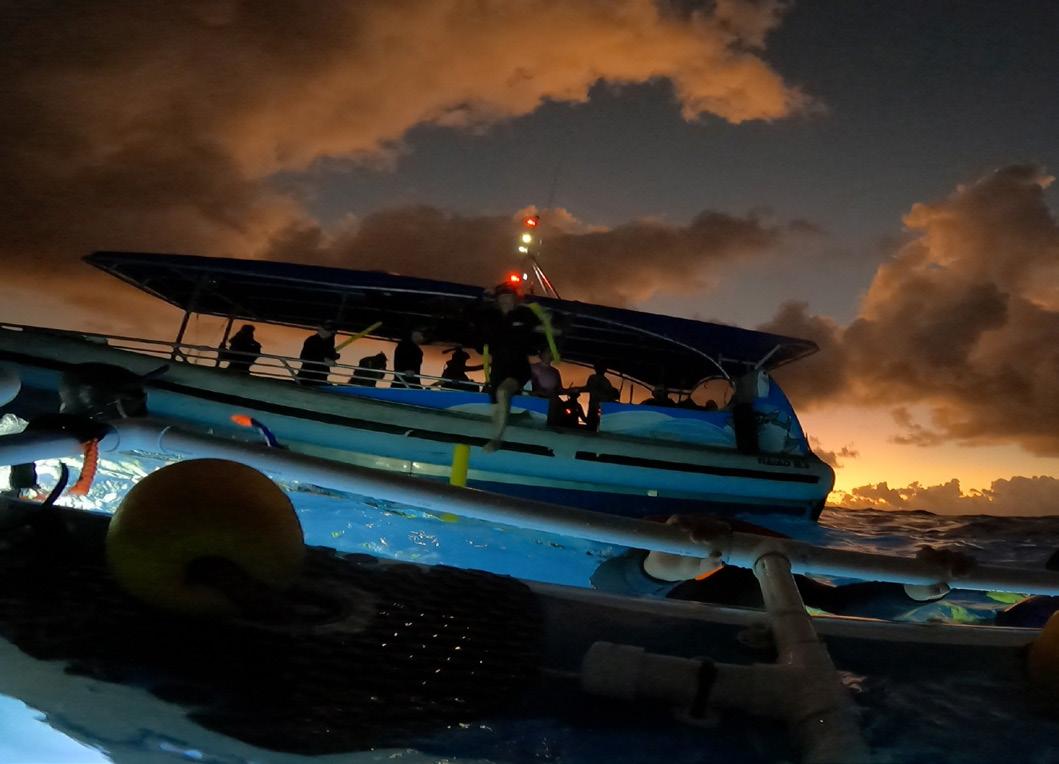
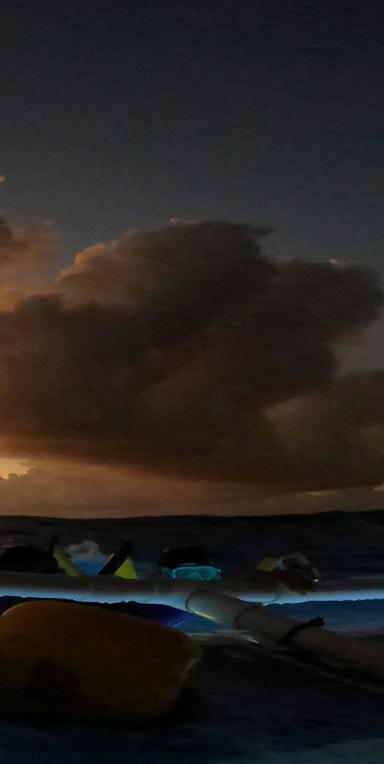
The fear didn’t hit me until the boat stopped and they told us we had to jump in. Jump off the boat into the pitch-black ocean. In my head, I had pictured myself descending a ladder into the water and carefully testing it with my foot before slipping in. But now they were telling me I had to jump—no safety test, no ladder to climb back up if it didn’t feel right. Just immediate, full immersion. I took one last look behind me at the sun dipping below the horizon and thought, “If sharks were eating people, the tours wouldn’t be so popular.” Then I jumped.
I held my breath as I plummeted down into the blackness. The deck of the boat was at least 10 feet above the water, and despite the buoyancy of my wetsuit and the pool noodle looped under my arms, my head was dragged under by the force of my impact. The warm water enveloped me and although my goggles were on it was too dark to see anything below the surface. My snorkel dangled to the side—per our guides’ instructions— and I accidentally swallowed a mouthful of salt water as I resurfaced.
I caught my breath and paddled to the lighted viewing platforms— surfboards lined with PVC pipe railing and bright lighting underneath—while trying not to imagine what might be lurking in the shadowy depths below. I followed the person in front of me to
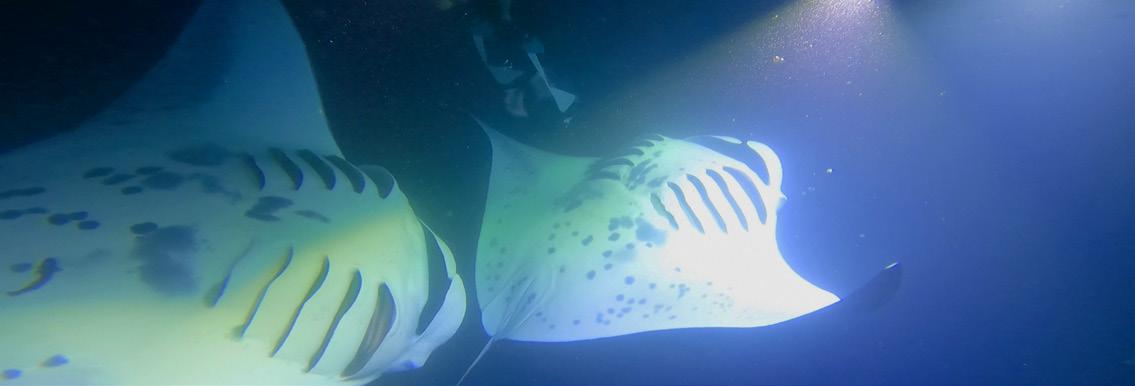
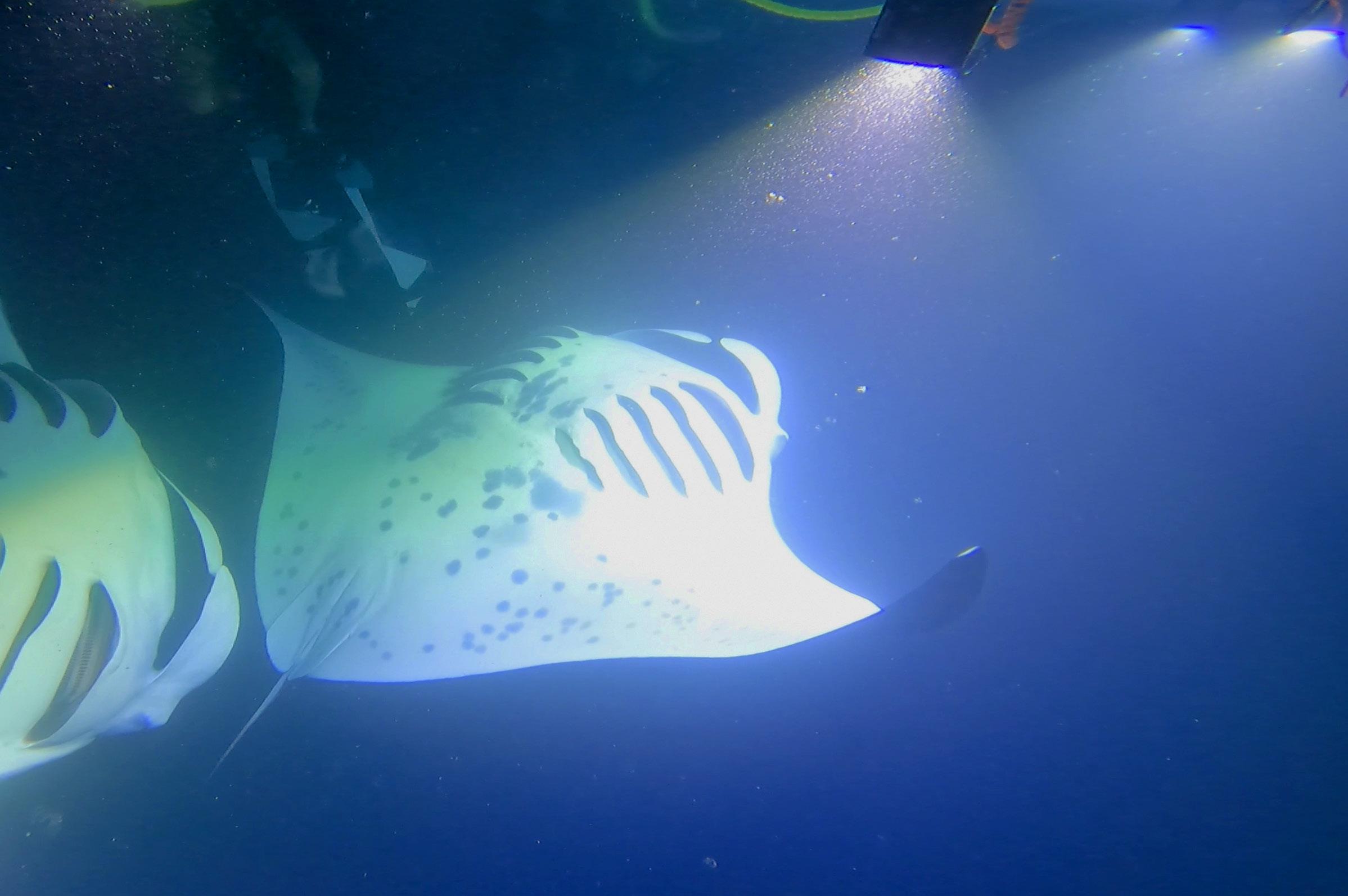
secure my spot on the railing. I tucked my pool noodle under my ankles so I could float flat on the surface and adjusted my snorkel. The lights on the underside of the boards illuminated the blackness, and as soon as I slipped my face into the water, I realized I was inches from a giant manta ray.
There were two manta rays, moving in a circular motion, taking turns rising up toward the lights to sweep through the illuminated water, white bellies up, before completing the loop a few feet down. I wasn’t expecting them to be quite so large—or so close. Their wingspan was wider than the board, and their wingtips nearly grazed the people on either side as they soared past. The instant amazement of being so close to something so incredible and elusive made me squeal with glee through my snorkel. This feeling—this once-in-alifetime experience—was exactly why I jumped.
Kona, Hawaii is one of only a handful of places in the world where you can snorkel with manta rays. These endangered giants are some of the most intelligent creatures in the ocean, making them playful and curious. They’re also completely harmless to humans—no, they’re not the same kind that killed Steve Irwin; those were stingrays. Manta rays don’t have any teeth or stingers. Watching them gently glide through the water is mesmerizing.
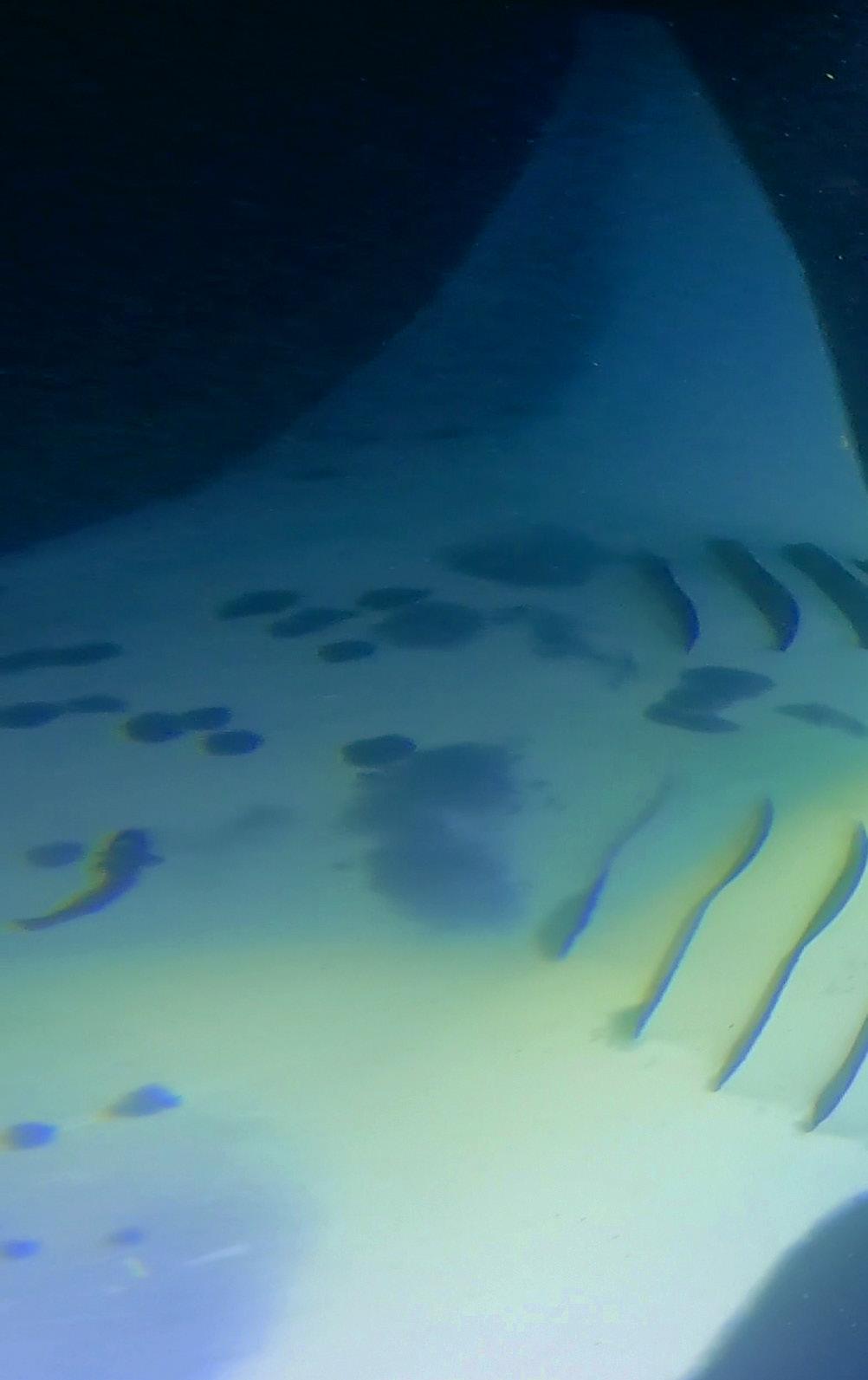
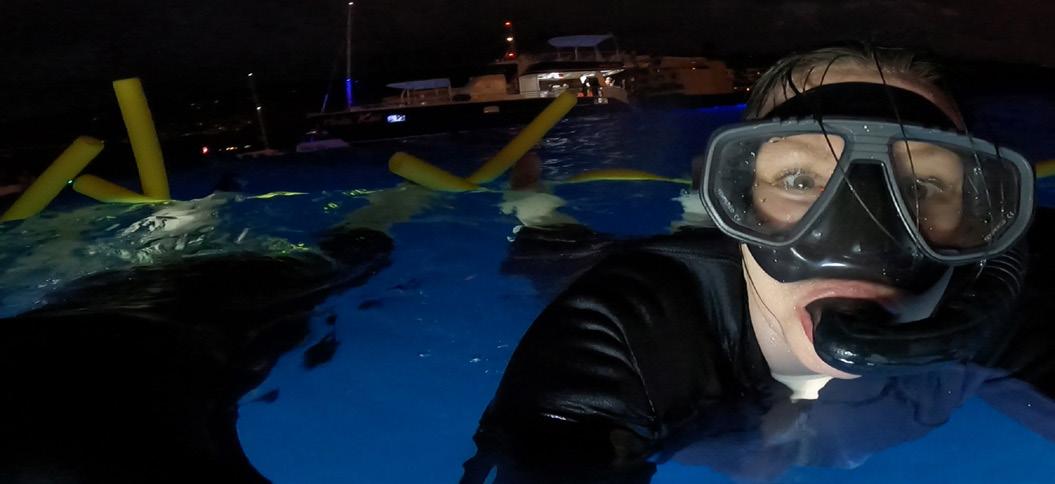
▼ The manta rays came within inches of us in the water.
▼ The pool noodles were positioned under our ankles so we floated flat agains the surface.
words and photos by BRENDA AUTRY
They move in slow, effortless arcs, their massive bodies twisting with a kind of quiet grace that doesn’t feel real. It’s no wonder the Travel Channel names this experience one of the “Top 10 Things to do in your lifetime.”
The only catch? You have to do it at night. As a general rule, snorkeling in the ocean after dark is discouraged—even crazy. But manta rays are filter feeders whose diet consists mostly of plankton, and the specialized lights attached to viewing plantforms attract the plankton, which in turn draws the manta rays.
There are dozens of tour providers offering the night snorkel experience. Some offer higher-quality service, while others are more bare-bones. No matter which you choose, you can expect to pay between $100–$200 for a tour that lasts around two hours. Most of that time is spent on safety briefings, getting into wetsuits, and boating out to the snorkeling site—commonly referred to as “Manta Ray Heaven”—about 100 yards off shore in Makako Bay. You’ll only be
in the water for about 30 minutes—but if you’re lucky, that’s more than enough time to see your fill of manta rays.
On occasion, some tours strike out and don’t see anything. For that reason, I recommend booking with a company that offers a guaranteed return (meaning you can go again if you don’t see mantas the first time). It’s also a good idea to schedule your tour early in your trip so you have time to try again if needed.
If you’re like me and not a fan of pitch-black water, many companies offer sunset tours. You’ll head out before the sun goes down, and there’s still a bit of light on the horizon when you get in the water. This is what I did, and the sunset views from the boat were spectacular—they really added to the overall experience.
Snorkeling with the manta rays in Hawaii was one of the most unforgettable experiences I’ve ever had. It gave me a new respect for these majestic animals and I hope I’m lucky enough to do it again one day.
Know Before You Go
⊲ These tours do require you to be a strong swimmer. You’ll need to swim through open water from the boat to the viewing platforms and back.
⊲ Manta rays can be seen year round, but January through March are winter in Hawaii and there are generally fewer manta rays during this time, and due to winter weather, the seas tend to be a bit rougher.
⊲ Even if the boat ride is short, if you’re prone to sea sickness, take some dramamine. I’d never been seasick before, but when the boat parked parallel to the rolling swells, and the smell of diesel for the surrounding boats hit the back of my throat, I got my first experience with it. Laying flat against the water can add to the sickness as well, so take some just in case.
⊲ Book ahead of time. These tours sell out, especially in high season.
⊲ Manta rays are a protected species, and touching them is illegal. Your tour guide will instruct you on how to behave while in the water, but it’s important to be respectful and do your part to protect these amazing creatures.
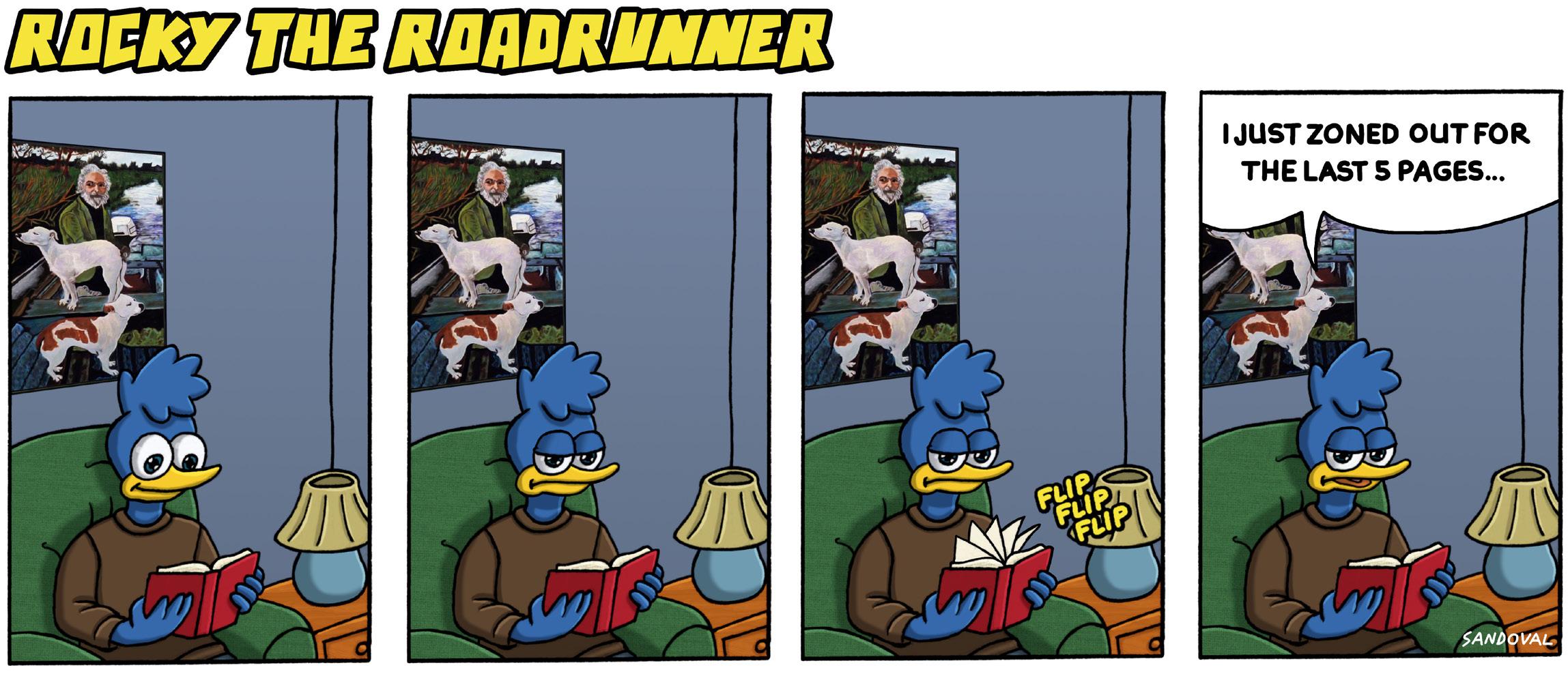


comic by JESUS
across
1. Air gun ammo
4. Incurred, as debts
9. Home of the Flyers (abbr.)
14. Pale or red quaff
15. Licorice flavor
16. Weather forecasting device
17. *Daily arrangement?
20. Talk effusively
21. Little chap
22. Farm outputs
23. Hilarious time
25. Feline warning
26. For the __ (readily available)
29. Mobility aid
30. "Yee-__!"
33. *Advice for those seeking a fresh perspective
35. VP before Cheney
36. Some exercise regimens
37. Sis's sib
38. Sharpened
39. Leather punchers
40. Milwaukee Brewers star for 20 years
42. Creator of Jekyll and 38Down, initially
43. Quilting events
44. Augments
45. "Iliad" figure
46. Rolex feature
47. Like an old circus tent
50. Luau staple
51. Admiral's helper
55. Police bullhorn message to a holed-up fugitive (as illustrated in three *clue answers)
58. 5-hour ENERGY alternative
puzzles crossword sudoku
59. Early times, in poetry
60. A little work
61. Patsy enshrined in Nashville
62. Yawning pit
63. The slightest down
1. Firecracker sound
2. French flag color
3. Does some quilting
4. Music genre
5. Kind of comparison
6. Attack, puppy-style
7. Not new
8. According to
9. Speak highly of
10. US president 1877-81
11. Matinee __
12. Speak highly of
13. Crafts' partner
18. Gets smaller
19. Not being honest
24. Signs, as a contract
25. Southeast Asian capital
26. Locked in conflict
27. Rectangular garment
28. Vetoes
29. They parallel gutters
30. Baseball Hall-of-Famer Wagner
31. "We __ alone!"
32. Sold on, as a concept
34. Some wind instruments
35. "Roseanne" actor John
38. See 42-Across
40. Some wind instruments
41. Mali and Malta
43. Gentle wind
45. City south of Cleveland
46. Pitiful
47. Coordinate, informally
48. Implement
49. Autobahn vehicle
50. "No __!" ("Glad to help!")
52. Mental "germ"
53. Laura or Bruce of cinema
54. Trend-setting
56. Thurman in the movies
57. Destroyer letters




"Bullhorn Message" by Mark McClain

