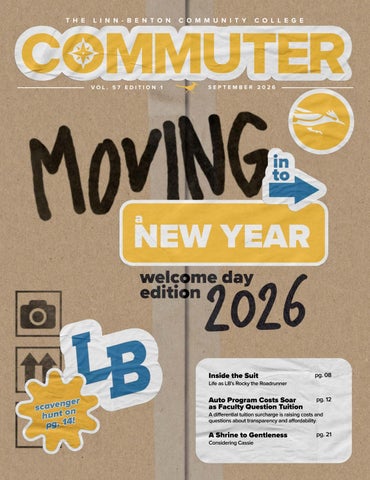
T H E
L I N N - B E N T O N
VOL. 57 EDITION 1
C O M M U N I T Y
C O L L E G E
SEPTEMBER 2026
Inside the Suit
pg. 08
Auto Program Costs Soar as Faculty Question Tuition
pg. 12
A Shrine to Gentleness
pg. 21
Life as LB’s Rocky the Roadrunner
A differential tuition surcharge is raising costs and questions about transparency and affordability
Considering Cassie
SEPTEMBER 2026
letter from the editor
A
nother school year, another new editor! I am thrilled to step into the role of The Commuter’s Editor-in-Chief for the upcoming year. I’m following a wonderful run by our previous Editor-In-Chief, Micah Teague, whose leadership brought fresh energy to The Commuter, including the popular Commuter stickers! While we said goodbye to several contributors who graduated and moved on to their next path, we are lucky to have a crew of returning contributors. Their hard work is what makes this Welcome Day edition possible. It also ensures that our publication keeps its authentic student vibe with more fascinating articles. Looking ahead, the goal this year is simple, to tell the stories that matter to our campus community. We want The Commuter to be a mirror of mostly student life. Such as celebrating campus achievements, asking tough questions, spotlighting local culture, and giving every corner of LinnBenton Community College a voice. Much like The Commuter, college is a team effort – never hesitate to ask for help, whether you’re returning for another term or setting foot on campus for the first time. You are not navigating this journey alone. Ask questions, explore new opportunities, and never hesitate to reach out for support when you need it. If you’re interested in writing, illustrating, photography, designing graphics, or pitching an idea, drop us a line! No journalism experience? No problem. Simply pick up an issue between classes, come say hello. Our door in Forum 222 is always open!
about us
The Commuter is the student-run magazine for LBCC, financed by student fees and advertising. Opinions expressed in The Commuter do not necessarily reflect those of the LBCC administration, faculty and students of LBCC. Editorials, columns, letters, and cartoons reflect the opinions of the authors. LBCC is an equal opportunity educator and employer.
letters welcome
The Commuter encourages readers to use its “Opinion” section to express their views on campus, community, regional and national issues. The Commuter attempts to print all submissions received, but reserves the right to edit for grammar, length, libel, privacy concerns and taste. Opinions expressed by letter submitters do not represent the views of The Commuter staff or the college.
Skylar Wilkerson Editor-in-Chief
join the team
Wanna get together? We’re really nice and fairly cool and we’d love to hear what you have to say. Not big on journalism but love to journal? Perfect. Are you a STEM major with major opinions? Let’s hear ’em. Like writing about ’80s film? Local animals? Snack hacks? Maybe you have a hefty folder of flash fiction on your laptop, just dying to be published and printed. Drop us a line. We’d love to meet you, read you, and support you. Think your ideas might be too weird or too niche for submission? Even better. The Commuter is an award-winning publication because of our wide range of contributions and our unique contributors. So reach out. We’ll be staring at our email inbox in the meantime, not an ounce of chill to be had.
in this issue:
staff
04
editor-in-chief
London Calling
Students study abroad
Skylar Wilkerson
design editor
08
Kailyn McQuisten
Inside the Suit
managing editor
12
marketing director
Life as LB’s Rocky the Roadrunner
Audrey Linder Julia Nevius
Auto Program Costs Soar as Faculty Question Tuition Model
Differential tuition raises costs for students and questions
Rob Priewe
contributors
16
Field Camp Mitchell
OSU hosts student science trip to Central Oregon
18
21
Exploring Zion Canyon by e-bike offers a little more freedom, and a lot more fun.
Considering Cassie
E-Biking Through Zion
24
advisor
A Shrine to Gentleness
Brenda Autry George Bennett Jesus Sandoval-Uribe Lilly Eberhart-Garah Michael McReynolds Savannah West
sticker contributors Jesus Sandoval-Uribe Nestor Gonzalez
The Commuter 25 years ago
Commuter follows up on 9/11 attacks, new buildings, and more
26
29
The Odyssey
The Fashionable '90s
A gift from the gods
A trip in the music time machine
WANT TO SEE YOUR NAME HERE? JOIN THE TEAM!
CAMPUS ⋅ FEATURE
DS
L MCREYNOL words by MICHAE photos via LBCC
4
CAMPUS
photo by BENJAMIN DAVIES VIA UNSPLASH
Return flight from Gatwick to Chicago
Rica, where they experienced living and studying in a lush rainforest through the Monteverde Institute. The Commuter spoke to LeAnne Trask, Pollywog director, about her London trip. She went as a student. Pollywog connects parents, grandparents, and caregivers to support, services, and resources they need to help their children.
▲
▲
B
uilding on the success of LBCC’s Study Abroad program, Laura Jones and Scott McAleer led another trip to London this summer, offering programs in history and psychology. This summer’s trip included stops at numerous museums and cultural landmarks, including the British Museum, the Imperial War Museum, the Royal Air Force Museum, the Victoria and Albert, the Benjamin Franklin House, and the Freud Museum. LBCC’s History Co-curricular already is making arrangements for Summer 2027 Study Abroad in London. It’s tentatively set for 10-12 nights in late June and early July. The cost per student will be between $2,000-$4,000 on a sliding scale. Other costs not included in that fee are class credits and fees, lunches, dinners, meals on travel days, and transportation to and from the airport and transportation costs in London. Important dates to keep in mind: The application deadline is Feb. 16. If selected, a $500 non-refundable deposit is due by March 9. Full payment is due on April 6. Pell Grant eligible students can apply for a scholarship. However due to deadlines and award dates students need to commit and pay for the trip before they would be notified of a potential scholarship. McAleer, history faculty, and Laura Jones, psychology faculty, led this year’s trip. Meanwhile, faculty Brian Keady and Liv Gifford led LBCC students on a trip to the Monteverde region of Costa
Trafalgar Square
How did you hear about this trip? I've been working on a history degree this last year, and I received an email from Scott McAleer, a history faculty member, announcing the trip and what you needed to do to apply for a spot on the trip. We had to fill out an application, interview with Scott, provide a downpayment on the cost of the trip, and sign up for a summer term independent study class. I understand that there were a large number of people who applied, and I was so happy when I found out that I had been selected to go. What helped make it possible for you and others to experience a trip like this? There are people in the community who make donations to the college that are earmarked for this trip, and rather than have to pay the full cost, we were able to make a much smaller payment to be able to go. I am very grateful to those donors! Who were the leaders of this trip? Scott McAleer, history faculty, and Laura Jones, psychology faculty. Each department brought along five students
COMMUTER
5
CAMPUS ⋅ FEATURE (I think that's correct), and we traveled to and from England together and stayed at the University of London dorms together, but some days the psychology people went to different museums and events than we did. Have you been overseas before and any first-time overseas goers? Both of the faculty advisors had been to London several times for the Study Abroad program, and they knew their way around London pretty well. I lived in England for a couple of years in my early 20s, so it was wonderful to go back and see some of the same places but with the eyes and experience of an adult. One of the things that Scott and Laura did that I think was so smart was to have one of the students lead the group to our destination each day so that we would gain an understanding of how the buses, trains, and tube system worked and be able to get around by ourselves, if need be. It gave some of the first-timers a real confidence boost to know that they could handle themselves in a very chaotic city. For the majority of the students, this was their first time leaving the States, and to their credit all of them seemed excited to try everything! There were so many opportunities to try different foods, and watch and listen to people from all different cultures, not to mention all of the information we gained at the museums and galleries – it was definitely a learning experience! What did you do there that you'll take with you the rest of your life? A couple of things stick out in my mind. One of the best parts of this trip
▲ LEANNE TRASK Stonehenge
6
CAMPUS
was that we were given three full days to have our own adventures, as well as all of our evenings to do as we wished. On our first free day, I went with a tour company to visit Stonehenge. We had studied Stonehenge in one of my history classes, and I learned that Stonehenge was not originally built in Wiltshire, but the giant stones were actually dragged from Wales to its current location in Wiltshire. As our tour bus was whizzing down the M3 freeway on a foggy June morning, I looked out the window and there was Stonehenge rising out of the fog – it was one of the most beautiful things I have ever seen – I kept wishing my husband was there to see it with me. I loved the time that I got to explore Stonehenge and I came home with a beanie from the gift shop that says "ROCKS." Another experience that I had was going to see "Hamilton" in the theater district in the Westend of London. I have been wanting to see it for years, but never had the opportunity, so I took the opportunity while I was there. For those who haven't seen “Hamilton” before, there is a scene where Mad King George comes out on the stage – crown, sceptre and cape – and sings a song called "You'll be Back." When King George stepped onto the stage, the British in the audience jumped to their feet and started singing "God Save the King" and cheering and stomping their feet for their ex-monarch. Then King George began to sing about the violence and death that he was about to rein down on the American colonists, and the crowd sat down and got very quiet. It was a gentle reminder to me that we do not all look at events the same way. So many of the things that we did left an impression
▲ RAF Museum
“There were so many opportunities to try different foods, and watch and listen to people from all different cultures, not to mention all of the information we gained at the museums and galleries – it was definitely a learning experience!” Scan for more information on the 2027 trip:
on me like that. How much study time was there compared to free time? Well, that kind of depended on how brave you were ... The Independent Study course that I signed up for included a two-page report on each of the museums, galleries, etc. that we visited (10 in total), as well as a 10page paper addressing the repatriation of artifacts from museums around the world back to their country of origin. Thank goodness we didn't have to give our opinion, but rather all the pros and cons of both sides of the argument. You had the choice of working on your homework while you were there each evening, or you had 10 days to complete the entire workload when you got home. I am a glutton for punishment so I came home and scrambled to get it all done. I did take lots of pictures and made notes on my phone of things I wanted to remember, so it wasn't a horrible task, but it was a lot to postpone until the last minute. Probably not my best idea. Last thoughts on your experience in Study Abroad? Thanks for giving me this opportunity to share! Scott and Laura were wonderful and patient, and the kids were great. The boys made sure that I could get my luggage into the overhead compartments, and pulled it off of the conveyor belts for me. The girls made sure that they didn't lose me in a crowd and that I didn't wander away when I saw something shiny. I will probably never again in my life have the opportunity to do nothing but visit museums for 10 days, and I am so grateful that I was included (and accepted!) by this group of people.
LBCC + AMERICAN RED CROSS BLOOD DRIVE
CLUB ROOM OPEN HOUSE & CLUB FAIR
Join our lifesaving mission and schedule an appointment today.
Follow SLC for events, opportunities, and ways to get involved on campus! @lbcc_slc
Wednesday, October 21, 2026.
WEDNESDAY & THURSDAY, OCTOBER 14-15, 2026, 10:00 A.M.-3:00 P.M.
10:00 a.m.-3:00 p.m.
Volunteer
Red Cedar Hall 207
LBCC Calapooia Center Fireside Room 6500 Pacific Blvd SW, Albany, OR 97321 Blood Program Leader: Jaymie Poujade
CONNECT INSPIRE ENGAGE
volunteer.linnbenton.edu
Interested in starting or joining a club?
linnbenton.edu/slc
Contact
Website
slcclubsengage@linnbenton.edu
email us at: getinvolved@linnbenton.edu
Be Here, Belong, Become...
SCAN TO SCHEDULE AN APPOINTMENT.
VOLUNTEER FAIR Wednesday, October 14, 2026 • 11:00 a.m.–2:00 p.m. • Albany Campus Courtyard
Meet local nonprofits, explore volunteer and internship opportunities, discover ways to get involved on campus and in the community, and learn how to earn tuition credits through the LB Volunteer Program.
SAVE THE DATE Student Monte Carlo & Dance Night October 30, 2026 - Join the fun More details to be announced soon
CHECK YOUR VOTER REGISTRATION STATUS Scan the QR code or visit lbcc.turbovote.org to check your registration, update your information, and make your voice count. COMMUTER
7
CAMPUS ⋅ FEATURE
LB Behind the Scenes:
Inside the Suit Life as LB’s Rocky the Roadrunner words by SAVANNAH WEST photos via LBCC
B
ehind the feathers and foam is a performer who builds personality without speaking a word. To most students at Linn-Benton Community College, Rocky the Roadrunner is simply a familiar part of campus life, appearing at games, events, and celebrations across the community. Behind the costume, however, mascot performance involves far more than waving, dancing, or hyping up a crowd. It is a full-body language of improvisation, timing, endurance, and reading a room without ever saying a single word. The student behind Rocky did not exactly plan to end up in a mascot suit. Their first real experience came from a search for something meaningful, a spark that emerged through a Special Olympics Oregon event. What makes Rocky work is not a script or routine but a kind of controlled chaos inspired by cartoon logic, where every prank, interaction, or joke is built in real time and often backfires in some way. Over time, the role became more than entertainment. It became a way of learning how to connect with people without speech, how to build confidence through repetition, and how a single moment in a costume can open doors to a much larger network of performers, teams, and unexpected opportunities. The performer spoke about their experience, their approach to performance, and the unexpected path that led them into mascot work. To preserve anonymity, identifying details have been generalized.
8
CAMPUS
“But the second people saw me and their faces lit up, it was like a switch flipped. All the anxiety and sickness I felt at that moment disappeared.”
How many years have you been performing as a mascot? I first started in February 2024, but I did not really begin doing it regularly right away. If you count consistent involvement, it has been about two years. Your first mascot experience was performing as Chilbert for Special Olympics Oregon. How did that opportunity first come about, and what was it like stepping into a mascot role for the first time? At the time, I was coming out of a really difficult period in my life and trying to figure out what direction I wanted to go in. I felt like I had not really found something I was passionate about yet. I did not play sports or anything like that. I just wanted to do something. I remember staying up late at night looking up things to do in Oregon, and one of the things that came up was a Special Olympics event in Portland. I looked through their volunteer opportunities and saw they had a mascot position listed. It said the position was full, but it also showed zero participants. I messaged the event organizer to ask if they needed a performer, and they said yes. About a month later, I finally got to do it. I remember putting on the suit and being so afraid of what people would think when I stepped out of the changing tent. I honestly felt like I was about to throw up. But the second people saw me and their faces lit up, it was like a switch flipped. All the anxiety and sickness I felt at that moment disappeared. It felt like waking up from a good night's rest. What stands out most when you think back to your very first time performing in costume? After the first event, I asked if they had any other mascot opportunities, because I already knew I wanted to do it again. They had one more event on Mount Hood, but after that there was nothing else planned for the season. That was the point where I realized I did not want to do this for just one month a year. I wanted to actually pursue it, either as a hobby or potentially as a future job. That was when I really started researching mascot performance and looking for more opportunities. Around May, I reached out to LBCC, because
they were the only organization that actually responded to me when I reached out about mascotting. How did you go from your first mascot experience to performing as Rocky at LBCC? I reached out to a lot of different places, including high schools and Oregon State University. Even when I was not specifically asking about performing and was just trying to learn or get involved, LBCC was the only place that got back to me. At first, I did not think I was meant to become the main performer for Rocky. They were just looking for someone to help with a graduation event, because they did not have anyone available. But after I did that event, I ended up doing a few things that stood out, such as interacting with people in ways they were not used to seeing from the mascot. After that, I was asked to come back and perform at the Corvallis Knights game as well. Rocky has become a recognizable part of campus life. How do you approach creating a personality for a mascot that never technically speaks? I look to a lot of old Looney Tunes cartoons and things like that. I try to go around and cause little bits of chaos, like taking something from someone or setting up a situation. It always has to backfire in some way. So I might tap someone on the left shoulder and run to the right, but then I end up tripping and falling. It is kind of a Wile E. Coyote situation, where I am constantly setting things up, but I end up getting caught in my own traps. Do you practice those motions, or is it all in your head when you’re in costume? Both, actually. I keep a massive archive of photos and videos of myself in mascot roles, whether it is Rocky or other characters. I use them as reference and as a portfolio, whether I need to show them to employers or just review my own performance. It has helped me figure out things like how to make eye contact in costume. In the Rocky suit, the head tilts upward, so you have to look toward people's stomachs to make it feel like eye contact. That is something I would not have understood if I did not have that kind of visual reference.
COMMUTER
9
CAMPUS ⋅ FEATURE
You mentioned how networking works in an industry where you’re not allowed to speak. What does that actually look like? A lot of it comes down to being in the right place at the right time. I was at events just because something small led me there, even something as simple as noticing a schedule and asking about it. One example came early in my mascot career when my grandmother actually pointed out the Corvallis Knights schedule. She showed it to me and said the Corvallis Knights were supposed to be playing at Linn-Benton Community College. I asked if Rocky was supposed to be there, and it turned into me getting connected to that event. It was the first time the Corvallis Knights had played at Linn-Benton in about 20 years, and it was a pretty significant game for them. At that event, I met the Corvallis Knights' mascot performer, who invited me to a mascot night about a month later. That event put me in front of a crowd of around 5,000 people and gave me the chance to meet the performers behind the Oregon Duck, Benny the Beaver, the Oregon Tech Owl, and several others from around the state. It was kind of a domino effect. One small thing led to another, which led to another, and before long I had made connections across the mascot community. A lot of it happens organically rather than through anything formal or structured. Many people think there’s only one mascot performer per team. How do mascot crews actually work behind the scenes? Typically, if there is one main performer, there are usually understudies, sometimes even multiple layers, depending on the organization. There is a primary performer and backups who can step in when needed. At some schools or colleges, there is a small team assigned to one mascot so events can be shared. That way, one person is not doing every appearance, which is especially helpful if you are balancing school at the same time. There is a support crew behind the scenes handling logistics, bringing the suit, escorting the performer, and taking
10
CAMPUS
pictures. Even if there is only one person in costume, there is a full team making it happen, often five to 20 people, depending on the program. What do you wish more people understood about the work, preparation, and physical demands involved? First, people do not always realize how expensive the suits are. Most professional mascot suits can cost tens of thousands of dollars because they are custom-made. Even lower-end or older suits are still a major investment compared to what people assume. On the physical and mental side, anyone can put the suit on, but it takes real consistency and dedication to get good at it. A lot of it comes down to showing up, being reliable, and actually caring about the performance. I have heard from professional performers and people who are hiring that they would rather call someone who shows up on time and is genuinely interested in the job, even if they have never done it before, than someone who is a seasoned veteran but is just in it for the money and does not really care about the work. It really comes down to how much you actually care about the performance and the character. Looking back at your journey from high school to working with multiple organizations, what has mascotting taught you about confidence, performance, and connecting with people? Probably confidence. Definitely confidence. Social interactions are not as scary as people think they are, but you do not really understand that until you are in a job where you have to talk to people all the time. Even with social anxiety, you still have to do it. One thing I use is basically forcing myself not to overthink. If I am about to do something I might find embarrassing or start second-guessing, I just do it immediately instead of sitting with it. I do not give myself time to talk myself out of it. That applies to the suit too. If I get the urge to do something exaggerated, like if the other team scores and I feel
ROCKY ROADRUNNER
SPECIES: Roadrunner
AGE: Timeless
HOMETOWN: Philomath, Oregon YEARS IN FEATHERS: 2 OCCUPATION: Professional campus chaos coordinator FAVORITE CARS: C5 and C6 Corvettes SECRET TALENT: Communicating without saying a word CAREER GOAL: Sports management — with a few more mascot adventures first
“If I am about to do something I might find embarrassing or start secondguessing, I just do it immediately instead of sitting with it.”
like dropping to the ground and rolling around in frustration, I just do it. I do not spend time thinking about whether it is funny or not; I just act right away. Is there a code or etiquette that mascots follow when interacting with each other on the field in costume? On the field, the main thing is to interact as much as possible. It is a lot like Road Runner and Wile E. Coyotestyle of improv. You are constantly building little scenes with each other in real time. Something as simple as challenging another mascot to rock-paper-scissors or trying to cheat and still losing, is actually
part of the fun. The idea is to stay in that back-and-forth and respond to whatever the other mascot is doing. What advice would you give someone interested in becoming a mascot performer? Honestly, I do not think people talk enough about how to actually get started. The easiest way is to find an organization with a mascot and just ask. Say something like, “I have been trying to find opportunities like this for a while. Is there any chance you could put my name down if you ever need someone to perform?” A lot of it is just getting your name out there. If people know who you are, have your contact information, and see that you are genuinely interested, they will reach out when they need someone. Organizations with mascots often just need reliable help. Once you get that first chance, use it to build connections and keep showing up. Are there any dream mascot opportunities or organizations you would love to work with someday? Probably the NBA or NFL if I were to work as a professional mascot. It is a very physically demanding job, so it is not something I could see myself doing forever, but I would definitely consider relocating for a team with a good mascot program. If that does not work out, I would love to teach the next generation of mascot performers at a university or similar program. Long term, I see myself moving into sports management, which is the current path I am interested in pursing. What does being a mascot pay? Every organization pays different. LBCC uses talent grants, similar to other student leadership positions on campus. Some local Oregon teams pay between $20-$30 an hour. Those are high paying compared to other jobs, as they typically pay minimum wage. Some jobs are contract based and pay around $300 or less for a one time event. Most colleges including OSU and UO pay minimum wage plus potential scholarships. It’s more of a paying hobby than a full time job. The exception are the pro mascots, such as the NBA, who are payed a salary from $40,000 to $90,000 depending upon experience and roles.
PUMPKIN spice latte fall term opening:
sept. 23rd
$5
roastrunners.kulacart.net
COMMUTER
11
CAMPUS ⋅ NEWS
LB Behind the Scenes:
Auto Program Costs Soar as Faculty Question Tuition Model Faculty say a 21% differential tuition surcharge is raising costs across career and technical education and lab-heavy programs, raising questions about transparency and affordability.
words and photo by SAVANNAH WEST
S
tudents enrolled in Linn-Benton Community College’s career and technical education and lab-based programs often pay significantly more per credit than peers in transfer-focused degree pathways, a cost structure some faculty say is becoming increasingly difficult for students to navigate as total program costs continue to rise. At the center of the debate is differential tuition, a 21% surcharge applied to many CTE and lab-heavy courses. The charge is meant to help account for the higher cost of running handson programs that require specialized facilities, equipment, and supplies. But faculty members in some high-cost programs say the model raises questions about affordability and transparency. Rising costs raise concerns about accessibility Mike LeBlanc, faculty department chair for automotive technology at LBCC’s Advanced Transportation Technology Center in Lebanon, said the impact is especially visible in high-credit, lab-intensive programs. “Our students pay $215 a credit,” LeBlanc said. “If you look at what it costs
12
CAMPUS
“We are getting to a tipping point right now … there’s going to be a threshold where we are just pricing students out of an education.”
to a trade student, we are by far the most expensive college in the state.” The automotive program consists of about 90 credits, with roughly 79 credits subject to differential tuition. The total cost of the associate degree is now estimated at just under $24,000. “We are getting to a tipping point right now … there’s going to be a threshold where we are just pricing students out of an education,” LeBlanc said. How differential tuition is applied Differential tuition is added as a percentage on top of base tuition for courses with heavy lab components across multiple programs. At LBCC, programs with this surcharge include automotive, diesel, welding, mechatronics, construction, animal science, and culinary arts, as well as science lab courses such as biology and chemistry. LeBlanc said the structure was intended to reflect higher operating costs in hands-on instruction. Automotive, for example, requires shop space, lifts, vehicles, diagnostic equipment, tools, parts, chemicals, and other materials that are not needed in a traditional lecture classroom. But LeBlanc said he is concerned that revenue from differential tuition does not go directly back to the programs generating it.
“Those funds … don’t funnel back directly to the programs; they just go to the general fund,” LeBlanc said, “We just want to know more so we can make better decisions.” Instead, programs still rely on regular materials and supplies budgets, as well as separate lab fees, to cover consumables such as tools, parts, and teaching supplies. “If we saw differential tuition coming back supporting our operation costs, then we could make a more educated decision about lowering those lab fees,” LeBlanc said. Student impact and financial pressure For automotive students, the cost can become clear early. The 2026-27 automotive program cost breakdown estimates a first-year fall term total of $5,236.91. That includes automotive coursework, math and measurement, a textbook subscription and the first $1,450 tool fee payment. Winter and spring first-year terms are also estimated at more than $4,800 each. LeBlanc said many students do not expect the first-year price to be that high. “A lot of them are coming in here with no idea that it costs $5,000 for their fall term, and they might get $3,000 in [financial aid] benefits,” LeBlanc said. “They are getting sticker shock at the end of the term when it is time to pay.” Many automotive students take 16 to 18 credits per term during their first year, more than the 12-credit load commonly used as a baseline for fulltime enrollment. LeBlanc said that creates a problem because financial aid, grants, and scholarships may not fully match the actual cost of a heavy-credit CTE schedule. The timing of aid and scholarships can also make the problem harder. Students may need to apply for scholarships in the spring for the following fall, but not every student knows the total program cost or the application timeline early enough to plan. Why the first year costs so much LeBlanc said the first year of the automotive program is expensive by design, but not because faculty want to overload students. The program is structured so students can complete a one-year certificate before continuing into the second year of the associate degree.
General education requirements such as math, writing, and human relations are placed in the first year so students who do not return for year two are not left with automotive credits but no completed credential. Students can technically move some general education courses into the second year, LeBlanc said, but doing so creates risk. If they leave after the first year, they may not have completed the certificate. “Our first year is going to suck financially,” LeBlanc said. “It’s a lot of classes, and it is a lot of money, but by the end of the year most of our students can see the finish line and a job on the other side.” Tools, lab fees and career preparation Automotive students also pay costs beyond tuition. The automotive program charges a tool fee of $1,450 per term during the first year, for a total of $4,350. According to the program cost breakdown, the fee includes two uniform shirts and a Snapon 525 digital multimeter with probe kit. LeBlanc said the tool fee functions like a layaway system. Students make payments throughout their first year, and the tools are distributed at the
end of their first year. Some students receive scholarships that help cover tool costs. LeBlanc said industry partners also support the program by donating tools, equipment and access to training modules. The structure allows financial aid, grants, and scholarships to help cover the tools because the cost is built into the program. LeBlanc said that matters because students need those tools to enter the workforce prepared. A possible change to the tuition model After discussing the issue with faculty in affected programs, LeBlanc brought his concerns about differential tuition to the LBCC Board of Education. His main message is that the college should consider differential tuition whenever it discusses base tuition increases. Because differential tuition is percentage-based, CTE costs increase when base tuition increases. “Make sure differential tuition is something you guys are considering before you approve a percentage increase on base tuition,” LeBlanc said. “It needs to be a bullet point in your budget discussion.” One possible change would be to break courses down by lecture and lab
“It’s a lot of classes, and it is a lot of money, but by the end of the year most of our students can see the finish line and a job on the other side.”
contact hours, then apply differential tuition only to the lab portion of a class. For example, if a 10-credit automotive class includes six credits of lab work and four credits of lecture, only the six lab credits would be charged additional tuition. Another option would be shifting from a percentage-based surcharge to a flat per-credit fee. LeBlanc said that would prevent the additional charge from automatically increasing every time base tuition rises. He said the goal is not necessarily to eliminate differential tuition, but to make the model clearer and fairer. A workforce issue LeBlanc said rising CTE costs are not only a student issue. They also affect the college and the regional workforce. Local dealerships, independent shops, and manufacturers rely on LBCC to train future technicians. Automotive students complete cooperative work experience during the second year, allowing them to work in shops while finishing their degree. Continued on pg. 17
Modest Means Legal Services Family Law Protective Orders Surrogacy Landlord-Tenant
971-865-3001 | dessertsaullaw.com Serving Marion, Polk, Linn, & Benton Counties COMMUTER
13
WELCOME DAY202 6 WEDNESDAY, SEPTEMBER 23, 2026
IS
RS
E
A
CT
P
CAMPUS
ND
BL
E
OU
F
14
TE
A TIO N T A
T
IM
Student ID#: _______________________
E-mail: ___________________________
IE S C E N
AC
Name: ____________________________
Phone: ___________________________
IV IT
T&
ENGAG
EN
AD
R
& LE
V
LIF E
EM
IN G
BL
H IP
AD
NT
DE
Get ‘stamped’ at locations around campus and redeem 20 stamps for a chance to WIN tuition credits! Note the 5 required stamp locations. Turn in your completed Scavenger Hunt forms at the First Resort counter in Takena Hall.
STU
SCAVENGER HUNT!
E
10 AM - 1 PM
Open Houses! Club & Info Tables! Canvas & SingleSign On Help! Fellow Roadrunners!
CENTER
TA
COMMUTER
15
CAMPUS ⋅ NEWS
FIELD
CAMP MITCHELL: OSU Hosts Student Science Trip to Central Oregon words and photos by SKYLAR WILKERSON
O
regon State University’s College of Earth, Ocean, and Atmospheric Sciences hosted the first trip for geology students at local community colleges to experience three days at the field camp outside of Mitchell, in Central Oregon. The June 19-21 trip gave students finishing or starting their bachelor’s degree at Oregon State a chance to observe students in their final year out in the field at the camp, while also experiencing the geological attributes of the region. Students for this trip were notified by instructors in geological courses at local community colleges at Linn-Benton, Chemekita, and Lane. In total, eight students attended the trip. In the past, OSU has hosted trips similar, but this was the first for community college students. “Since this was the first trip, it served as a trial run. In the future, we hope to announce it more widely,” said Deron Carter, an instructor in the geology department and interim dean at LBCC. The students left OSU’s Wilkinson Hall at noon Friday after a short tour of the CEOAS building, then headed out on their four-hour drive to Central Oregon. Along the way, students got to observe the geological anomalies in the Cascades alongside the roads and see the mountain ranges from a new perspective. “It is such a great opportunity for students to get out of the classroom, get their hands dirty, and see what a field science, like geology, is like first hand,” Carter added in his email. Once students arrived they were greeted by not only the dry heat of the desert, but also by the senior geology students charting the Earth's layers in nearby Meyers Canyon.
16
CAMPUS
Continued from pg. 13
The community college students engaged in conversation with the seniors, including the focus on their degrees. Most ranged from geology to oceanography and everything in between at CEOAS. “Not only do they get to apply what they have learned in the classroom, but they also get to engage with each other and build a sense of community,” Carter said. “What better way to get to know your peers than sharing a van ride across Central Oregon, and camping out under the stars for a few nights.” “Also, this experience allows them to see other OSU students in action, and can help envision their future and build their networks of students and OSU faculty, which can help ease the transfer process,” Carter wrote. In a separate email, Andrea Balbas said the drive to connect with prospective transfers stems directly from her own roots and is part of the reason this trip is possible. “I was a nontraditional community college student,” Balbas wrote. Balbas added that the goal of the trip is to demystify the university experience. “My primary goal is to help students self-actualize. We want to make sure students know they can make their dreams come true with us at OSU.” Even for those on the fence about geology or Earth sciences, Balbas made one thing clear: you don’t need your entire academic life planned out to step on the van. When asked if students still questioning their major or career path are
welcome on future field trips, her answer was straightforward: “Absolutely.” While the trip centered on geology, Balbas emphasized that CEOAS programs span the broader Earth sciences, including oceanography, climate science, and geospatial analysis. “Any student with an interest in transferring to CEOAS at OSU can attend,” Balbas said in her email. “They should reach out to me with any questions.” As the vans packed up and left the dusty sagebrush and the heat behind, one question lingered, “What was an oceanographer doing out in the desert?” The answer lies beneath the sand and gravel. Millions of years before Mitchell was high desert, it sat beneath a prehistoric ocean, making the ancient marine sediments and fossil beds of Central Oregon just as relevant to studying the sea as the Pacific coastline. Prospective Student Inquiries: Student Advisor Jen Edwards directly at; jen.edwards@oregonstate.edu LBCC+CEOAS Geology Field Trip: To sign up or get details about the next joint field trip, email Andrea Balbas at; andrea.balbas@oregonstate.edu Explore CEOAS Programs: Learn more about degree programs by scanning the QR code.
The second-year schedule is designed so students can work in the mornings and attend classes later in the day. That allows students to earn money while gaining career-related experience. “The industry needs technicians, and a lot of their technicians come from our programs,” LeBlanc said. “If we price students out and hurt enrollment, the college doesn’t stay open and the shops don’t get the workers they need.” The risk of pricing students out Automotive is different from some degree pathways because students do not legally need a degree to become mechanics in the United States. “We are not competing with other programs,” LeBlanc said. “We are competing with the question, ‘Why should I pay this much to come here at all?’” LeBlanc said many trade students come from low-income backgrounds and enroll in college as a pathway to better wages and longterm stability. If costs continue to rise, he said, “we are getting to that point where that is just not going to be an option anymore.” “If our degree costs $30,000, we are not going to have any students anymore,” LeBlanc said. “No one will come here to learn how to be a mechanic for $30,000.” What happens next For LeBlanc, the issue is not whether hands-on programs cost more to operate. He said they do. The issue is whether students, faculty, and decision-makers have a clear enough understanding of how those costs are calculated, how the money is used, and how tuition increases affect students already paying more. “We have a 90-credit automotive degree, and 79 credits have differential tuition,” LeBlanc said. “Our trade students are paying substantially more for their education in total than transfer degree students.” As LBCC continues budget and tuition discussions, LeBlanc said differential tuition should be part of the public conversation, not a hidden cost students discover after enrolling.
COMMUTER
17
TRAVEL
E-Biking Through Zion words and photos by BRENDA AUTRY
Exploring Zion Canyon by e-bike offers a little more freedom, and a lot more fun.
Z
ion National Park is home to some of the most epic hiking on the planet. As one of the most visited national parks in the country, it draws travelers from around the world to experience its famous landscapes on their own two feet. Whether you plan to climb to the top of Angels Landing, wade through the Virgin River into the Narrows or meander along the Pa’rus Trail beneath
18
TRAVEL
Zion’s towering sandstone cliffs, exploring the park on foot is an absolute dream. But what if I told you one of my favorite experiences in Zion wasn’t the hikes themselves, but the journey to the trailheads? Many of Zion Canyon’s most popular trailheads are reached via Zion Canyon Scenic Drive, a roughly 9-mile road that winds from the visitor center into the heart of the canyon. During the busy season, generally March through
November, the road closes to private vehicles and visitors rely primarily on Zion’s free shuttle system. It’s an efficient way to move thousands of people through the narrow canyon, but during peak periods, lines can get long—I’m talking an hour or more just to board. I visited Zion in June, right in the middle of peak season and when daytime temperatures start to soar. I knew I wanted to hit the trails early each morning, but I didn’t want to line
up for a shuttle at 6 a.m. just to reach a trailhead by 7:30 a.m. So, after a little research, I found another way into the canyon: I rented an e-bike. E-bikes have been gaining popularity in Zion over the past few years, and after trying it for myself, I can see why. Not only can you skip the hassle of waiting for a shuttle, but riding through the canyon becomes an attraction all its own.
It takes about 45 minutes to ride from the visitor center to the final shuttle stop if you don’t make any stops—roughly the same amount of time it takes to ride the shuttle. But instead of spending those 45 minutes crammed inside a shuttle, you’re out in the canyon, surrounded by epic views with the freedom to stop along the way. And if you’re a photographer like me, that freedom is priceless. Zion Canyon Scenic Drive is practically made for exploring on two wheels. With private vehicles prohibited for much of the year, there’s very little traffic to contend with beyond the park shuttles. The nine shuttle stops along the route also provide access to different trails and points of interest, with bike racks available so you can lock up your bike and continue exploring on foot. The Pa’rus Trail, which begins at the visitor center and ends at shuttle stop 3, is the only trail in Zion that allows bikes. The 1.7-mile-long trail (3.4 miles round trip) is the perfect introduction to Zion. It winds along the Virgin River, revealing postcard-ready views around every corner. It also bypasses the only section of road that cars are allowed on, making it a safer alternative for biking. Because many rental companies allow you to pick up your e-bike the night before or early in the morning, you can hit the trail before the first shuttle
COMMUTER
19
TRAVEL leaves, making it feel like you have the park almost entirely to yourself—even during the crowded summer months. And you can explore more trails before it’s too hot out. Because you’re not tied to the shuttle schedule, you can stay in the canyon after the final shuttle has departed or even head into the park after dark for some stellar stargazing. I spent a full day exploring Zion on an e-bike, and it ended up being just as much fun as all the hikes I did. Being able to stop at pullouts and admire views that most summer visitors never get to see was exhilarating. Cruising through the canyon with no one else in sight, towering cliffs on all sides and the feel of the wind in my face, was an experience that made me feel grateful to be alive and able to experience such an incredible place. While e-biking through Zion may sound like an adventure reserved for experienced cyclists, it’s actually really easy and accessible. If you can ride a bike, you can ride an e-bike. I had only ridden one once before this trip, and I had no problems at all. The e-bikes allowed in Zion are pedal-assist e-bikes, so you ride them
just like a regular bike, but you can turn up the motor to make pedaling easier. Oh, and did I mention these bikes can really get going? I got up to 20 mph at one point. Renting one is easy, too. There are several outfitters in Springdale that offer e-bike rentals, and rentals include a helmet and bike lock, so you won’t need much extra gear. Some bikes even have attachments for walking poles, which is especially handy if you’re planning to hike the Narrows. When you pick up your bike, you’ll be given a safety briefing that goes over all the rules and protocols you need to follow while riding through Zion. Prices for a one-day rental generally range from about $80 to $100, depending on the company and the season. If you're visiting in the busier months and you want to avoid some of the crowds or simply try a different way to experience Zion, consider renting an e-bike during your visit. It gives you the freedom to explore the park at your own pace, and you might discover that sometimes the journey to the trailhead can be just as memorable as the hike itself.
Behind-The-Wheel Train on 230 acres behind a closed gate before driving on public roads. We don’t rely on simulators. Students get real world experience and start driving and backing on the first day!
Unrestricted CDL Our trucks are equipped with manual transmission and air brakes, ensuring graduates earn unrestricted Class A or Class B CDLs and are ready for the road—no matter the truck.
Experienced Instructors Our instructors bring over 130 years of combined driving and teaching experience, delivering hands-on, industry-informed training that sets our students up for success from day one.
20
SECTION TITLE
Commercial Driver License CDL Program Ready to Roll? 541 - 917 - 4961
Gentleness A Shrine to
words and photos by LILLY EBERHART-GARAH
T
here's a bronze dog on the corner of Second and Madison in Corvallis. Her name is Cassie. The plaque says "Cassie - 2003 - Sue McNiel Jacobsen." I don’t know who the real Cassie was, or why someone decided she should be remembered in bronze. There’s no obituary, no photograph, no plaque explaining her life, and no story attached to the statue that I’ve been able to find. Whatever the reason, somebody wanted a dog statue named Cassie sitting on a downtown corner, and that is where she has been ever since. Her body is dark bronze, with the weathered patina that
happens over time, but her head has worn down to shiny gold from twenty-three years of townsfolk petting her on their way past. Students pet her between classes, parents pet her while herding kids toward the crosswalk. People on their way to work pet her, and so do people on their way home from the bar, perhaps with slightly worse aim and a little more enthusiasm. It's not planned. You're just walking, then you see the sweet doggie who appears to wear a small smile, and suddenly your hand's on her head and you're already saying the thing everybody says as they pass. "Good girl, Cassie." She was sculpted by Sue McNiel Jacobsen, a bronze
artist from Idaho, and installed downtown in 2003 as part of a public art push meant to make Second Street feel like a nice place to walk and enjoy the scenery, instead of just a route between the bank and the riverfront. Most public statues get placed high and facing the street, angled for whoever's driving past. Cassie faces the sidewalk instead, towards the people walking by. The water bowl at her feet came four years after she was installed, added specifically so real dogs could drink out of it. The bowl fills every time it rains. During the warm part of the year, passersby pick flowers off the corner bed and tuck them behind Cassie's ears, or balance one right on top of her head
like a crown. It happens as naturally as petting her head, a tiny tradition nobody organized. I found no account of the real Cassie or what she did to earn a bronze likeness of herself on a downtown corner. Perhaps that doesn't matter, though. The people who stop to pat her head aren’t thinking much about the biography of the dog she was based on, they're thinking about the bronze dog in front of them, sitting there being a very good girl. Real dogs treat her like she's one of their own. They walk straight up to her, no hesitation, tails wagging like they've met her a hundred times, which, depending on the dog, they may have. My own tiny dog, Virgil, won't let me pass by without giving him a chance to say hello, which has been true since he was eight weeks old. If I try to refuse him because I'm in a hurry, he lets out plaintive wails until I stop and let him kiss the statue he clearly sees as his friend. People are a little more selfconscious about it, but not by much. I've watched grown men in work boots detour off their route just to get a hand on her head. I've watched teenagers do it while pretending they weren't going to. "Good girl, Cassie." Nobody's teaching a lesson by patting a bronze dog, no point is being made. It's just a lot of people, on a lot of different days, who've all separately decided a statue shaped like a good dog deserves to be treated like one. It's a little ritual that shows off the gentleness of Corvallis. Cassie happily receives all of it. The rain, the hands, the same four words on repeat for over twenty years now, facing the sidewalk instead of the street, facing the people instead of the traffic. I'm sure somebody will pick another flower for her by the end of the week. Maybe this time it will be me.
“It's just a lot of people, on a lot of different days, who've all separately decided a statue shaped like a good dog deserves to be treated like one.” COMMUTER
21
LOCAL ⋅ REVIEW
words and photos by LILLY EBERHART-GARAH
PLAZA COMES TO THE
22
SECTION TITLE
F
or a couple of months, signs hung around the Corvallis Plaza saying things such as "Corvallis Kneaded This," hinting that a new restaurant was coming into the space left open by Nouveau Poke. The Plaza threw a reveal party for it on Aug. 6, and I went. A literal red carpet was rolled out of the entryway. Lee Eckroth, one of the Plaza's owners, met me when I got there. He told me the new restaurant was a second location for an existing business, that the business was local, and that he is excited about it. I would have to wait an hour and 10 minutes for the official name to be revealed. While we waited, he talked about how the Plaza operates. He described it less as a landlord and more as a partnership with whoever ends up in its spaces. "Have fun and make friends," he told me, "and if we do that, everything else works." I asked whether the new restaurant would compete with anything already downtown. Every restaurant in a small market is competing for the same discretionary dollars, he said, but the hope is that this one will bring something different enough to grow the market instead of splitting it further. Nouveau Poke, the outgoing tenant, had posted its own reasons for moving on, and Eckroth said the Plaza still had a good relationship with them. Nobody expects a storefront to last forever, he said. While I waited, a woman worked a lyra, the aerial hoop used in circuses, in the middle of the main floor, moving through it with the kind of ease that comes from years of practice. She's half of Soil Circus, whose studio operates down in the Plaza's basement and combines circus arts with agricultural science. Charlie Barth is the agricultural half, consulting on gardens and farms and helping people look at the systems
they already have and rebuild them in a way that works in harmony. His business partner teaches lyra and had been doing circus for about 10 years without a permanent place to practice. Moving into the Plaza, Barth told me, was "putting our roots down." A little further down the same open floor, in among the row of food counters, Bingo Guy (as Eckroth cheerfully calls him) played songs for music bingo. His name is Paul "Pash" Pashibin, and he owns PashCo Studio, a vinyl shop and rock-and-roll art gallery in the Plaza's basement, full of vintage psychedelic posters and music memorabilia. There was free popcorn. I played a round of bingo and didn't win anything. A woman a few tables over got a bingo and won a vintage rock poster donated straight from PashCo, and the whole room cheered for her. A few counters down, the storefront that was about to be revealed sat dark and taped off behind a huge sheet of plastic, though I occasionally observed a cart being wheeled past it. Eckroth found me again after bingo, and we sat in the Plaza community room, a freely reservable room for public use. An old jukebox sat in the corner. Lee told me the jukebox was from the 1950s, and it was his as a kid in North Dakota, where he used to roller skate to it in the basement. His dad bought it. It eventually went to his uncle Ray, and when the Plaza building went up, Eckroth got it back. It buzzes a little now and is waiting on a full restoration, which is complicated by the fact that there are apparently only two people on the entire West Coast who know how to do it. He wants to give it another hundred years. Then someone pulled the huge sheet of plastic off a giant light-up sign on the wall. BIRDIE'S, it said. There were tons of people there by that point, all ages, more than I've ever seen in the Plaza at once. A handful of people appeared carrying 25 New York and
Detroit-style pizzas they’d made at their Philomath location. The pepperoni was devoured almost instantly. I selected a Margherita Detroit slice, and a vegetarian New York slice that looked like it had a cheesy white sauce base. The crust was the first thing I noticed in each, both ridiculously light and flaky, like a crispy cloud. The New York slice was the kind you fold in half, with exactly the floppiness you’d expect. It's genuinely different from anything else downtown. The Detroit slice was thick but wonderfully airy, almost focaccia-like, topped with a brightly fresh-tasting tomato sauce. I learned the white pizza was called the Bianca, dolloped with attractive pearls of ricotta and carrying a strong scent of garlic. Once the crowd around the sample trays thinned out, Lee introduced me to Scott Willcockson, one of Birdie's three owners. He told me the connection to the Plaza came through a mail carrier, a friend of his who also delivers to the building and talks with Eckroth often. She mentioned Birdie's to him, Eckroth tried it and loved it, and messaged Willcockson on Instagram. Things "flowed very quickly" after that, Willcockson said. Corvallis is a bigger market than Philomath, but he said the Plaza itself was part of the draw too, a community space he is glad to be part of. The New York style pizza is Willcockson's own invention, shaped by years making wood-fired pizza rather than a strict copy of tradition. The Detroit style comes from another of the three owners, who grew up there. Baked in a pan, it looks a bit like a Chicago deep dish, but Willcockson drew a clear line between the two: the dough is lighter, and it isn't weighed down by heavy toppings. The New York dough ferments in the fridge for three to four days, the Detroit for two to three, and Willcockson credits that slow fermentation for breaking the gluten
BIRDIE'S PIZZA PHILOMATH HOURS: Monday-Sunday 11am-8pm LOCATION: 128 N 13th St Philomath, Oregon 97370-2006 PHONE: (541) 829-5207 BIRDIE'S PIZZA CORVALLIS HOURS: Monday-Sunday 11am-9pm LOCATION: 425 SW Madison Ave Corvallis, Oregon 97333-4799 PHONE: (541) 243-5769
down into something airier. From there it goes into a deck oven onto a hot stone, which he said makes a crispier crust. Pricing at the Corvallis location is expected to land between $4.50 and $6 a slice, with two slices making a complete meal, so lunch runs about $9 to $12. Whole pizzas are $26 to $34, sized at 18 inches and meant to feed about three people, working out to $9 to $12 a person. There's no student discount yet, though Willcockson didn't rule one out. When Birdie's agreed to move in, the Plaza also brought in six new, oversized tables, because pizza is the kind of food you're supposed to share. I went back on Sept. 3, a day after Birdie's officially opened, and ordered a plain cheese slice, on the theory that if you want to know what a pizza place is really doing, you start with the fundamentals. The quality, I'm happy to report, was consistent with what I experienced in the samples at the reveal party. The crust was thin, perfectly foldable, chewy, airy, and crispy all at once. The sauce wasn't the common type of thick dark tomato paste, it was more like they'd taken a perfectly ripe summer tomato and rubbed it all over the pizza in a light, bright layer. The cheese layer was a base of mozzarella with a gentle scattering of pecorino, the crispy tendrils adding as much decoration as flavor. The Plaza is built around people sitting together, eating together, doing something in the same room. Birdie's just gives them one more reason to do it.
COMMUTER
23
LBCC'S NOW DEFUNCT LEBANON CENTER WAS BUILT
u
YEARS AGO...
l
f
a
25
s
LBCC'S "NEW" COURTYARD CLOCK
OF THE THE START LENCE XCEL PASTEGA E ICH IS H W , D R A W A RDED TO STILL AWA ! THIS DAY
i w
c
xn
g
o
THE AFTEREFFECTS OF THE SEPTEMBER 11 ATTACKS
d
THE WEEKLY WEATHER REPORT...
NW Trucking Academy, Inc. 3615 SW Pacific Blvd Albany, OR 97321 Dedicated to offering the best training available.
Great starting wages!
Have your training paid for by the company you work for!
Be part of a Career you can be proud of!
Be a responsible professional driver, practice safe habits!
Manual 9 & 13 sp Transmission 48 & 53 ft Trailers ONLY
Come join us on the road to prosperity, job security and an opportunity to see the countryside as you have never been able to see it and get paid for it! Look at the sites through the windshield and wake up every morning with a new experience ahead of you. If you have the calling to travel this could be your ticket to fulfilling your dream. Don’t wait any longer; get started living your dream now!
20 Days of Training to a Better Future! Classes Starting 1st Monday of Every Month!
ELDT Refresher Classes Available Class A&B Available
CLASS B & C
(541) 248-3461
PASSENGER
www.nwtruckingacademy.com
ENDORSEMENT
david.nwta@gmail.com
COMMUTER
25
A&E ⋅ FILM
THE
ODYSSEY A Gift from the Gods
words by AUDREY LINDER
DIRECTOR
Christopher Nolan
STARRING
Matt Damon
Anne Hathaway
Tom Holland
26
A&E
T
he clearest view of a man is from below. Homer’s The Iliad and The Odyssey are two of the oldest surviving works of literature still read today. The poems, spanning 24 books and written in dactylic hexameter, once were considered near impossible to adapt for the big screen. Few have attempted and achieved a motion picture — Troy (2004), Helen of Troy (1956), The Return (2024), and O' Brother, Where Art Thou? (2000) — but none have, subjectively so, succeeded. Until now. Christopher Nolan, 56, is an iconic director known for epics such as Oppenheimer (2023), The Dark Knight (2008), Interstellar (2014) and more. When it comes to depicting intense action, tangible characters, and thoughtful cinematography, Nolan is the director of choice. And when The Odyssey was announced in the winter of 2024, we all anticipated nothing short of perfection — and it is an absolute pinnacle, earning a 94% on Rotten Tomatoes and an 8.5/10 on IMDb. After nearly directing Troy, Nolan became intrigued with Homer’s poem, calling it his personal project — his “destiny” — aiming to push the boundaries of both technology and narrative.
He began writing the script in March of 2024 whilst studying several translations of The Odyssey. Eventually, he landed on the most realistic interpretation of the poem, drawing inspiration from other historical films such as Andrei Rublev (1966) and Ran (1985). The Odyssey is unique when it comes to storytelling, building a non-linear narrative that contrasts with continuous flashbacks, waning between Odysseus’s journey home and Ithaca’s concurrent struggles.
The film opens with the preceding effects of the 10-year-long Trojan War — following Odysseus’s (Matt Damon) ploy to construct the Trojan horse and hide the Greeks inside, using Sinon (Elliot Page) as a decoy. Production designer Ruth De Jong returned to work with Nolan after her collaboration on Oppenheimer, designing the sets and building the 36-foot-tall and 8,800 pound wooden horse, which had to be transported in 27 crates to the Moroccan shore.
RUNTIME
2 hours 52 minutes RELEASED
July 17, 2026 GROSSING (WORLDWIDE)
$1.68 billion METACRITIC
88/100 OUR RATING
★★★★★
It was built to be completely functional and moveable, and so background actors legitimately pulled the horse from shore into town. Nolan and the actors really crawled inside of the wooden model to capture the uncomfortableness of the soldiers, whilst taking their time to decipher the filming process, which took several hours. “When you’re uncomfortable — and you are most of the time, physically, just by the nature of what’s required to get these shots — and you turn and look over your shoulder, (Nolan) is no more than five feet away and doing the same thing without complaint,” Damon said in an interview with Time Magazine. “There’s something really nice about being a soldier in the foxhole and looking over and the general is right next to you.”
Narratively, 20 years later, the city of Ithaca has remained without a king because Odysseus never returned home from war. Multiple suitors — including the machiavellian Antinous (Robert Pattinson) — have attempted to pursue the Queen of Ithaca, Penelope (Anne Hathaway), to claim the throne for themselves. Meanwhile, Odysseus’s son, Telemachus (Tom Holland), struggles with kinship restrictions and travels to meet with the King of Sparta (Jon Bernthal) to learn his father’s whereabouts. Another incredible feat — perhaps the most impressive of them all — is the usage of IMAX cameras. Nolan previously utilized IMAX in films such as The Dark Knight, Interstellar, and Dunkirk, but The Odyssey made history for being Hollywood’s first feature film
“The Odyssey” has made history on numerous accounts, including accumulation at the box office, intense practical effect design, and being filmed entirely with IMAX cameras.
shot entirely on 70mm IMAX cameras. However, there were setbacks to this accomplishment. IMAX cameras are incredibly loud and thus hearing dialogue is difficult. After some deliberation, Nolan and his crew developed a boxed casing to put around the camera — called the “Blimp” — that could muffle noise and allow for those intimate, dialogue-heavy scenes to take place. In addition, the camera was so large that the actors could not physically see around it, especially during closeup shots. So, yet again, Nolan and his team got to work in establishing a mirror system that allows actors to keep eye contact and stay in character without directly interacting with one another. “The wonderful thing about cinema — about IMAX in particular — is that you can take an audience to a place of immersion, feeling close to events like the storms, turbulent seas, and high winds,” Nolan said in an interview with Time. “You want the audience to be on a boat with them, fearing the ocean, fearing the wrath of Poseidon, the way the characters do. That, to me, is so much more powerful than any individual image you can have (of a god).” As Odysseus and his men strive to make their way back home from the war, they stumble upon an island where the giant cyclops Polyphemus (Bill Irwin) resides. He traps the soldiers inside of his cave, herding his sheep and devouring several men in the meantime.
COMMUTER
27
A&E ⋅ FILM
In an attempt to completely minimize CGI, Irwin, adorned in complete prosthetics and makeup, was filmed separately to create the illusion of being on a larger scale than the actors. Irwin also provided real-time vocalization while the soldiers interacted with a 60-foot puppet of the cyclops. The scene was filmed inside the historical 96-foot-tall Nestor’s Cave in Pylos, Greece, which is named after King Nestor and was featured in Homer’s original poem, The Odyssey, as well as several other Greek myths. “It got very, very dank and smelly after some time,” Nolan said in an interview with Empire. “But I’ve built a lot of caves before. Shooting in a real cave — the feeling is utterly different. Once the rock is moved across the door, and you’re in the dark, it’s very oppressive. It gave a sense of reality.” More challenges accumulated from filming here, such as intense hiking, 40 real sheep providing a pungent aroma, and the barrier of bees at the entryway. Damon touched upon this with People Magazine: “At the cave mouth, there was a buzzing. And you can hear it in the movie, because there were thousands of bees.” The film’s credibility only escalates further after discovering how much effort and dedication was poured into every shot. The voyage across the Mediterranean Sea, for example, was filmed with
28
A&E
real ships on open ocean, with the cumbersome IMAX camera following suit. De Jong acquired a 115-foot-long Viking vessel from Norway — which the production team transformed into a Greek ship — that traveled from Scotland to Morocco during filming. “I remember walking down this beach for half an hour, and I’m just seeing Greek soldier after Greek soldier, Greek boats and the Trojan war … for what felt like miles,” Holland said whilst talking with GQ. “And I’m saying to the PA: ‘Where is the crew? I haven’t seen any evidence of a film set. This is more reminiscent of a reenactment than it is a film set.’” While many agree that this is Nolan’s most impressive and monumental work to date, many have also challenged the film for being “too liberal,” griping that casting Elliot Page, a transgender actor, and the Grammy-nominated rapper Travis Scott, felt “historically inaccurate” and “absurd.” Though these claims have gone beyond political — others mentioning that Agamemnon’s dark armor is erroneous and Odysseus’s ship seems a bit too Viking-esque, respectively — it is important to note that Homer’s original poem was not necessarily historically accurate in itself. While the poem encompasses true cultural contexts and events, it
There is a scene in the film that showcases the witch Circe (Samantha Morton) turning the Greek army into a gaggle of swine. Morton’s performance was so powerful that she earned a round of applause from the crew, something that Nolan has not witnessed since Heath Ledger’s performance as the Joker in “The Dark Knight.”
also intermixes mythological elements that blatantly proves there is no room for complaint — or to hinder the film adaptation any differently. The Odyssey had a budget of $250 million, marking not only one of Nolan’s most expensive films, but it is the highest-grossing R-rated movie in cinematic history, earning an enormous $1.6 billion since July. The movie industry has been losing its traditional artistry as we venture further into the new generation of technology, and practical effects such as puppetry, models, and handcrafted sets have been neglected. It is refreshing to witness the revival of said methods on such a large scale, and one can only hope this sparks a trend of revitalizing the lost arts. The Odyssey has become an inspiration.
the
fashionable words by GEORGE BENNETT
O
'90s
ver the summer there were two concerts with perfect triple billings, both of which fit the Eugene setting like a fuzzy fabric bucket atop great Gandolf, trying to hook a trout. This piece will cover, loosely like the era’s denim, an extremely 1990s triumvirate of bands (Spin Doctors, Gin Blossoms and Blues Traveller), who were mostly only popular for an album and jammy in a Dead-lite sort of way. Now, for all those trying to revive JNCO Gumby legs and poppa Hannah Montana’s fighter pilot front, hippy party in the back hair job – now with Howie Mandel poodle perm flair -- take note, there was quite a diversity in melon-warming options for the adventurous pre-millenial. You might even have sighted, out in the mosh-pitted wild, jester tentacles poking out of a teen’s skull, like floppy crayola dreads or a dayglo Bart Simpson. Then there was perhaps the most egregiously impractical of all – sun visors. But upside down and backwards. Paired with ski goggles for your forehead, what manic weather surge would you not be prepared for? What disposable income in those Clintonian years, so disposable that people flaunted their ridiculous and pointless accessories. One gets the sense there were a lot of raves on ski lifts. People other than Prince and The Joker even wore purple suits. All this time later reveals connections and parallels that might have gone unnoticed in the diverse swirl of fads and the vaster open mindedness in that pre-net world. The ’90s were a combination of experimentation and cluelessness, much like those mullets, that could earn weirdos a paycheck and warp a general listener's sensibilities. It was all alternatives and sub-alternates – anti this and alt that and under and post whatever.
One such strange mash was caucasian hippy funk, with considerably more scatting than expected for anyone broadly filed under rock. Back when, the Spin Doctor singer was rather overdressed (more than the tubed-socked Chili Peppers anyway. Flea, as it happens, is currently a jazz trumpeter, so perhaps more scatting is forthcoming), swaying and wiggling, earflapped in a Peruvian alpaca beanie with tassels dangling in the breeze. Jamiroquai, another furry fisherman, or so hatted, also fell into this variety of funking and scatting. There was even Scatman (Ski-Ba-Bop). This was all probably somehow related to the blip of a horn revival moment, which was partly punkish, with chain-walleted daddios in formal wear, JNCO zooted. Yet also sponsored by The Gap. I don’t know if anyone actually dared to brandish both chullo and pachuco chains simultaneously. With such focus on fashion, occasionally lyrics went the way of gibberish, a wizard's incantation before a stewing cauldron, Boomhauer's mumbling come-ons, a Thornberry, wild in, let’s say the beflowered hat of TV’s Blossom. For a landscape of so many sullen dispositions, there sure was a lot of da da da and do do do’s. (Even the sweeter and poppier Gin Blossoms breakthrough hit album was called “New Miserable Experience”). Then again, things could seem apathetic and languid, so perhaps the lyrics fit the times. The sometimes meandering notes from a distant time gave me time to reflect on such matters. It is surprising to consider that Blues Traveller is one of the most distinctive bands in decades. How many hit songs feature lead harmonica solos? The grouping of bands at the Cuthbert Amphitheater was so simpatico, in fact, the main Traveller and the main Doctor actually lived together in the same abode early on in their careers. Also, in the mix were the Gin Blossoms, who harkened back to REM and The ’Mats and foretold of Dolls of Goo – themselves super influential, at least in terms of hair, both tips frosted blonde and the soon-to-be emo sweep over the eye. Are they most responsible for the death of the ’90s creative headwear? The Gin Blossoms began with what would be refreshing modesty, “Your favorite band … from Tempe, Arizona.” Except, also from Tempe come the band The Refreshments, who soundtracked the theme to Gribble and Boomhauer, those King of the Hill crimson-necked cul de sac cowboys. (A subsidiary benefit of the mullet-maned, as advocated by ’90s Wu: protected necks). Country punk, which some called a variant “psychobilly” – speaking of sub genre stews – will get discussed next time, as the other triple bill in Eugene featured X’s John Doe, arguably the inventor of the punk twang, Queen of alternative country Lucinda Williams, and godfather of various strains of Americana, Bob Dylan; all with poetry vastly more profound than those discussed here. Their fashion choices will remain unremarked upon. Later all you sk8terbois in your Muskas (truly the mullet of hats – half beanie, but noncommittally also featuring a ball cap brim). Peace out.
COMMUTER
29
ARTS & ENTERTAINMENT ⋅ COMIC & GAMES
comic by JESUS SANDOVAL-URIBE
o for students every Tuesday
With your valid Oregon college ID
Two locations open 7am - 9pm daily. @firstaltcoop
2855 NW Grant Ave. & 1007 SE 3rd St.
30
SECTION TITLE A&E
puzzles
crossword
medium
1.Diner sandwich 2. "Aah" preceder, maybe 3. Penny pincher 4. "Hell's Kitchen" competitor 5. Let off the hook 6. Food poisoning 7. Tops for pots, say: Abbr. 8. Taco chip giant 9. Currently ripe 10. Parliamentary pros 11. Strand on an island, say 12. Opposite of a string bean 13. Good calls, to base runners 18. One who checks out, in a way 21. Action word 22. You pass it on the way to the bar? 23. Special "je ne sais quoi" 28. German industrial centre 29. Polley who directed "Away from Her" 30. Take ___ (get ripped off) 35. Calling the shots 37. Legal processor of a will 39. In an overly dainty way 40. Forever and a day 41. Bay St. buys: Abbr. 43. Burn black 45. Like worms and some potatoes 47. "How dare you!" 48. Units of heat 49. First time driver, often 50. Where the world is flat? 51. Be a bellyacher
56. Vault cracker 57. Model T contemporaries 58. Posties' paths 61. Understanding words 62. What a picky person picks
"Measuring Up on the Job" by Barb Olson
hard
hard
sudoku
down
medium
1. Bartlett alternative 5. "Hey, that's not ___ idea!" 9. Keats's feet? 14. Scot's swimming spot 15. U2 front man 16. Spiral-horned antelope 17. Middle-of-the-road, to a hotel reviewer 19. Sans___ (plain font) 20. Work-related quip, part 1 22. On the ___ (fleeing) 24. 90° pipe turn 25. Wonderland party drink 26. Photo ___ (media events) 27. The quip, part 2 31. Greek war god 32. That, to a señorita 33. Longtime hockey announcer Cole 34. Foot bones 36. U.S. army field rations 38. Pony tail places 42. "There's something with this letter": Abbr. 44. Pink-slip 46. Not quite canter 47. The quip, part 3 50. Barley bristle 52. Gloater's cry 53. Capital of Canada? 54. Deflating sound 55. End of the quip 59. "What am I, chopped ___?" 60. Ability to keep, as a memory 63. So hot you could fry ___ on the sidewalk 64. Cattle calls 65. K-12, for short
66. Twilled suit fabric 67. Lith. and Lat., once 68. Part of G.P.S.: Abbr.
crossword
across
COMMUTER
31
CAMPUS ⋅ NEWS
APPLY FOR
SCHOLARSHIPS
The Linn-Benton Community College Foundation's Fall Scholarship Cycle is Now OPEN!
APPLY BY
Friday, October 23rd at 11:59 PM LBCC Foundation Scholarships are NOT a part of Financial Aid and it is NOT required to have a FAFSA to apply for scholarships Many LBCC Foundation Scholarships can be used on more than just tuition! Text “scholarships” to 888-553-0301 for LBCC Foundation scholarship updates Apply for scholarships: linnbenton.edu/scholarships Questions? Contact us at lbccscholarships@linnbenton.edu
For accommodations requests, contact Accessibility Resources at 541-917-4789 or accessibility@linnbenton.edu at least three business days in advance. LBCC does not discriminate based on any protected status in its programs or activities. For more information, visit linnbenton.edu/nondiscrimination.