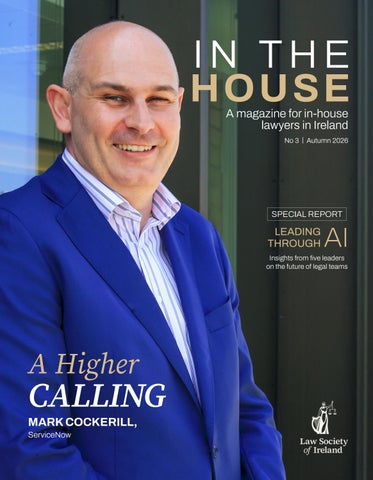
IN THE HOUSE A magazine for in-house lawyers in Ireland
No 3 | Autumn 2026
SPECIAL REPORT
Insights from five leaders on the future of legal teams
A Higher
CALLING MARK COCKERILL, ServiceNow
CONTENTS I N T H E HOUSE No 3 | Autumn 2026
3 THE CONFIDENCE TRAP – CERTAINTY ISN’T LEADERSHIP
Reflections on the paradox at the heart of being an impactful in-house leader from Antoinette Moriarty.
4
FEATURE INTERVIEW: A HIGHER CALLING
Mark Cockerill of ServiceNow is living proof lawyers can lead in business at the highest levels – he and Sorcha Corcoran talk building from the ground up and steering growth.
8 GOING WITH THE FLOW: MEET THE CLO, NOELEEN McHENRY Uisce Éireann’s Chief Legal Officer champions resilience, perspective and the importance of not taking yourself or your work too seriously.
15
10
13 LEADING LEGAL TEAMS IN THE ERA OF AI
Google Ireland’s Head of Legal, Ruth Murphy, sees AI’s real value extending far beyond mere efficiency as it frees teams to focus on deep, complex, meaningful work.
10 SPECIAL REPORT: LEADING THROUGH AI
14 EXPERIMENTING WITH AI: A FORTUNE 500 GC’S PERSPECTIVE
12 BUILDING THE AI-READY LEGAL FUNCTION
15 TRANSFORMATION STARTS WITH TRUST: LESSONS FROM RIO TINTO
From global technology companies and multinational corporations to legal operations pioneers and industry advisors, these leaders are navigating the same challenges. Áine Lyons, Senior Vice President and Deputy General Counsel, Workday, wants to ensure lawyers shape the future rather than letting others define it for them.
14
For Matt Fawcett, Chief Legal Officer, DXC Technology, AI is not simply another technology trend, it’s creating new opportunities for lawyers and legal teams.
In the view of Chris Fowler, Chief Operating Officer, Legal, Governance and Corporate Affairs at Rio Tinto, successful transformation starts with people, not technology.
16 LAW IN THE ERA OF AI: WHY CLIENTS WILL DRIVE CHANGE
8
Bjarne Tellmann, CEO of FjordStream Advisors believes as businesses invest heavily in AI and redesign operations, legal departments will be forced to evolve alongside them.
17 DATES FOR THE DIARY
Your guide to upcoming law society events and courses, plus library resources you need to know about.
18 CAREER OPPORTUNITIES
A selection of in-house legal vacancies.
In the House
THE CONFIDENCE TRAP
– certainty isn’t leadership Antoinette Moriarty
Director of Solicitor Services, Law Society of Ireland The Board is animated; the Chair’s imagination seized by a new opportunity. During the exchange, the GC mentally ticks off a well-rehearsed list: where this idea sits within a complex regulatory framework, the relative risk, the near-certain absence of a helpful precedent, and what’s driving opinion. Now, a question is levelled at the GC, one with no clear answer. The room turns to her, hoping for a yes, willing her towards easy certainty. This is the paradox at the heart of in-house leadership. Solicitors are trained to project certainty. Yet the work of an impactful in-house leader is increasingly defined by ambiguity – cross-functional, fast-moving, often without reference points. The gap between the demand for certainty and the inevitability of not-yet-knowing is where senior in-house lawyers can struggle. It is also where our real leadership muscles, and a different idea of confidence, can gradually build. THE ARMOUR PITFALL Many senior solicitors have built extraordinarily capable, professional selves: it can look and sound a lot like confidence. Sometimes, though, it’s armour – which doesn’t always flex in a period of rapid change. Real confidence is less about personal certainty, and more about being the stable ‘container’ who can also enable others – in particular, the Board and Executive team – to keep thinking clearly while a complex problem remains unresolved. Confidence becomes a relational skill, closer to steadiness under weight than certainty of outcome. And a leader who can risk being seen as notknowing is paradoxically more trusted (and arguably always more interesting!) than one who can’t.
flexibility; it’s the capacity to keep thinking innovatively while the solution forms collectively. The useful leadership distinction between technical challenges (known problem, known solutions – where legal training excels) and adaptive ones (no precedent, requiring others to change their thinking) maps closely onto today’s GC brief: AI integration, regulation and governance, geopolitical risk, complex human dynamics, multiple business dynamics. Certainty proves no match for this new reality; steady, adaptive leadership may be the only safe way through.
“Confidence becomes a relational skill, closer to steadiness under weight than certainty of outcome.”
THINKING UNDER FIRE Much of the work of in-house is holding trust – with stakeholders dipped in the raw anxiety of change. Fluid dynamics, competing interests, clashing values – none of it yet organised clearly into meaning. Adaptability isn’t just
THE LAST WORD IS – TEAM Confidence lives in the system, and a GC’s confidence isn’t entirely their own – it’s shaped by the business itself and its sector, legal colleagues, Executive Leadership peers, the overarching governing body, or Board. An adaptable but isolated GC can, and likely will, still struggle. Investing in the team around you is the foundation of success – spending time with your people, showing belief in their capacity, and, where appropriate, being honest about your own challenges. All will help reconnect you with your own willingness to see it through – whatever the outcome. Happily, this form of confidence isn’t a prerequisite for effective leadership. Rather, it’s arrived at over time, by sitting into our (often-uncomfortable!) leadership seats, and gradually loosening that grip on certainty – and finding the real strength that emerges from true adaptability. Autumn 2026
03
A HIGHER CALLING Interview with
Mark Cockerill Senior Vice President, Legal – Corporate, M&A and International Development, ServiceNow
04 lawsociety.ie
In the House
Mark Cockerill is living proof that lawyers have what it takes to lead at the highest levels in business. Sorcha Corcoran met the country lead of ServiceNow at its Irish headquarters.
Mark Cockerill is living proof that lawyers have what it takes to lead at the highest levels in business. Sorcha Corcoran met the country lead of ServiceNow at its Irish headquarters. Taking in the panorama of Dublin city and beyond from ServiceNow’s sixthfloor terrace on a glorious May afternoon, it’s not hard to understand why Mark Cockerill is such a ray of sunshine himself. The funky, lightfilled offices at 60 Dawson Street are a far cry from where he was just eight years ago, when tasked with building the American company’s Irish operation from the ground up. ’Part of the joy now is remembering that there were just 10 of us, me as the lawyer and nine engineers; we didn’t even have a printer! The vision was that I would fulfil the legal role but also grow the Irish organisation into something substantive where people would want to work and enjoy their jobs,’ he recalls. From that small, serviced office, ServiceNow moved to the Sharp Building in Hogan Place, Dublin 2, where employee numbers grew to more than 600 within five years. In 2024, the enterprise software and cloud computing company became the first tenant of 60 Dawson Street, occupying almost 90,000 sq. ft. across the top four floors. Today, around 1,000 ServiceNow people are based at the state-of-the-art premises and remotely across Ireland. Among the features that give it the ‘wow’ factor are a soundproof
amphitheatre-style collaboration space, acoustic booths, yoga and mothering rooms and a dining area more like a restaurant than a canteen. In addition to overseeing ServiceNow’s Irish headquarters and European hub in Dublin, Mark has gone from being vice president, legal for EMEA/APJ and head of global privacy to senior vice president, legal for corporate, M&A and international development since moving to Dawson Street. ‘In my legal role, I head up a global team of 30 lawyers across Asia, Europe and the US. It’s a quasi-business role, focused on guiding and directing the business to help it succeed,’ he explains. An advocate for Ireland There are now around 37 different teams in the Dublin office, including EMEA and global teams and leaders, and 56 different nationalities. ‘I’m passionate about global teams being headed up from Ireland. A lot of the roles and functions in Dublin wouldn’t have happened without my lobbying of US colleagues and intervention,’ Mark says. ‘It’s not about pulling the tricolour around, but because I genuinely believed it was the right thing for the organisation as a whole to have them in Dublin. As one of the world’s biggest tech hubs, we have all this great talent
who have walked the path before, are well trained and get the expectations in the tech sector.’ Championing Ireland as a location for foreign direct investment into the future is at the forefront of Mark’s mind in his role as president of the American Chamber of Commerce (AmCham) Ireland for 2026. ‘Post-Brexit, I feel a degree of responsibility to stand up for Ireland at European and American levels. Overall, it’s about leaning into the betterment of Ireland as a whole and what needs to happen to make us successful for the next 50 years,’ he says. ‘I think why I engaged with the board of AmCham when asked – and maybe what’s driven my entire career – is that I never want to be that guy on the sidelines pointing and directing what others should be doing. I’d rather lean in with suggestions of how to help. Autumn 2026
05
“... leaders are not there for their people to do what they want for them, but to do what their people need from them to be successful.” ‘My legal expertise helps a lot with engagement with government, political parties and providing input for position papers.’ Growing with the business Since becoming an enterprise-wide workflow platform, ServiceNow has grown exponentially and ended 2025 with over US$13bn in annual revenues. Going through the extreme growth in Dublin aligned with this, Mark has felt aware of his own development as a leader and an individual. ‘I’m a big believer in the concept of ”servant leadership” – that leaders are not there for their people to do what they want for them, but to do what their people need from them to be successful,’ he says.
Clockwise from top: Arsenal football; Mark enjoys baking with his three children; Trinity College, Dublin
06 lawsociety.ie
‘My fundamental principle around this is, if you’re not promoting or championing your team, not being honest about where they need to improve and not invested in their growth, then how do you expect them to succeed? ‘In Dublin, it’s important that people realise I’m here and am approachable. I always do a little tour to say “hi” to everyone. For the most part, I practice leadership by democracy – except every now and then when it has to be a dictatorship, because the buck stops with me!” Mark hates the term ‘work-life balance’ as he doesn’t see work and life as ‘either/or’. He admits to doing ‘way too much travelling’, but this is because he sees human connection as critical. With ServiceNow’s hybrid work culture, he’s in the Dublin office at least three days a week. Otherwise, he meets peers at senior vice president level, many of whom are based in the US, and visits customers in other countries. Whatever hat he’s wearing, Mark makes the effort to be truly present. ‘This is something I sometimes used to fail with but have got better at. I have three children, aged six, nine and eleven, and whether I’m a stand-in horse, a swing pusher or baking a cake with them, that’s what I focus on.’ An avid Arsenal Football Club fan, Mark likes to watch ‘any sport with a ball’. ‘I love the lessons sport teaches us about teamwork and how inspirational it is. It’s also important for learning about responsibility and pressure,’ he says.
‘The proliferation of women’s games on TV is really positive. It’s great for my six-year-old daughter to see. Recently, we sat down together to watch Arsenal play against Lyon in the UEFA Women’s Champions League, and the Women’s Six Nations Championship.’ Drawn to the profession When Mark was two years older than his daughter is now, he knew he wanted to be a lawyer. ‘I decided that teacher, lawyer or doctor were my three career options. I hate blood, teaching is a vocation that I realised wasn’t for me, and so I settled on lawyer. I was probably over-influenced by John Grisham novels and Tom Cruise in A Few Good Men and The Firm,’ he laughs. ‘My mum and nan would say I was argumentative and opinionated. I’ve always loved debating and the cut-andthrust of discussion. So, I thought I’d be a barrister. But in university, my mindset shifted. I liked being part of a team and creating stuff.’ Mark did his undergraduate law degree at Griffith College, and in 2004 completed a master’s in laws at Trinity College Dublin, which the ServiceNow terrace overlooks. From there, he trained at a boutique corporate and commercial firm in Dublin, which gave him hands-on experience of working in industry. ‘Meteor was one of our biggest clients, and I got seconded out to them after two years. I found that I loved working in that type of environment – with marketing, engineering and
In the House
finance teams – and being part of something bigger,’ he explains. Between 2011 and 2018, Mark held senior roles in the telecommunications industry, most recently director of legal services at Eircom (now eir). From there, he says his move into the tech sector and joining ServiceNow was very intentional. ‘I could only see three possible roles in my future – general counsel at Eircom, Three or Vodafone, which was quite limiting. Dublin is my home and uprooting my family wasn’t an option. The idea of taking on a new challenge – to lead and drive something of a global nature in a different industry – enriched my soul and still gets me out of bed every morning.’
THE SECRET SAUCE Mark Cockerill shares some nuggets of advice and insights for anyone considering an in-house career Encourage your intellectual curiosity – in people in other teams, how your industry works, how the technology behind it works. When I started out in telecommunications companies, I wanted to know how spectrum technology and radio base stations worked when I was drawing up contracts. At the same time, master your craft – law is still the core essence of what you do; you need to know and love it. From my experience, private practice was the best place to learn the craft, and the apprenticeship gave me the best grounding. To me, though, it’s a very different animal to working in industry. As an industry lawyer, you’re more than just a function; you’re providing deep subject-matter expertise – that, combined with working with smart people in all the different functions, was what really attracted me to it.
Don’t let someone else dictate your role and standards: stretch where you can, think beyond and outside the box in terms of opportunities. Don’t think of yourself as ‘just a lawyer’. You’ll often get a wider view across the company that some colleagues at the same level may not. In that regard, I think we’re the connective tissue – as well as being the voice of reason in raising legal points, we look at the bigger picture and what the organisation is trying to achieve. Because of the way we’ve been trained, lawyers can take a step back and analyse a problem. The skill of applying critical thinking and a calm and dispassionate analysis of facts to reach a result is even more essential today. That’s the secret sauce we bring, and why lawyers make excellent global leaders.
Autumn 2026
07
GOING WITH THE FLOW Meet the CLO Interview with
Noeleen McHenry Chief Legal Officer, Uisce Éireann
CAN YOU TELL US ABOUT YOUR CURRENT ROLE AT UISCE ÉIREANN? I’m the Chief Legal Officer, advising the Executive and Board, and overseeing the legal, secretariat and data protection functions, with a team of approximately 30. I’ve been with the company almost from the beginning, attracted by the opportunity to join the fledgling utility and put my environmental expertise to good use. It’s a fascinating job. In one day, I could advise on legal barriers to accelerating infrastructure, work crossfunctionally to balance AI governance with innovation, coach my team on a tricky problem, contribute to discussions on company direction and strategy, manage high-stakes litigation, and advise on novel questions of regulatory law. TELL US ABOUT YOUR BACKGROUND: WHERE DOES YOUR STORY START? I grew up on the north coast of County Antrim, with my three sisters and brother. My parents were teachers, but also part-time sheep farmers, and we grew up on a hill farm. I had a happy childhood there before moving to the bright lights of Dublin when I was 18. WHY DID YOU BECOME A LAWYER? Growing up, law was not the original plan. I was animalmad – living on a sheep farm, with a dog, pony, cat and zebra finch – and really wanted to be a vet. But in my teenage years, the prospect of getting up in the middle of the night to deliver a lamb had lost some of its appeal, so I needed an alternative. I enjoyed debating (my parents might say arguing), which I thought might come in handy for law and ended up studying Law and French at Trinity. I started my legal career in Arthur Cox, qualifying into the planning and environmental team, before moving to A&L Goodbody, and later Irish Water, now Uisce Éireann.
08 lawsociety.ie
HOW WOULD YOU DESCRIBE YOUR LEADERSHIP STYLE? I aim to be a leader who empowers people to perform at their best, in an environment that prioritises respect, collaboration, psychological safety and, hopefully, a bit of fun. I have a fantastic team, and they’re part of what makes my job so worthwhile. It’s important to me to be authentic and honest. I also like a bit of constructive challenge. There’s nothing more joyful to a born debater than being in a team where we can respectfully disagree and still have a pint afterwards. WHAT HAS HELPED YOU DEVELOP STRONG RELATIONSHIPS WITH KEY STAKEHOLDERS? I think it’s crucial to understand people’s perspectives and take the time to listen. Strong relationships are built on trust, which means being straightforward, knowing your subject, following through and being genuinely curious about different perspectives. The most excellent legal advice mightn’t land if a person doesn’t trust you to know where they’re coming from, or what they’re trying to achieve.
In the House
Right: The Great Barrier Reef Below: Acrylic painting
WHAT ADVICE WOULD YOU GIVE A YOUNG IN-HOUSE LAWYER STARTING OUT ON THEIR CAREER? Firstly, build a support network if you can – peers who understand the pressures, mentors who can advise you, sponsors who will help you. Secondly, bring good energy; being someone people actually want to work with matters. And, finally, keep your advice to the business short and focused. The only person interested in a beautifully legally drafted 20-page note of advice is another lawyer. Sometimes not even them. WHO HAS BEEN YOUR GREATEST INFLUENCE? I have much-loved friends and family who have been through, or are going through, tough times and still manage to keep living, laughing and having a zest for life. They have taught me a great deal about resilience, perspective and the importance of not taking yourself or your work too seriously.
“... bring good energy; being someone people actually want to work with matters.”
THE BEST PIECE OF CAREER ADVICE YOU HAVE RECEIVED? I have received too much great advice to credit it all. I’m just not always so good at taking it! WHAT DO YOU ENJOY DOING IN YOUR SPARE TIME (IF YOU HAVE ANY SPARE TIME!)? In addition to enjoying my gaggle of kids, I love travelling, eating good food, reading and live music. I also cycle through an ever-changing list of hobbies, usually trying to involve the most willing child. So far this year, I’ve gone through acrylic painting, gardening and fishkeeping. I think aquascaping might be next. WHAT IS YOUR FAVOURITE PLACE IN THE WORLD? My favourite must be the hills behind my family home on the North Antrim coast. You can see the hills of Donegal, the islands of Rathlin and Islay and, on a clear day, Scotland. Few places I’ve been surpass the starry nights or summer sunsets seen there. WHICH DESTINATION IS AT THE TOP OF YOUR TRAVEL BUCKET LIST? Oh, too many places to pick just one. I’d like to see more of Asia – maybe Japan or China. I’d also love to go diving again, perhaps at the Great Barrier Reef or Sipadan in Malaysia. Autumn 2026
09
SPECIAL REPORT
LEADING THROUGH
Five Leaders on the future of legal teams
10 lawsociety.ie
In the House
Artificial intelligence is transforming the legal profession at a pace few could have imagined even a few years ago. Yet the most interesting questions facing legal teams are not just about technology. They are about leadership, transformation, talent, culture and how lawyers continue to create value in a rapidly changing world. Through its Tech Talks: In-House Legal audio series, the Law Society of Ireland, in collaboration with Platforum9 hosted a series of conversations with five internationally recognised legal leaders from Workday, Google, Rio Tinto, DXC Technology and FjordStream Advisors. Together, they shared practical insights on AI adoption, legal transformation, leadership and the future of legal services.
MEET THE SPEAKERS Five legal leaders. Five different organisations. Five distinct perspectives on the future of legal teams. From global technology companies and multinational corporations to legal operations pioneers and industry advisors, the leaders featured in this Special Report are navigating many of the same challenges: harnessing the potential of AI, preparing their organisations for change and helping their teams develop the skills needed for the future. While their experiences differ, several common themes emerge. Successful transformation starts with understanding business challenges, not simply implementing new technology.
Trusted information, strong leadership and organisational culture remain critical foundations for meaningful change. Most importantly, every speaker emphasises that human judgement, communication, adaptability and strategic thinking will become even more valuable as AI takes on more routine work. The pages that follow offer practical insights from some of the world’s leading organisations on navigating one of the most significant periods of change the legal profession has ever faced.
Fe at u re d Spe ake r s
‘AI is going to be one of two things. It is going to be a headwind or a tailwind.’ Matt Fawcett, Chief Legal Officer, DXC Technology
‘It’s not just about getting tasks done faster. I think it’s freeing us up to focus on deep, complex, meaningful work.’ Ruth Murphy, Head of Legal, Google Ireland
Ruth Murphy
Áine Lyons
Matt Fawcett
Chris Fowler
Bjarne Tellmann
Head of Legal, Google Ireland
Senior Vice President and Deputy General Counsel, Workday
Chief Legal Officer, DXC Technology
Chief Operating Officer, Legal, Governance and Corporate Affairs, Rio Tinto
CEO, FjordStream Advisors
All five conversations are available through the Law Society’s Tech Talks: In-House Legal series on the Platforum 9 app, on Spotify and the Law Society’s Legal Tech Hub. Visit lawsociety.ie/techtalks
Autumn 2026
11
LISTEN ON
BUILDING THE AI-READY LEGAL FUNCTION Áine Lyons
Senior Vice President and Deputy General Counsel, Workday
For Áine Lyons, one of the biggest challenges facing the legal profession is ensuring lawyers actively shape the future rather than allowing others to define it for them. As artificial intelligence reshapes how organisations operate, legal leaders face growing pressure to show how AI can create value while continuing to articulate the uniquely human contribution lawyers bring to the table. At Workday, this has led to a strong focus on becoming ‘AI-ready’. Rather than rushing to deploy new tools, Lyons believes legal teams must first establish the foundations for success, including robust governance, skills development, trusted information and effective operating models. In her view, AI is not a standalone technology initiative, but part of a broader transformation in how legal services are delivered. That preparation has included a significant emphasis on content readiness. Before introducing AIpowered agents, Workday focused on ensuring legal information was accurate, accessible and properly governed. Lyons emphasised that AI is
only as effective as the information behind it. Without trusted, wellstructured content, organisations risk poor outcomes, low adoption and diminishing confidence in AI-enabled systems. One of the most ambitious elements of Workday’s strategy is the creation of a ‘legal front door’, supported by AI-powered agents designed to help legal professionals, employees and business stakeholders access trusted information quickly and efficiently. The objective is not to deploy technology for technology’s sake, but to solve practical business problems and improve how people access legal support. Lyons emphasised leadership’s role in driving transformation. She noted that legal departments are increasingly expected to demonstrate measurable value from AI but cautioned against treating AI simply as another technology project. Successful adoption requires bringing people with you, creating opportunities for learning and ensuring that no one feels left behind by the pace of change. She also challenged lawyers to take ownership of the profession’s future: ‘We have to take control of that narrative before people say, “I can just go ask ChatGPT. I don’t need lawyers. I don’t need legal people anymore.”’ Yet Lyons remains optimistic. Rather than replacing lawyers, she believes AI creates an opportunity to elevate legal work. As technology increasingly handles routine activities, lawyers can
12 lawsociety.ie
devote more time to strategic thinking, relationship management and solving complex business challenges. She encouraged lawyers at every stage of their careers to embrace the opportunity. Younger professionals may be naturally comfortable with emerging technologies, while more experienced lawyers bring judgement, context and risk awareness that remain essential in an AI-enabled world. The future, she argued, depends on combining both strengths. KEY INSIGHT Successful AI adoption starts with preparation. Trusted information, strong governance and investment in people are the foundations of an AI-ready legal function. LEADERSHIP LESSON When asked about the best advice she has received during her career, Lyons shared a lesson from a former CEO that fundamentally changed how she approached legal leadership: ‘I don’t have legal issues. I have business challenges with legal dimensions to them.’ The advice encouraged her to move beyond purely legal analysis and focus on helping organisations solve business problems. It remains a guiding principle in her work today and is particularly relevant as legal teams seek to demonstrate strategic value in an AI-enabled world.
In the House
LISTEN ON
human capabilities such as communication, judgement, influence and relationship-building. In Murphy’s view, technology will not diminish the importance of these skills. Instead, it will make them more valuable. The legal profession is not becoming less human. In many respects, it is becoming more human.
Leading legal teams in the ERA OF AI As Head of Legal at Google Ireland, Ruth Murphy has a front-row seat to AI’s impact on legal work. Her message was both practical and optimistic. Across legal teams, AI is increasingly moving beyond experimentation and becoming embedded in day-to-day legal practice. Lawyers are using AI tools to support drafting, research, knowledge management and decisionmaking. Yet Murphy is clear that AI’s real value extends far beyond efficiency. ‘It’s not just about getting tasks done faster. I think it’s freeing us up to focus on deep, complex, meaningful work.’ Murphy shared several practical examples of how AI is supporting legal work today, including tools that help organise legal knowledge, support research and strengthen critical thinking. One example highlighted the use of AI-powered knowledge management tools for transforming large volumes of legal information into searchable resources. Ruth also described using AI as a ‘thought partner’ to challenge assumptions, refine arguments and prepare for important discussions.
KEY INSIGHT The greatest promise of AI is its ability to create space for more strategic, complex and meaningful legal work.
Ruth Murphy
Head of Legal, Google Ireland
For this busy lawyer, some of AI’s most valuable applications are, surprisingly, not necessarily about automation, but about helping lawyers think more effectively and make better-informed decisions. The real challenge for legal leaders is not whether AI should be used, but how to ensure it is adopted responsibly and in a way that delivers meaningful value. Murphy also emphasised the importance of governance. In her view, legal teams cannot credibly advise others on responsible AI use without applying the same standards internally. As AI becomes more deeply embedded within organisations, legal functions play an important role in balancing innovation with accountability. Looking ahead, Murphy believes the legal profession is evolving. Legal expertise remains fundamental, but lawyers increasingly need AI literacy, adaptability and curiosity. Future lawyers will need to understand not only the law but also how to work effectively with AI tools, ask better questions and critically assess the outputs they receive. At the same time, the rise of AI is increasing the importance of distinctly
LEADERSHIP LESSON Ruth highlighted advice that has guided her throughout her career and continues to resonate with her today: ‘Learn how to get stuff done, how to take ownership of a problem, and help to solve it.’ She also shared another phrase that has stayed with her over the years: ‘Run to the fires.’ In other words, when challenges arise, step forward rather than step back. Murphy believes that taking ownership, embracing responsibility and focusing on solutions remain some of the most important qualities for aspiring leaders.
Autumn 2026
13
LISTEN ON
EXPERIMENTING WITH AI:
A Fortune 500 GC’s perspective Matt Fawcett
Chief Legal Officer, DXC Technology
For Matt Fawcett, artificial intelligence is not simply another technology trend. It is reshaping how legal work is performed and creating new opportunities for lawyers and legal teams. Fawcett leads a global legal organisation of approximately 400 professionals across 35 countries and has spent significant time exploring how AI can improve legal service delivery and create greater value for the business. One central theme of the discussion was Fawcett’s belief that lawyers who embrace AI will be better positioned to succeed in the years ahead. ‘AI is going to be one of two things. It is going to be a headwind or a tailwind.’ In Matt’s view, there is no neutral position. Lawyers who choose to wait and see how AI develops risk giving their peers a significant advantage. Every day spent ignoring the technology allows others to build knowledge, develop new skills and discover more effective ways of working. Standing on the sidelines, he argued, effectively turns AI into a headwind because the profession is moving forward regardless. By contrast, lawyers who actively engage with AI can use it as a powerful career accelerant. Fawcett highlighted
14 lawsociety.ie
three key benefits. First, AI enables lawyers to complete many tasks faster, helping them operate at the speed modern business increasingly demands. Second, it creates additional capacity by reducing time spent on routine work, freeing lawyers to focus on higher-value activities. Third, experimentation with AI unlocks new possibilities and ways of working that continue to emerge as the technology evolves. Interestingly, Fawcett’s own thinking about AI has evolved over time. Rather than asking what AI can do, he increasingly focuses on what it cannot do. While AI excels at drafting, research, summarisation and analysis, it cannot replicate trusted client relationships, business judgement or a deep understanding of organisational context. Those capabilities remain uniquely human and, in his view, will become even more valuable in the years ahead. The discussion also explored the implications for the next generation of lawyers. As AI automates more routine work, legal organisations will need to rethink how future lawyers build experience, confidence and judgement. While the answers are still emerging, Fawcett believes the profession must begin preparing now for a fundamentally different model of talent development. Despite these challenges, Matt remains optimistic. AI presents a significant opportunity for in-house legal teams to become faster, more responsive and more strategically aligned with the businesses they
support. By automating lower-value work and freeing lawyers to focus on complex decision-making, risk assessment and advisory work, AI has the potential to elevate the role of legal departments within organisations. KEY INSIGHT AI should be viewed as an amplifier rather than a replacement. The lawyers who thrive will combine technological fluency with human judgement and commercial insight. LEADERSHIP LESSON When asked about the best advice he has received during his career, Matt pointed to guidance from legal operations pioneer Connie Brenton: ‘Do something every day that scares you.’ For Matt, the message is particularly relevant in the context of AI. Lawyers who are willing to experiment, learn new skills and step outside their comfort zones will be best positioned to thrive in a rapidly changing profession.
In the House
LISTEN ON
Transformation starts with trust: LESSONS FROM RIO TINTO Chris Fowler
Chief Operating Officer, Legal, Governance & Corporate Affairs, Rio Tinto When Chris Fowler joined Rio Tinto after a 24-year career at BT, he resisted the temptation to arrive with a transformation blueprint. Instead, he focused on listening, building relationships and understanding the realities facing teams across the organisation. In Fowler’s view, successful transformation starts with people rather than technology. Leaders often move too quickly to deliver solutions before properly diagnosing the problem. Building trust, understanding local challenges and demonstrating early wins are, he believes, critical to creating the conditions for lasting change. One conversation early in his tenure proved particularly influential. When he asked Rio Tinto’s CFO how the legal function could improve, the response was striking: ‘External law firms knew more about parts of the business than we did.’ That observation highlighted a
fundamental challenge around organisational knowledge. Before the legal function could fully benefit from AI, it first needed to improve how it captured, stored, and shared information. The lesson was simple but powerful: AI is only as good as the underlying data and knowledge upon which it relies. Drawing on his experience at both BT and Rio Tinto, he noted that while technology played a role in both organisations’ transformation journeys, the underlying challenges differed significantly. At BT, the priority was managing increasing volumes of legal work and improving visibility over how work was allocated across the function. At Rio Tinto, the challenge was improving knowledge sharing, collaboration and access to organisational information. Rather than pursuing advanced AI use cases immediately, Rio Tinto first concentrated on strengthening its document management systems and improving knowledge management
practices. Only then did the organisation begin exploring how AI could generate insights and support decision-making more effectively. Culture emerged as another major theme. Fowler stressed that people need to feel comfortable experimenting, sharing ideas and trying new approaches. Without psychological safety, transformation efforts are unlikely to succeed. Interestingly, some of the strongest advocates for change have been more junior team members, often bringing fresh perspectives and a natural comfort with emerging technologies. Fowler observed that many of the most innovative AI use cases were originating from these digitally native colleagues. The discussion also explored how AI is reshaping relationships between in-house legal teams and external law firms. Increasingly, clients expect evidence that technology is improving efficiency, service delivery and value creation. As a result, conversations with law firms are shifting from hours worked to outcomes delivered. KEY INSIGHT The foundation for successful AI adoption is not technology. It is trust, culture and strong knowledge management. LEADERSHIP LESSON Chris shared a piece of advice that has stayed with him throughout his career, given to him by a former General Counsel at BT: ‘You won’t get the next job doing what you did to get this job.’ The lesson serves as a reminder that career progression requires continuous reinvention. As the legal profession evolves, lawyers must continually develop new skills, embrace new experiences and challenge themselves to think differently. Autumn 2026
15
LISTEN ON
LAW IN THE ERA OF AI:
Why clients will drive change Bjarne Tellmann
CEO, FjordStream Advisors
For Bjarne Tellmann, the biggest force reshaping the legal profession is not artificial intelligence itself, but the transformation taking place inside the organisations lawyers serve. As businesses invest heavily in AI and redesign how they operate, legal departments will be forced to evolve alongside them. A defining concept in Tellmann’s work is the ‘AI factory’. In his view, AI is not simply another technology tool but a foundational capability, comparable to electricity or the steam engine, that is reshaping how organisations operate, compete and create value. Around the world, companies are embedding AI into their core operations, using data, automation and continuous learning to improve decision-making, increase efficiency and scale at unprecedented levels. According to Tellmann, legal departments cannot remain unchanged while the organisations around them transform. Future legal functions will increasingly rely on AI-enabled platforms that combine legal knowledge, workflows, data and governance. These systems will allow legal teams to deliver services more consistently, generate insights more quickly and support businesses operating at a much faster pace. Despite his enthusiasm for AI, Tellmann cautioned against treating technology as the starting point for transformation. In his view, too many organisations become fixated on tools before clearly defining the outcomes they are trying to achieve. Instead, legal leaders should begin by
16 lawsociety.ie
understanding the purpose of their legal function, the value it creates for the business, and the obstacles preventing it from operating at its full potential. Only then should they consider how technology can support those objectives. For Tellmann, AI is most powerful as an enabler of strategy, rather than a strategy in itself. The discussion also explored what these changes mean for legal talent. Tellmann believes tomorrow’s lawyers will need a much broader skill set than previous generations. Legal expertise will remain essential, but it will increasingly be complemented by commercial awareness, technological literacy, communication skills, multidisciplinary thinking and the ability to lead through change. Lawyers, he argued, need to think more like business leaders and less like technical specialists operating in isolation. Tellmann also delivered a stark warning for law firms. Drawing on disruption theory and examples such as Kodak and Nokia, he suggested that some firms may be vulnerable if they fail to adapt. As AI automates more routine work and clients become increasingly sophisticated, traditional business models built around leverage and hourly billing may come under pressure. The firms that succeed will be those willing to rethink service delivery, pricing and how they create value for clients. Despite the focus on technology, Tellmann repeatedly returned to the human side of transformation. He emphasised that even the strongest
strategy can fail if leaders do not explain why change is necessary and help people navigate it. In his view, successful transformation requires leaders to recognise the emotional impact of change, bring people with them on the journey, and build understanding and trust throughout the process. KEY INSIGHT The future belongs to lawyers who combine legal expertise with business understanding, technological fluency and a willingness to embrace change. LEADERSHIP LESSON When asked about the best advice he has received during his career, Tellmann spoke about the importance of remaining flexible and adaptable: ‘Be future literate.’ For Tellmann, this means remaining relentlessly curious about emerging developments, understanding how they may shape organisations and professions, and translating those insights into practical action. He also stressed the importance of recognising the human impact of change and helping people navigate transformation successfully.
In the House
DATES FOR THE DIARY
UPCOMING LAW SOCIETY EVENTS / LEARNING / RESOURCES 6 OCTOBER 2026 Law Society Skillnet Wellbeing Summit 2026 Navigating Transitions: How We Manage Change Across Legal Careers 2.30pm–5.00pm | Online | CPD 2.5 hours 7 OCTOBER 2026 In-house and Public Sector Committee Annual Conference 2026 Navigating Regulation in Ireland: Balancing Competition, Innovation and Compliance 9.30am–1.15pm | CPD: 3.5 hours General (by group study) This year’s conference will explore regulatory developments across a range of sectors, with a particular focus on technology, artificial intelligence and communications. Speakers will share perspectives on developments at both the Irish and EU level and include: • Eadaoin Ní Chaoimh, European Parliament Legal Service • Paul Byrne, Chief Executive Officer, AI Office of Ireland • Niamh Hodnett, Commissioner, ComReg • John Evans, Digital Services Commissioner, Coimisiún na Meán • Niamh Sweeney, Commissioner, Data Protection Commission • Brian Kennedy SC, Chief Adjudication Officer, Competition and Consumer Protection Commission • Brian Connolly, Director of Responsible AI, Regulatory & Compliance Europe Lead, Accenture 20 OCTOBER 2026 Regulation Matters: Ethics and the In-house Lawyer 2026 Update 1.00pm–2.00pm | Live Webinar CPD: 1 hour Client Care & Professional Standards (eLearning)
UPCOMING DIPLOMAS & PROGRAMMES STARTS 13 OCTOBER Diploma in Regulation, Compliance and Risk Management CPD Course STARTS 14 OCTOBER Micro-Credential in Strategic In-House Practice CPD Course STARTS 23 FEBRUARY 2027 Diploma in In-House Practice CPD Course
LIBRARY SPOTLIGHT: TRENDING LEGAL QUERIES The Library and Information Service’s latest resource, Trending Legal Queries, helps solicitors stay up to date with frequently requested and emerging areas of law. Whether you are exploring an unfamiliar topic or looking for a quick and reliable starting point for legal research, Trending Legal Queries provides practical support for day-to-day legal practice. Have a suggestion for a future topic? The Library and Information Service would be delighted to hear from you. Email: libraryenquire@lawsociety.ie
LEARNING A full list of Law Society diplomas, certificates and professional development programmes is available on the Law Society website.
Autumn 2026
17
In the House
CAREER OPPORTUNITIES: OPEN IN-HOUSE VACANCIES The in-house legal market is strong, with numerous private and public sector opportunities available. Law Society Legal Vacancies has published over 120 in-house public and private roles since the start of the year. A selection of in-house legal vacancies is listed below:
• SOLICITOR
The Representative Church Body
• TRADEMARK ATTORNEY Newell Brands
• SOLICITORS
Legal Aid Board
• SOLICITOR ESB
• LEGAL KNOWLEDGE MANAGEMENT & STRATEGIC PROJECTS MANAGER Office of the Director of Public Prosecutions
Additional in-house legal opportunities are listed on the Law Society website: lawsociety.ie/legalvacancies 18 lawsociety.ie
As an in-house lawyer, your perspective is invaluable. As we prepare the next quarterly newsletter, let us know what features you would like to see more of. Email: solicitorservices@lawsociety.ie