IN REAL LIFE
Lawndale | Artist Studio Program | 2017 - 2018
IN REAL LIFE Lawndale | Artist Studio Program | 2017 - 2018
COVER
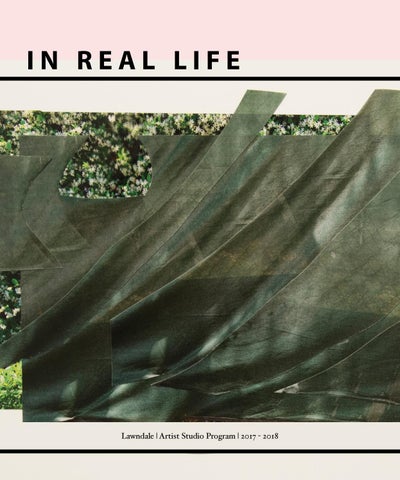
Regina Agu, Star Jasmine (detail), 2018. Mixed media on clayboard. 14 x 11 x 3⁄4”
RIGHT
Shannon Crider, Installation view
May 25 - July 29, 2018
WITH ESSAY BY LAUREN ROSS, CURATOR PHOTOGRAPHY BY RONALD L. JONES + LAUREN LOHMAN
CONTENTS 05
Introduction
07
In Real Life
22
About
24
Special Thanks
LAWNDALE | ARTIST STUDIO PROGRAM
4912 Main Street | Houston, TX 77002 | 713.528.5858 lawndaleartcenter.org | © Lawndale, 2018
INTRODUCTION stablished in 2006, Lawndale’s Artist Studio Program provides financial, material, and curatorial support to artists across disciplines who are working to develop a sustainable artistic practice. This year Lawndale welcomed four impressive Houston-based artists as our 2017-2018 Artist Studio Program participants: Regina Agu, Shannon Crider, and Bria Lauren and Morganne Nikole of htx people project. The Artist Studio Program encourages intensive studio practice and engagement with a wide range of artists, critics, curators, and art historians who are invited to meet individually with the participants in their studios. Lawndale extends its thanks to those who helped shape this year’s program including Haley Berkman, Lily Cox-Richard, Jamal Cyrus, Dean Daderko, Ashlyn Davis, Ryan Dennis, David Dove, Pete Gershon, Natilee Harren, Alhena Katsof, Mary Magsamen, Dennis Nance, Roberto Tejada, Laura Wellen, Michelle White, and Allison Young. Each spring, the program offers participants the opportunity to work with an established curator to mount an exhibition of work produced during the term. Lawndale is grateful to curator Lauren Ross for her skilled and thoughtful contributions to the exhibition, In Real Life, and to her eponymously titled essay included herewith. We were fortunate to work with Kayla E. and Design Altar on the book design and Emco Press on the printing of this publication. The Artist Studio Program would not be possible without the support of many individuals. Lawndale is particularly thankful to Kathrine G. McGovern and The John P. McGovern Foundation for underwriting the Artist Studio Program’s many activities and to Board Member Justin Segal for his generous support of this publication. As always, Lawndale is grateful to its committed and talented staff, Emily Fens, Lisa Gertsch, and Lauren Lohman, without whom Lawndale would not be embarking on ever-more ambitious exhibitions and programs.
ST E P HA NIE M ITC HE LL, E X E C U T IVE DIRE C TO R htx people project, concept; queerdom, 2018. Visual portrait film. duration 27 minutes
05
IN REAL LIFE esides their joint status as participants in the 2017-18 Lawndale Artist Studio Program, Regina Agu, htx people project, and Shannon Crider share another trait: the desire to reveal lived experiences that have been suppressed or relegated to the margins. In works spanning various media, these artists utilize literal and metaphorical lenses and framing devices to capture and re-present the lives and realities of various communities encompassing people of color, women, LGBTQ people, and gender non-conformists. They balance awareness of how the lives of their subjects have developed to date, while keeping an eye towards better potential futures. Since 2011, Regina Agu has been walking and documenting cities in the American Gulf Coast region, from Texas to Florida. Her explorations dovetail with her interest in the study of psychogeography and Black geographies, fields that consider complicated contexts and historically excluded perspectives for more faceted understanding of urban spaces and those who inhabit them. The works in In Real Life predominantly examine her home base of Houston, especially the city’s Third Ward, a community with which she feels a strong connection. In photographs and drawings of fauna and the built environment, she captures views of places vulnerable to forces ranging from gentrification to the destruction of natural and man-made disasters such as Hurricane Harvey. Change progresses rapidly, and Agu notes that some of the places she documented less than ten years ago have been essentially erased. Top left to bottom right: Regina Agu, T rader’s Compass, Confederate Jasmine, Southern Jasmine, Star Jasmine, Chinese Star Jasmine, and Confederate Jessamine, 2018. Mixed media on clayboard. 14 x 11 x 3⁄4” each
07
Regina Agu, Installation view
ARTIST STUDIO PROGRAM | IN REAL LIFE An ongoing source of inspiration for Agu is the queer African American poet, essayist, performer, and educator, Akilah Oliver (1961-2011). In “The Visible Unseen” (2009), Oliver describes her own walks through the urban landscape, and records her thoughts and observations on graffiti. At first, she compares graffiti artists to ghost writers, but then suggests that taggers are not as ethereal as they might initially seem: “… the ghost is/was embodied, speaks to and through cultural productions, specific identities, home communities, but still manages through encoding to evade as it upsets and redistributes identities. Each piece, each throw-up chronicles the days.” The urban details recorded by Agu function similarly. Human presence is less explicitly documented than located in the marks people leave behind; indexical traces of individuals and communities living their lives, at once prosaic and utterly complex. Agu is also drawn to Oliver’s observations of the passage of time: “If graffiti posits history as always in the process of becoming undone. And memory, then, is history’s mistress. That is, memory does not stand outside or apart from the becoming and undoing that is history.” This
BELOW
Regina Agu, L etters to Akilah 02,2018. Mixed media on paper. 9 x 12”
RIGHT
Regina Agu, His Hands Were Empty 02 ( Left), His Hands Were Empty 01 ( Right), 2018. Inkjet print on paper. 11 x 17” unframed
emphasis on memory is key to Agu’s entire project. As sites disappear, she is not only recording for posterity, but documenting the process of transition from existence to recollection. Another thread in Agu’s most recent work is her response to trauma and acts of violence made against people of color, and the landscapes marked by these incidents. In 2016, video capturing the shooting of Alton Sterling by white police officers in Baton Rouge was circulated widely on social media. Like many others, Agu felt conflicted; the video was both a crucial testimony and an unrelenting reminder that repeatedly replayed the trauma. Her response was to make copies of a newspaper’s front-page headline about Sterling’s death and black out the accompanying photo with ink. Two years later, she revisited her own reaction by developing that into a new series of works that layer media headlines with found and created photographs. These combinations of text and images relate to Agu’s past work in conceptual poetry and erased drawings, and are tied to her interest in makeshift memorials such as murals or shrines; acts of personal and collective remembrance constructed in public space.
10
11
ARTIST STUDIO PROGRAM | IN REAL LIFE Agu strives for a tone in her work that balances forfeiture and reconstruction. When places are erased, and people subjected to violence, what sorts of irrevocable loss occurs? At the same time, how can community memory and re-imagination lead to possible new futures?
ARTIST STUDIO PROGRAM | IN REAL LIFE conceive it as “a programming space, not a presentation,” and are utilizing it to hold conversations, workshops, readings, or other sessions that honor the project’s larger intentions. Even when the space isn’t being actively used for events, the presence of fliers will inform and invite potential participants
The presentation at Lawndale includes a new undertaking for htx people project: concept; queerdom is housed within a space that functions as more than just a screening room; it serves as a place of gathering, healing, questioning, and discussion. The artists made a deliberate decision to shape the physical space using three walls rather than four, to give it structure without making it inaccessible for viewing or entry. It is a “safe space” designed for queer people of color to be comfortable being themselves, but it exists within public space. The room is not a closed chamber to hide its subjects; it is intended to act as a bridge and facilitator, as well as offer a model for how art institutions can play a role in such exchanges. Lauren and Nikole
htx people project, Installation view
htx people project is the brainchild of duo Bria Lauren and Morganne Nikole, partners in life and artmaking. Their collaborative practice has focused primarily on crafting video portraits and interviews that give voice to members of the Black, queer community. As in their previous videos, NAKED (2016) and c r e a t i n g s p a c e (2017), concept; queerdom mixes individual interviews and group conversation formats with four subjects who self-identify as queer people of color. These subjects share their personal experiences, prompted to explore what words such as “queer,” “masculinity,” and “femininity” mean to them, or to describe their choices around gender expression, creativity, and political activism.
ARTIST STUDIO PROGRAM | IN REAL LIFE
ARTIST STUDIO PROGRAM | IN REAL LIFE
htx people project, concept; context, 2018. Cut vinyl on wall. 23 x 102”
for upcoming programs. Also incorporated on the interior of the space are still photographs of and quotes from the videos’ subjects, as well as vinyl texts that examine some of the language used around queer identity, including the word “queer” itself. These texts surround mirrors so that viewers can contemplate their own reflections while reading. The project is both documentary and aspirational. It seeks to present and help shape unapologetic, authentic expressions from perspectives that are too often ignored, misunderstood, repressed, or silenced. One of the subjects in a previous htx people project video points out, “There is no example of this liberated freedom we are talking about. We are literally creating it from scratch.” Lauren and Nikole approach their artmaking in the same manner of generative groundbreaking. They regard it as a process, not an end goal. concept; queerdom is but one pace in a long, potentially endless, journey. The artists want to remind their audience that “the work is never finished.”
14
htx people project, concept; context, 2018. 3 vinyl on acrylic mirrors and transparency film. 12 x 12” mirrors
15
htx people project, concept; visibility, 2018. Transparency film. 8 1⁄2 x 11” and 11 x 17”
ARTIST STUDIO PROGRAM | IN REAL LIFE Shannon Crider critically examines the experiences of women, on and off the screen. Concerned with fictional representations and real experience alike, Crider sources images from movies, television, magazines, and the web. In previous works, Crider utilized figures pulled from television scenes that pass the so-called “Bechdel Test” (only scenes that contain a minimum of two female characters who converse on a topic other than men pass the assessment defined by cartoonist Alison Bechdel) to explore dramatized female relationships. In her newest works, Crider applies found images to a variety of mediums and materials: collage, animation, as well as printed paper, fabric, mirrored film, and vinyl. At Lawndale, Crider plays with materials that reveal transparency when activated by light. Fabric works are installed so that they hang from the ceiling and float away from the wall, allowing viewers to walk among and around them. Some Mylar pieces have 2-way mirrored surfaces, allowing viewers to alternately see through them or glimpse reflections of themselves. These shifts between opacity, transparency, and reflection may inspire voyeurism or contemplation about past experiences or actions.
ARTIST STUDIO PROGRAM | IN REAL LIFE Many of Crider’s works present fragmented bodies in which heads or torsos have been removed, or limbs are isolated and dismembered from bodies. This treatment puts the emphasis on gestures and points of physical contact, and explores a spectrum ranging from the subtle to the unambiguous; body language, physical proximity and invasions of personal space, uninvited touch, or violent assault. With this range, she reveals how a touch can run a wide gamut of intention and reception—caring or controlling, welcome or oppressive, healing or violent.
Shannon Crider, Installation view
18
19
ARTIST STUDIO PROGRAM | IN REAL LIFE
ARTIST STUDIO PROGRAM | IN REAL LIFE
For In Real Life, Crider sources images from television series and movies, including Colossal, Big Little Lies, Girls, House of Cards, Salem, and Gossip Girl. The artist categorizes her interest as both coming from the position of a consumer and fan, as well as a critic. Her sources include “rom-com” movies and television shows developed for the WB network in the late 1990s and early 2000s—years in which she progressed from junior high school through college—and she reflects on their potential influence over her formation of relationships with boys and men. Other sources are directly linked to Crider’s personal development as an artist and experiences as an adult, as well as high profile scandals that have fueled recent #metoo/#notsurprised/#timesup movements.
A series of Crider’s collages, some of which are on view at Lawndale, was initiated with a publicity image of actress Gwyneth Paltrow standing with Hollywood producer Harvey Weinstein at the Academy Awards, taken before the general public became aware of accusations concerning Weinstein’s sexually predatory behavior, made by multiple women in the industry, including Paltrow. This shot of Paltrow projecting a façade of tranquility despite her presumed discomfort led Crider to ruminate on the frequency of women having to “perform” normalcy, even in situations of distress or danger. Crider overlaid photos of actors and producers posing for paparazzi with images from television and film depicting unambiguous violence against women; pairings designed to suggest what evils may lurk just below the surface. Crider’s concern with men like Weinstein relates not only to their behavior, but on the influence they wield. She wonders how their toxic attitudes towards women migrate into the media they write and produce, only to be absorbed and internalized by female viewers.
20
Shannon Crider, Kiss the Girls: Make Them Quiet (detail), 2018. Collage. 24 x 36” each
21
22 23 Shannon Crider, Installation view
ARTIST STUDIO PROGRAM | IN REAL LIFE Crider’s examinations extend beyond the realm of entertainment. A fabric piece features a screen grab from one of the televised 2016 presidential debates, in which Donald Trump paced and loomed behind Hillary Clinton as she spoke. Crider’s use of the image suggests the ways in which physical presence, even without spoken words or bodily contact, can serve as a tool of intimidation. But the image is also inextricably bound to the sex- and gender-related complexities that swirled around the entire election cycle. Trump’s tendency to regard women as trophies for sexual conquest was widely known, and irrefutably evidenced by the infamous Access Hollywood tape. And while multiple factors influenced the election’s outcome, many people, including this writer, believe that systemic sexism was one of them. Clinton’s loss denied her the opportunity to make history as America’s first female President. It doesn’t get more real life than that.
LAUREN ROSS
Shannon Crider, Stills (detail), 2018. Collage. 11 x 14” each
24
25
ABOUT R E G I N A A G U is an artist and writer based in Houston, TX. Her recent work focuses
on the complex relationships between the landscape and communities of color. Her work has been included in exhibitions, public readings, and performances nationally, including recent showings at The Drawing Center, New York; DiverseWorks, Houston; The American University Museum at the Katzen Arts Center in DC; Project Row Houses; and The Station Museum, Houston. She is currently a CASE-PRH fellow at the University of Houston, and a 2018 Houston Arts Alliance SACI grantee. Agu is a 2017 Artadia Houston awardee, and was a recent participant in Open Sessions at The Drawing Center. Agu was the co-director of Alabama Song, a collaboratively-run art space in Third Ward, Houston, which received a SEED grant from The Robert Rauschenberg Foundation. Agu is the founder of the Houston-based WOC Reading Group, and her other collaborative projects include Friends of Angela Davis Park and the Houston-based independent small press paratext.
___________
S H A N N O N C R I D E R , a Houston-based visual artist, is a resident of the 2017-2018
Artist Studio Program at Lawndale. Through re-photographing and re-staging stills from television, Crider’s work investigates the impact of contemporary representations of women in our televisual culture. Her two- and three-dimensional works employ collage, sewing, and print to construct new spaces that reflect the psychogenic space of female subjectivity in popular culture. She has exhibited throughout the United States, including Artists Looking at Art at the McNay Art Museum in San Antonio, TX, the 2013 Texas Biennial, and Hardesty Arts Center in Tulsa, OK. Crider earned an MFA in Printmedia from the School of the Art Institute of Chicago (2016) and her Bachelor’s from Oklahoma City University (2008).
26
HT X PEOPLE PROJECT:
the public spectators carry a body language that quietly wishes we were less black. less woman. less queer. their shifts; often disguised by faint smiles and delayed hesitations, are meant to persuade us that our intersecting identities are not responsible for disrupting their flavors and societal norms.their thoughts; prefer we quiet our voices and learn to behave. to only adapt ‘voice’ for swallowing in place of s p e a k i n g.our authenticity; displaced among the margins, urges our inner truth to become courageous enough to be courageous enough. after all, we are not obliged to make oppression comfortable.our collective marries the soul-ship of art and activism. we nurture the heartbeat of film, photography, text and storytelling to isolate and dissect the holistic scarring of race, gender and sexuality. through art. we create safe spaces for people to be exactly as they are. without censorship.without fear. with love. Bria Lauren and Morganne Nikole are a queer-people-of-color creative collective based in Houston, TX. Since the project’s inception in 2015, the pair have released two documentary films titled NAKED (2016) and c r e a t i n g s p a c e (2017). The project has noted creative collaboration credits with Diverse Works, Project Row Houses, Folklore Films, BLMHTX, Outsmart Magazine, Forward Times Newspaper, AFROPUNK, and University of Houston Graduate College of Social Work.
___________
LAUREN ROSS
is a curator, writer, teacher, and administrator with over twenty years of experience in contemporary art. She is based in Richmond, Virginia, where she recently founded the RVA Critical Art Writing Program. Ross has served as a curator at such institutions as the Institute for Contemporary Art, Richmond, VA; Philbrook Museum of Art, Tulsa, OK; the High Line, New York, NY; Brooklyn Museum, NY; and White Columns, New York, NY. As a writer, she has contributed to exhibition catalogs published by The Dallas Museum of Art, The Studio Museum in Harlem, and the Whitney Museum of American Art, as well as to periodicals such as ARTnews and Burnaway. Ross has taught at Virginia Commonwealth University, the School of Visual Arts, the Rhode Island School of Design, and the Whitney Museum. She holds a Master’s Degree from Hunter College and a Bachelor’s Degree from Cornell University, both in the History of Art.
27
SPECIAL THANKS REGINA AGU:
Deepest thanks to everyone at Lawndale, Lauren Ross, and all those who provided their time, generous feedback, and support in the production and exhibition of these works.
S H A N N O N C R I D E R : Thank you Lawndale Art Center for fostering a welcoming, nurturing environment. The visiting artists, curators, and community members who challenged and encouraged me throughout the residency. Lauren Ross for your guidance, vision, and insight in creating the essay and staging the exhibition. The art handlers, Jon Clark, Juan Camillo, Emmanuel Arambula, and Max Bridges, whose experience and talent elevated my vision. My fellow Lawndale residents for your community and fellowship. And my husband, Ryan, who supported me every step of the way. HT X PEOPLE PROJECT:
Endless thanks to the Lawndale Family, Lauren Ross, Lovie Olivia, and the many superhuman unicorns we journeyed with along the way. Thank you for believing in our voice and evolving our creative heartbeat.
LAUREN ROSS:
Lawndale.
Many thanks to the artists, Stephanie Mitchell, and the staff of
PUBLIC PROGRAMS concept; queerdom: an htx people project visual portrait John M. O’Quinn Gallery Sunday, May 27, June 24, and July 1, 2018 | 1 PM Thursday, June 14 and July 12, 2018 | 6:30 PM [film screening + interactive discussion] /an expedition of healing tools to examine+encourage language, gender identity, healing, gathering, discussion, and a safe space for people to arrive exactly as they are. Letters to Akilah John M. O’Quinn Gallery Sunday, June 3, 2018 | 2 PM Performative lecture by Regina Agu in response to the work of the late poet Akilah Oliver. Screen Queens Book Club John M. O’Quinn Gallery Wednesday, June 20, July 18, and August 15, 2018 | 6:30 - 8 PM Book club with ASP artist Shannon Crider examining women’s representation in popular culture. Wednesday, June 20 You Play the Girl: On Playboy Bunnies, Stepford Wives, Train Wrecks, & Other Mixed Messages by Carina Chocano Wednesday, July 18 Stealing the Show: How Women Are Revolutionizing Television by Joy Press Wednesday, August 15 Too Fat, Too Slutty, Too Loud: The Rise and Reign of the Unruly Woman by Anne Helen Petersen
LAYOUT BY DESIGN ALTAR PRINTED BY EMCO PRESS CORPORATION
28