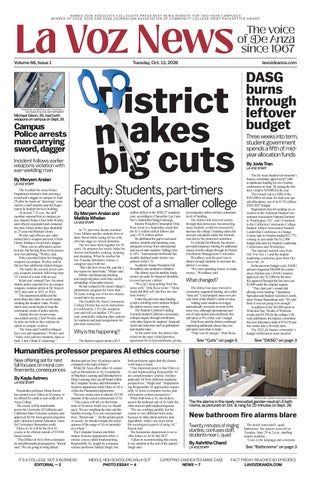
La Voz News
NAMED 2026 ASSOCIATE COLLEGIATE PRESS BEST NEWS WEBSITE FOR TWO-YEAR CAMPUSES WINNER OF 2024, 2025 AND 2026 JOURNALISM ASSOCIATION OF COMMUNITY COLLEGE PRINT PACESETTER AWARD
Volume 66, Issue 1
The voice of De Anza since 1967
Tuesday, Oct. 13, 2026
DASG burns through leftover budget
PHOTOS COURTESY OF FOOTHILLDE ANZA POLICE DEPARTMENT
Michael Glenn, 25, had both weapons on campus on Sept. 29.
Campus Police arrests man carrying sword, dagger
Three weeks into term, student government spends a fifth of midyear allocation funds
Incident follows earlier weapons violation with axe-wielding man By Meryem Arslan LA VOZ STAFF
The Foothill-De Anza Police Department arrested a man carrying a sword and a dagger on campus on Sept. 29 after he made an “alarming” comment to a staff member near the Registration & Student Services building. At around 7:32 a.m., the staff member reported him to campus police. Interim Police Chief John Worley said officers responded and contacted the man, whom police later identified as 25-year-old Michael Glenn. Worley said officers saw what looked like a weapon and took it from Glenn, finding a sword and a dagger. “There was no affirmative action he took, but having those in his possession was alarming,” Worley said. Police arrested Glenn for bringing weapons on campus. Worley said he did not face additional related charges. The marks the second recent campus weapons incident, following Sept. 19’s arrest of a man with an axe. In last year’s annual Clery Act report, district police reported two on-campus weapons violation arrests at De Anza in 2025 and none in 2023 or 2024. The department publicized the arrest three days later on social media, omitting the incident’s date. Worley said it uses social media to keep the community aware of police activity. Despite the two recent weapons-related arrests, Chief Worley said he does not believe they indicate an uptick in campus violence. “De Anza and Foothill (colleges) have very safe reputations,” Worley said. “There were just two incidents, back to back. I don’t think it’s alarming.”
lavozdeanza.com
By Jovia Tran LA VOZ STAFF
The district has since moved to community-supported funding, also called “basic aid.” Local property taxes now provide most of the district’s main revenue. Adding more students no longer automatically increases revenue in the same way, although international and out-of-state tuition and enrollment fees still raked in 9% of this year’s budget. Dela Rosa said the district continued supporting additional classes last year and spent more than it made. “That was by design,” Dela Rosa
The De Anza Student Government’s finance committee approved $27,000 in additional funding for two October conferences on Sept. 28, raising the line item’s total to $39,000 for the year. This rounds out to a fifth of the $365,000 it set aside for mid-year special allocations, out of its $1.93 million 2026-2027 budget. Registration fees for sending six executives to the American Student Government Association National Summit in Washington, D.C. and 14 students to the California Community College Student Affairs Association Student Leadership Conference in Orange County later in October totaled $11,773, coming in just under the $12,000 budget allocated for Student Leadership Conferences and Workshops. The national summit runs from Oct. 8 to Oct. 11 and the student leadership conference goes from Oct. 16 to Oct. 18. In the previous budget cycle, DASG advisers requested $40,000 for conferences, but last year’s DASG senators approved only $12,000 for the item; this approval brought the line item just $1,000 under the original request. “They (last year’s senate) did allocate some funding,” Operations Specialist and Student Activities Coordinator Dennis Shannakian said. “We told them it was not going to be enough.” In addition to the $43,000 spent on Welcome Day, Weeks of Welcome events and $4,350 for the college’s Diwali celebration, the finance committee has now allocated a total of $74,350 just two weeks into a 36-week term. The 2025-26 finance committee’s budget deliberation notes detailed
See “Cuts” on page 5
See "DASG" on page 3
Faculty: Students, part-timers bear the cost of a smaller college By Meryem Arslan and Matilda Whelan LA VOZ STAFF
At 73, part-time faculty member Tony Milano teaches students how to draw blood while caring for his wife, who has stage six mixed dementia. The two have been together for 50 years. He prepares her meals, helps her shower and handles cooking, cleaning and shopping. When he teaches his two Tuesday laboratory classes, a caregiver stays with her. “She’s the love of my life, and she’s the reason my heart beats,” Milano said. Milano said balancing teaching and caregiving takes more than careful scheduling; it also takes prayers. He has worked in De Anza College’s phlebotomy program for more than 20 years; losing one of his two classes would halve his income. The Foothill-De Anza Community College District has cut its instructional workload by 3.5% this academic year and will cut another 3.5% next year, potentially reducing class options for students and paid assignments for part-time instructors.
Why is this happening? The district expects about a $3.5
million deficit in the 2026-27 academic year, according to Chancellor Lee Lambert’s September budget message. Interim President Christopher Dela Rosa wrote in a September email that the $3.5 million deficit follows last year’s $7.6 million deficit. He attributed the gap to increased salaries, benefits and operating costs, alongside revenue from international and out-of-state students “falling close to 10%.” International enrollment has steadily declined under stricter visa policies in the U.S. Academic Senate President Erik Woodbury also pointed to inflation. The district used its stability funds, money set aside for financial shortfalls, to cover last year’s deficit. “We can’t keep pulling from the same well,” Dela Rosa wrote. “Those funds did their job, but they are onetime money.” Under the previous state funding system, enrolling more students helped the district receive more money. The Student-Centered Funding Formula funded California community colleges largely through enrollment, with other factors for students’ financial needs and outcomes such as graduation and transfer rates. At the same time, the district also relied on the state’s hold harmless agreement for its lost enrollment, giving
it a temporary safety net but a minimum level of funding. The district still received money through that protection, but attracting more students would not necessarily increase the college’s funding unless the amount calculated under the formula rose above the protected minimum. To rebuild enrollment, the district provided temporary funding for additional classes at both colleges through its District Enrollment Management Committee. Woodbury said the goal was to attract enough students to increase the district’s revenue. “We were spending money to make money,” Woodbury said.
What changed?
Humanities professor prepares AI ethics course New offering set for next fall focuses on moral confinements, consequences By Kayla Astrero LA VOZ STAFF
Humanities professor Mona Rawal has created a new Ethics in AI course, to be offered for credit or non-credit at De Anza College. The course will be transferable across the University of California and California State University systems, and approved for De Anza general education and Califronia General Education Transfer Curriculum Humanities credit. Ethics in AI will be the first AI course to be offered outside of STEM based classes. “This (Ethics in AI) is from a humanistic and philosophical perspective,” Rawal said. “We are going to bring ethical
theories and see how AI policies can be evaluated in the light of them.” While De Anza offers other AI courses such as Introduction to AI, Foundations of Machine Learning and Introduction to Deep Learning, they are all found within the Computer Science and Information Systems department while Ethics in AI is within the Humanities department. The new course aims to educate STEM students of the moral confinements of AI. “This course will tell you the limitations of AI and in which way we should use it. We are weighing the risks and the benefits of using AI in our own personal lives,” Rawal said. “...for the greater good of society, we should evaluate the consequences of the usage of AI on humanity as a whole.” The Computer Science and Information Systems department offers a similar course called Implementing Responsible AI, taught by computer science professor Sukhjit Singh, but
IT’S A COLLEGE, NOT A BUSINESS EDITORIAL — 2
both professors agree that the classes work hand in hand. “One important point is that Ethics in AI and Implementing Responsible AI are complementary courses, but they approach AI from different academic perspectives,” Singh said. “Implementing Responsible AI approaches responsible AI from a computer science and information systems perspective.” While both look at AI, one looks to answer the technical side of AI while the other answers philosophical inquiries. “We are working parallel, but his course is very different from mine because he talks about policies and algorithms, while I am more about the sociological aspects of using AI,” Rawal said. The humanities department is set to offer Ethics in AI by fall 2027. “I plan on recommending this course to my students at the end of the quarter,” Singh said.
MIDDLE, HIGH SCHOOLERS WALK OUT PHOTO ESSAY — 4
PHOTO BY JONATHAN NGUYEN-AU
The fire alarms in the newly renovated gender-neutral L5 bath rooms, as pictured on Oct. 8, rang for 20 minutes on Sept. 29.
New bathroom fire alarms blare Twenty minutes of ringing startles, confuses staff, students near L quad By Ashritha Chand LA VOZ STAFF
CUPERTINO CANDIDATES MAKE CASE NEWS — 7
The newly renovated L quad bathrooms’ fire sensors went off on Tuesday, Sept. 29 at 2 p.m., startling nearby students. “I was in the language and communi-
See "Bathrooms" on page 3 FACT FRIDAY REACHES 60 EPISODES LAVOZDEANZA.COM
2EDITORIAL OCT. 13, 2026
Editorial Board Editor-in-Chief Ann Peñalosa
Managing Editor Meryem Arslan
News Editor Gavin Rust
Sports Editor Jamie Watt
Features Editor Ashritha Chand
Photo Editor Matilda Whelan
Multimedia Editor Julia Gonzalez
Social Media Editor Haley Lillibridge
Staff Members Kayla Astrero Nguyen Khoi Vo Robert Parra Aileen Bucog Gia Khang Do Damian Renteria Mata Yosselyn Garcia Rodas Jose Aldana David Parent Jeyah Khuraijam Arlyse Bunao Adrian Kao Angeles Reynoso Jovia Tran Anat Kardonchik Shane Michel Wolfgang Choun Caleb Randria Katelyn Dianne Park Inaaya Yousuf Cris Li Jonathan Nguyen-Au Shreya Singh
Faculty Adviser Farideh Dada
Office Managers Kinjal Dhandar Igusti Agung Raharja
About Us De Anza College students have written and published La Voz News since 1967. Student access to La Voz is partially funded by the De Anza Student Government. La Voz News is printed by the Folger Graphics Company.
ILLUSTRATION BY AILEEN BUCOG
It’s a college, not a business Administrators, president must put students, staff over profit By La Voz Editorial Board Despite going through five presidents in the last three years, De Anza College’s different administrative lineups have consistently made themselves clear about the type of college they want to run — a moneymaker. Last spring, De Anza slashed its College Promise tuition coverage down to one year, barely three years after an earlier Promise cut, while cutting back on section offerings and enrollment for the foreseeable future. At Opening Day on Sept. 17, Interim President Christopher Dela Rosa told the college that the Foothill-De Anza Community College District would need to cut its instructional load by 3.5% this year and next year across both campuses. Eventually, at De Anza, that looks like a cut to one in 13 total instructional
hours by the 2027-28 year, specifically targeting part-timer and overload hours. Thanks to the district’s basic aid status, enrollment no longer drives how much the college makes; it gets the bulk of its budget from its property tax base regardless of if it has a thousand students or a hundred thousand. So, leadership wants to “manage enrollment” and offer less. The administration has lost focus of what truly matters; students and staff. Instead of maintaining a respectable campus, it shifted its priorities to cutting losses and making profit. Former Interim President David Wain Coon talked about running the college like a business in May, and former President Lloyd Holmes pushed for a rentable event center, which the Board of Trustees scrapped months after he left. While the college makes more money under basic aid, it sold off core services
to the highest bidder — dining to Pacific Dining last year and the bookstore to Follett Higher Education Group in 2021, while shuttering printing services in 2023. (Foothill privatized its own print shop this spring, outsourcing to Sir Speedy Printing.) De Anza also plans on cutting its on-campus bookstore in favor of an online one by the end of next year. Since this string of leadership is united on ensuring the college “is not going to grow,” it’s only natural that students will look toward colleges that offer comprehensive resources and use basic aid to help students, rather than squeeze them. To be clear, students will still want or need to take the courses that the administration cuts. It’s just a matter of whether they take it at De Anza or if they will flood to neighboring colleges. Meanwhile, the college is courting big business with contract education; after recently opening its doors to a $600,000 Tesla partnership, Vice President of Workforce Innovation and Economic Advancement Aaron Korngiebel said the administration plans for more companies to pay the college to make
ADVERTISEMENT
specialized courses for their workers. This comes not even three years after the district’s LinkedIn page wrote that it would “look forward to exploring new ways to partner” with weapons manufacturer Lockheed Martin, in November 2023. If the college would rather scrap itself and sell the parts while looking to corporations for backing, it has no right to say students drive its decisions when money plays an even bigger role. As De Anza searches for a new president, it needs one who will prioritize maintaining what the college offers in-house, restore its services and keep the college robust. This starts with, at minimum, restoring the College Promise and following neighboring districts’ lead — both the San Mateo County and West Valley-Mission community college districts have made tuition free for residents of their respective service areas. Whoever will lead the college going forward needs to ensure it comes out of the basic aid “transition period” primarily serving students, not whichever corporations promise the quickest buck.
want to break the news?
All rights reserved; no part of La Voz News may be reproduced without permission.
take your shot.
Staff editorials reflect the opinions of the majority of the editorial board and not necessarily the views of the entire La Voz Staff.
join la voz.
Opinions expressed by staff and contributors are the opinions of the individuals and not necessarily the opinions of La Voz News.
Contact Us
Send letters to the editor lavozdeanza.com lavoz@fhda.edu +1 (408) 864-5626
JOUR 61a-c and 361a-c
JOUR 21a
Student News Media Production
News Writing
JOUR 62a-f and 362a-f Freelance contributor courses
(61 classes are credit, 361 classes are free noncredit)
(winter quarter only)
(62 classes are credit, 362 classes are free noncredit)
For questions and more information, visit the newsroom in room L-41 or email the adviser at dadafarideh@fhda.edu.
NEWS lavozdeanza.com
Bathrooms cont. from page 1. cations village,” Rana Arjunmand, 19, business major, said. “We were right there when the alarms went off.” The sound went on for around 20 minutes before stopping, according to Foothill-De Anza Community College District Police Department Officer Miguel Lara. “I could hear it when I was heading to the (Registration and Student Services) building,” Arjunmand said. “I was hearing it until I entered the building, so I’m not sure how long, but it did go on for quite a while.” Vivian Plancarte, 25, undeclared major, said she was confused about the sound and why it was blaring. “I thought it was a drill,” Plancarte said. “No one was really paying attention to it.” Trinity Nguyen, 18, animation major, said that while this “may be a malfunction,” people smoking often triggered their high school’s fire alarms. “Usually people would smoke in the bathroom,” Nguyen said. “I was thinking (it was) something minor.” Lara said that the department doesn’t know the alarm’s exact cause yet. “It’s something going on with the sensors,” Lara said. “It could’ve been dust, it could’ve been smoke; we’re just trying to figure out what it is right now.” Arjunmand said they were relieved that the fire alarms worked and nothing too serious happened. “At least it wasn’t anything too crazy,” Arjunmand said. “I’m just glad that the fire alarms actually work, considering it’s a new bathroom.”
PHOTO BY JONATHAN NGUYEN-AU
The newly renovated genderneutral L5 bathrooms, sit quiet and unoccupied on Sept. 29.
DASG cont. from page 1.
how the senate spent nearly $30,000 on sending 25 students to the student affairs conference, recommending that future senates send fewer people to conferences and prioritize the Student Senate for California Community Colleges General Assembly. At the general assembly, student governments from all 117 California Community Colleges vote on resolutions that inform state policy, as well as setting the statewide system’s stance on issues. Shannakian said that while the advisers “try to eliminate as much as we can,” more students could have gone if last year’s senate approved more funding. “The 14 students for CCCSAA and the six for the D.C. trip, ... that’s not even half of the students that could have gone,” Shannakian said. “The more the merrier.” DASG advisers registered senators and other student leadership under the Office of College Life for the conferences at the end of the spring quarter of the 2025-26 school year, following the DASG elections and swearing-ins. Associate Dean of Student Affairs Hyon Chu Yi-Baker said that last years’ budget deliberations happened under a different set of students. “They (senators) end their term at the end of spring,” Yi-Baker said. “These new folks, they take their oath at the end of the spring quarter.” DASG President Allissa Lo, 19, cognitive science major, made the motion to fund the full $27,000 and DASG Budget Analyst Arman Alasvandian, 19, computer science major, seconded. “I think we could have had a little bit more deliberation,” Lo said. “Us budget analysts had already taken the chance to review all of the requests and all of the documents before the meeting, individually, which made it easier for us to make motions.” Every senator on the finance committee who voted on the conference funding plans on attending at least one of the two conferences, except for Veteran Center Program Liaison Georgy Demyanenko. Lo is registered to attend both. DASG Chair of Finance Arin Kumar, 19, business administration major, said the advisers booked and paid for tickets
3 .
PHOTO BY ANN PEÑALOSA
DASG President Allissa Lo, 19, cognitive science major, pulls up a document on her laptop at the finance committee’s Sept. 26 Student Council Chambers meeting. Lo, who will go to both the na tional summit and the student affairs conference, moved to fund the advisers’ request in full. for both conferences during the previous years’ budget deliberations, before he was sworn in. “Things were already in planning before my position,” Kumar said. “I wouldn’t be able to speak on anything that started before my position began.” Despite previous senates’ feedback on the student affairs conference, Kumar called the conference “cost-effective.” “We do want more senators to go (to the student affairs conference),” Kumar said. Kumar will not go to that conference; he joins five other DASG executives going to the national capital. Yi-Baker said that while previous senates disapproved of the student affairs conference, she found it worthwhile for its networking and team-building. “When we first started doing it (going to the conference), we did have student parties who were not in favor,” Yi-Baker said. “Maybe the sessions are not what they thought it was going to be.” Kumar declined to comment on where the student senate general assembly fell in DASG’s priorities. “It (the Washington conference) was a great opportunity,” Kumar said. “it was very costly, but that cost came with a lot of benefit as well.”
PHOTO BY ANN PEÑALOSA
The DASG Finance Committee looks over attached documents shortly before voting on its advisers’ $27,000 budget request at its Sept. 28 meeting in the Student Council Chambers. ADVERTISEMENT
4PHOTO ESSAY OCT. 13, 2026
PHOTO BY WOLFGANG CHOUN
Kat Heller stands amid a crowd of several dozen students while a young student to her left speaks at Sunnyvale Civic Center on Oct. 2.
Students walk out for women’s rights Middle, high schoolers rally in Sunnyvale over ‘Cornell Seven’ case By Damian Renteria Mata LA VOZ STAFF
PHOTO BY GIA KHANG DO
A Sunnyvale Middle School student holds up a sign on top of the Sunnyvale Civic Center’s sign on Oct. 2.
Several dozen students across Sunnyvale and Cupertino schools walked out of school on Oct. 2 in response to the resurfaced alleged gang rape case at Cornell University. Homestead High School freshman Melissa Flores and Fremont High School freshman Lilliana Smith organized the protest through a Sept. 29 Instagram post. “Make posters and be loud so we can stand out,” Flores wrote on Instagram. Homestead High School senior Kat Heller, 17, said the large student turnout
PHOTO BY WOLFGANG CHOUN
PHOTO BY WOLFGANG CHOUN
A student climbs upon a friend’s shoulders to draw attention to both their signs along the junction of El Camino Real and South Mathilda Avenue on Oct. 2.
Fremont Union High School District Director of Human Resources Greg Giglio walks beside students holding signs on El Camino Real at Sept. 29’s rally. Before taking his job at the district office, Giglio was Homestead High School’s principal for 11 years, from January 2013 to July 2024.
inspired her. “Anyone with a moral compass should be able to see that sexual assault is one of the most violating things you can do to someone,” Heller said. “It feels like survivors are more scared to speak up than perpetrators are scared of consequences.” Students started marching around 11:15 a.m., from their respective campuses to the junction on El Camino Real and Mathilda Avenue, eventually making their way down to Sunnyvale Civic Center. Stanley Kou, president of the Fremont Union High School District Board of Trustees, said he learned
about the walkout the morning of, then came down “to understand if the board needs to do more to address” the issue. “This is freedom of speech,“ Kou said. “Students can protest, no matter what kind of subject or topic it is.” Heller said that, especially with three Fremont Union High School District trustee seats up for re-election this November, she wanted trustee candidates to know of the culture “among our school communities.” “I hope our public officials take the Cornell Seven as a cautionary tale,” Heller said. “People who are running for office should understand that their number one priority is the safety of our students.” Homestead senior Kamea Gunobgunob, 17, called the protest a “good way to get students voices out there.” “I hope, with this protest, more people know how angry women are,” Gunobgunob said. “We want legislation to respect our bodies, and for us to have the same independence that men always have.”
NEWS lavozdeanza.com
Cuts cont. from page 1.
said. “We (the district) do not want to cut classes in the middle of the academic year.” Administrators now say the college needs to focus less on expanding and more on helping current students complete their education. “De Anza will likely serve fewer students and be a smaller college than we have been in the past,” Subramaniam wrote in an email to department chairs and deans on Sept. 27.
Although Milano said he did not lose pay, losing a class could force him to work another job. “I’d be DoorDashing every day trying to fix it,” Milano said.
Faculty questions who bears the cuts
In the Foothill-De Anza Faculty Association’s September newsletter, Chief Negotiator Kathy Perino wrote that many faculty question whether the cuts are necessary or another case of the district “crying wolf to influence salary negotiations.” Much of the change affects the college’s part-time faculty budget, or “While we do need to stay in budget, we should not stand by and object code 1320, which also covers full-time faculty’s overload pay. allow the full burden of the budget cuts to land on the backs of our The college measures those assignments in full-time equivalent part-time instructional faculty,” Perino wrote. faculty, or FTEF, which describes teaching workload against a fullFaculty Association Vice President and De Anza political science time load, rather than how many instructors it employs. In a hypothetprofessor James Nguyen called for greater faculty involvement at the ical example, three part-time instructors each teaching one-third of a Board of Trustees’ Oct. 5 meeting. full-time load would together “Faculty have felt too in the equal to one FTEF. dark, particularly at De Anza Administrators cut partamid years of leadership turnover time and overload pay across and instability,” Nguyen said. divisions based on enrollment “We want to participate in develpatterns, required courses, course oping solutions before decisions sequences and staffing, while are finalized.” leaving what courses to cut up to Milano questioned whether the deans and department chairs. people making budget decisions underPsychology Chair Mark stand how changes affect his students. Healy said he had to remove “I feel that we are financially four winter sections (repremismanaged,” Milano said. “How senting 160 students) and four did we get in this mess?” spring sections despite consisBooher said administrators tently filling classes, leading to should also shoulder the burden. uncomfortable conversations “This should be affecting with part-timers. everyone equally,” Booher said. “It feels weird to reduce someWhen asked why the college thing that’s successful,” Healy chose an approach that reduces said. “I’ve been telling them (partVice President of Instruction part-time instructors’ assignments time instructors) for a few years, and income rather than placing ‘Oh, you’ll probably have more more of the strain on administration, Dela Rosa said the district had classes with De Anza. You just have to wait until we grow or people retire.’ continued funding additional classes last year to avoid disrupting Now I have to tell them, ‘Sorry, I was leading you on a little bit.’” students’ education, despite spending in a deficit. Philosophy Chair Rich Booher said his department lost three classes “We don’t have continuous one-time funds available for us to continfrom its winter and spring quarters, worrying that part-time instructors ue in this trajectory,” Dela Rosa said. elsewhere could lose their entire teaching schedule. At his Opening Day speech, Dela Rosa said the district’s goal was “There may be some departments and divisions where people are “not to eliminate people, but to stop spending our people’s time on work losing all their classes,” Booher said. that no student ever feels.” In discussing how exactly that goal fits with instructors losing assignments and students losing access to classes, Dela Rosa said the district is reviewing work that doesn’t directly affect students. He said technology and automation could make that work more efficient, freeing up resources and reducing employees’ workloads. De Anza plans to reduce its part-time and overload workload “For example, back-end work in accounting. You don’t see from approximately 302 FTEF in 2025-26 to 267 this year and 252 those, you don’t feel those, but those are important things,” he said. next year. “We want to take a look at those.”Dela Rosa acknowledged faculty However, that decrease does not represent cancelled classes. frustration and the high cost of living in the Bay Area. According to Subramaniam’s methodology document, the college “Unfortunately, we’re dealing with very finite fiscal resources,” paid for some classes last year with money saved from unfilled jobs Dela Rosa said. Trustee Alexander Gvatua, also a part-time San Jose State University and temporary District Enrollment Management Committee funding. instructor, said he also wanted clarity about reductions outside instruction. New full-time faculty will take over some assignments previously “That is one of the things that we, as a board, are trying to get a paid for through the 1320 budget. Those classes will continue with sense of,” Gvatua said. different staffing. Other sections will disappear from the schedule. Milano said he wanted to make sure students can finish what they “A canceled section may mean losing a third or half of one’s income came to De Anza for. for the quarter,” Justin Glass, the Faculty Association’s associate secretary for part-time faculty, wrote in a union newsletter. “I’m not important,” Milano said. “My students are.”
Ram Subramaniam
Why part-time instructors face reductions
.
Part-time + overload
How departments make the cuts
"De Anza will likely serve fewer students and be a smaller college than we have been in the past."
5 (15-19)
GRAPH BY MATILDA WHELAN
How administrators say they will protect students Subramaniam’s methodology document said required courses, courses with strong demand and classes students must take in sequence received priority when he developed the proportion of cuts. For students who cannot find a class they need at De Anza, Dela Rosa pointed to counseling, courses at Foothill and online options through California Virtual Campus. “We cannot provide everything,” Dela Rosa said. “We will do the best we can in order to minimize the impact to our students.”
What comes next Subramanian wrote that departments have until Nov. 1 to finalize winter 2027 schedules and Feb. 1 for spring schedules, in an email. As departments decide which classes to offer, faculty and administration still face the question of whether a smaller instructional load can meet students’ and part-time faculty’s needs. “The last thing I want to see out of changes to our district as we transition to basic aid is making it harder for students to graduate,” Gvatua said.
What can be done Woodbury said he encourages faculty and students to participate in conversations before decisions become final. “The best thing we can all do is to engage,” Woodbury said. “Insist on transparency and accountability from our leaders.” “When we talk about part-time faculty, it’s not a conceptual conversation for me,” Gvatua said. “It’s talking about me. …I want to hear from folks who are on the ground, classrooms being impacted by these changes. We need to hear from them.” Healy said students speaking up at board meetings could influence the administration and trustees’ decisions. “A good old-fashioned student protest could help matters,” Healy said. “But I’m not going to count on it.” For Healy, who has been at De Anza for over 20 years, the changes also affect the college he feels deeply connected to. “The whole thing is just very unsettling,” he said. “What happened to my school?”
Social Sciences and Humanities Physical Sciences, Mathemathics and Engineering Language Arts Business, Computer Science and Applied Technologies Biological, Health and Environmental Sciences Creative Arts Intercultural and International Studies Physical Education and Athletics Student Services
GRAPH BY MATILDA WHELAN
ADVERTISEMENT
NEWS lavozdeanza.com
7 .
Cupertino candidates vie for votes PHOTO BY GAVIN RUST
Cupertino City Council candidates take part in a forum hosted by the San Jose Spotlight at the Cupertino Senior Center on Wednesday, Oct. 7.
Eight city council prospectives talk housing, wildfire prevention at forum By Gavin Rust and Jovia Tran LA VOZ STAFF
Over 60 people watched Cupertino City Council candidates share their platforms in a San Jose Spotlight forum at the Cupertino Senior Center on Wednesday, Oct. 7. Mark Fantozzi, J.R. Fruen, Tracy Kosolcharoen, Gopal Kumarappan, Seema Lindskog, Santosh Rao, John Tang and J.Z. Wang answered questions about topics such as housing affordability and wildfire concerns from moderator and Spotlight reporter Mike Langberg. “One of my priorities is to make Cupertino wildfire-ready. That means updating emergency evacuation routes,” John Tang said. “That means securing emergency ADVERTISEMENT
response activities. That means helping residents to harden their homes.” The topic of affordable housing also took center stage. All eight candidates agreed that higher-density housing should be concentrated near transit hubs and busy roadways as opposed to single-family neighborhoods. “We’re going to convert Class C (older) offices to housing,” candidate Santosh Rao said. “I’ve been proposing and advocating at the planning commission, and we will make that happen.” Incumbent J.R. Fruen said the city “needs” De Anza College, highlighting the campus’ parking availability and proximity to Memorial Park. “We (city council) need to repair our relationship with De Anza College,”
Fruen said. “My colleagues on city council took a rather pugnacious approach to De Anza’s acquisition of an old apartment building that otherwise would have been acquired by a market rate developer and demolished.” “I think it’s excellent that you (De Anza) are partnering with (the Fremont Union High School District) and I think that that’s absolutely one that should continue to be built out,” Tracy Kosolcharoen said. “Our high schools, a lot of times, don’t have all the classes that a high school student might want to take.” Kosolcharoen also said the city needed to find ways to make De Anza more of a “linchpin within the community,” highlighting the flea market and public use of the campus pool. “De Anza College is an amazing asset to our city,” Seema Lindskog said. “It’s one of the best community colleges in the country, but we don’t support that enough.”
Lindskog said she supports public transit improvements that help students get to campus. “It (De Anza) is equal unto any other Ivy League’s opportunity,” Gopal Kumarappan said. “That awareness is missing.” Kumarappan proposed a “Cupertino Future Leaders Platform” where high school students are mentored by college students including those from De Anza. However, unlike Lindskog, Kumarappan and Fruen, Mark Fantozzi had a more critical view of De Anza’s actions, including the Flint Center demolition; he said the demolition was ultimately unnecessary and that the college had other cost-effective ways to handle the asbestos contamination. “I wish that there was some replacement,” Fantozzi said. “That (a new event center) could have been a benefit to the city for some of the financial issues.” J.Z. Wang also brought up Vallco Mall’s ongoing redevelopment into a
mixed-use neighborhood. “When they (Cupertino) had a big mall like that, they offered so many working opportunities,” Wang said. “That’s when I had so much of a problem (with) how the city let this (closure and demolition) happen.” Wang said she remembers when the mall, which once anchored major department stores provided opportunities for students. “There were so many students working in the mall before,” Wang said. “I will push to have some business there.” Ballots for the 2026 midterm elections have already been mailed to registered voters in Santa Clara County. The last day to register to vote is Monday, Oct. 19, 15 days before the election. Students can also drop off their ballots at the county ballot drop box located outside the Registration and Student Services Building until 8 p.m. on Election Day.
8SPORTS OCT. 13, 2026
Quick Statistics FOOTBALL Overall Record 2-3 120 total points scored
MEN’ SOCCER Overall Record 2-5-3
Top Scorer Owen Gibbs - 2 goals, 0 assists
WOMEN’ SOCCER Overall Record 4-6
Top Scorer Dana Alvarez-Linares 4 goals, 1 assist
VOLLEYBALL Overall Record 6-12
Top Scorer Mia Moraski - 179 kills
Game Schedule OCT. 13 Women’s soccer vs Cabrillo at 4 p.m. Men’s soccer at Ohlone at 4 p.m.
OCT. 14 Volleyball at Ohlone at 6:30 p.m.
OCT. 16 Women’s cross country at Pat Ryan Invitational Women’s soccer at Foothill at 4 p.m. Volleyball at Gavilan at 5:30 p.m.
OCT. 17 Football vs. Santa Rosa at 1 p.m.
OCT. 20 Women’s soccer vs. Las Positas at 12:30 p.m. Men’s soccer at Chabot at 4 p.m.
OCT. 21 Volleyball vs. San Mateo at 5 p.m.
PHOTO BY ASHRITHA CHAND
Middle blocker Kaylee Arellano (De Anza No. 12) and outside hitter Charolette Lewis (De Anza No. 5) jump to block the ball while libero Maechelle Daquioag (Skyline No. 14) hits the ball over the net in the De Anza College Main Gym at Oct. 7’s Dig Pink game.
Volleyball beats Skyline 3-0 Team wins big at Dig Pink game for students battling cancer By Ashritha Chand LA VOZ STAFF
De Anza College’s volleyball team won its second conference game against Skyline College on Wednesday, Oct. 7, maintaining a 2-0 record in the league. Hosting their annual Dig Pink game, the team honored former libero CC Bonnard, 19, kinesiology major, and Lasaides Philyaw-Voorhees (De Anza No. 16), 18, kinesiology major, in their battles with cancer. Bonnard was diagnosed with bone cancer in December 2025 and went through major surgery to remove it from her femur. After 11 months of chemotherapy, she was declared cancer-free this past week. Philyaw-Voorhees was diagnosed with thyroid cancer after athletic trainer
Gerald Taberdo found a lump on her during a physical exam. She underwent surgery last Wednesday, Sept. 30. “I feel so honored we’re able to host it (Dig Pink) for our two teammates who were battling cancer,” outside hitter Mia Moraski (De Anza No. 14), 18, kinesiology major, said. “We were able to celebrate CC beating cancer at the game.” The game started with Skyline earning the first point, but Moraski immediately made a kill to tie it. De Anza took control after some push and pull, leading 8-5 in the first set. Skyline fought back, bringing the score to a tie at multiple points, with De Anza soon after regaining the lead. After recovering the lead at 22-21, De Anza made the final push to win the first set 25-21. “We started a little bit rocky,” Kyra Nguyen (De Anza No. 13), 19, biolo-
gy major, said. “But once we started playing our game, our connection was a lot more solid.” For the second set, De Anza started off with a 3-1 lead and kept increasing the gap after getting the point lead back at 8-6 to 13-7. Skyline then took charge, getting 4 consecutive points, forcing De Anza to regroup. De Anza later took the lead, eventually winning the set at 25-19. “We’ve dealt with a lot of injuries this season, and the first time we were here at De Anza, there were a couple of key players that weren’t here,” Annie Nussbaum (Skyline No. 21), 19, biology major, said. “Now with the full team, … we showed up as a team more and played as a team more.” The third set started with Skyline taking a lead, but after some back-andforth, Skyline and De Anza tied 9-9. Skyline pulled forward with a streak, giving them a six-point advantage at 21-15. De Anza made a comeback, cutting their advantage to 23-20. After
making five consecutive points, De Anza won the game with a 25-23 victory in the third set. “Towards the last five points, we cleaned it up,” Moraski said. “It’s a communication thing because when everyone gets quiet, every single job goes out of play.” The team stated their motivation to win was further driven by their teammates, Bonnard and Philyaw-Voorhees. “CC was our libero last year, and she beat cancer today, just one hour ago,” Nguyen said. “We went all pink out for breast cancer, and we wanted to bring awareness that there are people closer to us than you think who have cancer… we wanted to fight for them. We wanted to play for them.” Skyline middle hitter Lorabelle Zheng, 19, (Skyline No. 8) said that she hadn’t been part of a Dig Pink event before and found it meaningful. “At the end of the day, volleyball is all about the team because it is a team sport,” Zheng said. “You can’t do it by yourself.”
Hartnell crushes women’s soccer 5-0 Mountain Lions let one goal in during first half, Panthers score four in second By Jose Aldana LA VOZ STAFF
Hartnell College shut De Anza College’s women’s soccer team out in a 5-0 upset at the Mountain Lions’ home field on Tuesday, Sept. 29. While Hartnell came into the game as the underdog with its 1-5-2 record, compared to De Anza’s 3-4 record, the Panthers controlled much of the possession initially; however, the team couldn’t score against the Mountain Lions’ defense. As the first half neared its end, De Anza continued defending under pressure while Hartnell refused to let up. Jenna Partida (Hartnell No. 15) eventually opened the scoring in the 38th minute, sending the team into halftime with a 1-0 lead. De Anza head soccer coach Rusty Johnson highlighted the Mountain Lions’ strong defensive performance during most of the first half. “They had 42 solid minutes,” Johnson said. “We were hoping to get to halftime at least tied 0-0.” Johnson also said Hartnell scoring before halftime greatly changed the match’s second half trajectory. The scoreboard difference did not take long to grow, as Karina Vargas (Hartnell No. 12) hit a corner kick to midfielder Gimena Nuñez (Hartnell No. 8), who scored the match’s second goal
a minute into the second half. Sofia Custodio (Hartnell No. 10) then extended the Panthers’ lead twice, in minute 52 and minute 67 respectively. Custodio also hit seven of the team’s 16 shots on goals, compared to De Anza’s zero shots on goals. The last goal of the match came in minute 87, when Hartnell took advantage of a free kick near the opposing penalty area to seal the 5-0 victory for the visitors. Despite De Anza’s attempts to move out of its own half, Hartnell’s players imposed their rhythm, repeatedly forcing the Mountain Lions to drop back and stop their advance. Johnson said that as the match progressed, keeping possession of the ball and maintaining defensive organization became increasingly difficult. “As the game went on, we had trouble marking their players inside our box,” Johnson said. “We lost track of some players and became a little disorganized.” Midfielder Ashly Nunez Ceron (De Anza No. 19), 18, mechanical engineering major, and forward Leilani Loo (De Anza No. 25), 28, psychology major, said the team expected a difficult match. “This team was very physical,” Ceron said. “We are always trying to match or exceed their physical intensity.” Ceron said the final score did not fully reflect De Anza’s performance, especially during the first half. Loo said the team’s performance declined after halftime, but highlighted the support among the players. “Especially during the first half, we kept a good score,” Loo said. “We allowed some goals that really do not
PHOTO BY DAMIAN RENTERIA MATA
Sofia Custodio (Hartnell No. 10) scores a goal against the Mountain Lions on Sept. 29 in the De Anza College Soccer Field. reflect the way we played.” Goalkeeper Yarin Yañez (Hartnell No. 1), 21, business major, said the team’s ability to capitalize on shots led to its 5-0 blowout. “We communicated a lot in the second half,” Yañez said. “We finished our opportunities when we had them.” De Anza looks to improve its
defensive organization and maintain its intensity throughout the full 90 minutes heading into its upcoming matches. “Our focus will be on individual defending, team structure and simply trying to stay in games a little longer,” Johnson said. “We can execute better on offense.”