District adapts to basic aid funding
Associate vice president: College ‘not going to grow’ with enrollment
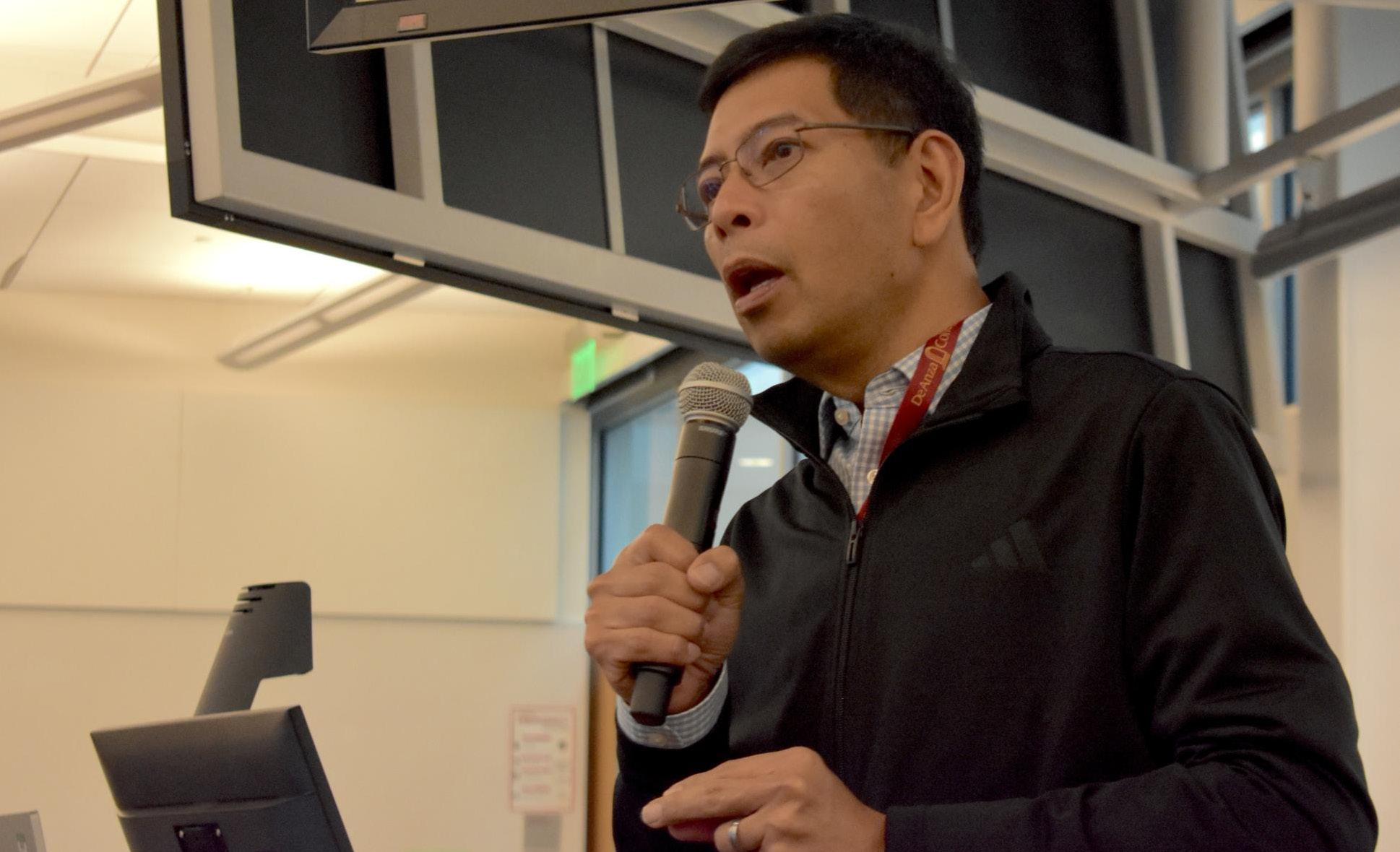
PHOTO BY GAVIN RUST
Vice Chancellor of Business Services Christopher Dela Rosa delivers a presentation on basic aid on April 14 in the Media and Learning Center. “Our primary sources of revenue are our property taxes and student enrollment fees,” Dela Rosa said. “For us, being basic aid is a blessing.”
By Gavin Rust LA VOZ STAFF
The Foothill-De Anza Community College District now draws most of its funds from local property taxes and enrollment fees.
The California Community Colleges system can transition districts that would receive more funds through property tax than the state would have allocated to a funding model called basic aid.
In prior school years, the district received a state apportionment tied to headcount, enrollment, success rates and other similar factors.
“Our primary sources of revenue are our property taxes and student enrollment fees,” Vice Chancellor of Business Services Christopher Dela Rosa said at an April 14 town hall. “For us, being basic aid is a blessing.”
"I’m sure you remember those days where we were chasing enrollment … All that logic is out of the window now."
Sam Bliss Associate Vice President of Instruction
At the April 13 Academic Senate meeting, De Anza College Associate Vice President of Instruction Sam Bliss called basic aid a “closed system” and said the college is “not going to grow.”
“I’m sure you remember those days where we (the college) were chasing enrollment, adding sections,” Bliss said. “You have those sections, we have more money to spend. All that logic is out of the window now.”
Foothill-De Anza Faculty Association president Tim Shively said he disagrees with Bliss and that the district could use its extra funds to offer more programs.
“The amount of tax revenue we’re taking in is not a closed system,” Shively said. “Basic aid districts have (generally) seen their revenue increase year over year.”
money, the (district) might stop trying to increase enrollment.”
Dela Rosa said while some districts adopted that philosophy, this district will not.
“We have a lot of checks and balances,” Dela Rosa said. “We have internal controls put in place in order for us to make sure we are spending our allocation based on what the board intends.”
Vice President of Instruction Ram Subramaniam said the funding the college gets from the district goes through its Resource Allocation and Program Planning committee.
"The amount of tax revenue we’re taking in is not a closed system. Basic aid districts have seen their revenue increase year over year."
Tim Shively Foothill-De Anza Faculty Association President
Swam Pyae Phyo, 28, biology major described the change as the “beginning of a disaster.”
“We’re entering dangerous territory,” Phyo said. “If you (the district) don’t have to focus on enrollment and receive the same amount of
“It is widely represented by faculty, staff, administrators and students,” Subramaniam said. “Everybody has a say in how funds are being allocated for the programs.”
The district joined eight other California Community College districts on basic aid last summer while the other 64 districts remain on state apportionment.
Youth leaders speak at San Jose City Hall

Students engage in advocacy around immigrant rights, civic, economic conditions
By Taylor Kim LA VOZ STAFF
South Bay student leaders called for youth involvement in civic engagement, immigrant rights and labor justice on April 24 outside San Jose City Hall.
Youth Voices Press Conference united student speakers, community organizations and local advocates to rally ahead of May Day or International Workers’ Day on May 1.
“I wanted to host an event where it’s youth-only speakers, where we share our perspective on what matters to us,” said Maria Blaze, 19, political science major and Foothill College student trustee.
Speakers addressed issues including immigration enforcement, education inequities and wealth disparities, connecting them to broader political debates before the June 2026 primary election.
Milpitas High School junior Alice Nguyen encouraged young people to advocate for what she sees as under-represented communities being threatened by President Donald Trump and Immigration and Customs Enforcement.
“I don’t think people in Congress or anywhere in our federal government should be 80 years old and making decisions for the youth,” Nguyen said.
Student organizers also shared their efforts to mobilize peers.
Jonathan Soria, 17, William C. Overfelt High School junior and a leader of William C. Overfelt for the People, a student-led activist group, said his group helped
coordinate student walkouts across multiple high schools.
“(My responsibility is to) let our community know that we’re there for them,” Soria said. “And our main goal, which is legalization for all (undocumented people).”
The Vietnamese American Roundtable and the Stanford University Peace and Freedom chapter partnered with the event.
Sabrina Sail, 23, Stanford Peace and Freedom member, said she felt encouraged by youth participation and described civic engagement as ranging from community support to public demonstrations.
“Solidarity looks like communities coming together and saying we know what we want,” Sail said. “And fighting this bigger enemy … (which) are the billionaires and the right wing.”
Oswaldo Hernandez, 19, Services, Immigrant Rigths and Education Network youth fellow said community involvement does not always require direct actions but can include smaller forms of support including emotional support.
“It’s important to be empathetic with everyone,” he said. “Even if it doesn’t affect you, it may affect someone else.”
The event concluded with a banner-making session for the May Day Strong demonstrations.
“If we don’t stand up for change, then our future is going to be controlled by someone else,” Blaze said. “We (want to) inherit a better future for everyone.”
PHOTO BY GIA KHANG DO
Maria Blaze, 19, political science major, delivers remarks outside San Jose City Hall during the Youth Voices Press Conference on April 24.
2 FEATURES
MAY 20, 2026
Editorial Board
Editor-in-Chief
Xitlaly Martinez
Managing Editor
Ann Peñalosa
News Editor
Gordon Yang
Sports Editors
Ashritha Chand Hayden Rush
Opinion Editor
Katherine Fritz
Photo Editor
Frank Mayers
Multimedia Editor
Meryem Arslan
Graphic Design Editor
Yosselyn Garcia Rodas
Social Media Editor
Jamie Watt
Staff members
Wylder Robison Cris Li
Lina Borges
Teymur Khanlarov
Gabe Manglona
Joshua Aguirre
Taylor Kim
Sam Eaton
Gavin Rust
Simona Sun
Caleb Randria
Ariel Alvarez
Rico Han
Haley Lillibridge
Damian Renteria Mata
Maceo Inoue
Tommy Ngo
Daenielle Tuico
Gia Khang Do
Schiera Ventura
Jonathan Nguyen-Au
Laila Zedan
Aileen Bucog
Godwin Taborada
Faculty Adviser
Farideh Dada
Office Managers
Ruben Pasaribu
Dicanio Darren Liong
About us
De Anza College students have written and published La Voz News since 1967.
Student access to La Voz is partially funded by the De Anza Student Government. La Voz News is printed by the Folger Graphics Company.
All rights reserved; no part of La Voz News may be reproduced without permission.
Staff editorials reflect the opinions of the majority of the editorial board and not necessarily the views of the entire La Voz Staff.

Pride is ‘queer and now’ Conference-goers ‘stand a little taller’
By Lina Borges LA VOZ STAFF
The De Anza College Pride Center celebrated queer ancestry and gave students advocacy resources at its Queer and Now conference on April 21 in Conference Rooms A and B.
“A lot of queer people don’t really have a connection, or (find it) hard to maintain a connection to their queer ancestors,” said Mariana Frias Da Costa, 20, English major and Pride Center student worker. “We wanted to make sure that we had an opportunity to hear from our elders.”
Rayceen Pendarvis, keynote speaker from Washington, opened
by reflecting on early HIV-stigma struggles and queer heritage.
“Find joy … Find what gives you purpose … Be creative. Be soulful,” Pendarvis said. “Celebrate your achievements and your accomplishments … Your life is your journey.”
Jamie Pelusi, Pride Center coordinator, said the conference’s 12-year legacy of creating connections began with professors Veronica Kieffer-Lewis, Julie Kieffer-Lewis, Roseanne Jeannini Quinn and Jessica Pari.
“We stand on the shoulders of the people that started this conference,” Pelusi said. “We are able to have this because they did what they did.”
Abril Torres, a 20-year-old music
VivaCalleSJ takes over the streets
City blocks Alum Rock roads for a car-free day
By Ariel Alvarez LA VOZ STAFF


Viva CalleSJ closed 6 miles of streets in San Jose’s Alum Rock neighborhood, allowing locals to walk, bike and roller-skate at its Eastside Quest event on April 19. Attendees followed a designated route and stopped at pit stops, which included professional wrestling, BMX riding, rock climbing and arts and crafts stations.
The event also featured vendors, live music and food trucks at Cimarron Park, Mexican Heritage Plaza and Alum Rock Village. The event also had bike repair stations and bike rentals for easier travel. Attendees stayed hydrated with water stations across the event.

Professional BMX rider Pete Brandt performs for the BMX Freestyle Team at Cimarron Park on April 19.
According to Viva CalleSJ’s website, the city program promotes healthy and safe neighborhoods, clean air and community. Its next event on June 14 spans from Japantown to the North Monterey neighborhood, shutting down parts of Market Street.
major attending for the second time, called the event transformative.
“Last year, I was friendless,” Torres said. “Coming here to support organizers — who are now my friends — and celebrate my identity has been amazing.”
Pelusi said the event tries to help students “stand a little taller, be a little more confident.”
“The Queer and Now conference is one of my favorite days of the academic year,” volunteer Victoria Kahler, who works at the De Anza Writing and Reading Center said. “I’m always looking forward to it because we have great keynote speeches, performances, activities and people getting to connect with each other.”
The planning process of the conference involved collaborative decision-making on meals, speakers and workshops.
“We had weekly meetings, and we all made the decisions
as a group,” Da Costa said. “We (talked about) what we would eat, who would speak and what kind of workshops we would have.”
Joyce Doanla represented the Santa Clara County Division of Equity and Social Justice at the conference to let students know of its resources.
“This is a crucial space for community connection and learning from speakers,” Doanla said.
Conference attendees sat in a drum circle, sang and prayed. They held tobacco before placing it at the center of the drum.
Angela Mendonza Dorantes, 20, biology major and Pride Center student worker, said the event was important amid growing targeting of queer communities.
“It shows how important it is to support and uplift each other and how important it is for an institution to support their students in this manner,” Dorantes said.
Club day comes back to the Sunken Garden
Students connect with clubs over music, food, performances
By Maceo Inoue LA VOZ STAFF
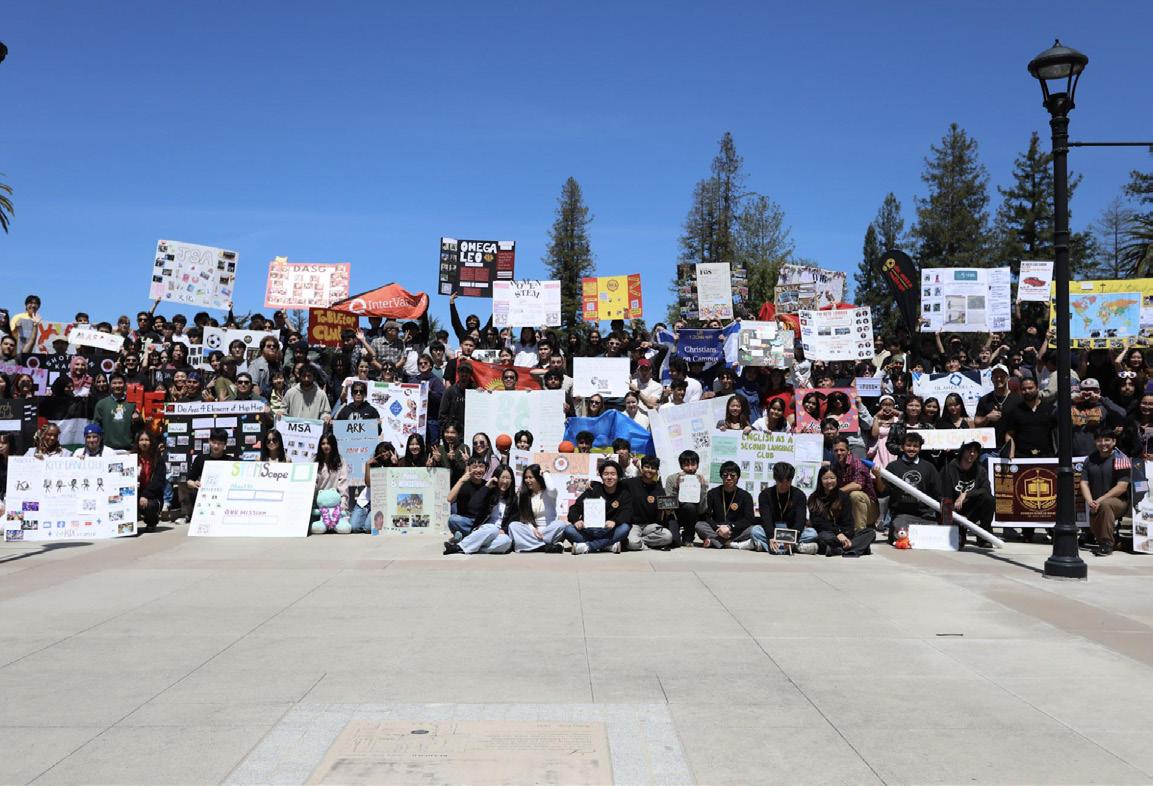
The Inter Club Council hosted its third club day of the academic year on April 23 in the De Anza College Sunken Garden. Students browsed and learned
about different clubs at the quarterly event.
Clubs showed off with the De Anza Auto Tech club showcasing its purple 1970 Dodge Dart dragster for all to see.
Club day also featured a DJ, food and karaoke from ICC members.
PHOTO BY LINA BORGES
Bay Area artist Naomi Takata Shepherd leads an art making workshop at the Queer and Now conference in Conference Rooms A and B on April 21.
PHOTO BY ARIEL ALVAREZ
PHOTO BY MACEO INOUE
Club members pose for the Spring Club Day group photo on the Sunken Garden’s stairs on April 23.
‘Mind the gap’
$800M transit deficit leaves students stranded

By Cris Li LA VOZ STAFF
Twice a day, 21-year-old biology major Perla Diaz completes a transit marathon: a SamTrans bus, a Caltrain ride and a VTA bus.
Without reliable public transit, Diaz said her “worst case scenario” would be relying on Uber every day, which is “not cheap.”
Diaz is one of many De Anza students who rely on public transit to get to school and work. Without new funding such as through the regional transit funding measure Senate Bill 63, these agencies plan to cut services starting 2027, leaving students with fewer ways to get around.
Caltrain, AC Transit, Muni, and BART must address a projected $800 million deficit total starting the fiscal year beginning July 1.
Before the pandemic, these agencies largely depended on fare revenue, mainly from downtown San Francisco commuters, to cover operating costs.
Transit agencies, especially those that cross county lines, have not recovered ridership, with remote work on the rise and downtown San Francisco still below 2020 occupancy.
service cuts.
Caltrain could cut weekday service to once an hour, end operations at 9 p.m., close over a third of stations and cut weekend service.
BART could close up to 15 stations, end service at 9 p.m. and reduce train service by 70%.
AC Transit could reduce service to half of pre-pandemic levels.
Muni could slash 20 bus lines, end regular service at 9 p.m. and halt cable car operations.
“They (transit agencies) are going to have to cut services if they want to be financially sustainable,” Neil said. “That is going to mean catastrophic results for our economy … and for our most vulnerable communities.”
One in five De Anza students live either outside Santa Clara County or in Milpitas, the county’s northeast-most city. The transit cuts disproportionately impact students who live farther from campus or take night classes.
"A sales tax is small in terms of the actual amount that you’re going to be paying per year. We’re getting so much for it in return. It is worth it."
Harry Neil 24, history major, Transbay Co alition South Bay volunteer lead
“The people who were commuting on Caltrain, BART or AC Transit and then taking Muni … stopped,” Harry Neil, 24, Transbay Coalition volunteer lead of the South Bay and history major, said. “Enormous, enormous financial deficits came about because of that.”
To stay afloat, Bay Area transit agencies plan to make drastic
students to either leave earlier or rely on AC Transit buses, since BART plans to end service by 9 p.m. starting January without new funding.
BART would also hike fares by 30% and reduce frequency from every 10 minutes to 30 minutes.
According to the American Public Transportation Association, every $1 billion invested in public transportation yields $5 billion of long-term economic benefit.
“For $800 million in cuts, that’s $4 billion of damage to our region’s economy,” Neil said.
Cutting public transit services will have broader consequences beyond economics.
“These budget deficits will inevitably increase traffic congestion and make our cities even more auto-dependent, exacerbating greenhouse gas emissions and climate change,” Jana Sanders, parttime environmental studies faculty, wrote. “Public transit is essential to meet our regional climate targets.”
“I see a lot of working people or students late at night after their shift (on public transit),” Diaz said. Reduced Caltrain service would bar students who rely on it from taking late classes in person.
“It would be really tight for me to get there (to and from campus) schedule-wise,” Diaz said. “Worst case scenario, I would have to get an Uber everyday. It’s not cheap.”
Hour-long gaps between trains would cut into time for homework, jobs or rest in addition to extra buses to get home.
Student commuters from Milpitas and the East Bay would have even less time on campus, forcing

On Oct. 13, Gov. Gavin Newsom signed the regional transit funding measure SB 63, also known as the “Connect Bay Area Act.”
“The bill authorized a signature-gathering effort to go onto the ballot,” Neil said. “Whether it’s here in Santa Clara County, up on the peninsula, in the East Bay or in San Francisco.”
Supporters must collect 186,000 signatures by September to advance the regional transit funding measure onto the November ballot.
The measure aims to resolve the $800 million transit deficit with a half cent sales tax in Alameda, Contra Costa, San Mateo and Santa Clara counties and a one cent sales tax in San Francisco county for 14 years.
The tax is expected to generate over $1 billion for Bay Area transit agencies to maintain current services, enhance bus routes for VTA and SamTrans, preserve Muni routes and improve rider experience across the Bay Area.
While agencies could start receiving funding from SB 63 in 2027 if it passes, Newsom also approved a $590 million emergency bridge loan on Feb. 19 to support Bay Area transit agencies in the interim.
“For agencies where their budgets are over a billion dollars per year, that only goes so far,” Neil said.
However, some voters say SB 63 is unnecessary and argue transit agencies should seek alternate funding sources.
“There’s enough money in there,” Ivan Kojnok, automotive technology instructor, said. “It’s a mismanagement issue.”
Despite running a deficit, the San Francisco Standard reported that BART had 100 employees earning more than $285,000 in 2023 while the Los Angeles Metro, which serves more riders, only had 15 employees earning more than $285,000 in 2023.
BART argues it is more cost-effective than L.A. Metro based on the National Transit Database.
“The public’s willingness to support repeated taxes cannot be assumed,” Gov. Gavin Newsom wrote in his SB 63 signing message. “Some transit systems fail to adequately demonstrate stewardship, accountability and innovation.”’
SB 63’s provisions include an independent committee that will oversee Bay Area transit agencies and regularly review their financial efficiency.
“A sales tax is small in terms of the actual amount that you’re going to be paying per year,” Neil said. “We’re getting so much for it in return. It is worth it.”

INFOGRAPHIC BY ANN PENALOSA
PHOTO BY ANN PENALOSA
With the Bay Area Rapid Transit system facing a financial deficit, its doomsday scenario would close all stations on the San Francisco peninsula south of Daly City, with the exception of its airport connection. This would end Millbrae’s status as an intermodal train station, severing BART’s only connection to Caltrain. Photo taken on Jan. 11 at SFO station.
PHOTO BY ANN PENALOSA
Students from the Inter Club Council play a board game during a committee outing on Oct. 30 while taking the Caltrain. The agency’s outlined cuts, which include eliminating weekend trains and half-hourly service, could make student outings such as this harder to coordinate, if not unfeasible.