PANTHER
the
V 61 N 5
Miami Palmetto Senior High School
7460 SW 118 Street, Miami, FL
Thursday March 21, 2019
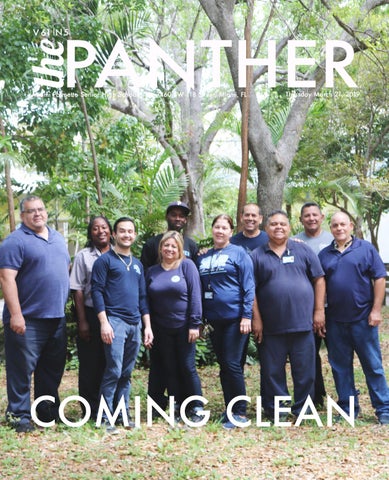
COMING CLEAN
2 CONTENTS
N E W S BRIEFS
CONTE V61 N5
FAST FOOD IN FLORIDA
Rental resource site, Apartment Guide, released their list of the top 10 cities for fast food consumers in the U.S. The list based its results on each city’s ratio of the number of franchises of the largest fast food chains in the country to the municipal population. Not only did three Florida cities make the list, but two of them rank at the top. Orlando sits at first with 265 restaurants and a population of 280,527 people, while Miami ranks as second with 318 restaurants and a population of 463,347. Tampa came in as eighth on the list with 200 restaurants and a population of 385,430.
ON
THE COVER The cover of this issue contains a photo of the custodial staff, containing members of both the day and night shifts. Photo taken by Joanna Salvat (11).
MARYLAND BANS FOAM CUPS Maryland’s House of Delegates recently signed a bill to ban polystyrene foam containers and cups. The bill’s fate now sits in the hands of Governor Larry Hogan, and if it passes, Maryland will become the first U.S. state to ban foam containers. Delegate Brooke Lierman, who sponsored the bill, cites the negative effect the containers have on the environment, especially the oceans. This comes after several companies and cities, including Pinecrest, resolved to stop using plastic straws.
LETTERS TO THE
EDITOR
Dear Editor, CHRISTCHURCH SHOOTING
On March 15, at approximately 1:40 p.m., a gunman opened fire on worshippers at the Al Noor mosque in Christchurch, New Zealand. 42 worshippers were killed on the spot and one later died at the hospital. Fifteen minutes later, at 1:55 p.m., the shooter arrived at another New Zealand mosque, the Linwood Islamic Centre, and killed seven more people before a worshipper named Abdul Aziz Wahabzadah drove him off. The shooter has been revealed to have ties to numerous far-right organizations.
“I thoroughly enjoyed “For the Love of Dogs” by Lindsey Solomon. I love how it mentioned Paws4You, a local nonprofit animal shelter that does so much for our community.
SINCERELEY,
GIANNA HUTTON (9)
Dear Editor,
“I really enjoyed Isabel Wilder’s story because it showed the true colors of popular companies. I think this story really achieved the goal of journalism.
SINCERELEY,
KATE STUZIN (9)
ENTS
11
6 8
11FEATURE An inside look into the daily lives of our custodians.
17
06 08life
news
Florida’s vote on corporal punishment.
The impact of toxic fashion on the environment.
20 17 opinion 18 sports
A preview of Palmetto’s up and coming talent.
Pinecrest’s last straw?
4 NEWS
WATER
You going TO
vote?
PINECREST RESIDENTS VOTE ON WATER SYSTEM
Starting on March 6, Pinecrest residents will vote on a water referendum to complete the water and sewer infrastructure for the 739 residents who do not currently have access to it, according to the Village of Pinecrest. “So you have about three weeks to choose whether you want or do not want to support a $15 million bond, which would complete our water infrastructure in Pinecrest,” Pinecrest councilmember Katie Abbott said. “Right now we have 739 homes who are still on well water, and that money would pay for putting county lines down those streets and putting fire hydrants on the road.” The water system is not run by Pinecrest as a village, Miami Dade County Utility owns the infrastructure and provides water to all the housing that have access to it. However, MDC has a policy that they will not pay for new infrastructure, only renovate what already exists. While some believe that they should not have to pay for other people to connect to a county waterline, voters who want the
PHOTO BY GEMMA TORRAS
referendum to pass argue that the remainder of well water in Pinecrest could ultimately bring property value in Pinecrest down because of the environment. “Homes that are still dependent on wells are having contamination in their wells… and then you add in the saltwater intrusion,” former vice mayor Cheri Ball said. “At some point we’re going to have a high level crisis, that puts people literally out of their homes and creates a very negative image of what Pinecrest is.” If Pinecrest residents vote to approve the new infrastructure, the Village will pay for it using ad valorem tax bonds, or a tax based on property worth. Pinecrest residents will pay a maximum of 23 cents per $1,000 of their home’s tax value. “We’ve been talking about this for 20 years. The problem is not going to go away, it’s just an issue of who’s going to fund it,” Abbott said. Fire hydrants make up the rest of the water referendum, since many streets do not have access to a fire hydrant in case of emergency. If the referendum passes, the plan involves
building 208 hydrants around the Pinecrest Village. The timeline for the construction of the new waterline and hydrants would bring the date of completion close to spring of 2022, three years from now. This would significantly affect residents whose houses are in the path of construction. After that date, the 739 homes without access to county water currently will have 10 years to connect. They will have to pay anywhere from $2,500 to $5,000 to connect to the water, leaving the rest of the cost to Pinecrest residents as a whole. “Forget that it’s just five, 10, 100 homes, it’s the entire image of the city. So yes, it becomes a project that to move it forward, needs the support of all of the homeowners to fund it,” Ball said. “It will ultimately be something that benefits all of the residents.”
Nicole Markus Copy Editor
n.markus.thepanther@gmail.com
The Last Opportunity
O
NEWS 5
PALMETTO STUDENTS REFLECT ON MARS ROVER’S LEGACY
pportunity: a fitting name for the persistent Mars rover that changed the game for Mars exploration. As the second rover to explore Mars, Opportunity’s work on Mars furthered the advancement in the search for signs of life on the “Red Planet.” Although the rover was only set to last for a 90-day mission, it persisted. For nearly 15 years, Opportunity continued collecting evidence for research on Mars. However, in June of 2018, a dust storm hit Opportunity which ended communication between Space Flight Operations Facility at NASA’s Jet Propulsion Laboratory. On Feb. 13, 2019, they made their last attempt at communication with the rover after thousands of tries over a course of eight months, receiving no response. Opportunity’s journey began at Cape Canaveral Air Force Station in Florida on July 7, 2003. A few months later, the rover landed on Mars on Jan. 25, 2004. The rover explored different terrain, now called “Perseverance Valley,” to study possible dry riverbeds and hills, all while collecting samples for research. “So the Opportunity Rover represented the tip of the iceberg when it comes to exploring Mars,” junior and Astronaut Challenge participant Chloe Wilson said. “It collected soil and rock samples to add to the body of knowledge scientists have in regard to the planet right next door.” Through Opportunity’s explorations, the rover also experienced many mishaps. In 2005 and again in 2017, the rover lost control of its wheel and in 2015 the rover lost most of the research stored in its memory drive. Nonetheless, Opportunity successfully showed possible signs of life. Through
Took
samples collected, the rover found a mineral containing water, known as hematite. “Opportunity set the stage for future Mars exploration trips that are made with people and not just robots,” junior and Astronaut Challenge participant Daniel Fein said. “Likely within the next 15 years, we’ll start getting ready to go to Mars ourselves and we now know how to navigate the surface and make sure that the first man on mars lives to come back home.” Considering the original predictions of the rover’s lifespan, Opportunity lived a long life. Only expected to live for 90 days on Mars and to travel 1,000 meters, around 15 years later Opportunity clocked in over 28 miles while taking 217,000 photos and collecting 52 rocks to check the minerals. Back on Earth, the Astronaut Challenge allows students to learn more about space exploration at the Kennedy Space Center. “Astronaut Challenge is a challenge involving a space simulation, an engineering challenge, landing a spacecraft challenge and a lab presentation,” sophomore and Astronaut Challenge participant, Ella Sleeman said. The group representing Palmetto this year consisted of Chloe Wilson, Daniel Fein, Daniel Rodriguez, Ella Sleeman, Abdul Khan and Adonis Borges. The challenge allows students to test the waters of space missions. “Astronaut Challenge is a competition that imitates the thought process and practices that real scientists, engineers, pilots and commanders undergo before participating in space exploration,” Wilson said. “Of course, it is not nearly as complex, but it allows students to get a taste of what happens behind the scenes of a mission.” Not only does Astronaut Challenge
give students a hands-on experience, it also provides a teaching opportunity about NASA’s work. “It’s really interesting to learn about the highly detailed and organized systems that helped 133 missions safely into space,” Fein said. “The shuttle was the industry’s first transition toward reusability, which has since dramatically reduced the cost of getting to space and allowed for much more accessible exploration.” Although we must say goodbye to Opportunity, the rover paved the way for even further research. Currently, JPL’s rover, Curiosity, continues to collect research. Also, the Mars InSight Team plans to launch a lander on Mars’ surface for further studies, and recently received a proclamation from the LA County Board of Supervisors on Feb. 19, 2019. Much more awaits with the Mars 2020 Rover Mission, which will hopefully land on Mars on 2021 to continue Opportunity’s research on inhabitable areas for humans on the Red Planet. “As the leading international force in technology and largest economy in the world, it is our responsibility as a nation to ensure that space is accessible and exciting to future generations,” Fein said. “Humans are naturally drawn to frontiers and it is important that we keep those frontiers in a position where they can inspire younger generations and continue to push the envelope in terms of what is possible.”
Gemma Torras
News and Design Editor
g.torras.thepanther@gmail.com
The Rover’s Accomplishments:
217,000 images Collected 52 rocks Traveled
28 MILES
INFORMATION COURTESY OF NASA SCIENCE INFOGRAPHIC BY GEMMA TORRAS
Law in progress FLORIDA’S BILL TOWARDS BANNING CORPORAL PUNISHMENT
6 NEWS
Annette Taddeo, a Democratic member of the Florida Senate, filed a proposal that could potentially ban all corporal punishment in Florida’s public schools. The proposal was introduced to the Senate on March 5. Taddeo’s proposal defines corporal punishment as using physical violence or physical contact as a means to punish a student or enforce school rules. While Florida currently allows some corporal punishment, they restrict some aspects of it. Twenty-seven out of 68 counties still practice it today. Florida state law requires that corporal punishment be practiced within guidelines set up by the principal of the school and it must follow the school board’s policies. State law mandates that along with the principal, another adult needs to be present during the time of punishment and the parents must receive an explanation. The only exception to the proposed law, states that corporal punishment remains justified if a school faculty member uses it as a measure of defense for themselves or another student.
PHOTO BY JOANNA SALVAT
“This form of punishment is absolutely unacceptable,” Palmetto geometry teacher Jessica Lorenzo said. “It is outdated and should no longer be used.” Taddeo wants to ban corporal punishment due to the psychological effects it can have on children. A study published in the Pediatrics Journal concluded that anxiety and other mental health issues can occur later in life when a child receives physical punishment. The study defined physical punishment as any form of pushing, grabbing, smacking or hitting. For example, paddling remains as the most common form of corporal punishment. The study discovered 2-7 percent of the mental problems include bulimia, depression, personality disorders and even learning disabilities, which stem from receiving such punishments as a child. “I have no long term anger, resentment or anxiety over being punished,” psychology and economics teacher Aretha Hutchinson said. “However, I do believe that some children are psychologically damaged by corporal punishment especially when
it crosses the line of becoming physical abuse.” Shortly after announcing her proposal, Taddeo branded the practice of corporal punishment archaic on Twitter. She also mentioned how the idea to ban corporal punishment came from her daughter, who made Taddeo aware that the practice still occurs in Florida today. Some people worry that corporal punishment will make children scared of school. Hutchinson also recalls learning from her mistakes and fixing them when she received physical punishment as a child. “I didn’t approve of corporal punishment with my own children,” Huchinson said. “So I definitely would not be comfortable hitting someone else’s child.”
Sydney Campbell Design Editor
s.campbell.thepanther@gmail.com
DIGITAL DOCTORS With today’s everchanging technological advancements, the medical field is no exception to improvement. Apps such as “Doctors on Demand” and “My Therapist” gained momentum and popularity recently, eliminating the process of making an appointment and physically going to a physician’s or therapist’s office. These apps offer a wide selection of doctors ranging from dermatologists to psychologists. According to the app “Doctors on Demand,” all physicians are certified and registered medical professionals who currently practice or previously practiced medicine. Patients also receive access to the profiles of different physicians before selecting one. Viewing profile qualities such as physician experience, location and reviews from previous patients gives users the power of choice. Financially, physician apps remain significantly cheaper than a traditional office visit. According to the Johns Hopkins School of Medicine, the average physician app saves users about $100 to $125 per session. A regular doctor’s appointment costs around $200 and an average trip to the psychologist costs $175 per hour for individuals without health insurance. Talk apps or mental health apps provide free access for users to have support through a tough time. A talk app connects the user with someone who will calm them down and discuss their issues with them via text message. “Over the summer, I volunteered as a listener on this app called ‘7 Cups of Tea.’ Basically it’s someone who talks to people who come to the app when they’re struggling and
don’t really have anyone else they feel comfortable talking to for help,” junior Victoria Amorim said. While apps like “7 Cups of Tea” do not provide a professional mental health counselor with a degree, they educate listeners on handling certain situations with a brief instructional presentation. Unlike a regular therapist, talk apps often provide a
HONESTLY THE FACT THAT SOMEONE IS REACHING OUT AND GETTING HELP AT ALL, IS WHAT MATTERS. DR. STACY JONES
person of similar age groups and issues. “It can be something as simple as ‘Oh, I had bad day’ or serious like ‘I want to kill myself’ and although therapists understand things and are trained, sometimes it’s helpful to talk to someone your own age who has been through a similar thing or experience,” Amorim said. Although app therapists and talk apps may provide an immediate response and comfort behind a screen, speaking face-to-face with someone allows for a stronger personal connection and evaluation. While seeking
07 LIFE
REDEFINING
THE MEDICAL FIELD
any medium of help proves a step in the right direction, the fact that people are not talking to a licensed therapist or counselor can be misleading or even detrimental for the patient. “I personally believe that face-to-face communication is the best way to receive therapy because when someone is sitting in my office I can see their body language and facial expressions that allow me to better understand their pain and see if they have physically harmed themself,” therapist Stacy Jones said. Talk apps oftentimes provide a two-way relief, benefitting both the person receiving help and the person providing help through their exchanges. “Sometimes helping people in the app, kind of serves as a therapy for me. Like when I’m super stressed, helping other people with their problems helps keep my mind off things and I won’t overthink,” Amorim said. Talk apps, therapy apps or physician apps are not the most professionally suggested outlet for mental health help or medical attention. However, no matter the medium one chooses for help, the fact that they receive help can make all the difference. “These apps are a great way for people struggling and don’t want to or can’t reach out to a therapist in real life to get some sort of help,” Jones said. “Honestly the fact that someone is reaching out and getting help at all, is what matters.”
Olivia Solomon
Business Manager
o.solomon.thepanther@gmail.com
08 LIFE
TOXIC
PHOTO COURTESY OF CHLOE GALLIVAN
FASHION
THE ENVIRONMENTAL IMPACT OF THE FASHION INDUSTRY In the wake of global environmental awareness, like the recent widespread ban of plastic straws in the Pinecrest community, another movement seems underway: reform of the fashion industry. “I have heard the term toxic fashion, usually referring to the external issues that the production of clothes introduces, which are more commonly recognized as ethical issues but also includes environmental impacts from it,” freshman Science Bowl, Envirothon competitor and chemistry student Julian Orrego said. According to The Independent, clothing comprised of polyester —a synthetic fiber— sheds toxic microfibers when rinsed in a washing machine. These particles travel into the plants that regulate water and sewage, undetected. This circulates the non-biodegradable polyester into the ocean and other bodies of water, later consumed by plankton. The food chain leads them all the way to unknowing fish, and eventually humans. “So there is a concept called biomagnification, which ensures that if the fish population ingest said contaminants, they will reach us in a more concentrated form,” Orrego said. “This would likely not be mentioned due to the widespread panic it would cause if people knew that their clothing is indirectly poisoning them.” Greenpeace, an international environmental organization, currently spearheads a mission to educate the
public on other unknown toxic materials. Evaluated in studies supporting their initiative, the “Detox Campaign,” asserted 11 dangerous chemicals in clothing remain unregulated and are actually permitted in the clothing industry. The status of this permission seems generally unbeknownst to the public; to ascertain the sustainability and safety of clothing, they will include what are called certified GOTS, Cradle to Cradle or OEKO-TEX tags. However, many seem unaware of these certifications and the need for them. “I actually had no idea that fashion and the environment interact to that extent. To be honest, I would try to make changes but then probably forget and go back to the same pattern,” junior Lissette Martinez said. “I think [companies] should educate the public so that they can constantly remind us…” Amidst this new publicization of the environmental consequences of toxic fashion, some of the world’s largest companies in the industry make their road to reform evident. Due to Greenpeace’s “Detox Campaign,” more than 70 of these companies currently commit themselves to what Greenpeace dubs “Detox by 2020.” The criteria includes a pledge to remove toxic chemicals from supply chains. These companies account for a total of 15 percent of global textile production. Putting that into perspective, well-
known brands like Adidas, Puma and Nike pledged for completely toxic-free production by the year 2020, but they remain some of the few taking concrete action in doing so, at least for now. “I think that because they are such big brands they will get good publicity from going toxic-free and other companies will see them doing that, and kind of simulate that pattern,” Martinez said. Outside of the industry, awareness of toxic fashion and efforts to publicize it remain sparse. “I think it is quite problematic that we are not doing anything to raise awareness to this, as we are simply brushing aside the problem instead of searching for alternate solutions to it,” Orrego said. “This ignorance to our effect on the environment may also have a domino effect on our ecosystems, when enough of the pollutants in our clothes reaches those fish and therefore the other organisms in the ecosystem, it will lead to a mass decrease in biodiversity and a dying off of organisms, forever impacting our ecosystems in a way that may be too difficult to fix.”
Allison Strasius Feature Editor
a.strasius.thepanther@gmail.com
ADS 9
Miami and the World. Harper Meyer is a full-service Miami law firm offering its clients highly personalized attention. We represent significant international enterprises and family offices in the U.S., Europe, Latin America, the Caribbean and around the world. Tax planning Trusts and Estates Immigration Intellectual Property Aviation & Maritime Real Estate Corporate Business Mergers & Acquisitions Franchising and Licensing Commercial Litigation & Arbitration
HM
HARPER | MEYER 201 S. Biscayne Blvd., Suite 800, Miami, FL 33131 www.harpermeyer.com
10 ADS
LTE
4:45
A Advertisement Have you heard about “CRE� ?
No, what is that? They are a full service appraisal and valuation firm
Really? yea! and rumor has it they are the best in Miami at what they do
OMG! I am telling everyone I know
Mick Stikma, MAI, MRICS + 1 786 533 1245 crevaluationservices.com
FEATURE 11
UNSUNG HEROES
12 FEATURE
behind the broom: Back in 2004, Juan Manuel Corredor worked as a paraprofessional. Fifteen years later, he has become the longestworking custodian at Miami Palmetto Senior High School. It was when he realized that in order to achieve success in America, he needed year-round employment, which he could not find in working with the handicapped. “Then, someone told me, ‘If you work as a custodian, you’ll work for 12 months out of the year.’ Then, I started in Sunset, then I went to South Ridge, and as custodian, I began in Palmetto in 2004,” Corredor said. He goes about his job with the mindset that he can take on anything that comes his way. His day-to-day routine keeps him busy, as many of his duties require him to be in multiple places at once. “I am a custodian, the first thing that I do is clean the cafeteria, and clean the hallways, check on the bathrooms, the outside areas, check in deliveries when they come in, and whatever else comes my way,” Corredor said. Corredor works with nine other custodians, who also want and work for
the school’s best interests, especially in extreme circumstances. When Hurricane Irma, a Category Five storm, hit Miami, the custodial staff prioritized getting the school organized and prepared for the students’ return. Although they also had homes and family affected by the hurricane, the custodians attempted to restore the learning environment, keeping students in mind. “...[A memorable experience of mine was] when we had Hurricane Irma come by, the complete disaster and how quickly we worked together, so that when you came back to school, the school was ready for you,” custodian supervisor Maria Medina said. While these efforts may be lost on some, it fails to discourage the custodians from continuing their work. Not motivated by receiving student recognition, the custodial staff works towards making a difference in the lives of students, whether they realize it or not. “I supervise the cleaning department, making sure that each day the school is clean, that everything is okay, that the students are comfortable and that they
feel good in the school,” Medina said. Students often leave trash behind with the idea that since the custodians get paid for cleaning, picking up students’ trash gives them work that they get paid for in the end. By contrast, other students acknowledge and appreciate the efforts of the custodial staff and wish that their peers saw it their way. “I recognize the efforts of the custodians that clean our school and I appreciate their work,” junior Natalie Ives said. “The students at this school don’t appreciate the work that custodians do nearly enough, and I have to say that we are pretty disrespectful.” The custodians know that students often scrutinize their work. When the 10 custodians spend hours cleaning up the trash produced by the approximate 2,800 students at Palmetto, they wish that students made more of an effort in better understanding the importance of cleanliness, not just for the school, but for themselves as well. “Not everyone is the same, some are cleaner and more organized, others are dirtier and more disorganized. What I would tell them is not only for school,
TEAM C
FEATURE 13
but in life, organization is important no matter where they are,” new custodian Belkys Garcia said. “You should be clean and organized for your own benefit. Not thinking of whether there is somebody who will clean up after you because it’s their job, but rather to do the right thing.” Students fail to recognize the amount of grunt work that goes into school maintenance. The custodians work at staggered hours, with shifts lasting from three hours to 12 hours daily. Their jobs encompass taking care of every need within the school, no matter how miniscule it may seem. “I clean, I dust the classrooms, pick up and throw out the garbage, put toilet paper and paper towels in the bathrooms, clean the walls, change the lights that aren’t working, clean, strip and wax the floors,” custodian Alberto Roig said. Many of the messes students leave behind put a strain on their workload. Although the custodial staff often receives disrespect from the students at Palmetto, they still
CLEAN
14 FEATURE
10
custodians approximately
2,800 students
up to
12
hour shifts up to
15
years of experience
feel motivated to clean up and maintain the school. “My effort, my dedication, my spirit of doing my best everyday makes it worthwhile, and that the students feel good about what we’re doing for you,” Roig said. In terms of their relationship with the rest of staff, despite not directly working alongside teachers and administration, the custodial team still feel a part of the Panther family. The staff, including Palmetto counselor and college advisor Harry Nerenberg, recognize the efforts of the custodians. “I have never seen the school cleaner than it has been in years, and I think it has a lot to do with the relations they have with Mrs. Dobbs, Mr. Hunter and the rest of the administrative staff,” Nerenberg said. Despite how some students may not appreciate their contributions to the school, their efforts do not go unnoticed. In the eyes of the custodial staff, the relationship between
themselves and students should consist of mutual respect. Little things, like picking up bits of trash off of the floor and throwing away one’s lunch, make all the difference. “The job that we do is very important to maintain the school looking good and clean, and if everyone pitches in, instead of throwing things on the floor, they could throw it in a garbage,” Corredor said. “That would be a good way to cooperate with us.”
Isabel Wilder Copy Editor
i.wilder.thepanther@gmail.com
Joanna Salvat Life Editor
j.salvat.thepanther@gmail.com
15 SPORTS
Marlins
REBOOT
The Progression of the Marlins Rebuild On Oct. 25, 2003, the Florida Marlins won their second World Series in franchise history. Since then, they have not won another playoff game. Despite having elite players like two time Silver Slugger Hanley Ramirez and National League MVP Giancarlo Stanton over the last 15 seasons, the Marlins have not surpassed 90 wins since their 2003 World Series victory against the New York Yankees. In October of 2017, a new group of owners, led by former Yankees shortstop Derek Jeter, took over the franchise and traded away several star players in exchange for numerous younger prospects. Jeter and the Marlins ownership group hope that these players will develop into superstars that can turn the franchise around in the next few years. “We have a lot of good, young players. [This season] is about getting them experience,” Marlins pitcher Jeff Brigham said. “We’re going to be competing, we have a lot of talent.” Although the franchise wants to focus on developing their young talent, both the players and team management alike agree they will still try to win as many games as possible this season. “The main goal is always to win,” Marlins pitcher Riley Ferrell said. Some fans were upset when the Marlins traded away their star players, such as catcher JT Realmuto, infielder Dee Gordon and outfielders Christian
Yelich and Marcell Ozuna, but others have mentioned that the Marlins received several promising prospects in return. Some prospects play with the Marlins minor league affiliates, while others are preparing to play for the Marlins 40 man roster this season. In the Realmuto trade this season, the Marlins acquired minor league pitcher Sixto Sanchez, the new top prospect for this upcoming season, according to the MLB. In the Yelich trade, the Marlins acquired outfielders Lewis Brinson and Monte Harrison. Brinson was considered the Marlins top prospect in 2018 before being named to the team’s Opening Day roster. Harrison is currently the Marlins third best prospect and the Marlins added him to their 40-man roster following the 2018 season. The Marlins acquired pitcher Sandy Alcantara and three other minor leaguers in the Ozuna trade. Currently the Marlins fifth best prospect, Alcantara made his major league debut last season after called up by the Marlins in June. Finally, in the Gordon trade, the Marlins acquired pitcher Nick Neidert and two other minor leaguers. Currently the Marlins fourth best prospect, Neidert earned the team’s Minor League Pitcher of the Year award in 2018. “[The organization] has made tremendous steps positively,” Marlins
outfielder and 2018 first round pick Connor Scott said. While some Marlins prospects were acquired via trade, others have come to the organization through other methods. The Marlins second best prospect, Victor Victor Mesa, defected from Cuba in 2018 and signed with the Marlins later that year. Meanwhile, the Marlins also drafted several prospects that have already risen quickly through the organization. The Marlins signed 16 of their draft picks from the 2018 draft, most notably Scott and catcher Will Banfield. Scott is currently the Marlins sixth best prospect, while Banfield, the 69th pick in the draft and ranked as the Marlins eleventh best prospect. Scott is the youngest player out of the Marlins top 10 prospects. The Marlins have struggled in recent years when it comes to making the playoffs. However, with new young players coming into the league soon, the fortunes of the Marlins may change. Although the Marlins currently have the second worst odds to win the World Series this year, it will be worth keeping an eye on the Fish for the next few seasons.
Jack Meyer
Sports Editor
j.meyer.thepanther@gmail.com
SPORTS 16
bringing in THE
dough how selling bagels helps fund athletics
With 144 bagels sold each day, the dedication of Advanced Placement human geography teacher John Hayduk leaves no bagel unsold. Since the creation of the Athletics Department at Palmetto, a fundraiser selling food has always existed to help raise money. Each day for over 25 years, bagel sales between each period have raised money for Palmetto Athletics. “All of the money that is created or gained by bagel sales goes to the Athletics fund, which helps fund teams to go to state, funds buses for transportation and helps pay for new uniforms,” Hayduk said. Each day, Hayduk orders 144 bagels from Outrageous Bagels. The bagels are either delivered to the school or he drives there himself. With the help of student aides, Hayduk sorts all of the money and sales, creating a reliable food source for hungry students. “I don’t usually eat breakfast at home so I eat it here. It’s a nice way for me to get food,” sophomore Kaitlyn Givens said. Each bagel sells at a price of $1.50.
Half of the money goes to paying for the bagels, while the other half goes to the athetics department, helping offset the costs for teams that do not have a booster club. “I think it’s huge,” Hayduk said. “I think if it wasn’t for the bagel sales, we would not be able to fund all of our programs.” On average, sales help generate $8,000-10,000 per year for Panthers Athletics. In past years, each coach sold bagels in several hallways, but this system shortened to only Hayduk and health teacher Joyce Brislawn, who are tasked with providing the breakfast food in order to keep a better track of the incoming money. “Kids come who just can’t wait for it,” Brislawn said. “It’s kind of a Palmetto staple and it goes to a good cause.” In 1997, the athletic department sold Krispy Kreme donuts and later pastelitos, but as a result of the Michelle Obama “Let’s Move!” nutrition campaign, the fundraiser switched to bagels, a healthier food by comparison.
“I’m known as the bagel man,” Hayduk said. “I don’t mind selling bagels, it gives me something else to do during the day.” The option of a cinnamon, cheese or classic bagel each day provides an easy way to access food for the students who neglect to eat breakfast before school. “If you’re not going to eat breakfast, it’s a good way to get your brain working and it gives the brain the glucose it needs to function,” Brislawn said. “It’s better than pastelitos.” The sale of each bagel not only benefits the Athletic Department, but contributes to its legacy at Palmetto. “I think it is a niche, I think it is really cool that my bagels have been mentioned in many of the senior speeches at graduation,” Hayduk said. “It has become a part of Palmetto.”
Natalie Askowitz
Print Editor-in-Chief
n.askowitz.thepanther@gmail.
ROOKIES ON THE Lauren Chong (9)
Lauren Chong puts her whole heart into every sport she plays. After playing basketball for Palmetto, her coach recognized her athleticism and suggested track to her after the season ended. “Coach Donnie recommended me after basketball to do it, so I just tried out for it. And now I actually really love it,” Chong said. This same coach has helped support and encourage Chong throughout her athletic endeavors. “Coach Donnie has made the biggest impact on me because I’ve done track with him and also basketball. He’s just a really easy person to talk to,” Chong said. Chong has track practices five days a week, and each practice lasts two hours in the blazing Floridian sun. “It is super hot, but Coach Amy and Mr. Reynolds and Coach Donnie are really good coaches and they help us get better at the sport, and to also have fun at the meets,” Chong said. Although Chong started running track this year, she thoroughly enjoys both the meets and the bonds she has made with her teammates as well. “The track team is like a little second family,” Chong said. Chong plans to continue to run track, in spite of the 80 degree afternoon practices.
Dylan Weinberg (10)
In the seventh grade at Palmetto Middle School, Dylan Weinberg made the fateful decision to join the brand-new, middle school lacrosse team. “Honestly, I just picked up the sport because my Dad thought I should try out,” Weinberg said. His Dad’s nudge in the direction of lacrosse paid off. Weinberg became hooked. Nearly four years later, Weinberg now starts on attack on Palmetto’s lacrosse team. He has a rigorous lacrosse schedule on the weekdays and weekends throughout the school year and summer season. “Now that we’re in season… usually just two hours on the field and an hour in the gym. On weekends it’s two sessions, an hour each,” Weinberg said. During the summer and off-season, Weinberg plays for the Miami Stone Crabs Lacrosse team. He credits many friendships towards his off-season playing time, as well as being able to meet and train with professional coaches. “It’s a great way to get to know people from other schools. Since, at least for public schools, there’s not a lot going on off-season, so that forces you to meet new coaches,” Weinberg said. “Most of them are from private schools, so you get to meet the private school coaches, the private schools kids. And now, during the season, it’s a lot more fun because I get to play against my off-season teammates.”
RISE
17 SPORTS
Nicolas Garavito (9)
Nicolas Garavito started playing soccer at the age of four, and still finds joy in the sport nine years later. His older brother, Alejandro Garavito, began playing at Pinecrest Premier and inspired Garavito to take it up as well. With Colombian roots, Garavito, along with his cousins and family, constantly played and watched soccer growing up. This enthusiasm for soccer furthered his love for the sport. As a freshman on the Palmetto varsity soccer team, Garavito consistently practices two hours a day, while also playing for a club soccer team, Kendall Soccer Coalition. This travel team takes him all over Florida and fills his weekends with soccer. “[I play in tournaments at] IMG, and in Tampa, Orlando, Palm Beach sometimes,” Garavito said. Garavito cites his main reason for continuing to play because of his passion for the sport and the many friendships and connections he has made with players from other schools. Soccer continually keeps him active and entertained, and he has no plans of quitting at any point soon.
Nathalie Van der reis (10)
Nathalie van der Reis has played tennis since she the age of five. Her mom, tennis coach Elise van der Reis, introduced her and her sister, Milena, to the sport from a very young age and has been a huge source of support and encouragement. “She’s my role model and she always helps me with strategies at tournaments,” van der Reis said. Van der Reis lives, breathes and sleeps tennis: she practices for three hours each day for seven days a week at Royal Palm Tennis Club. The only exception to this schedule is when she competes in tournaments. They can be several hours away, usually in Orlando, Daytona or Lakeland. The ultimate goal of her efforts is to be recruited to play for a university. “I hope that I get into Division I and go to a good college,” Van der Reis said. Van der Reis states her biggest accomplishment to date as winning the 2018 Florida High School State Championships for Palmetto. “I like being on the team because we all motivate each other and it was really fun to win first place at States,” Van der Reis said. Van der Reis plans on continuing to play tennis at both Royal Palm Tennis Club and Palmetto, and aspires to be captain in her junior year.
Jane Heise Copy Editor j.heise.thepanther@gmail.com
18 OPINION
full house of
cheats
GU
RIGGING THE COLLEGE ADMISSIONS PROCESS
Every college season, students receive heartbreaking rejection letters from their dream schools. The children of famous actresses Lori Loughlin and Felicity Huffman, along with 50 other people, however, never had to face these rejections from challenging schools, according to CNN. The rich and famous unfairly secured their children’s acceptances to the nation’s most elite colleges with bribes and lies. Loughlin, who plays Aunt Becky on Full House and Fuller House, got stripped from all her contracts with the Hallmark Channel, Netflix and the Crown Media Family, according to the Washington Post. She essentially lost her career due to illegal activity with the associate athletic director, Donna Heinel, at the University of Southern California. Loughlin and her designer husband, Mossimo Giannulli, each paid a bribe of $50,000 to Donna Heinel. In exchange, their daughters Olivia and Isabella Giannulli each received acceptance into the University of Southern California as recruited rowing athletes, despite not playing
the sport. After this discovery in the college admissions process, USC fired Heinel, and the Giannulli sisters face possible expulsion. Olivia Jade, Loughlin’s eldest daughter, made a career as a youtuber and Amazon spokesperson. In this new year, Jade expanded her career by working alongside other brands to create her own makeup and clothing collections, which have now been terminated because of the scandal, according to CNN. It is no surprise to the public eye that corruption occurred behind the doors of these big private universities, but it becomes surprising when influencers in society celebrate and practice this deception. An average high school student devotes all their time over the course of their high school career just to get accepted into one of their top colleges. Some high school students choose to pull all nighters, join more clubs than they can handle and drown themselves in various AP classes just to stand out. Now, students all over the nation have witnessed how celebrities abuse their fame
and wealth to promote their public image. The current generation of college students are left to question whether or not their applications remain truly valued in comparison to parents who buy their child’s way into top universities and use their stardom as an excuse to do so. From this point on, a line needs to be drawn between the ideas of prestige and self worth. In regards to the college admission process, one can only try their best to stand out in a pool of thousands of high school students. This scandal should not prevent the hard working high school students from putting in their maximum effort. In the end, a student who worked and learned to get to where they are will benefit more than a student who cheated their way through life. Attending an elite university does not define a student’s worth. At the end of the day, what a students brings and takes away from their college experience counts the most.
GU
Lindsey Solomon Copy Editor
l.solomon.thepanther@gmail.com
19 OPINION
A THIRD CHOICE, A LOST VOICE.
A third party candidate has never won a presidential election. Aside from that, third parties usually receive measly percentage points and only succeed in diverting votes away from mainstream candidates, where they might actually make a difference. Third party voters are essentially the disillusioned Republicans, the outraged Democrats and the voters looking for a fresh face to represent their beliefs. A vote for a third party usually represents a rebellious vote, when someone no longer can put confidence in major party candidates. In the 2016 election, major party candidate options for president seemed dissatisfying. This resulted in increased percentage
points for less popular parties, such as Independents and Green party candidate. According to the Washington Post, compared to the 2012 election, percentage votes for third party candidates skyrocketed in the 2016 election. The Green party failed to earn even half a percentage point in 2012, but pulled it up by .75 points in 2016, which translates to thousands of votes raised. The Independent party raised their voter base by a couple points. According to U.S. News, a vote for a third party candidate essentially becomes a vote for one of the major party candidates. So, voting for Howard Schultz — the former CEO of Starbucks currently running as an independent candidate in the 2020 presidential election — in turn correlates to a vote for the Republican candidate since Democrats are five times more likely to vote for a third party than Republicans. A vote thrown away to third party means a vote for the opponent. Schultz may also pull Republican voters away from their original party because his policies and platforms lean more toward right wing sentiments.
According to polls by Morning Consult, President Donald Trump’s approval rating has plummeted in key states throughout his term. Schultz gives Republican voters a candidate who represents what they believe in, if Trump no longer encapsulates that. There is pride in exercising the fundamental American right to cast a ballot in any election, but each vote should make a difference. Each vote for a third party is a vote discarded, a voice drowned out and it will only affect the election in the opposite way intended, giving a leg up to the opposing candidate. Although major party candidates may not completely stand for the issues a voter believes in, but picking the lesser of two evils remains the better option versus voting for a third-party candidate. Third party votes partially helped Donald Trump weasel his way into the presidential office, according to the Miami Herald. Frustrated millenials and people of color chose to snub Hillary Clinton in the 2016 election, and although their rebellion against Democratic ideals was completely justified, it clearly did more harm than good.
Allesandra Inzinna Senior Copy Editor
a.inzinna.thepanther@gmail.com
paperOR
20 OPINION
plastic?
A LAW FULL OF EMPTY PROMISES
The widespread ban on plastic straws throughout Miami-Dade County stands as yet another piece of legislation that appears helpful in theory, but upon further reflection, does not accomplish anything environmentally beneficial. This ban pioneered by proenvironmental groups attacks the right problem, but not in the correct way. As one sips on their Starbucks drink with their flimsy paper straw, one most likely assumes this saves the environment due to their environmentally-conscious straw choice. In reality, the plastic straw that companies banned has such a miniscule effect, that it is virtually worthless. According to the Chicago Tribune, the U.S. only contributes to 0.03 percent of pollutants in the oceans. Therefore, a ban in Pinecrest on plastic straws should not be the focus of attention when it comes to the reduction of waste. The other various items that Starbucks carries consist of plastic, effectively counteracting any progress made by the ban. The cups, milk cartons, and wrappings around the packaged food items all contain plastic. If the goal included banning all unnecessary plastic in the U.S., the straw ban seems like an odd place to start. According to USA Today, plastic straws only account for five percent of the U.S. ocean pollution while plastic bags, bottles, bottle caps and filters all account for substantially more. If
companies intend on stopping plastic pollution, they should stop producing and distributing more popular plastic products that contribute to more of the pollution in the oceans; the straws do not count as a big issue. The opportunity cost of the ban must be weighed in when looking at the positive effect that the ban may or may not have. The ban on plastic straws will have such an insignificant effect on oceanic pollution; it will, however, have a negative impact on American jobs. According to the First American Plastic Molding Enterprise, the plastic industry accounts for 900,000 jobs. Rendering 900,000 Americans unemployed should not be worth a 0.03 percent change in the pollution of the oceans. The straws serve as a facade placed by legislators on the current environmental issues to give the appearance of progress, without really doing anything at all. Furthermore, while drinking from a paper straw might seem like simply a hassle to the average customer, due to its flimsiness and degenerative qualities, disabled customers need plastic straws for their needs. According to Eater, a paper straw can be a choking hazard for disabled people as they become soft and easy to consume accidentally. Many in the disabled community need plastic straws for eating and drinking without fear of their straw becoming a choking hazard. At the end of the day, one can
assume that plastic persists as an issue when it comes ocean pollution. However, that problem does not start with the U.S., and it definitely does not end with the removal of plastic straws. Some may argue that banning plastic straws takes a step in the right direction, but such a small step in a country that barely contributes to the problem does not accomplish or merely contribute to a solution. Kickstarting campaigns in the countries that truly contribute to the issue would be more effective. A ban in the U.S. attacks the incorrect source of the problem at hand. Any company that serves paper straws alongside their plastic cups, or any activist that claims the United States is the main problem when it comes to the pollution of our waters, needs to rethink their stance and go back to the drawing board when it comes to environmental conservation.
Benjamin Spiegelman Online Editor in Chief
b.spiegelman.thepanther@gmail.com
SHOULDOFF: SECOND SEMESTER SENIORS TAKE A BREAK? FACE
21 OPINION
yES yes
Three and a half years. 33 months. Seven semesters. These past three years of build-up to graduation consisted of stress, tears and headaches. Many seniors felt a huge weight lift off their shoulders as the second semester of high school began. For many seniors, the past six months contained the stress of college applications, acceptances and rejections. But imagine, a light at the end of the tunnel, a breath of fresh air, a finish line. This is exactly what second semester seniors dream of. However, this does not mean that teachers should play movies and lounge in their chairs until June 3, but easing up on the homework load would be greatly appreciated. For all the seniors that gave their all during their high school career, their final semester is a pit stop before college. Although summer acts as the break that prevents burnout, many students start classes over the summer, work or pack for college. Seniors do not plan on slacking on their workload, but teachers assigning detailed projects and lengthy essays will likely be met with disappointment and incomplete work. The “senioritis” that plagues each graduating class does not mean that the entire grade chooses laziness over productivity. Most of it stems from the fact that many seniors now know where they are going to college. Seniors truly face a complete lack of motivation from an exhausting journey. However, seniors should not be lazy. While students understand that teachers must do their jobs and prepare their students for college, cutting down on the class work and lessening the homework load would make the last few months of senior year enjoyable and allow the seniors to rest up for the next four years of their lives. Plus, there will be less work to grade, so virtually, it is a win-win situation.
Camila Myers
Online Managing Editor
c.myers.thepanther@gmail.com
NO
In August, my AP students sit upright in their desks, listening intently and taking copious notes. Prepared for school with colorfully-organized binders and pencil pouches stuffed with new highlighters and glue sticks, students feel prepared to meet any task. Despite my encouraging students to maintain such enthusiasm, student performance dips significantly in February after students receive their college acceptances. Symptoms of senioritis begin with the borrowing of paper, choosing not to complete home learning, and increasing absenteeism. In addition to the nonchalance and apathy comes the anticipation of long-awaited events: senior picnic, Grad Bash and prom – and students should have fun – they have earned it! Reeling students back in? “Aye, there’s the rub.” Although students might believe that the second semester does not matter much and that they have earned the right to slack, they fail to see the whole picture. They do not consider how much they disappoint teachers who spent nights and weekends writing their college letters of recommendation. They fail to realize that their falling grades can affect their final transcript, financial aid and credits needed for graduation. Students look at me with astonishment when I remind them that colleges can and have rescinded offers of admission. Selfishly, I would like to think that my class has merit and should mean something to kids. Students have invested so much into their learning; why waste it by not showing off on the AP exam? I want to believe that student success in second semester indicates students’ sincere interest in their classes and a desire to continually learn. A good work ethic must be important in high school, at college, and in the work place. When students slack off, they make me ponder their disingenuousness in terms of the college application process. I question in second semester whether the person who filled out the application with all academic accolades, numerous extracurriculars, and community service efforts at the start of the school year is one and the same. Once students receive their acceptance they tend to stop trying, and it is a time when they should be exercising their brains the most for the more rigorous academic challenges that they will encounter in college.
Andrea Spivak Guest Writer
STAFF Print Editor-In-Chief Natalie Askowitz
Online Editor-In-Chief Benjamin Spiegelman
Print Managing Editor Mia Zaldivar
Online Managing Editor Camila Myers
Senior Copy Editor
Allessandra Inzinna
Senior Design Editor Alexandra Pedroso
Business Manager Olivia Solomon
Feature Editor
Allison Strasius
News Editor Gemma Torras
Life Editors
Sophia DeAlejo Joana Salvat
Sports Editor Jack Meyer
Opinion Editor Samuel Stone
Multimedia Team
Garret Livingston Annette Gonzalez
Copy Team
Jane Heise Nicole Markus Lindsey Solomon Isabel Wilder
Design Team
Jenna Bondy Sydney Campbell Chloe Gallivan Gemma Torras
Staff Writers
Camila Bondy Jayden Woodfall
Adviser
Laura Aviles
STAFF EDITORIAL
People say that celebrities are just like normal people, but when it comes to the law, they seem to rise above it. While ordinary people might face questioning about posting a photo on Instagram with a big bag of weed, Miley Cyrus’ mom, Leticia Cyrus, simply got likes and comments without triggering any authorities looking into the legality of the photo. Celebrity status should not involve getting a free pass for committing crimes that normal people would face severe punishment for. When the public finds out famous peoples’ nefarious deeds, fans often want to believe in the innocence of their beloved actor or musician, or that the crime was just a misunderstanding. In R. Kelly’s case, he managed to get away with years of sexually assaulting minors, and no one bat an eye for decades. Same goes for Bill Cosby, who only got three years in jail. Having a celebrity status gives people an unfair free pass. The #MeToo movement remains a perfect example of this, as many A-list celebrities accused of sexual assault were never investigated. In another scenario, an accusation of sexual assault would most likely spark an immediate investigation by the authorities, but when celebrities are involved, questions of credibility of the victims immediately arise. Most people remember Michael Jackson for his music and for his starpower, but an HBO documentary on his past of sexually assaulting children will air this month. Hardly anyone remembers or even knows about these disturbing allegations. Like most victims of high profile predators, the victims of Michael Jackson were hardly listened to or seriously investigated. Celebrities deserve the same treatment as everyone else. Nobody should receive free reign to break laws and hurt people, especially when someone accuses them of something serious and illegal.
SINCERELEY,
The Panther Staff
AN OPEN LETTER TO:
the DISR ESCPECTFUL
Some students seem to forget that they have two hands perfectly capable of disposing of their own trash. This results in the Pawvillion resembling an exploded landfill after both lunches. Sure, the school does employ custodians, but cleaning up after oneself should be done for the sole reason that it is the right thing to do. To the kids who have convinced themselves that this campus is one giant restaurant, sorry for the confusion! It’s not. Custodians have the job of cleaning the entire school and their job gets seriously impeded when students decide to deliberately dump their trash wherever looks the most convenient. It’s really not that huge of a burden. Throw out your lunch so that the custodians can complete their actual job. Cleaning up after each kid takes time. Custodians get here hours before students do and leave hours after. When a student decides to be especially disgusting one
day, it’s a custodian who has to stay late to clean up after he or she. Ten custodians take care of the mess 2,800 kids leave behind. That’s one custodian responsible for 280 student messes. Kids vastly outnumber the custodians. By carelessly throwing each piece of trash on the picnic tables, on the ground, in the bathrooms, you waste the custodians’ and the people who look after this school’s time. By ripping up the textbooks, destroying the desks, throwing toilet paper balls on the ceiling and just overall contributing to the grime, you have lost the right to complain. Everyone hates a dirty school, but everyone contributes to it, and each member of the school can easily help keep it clean.
BY ALLESSANDRA INZINNA
MISSION STATEMENT The Panther staff aims to inform fellow students and parents about school-wide, local, national, and international news. The Panther’s content aims to represent the student body. Editorials feature the opinions of staffers. Features of other students, teachers and clubs further promote the spirit, culture and personality of Miami Palmetto Senior High School.
EDITORIAL POLICY The Panther is a monthly publication of Miami Palmetto Senior High located at 7460 S.W. 118th Street Miami, FL 33156, (305) 235-1360 ext. 2337. The views expressed are solely those of The Panther staff. Students who wish to respond to an article in this publication or discuss another issue may write letters to the editor and submit them to room 911B or e-mail us at thepanthermpsh@gmail.com. The Panther has professional membership in NSPA and CSPA. The Panther prints 3,000 copies per issue for distribution. The Panther is distributed for free to all students in school. Subscriptions (for cost) are also available. Please visit our paper online at thepalmettopanther.com.
BYLINE POLICY: All creative work (such as illustrations, graphics, photos and writing) excluding staff editorials and staff member pictures will include byline credits.
CORRECTION POLICY:
Any errors in print will be acknowledged in the next print issue in a correction box. Any errors online will be acknowledged immediately. Errors include facts, figures, misquoting and name misspellings.
ADVERTISING POLICY: Ads will be designed by the advertiser and include all information the advertiser wants included. If the advertiser asks the staff to design the ad, the individual who sold the ad will design the ad or the Ads Manager will. Ads will be approved by EICs, the Advisor and the Ads Manager. If an ad produced is illegible, contains false information, or the advertiser does not like it, they will receive a free ad in the next issue. If you would like to advertise, please contact us.
ANTI-DISCRIMINATION POLICY The School Board shall comply with all Federal Laws and regulations prohibiting discrimination and all requirements and regulations of the U.S. Department of Education. The Board will enforce its prohibition against discrimination/ harassment based on sex, race, color, ethnic, or national origin, religion, marital status, disability, age, political beliefs, sexual orientation, gender, gender identification, social and family background, linguistic preference, pregnancy and any other basis prohibited by law. The Board shall maintain an educational and work environment free from all forms of discrimination/harassment, which includes Title IX of the Education Amendments of 1972. Title IX prohibits sexual harassment and other sexual misconduct such as unwelcome touching, graphic verbal comments, sexual jokes, slurs, gestures or pictures. All students, administrators, teachers, staff, and all other school personnel share responsibility for avoiding, discouraging, and reporting any form of prohibited discrimination or harassment against students by employees, other students and their parents or guardians, or third parties. This policy prohibits discrimination and harassment at all School District operations, programs, and activities on school property, or at another location if it occurs during an activity sponsored by the Board.