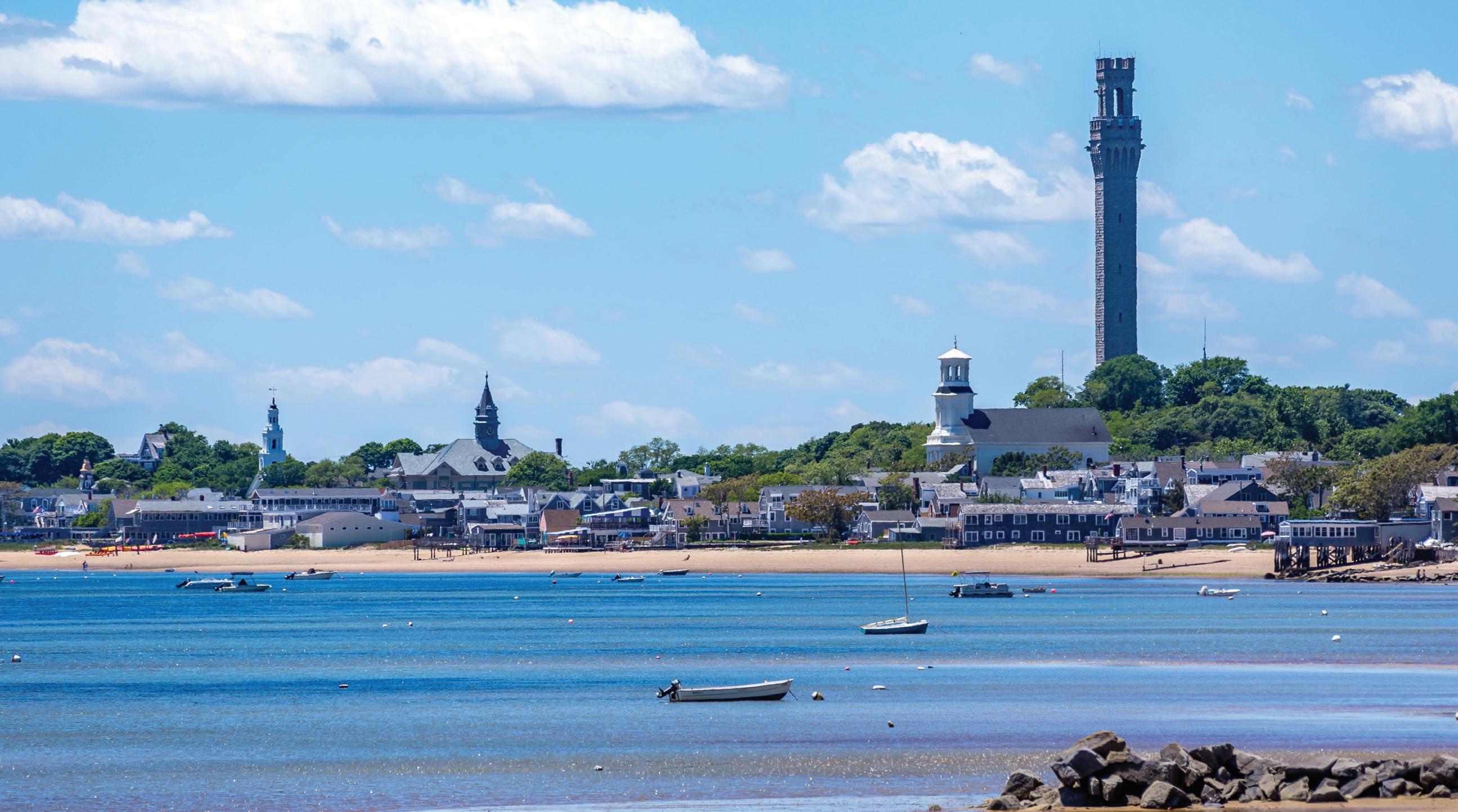
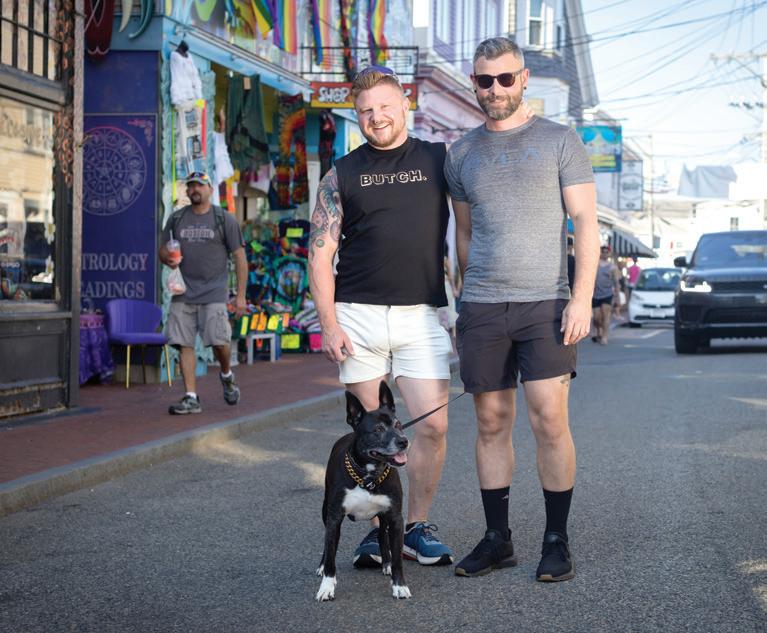
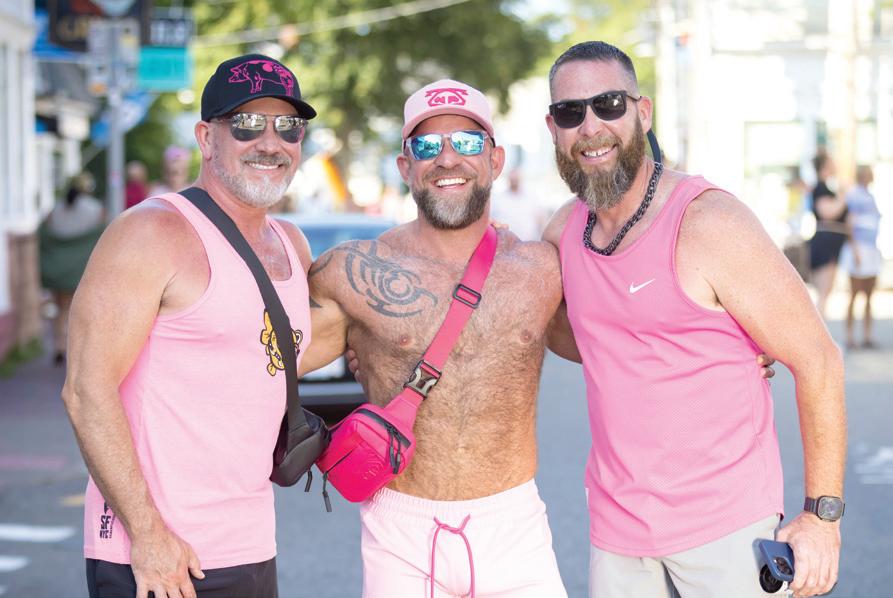
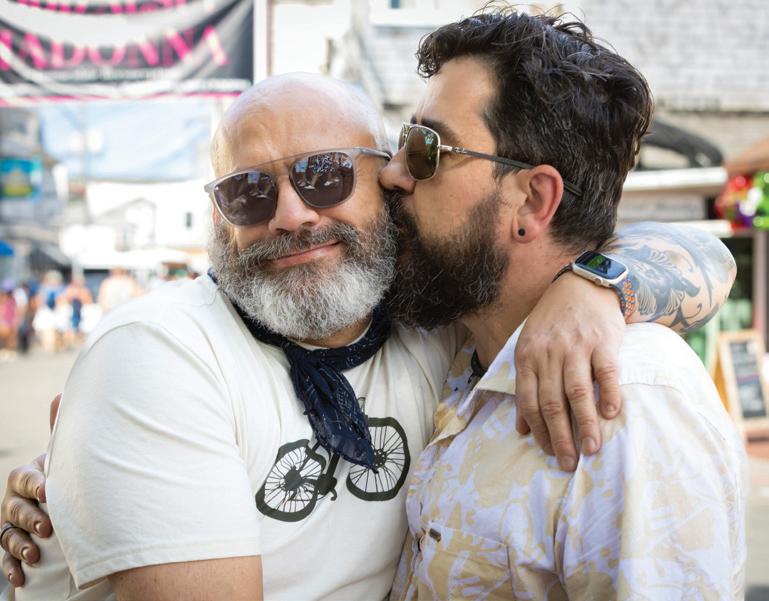
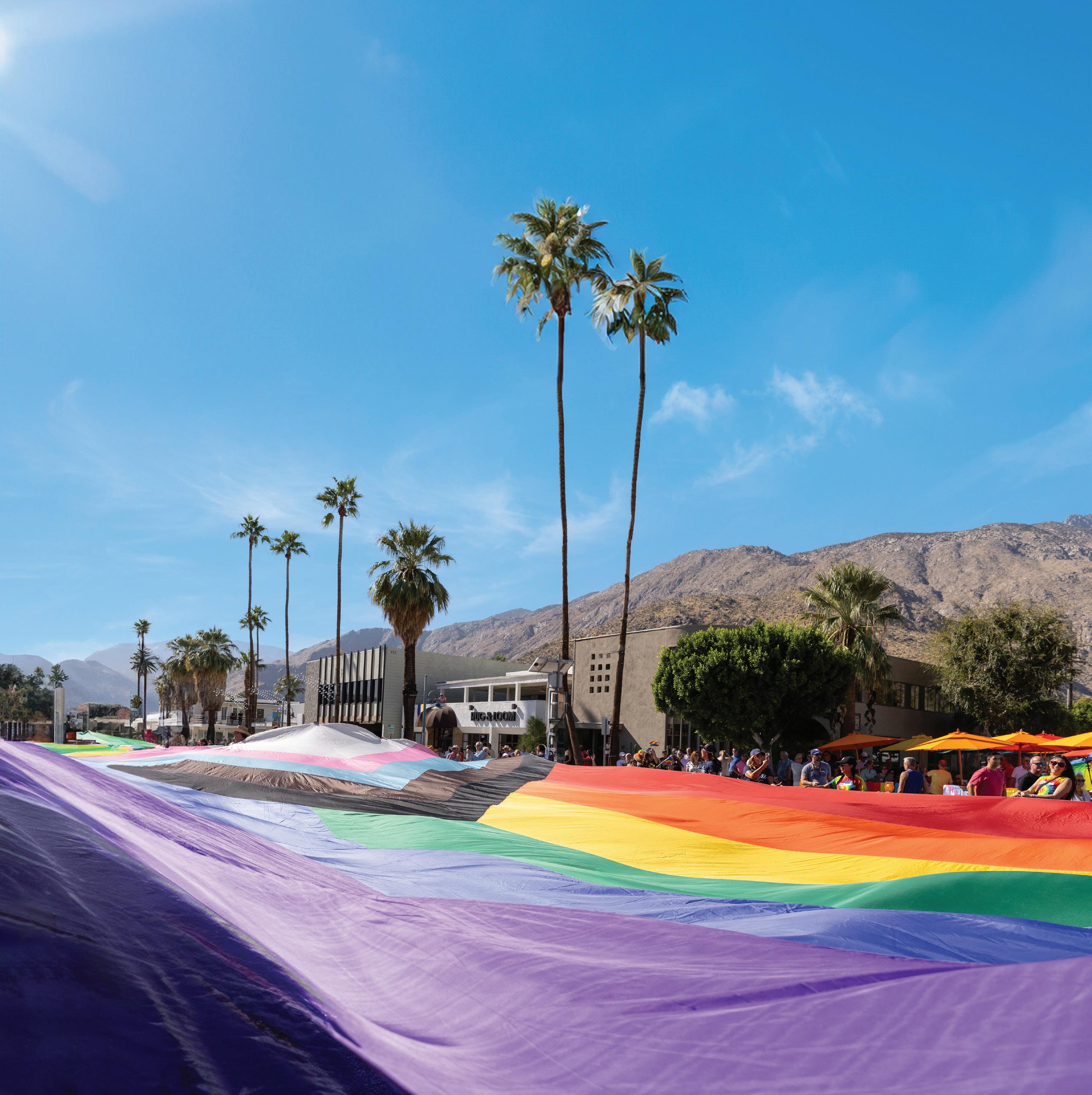
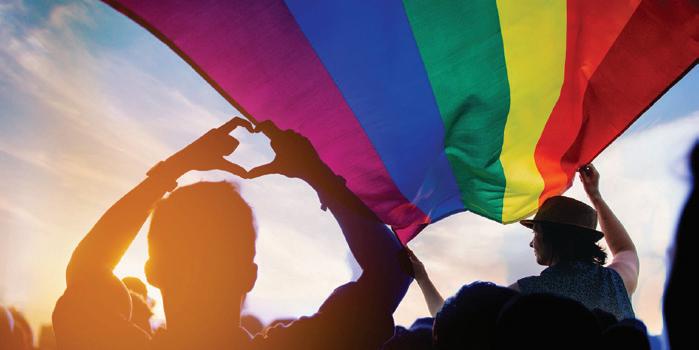
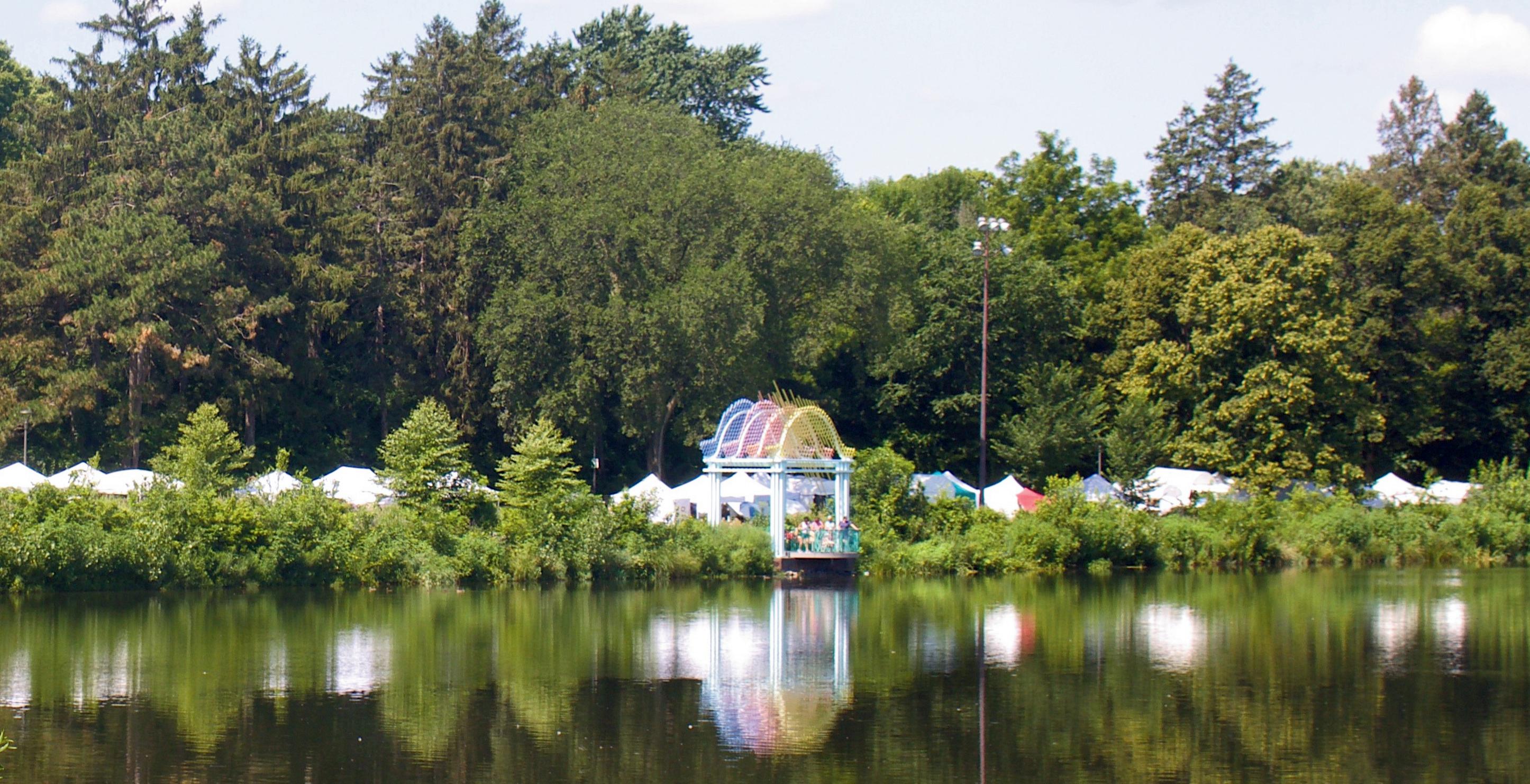
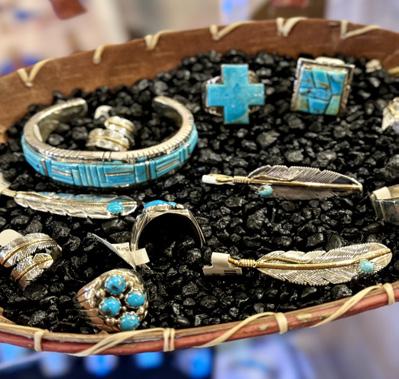
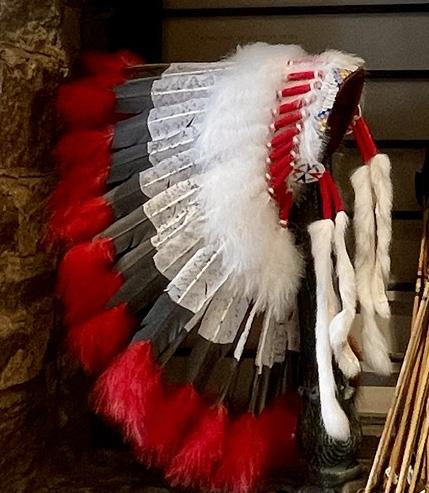
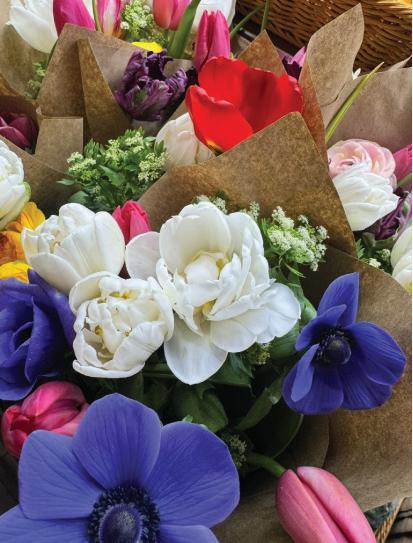
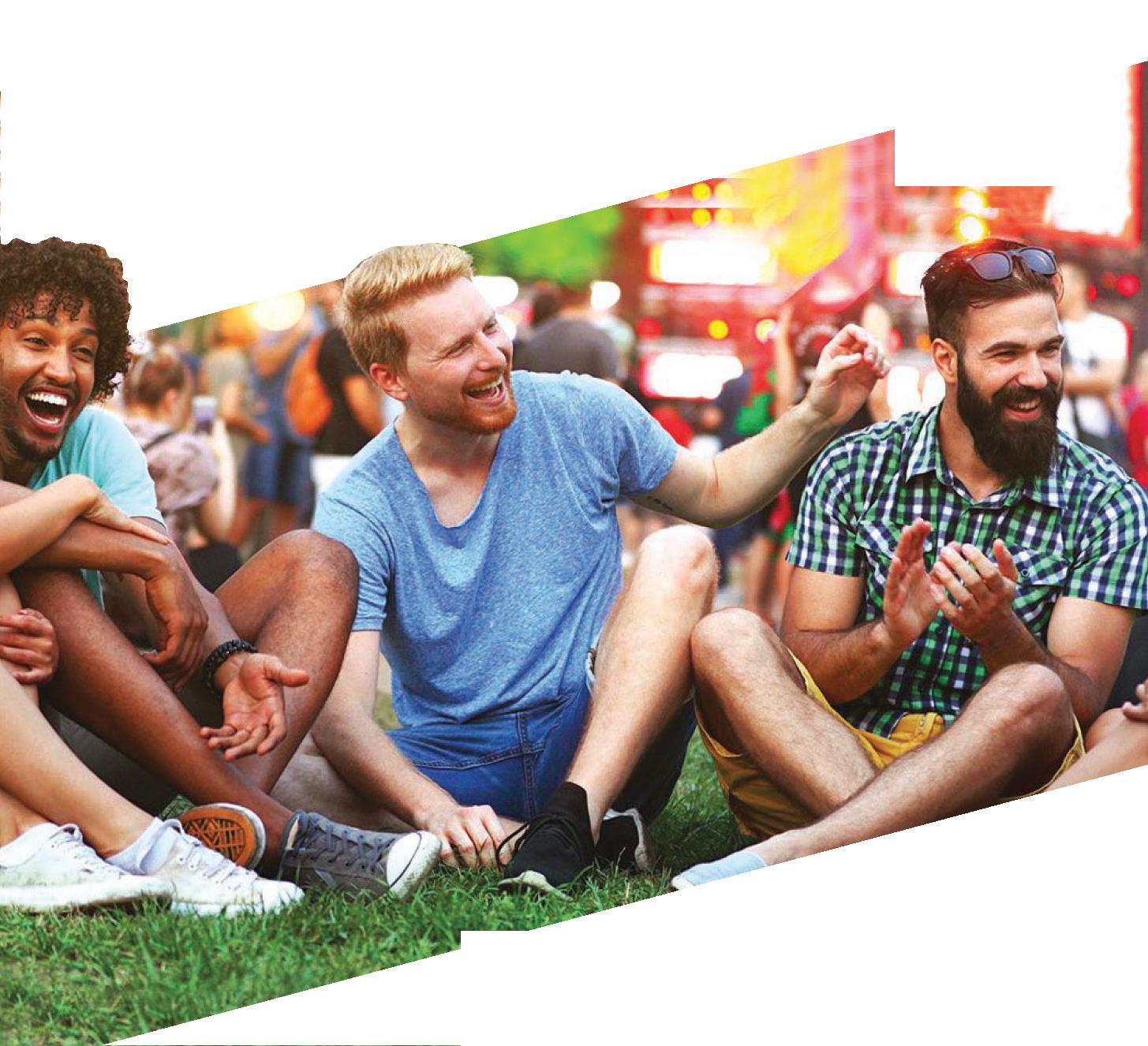
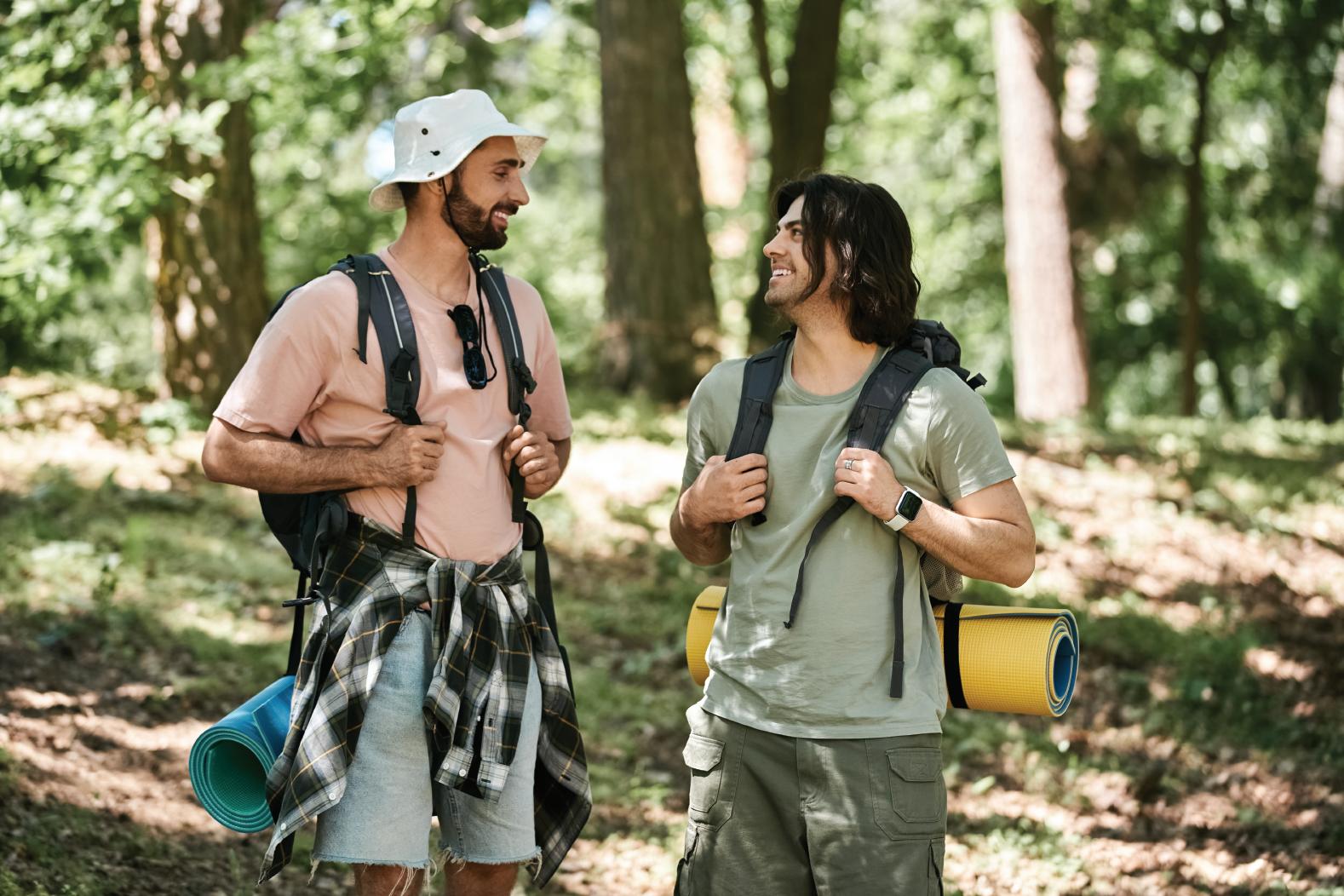
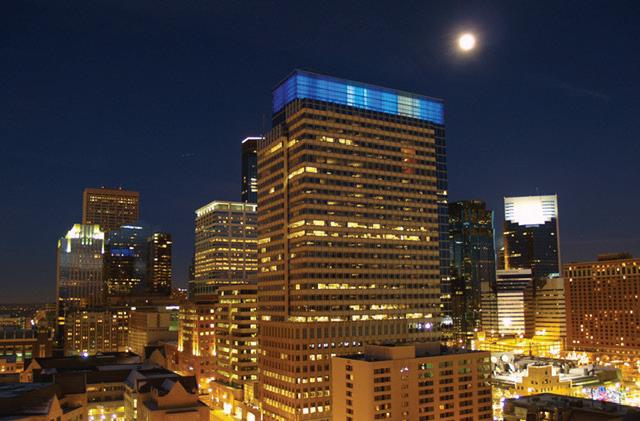
Yearning for a queer adventure? Thirsting for a good time? Provincetown is everything wrapped up in one destination! Provincetown offers a wide range of accommodations to suit every style and personality, along with a kaleidoscope of activities – beautiful beaches and trails, museums and galleries (we are the oldest continuous arts colony in the US), themed week events, fabulous dining, live entertainment, boutique shops for every taste, and so much more! And don’t forget the Mischief. Sizzle. Queer. Magic. Pride. Provincetown is a place that changes you. Any season. Every time.
Finding comfort in community
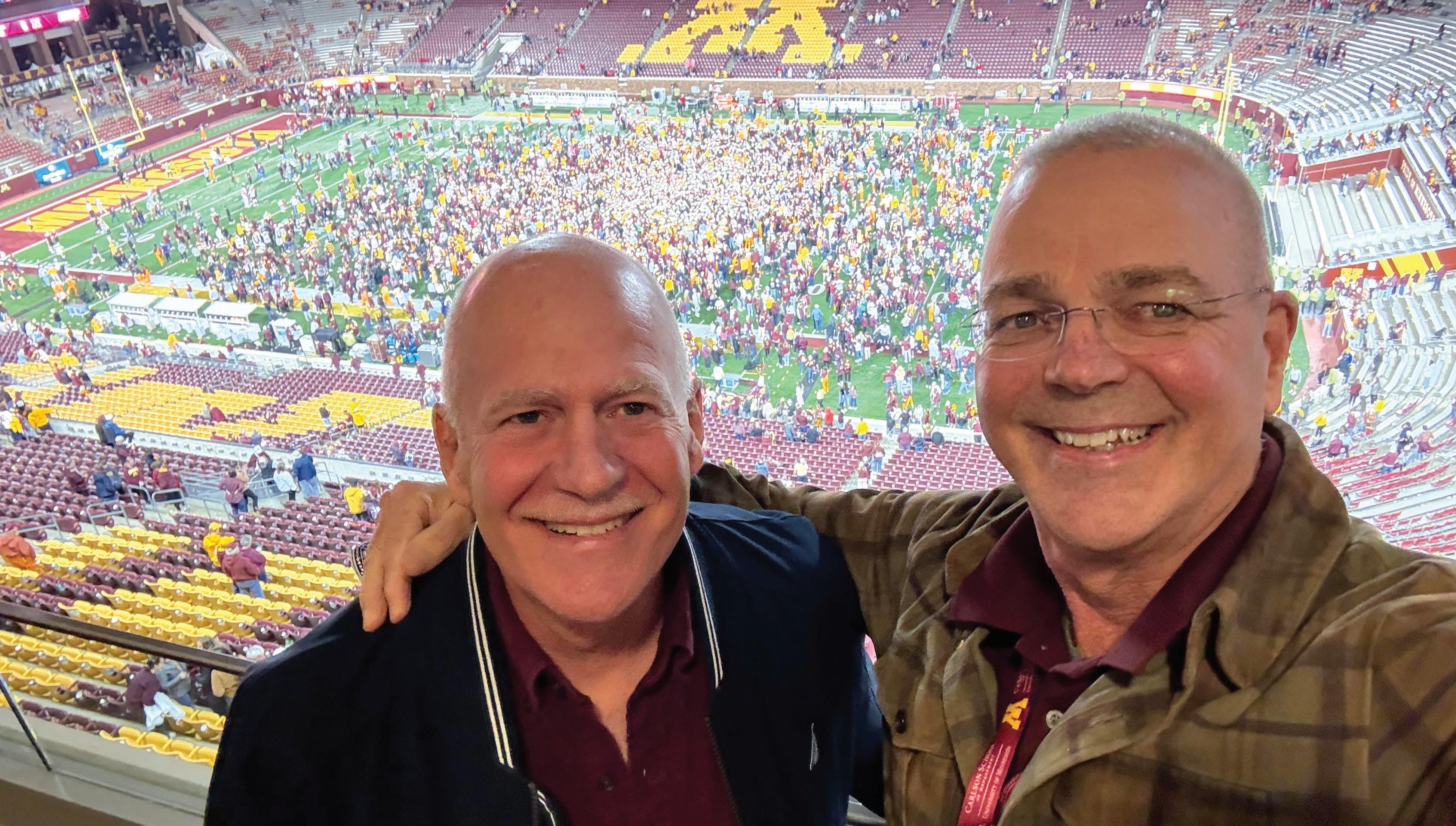
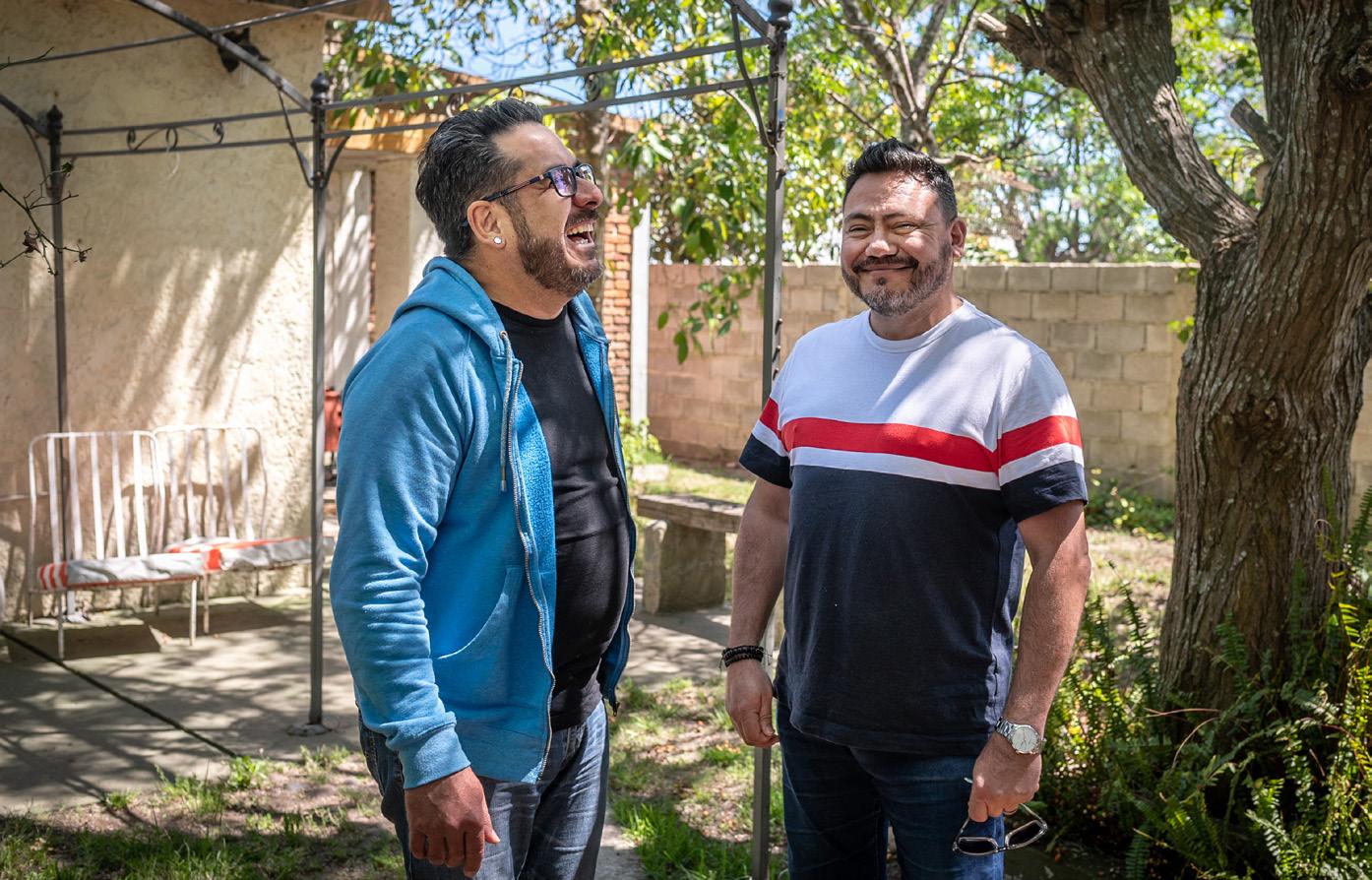
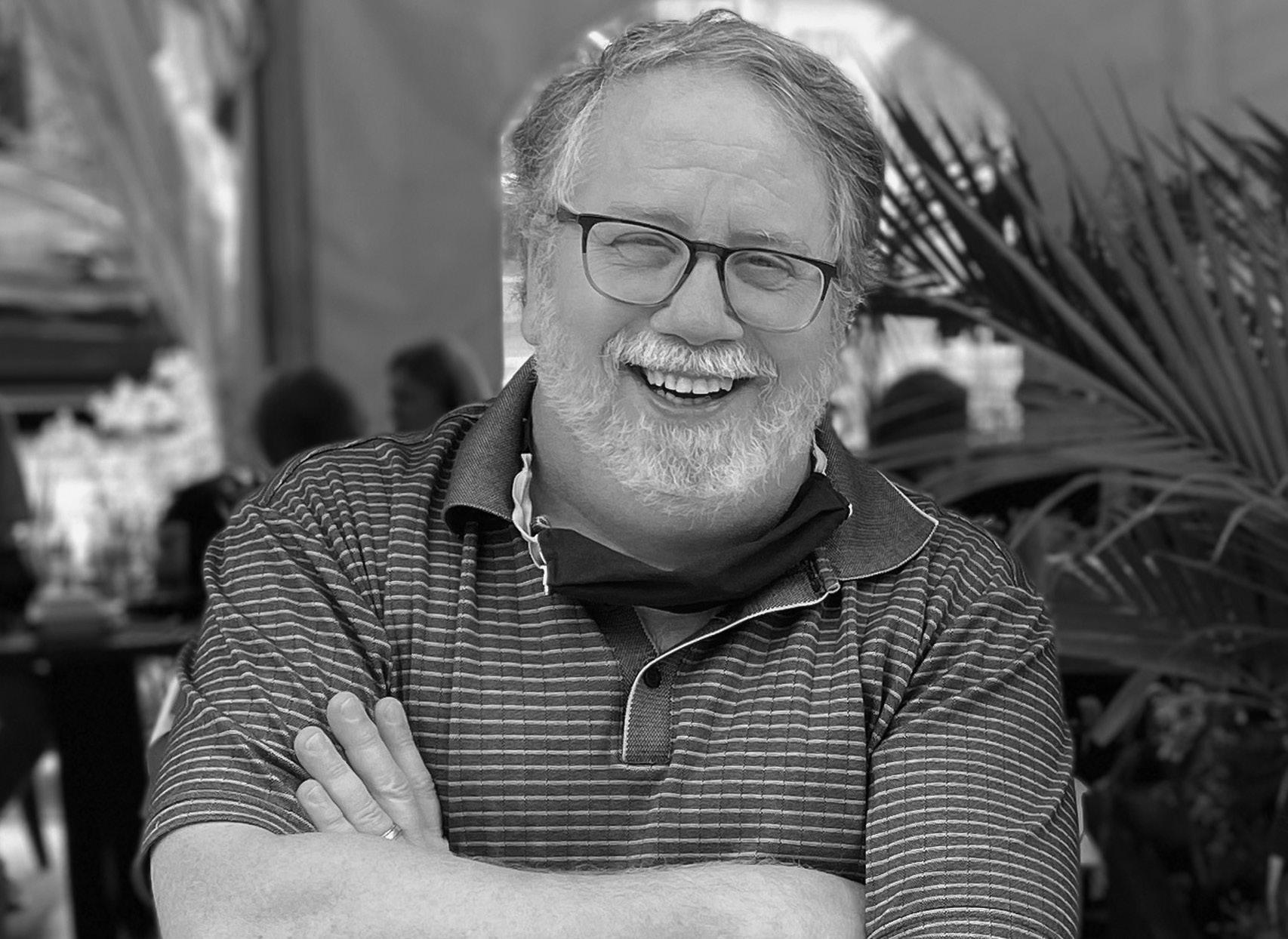
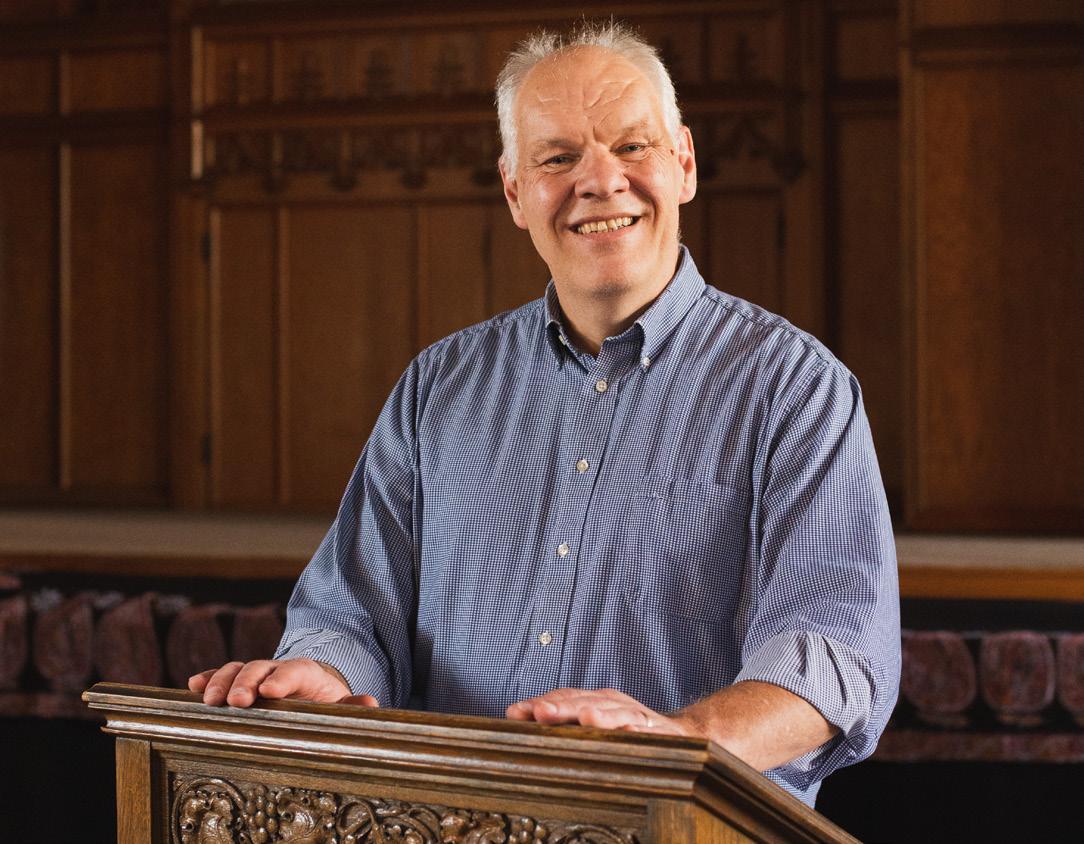
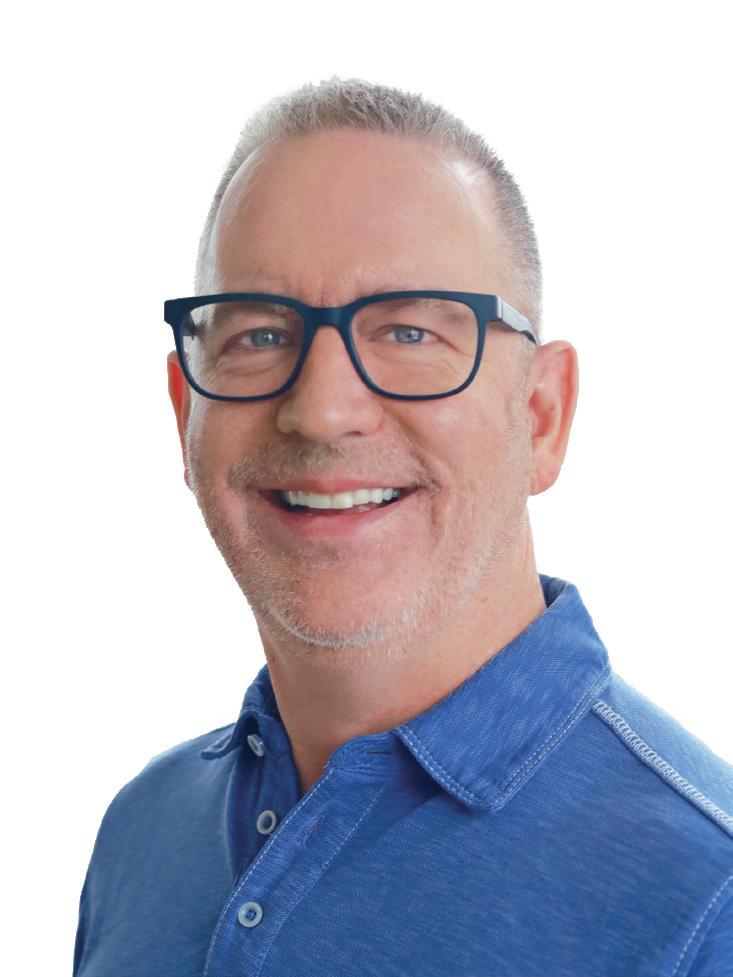
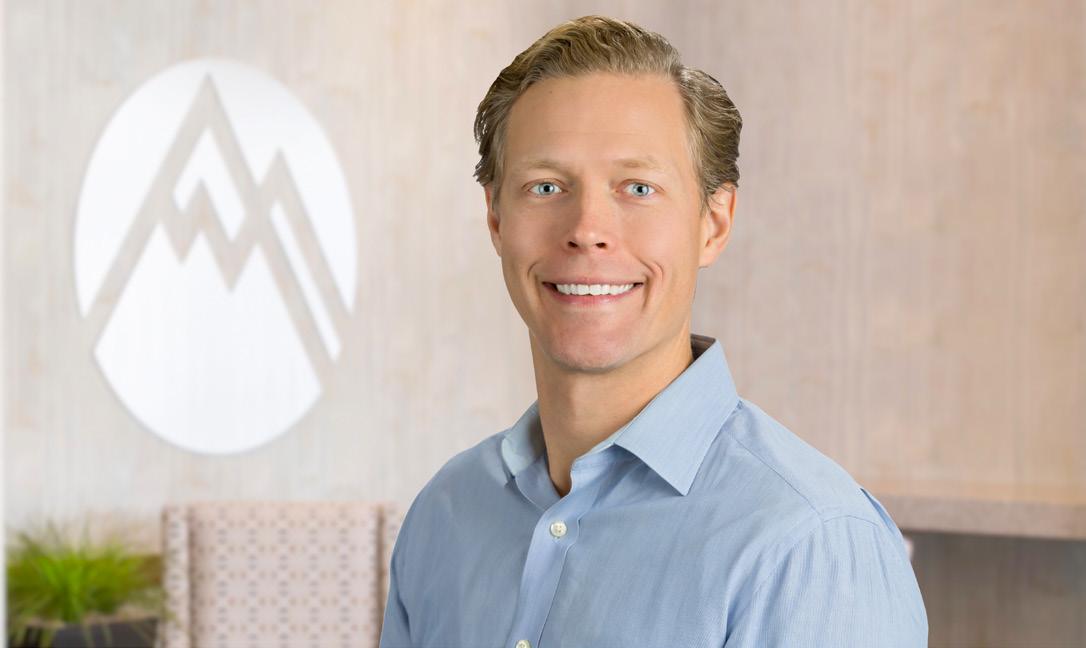
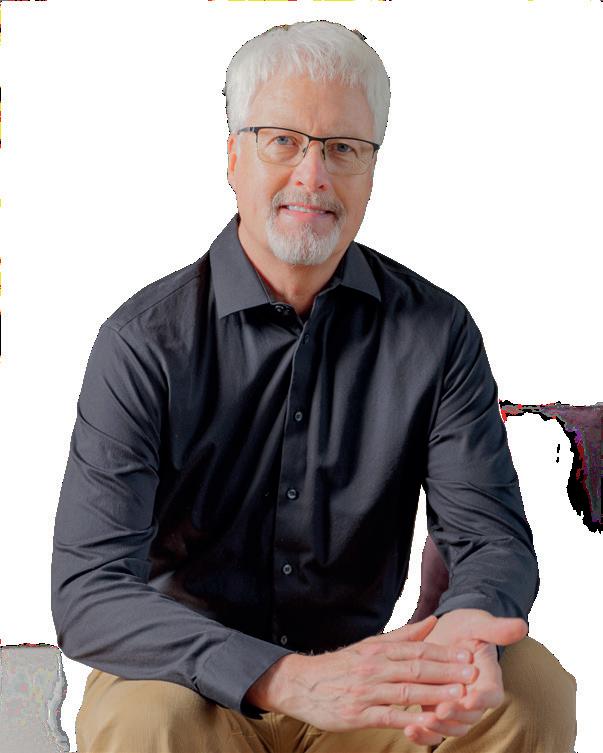
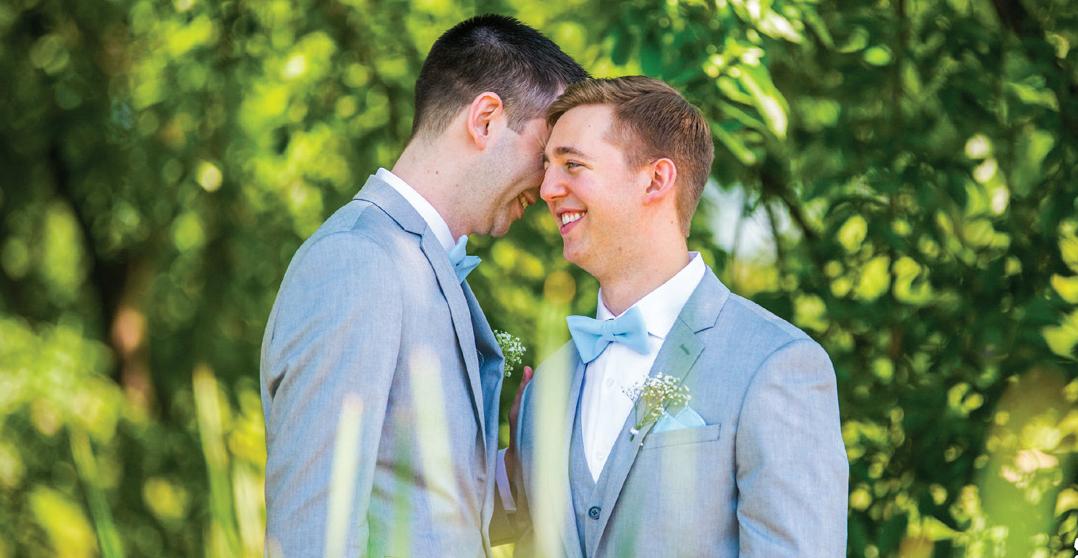
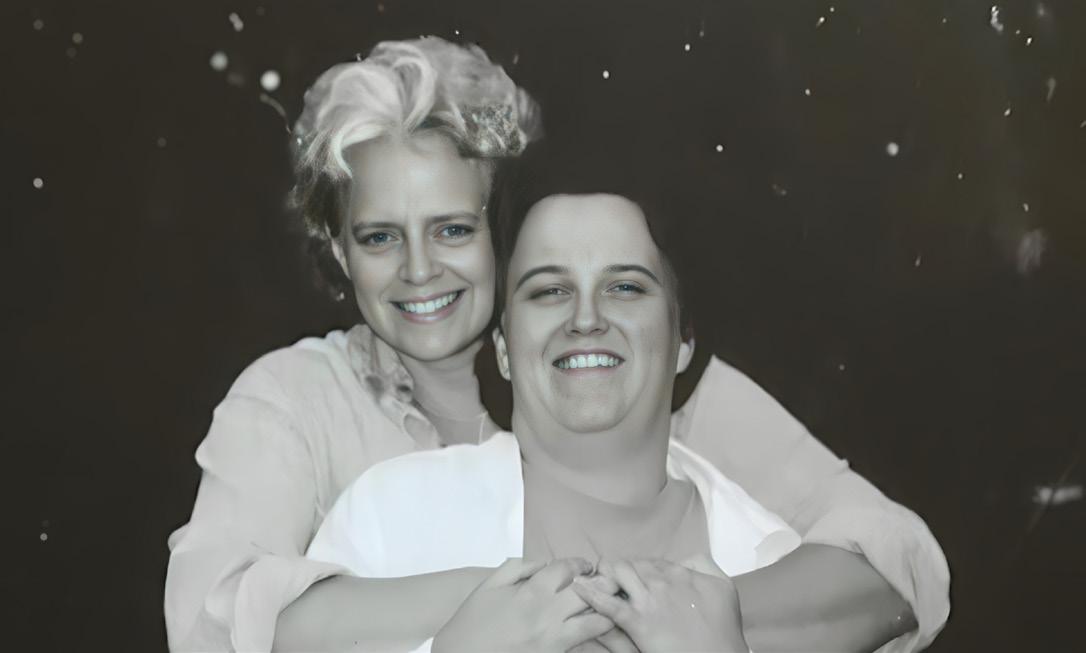
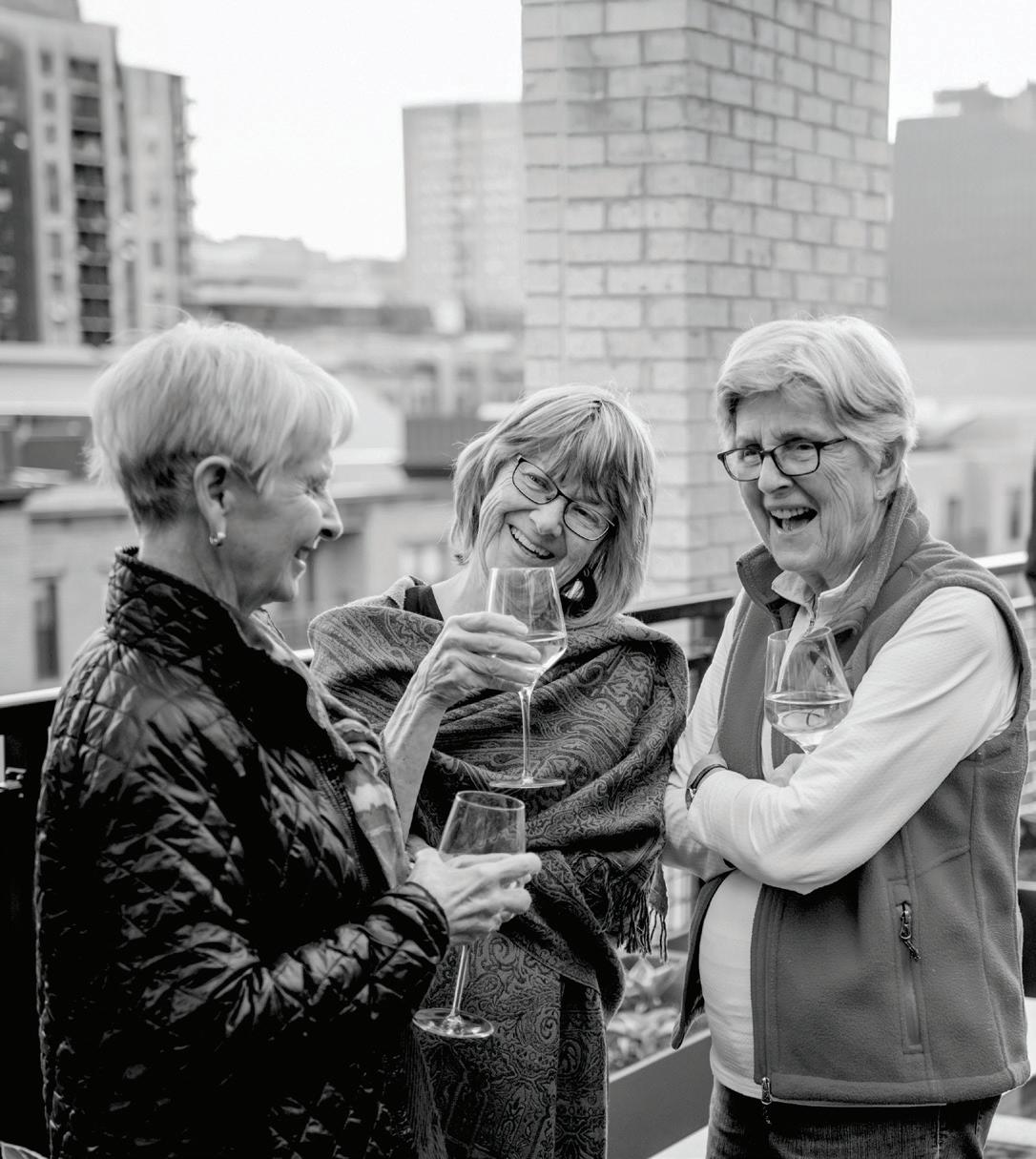
If Brian Gerhardson has his way, no student will struggle with the level of isolation he experienced. To offer students the financial support he didn’t have as an undergraduate, Gerhardson established the Brian K. Gerhardson Scholarship. “Having an education can make a difference in how you experience the rest of your life.”
Transform isolation into community. Leave a legacy that matters.
Visit z.umn.edu/future-giving
“If you told me there was going to be an LGBTQ gathering for Carlson students and alums back when I was here in the 1980s, I would have thought I would be the only one showing up.”
BRIAN GERHARDSON
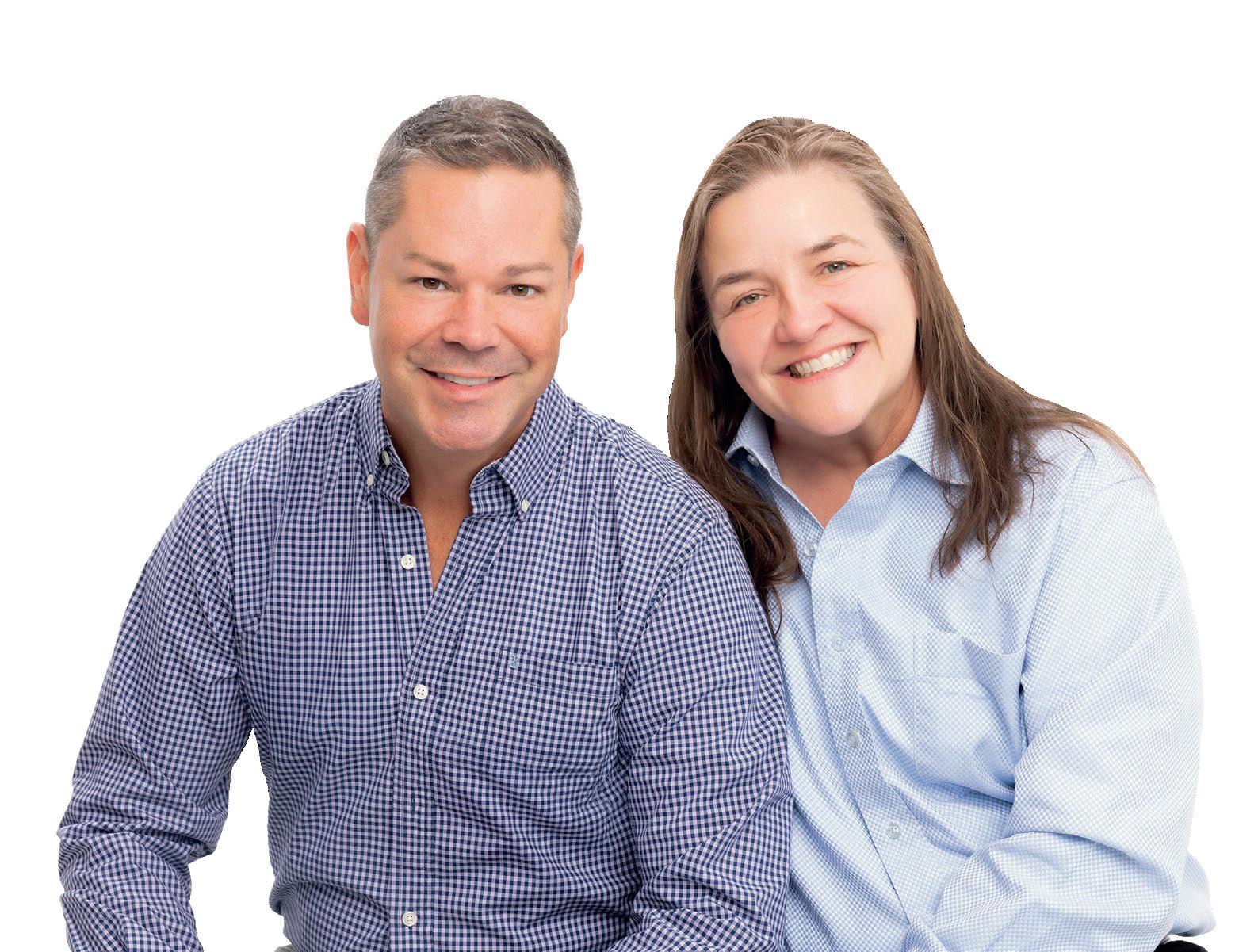
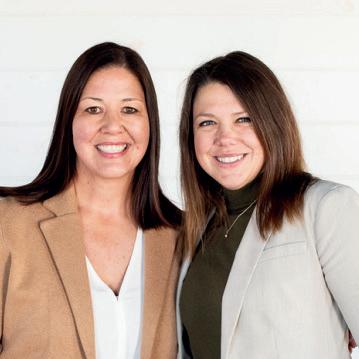
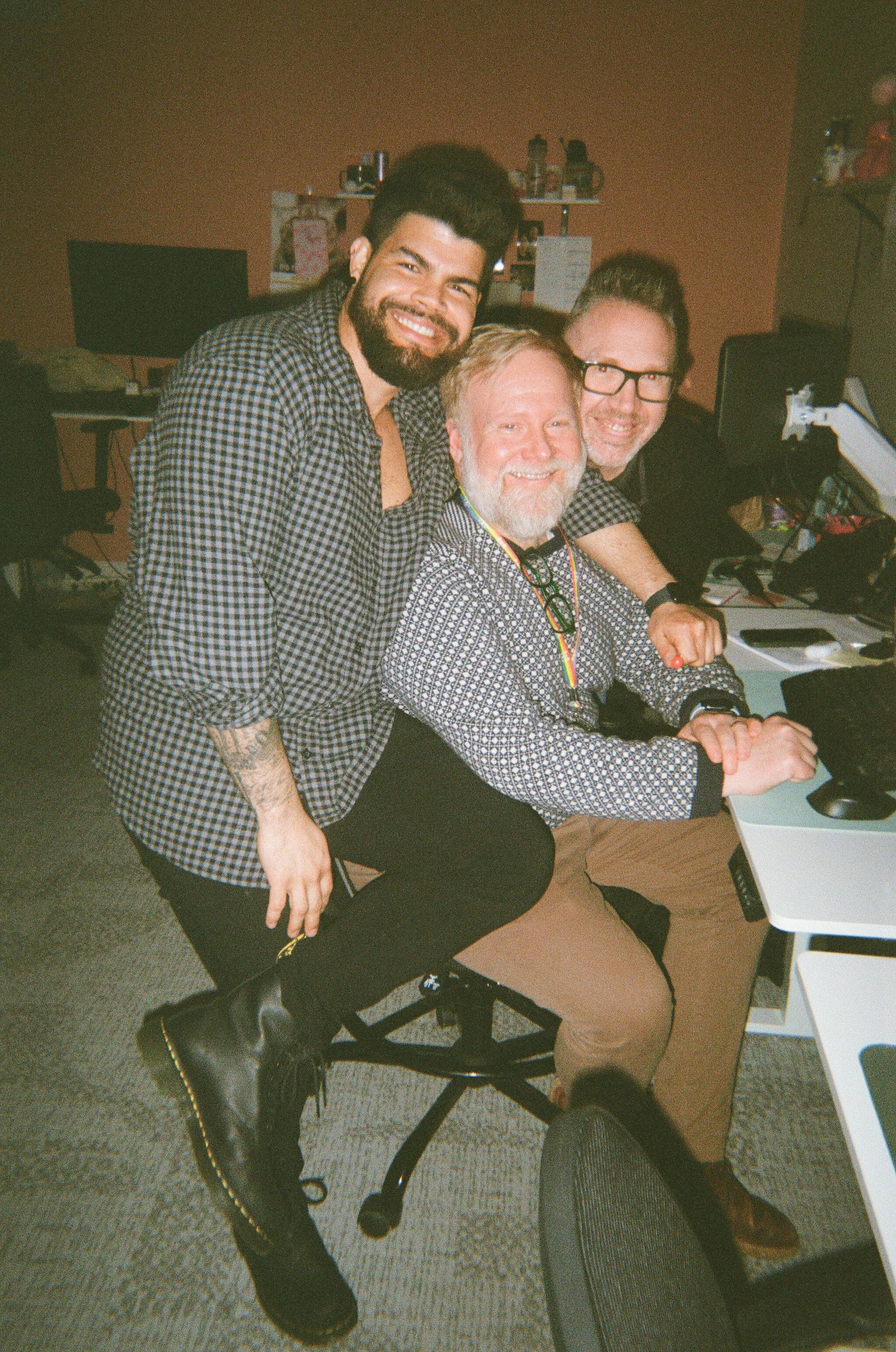
Brian Gerhardson (right) with his husband John Shade
I CAN BANK FROM ANYWHERE, ANYTIME. “
DAN AFFINITY PLUS MEMBER
LIFE MATH IS COMPLICATED. AFFINITY PLUS MADE DAN’S LIFE EASIER.
”
AN OASIS FOR ALL
In Greater Palm Springs, every traveler belongs. Explore a vibrant oasis where inclusivity and individuality shine beneath endless blue skies — and mark your calendars for November 6–8 to join us for Greater Palm Springs Pride, an annual celebration of love, joy, and community.
ISSUE 809 May 28-June 10, 2026
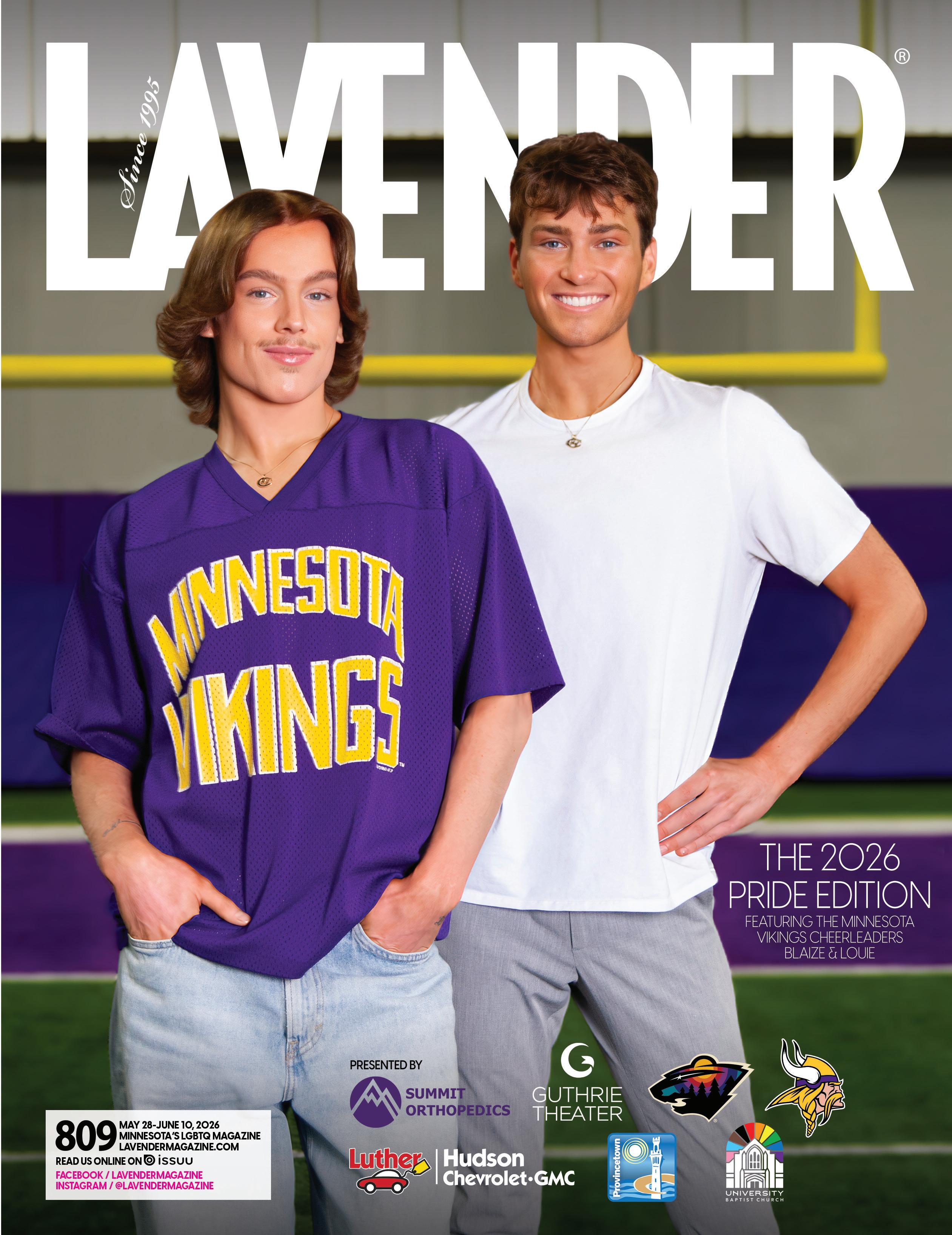
The 2026 Pride Edition
18 All in the Family, Always
20 2026 Pride What-to-Do Guide
26 Finding Joy in Drag: Dick Von Dyke’s Playful Take on Performance and Purpose
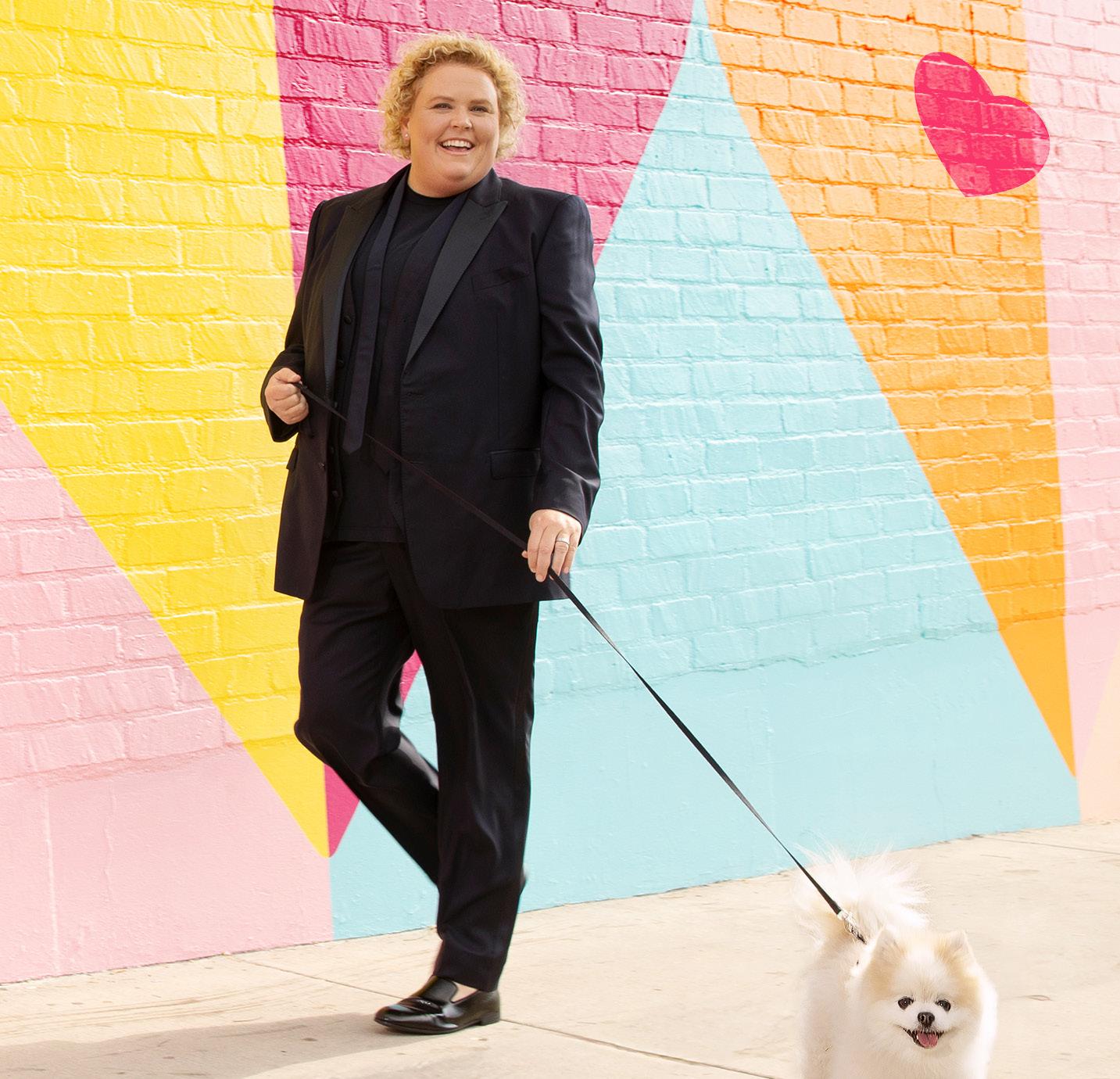
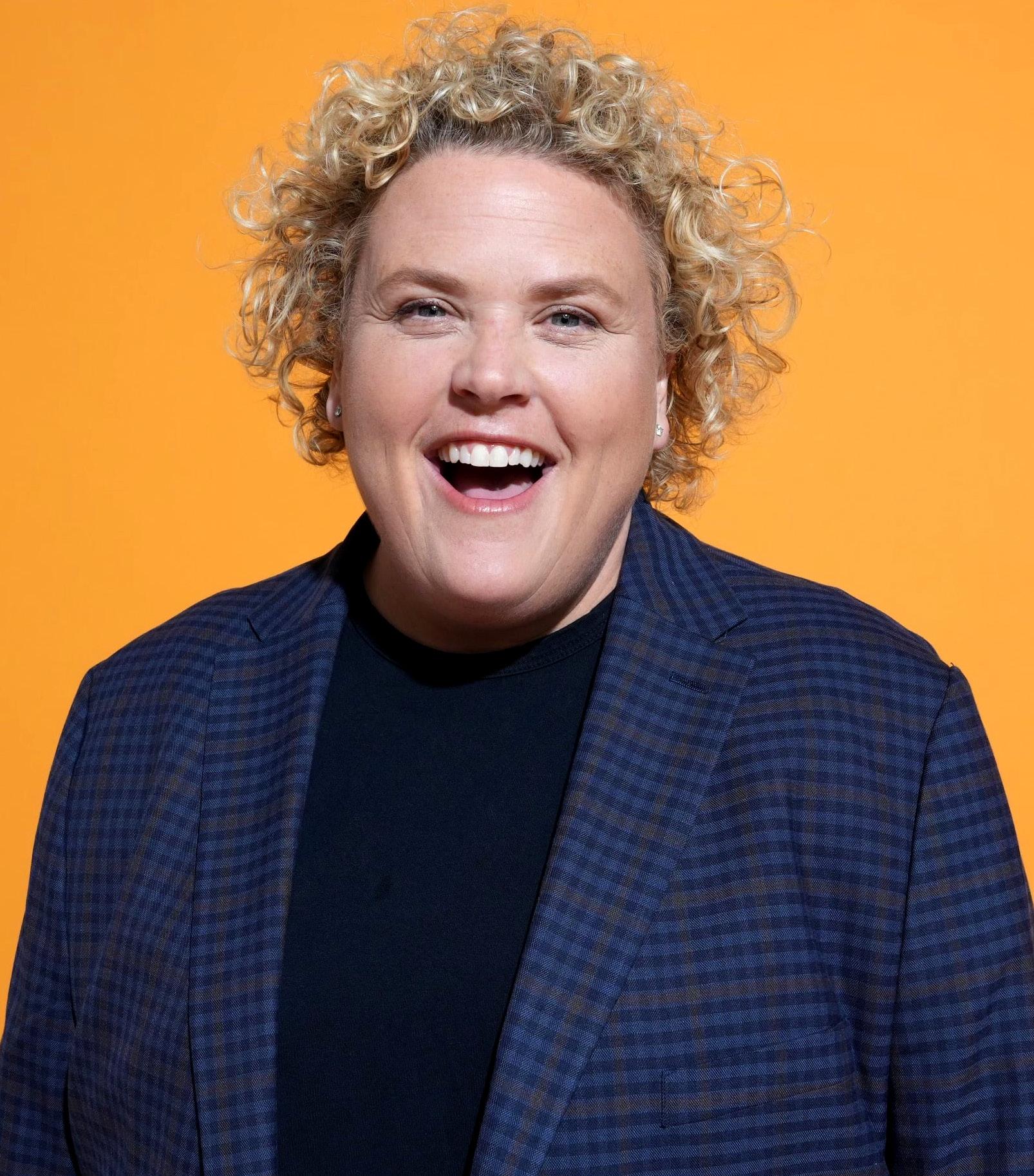
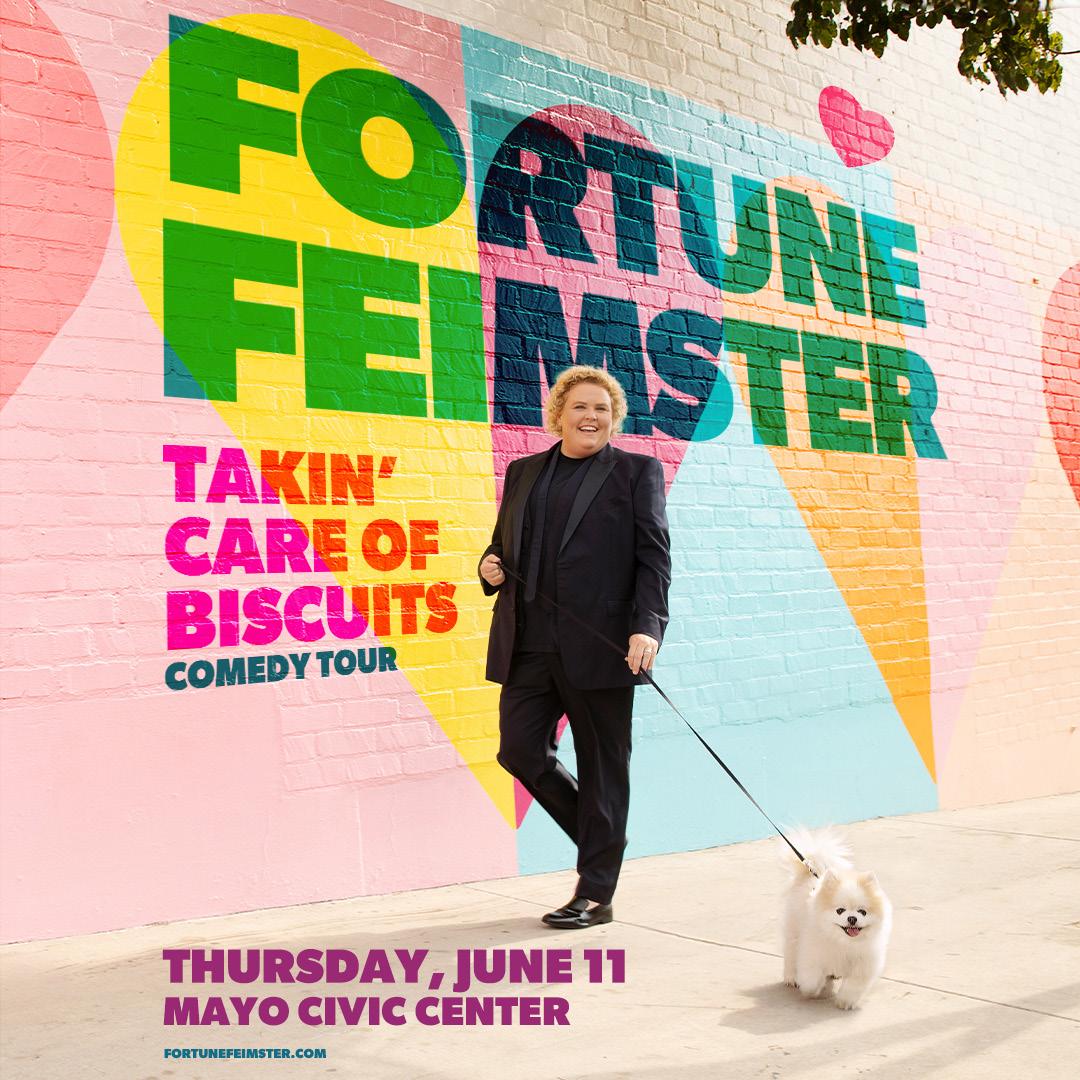
28 Fortune Feimster Talks ‘Takin’ Care of Biscuits’ Tour, Life Lately
30 ‘Disney PRIDE in Concert’: A Unique Collaborative Event
34 Abby Nissenbaum Packs Diverse Influences, Personal Affirmations and Advocacy into New EP
36 ‘Twins and Needles’ – Activist Sue Westegaard Proves A Stitch in Time Saves Lives
38 ‘Harold and Maude’ at the Westgate Theater: A Flop, A Triumph and A Queer Cult Classic
40 To: Prince, Dearly Beloved; For: The People
42 Duck Inn
46 Ready, Set, Summer: A Guide to Exploring Minnesota’s Five Regions
64 ‘A Rare Kind of Space’
66 Sideline Superstars: Blaize Shiek & Louie Conn
70 Women’s Sports in Minnesota Continue to Grow with Two Pro Volleyball Teams Coming in 2027
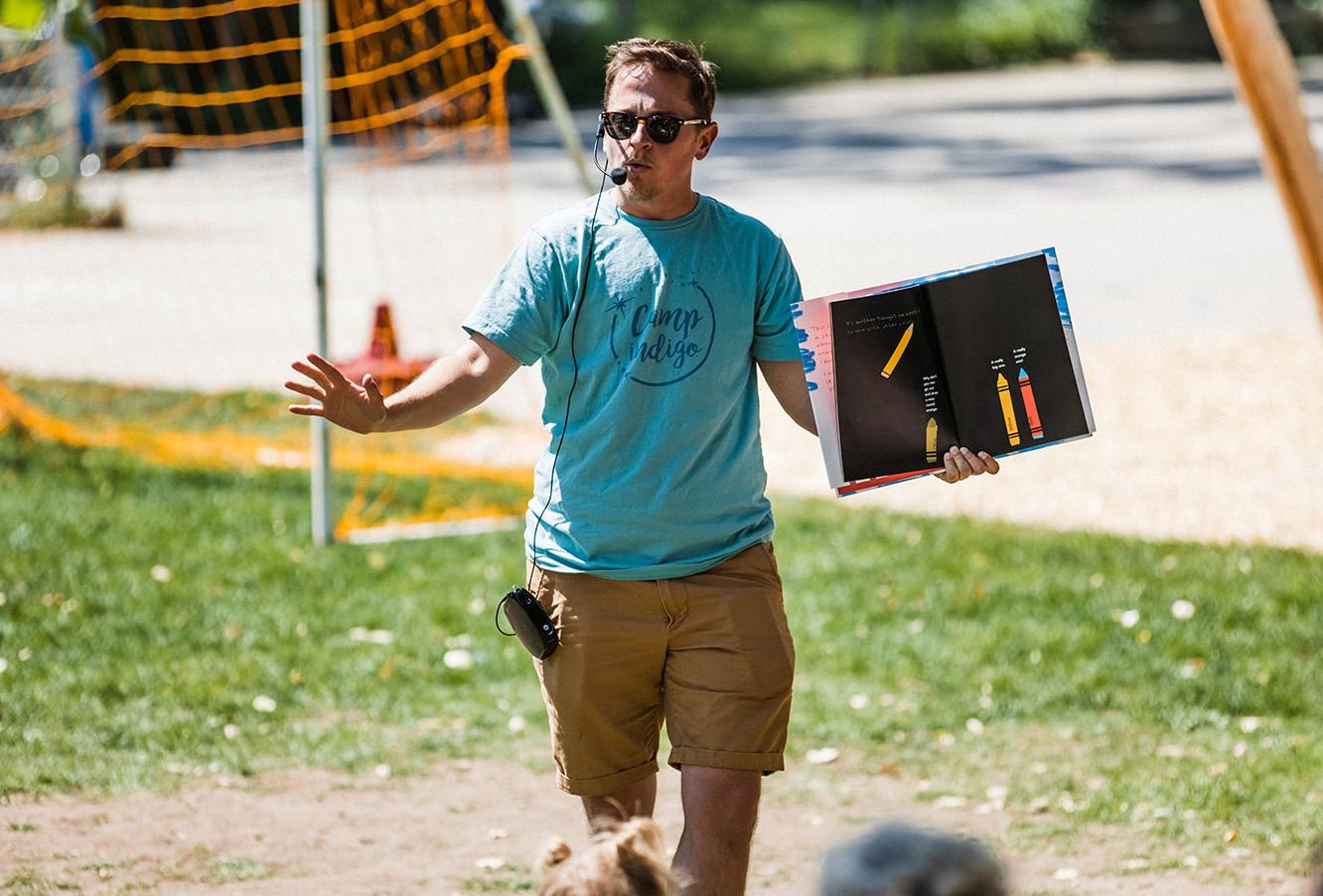
72 Kids Just Want to be Kids: See How Camp Indigo is Re-defining Visibility
OUR LIVES
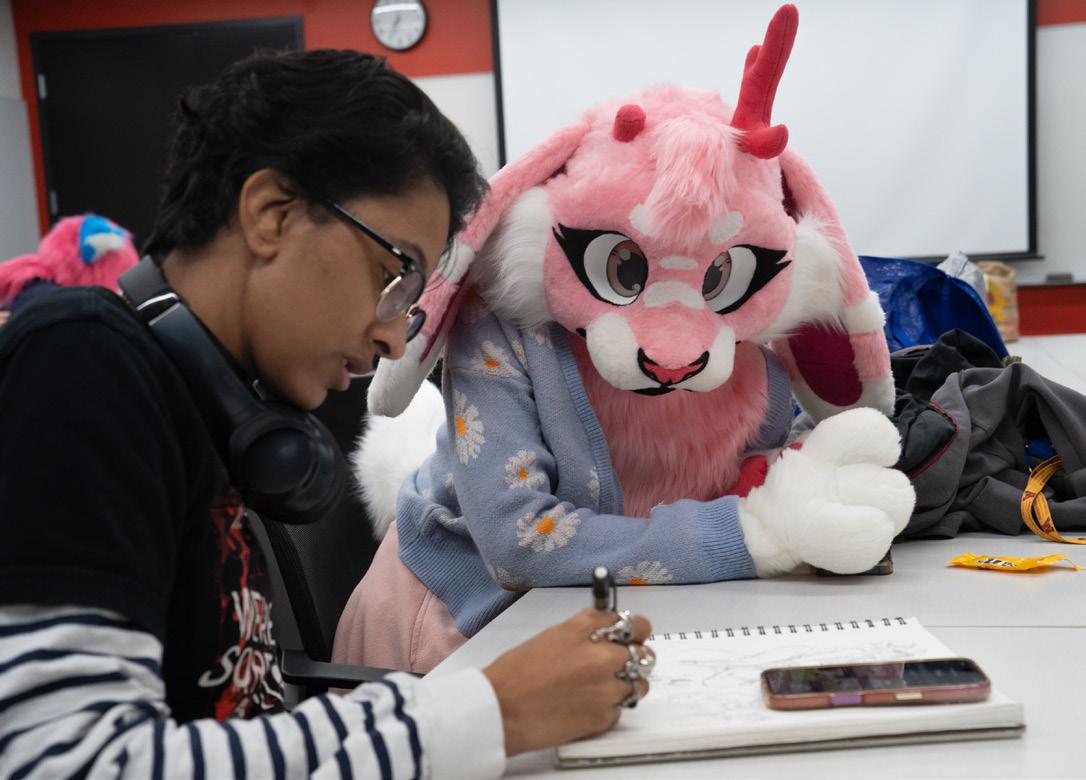
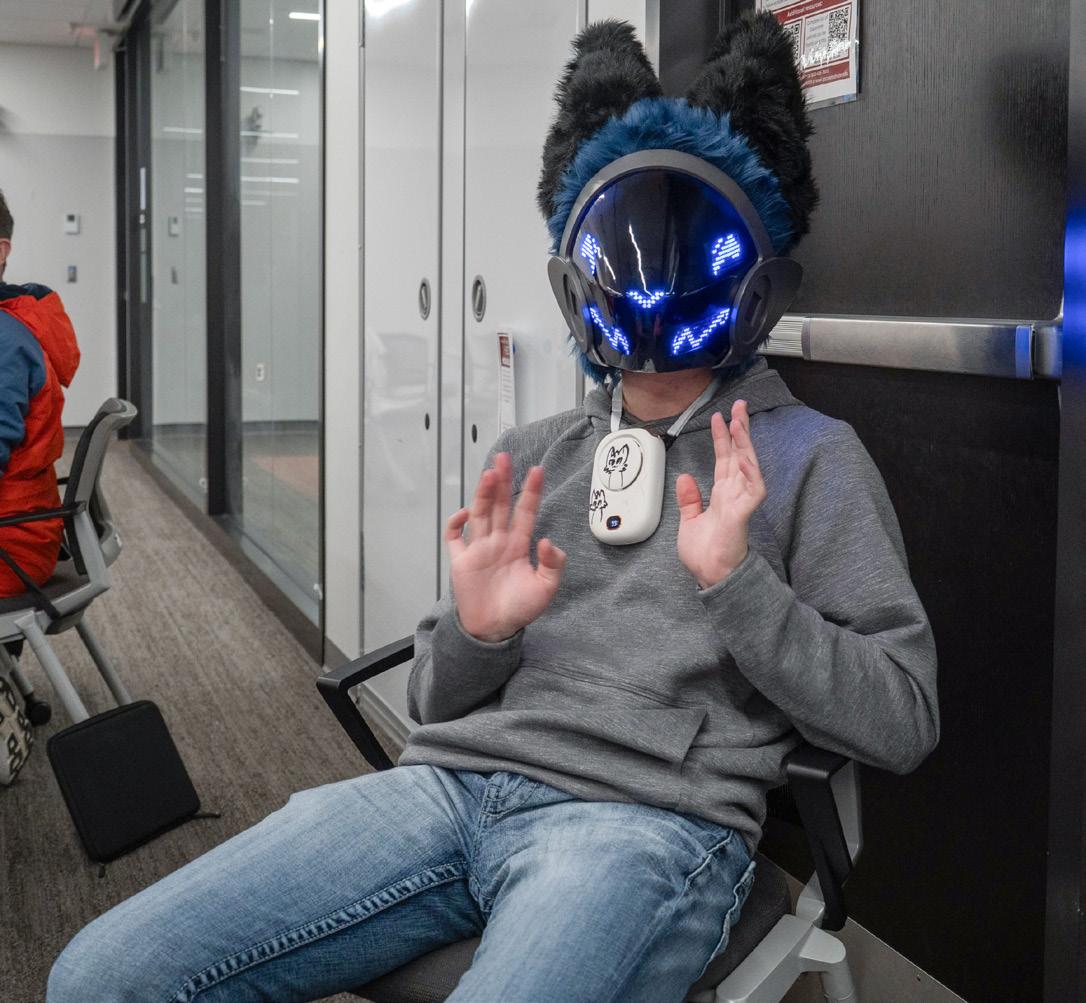
74 The Reality of Being A Furry
78 The Bones of University Baptist
83 The 2026 Pride Month Horoscope
84 ‘Birth and Rebirth’
86 Redefining Inclusive Care: How Identity-Related Stress Compounds the Impact of Trauma For LGBTQ+ Individuals
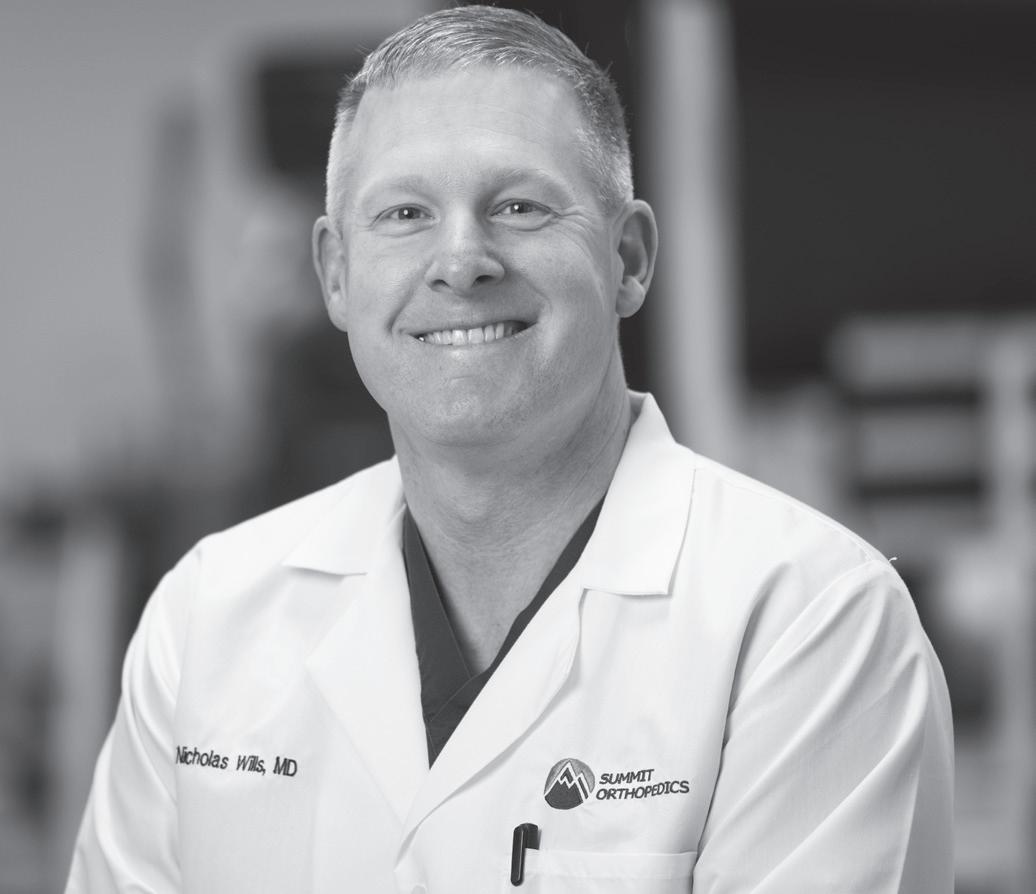
88 Summit Orthopedics’ Dr. Dane Hansen Discusses Joint Health and Injury Prevention
92 Leather marching toward the future
94 No Buzz, Just Truth: Queerity Sober Dating and Social App Is Something the World Just Might Need Right Now
96 When Love Doesn’t End: The Quiet Ways My Wife Still Reaches Me
98 The Challenges of Modern Dating for Nonbinary and Plural Identities ON THE COVER
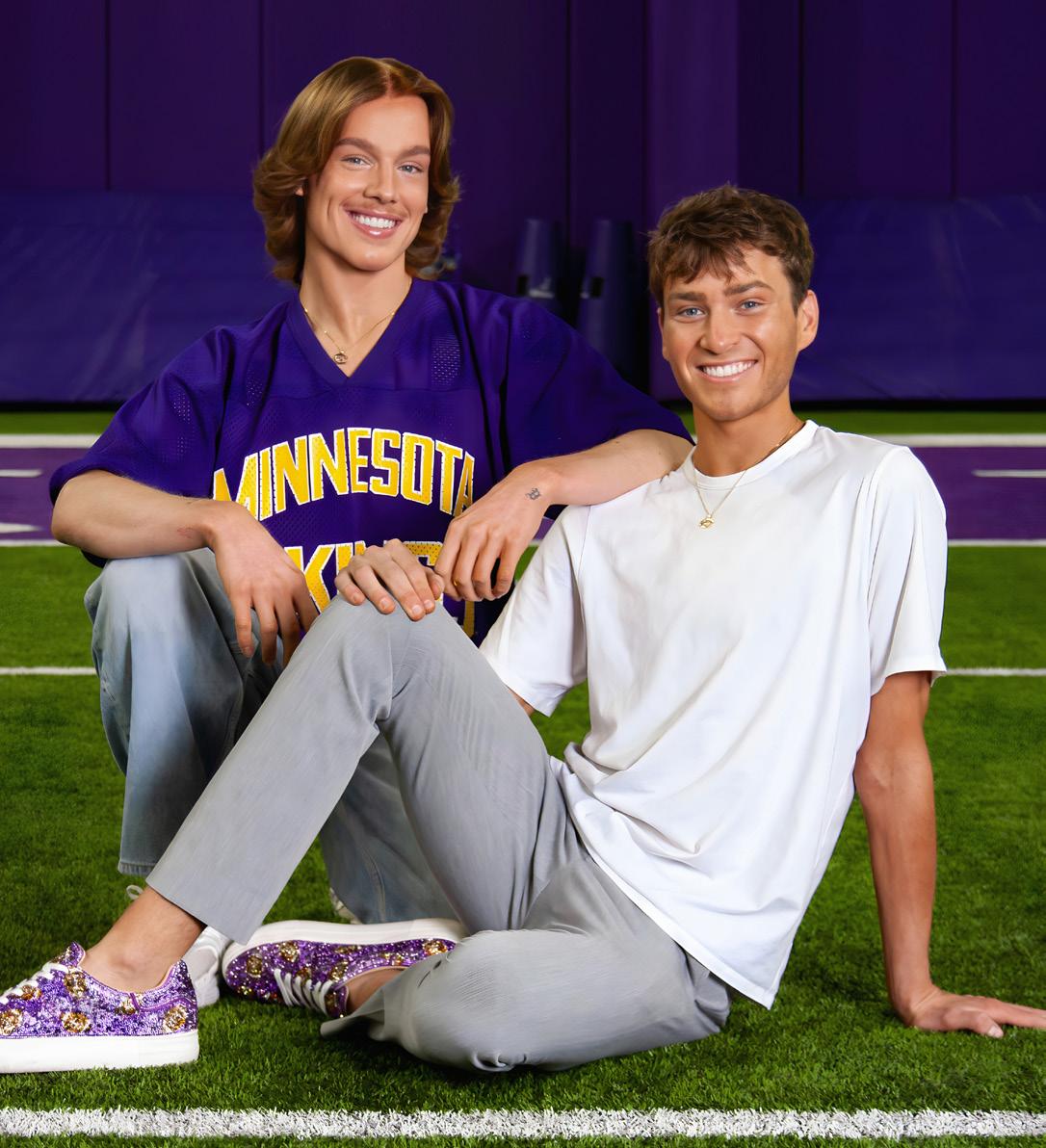
Blaize Shiek & Louie Conn. Photo by Mike Hnida
OUR AFFAIRS
102 Books
104 OUTWORDS Approaches 10th Anniversary, Welcomes New Executive Director Beth Shipp
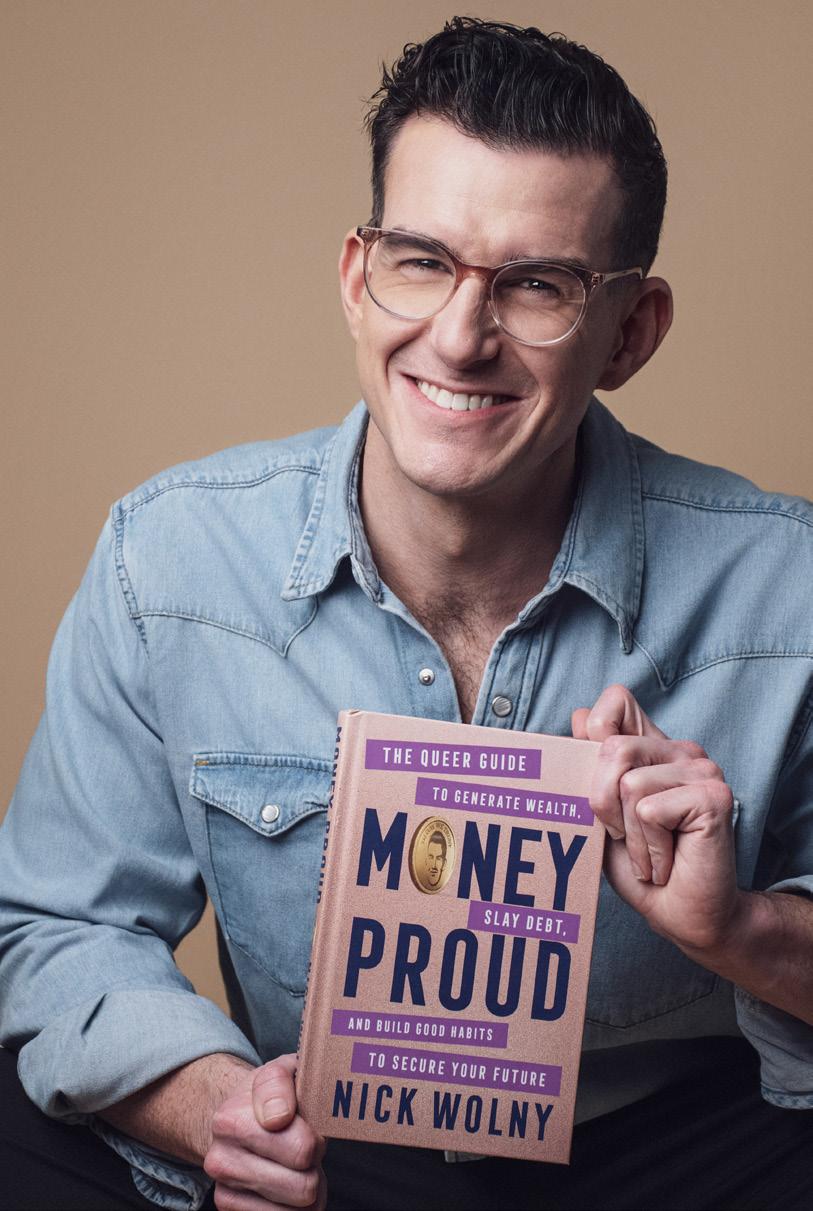
106 Being “Money Proud” in a Queer World
OUR HOMES
108 A Wagon No More OUR RESOURCES 112 Community Connection 113 The Network
OUR VOICES
114 Episode 15
114 After the Quiet Dance
Volume 31, Issue 809 • May 28-June 10, 2026
EDITORIAL
Managing Editor Noah Mitchell (612) 461-8723
Editorial Assistant Linda Raines (612) 436-4660
Editor Emeritus Ethan Boatner
Contributors Lakey Bridge, E.B. Boatner, Bianca Caputo, Stacy Dahl, Natasha DeLion, Alyssa Homeier, Terrance Griep, Hannah Kovnar, Shane Lueck, Elise Maren, Jen Peeples-Hampton, Linda Raines, Aspen Rush, Gregg Shapiro, Allie Skarda, Randy Stern, Susan Swavely, Natalie Trimble, Sommer Wagen, Carla Waldemar, Todd P. Walker, Emma Walytka, Spencer White
ADVERTISING
Vice President of Sales & Advertising
Barry Leavitt (612) 436-4690
Account Executives
Nathan Johnson (612) 436-4695
Richard Kranz (612) 436-4675
Sales & Event Administration
Linda Raines (612) 436-4660
National Sales Representatives
Rivendell Media (212) 242-6863
CREATIVE
Creative/Digital Director Mike Hnida (612) 436-4679
Administrative Assistant Michael Winikoff (612) 436-4660
Distribution Metro Periodical Partners (612) 281-3249
Founders George Holdgrafer, Stephen Rocheford Inspiration Steven W. Anderson (1954-1994), Timothy J. Lee (1968-2002), Russell Berg (1957-2005), Kathryn Rocheford (1914-2006), Jonathan Halverson (1974-2010), Adam Houghtaling (1984-2012), Walker Pearce (1946-2013), Tim Campbell (1939-2015), John Townsend (1959-2019), George Holdgrafer (1951-2024), Julie Dafydd (1951-2025)
Letters
Editor, 5200 Willson Road, Suite 316, Edina, MN 55424 or e-mail editor@lavendermagazine.com.
For our Privacy Policy, go to LavenderMagazine.com/resources/ privacy-policy
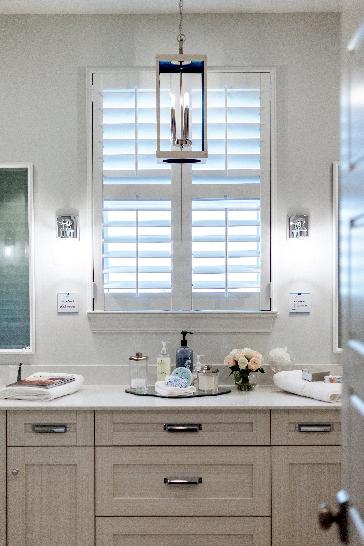
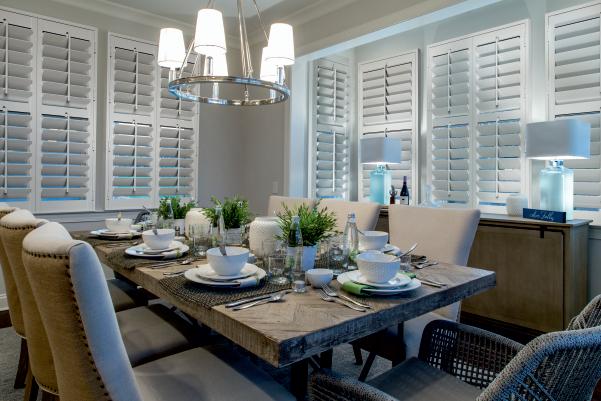
Get a fresh look for your home this Summer with Polywood® Shutters! Save 25% on all shutters for a limited time* and transform your outdated window coverings into a stylish focal point for any room.
* Offer is only good until June 30, 2024, and cannot be applied to previously quoted items or combined with any other offer
• Polywood® Shutters are 100% made in the USA
• Reduce your energy bills and add equity to your home
• 100% lifetime warranty
M-F from 9am to 4pm
BY E.B. BOATNER
All in the Family, Always
Families have been all-important since the dawn of time, at least since some early ancestor discovered they were a necessary unit for keeping oneself alive, to assure their regular meals and, finally, to hoard, to protect and assure that whatever went for wealth in their time passed on into the future so that their own specific line might survive. How these beings processed concepts of “future” or “valuable,” we can’t pinpoint exactly, but looking back over our own history, we may surmise these qualities had to do with gaining power over others, and that they were worth defending to the death.
Much — yet not so much — has changed from our misty dawn origins to our exhaust-ridden present. “Family” has myriad expressions, not all centering around blood-kin and Habsburg chins. It’s interesting, if one happens to read a wide range of printed material — in which I include not only books, fiction and non-, but also the “agony-aunt” tales that have jumped ship at the supermarkets to infest social media.
Two novels I’ve read recently illustrate how wide is the net, how broad is the definition that may encompass the bonds between “siblings.”
While the actions of Saleem Haddad’s “Floodlines” take place in the autumn of 2014, the family
drama runs back to 1950s Baghdad and on through today’s London, Yemeni refugee camps and varied dreams, including a long-desired Tigris River project. Elderly Bridget Mathloum, British mother of sisters Zaineb, Ishtar and Medhan, grandmother of Zainab’s gay son Nizar, has long held a secret concerning the death of her husband. Haydar Mathloum. Haydar was a highly-celebrated Iraqi artist whose works, decades lost, have now been found, and are central to the warring sisters who each have an agenda. Iraqi history, past and present, surrounds them all, but you needn’t be of a particular heritage or religion to see storms ahead for three different personalities colliding over how to handle an art collection now worth millions in whatever specie.
As Haddad weaves disparate threads of time, war, art and conflict into a compelling narrative, so does Jonathan Stone in “Prison Minyan.” However, where “Floodlines” flows through different countries, religions and conflicts of blood kin, Stone’s characters are not blood kin, but are perforce confined to Otisville for their various felonies. America’s only Jewish prison, Otisville offers a kosher deli and a minyan (the quorum of 10 Jewish adults required for study) led by a fellow felon rabbi in discussions
of prayer and ethics. A lesbian professor is allowed in to teach a poetry seminar.
Quite cushy until the order is disturbed by a tighter reining in, in part to punish a new inmate who’s offended the 45th President in some unspecified manner. No more super chef! No special noshes! The minyan regroups, drawing upon their own special talents — fraud, forgery, digital chicanery and more — to create a faux even-higher-up yet off-camera official to override the newcomer and restore “order” and breakfast bagels, blintzes and rugelach. When the con crumbles, and the sympathetic poet-professor’s life is endangered, all inmates band together in a hilarious yet hair-raising and Holocaust-evoking solution.
Stone’s satire is sharp, pulling all the stops to a climax with a powerful image of a threatened family uniting despite existing inner tensions and disagreements to face a greater danger.
From the Labdacids of Sophocles to Faulkner’s Snopes family ties, whether blood or chosen, families are the drivers of fiction and reality. From the personal to the presidential, you dismiss the strength of those bonds at your peril.
Celebrating, Uplifting, and Empowering LGBTQ+ Communities of Color Across Minnesota
AUGUST 12–16, 2026
Join us for a week of culture, community, and connection:
• Family Day in the Park – Powderhorn Park
• Pride on the River -Stillwater Riverboats
• Educational Brunch at Butcher & Boar
• Sip and Paint Party
• Live Performances • Vendors • Food • Wellness Spaces
Rainbow Roots Youth Program (Ages 14–24)
Workforce readiness, leadership development, and real-world skills:
• Resume building & interview prep
• Digital literacy & financial basics
• Paid youth opportunities
Community Health & Wellness Initiatives
• HIV/STI awareness & testing partnerships
• Opioid awareness & harm reduction education
• Tobacco cessation support through Quit Partner
Community Resource Access
• Direct connections to housing, employment, and health services
• Safe, affirming spaces for healing and growth
2026 Pride What-to-Do Guide
SWING OUT LOUD Pride Dance
June 1 • $8 • free beginner lesson at 6:30 p.m., dance at 8:15 p.m. • Four Seasons Dance Studio, 1637 Hennepin Ave., Minneapolis Put on your glitteriest dancing shoes and get your Pride on! rhythmjunction.com
Twin Cities Pride Grand Marshal Reception
June 4 • 6:30-10 p.m. • Como Zoo, St. Paul Twin Cities Pride honors its 2026 Grand Marshal, “Our Community,” at this fun event. tcpride.org/grand-marshal-reception
Cheers To Pride
June 6 • all day • participating locations around the Twin Cities listed on website
Come out for this fundraiser that kicks off Pride Month with purpose! Participating locations will donate a percentage of their proceeds to support Twin Cities Pride’s year-round programming. tcpride.org/cheers-to-pride
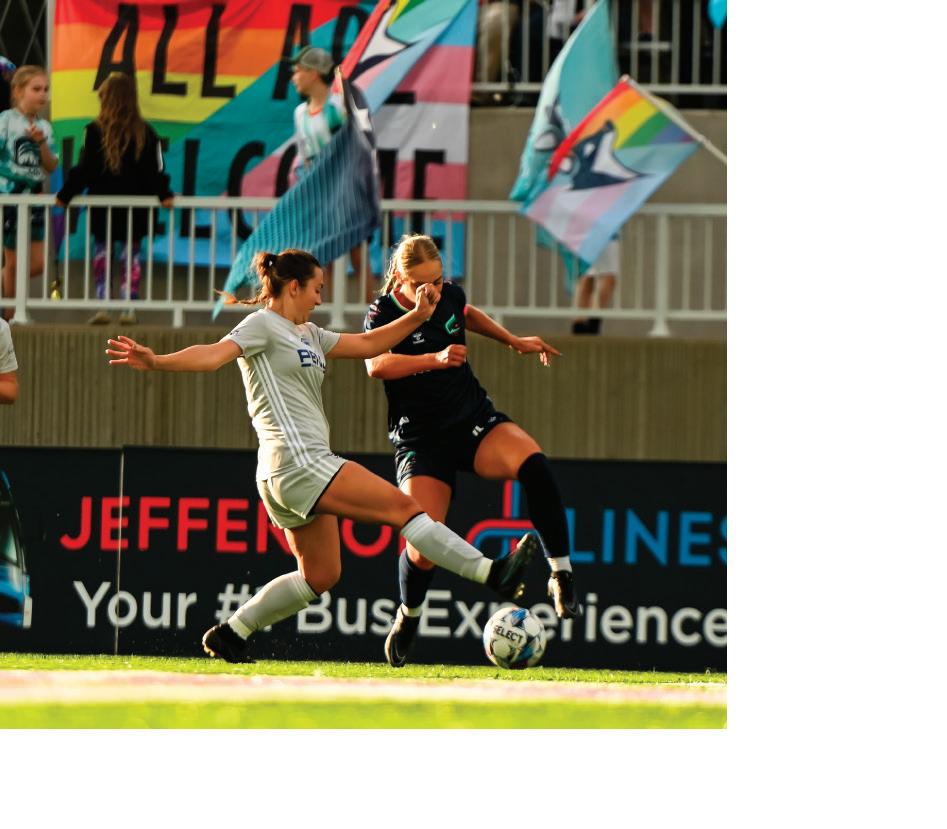
Minnesota Aurora FC Pride Night
June 6 • 4 p.m. • TCO Stadium, Eagan, Minn. Wear your best rainbow gear and join the Aurora as they take on RKC Third Coast. mnaurora.com
Trans Joy Fest
June 7 • 11 a.m. to 4 p.m. • Park Point Rec Area, Duluth, Minn.
Hosted by Trans Northland, this event aims to bring love, hope and joy into the transgender, two-spirit and gender expansive community. The festival will feature many vendors, performers, youth- and family-friendly activities, food trucks and so much more. transnorthland.org
Pride Brews & Drag Brunch
June 7 • noon to 2 p.m. • $15 • La Doña Cervecería, 241 Fremont Ave N, Minneapolis Beer, tacos and drag? Why yes, please! It isn’t brunch, it’s brew-unch, Pride style! tcpride.org/events
Break the Cycle
June 7 • noon to 3 p.m. • 5-mile, 15-mile and 25-mile routes • registration is Pay What You’re Able (suggested amounts: $30 standard, $15 reduced, $45 Pay It Forward or $0 if you need it) • Theodore Wirth Trailhead, Minneapolis
Ride with TC Pride and Women’s Advocates to raise awareness about domestic violence, enjoy the outdoors and connect with community partners. tcpride.org/event/break-the-cycle
Minnesota Twins Pride Day
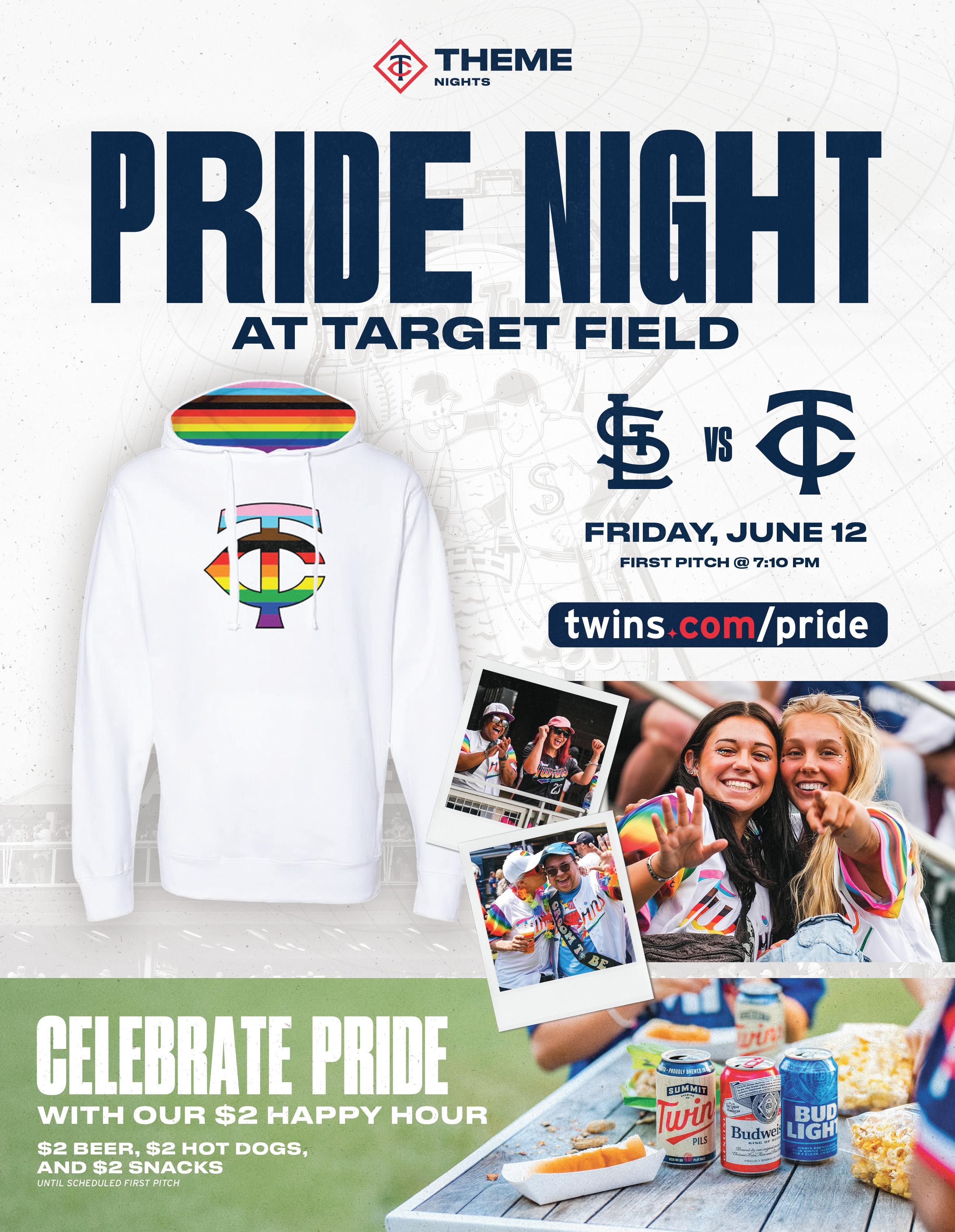
June 12 • 7:10 p.m. • Twins vs. St. Louis Cardinals • Target Field, Minneapolis
Dress in your sportiest rainbow gear and cheer on the Twins as they celebrate the vibrant LGBTQIA+ community so prevalent here in Twins Territory. mlb.com/twins
Gender Affirming Clothing Swap
June 13 • 1-3 p.m. • Hopkins Public Library, 22 11th Ave. N., Hopkins, Minn.
Organized by the Hennepin County Library, this event will offer folks the chance to find new-to-you clothing, explore your gender identity, refresh your wardrobe, bring clothes that no longer suit you and pick up some new things to try. Please bring only items that are gently used and freshly laundered, and limit donations to one bag. tcpride.org/event/gender-affirming-clothing-swap-3
Drag Divas & Pride Anthem at Chanhassen Dinner Theatre
June 14 • brunch at 11 a.m., show at 12:30 p.m. • age recommendation 13-plus • Chanhassen Dinner Theatres, Main Stage, 501 W. 78th St., Chanhassen, Minn. Wear your pride loud and turn up the volume with this drag brunch featuring bold beats, fierce performances and unapologetic joy. chanhassendt.com/dragshows
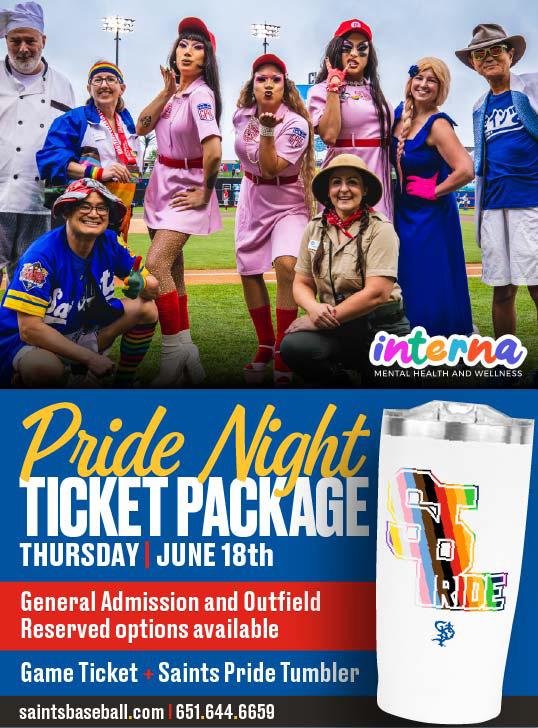
St. Paul Saints Pride Night
June 18 • 7:07 p.m. • Saints vs. Omaha Storm Chasers • CHS Field, St. Paul
Dress in your rainbow best and come out to see the Saints take on Omaha! milb.com/st-paul
Twin Cities Gay Men’s Chorus presents “Disney PRIDE in Concert with Minnesota Orchestra”
Join TCGMC as they celebrate LGBTQ+ life, love, family, and pride in a spectacular new concert that draws inspiration from both iconic Disney films and modern classics. Visit TCGMC’s website to purchase tickets. tcgmc.org
Queermunity’s Quiet Riot
June 20 • check website for upcoming details
Come out for a sensory-friendly Pride celebration that will provide a space for queer joy without compromising comfort.
queermunitymn.com
Minnesota Lynx Pride Night
June 21 • 5 p.m. (time subject to change) • Target Center, Minneapolis
Come out and celebrate Pride Night as the Lynx take on the Washington Mystics. lynx.wnba.com
TC Pride Family Fun Day
June 21 • 11 a.m. to 2 p.m. • Rain or shine! • Como Park East Pavilions, 1199 Midway Pkwy., St. Paul
Join Twin Cities Pride for a free Family Fun Day held annually to help celebrate LGBTQ+ families. Hot dogs, chips, beverages and more, along with fun, crafts and games for kids. tcpride.org/family-fun-day
Pride Beer Dabbler 2026
June 26 • 6-9:30 p.m., 5 p.m. with Early Access • Minneapolis Sculpture Garden
Get ready to dress cute and raise your glasses and Pride flags because Pride Beer Dabbler is back this year for its 14th year and bringing together over 70 Minnesota breweries and cideries! beerdabbler.com/festivals/pride-beer-dabbler
Twin Cities Pride Youth Night
June 26 • 5-8 p.m. • open to ages 10-20 • Loring Park, Minneapolis
With an array of drag performances, DJ, photo booth and more, this is a great way to start the festival! Free food, drinks and fun, and spaces for caregivers to relax as well. tcpride.org/pride-festival
Sips & Slays: Pride Show | Sociable Cider Werks
June 26 • 7:30-10 p.m. • $20 • 21-plus only • Sociable Cider Werks, 1500 Fillmore St. NE, Minneapolis
Start your Pride month with food, brews and a fabulous Twin Cities Pride drag show! Twin Cities rock band TIMISAROCKER starts the evening, followed by the performers of POWER Drag Revue.
June 27 and 28 • Loring Park, 1382 Willow St., Minneapolis
The second-largest Pride festival in the U.S. and the largest free Pride festival; here, you’ll find hundreds of vendors, including LGBTQ+ and BIPOC community resources, artists and businesses, along with music, food and entertainment, as well as the Pride parade on Sunday through downtown Minneapolis. tcpride.org
Pride Shabbat
June 27 • 10 a.m. • 12 p.m. community Oneg will follow • St. Mark’s Cathedral, 519 Oak Grove St., Minneapolis Join J-Pride for their annual Pride Shabbat morning service at Twin Cities Pride! It is a joyful, meaningful celebration of Shabbat in honor of Pride Month, with all LGBTQ+ Jews and allies welcome. jfcsmn.org/event/pride-shabbat
Minneapolis People’s Pride
June 27 • 12-4 p.m. • Powderhorn Park, Minneapolis
An alternative Pride celebration that intends to be a space for all queer folks to experience joy, eat food, trade art and enjoy various other activities centering on those most marginalized in our community. mplspeoplespride.com
A 5K run, starting at MCTC on Hennepin Avenue and following the parade route, turning around at the Mississippi River and running back down Hennepin to MCTC. The Kid’s Rainbow Dash runs two blocks on Hennepin from 11th to Spruce. tcpride.org
2026 Twin Cities Pride Parade
June 28 • 11 a.m. to 2 p.m. • Third & Hennepin start, proceeds down Hennepin to Spruce
With over 200,000 supporters cheering on the marchers, this is one of the largest Pride parades in the US. tcpride.org
LGBTQIA2S+ Pride Demonstration Box Tending on Nicollet Island
June 30 • 6-8 p.m. • Nicollet Island, Minneapolis
Join Friends of the Mississippi River for a special evening during Pride Month to come together and revitalize the planting demonstration boxes in the Nicollet Island prairie. fmr.org/events/lgbtqia2s-pride-demonstration-box-tending-nicollet-island
Join J-Pride, YALA Minneapolis, Moishe House and NextGen on the patio at Dreamstate Cafe for our annual Pride Happy Hour! Come together in community to share stories about Pride and celebrate an exciting conclusion to the 2026 Pride season with a drink (and snacks!). jfcsmn.org/events/category/pride
North Star Regional Rodeo
July 25-26 • gates open at 11 a.m., rodeo starts at noon • free admission • all ages welcome • Dead Broke Arena, Hugo, Minn.
Come out for some rip-roarin’ fun as top cowboys, cowgirls and cowfolk compete in bull riding and barrel racing, along with crowd favorites such as the wild drag race and goat dressing. nsgra.org
2026 St. Cloud Pride Paddle
August 2 • meet at 1 p.m., launch at 1:30 p.m. • 100 Pine St., Clearwater, Minn. • reserve shuttle and equipment with Clearwater Outfitters
Join St. Cloud Pride for this annual event, which offers a safe, community-focused water activity. stcpride.org
Northern Minnesota CampOUT
August 6-9 • West Forty RV Park Campground, Gilbert, Minn.
Enjoy an LGBTQ+ safe space, make new friends and explore the beauty of Northern Minnesota! This year’s CampOUT will be coordinated with Range Iron Pride. Owners Paul and Chuck will host their usual CampOUT CookOUT as well! westfortyrvpark.com/campout-weekend.html
MNPOC Pride Annual Boat Cruise
August 15 • 6-10 p.m. • 18-plus • tickets $55 • Stillwater River Boats, Stillwater, Minn.
Join MNPOC Pride for a night of music, community and celebration! Two DJs, free food, live entertainment. Limited spots available for LGBTQIA2S+ people and allies, so purchase tickets early. mnpocpride.org
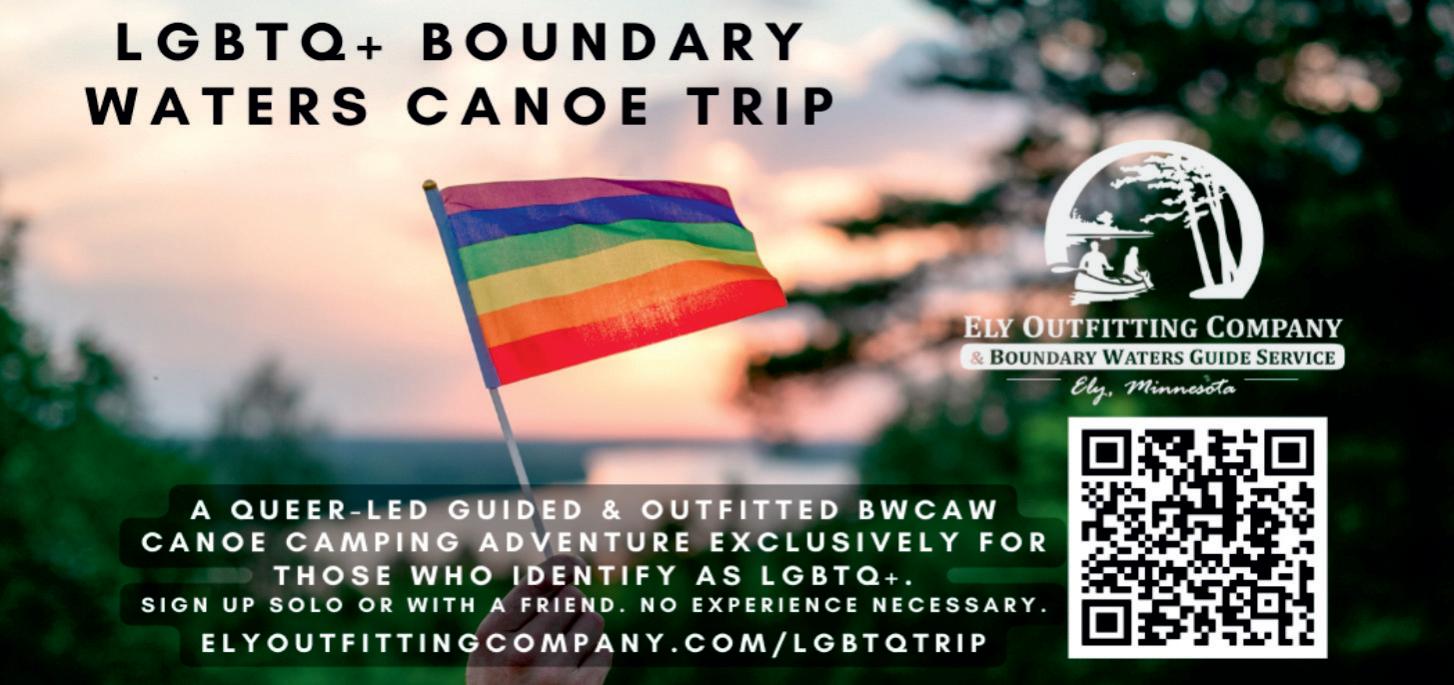
LGBTQ+ Boundary Waters Trip
August 19-23 • $895 per person, with possible financial assistance based on need • groups of 4-8 • ages 18-plus • Ely, Minn.
Ely Outfitting Company & Boundary Waters Guide Service is a gay-owned business that supports diversity and inclusion in outdoor spaces, so this is a great opportunity to make new friends and meet interesting people in a beautiful locale! This trip is queer-guided & open exclusively to those who identify as members of the LGBTQ+ community.
Stonewall Sports Twin Cities 10th Anniversary Gala
September 26 • Minneapolis Institute of Art Stonewall Sports Twin Cities is turning 10, and they’re celebrating! Themed L’Étoile du Nord (The North Star), it will undoubtedly be an evening of reflection, celebration and dancing.
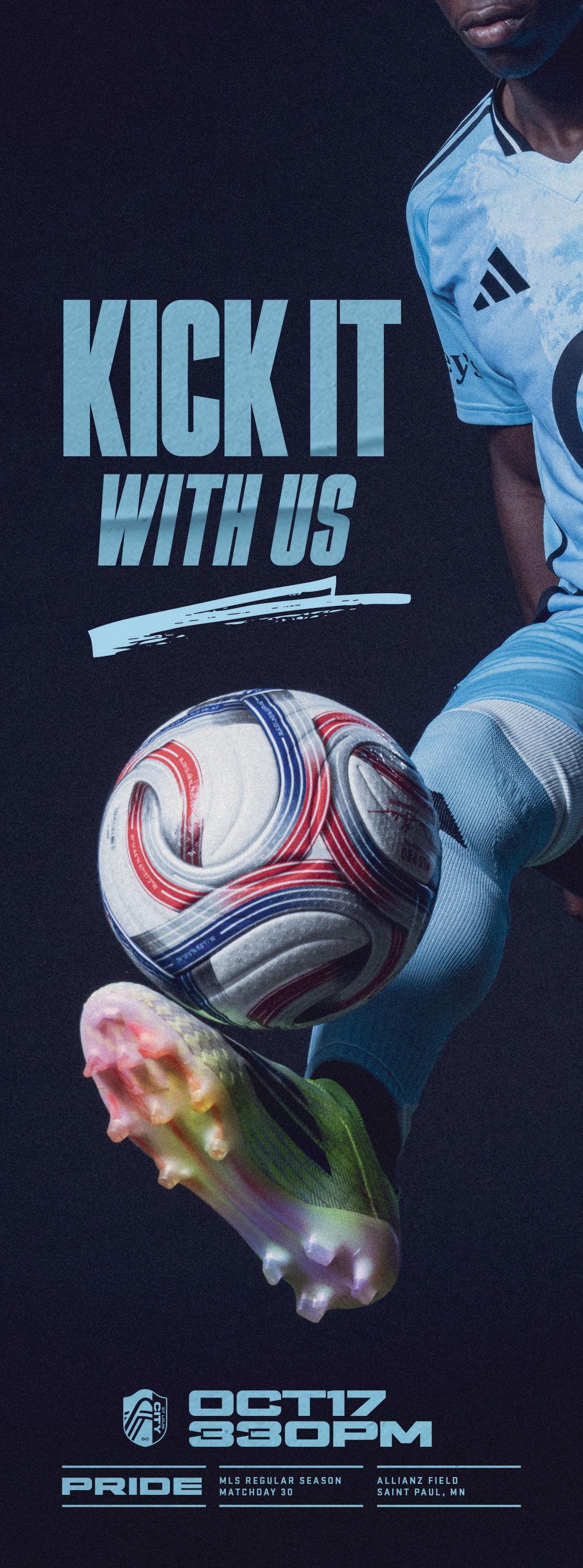
October 17 • 3:30 p.m. • Allianz Field, St. Paul Come out to Allianz Field in your Pride colors and cheer on the Loons as they take on St. Louis City SC. mnufc.com
Stonewall Sports 12th Annual National Tournament
October 22-25 • Various venues around Virginia Beach, Va.
Join Stonewall Sports and its Norfolk chapter for a funfilled weekend of festivities! The tournament is expected to bring more than 3,000 LGBTQ+ people and their allies from across the U.S. to connect, compete and create community.
stonewallsports.org/national-tournament
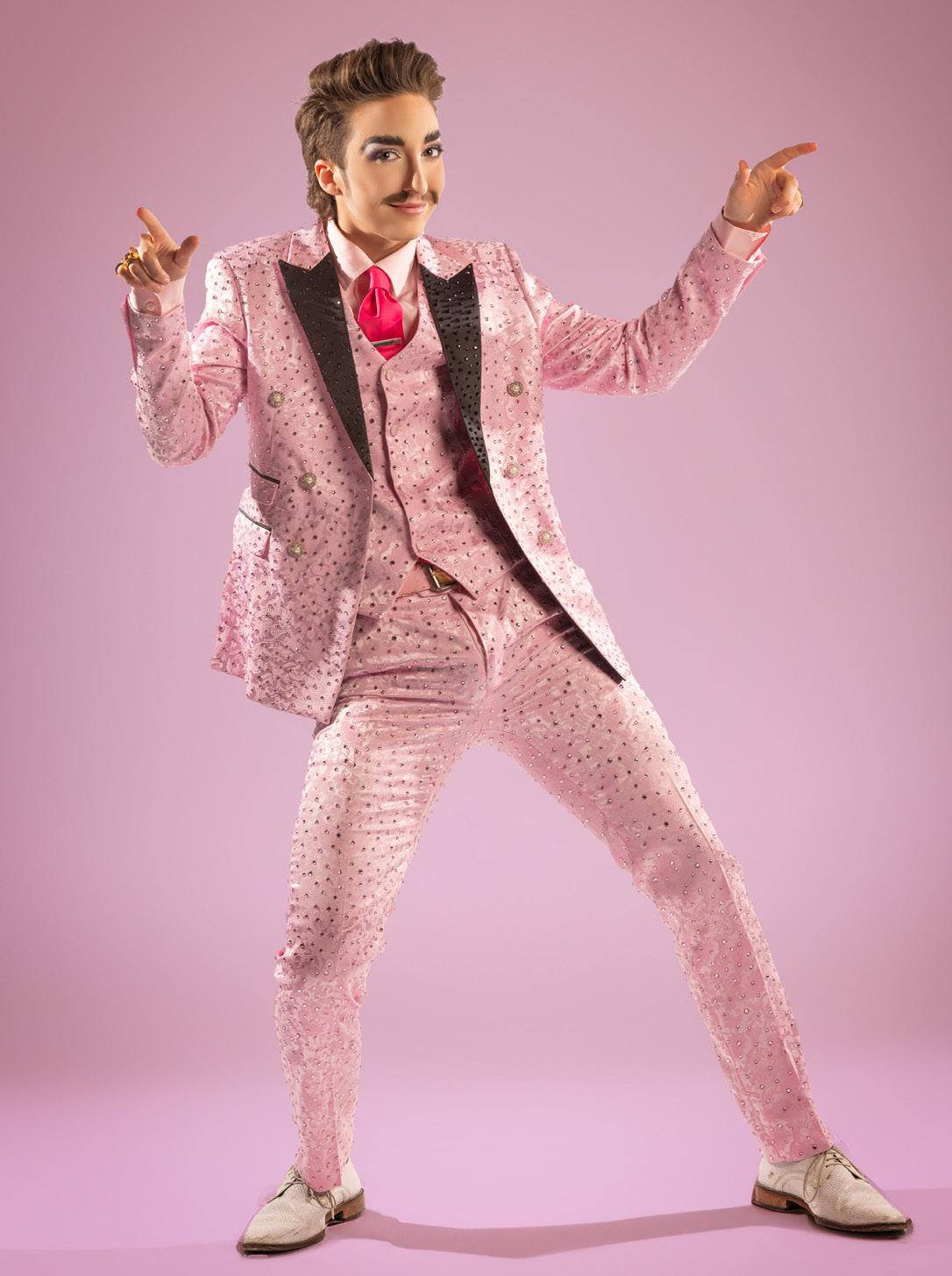
Finding Joy in Drag:
Dick Von Dyke’s Playful Take on Performance and Purpose
Drag king Dick Von Dyke grew up in St. Louis, Mo., in a Southern Baptist family where music and church played a central role. He attended church regularly, playing the French horn, while family members filled the orchestra and choir, and his uncle led the orchestra.
“It was very cultural from a young age,” Von Dyke reminisces.
Although the church was a strong presence in his upbringing, Von Dyke says he did not enjoy the experience but credits it with sparking his love of music.
He traces his first experience with performance to the fifth grade, when he was assigned the role of welcome minister at church.
“I borrowed a suit from my grandma, and I think I even wore a wig,” Von Dyke says. “I was really committed to looking like the welcome minister. They handed me a microphone, and I thought, ‘Well, this is fun.’”
It wasn’t until college, however, that he first began to learn about drag and about LGBTQ+ history.
“In college, I learned about Stonewall and about drag,” he says. “I remember a group of us piling into a car and going to a drag show in Kansas, with trash bags taped to the windows. From the moment I saw drag on stage, I knew I wanted to do it.”
He later moved to the Twin Cities, drawn by its thriving drag community.
“I moved here because there is so much drag, and we are really lucky for all the different spaces where drag exists right now,” Von Dyke says.
He says drag continues to evolve, shaped in part by changing audiences and the influence of social media.
“I feel really committed because I also think that drag is changing, and I think that it needs to,” Von Dyke says. “The economy plays a role, but so do changing audiences, especially in a world of social media where attention spans are shorter than when I started over a decade ago.”
Von Dyke’s current work includes themed drag brunches with Flip Phone Events, where he creates original music mixes tailored to each performance.
“The role extends beyond simply getting on stage and performing a number,” he shares. “For themed brunches, it involves creating original music mixes of songs audiences will enjoy while aligning with the character being portrayed.”
With a background in theater, he enjoys building character-driven performances, sometimes imagining what a character like Gimli from “The Lord of the Rings” might sing.
He also works at the Black Hart of Saint Paul, an LGBTQ+ soccer bar that hosts drag and burlesque shows.
Von Dyke is currently collaborating on a television project, “Detective Dick Quick,” created by Isaac Quick and Alex Tennyson.
“Detective Dick Quick was the brainchild of Isaac Quick and Alex Tennyson, who have worked on many projects together,” he explains.
“What I like about them as filmmakers is that they feel strongly about telling goofy queer stories, which is important because queer people are often represented in media by their worst experiences,” he continues. “It can be really empowering to show a queer person’s goofiness.”
He says the filmmakers began developing the project after seeing his performances and started writing with him in mind. He has since collaborated on a pilot featuring several local performers.
Von Dyke described the show as a playful concept, drawing visual inspiration from “Columbo.”
“I’m interested in portraying a lead character who doesn’t have everything figured out, using drag to both explore and parody traditional ideas of masculinity,” he says.
Von Dyke’s role as a performer is rooted in creating joy.
“I see my role as a drag artist as giving people joy,” says Von Dyke. “I think that happens in the bar and at brunch. I’m inspired by the ways that could happen in a more accessible way in film.”
“Drag feels especially empowering right now. Performers have always taken on a role similar to a rodeo clown, protecting others while creating space for joy.”
He referenced the Sisters of Perpetual Indulgence, who describe drag entertainers in that way, and says that amid global pressures, war and immigration enforcement, joy can be difficult to find.
Von Dyke says he and collaborators have paused fundraising for the project to prioritize community needs.
“We’ve put fundraising on the back burner because there are so many other important organizations we’ve been supporting instead,” he says. “Our community has shown that we will protect and support each other — whether that means paying rent or covering utilities.”
“I think it’s hard to ask people for money at a time when people are just trying to have a place to live,” he says. “So, it’s on pause for now, but joy is still valuable. I don’t want to downplay that.”
In addition to television work, Von Dyke performs in “Divas and Drag,” an opera theater production that pairs live opera singers with drag and burlesque performers.
This year’s show will also feature baroque musicians. He describes the performance as a uniquely immersive experience and says it is scheduled for August.
Von Dyke also praised the Twin Cities’ broader performance scene.
“I’m really becoming a fan of the Twin Cities’ clown and puppet scene,” he shares. “There are a lot of really cool shows, like the Bug Ballet, which recently had a sold-out run. That shows theater can still be relevant.”
Looking ahead to Pride, Von Dyke highlighted several events, including “Two Dykes Walk into a Bar,” which he co-created with Queenie Von Curves at the Black Hart of Saint Paul.
He described the event as “intentionally created as a space for dykes.” Von Dyke is also collaborating with One Voice Mixed Chorus for a Pride weekend performance featuring queer and trans singers alongside drag.
He says live music can be deeply unifying.
“Live music has a uniquely unifying and liberating quality,” he says. “Combining it with drag can be even more powerful.”
After what the city has experienced in recent months, Von Dyke says events like these can offer healing, and he encourages people to attend and support local performers.
Photo by Darin Kamnetz
WEISMAN ART MUSEUM
Fortune Feimster Talks ‘Takin’ Care of Biscuits’ Tour, Life Lately
After six months of juggling acting on screen and touring, stand-up comedian and actress Fortune Feimster is enjoying being out on the road and focusing solely on her brand-new tour, “Takin’ Care of Biscuits,” which kicked off in April.
The tour will be coming to Rochester, Minn., on June 11 at the Mayo Civic Center Auditorium.
When asked what her favorite part of the tour has been so far, Feimster shares that it is the love that she is receiving while on the road.
“A lot of people know that my family’s going through a lot, and every city I go to, everyone’s asking about my mom and giving me love, and the kindness of this tour has probably stood out more than anything,” she says. “I feel like all the positivity that I put out into the world is coming back tenfold from the people that are showing up for me.”
Visibility Award
On March 21, Feimster was honored with the Visibility Award at the Human Rights Campaign North Carolina’s 30th anniversary dinner. The award recognized her contributions to LGBTQ+ visibility.
“It’s always a really special thing to get recognized by your community,” Feimster shares. “I’ve worked really hard in my career to be authentic and to show people who I am, and part of who I am is being an out gay person, and I’m very proud of that fact.”
“I have always known that representation is so important for our community,” she adds. “I’ve been proud of the work I’ve done as far as playing out characters in many television shows and talking about being gay, so to have my own community see that and appreciate that means a lot to me.”
From Stage to Screen
Fortune Feimster said her comedy is rooted in authenticity, both on and off stage. “What you see is what you get,” she says, adding that she does not present a different version of herself for audiences. Her goal is to always be a good person and treat others well, something she believes comes through in her material and outlook on life.
If that approach inspires others, Feimster says, “that’s really cool.” She also pointed to the atmosphere at her shows as a reflection of that mindset. Audiences bring what she describes as “beautiful energy,” creating spaces that feel positive, welcoming and fun.
Her tours are long and demanding, typically lasting about two years with roughly 150 shows in 100 cities. It begins in smaller comedy clubs, spending three to four months writing and testing new material. Those early performances help shape the foundation of the set.
Feimster’s work then moves to theaters, where the material continues to evolve. Jokes are refined, and stories shift over time. Some pieces improve, while others are replaced. The process, she says, is like a puzzle, with parts moving around until the very end, even up to when it is filmed.
The role of comedy in everyday lives
“This is such a tough time for so many people,” Feimster says. “There’s a lot going on in the world. Now more than ever, it’s unpredictable what’s happening, and I think comedy has become a place where people can escape and laugh in a room with other people.”
She describes it as “the place where you can go to feel good with other people.”
“I really love that as a comedian I get to provide that kind of experience for others,” she says.
Feimster is proud of the work she is doing, focusing on creating stories that bring fun, light and levity. She said audiences who attend her shows often leave feeling a sense of release.
“It’s silly and fun,” she says, adding that people need that kind of experience now more than ever.
Upcoming Projects
Feimster will be playing the role of Will Ferrell’s caddie in his upcoming Netflix golf comedy series, “The Hawk,” set to premiere this summer.
She will also star alongside Nikki Glaser, Kim Kardashian and Brenda Song in Netflix’s upcoming comedy film “The Fifth Wheel,” directed by Eva Longoria. The film is set to release in late 2026 or early 2027.
When she’s not on the stage or on our TV screens, Feimster is an unapologetic homebody who enjoys drinking a glass of wine, taking a dip in the pool and sitting by the fireplace. With her busy schedule, though, those opportunities have been rare. But in the meantime, while she’s “Takin’ Care of Biscuits,” she can rely on her relentlessly positive community to take care of her.
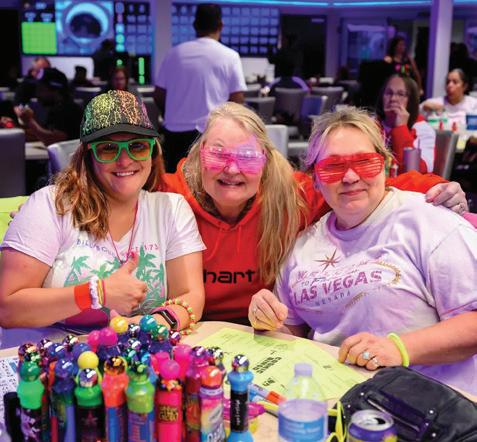
JUNE 28: BRUNCH & BINGO 11am LAS VEGAS SUPER BINGO GIVEAWAY 11am | 1pm | 3pm | 6pm | 8pm
‘Disney PRIDE in Concert’: A Unique Collaborative Event
For many, Disney music carries feelings of nostalgia and coming-of-age. With lyrics centered around embracing identity and overcoming fears paired with appropriate instrumentals, Disney songs can evoke emotions such as comfort and relief for those who have struggled with acceptance and belonging.
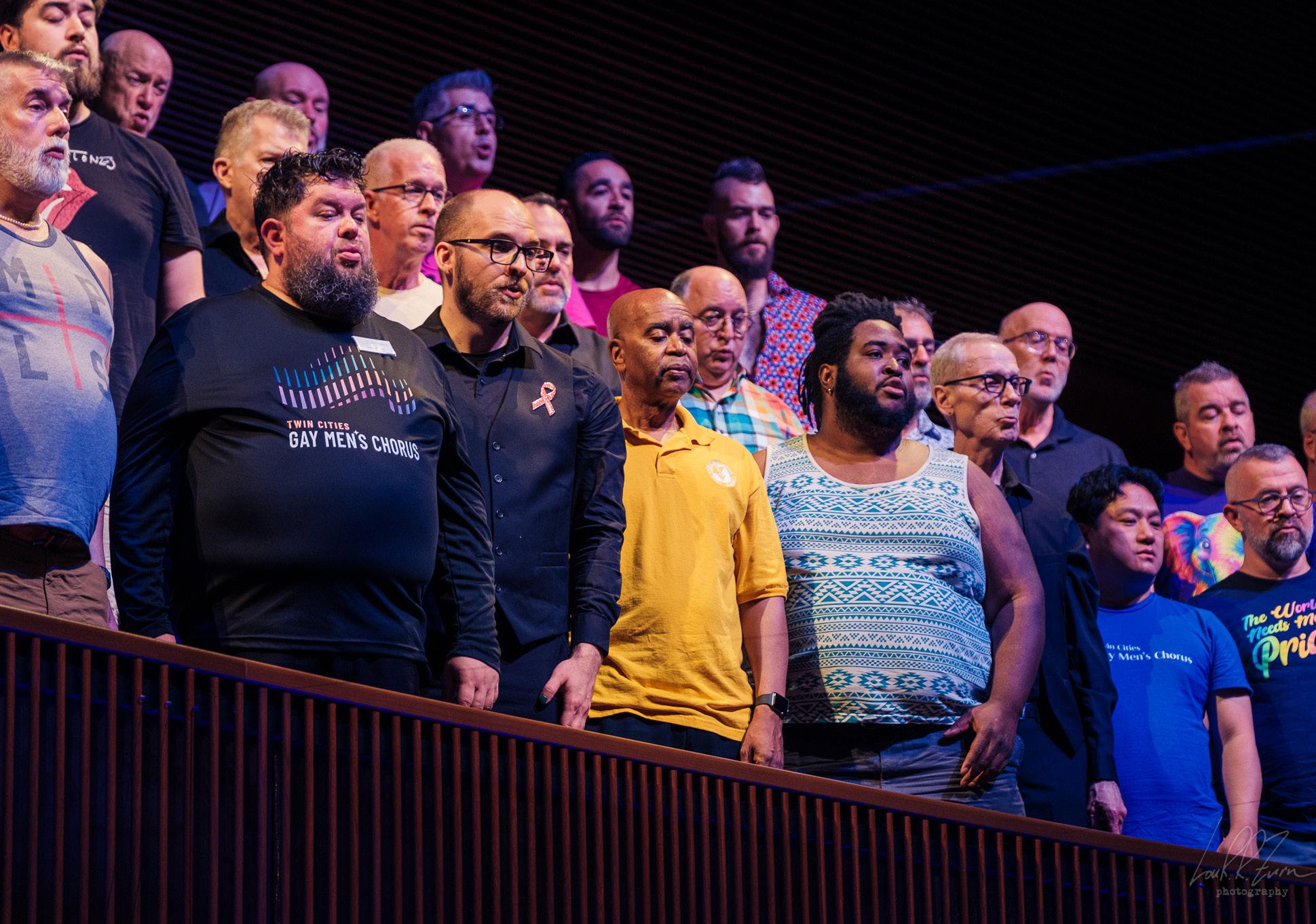
It only makes sense, then, that the Twin Cities Gay Men’s Chorus (TCGMC) would be the group approached by the Minnesota Orchestra to bring to life Minneapolis’ version of “Disney PRIDE in Concert.” Gerald Gurss, the artistic director for TCGMC, describes the impact of the men’s chorus on his life.
“I started singing with Heartland Men’s Chorus in 1999 as a 19-year-old, or 21-year-old at Emporia State University in Kansas, and I wasn’t out yet … I figured venturing two-and-a-half hours away from a small town in Kansas to go sing was a safe way to explore that without outed at home,” Gurss shares. “And it just offered me about 150 different viewpoints of what it means to be a gay person … all of a sudden I found people who are more like me and kind of validated who I was just by being in the space, and so I wanted to do something with my music degree that would give back.”
Created in 2020 for the Boston Men’s Chorus, “Disney PRIDE in Concert” is a showcase of musical talent meant to honor Pride and life itself. From its creation, the work was quickly adopted by other choruses, each iteration offering a distinctive style and approach. Gurss explains that while some groups work with full orchestras, others simply have a small group of players.
For the Twin Cities, the idea was brought up around a year and a half ago, when the Minnesota Orchestra approached TCGMC with the project and asked if they would like to collaborate on it. And, as Gurss puts it, “you just don’t say no when the Minnesota Symphony Orchestra asks if you want to collaborate on a concert.”
Photo by Lou Zurn
Throughout each different version, the heart of the event remains true: bringing people together to celebrate life and Pride in a unique visual and auditory display. Selecting songs from earlier Disney movies and more modern ones, the show uses the lyrics and storytelling to highlight Pride and individual experiences of those within the LGBTQ+ community.
“The unique part of this concert and why it’s called ‘Disney PRIDE’ is because some of the songs, or many of the songs actually in this concert, are set up through the lens of queer people. So people will be telling individual stories about their lives,” Gurss says. “It takes queer authenticity and puts it through the lens of Disney, and vice versa.”
Running for a duration of around two hours, audience members can expect to be presented with Disney musical classics shared in a way that reflects the different experiences of individuals with-
in the LGBTQ+ community. A combination of storytelling, instrumentals, chorus and visual effects has been put together to craft the show into a work of art. When the audience leaves, Gurss hopes they walk away feeling seen, learning new perspectives and having enjoyed themselves.
“I want them to leave feeling like, ‘Wow, I’m imagining some of these songs differently now because of that queer lens.’ Or, ‘I also felt that when I saw that,’” Gurss says. “And then for our non-queer friends … if you’re not a queer person, you’re not contextualizing things on the queer experience. … So I feel like that’s something that I want people to leave with, is that visibility.”
In all, TCGMC is a talented group of musicians who put a lot of passion into their work and are truly honored to have been approached with this opportunity.
Gurss believes that each member of TCGMC has stepped up to provide a display of excellent musical talent that can help “elevate” the impressive instrumentals of the Minnesota Orchestra. He acknowledges the hard work and dedication each musician and individual has to have in order to create this event.
“On a personal level, as a studied classical musician, I know some of the names who have conducted and performed in that hall, and the caliber of musicians who live in that hall. The Minnesota Symphony Orchestra is a legacy,” Gurss says. “And what that means for me is that an organization with that kind of legacy of the standard of quality they exude, they don’t want to partner with an organization who is not going to meet or elevate that quality.”
Although one sentence cannot truly cover the totality of the experience of “Disney PRIDE in Concert,” we asked Gurss to try to describe the event in one sentence anyway. He responded, “‘Disney PRIDE’ is not only an afternoon of entertainment and nostalgia, it is also a Pride-centric event where people take the familiar music of Disney and experience it through a queer lens.”
“Disney PRIDE in Concert” is set to take place June 20 and 21 at Orchestra Hall in Minneapolis. TCGMC and the Minnesota Orchestra will reimagine Disney in a way that embraces Pride and honors what it means to be alive. To learn more about the event, such as specific times and pricing, visit tcgmc.org/ disney-pride-in-concert.
Participate in a paid research study!
University of Minnesota researchers are seeking volunteers with treated HIV or without HIV to study how HIV affects body fat and metabolism. Participants with or without obesity are welcome.
Study procedures may include blood draws, lymph node biopsies, endoscopies (colon and stomach), stool collection, DEXA scans (body composition), and liver MRI.
Participants may be compensated up to $2,850. Email us at hivresearch@umn.edu or scan the QR code below to learn more.
Abby Nissenbaum Packs Diverse Influences, Personal Affirmations and Advocacy into New EP
Built from voice notes on lunch breaks and late-night songwriting sessions outside her full-time job, Nashville-based LGBTQ+ artist Abby Nissenbaum created her upcoming EP “Want to Be Wrong” in fragments inspired by situationships, disappointments and empowerment.
While primarily an indie-rock artist, her upcoming EP spans a diverse range of musical genres, including indie, alternative, pop and country. As a classically trained soprano, originally trained in Italian opera in high school, Nissenbaum’s melodic, smooth tones and high belts move listeners alongside her vulnerable lyricism.
Alongside music being a huge part of her life, she pursued a doctorate, ending with a master’s, with research focused on LGBTQ+ discrimination and violence. She also previously worked at an indie video game company on games such as “Fishin’ For Permission” and “Benevolent” (in which she voice acted).
“I got really into music around the time that I started working in video games, and just seeing the way that music can enhance a video game was really special to me, and like how it can drive or support a story,” Nissenbaum says.
“That’s kind of the approach I take with my music, too. There’s always some sort of central theme and storyline running through the entire album.”
The album’s first single, “Why Does No One Want Me?”, originally an empowering song written for her friend who is an R&B artist, explores vulnerability and difficulties in the modern dating world. The title is a common feeling many single people come across while navigating modern dating and self-confidence.
“I actually wrote it for a friend who is an R&B artist … and she was talking about how hard it is to just find someone in today’s modern dating world, so I was like, ‘Wow, you’re the most beautiful person I’ve ever seen. Like, if you can’t find someone, how am I going to find someone?’” she says.
The original premise of the song was “Why wouldn’t anyone want me?” so the verses take a sassy and empowering, almost early 2000s girl group style, she says, and the choruses were altered to fit her typical vulnerable side seen in her music.
The title “Want to Be Wrong” comes from the single’s bridge: “Will I have to do this all on my own? For once, I really want to be wrong.” The album explores the negative things she tells herself, and many of us do as well, and reinforces that they are untrue.
“You can tell throughout the album that there’s an arc of being really disappointed and being angry, and by the end, there’s a really fun song where I’m getting back into it and finding my power again,” Nissenbaum says.
Her music often deals with topics surrounding subjects such as past singles “Perfect Crime” and “Glass Half Full,” which discuss toxic relationships and abuse, in efforts to continue her previous advocacy work.
“I think it’s just really important to shine a light on LGBTQ+ harassment, which I unfortunately receive a lot of … or like domestic violence prevention, shining a light on how we can take community-based approaches to prevention efforts,” she says. “I think just like the more people who can speak about it in an educated way, the better off we’ll be as a society.”
While many songs stem from real-life experiences and advocacy work, Nissenbaum also writes songs to pitch to other artists or TV shows. “Naomi,” another single off the EP, was inspired by an episode of “Emily in Paris” that her mom was watching, and the sound is based on the French-Spanish pop genre yé-yé.
Nissenbaum says she’s inspired by artists like Brandi Carlile, especially for her advocacy and inclusivity for other artists and the queer community. Alongside Carlile, k.d. lang has also served as an inspiration as Abby explores the country music scene, notably in “Growth Story,” her favorite song off her upcoming EP.
Carlile and lang, while known LGBTQ+ artists, didn’t use that as a part of their marketing in ways artists are able to now, she says.
“It’s important to honor the roots of LGBTQ+ music and honor those trailblazers and also just be thankful for the fact that we’re able to use it as a way to get our audience,” Nissenbaum says.
Despite balancing music alongside a full-time job after pushing it aside for many years, Abby aims to get every drop of life she can get, whether it looks hectic or not, especially having felt limited as a queer kid in what she was told she could do.
“So now that I’m an adult and I can choose what I want to do, I want to do those things for myself as a kid who was told, ‘You can’t do that’ or ‘You can’t achieve X, Y and Z because you’re gay, you’re weird.’ So doing that for little Abby is really important to me,” Nissenbaum says.
Photos by Hannah Kik
‘Twins and Needles’ – Activist Sue Westegaard Proves A Stitch in Time Saves Lives
Even the descriptor “LGBTQ+” makes the point: the queer community sees itself as a quilt of sorts, a patchwork of castaways stitched together with a thread that’s hard to define. The “castaway” part was especially easy to identify with, not that many decades ago, when quilts took on a special significance for the rainbow tribe in a big way.
During the 1980s, the unchecked HIV/AIDS virus tore through the “gay community,” as it was known then, leaving in its merciless wake countless tragedies of lives needlessly ended too soon. Because of the stigma associated with the new and terrifying disease, many of these dead were not even given funerals.
In order to right this wrong, in 1985, activist Cleve Jones conceived the NAMES Project AIDS Memorial Quilt, finally bringing it to life in 1987. In doing so, Mister Jones bequeathed overdue appellations to nearly 2,000 anonymous HIV/AIDS victims, forever linking the queer community to this particular form of commemoration.
During this same era, Minneapolis’s Aliveness Project came to be. Its original purpose was to prevent as many new names as possible from adhering to that quilt. This was achieved, at least at first, by building a shame-free community using that most Minnesotan of traditions, the potluck.
Today, according to its website, the Aliveness Project “supports people living with and at the greatest risk of HIV through transformative resources and direct services.” These services include housing help, HIV testing and support groups, among others.
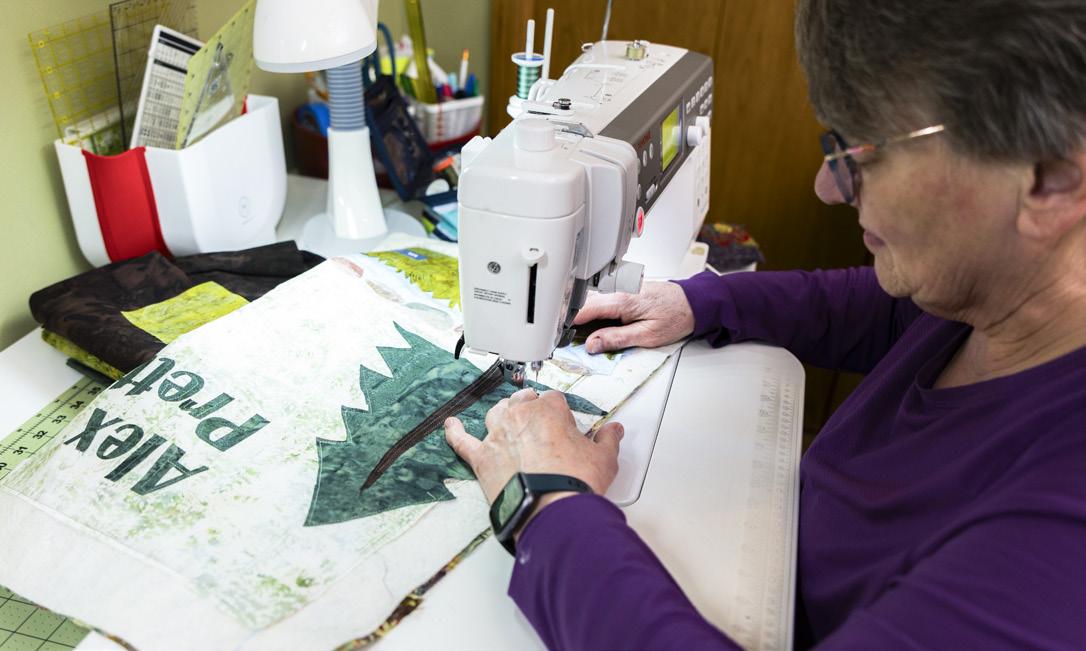
Dylan Boyer, the Aliveness Project’s current director of development, brought the notion of commemorative quilts to a pair of recent local demises that, although much smaller in scale when compared to those of the Me Decade, were no less tragic: the much-publicized deaths of Renée Good and Alex Pretti. When Boyer considered remembering the two Minneapolitans quiltatiously, he knew just where to turn.
“I have volunteered to help with registration for the Red Undie Run,” says Sue Westegaard, recalling the Aliveness Project’s light-hearted observance of World AIDS Day, where participants traverse one nipple-hardening mile wearing little more than passion-colored unmentionables.
It wasn’t, however, Westegaard’s skill as a registrar that Boyer had in mind — it was a more creative ability that ran three generations deep.
“My grandmother and mother quilted,” Westegaard reminisces. “Mom asked me to draft a block of a certain size and a certain pattern.”
Before being approached by Boyer, Westegaard was already experienced at combining her art form with unlikely ideas. A teacher by trade, Westegaard’s family tradition provided literal material for her day job.
“I presented many sessions on the mathematics in quilting at state and national mathematics conventions and wrote several articles for [the National Council of Teachers of Mathematics] publications,” she reports. “Over the last
20 years, I have done traditional quilting, as well as paper piecing.”
So the suggestion for a quilt remembering Renée Good and a quilt remembering Alex Pretti was made … but a thoughtful, heartful pause followed.
“When Dylan and I talked about doing wall hangings for the Good and Pretti families, the idea of doing an ‘art quilt’ was daunting,” Westegaard confesses. “I wanted each wall hanging to represent the way that Renee and Alex lived, not how they died.”
This commitment to aliveness guaranteed Westegaard’s approach would not be stitch first and ask questions later. As she describes: “On the back of each hanging was a letter explaining why I chose each item on hanging.”
In other words, Westegaard understood that these hangings weren’t just stitching sashings to blocks — these hangings were the stories of human lives.
Toward the end of achieving this laudable goal, Westegaard engaged in an art form even quainter than quilting — she listened.
“I listened to Renée’s brothers’ testimony before the Senate and read her wife’s message on Facebook,” she says.
She naturally brought the same approach to her second subject. States Westegaard, “When I started on Alex’s, I watched some YouTube videos — one of him leading a ceremony for a veteran who had died and another by a person who had been his patient.”
This sense of literal connection defines the quilts commemorating Renée Good and Alex Pretti … and the quilt that is the LGBTQ+ community. Thanks to the efforts of Westegaard and the Aliveness Project, the threads that bind its castaways together aren’t hard to define, after all — those threads are love.
The Good and Pretti quilts can, for the time being, be seen at the Aliveness Project’s office.
aliveness.org
Photo courtesy of The Aliveness Project
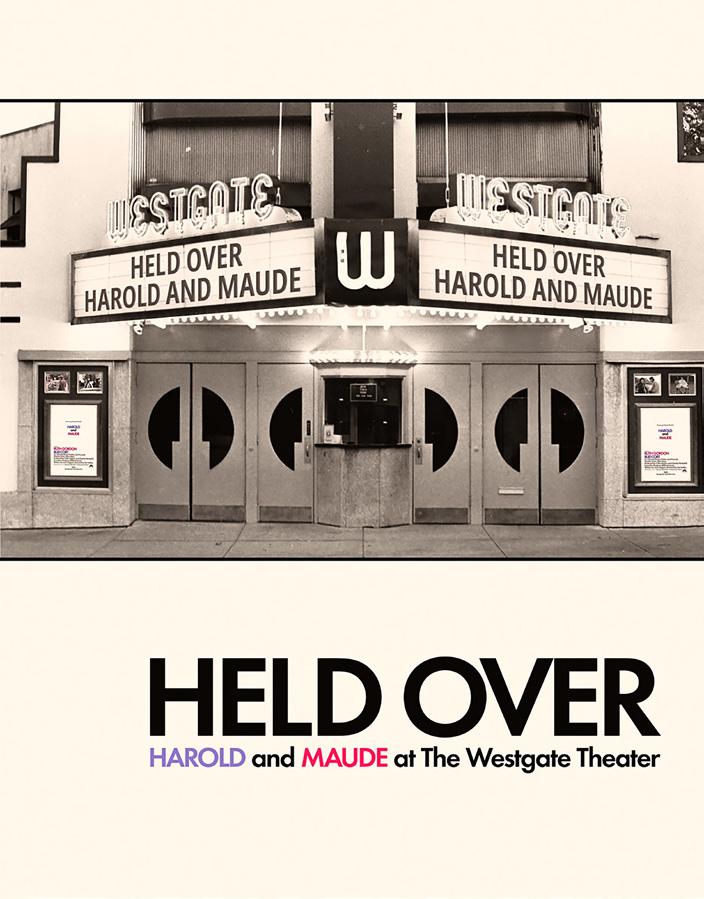
‘Harold and Maude’ at the Westgate Theater: A Flop, A Triumph and A Queer Cult Classic
There’s definitely no shortage of queer cult classic films. These beloved, campy, often over-the-top films have helped define modern queer culture, from “The Rocky Horror Picture Show” to “But I’m A Cheerleader” to “Fried Green Tomatoes.” Queer cult classics, with their focus on self-love, found family and profound connection, run the gamut of settings and genres, but there is one particularly beloved film that stands out to the LGBTQ+ community in Minneapolis: “Harold and Maude,” made famous by its uniquely long run at the Westgate Theater in Edina, Minn., just outside Minneapolis.
John Gaspard, a Minneapolis-based author, filmmaker, podcaster and archival researcher, set out to tell the fantastical, nearly unbelievable and 100% true story of the legendary run of “Harold and Maude” at the Westgate, which transformed it into the cult classic it is today, in his new book: “Held Over: Harold and Maude at the Westgate Theater.”
“If you love Minneapolis history, cult films or stories about passionate communities rallying around art, this book scratches all those itches,” Gaspard says. “And honestly, it’s just a great yarn: a quirky movie and a stubborn theater, a unique combination that wouldn’t let either one fade away.”
When “Harold and Maude” first came out (no pun intended), it was a total box-office flop. But an initial flop didn’t stop this story of chosen family and unconditional love. Instead, the Westgate Theater in Edina decided to do something rather unconventional: screen the film for over two years straight.
And that’s where the history gets even more interesting. The Westgate ran “Harold and Maude” for so long that locals actually protested its constant spot on the neighborhood theater’s marquee, angry and desperate to see anything else up there.
“The protests are a quirky, very Minnesota way of saying, ‘This is not normal.’ And they’re part of what cemented the film’s legend,” Gaspard says.
Gaspard’s book details the wacky, unexpected history of two local legends that refused to give up, and that wouldn’t have the niche fame they’ve created without each other.
“Held Over: Harold and Maude at the Westgate Theater” includes tons of amazing history, from never-before-published photos of the Westgate Theater, including its early Art Deco design, the Club Room and the 1950s remodeling, to the cool local reports that show how Minneapolis — not Hollywood — crafted a cult classic out of “Harold and Maude.”
Gaspard’s book is also full of amazing interviews with ushers, managers and moviegoers who remember seeing this film back in the theater’s heyday — including the local icon who saw the movie over 160 times during its crazy years-long run.
“Held Over: Harold and Maude at the Westgate Theater” is a love letter to the Westgate, to “Harold and Maude,” and to the queer community of Minneapolis.
“I grew up going to the Westgate, but once I started digging into its history — Carl Fust building it in 1935, the Club Room, the art gallery, the angry neighbors — I fell more in love with the place,” Gas-
pard says. “And the more I learned about the film’s improbable second life in Minneapolis, the more I realized this wasn’t just a movie story. It was a community story.”
As a film that celebrates outsiders and rebellious acts of joy, champions reinvention and simply refuses to behave, it’s no wonder it means so much to the queer community.
“What I love about this story — and what I think resonates with queer readers — is that it’s about finding your people,” Gaspard explains. “The Westgate became a haven for folks who didn’t always see themselves reflected in mainstream culture. ‘Harold and Maude’ gave them permission to feel seen, to feel understood, to feel joyful … It’s tender, anarchic, funny, melancholy and defiantly life-affirming. It’s about choosing your own path — even if that path makes absolutely no sense to anyone else.”
If you’re sold on learning even more about this one-of-a-kind story about the movie theater that would not give up on a flop-film-turned-queer-classic, then you’ve got to check out “Held Over: Harold and Maude at the Westgate Theater” by local author John Gaspard.
You can purchase the book at Albert’s Bridge Books (albertsbridgebooks.com), which Gaspard runs with his wife, Amy, or by searching for it on Amazon or Barnes & Noble. Local bookstores will also be able to order it for you upon request, and SubText Books in St. Paul usually keeps a couple of copies in stock, too. You can also ask your local library if they carry it or request that they do!
Also, keep an eye out for John Gaspard’s next book, “Minnesota in the Movies,” which is slated to come out in 2027.
Photo courtesy of John Gaspard. Cover Designed by Author Elevator
To: Prince, Dearly Beloved; For: The People
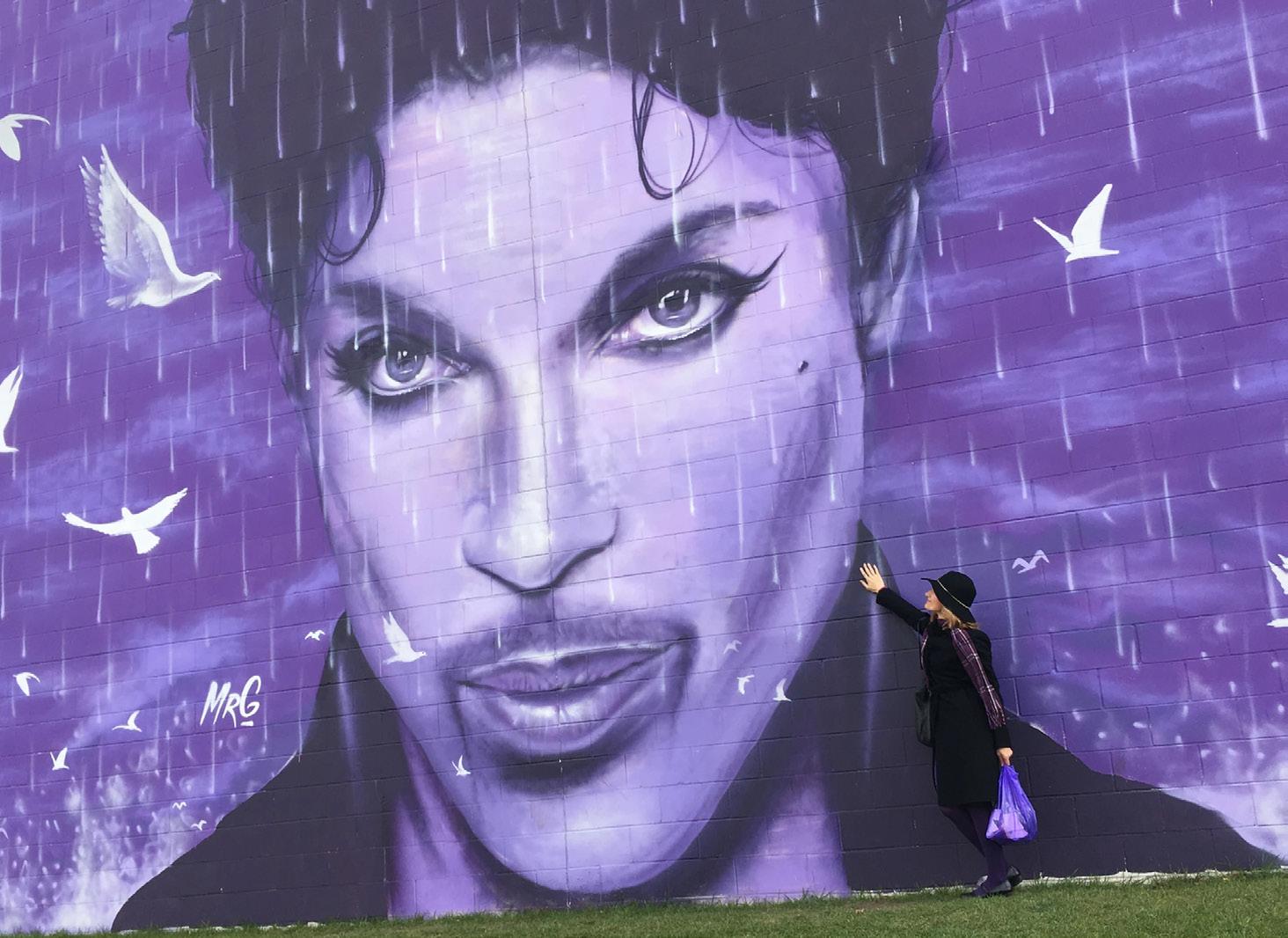
As early as 12 years old, Emma Balázs had Prince Rogers Nelson in her life in Australia; not physically, but through his “dimensions of influence,” contradictory ways of living and daringness to dream. In 2018, Balázs curated an exhibition that welcomed 3,000 visitors and featured artists from six countries. Yet, her calling to understand her heartbrokenness after his death persisted 10 years later with a new purpose: to commemorate.
Curator, writer and filmmaker Balázs didn’t always live in the Twin Cities and was working in New York at the time of Prince’s death. She eventually moved to Minnesota after numerous internal arguments about whether her heartbrokenness would be met with solace.
“When I came here, I found all these people who were similarly devastated by his death and just talking about how influential he’d been in their lives,” Balázs says. “That sort of led me to thinking about how I could use my skills and experience as a gift to Prince by collecting the stories and the art that people are offering up, as you know, a testament about the power of art and the influence of just one single artist.”
It was in the streets of Minneapolis and beyond where Balázs says she encountered numerous people who held stories, their tributes lining the Paisley Park fence, through tears, smiles and melancholy.
She knew that collecting these stories now meant obtaining beautiful, raw, emotive, and meaningful testimonies on how Prince influenced them, which is why, soon after she started the collection process for her first exhibition, which featured “Houses of Prince.”
“I did this because I needed to put a structure around it that gives the respect back to the people and tells them that their voice matters,” she says. “It’s not just about some official document of who Prince was and what his music did and how successful he was.”
And, although the pandemic prohibited a 2020 museum in North Minneapolis, as time inched toward the 10th anniversary of Prince’s passing, she felt a strong pull to create her second exhibition with an emphasis on commemoration.
Opening on Prince’s birthday (June 7), the community-sourced museum will be in Roberts Gallery, just a one-minute walk from an important house he lived in during his childhood after being taken in by Bernadette Anderson when his parents separated in 1965.
Conceptualized as a “counter museum,” Balázs wants attendees not to view it as oppositional, but instead complementary and “potentially radical,” questioning who has ownership of history.
Naming her curation “The People’s Museum,” she welcomes everyone to submit their artwork through personal stories in the form of written narrative or a voice/video recording, or even something inspired by Prince in the form of dance or visual art.
“Everyone’s welcome to tell their story,” Balázs says. “You don’t have to be a professional artist to share your art. You don’t have to be a writer to share your story.”
Though the unshaped submission process exists now, it started from a different idea based on what Balázs refers to as the “seven dimensions of his influence,” which include music, style, sexuality, spirituality, grief, joy, and music.
“I thought that might be evocative and help people start to think about submission ideas,” she says. “ I was sort of trying to frame it, but then very quickly I removed it, because I was thinking that it should emerge from what people give me.”
Who reviews the submissions? For the most part, Balázs takes charge, yet after years in the Prince-loving scene, she has a large network of fans and friends who assist her in the process.
Already, Balázs says many submissions align with the theme of grief, since this year’s museum has a commemorative focus. So far, she has been receiving stories about receiving the news of Prince’s passing, reflection in times of intense sadness, and the many ways grief can be dealt with.
“The other thing about Prince is that he was so joyful, and so he was so good at bringing people together to celebrate life, so I feel like that’s on me as a curator, to make sure that I have both present,” Balázs says. “Because the other thing about Prince is he emboldened so many people to feel that they could be their full, true, weird, creative, amazing self.”
Our Dearly Beloved, on a Purple Screen
Beyond the realm of the museum exists its first film: “Dearly Beloved,” a seven-minute documentary tracing a nine-year pilgrimage through Prince’s Minnesota homes as a meditation on community, grief, and unexpected transformation, with Balázs telling her personal story as a voiceover.
“Basically, I just filmed everything when I came to Minneapolis after he passed as my way of honoring him, because I didn’t know what I was doing, it became almost like an instinctive, intuitive pilgrimage,” she says. “So before I came to Minneapolis, I thought, ‘Well, what am I going to do there?’ And I just felt this need to follow in his footsteps.”
Balázs says she eventually began researching, tracing each house he lived in, going on an instinctive voyage through the city’s archives at libraries.
“I didn’t have a car, so, you can imagine, in Minneapolis, I was catching buses, and walking places that people don’t walk to around here, and it was really bizarre,” Balázs says. “ I did this sort of pilgrimage, basically filmed it on my iPhone, and then all kinds of incredible things happened. I met so many people here. I ended up falling in love. I moved to Minneapolis, you know, just this whole transformation of my life.”
Balázs has received lots of requests for screenings of “Dearly Beloved,” and is currently working on putting one together. She hopes that viewers will feel the power that art can have on people, and for them to, in turn, value artists more.
“I’m a filmmaker, first of all by training, and then later I became a curator,” Balázs says. “So I think that they’re often intertwined for me. And we all know the power of the moving image, and, you know, as a storytelling medium, it’s incredible. I love both so much.”
Photo courtesy of Emma Balázs
BY CARLA WALDEMAR
Duck Inn
When it comes to dining on duck, there are two categories of aficionados: one, those who agree that this bird is, indeed, the world’s most delicious fowl; and two, those yet to learn this basic fact of life.
Either category of diner can educate their palates while dining deliciously at a dive-gone-modestly-genteel in Nordeast called, ahem, Black Duck Spirits & Hearth. Chef/owner Jason Sawicki is the carnivore who got himself through the pandemic by trolling the streets in his Fare Game food truck while securing financing and fine-tuning the menu for a brick-and-mortar space.
The bright, cheery setting (including a fire-raging hearth, the heart of the operation) was once a gas station, as the story goes. Today, its well-spaced tables support conversations sans straining one’s vocal cords, all in view of the heart of the beast — an open kitchen, from which all manner of tasty eats appear. Trust the corps of servers, in their plaid flannel shirts, as your dining counselors.
The drinks menu sports a formidable list of spirits, plus a dozen original cocktails ($15 range) such as my choice, the Black Duck Old Fashioned. It stars duck-fat-washed rye whiskey (I have no idea what that entails, but why not?) abetted by cardamom, corn liquor and burnt agave. There’s a technical term for all that: yummy. If you prefer a glass of red to match the fowl’s rich, meaty profile, five suitable choices await.
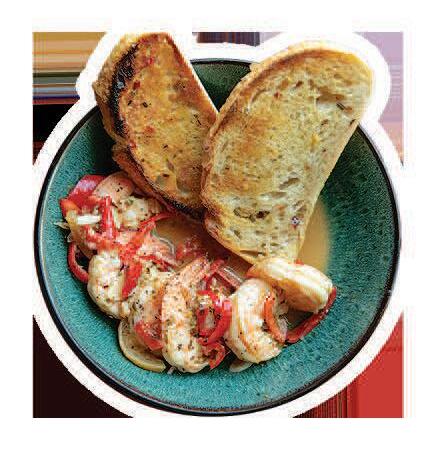
Because (I’m guessing) this dining room anchors a Polish pocket of Minneapolis, the menu’s starters include pierogi ($18.50) — a quartet of sturdy pasta pockets stuffed with a mix of soft farmers cheese, mashed potato and onion — in other words, comfort food deluxe — especially when accompanied by a scoop of chive-crowned sour cream. We added an order of duck confit cabbage rolls ($19 for two), a good decision that produced a rich filling of minced duck mixed with wild rice, afloat on a rosy-pink plate painted with modestly sweet red cabbage cream. Inventive and delicious.
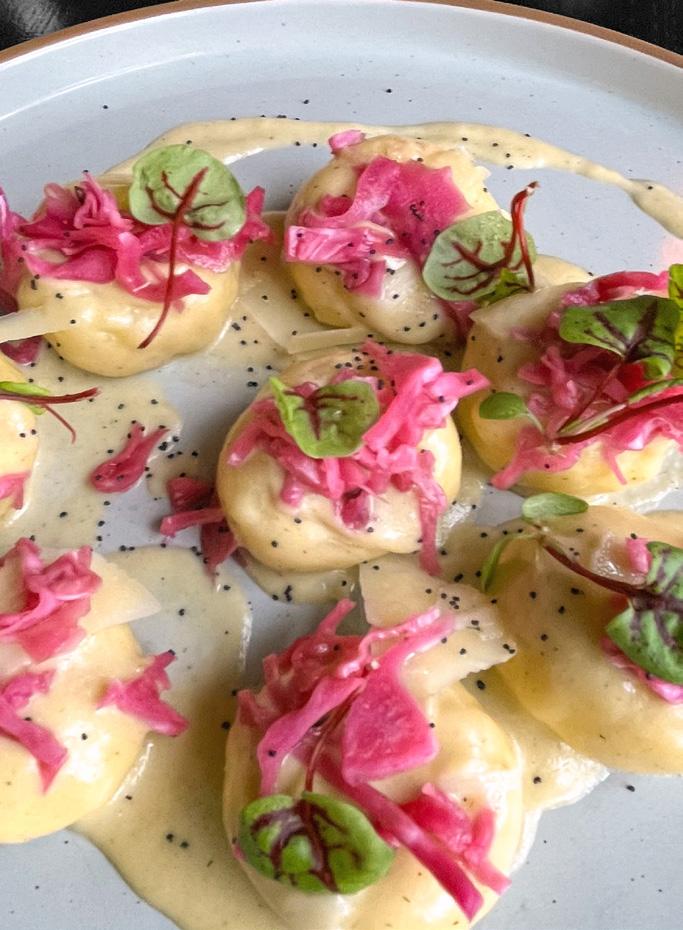
The app list hides some sophisticated surprises in its descriptions, such as pork belly in horseradish cream; egg & chips starring a just-barely poached egg served with properly salty potato chips and rich, rich truffle oil; or Silesian dumplings smothered in charred leek and Parmesan sauce, served with pickled red cabbage and a dusting of poppy seed.
But let’s talk about the supreme deity of Polish fowl: the duck. It’s served two ways on a single plate here ($39) — as leaves of ruddy, sweet and love-metender slices of breast meat, fanned around chopped duck confit — all accompanied by a petite mushroom pancake and a slice of sweet potato. There are enough hot peppers involved to leave a delicious little lingering burn in your mouth. Come the morning after, I’m still humming.
Duck Burger, Pierogis
Other hearth fare runs from a smoked half chicken with chimichurri and horseradish cream (not your usual “safe” chicken fallback) to a standard flat iron steak or double-cut pork chop served with sauerkraut and mustard vin.
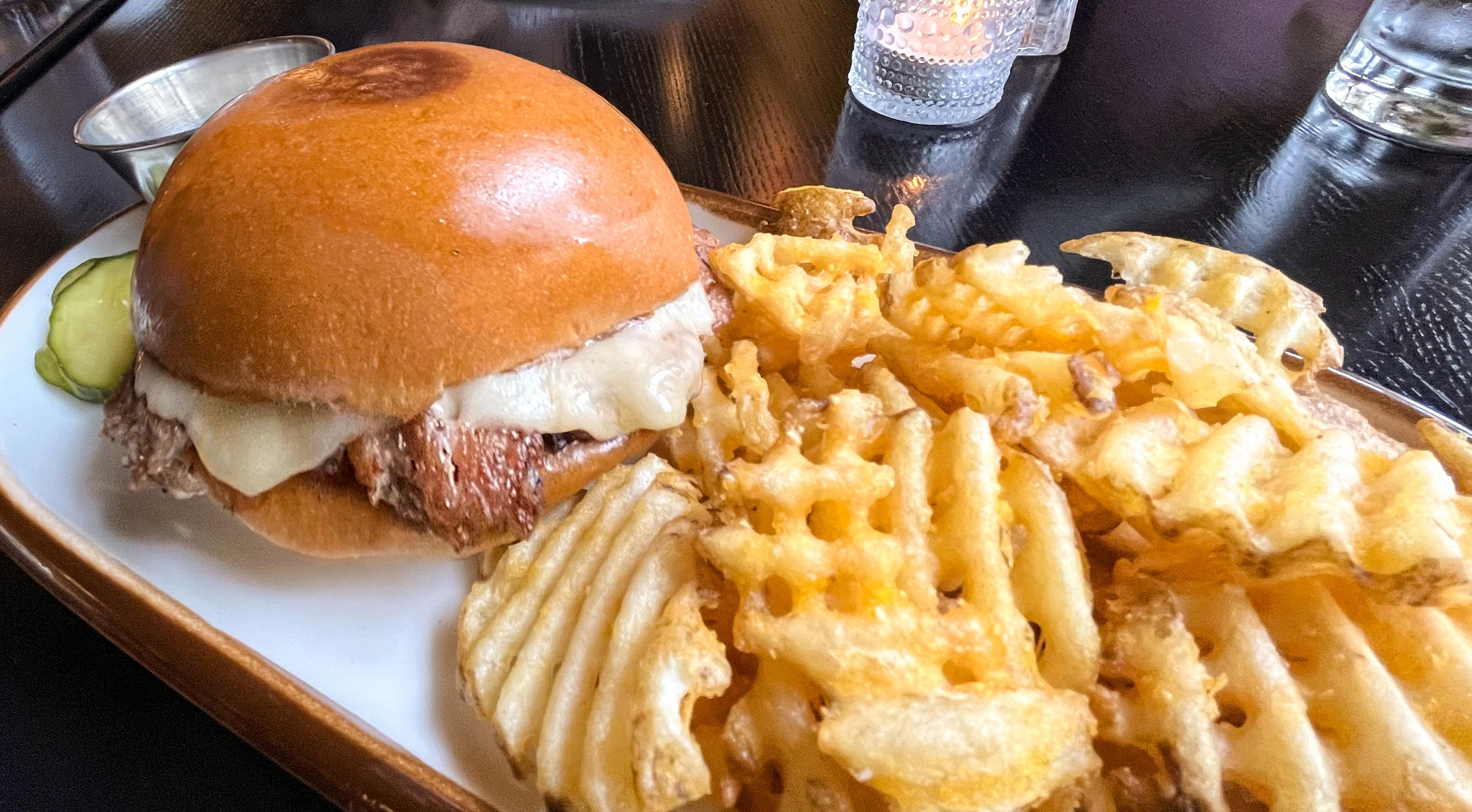
My dining buddy agreed to order the duck burger, which provided greedy me with half. A tender, billowy milk bun is loaded with a sturdy patty of ground duck meat garnished with everything on hand in the kitchen: onions, sharp mustard pickles, an also-mustardy Dijonnaise sauce and Swiss-like Havarti cheese ($18). Options include gilding the lily with duck bacon or duck leg. And for those who yearn for an old-fashioned bar & grill number, there’s the fried bologna sandwich (built upon a house-made sausage, however).
Missing your daily quota of veggies? Not to worry: the kitchen offers sides of spicy roasted cabbage, uniquely dressed in mole rosa, chili crisp and avocado herb aioli, as well as a Caesar salad inventively topped with smoked whitefish, along with toasted breadcrumbs.
Yes, desserts are on offer, too, but since our belts were set to burst, we passed. Next time: choose between a honey cake, a Polish cheesecake with poppyseed ice cream, a coconut sorbet or the treat I fondly remember from former visits, the paczek. It’s a divinely luscious yeastraised doughnut plumped with your choice of a raspberry or walnut/maple filling, then coiffed
Silesian Dumplings
with a brown butter glaze. If that isn’t a heavenly finale, well, why look forward to the afterlife?
A generous patio, anchored by the smoker truck that started it all, was already crowded in early April. How do you say it in Polish? Let the good times roll!
Black Duck Spirits & Hearth
1900 Johnson St. NE (612) 331-1421
blackduckmpls.com
Closed Tuesdays
Photo by Lisa Newmark
READY, SET, SUMMER: A GUIDE TO EXPLORING MINNESOTA’S FIVE REGIONS
BY TODD P. WALKER
Summer in Minnesota doesn’t sit still. Cabins open, patios fill and weekends start to book before you’ve had time to find your beach towel.
We all know how quickly summer flies by, from Memorial Day to the Minnesota State Fair in the blink of an eye. So let the planning begin — pull out a calendar and start circling dates and blocking off days.
Across the state, each region celebrates the season in its own way. Lakes, festivals, trails, small towns and city streets all come alive in the race to squeeze every minute out of those long summer nights.
LAKE COUNTRY WEEKENDS AND RESORT LIVING
The Brainerd Lakes Area offers a classic Minnesota summer. This is where people head to be on the water, whether that means fishing, water skiing, boating or cruising the lake on a pontoon. The lakes link to each other, towns are built around time spent on the water and days stretch from early morning coffee to sunsets on the dock. Evenings carry their own routine, with fish fries, local bars with pull tabs and places where people trade stories about the day.
Water, Trails and Open Roads
Gull Lake, the Whitefish Chain and Pelican Lake set the pace in cabin country, whether that means boating, swimming, paddleboarding or finding a stretch of shoreline to soak in the sun or cast a line. Boat rentals, jet skis and paddleboards are easy to line up through local outfitters.
The Paul Bunyan Trail runs for miles through woods and small towns, offering an easy way to hike or bike between stops. Golf also has a strong presence here, with courses that draw players throughout the summer.
For a change of pace, take a drive through the lake towns. Nisswa, Pequot Lakes and Crosslake offer shops, coffee stops and places to wander.
Basecamp
Grand View Lodge on Gull Lake keeps everything in one place, from golf and dining to direct lake access.
Madden’s on Gull Lake is built for those who want to stay active, with multiple golf courses and a spread-out property.
Cragun’s Resort on Gull Lake delivers a classic lake vacation, with cabins, beach access and space for families and groups.
Bites and Bevvies
Bar Harbor Supper Club on Gull Lake is a go-to for a summer dinner, where the setting and a plate of walleye carry the experience.
Zorbaz Gull Lake brings the energy, with boats pulling up throughout the day and a crowd that stays for pizza and drinks.
Main Street Ale House in Nisswa is a solid stop in town, known for burgers, beer and a setting that fits any time of day.
Don’t Miss
The Crosslake Fourth of July celebration is a signature event in this region, building into a full day around the holiday. There’s a parade through town, a boat parade on the water, live music and community events, with people moving between the lake and town throughout the day. Locals stake out their spots along the parade route early, with chairs lining the streets well before it starts — some even the night before. The day carries into the evening, wrapping with fireworks over the water.
Summer Events
• Nisswa Turtle Races — Wednesdays, June 3 to August 12
• Bean Hole Days, Pequot Lakes — July 14-15
• Crosslake Fireworks and Events — July 4
• Lakes Jam, Brainerd Lakes Area — June 25-28
• Brainerd International Raceway Racing — All summer
LAKE SUPERIOR DAYS AND NORTH SHORE DRIVES
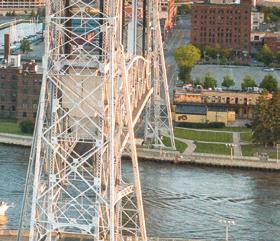
The North Shore starts in Duluth and runs up Highway 61 to Grand Marais, with Lake Superior leading the way the entire stretch. Canal Park is the starting point, where you can walk the lakefront, watch ships move through the canal and pick up something from Northern Waters Smokehaus before getting on the road. From there, the drive becomes the plan, connecting shoreline stops, small towns and places that turn a quick stop into a longer stay.
Water, Trails and Open Roads
From Duluth, follow the shoreline north as the road opens up and the lake stays in view. Gooseberry Falls State Park and Split Rock Lighthouse are the anchor stops, with places like Betty’s Pies and the Rustic Inn Café, both just north of Two Harbors, giving you a reason to slow down. In Knife River, stop at Great Lakes Candy Kitchen or Russ Kendall’s Smokehouse before continuing toward Gooseberry Falls. Farther up the shore, roadside stops for fresh lefse in places like Little Marais add another reason to take your time. Scenic overlooks, waterfalls and stretches of shoreline along Highway 61 turn the drive into a full day without feeling rushed.
Continue to Grand Marais, where Artist’s Point gives you a straight walk out into Lake Superior. Hike sections of the Superior Hiking Trail or spend time on the water kayaking or paddleboarding along the shore, then spend time in town with local shops, galleries and stops along the harbor.
Basecamp
Larsmont Cottages, just north of Duluth, offers a quieter start to the North Shore, with lakefront cabins close to town.
Lutsen Resort sits right along Lake Superior, with a mix of rooms, cabins and easy shoreline access.
East Bay Suites in Grand Marais keeps you in the center of town, within walking distance of the harbor, shops and restaurants.
Bluefin Bay Family of Resorts in Tofte offers a mid-shore option, with lake views, multiple lodging styles and an on-site restaurant.
Bites and Bevvies
Angry Trout Café in Grand Marais is a go-to for fresh fish, with a setting right on the water.
Voyageur Brewing Company in Grand Marais offers a place to sit back with a beer and take in views of the harbor.
New Scenic Café, just north of Duluth, is a destination stop along the drive, known for its menu and setting along the lake.
Naniboujou Lodge & Restaurant stands out for its historic dining room, making it as much about the setting as the meal.
Don’t Miss
A stop at Glensheen, the historic Congdon Mansion in Duluth, offers a look into the area’s past before heading up the shore. From there, the drive along Highway 61, with time built in to pull over and stay longer than expected, defines this stretch.
Summer Events
• Grandma’s Marathon Weekend, Duluth — June 19-20
• Fisherman’s Picnic, Grand Marais — July 30 to August 2
• Grand Portage Rendezvous Days — August 7-9
• Lake Superior Dragon Boat Festival, Superior/Duluth — August 21-22
LAKE LIFE AND SUMMER FESTIVALS
Northwest Minnesota is where the lakes get bigger and the towns sit farther apart, with more space and fewer crowds. The calendar centers on events like the Northwest Water Carnival in Detroit Lakes, WE Fest and the Watermark Art Festival in Bemidji. Detroit Lakes and Bemidji sit at the center of the region, with days that move between the water, town and whatever event is taking over that weekend.
Water, Trails and Open Roads
In Detroit Lakes, everything centers around the city beach on Detroit Lake. It sits right in town, with hotels, shops and restaurants just steps away, so you can move from morning coffee to the water. Rent a pontoon or jet ski, swim off the public beach or take a drive along West Lake Drive, where the shoreline stays in view.
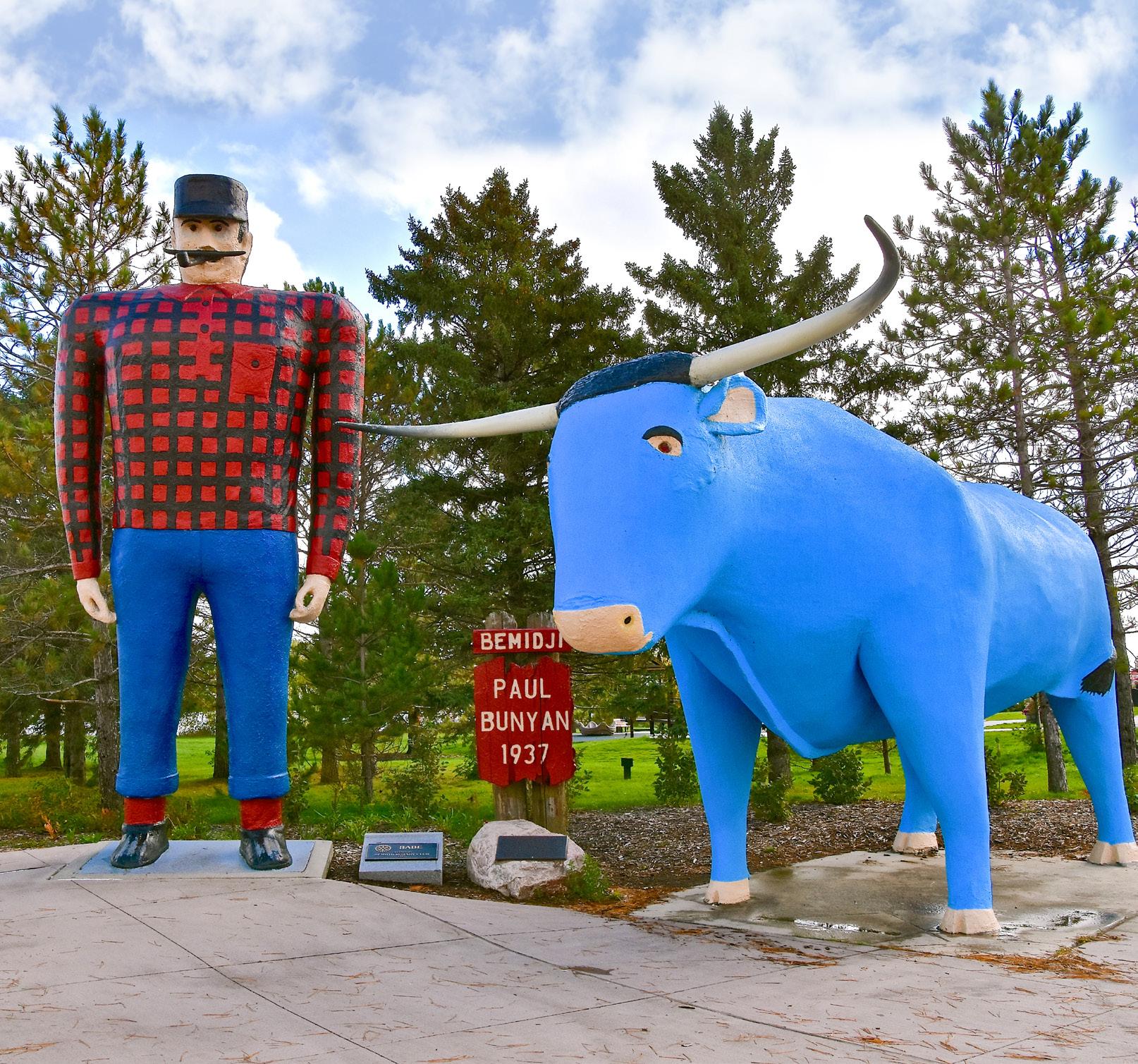
Bemidji brings a different setup. Lake Bemidji State Park and the paved loop around the lake give you a steady way to stay close to the water, whether you’re walking or biking. From there, it’s an easy shift into town, with stops near the Paul Bunyan and Babe the Blue Ox statues.
Basecamp
Chase on the Lake in Walker puts you right on the water with marina access, beach space and easy access into town.
LAKE DAYS. SLAY AWAY.
The lake is big, and love is bigger during Duluth Superior Pride. Bring your crew, your sparkle, and your fabulous fits to celebrate 40 years of acceptance Labor Day weekend, September 3-6.
Fair Hills Resort, outside Detroit Lakes, is an all-inclusive lake stay where meals, activities and time on the water are built in.
Ruttger’s Birchmont Lodge on Lake Bemidji offers cabins, golf and direct lake access in a classic Northwoods setting.
Bites and Bevvies
The Fireside in Detroit Lakes is a long-standing dinner spot known for steaks and a setting that feels like a classic night out.
Tara Bemidji offers a more refined option, with a menu and atmosphere that stand apart from more casual stops.
Bemidji Brewing is an easy stop in town, with a laid-back taproom and a lineup of local beers.
Don’t Miss
The Northwest Water Carnival in Detroit Lakes runs for over a week in July and is one of the region's defining events. It brings a full schedule of activities, from parades and live entertainment to lake events that keep the city beach and surrounding area active throughout the day. It’s the kind of event where the entire town is involved and the lake becomes the center of it all.
Summer Events
• Northwest Water Carnival, Detroit Lakes — July 10-19
• Watermark Art Festival, Bemidji — July 18-19
• Lake Bemidji Dragon Boat Festival — July 30 to August 1
• WE Fest, Detroit Lakes — August 6-8
BLUFF COUNTRY AND TRAIL TOWN WEEKENDS
Southeast Minnesota is bluff country, where the land opens into river valleys, winding roads and towns along the Mississippi and Root Rivers. Places like Lanesboro, Red Wing, Winona and Wabasha each bring their own draw, from bike trails and art galleries to riverfront views and historic main streets. This is where you pull over for eagle sightings along the Mississippi, spend time on the water kayaking or boating and move between towns that follow the landscape. The drive matters here, but so do the stops, whether that’s a walk along the river, a stop in a local shop or an afternoon that turns into dinner at a tavern, supper club or small-town diner.
Water, Trails and Open Roads
The Root River State Trail anchors this part of the region, running through Lanesboro and connecting towns like Whalan and Preston along a paved route that makes it easy to bike from stop to stop, with stops like Aroma Pie Shop in Whalan. Outfitters in Lanesboro can set you up with rentals or shuttle service, so you can focus on the ride and scenery. On the water, the Root River offers tubing, kayaking and canoeing, with stretches that move at a relaxed pace and keep you close to the bluffs.
Highway 16, known as the Historic Bluff Country Scenic Byway, winds through valleys and farmland, while stretches of the Great River Road along the Mississippi near Red Wing, Wabasha and Winona offer river overlooks and towns along the shoreline.
Basecamp
Root River Inn & Suites in Lanesboro offers a quieter stay just outside the main stretch, with easy access to the trail and river.
Cedar Valley Resort sits right on the Root River State Trail, with cabin-style accommodations and direct access to biking, tubing and time on the water.
Hotel Lanesboro keeps you in the center of town, within walking distance of shops, restaurants and the trail.
Bites and Bevvies
Pedal Pushers Café in Lanesboro is a natural stop along the trail, known for burgers and sandwiches.
Clara’s Eatery in Lanesboro offers a relaxed, small-town dining option with a menu that fits any time of day.
Sylvan Brewing in Lanesboro is an easy place to wind down, with local beers and a relaxed outdoor setting.
Don’t Miss
Start with a ride along the Root River State Trail, with stops in towns like Whalan to grab a coffee and pause along the river or Preston for a quick lunch or walk through town, then head back into Lanesboro for a beer at Sylvan Brewing and an evening at the Commonweal Theatre Company. It’s a mix of trail time, small-town stops and a night out that gives you a feel for how this region comes together.
Summer Events
• Art in the Park, Lanesboro — June 20
• Rochesterfest — June 20-28
• Thursdays Downtown, Rochester — every Thursday from June 11 to August 13, except July 2
• Buffalo Bill Days, Lanesboro — July 31 to August 2
FESTIVALS, PATIOS AND CITY
ENERGY
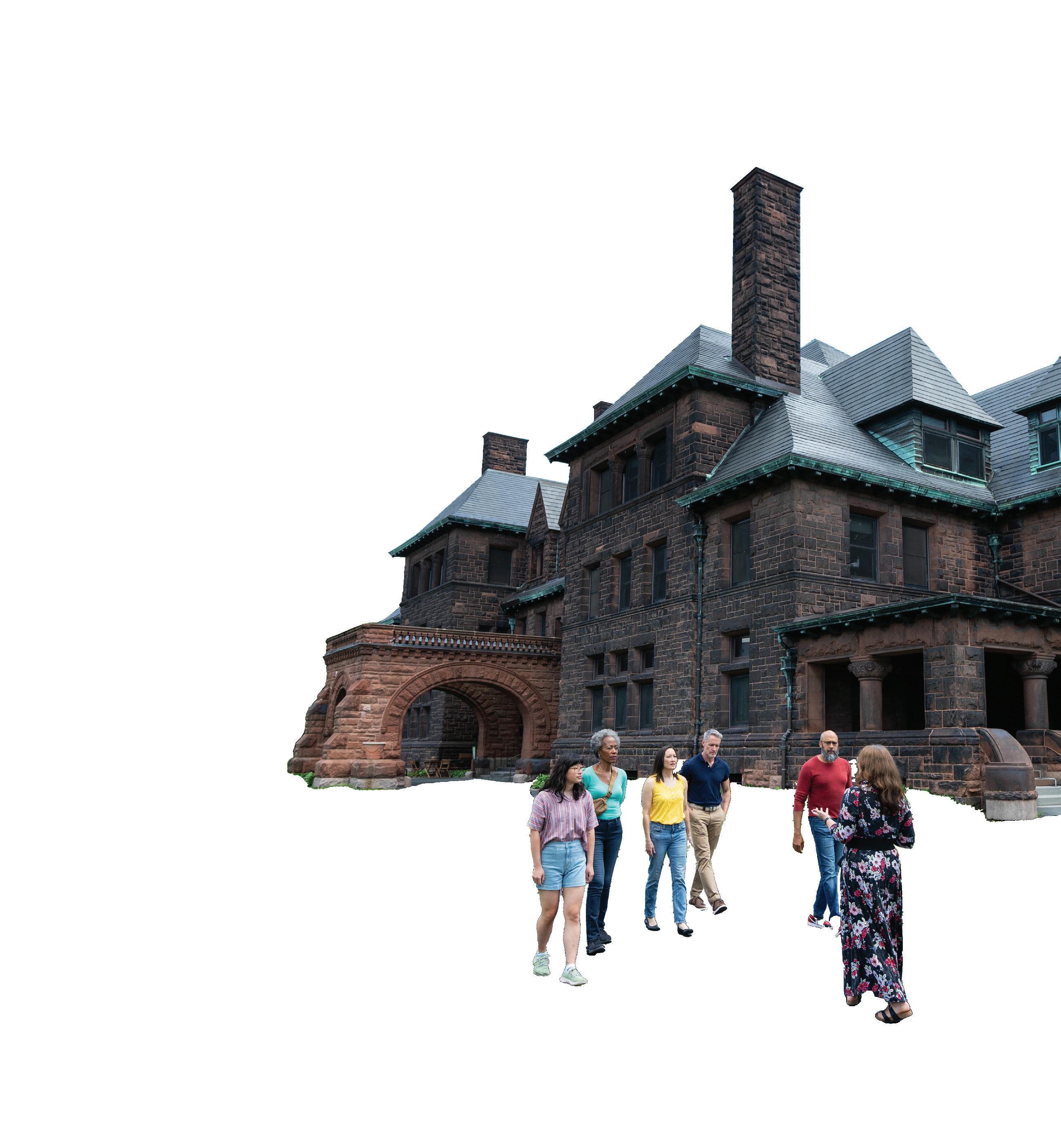
In St. Paul, the experience shifts. Segway tours focus on Summit Avenue, Cathedral Hill and Crocus Hill, moving through the city’s historic core. Routes include the Summit Avenue mansions, the F. Scott Fitzgerald House, the James J. Hill House, the Cathedral of Saint Paul and the Minnesota State Capitol, along with stops tied to Prohibition-era history along Selby Avenue.
Catch a St. Paul Saints game at CHS Field, where the experience leans as much into the atmosphere as the baseball. The downtown ballpark keeps fans close to the action, both inside and outside the stadium, and fits naturally into the rhythm of a summer night.
Basecamp
Hewing Hotel in Minneapolis anchors the North Loop, with a rooftop pool, easy access to dining and a central location.
Celeste of St. Paul Hotel + Bar, set in a former convent in downtown St. Paul, offers a stay tied to the building’s past with restored spaces.
The Nicollet Island Inn in Minneapolis gives you a quieter option near downtown, with river views and walkable access to the Northeast and St. Anthony Main areas.
Bites and Bevvies
Cossetta in St. Paul is a go-to for Italian, with a market-style setup and a rooftop that opens up in the summer.
Myriel in St. Paul offers a more refined dining option, with a setting that works for a night out.
Vinai in Minneapolis stands out for its Hmong menu, offering one of the most talked-about dining experiences in the city.
Don’t Miss
The Minnesota Yacht Club Festival at Harriet Island in St. Paul has become one of the standout summer events in the Twin Cities. Set along the Mississippi River, it runs July 17-19 and features headliners The Lumineers and Matchbox Twenty, along with acts like The Black Keys. People settle in early, the riverfront fills up and the energy carries through the night with the city as the backdrop.
Summer Events
• Grand Old Day, St. Paul — June 7
• Twin Cities Jazz Festival — June 19-20
• Stone Arch Bridge Festival — June 20-21
• Minnesota Fringe Festival — August 6-16
Closing
Summer in Minnesota doesn’t leave much room for waiting. The window is short and the calendar fills quickly. Whether it’s a weekend up north, time on the water, a small-town festival or a walk through the city, the plan is simple. Pick your spots, mark your dates and get out and enjoy the three hard-earned months of Minnesota summer.
175 Cesar Chavez St, St. Paul
‘A Rare Kind of Space’
Gamer Rachel Dove introduces an app that unites fighters, not lovers
Repulsive, hirsute, green-skinned, pig-snouted assassin of half-human, half-orc stock, drug and mostly disease free, seeks a partner in life and murder. The winning candidate will be proficient in the wielding of poisons, daggers and poisoned daggers. Gnomes, halflings and especially elves need not apply. Responses that include self-portrait woodcuts will receive fastest reply. Let’s see how well your sheath matches my blade!
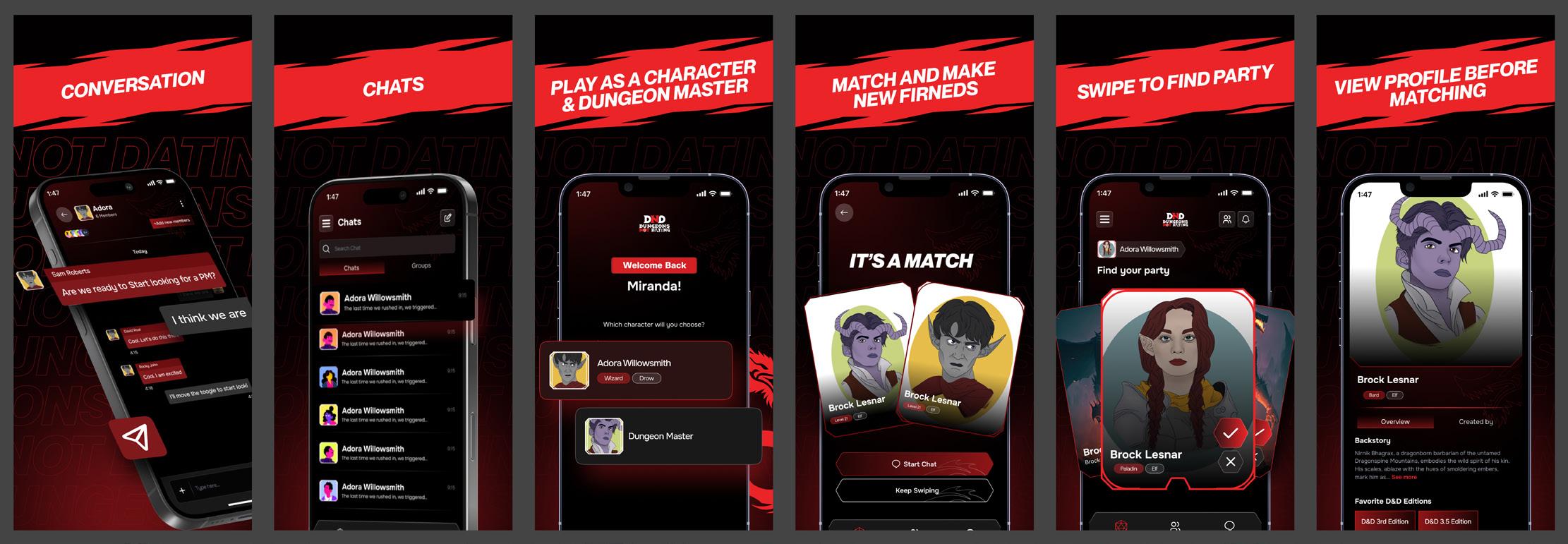
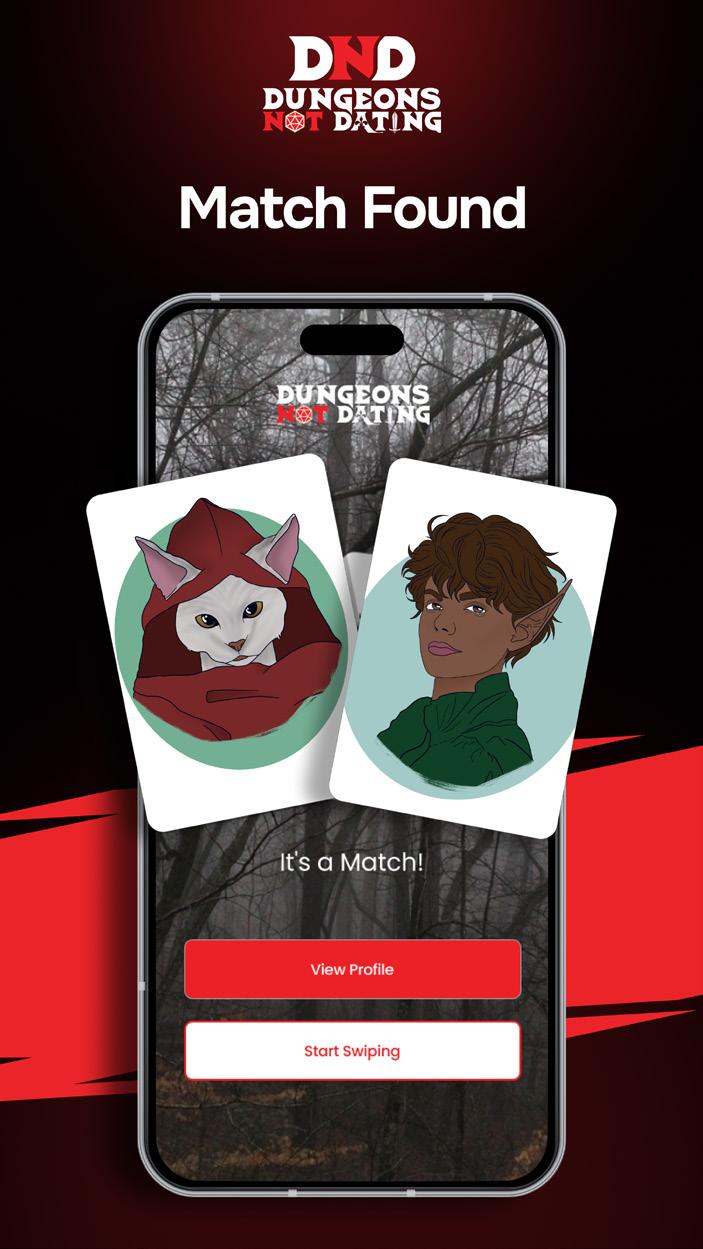
Something similar to the above might be evoked when first hearing of Dungeons Not Dating. DND is a smart device mobile application (or, as the digital wizards call it, “an app”) which, not unlike a lovelorn killah’s online profile, might require a squint or three for proper evaluation.
“The name ‘Not Dating’ is often misunderstood,” admits Rachel Dove, the app’s creator. “The app is structured like a dating app, with profiles, swiping and matching, but the goal isn’t romance. It’s to build a compatible adventuring party.”
The adventuring — and the partying for that matter — takes place mostly within the right brains of the adventurers: that is, the players of “Dungeons & Dragons,” the venerable dice-throwing game wherein participants assume Tolkien-esque selves as they engage in an experience that’s half probability, half possibility.
But sometimes, D&D companions can be as rare as gold pieces in the elemental plane of fire.
“For a lot of players — especially new, marginalized or queer players — finding a safe, consistent group is the hardest part of playing ‘Dungeons & Dragons,’” Dove observes. “Existing tools are fragmented, local or intimidating.”
That’s where Dove’s software unites prospective fellows-well-met who share overlapping game preferences.
“You’re matching on experience level, values, availability and playstyle, which is how someone prefers to experience the game: story-focused versus combat-heavy, serious versus lighthearted tone or rules-focused versus flexible,” Dove explains. “Instead of dating, you’re forming a campaign and ideally, real friendships.”
The campaign — that is, the long-term, ongoing story constructed via multiple adventures — might be built physically or virtually.
“Gameplay can look different depending on the group,” Dove elaborates. “Some play in person around a table, virtually using video and digital tools, or a mix of both. One of the long-term benefits [of DND] is helping more players transition from isolated or online play into consistent, real-world groups if that’s what they want.”
Getting to this point represents a victory of sorts.
“Gamers are often stereotyped as socially awkward, isolated or part of a very narrow demographic.” Dove laments. “But the reality is much broader. The tabletop space today is incredibly diverse across gender, sexuality and background.”
And those aren’t the only benefits tabletop play might provide.
“Tabletop role-playing games like ‘Dungeons & Dragons’ create a rare kind of space where identity is fluid, intentional and respected,” Dove points out. “For queer players — especially those without safe offline environments — it can be a powerful way to explore identity, be seen as your authentic self and practice expressing that identity in a supportive group.”
The diversity of play might be a side effect of the diversity of content.
“Over time, the game itself has become more accessible and inclusive, with broader representation in both players and characters,” Dove notes. “When people can find others like them, they’re more likely to stay and thrive in the hobby.”
That broader representation is what attracted Dove.
“I started playing ‘Dungeons & Dragons’ as an adult, initially drawn in by the storytelling and creativity,” she recalls. “It’s one of the few games where collaboration matters more than competition.”
That lack of competition can leave room for emotional growth. As Dove testifies: “I personally used D&D to explore my own gender identity, playing male or nonbinary characters to see if that fit who I was in a safe and consequence-free area of life before coming to the conclusion that I am just an old-fashioned tomboy.”
Such emotional growth is something that, unlike a magic spell or a 20-sided die or even a poisoned dagger, Rachel Dove can wield in the real world just as surely as she wields it within the game’s collective surreality.
“[Playing D&D has] made me more confident, both creatively and socially,” she affirms. “It gave me a space to take risks, use my voice and build community. It’s not just escapism. It’s often exploration and affirmation.”
dungeonsnotdating.com
Images courtesy of Rachel Dove
Sideline Superstars:
Blaize Shiek & Louie Conn
The duo made a splash when they became the Minnesota Vikings’ first male and openly gay cheerleaders on the dance squad last year. Exclusively for Lavender’s Pride Issue, they’re telling their stories for the first time, on their own terms.
Two dancers, both alike in dignity, in fair Minnesota, where we lay our scene.
These dancers are Blaize Shiek, 25, and Louie Conn, 22. They made headlines last year when they made the Minnesota Vikings Cheerleaders dance squad, the first male and openly gay dancers to do so. Of course, online trolls who have nothing to do with Minnesota came out of the woodwork to denounce their success. At the same time, the headlines, both negative and positive, reduced Shiek and Conn to the boundaries they broke and the hate they clapped back against, instead of the complex people they are.
If Pride Month is about celebrating the strides LGBTQ+ folks have made to demand our rights and lead successful lives, it’s also about celebrating ourselves as whole people apart from our marginalization and struggle against it.
In real life, Shiek, originally from Fargo, N.D., has bright eyes, hair layered in golden waves and a friendly yet outspoken demeanor that screams “diva” (or, as Conn says, “shiny.”) Conn himself comes off as the quintessential Iowa kid, complete with a genuine smile, heart on his sleeve and fascination with the big city he now calls home.
Blazing trail after trail
Both Shiek and Conn are used to standing out. Both were the first male dancers on their high school teams, and both were the lone male dancers on their college teams. They also each had non-linear paths to dance defined by friendship.
“I grew up playing baseball my entire life,” Shiek says. “I loved it, but it didn’t fulfill me in a way that I was looking for. Then I ended up quitting in high school, and all my friends were on the dance team. When we were hanging out, they were always going over their routines or doing cool things, and I was like, ‘I wanna try that!’ That turned into me actually trying out, and I feel like that changed my life.”
Conn describes getting his start at age 8 in tumbling. At the same time, he was watching his older sister, 14 years his senior, cheer in high school.
“I remember my dad actually took me to my first tumbling class, and I immediately fell in love,” he says. “That same tumbling studio had a dance competition team, and all of my friends were on both the dance and tumbling teams, so they kind of convinced me to do dance.”
Conn made his high school’s dance team his freshman year, but quit after facing homophobic bullying from his peers. Luckily, his friends came through again, and he returned to the team his sophomore year.
“I had so many friends being like, ‘You’re gonna love it. Just come on, come dance!’” he says.
A 2020 profile in his high school’s newspaper puts it simply: “(Conn) constantly reminds himself why he keeps dancing and why he will not let other people get in the way of his passion again.”
Finding home in the land of the ice and snow
Shiek and Conn both cheated the system, in a sense, to pursue dance as long as possible. Shiek enrolled at North Dakota State University just for dance, knowing he wasn’t actually
Photos by Mike Hnida
going to pursue a degree. After completing his general education credits in two years, he left to attend hairdressing school (the proof being in his own well-kept locks).
“It was a very expensive two years!” he laughs.
Meanwhile, Conn was so focused on dancing for the Iowa State University Cyclones team that he didn’t pick a major until his junior year.
“My advisor was like, ‘It’s time to choose a path,’” he recalls. “She basically told me, ‘The classes you’re taking are on track for a marketing degree.’ I was like, ‘Perfect. Guess I’m graduating with a marketing degree!’”
After dancing for all four years at Iowa State, Conn decided to follow in the footsteps of his team’s captain and try out for the Minnesota Vikings Cheerleaders.
“We had a good bond. She saw how hard I worked. She was like, ‘I can see the fight in you, and I think you would really enjoy this,’” he says. “I think that kind of drew me into the space of professional cheerleading. Seeing my people that I look up to doing this really inspired me.”
Shiek’s ties to the Vikings go much farther back than dance. (“I have pictures of me before I could even walk in a Vikings onesie,” he says.) But, like Conn, a college teammate, Kira Harper, inspired him to pursue a spot with MVC.
“Seeing her go off and do something like that made me realize that (dancing professionally) was an option,” he explains. “I didn’t always think that the dance career was over after college, but I didn’t really know where I would go or what I would do. Then, the more I talked to her and
looked into it, I saw how much (MVC) promotes an inclusive environment. I never even considered another team. It just felt the most like home.”
Indeed, Conn says he learned to drop the competitive mindset he brought into auditions as time went on.
“When you’re in that room and cheering each other on and seeing the support that we have for each other, it just changes the whole experience,” he says. “It’s all so much more enjoyable when you’re not scared of someone else taking your spot. It’s more like, if this is meant to happen, it’ll happen.”
It seems, then, that the Fates decided Shiek and Conn had not yet had their share of firsts.
“I think I was just in shock, honestly,” Shiek recalls of the moment he learned he made MVC last year. “I remember I made sure I was by myself that whole day. I don’t think my phone left my hand. Every email that came through, I was like, ‘I have to turn off my notifications. I can’t do this!’”
“I think it took a while to realize what was happening, because not only did I make the team, I knew my whole life was gonna change. Like, everything’s real,” he says. “Then I came home, and my family and friends threw me a big surprise party, and it was just the best feeling. Just knowing that all your hard work paid off and you get to just keep living out your dream and doing what you love is just such a special feeling.”
Meanwhile, like any college senior, Conn was on his way to a final class presentation when he found out he made the team.
“I was also looking at my phone and scrolling all day,” he recalls. “I had four roommates last year, so we were all just silent the whole day waiting. So finally, I remember I grabbed my keys, and I got up to go to class, and then I got a call.”
“All around me, people were figuring out where they were gonna be after college and getting jobs and everything, and I had no idea the whole year where I would be,” he says. “It felt like a chapter closed. I just remember the rest of that last month of school was so much fun because I just finally got to celebrate graduating and moving to a place that I’ve always wanted to go.”
That place, Conn says, has welcomed him with open arms.
“I love just lollygagging around the Twin Cities,” he says. “In Iowa, I would literally go drive around the cornfields for fun. There’s so many places around the Cities to just go see live music and eat good food and drink good drinks. I love it here.”
He adds that the Twin Cities introduced him to concerts, his favorite recent show being FKA twigs at the Armory in March.
“I don’t know why, I didn’t think there would be dancers,” he admits. “But they were incredible. I was just crying the whole time. I can’t stop listening to (her music).”
Steering the Viking (friend)ship
With male professional dancers already a rarity, Shiek and Conn followed each other on Instagram before meeting in person. With the intensity of auditions, they say they didn’t fully connect until a team retreat at the Omni Viking Lakes Hotel once they made it.
“We were in the same room, but we didn’t know each other, so we’re like, ‘Okay, well, we’re really gonna get to know each other now,’” Shiek recalls. “It was exactly what we needed. It just planted the seed to our friendship.”
Continued on page
Though their shared achievement could be seen as a tie that binds, Shiek and Conn say they became fast friends, forming a natural and uplifting bond.
“Throughout the year, you were just so supportive,” Conn tells Shiek. “Whenever I had any concern with anything that was going on, you were the one to just comfort and stick up for me. Just, older brother vibes, all the way.”
Conn also recalls being charmed by Shiek’s sense of humor during the retreat.
“I remember we were at dinner and you took a sip of a drink and you were like, ‘This tastes like a basketball!’” he laughs. “I think of that all the time. There’s nothing I like to do more besides dance than laugh, so anyone that can make me laugh is automatically gonna be my friend.”
Shiek also describes Conn as funny, as well as authentic in a way that feels hard-won.
“Louie is just so authentically himself, like nobody could take that away from him,” he says. “He knows who he is and he’s gonna be him, no matter what.”
Conn adds that, though they see things very differently, the result is mutual appreciation and not animosity.
“I bet we could disagree on every little thing, but we’re still such good friends. It’s amazing,” he says.
Strong bonds on MVC aren’t exclusive to Conn and Shiek, either. Both attest to the friendships they’ve made with their other teammates, too.
“Everyone’s pursuing their own dreams outside of this one, but when we can, we love to get together,” Shiek says. “We obviously love each other, not only just as a part of MVC, but outside of this team, we’re all very good friends.”
Outside of the team, Shiek and Conn both say their families are their biggest supporters, especially their moms.
“She just always lets me know how proud she is,” Shiek says. “She’s very vocal.”
“(My mom) is living for me, I guess,” Conn says. “She just truly cares so much. When she’s watching, I know I do better. We just have that special bond.”
“The hardest part is being away,” Shiek adds. “But it’s not too far where I would have to get on a flight. She can always come to a game, but also even just a FaceTime is so nice.”
Dancing through life
During the offseason, Shiek has enjoyed traveling the world, from Amsterdam to Paris to Hawaii, and he also walked in his first fashion show in Los Angeles. He also keeps up a social media presence on TikTok and Instagram, and says he loves connecting with new people on- and offline.
Conn, on the other hand, doesn’t stray too far from dance. At the time of our interview, he’d just returned from the National Dance Alliance national competition in Florida, his voice hoarse from screaming his support for every team.
Being in the middle of this year’s MVC tryouts, neither said they had any solid Pride Month plans yet. Still, living out their dreams as their full selves is something to be proud of any time of the year.
“I definitely felt more confident this year, and I feel like I showed up as my best self, and that was the best I could do,” Shiek says of his audition.
The MVC audition timeline begins in early March with virtual audition submissions and runs through May 1, when the final team is announced, per their website. The process includes performances, interviews and a training camp before final auditions at the Mall of America Rotunda.
“The process is definitely the best part,” Conn says. “I always say that being on stage at (the Mall of America) for finals is my favorite time of being on stage ever.”
Regardless of what happens, Shiek and Conn will have plenty to be proud of. They pass along similar messages to young queer people who see them as role models.
“Don’t be afraid to be loud,” Shiek says. “Don’t make yourself small in rooms that you don’t need to do that in. Don’t be afraid to make someone else uncomfortable because that’s none of your business. And if they’re gonna stare, just make sure you’re unforgettable.”
Conn echoes Shiek’s advice and also emphasizes the importance of having people in your corner.
“There’s 8 billion people in this world. There’s someone for everyone, and I think that truly makes all the difference,” he says. “Know that it could take time, but know that it will happen. Everyone just needs to have hope that they’re gonna find their people. Because you will.”
Women’s Sports in Minnesota Continue to Grow with Two Pro Volleyball Teams Coming in 2027
Minnesota has long been a top-tier destination for women’s sports; it’s one of many reasons I love this state. So, it’s no surprise that the Twin Cities have caught the eye of two professional volleyball leagues. League One Volleyball Pro (LOVB Pro) and Major League Volleyball (MLV) will both debut Minnesota-based expansion teams for their 2027 seasons beginning next January.
“[Minnesota has] always been one of the bedrocks of volleyball, with one of the nation’s highest youth participation rates across the board and ranking in the top 10 volleyball markets from youth all the way to pro now,” LOVB Pro Minnesota advisor April Erhman says. “Since the announcement [of the Minnesota expansion team], what stood out isn’t just the excitement but a real sense of pride and possibility. You can feel it everywhere with players stepping up, families leaning in and fans across the state rallying around something that feels bigger than them.”
Erhman added that LOVB Pro Minnesota has already seen hundreds of people putting down deposits for season tickets, and they haven’t even begun ticket sales yet.
Pedro Mendes, the head coach and general manager of MLV Minnesota, also emphasized the significance of the state’s strong volleyball roots. This is something Mendes has experienced up close, having spent the past three years as an assistant coach with the University of Minnesota’s volleyball team.
“What I learned pretty early [while working with the Gophers] is that the volleyball community here is very passionate about the game — they don’t only watch, but they actually like playing the game too,” Mendes says. “They know what the game is, they understand it and they can have a lot of opinions about it, so it’s just exciting to be a part of that community.”
At just over six months out from their inaugural season, both LOVB Pro and MLV Minnesota are still rolling out a lot of announcements and establishing their brand identity. LOVB Pro Minnesota is leaning into the two youth teams they have already established in Minnesota, Kokoro and M1 Volleyball, to build excitement. Since its founding, LOVB has been focused on creating a track for athletes starting in their own youth programs up to their pro league.
On the other hand, MLV doesn’t own youth teams, nor do they intend to acquire any. Instead, MLV Minnesota is getting involved in the community by partnering with high schools or independent clubs to run clinics and camps, Mendes says. Another major piece of MLV Minnesota’s brand strategy is their home at the Grand Casino Arena in St. Paul.
MLV Minnesota is owned by Minnesota Sports and Entertainment, which also owns the Minnesota Wild and holds the operating agreement for Grand Casino Arena, the RiverCenter and Roy Wilkins Auditorium, says Todd Fredrickson, the Senior Vice President of marketing for the Wild who is also helping with the rollout of MLV Minnesota.
Minnesota Sports and Entertainment had seen the success of women’s sports both on a national scale and right in their very own building with the Minnesota Frost, which encouraged them to break into that market when they discovered the MLV, according to Fredrickson.
“Women’s professional volleyball is an incredible sport, I mean, the way these players play the game and the intensity and joy they play it with was part of what made it attractive to us in terms of acquiring a franchise in volleyball,” Fredrickson says. “It’s such an entertaining game, and we think fans are going to love it.”
At time of writing, LOVB Pro Minnesota has not announced where they will play home games, although Erhman mentioned the team would potentially be practicing at the same facilities as LOVB’s youth teams. This is something some of the other LOVB Pro teams have done and helps to facilitate the LOVB’s youth-to-pro approach.
Regardless of where LOVB Pro Minnesota ends up, Erhman is excited that more women will have more opportunities to pursue professional sports with the introduction of not just one but two new leagues.
“Any opportunity for women in sports is a positive, and at the end of the day, we just want volleyball to win,” Erhman says. “Minnesota has really deep volleyball roots, and I don’t see that going away.”
Kids Just Want to be Kids: See How Camp Indigo is Re-defining Visibility
What would happen if there were no longer an urgency in asking people to explain themselves? No performance, no misplaced tolerance, just a wave of existence that transcends the need to feel seen by others.
That’s the feeling I kept coming back to after speaking with Andrew Kramer, executive director of Camp Indigo, a summer day camp designed for transgender and nonbinary youth across the country. What started as a small, almost casual idea in Oakland has grown into something bigger, now spanning multiple states and serving over a thousand campers each year. Despite that growth, its heartbeat hasn’t changed.
Visibility, as interpreted from Kramer and the Camp Indigo admin, is the natural flow of receiving people as they are, without judgment and without empty promises. Believe it or not, the best way to allow a kid or teen to be is to simply meet them where they are and let everything else fall into place.
The secret is play, and it sounds almost too simple, but it works. Connecting with our trans, queer and non-binary kiddos requires us, the older generation, to relax a bit and let go of the need to over-structure every moment.
If you’ve ever searched for “resources” for trans youth, you already know what comes up: therapy, support groups, crisis intervention. All necessary and valid, but also heavy. Kramer puts it plainly: when everything offered to a young person is framed as something they need to fix or process, what message are we really sending?
At Camp Indigo, the answer is different. It starts with creating a space where kids can meet each other, laugh, build friendships and leave with something as simple and foundational as one new connection, someone they genuinely like. That distinction matters because we’ve all been in those spaces before where shared identity becomes the reason people are expected to connect. Camp Indigo removes that pressure. When everyone in the room already understands something about your experience, you’re free to choose your people for all the other reasons. It could be humor, energy, interests or overall vibe that draws you together.
What struck me most is how intentional Camp Indigo’s environment is without feeling forced. There are no required sit-down conversations about gender identity and no structured moments where kids are asked to define themselves. Instead, as Kramer shares, “There are science experiments where things explode, improv games where nothing makes sense and everything somehow works, karaoke sessions that go on longer than expected, and competitions that are equal parts chaotic and unforgettable, usually ending in a lot of laughter.”
Underneath all of that, something deeper is happening. Kids are learning how to connect without fear and how to be seen without needing to explain themselves. They’re also learning that joy doesn’t have to come after struggle; it can exist right alongside it.
Early on, many campers identified in more binary ways. Now there is a wider spectrum of expression, which brings both more freedom and nuance. The camp has grown with that shift, not by trying to define it, but by holding space for it.
Visibility still plays a role, but not in a performative way. It shows up through lived experience. Staff members, many of whom were once campers themselves, reflect different versions of adulthood and different ways of being. For families, that kind of representation matters because it helps guide answers to questions that they may not always know how to ask out loud: “What does my child’s future look like?” Camp Indigo doesn’t offer one answer, but it shows that there are many possible paths forward.
What also made this feel real was Kramer’s refusal to position Camp Indigo as a solution to everything. As he puts it, “It’s a summer camp. That’s the lane. That’s the focus. There are other organizations doing important work year-round, and instead of competing, there’s collaboration, shared community and shared purpose.”
That mindset is rare, especially when resources feel limited, but it’s also what makes this work sustainable. Growth is happening, but it’s intentional, focused on preserving the culture that makes the space meaningful in the first place.
There’s also something important about the way Camp Indigo includes families. Parents and caregivers have their own sessions running alongside camp, not just to process, but to connect, laugh and figure things out together. Over time, those spaces have shifted as well, becoming less centered on fear and more rooted in community and shared understanding.
That ripple effect carries beyond the camp itself. When kids go home, they bring that experience with them. For a few days, they’ve been in a space where they are not the exception, not the only one, and not being constantly observed or explained. They’ve been able to move through the day like any other kid, playing games, making friends and coming home tired in the best way possible.
For many families, that’s the first time in a while they’ve seen their child like that: present, at ease and genuinely enjoying themselves. It’s a reminder that while safety, protection and resources are critical, there is also a need for something much more human. Kids need space to play and to experience life without everything being defined by fear.
That’s what Camp Indigo understands, and that’s what makes it different.
If you would like to learn more about this incredible work, you can visit Camp Indigo’s website, thecampindigo.org.
Photos courtesy of Andrew Kramer
The Reality of Being A Furry
Though many stereotypes exist about furries, the true lived experiences of Minnesota furries tell the story of a passionate, supportive and intelligent community.
On a chilly fall evening, members of the University of Minnesota Twin Cities Anthro Club entered the large classroom in the Phillips-Wangensteen building, where two students were already studying.
“We have this room reserved for a club, sorry,” says Zachary Wesley, the president of the club. “But you’re welcome to stick around and hang out if you want to.”
The room was more than large enough to accommodate everyone. The two students removed their headphones and looked up from their laptops.
“What club?” one of them asked.
“Furries,” Wesley answered.
“What?” They gave him a puzzled look, as though they had heard him wrong.
“Furries.”
The two laughed and gave each other an uncomfortable glance. They quickly packed up and left.
Who knows if their haste was in response to the myriad stereotypes that have proliferated for years online about furries — people who enjoy anthropomorphic animals, or animals given human traits and personalities. Some believe that being a furry is a kink, labeling it as “deviant.” Others assume that furries genuinely believe that they are animals, or that they are sexually attracted to animals. Sensationalist news stories promoted the false narrative that teachers were pressured into accommodating the needs of students who have this identity. Some also assume that all furries are mentally ill, or that their interests stem from neglect or abuse at an early age.
“I still get comments about the litter box thing,” Wesley says, referencing an online rumor about students requesting litter boxes in classrooms because they identified as cats.
Most members of the club shared similar awkward experiences when trying to explain their interest to people outside the furry community.
“I had to cut off some of the most important misconceptions right at the pass,” says Allison Rausch, who recalls showing off her furry art to her aunt only to be asked if it was a kink. Rausch, who uses she/they pronouns, found that laughable.
“Why would I want to show my art to you if it was a kink?” she says.
Furries in Context
Though it can be easy to believe that the appeal of furries is a new phenomenon or that it is relatively elusive, this is far from the case. Animals given human traits or physical features have a longstanding presence in storytelling, according to Furscience, a group of scientists that specializes in the study of furries.
Fairy tales, mythology and art have all featured anthropomorphizing over centuries across numerous cultures. Stories from the Chinese zodiac to Aesop’s fables have all used animals to be stand-ins for human characters in order to more easily
Photos courtesy of Hannah Kovnar
express a desired moral or message. The portrayals in works like the fables of Aesop would eventually give way to the funny animal cartoons of Walt Disney and the like in the 20th century, as technology expanded. In the 1980s, the term “furry” was coined by science fiction writers Mark Merlino and Rod O’Riley, who shared an interest in these unique animal characters.
At the UMN Anthro Club, 20 to 30 people show up to each meeting on average, but the online Discord server has 185 members. Across the internet, there are many who might identify as a furry, but finding an exact number of people is difficult. Many people who are interested in the furry community do not advertise this interest online out of fear of ridicule or a lack of interest in internet spaces.
At their most harmless, misconceptions about the furry community lead to awkward conversations based on a lack of understanding. However, at their worst, they can quickly lead to people harassing furries for their interests. Though most attacks against furries take place online, there have been attacks against furries in person. An intentional chlorine gas leak at Midwest FurFest 2014 in Chicago led to the hospitalization of 19 attendees.
Since Rausch started actively participating in online furry spaces a year ago, she has been berated with online attacks. Some accused her of being mentally ill for dressing up in costume, while others made violent threats, alluding to “hunting season.” A commenter on one of Rausch’s posts claimed that because they belonged to both the furry and LGBTQ+ communities, they “touched kids.”
Instead of allowing accusations to dissuade her from posting online, she makes jokes. For instance, when commenters try to claim that she is unloved, she responded with a video where she pointed to her parents and said, “Nope! My parents are right over there, say hi!”
Club environment and community
The discrimination against furries has resulted in a resilient and accepting community at the University of Minnesota Anthro Club. At a mid-October meeting, Rausch eagerly waved over shy newcomers to join the circle and chat with everyone else. Those who had costumes often showed them off, despite occasional stares that they received from students passing by the room. Such stares are met with laughter or sassy waves. Piles of snacks and candy sat on the tables on one side of the room, and people tossed bags of candy to one another without pausing ordinary conversation.
The club room during most meetings is full of energy. Sometimes students will yell across the room to one another if they overheard a conversation of interest, as previous circles of conversation dissolve and reform without any sign of traditional cliques.
Via Carney, another freshman at the club, was new to the furry community at large and felt immediately at home in the club’s chaotic but friendly atmosphere. Though she had her hesitations at first, Carney first became interested in the club due to the way that her old friend, Nick Gromova, always talked about the club and about furries, as they had been involved in the community since middle school.
As both a freshman and a commuter student, Carney struggled to make friends at college, feeling as though they were missing out on important parts of the college experience. On Oct. 16, they attended their first club meeting alongside
I CAN TALK TO MY DOCTOR ABOUT BEING QUEER
Gromova. They recalled their father giving them a grim warning before they went, insisting that they “be careful.” It didn’t take her long to realize that such worry wasn’t needed, as she was welcomed with open arms.
“I was like, ‘Holy crap, people talk to me here?’” Carney says.
The art of the costume
Furry art, especially furry costume making, anchors the community. Meetings are spent making art and sometimes wearing animal costumes that members usually design to reflect their identity or a chosen character — otherwise known as fursuits. Roughly 10-20% of the Anthro Club’s members have a costume of some kind. The complexity of costumes at the club varies: some only have clip-on tails or a headband with ears, while others have masks or paws. However, none of the club members has a full-body costume.
Some furries will buy their own costumes, but getting a custom fursuit can cost thousands of dollars. As a result, most will opt to make their own. Fursuits can be made of a variety of materials, such as foam, fabric, cardstock or even cheap storebought dinosaur masks. For many furries, the art of making a fursuit or costume is one of the most exciting parts of being in the community.
“It feels like a whole different community once you have a suit,” Rausch says.
Rausch commissioned a Texas-based artist to have a costume of her fursona — a furry character designed to be a stand-in for oneself, either online or in person — made and sent to her. Princey, Rausch’s fursona, is a bright pink, friendly jackalope with big floppy ears, white detailing and red horns. The costume was expensive, but for the quality of the materials and the craftsmanship, she knew it would be worth it.
Rausch recalls the day when she first unboxed it with reverence and nostalgia. Her friend Rowan, who introduced Rausch to the furry community, hovered behind her with anticipation. Seeing the costume’s paws alone already sent her over the moon, and she immediately put them on to show off to her equally ecstatic friends, temporarily forgetting that there was another part of the costume to look at. Her favorite part of the costume, however, was the jackalope’s face and especially the pink stuffed horns on top of her head. To her, the design of Princey’s horns — with one being broken — was one of the most important parts of the character to get right. Seeing the horns in person, recreated exactly as she imagined, was incredibly rewarding.
Designing costumes from scratch can be equally rewarding. Gromova explained that the process of making their own costume was a lot of trial and error. Though he had years of experience making cosplay — performance art involving dressing up as characters from movies, cartoons or video games — they had never made a fursuit before their current wolf-fox costume.
The process was grueling and involved feverishly following tutorials on YouTube, but in the end, Gromova was thrilled with the final result. Starting with a bucket-like shape made from foam, they layered additional foam pieces on top to shape the head into something more closely resembling an animal’s snout and ears. Throughout the process, they would frequently try on the mask and paws, which would only stoke the flames of their excitement to see the finished product.
Mental Health and Healing in the Furry Community
Rausch, Gromova and many other furries in the club agreed that the main appeal of dressing up in costume is the opportunity it provides for self-expression. Contrary to the claims of online trolls and fearmongering news stories, most furries do not genuinely believe that they are the animals that they dress up as, nor would they openly identify as such. The majority of those who identify as furries are aware that they are human, according to Furscience. Instead, the purpose of the costumes — in addition to being fun to wear — is to help people socialize. Many people in the furry community struggle with social interaction in some form or another, according to Gromova. Being able to assume an alternative identity to interact with others helps people overcome social anxieties and communicate better.
Being a furry serves as an act of healing in itself, which was Rausch’s experience. When she was 14, her mental health worsened and culminated in depression and a life-threatening eating disorder. For the next several years, she would spend over half of her time in a psychiatric hospital. Though she was placed in one of the best facilities for people with this condition, it was still a difficult place for a young person to spend time during such an important stage in their development. She was unable to contact friends due to the strict rules at the hospital. Patients were discouraged from looking at themselves in the very few mirrors that were present in the hospital, leading to Rausch not feeling connected with her body as she went through puberty.
Princey, Rausch says, was created as a part of her coping strategy from the impacts that her mental health struggles have had on her life. Princey’s broken horn, for instance, was designed as a direct reference to Rausch’s eating disorder, as hair and nail loss are common symptoms in such conditions.
“She is who I thought I was going to be when I was younger,” she says. “I wouldn’t say that I would like to be a version of me that had never been [in the psychiatric hospital], because it made me who I am today, but I wouldn’t say that I ever want to be there again.”
Though she has only been involved in the furry community for a year or so, her time within it has improved her life drastically. Being a part of the Anthro Club at college has been especially helpful, as it provided a place to make friends who were less likely to judge her.
“The club helps me feel like people know about my existence,” she says.
Most furries — over 70% — rarely meet up with other furries in person, according to research by Furscience. This is primarily because very few places exist for furries to openly meet up outside of occasional conventions. Opportunities to make real-world connections with other furries are all the more important as a result.
End of the semester
As the semester comes to a close, so do the weekly Anthro Club meetings. The final meeting of the semester, “anything but finals,” offers club members some time to relax, unwind and do arts and crafts before the stress of final exams.
During this final club meeting of the semester, once again, students had been using the space to work on finals that were not a part of the Anthro Club. About 15 minutes into the club meeting, the two girls packed up their laptops and notebooks and hurried out. Though this time, it was most likely due to the blaring sounds of Mario Kart over the projector speakers and the cackling of students watching the game unfold.
Piles of canvas boards were stacked high at the edge of the central table, and students quickly got to work drawing all sorts of designs from fursonas to Dungeons and Dragons characters to Kirby eating a traffic cone. The one constant in the chaos and commotion of the club was the support that club members had for one another, aside from perhaps an occasional jeer at someone’s poor performance in a game of competitive Tetris.
Like many of the activities of the Anthro Club, there’s nothing inherently out of the ordinary about the club aside from the interest that brought the group together.
Gromova has learned that most people are fairly open about furries and are willing to get to know them before judging them. The club has attended several furry conventions, even wearing their fursuits in public on occasion. Those who knew nothing about furries were often the kindest and most supportive of the hobby. A pair of elderly women on the bus, for example, were fascinated by Gromova’s costume and furry art when they were shown it online. In all, it was a validating interaction, Gromova says.
“If [people] don’t have a preconceived notion about furries, most are pretty chill,” they say.
In the end, Gromova realized that the majority of people are fairly open about furries, assuming that those people are willing to take the time to get to know them, rather than writing them off at first glance.
BY NOAH MITCHELL
The Bones of University Baptist
Rev. Doug Donley retires after 25 years at University Baptist Church in Minneapolis and a lifetime of fighting for justice around the world
The offices of University Baptist Church in Dinkytown, Minneapolis, are in a state of carefully contained chaos. The unmistakable scent of old paper heralds a line of cardboard boxes stacked on wooden chairs, full of old books on offer to anyone who passes through the narrow hallway. Yet more boxes litter the floor of the office of the pastor, Rev. Doug Donley. Even with what seems like dozens of boxes filled, the floor-to-ceiling bookshelves are still well-stocked, as if they can’t quite accept what’s happening — after 25 years of service at UBC and 37 total as a pastor, Donley is retiring.
Donley grew up in Cleveland and got his undergraduate degree at Denison University in central Ohio. He then worked at the university for three years before beginning seminary at Union Theological Seminary in New York City.
However, before his 1989 ordination and the beginning of his career as a pastor, Donley was twice denied ordination by the Columbus Baptist Association. He had been asked what he thought were the five most important domestic issues for the church to address.
“And what I said was, well, I’m living in New York City, and so I have to say what I see. What I see is homelessness, hunger, racism, sexism and homophobia,” Donley recalls. “And I was sitting on a couch next to this guy, he kind of moved away from me … They were just horrified that I would say something like that.”
Donley’s refusal to denounce homosexuality as a sin resulted in those two denials before his eventual ordination. This insistence on standing by his beliefs would become a common theme throughout the rest of his career.
Where does that conviction come from? Donley replies quickly, although not in a way that suggests he was anticipating the question, but rather as if he’s considered it himself at length and is confident in his answer.
“I’m a musician, and believe it or not, there’s a lot of gay people in the music field,” he says with a laugh, before quickly returning to the more serious demeanor one might expect of a clergyman of three-plus decades. “You know, some of my very dearest friends are in the queer community. And I learn a lot from them, and it breaks my heart to see them be vilified, especially way back in the ‘80s, by larger church bodies.”
Donley brought his conviction in his belief that all people, including LGBTQ+ people, are deserving of love and respect to his first two positions, at Asylum Avenue Baptist Church in Hartford, Conn., from 1989 to 1994 and Dolores Street Baptist Church in San Francisco starting in 1995.
From the very beginning of his career, Donley did more than just preach to his congregation. He was a founding member of the Baptist Peace Fellowship of North America, where he helped gather, equip and mobilize justice-seekers across the Americas and around the world. He served in several roles there, including as president, and has traveled across the world to further their mission.
He was also an original member of Soulforce, an organization co-founded by Mel White and Gary Nixon in 1998 to oppose religion-based spiritual violence against LGBTQ+ people using the principles of nonviolence. In the following years, they directly challenged homophobia in the church, including a highly publicized meeting with influential televangelist Jerry Falwell where 200 Soulforcers and 200 of Falwell’s conservative evangelicals held a forum on spiritual violence against LGBTQ+ people.
By 2001, Donley was ready for a new home base from which to continue his work.
“I let the wider circle of people know that I was looking for a change, and University Baptist came calling,” he recalls.
UBC was looking for a successor to Rev. Dr. Nadean Bishop, its first woman and first lesbian pastor. She had established UBC as a Welcoming and Affirming congregation, part of an organization of LGBTQ+-affirming Baptist churches in the U.S.
Donley says his history of advocacy for LGBTQ+ people, from his defiant stance during his ordination process to his work with Soulforce and Dolores Street Baptist’s reputation as LGBTQ+-affirming, were attractive to UBC. He became its new pastor in March 2001.
Over the next two-and-a-half decades, the faith UBC placed in Donley’s capacity for resistance and advocacy would be rewarded time and time again.
An early test of the new pastor’s mettle came in 2004, when UBC and Judson Memorial Baptist Church in South Minneapolis brought LGBTQ+ candidates for ordination. Mid-American Baptist Churches, the church region that UBC and Judson Memorial belonged to, blocked those ordinations.
“The region put roadblocks up to that because both these people were queer. And so, the weird thing was, this is 2004, they said, ‘We can’t recognize the ordinations because we don’t have a policy on gay ordinations,’” Donley says. “So, well, you don’t have a policy against it,” was his response.
“And so they said, well, let’s table it so until we can come up with the policy,” he continues. “And then they came up with a policy, and the policy was that the practice of homosexuality is incompatible with Christian teaching, therefore we will never recognize the ordination of a gay or lesbian person.”
Following this decision by Mid-American Baptist Churches, both UBC and Judson Memorial left the church region and, in 2006, joined the American Baptist Churches of the Rochester/ Genesee Region, which was renowned for being progressive and accepting.
Photo by Trista Marie McGovern
Under Donley’s leadership, UBC continued to advocate for the LBGTQ+ community and was one of the first churches to support the legalization of same-sex marriage. Donley’s voice joined the voices of other clergy members singing in the Minnesota State Capitol rotunda while representatives voted on marriage equality.
UBC also fought for other marginalized communities, both in Minneapolis and abroad. The church declared itself a sanctuary congregation in 2016, promising to be a safe space for undocumented immigrants. It developed a relationship with a sister church in León, Nicaragua, with which they exchanged visits and support, although political changes in both Nicaragua and the U.S. have made continuing the relationship difficult.
What Donley calls “some of the proudest work I’ve seen us do collectively” came after, albeit barely so, he announced his retirement in January 2026. As the Twin Cities community rallied to take care of itself during Operation Metro Surge, UBC became a hub for community organizers.
“We got a big ol’ building, and so we used the building to be a center for activism,” Donley says. “We didn’t feel like we needed to create a new program. Rather, we needed to augment the other programs that were already happening in the Twin Cities. There’s enough organizations, enough nonprofits doing good work.”
That good work has been a model of Donley’s vision of the best version of Christianity.
“In these past several months, we’ve really seen, the Twin Cities step up and model what I think the best of what Christianity can be, whether they’re Christian or not, in terms of loving neighbor, being a moral center, and being brave and connected with folks,” he says.
Throughout the early months of 2026, the UBC congregation gathered on Sunday mornings to “sit here and tell our stories of our trauma and try to get a little more strength for the journey ahead,” Donley shares. A pneumonia infection in January kept Donley away from the action, but he returned to his community as soon as he could.
“I realized it was not gonna be healthy for me to be out in the streets. My soul was out in the streets, but my body was not,” Donley recalls. “But this is a marathon, not a sprint. And it’s a relay race. And so, when I got healthier, I tapped in and and spent a lot of the time being out, just augmenting other people’s voices and being the place to receive the trauma that people were bringing in, and the stories that people were bringing in.”
The UBC community’s collective experience of Operation Metro Surge culminated in a Good Friday procession to memorial sites for what Donley calls “present-day crucifixions,” including George Floyd Square and the memorial sites for Renée Good and Alex Pretti in South Minneapolis.
The procession is a fitting final chapter to Donley’s storied career — a show of community solidarity and nonviolent resistance to match the actions that helped bring him to Minneapolis and UBC in the first place. It gives him confidence he’s leaving the congregation in “a really strong place.”
Following Donley’s retirement, effective May 31, Rev. Dr. Cody J. Sanders, who also serves as the associate professor of congregational and community care and leadership at Luther Seminary, will take over as interim pastor at UBC. Donley will head to Scotland to hike, before returning home to the Twin Cities. He’ll take some time before returning to church life, staying away from UBC to allow his congregation to move on and his eventual successor to establish themselves without his 25-year-long shadow being cast over their pulpit.
Hidden in plain sight in one of the boxes on Donley’s office floor, there is a collection of bones that was found in the church attic. Contrary to what some would expect from a clergyman of three-plus decades, Donley does not hide the skeletons in his church’s closet. Instead, he shows them off with a grin that hides the years of experience on his face, making wrinkles and smile lines indistinguishable.
One of the bones — a long, thick femur, seemingly from one of God’s larger creations — is marked with a list of names. It is a roster of a group of activists like Donley, but from generations past. In the 1920s, they resisted the demands of Rev. Frank Riley of the First Baptist Church of Minneapolis to ban the teaching of evolution. When UBC refused to submit, they lost the opportunity to host the Minnesota Baptist Convention, for which the offices that Donley and his predecessors have occupied were originally built.
Instead of church bureaucrats, 100 years later, the offices on University Avenue are still occupied by people who refuse to abandon their beliefs, regardless of the consequences. Whoever is tasked with succeeding Donley will inherit that legacy. While Donley may not leave behind a fossil of his own in the church attic, thanks to his relentless pursuit of justice, the bones of his church are as strong as they’ve ever been.
The 2026 Pride Month Horoscope
Astrology and queerness go together like peanut butter and jelly! Here’s a look at what the stars have in store for this Pride Month.
The middle of light, airy, adventurous Gemini season lands at the beginning of June. Then, the Sun switches over to the more emotionally-driven Cancer. That is to say, Pride Month tends to set a good stage for both partying and building community, both fleeting and deeply rooted connections.
Especially during these chaotic times, letting go and leaning in are equally powerful ways to challenge the oppressive forces bearing down on us harder than ever.
Mercury enters Cancer at the top of the month, setting the stage for community building through emotional communication. The mind and the heart will fall in line, and it will be easier to think about things on a deeper level. If you’ve been considering coming out, this transit provides a prime opportunity (but, of course, trust your own timing first and foremost). The same goes for letting that gay crush of yours know how you feel. *wink*
A week in, on June 8, the moon enters the last quarter phase in Pisces. In general, the last quarter encourages us to recharge and let go. Though the sun may be in chatty Gemini, this moon wants you to talk less and feel more. Take stock of the feelings the last month or so has left you and just let them be — you don’t have to know what to do about them just yet. If you need somewhere to put these feelings, a creative pursuit will make a good place.
On June 13, Venus enters Leo. Landing on a Saturday, this will be a good opportunity for a luxurious date night with your current lover(s), or perhaps that crush of yours, if you’ve managed to woo them. Furthermore, Pride Month is all about celebrating our ways of loving, and Venus in Leo gives us full permission to do so!
The next day, June 14, is the new moon in Gemini. The blank slate of a new moon will allow us to set goals for the rest of Pride Month, and Gemini encourages us to bounce these ideas off of others and be open to new perspectives. Weather permitting, sit outside with friends, new
or old, and chat until the sun goes down — maybe even well after!
A week later, on June 21, Cancer season begins. In the lead-up to annual Pride festivals like Twin Cities Pride and People’s Pride, we are reminded of why these festivities exist at all: the movement to protect and uplift each other as fellow queer folk, as family.
Later that same day, the moon will peak in the first quarter phase in Libra. Libra, another sociable air sign, prioritizes balance, namely that between individual and collective personalities and goals. While Libra champions harmony, it also reminds us that achieving it is never simple. Luckily, the first quarter moon provides the forward momentum to embrace tough conversations for the collective good.
At the same time, the sun in Cancer squares (or lands 90 degrees away from) Neptune in Aries from June 21 through June 30, making it an inopportune time for high-stress matters. Neptune, the planet of collective dreams and imagination, in the movement-focused Aries stalls against the subdued sun in Cancer, creating a feeling of weakened vitality. However, the tough conversations that the first quarter moon in Libra wants us to have don’t have to take the form of direct confrontations. Art, music and drama will remain powerful tools to participate in collective storytelling, spark dialogue and nurture change movements. Go see a play or an art exhibition, or mosh with your friends at a punk house show and take note of how the bass hits your core.
By far the most eventful day this Pride Month will be June 29, when Mercury retrograde begins on the same night as the full moon in Capricorn. This is just after Mars enters Gemini on June 28. This is the astrological equivalent of Wile E. Coyote running smack into a painting of a tunnel while chasing after Roadrunner in “Looney Tunes.”
The full moon is when things come to light and are illuminated. With Capricorn ruled by Saturn, the planet of restriction, and Saturn currently in Aries, this full moon in Capricorn may illuminate restrictions on taking action and asserting independence. Broadly, we will be encouraged to break out of dusty patterns and outdated structures that are holding us back. Appropriately, the moon was full in Capricorn
during the Stonewall Uprising, the impetus of the contemporary Pride movement.
What exactly in your own life this will apply to depends on where the moon is activated in your chart, so head on over to the astrologer’s booth at your local Pride celebration for a reading!
Then, of course, there’s the dreaded Mercury retrograde, which will last from June 29 to July 23. Mercury retrograde may cause misunderstandings and mishaps in the realms of communication, technology, learning and travel. With Mercury staying in Cancer throughout this period, these mishaps may target the areas of home, family, security, nurturing relationships and domestic situations. (U-Haulers, beware!) Apologies in advance if that crush of yours from the beginning of the month ends up being too good to be true.
As scary as Mercury retrogrades are made to seem and as confusing as they can actually be, it’s important to remember that clarity can come from chaos, especially by the light of the Capricorn full moon. If chaos arises in your life, look inward for the answer. Where do you need to set firmer boundaries? How can you change in relation to your insecurities?
Not all hope is lost, either. Jupiter entering Leo rounds out the month on June 30, leaving plenty of expansive potential for the rest of the summer. Jupiter in Leo tells us that we encourage growth in ourselves and others by living authentically, and isn’t that what Pride Month is all about? While the concurrent Mercury retrograde may make it harder to speak from the heart, Jupiter in Leo reminds us that actions speak louder than words. Being generous and courageous will inspire others to do the same. It’s these exact qualities that allow us to thrive in a divisive world built upon individualism and fear.
On paper, Pride Month has a beginning and an end. In practice, however, we embody our own history; we live our lives through experiences gained within discrete periods of time. Every day, month, year, is the time to be prideful, especially in a world that tells us we can’t. Remember, we are made from the same things as stars. They hold more wisdom than you might think.
Our Mission is to End Veteran Homelessness in Minnesota
BY TERRANCE GRIEP
‘Birth and Rebirth’
The M Health Fairview Transgender and Non-Binary Community Health Connector Program Raises People From the Ashes
The phoenix flutters, the red and gold of her feathers made dirty by the sun-choking clouds. Her talons touch down within her aromatic nest — it’s made of cinnamon, frankincense, myrrh and nard. She lowers her head and opens her night-hued beak. With a jeweler’s precision, she nudges the final chunk of cassia bark into its proper place. Held in place by the fern-like fingers of a whispery palm tree, her nest, the stage for her rebirth, is set at long last. Even after 499 years, 11 months, 30 days, 23 hours and 55 minutes, she still feels … something, an offness, a dissatisfaction … an incompleteness, perhaps. Whatever the feeling is, she reassures herself giddily, it will pass soon enough…
Although human beings are generally pattern-seeking beasts, sometimes radical, total transformation is necessary for a full and happy life. Or sometimes, entirely subtle transformation is necessary for a full and happy life. And other times, simple affirmation is necessary for a full and happy life. Such might be the case for people who experience gender dysphoria, where their sex — the parts they were born with — don’t align with their gender — what people feel is true about their bodies.
“Transgender” is an umbrella term for anyone whose gender identity differs from their assigned sex at birth. “Non-binary identity” refers to a gender that is not strictly male or female. While many non-binary people identify as transgender, not all do; transgender people can be binary — that is, man or woman … or they can be non-binary. Distinguishing between the two is crucial for healthcare, as biological sex affects health outcomes, while gender influences how people are treated and how they express themselves in society.
When such delicate healthcare intervention is needed in the Twin Cities, help is nearby. A partnership between the University of Minnesota, University of Minnesota Physicians and Fairview Health Services combines “the University’s deep history of clinical innovation and training with Fairview’s extensive roots in community medicine,” according to this collaboration’s website.
This partnership is called M Health Fairview Transgender and Non-Binary Community Health Connector Program … mostly because the name “3M” was already taken. According to M Health Fairview’s website, its mission is “to improve healthcare access and experience for transgender and gender-nonconforming patients by providing tailored navigation, advocacy and a welcoming environment.” That welcoming environment manifests thanks to over 2,000 providers plying 60-plus specialties at dozens of metro locations.
The realization of this mission isn’t just for the good of individual patients. As the website continues, “M Health Fairview is providing breakthrough medicine and transforming the health of our communities for the better.” Such breakthrough medicine takes the form of a personalized, multi-disciplinary approach to health care that aligns a person’s physical, social and emotional life with their gender identity. No two interventions, therefore, are precisely the same.
The “Connector” part of the group’s name isn’t just for show: the M Health institutions connect patients with the best gender affirming care, ranging from non-medical, social transitions, mental health care, medical care (in forms of hormones and blockers) and, if necessary, surgical care.
In these socially overcharged times, it’s worth remembering that, outside the realm of politics, this kind of medicine isn’t controversial: it’s age-appropriate, medically necessary, supported by all major medical agencies, in many cases, as life-saving as an ambulance trip.
For so many gender non-conformers, M Health Fairview provides a place with no judging, no preaching and no heckling. Quite to the contrary, M Health Fairview provides a space for patients to get healthier, as warm and nurturing, in its way, as a bird’s nest.
While it did its work, the fire must have looked like a force for destruction, but it was, in fact, a crackling engine of crackling creation in its purest, most radical, most profound form. The phoenix has been replaced by a bird-sized pile of ash, pale and grey … but now that ash swirls through the nest, which is somehow unburned, somehow pristine. The ashes of the old, dead self come together — skull, beak, ulna, sternum, something below the sternum — to form an altogether new bird.
The phoenix is reborn.
He is a rooster this time around, incomplete no longer. Finally, he is the phoenix he was meant to be. He unfolds his wings, now purple from end to end, now the color of royals. The phoenix uses his talons to spring up, and he notices that the clouds are gone, perhaps burned away as a side effect of the firebird’s own necessary transformation. He falls, he flaps. Beating the bright, blue air with his violet feathers, free of all that is false, the reborn phoenix studies the growing, unmasked sun and, as if for the first time, he flies — he truly flies.
Redefining Inclusive Care: How Identity-Related Stress Compounds the Impact of Trauma For LGBTQ+ Individuals
When it comes to providing care to someone who has experienced trauma, a person’s identity is more than just something to take into consideration; it can color their entire experience with healing. An accepting, informed response from their care team can do a world of good, while an invalidating response can be detrimental and, in many cases, further traumatizing to a person.
Enter Dr. Jillian Scheer, a licensed psychologist, the director of the Minority Stress & Trauma Lab and an assistant professor of clinical psychology at the University of Rhode Island. Scheer is leading the research for Project QueST: Queer Survivors of Trauma to discover more about the relationship between identity-related stress and trauma, and how that interaction affects healing.
“My research program is focused on understanding and addressing trauma, stigma and poor health outcomes (e.g., substance use disorders, chronic pain, traumatic stress symptoms) among LGBTQ+ communities and other minoritized groups like cis and trans women living with HIV and those with lived experience of sexual violence, with a particular emphasis on how social and structural stressors shape health,” Scheer says.
It’s a topic that Scheer is passionate about championing.
“I was drawn to this work through both clinical and research experiences,” they say. “Repeatedly, I saw that LGBTQ+ individuals were not only more likely to experience trauma, but also faced ongoing identity-related stress, like discrimination, stigma or lack of affirming care, that shaped how that trauma affected them over time.”
Through thoughtful research, Scheer has found that the facets of a person’s identity do not operate independently from their lived experiences; identity-related stress is not separate from past trauma, in fact, it often interacts with it in a way that intensifies distress and creates barriers to healing.
“One key finding [of Project QueST] is that identity-related stress, such as discrimination, anticipated rejection or lack of access to affirming care, can amplify the impact of past trauma,” they state.
In other words, not only is non-affirming healthcare not helpful in the journey of healing from past trauma, it is actively harmful to recipients.
Of course, conducting this crucial research was an extremely vulnerable, sensitive matter, and Scheer’s team made certain that participants in the study felt safe the whole time.
“We placed a strong emphasis on ethical, trauma-informed research practices,” they say. “That included giving participants control over what they shared, ensuring confidentiality and creating a respectful, affirming environment.”
To collect their data from study participants, Scheer’s team used a mixed-methods approach, combining surveys with in-depth interviews, to capture both broader patterns between individuals and the individuals’ unique lived experiences.
Their research aims to make a positive impact on people’s lives and is already making immense progress. One way the team is helping to create this positive change is through RISE (Recovery through Inhibitory learning, Self-Efficacy building, problem-solving and community building), a trauma-informed, five-week telehealth intervention for LGBTQ+ people who are experiencing both traumatic stress and unhealthy alcohol use, developed through the research gleaned from Project QueST.
“What makes RISE unique is that it is specifically adapted to reflect the experiences of LGBTQ+ individuals, including identity-related stress and barriers to care. It is also designed to be low-threshold and accessible and delivered remotely, with an emphasis on flexibility and safety,” Scheer says. “The goal is to provide tools for managing distress, reducing potentially unhelpful
coping behaviors, and supporting healing in a way that feels affirming and relevant.”
By validating patients’ identities, healthcare workers will be better equipped to guide queer individuals on their paths to healing from past trauma.
“Affirming care can be transformative, while invalidating experiences can have lasting negative effects and discourage future help-seeking,” Scheer explains. “Overall, the research reinforces that we need approaches that are not only trauma-informed, but also structurally and culturally responsive.”
Scheer’s research is intended to help queer people live healthier, happier, safer lives. Put simply, your identity is valid, special and deserves to be not only acknowledged, but celebrated.
“If you are navigating identity-related stress or past trauma, it’s important to know that your reactions make sense in the context of what you’ve experienced,” they say. “You are not alone, and your responses are not a reflection of personal weakness as they are adaptive responses to very real stressors … Healing is possible, and it doesn’t require you to separate your identity from your care; your full self deserves to be supported.”
Queer healing, after all, is just as vital as queer resilience.
Photo courtesy of Dr. Jillian Scheer
Summit Orthopedics’ Dr. Dane Hansen Discusses Joint Health and Injury Prevention
Dr. Dane Hansen is currently in his 10th year of practice at Summit Orthopedics, specializing in hip and knee arthritis and joint replacement for patients of all ages.
Originally from the Twin Cities, Hansen grew up in Roseville and attended medical school at Des Moines University College of Osteopathic Medicine. He later completed a joint replacement fellowship at Rush University Medical Cen
“It is a well-known program for joint replacement, but it also involved a lot of time focusing on minimally invasive techniques and quick recovery,” Hansen says. “That’s where my training has been most helpful — being able to help patients recover and return to their lifestyles quickly.”
“I was initially drawn to medicine because I enjoyed the field and liked working with my hands,” Hansen says. “I’ve always led an active lifestyle and was an athlete in high school and college, which sparked my interest in sports medicine and injuries involving the body.”
When it comes to joint replacement specifically, Hansen said the ability to significantly improve a patient’s quality of life is what drew him to the specialty.
“We see people with severe pain and mobility issues who can quickly become active and mobile again,” he explains. “That ability to restore function is what really drew me to arthritis and joint replacement care.”
Hansen centers his wellness philosophy on maintaining an active lifestyle.
“Being a surgeon, a lot of people assume the goal is to fix the problem by doing surgery, but there’s so many ways to manage arthritis,” Hansen says. “Exercise, injections, medications and different treatments can improve the quality of someone’s life and keep them active and doing their passions, whatever that is.”
With spring well underway and summer just around the corner, Hansen lists increased outdoor activities as a major cause of hip pain currently.
“As people become more active, spend more time walking and participate in more activities, they often experience pain in those joints,” Hansen says. “These
festivals, these are all great opportunities that people should want to be involved in.”
“But I think it’s just a matter of being smart about it, knowing your limits a little bit, but also knowing that you’re setting goals and working toward something will help people enjoy them more and not end up hurting afterwards or running into problems because they’re overdoing it,” he concludes.
Hansen shares that arthritis and joint replacement are becoming more common among younger patients, in part because of increasingly active lifestyles and injuries sustained earlier in life.
“I think part of that is just how active we are in America,” he says. “People are getting injured at younger ages, and that can create problems later in life.”
He said arthritis is not limited to older adults and can also stem from underlying conditions that develop earlier in life, such as hip dysplasia, a condition in which the hip joint does not develop properly.
“It doesn’t have to be a disease for people in their 70s and 80s,” Hansen says. “This affects people across many age ranges.”
When preparing for long walks or events such as the Twin Cities Pride Parade, Hansen shares that gradual preparation is key.
“Don’t go out and walk five or 10 miles if you don’t normally do that,” he says. “Build up to those distances slowly, especially in the spring when people tend to go from being inactive to suddenly doing a lot.”
He also emphasized the importance of supportive footwear.
“A lot of people want to wear cool shoes or sandals in the summertime, but that can really affect your joints,” Hansen says. “Having non-supportive shoes can put extra pressure and stress on your knees, ankles and other parts of the body.”
As warmer weather brings more opportunities for outdoor activities, Hansen encourages people to stay active while also listening to their bodies and taking steps to prevent injury.
“Movement is incredibly important,” Hansen shares. “A lot of us wonder why we’re sore or why our backs hurt, and a lot of that has to do with immobility.”
“Most of that comes from keeping your body and weight healthy, your muscles strong and just finding ways to stay active,” he continues. “It doesn’t have to be marathon or CrossFit or some crazy power lifting. It just needs to be good, consistent activity.”
Hansen believes that gradual conditioning, supportive footwear and addressing joint pain early can help people remain mobile and continue doing the activities they enjoy.
Dr. Madeline Stead Dr. Megan Mulligan
BY KARRI PLOWMAN
Leather marching toward the future
Hello readers, it has been a minute since the last time I’ve written. Admittedly, in prior Pride issues, I’ve had a great subject, the Minnesota Leather Pride Flag, to write about. With that activity completed, this column needed a new direction.
After the historic times our Twin Cities community has experienced so far in 2026, I was determined to write about something positive. It seems so much of what we hear of “queerdom,” especially in the leather and kink community, involves resistance, struggle or overcoming. My question to myself was … “Can we have a minute to separate queer joy?” So I decided to write positive leather stories, highlighting observations I’ve seen in the last few months that may not be known to all folks.
We began this year in difficult circumstances with Operation Metro Surge. Traditional local and national media, with the help of bloggers and community reporters, covered numerous topics. And while kink community leader Smitten Kitten was central to the efforts of “the sluts will save us,” I witnessed some of the small stories that give wings to that slogan in the leather community.
Starting in January, I witnessed a former North Star Kennel Club Puppy titleholder, at personal risk, lead the food aid distribution at the Umbra Arts building. As a person of color, they navigated coming to the location daily to volunteer with sorting food, organizing other volunteers and communicating with other aid locations. Their efforts were key to shipping out thousands of pounds of food.
I watched a former Ms. Minnesota Leather Pride titleholder keep folks sane with funny media posts. They were key to helping handle public relations with several organizations, and this spring helped coordinate one of the most innovative fundraising efforts I’ve ever seen, largely by dressing up and making fun of the mayor to donate money for rent relief.
A leather community member organized a public viewing of the movie “Pillion” at the Main Cinema. They filled the non-traditional space and helped foster ongoing conversations about our community. We’ve seen folks organize karaoke takeovers with leather folks at the Eagle. Leather Puppies have had free classes, photo opportunities and walkies at local parks. The bootblack socials and opportunities for classes have been numerous. From large public events to small acts, leather folk were quietly stepping up. It has not just been individuals but organizations as well.
Among my friends, we often joke that being leather means attending meetings instead of having sex. The last few months certainly included lots of meetings. I saw leadership in all leather organizations constantly ask, “How can we help our community?” “How can we do more?” I saw Minnesota’s oldest gay men’s club — Atons of Minneapolis — adapt to the future and drop gender identity and sexual orientation from their club requirements, opening their full membership up to all individuals who espouse the ideals of leather fellowship.
Twin Cities Leather Contest successfully added a new Fetish title. Twin Cities Fetish has no gender, orientation or fetish limits, and becomes an integral part of TCL weekend in its growth to being the longest running leather title in Minnesota history, notably also being 100% POC owned. These small positive moments reflect the growing strength and diversity of your local community.
From a new boy crying after the Sir who bought them their first harness to young transfolk or fellow POC folk feeling empowered to take up space and fully belong at a leather social, we have a lot to celebrate as our communities continue to evolve.
I’m certainly not downplaying the constant barrage of negativity that we experience in our communities. A lot of folks talk about us — both queer and leather — and during this election year, I’m sure it will be no different. It seems sometimes that our entire existence is wrapped up in resisting others and the falsehoods they place upon us.
When you are reading this in the Pride issue — whether you are a leather person or just a wonderful member of our Twin Cities communities — I’m giving permission to celebrate. Celebrate the big causes and small acts. I’m giving you encouragement to celebrate. I’m jumping up and down, hoping you celebrate … because resisting succeeds when we have a better future worth the fight.
Depend on my team for Integrity
Experience
Results
CONTROL. STI TESTING. PRIMARY CARE. GENDER AFFIRMING CARE. VASECTOMY. FERTILITY HEALTH TREATMENT. MENOPAUSE CARE. CANCER SCREENINGS. ABORTION CARE. HPV VACCINES. BREAST & CHEST EXAMS. BIRTH CONTROL. STI TESTING. PRIMARY CARE. GENDER AFFIRMING VASECTOMY. FERTILITY CARE. MENTAL HEALTH TREATMENT. MENOPAUSE CARE. CANCER SCREENINGS. ABORTION CARE. HPV VACCINES. PEP & PREP. BREAST & CHEST EXAMS. BIRTH CONTROL. PRIMARY CARE. GENDER AFFIRMING CARE. VASECTOMY. FERTILITY CARE. MENTAL HEALTH TREATMENT. MENOPAUSE CARE. CANCER SCREENINGS. ABORTION CARE. HPV VACCINES. PEP CHEST EXAMS. BIRTH CONTROL. STI TESTING. PRIMARY CARE. GENDER AFFIRMING VASECTOMY. FERTILITY CARE. MENTAL HEALTH TREATMENT. MENOPAUSE CARE. CANCER SCREENINGS. CARE. HPV VACCINES. PEP & PREP. BREAST & CHEST EXAMS. BIRTH CONTROL. STI TESTING. CARE. GENDER AFFIRMING CARE. VASECTOMY. FERTILITY CARE. MENTAL HEALTH TREATMENT. CARE. CANCER SCREENINGS. ABORTION CARE. HPV VACCINES. PEP & PREP. BREAST BIRTH CONTROL. STI TESTING. PRIMARY CARE. GENDER AFFIRMING CARE. VASECTOMY. MENTAL HEALTH TREATMENT. MENOPAUSE CARE. CANCER SCREENINGS. ABORTION CARE. PEP & PREP. BREAST & CHEST EXAMS. BIRTH CONTROL. STI TESTING. PRIMARY CARE. CARE. VASECTOMY. FERTILITY CARE. MENTAL HEALTH TREATMENT. MENOPAUSE CARE. SCREENINGS. ABORTION CARE. HPV VACCINES. PEP & PREP. BREAST & CHEST EXAMS. BIRTH CONTROL. PRIMARY CARE. GENDER AFFIRMING CARE. VASECTOMY. FERTILITY CARE. MENTAL HEALTH TREATMENT. MENOPAUSE CARE. CANCER SCREENINGS. ABORTION CARE. HPV VACCINES. PEP CHEST EXAMS. BIRTH CONTROL. STI TESTING. PRIMARY CARE. GENDER AFFIRMING VASECTOMY. FERTILITY CARE. MENTAL HEALTH TREATMENT. MENOPAUSE CARE. CANCER SCREENINGS. CARE. HPV VACCINES. PEP & PREP. BREAST & CHEST EXAMS. BIRTH CONTROL. STI TESTING. CARE. GENDER AFFIRMING CARE. VASECTOMY. FERTILITY CARE. MENTAL HEALTH TREATMENT. CARE. CANCER SCREENINGS. ABORTION CARE. HPV VACCINES. PEP & PREP. BREAST BIRTH CONTROL. STI TESTING. PRIMARY CARE. GENDER AFFIRMING CARE. VASECTOMY. MENTAL HEALTH TREATMENT. MENOPAUSE CARE. CANCER SCREENINGS. ABORTION CARE. PEP & PREP. BREAST & CHEST EXAMS. BIRTH CONTROL. STI TESTING. PRIMARY CARE. CARE. VASECTOMY. FERTILITY CARE. MENTAL HEALTH TREATMENT. MENOPAUSE CARE. SCREENINGS. ABORTION CARE. HPV VACCINES. PEP & PREP. BREAST & CHEST EXAMS. BIRTH CONTROL. PRIMARY CARE. GENDER AFFIRMING CARE. VASECTOMY. FERTILITY CARE. MENTAL HEALTH TREATMENT. MENOPAUSE CARE. CANCER SCREENINGS. ABORTION CARE. HPV VACCINES. PEP CHEST EXAMS. BIRTH CONTROL. STI TESTING. PRIMARY CARE. GENDER AFFIRMING VASECTOMY. FERTILITY CARE. MENTAL HEALTH TREATMENT. MENOPAUSE CARE. CANCER SCREENINGS. CARE. HPV VACCINES. PEP & PREP. BREAST & CHEST EXAMS. BIRTH CONTROL. STI TESTING. Why
Schedule an appointment for testing and treatment today. Specializing
No Buzz, Just Truth: Queerity Sober Dating and Social App Is Something the World Just Might Need Right Now
Let’s talk about it…
In the social media landscape where connection is often muffled by noise, performance and, at times, substances, Jordan Hurt is offering something different and exciting!
Known to many as a lead cast member on “Owning Manhattan,” Jordan Hurt is expanding his platform beyond real estate and reality television into a space that is both deeply personal and widely needed. As the founder of Queerity, a newly launched sober LGBTQ+ social and dating app, he is addressing a gap that has long existed but has rarely been centered.
Queerity officially launched in the United States and Canada, with expansion already underway. The platform is designed to be multi-functional, supporting dating, friendships and community-building, while placing sobriety at its core. Rather than offering sobriety as a secondary filter, as many mainstream platforms do, Queerity establishes it as a shared foundation, creating a space where users do not have to navigate or negotiate that aspect of their identity.
For Hurt, “This work is not only conceptual, but also lived as well.” For someone who identifies as both queer and sober, speaking candidly about the ways in which many traditional social platforms can unintentionally reinforce environments that are not always supportive of sobriety, particularly within LGBTQ+ spaces.
This is especially relevant given ongoing concerns around substance use within the community. Hurt referenced the prevalence of “chemsex” culture, where substance use and intimacy are intertwined, as one example of how connection can become complicated by external factors. While not always openly discussed, these dynamics have had a measurable impact on how individuals form relationships and navigate recovery. Queerity responds to this reality by offering an alternative: a space centered on connection without substances. As Hurt describes it, “The goal is to create opportunities for chemistry without chemicals and authentic interaction without the pressures or triggers that may exist elsewhere.”
The platform’s design reflects this intention. Queerity leans into a lighter, more welcoming aesthetic, an intentional stray from the darker, more slate feel that characterizes other builds. Functionally speaking, it has multiple modes that allow users to engage based on their intentions, whether that be dating, friendship or support. Additional features include wellness check-ins, progress tracking and access to community resources. These other variables allow the platform to offer more than something quick and light on substance.
The name “Queerity” brings alignment — sort of like a reclamation of identity that merges concepts of community and sobriety into a single framework.
“This is part of a larger cultural shift, one where individuals are not only redefining language but also reshaping the environments in which they exist,” Hurt says.
Beyond the digital experience, Hurt has aspirations for physical spaces that mirror Queerity’s values. When asked what Queerity might look like offline, he described community-centered venues with spaces where individuals can gather without the expectation of alcohol or substances, whether for conversation, creative expression or mutual support. The concept reflects a growing interest in sober social environments that prioritize inclusion and accessibility.
While Queerity is currently limited to users ages 18 and older, Hurt also touched on the importance of visibility for younger audiences. Although the platform itself maintains age restrictions for safety and legal reasons, he emphasized the broader impact of representation, particularly in demonstrating that it is possible to live, create and succeed without reliance on substances.
This visibility has already begun to resonate. Following his decision to share aspects of his sobriety journey publicly, Hurt noted an outpouring of responses from individuals who saw themselves reflected in his experience. That response underscores a key aspect of Queerity’s mission: not simply to connect users, but to affirm that alternative ways of living and connecting are both valid and attainable.
The platform has already received media attention and continues to expand its reach as conversations around sobriety and wellness gain traction within LGBTQ+ spaces.
When asked how he defines success, metrics or growth figures weren’t a priority. Instead, there was a greater focus on impact. Whether users are able to form meaningful relationships or simply have a positive experience engaging with others in a space that feels safe and aligned in moments where digital platforms often prioritize scale over true presence, Queerity presents a different model — one centered within intention, lived experience and community care.
For more information, visit: queerityapp.com Instagram: @queerityapp
Photo courtesy of Jordan Hurt
When Love Doesn’t End: The Quiet Ways My Wife Still Reaches Me
As Katy took her last breath, a gentle thunderstorm popped up out of nowhere. I had been sitting next to her on the edge of the bed, listening as her breathing became irregular, worrying about her, in awe of her, wondering if the end was near. I was on full alert, my body and mind in the grip of exhaustion and grief. Yet I was also extremely tuned in to everything Katy. So when the steady rain and gentle thunder came, I smiled because I knew she loved those smells and sounds. It was at that time she chose to slip out, while I was distracted with opening the windows for her to hear better. It was fitting she left during this impromptu storm. I think maybe she was the storm.
Katy’s death was unexpected. In the midst of the COVID shutdown, she had two strokes, 10 days apart. One month to the day after the first stroke, Katy died. The second stroke affected her ability to speak. She would start out a sentence just fine only to end with unrecognizable words. Her speech worsened with each passing day, sprinkled with brief times of stunning clarity. Those moments filled me with hope. Maybe she was going to be okay, I thought, as my shoulders dropped with relief. But those moments passed just as quickly as they’d come, taking hope with them.
Thankfully, because we were so close and so often on the same wavelength, I learned to understand what she was saying. Maybe not word for word, but I understood. I affectionally referred to it as “Katy-speak.” It took so much energy and focus to maintain. It was like we were in a cocoon of our own making. That intuitive, psychic connection we shared throughout our 23 years together enabled us to understand one another when no one else did. What could have been a complete nightmare scenario became doable between us. I wish I could remember those conversations. As I’ve come out of the intensity of that time, I can only recall one word. I cling to it as a most valued treasure. It connects me back to our last lived time together.
Our communication did not end with her death. Before Katy died, we talked about ways she could contact me after she was gone. I asked her not to do anything scary (like messing with the lights or knocking on walls). Since we shared a sense of humor that bordered on the preposterous, we had a bit of fun with the ideas. We decided on a gentle touch, like on my shoulder or arm. So it didn’t surprise me when, at some point after she died, I was in bed listening to the rain fall and I felt a gentle push against my shoulder at the exact moment a rumble of thunder occurred. I knew it was Katy. I smiled. I said hello. I welcomed having her near. It brought me comfort in my sorrow.
About a month and a half after Katy died, she appeared in a dream for the first time. The dream had nothing to do with her death. It was just her and me hanging out together. I woke up with a happy heart. Katy also often visited me in the in-between space — just before waking up. During these times, I knew she was visiting me versus being in a dream because I could hear myself talking out loud to her. I didn’t do that when she was just in a dream. Each visit, each time I heard her voice or felt her near, helped to counter the pain, loneliness and emptiness I felt without her.
I never felt frightened or disturbed by these experiences. Quite the opposite, in fact. I felt more connected to Katy. Her presence helped me navigate life without her. She is always with me (though I may not always pay attention). Surprisingly, in grief, my love for her only grows, our bond only deepens. I fully believe in the ability of our loved ones to send us messages, from wherever they are, as a way to comfort us, to let us know they have not completely left us — and we have not left them — or to let us know they are okay.
A short while after Katy took her last breath, I went out to the front porch to get some fresh air. With tears streaming down my face, I noticed one end of a rainbow across the street, opposite from where I stood. I couldn’t see where it began or ended on our side, though Katy immediately came to mind. My breath caught when I saw the rainbow. I had asked Katy to give me a sign. I couldn’t have asked for a more beautiful one.
Jackie Disch is a lifelong writer and the indie author of two poetry collections, “Life Forces a Journey” (2001) and “Hitting Bone” (2004), both part of the Tretter Collection in Gay, Lesbian, Bisexual and Transgender Studies at the University of Minnesota. Her latest book, “Losing Katy: A Memoir of Love, Loss, and Living Grief,” was released in 2025. Born and raised in Wisconsin, she now lives on the North Shore of Lake Superior, where she is working on a magical realism novel.
Photo by Carina Photographics
The Challenges of Modern Dating for Nonbinary and Plural Identities
When Skylar Kaye reentered the dating field, they were not sure what to expect. Coming out of what they describe as a “sexless marriage,” re-entering dating was a new experience that not only revealed a lot about themself, but also a lot about the shortcomings of modern dating in relation to nonbinary individuals.
Kaye is a person of many passions, experiences and identities. At 62, Kaye had spent many years learning about the arts, the world and, of course, about themself.
Their description of themself is as follows: “I am plural. I’m a gender-fluid trans faye. So, I’m nonbinary, gender-fluid. I’m a social justice artist, and so I’m a performer, and I’m a writer, and I’ve directed, I’ve produced a web series, and I’m certainly a world traveler, and at this moment, an expatriate,” Kaye says.
With their experience and constant drive for learning new things about themself and the world, Kaye was surprised to find out that modern dating presented challenges they were not ready for. More specifically, Kaye had figured that the knowledge they had gained from their previous marriage would provide some level of foundation that would help guide their experience.
They soon learned that this was not the case, and that modern dating was a new experience for them altogether. In fact, the experience had been so unique and powerful that Kaye felt motivated to revisit a concept from 20 years prior, writing a memoir. Kaye likens it to the moment in musical theater when the characters suddenly “burst into song,” having no other way to express their emotions.
“When something happens that is so intense, or the emotions are so high, and I can’t take it to fiction or plays or screenwriting, I take it to memoir, personal essay. This is the first memoir that I released, but I wrote one in 2006, and I actually took pieces of that and brought it forward into this,” Kaye says. “I had no idea what the apps were like. My marriage had been, you know, (it) wasn’t a sexual marriage, but it was so loving, and we grew together, and we worked on our relationship … I knew a lot, and it didn’t help me date at all. Like, useless.”
Being older than Gen Z, but more familiar with a Gen Z mindset than those within Gen X or the Boomer Generation, Kaye felt as though they were in a difficult place when it came to modern dating. While Gen Z seemed to understand plural identity and nonbinary identity more than Gen X or Boomers, they were less likely to date someone older than themselves.
“I came into dating, and I knew, I knew that I was in this kind of conundrum of a lot of people when it comes to dating are ageist, right? They don’t want to date somebody older than them, and in Gen X and Boomers, there is so much resistance to nonbinary identities and so much attitude … like, ‘Why can’t we just stick with butch? Nonbinary is butch, right? Trans masc is butch,’” Kaye says.
Throughout their dating experience, Kaye struggled with being mislabeled by the people they were dating. People would assign labels to Kaye that overly simplified their identity, often stripping them of their plurality, or using the wrong pronouns and labels altogether.
“I started dating bisexual and lesbian women, and they struggled with the pronouns, and they tended to want to be able to classify me as either femme if they saw themselves as more butch than me, or masc if they saw themselves as more femme than me,” Kaye says. “Sometimes they would suggest things about how I should wear my hair, or letting the hair on my legs grow, or did I want to start packing? I’m like, this is unbelievably invasive. You’re not asking me what it means to be nonbinary. You’re telling me to be the gender that you’re comfortable with.”
While being mislabeled was one aspect of modern dating Kaye was uncomfortable with, dating as a plural identity posed a different challenge altogether. Though Kaye is open to the world as plural today, they underwent a lot of discomfort sharing their plurality with the people they were dating. It took a lot of vulnerability to allow the people they were dating to see the different identities within their system.
Photos courtesy of Lyralen Kaye
www.jewelrybyjohan.com
Kaye explores these challenges and what they drew from these experiences. Throughout the memoir, Kaye honors their plural identity through utilizing different fonts that correlate with the speaker in that particular moment. And, while the memoir handles sensitive topics of selfhood and the difficulties of finding love, Kaye’s playful sense of humor still shines through.
“Tata”
Valerie Perrin
Agnes is informed of Aunt Colette’s death. But Colette has been buried for three years — who’s been resting under that stone? This mesmerizing novel travels through time, space and persona to reveal the meaning of “family,” how the power of love and sacrifice balance against the longevity of hatred and revenge. Agnes, a famed film director, spent childhood summers with her plain, taciturn aunt in rural Gueugnon. The aunt, we (and Agnes) learn, enabled her genius brother to become a famous pianist married to a gifted violinist: Agnes’s parents. This is a single thread in the tapestry of their lives. There’s the circus child, the serial killer, Agnes’s childhood friends back in Gueugnon, the buried one. Not a book to synopsize but read, savoring it word by word.
“Gay Mormon Dad”
Chad Anderson, art by Remy Burke
Anderson’s graphic memoir pulls no punches. As a Mormon (as in many churches), he was told what he was supposed to be, while knowing he could not honestly ever be that person. His mom’s second husband was physically abusive to her, and verbally shamed young Chad for being “sissy.” Their bishop blessed his mother with words that made the violence somehow her fault. Although Anderson was beaten for being gay, he was later as unsupportive of his gay sister as others had been to him. Anderson eventually married — he’d always wanted to have kids — but realistically, it couldn’t last if there were to be honesty between them. They discussed, finally arranging so that both are involved in their children’s lives, while Anderson reconciled with his sister.
“Who Killed Nessie? The Mystery of the Loch Ness Monster”
Paul Cornell & Rachel Smith
Young Lyndsay Grockle is amazed to be left solely in charge of a convention in the vast Lakeside Hotel, Turoga, Wisc., but understands the owners’ absence as participants begin to trickle, shuffle, sidle and slither in — all creatures from myth and legend, not cosplayers. She’s told to keep to her room for the duration. Worldwide attendees: many-armed, tiny fliers, that horned one … so large … that other, multiple sharp-toothed mouths. Oh well. But when Nessie — of Loch Ness fame — is murdered, Lyndsay must step up to sort through the monsters now involved in their convention panels (e.g., “Who Gets to Come Back and Who Doesn’t”) and apprehend the killer. A unique read and an excellent gift for a quirky friend.
“They Want Us Dead”
CL Montblanc
A group of eight young true crime content creators receives invitations from Helen@ToTC (“Teens of True Crime”) purporting to initiate an annual retreat and fellowship program for other crime investigators. Narrator and recipient Sam Tomb, nerdy, 17, whose broadcasts focus on crimes against LGBTQ+ teens, is thrilled at this opportunity for exposure and joins. He is horrified to find one of the other invitees to the eerie, isolated mansion (accessible only by a bridge) is a competitor, Dylan (AdventuresWithDyl). Worse is the (first) murder of one of the participants, and worst, the bridge to back home has been destroyed. A witty handling of teen angst and desire, a crush, tangled with a long-ago tragedy in a suspect fatal fire that wiped out the family of this mansion’s owner.
OUTWORDS Approaches 10th Anniversary, Welcomes New Executive Director
Beth Shipp
As OUTWORDS approaches its 10th anniversary this June, the nonprofit is experiencing a change of hands with the recent retirement of founding Executive Director Mason Funk.
After starting the nonprofit from scratch, interviewing nearly 400 queer elders and preserving their stories to create an archive that hadn’t previously existed, Funk is stepping down from his role after 10 years to make space for new leadership.
According to their website, the organization’s mission is to record, preserve and share the stories of LGBTQIA2S+ elders, to build community and catalyze social change.
OUTWORDS’ board of directors conducted a national search for the organization’s next executive director to continue carrying out this mission. The search brought them to Beth Shipp, a political strategist who possesses the desire to both build on Funk’s work and offer a slightly new perspective. She assumed her new position on April 15.
Shipp’s background spans two primary areas, beginning with nearly 20 years in electoral politics. She managed U.S. Senate and gubernatorial campaigns across the country and later served as political director for NARAL Pro-Choice America, now known as Reproductive Freedom for All.
In 2015, Shipp transitioned into leadership roles within social justice organizations, taking on positions such as executive director and managing director. Her first role in that space was with LPAC, a political action committee focused on lesbian and queer women.
As the organization’s first executive director, Shipp became deeply engaged in LGBTQ+-focused work, supporting candidates who were strong allies on issues including LGBTQ+ rights, racial equity and broader social justice causes.
Shipp credits her experience at LPAC for setting her on a long-term path in social justice leadership. Over the past decade, she has worked across a range of causes, including a role at MoveOn, where she led two regions of its down-ballot program aimed at electing young, queer candidates and candidates of color to offices at the gubernatorial level.
Most recently, she served as interim executive director of Recovery Café Longmont, which provides community support and resources for individuals in active recovery, helping them maintain sobriety and build a sense of belonging.
Now at OUTWORDS, she said the role feels like a return to her roots.
“It almost feels like coming home,” Shipp says. “I’m back in LGBTQ spaces, helping tell the stories of elder queer people and offering hope for the generations that follow.”
She said she sees an opportunity to expand OUTWORDS’ impact by deepening both its storytelling and its role in advocacy.
“I think we have an opportunity to move beyond where OUTWORDS is right now and broaden the storytelling and the activism we’re doing,” she says.
“We’re building a living record that future generations can turn to for understanding, connection and a sense of possibility,” she continues. “I want to make sure these stories don’t just exist, but that they continue to move people and shape culture for a long time.”
Bridging the Gap
Shipp emphasized the importance of intergenerational connection within the LGBTQ+ community.
“One thing I’d really like to see more of is intentional, intergenerational conversations,” she says. “Bringing elders together with younger LGBTQ peo-
ple to learn from each other. There’s so much growth that can happen on both sides.”
While some of that work has already begun at OUTWORDS, she said there is room to expand and build new partnerships.
She pointed to organizations like GenderCool Project, which shares the experiences of transgender and nonbinary youth, as an example of potential collaboration.
“Bringing younger people into conversation with our elders is what will help build the future for all of us,” she says.
For younger audiences encountering these stories for the first time, Shipp said the message is clear.
“I want them to know they are loved, valued, seen and that they belong,” she says. “Even when it feels like the system or society is against them, we’ve been there before. We’ve fought through it, and we will again.”
She added that community remains a powerful force.
“There are people behind them, alongside them and ahead of them who are willing to stand in this fight,” Shipp shares. “Nobody is going to erase us. Their future is hopeful, and it’s on all of us to come together and make sure that future is realized.”
A key focus for the organization moving forward is expanding the reach of OUTWORDS’ growing archive of stories.
“Over the past decade, we’ve recorded around 400 interviews with LGBTQ people,” she explains. “Our job now is to get those stories out into the world in a bigger way.”
She said increasing visibility can serve multiple audiences, including younger LGBTQ+ people, allies and even those who may not yet understand the community.
“For younger LGBTQ people, these elders can serve as beacons, people they can look to and learn from,” she shares. “For allies, these stories can reinforce that they have a role to play in pushing back against the erasure and authoritarianism we’re seeing.”
She also emphasized the potential impact on those outside the LGBTQ+ community.
“There’s also a role for people who may not currently be supportive,” she says. “If they’re willing to engage with these stories from a place of learning, there’s an opportunity for real understanding.”
She said many anti-LGBTQ+ attitudes stem from a lack of exposure and misinformation.
“A lot of people hold anti-trans or anti-queer views because of what they’ve been taught or because they don’t personally know anyone who identifies that way,” she explains. “These stories can help bridge that gap.”
While she acknowledged not everyone would be persuaded, she said even small shifts matter.
“We’re not going to reach everyone,” Shipp says. “But if we can help even a few people better understand others’ lived experiences, then we’re doing meaningful work.”
Photo courtesy of Beth Shipp
BY SHANE LUECK
Being “Money Proud” in a Queer World
In a financial landscape saturated with quick advice and overnight success stories, Nick Wolny asks queer readers to slow down and get honest. His new book, “Money Proud: The Queer Guide to Generate Wealth, Slay Debt, and Build Good Habits to Secure Your Future,” doesn’t promise instant wealth or viral hacks. Instead, it offers something far less flashy and far more useful: a framework for building a financial life that actual-
Like many queer people, Wolny didn’t grow up with a roadmap for money. He was left to figure it out himself. As his income shifted with new jobs, new opportunities and even new cities, his financial habits stayed the same. His breakthrough didn’t come from earning more, but understanding why money felt so fraught to begin with.
“I’m going to go to the gay bar and drink some drinks. It was not from a place of socializing, it was from a place of escapism,” he shares. That realization became a turning point “to actually start doing work on healing myself and finding satisfaction in myself rather than satisfaction from
His financial education came in pieces: some self-taught, some learned on the job while working in personal finance media. He saw people grasping for advice on the basics of good money habits. But those basics were never clearly explained to him and they often felt misaligned.
Photo by Cameron Thrower
P R I D E B E G I N S
A T H O M E
6 0 8 N 3 R D S T R E E T ( 6 5 1 ) 4 1 3 - 3 5 8 4 B O O K Y O U R T O U R S T U D I O - 3 B E D R O O M N O R T H L O O P
BY RANDY STERN
A Wagon No More
This is a story that just got a new chapter.
For over 30 years, our go-to “wagon” was the Subaru Outback. It was originally introduced as part of the Legacy lineup, with added cladding, a slightly raised ground clearance and a more rugged appearance apart from standard-issue mid-size wagon.
It would be considered one of the first true crossovers, combining a wagon with SUV qualities and tendencies.
Predating the Forester by a few years, the Subaru Outback became a mainstay in LGBTQ+ households. We loved its rugged looks and abilities, while finding space for our pets, partners, spouses and life. It was the right vehicle at the right time for us.
Now in its seventh generation, the 2026 Outback has evolved further into SUV territory. From this point on, you can no longer consider it a wagon.
How did we get here?
If there was one design feature our community loved about the Forester, it was its taller cabin area and a greater upright rear cargo area compared to previous Outbacks. Subaru addressed this by increasing the overall height by about an inch and stretching the overall length by about three-fifths of an inch over last year’s model. The overall width and wheelbase have not changed. These numbers may not mean much on paper, but there’s a lot more going on inside.
The tester we received was the Wilderness model, which offers more agility and ruggedness than the rest of the 2026 Outback lineup. One measurement that has not changed from last year is its 9.5 inches of ground clearance. Standard Outback models also retain their 8.7-inch ground clearance from the previous version.
That extra inch in roofline translates into more cabin space overall. In all, there is an extra inch of headroom for front and rear seat occupants over last year. Cargo space was increased by an extra two cubic feet behind the rear seats, expanded to find another five cubic feet with those seats lowered.
With these expanded measurements, the 2026 Outback is now classified as a mid-size SUV. Some might disagree, since it may seem that it is “smaller” than its direct competitors — perhaps by a few inches.
Once you put away the tape measure, you will appreciate some of the more evident changes inside the 2026 Outback. Inside the driver’s seat is a new 12.3-inch digital instrument cluster with more screen options than before. This is part of a new interior design that offers better quality materials and switches throughout.
Photos by Randy Stern
(612) 333-5554
4020 Minnehaha Ave., Ste. 1010 dbartell@amfam.com
(651) 439-8442
1330 Frontage Rd. West ppeters1@amfam.com
Subaru also improved the infotainment system located in a portrait-oriented 12.1-inch center touchscreen display. Backed by a new Qualcomm Snapdragon processor and a new GPU, the new system is quicker and more responsive than the Starlink system on most of the lineup. The infotainment suite adds Google Services for expanded app use, along with smartphone mirroring for Apple and Android devices.
As a huge bonus, they separated the climate control system from the infotainment screen with tactile buttons and controls. It still has a gear lever for the transmission on the console.
Compared to previous Outback models, the cabin feels airy and the seats are more comfortable and supportive. The cargo space is very useful, thanks to its taller height and steeper rear roofline. If you are looking for a benefit to these changes to the 2026 Outback, let your dog jump into the rear cargo area. Let them roam free back there. Studies show that dogs will feel less claustrophobic in an environment that has a boxier and more open space, including a steep window angle and a taller roofline.
When you get the Wilderness model, your seats are upholstered in StarTex. It looks like leather, but it is not. It is, however, durable. Inside and out, the Anodized Copper trim makes the 2026 Outback Wilderness more distinctive, along with the requisite badges all around. It also rides on 17-inch black alloy wheels and all-terrain tires, along with electronically controlled dampers with improved suspension travel.
The engine lineup for the 2026 Outbacks has not changed, with two horizontally opposed “BOXER” four-cylinder engines. The Wilderness model is still powered by a 260-horsepower 2.4-liter turbocharged version that also puts down 277 pound-feet of torque. The Lineartronic continuously variable transmission, along with the Symmetrical all-wheel drive system, is standard with both engines. The Wilderness receives the dual-mode X-MODE traction management system, which adds settings for Deep Snow and Mud.
Putting it all together, this is a vastly improved Outback. It is very spacious and practical — more so than last year’s model. The drivability is better, thanks to the new suspension system offering a better ride quality on and off the highway. The performance is there with the turbocharged engine and X-MODE managing torque where you need it.
As for fuel economy, we did manage an average of 23.4 mpg in our care.
What really makes this 2026 Outback Wilderness shine is the overall quality inside. Not just in the use of materials, but of the vastly improved interfaces for instrumentation and infotainment. The center screen alone is a huge win and a major break from other current models.
However, there is a little controversy to address. Not everyone will like the exterior design elements that were added to the 2026 Outback Wilderness. The front grille, bumper and protection assembly has received its share of reactions, along with some of the other added cladding and lights found on our tester.
For those who are not keen on the Wilderness, Subaru offers five additional trim levels, including two XT turbocharged models. In fact, you’ll find that non-Wilderness Outback models are very handsome overall.
Nonetheless, if adventure is what you seek, the 2026 Subaru Outback Wilderness starts with a base price of $44,995. Our tester came with a sticker price of $50,930. The entire 2026 Outback lineup starts from $34,995.
Our “go-to” wagon has grown up to become a bona fide SUV. What the 2026 Subaru Outback delivers is more than just the improvements discussed here. Beyond just expanded dimensions and the capability of the Wilderness trim is a vehicle we should be proud to own. That sounds like a massive victory for our favorite brand of automobile.
Community Connection brings visibility to local LGBTQ-friendly non-profit organizations. To reserve your listing in Community Connection, email advertising@lavendermagazine.com.
ANIMAL RESCUE
Second Chance Animal Rescue
Dedicated to rescuing, fostering, caring for, and adopting out dogs and cats into forever homes.
P.O. Box 10533
White Bear Lake, MN 55110 (651) 771-5662 www.secondchancerescue.org
BUSINESS ASSOCIATIONS
Quorum
Minnesota's LGBTQ+ and Allied Chamber of Commerce working to build, connect, and strengthen for a diverse business community.
2446 University Ave. W., Ste 112 St. Paul, MN 55114 (612) 460-8153 www.twincitiesquorum.com
ENVIRONMENT
The Nature Conservancy
TNC is an environmental nonprofit working to create a world where people and nature thrive. 1101 W. River Pkwy., Ste. 200 Minneapolis, MN 55415-1291 (612) 331-0700 minnesota@tnc.org www.nature.org/minnesota
EVENT VENUES
Landmark Center
A classic venue, with a grand cortile and beautiful courtrooms, accommodates celebrations of all sizes.
75 W. 5th St. St. Paul, MN 55102 (651) 292-3228 www.landmarkcenter.org
FOUNDATIONS
University of Minnesota Foundation
Connecting passion with possibility to transform the future through philanthropy.
200 Oak St. SE, Ste. 500 Minneapolis, MN 55455 (612) 624-3333 giving@umn.edu www.give.umn.edu
GRANTMAKERS/FUNDERS
PFund Foundation
PFund is the LGBTQ+ community foundation that provides grants to students and grants to non-profits. PO Box 3640 Minneapolis, MN 55403 (612) 870-1806 www.pfundfoundation.org
COMMUNITY CONNECTION
HEALTH & WELLNESS
Aliveness Project
Community Center for individuals living with HIV/AIDS – on-site meals, food shelf, and supportive service.
Radio K is the award-winning studentrun radio station of the University of Minnesota.
330 21st. Ave. S. Minneapolis, MN 55455 (612) 625-3500 www.radiok.org
MUSEUM
Minnesota Historical Society
Create your own adventure at MNHS historic sites and museums around Minnesota. www.mnhs.org
Minneapolis Institute of Art
Home to masterpieces from around the world and through the ages. Always free. Everyone welcome.
2400 3rd Ave. S. Minneapolis, MN 55404 (612) 870-3000 www.artsmia.org
Science Museum of Minnesota
Mississippi Riverfront Museum featuring dinosaurs, hands-on exhibits, Omnitheater films, and interactive science performances. Café onsite. 120 W. Kellogg Blvd. St. Paul, MN 55102 (651) 221-9444 www.smm.org
PERFORMING ARTS
ARENA DANCES
ARENA DANCES presents innovative contemporary dance, fostering community, dialogue, and inclusion through performance and education 711 W. Lake St., Studio 308 Minneapolis, MN 55408 (612) 804-0238 www.arenadances.org
Children’s Theatre Company
Children’s Theatre Company excites the imagination with world-class family-friendly theatre for kids, teens, and adults.
2400 3rd Ave. S. Minneapolis, MN 55404 (612) 874-0400 www.childrenstheatre.org
Guthrie Theater
Open to the public year-round, the Guthrie produces classic and contemporary plays on three stages. 818 S. 2nd St. Minneapolis, MN 55415 (612) 377-2224 www.guthrietheater.org
Minnesota Opera
World-class opera draws you into a synthesis of beauty; breathtaking music, stunning costumes & extraordinary sets. Performances at the Ordway Music Theater - 345 Washington St. St. Paul, MN 55102 (612) 333-6669 www.mnopera.org
Minnesota Orchestra
Led by Music Director Thomas Søndergård, the Minnesota Orchestra, one of America’s leading symphony orchestras. 1111 Nicollet Mall Minneapolis, MN 55403 (612) 371-5656, (800) 292-4141 www.minnesotaorchestra.org
Twin Cities Gay Men’s Chorus
An award-winning chorus building community through music and offers entertainment worth coming out for! 1430 W. 28th St., Ste. B Minneapolis, MN 55408 (612) 339-SONG (7664) chorus@tcgmc.org www.tcgmc.org
PETS
MACC Pack
Nonprofit partner of Minneapolis Animal Care and Control. Adopt animals at the address below: 212 17th Ave N. Minneapolis, MN 55411 www.maccpack.org
RELIGIOUS & SPIRITUAL
All God's Children Metropolitan Community Church
A welcoming, inclusive, safe place to explore and discover God's love for ALL God's children. 3100 Park Ave. Minneapolis, MN 55407 (612) 824-2673 www.agcmcc.org
A Christian community of creative, quirky, curious folx where All Means ALL. Sundays, 10:30am. 100 W. 46th St. Minneapolis, MN 55419 bigdoor@spiritgarage.org www.spiritgarage.org
St. Luke Presbyterian Church
An inclusive faith community in the western suburbs grounded in justice, compassion and courageous love. 3121 Groveland School Rd. Minnetonka, MN 55391 (952) 473-7378 www.stluke.mn
Westminster Presbyterian Church
An open and affirming congregation, welcoming persons of all sexual orientations, gender expressions and identities.
Minnesota’s Sweet Spot! St. Louis Park & Golden Valley offer exceptional dining, attractions, shopping, hotels and event space.
1660 Hwy 100 S., Ste. 501 St. Louis Park, MN 55416 (952) 426-4047 www.westopolis.org
Much of the guidance, he notes, is “dissonant with queer culture.”
That disconnect sharpened once he began writing a finance column for Out Magazine, where audience response revealed a clear demand for something more tailored. The glossy stereotype of queer affluence with luxury travel, designer wardrobes and effortless wealth simply doesn’t match reality.
“That’s not most people in our community or most people in general,” he says, adding that his work aims “to amplify a lot of the socioeconomic data we have about queer people that does not get picked up very much in mainstream media.”
In “Money Proud,” Wolny examines the structural and emotional realities shaping queer financial lives. Estrangement from family, for instance, often removes the safety nets that prompt traditional financial planning.
“People don’t have a relationship with their family,” he says. “And so things like generational wealth and family planning are often the catalyst for financial planning.”
Add in what he calls “minority stress” — the chronic weight of discrimination — and money becomes about far more than numbers on a spreadsheet. Social dynamics add another layer.
“There’s this yearning. There’s this desire for acceptance,” Wolny says, pointing to the pressure to keep up socially and financially.
He recalls one source who overspent simply to maintain connections: “I don’t even want to go to this. I just feel like if I don’t go to this, I’m not going to get invited to the next thing.”
Rather than sidestep those realities, “Money Proud” is built around them. The book introduces the Saving Rate Roadmap, a framework designed to meet queer readers where they are, rather than where traditional finance assumes they should be.
“One of the challenges of personal finance is that it’s very broad,” Wolny explains. His approach prioritizes adaptability over perfection, creating systems that function even when life refuses to follow a predictable path.
That philosophy extends to his definition of success. In a culture that often equates wealth with extravagance, he’s intentionally centering something else.
“I’m middle class, and I’m happy in a middle-class setting,” he says. “I’m fulfilled, and I am living my life, a really fulfilling queer life.”
His goal isn’t to become “celebrity rich,” but to build something stable and sustaining.
For readers who feel behind or overwhelmed, his advice is both practical and compassionate: “Take care of it how you need to take care of it. Don’t spiral, because the spiral will probably make it worse.” Progress begins with small, deliberate shifts: “If you’re going to get out of the hole, you have to stop digging.”
With the book now in the world, Wolny’s focus has expanded beyond authorship toward something closer to advocacy.
“My skill, I believe, is gathering and packaging information for people,” he says. “What information do I want to gather and amplify for queer people in this moment?”
It’s a question rooted not just in finance, but in legacy.
Ultimately, “Money Proud” is less about money than it is about permission to reject outdated and heteronormative narratives, to define success on your own terms and to build a life that feels both secure and authentically yours.
Episode 15
I’m short-sighted. So was my mother. Neither of us ever needed to wear reading glasses. We just couldn’t see too far into the distance.
My mom only wore glasses when shopping for clothes, because fashion demanded her focus. Otherwise, she strode through life without them. She once told me — before I lost my own ability to see into the distance — that she refused to wear glasses because going without them was like living in an impressionist painting: everything from mid-distance onward was a beautiful blur.
I used the verb “strode” intentionally when describing my mom’s confident gait through life. I could have instead used “stumbled,” given her diminished sight. But she was a strider, not a stumbler. Maybe her inability to see clearly the road ahead made her not fear lurking potholes, and to carry on as if they didn’t exist.
As a result, she didn’t spend time anticipating danger. Instead, it sprang out of the shadows only once it was close enough for her to define it. And she’d have to battle it in the moment — often without the right weapons on hand because she didn’t see it coming.
And this is my inheritance from my mom: bad eyes and the unshakable confidence that everything is OK. Until it isn’t.
I was reflecting on this recently when a relationship from my past — an unfortunate, but distant spike on the Geiger counter of my romantic life — roared into my vision without warning. Except there was warning. I just didn’t see it.
Now, as danger goes, it was more like a little gremlin jumped out from behind a tree, small enough for me to smoosh under my foot. An annoyance more than a threat. But I was irritated with myself that I didn’t bother to see the red flags that had been waving for months. To me, those bits of fire alarm red were just tiny dots in my pointillist landscape.
The first hint of drama was a casual mention from a friend that my ex had connected with her out of the blue. My friend was baffled since she hadn’t spoken to the woman since we broke up a decade ago. And neither had I.
We had met at a Pride party in June and split six months later. Our breakup was the emotionally cleanest in my life. I found out she was cheating on me, and I was delighted! I had spent months trying to figure out how to kick her to the curb, and she gave me an easy exit! She tried to stir up a bit of mess in the months following the split, but I just ignored it and carried on. And she quickly faded into deep background.
One of her siblings — who she had a deeply fractious relationship with — remained a Facebook friend. She’d occasionally comment on my infrequent posts. Yet after a recent sibling blowup, the sister reached out to gossip, suggesting we compare notes on the many gargantuan lies my ex peddled.
I know I should have seen the clear danger in this, but short-sighted that I am, I merrily got sucked in. My ex had told me she had cancer and had had a baby (neither true), and she stole large sums of money from me. She’s the type of nut people make serialized podcasts about. Of course, our sharing session got back to my ex.
The sister wrote me in a panic that my ex was plotting revenge after being exposed. Damaged people are dangerous. Still, I laughed it off because it was all so insane.
But then an email landed like a baby bomb in my inbox. It exploded in a dark confetti of more poorly crafted lies and justifications. I deleted the email without responding.
I told my spouse about it and apologized for this minor but preventable intrusion into our lives.
My spouse is forever scolding my refusal to deal with my short-sightedness, which she blames on my inability to clean the house because I can’t see the grime. “You never see a mess until you step in it. Wear your damned glasses!”
Happy Pride! But don’t lose sight of how a beautiful point of light you see in the distance at a Pride party might just be a lunatic once they come into focus.
OUR VOICES | POETRY
BY JAMES D. ERICKSON
After the Quiet Dance
We linger at the threshold, morning light caught in the grain of the floor, the door left open just enough for the day to overhear us.
Your hand waits near mine, fingers flexing once, then still, close enough to feel heat, as if warmth itself were a question.
Inside, we learned each other by heart— how a thumb at the base of the knuckle can quiet the body, how breath shared in the dark teaches the ribs to loosen.
The hands that traced collarbone and jaw taught us what care feels like.
We carry that knowledge now, not hidden, not displayed, but held the way you hold something alive.
Outside, the street is already in motion. Coffee and rain and exhaust.
Footsteps passing, then passing again. A bus kneels at the curb and sighs. Someone looks too long, then looks away.
The old arithmetic returns— where we are, who is near, what it might cost to be exact.
Your fingers brush mine. Just enough.
The same hand that learned me in silence steadies me here.
The room we left gathers between us— its calm, its certainty— a language we don’t translate: touch as answer, presence as promise. We could let it go. Hands back in pockets. Space restored with practiced ease. No scene, no consequence. The world would continue, pleased with our discretion.
Instead, we choose this. Your hand finds mine, not tight, not declarative— damp, a little unsure, still warm.
Our steps adjust to each other. Two bodies moving forward, carrying what was learned in private into the open air.
A voice behind us falters— maybe our names, maybe nothing— and we do not turn.
This is how pride arrives for us— without music, without spectacle. In the decision not to shrink. In letting tenderness remain visible. In trusting that what made us whole in shadow will not betray us in light.
Around us, the city keeps going— doors opening, voices lifting, lives brushing past our own.
Somewhere, others are making this same choice, testing the weight of truth in an offered hand.
We walk on, hands joined, our gesture small but unmistakable— not a challenge, not a demand, but an offering: this is what love looks like after the quiet dance, when it enters the day and decides to stay.
Author’s Note
“After the Quiet Dance” completes a trilogy with The Quiet Dance and Unhidden, exploring intimacy, trust, and the quiet bonds that hold us. From private tenderness to the courage of being seen, it traces the small gestures that allow love to enter the world and endure.
At Summit Orthopedics, we’re proud to be Minnesota’s only top-ranked orthopedic and spine outpatient surgery center as recognized by U.S. News & World Report. And while our expertise sets us apart, it’s how we care for people that defines us. Even after thousands of procedures, we treat each patient like the only one.