PRIDE NIGHT TUE
7:00 PM MARCH 10
A portion of each ticket pack purchased is donated to Twin Cities Pride
wild.com/promotions
The historic Triangle Inn Palm Springs is a feast for all your senses, with a special flair for Southern (California) hospitality. Escape to the secluded privacy of our unique walled compound where clothing is always optional, and fun is a way of life!
triangle-inn.com visitgreaterpalmsprings.com/lgbtq
www.triangle-inn.com • 800-732-7555 • 760-322-7993
CONTENTS ISSUE 799 January 8-21, 2026
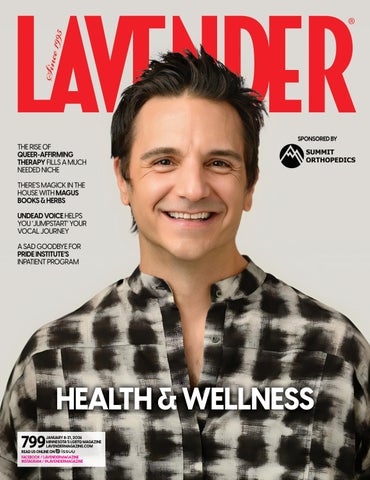
Health & Wellness 14 Safe Space, Real Talk: The Rise of Queer-Affirming Therapy in Minnesota 18 ‘Jumpstart’ Your Vocal Transition Journey With Undead Voice 20 Goodbye to a Safe Place to Heal 24 Magus Books and Herbs: Where the Magick Happens 26 A New Perineum Patch Could Make You Last Longer and Finish … MOR? 28 What Moves Max Vasilchuk
28 OUR LAVENDER
10
8 Well Wishes 9 Will My Children Remember Me?
OUR SCENE
10 Parlez-Vous Thérèse? 12 U nrivaled’s Second Season Promises to Showcase an Even Larger Pool of Talent and the Power of Player-Driven Media
OUR AFFAIRS
30 Books
OUR HOMES
31 Where’s the Trail?
OUR RESOURCES
32 Community Connection 33 The Network
24
OUR VOICES
33 Every Shade We Rise
ON THE COVER
Sam Trewick
28: Photo courtesy of Max Vasilchuk, 10: Photo by Mike Hnida, 24: Photo courtesy of BigStock/Samiramay, 31: Photo by George Torline
4
LAVENDER JANUARY 8-21, 2026
31
EVERYONE WELCOME Volume 30, Issue 799 • January 8-21, 2026
EDITORIAL Managing Editor Noah Mitchell (612) 461-8723 Editorial Assistant Linda Raines (612) 436-4660 Editor Emeritus Ethan Boatner Contributors Lakey Bridge, E.B. Boatner, Bianca Caputo, Stacy Dahl, Natasha DeLion, Alyssa Homeier, Terrance Griep, Shane Lueck, Elise Maren, Jen Peeples-Hampton, Linda Raines, Aspen Rush, Gregg Shapiro, Allie Skarda, Randy Stern, Susan Swavely, Natalie Trimble, Sommer Wagen, Carla Waldemar, Todd P. Walker, Emma Walytka, Spencer White
EMBRACE WELLNESS IN THE NEW YEAR
ADVERTISING
2823 E. Franklin Ave., MPLS & 317 E. 38th St., MPLS www.seward.coop
Welcome the new year with wellness at Seward Co-op. From fresh fruits and veggies, organic ingredients, supplements, and more, we’ve got what you need for a happy, healthy new year.
Vice President of Sales & Advertising Barry Leavitt (612) 436-4690 Account Executives Nathan Johnson (612) 436-4695 Richard Kranz (612) 436-4675 Sales & Event Administration Linda Raines (612) 436-4660 National Sales Representatives Rivendell Media (212) 242-6863
CREATIVE Creative/Digital Director Mike Hnida (612) 436-4679
ADMINISTRATION Publisher Lavender Media, Inc. President & CEO Stephen Rocheford (612) 436-4665 Senior Vice President & Chief Financial Officer Doug Starkebaum (612) 436-4664 Administrative Assistant Michael Winikoff (612) 436-4660 Distribution Metro Periodical Partners (612) 281-3249 Founders George Holdgrafer, Stephen Rocheford Inspiration Steven W. Anderson (1954-1994), Timothy J. Lee (1968-2002), Russell Berg (1957-2005), Kathryn Rocheford (1914-2006), Jonathan Halverson (1974-2010), Adam Houghtaling (1984-2012), Walker Pearce (1946-2013), Tim Campbell (1939-2015), John Townsend (1959-2019), George Holdgrafer (1951-2024), Julie Dafydd (1951-2025) Letters are subject to editing for grammar, punctuation, space, and libel. They should be no more than 300 words. Letters must include name, address, and phone number. Unsigned letters will not be published. Priority will be given to letters that refer to material previously published in Lavender Magazine. Submit letters to Lavender Magazine, Letters to the Editor, 5200 Willson Road, Suite 316, Edina, MN 55424 or e-mail editor@lavendermagazine.com. For our Privacy Policy, go to LavenderMagazine.com/resources/ privacy-policy
LAVENDER MEDIA, INC.
5200 Willson Road, Suite 316, Edina, MN 55424 612-436-4660 Office 612-436-4660 Subscriptions/Distribution 612-436-4660 Lavender Advertising
Lavender 2016 Magazine of the Year
Entire contents copyright 2026. All rights reserved. Publication of the name or photograph of any person, organization, or business in this magazine does not reflect upon one’s sexual orientation whatsoever. Lavender® Magazine reserves the right to refuse any advertising. This issue of Lavender® Magazine is available free of charge during the time period published on the cover. PICKUP AT ONE OF OUR DISTRIBUTION SITES IS LIMITED TO ONE COPY PER PERSON.
6
LAVENDER JANUARY 8-21, 2026
LAVENDERMAGAZINE.COM
7
OUR LAVENDER | FROM THE EDITOR
BY NOAH MITCHELL
Well Wishes Happy New Year, Lavender readers! I hope you all had a peaceful and joyous holiday season, and I wish you the best in whatever endeavors, new or old, await you in 2026. My first order of business for the year, as far as Lavender is concerned, is this very Health & Wellness issue. Last year, our Health & Wellness issue was more focused on physical health, including stories on personal trainer José Mendoza, skincare and dermatology, and how to keep yourself safe (or recover from injuries you suffered) while skiing. This year, our stories are more in the realm of overall wellness than physical health, specifically. While mental and spiritual wellness aren’t as easy to show off on Instagram as a physique, that doesn’t mean they’re any less important. But you don’t need me to tell you that. Instead, take it from the experts featured in this issue. Our first Health & Wellness story documents the rise of queer-affirming therapy here in
Minnesota. Features on voice training for trans people, local magical and spiritual goods supplier Magus Books & Herbs, and a new male sexual wellness device from Minnesota-based sexual health and wellness company Morari follow.
There is another story in this issue that I regret having to tell, but am honored to be able to feature in Lavender. Award-winning local journalist (and personal trainer, for extra Health & Wellness credentials) Danelle Cloutier documented for Lavender the end of the inpatient program at the Pride Institute, an LGBTQ+-specific facility for people in recovery. Pride was one of only a few facilities of its kind in the U.S., and the end of this program is a massive loss. While it’s a shame that our community is losing this resource, the least we at Lavender can do is tell the story of the place and the people whose lives it transformed, and Danelle did an incredible job doing just that. Whatever your Health & Wellness goals for the new year may be — aligning your chakras, lasting longer in bed, transforming your voice, finally finding the right therapist or anything else — I hope something in this issue helps you achieve them.
Photo courtesy of BigStock/blas
OUR LAVENDER | A WORD IN EDGEWISE
BY E.B. BOATNER
Will My Children Remember Me? In answer to a recent “Personal History” piece published on November 22, one respondent griped that it never would have been published but for the writer’s “Kennedy” name. Perhaps not, but in my opinion, that was part of the point of the essay. Tatiana Celia Kennedy Schlossberg chose November 22 to reveal a personal tragedy to evoke the shock and mourning that travelled the globe on that date in 1963 when her grandfather, President John Fitzgerald Kennedy, was assassinated in Dallas, Texas. Tatiana is the daughter of Caroline Kennedy, televised worldwide as a 5-year-old standing by her widowed mother, First Lady Jacqueline Bouvier Kennedy, as her little brother, John Jr., saluted — on his third birthday — their father’s horse-drawn hearse. In 2024, Tatiana, 34, an athletic, outgoing young woman, a widely-travelled environmental journalist and author, had just delivered her second child, a daughter. A follow-up blood draw revealed an alarmingly high white blood cell count and a diagnosis of acute myeloid leukemia, with a “rare inversion mutation 3,” making the standard disease presentation highly resistant to treatment and prone to relapse and reappearance. Tatiana’s personal account is harrowing. But her aim is not to seek pity or financial assistance, but rather to stress that even a Kennedy name and finances do not exempt one from a shattering, fatal disease. Despite access to excellent
care, from superb nursing to a team of medical specialists (including her physician husband, George), her prognosis is bleak. She makes clear the amount of funding and research that have gone into finding the treatments and/or prevention for earlier diseases, that have killed scores over the years, and how critical it is to keep on funding the research and experimentation, so that the “rare inversion mutation 3,” as well as other fatal illnesses, may be overcome. That time is yet to come. Tatania frankly addresses the role her cousin, Robert Francis Kennedy Jr., is playing in the obstruction of current preventative techniques, the hindrance of vital research, and the damage he has done in the medical field and to the family name. Will efforts for her own treatments be discontinued? The Kennedy family itself illustrates the importance of time and research in saving lives. Baby Patrick Bouvier Kennedy, born August 7, 1963, lived only 39 hours before succumbing to Hyaline membrane disease (HMD, now infantile respiratory distress syndrome), a lung surfactant deficiency disorder prevalent in premature infants. The nation mourning that tiny Kennedy’s death brought attention to the disease and increased research to bear, to a degree that today some 90% of affected infants survive. The toddler JFK nearly died in 1920 from scarlet fever. There’s still no vaccine, but once antibiotics were developed for soldiers in WWII and
flowed on to civilians, the deadly streptococcus bacteria could be controlled. While president, Kennedy also suffered from Addison’s disease, an autoimmune deficiency of the adrenal glands. This, too, with the later development of hormone replacement therapy, became treatable. Whooping cough, measles, chicken pox and many others were all dangerous in their day — and can become so again without proper vigilance, together with the protection of a high percentage of the populace, together with ongoing research into emerging threats. We’ve become complacent. Because earlier diseases aren’t seen as often doesn’t mean they’re gone. Perhaps we were lulled by the recent eradication of smallpox, achievable since — nearly uniquely — it had no vectors, no secondary carriers. We must remember that mosquitoes, ticks, fleas, mites, tsetse flies and aquatic snails still go about their business, covering even larger areas as the atmosphere warms. While we may no longer remember them, mumps, measles, whooping cough, diphtheria, scarlet fever and others lie waiting in the wings. If Tatiana’s physician is correct in his estimate of her having “maybe another year,” her daughter will be about little John Jr.’s age when he saluted his father’s coffin. Beyond the personal burden of disease is the fearful question of similarly afflicted young mothers: “Will my children remember me?”
Photo courtesy of BigStock/Rawpixel.com LAVENDERMAGAZINE.COM
9
OUR SCENE | EAT THE MENU
BY CARLA WALDEMAR
Parlez-Vous Thérèse? Restaurant czar Daniel Del Prado has treated us to Latin influences (Martina, Colita, etc.), nibbles from Japan (Sanjusan), plenty-o-meat (Porzana) and more. With his latest culinary offspring, Thérèse, housed within a 50th & France mall site, he devotes his skills and skillets to a nicely vetted menu of classic French brasserie fare. However, when it comes to the room, which he describes as a “classic, warm Parisian” setting, our culinary emperor is lacking clothes. It’s simply a bland, atmospherefree nook of a mall. Come for the food and the service — both succeed — just not on Valentine’s Day. And not if your heart is set on its most talked-about dish, the lobster and sweetbreads ravioli — because the kitchen wasn’t offering it, at least on our visit. (By the way, we had trouble getting a reservation time to our liking on a Tuesday, ending up with an 8:30 p.m. seating, noted as “ear-
10 LAVENDER JANUARY 8-21, 2026
liest available” on the web. Only two other tables were full.) Anyway, our Old Fashioned cocktails were swell, adorned with a thread of green apple circling the glass. We skipped the cold starters ($13-19, mostly shellfish, plus $110 for caviar service) in favor of the warm app list ($1921, plus $26 for that famed lobster and sweetbreads ravioli, unavailable). Bypassing the escargot, onion soup and mussels — next time! — we summoned the chicken liver pate. Fine choice. Coarsely ground and barely hanging together, the serving could shine in an actual Parisian bistro: a bit lumpy and liver-y (all in a good way), it demanded to be spread on the chunky toasts provided. Bits of sherry jelly, plump raspberries, savory hazelnuts and perky pink peppercorns completed the platter’s couture. We also made quick work of the app list’s beef tartare — sweet as raw beef is at its best, and dolled up with a slick of horseradish-infused buttermilk and capers. Next, I insisted on the Lyonnaise salad ($17 and huge enough for four), just because that’s my go-to in an actual Parisian side-
walk setting. Loads of crisp and curly frisée in a mustard-sherry vinaigrette were garnished with meaty bacon lardons plus half a soft-boiled egg. But it had been boiled a few seconds too long and no longer boasted the golden yolk runny enough to toss with the waiting greens. The beet/goat cheese and Nicoise salads sounded tempting, too. Entrees range from a classic steak au poivre, $45, to poached salmon with clams (!) for $31, a winter-busting pork with squash, cider jus, fennel and apple number, or chicken (touted by a manager who walked by) gussied up with celery root purée, black trumpet mushrooms and truffle jus. Big spenders can opt for lobster thermidor ($55) or braised short rib ($65), while we jumped for the pig trotters ($31) because, well, how often do you spot those on a menu in the U.S.? Good choice, and meaty enough for the two of us, stripped from the hoof-y end of the piggy’s leg, braised until fork-tender and juicy, then adorned with morels atop a pond of finely-puréed potato, moist with madeira jus. BTW, for the cautious, there’s also a sturdy burger on the menu, $21. The dessert list is short and sweet: crème brûlée, passion fruit panna cotta, gelato and our choice, the flourless chocolate number ($13). It’s as rich and dark and custardy as in your dreams, but topped with “chocolate crumble,” which turned out to be dried-out diced chocolate cake. (Why?) It’s set upon a painting of gin-and-tonic mousse of innocuous flavor. So, despite my whining about a promise-more, deliver-less setting, the food and service earn a repeat visit.
Thérèse 3945 Market St., Edina (612) 836-9282 theresempls.com
Palette De Porc, Snow Crab Lettuce Cups, Poached Salmon, Flourless Chocolate Torte
BOX LUNCH DELIVERY EVERYWHERE
years
ln by 10, there by noon. 651 South Cleveland, St. Paul 651-698-0334 fax: 651-699-2303 www.cecilsdeli.com LAVENDERMAGAZINE.COM
11
OUR SCENE | SPORTS
BY ALLIE SKARDA
Unrivaled’s Second Season Promises to Showcase an Even Larger Pool of Talent and the Power of Player-Driven Media Almost three months after the Las Vegas Aces clinched the WNBA championship, women’s professional basketball fans finally got relief from their sports drought this Monday with the tip-off of Unrivaled’s second season. Unrivaled is a 3-on-3 women’s basketball league co-founded by Minnesota Lynx star Napheesa Collier and fellow WNBA icon Breanna Stewart. The league provides a domestic option for women’s professional basketball players, who have historically had to go overseas to play during the WNBA offseason. This season, Unrivaled added two new teams, Breeze Basketball Club and Hive Basketball Club, to its original six clubs. This expansion, which comes a year earlier than originally planned, takes the league up to 54 players between the eight teams and the player development pool. “Expanding a year earlier than planned is a testament to the strong business model we’ve built and the potential Unrivaled has for long-term success,” Unrivaled President of Basketball Luke Cooper said in a press release ahead of the season. “We outperformed every goal we set for the league in year one, and with the incredible talent we have returning paired with the influx of new stars, it was a no brainer to add two more clubs this season.” Photo courtesy of BigStock/yobro
12
LAVENDER JANUARY 8-21, 2026
To accommodate the two additional teams, Unrivaled has added a fourth night of games each week for a total of 56 games in the regular season. The playoff structure has also been expanded to include six clubs, with the top two seeds earning byes to the semifinals. Unrivaled’s second season features a plethora of Minnesota talent, including the return of Lynx players Courtney Williams, Natisha Hiedeman and, of course, the league’s co-founder, Collier. All three, as well as every single 2025 Lynx player besides Anastasiia Olairi Kosu and Dorka Juhász, are free agents in a chaotic 2025-26 WNBA offseason that will also feature an expansion draft. Hiedeman and Collier both had impressive first seasons in Unrivaled. After being signed on as a relief player, Hiedeman played with Rose Basketball Club throughout the playoffs, ultimately helping the team earn the inaugural championship title. This season, she is signed on as a full-time player with Hive Basketball Club. As for Collier, she won the league’s 1-on-1 tournament and earned the title of Unrivaled 2025 Most Valuable Player. “I couldn’t do any of this without my teammate,” Collier said after being named MVP. “This has been such an incredible season and everyone played
a part in our success, from the coaches and training staff to the staff behind the scenes. I’m so proud of this club and am honored to be the first-ever Unrivaled MVP.” Notably, Lynx guard Kayla McBride did not return to Unrivaled for season two. Last year, McBride was third in the league in scoring with an average of 22.2 points, earning her a spot on the 2025 First Team All-Unrivaled. McBride will instead be returning to Turkish club Fenerbahçe, where she has played during offseasons since 2020, including finishing the 2024-25 offseason there after playing the 2025 Unrivaled season. However, there are two new Minnesota names to watch for this season in Alanna Smith and Paige Bueckers. Lynx forward Smith is coming off a career year after earning the title of 2025 WNBA Co-Defensive Player of the Year. Hopkins, Minn. native Bueckers also had an impressive season, being named WNBA Rookie of the Year after being selected by the Dallas Wings as the No. 1 draft pick. That being said, Bueckers actually decided to invest in Unrivaled before even playing her first WNBA game. “I feel like the return on investment (for women’s sports) has been amazing,” Bueckers said on “Good Morning America” last April when she confirmed her investment with the league. “Even the first year (of Unrivaled), the numbers were shocking. They blew it out of the water.” What’s not shocking, however, is Bueckers’ decision to play with Unrivaled given their player compensation scheme. In its first season, the league reportedly paid its players an average salary of over $220,000, with every player earning at least six figures. Bueckers’ rookie contract with the Dallas Wing will total less than $350,000 over the course of the next four years. This is despite the WNBA’s regular season including 30 more games than Unrivaled did in 2025. Since the inception of the league, Collier and Stewart made it very clear that improving player compensation was a major priority for Unrivaled. “For years, women have relied heavily on off-court sponsorships for a majority of their income,” Stewart said when the league was first unveiled back in 2024. “With Unrivaled, we’re revolutionizing the game by prioritizing investments in our stars and ensuring their on-court performance is reflected in their pay.” Conversations around player compensation have heightened in recent months, as it has been a major point of contention in the ongoing Collective Bargaining Agreement (CBA) negotiations between the Women’s National Basketball Player Association (WNBPA) and the WNBA. At the end of November, the WNBPA and WNBA agreed to extend the current CBA to January 9, 2026, just days after the Unrivaled tip-off. Unrivaled co-founders Collier and Stewart both serve on the executive board of the WNBPA, and Collier in particular has become one of the main faces of advocacy for improving player compensation throughout negotiations. Given the circumstances, it’s not a stretch to think Unrivaled’s competitive player compensation scheme has put additional pressure on the WNBA throughout negotiations. Of course, the long-term impacts and viability of the young league remain unknown and will likely continue to be so even after the conclusion of its second season. Nonetheless, Unrivaled’s ability to attract and retain high-caliber talent, all while growing its business model, appears promising. And, in the meantime, it certainly is shaping up to be an electric, star-powered season.
SAVE $3,000!*
W E LC O M E TO A B I I TA N MILL CITY
A unique 55+ community located in the heart of downtown Minneapolis next to theaters and the arts, restaurants, walking paths, and beautiful views.
NOW WITH AN EXPANDED MEMORY CARE!
CONTACT US TO SCHEDULE A TOUR TODAY!
Abiitan.org | 612-378-0020 428 SOUTH 2ND STREET, MINNEAPOLIS, MN
Independent Living | Assisted Living Memory Care *See offer details online.
LAVENDERMAGAZINE.COM
13
OUR LIVES | HEALTH & WELLNESS
BY STACY DAHL
Safe Space, Real Talk:
The Rise of Queer-Affirming Therapy in Minnesota In recent years, the landscape of mental health care for LGBTQ+ individuals has shifted in a powerful and long-overdue direction. Queer-affirming therapy (also called LGBTQ+-affirmative therapy) is a mental health approach that validates, celebrates and supports queer identities and has been on the rise throughout Minnesota, particularly in the Twin Cities.
Sara Kelly (she/her) — The Family Partnership
Sara Kelly currently works as an Outpatient Therapist for The Family Partnership, a Minneapolisbased nonprofit human services organization founded in 1878 that became the first family service agency in the U.S. to provide an affirmative counseling program for lesbian, gay, bisexual and transgender (LGBTQ) individuals and families in 1975. The Family Partnership serves primarily underserved communities, and in addition to therapeutic services, the organization offers a multicultural therapeutic preschool. The organization also has a Pride program, which is a community outreach and drop-in support center for people who are at risk of or have previously experienced sexual exploitation. As an outpatient therapist, Kelly sees individuals and couples both in-person and in a virtual setting. She works with clients from the ages of 13 to 85, with most patients being in their 30s and 95% of her clientele being part of the queer community. Photos courtesy of Sara Kelly, Diver Van Avery, Sam Trewick
14
LAVENDER JANUARY 8-21, 2026
Having been with the organization for 3.5 years, Kelly is trained in providing queer-affirming therapy to her clients. She describes it as an experience that is “Open, accepting and a place where clients can come as they are.” “Sometimes people get it wrong and view queer-affirming therapy as the client’s only issues revolving around queerness and being trans, but that’s pretty rarely the case,” Kelly explains. “People are people and we have all sorts of complicated lives.” Kelly believes that being knowledgeable and skilled in working with marginalized identities is really the backbone of any kind of affirming therapy. “Queer-affirming therapy is important and needed because it’s such an underserved community,” Kelly continues. “There are many statistics out there that support the notion that, disproportionally, queer folks experience all sorts of trauma and all sorts of painful, harmful marginalization. They want to come to therapy and feel supported.” In her undergraduate studies, Kelly focused a lot on queer theory, race theory and other critical thinking courses. Every two years, Kelly must complete 40 hours of continuing education. She intentionally seeks out queer-, trans-, and polyspecific programming and education. “To me, part of it is just being in the community,” Kelly says. “I’m a gay person who happens to run in the same circles as a lot of my clients.” To create a comfortable space for her clients, Kelly describes her approach as being “absolutely blunt” about her lack of judgment. “I am not going to shift how I view you as a fundamentally good, worthwhile person based on anything you do in your spare time, who you are or how you identify,” Kelly says. At the door, she checks in with clients about what names and pronouns feel good to them. “Having a lot of humility helps because no one gets everything entirely right,” Kelly says. Regarding clients who come out or face rejection from family and friends, Kelly says that this is, unfortunately, a recurring theme. “I try to make sure that my clients are still affirmed in who they are and reiterate that what is acceptable to one person doesn’t have to have any bearing on what you are allowed to do,” she says.
to offer spaces and communities where people can find that belonging.” “I currently have several clients who are contemplating their nonbinary or trans identities and feeling fear in today’s political climate,” they say. “Trans hatred is being weaponized as a tool of oppression, but one thing that’s been powerful for many clients is learning queer history, exploring times and cultures where queerness and transness were celebrated, honored or viewed as sacred. Understanding how queer communities have historically built resilience through challenging times can be deeply healing.” When it comes to family acceptance and coming out, Van Avery emphasizes that each situation is unique. “Therapy is so rich because everyone’s story and family dynamic is different, so there isn’t a one-size-fits-all piece of advice,” they explain. “For some, it can be powerful to draw clear boundaries and say, ‘Call me when you’re ready to love me,’ so they can focus on finding their family of choice. For others, there’s a lot of nuances. They might choose to be patient with their family’s process, and though it can be difficult, those conversations can sometimes lead to deeper understanding and connection over time.” “Therapy,” Van Avery concludes, “is a place to learn that many things can be true at once. It can be hard to be trans, nonbinary or queer, and it can also be the best part of your life. It takes courage and can come with both fear and joy, connection and disconnection. Part of healing is learning to let go of binary thinking and embrace complexity, to hold multiple truths at once.”
Diver Van Avery (they/them) — LynLake Centers for Wellbeing
As a therapist of four years with LynLake Centers for Wellbeing, Van Avery’s role is to schedule and coordinate hour-long therapeutic sessions for couples and individuals primarily focused on the LGBTQ+ community. To Van Avery, queer-affirming therapy means that “people feel no hesitation to be fully themselves within a therapeutic setting or context. That doesn’t necessarily mean your therapist has to identify as queer, but there is a sense of deep understanding, collaboration and curiosity.” To Van Avery, therapy is about healing wounds, whether it’s from families of origin, childhood trauma or from things that have happened throughout a person’s life. For any identity, there are wounds and lived experiences that come from that identity. “There’s so much in therapy that’s a dance between the deeply and profoundly personal and the systems and dominant culture that we all live in,” Van Avery explains. “We need to toggle back and forth between the challenges that each person is facing and the liberation that each person is working toward.” “There are both internal and systemic barriers,” Van Avery says. “People need to understand that it’s not their fault for whatever they’re holding or struggling with. In my experience, both as someone who is queer and nonbinary, and in my clients’ experiences, there’s so much richness that can come from feeling empowered to own one’s queerness in unique ways.” “One of the greatest honors of my work,” they continue, “is writing letters for clients seeking gender-affirming surgeries. It’s important for providers to stay up to date on WPATH standards and evolving guidelines. There’s a strong network of queer-affirming therapists who keep their pulse on policy changes to ensure people can access the medical care they need. From nonbinary and transgender clients seeking gender-affirming care to queer elders navigating later life, queer therapists play a crucial role in supporting clients across all stages of life.” “One of the signs of healing,” Van Avery adds, “is a deeper sense of connection and belonging to others. That’s something people can go to therapy to explore and build. It’s exciting when queer-affirming therapists are able
Sam Trewick (they/them) — LynLake Centers for Wellbeing
Sam Trewick has been with LynLake Centers for Wellbeing for a year and a half. They are a psychotherapist who also works with clients using psychedelics as part of their therapeutic practice. Trewick sees a caseload made up mostly of queer, BIPOC and other marginalized clients, and primarily works with people with complex trauma. “Complex trauma, to me, is a collection of things that have happened, such as abuse or neglect, throughout childhood,” they say. “Because of lack Continued on page 16 LAVENDERMAGAZINE.COM
15
OUR LIVES | HEALTH & WELLNESS
IN-PERSON
NEW YE AR, NEW CL ASSES. WEEKDAYS OR WEEKENDS. WINTER OR SPRING. IN-PERSON OR ONLINE.
WEEKENDS
REGISTER NOW MCAD.EDU/CE
ONLINE
Reproductive Medicine and Infertility Associates
Family Building in the LGBTQ Community
Learn More About Our Services at www.rmia.com 16
LAVENDER JANUARY 8-21, 2026
of acceptance and bullying, most queer folks have some degree of complex trauma, so that’s why I specialize in that area.” They describe queer-affirming therapy as “Connection, community and the assumption that something is wrong with society, not with the individual. Our task is helping people cope with the limitations and shortcomings of society that tend to manifest as anxiety, depression and what people call mood disorders. I view those as appropriate responses to a hostile environment.” “We have to assume the world is pretty hard for you, acknowledge that it’s not your fault, and then do what we can to help you survive and eventually thrive,” Trewick continues. “It’s a lot of working through trauma and helping people understand their bodies and emotions better. Most queer folks who have been bullied or traumatized separate from their bodies and emotions. We’re trying to bring everything back into a whole and help them learn enough about themselves, especially their strengths and values, to actually thrive.” “Trauma creates injuries, but it almost always creates opportunities and what I call trauma superpowers. If something terrible happened to you, something that should never have happened and it resulted in cultivating something really special inside you, that’s worth seeing,” Trewick concludes. “A lot of my work is helping people move through the past pain to find what makes them unique.” The overwhelming sense of separateness, loneliness and burden is common among queer people, according to Trewick. “Right now, there’s such a sense of threat and this narrative that something is wrong with queer people and their struggles are their fault,” they say. “It’s important for us to combat that. Even if we can only do it at an individual level by helping people reframe what’s happening to them, my hope is that it reverberates at a societal level.” Trewick knew that this work was their path the moment they entered graduate school. The program focused heavily on multiculturalism and the experiences of queer and BIPOC communities. “From day one, we were steeped in that,” Trewick says. “My first class was this sweeping multicultural class where we learned the history, how things got this way and the skills to work with it.” Their decision to work with psychedelics is tied to queer history. “There’s so much medicine our community has used to feel better, form community and create healthy subcultures around healing from societal trauma,” Trewick says. “Focusing on psychedelics is a pillar of my work with queer folks. I grew up in the ’90s, and back then, the club and rave scene was where you found community. For me, it’s an opportunity to utilize the healing those medicines can provide and to reclaim them intentionally.” “My process [with therapy] is that I don’t accept any clients I haven’t met with first. We meet for 20 to 30 minutes, and we don’t decide that day if we will work together,” Trewick says. Trewick asks their clients to reflect on what was talked about, how their body feels, how they feel emotionally, what thoughts they are having, and let that tell them if they feel safe. “Ask yourself, ‘Is this someone I can open up to?’ If the answer is yes, that’s a green light,” Trewick says. Most people with complex trauma struggle to identify what safety even feels like. “We spend a lot of time talking about what safety can feel like and fleeting moments when they might have experienced it. That way, they can know in our sessions when safety is present,” Trewick says. “It’s my job to keep checking in. If I ask a question, you don’t have to answer it if it doesn’t feel safe. Part of my job is helping you learn what safety feels like.” Trewick encourages people not to be intimidated by the idea of finding help. “A lot of people get stuck seeking therapy because they think they don’t have options or think it’s an arduous task,” Trewick says. “I’d say it’s a lot easier than you think. It’s important to find a provider with whom you can feel some sense of safety.”
WE WANT TO SEE
YOU SMILE AS BRIGHT AS
WE DO! SCHEDULE YOUR APPOINTMENT TODAY GrandAvenueDental.com | 651.291.9667
Dr. Madeline Stead
Dr. Megan Mulligan
seize the deal
DEALMAKERS RELY ON DORSEY FOR PRACTICAL AND CREATIVE SOLUTIONS TO LEVERAGE OPPORTUNITIES WORLDWIDE.
Our clients accomplish their goals with the help of our in-depth experience and grounded counsel. We recognize the fundamental importance of getting the deal done.
TOP CORPORATE LAW FIRM
Nationally ranked in
2026 Best Law Firms® (BL Rankings LLC)
TIER 1 COMMERCIAL LITIGATION LAW FIRM
Nationally ranked in 2026 Best Law Firms® (BL Rankings LLC)
LEADING FIRM 40 PRACTICES RECOGNIZED
Chambers USA 2025
Incredible Ready-to-Wear Gallery Full Custom Rings Full Custom Jewelry • Trusted and Award Winning Talent Gallery of Independent Artisan Jewelry • Expert Restoration and Repair Call Now For An Appointment (612) 402-0561
dorsey.com
4300 Upton Ave South, Minneapolis, MN 55410 www.newgild.com
LAVENDERMAGAZINE.COM
17
OUR LIVES | HEALTH & WELLNESS
BY NATASHA DELION
‘Jumpstart’ Your Vocal Transition Journey With Undead Voice Most systems are not built with certain communities in mind, and trying to work within that system can be challenging and uncomfortable. Everyone deserves a space to safely be themselves and get the reaffirming care they need. The moment when someone feels comfortable and confident in the sound of their voice is magical and provides a sense of ease to that person, says Undead Voice founder Nicole Gress. “There is this pretty visceral moment that happens when somebody finally hears or discovers a sound that they love in their voice,” Gress says. “This awareness starts to land, like I can finally answer the phone without bracing, read to my kid without flinching at the sound of my voice, speak up in a meeting or order a coffee.” Gress said they rarely saw these moments when working as a speech pathologist in hospital and private practice settings, which was very frustrating. Photo courtesy of Nicole Gress. Graphics courtesy of Undead Voice
18
LAVENDER JANUARY 8-21, 2026
“Even while using all of the best practices … so many of our patients and the people I was working with were still struggling to actually reach the real life day-to-day goals that really matter when you’re communicating, because all of those methods that we are taught as speech pathologists weren’t actually built to shift the gender perception of a voice or how a voice is gendered,” Gress says. When it comes to someone’s vocal transition journey, many programs can be costly and are built for those with a vocal disorder or injury, according to Gress. They worked as a speechlanguage pathologist for years before deciding to create a space specifically for trans and genderdiverse people. They wanted to create something that not only gave people the tools but also a community, so they redesigned the whole system, creating Undead Voice six years ago. This online program
is Gress’ curriculum, very different from traditional speech practices, curated specifically for those working to find their affirming voice. While Undead Voice has a full voice training program, which is a lifetime membership, Gress wanted to make these tools as accessible as possible, so she created the Jumpstart program. This free three-week program provides practical strategies to explore in a safe, supportive and community-centered space. The program consists of live masterclasses led by Gress on foundations, goal setting and the five pillars of voice, and ends with a Q&A and next steps session. “We took the most impactful pieces from across the entire curriculum and created a threeweek introversion for people of any age and gender identity,” she says. “There’s a place where you can get started … and end the program with a lot more hope, a feeling of ‘I know what to do now, I know what the road ahead could look like and I have some pathways to get there.’”
The nitty-gritty of the Jumpstart program takes you through the five pillars of methodology to teach you how to create a voice that you love, but it also provides you with access to expert vocal coaches, feedback and a community of others going through a similar journey. “You get not just being told that things are possible, but shown that it’s possible, and support to actually be able to make actionable steps towards loving your voice and to do that surrounded by people where everybody is part of the community,” Gress says. The programs also take into account how prevalent voice dysphoria is for people going
on this journey and in the trans community. Throughout the program, they implement different support systems to help people reach their goals without dysphoria holding them back. “The number one evidence-based, and what we have seen from lived experience, way to help people navigate dysphoria is by having community, as simple as it sounds,” Gress says. “But honestly, we all know the power of being around somebody who has the same lived experience and knowing that you’re not alone.” The program also has everyday practice groups that people can hang out in and practice their voices together, as well as pairing people
up with a buddy in a different stage of their vocal journey as they go through the program to maintain direct support. Members also have access to coaches every day to ask questions, share moments and maintain an open line of communication to receive the support they need. Jumpstart has cohorts running throughout the entire year, with the first starting January 19. You can also put your name on the waitlist, which guarantees you an entry into a cohort this year. They will also run youth-specific cohorts in a partnership with the GenderCool project. Whether you’re just starting your vocal transition journey or looking for accessible tools and support to keep going, Jumpstart has a spot for you. Those who participate in the Jumpstart program will also receive a tuition credit, cutting the full Undead Voice lifetime membership tuition in half. Jumpstart is there whether you intend to continue with the full training program or not, and will provide you with the tools you need regardless. Jumpstart also partners with organizations that work with or see the value in the LGBTQ+ community to connect more people with the program for free. Undead Voice runs the show and hopes to make this program accessible for everyone who needs it. Learn more at undeadvoice.com/partnership for more information on bringing the Jumpstart program to your community. “Now more than ever it’s important that like trans people have voices and that we feel comfortable using them for safety, self-expression or confidence,” Gress says. “There’s a lot of reasons why we’re already struggling to feel safe being heard; we don’t also need to struggle to feel safe in our own voice.” Learn more about Undead Voice and the Jumpstart Program at undeadvoice.com/joinjumpstart.
LAVENDERMAGAZINE.COM
19
OUR LIVES | HEALTH & WELLNESS
BY DANELLE CLOUTIER
Goodbye to a Safe Place to Heal
Past clients mourn the closure of Pride Institute’s inpatient program after nearly 40 years of LGBTQ+-specific residential addiction and mental-health treatment When Universal Health Services, Inc. announced last month (December 2025) that it would close the inpatient treatment program at the Pride Institute in Minnesota, the news rippled through LGBTQ+ communities across the state like a shockwave. For nearly 40 years, Pride has been one of the only LGBTQ+-specific residential treatment centers in the U.S. — a place countless people describe as life-saving and life-changing, and for many, the first place they ever felt safe in their own skin. “Had it not been for Pride, I either would not be alive or I would have not become myself,” said Clarke Thielen, a non-binary Minnesotan in their 30s who went to Pride a few years ago. “And honestly, I think not becoming myself would be worse, because not living authentically as who I am feels like a worse fate than death.” To Thielen, the closure is devastating. “I know that people are going to die,” Thielen says. “I know if I hadn’t gone to Pride, I would have, and I know so many others who can say the same.” Art LeBeau agrees. “We need a safe space to open up about ourselves because we can’t do this alone, and if we don’t have that safe space, we’re going to die. There are people who are going to die.” The Massachusetts man came to Minnesota for the Pride Institute’s residential program in 1990 and 1996. “I’m distraught that they are not going to be a residential program,” he says. “I really feel strongly in what they did and how effective they were at doing it.” “There are plenty of people who need that resource, and to have that taken away from them is simply devastating to our community,” he continues. “There is a reason why LGBT is a special interest group in AA, and I think it needs to be a special interest group in recovery communities all around because there is stigma still, there is homophobia still. It’s not gone away. That’s reality.”
A place to become authentic
Thielen describes walking into Pride as stepping into a world where queerness, trauma and addiction weren’t something to hide, tiptoe around or explain. “It was the first space where I spoke my name out loud,” Thielen says. “That was one of the most powerful, empowering moments of my life. Had it not been for Pride, I either would not be alive or I would have never become myself — and not becoming myself would be worse.” Before Pride, Thielen used they/them pronouns only in limited environments, mainly within a Unitarian Universalist church that offered a pocket of safety, and they went by their deadname. But the idea of living authentically in the wider world felt terrifying. Clarke worried most about their
Pride Institute closed on December 31 after nearly 40 years of LGBTQ+-specific residential addiction and mental-health treatment. Photo by Danelle Cloutier. Clarke Thielen says they wouldn’t be alive without Pride Institute. Photo courtesy of Clarke Thielen
20 LAVENDER JANUARY 8-21, 2026
Barriers during HIV/AIDS epidemic
LeBeau sought treatment in Massachusetts at a time when being an openly gay man was, well, discouraged, to say the least. “None of the treatment centers I went to wanted me to let people know I was gay. I was told not to come out,” he says. Between 1990 and 1996, he struggled to stay sober and was in and out of treatment in his home state. He never felt he fit in until he went to Pride Institute. The center opened in Eden Prairie in 1986 during the HIV/AIDS epidemic as a safe haven while gay and bisexual men encountered discrimination in all areas of their lives. Some people with AIDS were kicked out of their homes, not touched by medical professionals, and some lost their jobs, according to David W. Purcell’s publication in the National Library of Medicine, “Forty Years of HIV: The Intersection of Laws, Stigma, and Sexual Behavior and Identity.” “It was something that really meant that, okay, then I’m not having sexual intimacy because I’m not willing to die yet, and so for me, that was a big part of that isolation, which was a big part of my drinking,” LeBeau says of how the HIV/AIDS epidemic affected him. Arriving at Pride felt like finally exhaling. “For the first time, I found my people,” LeBeau says. “Pride was my coming-out experience.” Even after multiple treatment attempts elsewhere, Pride was the only place where he was allowed to be honest — and honesty, he says, was essential to getting sober. “Other places told me to hide,” he says. “Pride told me to breathe.” It was also a safe space for him to explore his sexuality, even while the fear of HIV and AIDS was rampant. “It was freedom,” LeBeau says. “It’s probably the one single word I would use to describe it, to know that I didn’t have to hide that part of my identity.” During one of his stays at Pride Institute, he was attracted to another client. “I didn’t know what the hell to do with that, and I talked with my counselor about it, and he just said, ‘Well, tell them,’” LeBeau recalls. “I was like, what? Are you crazy?” LeBeau told the person he was attracted to them. “And you know what? It didn’t kill me,” LeBeau says. “It actually got me to open up and connect with someone.” LeBeau said his admission didn’t change anything in their relationship, but he got to practice vulnerability. “I felt safe enough that I was willing to try it, even though I didn’t know the outcome. I don’t know that I could have had that experience anywhere else,” he says.
Why Pride Mattered
To understand the grief around Pride’s closure, it’s necessary to understand what made it unique. Substance use disorders and mental health struggles often intersect with minority stress — especially for LGBTQ+ people, who experience disproportionately high rates of trauma, discrimination, homelessness, family rejection, barriers to care and substance use. Between 20% and 30% of gay and transgender people abuse substances, compared to about 9% of the general population, according to American Progress. Standard treatment settings can unintentionally replicate oppressive dynamics — misgendering, heteronormative assumptions, lack of cultural competency or environments that feel unsafe for people whose trauma is rooted in identity-based harm. Some LGBTQ+ people who seek treatment elsewhere describe feeling retraumatized rather than supported. “I know people who went to non-LGBTQ treatment centers and were just traumatized further,” Thielen says. “Pride was sacred in a way that can’t be found elsewhere.” Residential treatment is different than outpatient programming because clients can’t leave residential, making a return to substance use less likely during their stay. In outpatient programs, clients come to the treatment center only for programming and then return to their homes, leaving more freedom and risk of returning to use. Some people also need to be physically taken away from substances in order to stop, and outpatient simply isn’t enough. “You go home at night,” Thielen says. “You lose that family. That safety. For queer people who don’t feel safe at home, 24/7 support matters.”
“
I wouldn’t be alive if Pride had not been there when I needed them.
“
children and how coming out as non-binary more publicly might impact them in a rural community. At Pride, staff and peers challenged that fear in ways that changed everything. “They asked me, ‘What impact will it have on your kids if you don’t become who you are? What example does that set?’” Thielen recalls. “That was life-changing.” The day Thielen said their name out loud during evening reflections, where each client shared their name, something about their day and an affirmation. “I remember locking eyes with someone who understood me better than anyone ever had, and I said, ‘Hi, my name is Clarke, and I’m a f—-ing warrior.’ And then I cried. It was a declaration of identity, of existence and courage. That’s what Pride gave me,” Clarke says. “The safety to be who I am so I could actually do the deeper healing — my trauma, my substance use, my mental health. Without the LGBTQ-inclusive part of treatment, the whole puzzle wouldn’t have fit.”
— Art LeBeau, former Pride Institute client
Joy as healing
For many, Pride wasn’t just a treatment center — it was home, a family, a place where they could express queerness loudly, joyfully, safely. “It was gay summer camp,” Clarke laughs. “Well — winter camp. But you get it.” Being surrounded by sober LGBTQ+ people transformed what joy meant for Thielen. Karaoke nights, games and the cheesy slogans at evening reflections that people rolled their eyes at but secretly cherished were part of the healing. For example, a client would say, “I love my Pride family” as their affirmation and the 40-something other clients would yell back in unison, “and your Pride family loves you right back. Hey!” “Joy isn’t just a result of healing; it’s a part of it,” Thielen says. “I realized I could have fun without drugs. I realized I was alive.” Pride didn’t just help Thielen survive — it altered the course of their life. The impact of the staff inspired them to enter the mental health field, where they now work with people navigating trauma, identity and substance use. “They showed me my purpose — creating safe, inclusive spaces for other people,” Thielen says. Continued on page 22 LAVENDERMAGAZINE.COM
21
OUR LIVES | HEALTH & WELLNESS
What comes next
On January 1, Pride’s inpatient program will officially end at 14400 Martin Dr. in Eden Prairie. LGBTQ+ outpatient services will continue in Minneapolis under a new umbrella organization, Foundations Minnesota, while inpatient LGBTQ+-specific treatment will be relocated to Michael’s House in Palm Springs, Calif. Foundations Minnesota will also offer a partial hospitalization program, intensive outpatient program and virtual intensive outpatient program for co-occurring substance use disorder and mental health treatment for adults 18 and older that is not LGBTQ+-specific. “We remain committed to affirming care, community, and inclusive healing,” says a spokesperson on behalf of Pride Institute. “These adjustments allow us to keep programs accessible for more people who need our help.” Daub hopes that someone will be able to open a facility like Pride Institute.
“
There are people who are going to die.
“
— Clarke Thielen, former Pride Institute client, on why closing the residential program matters
“I am hopeful that somehow, some way, something good will come out of this, that somebody is going to come through and a new program, an opportunity is going to come up, and we’re going to find something that’s going to take its place,” Daub says. “I really do.” For Clarke, and for countless others, Pride was a lifeline. “It saved my life,” they say simply. “And I know it saved many others.” As Minnesota prepares to say goodbye to this sacred space, one truth remains: Pride’s legacy lives on in the people who walked through its doors and in the communities they now shape, support and fight for. They carry its spirit forward, even as the building goes quiet.
LGBTQ+ TREATMENT IN MINNESOTA
Susan Daub is a mental health therapist at Pride and has seen the program’s magic working since 2017. “I’ve watched clients come in terrified and really insecure about their identity, really scared of what’s next for them, and I’ve seen them completely evolve and change, become who they were meant to be in a really short period of time,” Daub says. “It’s pretty miraculous.” A particular memory that sticks out to Daub is when all the clients had to remain in a group room for hours while staff dealt with an emergency. She and a nurse looked at the cameras to observe the clients and saw that they made costumes and turned the group room into a dance party. “It stands out to me as this is why I love this place. How do you even describe to people what joy and creativity?” she says. “At any other place, they would have been tearing down the walls, but no, we’re making the best of this, and we’re going to have fun here. We watched [the live video footage], and we were laughing and crying.” Art LeBeau has stayed sober since his last stay at Pride Institute in 1996. Photo courtesy of Art LeBeau
22 LAVENDER JANUARY 8-21, 2026
• Inpatient services • EOSIS Latitudes is a 14-bed, LGBTQ+ residential facility that treats substance use and mental health needs in St. Paul. • Outpatient services • Under the new structure, Foundations Minnesota will off • Pride LGBTQ+ outpatient treatment in Minneapolis. Fellowship Recovery has a daytime LGBTQ+ track for substance use and mental health needs in Minneapolis, and it has a lodging program. • Elite Recovery offers a daytime LGBTQ+ track for substance use and mental health needs in St. Paul. • LGBTQ-specific meetings: There remain LGBTQ+-identified recovery and peer-support groups (e.g., LGBTQ+-friendly AA/ NA), which can be found by using the Meeting Guide app.
Suite 1600 Medical Arts Building, 825 Nicollet Mall, Minneapolis, MN 55402
i’d rather be listening to radio k real college radio
EXPRESS YOUR IC AUTHENT SELF
FIND YOUR FREQUENCY: 770 AM 100.7 & 104.5 FM Locally handmade designs that tell your unique story Handcrafted in Minnesota with unique materials, including real meteorite. Schedule a free online video consultation today to start designing your dream rings! 651.321.9267 www.jewelrybyjohan.com LAVENDERMAGAZINE.COM
23
OUR LIVES | HEALTH & WELLNESS
BY ASPEN RUSH
Magus Books and Herbs: Where the Magick Happens
Magus Books and Herbs has been facilitating spiritual exploration for upwards of 30 years. Complete with instructional courses, informational texts and divine guides, the shop describes itself as a “one-stop-shop” for all things magickal and mystical. Their new storefront is located in northeast Minneapolis off of Central Ave. Magus Books and Herbs’s central philosophy mandates that there is no singular spiritual path, but every individual’s journey should be honored and respected. Whether you are seeking knowledge on Afro-Caribbean tradition or Christian mystics, Magus encourages everyone to follow their inner compass. Owner and herbalist Liz Johnson uses the example of the Om symbol to describe the shop’s approach. The icon is sacred in Hinduism, Buddhism, Jainism and Sikhism, but has recently entered the popular zeitgeist as a symbol for meditation and peace. “So you come in, and you have so much road rage … I’m going to get this [Om] keychain. It’s going to remind me to take a deep breath and chill out on my way to work … Then you come back in a few months for a book Photo courtesy of BigStock/Samiramay
24 LAVENDER JANUARY 8-21, 2026
on Buddhism, because it works,” Johnson explains. “Continue to explore down that path. Find the resources you need to grow and be happy. That’s the whole point!” Johnson is the second owner of Magus Books, but has been an integral member of its success since its beginning in the 1990s. Johnson continues to honor their predecessor’s founding principle, cultivating a hub for unique spiritual exploration. Magus Books and Herbs was founded by Roger Williamson, who migrated from the UK. He found the Twin Cities lacking in metaphysical literature, so he took it upon himself to create a mail-order catalogue of his personal library, based out of his basement. Soon, Williamson garnered enough traction to open a storefront. Upon retirement, longtime employee Johnson took up the mantle and purchased the store with his blessing. Fast-talking and boisterous, Johnson is eager to share their hard-earned knowledge and provides herbal consultations in-house. They have spent the majority of their life studying traditional knowledge and medicine, including
Ayurvedic, Chinese, Kampo and Tibetan, to name a few. Johnson’s interest in herbal remedies began early in life when their father suffered several minor myocardial infarctions, otherwise known as heart attacks. By the time he was diagnosed, bypass surgery was the only option. “I love modern medicine…” Johnson clarifies. “But there has to be more that we can do. And that brought me to herbalism.” Herbal medicine works in tandem with medical professionals, not in place of them. It does not have the power to cure everything, but traditional wisdom may be able to ease some symptoms. “We’re not gonna fix schizophrenia with herbs,” Johnson says. “For those with more serious things that I specialize in, there are people I won’t see if they don’t see their doctor … I prefer to work in concert with your physicians.” The herbalist believes in interweaving ancient empirical knowledge from across cultures with modern medicine for the best results. Clients seek Johnson’s advice for issues as serious as cancer or as trivial as vanity. While it may seem shallow, Johnson assures customers that they can help with that, too. “I also have people come in because they want designer tea,” they giggle. “If you want to avoid those wrinkles, you take good care of the body.” The herbal consultations consist of an amalgamation of noninvasive traditional diagnostic methods from many systems around the world, including methods like face reading and pulse response. Based on the test results, Johnson makes a list of potential herbs and performs sample tests to measure their effectiveness. “We’re tailoring the formula to the individual specifically,” Johnson explains. “And recommendations are not made without a consultation.” “If you’re the first person to turn the heat on in the fall, you’re not the first person to turn the AC on in the spring; those are different body types,”
Johnson continues. “One runs hot, one runs cold. You need different herbs for the same things.” Traditional medicine is only one of the offerings at Magus. The shop also offers courses such as Reiki, palmistry and astrology at varying price points, and they post daily on social media with videos on stones, herbs, magick and meditation. For a more personalized experience, you can find divine guidance with a variety of practitioners in fields such as palmistry, tarot, dream interpretation and oracling. The team at Magus Books and Herbs is small but mighty. After moving shop locations so many times, keeping up with their social media campaign, consultations and the day-to-day retail, there’s a lot of labor that goes into the business. But, without a doubt, it is a labor of love. Johnson likens Magus to the fantasy game Dungeons and Dragons. “It’s very much like being a player who’s decided to be a paladin and a mage,” Johnson says. “You’re going to be amazing when you get there, but the process to get there takes twice as long because you’re trying to level up in two different ways. That’s kind of what we’re all doing. We’re leveling up in multiple ways at all times.” Johnson encourages everyone to follow their inner wisdom, to find their most authentic self. Whether you find peace in Buddhism, Christianity, magick or another divinity entirely, they have spent their life cultivating a space for thought-provoking experiences and materials. If you’re in the mood to expand your horizons, Johnson encourages you to stop in to explore. “Come here for your spiritual needs, and come here for your Lavender too,” Johnson adds with a cheeky grin.
We Are Aging Connect with local resources: Medicare | Financial help | Housing Legal help | Services
800-333-2433
mn.gov/aging-pathways
Minnesota Aging Pathways is a free statewide service of the Minnesota Board on Aging in partnership with Minnesota’s area agencies on aging.
LAVENDERMAGAZINE.COM
25
OUR LIVES | HEALTH & WELLNESS
BY SPENCER WHITE
A New Perineum Patch Could Make You Last Longer and Finish … MOR?
Have you ever ejaculated before you intended to? While it is one of the most common sexual dysfunctions men deal with, I doubt many of you would answer “yes” if I asked you face-to-face. Why would you? It’s hard to admit that you were getting down and dirty with your partner and couldn’t make it more than two minutes before you came. It can be embarrassing, and the options to help you are limited. There are no FDA-approved drugs targeted toward premature ejaculation, and SSRIs, which are often prescribed to people struggling with premature ejaculation, have a laundry list of potential side effects. Enter the MOR patch, an FDA-cleared adhesive patch from Minnesota sexual health company Morari meant to help you last longer through electronic pulses. The basic idea is this: place the MOR patch between your balls and butthole — the gooch, as some call it, or the perineum, as nerds call it — and control the pulses through Bluetooth with the MOR app. If you’re worried about the electrical impulses, it is important to note that MOR patches don’t electrocute your taint. They are transcutaneous electrical nerve stimulation units, or TENS units, that use electrical pulses to stimulate your nerves. Everyone is different, and so are their MOR settings (which can be modified and saved in the app), so don’t just throw it on and expect it to work perfectly for you immediately. Morari founder Jeff Bennett says it is best to test out the patch on your forearm to get a feel for how it works, then to try it in a masturbation setting before using it with a partner. But you can do more with MOR than just prolong your sexual experience. According to Kevin from San Jose, a 26-year-old MOR user, one of MOR’s greatest upsides is its ability to intensify your orgasm. “This is kind of like a dual-use product if you find the right settings: one for delaying and one for intensifying orgasms,” Kevin says. Kevin, who is bisexual, says he’s tried MOR with both men and women and has used it as a top and as a bottom. Generally, he uses his saved delay setting when he is the top and his intensify setting when he is the bottom. After all, you are placing this taint-tingler directly under your prostate. Photos courtesy of Jeff Bennett
26 LAVENDER JANUARY 8-21, 2026
“Who doesn’t want to have a better orgasm?” asks Dr. Amy Pearlman, a board-certified urologist specializing in male sexual and hormonal health and co-founder of the Prime Institute in Florida. Pearlman says people struggling with sexual dysfunctions usually want to approach their issues through either a medical or novel approach — meaning some people want to view their dysfunction as a purely medical issue, and others want to view it more as a novelty, an opportunity to experiment. For those looking for a medical diagnosis, Pearlman would say MOR is a noninvasive approach to delaying your orgasm. For those interested in a novel approach, MOR offers users a fun new device they can try with a partner and maybe even get a more satisfying orgasm out of. It might take you out of the moment to reach down and adjust your settings while you and your partner do the dirty, but if your partner is operating it, that could offer a sexier way to keep yourself going or heighten your climax. Plus, it could lighten the conversation surrounding your battle with busting early. However, the MOR patch, like delay sprays and sensitivity-reducing condoms, isn’t a longterm fix to premature ejaculation, Pearlman says. While the patch certainly can help someone while they are having sex, it doesn’t solve the problem long-term.
However, Pearlman says that people struggling with premature ejaculation should use whatever helps them during sex, but they should also seek out long-term solutions like masturbation training or sex therapy. But everyone is different, and you should go with whatever works for you. Kevin had tried the delay sprays and special condoms, but never liked how they reduced the sensitivity during sex. However, Kevin says if you have sensitive skin, aren’t a fan of electrical im-
pulses or just don’t want to cough up $300, MOR might not be right for you. After all, MOR does use an adhesive to cling onto your undercarriage, so if you don’t groom or are a bit sensitive down there, you might have some issues. But if you’ve struggled lasting as long as you’d like and want to try some new tech — and maybe cum harder while you’re at it — MOR might be for you.
LAVENDERMAGAZINE.COM
27
28 LAVENDER JANUARY 8-21, 2026
OUR LIVES | HEALTH & WELLNESS
BY NOAH MITCHELL
What Moves Max Vasilchuk “I prayed, ‘God, if I live my life as a queer person and I love with all of my heart, as I’ve been taught and as my religion teaches me, how can you send me to hell? If all of my life is centered around love, how can I go to hell for this? For loving truly and freely.’” Max Vasilchuk was born in Ukraine, but moved to California along with their family when they were just nine months old. They don’t have any memories of their home country, which they say they’re often asked about. They grew up in Sacramento and the Bay Area — mostly Sacramento. They liken their relationship to their hometown to that of the protagonist of Greta Gerwig’s “Lady Bird” (which, for those who haven’t seen it, is set in Sacramento). “My journey with my hometown is similar with the protagonist’s in [“Lady Bird”], where you kind of just grow up hating your hometown,” Vasilchuk says. “At the end, she kind of realizes that she appreciates where she grew up. I haven’t gotten to that place. I’ve never really liked Sacramento.” Vasilchuk was brought up in a conservative, religious household. They also knew they were not straight from a young age — at least 8. As one might imagine, this combination created tension in Vasilchuk’s life. That tension would stay with them throughout their childhood and eventually follow them to college. Vasilchuk attended a private Christian university in Minneapolis, where their Californian pastor had recently moved to become the university president. They also wanted to experience all four seasons and, of course, get far away from Sacramento. “I was very much in the closet when I went to college,” Vasilchuk says. “My expectation for myself was to just stay in the closet and maybe be single for the rest of my life, or kind of pretend to myself that I was. That I wasn’t my sexual identity, that I wasn’t queer, and maybe marry a girl at some point that I get along with.” Despite the tension they felt between their budding queer identity and the conservative interpretation of Christianity they had grown up in, Vasilchuk chose to major in religious studies (with a minor in ancient Greek literature). They wanted to learn more, hoping to conduct research post-grad and one day become a professor. In the religious studies program, Vasilchuk got a taste of academia, getting the chance to present research papers at conferences. They studied Christian theology and scripture, as well as other religions. “A big part of my life journey is searching for wisdom wherever it exists,” Vasilchuk explains. That search led them to apply the methods they had learned in their coursework to a deep study of the Bible passages used by some Christians to discriminate against LGBTQ+ people. Vasilchuk had learned that cultural and historical context are key to interpreting scripture, which is shrouded in subjective translation decisions and thousands of years of cultural evolution. “I was looking into the passages that many Christians will use to either demonize the queer community, or to say that it’s wrong or that saying that queer love is wrong,” they recall. “I discovered that things weren’t adding up from what I was told.” “And I kept on studying those passages, and I found that there was no reason for me to feel ashamed of my identity or to hide it, that these were passages written in a certain context, and that context is not the same context that we have today,” they conclude. Then, finally, after a lifetime of wrestling with the tension between their faith and their identity, and after years of studying the scripture that was the source of that tension, Vasilchuk was able to say the prayer that opened this story. “That was a tipping point where, as I said those words, I made the conscious decision to be proud of who I am in my sexual identity,” they say of the prayer.
Vasilchuk thought that once they came out as gay, they’d feel a sense of relief and that the tension they had felt for nearly their entire life would be gone. That was not the case. They continued to feel that something wasn’t right. Eventually, they became friends with a nonbinary person. This friendship opened Vasilchuk’s eyes to something they hadn’t considered for themself before. “It wasn’t just my sexual identity that I need to come out with — I don’t feel cisgender either,” Vasilchuk recalls. “That gender identity journey took a little bit, but I think I finally settled on nonbinary, or genderqueer, or however. Depending on the context, I kind of oscillate between those two.” With that realization, and with a move to a more welcoming and inclusive church than the one they had grown up in, Vasilchuk was finally able to begin to ease the tension that they had wrestled with for almost their entire life. Today, Vasilchuk works not as a professor, but as the aquatics director at the St. Paul Midway YMCA. They began working at the Y as a swim instructor as a second job, but decided to stay long-term after they found that both the role and the Y’s culture deeply resonated with their values. As a swim instructor (and now aquatics director), they’re able to pursue their passion for health and safety and compliance. “It sounds a little nerdy,” Vasilchuk says, but their work is centered around setting things right, which satisfies an orientation toward justice that they’ve held since they were a child. As for the Y, it, too, is in line with their pursuit of justice — the YMCA of the North is the only YMCA chapter in the U.S. to add “equity” to the YMCA’s core values of “caring, honesty, respect and responsibility,” according to Vasilchuk. They are on the YMCA of the North’s Equity Advisory Council. Additionally, Vasilchuk is a member of the Y Pride LGBTQ+ employee affinity group, where they’re able to “create a safe space for other queer professionals to come together and be able to just be ourselves around our own community,” they say. As for what’s next, Vasilchuk wants to continue to move up within the Y in order to positively impact as many people as possible. “I want to stay in the YMCA because I love all the programs that the Y does and the values that they stand for,” Vasilchuk says. “When I first started at the Y, I didn’t know that there were programs for families in crisis, for kids in crisis. Like Beacons is an incredible program. It’s an after-school program for kids in the city. And I’ve met people who said that that program has literally saved their life. And I want to continue working for an organization that has programs like that for people.” “I don’t have a particular plan about how I want to go forward as long as I can impact people,” they continue. “And I’m going to keep on moving up until I’ve reached maximum impact.” The YMCA of the North is currently running a campaign called “What Moves You,” highlighting the stories that inspire people in their community, and it is through this campaign that Vasilchuk’s story reached Lavender. Vasilchuk said one story that inspires them is the “starfish story,” a parable about a young boy who walks along a beach, throwing starfish back into the ocean one at a time. When an old man tells the boy that he’ll never be able to save them all, the boy replies, saying that even if he doesn’t save them all, every one that he does save makes a difference. In their office, Vasilchuk has a “starfish wall” where they save notes from people who say Vasilchuk has had an impact on them, as a reminder of the impact they can have. By sharing their story, perhaps Vasilchuk can move many Lavender readers into the ocean where they belong. But, even if it only changes one person’s life, they’ve still made a difference, just as they already have in the lives of their students, coworkers, friends and family.
Photo courtesy of Max Vasilchuk LAVENDERMAGAZINE.COM
29
OUR AFFAIRS | BOOKS
BY E.B. BOATNER
“The Land in Winter”
“Murder by Memory”
The story explores the lives of two neighboring couples, one struggling to run a small dairy farm, the other, a doctor and an upscale wife able to throw an alcohol-fueled Christmas party. Both wives are pregnant. All, with the rest of England, are about to endure the “Big Freeze” months of 196263. Post-war, but bombing ruins still litter London and the surrounding areas. Each of the four is seeking footing between their earlier, constrained society and a daunting new freedom. Miller writes of small things with large consequences; Oxford dropout Bill doesn’t have the knowledge to manage a farm; Doctor Eric engages in a fling with a patient; and wives Rita and Irene form an unlikely friendship. So little remains of the old, so much of the future is unknown.
Q: When is a “cozy” less cozy? A: When it’s spun from the nimble mind of queer science fiction author Olivia Waite. Aboard Her Majesty’s generational interstellar ship Fairweather reside 800 souls. No faster-than-light hocus-pocus; new bodies simply fabricated en route throughout the so-far 300-year journey, individual minds decanted into fresh flesh from vessels backed up securely in the ship’s library. And life goes on. Until there’s a break-in and erasure. Death. Dorothy Gentleman, a ship’s detective, wakes in a foreign body and must sort it all out. A witty, twisty tale, long enough to satisfy yet not overload. Dorothy’s savvy and one to watch; she’ll be returning in 2026 with “Nobody’s Baby.” “Ooops!” aboard the Fairweather: Who done it? And how? Watch this spot!
Andrew Miller
“Midnight Cowboy” Jon Towlson
Part of McGill-Queens’ Queer Film Classics series, Towson offers nuanced perspectives on this groundbreaking 1969 film, considered then to be merely a homophobic view of ‘60s New York counterculture focusing on 42nd Street male hustlers. Texan Joe Buck (Jon Voight) steps off the bus intending to live by servicing wealthy socialites. Quickly disabused and broke, the Cowboy is taken under the wing of the more savvy (and increasingly ill) “Ratso” Rizzo (Dustin Hoffman). Towson redeems the original view by exploring the film as a proto-queer buddy story and the foundation for future films like “My Own Private Idaho” and “Brokeback Mountain.” Someone must have had an inkling back then: director John Schlesinger was gay, and the film won Academy Awards for Best Picture, Best Director and Best Screenplay.
30 LAVENDER JANUARY 8-21, 2026
Olivia Waite
“What We Can Know” Ian McEwan
Here we are post-apocalypse — 2119, to be specific — where folks are pretty much getting along with it, as survivors will. Enter Thomas Metcalf, humanities professor of a course called “The Politics and Literature of Inundation.” (Britain is now an archipelago.) He’s at the mountain location of the Bodleian Snowdonia, seeking the late, celebrated Francis Blundy’s “A Corona for Vivian,” a poem vanished after its reading at a birthday party in 2014. Vivian herself then begins to voice, at that birthday party a century earlier, when the dedicatory poem received its sole, known reading. Enmeshed, the reader is lured ever more deeply, not only into the “What” of the title, but down to the bedrock “Vanity of vanities, all is vanity,” of an equally enigmatic preacher.
OUR HOMES | OUR RIDES
BY RANDY STERN
Where’s the Trail? We hate to use the word “butch,” but we’re going to have to in this context. Since the start of our liberation movement, we wanted to express ourselves in a way that gives us the license to exude our power towards equality. LGBTQ+ people of all genders and orientations have worn flannel shirts, jeans and boots to exude this path towards liberation. That also meant owning off-road capable SUVs. Especially ones where you take the top off, fly through the gayborhood, pumping fists into the air and kissing the person next to you in the middle of traffic. Those were the days… Fifty-plus years later, the whole world is looking to exude some sort of energy by buying these ruggedly “butch” vehicles. It seems that many manufacturers have been catching on to consumer desires. Now, almost everyone wants to get into the act. Honda is not a latecomer to this trend. Back in the early 1990s, they reached out to Isuzu for a collaboration. They obliged by rebadging the capable 1993 Rodeo mid-size SUV being built at their plant in Indiana with Honda’s logo and name. The result is the Passport — their first SUV offering. This collaboration and rebadging job lasted through two generations until 2002. Since then, Honda developed, produced and sold SUVs under their own design and engineering. Seeing that market trends were about to change toward off-road-ready SUVs, they reintroduced the Passport for 2019 as a shorter, more concentrated version of the Pilot SUV. That got everyone’s attention quickly. For 2026, Honda set out to distinguish the Passport from the latest Pilot. They gave it a more squared-off exterior and emphasized the TrailSport branding to draw consumers looking for something more than your run-of-the-mill two-row mid-size SUV. Photos by George Torline
The result has been a rise in sales. Plus, they sent the new Passport into further adventure at the Alcan 5000 and the Rebelle Rally — two amazing tests of endurance in extreme conditions. However, we all know that a few of us would dare to take our 2026 Passport away from interstates 35, 90 and 94. Let alone deep into an ORV park and its extreme challenges. Before you consider such adventures into the uncharted lands across the Upper Midwest, we should talk about the 2026 Passport. Continued on page 34 LAVENDERMAGAZINE.COM
31
COMMUNITY CONNECTION Community Connection brings visibility to local LGBTQ-friendly non-profit organizations. To reserve your listing in Community Connection, email advertising@lavendermagazine.com.
ANIMAL RESCUE
Second Chance Animal Rescue
Dedicated to rescuing, fostering, caring for, and adopting out dogs and cats into forever homes. P.O. Box 10533 White Bear Lake, MN 55110 (651) 771-5662 www.secondchancerescue.org
BUSINESS ASSOCIATIONS
Quorum
Minnesota's LGBTQ+ and Allied Chamber of Commerce working to build, connect, and strengthen for a diverse business community. 2446 University Ave. W., Ste 112 St. Paul, MN 55114 (612) 460-8153 www.twincitiesquorum.com
ENVIRONMENT
The Nature Conservancy
TNC is an environmental nonprofit working to create a world where people and nature thrive. 1101 W. River Pkwy., Ste. 200 Minneapolis, MN 55415-1291 (612) 331-0700 minnesota@tnc.org www.nature.org/minnesota
EVENT VENUES
Landmark Center
A classic venue, with a grand cortile and beautiful courtrooms, accommodates celebrations of all sizes. 75 W. 5th St. St. Paul, MN 55102 (651) 292-3228 www.landmarkcenter.org
FOUNDATIONS
MEDIA & COMMUNICATIONS
Radio K
Radio K is the award-winning studentrun radio station of the University of Minnesota. 330 21st. Ave. S. Minneapolis, MN 55455 (612) 625-3500 www.radiok.org
MEDICAL SERVICES
Red Door Clinic
HIV and STI screening, treatment, education, and referrals. Doxy PEP, nPEP, PrEP, and Reproductive Health. 525 Portland Ave., 4th Fl. Minneapolis, MN 55415 (612) 543-5555 reddoor@hennepin.us www.reddoorclinic.org
MUSEUM
Bell Museum, University of Minnesota Discover Minnesota’s rich natural history through engaging exhibits, wildlife dioramas, and an exciting planetarium experience! 2088 Larpenteur Ave. W. St. Paul, MN 55113 (612) 626-9660 bellinfo@umn.edu www.bellmuseum.umn.edu
Minnesota Historical Society Create your own adventure at MNHS historic sites and museums around Minnesota. www.mnhs.org
Minneapolis Institute of Art Home to masterpieces from around the world and through the ages. Always free. Everyone welcome. 2400 3rd Ave. S. Minneapolis, MN 55404 (612) 870-3000 www.artsmia.org
Science Museum of Minnesota
University of Minnesota Foundation Connecting passion with possibility to transform the future through philanthropy. 200 Oak St. SE, Ste. 500 Minneapolis, MN 55455 (612) 624-3333 giving@umn.edu www.give.umn.edu
Mississippi Riverfront Museum featuring dinosaurs, hands-on exhibits, Omnitheater films, and interactive science performances. Café onsite. 120 W. Kellogg Blvd. St. Paul, MN 55102 (651) 221-9444 www.smm.org
GRANTMAKERS/FUNDERS
PERFORMING ARTS
PFund Foundation
PFund is the LGBTQ+ community foundation that provides grants to students and grants to non-profits. PO Box 3640 Minneapolis, MN 55403 (612) 870-1806 www.pfundfoundation.org
HEALTH & WELLNESS
Aliveness Project
Community Center for individuals living with HIV/AIDS – on-site meals, food shelf, and supportive service. 3808 Nicollet Ave. S. Minneapolis, MN 55102 (612) 824-LIFE (5433) www.aliveness.org
32 LAVENDER JANUARY 8-21, 2026
ARENA DANCES
ARENA DANCES presents innovative contemporary dance, fostering community, dialogue, and inclusion through performance and education 711 W. Lake St., Studio 308 Minneapolis, MN 55408 (612) 804-0238 www.arenadances.org
Chanhassen Dinner Theatres The nation's largest professional dinner theater and Minnesota's own entertainment destination. 501 W. 78th St. Chanhassen, MN 55317 (952) 934-1525 www.chanhassendt.com
Children’s Theatre Company
Children’s Theatre Company excites the imagination with world-class family-friendly theatre for kids, teens, and adults. 2400 3rd Ave. S. Minneapolis, MN 55404 (612) 874-0400 www.childrenstheatre.org
Guthrie Theater
Open to the public year-round, the Guthrie produces classic and contemporary plays on three stages. 818 S. 2nd St. Minneapolis, MN 55415 (612) 377-2224 www.guthrietheater.org
Minnesota Opera
World-class opera draws you into a synthesis of beauty; breathtaking music, stunning costumes & extraordinary sets. Performances at the Ordway Music Theater - 345 Washington St. St. Paul, MN 55102 (612) 333-6669 www.mnopera.org
Minnesota Orchestra
Led by Music Director Designate Thomas Søndergård, the Minnesota Orchestra, one of America’s leading symphony orchestras. 1111 Nicollet Mall Minneapolis, MN 55403 (612) 371-5656, (800) 292-4141 www.minnesotaorchestra.org
Ordway Center for the Performing Arts
Leading performing arts center with two stages presenting Broadway musicals, concerts & educational programs that enrich diverse audiences. 345 Washington St. St. Paul, MN 55102 (651) 224-4222 info@ordway.org www.ordway.org
Twin Cities Gay Men’s Chorus
An award-winning chorus building community through music and offers entertainment worth coming out for! 1430 W. 28th St., Ste. B Minneapolis, MN 55408 (612) 339-SONG (7664) chorus@tcgmc.org www.tcgmc.org
RELIGIOUS & SPIRITUAL
All God's Children Metropolitan Community Church
A welcoming, inclusive, safe place to explore and discover God's love for ALL God's children. 3100 Park Ave. Minneapolis, MN 55407 (612) 824-2673 www.agcmcc.org
Hennepin Avenue United Methodist Church
Everyone is welcome at Hennepin Church! Vibrant Worship. Authentic Community. Bold Outreach. 511 Groveland Ave. Minneapolis, MN 55403 (612) 871-5303 www.hennepinchurch.org
Plymouth Congregational Church Many Hearts, One Song; Many Hands, One Church. Find us on Facebook and Twitter. 1900 Nicollet Ave. Minneapolis, MN 55403 (612) 871-7400 www.plymouth.org
Spirit Garage
A Christian community of creative, quirky, curious folx where All Means ALL. Sundays, 10:30am. 100 W. 46th St. Minneapolis, MN 55419 bigdoor@spiritgarage.org www.spiritgarage.org
St. Anthony Park United Church of Christ
We are an Open & Affirming, Progressive Christian Community. Real Church. Real People. Real Life. 2129 Commonwealth Ave. St. Paul, MN 55108 (651) 646-7173 www.sapucc.org
Westminster Presbyterian Church
An open and affirming congregation, welcoming persons of all sexual orientations, gender expressions and identities. 1200 Marquette Ave. Minneapolis, MN 55403 (612) 332-3421 www.westminstermpls.org
SENIOR LIVING Lyngblomsten
Offering caregiver education, resources, support groups, and The Gathering (daytime respite, memory-loss enrichment program). 1415 Almond Ave. St. Paul, MN 55108 (651) 632-5320 caregiving@lyngblomsten.org www.lyngblomsten.org/CServices
SOCIAL SERVICES Friends & Co
Fostering meaningful connections for older adults for 50+ years. Offering quick drop-in chat line, phone & visiting companionship services. 2550 University Ave. W., Ste. 260-S St. Paul, MN 55114 (612) 721-1400 www.friendsco.org
Lutheran Social Service of Minnesota
Serving all Minnesotans with individualized services that promote full and abundant lives. lssmn.org | (651) 642-5990 | (800) 582-5260 Foster Care and Adoption | chlss.org | (651) 646.7771 PICS (Partners in Community Supports) | (651) 967-5060 Pooled Trust | (888) 806-6844 Supported Decision-Making | (888) 806-6844
TRAVEL DESTINATIONS Westopolis
Minnesota’s Sweet Spot! St. Louis Park & Golden Valley offer exceptional dining, attractions, shopping, hotels and event space. 1660 Hwy 100 S., Ste. 501 St. Louis Park, MN 55416 (952) 426-4047 www.westopolis.org
OUR VOICES | POETRY
THE NETWORK
BY JAMES D. ERICKSON
Every Shade We Rise Health begins as a spark— small as a heartbeat learning its first rhythm, quiet as breath before sunrise.
AUTO REPAIR & SERVICE
HOME SERVICES
Proudly Serving Minneapolis Since 1950
But in us— the LGBTQIA+ family, stitched from courage, shaped by truth— that spark stretches into a horizon bursting open with color. We rise in that color. Again. And again. Our bodies are not battlegrounds. They are sacred terrain— gardens that outlived storms, soil that learned to bloom after being told it never could.
Estimates 7:30am-4:30pm
So we tend them: with water like blessing, with meals that warm the palms holding them, with rest deep enough to let the roots remember their power. Our minds—bright constellations— deserve a quiet sky. Anxiety, depression, trauma: these are real. But so is the healing. Reach for therapy, for community, for the voices that say, “You belong. Stay.” There is no weakness in reaching— only bravery, only survival refined into wisdom. To our trans and nonbinary family: your truth is the first light over mountains. Your gender is a masterpiece that answers only to itself. May your care be affirming, your names honored, your body cherished as entirely your own.
BOOKSTORES
REAL ESTATE
Love, literature, and lattes www.inkwellbooksellersco.com 426 E Hennepin Ave, Minneapolis, MN 55414 763-209-8117
GUN SHOPS
SENIOR SERVICES
Providing Companionship Visits to Seniors in their Homes
To our elders— the ones who marched, who protected, who carved freedom into the future— you are the reason we have sky enough to rise. Your wellness is as sacred as your legacy. To our youth—radiant, discovering, soft and fierce all at once— you are not ahead or behind. You are blooming right on time. To our allies: thank you for choosing love in a world still learning how. Stand close. Stand loud. Your support heals more than you see. And to every queer soul walking through shadow and sunlight— you deserve care that honors your whole spectrum. Seek healers who see you clearly. Move your body like liberation lives inside it. Feed it joy small and bright as sparks. Rest as someone building a future.
Patti O'Neil (612) 879-0039
pat111742@aol.com
HOME SERVICES
Pause. Steady yourself. Rise. Because when we rise— in health, in truth, in wholeness— we do not rise alone. We rise as a symphony of color bending the edge of the world. We rise until the sky remembers who taught it how to shine. We rise because we are worth the rising. Every shade. Every story. Every beating, beautiful heart. ©2025 James D. Erickson. All rights reserved.
LAVENDERMAGAZINE.COM
33
OUR HOMES | OUR RIDES
One look at its boxy exterior and you could get away with calling it “butch.” It definitely looks rugged. Our TrailSport Elite test vehicle in Sunset Orange exudes these shapes and lines that frame this intentional machine. The squared off shape starts with a flat hood, aggressive grille textures, additional cladding front, back and all around. The headlamp units are an all-LED affair with driving lights and turn signals integrated in each unit. The Passport name is stamped on both the front fascia and rear liftgate. The rear end is more upright, flanked by large vertical LED taillight units. You also have a large liftgate for great cargo management. When you’re traversing the trails or getting up a steep driveway, the approach and departure angles look correct. That is due to the aggressive all-terrain tires fitted to a set of black-finished 18-inch alloy wheels.
The driver is greeted with an updated dashboard with a 10.2-inch digital instrument cluster. Controls are tactile where you need them. Honda uses a push-button actuator for the transmission instead of a shifter. On top of the center stack is a new 12.3-inch infotainment touchscreen. This features a lot of options for connectivity, including Google Built-in. Google Assistant will handle most of your voice commands, unless you Interior leather seats photo by Randy Stern
34 LAVENDER JANUARY 8-21, 2026
connect your smartphone wirelessly. Sound is emitted through a 12-speaker Bose audio system in this TrailSport Elite test vehicle. Also in our test vehicle is lovely two-tone leather seating. The front seats are large and comfortable with some support. The rear seat room is very spacious. You also have a large cargo area, starting with a 44-cubicfoot space behind the rear seats. Folding down the rear seats will expand the cargo hold to 83.5 cubic feet. Every 2026 Passport is powered by a 3.5-liter V6, putting down 285 horsepower and 262 pound-feet of torque. A 10-speed automatic transmission sends power to all four wheels through Honda’s i-VTM4 all-wheel drive system. We found that the V6 accelerates well on the highway and puts down power on dirt and gravel surfaces. Switching to Trail mode will maximize traction when you are on even more challenging terrain. As for fuel economy, we averaged 20.7 mpg. The best way to describe the ride quality of the 2026 Passport is balanced. With an off-road suspension set-up, it was never firm nor ultra-soft. Just the right amount of dampening on practically every surface. Cornering is fine within limits, but you will feel some lean and roll if you push it a bit. Evasive maneuvers yielded good results, however. The steering system was fine. We wished the effort was tighter. Oncenter feel was also just fine. However, we do love the braking system. The pedal feel and response were quite good. We also yielded good stops in normal and panic situations. The 2026 Honda Passport comes in three main trim levels, with additional packages available for each one. Pricing starts at $44,750. Our TrailSport Elite test vehicle came with a sticker price of $54,400. The 2026 Passport has that rugged presence we want now to seek adventure on the next trail. Its rugged “butch” look also offers practicality, translating into a well-balanced vehicle for everyday use. It may be your escape to liberating your active lifestyle or your fantasy of one.
when life
puts a bump in the fun Orthopedic Urgent Care
THAT PUTS PEOPLE FIRST — ALWAYS
6 LOCATIONS 7 DAYS A WEEK 8 AM – 8 PM summitortho.com