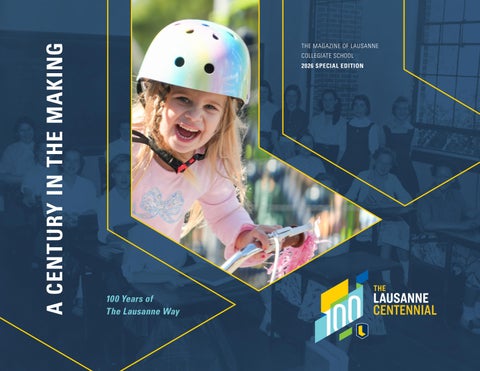
A CENTURY IN THE MAKING
THE MAGAZINE OF LAUSANNE COLLEGIATE SCHOOL 2026 SPECIAL EDITION
100 Years of The Lausanne Way
CONTENTS
Letter from the Headmaster � � � � � � � � � � � � � � � � � � � � � � � � � � � � � � � � � � � � � � � � � 2
Lausanne Magazine is a publication of Lausanne Collegiate School whose mission is to prepare each of its students for college and for life in a global environment.
1920s ................................................................ 6 1930s .............................................................. 10 1940s .............................................................. 16 1950s .............................................................. 18 1960s .............................................................. 26 1970s .............................................................. 32 1980s .............................................................. 40 1990s .............................................................. 46 2000s .............................................................. 52 2010s .............................................................. 58 2020s .............................................................. 64
Background Photo: View of the new Massey Rd. campus,1960 Front Cover Photo: Lucy Gehringer ’40 perticipates in annual Bike-A-Thon in support of West Cancer Foundation
Source materials for the articles in the special issue of The Lausanne Magazine include content, photographs and clippings from the Lausanne Archives.
EDITOR Shayne Fick Assistant Director of Communications sfick@lausanneschool.com MANAGING EDITOR Drew Smith Director of Marketing and Strategic Communications dsmith@lausanneschool.com
Lausanne Collegiate School 1381 W. Massey Rd., Memphis, TN 38120 901.474.1000 lausanneschool.com
100 YEARS OF THE L AUSANNE WAY | 1926 -2026
ART DIRECTOR Irina McGuire Graphic Design and Web Specialist imcguire@lausanneschool.com
1
LETTER FROM THE HEADMASTER
I feel a deep sense of gratitude for all who have shaped Lausanne into what it is today. Their influence surrounds us even now. —Stuart McCathie, Headmaster
For more than a century, Lausanne has been a place in motion. Since 1926, when a small group of teachers set out to build something different, this school has asked more of education and more of itself. They believed that students learn best when they are invited to wrestle with ideas, to test their thinking and to discover the purpose behind answers. That belief has never left us. It lives in our classrooms, on our fields and stages and in the moments when a student begins to see the world and their place in it more clearly.
Milestones invite reflection, and this one carries a particular weight. One hundred years of students who have walked these halls, each leaving a mark in ways seen and unseen. One hundred years of teachers who have given their time, their intellect and their belief in young people. One hundred years of families who have chosen this community and helped sustain it. I feel a deep sense of gratitude for all who have shaped Lausanne into what it is today. Their influence surrounds us even now.
I arrived at Lausanne in 2005 and from the very beginning, I recognized something rare. There is an energy here that cannot be manufactured. It comes from people who care deeply about the work in front of them and about one another. I have watched students grow into confident thinkers and compassionate leaders. I have seen teachers bring extraordinary creativity and care to their craft. I have stood alongside families who trust us with what matters most to them. Over time, these moments connect into something lasting, becoming the story of a school.
As we look ahead, I find myself returning to the same sense of possibility that defined our earliest days. The world continues to change, often in ways that challenge us to think differently and act with courage. Our responsibility remains clear. We must prepare students who are ready to meet that world with confidence, with integrity and with a willingness to lead. That work asks us to keep evolving, to keep asking more of ourselves and to embrace the values that have taken us this far.
Lausanne has grown in ways our founders could not have imagined. Our campus, our programs and our reach now extend far beyond what once felt possible. Yet the heart of this place remains enduring. We are still a community that values curiosity, encourages students to ask better questions and believes learning should feel alive. Our International Baccalaureate programs and global connections have strengthened that vision, giving our students the perspective and responsibility that come with understanding a world larger than themselves. They leave here prepared not only for college, but for life as informed, compassionate and engaged global citizens.
2
It is a privilege to be part of this community and to help guide it into its next chapter. The story of Lausanne is still being written, and I look forward to all that is yet to come.
Stuart McCathie, Headmaster
100 YEARS OF THE L AUSANNE WAY | 1926 -2026
In 2005, newly appointed Headmaster Stuart McCathie appeared on the cover of Lausanne Magazine while standing inside the recently opened Upper Middle School building. Twenty-one years later, he stands in the same location, now part of Lausanne’s new Upper School building as it nears completion ahead of its Fall 2026 opening. The paired images reflect a period of extraordinary growth on campus and Lausanne’s continued commitment to evolving its facilities, programs and opportunities for future generations of Lynx.
3
4
100 YEARS
of The Lausanne Way Since our founding in 1926, Lausanne has created a joyful and challenging learning process. By encouraging our students toward continual self-reflection and providing opportunities for them to succeed, we’ve empowered our students to seek their own journeys. The character they’ve built through service to others and the meaningful relationships they’ve forged on our campus give them the strength to make a difference on the global stage.
It’s The Lausanne Way.
100 YEARS OF THE L AUSANNE WAY | 1926 -2026
It’s not just what we do. It’s who we are.
5
THE COURAGE TO BEGIN
1920s 6
In the autumn of 1926, when Memphis still moved at the pace of streetcars and handwritten letters, a bold idea took shape inside a two-story home on Central Avenue. Emma DeSaussure Jett and Bessie Statler opened the doors of Lausanne, a new preparatory school for girls, welcoming a small group of students and a vision for education that challenged the norms of the time. Both women understood classrooms from the inside out. Miss Statler had taught at Miss Higbee’s School for Young Ladies, and she and Mrs. Jett had spent much of their careers at St. Mary’s Episcopal School. They knew how children learned, how confidence grew and how relationships made all the difference. Soon, two colleagues joined their efforts. Sophie Alexander Gardner guided the youngest students, while Florence Goyer Taylor, a Northwestern University graduate who had studied music in Berlin, brought creativity and a love for the arts into daily lessons.
Left: Rumor has it that Mrs. Jett carried all of Lausanne’s financials around in a cigar box, 1920s
100 YEARS OF THE L AUSANNE WAY | 1926 -2026
Long before students filled the classrooms, the idea for Lausanne grew through conversations on the shaded side porch of their close friend Mrs. Nelse Thompson’s home in Central Gardens.
7
During many afternoon visits, Mrs. Jett and Miss Statler returned to their dream of building a school centered on strong academics and compassion. That porch became their planning room and the birthplace of Lausanne itself. Mrs. Jett chose the name Lausanne to honor the Swiss city where her DeSaussure ancestors once found refuge from religious persecution. The city stood as a symbol of tolerance and thoughtful learning, influenced by educators such as Johann Pestalozzi and Maria Montessori, who believed children should be met with both structure and compassion. In many ways, the name reflected exactly what Mrs. Jett and Miss Statler hoped their school would become.
1920s
Mrs. Thompson believed deeply in that mission and showed her faith in the most meaningful way possible. When Lausanne opened, her daughters Helen and Lucia were among the first students to enroll. Other families soon followed, many led by mothers who had once sat in Mrs. Jett’s or Miss Statler’s classrooms themselves, trusting the women who had once shaped their own childhoods. The Central Avenue house shaped daily life as much as the curriculum. Every space served a purpose. The front lawn became a gathering place for athletics, dance recitals and graduation ceremonies. Lower School classrooms lined the upstairs halls while Upper School students studied below. A formal parlor transformed into both a history classroom and a biology lab, adapting to whatever the day required.
Miss Statler’s daily lunchtime and dismissal bell, 1920s
8
Each morning at 8:30 a.m., Miss Statler rang a cowbell at the front door to welcome students into the school day. The same bell signaled lunchtime and dismissal. In the backyard carriage house, kindergarteners
spent their mornings learning under the close care of Mrs. Jett and Miss Statler, beginning their Lausanne journey in a space filled with warmth and attention. From the beginning, Lausanne embraced small classes and a personal approach to learning. Teachers knew their students well: lessons were tailored to individual strengths, and girls were encouraged to explore ideas, learn through experience and grow confident in their voices. Lausanne reached an important milestone when the school celebrated its first graduating class. With just two seniors, Jane Vinton and Martha Walker, the ceremony was modest in size but powerful in significance. It was the first tangible sign that a dream born on a shaded porch had begun to flourish. Over the next century, Lausanne would grow far beyond that original home, expanding its campus, programs and opportunities more than its founders could have imagined. However, the spirit created on Central Avenue remains at the heart of the school today. The focus on relationships, individual growth and academic excellence continues to link generations, reminding each new class that the strongest traditions often begin with courage, care and a few people willing to believe in something better. n Graduation program, 1929
100 YEARS OF THE LAUSANNE WAY | 1926 -2026
9
HOLDING THE LIGHT
1930s
Backyard dance recital, 1930s
The Great Depression arrived without warning in the 1930s and settled in slowly. Banks failed, businesses closed and families in Memphis and across the country faced an unsteady future. Inside Lausanne’s classrooms, another story unfolded. 10
Parents kept bringing their children through the school’s doors, drawn by a belief that education could serve as an anchor in rough water. While much of the world felt as though it was shifting beneath their feet, Lausanne leaned into its purpose. In 1933, the school earned full accreditation, a significant achievement during a decade when many institutions struggled to survive. Lausanne’s founders, each with their different skill sets, created a natural balance and gave the school the ability to navigate the challenging time.
students more than creative outlets. Music drifted from practice rooms each afternoon, while dance classes filled the halls with energy and movement. Performances gave students an outlet for creativity, helping them develop focus, confidence and collaboration through the arts. Rehearsals required dedication, and recitals called for courage, with each applause-filled moment celebrating growth and achievement. Along the way, friendships were forged through shared challenges, teamwork and memorable performances. These early arts programs reflected a belief that education should nurture the whole child, and would become a lasting part of the Lausanne way.
Mrs. Emma Jett brought the polish of a Memphis society leader, modeled by a family history tied to South Carolina, the Daughters of the American Revolution and the founding of St. Luke’s Episcopal Church. Miss Bessie Statler offered structure and academic rigor, known for her formidable presence and high expectations. Together, they served as administrators, teachers, mentors and role models for the young women in their care. From the beginning, Lausanne assembled an all-female faculty with a strong focus on history, languages, literature and the humanities. Biology stood as the school’s only science course in the early years, reflecting the era’s academic priorities. The goal was to cultivate both cultural grace and intellectual discipline.
Student life beyond the classroom also began to grow during the 1930s, with the school’s first athletics offering, tennis, taking to the court. But the school’s arts programs became an essential part of the Lausanne Way. Dance recitals, music and performance offered
Tennis team, 1930s
100 YEARS OF THE L AUSANNE WAY | 1926 -2026
Many graduates still envisioned futures centered on home and family, following the norms of the time. Lausanne’s philosophy held that any future would be strengthened by a well-furnished mind and most students would thrive carrying forward habits the school could instill. With this empowerment, college became a more achievable goal.
11
Our First Miss Lausanne In 1938, Lausanne honored its first Miss Lausanne, Jean Gray Williamson, marking the beginning of a tradition that celebrated character as much as achievement.
1930s
Each year, Miss Lausanne was selected as a student who embodied kindness, graciousness and dependability, among other qualities that reflected the school’s early vision of a well-rounded education. The tradition endures today, evolving alongside the school itself. When Lausanne became coeducational, the honor expanded to include Mr. Lausanne, ensuring that these values continued to be recognized and celebrated across generations of students.
As the community strengthened, some of Lausanne’s earliest traditions began to form. One of the most treasured was the election of Miss Lausanne, a senior chosen each year as a symbol of leadership and spirit. Graduation followed a familiar ceremony. Younger students gathered on the lawn first, seniors processed next and Miss Lausanne always came last. As she appeared, families rose and the school sang “Chere Lausanne,” a song every student learned by heart and one that remains part of commencement today. The tune came from an Irish melody by poet Thomas Moore, with new lyrics written in honor of the school. While Lausanne required attendance at a non-denominational Christian chapel, it stood apart in Memphis by welcoming Jewish students and excusing them from chapel, an early expression of the school’s commitment to inclusion. For the girls who walked its halls during the decade, Lausanne offered more than academics. It provided stability during a turbulent decade. It fostered curiosity, connection and confidence. Through daily routines, shared songs, friendships and milestones, a distinct identity emerged. n
12
The Lausanne Locket In the late 1930s, Lausanne began producing its first yearbooks, capturing student life in print for the first time. Appropriately named The Lausanne Locket, these early volumes preserved moments, friendships and traditions at a young school still defining itself. One treasured copy belonged to Cleo Evans Caughlin ’38 and was signed by the school’s founders. Their handwritten inscriptions offer a rare and personal glimpse into Lausanne’s humble beginnings, a reminder that the school’s history has always been shaped by close relationships and a deep sense of community.
100 YEARS OF THE L AUSANNE WAY | 1926 -2026
Young Book-Lovers’ Club, 1938
13
A Senior’s Reflection, 1939 By the end of the decade, the values Lausanne had upheld through uncertainty were reflected not just in its traditions or programs, but in the voices of its students.
1930s
In the 1939 Lausanne Locket, one senior captured the experience of finishing her final year in words that still resonate generations later.
Above: Students at a “Society” themed party, 1930s Below: Lausanne Riding Group, 1930s
She wrote of realizing that while her years at Lausanne were coming to an end, what the school had given her would last far beyond graduation. Knowledge, she reflected, was only part of the education. More lasting were the friendships formed, the closeness with teachers, and the ideals Lausanne helped instill. Walking down the aisle with her classmates, surrounded by kindness and the spirit the school upheld, she described it as one of the most important and happiest moments of her life. Her words offer a rare glimpse into how Lausanne felt to its students in the 1930s. Even in a decade shaped by national hardship, the school succeeded in creating a place where young people felt prepared, supported, and deeply connected. What this senior described was not simply the end of high school, but the lasting impact of a community that believed education should shape both mind and character.
Read Tinnie Burch’s original article (next page)
14
A SATISFACTION OF BEING A SENIOR Since I have been going to the same school year after year, it is hard to realize that the chapter of my life in that school is coming to an end. The realization of this is somewhat
melancholy, but yet it gives me a great deal of satisfaction, such as can only come when one is nearing the completion of a thing that has been uppermost in his mind for years. Corinne Meriwether Burch, ’39
I feel that my four years in high school have not been fruitless, but have developed in me
something of knowledge. They have prepared me for college, and if this proves to be impossible, I can still feel that I have a foundation on which to base future years.
Knowledge alone, however, is not all this school has given me. It has made me appreciate the high ideals of life. It has secured friendships for me and others, friendships which have become teachers, and has shown us what fine things they stand for.
The day when I walk with my friends down an aisle surrounded by kindness and the spirit that Lausanne upholds, will be the most important and happiest day in my life. —TINNIE BURCH
100 YEARS OF THE L AUSANNE WAY | 1926 -2026
richer and dearer each year. It has brought me and other pupils into close contact with the
15
A W O R L D AT W A R
1940s
During World War II, Lausanne’s high school girls stepped beyond the classroom and into the heart of the Memphis community. Many devoted their afternoons and weekends to volunteering with the Red Cross at John Gaston Hospital on Madison Avenue, offering aid to wounded soldiers and overworked nurses alike. It was hands-on service in its truest form, motivated by compassion and a growing awareness of the wider world. Inside the school’s walls, Lausanne’s founders continued to nurture the values that had defined the institution since its earliest days. Fairness, justice and respect for others were not simply taught; they were practiced. Students were encouraged to look outward, balancing academic rigor with meaningful community involvement and an expanding sense of global responsibility. The 1940s also brought a flourishing of cultural life on campus. Lausanne girls attended lectures at the Brooks Memorial Art Gallery, explored literature and history through discussion, and took to the stage in school productions that drew families and friends together. In 1947, students performed a stage adaptation of Louisa May Alcott’s beloved novel Little Women, bringing the story’s themes of resilience, sisterhood, and perseverance vividly to life. As the decade drew to a close, Lausanne found itself at a turning point. Enrollment had steadily grown, filling every available corner of the Central Avenue house that had served as the school’s home since its founding. The largest class in the school’s history arrived in 1947, with 151 students packed into the modest space. Even so, numbers in the upper grades remained small. For the 1948 and 1949 yearbooks, the eighth and ninth grades were combined into a single group affectionately known as the “sub-freshmen.” Lausanne was thriving and its future would soon require room to grow. n
16
How Service Built Lausanne’s Early Leaders As students volunteered in hospitals, supported wartime efforts and looked after neighbors in need, they were learning the foundations of leadership. That spirit of service naturally gave rise to student voice. In 1947 Lausanne formed its first student government council, led by a president and representatives from each grade level. In an era shaped by cooperation and duty, student leaders helped organize school events, promote service projects, represent classmates’ concerns and foster school pride.
In addition to hospital aides, Lausanne had a Red Cross Council that served as a hub of student leadership and wartime service. Guided by faculty sponsors and run by student officers, the council organized volunteer efforts throughout the school and into the wider Memphis community. Members coordinated shifts at local hospitals, rolled bandages, assembled care packages, and led schoolwide drives to collect clothing, supplies and funds for relief efforts at home and abroad. Meetings often included first-aid instruction and updates on humanitarian needs, reinforcing the connection between daily school life and the global conflict unfolding overseas. For many students, participation was a source of pride, offering a tangible way to contribute to the war effort while learning responsibility, compassion and civic duty.
100 YEARS OF THE L AUSANNE WAY | 1926 -2026
Serving on the Home Front
17
A GROWING FUTURE
1950s Paper staff, 1950s
18
At the beginning of the 1950s, Lausanne still held the feel of a place you discovered through word of mouth, a school tucked neatly into Memphis life and cultivated by the same two women who had first unlocked its doors decades earlier.
By the time the decade closed, Lausanne had packed up and moved across three addresses, the student body had more than doubled and the uneasy work of imagining life beyond its founders had begun.
Before classes began, the school secured a firmer legal footing, incorporating as a state-chartered nonprofit under the name Lausanne School for Girls. The decision served as a declaration of permanence. Mrs. Jett used the moment to answer lingering doubts. She told reporters the move might finally quiet rumors of closure and insisted the school would continue as long as Memphis did.
100 YEARS OF THE LAUSANNE WAY | 1926 -2026
First grade class, 1953
With enrollment steadily increasing, the Central Avenue house reached its limits. Classrooms spilled into every available corner, and growth demanded a different kind of space. In 1952, after months of negotiation, Lausanne leased a former boys’ school at 2485 Union Avenue. The move transformed daily life at Lausanne, giving the school space not only to grow, but to gather. Real classrooms replaced borrowed corners, a gymnasium became the heartbeat of student activity, and hallways turned into places where friendships formed between classes. Lunches, assemblies, and school events finally brought everyone together under one roof, strengthening the sense of community that had always existed in spirit.
19
However, public confidence masked a fragile reality. After paying off debts from the sale of the Central Avenue property, the school had less than $1,000. By 1953, the danger was unmistakable, and Lausanne faced the possibility of closing, unsettling those who understood its influence. Among them stood Mrs. Nelse Thompson, who had been loyal to Lausanne from the very beginning and was determined to ensure its doors wouldn’t shut. That winter, Thompson traveled to Washington and visited the Holton–Arms School to study how a girls’ school survives beyond its founder. Back in Memphis, she gathered a group of Lausanne fathers in her library and laid out a plan for reorganization. Tradition alone could no longer carry the school forward. Structure had to step in.
1950s
Leadership shifted soon after. For decades, Mrs. Jett and Miss Statler had carried Lausanne on their shoulders. Now, with the school stretching beyond what two hands could hold, they began to loosen their grip, trusting others to guide what they had so lovingly built. Ellen Davies Rogers became principal in 1954, bringing strong ideas and impressive credentials. Her time was brief, and the year that followed brought profound change. In May of 1955, Mrs. Jett passed away, leaving a profound absence felt across campus. Mary Lucas Butler, a respected history teacher, guided the school through the following year, expanding offerings from public speaking to horseback riding while French was introduced in the lower grades. The board then turned to Myrtle Cobb, an assistant professor at Memphis State University known for academic rigor and decades of classroom experience. She accepted the position after careful reflection and candid warnings about the challenges ahead. Lausanne faced accreditation probation, low faculty salaries and lingering financial strain. Cobb met the work head-on. Within a year, salaries rose, instruction strengthened and the school received confirmation that probation had been lifted.
Top: Lausanne Spring Formal, 1954 Bottom: Speech class, 1955
20
100 YEARS OF THE L AUSANNE WAY | 1926 -2026
Above: Girls basketball game held in the Union Avenue gymnasium, 1950s
21
1950s First Grade Class, 1953 s
Students enjoy games and activities at first Fall Carnival, 1955
22
The school also introduced two new traditions in 1955 that would quickly become community favorites. The first Fall Carnival filled the campus with carnival games, laughter, and joyful activities for students and families alike. That same year, the school also hosted its first Spaghetti Dinner, inviting families to gather around the table, share a meal and strengthen the bonds of community. Both events helped raise funds to support student life and campus growth, while creating memories that would last for generations.
100 YEARS OF THE L AUSANNE WAY | 1926 -2026
Lausanne community gathers for first Spaghetti Dinner, 1955
23
1950s 24
As stability returned, growth followed naturally. Enrollment climbed to 218 by the 1956–57 school year, and for the first time, kindergarten welcomed boys. Families from beyond Memphis also began seeking out Lausanne, drawn by its reputation for strong academics and close community. Boarding students joined the school family, some staying in Mrs. Thompson’s own home.
They found it on twenty wooded acres along Massey Lane, a stretch of open ground at the edge of the city that felt full of possibility. The building fund grew through community support, with each donation offering both hope and belief in what Lausanne could become.
Before long, Union Avenue felt familiar in the way that spaces do just before you outgrow them. Accrediting visitors called for expanded science spaces, improved physical education facilities and room that matched the school’s ambitions. The board began searching again, this time, for land where Lausanne could finally plant lasting roots.
Mrs. Thompson continued to lead with generosity, offering both guidance and financial support when the school needed it most. Her public gift in 1958 inspired others to give, helping secure Lausanne through one of its most pivotal chapters.
Groundbreaking took place in April 1959, with ambitious plans that included classrooms, dormitories, recreation areas and dining spaces, designed for a school that had learned how quickly it could outgrow its surroundings. When the campus opened that fall at 1381 West Massey Road, Lausanne stood on firm ground. With the move complete and a promising future, Myrtle Cobb stepped aside. The decade closed with Lausanne no longer defined by borrowed space or fragile finances. The school had learned how to expand and adapt while keeping its sense of purpose intact. The buildings were new, and the Lausanne mission endured. n
Left: Mrs. Thompson’s home becomes the first place for boarding students,1953
100 YEARS OF THE L AUSANNE WAY | 1926 -2026
Above: Marketing piece, school year 1958-59
25
A CHANGING WORLD
1960s 26
Class officers, 1963
By 1960, Lausanne had begun to make itself at home on West Massey. While the new campus had a lot of potential, it did not start with a grand appearance that some families imagined as they drove in from cities around the country. Instead, the school presented itself plainly and proudly. The main building faced the parking lot, its rooms doubling as both classrooms and dormitories. At the center, the foyer served as the school’s crossroads, with portraits of Mrs. Jett and Miss Statler lining the walls. During the day, the halls echoed with classroom lessons, and by late afternoon, they became a place for conversation over tea and the slow building of community on the new campus.
Growth continued, enrollment climbed and the board made a decision that marked a turning point for Lausanne when it hired Walter R. Coppedge as the first Headmaster and the only male faculty member. Although he had no administrative training or experience, Coppedge proved a strong choice. He was popular with the school’s board, faculty and staff, students and parents. His innovations included a distinguished speaker series that brought voices from beyond Memphis to campus and a summer program that spanned oceans as students traveled through Europe and Mexico, collecting stories to bring back to Tennessee. Lausanne’s intellectual life felt charged, as if windows had been thrown open to let in the broader world.
Distinguished Lecturer Series As one of his first initiatives, Coppedge launched Lausanne’s Distinguished Lecturer Series, with support from an anonymous donor who believed students should engage directly with the world’s most influential thinkers. The series, which is still a part of the Upper School experience today, drew an extraordinary roster of international voices to campus in the 1960s, including: • Aldous Huxley, English writer, novelist, and philosopher • Malcolm Muggeridge, British journalist and satirist • Sir Stephen Spender, English poet, novelist and essayist • Archduke Otto von Habsburg of Austria • William L. Shirer, American journalist and war correspondent • Harrison Salisbury, American journalist • Norman Cousins, American political journalist, author, professor, and peace advocate
• Dwight Macdonald, American writer, editor and social critic • Lieutenant-General Sir John Bagot Glubb, British soldier, scholar and author • B. F. Skinner, American psychologist and social philosopher • Margaret Mead, American cultural anthropologist
A letter from Coppedge to parents about the speaker series, 1961
100 YEARS OF THE L AUSANNE WAY | 1926 -2026
• William F. Buckley Jr., American conservative author and commentator
27
1960s Students introduce themselves to distinguished lecturer, Malcolm Muggeridge, who spoke to the girls about social aspects of American institutions, 1963
The prominence of the speakers was matched by the intensity of the reactions they inspired. When Vance Packard, author of The Hidden Persuaders, challenged the influence of advertising, a Memphis business leader publicly accused him of favoring control over free-market choice. Norman Cousins’ lecture on nuclear disarmament ignited city-wide debate, prompted a critical editorial in The Commercial Appeal and even led to the resignation of a board member. Letters to the editor flooded in, some applauding Lausanne for welcoming bold ideas, others warning that such speakers threatened young minds. On campus, the controversy became conversation. Students debated Cousins’ arguments in The Columns, the school newspaper, and later engaged just as vigorously after William F. Buckley Jr.’s visit. Rather than retreating from opposing viewpoints, Lausanne students leaned into them, treating the Distinguished Lecturer Series as a vital part of their education, where real-world ideas collided and learning came alive.
28
Lausanne Boarding flourished under Headmaster Coppedge’s leadership. Girls arrived from across the South and the Midwest, as well as from several countries around the world. By 1962, nearly every bed was claimed, and by 1964, students had come from 15 states and 5 nations. Groundbreaking for Thompson Hall began the following year, promising new classrooms and space for 28 additional boarders. Demand outpaced construction, and a waiting list stretched ahead. During the 1963-1964 school year, some junior and senior boarders moved into a rented place in Germantown, known as The House, to accommodate the extra students until the new dormitory opened. Before the mid-1960s hit, enrollment hovered around 300, and as additional teachers joined Lausanne, Coppedge no longer stood as the sole male voice on the faculty.
Above: Junior and Senior boarding students,1961
Right: Headmaster Coppedge, Mrs. Nelse Thompson and Lausanne board member Edward Jappe discuss plans for the new boarding and classroom building,1963
100 YEARS OF THE L AUSANNE WAY | 1926 -2026
Above: In 1966, our Massey campus began to grow again with the groundbreaking of Willie Thompson Norfleet Gymnasium.
29
1960s Class Officers, 1963
Architectural rendering of Thompson Hall, 1963
30
Dr. Theodore Johnson joined after retiring from the English department at what was then known as Southwestern, now Rhodes College. Poet Allen Tate, coauthor of an Oxford University Press anthology, added literary weight to the curriculum. Thomas A. Eppley arrived with a Jaguar sports car, a quirky intellect and a refusal to teach history in chronological order. In his Thompson Hall classroom, desks gave way to a massive round oak table and conversation took precedence. In 1965, Coppedge accepted the presidency of the College of Charleston, and Eppley, who was just 25 years old at the time, took over as Headmaster, ushering in a tenure that would span more than two decades. An alumnus of St. Albans School in Washington, D.C., with degrees from Washington and Lee University and Columbia University, Eppley brought energy and academic rigor inspired by years of teaching in New York. His time at Lausanne saw racial integration, the strengthening of a Montessori program, a gradual shift toward coeducation and, later, the school’s departure from the Montessori approach. Each decision reflected a school willing to evolve rather than cling to familiarity.
Top: Students perform outdoors for guests, 1969s Bottom: Students in Denmark during Lausanne’s first European trip, 1960s
100 YEARS OF THE L AUSANNE WAY | 1926 -2026
By the decade’s close, Lausanne no longer resembled the modest newcomer of 1960. The faculty and student body had absorbed voices from across the country and beyond and the campus itself was evolving as well. A school that once surprised visitors with its simplicity had grown into something more expansive, confident in its identity and ready to step into the years ahead. n
31
FINDING OUR VOICE
1970s By the early 1970s, Lausanne students arrived on campus with stories from across the United States and around the world, bringing languages, traditions and perspectives that reached far beyond Memphis. 32
That sense of reach was intentional. Under Headmaster Eppley, Lausanne looked outward with purpose, strengthening its international recruitment and widening its network of families and students. The school’s academic foundation remained stable, while programs such as its partnership with the Racquet Club of Memphis added another draw. The tennis program brought in students from abroad, including young athletes from Japan who came to train while continuing their education. At the same time, the Montessori program, introduced by Lausanne board member Edward Jappe and faculty member Jane Dutcher, continued to grow through the Lower School and by 1971, boys were enrolled in every grade from PK through sixth. Inside the classroom, that mix of backgrounds asked something new of both teachers and students. Lessons were adjusted for
those still learning English, and classrooms became spaces where understanding often depended on patience, repetition and clarity. A discussion might include several languages, different levels of familiarity with the material and a range of cultural perspectives. Over time, that environment encouraged students to listen more closely and to approach ideas with greater care. Beyond campus, students carried that same awareness into the community. Many volunteered their time tutoring children in reading and math through Porter-Leath or working alongside students at Booker T. Washington High School. Students also organized the Christmas Project for Underprivileged Children, hosting a full-day celebration for fifty children connected to Wesley House. Their work extended to the March of Dimes and to supporting a Peace Corps school in Uruguay. These experiences became part of how students understood responsibility and connection beyond their own routines.
Bottom Left: An afternoon outdoors with the Class of 1972 Below: Lausanne PE and sports uniform, 1974
100 YEARS OF THE L AUSANNE WAY | 1926 -2026
33
1970s
Above: Lower School Montessori classroom, 1978
Nostalgia to Mark Lausanne School Birthday Lausanne reached a significant milestone in 1976 when the school celebrated its 50th anniversary as an institution. As students, families, faculty and alumni looked back on five decades of growth and achievement, the anniversary also offered an opportunity to consider the school’s future and the challenges that lay ahead. At the same time, leadership worked through questions that would affect the school’s future. Despite Headmaster Eppley’s achievements, Lausanne faced declining enrollment and financial stresses in his last few years, prompting discussions about tuition, financial sustainability and access. Administrators and board members weighed these decisions carefully, seeking to support the school’s progression while maintaining stability. A comprehensive review by faculty, administrators and trustees affirmed that coeducation offered clear advantages, and by the fall of 1977, boys were enrolled across every grade level.
34
100 YEARS OF THE L AUSANNE WAY | 1926 -2026
Lausanne celebrates its 50th commencement with the Class of 1975
35
Right: Lausanne Yearbook publishes first yearbook with new name, 1979
1970s 36
Below: Lower School performance, 1979
Though their numbers were small in the early years of coeducation, they quickly found their place within the Lausanne community. The transition showcased the school’s willingness to embrace change while remaining true to its mission. During the same period, Monique Smith ’78 became the first black Lausanne graduate and valedictorian, an important step that brought light to the growth and inclusion happening on campus. Venezuela, South Africa, Saudi Arabia, Mexico and Thailand were all represented and by the end of the decade, that reach extended further to include Iran, Nicaragua, Taiwan, India, China and Japan. Conversations carried as much weight as coursework as students found themselves learning about religion, philosophy and politics through one another, building an education grounded in lived experience and an expanding view of the world. As a reflection of Lausanne’s evolving identity and growing ambitions, the yearbook was redesigned and renamed Horizons in 1979. The new name captured both pride in how far the school had come and optimism for the future that lay ahead.
As the school expanded its reach and embraced a more globally minded community, the Lausanne shield was thoughtfully updated to showcase that evolution.
100 YEARS OF THE L AUSANNE WAY | 1926 -2026
By the end of the decade, Lausanne’s student body mirrored a broader world, its classrooms had adapted to new needs and its identity continued to strengthen alongside the people who filled its halls each day. n
37
1970s Top Left: May Day celebration,1974 Bottom Left: May Day performance program, 1974
38
May Tradition May Day, a spring ritual that brought the entire campus together in motion and celebration, had settled into its place as one of Lausanne’s most anticipated traditions by the 1970s. Its roots traced back to the 1950s, when students organized an annual dance and musical performance program, and Miss Lausanne was named each year at the start of the celebration. During the same era, students participated in a Field Day to cap off the year’s athletic competitions and raise funds for the school’s yearbook. Middle and Upper School students were divided into the Blue and Gold teams, competing across events like basketball, tennis and badminton, with just as much pride riding on teamwork as on the final score. Over time, May Day and Field Day merged into into a combined arts and athletics event. As the tradition continued to grow, it was renamed Derby Day in the 1980s, and later became ArtsFest/ SportsFest in the 1990s, a name that still reflects the balance of competition and creativity at the heart of the event today. Below: Headmaster Thomas Eppley crowns Miss Lausanne at May Day, 1974
Jappe Wing dedication ceremony, 1980
In 1980, Lausanne honored Edward Jappe with the dedication of the Jappe Wing, recognizing more than two decades of service on the Board of Directors and his instrumental role in establishing the school’s Montessori program in 1965. As part of the ceremony, a stained-glass window featuring the Lausanne crest was unveiled and installed at the entrance to the wing leading into the Lower School, where it remains today.
100 YEARS OF THE L AUSANNE WAY | 1926 -2026
Jappe Wing
39
A TURNING POINT
1980s 40
The 1980s were a turning point for Lausanne. At the start of the decade, the community was still adjusting to changes that had already begun to reshape it. Coeducation was no longer a new concept, but still not fully cemented in the outside reputation of the school. There were real signs of progress. The first male graduates, Neal Stapp, Adam Hohenberg and William Connelly, walked across the stage in 1982. Traditional white graduation dresses and May Day dances gave way to new customs that reflected Lausanne’s evolution. Lausanne began moving away from a narrowly defined religious foundation and toward a more inclusive, international outlook that better reflected its growing, increasingly diverse student body. Latin Club assembly, 1980
Europe class trip, 1984
In the years that followed, boys began stepping into leadership roles with David Pollack ’84 named the first Mr. Lausanne and elected the first male Outstanding Senior in 1984, and John Rolfe ’85 the first male Senior Class President. As the community embraced this new chapter, the school introduced updated uniforms and athletic jackets and, in 1984, established its first parent-run booster club to support and promote Lausanne throughout the broader community.
100 YEARS OF THE L AUSANNE WAY | 1926 -2026
To match the shift in identity, in 1983, the name officially changed from Lausanne School for Girls to Lausanne Collegiate School, a move that aligned with what was already happening in the classrooms, and to help market the school as a coeducational experience.
41
Students form the Lausanne “L” for the cover of the 1985 Horizons Yearbook, 1985
1980s Above: Booster Club announcement, 1984
42
Becoming the Lynx
Student life beyond the classroom was flourishing as well. The decade brought growing enthusiasm for extracurricular involvement, with students finding connection and purpose through clubs, athletics, theater productions, class trips and fine arts programs. Lausanne students were building a vibrant community rooted in friendship and school pride, and these experiences helped bring meaning to being a Lynx.
Top Left: Class of 1986 in new cap and gowns, 1987 Top Right: Lynx sport ad from an admissions piece, 1987 Left: Lausanne Cheerleading uniform, 1987
100 YEARS OF THE L AUSANNE WAY | 1926 -2026
One of the decade’s most defining changes came in 1985, when Lausanne officially adopted the Lynx as its mascot. More than just a new symbol, the Lynx marked the beginning of a bold new era for the school, creating a unified identity that would become synonymous with Lausanne spirit, athletics and community pride for generations to come. Graduates later in the decade also became the first to walk across the stage in distinguished blue-and-gold caps and gowns, further cementing the school’s evolving identity and traditions.
43
But while the culture was evolving, the numbers told a different story. By the mid-1980s, enrollment was dropping, and the financial pressure was mounting. The boarding program, which had once been a major draw, had shrunk dramatically. Families were feeling the strain of the broader economy, and tuition at a private school was becoming harder to justify. For several years in a row, the school was operating at a loss, and it became clear that something had to change.
1980s
At the same time, leadership was in flux. After nearly 25 years, Headmaster Thomas Eppley stepped down in 1986. What followed was a stretch of short-term leadership, with new headmasters coming in but not staying long. Each brought ideas, but there wasn’t a consistent path forward, and that uncertainty made an already difficult situation even harder to navigate. At one point, the school came close to a decision that would have changed everything. Both Hutchison and Memphis University School approached Lausanne with a proposal to merge, which would have meant giving up the campus and becoming part of another institution. For some, it felt like a practical solution to a very real problem. For others, it felt like the end of something worth fighting for. The board met, debated and ultimately decided to keep Lausanne independent. That decision galvanized the school community to make decisive actions. To stay afloat, the school had to make tough financial moves, including selling more than thirteen acres of land. It was a significant sacrifice, but it gave Lausanne the breathing room it needed to keep going. Left: Cast of “You’re A Good Man, Charlie Brown,” 1987
44
Financial pressures, leadership transitions and questions about the school’s future demanded hard choices from those entrusted with its care. Yet rather than retreat, Lausanne adapted. Commercial Appeal article about the decision not to merge with Hutchison, 1989
By the close of the 1980s, the school had weathered some of the most uncertain years in its history with determination and resilience, emerging ready to enter the next decade with ambitious plans and renewed momentum, even with a little less land beneath its feet. n
100 YEARS OF THE L AUSANNE WAY | 1926 -2026
Seventh grade class, 1988
45
THE ROAD TO RENEWAL
The 1990s began as a transitional period for Lausanne during a particularly uncertain chapter in the school’s history.
1990s
Following years of financial strain and declining enrollment, Dr. Logan Malone was selected to serve as headmaster in 1990 but resigned after only a year. Lausanne’s Board of Directors led a nationwide search for a headmaster who could stabilize the school while building a stronger future. The need for leadership was underscored during the search in 1992, when the school officially closed its boarding department after years of declining enrollment in the program. While the boarding tradition had been meaningful to generations of alumni, the program had become financially unsustainable. The board’s efforts ultimately led Lausanne to George B. Elder, headmaster of Woodland Presbyterian School. A New Orleans native and Rhodes College graduate, Elder brought enthusiasm, optimism and a philosophy centered on helping every student thrive. Klein believed his “Discovery and Breakthrough” approach, which treated all students as gifted learners, aligned perfectly with Lausanne’s identity as a place “Where Everyone Is Someone.” Elder officially became headmaster for the 1992–93 school year and quickly sparked momentum across campus. Enrollment surged almost immediately, with 177 new students joining Lausanne in his first year. He also brought several faculty members with him, including Keife Hyland, whose work would come to reflect the close, personal relationships between Lausanne teachers and their students. In 1994, Hyland responded to what she jokingly called “senioritis” by creating a senior seminar designed to help students look beyond graduation and begin exploring their futures. Drawing on resources such as the Memphis Business Journal and Stephen Covey’s The 7 Habits of Highly Effective People, students researched career possibilities, built professional contact lists and even made cold calls to potential mentors. Hyland also helped establish an early student support program that would evolve over time into the learning specialist resources available at Lausanne today.
Bottom: Headmaster Elder introduces Tom Cruise to students and guests in EPAC, 1992 Top: Germantown News clipping, 1992
46
Lausanne football practice, 1993
That spirit of innovation extended across campus. Elder credited the rise in enrollment to newly introduced programs that gave students more opportunities to discover their interests and develop their talents. He envisioned Lausanne becoming Memphis’ premier arts school, leading to the launch of programs like the Michelangelo Project, which introduced European-style atelier art training to Middle and Upper School students. Young writers’ symposiums, theater productions and music programs also gained momentum, helping establish the arts as a defining part of campus life. The school being used as a set for the movie “The Firm” during the winter of that year gave the campus a bit of free publicity, further increasing the buzz around Lausanne in the greater community.
Athletics also entered a new chapter as Lausanne launched its first football program, fielding a developmental team under Coach Don Waters during the 1993–94 school year. The fledgling squad competed on a limited schedule as the school explored what football could look like on campus. While the program lasted only a little over a year, it reflected Lausanne’s willingness to embrace new
opportunities and expand student experiences. The short-lived effort planted a seed that would grow into expanded athletic offerings in soccer, volleyball, golf and track and field. Student support for athletics steadily grew, laying the foundation for future success across multiple sports. The expanded athletics and arts offerings and increased visibility drew larger numbers of families to campus. By the year future actress Ginnifer Goodwin graduated from Lausanne in 1996, enrollment at the school had climbed past 500 students, signaling a dramatic turnaround.
100 YEARS OF THE L AUSANNE WAY | 1926 -2026
For several days, campus buzzed with excitement as actors Tom Cruise, Gene Hackman, Jeanne Tripplehorn and director Sydney Pollack arrived alongside a production crew of more than 100 artists and filmmakers to shoot scenes for the movie. Students watched classrooms, hallways and outdoor spaces transform into working film sets and even had the opportunity to hear from Tom Cruise during a special visit with students while filming was underway.
Ginnifer (Jennifer) Goodwin ’96 senior portrait
47
1990s Background Photo: Tanner Hall rendering, 1997 Bottom Left: Tanner Hall groundbreaking ceremony shovel
Tanner Hall With the number of Lynx on campus growing, expanding the campus’ classroom space soon became a necessity. In 1997, Lausanne took another significant step forward with the opening of Tanner Hall, a dedicated space designed to house the Lower and Middle Schools. The new building reflected the school’s continued growth and commitment to providing age-appropriate learning environments for its students. More than just a new facility, Tanner Hall strengthened the sense of community on campus and created a lasting home for generations of young Lynx as they began their educational journeys at Lausanne.
48
Construction of amphitheater behind Tanner Hall, 1997
Commercial Appeal building announcement, 1997
100 YEARS OF THE L AUSANNE WAY | 1926 -2026
New Tanner Hall building, 1997
49
1990s
“Robin Hood,” 1993
“Anything Goes,” 1997
50
As the campus expanded, so did the opportunities available to students. The investment in academics was matched by growing enthusiasm for the arts, which had become an increasingly important part of the Lausanne experience throughout the decade. Productions, performances and student-led creative projects became fixtures of campus life, giving students new avenues for creativity and self-expression. The zest for the performing arts extended beyond the school year through a summer theatre program that provided additional opportunities for students to develop their talents on stage. Alongside a thriving music and visual arts scene, these experiences fostered creativity, confidence and collaboration while helping establish the arts as one of Lausanne’s defining strengths. By the close of the decade, Lausanne had undergone a remarkable transformation. What began as a period of uncertainty evolved into one of renewed optimism, expanding opportunities and sustained growth. Strong leadership, rising enrollment, new facilities and a flourishing arts and athletics culture helped position the school for the successes that would follow, setting the stage for a new century of innovation and achievement. n
100 YEARS OF THE L AUSANNE WAY | 1926 -2026
“Peter Pan,” 1999
51
BUILDING LAUSANNE FOR THE 21 CENTURY
2000s Seniors gather on the first day of school, 2001
52
As Lausanne entered the 2000s, the momentum of the previous years accelerated into a period of major expansion, innovation and global growth... New buildings rose across campus, technology reshaped classrooms and a broader vision of education began taking root, preparing students for a world that was becoming more connected by the day.
Shockey Hall construction nears completion, 2001
Technology quickly became one of Lausanne’s defining strengths. After years of research and planning, the school launched the MidSouth’s first “anytime, anywhere learning” laptop program, placing a personal laptop in the hands of every student in grades five through twelve. Teachers embraced new approaches to instruction, while the annual Summer Laptop Institute drew educators from around the world eager to learn from Lausanne’s pioneering work in educational technology. 75 TH anniversary celebration, 2001
100 YEARS OF THE L AUSANNE WAY | 1926 -2026
The decade opened with a milestone worth celebrating. In 2001, Lausanne marked its 75th anniversary, honoring three-quarters of a century since its founding in 1926. At the same time, the school was investing heavily in its future. That year brought the opening of the Robert Drexel Shockey Science Center, made possible through a landmark $1 million gift from businessman Robert Drexel Shockey. The facility expanded opportunities for hands-on scientific learning and signaled a continued commitment to academic excellence. Additional improvements soon followed, including renovations to Tully Dining Hall and plans for a new performing arts center.
53
The Katrina Response
2000s
When Hurricane Katrina devastated the Gulf Coast in 2005, the Lausanne community responded with compassion and action. The school opened its doors to students displaced by the storm, welcoming them to campus and providing a year of tuition-free education so they could continue their studies during a time of tremendous uncertainty. Beyond the classroom, Lausanne families and faculty rallied together to support those in need, donating clothing, food and essential supplies, while many Lynx community members also helped secure temporary housing and other forms of assistance. Isidore Newman School, one of the New Orleans’ schools Lausanne took in students from, presented an Award for Excellence of Achievement to Lausanne for caring for their students as they faced hardship following Katrina. The compassionate response reflected Lausanne’s enduring commitment to service and reminded students of the impact they can make by coming together to serve others.
Lausanne holds ribbon cutting ceremony to open EPAC theater, 2005
Creativity flourished alongside these academic advances with opportunities such as The Michelangelo Project, which earned national recognition for its classical approach to fine arts education, while the Blue Heron Coffeehouse became a favorite gathering place for student musicians, poets and performers. A pivotal moment for the performing arts program arrived in 2005 with the opening of the Elder Performing Arts Center (EPAC). The 500-seat theater finally gave students a permanent home for performances, concerts and productions. It was a milestone decades in the making. When Norfleet Gym opened in the 1960s, theater students performed on a simple platform inside the gymnasium. As interest grew, productions later moved to Tully Dining Hall. For generations, students created memorable performances wherever space could be found. EPAC changed that story, providing a dedicated venue that reflected the talent, commitment and artistic tradition that had long existed at Lausanne. The same spirit was evident in athletics as programs that had spent years building a foundation began seeing the results. During the 2000-01 school year, both the boys and girls basketball teams ranked among Tennessee’s best, while a towering young player named Marc Gasol ’04 was becoming one of the most recognizable athletes in school history. Success continued throughout the decade with Left: Award for Excellence of Achievement from Isidore Newman School, 2005
54
Community members, special guests and major donors attend inaugural play in EPAC, 2005
Varsity Girls Basketball team, 2008
As activity increased across campus, Lausanne was also preparing for an important leadership transition. Following an international search led by parents, faculty and trustees, Stuart McCathie became headmaster in 2005. He arrived with extensive experience in international education and the International Baccalaureate programme at a time when Lausanne’s global reach was already expanding. Students from 14 countries were enrolled, and nearly one in four students came from outside the United States.
Louie the Lynx hypes up a crowd in Norfleet gym, 2000s
100 YEARS OF THE L AUSANNE WAY | 1926 -2026
the varsity girls basketball team reaching three consecutive state tournaments from 2007 to 2009 and capturing its first state championship in 2008. The boys team advanced to state tournaments in 2003 and 2009, finishing as runner-up in 2003. Boys tennis added an individual state title in 2008 and a team runner-up finish the following year. Lausanne athletes also competed on the state stage in cross country, track and field, golf and tennis, while soccer, volleyball and lacrosse continued gaining momentum. A culture of excellence was taking hold across the athletic program.
55
2000s
Lausanne championship basketball game, 2003
From Lynx to Legend Marc Gasol ’04 arrived at Lausanne as a teenager after his family moved to Memphis, and he quickly became one of the most dominant basketball players in school history. Gasol led the Lynx to regional success and earned Tennessee Division II Mr. Basketball honors in 2003 after averaging 26 points, 13 rebounds and six blocks per game. His impact on Lausanne was so significant that the school later retired his No. 33 jersey. After graduating, Gasol returned to Spain to begin his professional career before making his way to the NBA. Over the next two decades, he became one of the most accomplished international players of his generation, earning three NBA All-Star selections, the NBA Defensive Player of the Year Award in 2013 and an NBA Championship with the Toronto Raptors in 2019. He also enjoyed tremendous success representing Spain, winning two FIBA World Cup titles and multiple Olympic medals. Right: Gasol shares sweet moment with longtime faculty member Brenda Robinette at Grizzlies jersey retirement ceremony, 2024
56
Lausanne hosts jersey retirement ceremony to honor Marc Gasol’s #33, 2008
When the Memphis Grizzlies retired his No. 33 jersey in 2024, dozens of Lausanne students, faculty, alumni and friends gathered at FedExForum to celebrate the achievement. During the ceremony, Gasol reflected on his years at Lausanne and the family he found there, describing Memphis as a place that would always remain close to his heart. The moment underscored what has made Gasol’s story so meaningful to the Lausanne community. While his accomplishments on the global stage are remarkable, the lifelong friendships, mentorships and sense of belonging he found at Lausanne have remained equally important throughout his life and career.
Under McCathie’s leadership, the school began asking what a Lausanne education should prepare students for in the twenty-first century. The answer extended beyond college admissions as faculty and administrators developed new vision and identity statements and created a portrait of a graduate that emphasized curiosity, critical thinking, global awareness and lifelong learning. Those conversations led to one of the most significant academic achievements in school history. During the late 2000s, Lausanne pursued authorization as an International Baccalaureate World School, embracing a curriculum designed to challenge students academically while encouraging intercultural understanding. After years of preparation, the application process concluded during the 2008-09 school year, paving the way for the launch of the IB Diploma Programme for juniors and seniors in 2010.
Below: Headmaster Stuart McCathie chats with students at an ice cream social, 2007
A LAUSANNE IB LEARNER WILL BE: OPEN-MINDED – willing to experience and grow through the understanding of their culture while gaining an appreciation of other cultures and alternative points of view. THINKER – a critical and creative approach when solving complex problems for the purpose of making reasoned and ethical decisions. COMMUNICATORS – effective in collaboration with others while confidently and creatively using a variety of communication tools. PRINCIPLED – honest and acts with integrity, has a strong sense of fairness while taking responsibility for their own actions and accepting the consequences that accompany them. INQUIRERS – naturally curious, as they have been instilled with the necessary skills to conduct inquiry and research. REFLECTIVE – able to evaluate and understand their strengths and limitations through careful consideration of their learning and personal development. KNOWLEDGEABLE – able to explore concepts, ideas and issues that have local and global significance and develop a deeper understanding across multiple disciplines. RISK-TAKERS – independent to explore new roles, unfamiliar ideas and uncertain situations with courage and the empowerment to articulate when defending their beliefs. CARING – empathetic, compassionate and respectful towards the needs and feelings of others in order to make a positive difference to others and to the environment through a personal commitment to service. BALANCED – conscientious of the importance of intellectual, physical and emotional balance.
100 YEARS OF THE L AUSANNE WAY | 1926 -2026
By the end of the decade, Lausanne looked very different than it had just ten years earlier. New facilities had transformed the campus. Technology had become an integral part of learning. The arts and athletics were reaching new heights, and a clear vision for international education was beginning to materialilize. The foundation laid during these years extended Lausanne’s influence far beyond Memphis and positioned the school to enter its second century with purpose and a global outlook. n
The Portrait of a Graduate
57
THE WORLD COMES TO LAUSANNE
2010s Flags hang in Tully Dining Hall to represent and honor every Lausanne student’s nationality, 2010s
58
The momentum that began in the early 2000s carried naturally into the next decade as Lausanne entered one of the most exciting periods in its history. Years of planning and steady progress were beginning to pay off, including the opening of the new Upper Middle School building next to EPAC in 2005. Across campus, students found themselves learning in new spaces, pursuing new opportunities and preparing for a world that looked very different than it had just a few years earlier.
Lower School students share their knowledge of other countries and cultures at their “Around the World at Lausanne” showcase, 2017
As the academic program grew, so did the school’s international community. Students from dozens of countries brought new languages, traditions and perspectives to campus each year. The flags hanging in Tully Hall became a familiar reminder of Lausanne’s expanding reach, while language courses, international travel and cultural exchange experiences encouraged students to look beyond their own communities and understand the world from different points of view. What had started decades earlier with a small international population had become one of the school’s greatest strengths.
Class of 2013 Baccalaureate Ceremony, 2013
100 YEARS OF THE L AUSANNE WAY | 1926 -2026
A major milestone came in 2010 when Lausanne became Tennessee’s first independent school authorized as an International Baccalaureate World School. The achievement reflected years of work by faculty and administrators who believed students should be challenged to think critically, ask thoughtful questions and see the world through a broader lens. That vision reached another milestone in 2018 when Lausanne became a fully authorized Pre-Kindergarten through Grade 12 International Baccalaureate continuum school, joining a small group of schools around the world able to offer the complete IB experience from the earliest years through graduation.
59
The campus itself was changing just as quickly. Construction on a new library and indoor sports complex began in late 2009, and when the building opened the following year, it quickly became one of the busiest places on campus. Students gathered there to study, collaborate, compete and celebrate together. This renovation also included updating the north side of campus with six new tennis courts, two full competition fields for football, soccer and lacrosse, a sprint track and dock expansion into Blue Heron Lake. In 2015, the International Outdoor Discovery Center added another unique learning space. The interactive world map turned the Lower School playground into a place where children could climb, play and discover cultures from around the globe.
2010s 60
Middle School House System annual canoe race, 2017
Divided into four houses named for the streets surrounding campus, Massey, Lendenwood, Monmouth and Cottingham, students built friendships across grade levels, competed in friendly competition and found opportunities to lead through House Council and school-wide events. That same culture of teamwork and determination extended well beyond the Middle School, as students found opportunities to excel in every corner of campus, including one of the most accomplished eras in Lausanne athletics.
100 YEARS OF THE L AUSANNE WAY | 1926 -2026
Student life also took on new energy throughout the decade. What began in 2006 as a simple idea championed by a handful of Middle School students who wanted to bring the House System to Lausanne steadily grew into one of the school’s most beloved traditions. By the 2010s, the program had become a cornerstone of Middle School life for students in fifth through eighth grade.
61
The results spoke for themselves as boys basketball captured a state championship in 2017, boys soccer won back-to-back state titles in 2017 and 2018, and cheerleading claimed its first state championship in 2019. Lausanne athletes also earned multiple individual state championships in track and field, adding to the school’s growing list of accomplishments. Every championship had its own story, but few unfolded as quickly as the one written by Lausanne football. When Lausanne launched its varsity program in 2013, success was anything but guaranteed. Players and coaches spent the program’s first seasons building from the ground up before completing a perfect 14-0 campaign to win the school’s first football state championship in 2016. The Lynx successfully defended their title the following year, capping one of the most remarkable turnarounds in Tennessee high school football history.
Above: Lausanne Lynx Cheerleading earns state title, 2019
2010s Above: Lausanne Varsity Football and Varsity Cheer team pose post win at the state championship, 2017
Above: Students cheer on Varsity Boys Soccer as they headoff to the state championship, 2018 Right: Varsity Football celebrates first state championship win, 2016
62
Third grade students perform at Grizzlies game, 2018
While new buildings, academic achievements and athletic championships often captured headlines, some of the decade’s most meaningful growth happened under stage lights, in rehearsal rooms and behind easels. Visual and performing arts became an even larger part of campus life as students found new ways to develop their talents and express themselves. Upper School productions reached new levels, while Lower School and Middle School theater programs flourished, introducing younger students to the excitement of performing. Music ensembles, visual arts classes and interdisciplinary creative experiences also earned recognition, highlighting the remarkable work happening throughout the arts.
By the end of the decade, Lausanne had become a place where students were encouraged to stretch themselves in every direction. Whether they were solving problems in the classroom, competing for championships, creating works of art or serving their communities, they were learning lessons that would stay with them long after graduation. And if Lausanne’s first nine decades had proven anything, it was that the next chapter would almost certainly bring even bigger ideas and, more than likely, another construction project. n
Bottom Left: Annual Lausannia concert, 2017 Bottom Center: Upper School IB Art students showcase their drawing skills at Arts Gala, 2017
100 YEARS OF THE L AUSANNE WAY | 1926 -2026
“The Drowsy Chaperone” Upper School Musical, 2017
63
A CENTURY FORWARD
2020s 64
In March 2020, Lausanne’s varsity boys basketball team celebrated its state championship win in Murfreesboro with classmates gathered around the trophy. No one realized this would become the final Upper School group celebration before the COVID-19 pandemic brought classrooms, competitions and everyday campus life to an unexpected pause. Within days, students left for spring break and did not return until the following school year. What began as a championship photo quietly became a snapshot of the last moments before everything changed.
The 2020s opened unlike any period in Lausanne’s history. Just as the school entered a new decade filled with excitement and possibility, the COVID-19 pandemic transformed classrooms across the world. Overnight, familiar routines disappeared and education looked very different. Lausanne responded the same way it had throughout its history by adapting quickly, supporting one another and keeping students at the center of every decision. While the circumstances were unprecedented, the commitment to learning never faltered.
The school’s reach also extended far beyond Memphis.
Upper School Environmental Club students mask up to stay safe while they continue their efforts to make Lausanne a more sustainable campus, 2020
100 YEARS OF THE L AUSANNE WAY | 1926 -2026
As campus life returned, Lausanne quickly found its rhythm again. Students filled classrooms, theaters, athletic fields and performance spaces with the energy that has long defined school life. Service learning, global education, athletics, the arts and academic excellence continued to thrive as students embraced new challenges, discovered new passions and strengthened their leadership skills. Emerging technologies and evolving teaching practices further enriched an International Baccalaureate education centered on inquiry, collaboration and solving real-world problems.
Robin Fessler conducts an outdoor classroom activity with her Lower School students, reflecting the creative approaches teachers used during the COVID-19 pandemic to keep learning interactive and safe, 2020
65
2020s Lausanne Collegiate School launches its first-ever branch campus, Lausanne Collegiate - Incheon, in Incheon, South Korea, 2025
Drawing on decades of experience in international education, Lausanne launched Lausanne Global Schools, partnering with educators around the world to help schools cultivate globally focused learning environments. What began in 1926 with two educators and a handful of students had become an institution contributing to conversations about education on an international scale.
66
As Lausanne prepared to celebrate its 100th anniversary, the school launched the Centennial Campaign, an ambitious effort to invest in future generations of students. At the heart of the campaign is the largest construction project in school history, a new Upper School and Arts Wing designed to encourage collaboration, creativity and discovery. Flexible learning environments, advanced science laboratories, dedicated visual and performing arts facilities and innovative classrooms reflect the same bold thinking that has defined Lausanne for generations.
100 YEARS OF THE L AUSANNE WAY | 1926 -2026
Back on campus, another remarkable transformation was underway.
67
2020s A century after Emma DeSaussure Jett and Bessie Statler welcomed their first students, Lausanne stands as a reflection of the vision they first imagined. The faces have changed, the campus has evolved and each generation has left its own mark, yet the values that inspired the school’s founding are still the heart of Lausanne today. Now, as we begin our 100th year, we celebrate the journey that has brought Lausanne to this moment. Throughout the school year, Lausanne will commemorate the centennial through special events, stories and traditions that honor our history and the moments that define what it means to be a Lynx. This centennial is for every member of the Lausanne community. It honors every student who has walked these halls, every faculty and staff member who has poured their heart into this school, every family who has entrusted us with their children and every alumnus who carries a piece of Lausanne wherever life has taken them. Together, we’ve spent the last hundred years writing a story worth celebrating. It’s the Lausanne Way. n
68
NON PROFIT ORG. U.S. POSTAGE PAID MEMPHIS, TN PERMIT NO. 1419
100 Years of The Lausanne Way | 1926-2026