Lauriston Life
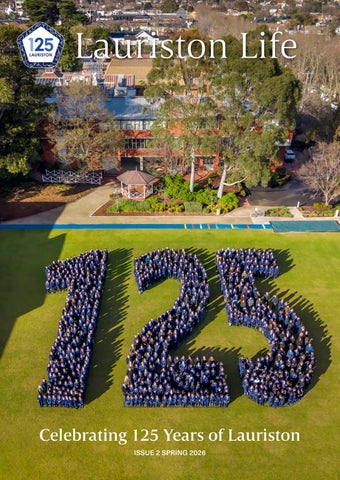
Celebrating 125 Years of Lauriston ISSUE 2 SPRING 2026
CONTENTS WELCOME 04.
A Note from the Chair
06.
Principal’s Perspective
08.
The Lauriston Learning Tour 2026
10.
Strengthening the Foundations of Learning
CREATIVITY AT LAURISTON 12.
Celebrating 125 Years
14.
Nicole Zhao - OL 2022
16.
Visual Art at Lauriston
18.
Performing Arts at Lauriston
20.
Nurturing Creativity
22.
From Small Ideas, Big Things Grow
24.
Creativity in the Age of AI
26.
Creativity At Full Speed
Cover image – “125” at our Armadale campus, by Prep - Year 12 students and staff. Photographed by James Grant
Our Values Creativity We approach learning and teaching with creativity as our cornerstone. We are imaginative, inventive, and entrepreneurial. We are open to and champion new ideas and new ways.
Engagement in Life We learn how to connect with others, manage the highs and lows and reap the rewards of our commitment by our purposeful engagement in all aspects of school life. We are motivated to participate and respond to changes in our world.
Intellectual Curiosity We engage proactively with the world; determined to better understand, reflect upon and question ourselves, our experiences, and the society in which we live. We are critically engaged and curious about all that we encounter and learn.
Courage We are courageous in our approach to managing change; embracing physical, moral, and intellectual challenges; and standing up for what we believe. Courage enables us to understand our strengths and act accordingly.
Relationships We communicate openly, honestly, and respectfully allowing us to have meaningful connections with each other in the community and beyond. We foster a culture of optimism, collaboration, and celebration.
A NOTE FROM THE CHAIR
LAURISTON’S FUTURE
Built on Curiosity and Creativity It was a great privilege to take over the role of Chair of Lauriston from Claudette Leeming (OL 1991) at the end of June this year. I would like to express my appreciation to Claudette for her exemplary leadership, support and friendship since my initial appointment to Council a little over two years ago.
For those who do not know me, I am an alumna of the School, as is my daughter Imogen (OL 2020). My son Percy also spent a couple of happy years at the school’s kindergarten. I have spent most of my career practicing as lawyer, specialising in projects and construction, and (more recently) writing fiction on the side. Along with the rest of Council, I was delighted to see the energy and passion Sabine and her team brought to the Lauriston Learning Tour in the first half of the year. Understanding the different perspectives and ideas across the student, teacher and
broader school community as we progress towards finalising the School’s Strategy for 2027 and beyond is critical to our success. Thank you for the time you have taken to speak to us with clarity and passion about our School. In keeping with this edition’s theme of creativity, I have reflected on how creative expression is embedded in everything we do at Lauriston, and how that can inform and support a fulfilling and purposeful life after school.
Whilst Lauriston may have changed considerably in the decades since I completed my final year of studies (the slightly bumpy asphalt tennis courts are gone, as are the classroom bar heaters we crowded around on cold winter mornings) there are many things which endure, including the strength of our visual and performing arts program. Many alumnae will remember Heather Ellis, who taught art at Lauriston for many years. Her wonderful sculpture greets us as we enter the Huntingtower school gates, a vivid moment in time capturing a quartet of young girls’ curiosity and mischief. Heather’s lifelong passion for bronze sculpture reminds us that we never stop learning. At Lauriston, we were always taught that the question is not whether you are ‘good’ or ‘bad’ at art. It is about whether the process of creating or performing (with paint or words or movement) triggers a desire to expand horizons, to learn more and to ask questions. As a lawyer, this is the aspect of my practice I enjoy the most; the part that involves problem solving and devising delivery structures and drafting solutions. As we all face the threats and opportunities presented by generative AI, it is important to reflect on what continues to make us human. We may view our attempts to create something on a potter’s wheel or to memorize a monologue as imperfect, perhaps even messy or flawed, but it is the process that teaches us how to think, to question, and to challenge, and it is this which will serve us so well in the future. We must continue to ask questions and embrace a creative mindset, so we develop the flexibility to adapt to whatever the future holds.
LAURISTON LIFE
Jane Hider (OL 1991) Chair of School Council
04
PRINCIPAL’S PERSPECTIVE
The Courage to Create What listening to our community has revealed about Lauriston, and the future we are creating together. At Lauriston, creativity is not an added extra. It is a value that unlocks learning and unleashes possibility. It turns knowledge into action and curiosity into impact. That spirit has been part of Lauriston from the beginning. In 1901, the year Australia became a nation and before the women of Victoria could vote, Margaret and Lilian Irving had the courage to imagine something different. In establishing Lauriston, they expressed a bold belief in the power of girls’ education and in the contribution women could make to society. They created a place designed to expand the horizons of young women and equip them to make their mark on the world. A century and a quarter later, that ambition still speaks to us. Generations of Lauriston women have shaped communities, advanced knowledge, led organisations, created opportunities and influenced public life. Their contributions remind us that the measure of a great education lies not only in what students achieve for themselves, but in what they make possible for others. One of the privileges of being new to a school is being able to see it with fresh eyes. In my first year as Principal, the Lauriston Learning Tour took me into classrooms, staffrooms, coffee shops, boardrooms and countless conversations. In all, 1,522 students, parents, staff, alumnae and past parents shared their views; their voices are captured on the following page. I asked what they value most about Lauriston, what they would like us to do even better and what they hope the School will become. Every group I met named the same thing first. Not a program, a result or a building, but a feeling: belonging. Students talked about teachers who know them well and challenge them to do their best. Parents spoke about finding community, often beginning with a chance conversation at a school event that grew into a friendship lasting many years. Alumnae reflected on relationships that still shape them long after they left. Staff spoke with pride about being part of a community that cares deeply for young people.
This sense of belonging is not accidental. It has been built carefully over generations. It is visible in classrooms where intellectual rigour and encouragement work hand in hand, in the way our girls celebrate one another’s successes and carry one another through disappointment, and in the quiet confidence of older students as they step beyond what is familiar. The Learning Tour reinforced something else I have come to admire about Lauriston. Ours is a school that refuses to choose between excellence and humanity. We expect our students to think deeply, work hard and strive for their personal best. At the same time, we know that education is about far more than academic achievement. A Lauriston education develops character, curiosity, confidence and the capacity to contribute meaningfully to the lives of others. The longer I listened, the more I realised that the story our community was telling was, at its heart, the story the Irving sisters began: a story about creativity. I mean creativity in its broadest and most human sense: the capacity to imagine what might be, to question what is and to bring into being something that did not exist before. It is there in a young child asking ‘why?’ for the fifth time. It is there in a student at Howqua discovering new reserves of confidence, in the teacher reimagining a lesson and in the musician giving voice to an idea that cannot yet be expressed in words. What I heard convinced me that creativity is already woven through Lauriston’s culture. It grows from the very things our community values most deeply: intellectual rigour, curiosity, courage, connection and the confidence that comes from belonging. Creativity does not emerge in isolation. It flourishes where young people feel known, trusted and encouraged to explore beyond the obvious answer. It develops when they are given the freedom to experiment and the resilience to learn from what does not work the first time. Belonging, in other words, is the ground in which creativity grows. And creativity is not separate from excellence. It is one of the ways excellence is achieved.
Year 7 Science Class
“Our responsibility is not to tell the young women in our classrooms what the future should look like. It is to equip them to create it.” The qualities our community holds dear have served generations of Lauriston girls well. Each of those generations stepped into a world its teachers could not fully foresee, and the girls in our classrooms today will be no different. That is precisely why these qualities will matter more, not less. The question before us is not simply what our girls will do when they leave Lauriston. It is what they will create, improve and influence. What problems will they help solve? What ideas will they champion? What organisations, professions and communities will be stronger because they were part of them?
The hopes our community shared, set out on the following page, reflect that same ambition: not simply for achievement, but for the kind of people our girls become. As we shape Lauriston’s next chapter together, I hope we remain worthy of the Irving sisters’ vision, not by preserving their legacy unchanged, but by carrying forward the bold spirit that inspired it: a belief in young women, a belief in education and a belief in the power of individuals to shape the world around them. They did not simply found a school. They created a place where generations of young women could discover their capacity to think deeply, act courageously and turn imagination into action. More than a century later, that remains both our privilege and our responsibility. The next chapter is ours to begin, and theirs to write. Sabine Partington Principal
LAURISTON LIFE
Our responsibility is not to tell the young women in our classrooms what the future should look like. It is to equip them to create it. We want them to leave Lauriston with the confidence to ask difficult questions, the courage to pursue ambitious ideas and the conviction that they can make a meaningful contribution.
06
1,522
THE LAURISTON LEARNING TOUR 2026
LISTENING IS WHERE THE NEXT CHAPTER BEGINS
voices
shaping Lauriston's next chapter
Six months of listening. Students, parents, staff, alumnae and past parents told us what they cherish, where can grow and what they hope Lauriston becomes. They survey was deepened through 77 individual staff interviews, 14 focus groups and 3 dedicated Howqua learning sessions.
01 Who we heard from
603
270
328
Staff
Parents
Students
267
Old Lauristonians
54
Past Parents
Every dot is one voice.
02 What we cherish most
03 Where we can grow
I
RELATIONSHIPS & BELONGING the theme every cohort named first.
I
FUTURE-READY PATHWAYS broader subject choice, clearer VCE/IB guidance.
II
TEACHERS WHO KNOW US caring staff, valued for mentorship as much as expertise.
II
COMMUNICATION & TRANSPARENCY earlier, clearer explanation of decisions.
III
THE HOWQUA EXPERIENCE resilience, independence and confidence.
III
SPORT, FACILITIES & ENVIRONMENTS visible investment matching our ambitions.
IV
ACADEMIC EXCELLENCE rigour paired with holistic growth.
IV
WELLBEING, BELONGING & INCLUSION consistent support through every transition.
V
EMPOWERING YOUNG WOMEN confident graduates who contribute beyond school.
V
EVOLVE WITHOUT LOSING WHAT WORKS build on strengths, not wholesale change.
04 Hopes for the future A leading girls’ school, sustained Confident, future-ready learners
Howqua embedded across the P–12 journey Excellence & holistic education, side by side
Belonging and values at the centre
NOT E ITH E R , BUT BOTH
Excellence + humanity
Tradition + evolution Belonging + ambition
LAURISTON GIRL’S SCHOOL Lauriston Learning Tour 2026. Community Survey of 1,522 respondents (9 March to 3 April 2026), 77 individual staff interviews, 14 focus groups (3 staff · 5 student · 6 parent) and 3 dedicated Howqua learning sessions and PeopleBench Workforce Survey (Term 1, 2026). Research and strategic advisory: PeopleBench.
08
LAURISTON LIFE
STAFF SPOTLIGHT
Strengthening the Foundations of Learning Through Exceptional Teaching in Mathematics and Literacy By Kate Hehir Deputy Head of Junior School
At our Junior School, we recognise that exceptional student outcomes begin with exceptional teaching. This year, we have strengthened our commitment to this philosophy through the introduction of two new leadership roles: Mr William Fogarty, Numeracy Coordinator and Mrs Sashelle Lock, Literacy Coordinator.
Inspiring Mathematical Thinkers As Numeracy Coordinator, Will Fogarty is leading the continued development of mathematics teaching across the Junior School. His role is not simply to support what happens in the classroom, but to inspire teachers to continually refine their practice and deepen their understanding of how children learn mathematics. Will has developed and presented professional learning for colleagues, with a particular focus on strategies that strengthen student understanding and retention. In June, he attended the Melbourne Mathematics Conference, Elevating Mathematics Education through Connecting Theory and Practice. Here Will connected with educators, researchers, mathematicians and industry professionals, exploring the relationship between contemporary research and effective classroom practice. Will has subsequently shared this learning with colleagues, including professional development on retrieval practice, an approach that helps students revisit and strengthen previously learned mathematical concepts.
The Weekly Numeracy Spotlight, introduced by Will, further supports this culture of professional growth. Each week, teachers have access to carefully selected resources, professional reading and mathematics games, providing inspiration and practical ideas to enrich classroom learning. For students, this commitment is evident beyond the classroom too. The introduction of the Year 5/6 Lunchtime House Mathematics Competition has created an opportunity for students to experience mathematics as challenging, collaborative and enjoyable. It encourages students to take risks, think creatively and develop a positive mathematical identity. Enrichment opportunities for our more able mathematicians, or those wanting a challenge, continues to be a priority with students participating in a range of events including the Australian Mathematics Competition (AMC), Computational and Algorithmic Thinking (CAT) and Mathematics International Competitions for Schools (ICAS).
‘I get really excited when a student walks into my classroom at the start of the year declaring, “I’m not a maths person.” I take it as a challenge to change that mindset, providing the support and encouragement they need to build confidence by focusing on personal growth rather than comparison.’ – Will Fogarty, Numeracy Coordinator
Will Fogarty Teaching
Cultivating a Love of Language Literacy is equally fundamental to a child’s capacity to understand the world and express their own ideas. As Literacy Leader, Sashelle Lock is helping to ensure that students develop strong foundational skills alongside a genuine appreciation for reading, writing and language. A key focus of Sashelle’s leadership is building staff expertise through purposeful professional learning. Teachers have engaged in professional development exploring the use of mentor texts with Dr Helen Harper, Associate Professor at the University of New England. Dr Harper is an expert in English, literacies and language education. With Dr Harper’s guidance, teachers have chosen age-appropriate mentor texts (mentor texts are high-quality books and pieces of writing that help students see how authors use language and make choices to create meaning) and designed curriculum.
By studying these texts closely, students develop stronger reading comprehension and writing skills, learn to ‘read like a writer,’ and are inspired to create more thoughtful and sophisticated writing themselves. In the first half of the year, Sashelle led the teachers through a review of our current spelling program and formed Professional Learning Communities to explore effective Tier 1 spelling instruction (Years 3-6) and a systematic synthetic phonics program (Prep-Year 2), with plans to launch these for the beginning of the 2027 school year. Sashelle recognises that literacy extends well beyond the teaching of skills and looks for ways to further enrich the students learning. Through opportunities such as the Melbourne Writers Festival, National Simultaneous Storytime and Premier’s Spelling Bee, students encounter the joy, imagination and possibility that language can offer.
Sashelle Lock Teaching
‘When I watch a student who once struggled with reading become deeply engaged with a mentor text, say, “This is actually really fun!”, and confidently raise their hand to share a thoughtful insight, I feel reassured that rich literature, paired with explicit teaching and a splash of fun, has the power to transform students’ confidence as readers and writers, and their love of learning.’ – Sashelle Lock, Literacy Leader
A Culture of Excellence The introduction of these specialist leadership roles represents more than an organisational change. It is a deliberate investment in the quality of teaching and in the experience of every child.
LAURISTON LIFE
Through Will and Sashelle’s leadership, our teachers are supported to learn, collaborate and continually refine their practice. Our students, in turn, benefit from classrooms where learning is intentional, engaging and informed by contemporary educational thinking.
10
125 COMMUNITY ARTWORK
CELEBRATING 125 YEARS
Through Collective Creativity By Terry Abraham Junior Art Teacher To mark Lauriston’s 125th Anniversary, students and staff have come together to participate in a communitygenerated art project that is now displayed throughout the School. Designed to celebrate the collective spirit, creativity and shared history of the Lauriston community, the project invited participants of all ages to contribute to a larger artistic vision.
The aim was to create a series of commemorative visual installations in various locations around the campus through an activity that felt both organic and accessible, ensuring every student had the opportunity to leave their mark on this significant milestone. The project has been led by our incredible Head of Junior Art, Terry Abraham, whose creative vision shaped both the concept and execution of the work. Terry developed the artistic framework
and guiding constraints for each contribution, allowing individual expression while ensuring each piece formed part of a cohesive whole. The hundreds of individual tiles created by students and staff were then meticulously assembled by Terry onto larger canvas boards, transforming many unique contributions into striking collective artworks. Together, these installations serve as a lasting tribute to 125 years of Lauriston, celebrating the connections, creativity and sense of belonging that continue to define our School community.
Each student designed a unique artwork that had to feature a heart and the number 125, celebrating our shared history and the many people who make Lauriston such a special community. When displayed together, these colourful canvases form striking large-scale panels that are now around the School.’
12
LAURISTON LIFE
‘Students have come together to create a series of vibrant collaborative artworks made from hundreds of individual 4x4 inch canvas panels.’
CELEBRATING ALUMNAE CREATIVITY
NICOLE ZHAO (OL 2022)
Illustration and Engineering: Two Sides of the Same Idea Nicole Zhao’s (OL 2022) path from Lauriston to aerospace engineer at the University of Southern California (USC) was not a straight line, and she is the first to say so. It started with a sketchbook. In Year 8, a classmate’s talent for drawing sent Nicole home to start one of her own. She titled it Journey to Become Flora, after the friend who’d inspired her. That sketchbook, and the years of support from teachers in the Art Department like Ms D’Angelo and Ms Deveraux, set her on a creative path that would eventually take her across the world. But not directly.
After Lauriston, Nicole moved to Los Angeles to study Entertainment Arts at ArtCenter College of Design, chasing a version of LA she’d built up in her head without ever visiting first. It didn’t match reality. The experience forced her to start over: she missed structure, problem-solving and, by her own admission, the intellectual rigour of Specialist Maths. She unenrolled, going into a community college for aerospace engineering, and worked her way through three colleges in three years before landing at USC.
‘Illustrating and engineering are both, fundamentally, about turning an idea into something real.’
It would be easy to frame that detour as a wrong turn corrected. Nicole doesn’t see it that way, and it’s the most useful thing about her story. Illustration and engineering, she says, aren’t opposites - they’re the same instinct pointed in different directions. Both start with something that only exists as an idea and require someone to physically build it into reality, whether that’s a sketch of a character or a design that meets a weight budget. Engineering, in her account, isn’t the tidy, calculatordriven discipline people imagine. It’s improvisation. It’s finding a workaround for a problem the textbook never covered. That is creativity, just wearing a different uniform.
Lauriston is proud to have commissioned Nicole for several illustrations since graduating. These include Junior School Hat, Moreton Bag Fig, Howqua iconography and Lauriston student journey.
Nicole’s advice to students juggling more than one passion is straightforward, and worth sitting with: there is no wrong choice. She spent a long time regretting ArtCenter, running the alternate timeline where she finishes at USC two years early. But she’s since come around to a different view: that the discomfort of that first attempt taught her more about herself than a smoother path would have.
‘Don’t worry about making the “wrong choice”, because there isn’t one.’ Passions that don’t fit your current work or study aren’t abandoned, she says. They just take a different place in your life. It’s a fitting note from someone who has spent her career translating ideas, sketched or engineered, into something real.
LAURISTON LIFE
‘Engineering is problem solving, and problem solving always requires creativity.’
She’s kept the habit of bringing an artistic edge to work that doesn’t strictly call for it; something she started at Lauriston and now calls her ‘flair.’ It’s also proven to be a professional advantage: in engineering, she’s found that clear visual communication carries real weight, because good design is ultimately about explaining an idea well.
14
CREATIVITY AT LAURISTON
VISUAL ART AT LAURISTON
Emily – Year 10
Gemma – Year 6 People’s Choice Winner
Zabrina – Year 11
Samantha – Year 10
Lexi – Prep
The Young Laurie Portrait Competition By Giuliana D’Angelo Head of Art The Young Laurie Portrait Competition provides students with a meaningful creative outlet to celebrate and reflect on someone who is, or has been, important or significant in their lives. Through portraiture, students are encouraged to consider the people, relationships and experiences that have shaped who they are. For some students, this may involve painting a family member, friend, teacher or role model, while others choose to create a self-portrait as a way of exploring their own identity.
Participating in the competition encourages all students to take creative risks, experiment with materials and techniques, and develop confidence. The process of creating a portrait for an audience gives their work purpose and authenticity, while the opportunity to have their artwork recognised celebrates the value of their creativity. Importantly, the competition creates a space where students of different ages and levels of experience can participate alongside one another.
It fosters a sense of community and encourages students to see art not simply as a classroom activity, but as a powerful means of self-expression, communication and connection. It gives young artists an authentic platform to express themselves, celebrate important people in their lives and connect with others through art.
Amber – Portrait of Ms Johns (winner)
Sophia – Portrait of Mr Brophy
Grace – portrait with Charlie
Liesel – Portrait of Felicity
Aya – Portrait of Hollyer House
Howqua HARCHIE Competition By Jamie Watson Howqua Art Teacher
Students are invited to create a portrait of a member of the Howqua community using any medium of their choice. Each artwork captures not only a likeness but also the unique stories, relationships and connections that shape life at Howqua.
One of the most rewarding aspects of the Howqua year is the strong sense of community that develops through shared experiences, challenges and achievements. The Harchie provides students with an opportunity to reflect on the people who have influenced, supported and inspired them throughout their journey.
The resulting collection is a powerful celebration of creativity, belonging and the relationships that make Howqua such a remarkable place.
LAURISTON LIFE
Inspired by Australia’s iconic Archibald Prize, our annual Harchie Portrait Prize celebrates the people who make the Howqua community so special.
16
CREATIVITY AT LAURISTON
PERFORMING ARTS AT LAURISTON
Les Misérables
Singin’ in the Rain
The Stage as a Classroom:
How Drama Shapes Confident, Capable Learners By Jannah Davies Head of Drama Being involved in Drama, be it in the classroom or part of our cocurricular program, is about so much more than putting on a great show. It’s an incredible learning experience that helps students grow in ways that extend far beyond the performance. From the first rehearsal to the final bow, students build confidence, improve problem solving skills, and learn how to work as a team. Performing in front of an audience strengthens their public speaking skills and self-assurance, which will serve them well in school, future careers, and everyday life. Collaboration is key, and students quickly realise that every role, on stage or backstage matters. In our productions, students take on significant responsibilities such as designing and operating sound, lighting, and technical equipment. These opportunities not only enhance the quality of the performance but also provide meaningful, real-world learning experiences that encourage hands-on understanding of industry practices. The creative process fosters self-expression, adaptability, and resilience – critical skills for the 21st century. Beyond that, the friendships and sense of community built during the rehearsal process are truly special. The performances that our students are involved in are a celebration of their hard work, but the real reward is the journey they’ve taken together.
Les Misérables student reflections:
Singin’ in the Rain student reflections:
Hatty, Year 12 – ‘For me, Les Mis was an opportunity to push myself out of my comfort zone. Despite feeling comfortable on stage, the vocal challenges of this particular musical felt daunting. Being able to confront these doubts head on in front of a large audience was all the more thrilling and rewarding!’
Marianna, Year 8 – ‘Singin’ in the Rain was my first 5-8 Musical at Lauriston and I can’t find another word to describe it besides magical. I am so grateful for the opportunity because it helped me step out of my comfort zone and express myself through something I love doing which is singing, dancing, and acting.’
Annabel, Year 11 – ‘Making connections with other students through a programme such as drama is so important. My communication and collaboration skills improved over the process of taking part in Les Mis. When something didn’t feel right, we had to work together as an ensemble to fix it and make it work. I had such a fun time taking part in Les Mis and building connections and a piece of work I am proud of!’
Aurora, Year 6 – ‘Being part of the musical Singin’ in the Rain meant a lot to me. It meant working with new people, building my confidence and enjoying the precious time performing on stage. It is a very special opportunity to have fun and express myself. It had been a wonderful and memorable experience that I’ll always be proud of.’
From Program to Proficient:
The Sequential Stages of Developing Confidence in Music Performance By Elizabeth Tindall Director of Music
From their youngest years, Lauriston students are introduced to singing and instrumental playing through our Junior Choral, Strings and Band Programs. The earliest exposure to performance for many students is in large group settings, sharing repertoire of just 3-4 notes for family members, learnt during our Instrumental Programs. As students step across from program learning into individual tuition, frequent participation in Lunchtime Concerts and Termly Recitals sees them bravely undertake their first solo performances. Regular practice in these safe settings ensures students grow gradually in confidence over time. Moving into their senior years, performances in front of larger audiences or in more public settings, such as Experience Lauriston or Jazz Cabaret, encourage students to take greater risks. By now, students are quite familiar with the stage setting, have a deeper understanding of how outside factors can impact their performance and are developing strategies to manage these.
Lauriston in Recital was introduced in 2024 in recognition of the multiple students who are highly proficient performers and for whom a significant public performance provides a necessary growth challenge. Stepping out as a soloist at the Melbourne Recital Centre is a goal which those students work steadily towards, are prepared for and are deeply enriched by.
Regular exposure to performance through the stepped and targeted practice opportunities provided at Lauriston, facilitates student command of the performance space and sees our musicians successfully learn how to communicate their musical and artistic intention.
In each phase of sequential performance development, Music staff support students not just through the successful mastery of repertoire, but through careful practice of stage management such as confident stage entry, tuning an instrument in front of an audience, maintaining composure through moments of challenge and finally, bowing and acknowledging associate artists at the end of a performance.
LAURISTON LIFE
At Lauriston, a carefully curated performance program from PrepYear 12 ensures that students have the opportunity to not only learn a musical instrument or voice, but to sequentially develop their skills in performing in front of an audience. Those students who feel confident and well equipped to step onto the stage will attest to the steps they have taken along the way to nurture these skills, and how dedicated practice both on and off stage is what has allowed them to grow in performance proficiency.
18
CURRICULUM
NURTURING CREATIVITY By Dr Natalie Bunn Deputy Principal, Learning and Innovation
Capability for Life We live in a rapidly changing and increasingly complex world. Today’s young people will enter a workforce shaped by evolving careers, emerging technologies and unforeseen challenges. With many expected to have around 18 jobs across six different careers, adaptability and lifelong learning will be essential.
Thriving will depend on far more than academic achievement alone. Young people will need to think critically and creatively, solve complex problems, collaborate effectively and respond to change with confidence and integrity.
These deeply human capabilities will equip young people to navigate complexity, lead with confidence and help shape the future with purpose and impact. Contemporary research highlights the importance of these capabilities. The World Economic Forum’s Future of Jobs Report 2025 identifies creativity, innovation, adaptability
and complex problem-solving as increasingly important, while the OECD’s Learning Compass 2030 calls for young people to create new value, collaborate effectively and act responsibly in an interconnected world.
For our youngest learners in Blairholme, creativity is woven into everyday learning through our Reggio Emilia-inspired approach. Guided by their interests and sense of wonder, children learn through play, collaboration and discovery.
At Lauriston, creativity sits at the heart of learning. More than artistic expression, creativity is the capacity to create new value through imagination, innovation and problemsolving. Nurtured intentionally across the curriculum from Blairholme to Year 12, this capability develops from curiosity and exploration in the early years to imagination, innovation, critical reflection and problem-solving in the Senior School.
Their questions spark creative investigations, from exploring First Nations stories and creating artworks inspired by Bunjil the Eagle to designing ways to travel to the moon and constructing a giant papiermâché hot air balloon. In doing so, they imagine, create and solve problems while building foundations for communication, collaboration, adaptability and agency.
“
By encouraging students to question, explore and create, we cultivate the agency needed to embrace change.
”
Dr Natalie Bunn, Deputy Principal, Learning and Innovation
Howqua’s Outdoor Program
Creativity is also a defining feature of the Year 9 Howqua program, where learning is deeply connected to nature, place and experience. Through academic studies, outdoor
As a school for life, Lauriston nurtures creativity from Blairholme to Year 12 as a core capability. By encouraging students to question, explore and create, we cultivate the agency needed to embrace change. In doing so, we develop confident, adaptable young people equipped to navigate complexity and shape the future with purpose and impact. This is why creativity sits at the heart of a Lauriston education as a capability for life.
Year 10 Physical Education class
Prep Music class
Organisation for Economic Co-operation and Development (OECD). (2019). OECD Learning Compass 2030: A Series of Concept Notes. OECD Publishing. Available at: https://www.oecd.org/education/2030-project Organisation for Economic Co-operation and Development (OECD). (2024). Creative Thinking: PISA 2022 Assessment and Analytical Framework. OECD Publishing. Available at: https://www.oecd.org/en/topics/creative-thinking.html Organisation for Economic Co-operation and Development (OECD). (2024). PISA in Focus: Creative Thinking. Available at: https://www.educationestonia.org/wp-content/uploads/2024/06/PISA-in-Focus-125-CreativeThinking.pdf World Economic Forum. (2025). The Future of Jobs Report 2025. Available at: https://www.weforum.org/reports/the-future-of-jobs-report-2025 Reggio Children. (n.d.). The Reggio Emilia Approach®. Available at: https://www.reggiochildren.it/en/reggio-emilia-approach
20
LAURISTON LIFE
While the Creative and Performing Arts provide rich opportunities for students to imagine, create and communicate, creativity is embedded across all areas of learning at Lauriston. In the Senior School, students apply creative thinking across academic, entrepreneurial and co-curricular experiences, from crafting stories and exploring contemporary issues to investigating scientific questions and solving complex problems. Learning experiences such as the Year 7 pinball machine design challenge, the Year 10 Business Market Day and Theory of Knowledge encourage students to generate ideas, explore different perspectives and respond to authentic challenges. In Physical Education, students redesign games to make them more inclusive and effective, reinforcing the understanding that creative solutions can take many forms.
education and experiential learning, students are challenged to think independently, solve problems and embrace uncertainty. The natural environment becomes both classroom and catalyst, encouraging curiosity, creativity and new ways of thinking. Through the outdoor program and place-based learning, students further develop confidence, resilience and resourcefulness.
REFERENCES.
Building on these foundations, creativity flourishes throughout the Junior School. Through investigations, dramatic play and entrepreneurial projects, students generate ideas, explore possibilities and bring solutions to life. Claymation films, sustainable tiny house designs, the Smoothie Project and the Lauriston Launch Business Expo provide opportunities to apply design thinking and innovation.
JUNIOR SCHOOL
FROM SMALL IDEAS, BIG THINGS GROW By Chris Toms Vice Principal & Head of Junior School
Entrepreneurship in the Junior School At Lauriston, creativity is more than artistic expression. It is about seeing possibilities, solving problems and having the confidence to turn an idea into something real. That spirit is alive in the Junior School, where entrepreneurship provides students with authentic opportunities to imagine, create and collaborate. This year, our Year 5 and Year 6 students did far more than learn about business. They experienced what it means to think and act like entrepreneurs. Our Year 5 students explored entrepreneurship when they created their smoothie business. Working in teams, they designed websites and developed smoothie brands. The Year 5 entrepreneurial unit culminated in a series of Pop-Up Stalls, where Year 4 students and staff became customers, tasting smoothies and experiencing each team’s carefully crafted brand. From innovative flavour combinations to polished digital presentations, the girls demonstrated creativity, collaboration and confidence. In Year 6, the entrepreneurial journey began with a simple but powerful question. Looking at two contrasting images, Steve Jobs’ parents’ garage where Apple began, and the company’s global headquarters today, students explored the idea that every successful venture starts with a single idea. Inspired by this concept, our Year 6 students began their own entrepreneurial journey. They identified needs and wants within the Junior School community, conducted market research through surveys, and used their findings to create products with a real audience in mind.
Working collaboratively, each Year 6 team developed a business plan, created a brand identity and justified every design decision, from colour palettes to typography and imagery. They explored persuasive advertising techniques, calculated production costs, set pricing and learned how to balance profitability with affordability. The journey culminated in the Year 6 Business Expo, where students proudly showcased their businesses to the Junior School community, selling their products in Irving Hall. The Year 6 students raised $3,761 which was donated to the Asylum Seeker Resource Centre, reminding our girls that entrepreneurship can be a powerful vehicle for generosity, service and positive social impact. For students inspired to continue their entrepreneurial journey, learning extends beyond the classroom. Each Friday after school, Year 5 and Year 6 students can participate in First Pivot’s GirlPreneur program, where they launch genuine ventures with real customers and real revenue, with profits donated to charities they choose themselves. The program connects students with entrepreneurs who demonstrate that age is no barrier to innovation. The students have collaborated with 19-year-old Kai, founder of Kaiko Fidgets, 14-year-old Patrick from Sweet Tooth Marshmallows, and Lauriston alumna Emma Welsh, co-founder of Emma & Tom’s Juice.
Meeting young entrepreneurs helps our students recognise that their own ideas have value and that they, too, can create something meaningful.
Entrepreneurship in the Junior School is not simply a unit of work. It is an authentic way for students to develop creativity, critical thinking and collaboration while learning to solve real problems for real people. Whether they are pitching a business idea or running a smoothie stall, our students are discovering that creativity is not confined to the art room. It is a mindset that empowers them to ask thoughtful questions, embrace new possibilities and contribute positively to the world around them. At Lauriston, we believe every big idea begins with the courage to take the first small step. Our Junior School students are already showing us just how far those first steps can lead.
Year 6 Business Expo
LAURISTON LIFE
Year 6 Business Expo
Year 5 smoothie bar
22
SENIOR SCHOOL
CREATIVITY IN THE AGE OF AI By Vanessa McDonnell Head of Senior School
From Imagination to Innovation We believe that creativity is far more than artistic expression; it is the ability to imagine new possibilities, connect ideas in unexpected ways, solve complex problems and bring innovative thinking to life. At Lauriston, we strive to ensure that creativity remains at the heart of learning because it is a capability that will become increasingly important in a world shaped by artificial intelligence.
“
You can’t use up creativity. The more you use, the more you have.
AI Buildathon
MAYA ANGELOU
”
AI Conference Organisers - Olivia and Lucy
This theme was powerfully explored through Input: Her Future, a studentled interschool AI conference held earlier this year. Conceived and led by students Olivia (Year 11) and Lucy (Year 12), the conference brought together students from a range of schools to explore the opportunities and challenges presented by artificial intelligence. The central message of the conference was clear: AI should be viewed as a tool that empowers creativity rather than replacing it. This idea came to life during the conference Buildathon, where students were presented with a challenge, access to a range of AI tools and a limited timeframe to develop a solution. The results were remarkable. Faced with the prompt, ‘How can AI help you track your impact on the environment?’,
one winning team created an immersive visual representation of a changing Arctic environment. As users interacted with the program, icebergs melted and wildlife habitats diminished, providing a compelling representation of environmental impact. Given more time, the students envisaged developing a browser extension capable of tracking the technological and environmental costs of AI usage itself. What stood out was not the technology. Every team had access to the same AI tools. What differentiated their solutions was creativity, curiosity and collaboration. AI enabled students to build quickly, but it was their imagination that shaped the ideas. The conference itself was also an example of student creativity in action. From designing the event website and creating digital resources to developing interactive activities and presentations, students demonstrated ingenuity, initiative and entrepreneurial thinking. They were not simply learning about AI; they were actively creating opportunities for others to engage with it. A highlight of the event was hearing from guest speaker Alice Hong (OL 2011) who reflected on the continuing importance of human creativity in a rapidly evolving technological landscape. Alice spoke about creativity as the ability
to generate novel ideas and make connections across disciplines, suggesting that these capabilities will become increasingly valuable as access to AI tools becomes widespread. Her analogy resonated strongly with students: while technology can provide everyone with the same paints and brushes, creativity remains the factor that determines whether someone creates a masterpiece. More recently, members of the Senior School leadership team have been discussing the complementary relationship between creativity, curiosity, engagement and courage. These qualities work together to prepare students for an uncertain but exciting future. Curiosity inspires questions. Courage enables students to take risks and embrace challenges. Engagement drives sustained effort and commitment. Creativity allows students to transform ideas into action. At Lauriston, creativity is not confined to one subject or one classroom. It is present when students design scientific investigations, solve complex mathematical problems, develop entrepreneurial initiatives, create technological solutions or explore new ways of understanding the world. As artificial intelligence becomes an increasingly powerful tool, our commitment to fostering creativity will only grow stronger.
24
LAURISTON LIFE
AI is transforming the way we learn, work and create. While these technologies can generate content, analyse information and automate tasks, we know they rely on patterns derived from what already exists. Human creativity remains different. It allows us to ask original questions, challenge assumptions, make connections across disciplines and envision possibilities that have not yet been imagined. In the age of AI, creativity is not becoming less important; it is becoming one of the most valuable skills students can develop.
HOWQUA
CREATIVITY AT FULL SPEED By Eleanor Richards Howqua Coordinator of Curriculum and Learning
Inside F1 at Howqua By this definition, creativity is at the heart of the Howqua experience. Howqua students break traditional roles of women and continue to strive to increase the creative focus of the campus in multiple different areas. These can be as wide ranging as the reflective pieces of writing and drawing that are created on Solo experiences in the Outdoor Program, to the solutions for sustainability and indigenous connection that are incorporated into the Howqua year by the leaders in those areas, and to the defined aspects of the academic curriculum that are included as the core of Howqua.
“
Creativity is inventing, experimenting, growing, taking risks, breaking rules, making mistakes, and having fun. JANELLE MONÁE
”
2025 F1 Winner - Mirra Maccas
2026 CAD Workings
experts in their fields and the overall winner announced and presented with our ‘F1 at Howqua’ trophy. Kaitlyn (Year 11) was one of the students who implemented the competition and describes her interest with the ‘F1 at Howqua’ competition and how it came to be a prominent feature of the Howqua calendar that encourages collaboration and creativity. “What makes “F1 at Howqua” meaningful is the flexibility that Howqua provides to take an idea we are interested in and turn it into action.” “Developing and launching the cars in our house groups, allowed us to bring together students with different interests and strengths, working collaboratively towards something we were all invested in.”
Students begin by investigating the science behind Formula 1 cars and watch video of both Formula 1 cars and drag racing cars to gain inspiration for their designs. Students then work in their house groups to sketch possible designs and allocate one another to the different components of the competition. They then move to Tinkercad to create two different designs per house that are then 3D printed and tested against each other before a final design is chosen for each house. The group will also prepare a poster outlining their design concepts and inspiration, and pitch their design to the judges as if they are sponsors. They also create a theme for the entire team and a cheer that is presented as the final designs are raced against each other down our track. All aspects of the competition are judged by
“I think creativity at Howqua comes from having the freedom to try out something new and contribute our own ideas which makes the experience unique and memorable. For me, ‘F1 at Howqua’ was more than a House Competition; it was an opportunity to learn, collaborate and create something meaningful together.”
2026 CAD Workings
“We were also able to use a full set of professional ‘F1 in Schools’ racing equipment, including the track, which made the experience feel exceptionally real. After spending so much time planning, building and refining our designs, watching our own little cars accelerate down the track at full speed was an incredibly rewarding moment.”
LAURISTON LIFE
The STEAM program at Howqua has been enhanced to include a range of activities for the students, with one of the most prominent programs being the ‘F1 at Howqua’ House Competition. This competition involves all students collaborating to develop F1 cars in their house groups that they design and then race on the last day of Term 3. The competition was initially completed by a group of Year 8 students in 2023 who then championed its inclusion at Howqua the following year. It is now a feature of the Term 3 program.
“This experience also gave me the opportunity to explore the creative side of STEM in a way that was particularly meaningful to me, and I also got the chance to develop a logo for the competition! My inspiration for the ‘F1 at Howqua’ logo and the accompanying trophy came from the concept of infinity, represented by a circle, which is a key element in both designs. I wanted the circle to represent the unlimited potential we have to pursue our passions, challenge traditional boundaries and contribute meaningful change, not only in STEM, but in life.”
26
#1
GIRLS’ SCHOOL IN AUSTRALIA SCHOOLS -360
+61 3 9864 7555 admissions@lauriston.vic.edu.au 38 Huntingtower Road, Armadale, Victoria 3143 Australia