contents
If there’s one thing I learned in this class it’s how to write/create/perform a proper reflection. Never before in a class–and probably even in my life–have I been so frequently asked to carefully take a look at my thought process, experiences, successes, and failures. It’s something I’m not always comfortable with, especially in a context where I’m asked to share that reflection with so many other people. I suppose in my “real life” (that is, my life outside of the classroom) it’s easy to move on from these experiences without looking back for a while. I mean, there’s no one really asking you to reflect on yourself in your everyday life, so it becomes one of those things that I say I’ll do “eventually” but somehow never really get there. This class was different, though. It pushed me out of my comfort zone. It forced me to stop.
It forced me to take a deeper look at myself as a means of better understanding the world around me. From the very beginning of this class I was asked to “read like a writer,” or examine the way writers structure their work in order to become a better writer myself. What I didn’t expect, though, was that this same mentality would be applied to my work as a whole, my life choices, and my personhood. I started imagining my work and my major in broader contexts, questioning where they fit in an interdisciplinary academic landscape. wHow do other disciplines affect mine? What impact does my discipline have on others and how and why does it function in different industries?
I started imagining myself in broader contexts, too. Why do I study the subjects I study and how can I make those subjects meaningful for myself and others? Which of my past academic experiences had the greatest impact on me and what did I take away from those experiences? How has my past self shaped the person I am today? All of this self-reflection has created space for me to connect the dots between how my past experiences have influenced my current work. I created this zine to highlight those personal reflections as well as showcase my experimentations with different writing genres,
How Does It Mean? During my sophomore year of high school, my English teacher had an entire whiteboard at the front of the classroom dedicated to mantras he wanted us to follow throughout our learning journey in the class. The whiteboard was meant to serve as a daily reminder of the best ways to think critically about our readings and assignments. One of his most important mantras lied smack dab in the center of the whiteboard in huge text: “How does it mean?” Of course, on the first day of classes all of us students were pretty confused upon looking at the saying, thinking it was some sort of error in grammar– wasn’t this supposed to be an English class after all? Very quickly, however, my teacher explained what it was all about. When reading for the class, rather than looking at what our assigned texts mean, we were instead asked to look at how those texts mean, that is, to analyze how each text created meaning in order to better understand that meaning itself. Our teacher encouraged us to look at everything from the author’s broad choices of chapter title and paragraph structure down to their individual word choices and punctuation mark usage. At first this process felt a bit extreme and tedious, often slowing down my reading to a significant degree, but it eventually changed the entire way I approached–and appreciated–reading. What I thought were negligible details like whether an author used a period versus a semicolon suddenly became the basis for a full 20-minute discussion in class. Just like Mike Bunn’s “Reading Like a Writer,” the “How Does it Mean” technique forced me to read slowly, take notes in the margins, view texts as a series of choices, and above all, constantly question the author’s purpose and intent.
After completing nearly three years of college now and getting used to 60+ page reading assignments each week, I’ve unfortunately gotten used to reading with the goal of simply finishing as fast as possible. Reading Bunn’s “How To Read Like a Writer” completely took me back to my experience in high school and almost served as a reminder of the fruitful effects of taking my time and thinking critically about reading. Although the RLW and “How Does it Mean” (HDM?) techniques share a lot of similarities, I will say that the purpose of my reading in high school English class was never with the specific intent of getting better at writing (although that was a beneficial side effect). Instead, HDM was practiced with the idea that by understanding how the text was structured, one can better deduce meaning from that text. Whether the meaning you deduced was the author’s intended meaning or something you forged yourself was not really an issue, because either way the structure of the text could serve as evidence to back up your argument. Bunn’s RLW is almost the opposite idea–it’s not so much about “better understand[ing] the ideas in the writing” (although that will be a beneficial side effect), but instead to get better at writing by looking at the structure of another author’s writing.
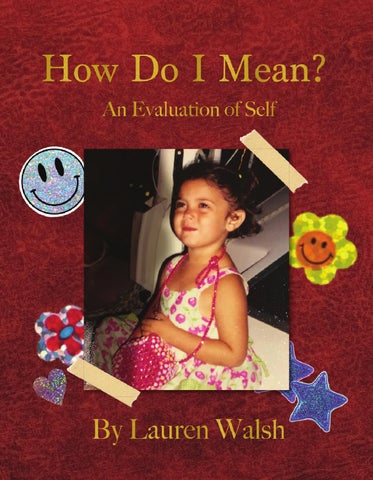
How Do I Mean? If the “How Does it Mean” technique is meant to serve as a guideline for analyzing the way authors create meaning in a text, then, I propose, how do I mean? That is, given my experiences as a writer, scholar, or simply a human, how do I create meaning? How do I create meaning in my writing, in my academic achievements, and in my overall life? This zine is meant to serve as an overall evaluation of my work–particularly from this class while taking deep dives into my past–in an effort to highlight the ways I create meaning in each of these areas.
Dear Diary, When I was in high school, one of my English teachers (the same one who coined “how does it mean”) made us memorize a poem: “A Noiseless Patient Spider” by Walt Whitman. At first the task seemed like a drag, and an archaic one at that, but the message of the poem eventually shaped the entire way I approached learning, and still sticks with me to this day. A Noiseless Patient Spider
I actually used this poem as the basis of my college essay (I wrote a personal letter to Walt Whitman), so I tend to joke that it will follow me around forever. From a student’s perspective, the crux of the poem is to call on people to take an active role in the learning process, that motivation and passion are what equate to valuable academic performance. This has become something that I really value, and I’m glad to have our grading contract emphasize the same idea, because it has given me the go-ahead to connect my genuine interests to the topics in this class. For instance, I’ve been able to write extras about Euphoria and Husky Hunt and even create a graphic to visualize my ideas, all while still exploring and learning more about the process of writing as well as how I, as a writer and scholar, fit into that process. In turn, this makes me genuinely curious about the topics we’re covering in this class, and I’m definitely excited to learn more. One phrase from Whitman’s poem, “seeking the spheres to connect them,” has always been the one to stick with me the most. In addition to “seeking the spheres” to intertwine my personal passions with the topics we learn in this course, I also feel like this class has been an overarching exercise in “seeking the spheres to connect” between disciplines. I’ve had a very unique learning experience in this class that I wouldn’t have gotten in my other courses. I think this mostly stems from being in a class with students from so many different majors that also emphasizes interdisciplinarity so heavily. While, yes, I do feel that I’m learning more about writing and communication, in a weird way the most valuable part of this class for me
has been learning how to seek out and build connections between disciplines that initially seem so different. The experience of being part of this learning environment has almost been more of an exercise in interdisciplinary exploration, with writing as our universal “tool” for conveying our ideas. Overall, I’m finding this approach has had me thinking about my major in many different ways. For the most part, I find myself often having to describe my major to an audience that is not already familiar with it- something I’m not often tasked to do in, well, major-specific classes. I’m thinking a lot more about how my major intersects with other disciplines, as well as even my major’s overall place and function in the academic world. I definitely feel myself being pushed creatively, and I can see it from other students as well, which motivates me even more to be more creative with how I think about the ideas we cover in this class as well as how I choose to answer our writing prompts. With that, I’m also really glad to have the freedom we do to write in so many different genres. I’ve been able to write in ways I’ve haven’t written in for years (like doing poetry as an extra) or ways that I’ve never written in altogether (like writing a mock dictionary page). Not only do we have the freedom to be creative in our writing, but the grading contract actually encourages us to do so, which is another reason why the grading contract format has been working really well for me. I feel like I’m learning how to communicate in more ways than just plain academic writing.
I’m learning to relate, to make connections between topics, to form generative ideas, which, as Whitman says, fuels even better academic study, writing, motivation, and inspiration. One part of this class that has surprised me the most has been how personal it is (which is funny considering it’s an entirely virtual class). What I mean by that is there has been a healthy amount of personal self-reflection– something I was not entirely used to in an academic setting. I find myself being a lot more open about my experiences, personal opinions, and inner thoughts than I expected. Sometimes it takes a lot of emotional, as well as mental, effort for me to write for this class, but I think that’s a good thing. It seems, to me at least, that other students in this class are also being quite vulnerable, and it feels good to know I’m in a class where that is not only accepted but encouraged! Yours truly, Lauren <3
An Evaluation of Self
The Oppositional Gaze
When I was 8 years old I moved from Long Island to central Massachusetts. Going from a bustling town adjacent to New York City with 15,000 residents to a small farm town with 3,000 residents and more cows than people definitely came with its changes. When I first moved, I felt that I had to unlearn a lot of the Long Island-specific behaviors and vocabulary that I was used to in order to relearn Massachusetts behaviors and vocabulary to fit in.
The “Masshole Dictionary” highlights what my experience was like and sheds light on some key differences between the two locations. This was a time in my life where I probably underwent some of the biggest personal changes, as I adjusted between two very different living (and learning) environments with distinct behaviors, values, and atmospheres. Moving was also a pretty difficult experience for me, especially being so young, but creating this was quite a cathartic process, allowing me to put a comical spin on a tough experience.
The “Masshole” Dictionary (for former Long Islanders)
Bubbler || bub•bler /ˈbəb(ə)lər/ noun || Known to you as a “water
fountain,” a steel apparatus found in the school hallway that dispenses water for public consumption. On Long Island, just don’t use these. In Massachusetts, you’re probably fine.
Bulkie || bul•kie /bŭl′kē/ noun || No, this is not referring to some
thing that is inconveniently large or thick (although a bulky bulkie might not be too bad…). This is a pillowy piece of bread topped with poppy seeds known to most as a “Kaiser roll” and Long Islanders as simply a “roll.” Forget about the struggle of choosing from which deli you should order your morning “BECSPK on a roll.” Here, it’s “bulkie,” and no, you won’t find Italian delis on every street corner.
Clicker || click•er /ˈklikər/ noun || A plastic rectangular device used
for changing channels on the tv. If you hear: “I got this tv from some store by The Cape and back on the Pike I noticed it didn’t come with a clicker,” this translates roughly to “I got this tv from some store out east and back on the L.I.E. I noticed it didn’t come with a remote.”
Frappe || frappe /frap/ noun || If you ever go to your favorite diner
(which by the way, they don’t have nearly as many of here) and order a “frappe,” don’t expect a cold coffee beverage to come out to your table. Asking for a frappe will usually result in the question “What flavor?” only for you to find out that this is, indeed, just a fancy name for a milkshake. Note that this is a markedly one syllable word–don’t get caught pronouncing it as “frap-ay.”
Grinder grind•er /ˈɡrīndər/ noun || A sub-style sandwich that, once
again, you won’t be able to simply get at the Italian deli on the corner anymore. So-called “sandwich shops” are few and far between here, and what you know as a “hero” will not be on the menu, either.
Jimmies jim•mies /ˈjimēs/ noun || Probably the most common ice
cream topping you’ll find in Massachusetts–chocolate sprinkles. And while you’re at it, no one here gets ice cream at an ice cream shop. If you’re not getting fresh ice cream from a farm you’re not getting the right type of ice cream. Swap your Carvel and Ralph’s for Rota’s and Kimball’s.
Rotary rot•a•ry /ˈrōdərē/ noun || A circular roadway used to slow
down and direct traffic; what you know as a “traffic circle.” While we’re on the subject of cars, remember that now you get your driver’s license at the RMV, not the DMV. And if you’re thinking of taking a road trip to The City while listening to LongIsland’s#1HitMusicStation106.1BLI with a slice in hand, don’t even try.
Swear swear /swer/ noun || To you, “swear” means nothing more
than making a promise or hyperbolic statement, but here it’s used instead of the word “curse.” This one you’ll never quite adapt to. Something about saying “swear words” doesn’t pack as much punch as saying “curse words.”
Wicked wick•ed /ˈwikid/ adj. || Ah yes, the oh-so popularized New
England favorite: wicked. You’ll quickly realize this is not a term only reserved for Halloween time, and is used a lot more loosely than you expect. Reserved mostly for young kids and townies, not only can things be “wicked cool,” but they can also be “wicked annoying,” “wicked expensive,” or “wicked fun.” The word has more nuance than you think–always use it as an adverb (nothing is ever just “wicked,” like they might say in the UK); it’s best used as a replacement for “really.”
MY LIFE IN WRITING: a progression of confidence On the following pages is a chronology of the writing assignments throughout my life that have left a lasting impression on me. Each of these assignments have, in significant ways, shaped the ways I write, learn, and think about my personal growth in general. When I look back on my proudest writing achievements these are usually the projects I turn to. All of these writing experiences come from high school and college assignments mostly due to the fact that I don’t do much writing otherwise. This timeline also starts in my sophomore year of high school because that was the first time I ever really started thinking about my writing in critical and innovative ways. As I’ve said in a number of posts at this point, one of my high school english teachers (from my sophomore and senior years) greatly shaped the way I approach learning, and it was through reading and writing that most of that change took place, making this a great starting point for my writing timeline.
The first step of good writing starts with good thinking. Mr. Doherty assigned Slaughterhouse Five this week and told us he wants our class discussions to be entirely student-led. He’s taking off the training wheels for this book and making us read and think about reading in ways I’ve never had to do before. We also have to write 2-4 pages every night about the chapter that was assigned. I’ve never had a reading and writing experience this intense before. To make sure I have ideas to talk about in our class discussions I’ve started writing in the margins of my book. I don’t really know how to “analyze” a novel, but Mr. Doherty told us to think about “how the story means” (another one of his monotonous mantras–cue eye roll). Just to be safe, I’ll really dig into this novel’s structure. Every punctuation mark, every paragraph break, every chapter title will not go unnoticed. If I have to mark up that entire book I will.
February 2016 Writing in the Margins
(I’ve saved that copy of Slaughterhouse Five to this day.)
Here it is, the dreaded essay that allll the seniors talk about. Ryan warned me about this one. Mr. Doherty has a Socrates quote on the whiteboard in the back of the classroom, the one I sit directly in front of. “Where have you come from, my dear Phaedus, and where are you going?” It’s written in partially-erased red Expo marker. It’s almost the end of the year and I just want to be done with school already. But here I am, sitting at my desk, with a blank paper in front of me. Well, almost blank, because the top reads “Name:” and then “‘Where have you come from, my dear Phaedus, and where are you going?’” We have the entire period to write this, and then he will hold onto them, and then he will give them back to us at graduation in a few years. What am I even supposed to write about anyway? My progress in this class? In my academic career? In my entire life?
June 2016 My Dear Phaedrus
This is easily the most stressful writing assignment I have ever done. How do I write something that stands out, that admissions officers have never seen before, that still holds a deeper meaning, that still stays true to myself? So much rides on this. I’m writing a personal letter to Walt Whitman–do people even write letters for their college essay? I’ve learned to push the boundaries with my writing for school assignments but this is a pretty big risk. I hope it pays off. If there’s anything that A Noiseless Patient Spider has taught me, it’s to do what I’m doing right now.
October 2017 A Letter to Walt
We just finished reading Zora Neale Hurston’s Their Eyes Were Watching God (finally we got to read one book written by someone who isn’t an old white guy) and now we have to write an essay about, well, anything we want as long as it incorporates the novel. It’s nearing holiday break so this is a pretty big assignment, and probably the longest essay I’ve ever had to write–5 to 8 pages. I want to shake things up and take this assignment into my own hands. That’s what Mr. Doherty always teaches us to do anyway, right? Willow Smith released a new album last month called The 1st and weirdly, I noticed a lot of similarities between her album and Their Eyes Were Watching God. Would Mr. Doherty let me do a comparative analysis between a novel and an album? No one else is doing that but… it must still have academic value, right? (The paper ended up being 12 pages.)
December 2017 Janie and The 1st
Exhibition is coming up in a month now and we all have to submit individual writing assignments that relate to our overall topic. Lexi, Cait, John, and I are presenting about the meaning of monsters in literature, but since we have to research the role of monsters in more than just novels, I forced them all to watch M. Night Shyamalan’s The Village! We can write our individual essays about any of the texts we researched, so I’m writing mine about Lucius’ “color” in The Village.
January 2018 The Color of Lucius
This is the first time I’ve ever written an essay about a movie, and it’s kind of amazing. Well, really it’s the same process as writing about a novel–focus on a specific topic, analyze structure, look out for symbolism, consider the story’s overall themes–but something about this is so much more fun. Maybe it just feels less pompous and serious than writing about a novel. Crazy how I’m allowed to write something academically meaningful and have a good time while doing it!
We’re so close to graduation and our last assignment in AP Lit is to create a “poetry anthology.” Poetry?? This seems so out of the blue because we’ve never had to write poetry in this class before–actually, in any class before. Sure, we’ve read poetry, but writing it is a whole other story. I’ve written poetry on my own, but it’s pretty personal, and I’ve never shared work that personal before–especially not to be graded. We have to theme our anthologies, and true to this stage in my life where I’m about to graduate high school and go to college, I’m going to make mine a “coming-of-age” poetry anthology. All of the poems I include will be about change, transition, and transformation. The poem I’m most proud of is called Growing Roots. I referenced Whitman’s A Noiseless Patient Spider, of course, and I know that I myself am growing roots too.
May 2018 Growing Roots
I’m writing my big final paper for Film Analysis. It’s one of my first “real” college papers. I choose the topic myself–analyzing Todd Haynes’ Carol as a contemporary maternal melodrama by comparing it to King Vidor’s 1937 classic Stella Dallas. I’ve never written about feminist film theory in such depth until now, and I’ve never written about queer theory either. I guess I never really knew that it could be an entire field of academic study until now. This paper is really quite good, and I don’t mean that in a conceited way. I’m just so proud of the research, passion, and effort I’ve put into it. I’m thinking this will be a topic I revisit in the future.
April 2019 Fitting the Societal Mold
It’s the end of the semester and for Intro to Film Production (or should I say, the more aptly named, Intro to Media Production) we have to create an “artist’s statement” that describes our goals and purpose as an artist. I’ve never really considered myself an “artist” before so this assignment feels a little weird. As an example, Prof. Tames showed us Salvador Dalí’s list of “dos and don’ts” that explain his intentions as an artist, but I’m no Salvador Dalí. We can create this statement in whatever medium we choose, but we must create a supplementary written piece to explain our thought process in more detail. I’m going to make a digital artwork listing out key words that describe the way I want to approach art-making. This is the first time I’ve really been asked to reflect on my role as an artist, or simply as someone who makes media. What are the principals I want to adhere to in the process of creation, and will those principals change as I get older? For now, I’ll stick with “Elevate Myself, Get Intense, Get Attached, Take a Long Time, Know It All, and Give Everything Reason.”
April 2019 Lessons Learned in Art-Making
It’s about time I get to write a formal essay that incorporates a visual component! Prof. Ahnert assigned our final “papers” today and told us we have to write “visual essays” about one of the films we analyzed in class compared to one other film of our choosing. She showed us a couple examples of articles she read that are organized in a visual format, but she said it’s the first time she’s ever assigned this type of assignment, so we can really take it into our own hands.
December 2020 The Alpha Female Comedy
We watched John Hamburg’s “beta male comedy” I Love You, Man in class last month, so why not flip that around? Karyn Kusama’s Jennifer’s Body is totally underrated and would be the perfect “alpha female comedy.” Structurally, I’ve always thought about essays in a visual way, especially when writing about films. In fact, sometimes it’s difficult to not use images when describing films in an essay, so this is going to be the perfect assignment for me. Maybe I can even incorporate this style of writing into my essays for other classes!
This is easily the most intimidating writing assignment I have ever done. Fifteen pages. FIFTEEN PAGES? Doesn’t Prof. Kannon know we’re Media and Screen Studies Majors? Can’t we just make short films or something and call it a day? We have to cite a minimum of 12 academic papers in addition to numerous non-academic sources, which is, by far, the most external research I’ve ever had to do for an assignment.
December 2020 Madonna and the Pre-Digital
I chose to write about Madonna through the lens of star studies which has been a blessing and a curse. A blessing because, being the Madonna fan I am, I’ve done a good chunk of this external research on my own already, spending hours upon hours watching her movies, dissecting her interviews, analyzing her music. A curse because I don’t know how to stop myself from going into meticulous detail about Madonna’s life! This may be the most stressful and longest writing assignment I’ve ever done, but it’s also the most passionate one. I’m not quite sure where my personal passions end and my “research” begins at this point, but maybe that’s a good thing.
When Is My Work “Good Enough?” How do you know when something you’ve written is “publishable?” There have been a couple times now throughout my college career where I feel like I’ve written something great for an assignment, but then I end up just hitting “submit” on Blackboard or Canvas and not doing much else with it. On those few occasions I’ve asked myself the question about whether it would be “publishable” or not, but don’t really know where to go from there. Is it actually that good? Should I ask my professor if it’s publishable first? I usually get “paralysis by analysis” when thinking about all of these questions and just quickly move on to my next homework assignment. It’s amazing the extent to which I would throw myself into a project or essay and do hours of research and pour all of my thoughts and all of my passion into it, when at the end of the day I would finish it and never revisit it again. It would just “become another grade” and live on my laptop forever.
I’m also never really sure if my perspective on my work is distorted by the fact that I’m a student and don’t know as much about my field as, well, actual media scholars. For instance, if I think my work is “good,” does that mean it’s publishable, or, from an industry perspective, does it actually read like a student’s work Does that make sense? Aside from the age-old question of determining whether your work is “good enough,” I ultimately just don’t know where to start when it comes to publishing writing. Who/where would you go to explore those opportunities? Or, are there other opportunities for making the most of your assignments when they’re “good” and you want to do more with them than simply hit “submit” and move on to the next one?
After some discussion, some research, and some time, I pretty much confimed what I already knew at heart–– you never really really know when your work is good enough. And at the end of the day maybe there really is no “good enough” in the first place. The concept of publication in my mind seems really serious and elite, but when it comes down to it, publication is really just a choice. Hanieka Balint commented on my post saying “something is ‘publishable’ if someone with publishing power decides that it is,” and that “someone” is simply human. It seems so straightforward, but this was a real turning point for me. Demystifying what seems like an unattainable (or at least, difficultly-attainable) achievement is the first step in actually getting there. And I’m proud to say that I am now actively working toward getting there. It’s going to take even more work, more research, and more time, but I’m happy to have even started this discussion in the first place to get my journey toward/ around/through publication up on its feet.
exploration experimentation evaluation visual representation multimedia forms of communication creativity reading like a writer playfulness having fun connecting my passions to my work staying passionate about my work trying to take my work one step further listening to the advice of past mentors listening to my past self
I stated earlier that if there’s one thing I learned in this class it’s how to write a good reflection, but the truth is I’ve learned more than just one thing in this class. I’ve learned how to become a better writer, a better scholar, and a better person. I’ve also learned that if I did this “reflection” thing right (and continue to do so) this list will be forever changing and forever growing as I continue to experiment with new genres, mediums, and life experiences. I’ve begun to fully realize the ways my past work has informed my current self, so naturally, my hope from here on out is that the work I’m creating right now, as I type this very sentence, will somewhere and somehow impress, inspire, and encourage my future self to produce bigger and better work.