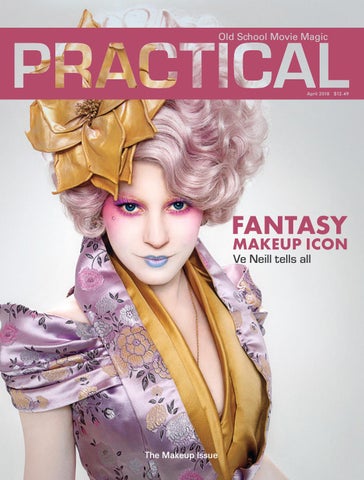
Old School Movie Magic
April 2018   $12.49
FANTASY
MAKEUP ICON Ve Neill tells all
The Makeup Issue
14 32
18
26
38
44
Practical April 2018
3 Table of Contents
Practical v. Visual
14
Monster Maker
18
World’s Collide
26
Across the Globe
32
Fantasy Legend
38
The Godfather
44
As computer-based effects gain more popularity in the special effects industry, some argue that makeup effects are a dying art. So what exactly are the pros and cons to FX Makeup and CGI?
Oscar-winning makeup artist Rick Baker discusses his work on some of his most iconic films.
Featured Content
FX Makeup and CGI are combined in Guillermo deToro’s The Shape of Water, makeup artist Mike Hill explains the process.
A list of the best makeup schools across the world and your chances of getting in.
Oscar-winning makeup artist Ve Neill discusses her role on hit reality show Face Off, her work, and future in the field.
A definitive timeline of the “Godfather of Makeup” Dick Smith’s work.
On the Cover
Fantasy Legend Ve Neill Interview pg. 38
Practical April 2018
MONSTER MAKERinterview RICK BAKER
Six time Oscar winner, Rick Baker, discusses the joys and tribulations working on “Men in Black 3”, why CGI has made filmmakers sloppy, and reflects at length about his work on two classic projects: Michael Jackson’s “Thriller” and the original “Star Wars.”
19 Interview
«
Rick Baker with his monsters and aliens
words by Mike Ryan photos by Ryan Schude
I
met rick baker, winner of seven academy awards for best
makeup, at the Museum of Moving Image in Queens, New York. It was a fitting location for the interview considering Baker’s illustrious career: At the museum, Baker was roped off, with an empty stool next to him, like he was his own display. Actually, if Baker were up for it, perhaps he should be his own display—a constant reminder of movie-making magic, before computer-generated effects made everything too easy. Or, as Baker calls it, too “sloppy.” Thankfully for all of us, Baker is still too busy to be considered a museum piece.
Practical April 2018
In “Men in Black 3,” was Jemaine Clement’s Boris the most difficult? Well, Jemaine was one we focused on a lot. What was hard was getting the studio and everybody on the same page that I was on. What I thought he should be.
That’s interesting. What did the studio want?
The hard thing for me was that we made things for scenes that weren’t in the movie anymore. It was designed specifically for a scene, we pretty much got it finished, then, all of a sudden, “We threw that scene out.”
In the original script, Boris was described as being like Dennis Hopper in “Easy Rider.” And I thought he should be much more intimidating than that. And more alien. He wasn’t very alien at all. And it turned out, in the end, it was a virus. I said, “I don’t buy it.” And I kind of pitched a whole different idea.To me, he should be much more Charles Manson or Sonny Barger, who was head of the Hells Angels — he should be an alien. I mean, from a distance, he looks like a scary biker. And you avoid eye contact. If you see a guy who looks like that walking down the sidewalk in front of you, you’re not going to be [freaking] staring at him.
I’ve seen human beings who don’t look that different than Boris. When I first pitched my concept for Boris, I showed them a distant image. I said, “See that guy? He looks like a human.” Then I should them a little bit closer and I’m like, “OK, now you can see him a little bit better. You’re not going to want to look at him.”
Especially when a monster shoots from his arm. Was that your idea? Well, it’s funny, that kind of evolved. In the original script, an organic creature turns into a gun. A regular gun. And I said, “You know what? I don’t buy that.” And they go, “Why?” And I said, “It doesn’t make sense.” They’re like, “It’s like Transformers.” I said, “No, it isn’t. Transformers is a machine, turning into a different machine. It’s not an organic creature turning into a machine.”
It sounds a little like “Terminator 2.” But at least that was a liquid. But I said, “I don’t buy it. Why don’t we make it a creature?” Also, I said that I thought the creature should be part of him. Without this thing, he doesn’t have his power. And Will had the idea that his weapon should shoot quills.
OK, even with something like the quills, with all of the rewrites, does that affect you at all? Like, “By the way, this character now has this power.” Did you ever think, “I wish you would have told me a month ago”? I mean, it happens in every movie.
« Worm Alien from Men In Black Franchise
21 Interview
«
Worm Alien Animatronic
OK, with any movie that you’ve ever worked on, what’s the worse example of that? Well [laughs], this is probably the worst example. The hard thing for me was that we made things for scenes that weren’t in the movie anymore. It was designed specifically for a scene, we pretty much got it finished, then, all of a sudden, “We threw that scene out.”
Can you use that elsewhere? That’s the thing. It’s like, “OK, we’ll use that for Men in Black headquarters.” So, all wasn’t lost. But it’s happened to me, I would think, on every film I’ve done that we did something we worked really hard on, but it’s not in the movie.
You’ve done amazing work on movies that aren’t the best. [Laughs] Most of the movies in my career, yes.
Nothing against The Wolfman... I only use it as an example in this case because you did win an Oscar. No, it’s true. For me, I try to do the best I can do, no matter how the movie is going. It’s still my name and my name is on it and I want the work to be as good as possible. You always do hope that the movie will be as good as your work is. I can’t tell you how many films I’ve done where people have said to me, “I wish the rest of the movie was as good as what you did.”
You don’t see a lot of actors winning Oscars for bad movies. Yeah. I mean, it was a joke when “Norbit” got nominated for makeup. And the thing is, the Academy is looking at the work, not the movie, for this specific craft category.
Almost 30 years later, did you have any idea we’d still be talking about the video for Michael Jackson’s “Thriller”? Heh.You know what? John Landis told me that was going to happen. He said, “You’re gong to be remembered more for this than anything else you do.” I was like, “You’re kidding? This is a music video.” But, when we filmed the zombie dance, it’s in the middle of the night in a not great part of Los Angeles—like in a meat-packing
district next to a place where they just slaughtered animals. But it was a crazy day for me because I had all of these zombies to makeup. It was crazy, beat the clock thing. And I’m standing there, watching people do that “Thriller” dance for the first time. And it was like, “Look what I’m looking at! Look at what these guys are doing. People would pay money to see this.” It was a cool thing to be involved in.
Practical April 2018
Do you look at movies that are completely CGI and think, You know, you should have called me?
To that point, you worked on the first “Star Wars.” I’ve read Ewan McGregor compare his acting in the prequels to that of working with a tennis ball, compared to Mark Hamill who was actually looking at a creature. Do you think it makes that big of a difference?
You know, I embrace the technology. But I hate when it’s used wrong. And it’s something I think we can do better. What I really do hate about the digital revolution is that it’s made for sloppy filmmaking. “Fix it in post.” It’s like, I do think it makes a difference. I “I don’t even have to think about this mean, I do think it’s cool that you can now. I can just not make this decision.” do things that you can’t do any other And I don’t think that’s always the way. But, just because you could have best way to go. I do hate that part. 10,000 werewolves running down a
I mean, you will always be fine. But are you worried about young people starting out in this craft? Like in 40 years, filmmakers may decide that we don’t need this at all?
What are your memories of working on the original “Star Wars”? I know you did some work on the Mos Eisley cantina scene. My involvement in “Star Wars” came in post-production. Ken Ralston and Dennis Muren were working on it and they had already filmed the cantina scene, originally. With different aliens, but not as many. George wanted to embellish on it. So, I came along and no one knew “Star Wars” was going to be “Star Wars”. Fox didn’t
“Did you see ‘Star Wars’? Do you know the cantina band, playing in the cantina? That was shot six months later, in a whole different country, by completely different people.”
Well, yes. People are trying to do that. I just worry about, not just the people in the craft, but what you’re going to be seeing. There’s a real magic that wall, doesn’t mean that you should. happens when you have a really The backlash it’s getting is that they good actor in really good makeup do things that totally take you out on really good set. Now, you have of reality that you’re not buying it a guy with motion capture dots on anymore. You don’t care. You know, his face and he has no idea what he the first “Star Wars,” when I saw that, really is on that motion capture stage I was so [freaking] excited. Everything — you’re not going to get the same was just so exciting. I saw some of performance. I mean, you have Andy the later ones and they had some Serkis who is really good at that, but, sort of huge scene in outer space most actors ... I mean, Eddie Murphy, with a zillion ships and all of this so many times, didn’t know what he stuff going on. And I was just like, was going to do until he sat in the “Why do I give a sh*t?” You know? makeup chair. Technology, when it’s used well, is great. Not that it wasn’t done well in “Star Wars”...
want to spend any more money. George wanted to add some stuff, but there wasn’t any money to do it. We couldn’t do stuff as elaborate and cool as I wanted to do it. But it was a one-day shoot, basically. And some of the masks we made were mass production kind of masks — I figured we’d throw it in the background. And George actually featured some of them more than we should have.
It’s one-day shoot, but it helped create one of the most iconic scenes of all time. Oh, I was so glad I did it, for so many reasons. One, because it’s “Star Wars.” But also because movies are a series of cuts. And it’s crazy, people in the industry don’t understand. Many
23 Interview
Aliens from the cantina scene in Star Wars: Episode IV
«
«
Cantina Scene Masks
time I’ll say, especially when we did much more practical effects, “Let’s shoot it in post with a smaller crew.” That’s how we did the American Werewolf transformation. And they say, “It won’t work.” And I say, “Did you see ‘Star Wars’? Do you know the cantina band, playing in the cantina? That was shot six months later, in a whole different country, by completely different people.” They were never in there at the same time Harrison Ford was in there. And they’re like, “I can’t believe that.” And I say, “It can be done.” You swear those guys are there. We did a closeup of Greedo...
Two different actors played Greedo. Yeah. And the shot where we did a closeup of him, where Han shoots him, we shot, again, later. Different people. A series of pieces of film, cut together.
On any movie you’ve worked on, what character are you most proud of? Even it appeared on screen for a second. It was actually a movie titled “Harry and the Hendersons.” Harry, I think, was my favorite.You can watch that movie today and I think it still looks good. For one, it was cool because I was one of the puppeteers who controlled his face. And it was our first radio controlled, animatronic guy. Like I said, I think he holds up. “American Werewolf,” a lot of people still say great things about it, but I look at it and think, Oh, we could do so much better. Harry, I could improve upon, but not the same amount. I think he still looks pretty damn good.
«
Rick Baker at his Hollywood Walk of Fame Star
photos by Ryan Schude
FANTASY
LEGEND VE NEILL interview Makeup legend Ve Neill discusses the new season of her show Face Off, how she created her Oscar-winning makeup for Beetlejuice, and why she’s having the time of her life.
N
eill has brought us some of the
most unique character makeups of our time and won Oscars for Beetlejuice (1988), Mrs. Doubtfire (1993) and Ed Wood (1994). For over 40 years she’s worked on some of the most well-recognized and notable films and TV shows of our time. Beyond her three Oscar wins, she’s been nominated for five more Academy Awards and won an Emmy for The Shining miniseries (1997), a BAFTA Award for Pirates of the Caribbean: The Curse of the Black Pearl (2003), and Saturn Awards for Pirates of the Caribbean: At World’s End (2007), Interview with the Vampire: The Vampire Chronicles (1994), Batman Returns (1992) and Beetlejuice.
Ve Neill creating Hunger Games character Effie Trinket
«
Practical April 2018
words by Kathie Huddleston
39 Interview
Practical April 2018
«
Makeup for Pirates of the Caribbean character franchise
If we did it out of silicone now it be so much easier. But back then it was foam latex and it all had to be hand-painted every single day. This season is very different from seasons’ past. What can you tell us about it? This is like an alumni of a school. They all tend to work together and help each other. A lot of these kids are friends outside of the studio, so it’s kind of great. They all hang together and they’re all friends. So it makes it a lot more congenial when they’re in the lab and they tend to help each other more. I think that’s kind of an interesting dynamic this year. At least that’s what I think is going to happen because we judges don’t get to see everything ahead of time. We only get to see our little bit at the end. I think it’s going to be really interesting to see everybody working in teams for the entire season. And we’re not eliminating people every episode either, only every other episode. So you have a chance for redemption. So if you mess up on that one, you have a chance to redeem yourself next time. If you don’t, well, sayonara.
Do you get attached to the artists? Is it difficult to eliminate them? For me it’s always hard to send somebody home because it’s so devastating to tell an artist they’re going home. Many times I’ve cried. You might not ever see it but I get all teary-eyed. When we have to send people home it’s really sad and we all talk about it. Because they all try so hard and you’re doing your darndest. You might have an off week where maybe that’s not your niche, that you don’t do so good at that one particular thing. But this season they’re working in teams and so if one of them is weak in one area, the other can pick up the slack. It’s kind of helpful and hopefully you’ll see it works out well that way.
Do you have any disagreements as judges on who to send home? Sometimes we have disagreements. I don’t remember exactly specific things but sometimes where it’s like, “No, I just don’t agree with that,” but then I get outnumbered or maybe one of the other guys gets outnumbered. You just have to say, “Okay, fine.You win.”You like something more than the other one for whatever reasons those are. We all have our own reasons for liking things. Maybe something doesn’t make sense to one of us and it does to the other one or maybe we don’t care. It’s usually me that doesn’t care if it makes sense. If it looks good to me, I like it. It doesn’t necessarily always have to work.
I was looking on IMDb -- you have 82 credits to your name starting in 1977. I have 82? Oh, my God, I’m old [laughs]. I actually started before that.They just don’t have them all, I think [laughs]. Thank God! Unfortunately for me there’s some movies that I did that were very famous and I can’t really say I did them. I’m kind of stuck.
41 Interview
few pictures with Johnny and he’s just so fantastic. He’s just like your dream guy.
I have so many favorites for different reasons. It’s very difficult for me to come up with one. All the films that I did with Tim Burton have been fantastic. I mean every single one of them. Just always so much fun and so creative. Several films I did with Joel Schumacher, like the early Batman [Forever, 1995]. And just on and on. And of course Mrs. Doubtfire with Robin Williams. That was probably one of the more difficult ones, only because that was 13 overlapping pieces that had to be placed in exactly the same spot every day and I did that makeup 54 times.
I imagine there’s quite a lot of people who wouldn’t mind having hung out with Robin Williams and Johnny Depp for hours on end.
Applying a complex makeup on Robin Williams 54 times must have been very interesting. That was probably one of the more difficult projects and it was foam latex. If we did it out of silicone now it be so much easier. But back then it was foam latex and it all had to be hand-painted every single day. And we’re talking about putting it on a very active human being who was ... very active [laughs]. But it was fun and so delightful. Robin, what a dream he was. He was such a joy to be with. So there’s difficult things that make it still joyful. I have so many favorites, and I love all the films I did with Johnny Depp. He’s so willing to be somebody else. Well, Pirates. I did the movie Blow (2001) with him and aged him from a teenager all the way to 60-something years old. Edward Scissorhands (1990). Sweeney Todd (2007). I’ve done quite a
I’ve been very fortunate in my career, and then, of course, I just finished a couple of years ago the whole Hunger Games sequence with all those fantastic young actors. I mean, Donald Sutherland. I know just all these fantastic actors that you see everywhere all the time and if not you hear their voices [laughs]. You know what was so fun aboutThe Hunger Games for a makeup artist? We did everything from dirt and prosthetics and blood and guts all the way up to high-fashion makeup and runway and just gorgeous beauty makeup. So it spun the gamut on that. We got to do everything on those movies. For a makeup artist that was a dream project to be able to do everything. Like one week making Jennifer [Lawrence] look like she’s going down a runway and then the next week I have whip marks on Liam’s [Hemsworth] back. For us it’s really fun to do everything.
The Pirates of the Caribbean movies must have had a lot of different kinds of makeups, too. Yeah, absolutely. We got to do so many fantastic looks in that. The first film we got to establish
all those crazy-looking pirates. The second film we got to do all the cannibals and all that crazy makeup with the bones and the body painting and all that stuff. And then I got to do that crazy eyeball paint job on Johnny. And we always have Keira [Knightley] in there somewhere running around, and we have our trollops that slap Johnny. So we have like all these fun period female makeups. And then we’ve got our nasty, filthy, sunburned, rotten-toothed, yelloweyed pirates [laughs].
Looking back at Star Trek: The Motion Picture (1979), that had to have been huge for you, since it was so early in your career. Oh, yeah, that was my first big union film that I worked on. I had worked on several films before that, but nothing like that.That was a giant film for me, so going to do that with Fred Phillips, who was kind of my mentor, was really a fun job. I mean, I was still very young and it was really a lot of fun.
Makeup for Mrs. Doubtfire
«
I was hoping we could talk about some of your most notable projects. Looking back, is there one project that stands out in your mind?
Practical April 2018
«Ve Neill
Where you able to push things farther in Star Trek than in some of your earlier projects? And Fred was really good with me because he knew I could do prosthetics cause that’s how I knew him. The guy that I learned from and I worked together. We could never go on the union set. So I would always call up Fred Phillips and say, “Hey Fred. We made this stuff. Can you go put it on?” We had a really great relationship with Fred. He put me in charge of putting all the Klingons together. I got to basically design all the hair work and the paint jobs for all those Klingons in the movie. That was really fun for me as a young woman.
When you tackled Beetlejuice as a character, what did you think? Tim Burton is very good about designing because he’s an artist himself.Tim had some pictures up on his wall in his office, just some pencil sketches of what he wanted him to look like and it was kind of like a derelict. So the first couple of tests I did he said, “He’s too real and too creepy-looking and we don’t want to look at him.” I said to him, “Let me just go back and do something kind of fun and kooky. I’ll go to the other extreme and you tell me if you like it.” So I went and did what we saw on the screen and he loved that. That’s how he got developed.
I actually sent somebody off to the hobby store to get me some of that crushed foam that they use when you make little railroad sets and little villages. I told him to go get some little bushes and some crushed foam and all the packages. I said get me all different colors in all different densities and they give me some moss. And I said, “I’m just going to make him look like he’s been living under a rock.” That’s how that look came up. He comes out of that grave and it’s like, “Okay, he’s just been living under this thing getting all moldy and full of moss.” So that’s how he came about.
You’ve been in the makeup industry for a long time. Have you developed techniques that others use now? Well, it’s like anything else. It’s like Dick Smith’s book is one of our foundations for all of our prosthetics now. He was kind enough to share with everybody. Nobody wanted to share with me when I got in because I was a girl and they didn’t want me in there anyway.
So I have made it my life’s mission to make sure that I share with everybody, and in actuality, I am now Director of Education at Cinema Makeup School, which is probably one of the best makeup schools in the country. So I get to put my two cents in there as well and make sure that the students are getting the best education they can with all the latest updated techniques.There are lots of girls and there’s lots of really good girls doing it, let me tell ya.
What are you working on right now? Right now I’m not working. I’m looking for a job. Films don’t typically start up until March or April. So something will happen between now and then. I’m actually working off and on on the television series Feud. It’s about the feud between Bette Davis and Joan Crawford. It’s being done by the same production company that does American Horror Story and their whole crew. So they’ll finish that off next week and then they start on American Horror Story in a couple of months and I’ll go back on to that show. I’ve been helping them out a little bit and doing commercials and odds and ends and stuff. And I have a lot of my own projects that I’m working on as well.
43 Interview
Not working usually means sitting at home reading a book or watching TV? Maybe you should take a vacation, Ve.
CGI can really be a fantastic enhancement to our makeups. I don’t really think it will ever take the place of an organic-looking makeup...
I want to retire pretty soon. Working on Face Off is a vacation for me. That’s lovely. But I have things I’m doing. I’m starting a cosmetic line. I’ve also started an online platform for teaching, so I started an online school. And then my brush line was just revamped. So
that’s coming out shortly. I have a lot of projects in the fire. I want to have all that stuff all set up for me so that I have an income when I retire. And that way I can just do movies whenever I want or not have to do anything.
Until they call and say, “We have a makeup emergency, Ve, and only you can help us.” And that does happen, funny enough. [laughs] I stay busy. Sometimes I’m busier when I’m not working. It’s like how do I have time to work? I mean I’m so damn busy ... I’ve been very fortunate. I’ve had a extremely lucrative and very wonderful career and I’ve been very lucky. But I love working on Face Off. We have a fantastic crew. The contestants are always so wonderful and love to hear
Ve Neill’s character makeup for Beetlejuice
«
«
Klingon General for Star Trek: The Motion Picture
our critiques. As I said there’s plenty of them that I see often, they’re like our extended family. It’s an experience for them. A lot of these kids are from the Midwest and places where they don’t have a lot of the technology and/or resources we give them on the show. It’s really good for them to have all that and see how it all works, and they meet all these people, that they stay in touch with.
When you think back on your career and you look at the new up-and-coming makeup artists, what are your thoughts about what they’re facing in their career? Well, technology has advanced so much since I started. We still use the old techniques, but there’s so much new technology that works so much better and so much faster. And you can do things that you could never do before. I think it’s a really exciting era for makeup artists to be working right now, because not only do they have all the advances that we’ve made in makeup, they also have the advancements that we’ve made in visual technology. CGI can really be a fantastic enhancement to our makeups. I don’t really think it will ever take the place of an organic-looking makeup, but enhancements with CGI are really a fantastic tool. Especially now because a lot of the CGI artists will start working with the makeup artists in post so that they can make it look right, so they don’t wipe out everything the makeup artist has done and they only make it better.