‘The Noblest Jewel’ A Celebratory Record of Activities Week
1
Introduction and Acknowledgments The story of one of the best known and best remembered achievements of Latymer Upper School begins rather unobtrusively with this report from ‘The Latymerian’ of Summer 1957, now therefore some sixty years ago:
‘Latymer At Home. The North Wales Expedition. In July during the School Joint Examinations a party of fifty-five boys in the Upper Fifth and Second Year Sixth who had finished their examinations, went with five members of the staff for a week’s course at Plas-y-Brenin, near Capel Curig. One section went by train, the other intended to go by the School coach, but were marooned in the Midlands until rescued by a hired bus. However, all arrived for supper, which like all the meals during the course, was very good. There follows an account of allocating kit and rooms, a frightening film on mountain safety made by the Royal Marines, and a fine week of canoeing (the most popular activity), camping, though some of that was rather stymied by poor weather, a trek to the summit of Snowdon, exciting rock climbing and the novel Swedish activity of ‘orienteering’. British Railways and Mr Stewart, driving the now repaired school coach, brought them safely back at the end of the week. So, quietly, starts the story of Activities Week, now in 2017 in its Diamond Jubilee year, which makes the title of this account of its inception and growth rather appropriate. Maurice Isaac, in his time as Headmaster of Latymer, frequently referred to Activities Week in his annual briefing to the staff about to go off for the week, as ‘The Noblest Jewel in Latymer’s Crown’, and indeed it has much to deserve that title. Latymer had had a tradition of out of school trips for some considerable time by the summer of 1957. The best known of these is the annual exchange visit with the Gelehrtenschule des Johanneums in Hamburg, set up remarkably quickly after the Second World War in a fine act of forward-looking reconciliation and generosity by Mr Frederick Wilkinson the great, humane and far-sighted Headmaster of Latymer, in 1948. But even before the war, Latymerians had frequently travelled abroad: to France, for visits and exchanges with French schools, notably to St Germain-en-Laye, and with the Lycee Chaptal, and also to Germany, to Austria and Switzerland and even Scandinavia. They had taken part in Harvest Camps during and after the war, and there had been Scout and CCF camps, and some academic field trips in Biology, History and Geography. Latymer therefore already had a very sound reputation for pursuing actively the real and undoubted benefits of education beyond the walls of the classroom or laboratory. But this had always taken place during the school holidays, either at Easter or in the summer. The great innovation of 1957 was that this expedition to the Mountain Activities Centre at Plasy-Brenin took place while term was still running. And there was also a clear connection with examinations. Those who so much enjoyed their week at Capel Curig were at least some of the boys who had just finished their public exams, at either O level or A level, but had not left school before the official end of term, as their Upper Sixth Form successors at least, effectively do now. And the rest of the school was still in the throes of its own internal (‘Joint’) examinations. The needs of both those still working on examinations at school and those with less impetus to work because their exams were finished, could be served by despatching at least some of the latter to do something different yet something educationally worthwhile- and do it elsewhere.
2
While 1957 marks the start of what became Activities Week, though it did not as yet have that name, what happened next in the development and history of Activities Week is rather less clear and easy to trace. The primary sources used have been above all the accounts of camps and visit given year by year in ‘The Latymerian’- except that for some time these accounts are not completely ‘year by year’ with gaps when almost nothing is said or only hints of an Activities Week programme being given, leading to some interesting detective work. The School Journals, which give the lists of students in each form for each year, the staff, the school rules, details of clubs, sports and societies, and the calendar for each academic yearhave been another source. But this author is chiefly grateful for the help and recollections of those who have been in charge of Activities Week over the years, and especially John Wilson, Nigel Orton, and Sally Markowska, and above all to Chris Hammond, former Head of Middle School and then Assistant Head, who was heavily involved from his appointment to the staff in 1966, and George Terry, who was appointed to the staff in 1954 to teach Geography and later served his School for many years as a distinguished Second Master. George had been one of the five members of staff on that first visit to Plas-y-Brenin along with Mike Bond, the Head of P.E. and Games, Geoffrey Grimsey, the Head of Classics and a fine sportsman who had helped introduce Rugby to Latymer, and Tom Stewart, who had had a most distinguished army career and ran the CCF. (The name of the fifth teacher seems to have been forgotten and any reader who recalls it is invited most strongly to pass that on.) Plas-y-Brenin was certainly a worthwhile venue to choose. As George Terry pointed out, and proved with a small gallery of press cuttings, it had been a favourite training place for Sir John Hunt, leader of the first successful expedition to conquer Mount Everest. I am most grateful to George, and to Shirley Terry, for their very kind hospitality and help with this research, kind not least at a time when George was recovering from illness. ’Latymer Upper School, A History of the School and its Foundation’, by Nigel Watson, (published by James and James 1995 for the centenary of the Upper School) has also been used. Everyone consulted has been absolutely clear that Michael Bond’s was the vision and mind behind the first beginnings of the Activities Week ‘project’, certainly behind the Plas-y-Brenin camp of 1957,which broke out of the notion of camps in holiday time only. He had been educated at Sibford School in Banbury and Bootham School in York and trained for teaching P.E. in 1946-8 at Loughborough College, long afterwards to be renowned as a centre for education in sports training and teaching. He had gained a supplementary certificate in Physical Education there in 1953-4 having also pursued further study through a Physical Education course at Fredensborg University in Denmark in 1950-1. He represented that post war generation of more professionally qualified P.E. and Games teachers now working alongside the committed and distinguished ‘amateurs’ and fine military trained and experienced teachers who had well led sports in schools such as Latymer previously. He taught at Shebbear College in Devon between1951 and 1954, when Mr Wilkinson appointed him Head of PE and Games. He later became Head of Craft, and was renowned for his ability to manage the very rapid erection and dismantling of the raked seating used each year to turn the Hall into a theatre auditorium for the School Play and Jantaculum, and he played the saxophonenot least in the ‘Jantacuband’. Nigel Watson states in his book, that Activities Week had ‘begun as an effort by Mike Bond the Head of PE to find something to do for boys who had just finished their O Levels. He took parties each year to Plas y Brenin in Wales where the boys enjoyed walking, canoeing and mountaineering. Later, when a change of examination boards altered the timings of the exam, the rest of the school had to be catered for and Activities Week burgeoned.’ 3
But he also writes ‘Activities Week had been started in the first place by Laurence Elliott, who had been a distinguished Head of Geography at the School for many years.’ Educated at East Sheen Grammar School and St Edmund Hall Oxford, Mr Elliott had been appointed Head of Geography in 1950 and served the School superbly until his retirement in1984. He was a Fellow of the Royal Geographical Society and served many years as a Chief A Level Examiner in his subject. A devout Anglican, Laurence shared with Michael Bond the sometimes-forgotten virtues of quiet, patient constantly courteous professionalism and commitment that made them two of the finest colleagues a school’s common room could have. It is perfectly reasonable that he saw the value of the out of the classroom education that Plas-y-Brenin offered, as he was involved in taking parties of Latymerians on educational cruises for some years, and that the idea of extending this to other boys than just those who had finished their exams had come from him. Your author, who joined the staff in 1976, has memories of Laurie Elliott being involved in organising the London side of Activities Week and of accompanying him in his first year or so, on superb visits to Bath and Salisbury, but at that stage the overall organisation of Activities Week was certainly in Mike Bond’s capable hands. In ‘The Latymerian’ in 1981, Michael Bond contributed his aims for Activities Week in an interview for the following article by Simon Manley and Mark Jenkin, who wrote: It was back in 1964 before many of the present pupils were born, that Activities Week was started as a ‘useful activity between exams and the holidays to stem the feeling of anticlimax’. It was organised on a departmental basis with subject masters organising activities to suit an age level. Moreover, it was all London based with visits to art galleries and sewage works! The subject masters would try to organise activities which reflected their subject with, for instance, a geographical bias. This form of activities week existed until 1970 when the first camps were brought in. The result was a switch in organisation from departmental to individual masters. Camps were mostly on an instructional nature, for instance landscape painting and sailing. Since 1970 camps have become the dominant picture with only about 100 boys remaining on London -based. Mr Bond believes that the London-based activities are as good as the camos in their own way, as ‘education outside the classroom’. Mr Bond says: ‘I want to make sure that any boy in the School has a choice of activities, be they London-based or camps and also a wide range of prices’ In this he seems to have succeeded, with activities as diverse as Normandy, Changing Hammersmith and the Music Activity. But Mr Bond points out that the camps depend on the goodwill of the staff who have to put in quite a lot of time before and during the activity and also in ensuring a wide range of prices. Messrs Manley and Jenkin seem to have been quite correct in their outline, but a little inaccurate in their dating, and further research suggests a slightly more complex picture of the turning of the perhaps rather experimental visit to North Wales in 1957 into the great scheme of Activities Week as it is now, taking away from the classroom the whole of the first four years of the school and much of the Lower Sixth in what could be seen as quite a staggeringly challenging piece of organisation, administration and commitment. Sometimes imitated but never really excelled by other schools. The first mention of the actual phrase ‘Activities Week’ in ‘The Latymerian’ does not come until 1966, when ‘a trip to Hadrian’s Wall in Activities Week’ is reported on. In the years between 1975 and 1966 there is almost no mention in the magazine or elsewhere. Plas-yBrenin is mentioned in 1958, then there is nothing from 1959 to 1963, but the next possibly significant development is the account in 1964 of ‘The days of special visits, films and games at Wood Lane which followed the joint (i.e. the ‘internal’ rather than ‘public’) examinations. This is accompanied by a photograph of quite young boys, second and third formers, leaving 4
a train at Windsor and Eton Riverside Station, presumably on route to the Castle. The tone of the article seems to suggest that this is quite a new development. Almost as soon as the first Plas-y-Brenin party returned from North Wales, there was a change of Headmaster at the School. Mr Wilkinson retired at the end of the academic year in summer 1957 and Mr Kenneth Sutcliffe succeeded him at the start of the autumn term. The end of a Headmaster’s reign may well have been thought by Mike Bond as a very good time to suggest something as radical as taking students away during term time, and he will have known that Frederick Wilkinson was just the kind of Head who would love such radical suggestions and would not have declined anything seen as interesting, exciting and stimulating to the boys, who had always been the most important members of the school community in his eyes. A new and rather different Headmaster might have taken more persuading. There was a lot for Mr Sutcliffe to tackle in directing the School, so there might well have been a pause in the development of Activities Week, a pause sensed in the absence of reports in the magazine, and a pause perhaps ended by the change of examination boards for the public exams, the kind of change that a new Headmaster might well have been keen to make, and which with different date,s will have suggested, even required, the reordering of the end of the summer term. One can well imagine Mr Elliott suggesting that the way to keep the very cramped school site quiet for those taking O and A Levels was to re-energise Mike Bond’s Plas- y -Brenin camp idea and extend it. This will have been a very fundamental decision indeed, to have over half the school away from the site for a week, and those who suggested and accepted it should have their courage acknowledged. Perhaps a good share in that acknowledgement is due to Mr Sutcliffe. ‘Wilkie’ had been a uniquely hard headmagisterial ‘act to follow’ and Mr Sutcliffe, who does not always seem to have been remembered as an adventurous or charismatic man, unlike his predecessor, had to work hard to further his new aims for the school. One might very well suggest that Activities Week was his great new contribution to the School’s life, as significant in its way as Mr Wilkinson’s setting up of the Johanneum Exchange with the ruins of London and Hamburg still very far from being rebuilt in 1947-8. And the 1960’s were the 1960’s, when new ideas, approaches, values and ways of thinking were blossoming everywhere, not least in education. Latymer had a vision of the school being rebuilt, it had a fairly new Headmaster, and soon a new Second Master in George Terry, and new, energetic members of staff such as Chris Hammond, Bruce Perkins, Geoff Tait, Graham Bearman, Geoff and Derek Bone, Robert Orme and Peter Stevens, all of whom were to be involved in the subsequent development of Activities Week in the years ahead, when the foundations of the Activities Week concept were being built on. Chris Hammond’s recollections of this stage are very valuable. He was appointed to the Chemistry Department in 1966 but was asked to begin in the summer term rather than the more usual autumn term of that year because two chemists had left the department for other posts at Easter. In his first term he was filling emergency cover for staff on the London based activities which occupied the time after the joint exams. In that year the boys involved included the Upper Fifths whose O Levels had finished, who, Chris recalls, participated with a certain amount of boredom. He recollects that staff looked back to the Plas-y-Brenin experiments with some fondness for its being a breakthrough in happening in term time. But, in his words, the ‘real step changer’ was the addition to the London based programme of the trip to explore Hadrian’s Wall (much to the delight of your author, as a Classicist), in that it too was in school time but away from London and the first of such out of town Activities Week activities which was controlled, planned and run by Latymer teachers rather than professional instructors such as 5
those at Plas-y-Brenin. The leader of that breakthrough Hadrian’s Wall trip, seen as ‘an experimental away from home activity’, was James Flecker. Alongside the foundational work of Mike Bond, George Terry and Laurence Elliott, James Flecker, and Kenneth Sutcliffe, Chris Hammond, recalling that the decision to encourage staff to conceive ideas to offer more ‘away from London’ trips was soon and readily made, praises in this the visionary input of Geoffrey Grimsey, who had accompanied the first Plasy-Brenin courses, and now encouraged further visits to Hadrian’s Wall and other new activities Among these was the first Brecon Camp in 1967.In this came a further and perhaps quite radical innovation in that selected VIth Formers actively led the younger boys of the 4th and LVth forms, with staff in more of an overall supervisory role. The success of this led to the same approach with the first Brittany trip set up by Geoff Tait in which boys stayed in small villas with VIth formers in charge of each villa. The fact that this was outside Great Britain is of course another rapidly introduced innovation. The pattern of the modern Activities Week therefore began to appear very quickly once the process began. The list of Activities which forms the heart of this work shows this process of development well, with several other continuing long standing stalwarts of the scheme soon appearing and making their mark. So when the phrase ‘Activities Week’ appears formally for the very first time in the School Journal for 1968, the process of developing Activities Week was very much underway and the week was fully embedded in the life and values of the School. The title continued to appear in the Journal each year until the Journal ceased to be published, and in the ‘Events and Fixtures’ during its publishing lifetime too. Activities Week has also had its rightful mention as an aspect of Latymer life which is attractive, significant and to be celebrated, in all the School Prospectuses and similar material. The range of Activities has naturally tended to broaden and the number of Activities offered has always tended to grow. But at heart Activities have always been created out of the interests and skills of those members of the Teaching Staff who have devised and led them. Many have been in a general sense ‘sporting’ and often covering physical activity and skills which have not been offered in the course of the normal sporting curriculum, such as riding, climbing, walking, canoeing and sailing. Others have been in a broad sense academic but covering the kind of experience which the classroom could not offer, with programmes of visits to places of particular cultural, artistic, creative, historical, geographical and scientific or ecological interest. The geographical span has always tended to widen, with Hadrian’s Wall giving way to Roman Provence, the walking routes of the Brecon Beacons extending to the Alps, local history and culture in London moving on to Paris, Barcelona and Budapest, Activities have been based in France from almost the earliest times, now they have even gone beyond Europe to Morocco, where they cover not just cultural experience but active work in the local community too. Some activities have grown from the more particular interests of those teachers who set them up. One thinks of birdwatching with Mrs Socrates or Mr Mower’s breathtakingly ‘whistlestop’ explorations of the entire railway network of Britain, from Thurso to Penzance in five days with one quick visit to school - ‘for ablutions’…… Reports in ‘The Latymerian’ were patchy in the early days, and have often since been subject to the vagaries of the mores and values of Latymer student journalism, but from the 1970’s there has always been a dedicated and usually prominent section of the magazine devoted to reports of the week. And almost always, the reportage has been enthusiastic and positive, reflecting the enjoyment and benefits which students always seem to have felt from 6
their experiences on activities. There is of course a certain amount of good naturedly sardonic writing, some gentle acerbity about bad weather, travel delays, the sleepdiscouraging behaviour, musical or footballing preferences, or personal freshness of those with whom the authors had shared tents, boats or dormitories, and the occasional reference to illness. The journalists also sometimes include good natured judgement of the foibles of the staff who were leading them, and this is quite an early feature. In 1973 we find written: In Royal Richmond, leeky Wales, heathery Scotland and rocky Brittany, to name but a few, the ever curious Latymerian pursues his real and all-absorbing interest-the School Master or Mistress. How fascinating to observe this strangely unique phenomenon in an alien habitat. The reports in the magazine at times give quite a clear picture of Activities Week’s ability to refresh and renew itself, with new activities on offer and new members of staff taking the chance to find, devise and lead those new camps and programmes. The 1976, 1979 and 1985 1991 and 1995 editions are good examples. The Activities Week booklet of 1997 is the first to set out explicitly a graduated and defined set of aims and objectives for the activities on offer. The 2nd Form Activities were designed to ‘allow peer group’ interaction’, the 3rd and 4th Form ones were for ‘trying new experiences’ and the LVth Form programme was pointed towards ‘developing a skill at greater depth’. This was the period in educational matters when explicitly setting out ‘aims and objectives’ was very much de rigeur, but in fact tight control of that structure was perhaps difficult to work and all of those points have probably always been in all the activities ever offered. In the same year comes the first explicit reference to the availability of Bursary funds (later to be called the ‘Horizons Fund’), to support students who might be discouraged from choosing more distant and attractive activities by the higher costs involved. That many students will have benefitted from the quiet and unobtrusive offering of that sort of support is of course entirely apt within the tradition of generosity and universality in education which began with Edward Latymer’s Will in 1624. Sally Markowska’ s recollections of being the Teacher in Charge include her very fond memory of a student who had never been abroad before being awarded such a bursary for the week’s visit to Morocco, which in addition to sightseeing had a very full element of work in a community there,thanking Sally on her return and saying on the day that she left Latymer that the trip had changed her life. Another concern which appears in the surviving Activities Week choice booklets is that of risk, risk of accident and risk of indiscipline. This concern had been in evidence for some time. Alongside his commendation of the week as ‘The Noblest Jewel in Latymer’s Crown’, Maurice Isaac was famed among the staff for his briefing about the risks of accident or misunderstanding, which always reminded them that ‘this is not a holiday’, and that relationships between staff and students must be exactly as they would be in the classroom. It always ended rather chillingly, but effectively, by averring that in all the orders, instructions and directions they gave the students, the Staff must ‘Think how this would sound in the Coroner’s Court.’ Such things continued, and rightly, to be matters of headmagisterial concern, even though Coroners have never in fact had to be involved in Latymer activities. The worst incident remembered is the Dartmoor Activity’s being overwhelmed by a virulent stomach bug which affected every student and every member of staff there, so that the trip had to be curtailed early and the group brought home by train. The Choices booklets begin in the 1990’s to contain assurances that the instructors at centres used for activities such as canoeing and climbing will be fully and professionally trained and licensed, and requests that parents, when appropriate, must confirm that their children could, for instance, swim fifty metres. Recent booklets have also included a code of conduct for those taking part in the week. All 7
this came in the wake of incidents such as the Lyme Bay tragedy, when some young seacanoeists were lost and their instructors were shown to be insufficiently trained and managed, and in the face of more enthusiasm for litigation and accountability. The school’s response was as ever, clearly thought through and managed, with the growth of risk assessments and the oversight of Safety Officers such as Mr Hammond and Mr Hirst. Keeping apace with, indeed ahead of all these developments and concerns were the Teachers in Charge of Activities Week. Succeeding Mike Bond were Nigel Orton, John Wilson, Tony Nelson, Simon Weale, Sally Markowska, Richard Niblett and Lucy Cole. Nigel Orton continued to act as the person in charge of the control centre, manning the telephone in case of any crisis that occurred and ready to deal with whatever might happen for some years after stepping aside as Master in Charge, a role also played for a long time by David Brooks. A very considerable amount of very hard work fell on them in encouraging or cajoling staff to participate and arrange activities, in researching into new centres and programmes and assuring the school of their quality, in preparing the Choices Booklet, (once typed, then, from Nigel Orton’s time, more computerised and word processed, now fully ‘digital’), in managing and arranging choices and allocating students to activities, sometimes covering large areas of their home carpeting in piles of choice forms, in liaising with the Headmaster and Senior Management of the School, in dealing with parents, (not least those few who -or whose sons and daughters- did not like the activities to which they had been allocated), in managing insurance, risk assessments and so on, in organising and leading the briefings to staff and students in the days before the week itself, in helping staff out with centre and transport bookings, seeing each trip off, welcoming each trip back and in visiting trips and camps during the week, in ensuring that there were reports to the Headmaster from each trip, and reports and photographs for ‘The Latymerian’, and often many more ‘behind the scenes’ tasks. This work was recompensed, as Sally Markowska, John Wilson and Nigel Orton have all recalled, by the delight of visiting the activities and of seeing students and staff working and enjoying time together, building new friendships, learning new skills, finding new respect for each other and fostering that sense of learning as a staff and pupil partnership which has long been the foundation of the Latymer way of doing things. It is hoped that this brief Celebration of the Diamond Jubilee will be a fitting tribute to their hard work, the enthusiasm of all Teachers who have led or assisted with Activities, the foresight and faith of Mike Bond and those who first began the project, and the enjoyment and education of sixty years of Latymerians.
M.J.Smith Hon.Archivist, Latymer Upper School Easter 2017.
8
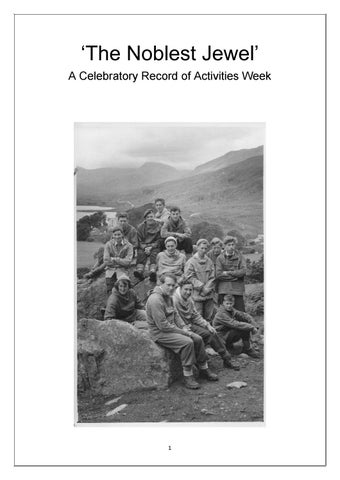
A list of the known trips and camps held as part of Activities Week during the last 60 years. What follows is an attempt to list all the trips and camps that have been part of Activities Week since it started. This is an honest attempt, but it is not impossible that some trips and camps have been omitted, and for that and any errors, the Hon. Archivist sincerely apologises and invites notification of any mistakes or omissions. The number of activities that have taken place in the last sixty years is really quite astonishing, and a tribute to the commitment, determination and professionalism of the Latymer staff over the years. Sally Markowska has recalled that in her time as Teacher in Charge, there were well over thirty activities on offer each year. The sources for this list are firstly the few surviving copies of Activities Week brochures that have come into the archive, chiefly from the late 1990’s and early 2000’s and secondly, and mainly, the Activities Week reports contributed by staff or pupils over the years to ‘The Latymerian’. All of them are available in the Archive of course, and they offer a very fascinating range of approaches, from strictly informative, through creative and reflective to cheeky and pointed- which is so very Latymerian! (There is even one example of what must have been a ‘spoof’ report- on the ‘Militia Activity’.) The dates listed indicate the beginning of the activity in the source material or any significant changes. It is almost impossible to be complete and accurate in attempting to indicate when an activity was run for the last time. Where known the numbers of students attending are given, and their age groups. A note may be useful here for readers from different ‘eras’: The former 2nd form is now Year 7, 3rd form Year 8, 4th Form Year 9, Lower Fifth (LV) is Year 10 and Lower Sixth (LVI) is today sometimes referred to as Year 12. For the one occasion where it is mentioned, the Upper Fifth is today known as Year 11. The list also tries to detail the venues and the kind of activities which went on, but perhaps the main element in each entry should be the names of the staff who planned, booked, arranged and led (often from the very front) each of the activities. For without them, it must never be forgotten, nothing would have happened! One aspect rather omitted from this list is Activities for the Prep Department/School. Mention of Prep Activities in the ‘Latymerian’ is really very ‘hit and miss’. But there are reports occasionally which recall events and people which should not be forgotten. There were the visits to the Isle of Wight and Padworth Camp, and the programmes of London based visits, including all the best places to see and learn about in London and along the river, along with artwork, a drama workshop, cookery and sugarcraft. The staff who led all of these must be remembered too: Mrs Chandler, Mrs Harding, Mr Nott, Mr Woodhall, Mr Robinson, Mr Hull and their more recent successors all deserve their well-earned recognition and thanks. The cover picture, very kindly contributed by Mr George Terry, shows some of the staff and boys who took part in the first visit to Plas-y-Brenin in 1957.The lady is one of the resident instructors from the centre, and the two Latymer staff members in the front row are, on the right, George Terry and on the left Michael Bond, the originator and driving force behind the whole concept of Activities Week.
9
Activities based in London Days of special visits films and games at Wood Lane noted in1964 Film-making 1970: The film ‘Bloodbath at the Special K’ was made by a group of students including Mel Smith and Taylor Downing. Staff involved included Mr Orme and Mr Turner Some Activity took place in Richmond in 1973. This is hinted at in the ‘Latymerian’ but with no more detail. School Based Drama course 1976: The group dramatised the Graham Greene short story ‘The Destructors’ for performance on Friday evening. Led by Mr Owens. 1977:. Room B14 was converted into a theatre to put on ‘Jack Sheppard’ at the end of the week, led by Mr Fanning and Dr Sales. On the Wednesday the group saw ‘Wild Oats by the R.S.C. 1979: The play being worked on in the week was ‘Charge’ by Mike Shearing and David Evans, produced by Mr Fanning, covering the Battle of Balaclava. The group also saw ‘Deathtrap’ by Ira Levin at the Garrick Theatre.
TV Course with Dr Parkin. 1977: With room A17 being converted into a studio, three programmes were produced in different styles, an ITN bulletin, ‘Albanian PlaySchool’ and an analysis of the work of Pink Floyd. LVth Film Making Course 1977: Led by Mrs Anderson with help from Dr Parkin. Art Course at School 1973: Under Mr Lobley the party visited the Royal Academy Summer Exhibition, Coventry Cathedral, Lacock, and Cookham and worked in the art room 1977: Led by Mrs Moock and Mr Noble there was sketching by the river and at Chiswick House, then at the London Zoo, with work completed in the Art Room at the end of the week. The group also visited the National Gallery, the Design Centre and the Royal Academy Summer Exhibition.
Drama at Hoxton 1977 1978: under Mr Heyworth 4th and LVth worked towards sketch performances for a Hoxton audience on Friday, with visits to the Old Bailey Old St Magistrates Court, a visit to Radio London and a five-a-side football match with Hoxton which Hoxton won 5-4 and in 1978, a one man play, the film ‘The Wanderer’ and a recording of the radio quiz programme ‘My Word’. 1979: the performance venue was Hoxton Hall (formerly a music hall, coffee house now a community arts centre) and the performance was based on court trials. There were also visits to the Stock Exchange, the National Theatre, the Old Bailey, Old Street Magistrates’ Court and a BBC recording of ‘Pop Score’.
10
Vox Pop A survey of Hammersmith in 1979. 15 4ths and LVths conducted a survey on the public’s views of teenagers. Field Based Activities 1979: 12 4ths formers with Mr Percik and Mr Meech the Groundsman spread forty lorryloads of topsoil over the football and rugby pitches at Wood Lane. The week also included tennis, swimming, a cinema visit and cricket match. Archaeology in the City of London 1979: Mr Smith and Middle School boys joined the Museum of London Archaeology team on a dig near St Paul’s cathedral, working on a courtyard of houses destroyed in the Great Fire of 1666, in particular excavating in a well and a cesspit. London Based Geography 1979: Mr Brooks and Mr Elliott led 4ths and LVths, who surveyed Hammersmith with a questionnaire on the Council’s proposals for making the centre of Hammersmith more vibrant, thriving and pleasant. The survey covered shopping, housing, traffic and employment. Art for 2nd Formers Discovering London 1980 no further details of this are recorded. History and Warfare 1981: Led by Mr Foynes with 25 boys taking part, there were visits to R.A.F. Northolt and the R.A.F. Museum at Hendon, the Imperial war Museum and the National Maritime Museum in Greenwich Changing Hammersmith 1982: Mr Brooks led this local geography week, including a shopping survey, architectural study, a study of planning issues, a Town Hall visit and an urban trail in Fulham. Behind the Scenes in London 1983: With Mrs Finch and Mr Beharrell, the places visited included Battersea Power Station and Dog’s Home, Hammersmith Fire Station, The National Theatre, The Imperial War Museum, The Telecommunications Museum, Regent’s Park Theatre (to see ‘A Midsummer Night’s Dream’), and Greenwich by boat-the Cutty Sark and Maritime Museum.. Making a Film 1983 Media and Press week 1984: No staff are mentioned but the activity seems to have been for Middle School boys who visited British Telecom, the National Theatre, the studios producing, ‘Spitting Image’ to see how the puppets were made and used, Fleet Street, B.B.C. radio news at Broadcasting House, the Advertising Standards Agency, the Financial Times and Thames Television. Music in School 1985: The Music Activity was based in school this year with a visit to the Musical Museum at Brentford, an R.A.F. Central Band concert at Barbican, ensemble work and performance. Mr Hobson was in charge. Computer Interfacing and Control 1985: Mr Jennings and 15 boys from the 2nds to LVths 11
Photography with Mr Simmons 1984: Mr Simmons took photographers to the New Forest and Lymington marina, St Katherine’s Dock, the Monument and Parliament Square, Victoria Station and Heathrow Airport, and the week concluded with darkroom work. 1985: Kew Gardens, St Katherine’s Dock, Hammersmith, London Zoo, New Forest, dark room work.
London Theatre 1986: The places visited were Drury Lane, Shakespeare’s Globe, The Bear Gardens Museum, Wyndhams Theatre, The National Theatre, and The Barbican. Performances seen included ‘Les Miserables’. Geographical Fieldwork and Excursions 1985: With Mr Brooks, Mr Wilson and Mr Hirst in charge, Hammersmith, Shepherd’s Bush and Fulham surveys, Box Hill and the North Downs, and the Ford works at Dagenham were all on the itinerary. Commerce and Industry 1985 London Based General Activities This set of visits and similar ones had been taking place for some time. The1984 account feels typical. Led by Mr Watts, and taking Lower School boys and two VI th formers, it included visits to Thorpe Park, The London Museum, the London Zoo, football in Ravenscourt Park, a tour of the Lyearic Theatre Hammersmith, St Paul’s Cathedral and the National Theatre. Junior General 1986: For Lower School boys, and led by Mr Rees and Mme Widdowson, the itinerary covered Beaulieu, the London Transport Museum, a trip to Boulogne for the day, the Richmond waterslides, the National Theatre and a river trip. The: Latymerian report was a little ‘anti worksheet’. 1988: Mr Rees and Mrs Widdowson with a pattern as before but adding ‘The Mousetrap’. 1991: Mrs Widdowson and Mr Rees added a new visit to the ‘Spitting Image’ puppet works, with the rest of the itinerary as before. 1993: Mr Gysin and Mme Widdowson arranged visits to the Museum of the Moving Image, the National Theatre for a backstage tour, the Imperial War Museum, a performance of ‘Blood Brothers’ at the Phoenix Theatre, the National Gallery and Boulogne 1994: Mr Gysin and Mrs Widdowson led, with Mrs Philpott 1995: The visits included the National Theatre backstage, a trip to Calais, ‘Blood Brothers’ at the Phoenix Theatre, and the Old Operating Theatre near London Bridge. Mr Gysin, Mme Widdowson and Mrs Philpott were the leaders again. 1996: The set pattern was followed including the trip to Calais with Mr Gysin and Mr Perkins 1997: Mr Gysin led a party of 24 2nd and 3rd formers and 3 LVIths 2003: The teacher in charge was now Dr Hardy
12
Sports General 1988: A week of home based sporting activities: Cricket skills and a day at a Test Match (England v West Indies at Lord’s), gliding, a visit to Wembley, Squash, windsurfing at Staines, basketball tuition Mr Scott and Dr Cichon were the leaders. 1992: Mr Bearman and Mr Cliff-Hodges took pupils to the Gliding Centre, Peckham Laserdome, windsurfing at Maidenhead and county cricket at Lord’s 2-3 Form Art Activity 1988: Sketching at London Zoo, Regent’s Park, British Museum, Chiswick House and Hogarth’s House, with sketches being turned into drawings at end of week Rowing and Sculling Mr Clark and Mr Hirst 1988 There was also often a clash with Henley Royal Regatta in Activities Week which usually took away the First VIII and others from the Activities Week programme, but often with fine results on the river. Golf 1991: Mr Teskey and Mr Barr were in charge. The LVths undertook driving, putting and other practice at Wood Lane and Perivale, with ‘pro’ tuition at Lime Trees Golf Club, and then a match on Friday, which the staff won. 1995: 17 4th and LVth and 2 LVIths were involved under Mr Teskey and Mr Rose. The week covered visits to a number of courses and driving ranges to begin or improve golfing skills, some professional coaching, and an 18 hole competition at the end of the week. 1997: 19 4-LVth and 5 LVIths worked up to a full 18 hole competition, after some professional coaching 2002: this year Mr Pickering took the leader’s role. Gliding 1991: At the London Gliding Club in Dunstable Mr S. Wilson and students had 16 enjoyable flights over Milton Keynes, Dunstable and Aylesbury. 1993 -1994: Mr Mumby and Mr Davies were in charge. 1995: 13 LVths and LVIths with Mr Mumby and Mr Davies learned to glide at Dunstable Downs in five days of instruction with about 20 flights, and a course including the skills of team work, radio operation, tractor driving and log keeping. 1997: Mr Davies and 14 LVths and LVIths had five days instruction at Dunstable with roles in radio operation, tractor driving and log keeping as well as flying. Scuba Diving and Sub Aqua 1991: In the school pool 10 boys were working towards novice diver awards- 9 hours of theory, 12 of pool work. 1993: 21 boys took the BSCA Novice Diver Award, with Mr Simmons. 1995: 30 4ths -LVIths took part and Mr Newton was leader for a course leading to the World Underwater Federation and British Sub Aqua Club Novice Diving Award. This included both theory and practical instruction by professional instructors. (The booklet stated that boys needed to be 14+, physically fit and able to swim 100 metres freestyle) 1996: 15 students were aiming for Novice Diver Scheme certificates on a course normally taking two terms- but this time in one week) 1997: Mr Green led 30 4-LVths, leading to World Underwater Federation and British Sub Aqua Novice Diving Awards- run by professional instructors using the school pool. 2002: The course was now led by Mr Pearce 2013: The activity is mentioned again
13
Cycle Tours 1 Mr Simpson 1992. The party travelled to the start points each day by Underground and visited Hampton Court, Latimer House, Chalfont Shire Horse Centre, and a Fruit Farm. 1994: 12 cyclists Mr Simpson, Mr Matthews: the itinerary was much as for Cycle Tours 1 of previous years. 1995: 12 3rds and 4ths with Mr Simpson Mr Matthews undertook tours of around 20 miles each day, starting at school but first travelling to start points by Underground e.g. to Chalfont St Peter, Latimer, Chesham, Epping, Hampton Court. Boys had to provide their own mountain bike.
Cycle Tours 2 Mr Mower 1992. Destinations included Staines, Ashford and Richmond, then Oxford, Uxbridge, Windsor Henley and Reading There was cycling of about 33 miles per day, travelling to the starts by train. Science in Action 1992: The programme arranged by Mr Stenhoff covered the Science Museum ‘Flight Deck’, the Natural History Museum’s human biology exhibition, National Maritime Museum, Museum of the Moving Image for a recorded TV interview, Guinness World of Records, London Butterfly House at Syon House, Culham Laboratory to study nuclear physics and the Rutherford Appleton Laboratory’s lasers. 1993: With Mr Stenhoff and Mr Hughes the itinerary covered the Greenwich Observatory, Syon Butterfly House, Kew Bridge Steam Museum, MOMI, British Telecom Museum , South Kensington Museum, Planetarium, Guinness World of Records and Mme Tussaud’s. 1995: 15 2nds -LVths and Mr Stenhoff visited the Science Museum, Wellcome Museum on history of medicine, Natural History Museum, National Maritime Museum and Greenwich Royal Observatory, London Butterfly House and the Museum of the Moving Image. 1996: Mr Stenhoff led on an itinerary which included the Museum of the Moving Image, the Story of Telecommunications, Science Museum, Natural History Museum, Planetarium, Greenwich by boat, Syon Park Butterflies and London Aquatic Centre.
London Activities 1992; Messrs Scott, Barnett, Rachel, Mrs Beresford arranged for 4ths and LVths a programme of visits to the Cabinet War Rooms, London Zoo, Greenwich Observatory, the Cutty Sark, the Planetarium, H.M.S. Belfast, the London Dungeon and Chessington World of Adventures. 1993 saw new staff and one new feature, the Hillingdon Dry Ski Slope with Mrs McKeith and Dr Hardy Walking along the North Downs Way 1993: With destinations including Farnham, Guildford, Box Hill, Mole Valley, Caterham, Otford, and led by Mr Pickering and Mrs Barrault, this included some quite demanding walking. Local History 1993: Mr and Mrs Bearman were in charge.The party explored Chiswick Mall and House, Hammersmith, Syon House, Brentford (Julius Caesar’s Thames crossing), Osterley House, The Monument and the London Dungeon
14
1995: There were12 places for students from all years, led by Mr Bearman, aiming to produce project papers on items of local history with visits to archives and advice on research techniques- ‘A useful insight into doing as opposed to studying history.’ Motor Sport and Vehicle Technology 1994: Held at Daytona Raceway in White City and led by Mr Perry, 28 LVth and LVIth boys built 6 160 cc Go-Karts then raced them on the Friday- 300 laps two and a half hours endurance race won by team led by Max Harvey. The Centre’s Staff were reported as very impressed by the skill and commitment of the participants. Sports Activity and Management 1994: Mr Perkins and 22 boys from 2nds to LVths aimed to plan a new all-inclusive sports centre to accommodate the Olympic Games as well as football. There were visits to Twickenham, Crystal Palace National Sports Centre and Lord’s then the project plans were made – the prizewinning one by C.Mower. 1995: 10 LVths and 2 LVIth were led by Mr Perkins, Mr Mower, Mr Stone on ‘A practical and academic survey of sport with visits to great sporting venues, a project to design an Olympic Centre and sports activities at Wood Lane and School.’
Film Course 1994: Ms Sidoli’s group produced a documentary on inequalty, Mr Harris a ‘Waiting for Godot’-esque drama.entitled ’South of France.’ 1995: The activity was renamed ‘Film Making’. Under Ms Sidoli and Mr Cliff-Hodges both groups produced short dramas with the titles ‘Grim Reaper and ‘Bad Cops’
Art and Architecture in London 1995 15 4th-LVIths with Miss Taylor and Mr Noble aimed to fill a sketch book with notes and drawings based on galleries, museums and places of architectural interest. Electronics Made Simple 1995 14 4ths -LVIths under Mr Clark and Mr Rochford, built simple electronic circuits such as a radio and computer controlled models, with a Science Museum visit on one day. London Based Watersports 1995: Organised by Mr Scott for18 2nd formers, this was an introduction to dinghy sailing windsurfing and canoeing, with instruction in water safety too 1997 12 2nd formers covered dinghy sailing, windsurfing and canoeing. Squash 1995 for a group of 22 2nds -LVths and 2 LVIths, Mr Thomas and Mr Perry led beginner and intermediate courses under the schemes laid down by the Squash Racquets Association with coaching by a qualified S R A coach, and a short final tournament. 1996 At Broadway Squash centre Hammersmith, for Lower School and 6th formers, the activity was described as ‘intensive but enjoyable’.
15
Cycling and Golf 1995: 14 4ths-LVths 2LVIths were led by Mr Warren and Mr McMorrow. This activity was listed in the brochure as, ‘A combination of golf at various courses and driving ranges and cycling about 25 miles per day in Surrey countryside. Boys will need their own bike and golf clubs.’ Tennis 1996 12 players with Mr Chivers and coach Paul Hopkins worked in the Sports Hall. 1997 9 4ths-LVths and 2 LVIths had coaching, games and matches against other schools, and a day at Wimbledon HTML 1997: Led by Mr Rochford, this involved working on handling H.T.M.L. and website production and use. Secret London 1997: Guided by Mr Pickering, 25 2nds -LVIths traced one of the lost rivers of London from Tyburn Convent past Kensington Roof Garden and on to Englefield Pewter Works
Food from Field to Table 1998 and 2000: Tracing how food went from field to table, Rev.Simpson and the group visited Wye College near Canterbury and their farms, sausage makers in Soho, a Gold Medal winning Pie Shop in Holland Park, had a behind the scenes supermarket tour, visited Charing Cross Hospital kitchens, and ended with a barbecue in the Prep School Gardens or with a dinner party in the Prep. School Library Fly Fishing 1998 and 2002 10 4th-LVIth formers were guided by Mr Clark. This was ‘a chance to learn fly fishing skills have expert instruction and visit various fisheries local to London.’ 2004 The Latymerian reported a party of 8 LVIth formers, Mr Clark and Mr Hirst, visiting Syon Park, chalk springs near Arundel Castle, and ‘Jurassic Park’ and successfully catching 70lbs of trout in one day.
Making a Documentary 1999: The brochure entry for this reads: ‘15 6th form places. Students develop their own ideas for a 5 minute mini documentary on a subject of their choice. They will be involved in all aspects of planning filming and post production, under a local professional production company.’ Mr Newton was in charge. Coarse Fishing 1999 For 10 2nds to 4ths and 1 LVIth Mr Clark arranged ‘Daily trips to well stocked local fisheries offering participants the opportunity of good sport.’
Cityscape 1999: 12 2nd -LVth, Led by Mrs Fryer, this offered ‘Exploration of images of London in word, film and photograph, visiting London Zoo, Highgate Cemetery, the Stock Exchange, Oxo 16
Tower and the London Dungeon with an exhibition of reactions in word and picture on Friday.’ 2000: 17 third and fourth formers and 2 LVIths were invited to ‘See the sights of London and capture them in words and photographs’.
Literary London 1999: 14 2nds to LVths and 2 LVIths covered Hampstead and the Romantic Movement, Dickensian London, saw ‘Minstrel Magic’ at Shakespeare’s Bankside and had ‘a Romp through Restoration London’. Mrs Adams organised the week. 2000: Mrs Markowska and 20 2nd-LVIths enjoyed backstage theatre visits, shows, guided walks, and museum visits to trace the London of Shakespeare, Dickens, Keats and others. Walking the Medway 2000: Led by Mr Gilbert the party of 20 3rds -LVIths covered 35 miles of the Medway Valley Path, visiting Tonbridge Castle Upnor Castle, Chatham Historic Dockyard and the fine scenery of the Garden of England. They travelled out by train to new part of path each day. Theatre Art and Creative Writing 2000: Mr Watts and 12 LVIhs aimed ‘To see the best of contemporary art and current productions and produce a magazine of creative work and photography reflecting this on Friday.’ 2002: Mrs Markowska was in charge ‘The Fantasticks’ 2001: Mr Green and 16 LVIths put on the musical ‘The Fantasticks’ from scratch in a week for three performances in the school theatre’
Multi Sport Activity 2003: 30 4-LVths with Mr Coulson enjoyed day excursions from school for water-skiing, windsurfing, karting, abseiling and paintballing and a day visit to and tour of Old Trafford. Play in a Week 1997: Ms Sidoli and 20 LV and LVIths put on a play in a week with the performance in the dining hall on Friday evening for an invited audience. The week offered opportunities for acting directing and backstage work. 2003: This year there was a ‘Summer Outdoor Production’ under Mrs Adams. The Activity had 20 places for all ages producing and performing ‘Much ado about Nothing’ from scratch for a performance on the last Monday of term. ’Everyone is welcome, regardless of experience, the emphasis being on enjoyment, fun and fulfilment.’ Best Buildings in London 2006 10 LVIths spent the week guided by Mr Baker and focussing on the work of Lord Foster in London: the Gherkin, the Egg, the Millennium Bridge and Foster’s design studios in Battersea.
17
Touring Panto 2006: Mr Joseph Mr Ryan Mr Vernon and Gemma Sneath and 15 LVIths put on ‘Cinderella’ for several local primary schools. 2009: Mr Joseph Mr Ryan and Mr Crohill put on ‘Dick Whittington’ with a script by a previous participant Charles Scherer. The party was formed of 13 LVIths. 2010: 2 days were spent rehearsing ‘Goldilocks’ and the Three Bears by Charles Scherer, then putting it on in local schools. The team were Mr Joseph and 12 LVIth students. 2011: Mr Joseph Mrs Adams and Stu the Latymer Theatre manager and 12 Lower Sixth formers rehearsed and performed ‘Sleeping Beauty’ Documentary Film Making in London 2006: Mr Spencer and 14 L6th students made 3 short films ‘Malcolm’ about the life of the hero of the facilities department, Marigolds, The Polish Question (those who wait for work opposite the school) Complete process from filming interviews etc to editing and post production. (This was claimed in the ‘Latymerian’ to be a new activity) 2007 Mr Gysin, Mr Merchant and Dr Coetzee led 4 groups of year 9-10 students making a film each 2008 With Ms Goldsworthy 3 films were made for exampke ‘Lite to Litter’ on London’s free newspapers. There was professional tuition from Gabriella Eris on editing and post production Creative Film-making 2010: Creative Film making, ‘a week spent acquiring specialist skills from an industry insider which may be useful in a future career’ was led by Ms Boulton, Ms Goldsworthy and Mr Holder, with Tom Edmunds of the Young Film Academy, students from years 9 to L6ths filmed the Catering Staff, and the Dreams of people around the School, London-based Cookery 2006 A course with Mrs Douglas and Mrs Hanbury and 11 students planning, purchasing preparing and savouring a varied menu. 2010 12 year 10-L6ths,with Ms R.Nanayakkara enjoyed ‘Five days to be spent preparing and cooking a wide range of dishes; main courses, salads, puddings and some baking.’
Hammersmith Playhouses 2008: Under Mr Baker 5 Year 10 students were working with year 1 children from St Paul’s C of E Primary School in Hammersmith to design and build a playhouse for the school- opened by Samantha Bond. 2009 4 year 10’s and Mr Baker worked on a similar project at St Peter’s Primary School. The House was opened by Mr Niblett 2010: 6 year10 students Mr Baker and Mrs Heywood were at Flora Gardens Primary School to work with a small group of primary school children to design build and decorate a child sized timber house ready for an opening party on the Friday afternoon. London Calling 2008: Planned and led by Ms Ellis, this was a set of Art and Culture visits to the Courtauld Institute, Tate Galleries, Sir John Soane Museum, Hunterian Museum, Imperial War Museum, Lord Leighton’s House. In 2010 there were12 year 10 places and the invitation was to.‘Experience the rich vibrant cultural sides of London’s art, artefacts and architecture. The Itinerary includes a tour of Tate Modern guided by a resident artist, visit to Greenwich, workshop with an award winning photographer on composition, and exploring the devotion to artefacts and world culture of Sir John Soane.’ 18
2009 There were 15 students from years 7-9 visiting The Cabinet War Rooms, Churchill Museum, Wallace Collection, St Paul’s, Tate Britain for the Gilbert and George exhibition, Saatchi gallery, The ‘Old Vic’ to see ‘Winter’s Tale’, the Hayward gallery and IMAX plus the Soane and Hunterian Museums
London Multi Sports 2009 Under Mr Lewis, Mr Ashby, Mr Savva, Mr Mumby, Mr Twomey and Mrs Hetherington, activities included watersports at Queen Mary reservoir, and Princes Club, visiting the Snowdome in Milton Keynes for skiing and snowboarding, paintballing at Cobham, and karting at Surbiton Raceway. Theatreland 2010 This was a new activity organised by Miss Smith, with exploration of the performing arts in contemporary London including visits to galleries and theatres; an ‘in depth’ tour of the National Theatre and a workshop with the Almeida Theatre on ‘Through a Glass Darkly’ by Ingmar Bergmann. The group also watched ‘Legally Blonde’, and ‘Macbeth’ at the Globe. 2013 the Theatreland workshop was with the Almeida company There were Old Vic and Globe tours, visits to the V and A theatre and performance galleries, and enjoying ‘Noises Off’ and a National Theatre set design workshop All Aboard 2012. Led by Mr Baker and Ms Ip, this involved visiting railways (this year the ‘Watercress Line’) and making models with a story for local primary school children (St Paul’s Primary School) 2013 saw a visit to the Bluebell Railway
Gastronomic London 2013: Led by Mr Joyce the course aimed at learning cookery at The University of West London in Ealing. This involved planning and cooking meals, visiting Billingsgate Fish Market, Leith’s Cookery School and Borough Market, and a ‘Masterchef’ Competition at UWL Alternative Latymer 2014 London based activities with Mrs Snelling and Ms Doyme included a BBC visit, cross stitch work, Natural History Museum tour, and a ‘Great Bake Off’ contest.
19
Trips Camps and Tours within the United Kingdom and Ireland Plas-Y Brenin The original Activity of 1957 Hadrian’s Wall 1966: A 3rd form trip to Hadrian’s Wall is mentioned, the first use of the phrase ‘Activities Week’. The trip appeared again in 1967.In 1966 there were 30 3rd formers and a few fifth and sixth formers, led by Mr Ward and Mr Flecker. They stayed in tents in a field near Bardon Mill. Mention of this appears again in 1967, with Mr Fallows joining. 1970: 35 3rd formers, 4 VIth formers, Mr Knight and one other teacher walked the Wall, took part in an archaeological dig in Corbridge and climbed Great Gable. 1980: and for a few years afterwards the trip resumed as the ‘Hadrian’s Wall Activity’ for 4th and LVths led by Mr Smith and Mr Parry Jones, with Mr Pigott joining in 1982. Based at Greenhead and Once Brewed Youth Hostels, much of the central section of the Wall was walked between Greenhead and Hexham and the main sites all explored. Canal Trip 1970: This is first mentioned as ‘starting 27th June’ so this was in Activities Week rather than in holidays. (There had been earlier canal trips in Easter or Summer Holidays before Activities Week really began). The 1970 trip was on the Oxford Canal, but starting at Braunston. 36 LVth and 6th formers took part, led by Mr Bearman and Mr Hopper. In 1975 the trip moved to the canals of the Manchester area, led by Mr Bushnell. 1976: 25 LVths and some VI formers with Mr Coote and Mr Black were on Bridgewater Canal again in the Manchester area. 1977: Mr Bushnell Mrs Burnham Mr Broad took 3 boats from Willow Wren boatyard in Rugby onto the Oxford Canal. 1979: The party aimed to cruise from Rugby to Stratford and back and just succeeded. 1980: The party was led by Messrs P. Broad and M. Morrison 1981: Mr Morrison and Ms Miller were in charge 1985: Now led by Messrs Smith and Piggott, again cruising the Oxford canal from Rugby to Banbury 1986: This year saw a more adventurous route with Messrs Smith Newell and Pigott, now on the Coventry Canal, cruising from Coventry to Birmingham and back. 1988: Mr Gilbert joined in place of Mr Piggott 1991: Over 40 boys, the largest number yet took part, on 4 Club Centurion boats from Coventry touring the 120 miles and 100 locks of the Warwickshire Ring with Mr Harris Mr Nelson, Mr Pickering Mr Smith 1992: On the Warwickshire Ring. Mr B Harris, Smith, Nelson, McMorrow and Teed were the staff members.. 1993: Mr Bladon and Mr Barnett joined. 1995: Messrs Smith, Barnett, Bladon, J.Harris, B.Harris led the party cruising the Black Country Ring through Birmingham and Wolverhampton
Geography Field Trip 1970: Described as ‘a new venture for Activities Week’ Mr Streatfield and 30 students visited the north east. Staying at the County Agricultural College, they visited Newcastle, Bamburgh, the Farne Islands, a shipyard in Sunderland, a coal mine extending under the sea, and the ICI works.
20
Brecon Camp 1967: The LVth and 4th formers’ Brecon Trek is mentioned for the first time,with Messrs Bone, Billington and Hammond in charge. The LVths began at Pencelli, climbed in the Brecon Beacons and went on visits to Langanydyear, Crickhowell and Abergavenny. 1971: The only Activities Week note in ‘The Latymerian’ at all is of the Brecon Camp with Mr Hammond, Mr Kitchen and Mr Bone. This year the trip began with a preparation day on the Sunday. 1972: ‘The Latymerian’ records ‘The peace of South Wales was shattered by an influx of visitors at the beginning of Activities Week’, with over 60 boys travelling by train or minibus. 1973: There were 54 boys on this camp, led by Messrs Hammond, Bone and Allen, and in 1974: 55 4th and LVth Formers took part. 50 took part in 1977. Orienteering was added to the list of activities. 1977: Staff in charge now included Mr Sussams and activities included orienteering, canoeing, sailing and a two day expedition. 1978: The LVths went pony trekking canoeing and walking. The 4ths had expeditions on 2 days, and on the Wednesday a caves visit or a day in Ebbw Vale. 1970: Mr Jackson joined the trip’s staff and the two or three day hike was the main feature, especially for the LVths doing this as part of the Duke of Edinburgh’s Award Scheme programme. 1983: The Staff were Messrs Barr, Douglas, Sumner, Parry-Jones and Hammond. After that the Brecon Camp seems to have been replaced by the Elan Valley Camp. 1984: The Latymerian article notes that the group of 40 Middle School boys and several VIth formers, stayed at Panteg Farm and were led by Messrs Hammond, Douglas, Barr, Adlam and Beharrell, They climbed Pen-y-Fan, the highest point in South Wales. In 2006 it reappears in a different form as ‘Brecon Beacons’ with 44 places for years 7-8 under Mr Horsman, staying at a new centre in the Brecon Beacons on the banks of the River Wye, and offering canoeing, kayaking and other water based activities, and sleeping in 4 person tents.
Geography and Biology Field Trip 1973: The magazine records that this trip left on Saturday June 30th with 39 boys. 1974: In north Devon, at Westward Ho! And Instow, 4th formers formed the party, and the wet weather was much emphasised in the report. Fr Iball and Mr Nelson were in charge. The East Yelland Power Station’s ecology was studied and nearby villages geographically surveyed. 1975: The trip moved to North Wales with Messrs Brooks, Iball, Nelson and Matuszak with studies of local farming and villages, the ecology of the Menai Straits, the Ffestiniog Pumped Storage and Trawsfynydd Nuclear Power Stations, Conwy and Llandudno. 1976: The venue moved to Boggle Hole, Yorkshire 1977: The base was at Eyam in Derbyshire, with exploration of White Edge Moor, the Blue John Cavern, a tram museum visit and tour of the steel works of Sheffield. 1985: The trip perhaps reappeared as the ‘Sixth Form Ecology Trip’ 12 students under Messrs Iball, Cotmore, Gilroy and Butterworth stayed at the UWIST field centre near Brecon.
21
Peak District Walk 1973: Led by Mr Hutter and Dr Parkin, the group stayed in several Youth Hostels: Ilam Hall, Ravenstor, Castletown and Edale, with a climb of Ham Tor, a walk over Kinder Scout and visits to the Blue John Caverns, Bakewell and Tideswell. 1979: Lower School boys and Messrs Butterworth, Iball, and Bone stayed at Eyam Youth Hostel with much field work and freshwater collecting, walking over Kinder Scout, treasure hunting around Eyam, visiting Over Wheal farm and enjoying Bakewell Carnival. Grosmont Painting Trip 1973: Led by Messrs Underwood and Pye,14 boys stayed in the Market Hall at Grosmont, with painting and sketching in and around the village, and a visit to Cardiff Museum and Southerdown Bay. Work produced on the trip was exhibited in the Art Room at School.. 1974: The programme included a viewing of Monet’s ‘Water Lilies’ in Cardiff Northumberland 1979: Led by Mr Boulding and Mr Allen with Lower School boys and 2 VIth formers, the group stayed at the Coquetdale Club in Thropton and explored Clennell Street, a former smugglers’ route, the River Coquet, Cunyan Crags and Dunmoor Hill, Linhope Spout, Dunstanburgh and Bamburgh castles and the Farne Islands. Music Activity 1975: This is noted in the magazine as the first music camp, staying at Mr Fletcher’s parents’ house near Brookwood. There were lessons from professionals, playing with the orchestra at St John’s School, Leatherhead and a visit to Guildford Cathedral. In 1976 the venue moved to the Youth House at Wanborough near Guildford and the music included a session of playing an instrument the player had never played before. 1977: Mr Hobson joined the staff. The week ended with a concert given by the participants in a church near Wanborough. A similar pattern is also recorded for 1979. Shropshire History Trip The first mention is in 1975, of historians exploring one of the areas where the Industrial Revolution began, staying in a cottage on the Long Mynd and visiting Blists Hill, Coalbrookdale and Birmingham. 1976: 3 transit vans were taken so c. 40 boys took part. They began with a narrow boat ride through the tunnel at Stoke Bruerne before going on to Shropshire itself. Sites visited included Pontcysyllte aqueduct. Messrs Orme, Bearman and Palmer were in charge. 1977: 22 boys led by Mr Orme and Mr Palmer, with additional visits to the Gladstone and Wedgwood potteries museums. 1978: There was very poor weather, and the trip began with a canal boat trip through Blisworth tunnel on way to Salop. 1979: The base for the trip was The Priory Cottage, Bridges- in fact a prefabricated concrete hut. A visit to the Anderton Boat Lift was added to the itinerary. The staff included Mr Offiler, Mr Bearman, Mr Orme and Mr Palmer.
Aviemore First mentioned in 1975 Led by Mr Stevens, the 2nd formers braved the long train journey north and visited the Landmark Centre at Carrbridge, the Ospreys of Loch Garten, the pulp mill at Corpach, Fort William, Seal Island, the Aviemore Centre the wildlife park at Kingussie, the Glen More nature trek and reindeers on Cairngorm.
22
1977: Mr Stevens and Mr Boulding being in charge, the base is identified as the ‘Old School’ at Dulnain bridge. Visits included ones to Cawdor Castle and the battlefield of Culloden. 1978: A Roman Treasure trail with Mr Carroll round Dulnain Bridge and climb up Cairngorm were highlights 1979: This year saw an extra new visit to the Strathspey Railway and two mothers, Mrs Da Costa and Mrs Holmes joined to run the catering. 1982: ‘Hunting the Haggis and Black Pudding’ was added to the programme. 1991: There was orienteering (new?) and seeing ospreys (new?) with Mr Stevens, Mrs Nott and Mr Rodgers. 1994: The report states: ‘The Aviemore week sported a plethora of varied activities in which to take part. Unfortunately there is not world enough or time enough to write about all that took place during that short week in July so we have digested the choicest of morsels for your digestion.’ New features this year included the Ospreys, a Whisky distillery, RAF Kinloss. The staff team were Mr Stevens, Mrs Nott, Ms Farndell and Mr Wilson. 1995: Included on the itinerary was a new visit, to R.A.F. Lossiemouth, and new staff, Mr Pearce with Mrs Nott and Mr Stevens. The report remembers: ’Staying at Dulnain Bridge Outdoor Centre in Spey valley large dormitories, cooking facilities, games room for table tennis and pool, large playground games and treasure hunts in surrounding woods, orienteering, river walks, canoeing, climb to top of Cairngorm, Loch Ness Monster Exhibition, bird watching.’
Chester Camp 1973: 3rd Formers under Messrs Butterworth and G. Bone were staying in tents on a farm near Chester, with walks along the canal, visits to Tatton Hall and Chester Zoo, and a walk up Kinder Scout. 1974: A visit to Ruthin and a day in Chester were added. 1975: The report mentions 32 boys taking part and Mr Doherty joining. 1976: 35 2nd and 3rd formers took part, of whom some had travelled with the Canal Trip (to the latters’ expressed disdain in their article), with some VIth form helpers and Messrs Butterworth Bone and Orton
English Camp 1977 with more detail given in 1978: 16 VIth formers, Mr and Mrs Owens, reading, painting, input from journalist Adam Hopkins and poet Richard Crodden. 1981: 15 VIth formers at Tumpa in the Wye Valley, now with 6 of Mrs Owens’ primary school pupils too from St Cuthbert and St Matthias school. Resident poets were Ann Stevenson, Michael Farney, Adam Hopkins and Richard Godden-work featured in the article. 1979: The camp took place in a cottage in the Black Mountains with 16 Latymerians engaged in walking, painting and sketching, music, and advice from the resident poet Richard. The trip recurred at least in 1982 and 1986. Sailing trip on the Solent 1977: Messrs Winter and Allen led Middle School boys on a week of sailing coaching at the National Sailing Centre, ending with a race. Dartmoor 1977: The Dartmoor Camp consisted of 26 boys, Mr Wild and Mr Black, staying at Rowden, a delightful thatched farmhouse near Widecombe run as an activity centre by John Earle, 23
explorer, mountaineer and TV presenter. Activities included walking, canoeing, caving rockclimbing and sailing a historic (1885) 8-ton gaff cutter off Dartmouth. 1979: The Dartmoor Activity was with Mr Bond and Mrs Hadley; climbing, canoeing, caving, hill-walking and sailing 1981: The report notes that 24 Lower School boys took part, led by Mr Wild and Mr Heyworth and activities included a 10 mile hike and sailing in John Earle’s 100 year old boat ‘Helen’. 1982: Mr Wild and Mr Heyworth led. 1983: 29 boys took part. Later accounts report the following: 1993: Dartmoor (John Earle’s Dartmoor Expedition Centre) Mr Dorrian, Mr Chivers, Mr Flynn were caving, rock climbing and canoeing with 29 3rd formers. 1995: Mr Dorrian and Mr Flynn with 29 3rds and 2 L6ths enjoyed caving, rock climbing and canoeing at the Dartmoor Expedition Centre, with filling and delicious food, and expert supervision. 1997: Dartmoor was led by Mr Dorrian with 29 2nds -3rds in the group. 2002: Mr Culling was now in the staff group. 2007: Dartmoor. Years 7-8 took part with Ms Coates, Mr Drumm and Mr Oehler
Marlow Boating Camp 197:7 22 4th and LVth, Mr Orton, Mr Simmons and some VIth formers, were at Longridge, the national Scout boating centre. 22 boys gained their British Canoe Union Elementary Certificates. 1979: Early morning training/fitness runs into Marlow were added. There was a 100% pass rate in the Certificate tests, some at the elementary level some at the advanced level. 1980: Canoeing and sailing with Mr Orton and Dr Gilroy were recorded. 1983: The staff leading were Mr Orton and Mr Morris. Cornwall 1978: 21 boys Mr Bond and Mrs Hadley took part in cliff walking near Fowey, visited the china clay museum, Newquay and Benruthen Steps and enjoyed football, bird spotting, mussel collecting and mackerel fishing at Mevagissey Dentdale 1980: The participants’ list included 24 2nd and 3rd formers with Messrs Butterworth and Simmons and 2 VIth formers: Nick Frank and Ali Lane’ 1982: With Mr Butterworth and Mr Robinson, the group went caving, especially through the ‘Cheesepress’ and climbed Whernside. 1983: There were 26 boys, Mr Butterworth and Mr Dodwell. 1986: Walking, caving and canoeing were led by Messrs Butterworth and Teskey New Forest First mentioned in 1981 and again in 1985, the fullest account of the trip appeared in 1984. Led by Mr Bond, Lower School boys camped near Brockenhurst, hiked through the new Forest and visited Lymington, and Yarmouth and Alum Bay on the Isle of Wight. There was also map reading and biological field study. Cricket Tours 1980: With Mr Percik to Stevenage and Malvern 24
1981: Led by Mr Percik, there were15 4th, LVth and VIth form cricketers beating Cheltenham Y.M.C.A.(where they stayed) and Magdalen College School, Oxford, but losing to Malvern College. 1984: With Mr Orme and Mr Percik, the tourists were playing Magdalen College School Oxford, the game ending in a draw, and Dean Close School, Cheltenham, who won. The School beat Rendcomb and Malvern College. Isle of Arran 1981 Staying at the Loch Ranza centre, the party went walking, and enjoyed sea-shore geology and zoology, cycling, visiting Brodick and climbing Goat Fell.
Art Sailing Activity in Norfolk 1983: Mr Lobley organised this activity spending the week on the Broads aboard the professionally skippered wherry ‘Albion’ with sketching, fishing, birdwatching, butterfly watching and so on.
Lake District 1983: 15 boys led by Mr Allen spent the week walking, climbing Helvellyn, sailing – and eating Kendal Mint Cake 1984: Mrs Allen joined the party, who stayed at Motherby House. Activities included windsurfing and sailing on Ullswater, pony-trekking, fell-walking, rock-climbing and a (nonemergency) visit to the Mountain Rescue Centre. Merionethshire 1983: Mr Smith and Mr Piggott and 4th and LVth formers, stayed in a converted coachhouse on the Mawddach estuary near Barmouth, walked round the estuary and visited slate quarries, the Ffestiniog Railway, and several castles. Cornwall 1984: Mr Parry-Jones and Mr Smith with a group of 4ths and LVths stayed in a house and campsite in Fowey, visiting Truro, Falmouth, Mevagissey, Lanhydrock House, Charlestown, and the China Clay and Tin Mining museums. Birdwatching 1983: Mrs Socrates arranged a week of ornithology in East Anglia. 1985: The group visited Sandy- the R.S.P.B. HQ, Broxbourne, Rye House Marsh, Savernake Forest, Marlborough Downs, Cranborne and Slimbridge. 1986: This year’s base was the Waunfor Centre in the Teifi Valley in Wales, and the week proved very successful in terms of species seen. Mid Wales 1985: Activities included river walking and rafting. Mr Bates and Mr Douglas were the staff team. Wales Riding Camp 1985: LVth formers under Mr Orton camped and rode in the Black Mountains near Brecon. 1986. Again with Mr Orton the group were staying at riding centre near Talgarth in the Black Mountains. The group also enjoyed a leisure day in Swansea. 25
Railway Activity 1985: Mr Mower led a party on a wide -ranging set of visits to Newcastle, York, Cardiff, the Settle and Carlisle and Severn Valley Railways, and to depots and signalling centres Sailing at Emsworth 1985: Mr Beharrell and Mr Leake led a group for sailing coaching with instructors.
Sixth Form Ecology Trip 1985: 12 students were led by Fr Iball, Mr Cotmore, Dr Gilroy and Mr Butterworth, staying at the U.W.I.S.T. field centre near Brecon. Elan Valley 1986: Mr Hammond, Mr Overend led a group based at Beulah on activities similar to those on the Brecon Camp. 1988: Mr Hammond and Mr Dunster were the staff. 1991: Messrs Hammond, Dunster and Lawrence were in charge. There was poor weather but much enjoyment. 1992: Mr Hammond and Mr Alter were the staff. 1993: Mr Hammond, Mr Shipway and Mr Morley led. 1995: The party consisted of 27 4th and LVth formers, 2 LVIths, Mr Hammond, Mr Shipway, Mr Morley. Their camping in Mid Wales counted towards their ‘D. of E.’ Silver Award. 1997: Mr Hammond led 25 4th and LVths and 2 LVIths. 1999: ‘Elan Valley’ becomes ‘Doing an Expedition’ with Mr Willis 25 4ths and LVths and 2 LVIths. U14 Cricket Tour 1986: Mr Orme and Mr King being in charge, the team stayed at a Youth Hostel in Alfriston, and played matches at Seaford, Brighton and Eastbourne Colleges and Cranbrook, Exploring West Wales 1986: A group of 4th formers visited Chepstow and Kidwelly Castles, the Dolaucothi Roman Gold Mine the Vale of Rheidol Railway, the Dan yr Ogof caves, Carmarthen, and St David’s cathedral. Accommodation was in a centre with facilities such as swimming pool and tennis courts. Railrover 1986: ‘Masterminded’ by Mr Mower, ‘Railrover’ aimed to cover almost all the national railway system including Wick and Penzance with much overnight travel and one school visit ‘for ablutions…’
Railway Trip 1986: With Mr Jervis, the party visited the Tyne and Wear Metro system, the Tram Museum at Crich, Eastleigh Works, the Isle of Wight Steam Railway and the Nene Valley Railway and Severn Valley Railway. Railways 26
1989: There was no national roving activity this year due to the allocation of a less enthusiastic group and railway strikes. The focus was on the ‘Heart of England Rover’ area, returning to London each night; with visits to the tram museum at Crich, the Settle and Carlisle line, the Severn Valley Railway, and the Birmingham Science and Industry museum Sailing at Rockley Park (1986) Sailing on the Isle of Wight (1987) Skern Lodge 1988: Based at an Outdoor Centre near Bideford in North Devon and led by MIss Hillier and Mr Aniolkowski and the centre instructors for abseiling, waterskiing, canoeing, coastal traversing an assault course and cliff rescue exercise. 1992: Drs Millican and Miles joined 1993: The party consisted of 32 boys Dr Millican and Mr McMorrow 1995: There were 36 3rd, 4th and LVIths, Mr Alter and Mr Williams, staying near Appledore in N Devon to enjoy abseiling, raft racing, assault courses, canoeing, climbing, surfing, sailing, bridge jumping and overnight camping. 1996: Under Mr Williams and Mr Pearce, bad weather cut activities short before the end of the week. 1997: Mr Williams led 30 3rd ,4th and LVIth formers. 2000: Mr Macro joined. 2002: Mr Gratwick joined. 2008: There were 34 year 8’s and Mr Cooper was the new staff member. Orienteering 1988: This was an activity for 2nd and 3rd formers in Buckinghamshire, camping at Handy Cross Farm North Wales Adventure Camp 1988: At Ty’r Brodyr Activity Centre near Llandudno, the group took part in canoeing, gorge scrambling, climbing and abseiling, orienteering and mine exploration and a visit to a dry ski slope. Mr Johns, Mr Evans-Evans and Mr Cliff-Hodges were the staff leaders. Chamber Choir Canal Cruise 1988: Messrs Hobson and Rayfield conducted a group on the Avon from Evesham operating boats and playing music at times on the canalside. A Concert was given in Stratford on Avon Church and in schools in Bidford and Fladbury, with solos by Tom Deards and Jonathan Thomas. Sprint Park 1988: The World’s End Lodge accommodated 30 boys from the Lower School, Mr Teskey and Dr Miles for pony trekking, canoeing, abseiling, walking caving. Scottish Highlands and Islands 1989: Messrs Foynes and Rosenberg oversaw 23 Lower School boys at the Glen Nevis Youth Hostel, Fort William. They rode on the steam train to Mallaig, visited Skye -the Clan Donald Centre, toured the Great Glen tour including Urquhart Castle and Nessie centre, Glencoe, and then stayed at Oban for the last two nights, visiting Mull and Iona. The party made use of coaches for travel after train to and from Scotland. 1994: Mr Glavin joined.
27
1995: 20 2nd and 3rd formers and 2 LVIths went with Mr Foynes and Mr Harris to enjoy the scenic mountains, lakes, sea coasts, islands and wild places, travelling by rail, road, ships and chair lifts, visiting Ben Nevis and Loch Ness, castles, Skye, Glencoe and Iona.
Woodside 1989: At Westward Ho! In North Devon, staying in chalets, led by Mr Dutton and Mr Hunter, activities included windsurfing, water skiing, abseiling, and ‘problem-solving’.
Music in the Yorkshire Dales 1989: Staying in Mill Hill School’s field centre at Dent, the party played and studied and enjoyed visits to White Scar Caves, Malham Cove and Sedbergh and put on a concert in Dent Church. Snowdonia 1991: Led by Mr Weston and staying at a centre at Cwmpenachno, the group took part in mountain walks over Harlech dome and Roman Steps (in heavy rain, but with great views when the skies cleared over Rhinog Fawr), riding, mountain biking, river walking, water sports and visiting the Ffestiniog Railway and Llechwedd slate quarries. 1993: At Plas y Brenin ( a neat circle in the history of Activities Week) Mr Weston and other teachers not named in article (they might have been the centre’s instructors led the party in mountain climbing, abseiling, rock climbing indoors and outdoors, dry skiing, canoeing and an overnight camping expedition. 2000: Again at Plas-y-Brenin were Mr Willis and 24 LVth and LVIth formers. Staying at the National Mountain Centre they had professional instruction in rock climbing abseiling, sea-cliff traversing, mountain walking, gorge walking, canoeing, dry slope skiing. 2007: Kayaking in Snowdonia at Plas-y-Brenin is listed with Mr Clark 2013: ‘Snowdonia’ was listed as being led by Mr Riggs, Ms Hopley and Mr Sweeney.
Simply Walking 1992: Mr Harris and Mrs Freeman Attwood aimed to have the students climb all 14 peaks in the Snowdonia mountain range over 3000 feet They walked more than 75 kilometres and climbed 5000 metres.
Northumbria 1992: Staying at Grinton Lodge Youth Hostel near Richmond, Messrs Gilbert Foynes Harris. Led the group through a programme of visits to York, the North of England Open Air Museum at Beamish, Durham and Hadrian’s Wall. 1995: 30 2nds-4ths were led by Mr Gilbert Mr Glavin, visiting Hadrian’s Wall, Jorvik Viking Centre York, Durham’s historical sights, Beamish Museum, National Railways Museum, a coal mine and prisoner of war camp. 1997: Mr Gilbert and 30 2nd -4th formers and 2 LVIths were based at Ampleforth Abbey and studying the military and industrial history of Northumbria- Romans, Vikings, coal mining, railway museum P.O.W. camp. 2008: Mr Smith joined.
28
Defending England 1993: Led by Mr Orme and Mr Holmes, a party of 3rd formers stayed in a bungalow near Kingsdown in Kent, visiting Chatham dockyard, Dover Castle, Deal Castle, R.A.F. Manston, the Battle of Britain Museum at Hawkinge, Richborough Roman Fort and Rochester Castle. 1995: Again with Mr Orme and Mr Holmes, 26 3rd formers were staying near Deal visiting castles, forts, museums connected with the defence of England and playing sports and swimming. 1997: There were 34 3rd formers in the party. Guernsey Adventure 1994: Very few details appear in the article and no staff are mentioned. Riding at the Bucks Meadows Riding Centre 1994: This was organised by Mr Simmons. Cycling and Golf in Yorkshire 1997: Mr Warren led 13 4th -LVth formers and 2 LVIths for 3 days cycling and 2 days golf staying in Wensleydale on the Elm House Estate, Reduire in log cabins. 1996 Elan Valley becomes ‘Doing an Expedition’ Hyde House 1999. Discovering Cornwall (2000) Mr Henwood, 30 2-LVth and 4 LVIth stayed in Youth Hostel visit St Michael’s Mount, Falmouth, Land’s End and the Gweek Seal Sanctuary. Glenmore Lodge 2001: Mr Shawcross led a party of 18 LVth and LVIth formers - ‘at Scotland’s premier outdoor centre’. Three options were available: an introduction to white water canoeing a 5 day open boat canoeing expedition of 60 miles on the River Spey with overnight camping hill walking and mountaineering, which could be used as D of E practice and included an overnight camp. Surfing in Cornwall 2001: Mr Oehler and 18 LVth formers stayed in Newquay, being taught by British Surfing Association accredited instructors. 2002: Mr Finnemore joined the staff. 2006: The party included Ms Boulton, Mr Paradise, Mr Barrel and 36 year 10 and LVIths 2008: In Newquay again the staff were Miss Selby, Dr Shah, Mr Flynn and Mr Finnemore. Tregoyd House 2001: Mrs Markowska, 24 2nd and 3rd formers and some L6th helpers stayed at a P.G.L. centre set in a stately home in the Black Mountains near Hay-on-Wye and undertook a number of outdoor pursuits and team building exercises
29
Real Britannia 2002: Mr Smith led a party of 28 year 7-9 students to trace the Romans in Britain – a G.B. version of the Classics Tours to Greece and Italy, beginning with day visits to Maiden Castle, Fishbourne and Bath, then exploring Hadrian’s Wall while staying at the Birdoswald Roman Fort study centre for the last two nights.. Walk Round the Isle of Wight 2003: Mrs Fryer led a group with12 places for all ages with 2 LVIths. They were to walk 6 miles per day round the coast, staying in hotels, visiting Cowes (yacht counting), the coloured sands of Alum Bay, the old village of Bonchurch for cream tea and enjpying some swimming on the beach at Sandown. Cycling in Kent 2006: With Mr Finnemore and Mr Jessup, 20 Year 10 and L6ths were based in and cycling around ‘The pretty city (sic) of Tonbridge’
Barton Hall Devon 2006: This offered a programme of outdoor pursuits with archery and zip wires for Mrs Adams, Dr Shah, Mr Hall, Mr Newhouse and 48 Year 7 students. Interestingly, this trip was advertised as ‘Tan Troed’ with the plan to stay at an activities centre at Llangorse in Wales.
Ireland Surf and Turf 2006: Ms Clarke and a group of 34 from years 8-9 stayed at the Delphi Centre in Co Mayo, surfing, riding, sightseeing, climbing Croagh Patrick and enjoying a dolphin-spotting boat trip. Coast to Coast Cycling 2007: Cycling all the way from Whitehaven to Newcastle were a Middle School and L6ths group led by Mr Jessup and Mr Godfrey. Sailing in Scotland 2008 Based at Millport on Great Cumbrae, Mr White led a group from years 9-10. Books and Beaches 2008: Based in a hotel in Bournemouth, years 7-8 and 3 L6ths under Ms Babuta experienced ‘A combination of cultural enrichment and energetic pursuits, visiting in the mornings local sites with literary or cultural connections such as Lulworth Cove and Corfe Castle, afternoons surfing, mountain biking, kayaking, sailing an water parks, boat trip along the Jurassic Coast and visit to Oceanarium.’ Devon 2009: This might have been a restating of ‘Dartmoor. Mr Savva, Mr Nash and Mr Hole led a group staying at Okehampton Youth Hostel.
30
Becoming a Writer 2010: Mrs Adams, Mr Newhouse Dr Cooper and 20 year 10 and L6th students stayed on a croft near Inverness, (though the brochure spoke of staying in John Osborrne’s house in Shropshire) for creative writing workshops with three professional writers as tutors and visits to local places of interest and inspiration, with writing workshops in the morning and writing time in the afternoons along with canoeing, riding, fishing, clay pigeon shooting and rock climbing as possible activities. The residential writing course was run by the Arvon Foundation whose patrons include Ted Hughes and Andrew Motion. Discovering Northern Ireland 2010: Led by Mr S Hole, 23 students and 3 teachers toured Belfast, seeing the Giant’s causeway Carrick a Rede rope bridge, Rathlin Island. They also enjoyed water activities – coasteering and rock climbing, exploring Belfast and its history (including ‘The Troubles’ 2011: Mr Hole, Miss Quinn, Miss Gilbert were the staff group. Sailing in the Solent 2010: 16 L6ths with Mr Sennett and Mr White undertook a five day Competence Crew Course living on and crewing yachts with professional skippers teaching them enhanced sailing skills. 2012: Mr Charlwood Mr McCarthy Ms Desmonds joined Mr Sennett. 2013:Ms Parra, and Mrs Bernstein joined. Discovering Yorkshire 2012: Mr Gilbert lead a years 7-8 party to York and Whitby. Multi Activity in the Yorkshire Dales 2012: Ms Monahan, Mr Edwards, Mr Sweeney and Jim the local instructor took Middle school students climbing, mountain biking and canoeing with some high rope work and much evening fun and games.
Creative Writing in Devon 2014: Ms Bell, Mr Joseph and professional writing tutors led creative games and workshops in a week shared with Clayesmore School.
Isle of Man Adventure 2014 The programme included kayaking, sailing, shooting, abseling, archery and bowling.
Yacht Sailing on the Solent ( 2014: Mr McCarthy Ms Andrew and 6th formers crewed a yacht called ‘Shallingar’s Luck’for a week. Eco Explorers 2016 Year 7-8 were in Cornwall; for 2 days of workshops at the Eden Project, visiting the Newquay Aquarium, exploring St Ives with a Murder Mystery, and seeing the Minnack Theatre.
31
Idyllic Exmoor 2016: Year 10 and 12 students were staying at Northmoor House near Dulverton , hiking to Watersmeet, coasteering, paddleboarding, clay pigeon shooting, participating in a murder mystery put on by Dulverton Players and cooking.
Outside the United Kingdom and Ireland. Brittany Tour Though there is a report of a tour to Brittany in the Latymerian of Summer 1964, it is not clear whether this took place in Activities Week or the Summer holiday as no date is given. Mr and Ms Bond and Mr and Mrs Grundy led 2nd and 3rd formers staying at Pentrez and Benodet, Pte. 1969: Brittany Tour mentioned for 25 fourth formers. This took the whole week but was not dated. Bruce Perkins and Geoff Tait took part 1970: 37 boys were led by Messrs Tait and Perkins and M.Driant, the French Assistant at Latymer for many years. They stayed at Le Val Andre, and visited the D Day beaches, Bayeux, Mont St Michel, Rance tidal power station,the satellite earth station at PleumeurBodou and St Malo. 1972: The Brittany trip took 48 boys. 1974: Mr Cosh joined and the tourists watched the Tour de France go by. 1976: The Brittany trip account was written in French and mentions the staff as Messieurs Tait, Willson, Perkins et Spong. 1977: A party of 40 3rd and 4th formers was led by Messrs Tait Spong, Willson and Perkins 1981: Messrs Tait Winter Jackson and Perkins formed the staff. 1982: There 38 boys 8 prefects and 3 teachers. 1985: Brittany Messrs Tait Perkins and Overend led 9 LVIth formers and 38 2-4th formers on visits and some project work: ourism in Benodet, food in Benodet, fashion in Benodet. 1986: BrittanyTour: caravans in Benodet,visits to Quimper, Carnac Mont St Michel1986 1995: Brittany Tours 35 2nd and 3rds 6 LVIths with Mr Rees Dr Jeanes Mr Fella and Mr Willson stayed at St Cast visiting Dinan, Mont St Michel, St Malo, the Rame Dam and Breton fishing villages.
Boulogne Exchange 1977: The new Boulogne exchange saw 14 3rd formers plus John Fisher of the VIth form and Mrs Bond and Mrs Hadley stay with French families. The return half of exchange had been done in London in Easter.) 1980: 2nds, 3rds and LVths under Dr Jeanes and Mr Rees were staying with French families this year. 1982: There were visits to Belgium, Paris, Calais and Le Touquet, Dr Jeanes and Mr Rees were the staff in charge.
32
Mediterranean Watersports 1989: The group stayed at Argeles. The report mentions instructors organising cabaret and ‘Blind Date’ shows. 1996: Dr Hardy led the group staying in Spain and enjoying snorkelling, banana boating, windsurfing, sailing canoeing, with a visit to Barcelona,and Port Aventura Theme Park. 1997: There seems to have been a retitling to ‘Watersports Instruction’. Dr Hardy led 30 3LVth and 15 LVIths staying near Barcelona. Working with qualified professional staff instructors, the activities led to certificates in windsurfing sailing, waterskiing, surf canoeing/ There were local cultural and food trips and activities too. 2009: Mediterranean Watersports was led by Mr Payne, and Ms Grove. Belgium Barging 1989: Mr Piggott, Miss Nash, 8 VIth formers and 20 2nd and 3rd formers, travelled on a barge crewed by its owners Chris and Barbara from Ostend to Bruges and Deinze, There were town visits,, wide games, football, and exploring the countryside by cycling. The European Dimension 1991: 7 sixth formers went to France (It is not clear exactly where) to practice and play tennis and golf and improve their French. No teachers are listed. 1999: Led by Mr Hynd, brochure information read, ‘6th formers are permitted to organise a Golf or Tennis activity holiday (professional coaching included) near Paris with the UCPA organisation, ether individually or in groups.’ Real Madrid 1991: Dr Jeanes and Mr Tait and 12 VIth formers went to explore the sights of Madrid (also Toledo and Segovia) South of France 1989: 45 people went to Arduse with Mr Rose, Mr Gysin ,Mr Fella (who was excellent at making salads, said the report), to enjoy camping, sports, canoeing, swimming, windsurfing, and the Aqualand waterpark. 1992: Mr Ware,Mr Tait, Mr Willson, Mr Fella led the group to Orange, Avignon, the Pont du Gard, Nimes (to see the Roman sites), Montpellier, Aigues Mortes, Arles, Aix en Provence, Les Baux, and Les Saintes Maries de la Mer. 1993: With Messrs Ware, Willson, Fella and Downes, the activity found a new base in a motel in Miramar, with visits to Monaco, Grasse, Antibes, St Tropez, and Beauvallon. World War I Battlefields 1996: Mr Bearman , Mr Glavin, Mr Weale set up a programmes of visits to the Commonwealth War Graves Commission Cemeteries, Vimy Ridge, the Ypres Salient and Menin Gate, Sanctuary Wood Museum, the Somme battlefields- Delville Wood, the Ulster Tower and Newfoundland Park, and also a day in Bruges. 2000: Ms Quaradeghini joined. 2006: Dr Coetzee and Mr Dickens leading students from years 9 and 10, particularly traced George Davis, a Latymer alumnus who fell in the war, from his house in Shepherd’s Bush to his name listed on the Thiepval Memorial where a wreath was laid. 2006: Mrs Douglas joined the trip.
33
La Rochelle and Futuroscope 1997: Mr Rees leading, a group of 41 from the 2-4th forms + 6 LVIths enjoyed excursions to Futuroscope High Tech park of the moving image, Ile de Re, Poitiers and Cognac/ 1999: 34 2nds-4ths and 8 LVIths, again led by Mr Rees; stayed at the Residence Lafayette in La Rochelle, in apartments for 4 or 5 with opportunities on site for swimming tennis football, table tennis and boules. They visited La Rochelle, the Aquarium, Cognac, Saintes and Futuroscope.
Ardres 1999: 27 4th -LVth and 3 LVIths formed the group under Mr Shipway for a 5 day multi activity programme at Acorn Venture centre at Ardres 45 minutes from Calais,-‘a charming old market town’. Activities included rifle shooting, canoeing, archery, sailing, kayaking and windsurfing. Alpine Adventure 1999: Offering 40 places for 4th -LVIths and led by Miss Powell, this activity was based at Lac de Tignes in the French Alps for white-water rafting, rock climbing mountain walking and visits to Annecy.
Germany- The Rhine Valley 2000: Ms Losse led a group of 25 3-LVth and LVIths for a programme which included a Rhine boat trip, theme park, visiting a Rhine valley castle. They stayed in a family run hotel. Alpine Watersports 2001: 32 LVth and LVIths stayed in Chatel in the French Alps for a programme of watersport instruction on Lake Geneva.. 2002: Mr Bennett joined 2003: Mrs Z Matthews joined. Sailing in the South of France 2002: Sailing with Mr Wallace now moved to the South of France but with much the same activities as before Discovering Catalonia 2003: Mr Williamson and Mr S Wilson led 36 LVth and LVIths. Staying near Barcelonan in chalets in a coastal area, they explored Barcelona including the Gaudi buildings and football stadium, along with watersports on the Costa Brava and a day at Waterworld Leisure Park’ 2005: Mr Wilson, Dr Rodgers, Mrs Bell. and 44 students from year 10 and L6ths undertook a set of visits around Barcelona: the Nou Camp Football stadium of Barcelona F.C. La Sagrada Familia and other Gaidi buildings, Parc Guell, Las Ramblas and the Gothic quarter. The also spent some time by the sea at Tossa del Mar, enjoying watersports there and at ‘Waterworld.’
34
Kitzbuhl 2003: Mr Simmons led 34 3rds to LVth and 6 LVIths on a programme described thus in the brochure: ’Kitzbuhel is set within a spectacular landscape at the western end of the Austrian Tyrol. Outdoor activities include mountain biking, white water rafting, mountain walking and swimming, plus a visit to Salzburg and full evening entertainment programme to make for a rewarding and enjoyable trip.’ Austrian Adventure 2004 at Wagrain Year 8-9 students with Mr Wooldridge and Mr Culverhouse took part in water sports and outdoor activities, a salt mine visit and an overnight expedition. Multi Watersports in the South of France 2005 25 Year 9-10 and 4L6ths led by Mr Summers, Mr Gibson and Ms Shelley were based at Rockley Watersports at La Rivage Mountain Biking for sailing (Darts and Picos), waterskiing, canoeing, high rock climbing, bodyboarding a visit to Aqualand,and windsurfing. 2006: Staying near Biarritz were 30 year 8-10 students participated in watersports mountain biking and climbing, Miss L Summers, Dr Hardy and Ms Kendall formed the stafg group. Paris 2006: There were 2 trips. One had 32 places for years 7-8 and was called ‘Discovering Paris’. The staff were Mr Henwood, Mr Noakes and Mr Winter. The other group offered 32 places years 9-10. The leaders were Mr Rees and Mr Simmons, and the itinerary covered Sacre Coeur, the Stade de France, Musee D’Orsay, Eurodisney, Notre Dame, and Aqualand. 2008: Discovering Paris happened again under Mr Noakes 2014: The Paris trip was renamed ‘Paris a la carte’. Chateau Adventure in Normandy 2006: 40 places were offered to year 8-10 students, led by Miss A. Hetherington. Staying in ‘a beautiful 17th century Chateau in 40 acres of stunning grounds’ there was abseiling, climbing, fencing, kayaking, orienteering and archery, a visit to Aqualud Water Park, and also to ancient fortifications and mediaeval monuments. The Pleasures of Venice 2006: The history, architecture and art of La Serenissima were explored by Mr Chivers, Ms Playfair and 30 L6ths. 2008: Mr Laflin joined the staff. Walking in the Swiss Riviera 2006: Mr Gray, Mr Gibson and 12 L6th formers, were based at Villars-sur-Ollon near Lake Geneva, following several fine walking routes and also visiting Lausanne. 2010: Again with a group of 12 L6ths under Mr Gibson, the brochure account read, ‘The area encompassing Lake Geneva and the surrounding mountains is one of the most beautiful locations in Europe. During our visit we will enjoy a varied programme of activities making the most of the spectacular scenery on our doorstep. We will be based in the 35
beautiful mountain village of Villars, famous for its spectacular views over Le Central Massive and onto Mt Blanc. During the trip we will complete a variety of walks through the mountains enjoying the crisp alpine air and breath-taking scenery. The area also has lots more to offer than just the mountains, though, and we will also visit Glacier swim in the thermal baths, go to the beach and take the opportunity to explore the picturesque University city of Lausanne and attend the Montreux Jazz Festival.’ 2009: A cable car ride to the mountain top and husky driving were added to the prevous itinerary. Ardeche 2006: Mr Welford led this activity with 23 places for year 9-10 students and 4 L6ths; staying in tents around a large Adechois farmhouse canoeing and kayaking on the Ardeche river, climbing, abseiling and gorge walking. 2008: Mr Biddle Mr Kirk and Mr Payne joined the staff. 2014: Ms Garforth, Ms Betteridge, Mr Elphinstone and Mr Gill joined the staff group. Aravis 2007: This was in France offering courses in watersports at a Rockley centre. It may be a renaming of an earlier trip. Biarritz (this may also be a new version of the French watersports activity. 2006: This activity offered ‘Multi Watersports near Biarritz’ for 30 students from years 8-10, a range of watersports and mountain biking and climbing, led by Miss L Summers,Dr Hardy and Ms Kendall. 2009: Again at the Rockley adventure centre, but staffed by Mr Newhouse, Ms Boulton, Mrs Adams, Mr McMahon and Mr Pollard, who led 40 year 7-8 students. 2008: Mr Whitehead and Ms Attenborough-Cox joined. 2009: The staff were Ms Attenborough Cox, Mr Russell, Mrs Parra, Mr Forbes- French with shopping now joining the watersports. 2010: Mr Forbes joined. Alpine Adrenaline 2005: Mr Payne, Mr Kirk, Miss Teale and Mr Welford led a group going, sailing, windsurfing canoeing climbing, and enjoying the sights of Lake Garda and Venice. 2007: The party consisted of Mesdames Shelley, Summers and Bishop and Mr Ballard, 5 L6ths and many year 9-10 students. Hauteville-sur-Mer 2000: This may be a development of the former Normandy Activity. Mr Shipway led 40 4LVth students staying Hauteville-sur-Mer to go kayaking, land yachting, wave skiing ,climbing, abseiling and also visit the D Day Beaches. 2008: A group of year 7 students enjoyed watersports at the Acorn Adventure Centre. Bordeaux 2008: This was for L6ths and there are only photos in the ‘Latymerian- no written account, but the pictures show cycling, sightseeing and ‘viticulture’. 36
Bordeaux Grape Escape 2009: Mrs Bell and Mrs Hopley organised a group of L6ths in a thorough but careful study of wine with a beach day, opportunities for cycling and a boat trip. 2010: 14 L6ths formed the party along with Mrs Hopley and Mrs M Bell. The brochure notes read: ‘This trip will include five days exploring the vibrant towns and cities of the Bordeaux region. We will be staying in the historic town of Bordeaux, Highlights will include tastings and visits to world famous vineyards pf the Graves, Sauternes and Medoc regions. Cultural visits will include St Emilion (UNESCO world heritage site) and a visit to a barrel maker and wine museum. Fun activities include cycling, visiting the beach and a selection of food an wine evenings.’ . Discovering Belgium (later ‘Mussels in Brussels’) 2009: Mrs Varma, Mme Dutrieu, Miss Andrew, Mr Gysin and Mr Cox led a group of years 7-8 staying in Ghent and visiting Antwerp, Bruges, Brussels, chocolate, canals, zoo, waterpark. 2010: The Belgium trip was renamed ‘Mussels in Brussels’ and the Antwerp Diamond Museum was added to the programme. A was led by group of 40 year 7s Ms Ellison, staying in Ghent – a gastronomic and cultural tour, visiting Sukerbuyc chocolate factory, Antwerp Zoological Park, Aquarium and Dolphinarium, with a tour of Bruges, excursion to Brussels, a canal tour of Ghent, ten pin bowling. 2011: The staff were Ms Kendall Mrs Temple Ms Hopley and Mr Rees.
Discovering Barcelona 2010: The staff leading were Mrs Markowska, Mr Henwood and Josep Soldevilla, offering 24 L6ths ‘immersion in Catalan culture and the chance to enjoy the Feast of St Joan.’
Azu Rivage 2009: Azu Rivage at Azu in S of France at a Rockley sailing school 29 years 9-10 aiming for RYA level 2 and level 4 qualifications, with Ms Summers, Ms Kendall and Mr Sennett Gredos 2009: Led by Mr Spencer Ms Goldsworthy, Mme le Belhomme Mrs Heywood, Dr Rogers and staying in the small village of Navarredonda in the Sierra de Gredos in Spain, the programme included outward bound activities- horse riding, mountain biking, archery and team building and experiencing a new landscape and culture. 2010: ‘The Gredos Mountains are famous hunting grounds of the Kings of Spain. Situated between the metropolitan buzz of Madrid and the Old World charm of Salamanca, the region has an earthy rural charm set in dramatic mountain scenery. Thus activity intends to place pupils in a landscape so as to explore the cultural as well as the physical. In this context there will be the chance not only to stay overnight at a mountain refuge or sleep under the stars but also to learn the subtleties of Spanish cooking from paella to the best way to cure ham. There will also be organised outward bound activities such as horse riding and abseiling and trips to the mediaeval towns of Avila and Salamanca. As such, openness to new cultures and environments is just as important as a sturdy pair of legs, in order to enjoy this trip.’ 37
Discovering Budapest 2010: Mr Laflin, Mr Chivers and Ms Pyne and L6ths undertook a Danube sightseeing cruise, tours of churches and synagogue, parliament, Holocaust Museum, etc. 2011; The staff were now Miss Pyne, Miss Ellison Mr Joyce Magical Morocco 2010 Dr Hardy and Mr Savva led L6th and Year 10 students on a charity based adventure, involved with the Berber village of Talataste in the Atlas Mountains. Latymer supplied computer equipment for an educational centre there set up by the British Moroccan Society, students took part in the opening of the centre and redecorated rooms of the local school taking clothes to the local nursery, learned about and shared in local village life and craft (pottery) and helped with local environmental conservation work, as well visiting and sightseeing in Marrakech. 2013: The trip was renamed ‘Marrakesh’, it reverted to ‘Magical Morocco’ in 2015.
Deep Sea Fishing in Norway 2010: Mr Newhouse and 30 Year 10s and L6ths. ‘Norway’s fjords, renowned for their huge deep-sea fish, are the perfect setting for the ultimate sea-angling adventure; join Mr Newhouse in pursuit of a monster halibut at Angelamfi Hitra in the Trondheim region. Deep sea fishing will be on a skippered charter boat. Optional activities will include searafting, diving, trout fishing, sea-jeep driving and cultural trips as well as cooking and eating our catches.’ This trip seems not to have taken place, however. Jewels of Andalucia 2011: Led by Mrs Bell, Mrs Rodriguez, Mr Soldevilla, an activity for L6th based in Seville and visiting Seville, the Alcazar, Granada a bullfight, flamenco show. In Caesar’s Footsteps 2011: This was a tour exploring Roman Provence (Arles, Nimes, the Pont du Gard- and the Haribo factory) led by Mr Smith, Mrs Dutrieu, Mr Holmes, Mr Winter for years 8-10. Provence Past and Present 2012: Provence Past and Present (as previous In Caesar’s footsteps’)with Mr Holmes Mr Paterson Ms Pickles. Art history was added to Roman ruins
Camargue 2015: This offered outdoor activities, including watersports, riding, observing the flamingos, and a visit to Aigues-Mortes 2017: Mr Blanchard, Mr Palmer, Mr Hansford were in charge.
38
Swim Trek in the Algarve 2015: Mr Willingham and Ms Chapman led on a combination of ocean swimming and exploration with swimming coaching. Two Wheels Toulouse 2015: Mr Noakes and Mr Bladon led a group cycling from Bordeaux to Toulouse Destination Danube 2017: Mr Bladon and Mr Noakes organised an itinerary visiting high points of this great river. Tour du Mt Blanc 2017: Mr Monk, Ms Chapman Tour de Somme 201: 7 Ms Selby, Mr Creak, Mr Haynes
39