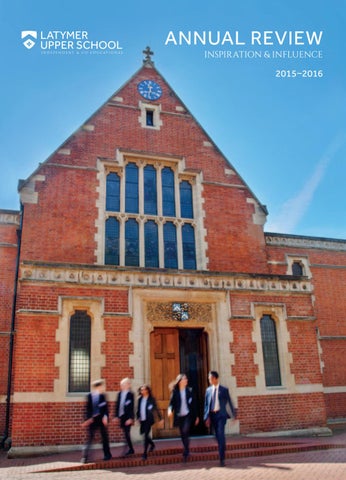
ANNUAL REVIEW INSPIRATION & INFLUENCE
2015–2016
L AT YM ER U PPER SC HOOL AN N UAL RE VIE W
2015– 2016
01
Welcome to our third Annual Review. In this edition we’re celebrating the origins and ethos of the Latymer Foundation at Hammersmith, established nearly 400 years ago by our founder Edward Latymer. Upon arrival at the School the keeneyed visitor will spot a few visual references to the Foundation. Above the wooden doors to the Main Hall is the distinctive Foundation crest, unchanged since the School’s creation, and inside the visitor will observe the same crest set in the gothic stained glass window. While many of our alumni vividly recall the more prosaic Victorian brown tiles and august portraits of headmasters, they may be less familiar with the Latymer Foundation and its central role in our School’s history - an omission we hope to right in the pages of this Review. The alumni featured in this year’s ‘In Conversation’ series typify the Latymer spirit: big thinkers and influencers within the fields of science, drama, politics, design and academia, who inspire on the local, national and world stage.
02
L AT YM ER UPPER SCHO O L A NNUA L REV I EW
2 01 5 – 2 016
CONTENTS WELCOME FROM THE HEAD David Goodhew
2
LATYMERIANS: IN CONVERSATION Jim Smith
6
Niel Bowerman
10
Deyan Sudjic
14
Natalie Abrahami
18
Andy Slaughter
22
EDWARD LATYMER: INSPIRATION AND INFLUENCE Amanda Scott
26
FINANCIAL REVIEW Key Financial Facts
30
Financial Highlights
33
Governors and Committees
34
Advisers and Credits
36
L AT YM ER U PPER SC HOOL AN N UAL RE VIE W
2015– 2016
1
The challenge for us is how to ensure our education equips and inspires our students to excel in the wider world.
2
L AT YM ER UPPER SCHO O L A NNUA L REV I EW
2 01 5 – 2 016
WELCOME FROM THE HEAD david goodhew ma (oxon) frsa
F
or the Greeks and Romans, education meant ‘rearing’ and training children to follow in their parents’ footsteps. Girls, therefore, required little schooling, as they could learn ‘on the job’ by spending time with their mother; poor boys required little schooling, as they could learn ‘on the job’ by helping their father in the fields or the pottery. Schooling (a word derived, somewhat ironically, from the Greek word for leisure) was largely reserved for the elite, who needed skills in rhetoric and literature to thrive in politics and society. In all cases, education could be entirely ‘useful’, as a child’s future was fixed and known in advance.
For Latymer Upper, whose origins lie with the poor and a desire for social mobility, this answer will not do. Access to an academic education, rather than a utilitarian or vocational education, is fundamental to changing lives and raising aspirations. However, the challenge for us is how to ensure our education equips and inspires our students to excel in the wider world. The impact of Moore’s Law, coupled with advances in robotics and artificial intelligence, means that our students will require more than academic subject knowledge to thrive in the twenty first century and cope with the ‘disruption’ that all traditional careers and professions will experience. How do we ‘future-proof’ Latymerians when we can’t know, and don’t wish to predetermine, what they will do? Firstly, we need exceptional teachers. Research has consistently shown that quality of teaching is one of the most important and decisive factors in improving educational outcomes. Research by the
L AT YM ER U PPER SC HOOL AN N UAL RE VIE W
2015– 2016
Above all, at Latymer we promote a love of learning for its own sake, which is vital for intrinsic motivation, itself required for persistence and resilience in the face of failure. University of Durham has also shown that the best teaching is both inspirational and scholarly, as many Latymerians will recall fondly. With this in mind, we have introduced a strong focus on making our teachers the best they can be by imbuing a coaching culture and a new professional review system. Rather like university dons, our teachers now have protected time for professional development, as well as the opportunity to engage in action research overseen by the Harvard Graduate School of Education. They are also able to share good practice using IRIS lesson-observation software. Secondly, we need a modern and global curriculum. In Years 7 and 8, all pupils study Spanish and Mandarin, while coding and computer science are taught to all pupils in Years 7-9. Building on our successful ‘World Perspectives’ course, studied in Years 10 and 11, we have introduced a ‘Global Goals’ course for Year 9 that critically examines the 17 sustainability targets set by the UN. We have recently joined the Round Square group of schools, an organisation that has existed for 50 years and unites 150 schools in 40 different countries. Round Square schools subscribe to six core values summarised by the acronym IDEALS: international understanding, democracy, environmental stewardship, adventure, leadership, service. This will provide our students with opportunities to engage in projects with their peers across the globe, often digitally, but also physically.
3
Latymer is a full Global Member of Round Square which celebrates the ideals of Internationalism, Democracy, Environment, Adventure, Leadership and Service.
Issues studied in World Perspectives include the refugee crisis, Brexit, econonic globalisation, sustainability and geopolitics.
Thirdly, we need to focus on learning. In particular, we emphasise the value of scholarship because it promotes independence of thought, adaptability, the ability to make connections and identify patterns, to apply existing knowledge and understanding to new situations. We also prize creativity and the ability to ‘think out of the box’, because it incorporates curiosity, originality, flexibility, divergent thinking, messiness, risk-taking, and collaboration. Above all, at Latymer we promote a love of learning for its own sake, which is vital for intrinsic motivation, itself required for persistence and resilience in the face of failure. All of this leads towards a ‘growth mindset’, where ability is not fixed by destiny, genetics, or socio-economics, but is capable of improvement.
educational strategy. By the time they leave us, we want our students to be:
It goes without saying that the scale of our ambition far exceeds the capacity of reductive league tables to describe, and so we have developed our own learner profile to measure the success of our
4
• curious and questioning, with a love of learning for its own sake • principled and responsible, acting with integrity, respecting justice and ethics • open-minded and tolerant, displaying empathy and compassion • critical, creative, flexible and resourceful • hard-working and committed, understanding the value of effort and persistence • believers in a growth mindset, where intelligence and ability are not immutably fixed • courageous and resilient • confident, reflective, mindful and self-aware • global citizens, interested in the world around them • concerned to promote international understanding, human rights and social justice • sensitive to the importance of sustainability and the environment
L AT YM ER UPPER SCHO O L A NNUA L REV I EW
2 01 5 – 2 016
• able and willing to act for a better world, whether as an individual or in collaboration with others Although many of the features of this educational strategy have been developed in the last four years, it is striking how they resonate with many of the aspects of a good education that Latymerians have always held dear. For example, the far-sighted compassion that led to the founding of the Hamburg exchange back in 1948 would be an excellent corrective to much of the xenophobic rhetoric currently surrounding Brexit. A liberal respect for diversity has always been the hallmark of a Latymerian, and this mindset has never been more needed in view of the present international situation.
The alumni interviewed for this Annual Review exemplify our approach to learning and provide inspirational examples of the value of thinking ‘outside of the box’ - a skill we help develop in all our pupils and one that will enable them to flourish in our rapidly changing world. Further examples of those who share this flexible and resourceful mindset can be found in our Think Out Of The Box film clips which we hope will inspire all pupils: www. latymer-upper.org/whats-on/think-out-of-the-box We emphasise the value of scholarship because it promotes independence of thought, adaptability, the ability to make connections and identify patterns, to apply existing knowledge and understanding to new situations.
A Think Out Of The Box talk from neuroscientist Mary Lou Jepsen focused on the new technologies she’s helping to develop that will one day read people’s thoughts.
L AT YM ER U PPER SC HOOL AN N UAL RE VIE W
2015– 2016
5
I want to champion basic science: research that is conducted for its own sake. It’s so important because you have no idea what you will discover and where it might lead eventually, be that next week, next year or next century.
6
L AT YM ER UPPER SCHO O L A NNUA L REV I EW
2 01 5 – 2 016
JIM SMITH director of science, wellcome trust in conversation with matthew bond, class of 1978
S
ir Jim Smith is one of the most eminent developmental biologists this country – and certainly Latymer Upper – has ever produced. His pioneering work on the development of frog embryos – and particularly the chemicals that control that development – saw him elected a Fellow of the Royal Society at the early age of 38 and he’s been at the heart of the biological and medical establishments ever since.
Currently, he’s Director of Science at the Wellcome Trust, and yet at Latymer he didn’t study biology at all. Not at O level, not at A level – never. Small wonder he’s been dubbed ‘the accidental biologist’. It wasn’t until he got to Cambridge to read Natural Sciences – then, as now, the umbrella degree under which pretty much all scientific disciplines are studied – that his Director of Studies at Christ’s College, Douglas Barker, gently steered him towards biology for the first time. “We had to pick a range of options for our first year and I remember him saying ‘try doing Biology of Cells’. So I did. And that was it, that was the epiphany.” Never under-estimate the importance of pedagogy – it can have such a profound impact in shaping individual lives. It was a handy one too, as he admits, with his hitherto impressive maths beginning to hit a ceiling and his physics likely to suffer in time as a result. But combine chemistry – honed at Latymer by the likes of Dr David and a young Chris Hammond – with his new-found passion for biology and you can already see the path that lay ahead. L AT YM ER U PPER SC HOOL AN N UAL RE VIE W
2015– 2016
He’s profoundly grateful for those who steered him on his way – academics like Dr Barker at Christ’s and the great developmental biologist and thinker Lewis Wolpert, under whose supervision he came at the Middlesex Hospital Medical School (now UCL) while studying for his PhD. It’s important to recognise just how vital this sort of guidance and mentorship can be, he believes. “Never under-estimate the importance of pedagogy – it can have such a profound impact in shaping individual lives. That’s why teaching is such a noble calling. They really should give out prizes for it.” That inevitably raises the question of what influence Latymer has had on Smith’s life and career. “First of all, it got me into science and into Cambridge; both things for which I will always be grateful. Going up through the School I think I’d
KEY FACTS Class of 1972 Important influencers: Douglas Barker, Director of Studies at Christ’s College; Lewis Wolpert, Middlesex Hospital Medical School Higher education: Christ’s College Cambridge, Natural Sciences Appointments: Wellcome Trust; Medical Research Council; Francis Crick Institute; Gurdon Institute; National Institute for Medical Research Areas of research: Cancer, regenerative medicine, frog embryos
7
been as good at the arts as I was at the sciences but I chose science at A level because I had a stutter at the time and imagined that a career in science might involve less public speaking. How wrong I was!” Jim enjoyed virtually all his time at Latymer but, like so many of his generation, he absolutely loved the Sixth Form. “While I was studying for O levels, London was still very much caught up in the ‘swinging sixties’ and Latymer seemed an integral part of it; embraced it even. It was a very cool place to be.” By the time Jim joined the Sixth Form, it was even better as the wearing of school uniform had just been abolished. Suddenly, the Sixth Form common room was awash with bell bottoms and floral shirts, while there were rumours – no doubt unfounded – of the controversial Schoolkids issue of Oz magazine being put together in the art room.
“It was a great time to be a young person and a great time to be at Latymer,” Jim recalls: “I blossomed in the Sixth Form – I enjoyed what I was doing academically and studied hard but I also loved what happened after school, particularly on a Friday. I loved the Gild, the fact that Godolphin girls came and that we all went to the Ravenscourt Arms afterwards. It was just great fun.” “And one of the things about Latymer is that you meet such interesting and clever people from all sorts of backgrounds. And I think that’s the really valuable thing the school gave me – the social skills, the ability to communicate and to get on with people. If I have any talent for running organisations now, it’s got a great deal to do with what I learned at Latymer; the people stuff.” Alongside his new post at Wellcome, Jim still has his own research team at the Francis Crick Institute looking at “the first ten hours in the life of a frog”
Science Week in March included bridge building, Science Week Bake-Off, snake dissection and a plethora of talks and activities.
8
L AT YM ER UPPER SCHO O L A NNUA L REV I EW
2 01 5 – 2 016
Michael Cheng was awarded the “Salters Horners Advanced Physics Prize” in recognition of his outstanding A Level Physics examination.
or, to be more precise, frog embryo. If that sounds a little arcane, they’re looking at how some cells know to develop into particular organs, how they know when to start dividing and when to stop, and whether they should migrate from one part of the embryo to another. That, of course, is what happens when cells are developing as they should. When they’re not... well, let’s just say that’s why Jim has spent a large part of his career working alongside researchers investigating cancer and, more recently, regenerative medicine. But just because his own research is already having far-reaching practical and medical applications (the chemical, or morphogen, he originally found in frog embryos also turns out to direct the differentiation of human stem cells) doesn’t mean he’s turning his back on “basic science”. Indeed, quite the opposite. Jim is passionate about science that has no obvious immediate application and is conducted simply to expand human knowledge. “I want to champion basic science: research that is conducted for its own sake. It’s so important because you have no idea what you will discover and where it might lead eventually, be that next week,
L AT YM ER U PPER SC HOOL AN N UAL RE VIE W
2015– 2016
Jim studied Maths, Physics and Chemistry at A level.
next year or next century. That’s what makes basic science so exciting.” “It’s a great career too. Going to the lab in the morning, working on a subject you are passionately interested in, getting reasonably well paid for it, working in a good environment alongside a team of clever people who are every bit as interested and knowledgeable about the subject as you… it’s fantastic, super-fun!” He’s equally enthusiastic about making science more open and welcoming too – to women, ethnic minorities, the disadvantaged, the disabled… anything that gets away from the lingering idea that scientific research is some sort of white male closed-shop. It’s no surprise that promoting science is top of his list of things he’d like to achieve at Latymer, where he’s a Governor. “I do want to encourage science at Latymer, particularly now the School has such wonderful facilities. Quite rightly, the School has a great reputation for producing good actors and others who work in the arts and it would be wonderful if it could be recognised for producing top scientists too.” But maybe these days with Biology A level rather than without.
9
I pointed out to the Obama campaign team that they were taking decisions that would affect the world in 30-40 years’ time and that they needed to have more young people involved. It worked; suddenly I was on board.
10
L AT YM ER UPPER SCHO O L A NNUA L REV I EW
2 01 5 – 2 016
NIEL BOWERMAN assistant director, oxford’s future of humanity institute in conversation with matthew bond
A
ll lives should have a moment of revelation, that sudden flash of insight when the clouds part, the scales fall from our eyes and we suddenly know exactly what we want to do with our lives. For Niel Bowerman that moment came half-way down a mountain while on a Latymer expedition to Tibet and China in 2004.
“We’d been walking in the Himalayas at over 5,000 metres and one of our guys developed altitude sickness,” he recalls,“ after 24 hours he wasn’t getting any better and our guide said we had to get him down to lower altitude. Eventually we got to a tiny hamlet and, in the space between the two or three small houses there, I saw this strange, highlypolished bowl with a kettle suspended over it.” “There was no fire, no flame and certainly no electricity but, when I put my hand out, the kettle was hot, really hot. And that was the moment when I knew what I wanted to do.” What Niel had stumbled across was a parabolic solar cooker that harnesses the sun’s rays to cook food. They are fashion items in places like California but in parts of the developing world, especially where fuel sources are scarce, they are a vital part of daily life. “I realised that I wanted to be helping the world get so much more of our energy needs from renewables.” What makes Niel so remarkable was both his enthusiastic commitment to this new mission in life and the dazzling speed with which he has been able to put it into hard practice. By the end of his first year reading physics at Oxford, he’d led a campaign that resulted in the L AT YM ER U PPER SC HOOL AN N UAL RE VIE W
2015– 2016
I particularly liked the Latymer belief that you can have a go at anything and shouldn’t be confined by your A level choices. university becoming what was then one of the biggest institutions in the country to commit to a long-term contract to take its electricity needs from renewable resources. By the end of his third year, and still very much an undergraduate, he was on Barack Obama’s Energy and Environment Team ahead of the 2008 election. When we meet in Oxford’s Future of Humanity Institute, where he’s now Assistant Director, it’s clear that the pace hasn’t dropped. Not only has he found time to graduate and complete a DPhil in Climate Change Physics, he’s been Climate Science Advisor to the President of the Maldives, cofounded the Centre for Effective Altruism, sat on the executive committee of the G8 Research Group
KEY FACTS Class of 2005 School sporting achievement: Boat Club Captain Higher education: Keble College Oxford, Physics; Linacre College Oxford, DPhil in Climate Change Physics Most influential philosophers: Peter Singer and Stephen Hawking Areas of influence: Climate change scientist including Barack Obama’s Energy and Environmental Team; philanthropy; threats to the future of humanity
11
Latymerians trekking in Kyrgyzstan, Silk Route. For many students, including Niel, the World Challenge expedition is a life-changing experience.
(UK) and delivered speeches to the World Bank, European Parliament and the World Economic Forum in Davos. That’s quite some going for someone who only left Latymer Upper School in 2005. It would be wonderful if the School could take all the credit but this was a boy who had obvious environmentalist leanings by the time he arrived at Latymer. “I remember one of my teachers used to call me ‘her little environmentalist’ which might have been patronising if it hadn’t been so warm and well-intended.” Later, in a Latymer career that saw him becoming Boat Club Captain and studying Maths, Further Maths, Physics and Music Technology at A level, he also remembers an influential school assembly when a campaigning group called Envision had been invited to come in and encourage Latymerians to make a difference in their own community. “Suddenly, they were asking for a volunteer and people started shouting ‘Niel, Niel…’ and I realised that I’d become someone who liked to do things, who wanted to make a difference.” 12
Advising the future President of the United States while you’re still an Oxford undergraduate surely counts as making a difference. He laughs, admitting that it came down to luck and the realisation he had nothing to lose. “One of my close friends at Latymer was a guy called Lewis Drummond – we used to do nerdy, computer stuff together – who had US citizenship and was a supporter of the Democrat party. As a seriously good IT specialist, he’d ended up on Obama’s Technology, Media and Telecoms Team.” “So when he became aware that there was an opening in the Climate Change team he encouraged me to get in touch, even though I was revising for my third year exams at the time.” “I pointed out to the Obama campaign team that they were taking decisions that would affect the world in 30-40 years’ time and that they needed to have more young people involved. It worked; suddenly I was on board.” Talking to Niel, it’s clear that he’s a gifted and enthusiastic communicator, which stems, I suspect, from a natural eloquence and fervent L AT YM ER UPPER SCHO O L A NNUA L REV I EW
2 01 5 – 2 016
belief in what he’s talking about but also from a confidence that he’s happy to attribute to his school. “I particularly liked the Latymer belief that you can have a go at anything and shouldn’t be confined by your A level choices.” These days, he certainly encapsulates that intellectual breadth and flexibility. On paper, he’s a physicist who – when that famous butterfly flaps its wings in the Amazon and causes a storm somewhere near Chiswick – can guide you through the chaos theory maths involved.
Suddenly, they were asking for a volunteer and people started shouting ‘Niel, Niel…’ and I realised that I’d become someone who liked to do things, who wanted to make a difference.
Niel studied Maths, Further Maths, Physics and Music Technology at A level.
But in the intellectual rough and tumble of real-life, where careers don’t always take you where your A levels intended, he’s a physicist who’s relaxed and comfortably at home in an institute that’s actually part of the Faculty of Philosophy and where he’s sharing office space, coffee machines and serious research with geneticists, economists, statisticians, philosophers, political scientists…. He’s recently taken a step back from the Centre for Effective Altruism – a charity he co-founded to look at ways of quantifying philanthropy – and much of his time is now taken up by the Future Of Humanity Institute. They’re addressing the really big stuff – anything that seriously threatens the future of human existence – from rogue asteroids to nuclear war, from pandemics to runaway climate change. The latest to be added to this list is the possible risk from AI: artificial intelligence. So how does he relax and take time off from pondering apocalypse and Armageddon? “Wild swimming,” he says instantly. “Oxford is full of rivers and streams and has the most wonderful secret places for swimming. When I was a graduate student at Linacre I swam in the Cherwell every month of the year, often with a good friend who – very happily – is now my wife.”
Niel was Boat Club Captain and now relaxes by wild swimming in the Oxford rivers.
So if you spot a happy couple floating down an Oxford river one idyllic sunny day, remember all may not be as it seems. The end of the world may finally be nigh.
L AT YM ER U PPER SC HOOL AN N UAL RE VIE W
2015– 2016
13
Britain is good at this stuff but design never stands still and there are other countries looking to become pre-eminent in this field. But by doing it really, really well I hope this is a way of reminding Britain, its politicians – everyone – that this stuff matters.
14
L AT YM ER UPPER SCHO O L A NNUA L REV I EW
2 01 5 – 2 016
DEYAN SUDJIC director, design museum in conversation with matthew bond
T
he best piece of advice Deyan Sudjic ever received came from a wise old sub-editor in his first week as architectural correspondent of The Sunday Times in 1980: “Never use the word ‘fenestration”, laddie, when you can use ‘windows’ instead.”
“And, of course, he was absolutely right,” admits the man swiftly dubbed ‘Sudjic Minor’ (on account of his elder brother) when he arrived as a nervous 9 year-old at Latymer’s Prep department in 1962. His self-adopted mission to demystify and explain is what has allowed Deyan to make that toughest of career jumps: from being a highly-regarded commentator to being a leader in the field itself. That doesn’t mean he’s finally using his degree in architecture from Edinburgh University or indulging his life-long passion for good design, but it does mean the former journalist has spent the last 11 years as Director of the Design Museum, actively shaping how mass-audiences experience both. We meet in the Museum’s stunning new home in the West London landmark that both of us still remember as the Commonwealth Institute. After lying derelict and unloved for ten years, the Grade 2 listed building re-opened in its new guise in November last year, after a three year refurbishment that cost £83 million. Deyan is too media-savvy – and, indeed, naturally cautious – to start talking about success yet. But the signs are encouraging. In the first three-anda-half months of being open, they had 310,000 visitors compared to the 200,000 they might have seen all year at the museum’s old riverside home in Shad Thames.
L AT YM ER U PPER SC HOOL AN N UAL RE VIE W
2015– 2016
“No matter how much you plan something, it’s only when you open the doors that you find out whether anyone is actually going to come.” So far, however, so good. Communicating on the page is very different from talking to people – it’s definitely a skill I’ve had to learn. It’s all a far cry from the day that Deyan was summoned to see the then Headmaster of Latymer, the famously dour Ken Sutcliffe, to discuss his projected A level grades. “He told me that I’d do very well to get 3 Ds and that wouldn’t be good enough to go to university.” Reverse psychology? Deyan insists not. “I wasn’t a high flyer at school at all,” he admits. “At the time, Latymer was good at acting and sport and, like others who weren’t particularly interested in either, I found sanctuary in the art room.” Initially, he chose Art, Maths and Physics for A level but encouraged by the teaching of the then very young
KEY FACTS Class of 1970 Influential teachers: Graham Bearman and Robert Orme Higher education: University of Edinburgh, Architecture Journalistic career: Building Design Magazine; The Guardian, The Sunday Times, Blueprint, The Observer, Domus. Areas of influence: British Architecture and Design
15
Deyan studied Art, Maths and History at A level.
Graham Bearman and Robert Orme – and absolutely hating physics – he swapped the latter for History. The only early clue to the career to come was when, after a great deal of thought, he chose to spend the proceeds from an Art prize on a mustard-coloured anglepoise lamp. Regular bike rides did the rest: “I just found London a fascinating place to cycle around, slowly working out how a city is formed.” A levels proved better than expected and his place at Edinburgh was secured but Deyan quickly discovered that he had neither the patience nor the competence to ever professionally practise his chosen subject, so threw himself into student journalism and politics. Among his achievements, he recalls, was helping a young Gordon Brown become the second student rector of the university. After Edinburgh, Deyan moved swiftly into journalism – Building Design magazine, The Guardian… and subsequently at The Sunday 16
Times, a paper then at the heart of British cultural life. He remembers incoming editor, Andrew Neil, remarking: “We must be a classy newspaper if we’ve got an architecture critic.” Here he was at the centre of the design world, rubbing shoulders with the likes of Terence Conran, designer, restaurateur and founder of the Design Museum in the early 80s. When architect, publishing entrepreneur and green campaigner Peter Murray was looking for a launch editor for a new design magazine to be called Blueprint, Deyan was the natural choice. He would remain involved with Blueprint – first as Editor and then Editorial Director for over a decade. He could have stayed as a journalist and author for the rest of his working life but in the mid-90s came the career-transforming chance to jump the fence. Glasgow had been designated UK City of Architecture and Design and a Director was needed to head the two-year preparation period. L AT YM ER UPPER SCHO O L A NNUA L REV I EW
2 01 5 – 2 016
There was Arts Council money available and the chance, finally, to make his own mark. “That was the job that took me significantly away from being a journalist – which is quite a solitary occupation – to working with a lot of other gifted people.” Suddenly, he had a team, a budget, publicity responsibilities… part of which meant he was now facing the press rather than being part of it. Like many, public speaking did not come easily. But he learned from watching those who were better at it, such as the designer Paul Smith who took him on a ten-day tour of his stores in Japan. “Communicating on the page is very different from talking to people – it’s definitely a skill I’ve had to learn.” And one that has stood him in good stead throughout his career and most recently at the Design Museum where he became Director in 2006. The first task in his in-tray? To find the museum a new home. “But with the clear subtext that it should also be the finest institution of its kind anywhere in the world.”
I’ve discovered that asking for money for something you really believe in is far less difficult than asking for money for yourself. developer, who wanted to build apartments around the building, had made their contribution, we still had to go out and raise £50 million.” “But I’ve discovered that asking for money for something you really believe in is far less difficult than asking for money for yourself.” You don’t need to ask whether it’s been worth it because the evidence is all around you. “Britain is good at this stuff but design never stands still and there are other countries looking to become pre-eminent in this field. But by doing it really, really well I hope this is a way of reminding Britain, its politicians - everyone - that this stuff matters.”
“It took 10 years – much longer than I, or anyone, expected. But then the 2008 banking crisis didn’t help. However, after years exploring other sites, there came a phone call from the director of development at Kensington and Chelsea council about this building. Initially, I thought it would never work but slowly the pieces started to fall into place. We had almost no public money. Even after the The inaugural Future Skills event gave students the opportunity to discuss their work with leaders in the fields of Design and Technology.
Every year Latymer students show case their design work at the end of year show. L AT YM ER U PPER SC HOOL AN N UAL RE VIE W
2015– 2016
17
I sat in the front row and felt so involved that I had to stop myself shouting at Othello for not recognising that he was being manipulated by Iago. I was overwhelmed by the real excitement of live drama.
18
L AT YM ER UPPER SCHO O L A NNUA L REV I EW
2 01 5 – 2 016
NATALIE ABRAHAMI theatre director in conversation with chris chivers, english teacher and head of sixth form, 1994-2014
B
ack in 2005 when I took my seat at the Southwark Theatre, little did I realise that I was witnessing the start of Natalie Abrahami’s distinguished directorial career in professional theatre.
The occasion was the UK premier of Les Combustibles by Belgian novelist Amélie Nothomb, in a translation by Natalie herself, which somehow epitomises her approach to theatre: adventurous and daring in her choice of work and tenacious and indefatigable in seeing her projects through (she raised funds for the production herself). The production was described in The Sunday Times as “cerebral …. it also has fiery moral passion”. This resonated very much with the student I knew at Latymer and so, when we met up recently, I was interested to find out how her time in the Sixth Form had shaped her career, and what new directions she had taken since her London debut. Natalie was part of the first female cohort to join the Latymer Upper’s Sixth Form in 1996. During her admissions interview we had an impassioned discussion about magical-realism in the South American novel and it was clear that here was a prospective sixth former with the intellectual independence and appetite to excel at Latymer. It was no surprise that, subsequently, she won a place to read English at Christ’s College, Cambridge. I was curious as to why she had originally applied to Latymer: “I liked the idea of being a pioneer and I wanted change,” she explained. “In fact, at interview I sensed a degree of respect for students as individuals who might have their own thoughts
L AT YM ER U PPER SC HOOL AN N UAL RE VIE W
2015– 2016
to share. Latymer didn’t feel like a ‘results-based school’; people were being nurtured to be the best version of themselves.” I liked the idea of being a pioneer and I wanted change… at interview I sensed a degree of respect for students as individuals who might have their own thoughts to share. “Lessons at Latymer opened my mind; I was ready for a change. No more dictation and rote learning now; suddenly there was dialectic.” Perhaps, Natalie opines, mischievously, it was because the teachers had to work extra hard to secure the attention of boys who were not always biddable! “I thrived in the teaching at Latymer and loved the combative, robust discussion and debate.”
KEY FACTS Class of 1998 Early influential theatre: Sam Mendes’ Othello, National Theatre; Waiting for Godot, Watermans Arts Centre Higher education: Christ’s College, Cambridge; 1st in the English tripos Theatrical training: Graduate traineeship at the Royal Court; Directors’ Course at the National Theatre Awards: James Menzies-Kitchin Award for Directors
19
This year’s Latymer Middle School musical production of 'Little Shop of Horrors’ was a fiendish delight.
A career in the professional theatre was not an ambition of Natalie’s when she joined the School “I was more interested in the image, in art and photography, at the time”; like many before her and since, she was inspired by Robert Orme’s History of Art classes. It was really a chance remark I made as we planned a strategy for her Cambridge application that set her on course. “You should see as much theatre as you can; you don’t need to read it – just go and experience it.” And so she did: firstly, to the National Theatre to see Sam Mendes’ production of Othello – “I sat in the front row and felt so involved that I had to stop myself shouting at Othello for not recognising that he was being manipulated by Iago. I was overwhelmed by the real excitement of live drama”; and secondly to the Watermans Arts Centre to see Waiting for Godot, the start of an affinity with Beckett’s work that is evident even from a quick glance at Natalie’s theatrical CV.
good experience,” not least in man-management, persuading students to stay for rehearsal at the end of a school day! Her approach then, as now, focussed on “pinpointing the emotion each character would feel”. Such meticulousness is one of her hallmarks: as one critic remarked of her much lauded production at the Young Vic of ‘Happy Days’, “[Juliet] Stevenson and her director, Natalie Abrahami, make every word count”. Natalie studied English Literature, Ancient History, French and History of Art at A level.
Natalie’s school production of Oedipus Rex in the Duke’s Garden marked her directorial debut and featured a novel use of the fire-escape from what used to be the library – “a site specific production before its time,” she quips. Looking back, she is grateful that “Latymer was able to give students an opportunity to do things they were interested in”. She describes the production as a “really 20
L AT YM ER UPPER SCHO O L A NNUA L REV I EW
2 01 5 – 2 016
Surprisingly, Natalie was less involved with the theatrical world at Cambridge than one might have anticipated, pressurised perhaps by the ethos at Christ’s that everyone should get a 1st – which, of course, she did. Nevertheless, she produced work at the ADC, took on Arthur Miller’s tricky Broken Glass and also directed Neil LaBute’s Bash: Latterday Plays in the college gardens, a kind of reprise of her earlier debut show in the Duke’s Garden at Latymer. A graduate traineeship at the Royal Court before assisting Artistic Director Ian Rickson on a show at the Theatre Downstairs, were due reward for her tenacity in seeking employment in the theatre after university. The Royal Court felt like “a breath of fresh air”, a place “to study writers who are alive”. Invited to join the Directors’ Course at the National Theatre, it was there that Natalie met Carrie Cracknell with whom she applied for the position of Artistic Director of the Gate Theatre. Having “never run anything bigger than a student overdraft”, this was a formative experience, both in the rehearsal room and the back office where she spent many hours raising the necessary funding. But she loved running a building – and who would bet against her doing so again in the future.
Lessons at Latymer opened my mind; I was ready for a change. No more dictation and rote learning now; suddenly there was dialectic. In September, Natalie hooks up again with Juliet Stevenson at the Young Vic in a new play entitled Wings, an innovative, multi-media production about the early American aviatrix Emily Stinson. They love working together, in a process in which the “director must provoke confidence and positivity in her actor”, says Natalie. Employing the Socratic teaching techniques she so enjoyed in the Latymer classroom, Natalie seeks to find out what her actors are thinking and feeling, so “the student/actor can reveal things to the teacher/director”; collaboration is right at the heart of her approach to directing. To Latymerians wanting to forge a career in the professional theatre she offers this advice: “be curious – for anything really; harness and cultivate your interests; and be tenacious.” Or emulate Juliet Stevenson, whom she describes admiringly as “brave, fearless, tireless” – which is a pretty good summary too of this Latymerian and theatre director, Natalie Abrahami herself!
Many acting careers flourished on the Latymer stage such as those of the late Mel Smith (Class of 1971) and Alan Rickman (Class of 1964).
L AT YM ER U PPER SC HOOL AN N UAL RE VIE W
2015– 2016
21
You have to have ideals and an underlying set of core-beliefs that underpin everything you do but you also have to understand that real politics is about real life and real people.
22
L AT YM ER UPPER SCHO O L A NNUA L REV I EW
2 01 5 – 2 016
ANDY SLAUGHTER labour mp for hammersmith in conversation with matthew bond
F
or anyone hoping to make a difference on the national stage, who wants to wield real influence and power, you might imagine that becoming an elected politician would be the obvious first step. Andy Slaughter, who in the course of a 30-year political career, has been a councillor, MP, a parliamentary private secretary in Government and a Shadow Minister in Opposition, gives a slightly world-weary grin.
“If I’ve learned anything in my time it is that politics is about the practical rather than high principle. It’s about where people can afford to live, which hospital or surgery they can go to when they are sick and where they can send their children to a decent school.” “It’s very rare for an individual to make a difference in an altogether profound way. Some members of the post-War Labour government of 1945 definitely did and so, I fear, did Mrs Thatcher in the early 80s, albeit in a way that I disagreed with completely. And I believe Tony Blair was achieving something significant…” The Labour MP for Hammersmith pauses: “before he got involved in Iraq.” “Of course, you have to have ideals and an underlying set of core beliefs that underpin everything you do but you also have to understand that real politics is about real life and real people. So when my phone goes off early one morning with the news that they’re planning to shut Charing Cross Hospital, I not only know that I might be spending the next four years fighting its closure but I also have to understand why it matters to people.”
I loved my time at Latymer but I wasn’t particularly politically active at either school or university and I see that as a benefit now. I don’t want to discourage any young activists but it was important to me that I only came into politics once I’d gone out into the real world. It would be nice to say that understanding came from the six years (he was one of the accelerated stream boys) he spent at Latymer in the 70s but he’s rather proud of the fact that it isn’t true. Nor were the three years he spent at Exeter University particularly influential. “I loved my time at Latymer but I wasn’t particularly politically active at either school or university and I see that as a benefit now. I don’t want to discourage any young activists but it was important to me that I only came into politics once I’d gone out into the real world.”
KEY FACTS Class of 1978 Higher education: Exeter University, English Local Council: Joined Fulham Labour Party in 1983; Councillor 1986; Deputy-Leader 1991; Leader of the Council 1996 Impact on education: A founder and Governor of William Morris Sixth Form Academy in Barons Court; regularly speaks at West London schools. Supports: Fulham FC
L AT YM ER U PPER SC HOOL AN N UAL RE VIE W
2015– 2016
23
To the impartial observer, however, you can’t help but think it highly significant that it was during Andy’s first year at Exeter that Margaret Thatcher first came to power. Nothing helps one crystallise one’s own political beliefs faster than discovering a whole set of political beliefs you completely disagree with. “I found Thatcherism deeply unpleasant and unattractive. It always seemed to be about helping people who could already help themselves and never about those who couldn’t. That just seemed lazy and unfair.” If I’ve learned anything in my time it is that politics is about the practical rather than high principle. It’s about where people can afford to live, which hospital or surgery they can go to when they are sick and where they can send their children to a decent school.
the 30s and, together with Andy’s mother, had actively campaigned for the local Labour party over the years. But they were what he describes as “nonconformist” or “anti-establishment” in their political beliefs, as happy to criticise Labour when they felt the party had got something wrong as they were to praise when it had got something right. So what they passed on to their son was not a diehard devotion to the Labour cause but certainly a deep-rooted sense of social justice; of what was fair and what was not. What they started, Thatcherism finished: Andy joined the Fulham Labour Party in 1983 (the Michael Foot era he points out with another smile), became a councillor in 1986 and served as first deputy-leader and then leader of the council in 1991 and 1996 respectively.
Some politicians are born, while others are made but Andy is an interesting mix of both. Born and raised in Fulham (the Slaughters have been Fulham FC supporters for four generations) his father – a man whose own education came to an end at the age of 13 – marched against Mosley in
But throughout his 20-year career in local government he had to earn a living too, initially holding down a fast-changing succession of jobs – British Safety Council, PR man, BBC researcher – before deciding it was time to get a proper job. He retrained as a lawyer and was called to the bar in the early 90s, eventually specialising in housing and personal injury.
Latymer students debating the referendum.
Andy became MP for Hammersmith in 2010.
24
L AT YM ER UPPER SCHO O L A NNUA L REV I EW
2 01 5 – 2 016
Andy studied English, History and Politics at A level.
A first attempt to get into parliament – he contested Uxbridge in an unexpected by-election in 1997 – was unsuccessful and it wasn’t until 2005 that he was elected MP for Ealing, Acton and Shepherd’s Bush before boundary changes prompted a shift to the new constituency of Hammersmith in 2010. So how has Latymer helped shaped a political career that Andy is certainly hoping will continue for a general election or two yet? Its historical roots in West London are important, as – in a slightly roundabout way – is the charitable ethos of its founder, Edward Latymer. For while Latymer famously did his generous bit for the “eight poore boyes of Hammersmith”, almost 400 years later Andy is a Governor of the William Morris Sixth Form Academy in Barons Court, a school he helped set up in 1994. Latymer has also given him an open-mindedness when it comes to opposing views and a refreshing respect and tolerance for those who labour in pursuit those views. After seven years in Opposition, he is full of sincere admiration not just for the Labour MPs who endured 18 years in opposition after the election of Mrs Thatcher but
L AT YM ER U PPER SC HOOL AN N UAL RE VIE W
2015– 2016
also for their Tory counterparts who were in the political wilderness for 13 years after Tony Blair’s election in 1997. Despite serving as a Parliamentary Private Secretary to three ministers under both Blair and Gordon Brown, Andy is that rare politician – happy to admit that the Government he served in might have made the occasional mistake and to concede that David Cameron’s coalition Government might have done “one or two” good things. Latymer was a direct grant grammar school when Andy was here but, for a Labour MP, he’s relaxed and tactful about its independent status. Indeed, he’s just become a member of the Sports Club as all alumni and former parents are invited to and he regularly visits the School both in his capacity as an alumnus and as its local MP. “I’m in favour of all good schools and I’m as happy to visit Latymer as I am the West London Free School, St Paul’s Girls School or the Phoenix Academy. In fact, it’s one of the nicest things you do as an MP. You get real interest and enthusiasm from the young people and, of course, better questions!”
25
Edward Latymer’s spirit continues to live on through the Latymerians who have benefitted from his vision and have gone on to achieve so much in the world.
26
L AT YM ER UPPER SCHO O L A NNUA L REV I EW
2 01 5 – 2 016
EDWARD LATYMER: INSPIRATION & INFLUENCE amanda scott MA (OXON), director of development
O
ne of the most pleasurable parts of my job is to welcome back to the School Latymerians who are making an impact on society in their chosen fields. Many – such as those featured in the previous pages – are highly respected thought leaders from the worlds of politics, design, science and the performing arts. Whatever their field, they all agree that it was their Latymer education that encouraged them to be bold in their thinking and to question the status quo.
The first port of call for many visiting Latymerians is invariably the School Archives. For many of our alumni this is a trip down memory lane where they can spot their old blazer, class photos or even their school reports (though perhaps not such a pleasant memory for some!). It is also a moment to stop and consider how much in common our influential Latymerians have with the founder, Edward Latymer, who created our School with a single act of philanthropy. He too was a bold and ambitious thinker who read Law at St John’s College Cambridge before becoming Clerk and Attorney to the Court of Wards and Liveries. He lived in Fleet Street and worshipped at the Church of St Dunstan’s, where he was buried, and may very well have been a friend of its most distinguished Vicar, the metaphysical poet Dr John Donne.
revenues from the Latymer Foundation’s lands paid for local boys (and even some girls during the 18th century, which was unusual at the time) to be educated in local schools. Then, in 1895, the Trustees of the Latymer Foundation decided to establish Latymer Upper School which opened its doors on King Street with 106 pupils. Latymer has always drawn children from diverse backgrounds. At the beginning of the 20th century many of these children were beneficiaries of either Latymer Foundation scholarships (or ‘bursaries’ in today’s parlance) or scholarships funded by the London and Middlesex education authorities. By 1919, four out of ten pupils were receiving full scholarships; a number that continued to rise over the next two or three decades.
This year we celebrated 20 years of girls at Latymer.
A wealthy lawyer and man of property, in 1624 Edward Latymer bequeathed part of his wealth for the clothing and education of “eight poore boyes” from Hammersmith. Between 1624 and 1895 the
L AT YM ER U PPER SC HOOL AN N UAL RE VIE W
2015– 2016
27
In 1944, the Butler Education Act meant the Governors had to decide between becoming one of the newly established direct grant schools or continuing with grant-aided status. The Governors chose the former. The Latymerian magazine commented, “our system of admission… will remain based strictly on a boy’s intrinsic merit and not on the financial capacity of his parents.” Half of all places were reserved for direct grant pupils, funded by the respective local education authorities, although in fact more were often taken up. The remaining places were available to fee-paying pupils, whose families could apply for generously reduced fees if their income fell below a certain threshold. In practice this meant that during the ensuing decades of the 1950s-1970s some 80% of the School’s pupils were on free places.
Scholarship and fee-paying boys studied alongside each other, with no distinctions made by the School or by the boys themselves.
Although local authority funding declined during the 1970s, Latymer still strove to maintain its treasured ethos of social and financial diversity. Scholarship and fee-paying boys studied alongside each other, with no distinctions made by the School or by the boys themselves. The abolition of the direct grant system in 1976 posed the first real threat to Latymer’s tradition of educating pupils from all walks of life in a tolerant, liberal environment. The Governors opted for independent status, rather than being subsumed
Stuart Dorrian (left), Principal of Latymer Prep is a dedicated supporter of Latymer’s bursary programme and was instrumental in setting up the Latymer Prep Bursary Fund. He is seen here with Barry Southcott (Class of 1968), former Governor.
28
L AT YM ER UPPER SCHO O L A NNUA L REV I EW
2 01 5 – 2 016
Malcolm Smith (left), Latymer Foundation Archivist and former Head of Classics, looking through the School photographs with Michael Hellyer (Class of 1958).
into the state comprehensive system; they were thereby able to retain the principle of selection on academic ability but were put on the financial defensive. Thankfully, the assisted places scheme in 1981 ensured that one-third of all pupils still received some form of financial support. Valuable as the assisted places scheme was at the outset, successive Governments did not fund the scheme adequately. Increasingly Latymer found itself spending more on the education of assisted places pupils than it was receiving in fees through the assisted places scheme. Sadly the only way to remain financially solvent was to leave the scheme, even before it was abolished in 1997. Reluctantly, but recognising they had no option, the Governors took the decision to set fees at a realistic level and, thereafter, effectively all parents then had to pay full fees. In consequence, it became much more difficult to accept boys from poor families. Indeed, by 1998 there were only two full bursaries available at Latymer, funded by the Foundation. The School was unhappy at this inevitable outcome and the Latymer Development Office was set up in 2004 to help rectify it. A central task for the Development Office is to ensure that the School continues to fulfil its founder’s vision – as relevant today as it was in 1624 – by securing private donations of all sizes that in turn fund additional bursaries. L AT YM ER U PPER SC HOOL AN N UAL RE VIE W
2015– 2016
… the School aspires to be in a position to double the size of the bursary programme and to build the endowment for bursaries to protect them for generations to come.
In 2002 the best efforts of the School meant that there were seven children in receipt of full bursaries. As of September 2016 there were 130 Latymer pupils receiving bursarial support. Of these the majority receive fee remission of between 75% – 100%. The School is justifiably proud at having made such strides, and plans to achieve a great deal more by building on the legacy and ambition of our founder. Edward Latymer’s spirit continues to live on through the Latymerians who have benefitted from his vision and have gone on to achieve so much in the world. It is with their help that we will achieve our ultimate aim to ensure that no child who is worthy of a place at Latymer is prevented from taking up that place for financial reasons. For the first stage of that journey, the School aspires to be in a position to double the size of the bursary programme and to build the endowment for bursaries to protect them for generations to come. We hope that Latymerians from all decades and generations will support our ambition and join us on this journey. 29
KEY FINANCIAL FACTS at 31 august 2016
million
£6.1
million
£26.8
The Foundation retained bank loans totalling £10.6m to help fund buildings including the new Sports Centre
The year’s net movement in funds
The value of the Foundation’s investments
£2.7+
£13+ million
£2.0+ million
The value of all donations received during the year
Amount raised for bursaries over the last decade
Amount expended on bursaries and scholarships this year
£10.6
million
million
TOTAL FUNDRAISING INCOME 2005/06 TO 2014/15 (£M) 22 20 18 Gross cumulative amount raised for all projects (including gift aid claimed)
16 14 12 10
Gross cumulative amount raised for bursaries (both current and endowed)
8 6 4 2 0
30
2006
2007
2008
2009
2010
2011
2012
2013
2014
2015
2016
L AT L AT YM YM ERERUPPER UPPERSCHO SCHO OO L LA NNUA A NNUA L LREV REV I EW I EW 2 01 5 – 2 016
FUNDING FOR BURSARIES 2015/2016
SOURCE OF GIFTS
Gifts to the bursaries appeal 15% Gifts from individual sponsors 31%
Parents 62%
Endowment returns 16%
Alumni 35%
School 38%
Staff, Students, Others 3%
ALLOCATION OF GIFTS
BURSARIES AWARDED
Bursaries 90% Capital Projects 7%
Total 130
Full 100% bursaries 78
Individual Departments 3%
Partial bursaries 52
THE CAMPAIGN FOR LATYMER SEEKS TO RAISE MONEY FOR:
1
Enhanced bursary provision at Latymer Upper School and Latymer Prep
2
L AT YM ER U PPER SC HOOL AN N UAL RE VIE W 2015– 2015– 2016 2016
Investment in the curriculum and academic teaching staff
3
Ongoing improvements to school facilities
31
32
L AT L AT YM YM ERERUPPER UPPERSCHO SCHO OO L LA NNUA A NNUA L LREV REV I EW I EW 2 01 5 4 – 2 015 016
FINANCIAL HIGHLIGHTS
Income and Expenditure
Investments (£m)
For the year ended 31 August 2016 £000 Incoming Resources School fees
23,774
Less bursaries & scholarships
(2,080)
Net school fees
21,694
Other income
1,097
Donations and gifts
2,748
Investment income
690
Investment
26.8mproperty 0.9
Restricted funds2 2.9
Expendable endowment1 10
Total 26,229 Expenditure 21,722 Other gains & (losses) On investment assets
2,002
Defined pension scheme
(467)
Investment property 0.9
Restricted funds2 2.9
6,072
Permanent endowment funds 9.3
Unrestricted funds 3.7
Expendable endowment1
1 Donated over the last 10 years to endow bursaries and 10 scholarships 2 Given by donors over the last 10 years for current bursary and (£000) scholarship support Unrestricted 12
funds 3.7
10
NET MOVEMENT IN FUNDS
Permanent endowment funds 9.3
Bank loans and overdrafts
8 6
For further information please refer to the Annual Report and Accounts at www.latymer-upper.org or on the Charity Commission’s website.
(£000) 412 210 08 2009
2010
2011
2012
2013
2014
2015
2016
6 4 2 0
L AT YM ER U PPER SC HOOL AN N UAL RE VIE W
2015– 2016
2009
2010
2011
2012
2013
2014
2015
2016
33
GOVERNORS AND COMMITTEES 2015-2016
GOVERNORS OF THE LATYMER FOUNDATION
EDUCATION COMMITTEE
INVESTMENT COMMITTEE
Simon Downham (Ex-officio) Lucinda Evans (Clerk) James Graham (Chair) 1976 Stephen Hodges 1972 Nicholas Jordan 1977 Joanna Mackle Alexander Plavsic 1983 James Priory Rosemary Radcliffe Margaret Salmon Tracey Scoffield Hugh Sloane 1974 Jim Smith 1973 Rosalind Sweeting Julius Weinberg 1972 John Wotton 1971
Stuart Dorrian David Goodhew Helen Lowe Andrew Matthews Richard Niblett James Priory Margaret Salmon Jim Smith 1973 Angela Tomlinson Julius Weinberg 1972
Judy Bollinger Gerald Davies Rosemary Radcliffe Paul Taylor 1976 John Tyrwhitt
Today’s Board of Governors (see www.latymer-upper.org for Governors’ biographies)
34
L AT YM ER UPPER SCHO O L A NNUA L REV I EW
2 01 5 – 2 016
FINANCE & GENERAL PURPOSES COMMITTEE
COMMUNICATIONS COMMITTEE
AUDIT AND RISK COMMITTEE
Stuart Dorrian David Goodhew James Graham 1976 Stephen Hodges 1972 Nicholas Jordan 1977 Andrew Matthews Richard Niblett Margaret Salmon Amanda Scott Angela Tomlinson John Tyrwhitt John Wotton 1971
Susan Bartholomew Matthew Bond 1978 Adrianne Brewer Sian Davis David Goodhew Joanna Mackle Tracey Scoffield Amanda Scott Adam Toop 1984 Charles Wijeratna 1986
Gubby Ayida Alexander Plavsic 1983 Rosalind Sweeting
L AT YM ER U PPER SC HOOL AN N UAL RE VIE W
2015– 2016
35
ADVISERS
CREDITS
Bankers
Photo credits
National Westminster Bank 22 King’s Mall London W6 0QD
Our warm thanks go to:
Investment Advisers Smith & Williamson Investment Management LLP Portwall Place Portwall Lane Bristol BS1 6NA
Mark Pain, Class of 1988: Award-winning professional photographer www.markpain.com Pages 6, 10, 14, 18, 24, 32 Lindsey Smith, photographer Pages: Front cover, 2, 26 Guest Interviewers Matthew Bond, Class of 1978
Insurance Brokers Marsh Ltd 9-17 Perrymount Road Haywards Heath West Sussex RH16 3DU
Chris Chivers Design www.mercerdesign.com
Solicitors Farrer & Co LLP 66 Lincoln’s Inn Fields London WC2A 3LH DAC Beachcroft LLP 100 Fetter Lane London EC4Y 1BN Auditors BDO LLP 2 City Place Beehive Ring Road Gatwick West Sussex RH6 0PA
36
L AT YM ER UPPER SCHO O L A NNUA L REV I EW
2 01 5 – 2 016
Photo back cover: Latymer Foundation crest on a flag that previously belonged to the Latymer Foundation School. This is the crest of The Latymer Foundation at Hammersmith, the charitable trust governing Latymer Upper and Prep School. Latymer Foundation at Hammersmith Registered Charity No. 312714 L AT YM ER U PPER SC HOOL AN N UAL RE VIE W
2015– 2016
37
Latymer Upper School King Street Hammersmith London W6 9LR 0208 629 2024 head@latymer-upper.org www.latymer-upper.org
38
L AT YM ER UPPER SCHO O L A NNUA L REV I EW
2 01 5 – 2 016