CACH
FEEDER NEWS APRIL 2022
STAY ALIVE
R OLL ROLL TEXT WITH SAFET SAF ETY Y AND SAFETY APRIL-2022 IS DISTRACTED DRIVING AWARENESS MONTH of
s
eW
rive r
Safety
tD
Home
Th
ce vi
Un it
Parcel Se r ed
o r l d ’s S a f
es
DON’T DRIVE
@ CACH Feeder /
@ CACH CHSP
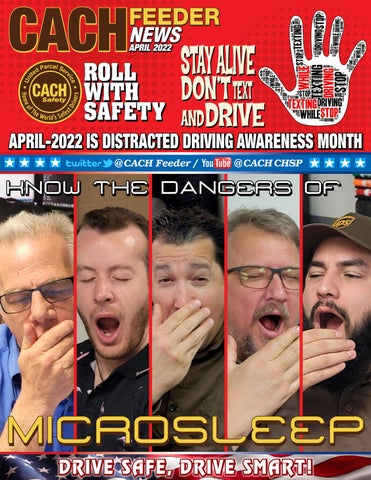
KNOW THE DANGERS OF
MICROSLEEP DRIVE S AFE , DRIVE SMAR T!
SDTOANY ’TALIVE
TEXT
ANDDRIVE
DISTR
PUT DOWN TO A P DANGERO PHONE, B
HISTORY OF DISTRACTED DRI
To understand the history behind Distracte made the mistake of looking at their cell p SUV head-on. Erica passed away two days
At the time, distracted driving was hardly c decided to do the opposite. She knew that her family had to. Shelley went on to becom audiences for the next ten years, appearing she was invited to Washington DC to speak
Stories like Shelley’s are far too common a to shrink that number significantly, you cou place to be.
HOW TO OBSERVE DISTRACTE
1. DRIVE RESPONSIBLY DUH. We don’t care if your friend has to you stay alive to go to said party. 2. LISTEN TO MUSIC, PODCASTS, OR AUD What a great alternative to handicapping entertaining than discussing what you w 3. TAKE A ROADTRIP WITH FRIENDS Not only is this a fun way to bond, but yo
5 FACTS YOU SHOULD KNOW
1. YOU’RE AT A HUGE RISK Text messaging increases the risk of cra 2. TEENS ARE AT A HUGE RISK The fatal crash rate for teens is 3 times 3. TEENS ARE N Driver distract 4. MOST PEOPLE Over 80% of d changing cloth 5. SECONDS IS A Sending or re enough
WHY DISTR
A. TEXTING A People who B. IT’S ILLEGA 43 of Ameri Texas, Oklah cover textin C. TEXTING IS
STAR ST ARTT SEEING
Texters are s Answer: VER
MOTO
RACTED DRIVING AWARENESS MONTH – APRIL 2022
N THE PHONE AND PAY ATTENTION; APRIL IS NATIONAL DISTRACTED DRIVING AWARENESS MONTH. ACCORDING PHONE COMPANY SURVEY, ALMOST 100% OF INDIVIDUALS SURVEYED AGREE THAT TEXTING AND DRIVING IS OUS, BUT HALF ADMITTED TO DOING IT ANYWAY. IT MAY TAKE ONLY A MATTER OF SECONDS TO GLANCE AT YOUR BUT, IF YOU ARE DRIVING AT 60 MILES AN HOUR, YOUR EYES WERE BLIND TO THE ROAD WHILE YOU DROVE THE LENGTH OF A FOOTBALL FIELD. PLEASE DON’T TEXT AND DRIVE.
IVING AWARENESS MONTH
ed Driving Awareness Month, one can’t ignore the story of Shelley Forney. On November 25, 2008, Shelley’s life was completely changed when a driver phone whilst in control of an SUV. Shelley’s nine-year-old daughter Erica was riding her bike home, just 15 pedals away when she was struck by the s later on Thanksgiving Day.
covered in any media, let alone described as a pandemic. And while the average person suffering the unthinkable might curl into a ball of pain, Shelley the story of Erica was avoidable, and if she could tell her story to enough people, it would save another person from having to live through the grief me an independent contract safety speaker and founded a distracted driving advocacy group named Focus Driven. She would continue to speak to g on Oprah, Larry King Live, and many other shows and events. Erica’s story caught the attention of Representative Betsy Markey, and in early 2010, k at a safety conference.
and entirely avoidable in today’s society. In 2020 4,637 people died in car crashes due to cell phone and electronic device use. This month is our effort uld be saving a life. So please join us this month and make an extra effort to avoid using our phones while on the road and make our roads a safer
ED DRIVING AWARENESS MONTH
o wait until you get home to find out whether or not you’re going to Josh’s party. We would much rather
DIO BOOKS g yourself with texting! Jamming out to your tunes or listening to an epic fight scene is much more want for dinner anyway.
our friends are actually there. Plus, it’s rude to text while visiting with people.
BEFORE TEXTING AND DRIVING
ash or near-crash by 23 times.
greater than for drivers age 20 and over NOT BETTER AT TEXTING tion is responsible for more than 58% of teen crashes. E ARE HAZARDS drivers admit to blatantly hazardous behavior while driving, such as hes, steering with a foot, painting nails, or even shaving. A LONG TIME eading a text message takes your eyes off the road for about 5 seconds, long h to cover a football field while driving at 55 mph
RACTED DRIVING AWARENESS MONTH IS IMPORTANT
AND SWERVING o text and drive statistically spend 10% of their time on the road outside their lane. YIKES. AL ica’s 50 states have laws prohibiting texting and driving. South Dakota, New Mexico, Mississippi, homa, and Missouri have laws regulating it. Arizona just extended their reckless driving laws to ng. S WORSE THAN DRUNK DRIVING
six times more likely to wreck their car than drivers over the legal drinking limit. How horrifying is that? RY.
ACCESS THESE QR CODES TO VIEW THESE LIFE SAVING TIPS
ORCYCLES BIKERS HAVE BONES. DRIVE AWARE! CARS HAVE BUMPERS.
INSPECT YOUR TIRES THIS SPRING Here’s what you need to know about the changing temperatures and tire PSI. The harsh winter climate can negatively affect the performance of heavy-duty vehicles and might be the culprit for tire inflation pressure (PSI) loss and decreased safety. Proactive tire maintenance can help save truckers from experiencing issues resulting from under inflated tires. Here’s what you need to know about the changing temperatures and tire PSI as we inch closer to the spring season. Changes in air temperature affect the speed of air molecules in a tire, thus resulting in a fluctuation of PSI. This means that a truck starting its long-haul trip may notice a dramatic change in PSI by the time it reaches its destination. Hot tires can affect the sound of a tire, in addition to the pressure. Tires coming off the highway may see a 15% increase in inflation pressure compared to cold tires. Cold inflation is based on room temperature of 68 degrees Fahrenheit and does not include any inflation pressure buildup due to vehicle operation.
Managing commercial truck tires in real time Drivers will not be able to tell the exact pressure rating of the tires just by looking at them. Therefore, it is important to recognize the common symptoms of under-inflation including: the TPMS light illuminating on dashboards; reduced steering and handling; longer stopping distance; increased road vibrations; and flapping noises coming from the tires. If any of these sound familiar, it is likely time to inflate tires to avoid trouble down the road.
Driving with under inflated tires You may be wondering what will happen if you drive with under inflated tires. Running a tire under the recommended PSI can reduce tread life and cause a substantial reduction in fuel economy. When tires are under-inflated, the rubber to ground ratio is off and leads to an increase in friction. In turn, it causes overheating and premature wear and tear on tires (or even a blowout). The U.S. Department of Transportation has mandatory minimum requirements for tread depth on all commercial vehicles, 4/32-in. for the steer tire position and 2/32-in. in all other positions to ensure commercial truck tires have the appropriate level of tread for operation. Because of these DOT requirements, truckers will want to inspect tires for proper PSI and tire tread before making deliveries and pickups.
Exploring the numbers PSI is a unit of measurement that is up for debate within the trucking community. When looking at the right PSI amount for inflation, the consensus is that PSI in heavy-duty applications will be based on several factors, including the maximum load capacity of each vehicle. Other factors include whether trucks are using “steer” or “drive” tires; the brand of tires; and the size of the tires. There is a maximum cold inflation pressure stamped on wheel rims that should not be ignored. It is usually set at 120, 130, or 140 PSI. In most cases, steer tire pressure can be set at 110 PSI while drive tire pressure can be around 85 PSI. Tire inflation can be measured using a universal tire pressure gauge like a stick gauge. This type of tire pressure gauge has a 3 PSI plus or minus accuracy rating and can be verified for accuracy using a master gauge. To use a stick gauge, drivers will simply remove the valve cap from each tire and place the pressure gauge on the valve stem. Then, press down hard enough to hear a hissing noise that will tell them the PSI amount for each tire. If tires are set below 85-110 PSI, it is time for inflation. The jury is still out on the perfect PSI numbers; but one thing is for sure, the weather outside can affect tire pressure. As we approach the spring season, be sure to pre-inspect tires for appropriate tire pressure levels based on application and other factors including maximum load capacity and tire size. With these tips, you can cruise the open road without worrying about blowing tires and missing deadlines.
Do YOU Need Socks?
It's that time of year again! when we trade in our
sporting official ups branded socks. To order you
username, pp@ups= password. Cost is $10.92 for a
KICK THE HABIT!
LETS DO OUR BEST TO AVOID ON-ROAD TIRE FAILURE AND INJURIES ASSOCIATED WITH KICK-CHECKING TIRES.
A very important part of your daily pre-trip inspection is checking tire air pressure for proper inflation. Low tire pressure is one of the leading causes of on road blow outs. Low pressure builds up heat, which in turn is the source of delamination and tire failure. This is commonly done by striking the tire with an instrument or favorite foot, this practice is only accurate to a point and does not give true inflation pressure. What it does give is a sound tone that signals you are at least in the ball park. What you are listening for is that tell tale sound or thump that you do not have a problem with that tire....sort of, but If your actions are not satisfactory then more in-depth action is needed, mainly a trip to the shop to get it checked out by the pro’s.
What you also must be conscience of is not to injure yourself while kicking your tires, you can easily sprain your ankle or toe, and sprain the arch of your foot, not to mention breaking your foot or toe in the process as well. When KickChecking your tires use the heel of your foot for safety, or choose a favorite tool such as your pin puller, a hammer or tire thumper. Make sure you have your listening ears on so you can hear a good solid THUD when you strike the tire. IF YOU DO HAVE A BLOW OUT ON ROAD: Try to get to an exit, rest area or truck stop. If that’s not possible, get over to the right side of the shoulder as best you can. ON ROAD TIP; If you see gators (tire blow out remnants) on the road, expect to see a tractor trailer on the should in the near future, don’t drive over the gators.
OR YOUR PIN PULLER
USE THE HEEL OF YOUR FOOT
TIRE THUMPER IS GOOD ALSO
A HAMMER WILL DO
r long pants for shorts, and you know you can't wear shorts without
urs go to
www.aramark-uniform.com\upsperpurchase\ type in pp@ups =
a six-pack of socks, sizes are S/M/L/XL, your feet will Love You for it!
Know the Dangers of
Microsleep Perhaps you are watching a movie and jerk yourself awake multiple times. Maybe you are driving at night and awaken when your car crosses a rumble strip. In both cases, you have experienced microsleep. Microsleep can be dangerous or just annoying, depending on when it happens. WHAT IS MICROSLEEP? Microsleep refers to episodes of sleep lasting less than 30 seconds. Often, you aren’t aware of them. You may have multiple episodes of microsleep close together, as you try — and fail — to stay awake. Often in microsleep, your brain flips rapidly between being asleep and being awake. Each sleep period lasts only a few seconds. A period of sleep needs to last at least a minute before the brain can register it.
You may have experienced microsleep if: • You’re awakened by body jerks or your head falling forward • You find yourself yawning or blinking excessively • You aren’t aware of something that just happened • You have trouble processing information
Dangers of Microsleep While Driving If you are home on your sofa, microsleep may be an irritation, but it’s unlikely to be dangerous. In other situations, microsleep can pose a threat to yourself and others. Driving while experiencing microsleep is a common hazard. The National Highway Traffic Safety Administration estimates that up to 6,000 fatal crasheach year may be linked to drowsy drivers. In one survey, 4% of drivers said they had fallen while driving at least once in the past 30 days.
es asleep
Microsleeps are especially dangerous for drivers because of the short time it takes to make a serious mistake at the wheel. If you doze for 3 seconds while going 60 miles per hour, you can travel 300 feet in the wrong direction. This can put you off the road or into an opposing lane of traffic.
Other Dangers of Microsleep Public safety is threatened when certain workers experience microsleep. Microsleep can be especially serious if you work as any of the following: • Pilot • Air traffic controller • Truck driver • Locomotive driver • Process worker in a plant or refinery The medical field is another field where sleep deprivation can have a serious impact. Several studies have shown that needlesticks and injuries with sharp instruments happen more often when medical workers are on night shift, extended hours, or mandatory overtime. Other medical errors may
FATIGUE/Microsleep
WARNING SIGNS
People who fall asleep for more than a few m of shorter lapses and microsleeps, which can to avoid a crash Most people are not aware o falling asleep. Studies suggest that people ca few indicators of drowsiness and drowsy dri
Microsleep and Sleep Deprivation Sleep deprivation is the main cause of microsleep. One study found that 20% of those surveyed needed 90 minutes more sleep per night than they were getting. Shift work and long hours at work are part of the problem. Round-the-clock digital access is another problem. You don’t have to have a pattern of sleep deprivation to be affected. One study found that just one night of restricted sleep (less than 4 hours) resulted in an increase in microsleep. Also, those who have regular patterns of sleep are more likely to have microsleep episodes when they lose sleep.
Other Causes of Microsleep Poor quality of sleep may also result in microsleep. Poor sleep can stem from physical and mental conditions, including: • Diabetes and blood sugar problems • Sleep apnea • High blood pressure • Obesity • Depression • Anxiety
The use of alcohol and certain medications can lead to episodes of microsleep. Antihistamines are one commonly used medicine that can cause sleepiness.
Prevention of Microsleep Short-term fixes for sleepiness can cut down on microsleep. Try these tips when you feel drowsy: • Change what you are doing. It only takes about half an hour for monotony to affect your alertness. A break
to get up and move around is especially helpful. • Take a power nap. Sometimes you can’t work your way through your sleepiness. Sleeping for 20 minutes or so can help. Set an alarm if you have trouble waking up. • Talk to someone. Conversation wakes up the brain cells. Also, talking speeds up breathing and pumps extra oxygen into the bloodstream. • Have some caffeine. Allow about 30 minutes for it to kick in. And try not to consume it too close to bedtime. For a more long-term fix, work on improving your sleep habits. Plan to spend 8 hours in bed, which will usually result in 7 hours of sleep. That’s enough sleep for most adults. Be sure to get some exercise during the day. Limit screen use near bedtime. Avoid heavy meals, caffeine, nicotine, and alcohol within several hours of bedtime.
TOP TEN Sleep Supplements of 2022
minutes are often aware of those lapses. Drivers may not be aware n also have serious consequences when a quick reaction is needed of how drowsiness affects their driving performance, even without annot reliably detect how sleepy they are. Research has revealed a iving which include:
• Frequent blinking, longer duration blinks and head nodding • Having trouble keeping one’s eyes open and focused • Memory lapses or daydreaming • Drifting from one’s driving lane or off the road
BRIANS BRIANS COOKING! COOKING! FOR YOUR HEALTH
( Access QR-Code for full Recipe & Details )
Farfalle with Spinach, Mushrooms, Caramelized Onions
FULL-RECIPE
GARDENING CAN MAKE YOU
HEALTHY CHECK IT OUT!
April Quote: “ There is no kind of ultimate goal to do something twice
as good as anyone else can. It’s just to do the job as best you can. If it turns out good, fine. If it doesn’t, that’s the way it goes.”–– Chuck Yeager.