CACH
FEEDER
NEWS APRIL 2021
of
s eW
rive r
Safety
tD
Home
Th
ce vi
Un it
Parcel Se r ed
o r l d ’s S a f
es
OLL R ROLL WITH SAFET SAF ETY Y SAFETY @ CACH Feeder /
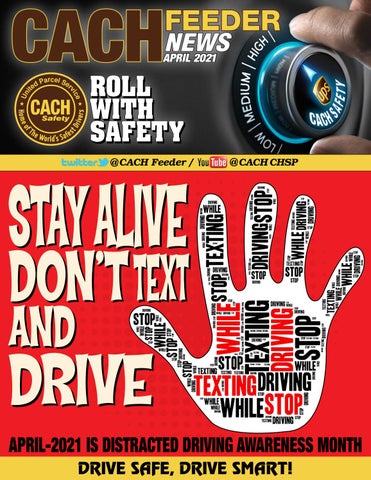
STAY ALIVE
@ CACH CHSP
DON’T TEXT AND DRIVE APRIL-2021 IS DISTRACTED DRIVING AWARENESS MONTH DRIVE SAFE, DRIVE SMART!
STAY ALIVE
DON’TTEXT ANDDRIVE
DISTR
PUT DOWN TO A P DANGERO PHONE, B
HISTORY OF DISTRACTED DRI
To understand the history behind Distracte made the mistake of looking at their cell p SUV head-on. Erica passed away two days
At the time, distracted driving was hardly c decided to do the opposite. She knew that her family had to. Shelley went on to becom audiences for the next ten years, appearing she was invited to Washington DC to speak
Stories like Shelley’s are far too common a to shrink that number significantly, you cou place to be.
HOW TO OBSERVE DISTRACTE
1. DRIVE RESPONSIBLY DUH. We don’t care if your friend has to you stay alive to go to said party. 2. LISTEN TO MUSIC, PODCASTS, OR AUD What a great alternative to handicapping entertaining than discussing what you w 3. TAKE A ROADTRIP WITH FRIENDS Not only is this a fun way to bond, but yo
5 FACTS YOU SHOULD KNOW
1. YOU’RE AT A HUGE RISK Text messaging increases the risk of cra 2. TEENS ARE AT A HUGE RISK The fatal crash rate for teens is 3 times 3. T 4.
5.
WHY
A. TEX Peo B. IT’S
43 of Texas cover
C. TEXT
STAR ST ARTT SEEING
Texte Answ
MOTO
RACTED DRIVING AWARENESS MONTH – APRIL 2021
N THE PHONE AND PAY ATTENTION; APRIL IS NATIONAL DISTRACTED DRIVING AWARENESS MONTH. ACCORDING PHONE COMPANY SURVEY, ALMOST 100% OF INDIVIDUALS SURVEYED AGREE THAT TEXTING AND DRIVING IS OUS, BUT HALF ADMITTED TO DOING IT ANYWAY. IT MAY TAKE ONLY A MATTER OF SECONDS TO GLANCE AT YOUR BUT, IF YOU ARE DRIVING AT 60 MILES AN HOUR, YOUR EYES WERE BLIND TO THE ROAD WHILE YOU DROVE THE LENGTH OF A FOOTBALL FIELD. PLEASE DON’T TEXT AND DRIVE.
IVING AWARENESS MONTH
ed Driving Awareness Month, one can’t ignore the story of Shelley Forney. On November 25, 2008, Shelley’s life was completely changed when a driver phone whilst in control of an SUV. Shelley’s nine-year-old daughter Erica was riding her bike home, just 15 pedals away when she was struck by the s later on Thanksgiving Day.
covered in any media, let alone described as a pandemic. And while the average person suffering the unthinkable might curl into a ball of pain, Shelley the story of Erica was avoidable, and if she could tell her story to enough people, it would save another person from having to live through the grief me an independent contract safety speaker and founded a distracted driving advocacy group named Focus Driven. She would continue to speak to g on Oprah, Larry King Live, and many other shows and events. Erica’s story caught the attention of Representative Betsy Markey, and in early 2010, k at a safety conference.
and entirely avoidable in today’s society. In 2020 4,637 people died in car crashes due to cell phone and electronic device use. This month is our effort uld be saving a life. So please join us this month and make an extra effort to avoid using our phones while on the road and make our roads a safer
ED DRIVING AWARENESS MONTH
o wait until you get home to find out whether or not you’re going to Josh’s party. We would much rather
DIO BOOKS g yourself with texting! Jamming out to your tunes or listening to an epic fight scene is much more want for dinner anyway.
our friends are actually there. Plus, it’s rude to text while visiting with people.
BEFORE TEXTING AND DRIVING
ash or near-crash by 23 times.
greater than for drivers age 20 and over TEENS ARE NOT BETTER AT TEXTING Driver distraction is responsible for more than 58% of teen crashes. MOST PEOPLE ARE HAZARDS Over 80% of drivers admit to blatantly hazardous behavior while driving, such as changing clothes, steering with a foot, painting nails, or even shaving. SECONDS IS A LONG TIME Sending or reading a text message takes your eyes off the road for about 5 seconds, long enough to cover a football field while driving at 55 mph
Y DISTRACTED DRIVING AWARENESS MONTH IS IMPORTANT
XTING AND SWERVING ople who text and drive statistically spend 10% of their time on the road outside their lane. YIKES. ILLEGAL
f America’s 50 states have laws prohibiting texting and driving. South Dakota, New Mexico, Mississippi, s, Oklahoma, and Missouri have laws regulating it. Arizona just extended their reckless driving laws to r texting.
TING IS WORSE THAN DRUNK DRIVING
ers are six times more likely to wreck their car than drivers over the legal drinking limit. How horrifying is that? wer: VERY.
ACCESS THESE QR CODES TO VIEW THESE LIFE SAVING TIPS
ORCYCLES BIKERS HAVE BONES. DRIVE AWARE! CARS HAVE BUMPERS.
THE CAUSES OF SEMI-TRUCK
HYDROPLANING If you have ever watched a driver in front of your slip and slide while trying to operate the vehicle in heavy rainfall, you have probably done all you could to prevent hydroplaning yourself. Hydroplaning happens when too much water accumulates in front of your vehicle’s tires quicker than your car can push the water away. The pressure from the extra water can lift your vehicle off the road and cause it to slide along the water. When this happens, you’re essentially water skiing while driving, which could be VERY DANGEROUS!
MORE ABOUT HYDROPLANING
If you are driving on a slippery road, you should drive slower, especially if you are in a large vehicle or semi-truck. It will take longer for you to slow down if the road is wet, and if you’re driving too fast, you could hydroplane, which makes the road more dangerous for you and all surrounding drivers. If you cannot avoid hydroplaning, you can regain control of your vehicle if you are paying attention. You can get your vehicle back on track by taking your foot off the gas and pushing the clutch pedal. This will slow the vehicle down and allow you to turn the wheels without resistance. Make sure that the tires are in great condition to avoid hydroplaning. If the tire pressure is low or the treads of the tires are worn, you are more likely to hydroplane. The composition of the water can also change the way it reacts with your tires. If there is oil, salts, or dirt in the water, you may be more likely to hydroplane. Remember that while hydroplaning can occur no matter how fast you are going, it is important to drive slower than 40 mph when the roads are wet. If you are a professional truck driver and you don’t keep the tires of the truck in good condition, you could be responsible for injuries if your vehicle hydroplanes and hits another automobile or a pedestrian.
HOW TO STOP SAFELY
To avoid hydroplaning, you should maintain a reasonable distance from the vehicles in front of you. This is especially important if you drive a truck that hauls heavy loads. Remember that the faster you are driving, the less time you’ll have to slow down and prevent an accident. Speeding also slows your reaction time. This means that even if you notice that you are about to get into an accident, you may not be able to brake in time to prevent it from happening. The weight of a truck can also affect the time it takes for the vehicle to come to a complete halt. Since a semi-truck is a heavier vehicle, the brakes have to work hard to stop it. This is why there are government regulations on truckload, since additional weight can determine how safe a truck is when it’s on the road in bad weather. That is why truck drivers must visit weigh stations on their assigned routes to make sure the load they are carrying is within government-mandated limits.
WATCH!
An empty truck can also be a safety hazard. The braking system on semi-trucks is designed to operate when the truck has a full load. When the truck doesn’t have any cargo, it doesn’t have as much traction, which means the truck needs more stopping distance. When the road is wet, the traction of the truck is significantly reduced, and you will have to travel at lower speeds to safely stop.
FINAL THOUGHTS
THE THREE MAIN FACTORS THAT CONTRIBUTE TO HYDROPLANING ARE: • VEHICLE SPEED - as speed increases, wet traction is reduced • TIRE TREAD DEPTH - worn tires have less ability to resist hydroplaning • WATER DEPTH - The deeper the water, the quicker you lose traction, but thin layers of water cause hydroplaning, too
WHAT CAUSES HYDROPLANING?
What it boils down to is that when your tires are moving over a wet surface too quickly there is insufficient time to channel the moisture away from the center of the tire. As mentioned, the water lifts the tire and you lose traction. The point at which your vehicle becomes waterborne is called the transition point. The transition point is determined by the following variables: • Tire size - the wider the contact area relative to length, the higher the speed needed for hydroplaning. • Tread pattern • Tire pressure • Water depth • Water composition - oil, temperature, dirt, and salts change the water • Vehicle drive-train - all wheel drive vehicles may be more likely to hydro plane in some circumstances. • Vehicle speed - always slow down when it’s wet. Hydroplaning can occur at any speed under the right combination of conditions, but some sources define higher speeds as over 40 mph. • Vehicle weight - the lighter the vehicle the greater the tendency to hydro plane. • Road surface type - non-grooved asphalt is more hydroplane prone than ribbed or grooved concrete It’s sometimes hard to tell when you’re hydroplaning. The vehicle’s rear end may be a little squirrelly. Steering may feel loose or too easy. Watch for standing water or spray from vehicles in front of you. Slow down. If you start to hydroplane, don’t apply your brakes or turn your steering wheel. Hold the wheel firmly, go straight, ease your foot off the gas until the car slows and your steering normalizes. If required to brake, do so gently with light pumping actions. For cars with anti-lock brakes, brake normally. Are your tires checked daily for wear, tread depth, and pressure? Do the people checking them know what they’re doing? Have they been trained the same way? Do they use the same equipment? Does anybody monitor the quality of their checks? Are appropriate records maintained? These things might sound basic, but they are important because you might be betting your life on them.
HOW IT HAPPENS
LIFE’’ S BAL LIFE
* Raise your Heart rate 30 min several times per week *Maintain a healthy weight *Reduce the risk of Stroke & Heart Disease
“KEEP YOUR BODY MOVING” MOVING”
GET YOUR REST!
The majority (65%) of drivers average bet ween 6 and 7 9 hours of sleep daily. (I am jealous)) Drivers are in favor Lesson learned from this is; as professional drivers we h Recognize when a nap is needed, even 5-20 minutes of r
LANCING ACT!
* 7 Hours of sleep per night is recommended *Essential for Muscle Recovery, Mental Alertness & Immune System Function
“A Well Rested Mind & Body Perform Best” Best”
7 hours of sleep per day/night. Some drivers claimed to get r of, and take advantage of a nap at a rate of 2 to 1. have to be disciplined to get the proper rest each of us needs. rest followed by a walk around the equipment can be rejuvenating.
ISAAC GREENWOOD, 710 46 YEARS SERVICE 31 YEARS SAFE DRIVING
DONALD PIETRUCHA, 705 43 YEARS SERVICE 29 YEARS SAFE DRIVING
LARRY LINGAR, 710 39 YEARS SERVICE 33 YEARS SAFE DRIVING
KEN JONASSON, 710 KEVIN SHARP, 705
37 YEARS SERVICE 34 YEARS SAFE DRIVING
31 YEARS SERVICE 26 YEARS SAFE DRIVING
DEAN BESTWINA, 705 32 YEARS SERVICE 27 YEARS SAFE DRIVING
SPRINGTIME Quote: “The only thing that could spoil a day was
people. People were always the limiters of happiness except for the very few that were as good as spring itself.” –– Ernest Hemingway.