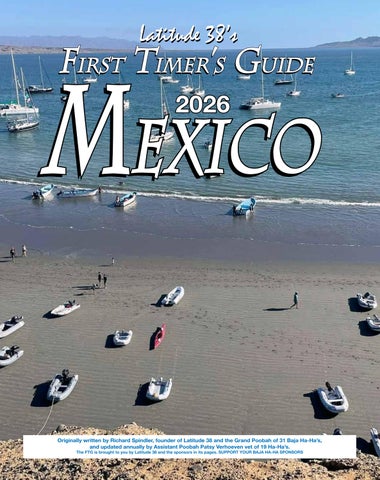
Latitude 38’s
First Timer’s Guide
Mexico 2026
Originally written by Richard Spindler, founder of Latitude 38 and the Grand Poobah of 31 Baja Ha-Ha’s, and updated annually by Assistant Poobah Patsy Verhoeven vet of 19 Ha-Ha’s. The FTG is brought to you by Latitude 38 and the sponsors in its pages. SUPPORT YOUR BAJA HA-HA SPONSORS
WELCOME BAJA HA-HA 2026 PARTICIPANTS
NOVAMAR INSURANCE HAS BEEN HELPING CRUISERS LIKE YOU SINCE 1987. Novamar Insurance Group welcomes the Baja Ha-Ha 2026 skippers and crew. The Ha Ha has always been about fun AND safety and we concur. REMEMBER TO BRING A GOVERNMENT ISSUED BOATER'S CARD OR LICENSE FOR ALL OPERATORS ABOARD YOUR BOAT TO COMPLY WITH MEXICAN NAVIGATION LAW. AUTHORITIES MAY ASK FOR IT AS WELL AS AN INSURANCE COMPANY CLAIMS ADJUSTER. Why insure with Novamar?
1. Founded in 1987 out of our love of boats and the boating lifestyle 2. Novamar has grown steadily now with 7 US offices and an office in Puerto Vallarta 3. 20 friendly and helpful bilingual staff in Puerto Vallarta for local Service in Mexico 4. Licensed in all 50 states in the USA and licensed in Mexico 5. With Novamar USA and Novamar Mexico you won’t find better Insurance options anywhere else 6. At Novamar “It’s About You, Our Client” www.novamarinsurance.com/insurance-services/yacht-insurance/quote www.novamarinsurance.com www.novamarinsurance.com.mx
Novamar Offices: Seattle/Newport Beach/San Diego/Puerto Vallarta/Sarasota/Yorktown/So. Amboy 800-823-2798 / 1-949-274-4111 CA Lic. #0I66844 2 • First Timer's Guide to Mexico
Latitude 38's
First Timer’s Guide to Mexico
Produced by the Latitude 38 staff, who remind you to 'keep in touch’ during your travels. We encourage you to email us with reports — and photos! — about interesting places you visit, or letters about issues of interest to other cruisers. Email your contributions: editorial@latitude38.com
For Baja Ha-Ha Information: Chuck Skewes, Grand Poobah: chuck@baja-haha.com Patsy Verhoeven, Assistant Poobah: patsy.baja.haha@gmail.com For Advertising and Sponsorship: Maddy Garcia: maddy@latitude38.com / 415-877-1573 www.latitude38.com
www.baja-haha.com
www.summersailstice.com
— © Latitude 38 Media, LLC, 2026 — No part of this booklet may be reproduced without permission from Latitude 38 Media, LLC. First Timer's Guide to Mexico • 3
OUR REDEVELOPMENT IS UNDERWAY BRAND NEW DOCKS, SAME PREMIER LOCATION
HARBOR ISLAND WEST MARINA SUPPORTS & CELEBRATES THE BAJA HA-HA CRUISERS, WISHING THEM FAIR WINDS AND FOLLOWING SEAS. START YOUR CRUISING SEASON WITH US. CALL OUR MARINA OFFICE FOR CURRENT AVAILABILITY. harborislandwest.com 4 • First Timer's Guide to Mexico
2040 Harbor Island Drive San Diego, CA 92101
(619) 291-6440
First -Timer’s Guide to Cruising Mexico The Big Picture
With more than 3,500 miles of coastline, the Pacific Coast of Mexico is one of the longest cruising areas of the world. Its coast is more than four times as long as the rest of Central America and Panama combined. It covers a greater distance than from Florida to South America via the Bahamas and Eastern Caribbean. And it has more coastline than the northern half of the Med. The Pacific Coast of Mexico is also one of the most desirable cruising destinations in the world. Here are just a few of the reasons why: Diversity The cruising grounds of Mexico include everything from the unique desert-by-the-sea environment of the Sea of Cortez, to the never-ending jungle coastline of mainland Mexico, to the offshore islands and those in the Sea of Cortez. North to south, that’s a distance of about 1,200 miles in latitude, which explains the wide range of geology and weather. There is also tremendous variety in the types of cruising available. There are countless remote anchorages that you can have all to yourself, particularly in the Sea of Cortez. But you can also enjoy the more cosmopolitan atmosphere of cities such as Los Cabos, La Paz, Mazatlán, Puerto Vallarta, Zihuatanejo, and Acapulco. And when you get off your boat — as all cruisers should from time to time — it’s easy to catch an inexpensive luxury bus to interesting inland destinations such as Guadalajara, Mexico City, Guanajuato, San Miguel de Allende, Oaxaca, and the Copper Canyon. The Sailing Conditions The greatest amount of sailing in Mexico is done in light to moderate conditions. Indeed, the most common complaint is not enough wind rather than too much wind. There are exceptions, of course. Sometimes it can be pretty breezy — 25 knots or more — for a day or so when sailing down the coast of Baja. Fortunately, the wind will almost always be from astern and there are plenty of anchorages in which to take shelter. It can also be nasty crossing the Sea of Cortez when a Norther is blowing, as you’ll be beam to seas that become unusually short and steep. Northers are telegraphed by high
pressure in the “Four Corners” of the United States, so nobody should get caught by surprise. For those heading to Central America, the Gulf of Tehuantepec is notorious for Tehuantepec’ers blowing 50 knots or more and extending more than 100 miles offshore, creating a huge fetch and seas that can build to well over 25 feet. Even though these are also easy to forecast, most sailors still keep “one foot on the beach” just to be sure. The “Baja Bash” is an entirely different weather proposition. There is a greater chance of more and longer safe weather windows in November, December, and January than in April or May. August is a good month, too, as it’s also warmer. When it comes to the best and most consistent daysailing in Mexico, we’d nominate Banderas Bay. It’s flat water, it’s tropical, and it’s beautiful. The winds tend to be on the light side from November through about mid-March, then breezy through April and May. Inexpensive Cruising Mexico is one of the least expensive places to cruise in the world. It starts with the Temporary Import Permit (TIP) for your boat, which only costs about $60 for 5 years. Many of the countries in the Caribbean charge you more than $50 for a week. The immigration fee, good for up to 180 days, is only about $55. Like all prices in Mexico, it varies slightly with the exchange rate. Medical and dental care are also very reasonable, often at a fraction of the cost in the States. Many U.S. insurance plans will reimburse emergency care in Mexico, but verify your coverage before departure. Based on conversations with cruiser/patients who have had everything from heart problems to cancer surgery to giving birth, the care is excellent — and more personal than in the States. But you have to choose the right hospital. If you go to the top hospitals, you’ll be stunned at how clean they are and what modern medical equipment they have. And how about this app? The super-modern American-owned hospital in the poor village of Anclote — Punta Mita — has an app for emergencies. You push the button on your smart device and it tells them exactly where to pick you up. They also do — for gringos — cosmetic surgery and fertility work. Warning: There have been cases of dramatically inflated medical bills in
Hiking and climbing can be a big part of cruising in Mexico, particularly in Baja. Don’t forget to bring water. FirstTimer's Timer'sGuide GuidetotoMexico Mexico••55 First
First -Timer’s Guide to Cruising Mexico
Cabo can be a madhouse when the fishing fleet returns in the afternoon. some tourist areas, so referrals from marinas or trusted cruisers are wise. Find your emergency care facility before you need it, as emergencies are not the time to be comparing facilities or payment requirements. Transportation, by both local chicken bus and luxury longdistance bus, offers big bang for the buck. And you rarely have to wait long for a bus. Rideshare apps in Mexico work much like those in the U.S. and Canada. Depending on the location, the most common services are DiDi, Uber, and inDrive. Domestic flights in Mexico can be incredibly inexpensive, like under $500 pesos ($30 USD) on Volaris and Viva Aerobus. Food is inexpensive at both markets and in restaurants that don’t cater to well-heeled tourists. As long as you avoid the Drunken Shrimp Tourist Trap and similar restaurants, you’ll find countless places with deals. Fellow cruisers will be happy to clue you in. Be careful though, as some restaurants include all the tequila you can drink with $12 fresh fish dinners. There is a place on the main road in Bucerias that serves more sushi than most people can eat for $15. Tacos on the street are a cruiser favorite, and it’s common for groups of cruisers to head to favorite spots en masse. The tacos are as delicious as they are inexpensive. Beer is cheap in Mexico. You can have a couple of store-bought beers every night for a month for not much more than a single bottle of vodka would run you in French Polynesia. If you have a favorite hard liquor from the States, bring an 6 • First Timer's Guide to Mexico
ample supply with you. There is a limit, but nobody seems to check. Budget Busters There are, however, three budget busters for cruisers: Marinas. These offer lots of comfort and convenience, but don’t assume they’ll be less expensive than in the States. Most, in fact, are more expensive if available at all. Fortunately, there are free anchorages in the vicinity of most marinas in Mexico. So while some deep-pocket cruisers and/or “commuter cruisers” may keep their boats in marinas most of the time, others might not spend more than a week in a marina the entire season. Tourist bars and restaurants. When you eat with the locals, the food is less expensive — and the experience is usually more fun. This holds true almost everywhere in the world. Paying for others to do your boat work. If you’re on a tight budget, you should be prepared to clean your own bottom, maintain the teak, wax the hull, and fix mechanical problems. That said, boatyard work is often less, and sometimes much less expensive in Mexico than in California. The other good news is that many cruisers are happy to help those who are just discovering the mechanical mysteries of their boats. While there is no limit to how much a month you can spend cruising in Mexico, if a couple avoids marinas, they can pretty much cruise like kings and queens on $3,500 a month. Frugal couples can have a great time on as little as $1,500 a month. First Timer's Guide to Mexico • 5
FEEL THE FREEDOM WITH HYDROVANE WINDVANE SELF STEERING: QUIET, TIRELESS, NON-ELECTRIC
EMERGENCY RUDDER /STEERING SYSTEM
INSTALL OFF CENTER AND WITH OTHER GEAR
Pearson 39: “Heavy wind and seas, or otherwise, ‘Bob’ has exceeded my expectations.
Jeanneau 43: [After colliding with an unknown object], we discovered that our main rudder was completely lost.
Roberts 44: “My setup is so cool… Hydrovane, davits, and 350 watts of solar panels.
The best part – ‘Bob’ doesn’t drink my beer.”
Without the Hydrovane, I wouldn't have a ship today. It's as simple as that.
I didn’t have to compromise!”
www.hydrovane.com
First Timer's Guide to Mexico • 7
First -Timer’s Guide to Cruising Mexico Naturally, it’s easier to get by on less money in the Sea of Cortez, where there are fewer places to spend money, than around big cities with lots of attractions, such as Puerto Vallarta. The Friendly People We’re talking about friendly fellow cruisers and about ultrafriendly and helpful Mexicans. The tropical sun is warm in Mexico, but the people — particularly the poorer people — are warmer. Yes, while drug cartel wars continue to take a terrible toll in parts of Mexico, incidents involving cruisers and tourists remain uncommon in the traditional cruising areas. And there are no “pirates” in Mexico. While you don’t want to be stupid and flash money anywhere in Mexico, or leave valuables unattended, if you’re interested in being mugged or attacked simply because you’re a tourist, you’ll have better luck if you go to certain parts of the Caribbean or the downtown areas of large cities in the United States. Many first-timers are surprised to discover the large number of gringos thriving in Mexico without undue concern for their personal safety. There are over 40,000 gringos in the Puerto Vallarta area and something on the order of 1.6 million in the entire country. As for cruisers, nowhere in the world are they more socially and group-oriented than in Mexico. Tenacatita Bay on the Gold Coast has even had a seasonal Cruising Mayor and Cruising First Lady — Robert and Virginia Gleser of the Alameda-based Freeport 41 Harmony — for 20 years. Unless you’re a hermit, you’ll make more friends in Mexico than you had back in the States. As cruisers continue on to the South Pacific or the Canal and the Caribbean, they often grumble about how cruising was so much more sociable in Mexico. Mexico Is Close to Home No matter if you’re from British Columbia, Seattle, Portland, the Bay Area, or Southern California, there are plenty of convenient flights “home” from all coastal population centers of Mexico. These flights are shorter and much less expensive than those you need to get to and from the South Pacific, the Eastern Caribbean, or the Med. And if you pick the right days, the Mexico-based flights are often very inexpensive.
ations now for
ja. Make reserv nland side of Ba ai m e th on al Marina Re ico. marinas in Mex 8 • First Timer's Guide to Mexico
all
Because of the low cost and convenience of flying to and from Mexico, many sailors can “commuter cruise,” meaning they can keep their jobs or maintain businesses up north while still being able to enjoy short to medium-length visits to their boats in sunny Mexico. Countless Attractions It’s hard to know where to start on a list of attractions for cruisers in Mexico, but we can start with great board surfing on the coast of Baja and on the mainland. In fact, there are a number of great breaks on the north shore of Punta Mita, where you can enjoy the ultimate surfer/sailor dream — being able to paddle from your boat to a great surf break. There’s also fun surf close to your anchored boat at Tenacatita Bay. The fishing is terrific everywhere in Mexico, with lots of dorado, tuna, and wahoo. Many cruisers summering in the Sea decide what they want for dinner, then grab their spearguns, dive in, and spear it. There is also whale watching on Banderas Bay, the Sea of Cortez — and in other places — from December to March, although you are not permitted to spear the whales. You can swim with whale sharks, the largest fish in the world, in the Sea of Cortez at almost any time of year. You can’t spear them either. There is excellent hiking, in both desert and jungle environments. We love hiking to the peaks of the islands in the Sea of Cortez, as well as up the jungle rivers to waterfalls on the mainland. And no matter if you like to play or just listen, the music scene in Mexico is vibrant. This is particularly true in La Cruz. In addition, there is the previously mentioned inland travel — and great tropical sailing. When To Cruise Mexico The cruising season in Mexico starts the first week in November, which is at the end of the hurricane season. Where and when the cruising season ends depends on what your game plan is and where you end up in Mexico. Many cruisers are on the “six-and-six” program. They cruise for six months — November 1 to May 1 — then do something else for six months. For the non-cruising six months, some take their boats back north, some stay with family and friends in the States, some RV the West, and the smartest ones, in our opinion, buy a little canal boat for 20k and do the waterways of
It’s easy and in expensive to ge t your daily fru requirement in it and veggie Mexico.
First Timer's Guide to Mexico • 5
Welcome to La Paz! FULL SERVICE MARINA IN DOWNTOWN LA PAZ Friendly, helpful, fully bilingual staff
Join us for the
BAJA HA-HA BEACH PARTY Friday, November Sunday, November20, 24, 4–7 4–7p.m. p.m.
La Paz Beach Party at La Costa Restaurant. Mexican folk dancing, live music, food and drinks, door prizes, and more. Free for the first 50 Baja Ha-Ha 2026 2024 participants; everyone is welcome.
Hardwood docks • Dinghy landing Protective piling & sheetpile breakwater Plug-in Internet • Cruisers’ clubhouse • Electricity Potable reverse osmosis water • And more! TEL: 01152 612 122 1646 email: marinalapaz@prodigy.net.mx email: info@marinalapaz.com www.marinadelapaz.com Apdo. Postal 290, La Paz, 23000 Baja California Sur, Mexico First Timer's Guide to Mexico • 9
First -Timer’s Guide to Cruising Mexico Europe. Staying on mainland Mexico from May 1 to November 1 is possible, but we don’t recommend it. It gets really humid, and the jungles are green because it rains so much. If you don’t have air conditioning, you’d be a masochist to stay on your boat on the mainland during the summer. Things are a little different in the Sea of Cortez, where the best of the best cruising weather is actually October and November, crossing fingers there are no hurricanes in October. And then again in April and early summer. By midsummer, it gets hot — really, really hot — in the Sea of Cortez. The Language Thanks to the increasing Mexican influence in the States, it’s easier to become semi-fluent in “Spanglish” as opposed to French Polynesian French, Caribbean Creole, or even what passes for English in the BVI and other former British colonies. Your iPhone or similar device makes learning Spanish much easier than ever. By using Google Translate — you carry an easy-to-access dictionary at all times. Furthermore, all good translation programs tell you how to properly pronounce words and sentences, and if you want, at slow speeds. And if you point your device’s camera at Spanish words even translate the words instantly. An effective technique for becoming better at Spanish is to record properly pronounced sentences that you use in everyday life. Then review them each night. It’s better than repeating the canned sentences in books or on tapes. But by far the best way to learn Spanish is to get a Mexican lover. Unlike the French, Mexicans are very tolerant of foreigners butchering their language. Minimum Mexican Cruising Boat If you’re a decent sailor, you can cruise just about any decent sailboat to and/or in Mexico. The normal minimum-size boat is 27 feet. But as Steve and Charlotte Baker, who formerly lived the suburban life in Santa Rosa, can attest, even an outboard-powered Catalina 27 can be all that’s needed for nine years of continuous cruising in
Mexico. Here’s their story: “Having become dissatisfied with our suburban lives in Santa Rosa, in 2009 we bought Willful Simplicity, a 1973 Catalina 27. Many people told us we couldn’t enjoy Mexico with our ‘mini-cruiser.’ The only person who encouraged us, and whom we used as a guiding light, was Richard Spindler, who founded both Latitude 38 magazine and the Baja Ha-Ha. Had we listened to the naysayers rather than Richard, we would have missed out on the nine best years of our lives. “We started our new life with 135 other boats in the 2009 Baja Ha-Ha, which is the 750-mile cruiser rally Richard runs each year from San Diego to Cabo San Lucas. That Ha-Ha is generally considered to have been the windiest of the 24 Ha-Ha’s to date, but we and our Catalina 27 Willful Simplicity didn’t have any problems. “We saw many beautiful places and enjoyed countless great anchorages on the way down to Cabo and up into the Sea of Cortez. But the absolute best part of our cruising was meeting the locals, especially the children, and coming to appreciate their natural way of life. We have become better people for what we’ve learned from the people of Baja. “For nine years, our homeport was more or less the tiny fishing village of San Evaristo, a popular anchorage about 50 miles north of La Paz by water. Over the years we tried to help this village as much as we could, and enjoyed the support of many cruisers in the Sea who donated supplies and equipment to the community. “Fortunately, our Catalina 27 can carry far more supplies than anyone would imagine. Indeed, it’s so roomy that Charlotte and I were constantly thinking about what junk we wanted to get off the boat. Simplicity is the best! “Our Catalina 27 has been the perfect Sea of Cortez cruising boat for us and has absolutely been the biggest bang for the buck. Who would have ‘thunk it’ when we sailed under the Golden Gate at 4 a.m. in 2009 and turned left, heading toward an unknown future? We have no regrets about the decision we
Not every Baja Ha-Ha participant starts the day with coffee. Some start with downward dog. 10 • First Timer's Guide to Mexico
First Timer's Guide to Mexico • 5
NOV
20
4PM to 9PM
MEXICAN FOLK DANCING, LIVE MUSIC, FOOD AND DRINKS, DOOR PRIZES, AND MORE! BAJA HA-HA 2026 PARTICIPANTS EVERYONE IS WELCOME!
First Timer's Guide to Mexico • 11
First -Timer’s Guide to Cruising Mexico made and will continue to live our lives in the spirit of ‘willful simplicity,’ although, after nine years, it will now be on land at Evaristo.”
would be important details for more comfortable cruising, but details nonetheless. Make sure you concentrate on the basics before moving on to the details.
Dirt-Cheap Cruising Boats Just for fun, in June a couple of years ago we looked around for very inexpensive boats that, if they passed inspection, we’d cruise to Mexico. Here are some examples we found in San Diego alone: Cal 27, $4,900; Pearson 28, $8,000; Catalina 27, $4,000; Cal 29, $5,000; Catalina 30, $9,999; Columbia 30, $8,000; Islander 30, $7,500; and a Newport 30 with autopilot, depthsounder, navigation aids, radio, fridge/freezer, kayak, roller furling and self-tailing winches, $10,000. Many of the previously listed boats had a lot of gear, too. We’re sure that a few of these boats were wrecks that might not be worth accepting even as a gift, and might even be dangerous without new rigging, new thru-hulls, and other expensive upgrades. But we’re also confident that given a little bit of knowledge and a lot of elbow grease, some of them would make fine little cruising boats for Mexico. Smaller cruising boats remind us of Christian Lauducci, who sailed across the Pacific with his wife and three kids aboard their Sausalito-based Stevens 40 Shawnigan. We first met Christian many years ago when he was cruising Mexico on his 26-footer, complete with girlfriend — and six surfboards. The truth of the matter is that a lack of money is rarely a true obstacle that prevents people from going cruising. It might be more “boat camping” than luxurious cruising if you’re on a short budget, but if you’re young and in search of adventure, it shouldn’t matter to you.
More Typical Cruising Boats The typical Pacific Coast cruising boat is about 43 feet. While they range from almost stock to having every imaginable convenience that can be put on a boat, most have quite a few creature comforts.
The Basic Requirements of a Boat As we all know, humans have five basic requirements for life: 1) Oxygen; 2) Fresh water; 3) Food; 4) Shelter, and 5) Sleep. If you’re fairly new to sailing and owning a sailboat, and not sure what the most important things are, we present the Wanderer’s Basic Boat Requirement Guide: Keep water out of the inside of the boat. Have some way to steer the boat. Have some method of propulsion. Have some way to navigate, even if it’s dead reckoning. Have some way to anchor. Everything after these five basic requirements is a detail. Some
12 • First Timer's Guide to Mexico
No Matter What Boat No matter what kind of boat you take to Mexico, you must make sure her basic features, systems, and emergency gear are in good working order. After all, you’re better off discovering that the steering cable needs replacement at the dock in California than off Cedros Island at 2 a.m. when it’s blowing 20 and some of the crew are seasick. “A stitch in time saves nine” is for landlubbers. When it comes to boats, a “stitch in time” can save 109 at sea. Furthermore, specialized marine gear is expensive and often hard to come by in Mexico. So if your gooseneck fails while you’re rounding Cabo Corrientes, you might blow a month or more of your precious cruising season trying to get it replaced. If you’re unsure how to evaluate the condition of your hull, thru-hulls, steering system and rudder, propulsion system, mast, rigging, sails, and other gear, hire a good marine surveyor. It may turn out to be one of the best investments you make. Cruising Gear, Level One An Engine. Lin and Larry Pardey cruised the world for years with their engineless 24-ft Seraffyn. And even folks with much larger cruising boats have — sometimes by necessity — cruised across the South Pacific without an engine. Heck, Steve Schmidt singlehanded his Santa Cruz 70 Hotel California throughout the Caribbean for several years without a working diesel. He and the others became more skilled sailors for not having an engine. Nonetheless, we recommend that your Mexico cruising boat have an engine. And a diesel is way better than an outboard, although the latter is better than nothing. It can be very slow going in Mexico without an engine, as there can be days in a row with little or no wind. This is particularly hard on boats loaded down with cruising gear and perhaps not having the cleanest bottom. We remember it took David Addleman six days to sail his Cal 36 Upsychia 400 miles from Puerto Vallarta to La Paz. And David, who more recently singlehanded his Santa Cruz 50 X from Malaysia to California — a distance of something like 6,000 miles — is a fine sailor. And remember, most engines pull double duty by also generating a certain amount of electricity. If you don’t have an engine, you need some other source of electrical power. Working Sails. These need to be in good shape, but shouldn’t get much wear in Mexico. And you’ll almost certainly want a spinnaker or gennaker. Sailing wing-on-wing can be extremely effective when there is a breeze, but when the wind goes light, as it often does in Mexico, there is no really good substitute for a big nylon sail. The garages of coastal California homes are full of used spinnakers and gennakers, many of them in nearly new condition. Satellite Communication. Wifi calling with Starlink, or communicating via Garmin inReach, Zoleo, and similar devices have made emergency communications easier and less expensive than ever. First Timer's Guide to Mexico • 5
all who are sailing the Pacific Coast of Mexico
First Timer's Guide to Mexico • 13
First -Timer’s Guide to Cruising Mexico Navigation Apps. Even though you can navigate with an inReach, we highly recommend you get a more dedicated navigation system, such as Navionics, Aqua Map, or iNavX operating on an iPad or similar device or a chartplotter. Navionics is all we’ve ever needed. Also remember that many charts of Mexico, are inaccurate by a mile or more, often showing you on land when you’re at sea. Which, while not good, is better than vice versa. Nonetheless, it’s important to frequently double- and triple-check your position, using a combination of things such as GPS, radar, the depthsounder, and your eyes. Some experts insist you should always carry paper charts, too. No matter if we’ve been in Mexico, the Caribbean, or Europe, we haven’t used a paper chart in years. If we were going to the South Pacific we’d take some paper charts. But for just Mexico or continuing on to Central America, we’d be happy with electronic charts and maybe a guidebook or two. Our rationale is that Mexico is one of the easiest places to navigate, with very few hazards. Caution: Despite all the incredible navigation aids now available, and Mexico navigation being rather straightforward, people still hit rocks and go aground. Be alert! Cruising Guides. According to our unofficial survey, the most popular cruising guides to Mexico are Shawn Breeding and Heather Bansmer’s Sea of Cortez: Cruiser’s Guidebook and Pacific Mexico: A Cruiser’s Guidebook. Followed by the latest edition of Capt. Pat Rain’s Mexico Boating Guide 2024 edition and Charlie’s Charts for Mexico, updated in 2015. Naturally, all of these guides have far more detailed information than we can fit in this short guide, and each one brings something a little different to the party. Of particular value in some guides are accurate GPS positions for approaches to harbors and anchorages. So even with inaccurate charts, you shouldn’t have a problem.
14 • First Timer's Guide to Mexico
If you want a real treat in cruising guides to Mexico, we recommend you go to Amazon and hunt down an out-of-print copy of Leland Lewis’s Baja Sea Guide, Volume II. The guide was published in 1971, so it’s ridiculously dated for marinas and such. But Lewis, once a prominent tuna boat skipper, packed a ton of fascinating historical and other information into his oversized volume. Information you won’t find anywhere else. We found it even more interesting than John Steinbeck’s Log from the Sea of Cortez. On the subject of printed matter, you might want to get a copy of Peter Benchley’s 1972 novel The Girl of the Sea of Cortez. It’s sort of a female version of The Old Man and the Sea and was written two years before Benchley wrote Jaws. Two Anchors. One is not enough. Steve Dashew suggests that you know your anchor is big enough when other sailors laugh because it looks so oversized. It’s good advice if you want to sleep well at night and don’t want to worry during elephantes in the Sea of Cortez. Modern anchor designs such as Rocna, Mantus, Spade, and Ultra have dramatically improved holding compared to many older designs. How much chain you need depends on the size and type of your boat, rode, and anchor. We’d say 100 feet is the minimum for a typical 40-ft boat. If you have a boat much over 30 feet or you’re much over 30 years of age, you’re going to want a windlass. If you’re going to be doing a lot of anchoring, you’re certainly going to want a power windlass, especially if you have a larger boat. No matter what kind of anchor and chain you have, make sure one of your electronic devices has an alert system or app to warn you that you’re dragging anchor. After all, it’s far easier to prevent your boat from going onto the rocks at 3 am than it is getting her off the rocks at 3 am. A Propane Stove. Forget alcohol and CNG as they aren’t available in Mexico, and the former is dangerous. But don’t forget to check your propane fittings for leaks. Every 10 years or so a cruising boat in Mexico explodes because of an undetected leak. A Windex on the Masthead. Or at least telltales on the shrouds. Even Bob Dylan recognized the need to know which way the wind was blowing. Sophisticated electronic wind instruments are great if you have them and they are working. But if your boat doesn’t have them, or they aren’t working, as on many older boats, we don’t think you have to have them. If you need to know the wind direction, look at your Windex or telltales on your shrouds. If you need to know how hard it’s blowing, stick your head outside the salon. Or look at the water and estimate wind speeds with the Beaufort Wind Scale. A Depthsounder. A depthsounder is more than handy as it allows boaters to triple-confirm their position, and helps calculate how much chain to put out. A depthsounder is all but essential on boats that are too big to be pushed off hazards. Dinghy. Inflatables are the most popular choice for dinghies: roll-up ones for smaller boats, and hard-bottomed ones for larger boats and cats. There are countless brands. Ever seen one of those weird-looking “Porta-Botes?” Over 200,000 have been sold, and lots of owners rave about them, in part because they fold up flat and are thus particularly easy to store. If you’re on a budget, get a dinghy that rows well so you don’t need an outboard. It’s good for your heart, too. Shade. Make sure your boat has lots and lots and lots of shade because there is no end to the brilliant tropical sun in Mexico. First Timer's Guide to Mexico • 5
Sailing Yachts for Sale! More than 30 yachts available Sail-away ready, with listings as low as $10K
Life’s too short for dry land, it’s time to set sail. Find your dream yacht today! Your start and home base for all things yachting. Uniquely located outside the hurricane belt in Puerto Peñasco, Mexico, Cabrales Boatyard is the launch point for your boating journey, with full-amenity dry storage and yacht servicing. We are your safe harbor in the Sea of Cortez. Our gated boatyard with 24-hour security gives you access to: • Vessel recommissioning and decommissioning • Shrink wrapping for off-season protection • Clean, private showers • Lounges and common areas • On-site apartments for rent • and much more! Explore listings, services, and more at
CabralesBoatyard.com Pricing and availability subject to change or prior sale without notice. Photos are representative and may not reflect current inventory. Services and amenities subject to availability.
First Timer's Guide to Mexico • 15
First -Timer’s Guide to Cruising Mexico
The Ha-Ha awards at Mango Deck with a view of the fleet—and a chance to celebrate friendships, adventures, and miles shared along the way. Cruising Gear, Level Two Refrigerator/Freezer. Boaters have cruised Mexico with a refrigerator/freezer and without. It’s much more pleasant to cruise with them, particularly if you like cold drinks at sunset and not having to shop for perishables every day or two. If you want to cruise with a foodie on your boat, a fridge/freezer is all but mandatory. The downside of refrigerators/freezers is that they require energy to work, and much more energy in tropical Mexico than the cold air and cold waters of California and the Pacific Northwest. In addition, fridges/freezers, particularly older ones, tend to require maintenance, if not on themselves, then on whatever system provides energy to run them. Inadequately insulated fridges/freezers, and/or inadequate energy sources to power them, are probably the most common problem for first-time cruisers in Mexico. If you have an older boat without a fridge/freezer, and some space in that boat, you might consider a highly efficient Engel, or similar self-contained portable unit. A Better Dinghy/Outboard. When cruising and not at sea or in a marina, your dinghy/outboard is your daily ride. So you need to be able to rely on it. A displacement dinghy/outboard extends your range on water much in the same way a bicycle gives you a better range than walking. And a planing dinghy is like having a motorcycle as opposed to walking. It can be a game-changer in the Sea of Cortez, although not quite as important on the mainland. How to stow your dinghy while underway is a major issue rarely given adequate consideration prior to getting to Mexico. Having to set up and break down your dinghy every couple of days gets old quickly, so make sure you figure out the easiest system possible. Dinghy davits are great if they’re already on your boat or can be fitted on your boat. Lots of first-time cruisers get dinghy davits made while in Mexico. Always lock or raise your dinghy/outboard at night! While thefts are relatively few in Mexico, replacements are very expensive. Watermaker. This is a somewhat controversial big-ticket/ installation/maintenance item. When we last polled veteran 16 • First Timer's Guide to Mexico
cruisers in Mexico and the South Pacific about the need for a watermaker, about half said they got along just fine without one, while the other half said it was absolutely essential to their cruising enjoyment. It’s the “simple is better” school versus the “I don’t want to be camping on a boat” school. Watermakers are less expensive and more reliable than they once were, but if you get one, you have to make sure you know how it works and how to replace filters and troubleshoot, that you have enough energy to run it, and that your source of energy is reliable. Chartplotter. While you’ll find chartplotters on almost all newer boats, we personally have never been that crazy about them. Our complaint is that we don’t like integrated everything because sometimes when one thing goes down, everything goes down. We bought a chartplotter because it was the only way to get radar. It is capable of doing about 10,000 things, about 9,985 more than our boat is set up for and that we care about. If we want to know the oil pressure on our engine, we’ll look at the engine instrument rather than buy a new engine that can be hooked up to the chartplotter. The bottom line is that if your boat came with a functioning chartplotter, that’s terrific. Radar. If she has a functioning analog radar, or no radar at all, it’s not the end of the world. During an interview with the great sailmaker Lowell North a few years ago, he told us he didn’t think radar had been necessary at all on his circumnavigation. Don’t get us wrong; radar is great for navigation, for avoiding other vessels, and for tracking the approach of lightning storms. AIS is a wonderful tool, but don't let it lull you into believing it shows every vessel. In Mexico and around the world, plenty of vessels of all sizes either don't have AIS or aren't transmitting. We don’t think AIS is necessary that useful after Cabo, other than for being able to identify other cruising boats around you. After all, except for crossing the Sea of Cortez, most passages after Cabo are daysails, and there just isn’t much vessel traffic out there. Power Generation System in addition to your engine. If you’re going to have a fridge/freezer, watermaker, Starlink, First Timer's Guide to Mexico • 5
VISIT
BAJACALIFORNIASUR
WWW.VISITBAJASUR.TRAVEL
www.visitbajasur.travel First Timer's Guide to Mexico • 17
First -Timer’s Guide to Cruising Mexico autopilot, honking chartplotter, use your computer all the time, and watch a lot of movies, you’re going to need a lot of power. Probably more than you think. Solar panels combined with lithium batteries have transformed energy management aboard cruising boats. If you have enough room for an adequate number of solar panels and enough budget for the lithium batteries, these are great solutions. But it’s all about minimum power out and maximum power back in and sometimes solar just isn’t enough. High-output alternator on the engine is a start. Then there’s the ever-popular — except with people anchored near you — Honda 2000i portable genset. But that means you have to carry gas for more than just your outboard. Built-in diesel gensets are terrific — except for the fact that they are expensive if not already on the boat, and are yet another diesel to maintain. And maintain them you must, lest you be one of those owners who filled his boat’s freezers with a season’s worth of meat, then had to throw it all away when the genset wouldn’t start to run the freezer. As energy demands are unique to each boat and each cruiser’s lifestyle, only you can figure out how much energy you’re going to need. Be forewarned: Most first-timers underestimate how much they’ll need. And as in all other things on boats, some sort of redundancy is a beautiful thing. SSB or Ham Radio. Cruiser's dependence on SSB and Ham radios has reduced dramatically. Given increase in satellite communication, we don’t consider SSB/Ham to be essential for cruising Mexico. Air Conditioning. If you’re going to spend the summer in Mexico, be it on the mainland or in the Sea of Cortez, air conditioning is all but mandatory. But it uses a lot of juice, so if you’re going to be on the hook, you’ve got to figure out how you’re going to power it. If you’re going to be in a marina, count on a big bump in your electrical bill. If you must have it look into the increasingly popular mini-splits with their high efficiency, quiet operation, and low cost compared to traditional marine units. A Dedicated Liferaft. You can cruise Mexico without one, and many have, counting on their dinghy to be the liferaft. The smaller the dinghy, the less wise this becomes. And as you can get new liferafts for less than $2,000 these days, we’d want at least a 12-ft inflatable “dinghy/liferaft” before we’d go without a dedicated raft. The Golden Rule of Boat Gear. “It’s far better to have less gear that you know how to use and maintain than to have lots of gear that you haven’t hooked up, don’t understand, and aren’t going to maintain. Most cruising boats are full of gear that was purchased years before and was going to be installed “someday.” Spare Parts. Downwind Marine in San Diego has an online cruising guide with a checklist of spare parts and equipment for cruising boats. It's an excellent resource, and if you bought everything on it, your boat would sink to the bottom, as would your bank account. So use it as a rough guide. Most cruisers eventually discover they brought twice as much stuff as they needed. Unfortunately, nobody knows which half they didn't need until they've been cruising for a year. Before plunking down money for that breadmaker that sounds absolutely essential, figure out where you're going to store it and whether you're really going to use it. Besides, they sell bread18 • First Timer's Guide to Mexico
The crew takes a break. Dolphins off the bow never get old. makers — and almost everything else sold in the States — in Mexico too. In the old days cruisers tried to carry everything. These days most carry critical spares and source the common stuff locally. We still recommend carrying spare parts that are unique to your boat or difficult to source, particularly items that could leave you stranded if they fail. For example, we have always carried a spare alternator and starter motor. Beyond that, many cruisers find they need fewer spares than they expected. Getting parts in Mexico is much easier than it was twenty years ago. Amazon delivers in much of the country, and there are good chandleries in places such as La Paz and Puerto Vallarta. However, "easier" does not mean "easy." A part that is supposed to arrive in four days may arrive in four weeks due to shipping delays, customs issues, or simple bureaucratic inefficiency. Welcome to Mexico. Before ordering expensive equipment, ask other cruisers for advice. Often the easiest solution is having someone bring the part down on a plane. Services such as Deko Marine can also transport parts from San Diego to Mexico, but naturally that convenience comes at a price. One final tip: before entering Mexico, remove spare parts and equipment from their original packaging. New items still in retail boxes can attract unwanted attention from customs officials and may result in duty being assessed. Did we leave something off our list? We’re sure we did. Our apologies. Phone and Internet Services Staying connected via the internet is all but mandatory for most cruisers. From social media and weather forecasting to sourcing parts and watching YouTube videos on how to repair whatever just broke, the internet has become a cruiser necessity. Starlink has been one of the biggest changes to cruising in decades. The fast-growing number of cruisers who want to run businesses or work from their boats now have no geographical limitations. Those who want to keep up with the news or download movies in remote spots now have their solution. Cruisers First Timer's Guide to Mexico • 5
MARINE REFRIGERATION
WATERMAKERS
Our Watermakers, Refrigeration, and Air Conditioning Let You Go Cruising Not Camping!
AIR CONDITIONING
La Paz Cruisers Supply – Sea of Cortez Brokerage
www.LaPazCruisersSupply.com
Keeping BEER COLD and ICE CREAM HARD and YOU COOL while Cruising!
When the time comes, we can help sell your boat here in Mexico rather than Baja Bash it!
www.CruiserServices.com Rich@CruiserServices.com First Timer's Guide to Mexico • 19
PHOTO: JEREMY SNYDER
First -Timer’s Guide to Cruising Mexico
can now call, text, and video chat from anchorages where communication used to be nearly impossible. In addition to Starlink, good internet can be found in countless marinas, restaurants, internet cafés, and resorts — just about everywhere. Cell Phones Many cruisers now make calls and send texts over Starlink using their regular phone numbers. If you don’t have Starlink you can connect to the internet with your computer or tablet using your cell phone as a hotspot. There are loads of cell towers along most of coastal Mexico, with two big exceptions north of La Paz in the Sea of Cortez and the Pacific Coast of Baja. Cell towers in Mexico seem to have more powerful signals than those in the States. For example, cruisers heading for Puerto Vallarta regularly get good cell service 12 miles out of Cabo San Lucas. And you can usually manage to get SMS text to work even when the cell tower signal is very weak. Another option is to buy a Mexican SIM card for data. Many newer phones allow two SIMs so you to keep both a U.S. and Mexican phone plan at the same time. Most cruisers continue to use their current unlimited Mexico/ Canada plans with T-Mobile, AT&T, Verizon, and others. But these companies mislead consumers, as they often use the terms “high-speed internet” and “unlimited internet” in the same sentence. This is rubbish! They often do have high-speed internet, but after just a little bit of internet use, they throttle you back to a ridiculously slow speed. In addition, these plans are designed for folks who are just traveling to Mexico for a short time, not for people living there. As a result, if you access the internet from Mexico too much, you’ll get a dreaded “this line is scheduled for disconnection” text and be referred to the Extreme Roaming Department. Really. No matter what you use to get onto the internet, on the internet means you can use apps such as WhatsApp. WhatsApp is mandatory to communicate with most Mexican businesses and other cruisers. Be sure to hook up with one or lots of the many active WhatsApp chat groups in the cruising community. Before Starlink, many cruisers carried Iridium satphones or satellite messengers for emergency communications. Some still do, but Starlink has largely taken over that role for boats spending most of their time in Mexico. 20 • First Timer's Guide to Mexico
Starlink, the Game-Changer Starlink has become so common among cruisers that many now consider it standard equipment, much like refrigeration or a chartplotter. It allows people to work from remote anchorages, stay in touch with family, download weather, and stream movies from places where getting a text message used to be cause for celebration. For most Mexico cruisers, the Starlink Mini dish with the Roam Unlimited plan—including the ability to toggle on Ocean Mode when offshore—is all they need. If you purchase the equipment in the U.S., the total cost for both hardware and subscription is about double of what you'd pay in Mexico. Starlink changes its plans, pricing, and policies with surprising regularity, so joining the Starlink on Boats Facebook group is probably a good idea. Skipper Preparation If you’re the skipper, recognize that there are significantly greater challenges to cruising to and in Mexico than there are in sailing across San Francisco Bay or on a typical weekend cruise from Marina del Rey to Catalina. The biggest challenge is accepting and managing the fact that you’ll need to be as self-sufficient as possible. While you won’t necessarily be on your own, you should assume that you will be. As such, you need to know how you’ll respond to given situations, such as not being able to get engine to start, not being able to generate electricity, and more serious emergencies such as suddenly finding water up to the floorboards, losing the steering, losing the rudder, or losing the mast. Having advance plans will give you confidence in dealing with such situations and help you remain calm. Want a good place to start? Make a diagram indicating the location of all your boat’s thru-hulls, as well as how to get to the other areas where water might come in — such as around the cutlass bearing and rudder shaft. And post the diagram for all to see. Outside Help There are no official towboat services, such as TowBoatUS or Sea Tow, south of San Diego. While the US Coast Guard won’t tow, the Mexican navy has, on occasion, towed boats long distances. You might also get a fishing boat to help, but you’ll probably have to pay big bucks. When it comes to getting tows, other cruisers are usually the best bet. A few years ago, folks on the Lagoon 40 Muskoka towed the Solaris 36 catamaran Striker the entire 175-mile last leg to Cabo after both of the latter’s engines failed. We can also remember a case when a disabled boat in Puerto Escondido needed to get to repairs at 130-mile-distant La Paz. She was towed by another boat. So it happens. That said, we personally do not consider it an “emergency’” if a boat with a non-functioning engine is becalmed 200 miles upwind of the next port. After all, the wind will eventually fill in, and sailors should be able to sail their boats. Unless you’re good friends, it’s generally considered bad form to ask for a tow in such situations. But as with everything else in the First Timer’s Guide, there are differing opinions and differing circumstances Help From the Coast Guard If you have a life-threatening emergency, you can call or text Coast Guard Search and Rescue in Alameda at +1 (510) 4373701. It’s smart to post this number near your nav station. In life-and-death cases, the US Coast Guard doesn’t hesitate First Timer's Guide to Mexico • 5
FLOPSTOPPER.COM
HAHA boats $50 off
GREATLY REDUCES side-to-side rolling, making every anchorage comfortable. W O R K S O N A N Y B O A T , power or sail. Hang from a pole or right off the rail.
LARGEST PLATFORM YET SMALLEST STOW SIZE the tuck-away bundle is only 10”x36”x4” QUICK & EASY TO ASSEMBLE – 2 MINUTES FROM TOWEL TO WATER, NO TOOLS, NO SMALL PARTS
Blades OPEN on the down-roll = unit sinks Blades CLOSE on the up-roll = 8.4 ft2 of resistance The slow up-roll takes the boat out of the wave cycle, so the hull “cancels” the next wave.
ESSENTIAL CRUISING EQUIPMENT PLEASE DO COMPARE US TO THE COMPETITION: LARGEST PLATFORM yet SMALLEST STOW SIZE FASTEST ENGAGING and MOST EFFECTIVE DURABLE & CLEAN MARINE GRADE ALUMINUM FAST AND EASY TO ASSEMBLE AND DEPLOY
Drinks, Meals, Repairs, Sleeping… SAFE & COMFORTABLE!!
First Timer's Guide to Mexico • 21
First -Timer’s Guide to Cruising Mexico
PHOTO: JEFF HARE
to go south of the border — and much farther — to save lives. In a more extreme case, one of the crew on a boat was nearly choking on his tongue far into the Pacific on the way to French Polynesia, so the captain put out a distress call. The Coast Guard sent out a C-130, from which a boat and two Coast Guard swimmers were deployed! In the middle of the night! The Coasties got to the stricken crew and took care of the medical business. Coast Guard SAR rocks. There are also 20 ENSAR — Mexico Search and Rescue bases — on the Pacific Coast of Mexico, from as far north as Ensenada to as far south as Chiapas. Contact the National Coordination Center for Maritime SAR at +1 (800) 627-4621 or email cc2_emga@semar.gob.mx or sarmarina@semar.gob.mx. In a serious emergency, we would first call the US Coast Guard, and if necessary, have them initiate contact with ENSAR. Modern satellite messengers such as Garmin inReach and Wi-Fi Calling with Starlink, have made emergency communications much easier than they once were. Crew While many sailors have singlehanded to and cruised around Mexico, it’s safer — and usually more fun — to have at least one other person along. If sailing shorthanded, you’re even more subject to fatigue. That not only makes the trip less pleasant, but fatigue is a common contributor to making mistakes on boats. If your boat is large enough, a third or fourth person often makes the trip down Baja more of a pleasure sail than an ordeal. That said, some couples are only comfortable with themselves, even on larger boats. To each their own. The first couple of days at sea are always the hardest, as it takes time for minds and bodies to adjust to the continuous motion and getting into a 24-hour rhythm. So remember to 22 • First Timer's Guide to Mexico
be super-indulgent toward your crew, particularly if they are relatively new to sailing. And ask that they do the same. If you don’t have much offshore experience, we recommend you bring along — if not hire — an experienced mentor for your virgin run from San Diego to Cabo. We had a mentor for our first trip from San Diego to Cabo, and it made the trip more relaxing. In addition, by the time we got to Cabo, we were much more knowledgeable and thus confident in our abilities. If you are looking for crew or a mentor check out the Baja Ha-Ha crew list at baja-haha.com or the Latitude 38 Crew List at www.latitude38.com/crew-list/ Crew Familiarization Before heading south every skipper needs to familiarize the crew with the boat, the boat’s systems, basic procedures, and emergency gear. This includes how to start and operate the engine. Nobody whines more than the skipper who falls overboard prior to showing the crew how to start the engine so they can come back and get him. The skipper and crew should practice shortening sail before taking off, as an overpowered boat is a slow, uncomfortable boat with an uptight crew. Having a boat well reefed in 25 knots of wind can make all the difference between a miserable time at sea and a comfortable and safe one. And having crew continue on the next leg. You’ll probably be anchoring frequently in Mexico, so the whole crew should be made familiar with all the gear and techniques prior to having to set the hook at midnight in Bahia Santa Maria. If your boat is over 40 feet, it’s great to have headphones so the person at the helm and the person at the windlass don’t have to shout/scream back and forth. Such headphones are called “marriage savers” for couples, and come in handy when docking, too. First Timer's Guide to Mexico • 5
SERVING BLUE WATER SAILORS TO DISCOVER IT ALL Victoria
Yokohama
Morehead City, NC Ensenada Honolulu
La Paz
Palm Beach Port Everglades St. Thomas Golfito
Papeete
Brisbane, AUS
Newcastle, AUS
Our sailing schedule
Le Marin
Auckland, NZ
05-15 SEPTEMBER | 05-15 NOVEMBER 04-10 NOVEMBER 20 JANUARY – 10 FEBRUARY | 15 MARCH – 15 APRIL 25 APRIL – 15 MAY 25 NOVEMBER – 15 DECEMBER | APRIL 15 – MAY 5 JANUARY 2027
Contact our specialist KRIS CAREN T +1 415 316 3072 E kris@sevenstar-usa.com SEVENSTAR-YACHT-TRANSPORT.COM
First Timer's Guide to Mexico • 23
First -Timer’s Guide to Cruising Mexico When anchoring, don’t just stop and drop the hook. Ease aft and set the hook hard with plenty of chain. Nothing disturbs a good night’s sleep as much as having your boat drag and start bouncing on the rocks. Anchor Pro, Anchor!, Anchor Watch and other apps on electronic devices are excellent for warning you of imminent disaster. Crew Preparation If you’re thinking about crewing on a boat to or in Mexico and aren’t knowledgeable about boats and sailing, make sure you get second opinions on the boat and skipper from other experienced sailors. Better still, invest in a professional trip survey. You are responsible for your life, so you want to know that the boat is properly equipped for going offshore and that the skipper knows what he/she is doing. Skippers of pleasure boats are not required to be licensed, and there are some out there who don’t have a very good idea of what they are doing. It’s also critical that the skipper goes over the boat, the gear, the procedures, and emergency equipment with you. One of the most important things to know is how, after making sure the lines in the water aren’t near the prop, to start the engine. After all, if the skipper falls overboard and you can’t start the engine to get back to him/her, you’re likely to be out at sea a lot longer than you anticipated. Maybe forever. Not having sailing experience is not necessarily an impediment to being good crew. Indeed, a common skipper complaint is that a know-it-all crew tried to change the way the boat was rigged and how everything was done. If you stay in good spirits, come on watch on time, and are always willing to help, you’re well on your way to being excellent crew. Documents and Paperwork You’ll need the following for your boat: The Original Boat Documentation or State Registration.
Modern copiers are so good that we can’t tell the original from the copies. Notarized Letter. If the boat is registered under a corporation or LLC, as so many boats are these days, the boat must carry a notarized letter on the company letterhead that states the master is authorized to operate the vessel in Mexico. Similarly, if the owner is not on the vessel, the master must have a notarized letter from the owner stating that the master has the authority to operate the vessel in Mexico. It’s unlikely anyone will ever be asked for such a document, but it’s good to get into the habit of having it. Entry Fee. Once you get to your first port of entry, you’ll have to pay the port captain a small Port Entry Fee — it depends on tonnage — for your international arrival. It is less than $50. Insurance. There are two kinds of insurance for boats in Mexico. The first is liability insurance, which is mandatory. This covers you in the unlikely event you do some damage with your boat in Mexico, such as run over a panga fisherman in the middle of the night, T-bone a shrimper and scratch her topsides, sink and spill diesel on the beach, that kind of thing. Liability insurance for Mexico is not too expensive and can be purchased from any number of brokers in the States or in Mexico. It’s unlikely you’ll ever need this insurance, but if you do, you’ll be glad to have it. And most marinas won’t allow you in without it. The second type of insurance is the normal hull insurance that most boat owners have on their boats. We’re guessing that probably 60% of boats cruising Mexico — and almost all the more valuable ones — have such insurance. Others “selfinsure.” Some insurance policies do not cover boats in Mexico during what the insurance companies consider to be “hurricane season” — meaning parts or all of the summer and fall. However,
The Skippers' Meeting provides final briefings on the route, VHF nets, check-in procedures, safety, and rally logistics. 24 • First Timer's Guide to Mexico
First Timer's Guide to Mexico • 5
First -Timer’s Guide to Cruising Mexico
Ways to Get a TIP Get Your Documents Together. To apply for a TIP, you will need proof of ownership, which can be in the form of boat documentation, a title, or state registration. You will also need the model, year, and serial number of both the main engine and the dinghy engine, as well as proof of ownership for the dinghy. Passports for all owners are required, along with a list of major equipment onboard, such as radar, radios, and a generator. Serial numbers for the equipment are not necessary. Get Your TIP online. You should apply for your Temporary Import Permit between 11 and 60 days before your boat enters Mexico. It’s best to apply as early as possible to allow time to correct any issues or gather additional documents if needed. To guide you through the process, refer to the video tutorial “Assistance Completing a Mexican Temporary Import Permit for Boats” at Be sure to include your dinghy and outboard motor in the application. When asked for your Port of Entry, you can enter either Ensenada or Pichilingue (La Paz); it makes no difference what you choose. After submitting your application, you will receive a confirmation message stating your request has been accepted—this does not mean you have been issued a TIP yet. The actual permit will be emailed to you within a few days, so be sure to check your spam folder. If you do not receive your TIP within 10 days, there may be a problem with your application. In that case, you should receive an email explaining the issue. Contact Banjercito at +52 (229) 689-8006 or by email at . If your application cannot be processed, the fee you paid will eventually be refunded. In Person at a Banjercito in a Mexican Consulate. You can also get your TIP in person at a Banjercito office located within certain Mexican Consulates. However, not all consulates have a Banjercito—only those in Los Angeles, San Bernardino, Sacramento, Phoenix, Albuquerque, Dallas, Houston, Austin,
PHOTO: SV KIT
you can get a rider on most policies to keep your boat in Mexico during hurricane season. Be aware that some insurers require specific hurricane-season plans or approved hurricane holes if your boat remains in Mexico during the summer. Also, be aware insurance claim adjusters may ask for your government issued boater’s card or license. Temporary Import Permit (TIP) A TIP is required for all boats over 15 feet in Mexico. In 2026 the term of a TIP was reduced from 10 to 5 years. As with most changes this may take time to become in effect throughout Mexico. A TIP allows you to keep your boat in Mexico for 5 years with unlimited entries and exits and may be renewed (reissued) after 5 years. It is usually a requirement that the vessel leave Mexican waters for 6 to 12 months before a third TIP will be issued. TIPs cost about $60 USD and are issued online or in person at a Mexican government bank called Banjercito (pronounced Ban-hair-see-toe). You must surrender your TIP to Banjercito if leaving Mexico permanently or before it expires. Canceling expired or uncanceled TIPs—especially those issued before 2005 by Aduana—can be difficult. Is There a TIP on My Boat? If your boat has an uncanceled or expired Temporary Import Permit (TIP), you will not be able to obtain a new one until the existing TIP is officially canceled. To check if there is a current TIP associated with your boat, visit the Banjercito website at . On the site, enter your boat’s hull number in the first box and leave the second box blank. This tool only checks for TIPs issued after 2005 by Banjercito. If you suspect your boat may have an older TIP issued before 2005 by Mexican Customs (Aduana), contact Banjercito at +52 (559) 689-8006 for assistance.
Denver, and Chicago offer this service. Alternatively, you can cross the border at Otay Mesa and obtain your TIP at the Banjercito office there. In Person at Your First Port of Entry. Another option is to get your TIP in person at your first port of entry in Mexico, but the port must have a Banjercito office. For example, Ensenada has a Banjercito office, but Cabo does not. If Ensenada is your first port in Mexico, your marina will assist you for free with the paperwork, including checking into the country and issuing or canceling your TIP. Hire an Agent. You can hire an agent to handle the TIP process for you. There are many agents available, and a couple bilingual agents who issue TIPs remotely are Michelle Aguilar at BC Connection , +1(619) 305-9385 and Yolanda Espinoza at Eco Naviera , +52 (612) 348-8787. Ways to Cancel an Existing or Expired TIP Cancelling TIPs Issued by Banjercito after 2005. This can only be done at a Banjercito office located at a Port of Entry. First Timer's Timer's Guide Guide toto Mexico Mexico •• 525 First
First -Timer’s Guide to Cruising Mexico
Give cruisers a beach and they'll organize volleyball, frisbee, bocce ball — and probably a happy hour before sunset. These offices are found in Mexican cities such as Ensenada, Pichilingue (La Paz), and Mazatlán. Cancellation is free and you do not need to bring your boat with you. Paperwork Required to Cancel. When you visit the Banjercito office to cancel an existing TIP you will be issued a new one, so bring all documents required for a new TIP. These include proof of ownership (boat documentation, title, or state registration), model, year, and serial numbers of the main engine and dinghy engine, proof of dinghy ownership, passports of all owners, and a list of major onboard equipment such as radar, radios, and generator. Serial numbers for equipment are not necessary. Additionally, bring the original or a copy of the previous TIP, if available, and proof that your boat has left Mexico. Proof the Boat has Left Mexico. Bring either the original Mexican port captain clearance papers or CBP Form 1300 issued by the U.S. Customs and Border Protection office, only in San Diego. To obtain Form 1300, visit the San Diego Airport CBP office across from Loading Zone V, parking at the McCain lot (2310 McCain Rd). The office phone is +1 (619) 491-2680, and hours are 9 am to 5 pm, bring your boat’s registration or documentation and ask for a Courtesy Clearance. The staff will assist you in completing and authorizing Form 1300. After hours or on weekends, call Watch Command at 1+ (619) 4912601 for assistance. CBP rules require you to leave the country within 48 hours of receiving Form 1300, but they are turning a blind eye, so don’t blow it. Cancelling a Pre-2005 TIP issued by Aduana (Customs). Until recently this was impossible, and boats with these old 26 • First Timer's Guide to Mexico
TIPs could not enter Mexico. Period. The rules have changed. As of this writing, the Aduana office in Ensenada is the only place handling these old Aduana TIP cancellations. You must provide a CBP Form 1300 (see above). However, if you have international departure paperwork issued by a Mexican Port Captain's office, these Aduana TIPs can also be cancelled elsewhere in Mexico. For more information, contact Aduana at +52 (556) 272-2728 or clitev.aduana@anam.gob.mx. Hire an Agent. While Banjercito notes that all TIP cancellations are free and usually take only a few minutes, many people prefer to hire an agent to ensure their paperwork is properly handled before making the trip down the coast to San Diego. Recommended bilingual agents who can cancel either Banjercito or Aduana TIPs remotely include Alondra or Michelle Aguilar at BC Connection , +1(619) 305-9385 and Mario Herrera at Niza Marine , WhatsApp or call +52 (646) 119-1591 or call the USA office: +1 (619) 780-9622. Paperwork for Owners and Crew A Passport. Everyone going to Mexico on a boat must have a current passport. Notarized Letter for those under 18. If one of the crew is under age 18, he/she must also have a notarized letter for travel if not accompanied by both parents. Immigration When you arrive in Mexico by boat, you typically will not get a paper visa known as an FMM as they are phasing them out — instead, your passport is stamped and dated permitting up to 180 days. The actual number is set by the officer at the counter and recently airport officers are First Timer's Guide to Mexico • 5
VISITING MEXICO BY PRIVATE BOAT A QUICK REFERENCE TO REQUIREMENTS FOR PRIVATE VESSELS, OWNERS AND CREW.
2026
SECRETARÍA DE MARINA
SECRETARÍA DE GOBERNACIÓN
SECRETARÍA DE HACIENDA Y CRÉDITO PUBLICO
First Timer's Guide to Mexico • 27
First -Timer’s Guide to Cruising Mexico
Surfers riding the waves near the entrance to Bahía Santa María. granting far fewer than the standard 180 days, and some say as few as 10 days — a number that cannot be changed or extended once issued. Always check your passport stamp before leaving immigration. Those who overstay their permit face a fine before departure and possible re-entry complications. The 2026 immigration fee is $983 pesos or about $54 USD paid either at the bank or to an agent at your first port of entry. If arriving by boat to a Mexican port you may not pay this fee online. The payment receipt will not be accepted by immigration. It doesn’t matter where your first port is, the crew doesn’t have to stay on the boat while the captain checks in and gets the passports stamped. Even if it’s a weekend. Mexican officials are generally very accommodating — unless they catch you trying to put one over on them. If you have a problem, our experience is that the best thing to do is tell the officials up front that you have a problem. Most Mexican officials like to solve “problems.” Fishing Licenses. If you carry fishing gear on your boat technically even if the only fishing gear aboard is a few hooks in your liferaft — every person aboard must have a valid fishing license. It doesn’t matter if only one or two people fish; everyone has to have a license. Fishing licenses cost about $11/day or $60/year for one person. In light of this, if you only have fish hooks in your liferaft, we wouldn’t worry about it. In more than 30 trips to Mexico, we’ve never been asked for fishing licenses. By the way, you do not need a license to fish from shore. However, you do need a license to spearfish. Note that you are not allowed to spearfish with scuba tanks or air-powered spearguns. While you are still in the US, fishing licenses may be obtained from any of the big sportfishing places at America’s Cup Harbor in San Diego. You can also get them online at tinyurl.com/zepyar9 Park Pass Park passes are required to anchor and to go ashore at many protected areas in Mexico. Yearly passes (passports) and day passes (bracelets) are available for purchase online at . Or, if you are stopped by a park ranger and asked to show your pass, you may purchase one at that time. 28 • First Timer's Guide to Mexico 24 • First Timer's Guide to Mexico
Boater’s Card or License Mexican law states that everyone operating a boat in Mexico must have an operator’s license or boater’s card. This requirement has been in Mexican law for years but not enforced until recently. Enforcement remains inconsistent, but more port captains are asking for proof of competency than in years past. It’s not difficult online at the Boat US Foundation Boating Safety Course and is free although it does take some time. Be prepared and get your card. Let’s Review Because It Can Be Confusing: Before Sailing to Mexico You Need: TIP (unless obtaining it in Ensenada) Documentation or Registration Passports Liability Insurance
Mexican officials process immigration and vessel paperwork in Bahía Santa María, making entry formalities remarkably easy for Baja Ha-Ha participants. First Timer's Guide to Mexico • 5
First Timer's Guide to Mexico • 29 First Timer's Guide to Mexico • 25
First -Timer’s Guide to Cruising Mexico
Open only during the Ha-Ha, Turtle Bay's pop-up beach bar offers a warm welcome, cold drinks, and a chance to reconnect before continuing south. Boater's Card or License Park Pass (if applicable) Fishing Licenses (if applicable) Notarized Letter (if applicable) Letter of Authorization (if applicable) Who Does the Paperwork? First of all keep your check in papers! You will need the originals when you check out of Mexico. If you are on the Baja Ha-Ha, you will have the unique opportunity to check into Mexico at Bahia Santa Maria. The vessel paperwork is all done in advance via email. Immigration officials arrive to the Bahia Santa Maria anchorage by fishing boat to stamp everyone’s passports. The amazing process is made possible by our friends at Mag Bay Outfitters. If your port of entry is Ensenada, the staff of either Cruiseport Marina, Baja Naval or Marina Coral will help you with your TIP and your entry paperwork. If your port of entry is Cabo San Lucas, do the TIP before you go, and then you can easily do the check-in yourself. It involves some walking and can take a couple of hours, but lots of cruisers do it. You can also use a ship’s agent in Cabo. We recommend Barreda Agency: operations@caboportagent.com. They will also go to the marina in San Jose del Cabo to check you in. If you or your crew only have limited time in Cabo, we recommend using Barreda Agency’s services. If you have more time than money, you might want to take care of the paperwork yourself. Over the years Mexico has justifiably been unhappy about private American boats that come south to fish in their bountiful waters without ever checking into Mexico, and thus without anybody paying for a boat permit or tourist visas. As a result, there are different rules for boats — almost all fishing boats — 30 • First Timer's Guide to Mexico
that go into Mexican waters but never go to port. The procedures are outlined in a very informative booklet titled Visiting Mexico by Private Boat—published by the Mexican Marina Association. Specifically, those boats need to get a permit online, and each member of the crew has to, individually, get a tourist visa online. They also have to email their crew list to the nearest port captain’s office in advance. But as we said, this only applies to a special class of boats: those “cruising in territorial waters of Mexico for any length of time without going ashore, such as those visiting the Coronado Islands, going on fishing ventures, etc.” This almost certainly will not apply to you, so don’t get confused. Do not have your crew purchase their FMM online and don’t worry about having to email a crew list to the port captain. What about a Zarpe? When you leave most countries, you are given a zarpe, which is an exit document to show officials at your next port of entry that you properly checked out of your last country. Technically, Mexico requires a zarpe from boats coming down from the States. In reality, we’ve only heard of a couple of boats that have been asked for them. In times when Mexican officials have requested them, they’ve never insisted on them. If you ask the Coast Guard, they will tell you that you don’t need a zarpe for Mexico. And as we said, we’ve never needed one. The rules are different for vessels not registered in the United States. You have to get exit papers. Once you’re in Mexico Checking Into and Out of Ports. Navigating from one Mexican port to another is yet another case where different port captains have different requirements. First Timer's Guide to Mexico • 5
Get your boat ready for the Tropics! #1 sail failure in Mexico are UV Covers coming loose!
Get your sails inspected and prepared before you leave for Mexico
Ullman Ullman Sails Sails
2040 Harbor 4422 Glacier AveIsland Dr San Diego, CA 92101 San Diego 92120
268-1404 (619) (619) 268-1404
sd@ullmansails.com sd@ullmansails.com
First Timer's Guide to Mexico • 31
Paddle from yo ur boat to the wa ves? Punta Mita spots, but you has the most can do it at BSM , Tenacatita, an too. d other places,
Most sailing in Mexico is in lig ht air. So spinna money on dies kers and gennak el, which isn’t ch ers can save lots eap like it used of to be.
g to taking There’s nothin d out of the an in a dinghy all. Unless, at surf. Nothing t caught in ge u yo , se of cour . Did you ve a breaking wa all props sm e th at th know so used al e ar on outboards usage? sa r fo t ea m d to grin ved by oming city belo Mazatlan, a bo in a swell as is in e ar er m th l if ra seve at the entrance l fu El Cid is one of re ca be t eaboards. Bu many of the liv g. in runn
introduces the Fleet booklet t ee M at al nu an The s, and stories th the boats, crew Come on down participants to . , the water is wa Ha-Ha unique rm. make each Baja 32 • First Timer's Guide to Mexico
First -Timer’s Guide to Cruising Mexico Ask around for the local policy. Procedures vary wildly, including emails to the port captain, or the requirement of a boater’s card or other proof of competency, and some port captains insist on a document issued by your last Mexican port. We have heard of instances involving days of delay to complete the paperwork, and in some instances exorbitant fees. In La Cruz, you must physically go to the port captain with your papers. If you stay in a marina in La Paz, the marina will notify the port captain. If you anchor out in La Paz, you hail the port captain on the VHF, answer a few simple questions, and you are good to go. Do what the local port captain requires or it can lead to problems, delays, and/or fines. Clearing Out of Mexico International clearance must be done at a port of entry, not just any port captain’s office. The process for clearing out of Mexico is as follows: Complete the crew list for your zarpe. Have immigration stamp your crew list. Go to the port captain’s office to pay the vessel’s clearing out fees, and have the crew list stamped with the authorization for leaving Mexico. Go to a Banjercito and cancel your Temporary Import Permit if there is a possibility that you may not return to Mexico before it expires. Before attempting to get an international clearance, we’d ask other cruisers whether the port captain is a stickler for obscure rules and regulations. Apparently, boats and crews are technically supposed to get health certificates before clearing out of the country. In addition to being a waste of time, it makes little sense for Mexico to ask for one when a vessel is leaving as opposed to arriving. To our knowledge, this rule has only been enforced in La Paz. A few years ago this was a complicated and expensive process, but more recently it’s said to be “quick and free.” In general, boats headed back to California will clear out at either Cabo San Lucas or Ensenada. What happens if you arrive in French Polynesia without a zarpe from Mexico? Fortunately, officials there generally understand that obtaining a Mexican zarpe can sometimes be difficult. Even so, don't count on exceptions. Just get the zarpe. Dress to Impress To a much greater degree than in the United States, Mexican officials and others will treat you according to how well you dress and behave. If you dress neatly and respectfully, you’ll usually be treated as such. It’s not the end of the world if you dress in the “cruiser’s uniform” of shorts, faded T-shirt, and flip-flops when you visit the office of a port captain or other official, but it doesn’t show much respect. So don’t expect too much respect in return. And as they say, you only get one chance to make a good first impression. If you’re a woman who prefers to wear a minimum of clothing, it’s not a problem in tourist areas or in most marinas. But if you visit official offices or venture off into “real” Mexico, you likely won’t be treated the way you expect. Similarly, although going naked is lots of fun, Mexico isn’t the South of France. So only go starkers on your boat when you’re anchored out. If you go naked on the beach, know that “Mexican eyes” are everywhere.
The Turtle Bay pier. The brave stern-tie here and catch the fuel hose from above. Most boats have fuel delivered by panga right to the boat. Cruising Itineraries Depending on how long you are going to stay in Mexico, we recommend one of two basic itineraries. Itinerary One If you'll be doing the Puddle Jump the following spring, we suggest heading up into the Sea of Cortez soon after arrival. Even a few weeks spent exploring the islands north of La Paz will give you a taste of what makes the Sea so special. If you can ultimately make it as far as Puerto Escondido, you'll have seen some of the very best of the Sea of Cortez. If you don’t have as much time, or like to take things slower, you can get almost as big a taste of the Sea by going just 45 nm north to Isla San Francisco. Most of your stops will be at the fabulous uninhabited offshore islands, which have great anchorages that offer excellent protection in the case of an early-season Norther. Pets, by the way, are strictly prohibited from going ashore at these islands/national parks. And don’t forget La Paz, one of the most popular cruiser destinations in Mexico. With five boatyards, multiple chandleries, First Timer's Timer's Guide Guide to to Mexico Mexico •• 533 First
First -Timer’s Guide to Cruising Mexico machine shops, welders, electricians, mechanics and so many others, La Paz remains the primary repair and refit center for cruisers in the Sea of Cortez. Not to mention the beautiful Sea of Cortez just outside the door. For more information visit clubcruceros.net and click on the Cruiser’s Guide for the services. “Northers,” which are two to three days of strong winds from the north, are the bane of cruising in the Sea of Cortez, as they bring cold air and cooler water temperatures. The number of Northers during any given winter can vary tremendously. Some years they seem to come almost one after another. Other years there are hardly any at all. Neil Shroyer of Marina de La Paz once told us, “La Paz is warm about 50% of the time in the winter. But you don’t know which 50% of the days, weeks, months or entire winter seasons will be warm, and which won’t.” The frequency and severity of Northers varies tremendously from year to year. While most Northers are manageable, strong winter systems can produce very steep, uncomfortable seas, particularly where wind opposes current or swell. But Northers that strong are rare, and Northers become more frequent from late fall through winter and are usually forecast several days in advance. Since most people cruise the tropics for warm air and water, we suggest that those following Itinerary One head to the mainland, meaning Mazatlán, Isla Isabela, San Blas, and Banderas Bay (Puerto Vallarta) by the mid-December. Banderas Bay — meaning Punta Mita, La Cruz, Yelapa, and the three marinas in the bay — is a major cruiser center in December with lots of great activities, such as the Banderas Bay Blast, which is a three-day mini-Ha-Ha on the flat waters of the bay. It’s also when the humpbacks arrive. After the start of the new year, we suggest working your way down the Gold Coast, where Chamela, Tenacatita Bay, and Barra de Navidad will be among the highlights.
The big decision for those who will Puddle Jump after only three to five months in Mexico is whether to continue 200 miles south to Z-town. This is a great place and home to the Zihua SailFest cruiser charity, which, in 2025 raised almost $4.6 million pesos for local schools and other projects. The dilemma for Puddle Jumpers is that SailFest is at the end of February, which is when most Puddle Jump folks are gathering and “seminaring” 300 miles north in Banderas Bay for March departures to the South Pacific. Boats can and do leave Z-town for the South Pacific, but it makes for a longer crossing with more light air the first week or so. Itinerary Two If you’re going to stay in Mexico for at least a year — which always includes a group of folks who think they’re going to Puddle Jump their first year, but realize they either haven’t gotten their fill of Mexico or aren’t quite ready to go across — Itinerary Two is what we recommend. In this case, and particularly if there has been an early Norther or two, we suggest that after arrival in Cabo you blow off the Sea of Cortez and head across to Mazatlán, San Blas, and Banderas Bay. While it’s twice as far to Banderas Bay as it is up to La Paz, the sail to Banderas Bay is off the wind, and there’s a decent chance you’ll get there in less time than it would take to sail up to La Paz. And having sailed 1,000 miles downwind, sailing upwind again, as you’ll have to do to get La Paz, will come as an unpleasant shock. So we suggest that you enjoy the mainland, with a special emphasis on Banderas Bay for the month of December. Since you’ve got plenty of time, we suggest you then leisurely make your way down the Gold Coast, and not miss Zihua SailFest. Come the middle of February, we’d slowly start heading back north, revisiting the places you liked best on the way down. Returning to Puerto Vallarta in time for the ever-popular Banderas Bay Regatta. Cruisers racing their houses in superb conditions never gets old. The big question is when to head across to the Sea. Most everyone goes too early — at least if they are looking to enjoy swimming in the Sea. The reality is that the Sea of Cortez water stays warm surprisingly late in the year — at least to the end of November — but doesn’t warm again till surprisingly late in the year — like May. The air temperature might be in the high 80s and 90s, but the water will still be chilly. May, June, and July are great months in the Sea of Cortez. After that, you have to be prepared for the Big Heat, and the increased possibility of tropical storms and hurricanes. You may want to leave your boat in a marina or on the hard and go elsewhere. The good news is that if you leave your boat somewhere in the Sea, she will be in a perfect position to enjoy the Sea of Cortez at its finest, which is in October and November. Other Itineraries Our suggested itineraries are just the roughest of guidelines. Lots of cruising vets will no doubt have other ideas. And every cruiser’s schedule is subject to all kinds of complicating factors. The good news is that it’s hard to go wrong when cruising Mexico, as long as you don’t try to do the mainland in the summer.
The Turtle Bay Bazeball game brings together local kids and cruisers for an afternoon of Baja Ha-Ha style baseball. 34 • First Timer's Guide to Mexico
Tropical Storms and Hurricanes The “official” hurricane season in the Eastern Pacific, which includes Mexico, is from the middle of May until the end of November. Not that hurricanes live by a schedule, as there have First Timer's Guide to Mexico • 5
First -Timer’s Guide to Cruising Mexico
The sky can produce spectacular displays of nature's power—and a reminder of why weather awareness is essential. been hurricanes in Mexico as early as mid-May and as late as the end of December. But only a very few, and usually far to the south, down by the border with Guatemala. Mariners view hurricane season a more nuanced way, as most tropical storms and hurricanes occur in August, September and October. And most of these storms parallel the coast a couple of hundred miles offshore and then head in the general direction of Hawaii. The biggest threat to marine interests in Mexico is in September and October, when some hurricanes tend to curve back toward land rather than head farther out to sea, and thus pose threats to Cabo, La Paz, and the rest of the Sea of Cortez. Despite the high hurricane threat in mid-October, that’s when they hold the multimillion-dollar Bisbee Fishing Tournament out of Cabo. By the beginning of November, the threat of tropical storms and hurricanes drops to close to nil. The nice thing about most Mexican hurricanes is that they start far to the south, often down by the border with Guatemala. Thus everyone usually has several days’ warning, and those in the Sea as much as a week. Tropical storms and hurricanes need a certain set of conditions to come together, so professional weather routers can often tell you whether conditions are present for the possible formation of tropical storms. Relatively Safe Places During Hurricane Season Barra de Navidad, which took a near hit from Patricia, the strongest — and also the most compact — hurricane to ever hit the Western Hemisphere. Not only did boats in Grand Marina do well, so did the ones at anchor in the lagoon.
Banderas Bay/Puerto Vallarta, perhaps because it’s guarded by mountains to 8,000 feet, has never been hit by a major hurricane. In October 2002, Category 5 Hurricane Kenna, made landfall about 60 miles to the north at San Blas, destroying 95% of the buildings. Banderas Bay did get some huge waves, particularly along the Vallarta Malecón, where some cars were tossed around by the surf. But there was no damage to boats in the marinas. In 2023, tropical storm Lidia quickly turned into Hurricane Lidia, and came ashore just south of Puerto Vallarta as a Category 4 storm with lots of rain. Despite making landfall near Puerto Vallarta as a major hurricane, marina damage remained limited compared with what similar storms have caused elsewhere in Mexico. We consider the marinas on Banderas Bay to be safe except for a direct hit, and they haven’t had a direct hit yet. Summer lightning has been a greater cause for concern on Banderas Bay than hurricanes. Mazatlán has historically experienced fewer major hurricanes than other parts of the Mexican coast.. A hurricane known only as “Mazatlán” hit in 1943 and claimed 100 lives. Walt Disney was reportedly there to experience it. The hurricane struck with no advance warning. Olivia hit in October 1943 with only Category 3 winds, but killed 30 people, 20 of them on shrimp boats, and left 7,000 homeless. Primitive weather forecasting was a major cause. We consider Mazatlán, where most of the marinas are a long way up a channel, to be safe in all but a direct hit. Cabo, La Paz, Puerto Escondido, and San Carlos/ Guaymas. All of these locations have been hit by powerful September First Timer's Timer's Guide Guide toto Mexico Mexico •• 535 First
First -Timer’s Guide to Cruising Mexico and October hurricanes, sometimes with severe damage. The other thing to remember is that flash flooding in these Sea of Cortez locations can be as destructive and deadly as the hurricane-force winds. The marina at Cabo has withstood 100-knot winds at least twice with little damage. But in September 2014 Odile hit with 120 knots, and caused extensive damage in Cabo, including knocking out several sections of marina docks. Odile continued north to La Paz, where marina interests also suffered a lot of damage from storms in the 1990s. The hurricane claimed the lives of three cruisers on their anchored-out boats. Other boats were sunk in the anchorage. The effect of tropical storms and hurricanes on La Paz is directly related to which way the wind is blowing. If the winds only blow offshore, the damage tends to be limited. If a storm blows onshore, as happened in the 1990s, the damage can be severe. Odile would continue on to damage boats in Puerto Escondido and across in San Carlos, two other places where a lot of boats were lost in the 1990s. Odile started far to the south of Acapulco, so boat owners in the Sea had plenty of time to flee to the north. The problem is that there are so many tropical storm false alarms that you could be fleeing to the north several times a season, and for nothing. We consider boats in all of these locations to be reasonably safe if they are in marinas or strapped down on the hard, as the Sea usually gets hit by a tropical storm only every two years. And not all tropical storms strike where boats are. Boats left on the hook or on moorings, particularly if they are left unattended, are much less safe during hurricane season. A big problem is other boats, particularly unattended boats, breaking loose and starting the “bowling ball” effect, with other boats being the “pins.” In such cases, no amount of preparation on your part can protect your boat.
Some boat owners hire other mariners to watch over their anchored-out boats during hurricane season, and to bring them into a marina if a storm approaches. Be aware that not everyone hired to watch over boats for absent owners does what they promise to do. If you leave a boat in Mexico for the off-season and hire someone to watch over her or do work on her, make sure somebody else checks on them. If you want your boat to be as safe as possible from hurricanes and tropical storms in the Sea of Cortez, we’d recommend the Don Juan anchorage in the Bahia de los Angeles area. It’s so far north that we can’t remember the last time it got hit. But you need to be on your boat. Protection from tropical systems is the reason to be in the Bahia de los Angeles area during the summer but do take note that the area is subject to Elefantes and Chubascos. Pat Rains, the author of "Mexico Boating Guide “warns: “An Elefante is a strictly local offshore blast of cold wind focused down onto nearby waters of the upper Sea of Cortez. An Elefante can reach out maybe 10 miles from a near coastal mountain, but the powerful blast actually originates as northwesterlies on the Pacific side of Baja. Because elefantes blast down narrow ravines in the coastal cliffs, some folks call them Gap Winds. A Chubasco, on the other hand, starts over mainland Mexico as a low-pressure mass of tropical thunderstorms that build up thunderheads during the afternoon. Then as the sun goes down, temps drop, and the rain and wind storms tumble down onto the eastern side of the Sea of Cortez and out 20 miles — sometimes even crossing all the way across the Sea of Cortez to Baja. The good news is that tropical storms in Mexico usually give plenty of warning. Most begin far to the south, and cruisers today have far better weather information than they did even a decade ago. The bad news is that hurricanes don't always do what the forecasters expect them to do. So pay attention. FAQS Q: Are there pirates in Mexico? A: No. In the last 40 years we know of only two cases of cruising boats — the catamarans Capricorn Cat and Moontide — being boarded by Mexicans with guns. Both incidents happened at the Bufadero anchorage south of Manzanillo. In both cases, the thieves made away with a little bit of money and did no harm. Q: Should I bring guns to Mexico? A: Only if you plan on buying large quantities of drugs from members of cartels. And in that case, you’ll want a full complement of assault weapons. We’ve never brought guns to Mexico, and have never felt the need for them. Oh yeah, they’re illegal. Q: Is dinghy and outboard theft a problem? A: Dinghy and outboard theft is uncommon but does occur from time to time throughout Mexico. Davits are one solution, but for those who don't have them, hoisting the dinghy to deck level with a halyard is an attractive alternative. A few minutes is all it takes to sleep easy. There's also the added benefit of keeping the bottom clean year-round. And thieves generally prefer easier targets. Q: How much food do I need to bring to Mexico? A: Only specialty items. Many first-time cruisers overload their boats with canned foods and other staples, apparently not realizing there is plenty of food in Mexico. Carrying lots of canned goods takes up lots of space and makes the boat heavy and slow, and oftentimes the cans just end up rusting in some boat corner for years.
36 • First Timer's Guide to Mexico
First Timer's Guide to Mexico • 5
Cruise Getaway to Mazatlán El Cid Marinas
elcidmarinas.com / ariesfleet@elcid.com.mx 001 (52) 669.916.3468 / 1-855-513-4080
First Timer's Guide to Mexico • 37
First -Timer’s Guide to Cruising Mexico
Some of the best memories are made underway—and sometimes with fresh yellowfin for dinner. There are big-box stores such as Costco, Sam’s Club and Walmart in all Mexican cities — Cabo, La Paz, Mazatlán, Puerto Vallarta, Manzanillo, Zihua. And some of them, like La Comer, are right up there with Whole Foods in style and substance. You do not want to fill a huge freezer with meat bought in the States because it might be confiscated by agriculture inspectors when you arrive in Cabo. Besides, you can buy great cuts of meat in Mexico. Most medium and large cities have traditional mercados. These are a lot of fun, although the skinned cow and pig heads in the display cases result in some cruisers converting to vegetarianism. Mazatlán has a fine mercado. Mexico is now inundated with OXXO stores, which are similar to 7/11s. They only sell four items: sugar, fat, beer, and tobacco. Entering them is not good for your health. There are plenty of tiendas and bodegas on the outskirts of cities and in smaller villages, although naturally, these don’t always have that great a selection. Ask what day of the week the fresh veggies come in. Q: Should I bring lots of my favorite wines? A: Wine tends not to age well on boats, so we wouldn’t bring that much. Besides, you can find a decent selection at the big-box stores. Similarly, you can find almost all your favorite brands of hard liquor at the big-boxes. Q: What is the best way to get money in Mexico? 38 • First Timer's Guide to Mexico
A: Get pesos from ATM machines — preferably at a bank where you can go inside for help if your card disappears in the machine. Bank ATMs also tend to be safer and usually give the best exchange rates. Avoid exchanging large amounts of cash at cambios, as the rates are often poor compared to what you'll get from an ATM. Never get dollars from an ATM. Always pay using pesos when paying in cash, because once again, you'll get totally screwed — we've seen as much as 30% — in the exchange rate if you use dollars. If the ATM pulls up a screen asking you to "Accept the Conversion," deny it. You will still get your cash at a much better conversion rate. Q: What about using credit cards? A: Using credit cards is fine under three conditions: Make sure your credit card doesn’t assess “foreign transaction fees,” which can run close to 5%. As anywhere in the world, periodically check your account for unauthorized charges. Pay in pesos not USD. That way you receive the bank exchange rate, not the exchange rate of the merchant. Q: What’s that buzzing sound? A: Quite possibly Africanized bees, which can be everything from an annoyance to a serious health hazard. Bees are commonly attracted to standing water on boats in the Sea of Cortez First Timer's Guide to Mexico • 5
HYLAS H48
Available Now in San Diego, CA
+1 954 866 0750 | INFO@HYLASYACHTS.COM | HYLASYACHTS.COM First Timer's Guide to Mexico • 39
GOOD JIBES
First -Timer’s Guide to Cruising Mexico in the summer. If anyone on your boat is allergic to bee stings, carry an EpiPen. And you might want to pick up a beekeeper suit, which runs about $60 from Amazon. Q: Why are marina rates so high in Mexico? A: First, almost all were built relatively recently, so there are land and construction costs that have to be recaptured. Second, there’s only a five to six-month season in Mexico, as opposed to California, where marinas have a 12-month season. Marina rates in Mexico usually drop some during the summer. Q: Is the water safe to drink? A: Marina de La Paz and Paradise Village Marina have desalinated water at their docks. At Marina de La Paz drinking water is included in the dinghy dock fee. Some brave souls drink tap water. Bottled water is available everywhere and not expensive if you buy it in five-gallon garrafon containers. Trade the container for a full one at your next port. Some folks use special solutions to wash their lettuce, spinach and other fruits and veggies. Many use watermakers or onboard filtration systems to fill their tanks. Q: How do I make sure I don’t get turista? A: There is no sure way to prevent it. You either get it or you don’t. As awful as you might feel, you’ll be better in a few days. If not, or if you become severely dehydrated, see a doctor.
Latitude 38 for your ears
OVER 250 EPISODES
Check out recent episodes:
Q: Where are the best places to have family and friends visit for an adventure? A: If they are sailors, they should enjoy crossing the Sea of Cortez, from La Paz or Cabo to Mazatlán or Banderas Bay. If they are lesser sailors or non-sailors, daysailing on the flat waters of Banderas Bay is excellent. If they are interested in unusual natural beauty, a short cruise from La Paz to the nearby islands of Espíritu Santo and Caleta Partida for snorkeling, fishing and hiking in a few overnights would fit the bill. Q: When is the worst time to have family and friends join us? A: During the summer and Semana Santa, which is the Mexican Easter vacation. The latter is a complete mob scene on the coast and on the beaches. The best times are late fall and late spring in the Sea of Cortez and winter on the mainland. The farther south you go on the mainland, the hotter it gets. Zihua and Acapulco are always cooking! Q: What kind of clothing should I bring? A: If you’ll be spending the winter in the Sea, you’ll need both warm- and cold-weather clothes. If you head over to the mainland, you’ll very rarely want anything more than shorts and light shirts. Long-sleeve shirts may seem like a bad idea in such a hot climate, but you want to keep the sun off your arms. Long-sleeve linen shirts are great. Most first-timers find they bring way more clothing than they need or want. But if you’re doing a Baja Bash before August, you’ll want to make sure you have a good cold-weather outfit, because, after the tropics, it’s freezing along that coast. Q: What about laundry? A: Doing laundry is usually one of the biggest annoyances when cruising. Fortunately, you can find good and inexpensive laundry services in most Mexican towns. Q: Can I get good work done on my diesel in Mexico? 40 • First Timer's Guide to Mexico
Many more at: www.latitude 38.com/goodjibes First Timer's Guide to Mexico • 5
First -Timer’s Guide to Cruising Mexico
Cruising kids from around the world make fast friends in Turtle Bay, where beaches, rocks, and imagination provide endless entertainment. A: Yes, but you must be careful. Unfortunately, lots of cruisers with a set of tools and an empty cruising kitty fancy themselves expert diesel mechanics and they aren’t. There are, however, some good cruiser mechanics and Mexican mechanics. Get referrals before making any commitments. Q: What other kinds of good work can I get done? A: Mexicans excel at repairing electric motors, and are very good at stainless, canvas, and cushions. We should say, many Mexicans are. Once again, always get references. And remember, mañana doesn’t mean “tomorrow,” it means “not now.” Just as in the States, many service providers don’t deliver when they say they will. We can’t tell you how many Baja Bashes and Puddle Jumps we’ve heard of being delayed by weeks — if not months — because jobs weren’t completed when promised. While making a deposit is customary, never pay for an entire job in advance. Q: What about getting my boat washed and waxed? A: Mexicans tend to do a great job of cleaning. But compare quotes and get references. Mexicans are good at keeping bottoms cleaned, but make sure your boat isn’t given a “donut.” Q: Should you use a Baja filter when taking on diesel? A: We take our fuel straight, treat it, and haven’t had any problems. Q: When anchoring in an uncrowded anchorage, should I anchor close to or just in front of an already anchored boat? A: No, you should not. And if you’re going to play loud music or run a Honda portable genset, anchor as far away from others as possible. Q: What is “API?” A: In 1997, the administration of most ports in Mexico was
turned over to a state-owned company referred to as “API” (pronounced app-ee). Since that time it has been taken over by Asipona, a government entity under the Navy in charge of the ports. API is responsible for maintaining lights and channel buoys in harbors. Boats anchored in ports such as Cabo San Lucas, La Paz, and Puerto Escondido pay an API anchoring fee, and at some a port entry fee as well. If you are in a marina they will usually take care of the API fees. Check with your marina regarding your responsibility. Q: What is the single most helpful device while cruising Mexico? A: A smartphone. To list just some of the reasons, it’s good for making calls via regular phone service as well as WhatsApp, Zoom and others. It’s good for messaging and for surfing the internet. It has great alarms to warn if you’re dragging anchor. It’s your always-with-you camera/video recorder and playback machine. It’s excellent for navigation with Navionics. It’s your book and music library, and when paired with Bluetooth speakers, the basis of your sound system. If you have modern instruments, they can pair with your phone, allowing you to monitor the weather and many of your boat functions from your berth. There’s more. Just don’t drop the phone overboard. Originally written by Richard Spindler, aka The Wanderer, founder of Latitude 38 and the Baja Ha-Ha, and updated annually by Assistant Poobah Patsy Verhoeven. Note: We hope you find this First-Timer’s Guide to Mexico helpful. We are particularly interested in hearing about any corrections, disagreements, updates, or additional information that should be shared with future cruisers. Contact Patsy at patsy.baja.haha@gmail.com.
First First Timer's Timer's Guide Guide to to Mexico Mexico •• 541
Contact Info for Major Mexican Marinas
• Ensenada • Puerto Peñasco Bahia Concepcion
Turtle Bay •
Approximate Distances in Nautical Miles:
• San Carlos • Puerto Escondido
ez
La Paz •
ort
fC
ao
•
Mexico Mexico
Se
• Bahia Santa Maria
• Mazatlan
Cabo San Lucas •
San Diego to Turtle Bay.........................360 Turtle Bay to Bahia Santa Maria...........................240 Bahia Santa Maria to Cabo...................180 Cabo to Los Frailes.................................45 Cabo to La Paz......................................148 La Paz to Puerto Escondido (Loreto)............................................140 Puerto Escondido (Loreto) to Bahia Concepcion..........................105 Bahia Concepcion to San Carlos............80 La Paz to Mazatlan................................230 Cabo to Mazatlan..................................200 Mazatlan to Puerto Vallarta....................175 Cabo to Puerto Vallarta.........................295 Puerto Vallarta to Manzanillo.................175 Manzanillo to Z-town.............................190 Z-town to Acapulco...............................115
Banderas Bay •• Puerto Vallarta
Please Note: We've done our best to confirm all contact information listed here. Please advise us of errors or omissions.
• Manzanillo • Ixtapa / Zihuatanejo • Acapulco Huatulco •
NORTHERN COASTAL BAJA NORTHERN COASTAL BAJA Marina Coral — Ensenada Slips: 353 - 30’ to 109’, end ties to 100’ Harbormaster: Fito Espinoza fito.espinoza@hotelcoral.com +52 (646) 175-0050 +1 (866) 302-0066 marina@hotelcoral.com www.hotelcoral.com VHF 71 42 • First Timer's Guide to Mexico
Baja Naval Marina — Ensenada Slips: 50 from 30’ to 75’ Harbormaster: Victor Manuel Cantu Aguilar +52 (646) 174-0020 marina@bajanaval.com www.bajanaval.com VHF 77 & 16
Ensenada Cruiseport Village – Ensenada Slips: 191 – 36’ to 68’, end ties from 83'135’, 510' mega yacht area. +52 (646) 173-4141 +1 (877)-219-5822 info@hutchisonportsecv.com hutchisonportsecvmarina.com
Contact Info for Major Mexican Marinas SOUTHERN COSTAL BAJA Marina Cabo San Lucas — Cabo San Lucas Slips: 380 up to 330’ Manager: Jesus Esquitel +52 (624) 173-9140 +52 (624) 143-1252 CSL@igymarinas.com igymarinas.com VHF 88A Marina del Rey — Cabo San Lucas Slips: 80 to 130’ Harbormaster: Arturo Serrano Torres +52 (624) 143-6522 ex25 +1 (619) 259-6902 arturo@marinadelreycabo.com www.marinadelreycabo.com VHF 06 & 16 Marina Puerto Los Cabos — San Jose del Cabo Slips: 200 - from 30’ to 260’ Manager: Brian Hopper +52 (624) 105-6028 +52 (624) 105-6181 bhooper@puertoloscabos.com www.puertoloscabos.com VHF 22A Marina Costa Palmas — East Cape, La Ribera Slips: 41 – up to 250’ 15.5’ depth at entrance Manager: Francesca Greco +52 (624) 166-1378 marina@costapalmas.com www.costapalmas.com VHF 19 LA PAZ Marina Costa Baja — La Paz Slips: 250 - from 30’ to 220’ Dockmaster: Gabriel Ley gley@marinacostabaja.com +52 (612) 121-5764 marina@marinacostabaja.com www.marinacostabaja.com VHF 16 Marina Palmira — La Paz Slips: 250 - from 30’ to 220’ Manager: LAE Eduardo Medina Villareal eduardo.medina@marinapalmira.com.mx +52 (612) 121-6159 reservation@marinapalmira.com.mx marinapalmira.com VHF 16
Marina Cortez — La Paz Slips: 50 - from 40’ to 250’ Manager: Guadalupe Morales Sanchez +52 (612) 123-4101 +52 (612)157-0013 dockmaster@marinacortez.com www.marinacortez.com Marina de La Paz — La Paz slips: 110 from 30’ to 200’ Harbormaster: Neil Shroyer +52 (612) 122-1646 info@marinadelapaz.com www.marinadelapaz.com VHF 16 Marina ASIPONA CSL La Paz Was Marina Fonatur Follow the narrow channel at high tide +52 (612) 124-2206 ext. 3861 customerservice@fonatur.com.mx www.gob.mx/ftm/acciones-y-programas/ marinas-fonatur VHF 16 SEA OF CORTEZ Marina Puerto Escondido — Loreto Over 200 slips to 250’, moorings Harbormaster: Javier Fuerte +52 (613) 133-0189, +1 (800) 800-8008 harbormaster@marinapuertoescondido.com www.marinapuertoescondido.com VHF 16 Marina Fonatur Santa Rosalia — Santa Rosalia Slips: 20 – up to 50’, 1 longer end tie +52 (615) 152-1769 +52 (615) 152-1768 customerservice@fonatur.com.mx www.gob.mx/ftm/acciones-y-programas/ marinas-fonatur VHF 16 Marina Fonatur San Filepe — San Filepe Slips - 15 - up to 80’, +1 (686) 577-6394 customerservice@fonatur.com.mx www.gob.mx/ftm/acciones-y-programas/ marinas-fonatur VHF 16 Marina Fonatur Puerto Peñasco — Puerto Peñasco Slips - 11 - up to 80’, Eduardo +52 (638) 388-6944 customerservice@fonatur.com.mx www.gob.mx/ftm/acciones-y-programas/ marinas-fonatur VHF 16 & 26
Safe Marina — Puerto Penasco Harbormaster: Miguel Acevedo +52 (638) 383-1145 +52 (638) 386-5868 miguelacevedo71@live.com.mx VHF 88A Cabrales Boatyard — Puerto Penasco Slips: dry storage up to 95’ Manager: Salvador Cabrales Irineo +52 (638) 112-0204 scabrales@cabralescorp.com www.cabralesboatyard.com Marina Real — San Carlos Slips: up to 55’ Manager: Isabel Escobar +52 (622) 227-0011 marinareal@prodigy.net.mx VHF 16 Marina San Carlos — San Carlos Slips: 336 - 16’ to 128’, dry storage Manager: Patricia Loster +52 (622) 226-1061 +1 (520) 225-0478 WhatsApp +52 (622) 149-4664 info@marinasancarlos.com www.marinasancarlos.com VHF 16 Marina Guaymas — Guaymas Slips: dry storage including cats Manager: gabriel@marinaguaymas.com +52 (622) 221-7200 +52 (622) 118-6701 info@marinaguaymas.com www.marinaguaymas.com Marina Fonatur Guaymas — Guaymas Slips: 19, one longer end tie +52 (622) 224-3000 customerservice@fonatur.com.mx www.gob.mx/ftm/acciones-y-programas/ marinas-fonatur VHF 16 Marina Palmira — Topolobampo Slips: 40 - up to 136 feet +52 (688) 862-1544 www.marinapalmiratopolobampo.com VHF 16 & 64 Marina Isla Cortés — Altata Slips: 90 - 30’ to 120’, dry storage to 35’ Harbormaster: Cristian Lares cristianlares1982@gmail.com +52 (672) 122-9908 WhatsApp +52 (672) 854-7371 comercialmcortes@gmail.com marinaislacortes.com VHF 16 First Timer's Guide to Mexico • 43
Contact Info for Major Mexican Marinas MAZATLAN & SAN BLAS Marina El Cid — Mazatlán Slips: 80 - from 32’ to 100’ Ends to 120’ Director: Geronimo Cevallos +52 (669) 916-3468 +1 (855) 513-4080 marinaelcidmazatlan@elcid.com.mx www.elcidmarinas.com VHF 16
Marina Nuevo Vallarta — Nuevo Vallarta Slips: 64 - from 22’ to 130’ Harbormaster: Juan Sebastian Estrada +52 (322) 297-7000 juan@marinanuevovallarta.com www.marinanuevovallarta.com VHF 16
Marina Fonatur Mazatlán — Mazatlán Slips: 20 - with a long end tie Manager: Gabriel +52 (669) 913-3730 customerservice@fonatur.com.mx www.gob.mx/ftm/acciones-y-programas/ marinas-fonatur VHF 67
Boutique Marina Pueblo Nautico — Nuevo Vallarta Slips: 10 – 50’ to 90’ Harbormaster: Jesus Alejandro Velasco +52 (322) 297-4553 +52 (322) 297-1069 rvirgen@pueblonauticomarina.com.mx www.marinapueblonautico.com
Marina Mazatlán — Mazatlán Slips: 339 - from 30’ to 125’ Harbormaster: Saul Alberto Lopez +52 (669) 916-7799 +52 (669) 669-2936 WhatsApp +52 (669) 153-0945 atecmarinamazatlan@gmail.com www.marina-mazatlan.com VHF 16
Marina Vallarta — Puerto Vallarta Slips: 351 - from 25’ to 200’ Harbormaster: Pablo Fernandez +52 (322) 221-0275 +52 (322) 221-0722 admin3@marina-vallarta.com.mx www.marina-vallarta.com.mx VHF 18 & 16
Isla Mazatlán Marina — Mazatlán Slips: 27 +52 (669) 913-3388 +1 (866) 357-5679 slips@islamazatlan.com.mx www.islamazatlan.com.mx Marina Fonatur San Blas — San Blas Slips: 20 - up to 110’ +52 (323) 285-0033 customerservice@fonatur.com.mx www.gob.mx/ftm/acciones-y-programas/marinas-fonatur VHF 16 & 74 BANDERAS BAY Marina Riviera Nayarit — La Cruz Slips: 354 - from 31’ to 400’ Harbormaster: Rafael Alcántara Luarte +52 (329) 295-5526 Cell +52 (322) 205-7467 harbormaster@marinarivieranayarit.com www.marinarivieranayarit.com VHF 16 Paradise Village Marina — Nuevo Vallarta Slips: 200 – from 26 to 240’ Harbormaster: Dick Markie dmarkie@paradisevillagegroup.com +52 (322) 226-6728 marina@paradisevillagegroup.com paradisevillagemarina.com VHF 16 44 • First Timer's Guide to Mexico
Opequimar Centro Marino — Puerto Vallarta Slips: 25 plus dry storage Manager: Carlos Verjan +52 (322) 221-1800 +52 (322) 221-1978 info@opequimar.com www.opequimar.com VHF 68 SOUTHERN MAINLAND Marina Puerto de la Navidad — Barra de Navidad Slips: 207 - 31’ to 150’, 6 end ties Harbormaster: Myriam Ortega +52 (314) 337-9014 harbormaster@islaresort.com.mx www.islanavidad.com.mx Marina Las Hadas — Manzanillo Slips: 70 – stern-to med mooring style Harbormaster: Adrián Evidarte Ramos +52 (314) 198-9819 +52 (314) 331-0101 +1 (888) 559-4329 hadas.marina@brisas.com.mx www.lasbrisascollection.com
Marina Ixtapa — lxtapa Slips: 583 - from 15’ to 200 Manager: Elsa Zuniga ezuniga@marina-ixtapa.com +52 (755) 553-2180 +52 (755) 553-0222 +52 (755) 553-2012 contacto@marina-ixtapa.com ixtapa@jarestate.com www.marina-ixtapa.com VHF 16 Club de Yates Acapulco — Acapulco Slips: 300 - from 30’ to 180’ Harbormaster: Enrique Calderon +52 (744) 434-1999 ggeneral@clubdeyatesdeacapulco.com cyatesaca.com VHF 16 La Marina Acapulco — Acapulco Slips: 269 - from 30’ to 240’ Manager: Luis Ramire +52 (744) 483-6143 +52 (744) 843-7744 +52 (744) 131-3007 marinaacapulco@jarestate.com www.lamarinaacapulco.com VHF 16 Marina Performance — Acapulco Slips: 13 to 100’ Manager: Alejandro Arnold Hudson +52(744) 480-2334 pensionacapulco@jarestate.com www.jarestate.com VHF 16 Marina Chahué - Huatulco Phone: +52 (958) 587-2652 Manager: Ezequiel Gutiérrez Arechiga marinachahuereserv@fonatur.gob.mx VHF 16 Marina Chiapas — Tapachula Slips: 72 40’ – 60’ end ties to 160’ +52 (962) 620-4038 +52 (961) 111-8291 Harbormaster: Guillermo Garcia Stivalet memogarcia@marinachiapas.com.mx www.marina-chiapas.com VHF 16
PLEASE NOTE: We've done our best to make this list as correct and comprehensive as possible. If you find errors or omissions, please let us know by emailing: patsy.baja.haha@gmail.com
Say Baja Ha-Ha to Offshore Fuel Problems! Eliminate the Most Common Cause of Engine Failure Your diesel engine is the most important system on your vessel and without clean fuel it will not run properly. Most boat operators are limited in the care they can provide their fuel system simply because filter only setups lack crucial monitoring, maintenance and troubleshooting tools. Keenan’s unique and comprehensive fuel maintenance systems will monitor, warn, and help maintain every aspect of your boat’s fuel system. It replaces your basic filter with a full-feature system that provides all the right tools to ensure clean, trouble free, fuel delivery from tank to engine. If you’re headed offshore, you can say ha-ha to most engine problems knowing your Keenan system will keep your fuel clean and your motor running smoothly throughout your trip.
MK60DP
Detects & Warns of Fuel System Problems Before Engine Shutdown • Removes Contaminants and Water from New & Stored Onboard Fuel • Warns of Developing Problems • Detects Air Leaks • Panel Warning & Filter Switching • Simplifies Troubleshooting
• Works as a Backup Fuel Pump • Allows for Tank-to-Tank Fuel Transfers • Convenient Top-Loading Filter Design • Dual Filter Models Offer On-the-Fly Filter Switching
Is Your Fuel Keenan Clean? Scan to Lean More Please Contact Us With Any Fuel Questions 800.336.0315 | www.ktisystems.com
First Timer's Guide to Mexico • 45
46 • First Timer's Guide to Mexico
First Timer's Guide to Mexico • 47