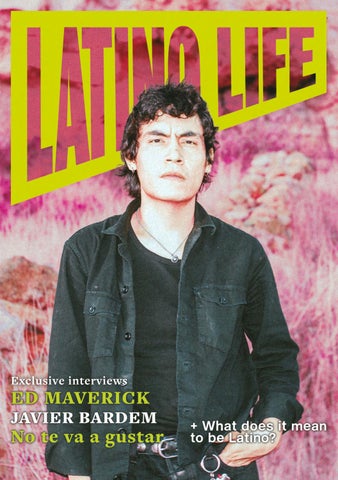
Issue No. 40 Winter 2026
04 06 14 22 30 38 LatinoLife on the BFI London Film Festival’s Red Carpet
Exclusive interview:
Ed Maverick
Culture and Resilience
What is Being Latino?
Afro Heroines of Latin American History
Beyond Language
An interview with Javier Bardem
You’re not gonna like this…
An interview with No Te Va a Gustar
2026 has been the biggest ever year for Latin music in the UK, with international Latin artists headlining stadium shows and mainstream festivals for the first time. It’s a trend that isn’t about to stop. Around the world, Latin music fills clubs. Latin food is celebrated. Our artists dominate global charts. Everybody wants to be Latino now. They love our stuff, but do they see us? Inside we explore what it means to be Latino in Europe and in the US and the challenge s we face. As ever, LatinoLife focuses on showcasing the best homegrown UK Latin talent and exciting emerging artists coming out of Latin America. One of these is Ed Maverick, one of Mexico’s most promising singer-songwriters who gives us an exclusive UK interview ahead of his album release Sin agua es ruta yerma. We also talk to much loved, multi-award-winning actor Javier Bardem about his amazing career and Uruguayan rockers No Te Va a Gustar. It’s been an amazing year, but no doubt about it, this is just the beginning for a continent and culture that the world just can’t get enough of. Editor, Amaranta Wright amaranta@latinolife.co.uk Designed By Somari Estudio / Fiesky Rivas latinolife.co.uk @latinolifeuk
4
ON THE RED CARPET
L
atinoLife loved being on the red carpet at the London Film Festival, speaking to great actors in Spanish about great movies in Spanish. Thanks to Javier Bardem, Penélope Cruz, Pedro Pascal, Rodrigo Sorogoyen, Isabel Peña, Victoria Luengo, Raúl Arévalo, Javier Calvo and Javier Ambrossi for your generosity and time! Don’t miss their films: La Bola Negra, a genre-defying queer epic, rooted in the legacy of beloved writer Federico García Lorca; ‘The Beloved’, Rodrigo Sorogoyen’s intense psychological study; ‘Bunker’, Florian Zeller’s elegantly crafted psychological thriller; and ‘Behemoth’, a stylishly crafted portrait of a beguiling classical musician, played by Pedro Pascal. You can find our interview with Javier Bardem inside these pages.
Amar Chadha-Patel
Victoria Luengo
Javier Bardem
Penélope Cruz
Rodrigo Sorogoyen
Sanne Wohlenberg
5
Pedro Pascal
Tony Gilroy
Pedro Pascal
Eva Victor
Alexa Swinton
Lux Pascal
Javier Ambrossi and Javier Calvo
Penélope Cruz
Guitarricadelafuente
Michael Giacchino
Nostalgic Maverick hey say it takes 20 years to become an overnight sensation. In Ed Maverick’s case, it took much less. But the principles are the same, from passing the hat around tables and gigging at quinceañera parties as a teen to touring the world, he always loved the hustle of performing. Having built a following around songwriting rooted in tradition and place, the young Mexican from Delicias talks to Isabel Sonderéguer about the bedroom mix that made a generation cry and his musical universe, gathered in a new double album, Sin Agua Es Ruta Yerma
8
O
ur call opens like a small window into his life. Through it I can see Ed Maverick’s studio in Delicias, a small city in the northern Mexican state of Chihuahua. Wood-panelled walls, a leather armchair, keyboards stacked against each other, a microphone waiting its turn and a red velvet curtain that could have come straight out of a David Lynch film. Eduardo Hernández Saucedo lights a cigarette, takes a sip of coffee and smiles, as if we had met before. Ed, as he is called, laughs easily and speaks slowly, in the unhurried Spanish of the Mexican north. He started sharing songs online as a teenager, and Fuentes de Ortiz, released when he was 17, has since passed 800 million streams on Spotify and more than 500 million views on YouTube. He signed to Universal at 18, and by 21 he had reached the top five of the Spanish singles chart with Párteme la cara, his appearance on C. Tangana’s El Madrileño, and performed at Coachella. But nothing happens overnight; since he was 14, Ed was gigging intensively. Whenever someone asks him what kind of music he makes, he says folk, “but really it’s the combination of all the references I lis-
ten to, so it’s kind of hard to categorise. At its core, I think it’s singer-songwriter music.” Out of the music of northern Mexico and decades of sounds from around the world, he composes his own universe, one that seems to hold an entire landscape.
In the north (of Mexico), as soon as you start sounding good with your band, it’s easy to get gigs, because everyone is looking for bands for their parties, their weddings, their quinceañeras. That universe began at home. Ed arrived in Delicias as a child from Ciudad Juárez, on the border with El Paso, “a very different context” he clarifies knowingly, still remembering “how fresh the air felt after the harshness of the border.”
His grandmother kept the radio tuned to Romántica 102.1 FM, a station of seventies love songs (Roberto Carlos was never far away), and which Ed still listens to, “it’s all romantic music, all very nicely curated. Every now and then they play something really ugly, maybe one song I don’t like, but almost everything they play is beautiful.” From his sister, Ed took Nirvana, Pearl Jam and Kiss, from his brother, heavy metal - from Korn to Pantera and from his father, the old banda music and the corridos of groups like Laberinto. Outside the house, the streets belonged to the brass of the Sinaloan bands: Banda MS, El Recodo, Banda El Limón and La Adictiva.
9
A
t that time, the progressive corridos as well as the movimiento alterado, a hardedged wave of corridos from the 2000s, were at their peak. As he grew older, the sierreño sound arrived, the sparse, guitar-led music from the mountains, carried by voices like Ariel Camacho, Virlán García and Alta Consigna, which seemed to fill every street of his adolescence. “I loved all of that once I started secondary school,” he tells me. “It doesn’t quite fit the question, but it was really crucial for the music I make today.” Everything Ed knows about music he taught himself or learned from whoever was willing to show him. His first teacher was Hugo Rivera, a young musician at the church he went to as a boy. “In a small church it was easier to get close to the musicians. I was still a kid, so I hung around them, but I wasn’t a musician. One day, I asked Hugo to teach me. He said, ‘well, I’ll teach you if you want,’” Ed remembers. “And so on Saturday mornings he’d invite me to play the drums, which was the best way in, easier than understanding chords, harmonies and keys. The drums are more primi-
tive and intuitive, the most accessible thing in every sense.” Hugo also taught Ed cumbia and, when he started secondary school, he was the only one at school who knew how to play it. “That caught the attention of the main norteño band at school who were becoming popular. They needed a drummer and recruited me.”
We’d finish at seven in the morning, with four or five thousand pesos, which at the age of 14,15, 16, is a lot of money!
During rehearsals his bandmates showed him his first chords on the guitar, and soon he was playing bass too. It was the height of the sierreño wave, country music from the nearby highlands Sinaloa, Sonora, Chihuahua, and Durango. “Sierreño music became so fashionable that honestly, everyone was learning to play guitar. Those musicians have their own way of understanding music,” Ed explains, as he goes on to describe his first performances with his high school band at Presa Las Vírgenes, a reservoir on the edge of Delicias lined with open-air eateries selling traditional dishes of freshly-caught fish.
Inspired by the biodiversity of the Amazon
Orchids
After Hours
Co-curated with LatinoLife
Selected dates Book now at kew.org
© RBG Kew
Orchids
6 February – 14 March 2027
11
“I
’d grab the snare, the guys would grab the guitar and the bass, and off we’d go to the dam. Literally table to table, saying ‘whatever you’d like to chip in, whatever you’d like to give us.’ Then at some point we’d say, ‘okay, it’s fifty pesos a song.’ At fourteen, walking away with 500 pesos after an afternoon of playing songs was incredible.”
I was made for anything,” Ed says, introspective. That changed with the band. “We had so much fun, singing with the crowd, and on top of that, people paid us for it, so I thought, ‘that’s it, nobody’s moving me from here. This is my thing.’ That’s why I stayed. It was like, ‘wow, I can actually have a job, I’m good for this. I really like how I sound with others.’”
The gigs soon came flowing in, thanks to essential dates in the Mexican calendar… Day of the Dead, Mother’s Day, Independence Day. In the north, Ed says, if you play well, music is never just a hobby.
In 2018, at 17, Ed released Mix pa’ llorar en tu cuarto (a Mix to Cry to in your Room), produced with Ei-
“As soon as you start sounding good with your band, it’s easy to get gigs, because everyone is looking for bands for their parties, their weddings, their quinceañeras. We carried serenades to people’s homes and to the graves of their loved ones,” he remembers fondly. “We’d finish at seven in the morning, with four or five thousand pesos, which at the age of 14,15,16, is a lot of money!” Ed was a quick, streetwise kid. “Even when I was very little I was pretty sharp. My parents had high hopes for me and told me how clever I was, but I still didn’t feel
The mix is the simplest thing in the world, but that’s also what makes it more complex, because it isn’t so obvious. They were norteño compositions, but they sounded different, they sounded sadder, they put you in a specific mood.
dan Velázquez on a small independent label. In Mexico, a mix is the homemade compilation you put together for yourself or for someone else, songs for a heartbreak, songs to cry to, and the album had exactly that feeling, a teenage mix made in a bedroom, sung with the voice and harmonies of norteño. Songs like Acurrucar and Fuentes de Ortiz found their audience on YouTube and social media. The major labels came knocking and the rest is history. Looking back, Ed speaks of that first record with a kind of paradox. “The mix is the simplest thing in the world,” he says, “but that’s also what makes it more complex, because it isn’t so obvious. They were norteño compositions, but they sounded different, they sounded sadder, they put you in a specific mood.” Those songs resonated with his audience, because, as it turned out, “that era of sad folk hit all of us.” To realise why his music resonated with so many, however, it took for Ed to listen to another folk singer, who emerged after him: “When I listened to Kevin Kaarl, it was like, ‘ah, okay, this is what people feel when they listen to my music’, and it became obvious.”
12
T
o describe that mood, Ed reaches for Beach House, the American dream pop duo known for slow, hazy, enveloping albums. “Even though the sound isn’t very similar, for me it was a lot like listening to Beach House.” What he means is not a sound but an atmosphere. Beach House makes records you don’t so much listen to as inhabit, spaces with their own weather and light, and Ed’s songs do something similar, building a whole universe out of the place they come from.
really patient producers who’ve deciphered what was in my mind,” he says of the whittling down process, from almost 50 pieces of music to 20. “Getting to the place where I’m comfortable to think of something and just do it, without having to ask anyone. It’s been a really beautiful journey, honestly.”
“Here in Delicias it’s very calm, and reflecting the city through music made a lot of sense to me, even if it sounds obvious,” says Ed. “Delicias shapes how my music is going to sound, together with my own vision.”
We had so much fun, and on top of that, people paid us for it, so I thought, ‘that’s it, nobody’s moving me from here. This is my thing ’.
Ed’s new album, Sin Agua Es Ruta Yerma, began as a series of instrumental sketches, and is the first album he has produced himself. “I didn’t study music production, I’m completely self-taught. For years I’ve been lucky enough to have
The album is also a product of what he describes as a magical period of psychedelic experimentation which began after the pan-
demic. “I had a lot of time on my hands and I was able to sit down for entire days listening to thousands of records and just enjoy them,” Ed says, explaining how he re-discovered major artists he’d overlooked. “I began to be more open to artists like the Beatles, who before I’d been more resistant to, because they were so influential and overplayed to the point they’d become a kind of a meme.” That experimentation was “very, very,
13 very inward”, he says, and that introspection shapes one side of the album’s duality, which he calls “fundamental”, while the other turns towards love. As a producer, everything began for him with Mac DeMarco, Connan Mockasin and Tame Impala, and with “that kind of sound, between lo-fi and hi-fi.” Ed also rediscovered old school Argentine rock, Spinetta, Almendra and Charly
I began to be more open to artists like the Beatles, who before I’d been more resistant to, because they were so influential and overplayed to the point they’d become a kind of a meme.
García, and Brazilian popular music, especially Arthur Verocai, whom he listened to constantly while making the records, and Erasmo Carlos. When Helado Negro came to Delicias to play with him, he introduced him to Las Grecas, a seventies flamenco duo from Spain, and Ed was hooked. But it is the old norteño and tejano bands such as Intocable that Ed always comes back to. “For me they have the most beautiful melodies. It gives me that feeling of Bonnie Tyler and all that super passionate eighties music, but norteño.” On Desierto, one of the quietest songs on the album, the production recalls Julee Cruise’s Floating into the Night, written by David Lynch and Angelo Badalamenti, while the melodies lean towards Junior H, one of the leading voices of the new corridos. All these retro influences, plus an eerie 90s desert feel, a la David Lynch’s Twin Peaks, which Ed is currently obsessed with, are all in the sound of Ed’s new album, which is “very desert-like, at least for me. A kind of cowboy, western, psychedelic thing.” Hence the title,
roughly translating ‘Without water, the path is barren’ “I wanted that feeling without writing the word desert in the title. Either way, the name is like a notice, a reminder, a warning, you know?” Meanwhile, as if protected from the real world, life in Delicias follows its own rhythm. “My days start with a visit to my local cafe, literally the best coffee I have ever had,” he says, before returning to his studio where “I am currently working with a young norteño musician from Chihuahua who blends classic ranchera with references like Dyango, flamenco voices and eighties sounds.” This is the universe I peer into through the small window on my screen. A studio, a cigarette, a cup of coffee, his grandmother’s radio, a church, a school band, family outings by the reservoir, open, dry desert plains stretching toward the horizon and a quinceañera party in Delicias. The rest is in the songs. Sin agua es ruta yerma vol. I and sin agua es ruta yerma vol. II are out now via CAPITOL Records / UNIVERSAL.
14
Culture and Resilience What is Being Latino?
atino– where does the term come from? What does it represent? Are there many ways of being Latino/a/x/e? In a world full of contradictions, where the Black Lives Matter movement has global reach, yet US Latinos are shot in the street by ICE agents (many of whom are themselves Latinos), being Latino covers a wide range of political and cultural issues. Graham Douglas explores what it means to be Latino.
15
16
I
n his book ‘Bolívar’s Nightmare’, Mexican novelist Jorge Volpi claims he discovered his Latino identity in a Latin nightclub, surrounded by Mexicans, in Spain. It is strange how something you always took for granted will suddenly swell you with pride and meaning when you are away from it. Most Latin Americans will agree, the word Latino only has any meaning at all when you are outside Latin America. But is there a way of being that makes you Latino? Do people from some Latin American countries feel more Latino than others? Is identifying as Latino a way of defending our identity? Do Spaniards and Portuguese feel Latino when outside their countries? There are way more questions than answers. Latin Americans have infused the world with what is called “Latino” culture, even though most people, including Latin Americans, might associate the word with Latin-Caribbean culture than South American. In the UK, while there are many events celebrating Latin culture, Latin-Americans are not even recognised as an ethnic group on census forms and most official documents. So, what does it mean to be Latino
when, as opposed to a recognised community, you are just an exotic minority from a continent, as Volpi claims, in no way unified or culturally coherent.
Historical Roots In the 1820s, the great liberator Simon Bolívar, referenced by Volpi, attempted to forge a regional union of ex-Spanish colonies encompassing modern-day Colombia, Venezuela, Ecuador, and Panama. The term latinoamericano or Latin American, however, wasn’t used till 1856, coined by Chilean politician Francisco Bilbao and spread by French diplomat Michel Chevalier and the government of Napoleon III. The Purpose? To use the concept—which highlights romance languages derived from Latin (Spanish, Por-
tuguese, and French)—to distinguish the region from Anglo-Saxon America and position French resistance to the US as the dominant power in the Western hemisphere. In 1848, after the Mexican-American War, 55% of what was then Mexico became the present-day states of California, Nevada, Utah, New Mexico and Arizona. Imagine what the geopolitical situation would be today if this had not happened? Then, after the Spanish-American War in 1898, the US gained control of Puerto Rico and the Philippines – so-named by Philip II of Spain - which completed the process of pushing out the Spanish and overtaking English naval dominance. And so, the concept of Latin-America is deeply rooted in a struggle between hegemonic powers ending with US dominance of Central and South America, expressed in the 1823 Monroe Doctrine, and recently re-ignited by Trump. According to Nancy Gomes, a Venezuelan-Portuguese lecturer at the Universidade Autonomo de Lisboa, the term latinoamericano (later shortened to latino) has never been, and probably never will be, universally
17 embraced because, while the hard power boundaries were created by men through war (hence the masculine use), cultural soft power does not follow the same boundaries: “Simon Bolivar was part of an intellectual elite educated in Paris, who wanted to integrate the new states as a way to stand up to Europe and Spanish influence, but each state wanted to defend their borders and their individuality. Venezuelans, who entail many ethnic groups and races, embraced a unifying concept that we are all children of Bolivar, a Bolivarian Republic, which Chavez exploited.” Brazilian exceptionalism is another fissure in Latin-American Identity. In a study of public opinion by the Latin America and the World project in 2016, only 16% of Brazilians said that Latin America was the most important region, while in the rest of Latin America their own region was favoured by 42%, consolidating Brazilians’ idea that Brazil is bigger than its continent. Becoming Latino by Leaving The notion that Latino identity takes place outside the home continent is a common denominator among all the
Diaspora Latin Americans I interviewed, and the use of gender-inclusive Latinx, is a direct US-engineered imposition, hardly used in Latin America at all. When growing up in Latin America, the US or Europe is often the common reference, argues UK Latin music promoter Jose Luis Seijas: “Growing up in Venezuela, all you wanted to do was play baseball, because the US was
I identify very much with Latino culture, I have family in both Brazil and Uruguay, so I say I am both Brazilian and Latino.
a mythical place where things were better. In Argentina, where I go quite often, there is anti-British sentiment because of Las Malvinas, yet I’ve never seen a country that loves British culture so much, a British band can sell four times more tickets in Buenos Aires than in London. When you are living in the US and Europe, however, Latin America becomes your reference because it feels like home.” Maria Luna-Thomas a Puerto-Rican Dominican-American living in London says how you feel about your homeland “depends on time, place, politics, economics, gender, religion. Venezuelan reactions to the capture of Nicolas Maduro by the US depend on whether you are living in Venezuela, the UK or USA, whether you are indigenous, black, white or mixed Venezuelan. Do indigenous Venezuelans feel Latino? There is no universal standard.” Many Brazilians, like filmmaker Joao Candido Zacharias, do not see themselves as Latino until they adopt a Spanish-speaking connection: “I identify very much with Latino culture, I have family in both Brazil and Uruguay, so I say I am both Brazilian and Latino.”
19
I
n Portugal, where I live, some Portuguese view Brazilians as backward by being in thrall to religion, others think that Brazilian women only come to Portugal to work as prostitutes; but there is a deep admiration, even envy, of Brazil’s success in football, music, even it’s economy. And regarding the other countries of South America, most Portuguese people know little about them. And the Spaniards? In Spain itself, Gomes sees the objection of most Spaniards and Portuguese to being called Latino linked to their own sense of superiority over sudacas (their derogatory term for South Americans) and immigrant poverty. But on the Latin dance floors of London, claims Venezuelan-born Jose Luis, promoter of VIVA, the UK’s most successful Latin club night, Spaniards are quite happy to identify with ‘trending’ Latin music and take the Latino label. As do contemporary Spanish artists such as Rosalía and Bad Gyal, when commercially advantageous. Who is ‘American’ in the Americas?’ Being Latino in the US interacts with being American, but are Latinos in the US any more unified than
they are in Latin America? There is no simple term like Estadounidenses to spanish-speaking refer to inhabitants of the US. “It seems absurd that just one country in the Americas can use the term ‘American’ when even North America includes Canada. But these words are changeable depending on who uses them and where,” says Joao Candido Zacharias. ‘Latino also means something different in the US than in Mexico, Brazil or Argentina.”
When growing up in Latin America, the US or Europe is often the common reference. When you are living in the US and Europe, Latin America becomes your reference because it feels like home.
Meanwhile, Monica del Pilar, the Colombian editor-in-chief of The Prisma, a bilingual multicultural newspaper, does not use the term ‘American’ to refer to people from the United States and Lélia Gonzalez, one of the major Black intellectuals of the Americas, refers to the entire continent as “Amefricano/ Amefrican.” For most diaspora Latin Americans, geographical and social context determine feelings of Latin identity, and this applies no less to ‘Americans’. Mexican professor Eladio Bobadilla who teaches at the University of Pittsburgh notices that, ever since the “war on terror” which initially unified many in the US, American unity has been unravelling, culminating in Trump’s harking back to an imagined past, describing US Latinos in insulting language, targeting minority groups and attacking multiculturalism. “Some conservative Latinos [in the US] who have strong assimilationist impulses, align with the American right, welcoming the attacks on multiculturalism and affirmative action. For others, it has renewed their sense of pride in their roots because they understand rising anti-immigrant and anti-Latino attitudes are existential threats and enforce a white suprem-
20 acist vision of the future that erases decades of civil rights gains.” Joao Candido points to “rich Brazilians living in Florida” as examples of those who embrace everything ‘American’. By contrast, “when Brazilians arrive in London,” Monica del Pilar points out, “many begin calling themselves ‘Latino’ to feel more included and protected by a growing diasporic community”. The Economics of Culture Ever since Bad Bunny’s Super Bowl half time Show, even the pro-ICE bigots are loathe to admit that being latino is having a moment. “Culture is Latin America’s best export,” says Jose Luis. “It’s like our Trojan horse: people start liking music and then they are into the food and the dancing; a guy finds an Ecuadorian girlfriend and suddenly they’re going to the Dominican Republic for a holiday. That’s how we are conquering Europe, a kind of reverse colonialism” “Music is fundamental to the experience of the immigrant,” adds Jose Luis. “It’s the first thing you pass on culturally to your kids, and to others outside your community. Other people might not get into your language,
but they enjoy your music,” Adds Jose Luis, “Bad Bunny may not be the best artist in the world, but he’s opening doors for others and has made being Latino like the coolest thing in the world. Everybody, Indians, Arabs, English people, wants to be Latino now.” Monica del Pilar agrees: “Popular music and dance are fundamental channels of resistance, memory and social cohesion within Latin identity, particularly in contexts of migration and marginalisation. In Nuyorican communities, salsa became an important social expression, while Mexican-Chicano corridos and Chicano rock have expressed labour struggles and a distinct identity.” At Sound Latino Radio based in London’s Seven Sisters Market “one guy does a show in ‘Spanglish’, and people love it because they can learn Spanish and English,” says the radio’s director Cesar Gamba. In the US, Eladio Bobadella points out: “Latinos express and display their ethnic pride through sports and culture; Latino supporter groups at soccer matches, Hispanic Heritage Month celebrations in baseball stadiums, Mexican flags at football stadiums.” Brands
exploit this passion, but at the same time, Bobadella adds, culture spills easily into politics: “The same people protest ICE in their cities and anti-immigrant policies”. Resisting Exploitation Joining the diaspora is “a kind of motor that permeates my body and transforms my relations with identity, belonging and migration. It adds to my sense of dislocation as a Black Queer person who doesn’t belong in the West,” says Luiz Lucas, founding member of Legitima Defesa ded-
Bad Bunny may not be the best artist in the world, but he’s opening doors for others and has made being Latino like the coolest thing in the world. Everybody, Indians, Arabs, English people, wants to be Latino now.
21 icated to Black theatre, who made the film Migranta. “This permanent sense of movement leads to a constant questioning, a search for new forms of existence. We really don’t know what Africa is, because Africa for us is like the place that we have to hold onto to keep our blackness alive. It’s more conceptual than real.” Like most immigrants, many Luso-Latin Americans are working the reconfigeration of their identities out; pulled between people telling them what they are (or aren’t), where they belong (or don’t) and meanwhile try to cash in on their identity. For Jose Luis, feeling Latino creates a “mythical construct we de-
vise in our heads.” But this imagined identity as a migrant brings hard practical issues involving immigration documents and finding decent paid work, and migrants are frequently exploited especially when they don’t have papers, sometimes by their own compatriots. In addition, Latinos abroad now have to navigate a new false argument agreed on by both conservatives and liberals, about having to stop “illegal” or “unauthorised” immigration, whereas in fact migration by nature is and has always been unauthorised, as Eladio Bobadilla highlights in his article for Socialist Forum “Unau-
thorized migration is not evidence of a broken immigration system; it is one of its defining features.” As long as society uses “unauthorized migration” to justify opposition to immigrants, Latinos in the UK, who are not officially recognised, will be vulnerable. This is why, one of the biggest issues for UK Latinos is to be recognized officially, says Monica del Pilar, who has been key in the campaign brought by CLAUK, for the recognition of Latin American as an ethnic minority, which six London Boroughs now accept: “Recognition brings access to public funding, interpreters and bilingual staff in hospitals and schools, meaningful health and education, legal protection, housing and employment policies, funding and grants, political influence and mandatory consultation.” The hostile environment for Latinos may not be as brutal in the UK as in the US, but the lesson is clear – organization and solidarity and, to use Monica’s chosen word, resilience, a talent ‘Made in Latin America’, are needed, just as they always were, if not more, when it comes to being Latino, Latina, Latinx, Latine or Latin American, away from home.
22
Afro-Heroines of Latin American History Being a female activist has always meant putting your life at risk. Being a black female activist? A probable death sentence. Yet these courageous women took that risk and, in some cases, gave their lives in order to shape our history. Many of these heroic figures in the building of Latin America were confined to the annals of history. It wasn’t easy to find them, but once we started digging we found so many that we have only been able to mention a few. These women were leaders and fighters, who defied the prejudices around them and demanded change, freedom and racial justice, whether through slave rebellion or fighting the Spaniards to gain independence and then build a new society free from racism. The work is still ongoing but it is on the shoulders of these brave pioneers we stand and to whom we have a duty to carry on the fight until racism is banished forever.
25 - 27 Feb 2027 Sadler’s Wells and Dance Consortium presents
Brazilian Perspectives
São Paulo Dance Company
Experience the passion. Feel the rhythm.
HHHH HHHHH HHHHH HHHHH Everything Theatre
London Living Large
Bachtrack
Photo © Lari Davies
The Telegraph
25 dragged until she died. Her followers found her body on the morning of November 6, 1843, and vowed to continue to fight for their freedom, but heavily-armed Spanish forces overpowered the machete-wielding slaves and the revolt ended.
La Negra Carlota Cuban Slave Rebellion leader (?- 1844) Kidnapped at the age of ten in Benin, West Africa, Carlota Lucumi was taken to Cuba to work at the Triunvirato sugar plantation in Mantanzas. In 1843 Lucumi and another enslaved woman, Firmina, began to plot a rebellion. While Fermina was severely beaten and imprisoned for distributing pamphlets, Lucumi continued to organize the uprising. On November 3, wielding a machete, she led a raid that freed a dozen house slaves, killed the overseer’s daughter and forced the owner to flee. Lucumi and her followers then went to the Acane plantation to do the same. In their brief two-day rebellion, they destroyed five sugar plantations, as well as a number of coffee and cattle estates. The day the last plantation was destroyed, Lucumi was captured, her body tied to horses and
The following year, 1844, became known as the “Year of the Lashes” in Cuba as slaveholders brutalised virtually all enslaved people on the island to punish both those who participated in the uprising and intimidate those who did not. Lucumi’s tale of bravery spread throughout Cuba. Her actions inspired subsequent rebellions throughout the Caribbean and there is now a monument to the legacy of Carlota Lucumi at the Triunvirato sugar mill.
Mariana Grajales Cuello Cuban independance leader (1808 - 1893) Born in Santiago de Cuba, Mariana Grajales Cuello
played a crucial role in her country’s struggle for independence against Spain. A mixed-race daughter of Dominican land-owning parents, Mariana was educated and, while mothering nine children, she and her husband trained them in the art of self-defence. Two of her sons, Jose and Antonio, became generals in Cuba’s Liberation Army. Two days after the war of independence against Spain began in 1868, Mariana established a hospital for wounded soldiers, and travelled with rebel troops, providing support. Despite the loss of her husband and some of her sons in battle she continued working for Cuba’s freedom. By 1878, she had lost all her family property and with death warrants issued on her surviving sons, Mariana went into exile in Jamaica, where she continued her work toward Cuban independence by forming patriotic associations among exiled Cubans. Mariana Grajales Cuello risked everything for Cuba and in 1957, Grajales was given the title “Mother of Cuba” by Havana mayor Justo Luis Pozo del Puerto, in acknowledgement and appreciation for her patriotism and work toward liberating her country.
Mentoring PROGRAMME 2026-2027
Are you interested in being metored? FIND OUT MORE AND APPLY LATINOLIFE.CO.UK/MENTORING
27 the end of slavery in Brazil
Maria Firmina dos Reis Brazilian Abolitionist (1825 - 1917) Born in São Luís, Maranhão, to a black enslaved woman and a white man, Maria Firmina dos Reis was shunned by society and begun life with three handicaps; she was mixed-race, illegitimate and a woman. Denied an education, Maria self-studied and by the age of 22 she was a primary school teacher who wrote poetry and short stories. In the last country in the Western world to abolish slavery (1888) and yet, astonishingly, in 1859 Maria Firmina wrote what is thought to be one of the first novels written by a Brazilian woman. Published under the pen-name Una Maranhense - Ursula is believed to be the first abolitionist work from Brazil. Maria went on to write several more books including Cantos à beira-mar (1871; Songs at the Coast), a collection of political poetry, and A Escrava (1887; The Slave Woman). She kept a diary for fifty years and wrote a song to celebrate
By 1881 Maria adopted ten children, her filhos do coração (“sons and daughters of the heart”) and founded a school for disadvantaged boys and girls. In an age when mixed education was deemed shocking, the school suffered from repeated protests and was forced to close two years later. Although she is now a celebrated figure in Brazil, she died blind and in poverty in 1917, at the age of 92.
Mamá Tingó Dominican human rights activist (1921 –1974) Born Florinda Muñoz Soria, Mamá Tingó was one of 350 small land owners who farmed land in the Hato Viejo region of the Dominican Republic. Under the government of President Joaquín Balaguer, farmers were told that the land had been purchased by a rich businessman, Pablo Díaz Hernández, and forced to leave. Mamá Tingó went to several government officials protesting the decision and the violence that was being used to remove people from the land. Mamá Tingó and
her husband even sought to buy the land but were unable to. Mamá Tingó decided to organize the families that lived on the land to form a united front against Díaz Hernández and his thugs who used tanks, bulldozers, and fires to get them off. After several violent clashes, the courts finally agreed to hear the case. On returning to her plot of land after the court hearing, which did not end in her favour, Mamá Tingó was shot twice. Mamá Tingó fought back with her machete but died from the gunshot wounds. After Mamá Tingó ‘s death, many of the farmers continued to fight for their rights. Mamá Tingó was survived by her children and husband.
María Elena Moyano Delgado Peruvian Feminist (1958 – 1992) María Elena Moyano was a Peruvian feminist, community organizer and activist of Afro-Peruvian descent. Born in the (Barranco district of) Lima, Peru, her
28 activism began in her teens and only grew stronger with age. At the age of 25, she was elected president of the Federación Popular de Mujeres de Villa El Salvador (Fepomuves), a federation of women from Villa El Salvador. Under Moyano’s leadership, the organization grew to include public kitchens, health committees, the Vaso de Leche program (which supplied children with milk), income-generating projects, and committees for basic education. Moyano left her position in Fepomuves in 1990 and shortly thereafter was elected deputy mayor of the municipality of Villa El Salvador. As an outspoken leader, she faced pushback and even death threats. Unfortunately, she was assassinated on February 15, 1992, which resulted in a public outcry.
children, and raised in a migrant worker camp. At the age of 14, Solange was arrested for speaking on behalf of Haitian sugar-cane cutters in her village, demanding better wages and living conditions. By her late teens Solange was director of the Movement for Dominican Women of Haitian Descent (MUDHA), which campaigned to end antihaitianismo in the Dominican Republic. In 2005, Pierre petitioned the Inter-American Court of Human Rights on behalf of two Haitian-born children who were denied Dominican birth certificates. The case Yean and Bosico v. Dominican Republic won and the court ordered the Dominican government to provide the birth certificates. Since then she has been a tireless voice for countless victims of racial discrimination in the DR. In 2008, Solange was awarded the Giuseppe Motta Medal for protection of human and was also given the 2010 International Women of Courage Award by the United States Department of State.
Solange Pierre Dominican Human Rights Acitivist (1963 – 2011) Born in the Dominican Republic to parents of Haitian origin, Solange was one of twelve
Marielle Franco Brazilian politician and LGBT activist (1979-2018)
The 2018 murder of Marielle Franco, a young black city councillor and human rights campaigner, deeply traumatized Rio de Janeiro. In a city where 75% of those who die in police custody are black, Marielle Franco gave voice to favela dwellers, black people, women and the LGBT community. And yet she too became another victim of Brazil’s violence against women and people of colour. Franco was raised in Maré, a slum in northern Rio de Janeiro. In 2002, as a young single mum, she entered the Pontifical Catholic University on a scholarship and went on to earn a Masters in Public Administration, exploring the corrupt law enforcement program to retake control of the city’s favelas. After years of community work, Franco ran for the Rio de Janeiro city council in 2016, and was one of 51 candidates elected, receiving the fifth most votes out of 1,500. As a councilor, Franco fought against gender violence and for reproductive rights of favela residents. She chaired the Women’s Defense Commission and formed part of a committee that monitored the federal intervention in Rio de Janeiro. On March 14 2018, Marielle was assassinated in
29 a targeted drive-by shooting 2018. Her press officer survived the attack with injuries. It took almost a decade for Brazil’s Supreme Court to convict former politicians Domingos Brazão and Chiquinho Brazão for masterminding the assassination, concluding that her political activism threatened their lucrative land development schemes linked to paramilitary militias in Rio’s West Zone.
Benedita Souza da Silva Sampai Brazilian politician (b. 1942) Benedita was the first female and Afro-Brazilian governor of the State of Rio de Janeiro and, later, Minister of the said Secretary of State as well in the Government of Luiz Inácio Lula da Silva. Trained as a social worker, “Bene,” as she is entered politics in 1983 as a member of the Rio de Janeiro city government. Once in office she championed the cause of Afro-Brazilian women and Brazilian black history, helping establish
the National Awareness day of Black Consciousness, celebrating Zumbi dos Palmares, the Afro-Brazilian
Marielle Franco gave voice to favela dwellers, black people, women and the LGBT community. And yet she too became another victim of Brazil’s violence against women and people of colour As Rio de Janeiro State Secretary for Social Services, she has lobbied against human trafficking, poverty, and for better access to education and health care. She was elected to the Brazilian congress in 1991 and senate in 1995. In 1998, she was deputy governor for the state of Rio de Janeiro. In 2004, she became Federal Secretary for Social Services and later occupying a similar position in the State government of Rio de Janeiro.
hero.
Marta Salgado Chilean activist (b. 1947) As an activist for the African diaspora in Chile, Marta has founded several non-governmental organizations to promote minority rights. Trained as a teacher and public administrator, Salgado began her career as a teacher in the in state universities of the Arica-Parinacota region and spent forty-one years as a professor at UTA. She was a co-founder of the Universidad de Tarapacá’ workers’ union and founded Oro Negro (Black Gold), the first advocate for the inclusion of Afro-Chileans in public policies, which include their official recognition as an ethnic group, with legal protections. She protested that governments only recognise the “Slave Route” as an educational and tourist-worthy part of the cultural heritage, but not the people themselves. Salgado pressed for the government to take a census of the Afro-Chilean population, as well as to sponsor programs to sensitize Chileans to their right to have their ethnic identity protected.
Beyond Language An interview with Javier Bardem
isiting London to promote two films at the BFI London Film Festival, ‘Bunker’ and ‘The Beloved’, LatinoLife caught up with the much loved, multi-award-winning actor Javier Bardem, both on the red carpet and later at the Curzon Soho where he gave a screen talk, and find an actor and human being whose power, mastery and magnetism lies beyond language.
By Jess Pacuar and Corina Poore
33
J
avier Bardem is one of those rare people who, no matter how famous he gets, stardom doesn’t seem to change his essence. Whether it’s being one of the first Hollywood actors who unapologetically spoke about about the genocide in Gaza, or stopping to talk to LatinoLife on the red carpet, Spain’s most notable actor consistently connects to his own and others humanity. Having first appeared on our screens in 1992 in Bigas Luna’s Jamón Jamón, Hollywood fame wasn’t as immediate as it was for Antonio Banderas or (future wife) Penélope Cruz. But when fame came it came with accolades, a first Oscar nomination for his role in ‘Before Night Falls’ (2000) and an actual Oscar for his chilling performance as Anton Chigurh in ‘No Country for Old Men’ (2007) directed by Joel and Ethan Coen. Since then, Bardem has seamlessly straddled major blockbusters such as James
Bond’s SkyFall or the upcoming ‘Dune: Part III, popular Netflix series such as the recent Cape Fear, even romantic comedies, whilst never sacrificing projects in Spanish, such as El Ser Querido (‘The Beloved’) which he was in London promoting, when we met him.
On the red carpet, Javier is approachable and humble, the kind of person who feels that everyone deserves respect. He receives our advance with a warm glance. What did you discover about Esteban during the filming process that you hadn’t found in the script?
El Ser Querido by Rodrigo Sorogoyen, is an intense psychological study exploring the toxic elements of power and control in a father/ daughter relationship. A famous and charismatic Oscar-winning film director, Esteban, (Javier Bardem) returns to Spain from New York, to shoot a film and chooses to cast his estranged daughter Emilia (Victoria Luengo), a struggling actor, in the lead. Esteban hopes this move will help cure the family rift that began 13 years earlier, when he abandoned Emilia’s mother to pursue his career in the United States, where he built a new family. Can past pain ever be swept away or will it linger forever?
“I discovered his inability to apologize, and the harm that causes to those around him—and this isn’t just a matter of upbringing or generation.” Javier tells us, ignoring the red carpet glitter to delve into deep matters. “He was never taught to take responsibility for his actions or to apologise for the consequences. That type of man exists, and Esteban is one of them. What did you have to understand about your character, even if you didn’t agree with him? “Hmm. Well, it was, in a sense, about understanding the mindset of a man who uses power—the power
34 of force—to justify his actions.”
B
ardem is not one for small talk. The nuanced and succinct way he expresses himself seems effortless. When we meet again in the Curzon Soho, his magnetism and eloquence fills the room. This time, we talk about his career, and the discussion inevitably starts with ‘No country for old Men’, for which Bardem won the Oscar back in 2008 as the cold, methodical and merciless villain. In the now famous scene in which Anton Chigurh challenges the gas station owner when he goes in to pay and whose life ends up dangling on the toss of a coin, Bardem exuded such
Words have an impact on our system, we have memories with those words, we have experiences… so how do you put emotion into a language that you don’t control?
suppressed volcanic tension that you could have cut the air with a knife:
veloped Anton’s alien-like character, the stiff walk and inhuman attitude.
“Half of the Oscar that I have is his, absolutely!” Bardem confesses, giving credit to the writer and his character, rather than himself. “Anton plays fear, insecurity, uncertainty so beautifully that he makes the scene. I do my part, but he does the horror. He’s fantastic and that‘s why I said, ‘you are not working alone’. You need your partners, you need to create a moment of commonality, because no matter how little the role is, everything, everybody, is important.”
“In the book there’s no back-story for the character of Anton Chigurh. We don’t know where he’s coming from, or going, or what he wants. I asked [the novelist], a couple of questions and he was elusive, but with the comments, we came up with this idea that he’s a symbol of horrible fate, horrible accidents, so in order to embody that, you have to take out all the humanity and just construct an image of somebody that doesn’t have anything personal in anything that he does.”
At this precise moment, a big bang in the auditorium makes everyone to jump, including Bardem: “Anton Chigurh is coming to haunt us!” He laughs.
Bardem dwells on the fact that words are key, how you say them and in what language, because people have different body language or even mouth movements, according to the language they are speaking, a reminder to all bi-lingual people, how we use and grow into languages that we were not born with.
Even in a language that is not his own, his sense of humour seeps through. He goes on to explain how he and the Coen Brothers de-
Bardem as Anton Chigurh
35 “Words have an impact on our system, we have memories with those words, we have experiences… so how do you put emotion, or lack of emotion, into a language that you don’t control, that doesn’t have any personal, intimate effect on you because you haven’t had any life experiences in that language? So, you have to do the surgery, like, okay, bring the emotion that that word means to you in Spanish, and put it into English. It’s intense mental work, that it’s hard to combine with the emotional work of an actor, it’s challenging.” Language is something Bardem is both a student and master of, so much that he can navigate between two of its most difficult forms, horror to comedy, with ease. His next film is alongside Kate Hudson in a romantic comedy called ‘Hello and Paris’, in which a maverick architect (Hudson) - “a marvellous actress. She’s so funny and she’s so real” - exchanges banter with best-selling novelist (Bardem) suffering a crisis, in a random encounter in Paris. This couldn’t be a further leap from the chilling characters for which he has gained an international reputation: from Pablo Escobar in ‘Loving Pablo’ (2017), the ghostly pirate hunter Captain Armando Salazár
in ‘Pirates of the Caribbean: Dead Men tell No Tales’(2017), the flamboyant and skin-crawling Raoul Silva in ‘Skyfall’ (2012), Max Cady in ‘Cape Fear’ (2026), or terrifying film director, Esteban Martínez in ‘The Beloved’. who torments and humiliates his daughter.
We all like to be rewarded and applauded and loved. But what comes next. Because the goal is not that. “These characters, most of the time, are way more satisfying to play than the good guys. They are more complex and more exciting to navigate, because you also have to find the humanity, and something that you can relate to, so the audience can go: ‘Oh, okay, I never thought of it that way’. It’s more challenging than playing good, ethical characters, which is like, okay, there’s one colour to play, and that colour I love. When you play Pablo Escobar, who was a monster, obviously, also, there is a moment where you have to find your way in, in order to understand why he became the monster, and that’s fascinating.”
Bardem managed to portray this contradiction fantastically in Cape Fear’s Max Cady, who at times you actually believe is the victim, and a sexy one. Initially, Bardem turned down the role of Raoul Silva in ‘Skyfall’, forcing Sam Mendes to fly out to Spain to persuade him. While he felt honoured to be asked to be in a James Bond Movie, he explains, he felt the character needed more complexity: “I said, listen, all the villains have done everything to destroy the world, but what about someone that, besides destroying the world, is actually attracted to Mr. Bond, wants a sexual encounter… I think it’s one of the scenes that now lasts in the memory of the audience. We went a little farther than what was scripted, because we wanted to say, okay, how do you really put Mr. Bond out of his place, a place where he hasn’t been before? And the way he comes out of it is brilliant.” The physical appearance of Raoul Silva became a cause célèbre in the movie, much like the dreadful hair-cut in ‘No Country for Old Men’. Here you had a man who was disfigured, so to bring him to life, they introduced the blonde wig, the extension of the chin and the change of his eye colour:
37 “It’s a man who is really trying to look good in the world, but he’s rotten inside.” Whether the ruthless company boss desperately trying to keep his excellence award in Fernando León de Aranoa’s ‘A Good Boss’ (2021) or the inquisitor Brother Lorenzo in Milos Forman’s ‘Goya’s Ghost’ (2006), Bardem has the ability to inhabit his characters so thoroughly that you cannot imagine them being any other way. “It’s the joy of our job, the moment where you have to put yourself in a situation absolutely unknown. It’s a gift to be pushed to feel and then explore where that happens to you and how it affects you. It is a way of growing up, externally as an actor, but also internally as a being.” It is this curiosity that connects all Bardem’s roles, from ones that have won him Oscars to others that English audiences may never have seen but would do well to seek out. Going back to El Ser Querido… “Esteban is a man who can’t say I’m sorry. And the damage that that creates in his family, in his daughter….in a way…(he sighs) I am the opposite. I believe strongly
in therapy. I’ve been going to therapy since I was 25- yearsold. And I ask, why he didn’t say it? Well, there are many people that cannot say it … they were not taught when they were little. And the damage that it creates! So yeah, sometimes it’s difficult to wrap your head around it… Esteban’s very used to getting his own way, he’s coercive and he’s charming. Yeah. I think it really shows a kind of old-fashioned masculinity, of showing power and imposition, force and strength rather than vulnerability.” Javier’s fascination with this inability to apologise chimes with his own humility; a man still wanting to learn, to discover. “Art is a way for us to help to understand the world better. Absolutely. It’s one of the reasons I love ‘Biutiful’ so much (referring to Alejandro González Iñárritu’s film in which Bardem plays a black market street-hustler), I think actors, directors, they’re the conduits that help us on that journey, to think about the world we live in. Art is one of the great ways that we are encouraged to reflect on the world. To feel the experience, rather than think or plan it.”
It is this humility that explains how Bardem is able to find the depth in his characters and why top directors want to work with him. It is in the very advice he gives to up and coming actors. “The goal is to get stronger, more secure and more confident within your own craft, knowing that every day, there are going to be difficult things you have to overcome, no matter what we do. Achieving that is what makes you feel proud. Second, is learn from things that go wrong. Yes, absolutely. I mean, there’s nothing better. Success is great and we all like to be rewarded and applauded and loved. Great. But what comes next? Because the goal is not that!” ‘The Beloved’ will be in UK cinemas from 5 March
W 38
You’re not gonna like this…
ith a career spanning more than 31 years, eleven studio albums that have all achieved Gold or Platinum certification in Argentina and Uruguay and over a billion streams on Spotify and YouTube, NO TE VA GUSTAR (NTVG) is one of the most popular and successful Spanish-language rock bands in Latin America. Having recently performed in London as part of their 2026 European tour, Martín Marini caught up with Denis Ramos from Uruguay’s rock giants.
W
41
M
artín Marini: Tell us a bit about the band’s early days. At what point did this become a full-time profession, and when did you realize you could actually make a living from music? Denis Ramos: For about a decade, many band members were balancing other music-related jobs with NTVG. But around 2004 or 2005, we started noticing that things were going really well. That’s when almost all of us decided to commit 100% to the band and leave our alternative jobs behind. MM: And that’s when the first albums and tours started happening... DR: Exactly. We were already doing very well in Uruguay, but we began travelling frequently to Buenos Aires and other parts of Argentina, and ticket sales were already fantastic. So we took the plunge. Fortunately, it worked out. Dedicating ourselves entirely opened up new opportunities. We professionalised our entire structure, from rehearsals to album production, so as it turned out, our shared decision to go all-in was the right one.
MM: With 12 studio albums, numerous hits and repeated international tours, how have you won over a new audiences, in Europe specifically? DR: Over the years European audiences genuinely love Spanish-language music. Back when the internet and social media weren’t as prevalent, winning over an audience was all about the live performance. When we first went to Europe, many people in the crowd may
have listened to an album or a song, but they had never seen us live. So that connection allowed us to build a strong fanbase in several European countries… Germany, Switzerland, and Austria. We toured there for many consecutive years and drew large crowds. We are heading to Italy, the UK and visiting France for the very first time, where it’s no longer unusual for people in those countries to watch a band singing in Latin American Spanish.
43 MM: How has your relationship with fans evolved from those early European tours? DR: We stay connected with a lot of fans from the early days through social media. We already know that people are waiting for us, so it brings a sense of responsibility to deliver a great show. We tour Europe about once every two years, and the audience always responds beautifully. This time, we’re bringing new
material, which adds a special element to the tour. MM: What were the band’s primary influences, especially in the beginning? DR: Back in the early nineties in Uruguay, we listened to a lot of Argentine rock and several Brazilian rock bands, alongside legends like Bob Marley, The Beatles, and The Rolling Stones. Mano Negra came to play in Uruguay around ‘93 or ‘94,
and that concert was really inspiring, showing us how to fuse rock with Latin instruments and heavy horn sections. It encouraged a lot of up-and-coming bands to experiment. During the early nineties, a lot of great bands started, like La Abuela Coca, La Vela Puerca, ourselves since 1994, and a bit later around ‘97 or ‘98, Once Tiros. A whole wave of bands that eventually became huge for our country started around that time.
44 MM: British rock influences fused with Río de la Plata culture, enhanced by brass and percussion has always created a unique signature sound... DR: That’s what set us apart, adding brass and percussion to a rock foundation was our way of carving out a path. It has been an amazing journey because we operate like a musical orchestra. With so many members, we have a vast palette of sounds and options to showcase on stage. MM: Speaking of influences, I have to ask you about Rubén Rada, who recently passed away. What did he mean to the band? DR: El Negro was always incredibly generous with us. From our very early days, he would invite us to his shows and have us play with him when he performed live on television. Later on, he was just as giving—recording tracks with us, performing live, and always bringing an incredible attitude. He contributed so much, both musically and on a human level. Those are unforgettable experiences that we were lucky enough to share
with him. Even though we belonged to different generations, we felt deeply connected to him. We hold the absolute best memories of a true musical leader. He left us physically, but his musical legacy and his impact on Uruguayan art will live forever. MM: What is the new material about, and what was the creative process like? DR: It was an excellent process. We had a massive pool of songs to choose from—36 in total—and only
10 made the final cut, so you can imagine the amount of work involved. Sound-wise, we wanted to try something different, so we worked with Argentine producer Nicolás Cotton. He’s young and brought a fresh, distinctive imprint to our sound. We wanted to put out an album that addresses the chaos of the world we live in today. It features a bit of our classic essence alongside new elements. The songs cover subjective reflections on society, as well as themes of love and heartbreak, which are always essential.
45 MM: It carries a stronger rock edge, doesn’t it?
new album and our classic hits. It’s been awesome.
DR: There is a lot of rock on this record. We chose “En Llamas” as the first single because it’s a very powerful, rock-heavy track that starts strong. For us, this is a great rock album. Even though it was just released in January, when we play live, people are already singing along as if they were old classics. It shows you how fast technology delivers music. That said, we obviously have a catalogue of classics that we can’t leave out, so our shows which are least two-hour performance are packed with a mix of the
MM: I imagine we can expect even more recorded material in the near future? DR: Absolutely. Since we started with 36 songs and only used 10, there is a ton of unreleased material left, and we will definitely keep composing throughout the coming year. MM: After 32 years as a band, you’ve naturally gone through phases. What is your day-to-day dynamic like now?
DR: When we are on tour, we focus heavily on staying united, taking care of one another, and respecting each person’s time and space. We also hold a deep respect for our audience; that is fundamental for us. Then, when we are back home, everyone gets the chance to disconnect and spend quality time with their children and families. Eventually, we gather again for rehearsals. We are always in touch, but we make a conscious effort to respect each other’s personal time when we aren’t on the road. That balance is crucial, but once we’re actually on tour, we are genuinely happy. We feel like a group of old high school graduates out there doing what we love most: making music. We enjoy every bit of it and consider ourselves incredibly privileged. We still live it with the same joy we had from the very first day of our first tour. The fact that 32 years have passed and we are still together is a dream come true. Every time we leave Uruguay to tour, we treat it as the dream it is and truly savour the experience.
46 MM: One of those tours was marked by a deeply tragic event when Marcel “Curucha” Curuchet, your keyboardist at the time, suffered a fatal motorcycle accident in New York. How did that affect the band? DR: For any group, losing a close companion is devastating. We were in total celebration mode, touring the United States alongside Los Auténticos Decadentes, when the accident happened. It turned our entire world upside down. In the immediate aftermath, it was chaotic; we were full of sorrow so we just tried to lean on each other but the shock made us reconsider whether we should continue as a band at all. We suspended everything for the rest of the year. Ultimately, we all agreed that he would have wanted us to keep playing and honouring him on stage, doing what we all loved most. We have a lot of songs that reference him, and we will always carry the absolute best memories of our time together. MM: How do you envision the band in the next 15 or 20 years? DR: We will definitely keep performing and recording albums. The projects are already lined up; we always
plan our schedule at least two years in advance. In fact, we already have a project to record a new album in 2028. We are just starting to map those things out, and even though there’s still a whole year ahead of us, we are quite methodical with our planning. The goal is simply to keep playing and creating new music, which is exactly what keeps us active, inspired, and eager to step on stage.
MM: Are there any new territories you’d love to conquer next? DR: Interestingly, there is a loose plan to visit Japan next year, though it’s still in the very early stages of discussion. There are still many logistics to sort out, but playing in Japan is definitely a dream we hope to fulfill soon.
NTVG finish their world tour in Uruguay on December 12